

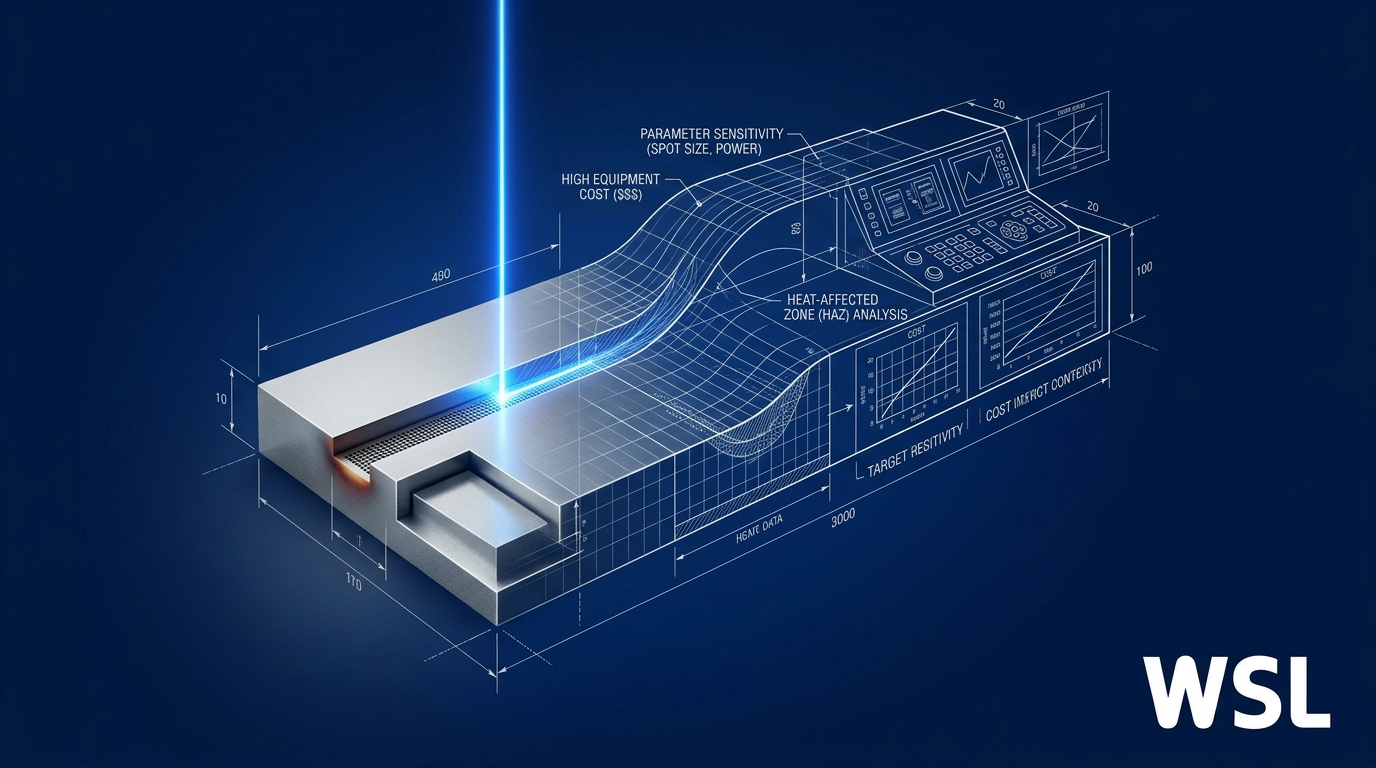
Introduction
If you're weighing laser ablation against other processes for a specific job, you're in the right place.
This guide goes beyond a flat list of pros and cons — every advantage and limitation is grounded in application context, so you can judge fit for your own situation rather than absorbing generalities.
It covers what laser ablation is and how it works, the strengths that make it compelling, the real constraints that can rule it out, how pulse type and parameters shape those trade-offs, and how the balance shifts depending on what you're processing.
TL;DR
Laser ablation's advantages are genuine — but they are not universal. Whether precision, minimal thermal impact, or chemical-free processing tips the balance in its favour depends on your material, your application, and your parameter choices. The right answer is specific to your situation, and this guide gives you the framework to find it.
This article covers:

What laser ablation is and how it works
The core advantages of laser ablation
The real disadvantages and limitations
How pulse type and parameters shape outcomes
How the balance shifts by application
How laser ablation compares to alternatives
What is Laser Ablation?
Point a sufficiently intense laser beam at a solid surface and the material doesn't just heat up — it disappears. Laser ablation is the process of removing material from a solid surface using intense laser light, causing rapid, highly localised energy deposition that vaporises, sublimates, or ejects material from the irradiated zone. It is a physical, surface material removal process: not a chemical treatment, not a cutting-through operation, and — for the purposes of this guide — not a medical procedure.
The process begins with the absorption of laser light at or near the surface. That absorbed energy is transferred to the material, where it drives heating, electronic excitation, or chemical changes that ultimately break material free from the surface.
Photothermal and Photoablative Mechanisms
Two primary interaction mechanisms govern how the laser energy produces material removal, and understanding the distinction is central to understanding laser ablation's advantages and limitations.
In a photothermal process, the laser heats the material intensely and rapidly until it boils off or sublimates — transitioning directly from solid to vapour or plasma without passing through a liquid phase. Photothermal processing can deliver relatively fast material removal rates, but it puts a meaningful amount of heat into the workpiece in the process.
In a photoablative (also termed photomechanical) process, material is removed by directly breaking molecular or atomic bonds, or by mechanical ejection driven by stress build-up — rather than by bulk heating. RP Photonics describes one such mechanism as photomechanical spallation: when energy is deposited faster than the heated region can expand, mechanical stresses build up and detach material fragments. This is a significantly cooler process than photothermal removal.
In practice, the boundary between these mechanisms is a spectrum rather than a hard line. As Coherent notes, it is not uncommon for a combination of both to occur within a single ablation process — the relative contributions shift with material type, laser fluence, and pulse duration.
The Ablation Threshold
Material removal does not begin the moment laser light touches a surface. It starts only when the incident energy density crosses a critical level known as the ablation threshold — specified as a fluence (energy per unit area, measured in J/cm²) under defined irradiation conditions.
The threshold is material-dependent and also varies with laser wavelength, pulse duration, surface condition, and the number of pulses applied. Research on PMMA films, for example, has shown ablation threshold values ranging from 0.5 to 2.5 J/cm² depending on pulse count, while alumina has been measured at threshold fluences around 0.69–1.1 J/cm² depending on pulse duration.
Why the threshold matters for process control: operating too far below it produces no removal; operating too far above it deposits excess energy as heat, degrading edge quality and increasing thermal side effects. Getting the fluence right — above the threshold but not excessively so — is the fundamental process control challenge in laser ablation.
Every laser ablation outcome — removal rate, edge quality, thermal damage — is governed by how far above the material's ablation threshold fluence the process operates. Too low and nothing is removed; too high and excess energy becomes heat.
The Heat-Affected Zone
Not all energy deposited at the ablation site stays there. Thermal energy that conducts outward into the surrounding material creates the heat-affected zone (HAZ) — the region adjacent to the ablation site where material properties are altered by heat, even though no material is removed.
The HAZ is the primary source of unwanted side effects in many applications: microstructural changes, residual stress, discolouration, or thermal damage to adjacent features. In wafer scribing, for instance, any HAZ risks damaging nearby circuitry and impairing device function.
The central thermal trade-off of laser ablation is straightforward: energy confined to the ablation site is ideal; energy that diffuses outward into surrounding material creates the HAZ. This trade-off runs through every subsequent section of this guide — it shapes the advantages, the disadvantages, and the pulse-selection decisions that engineers must make.
Pulse Duration: The Primary Thermal Lever
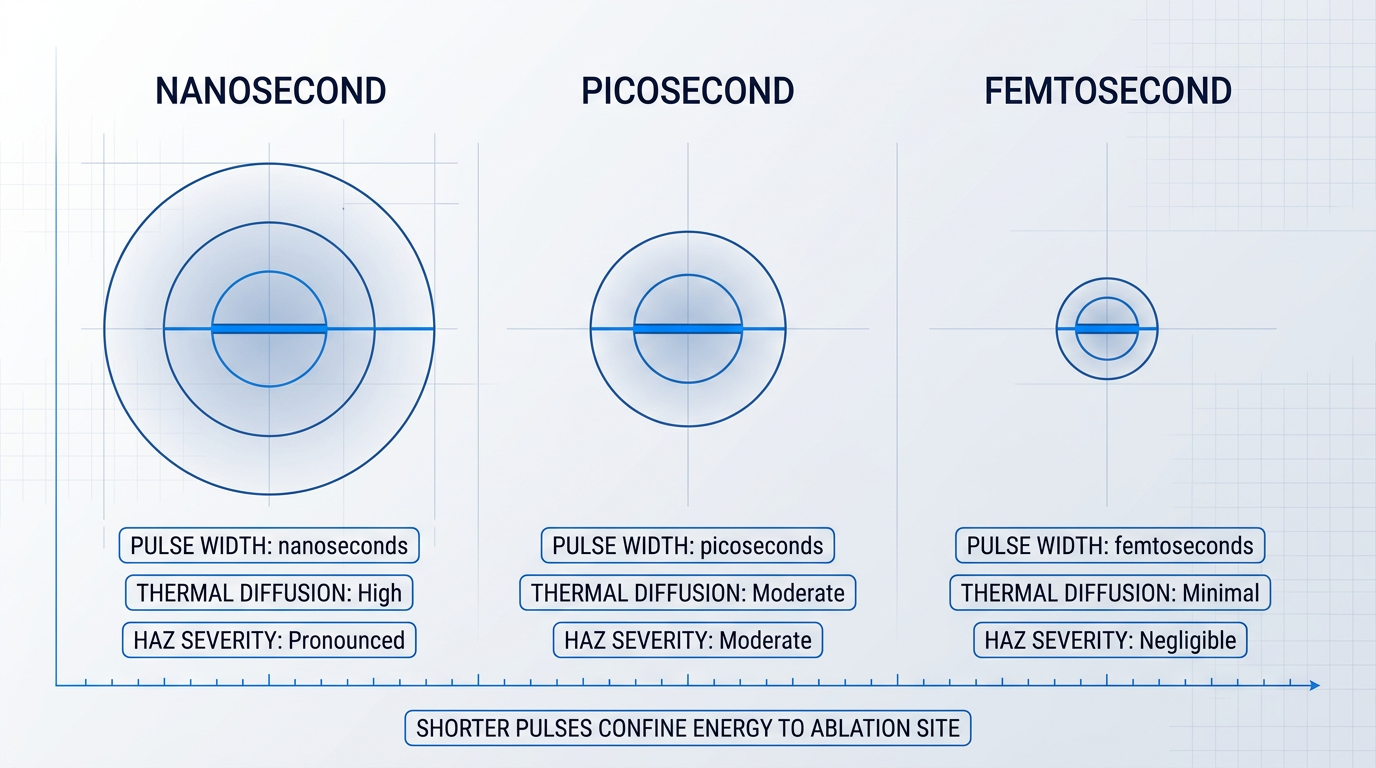
Pulse duration is the primary parameter controlling how much thermal energy reaches the surrounding material. The logic is straightforward: longer pulses deposit energy over a longer time window, giving heat more opportunity to diffuse outward before the pulse ends.
Nanosecond pulses are common for industrial marking and cleaning. They rely substantially on thermal processes and typically leave a more pronounced HAZ along with some recast material. Picosecond and femtosecond pulses deposit energy faster than thermal diffusion can occur, confining energy to the ablation site and enabling what is often called "cold ablation" — processing with negligible HAZ.
It is worth noting that "cold ablation" does not mean the complete absence of heat or thermal mechanisms — RP Photonics is explicit on this point. Rather, it means thermal effects are sufficiently confined that surrounding material is only minimally affected. The full comparison of these three pulse regimes and their practical trade-offs is developed later in this guide.
Materials and Applications
One reason laser ablation warrants a detailed evaluation guide is the breadth of what it can process. As Coherent notes, the technique can be applied to virtually any class of material.
- Metals: Including copper, steel, and aluminium alloys, processed for surface cleaning, micro-structuring, and precision drilling.
- Ceramics and glass: Including hard, brittle, and optically transparent materials where conventional mechanical processing causes fracturing.
- Polymers and composites: Including heat-sensitive plastics, multi-layer laminates, and fibre-reinforced composites used in electronics and aerospace.
- Stone and other materials: Including natural stone, wood, and biological materials, spanning conservation and specialist industrial applications.
Across these material classes, laser ablation is applied to surface cleaning, coating removal, micro-structuring, precision drilling, and chemical analysis techniques such as laser-induced breakdown spectroscopy (LIBS). This breadth is why the process cannot be evaluated as a single-use tool — performance, parameter requirements, and trade-offs vary significantly across applications and materials.
A note on scope: this guide addresses laser ablation as an industrial and scientific material removal process. Medical and surgical applications — including vein ablation, tumour ablation, and dermatological procedures — involve distinct clinical considerations and are outside the scope of what follows.
With the mechanism, key concepts, and application landscape established, the next step is to examine where laser ablation's characteristics translate into genuine process advantages for engineers and procurement professionals.
The Advantages of Laser Ablation
Understanding why laser ablation works well — not just that it does — is what separates a useful evaluation from a generic checklist. Each of the process's core strengths has a physical origin, and that origin tells you which applications benefit most and which constraints apply.
Two of laser ablation's most significant advantages flow from the same root cause: a laser beam is not a physical tool. It applies no mechanical force, leaves no worn cutting edge, and can be focused to a spot determined by the physics of light rather than the geometry of a blade or nozzle.
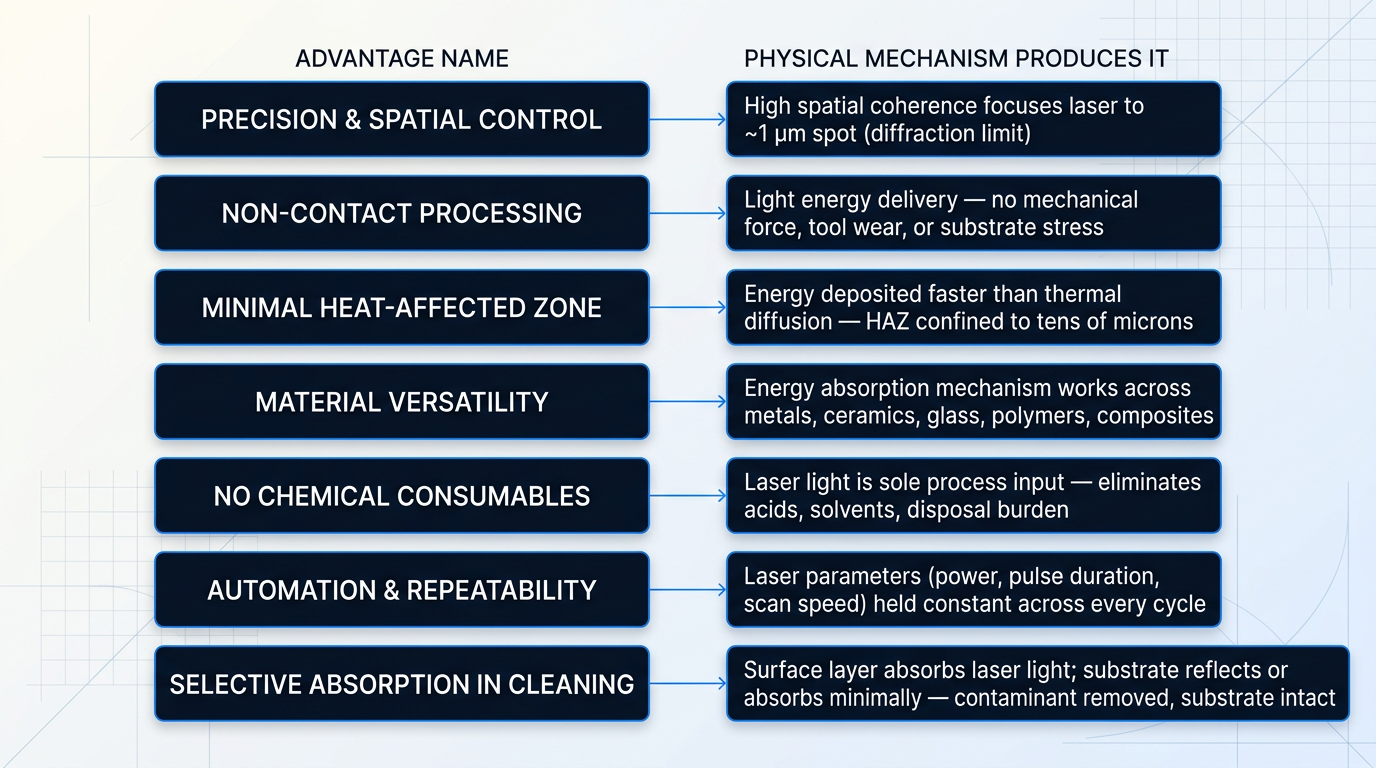
Precision and Spatial Control
A laser beam's high spatial coherence allows it to be focused to a spot approaching the diffraction limit — on the order of 1 µm with suitable optics, as described by RP Photonics. This is not simply a small tool: it is a concentration of energy whose spatial boundary is defined by wavelength and numerical aperture, not by mechanical tolerancing.
In practice, this enables selective material removal at micrometer scale — the kind of precision required for micro-structuring, PCB via drilling, resistor trimming, and fine-feature engraving on metals, ceramics, and polymers. Mechanical methods cannot match this selectivity; chemical methods cannot confine their action to a defined zone without masking steps that add complexity and waste.
Non-Contact Processing
Because the laser delivers energy as light, the process is entirely contact-free: no mechanical force is applied to the workpiece, no tool wears against the surface, and no stress or deformation is introduced by the process itself.
Coherent's documentation on UV laser PCB depaneling describes the process as "vibration and friction-free" with no mechanical deformation, delamination, or residual stress — a consequence of the physics rather than a design choice. For fragile substrates, thin films, precision-machined parts, or assembled components where contact from a physical tool would risk damage or contamination, this is a structural advantage of the method.
Minimal Heat-Affected Zone
The heat-affected zone (HAZ) — the region of material adjacent to the ablation site whose properties are altered by conducted heat — is a genuine concern in any thermal process. Laser ablation addresses it directly through pulse duration: when pulse parameters are correctly chosen, energy is deposited faster than it can diffuse into the surrounding material, confining thermal effects to the ablation site.
Coherent's technical literature notes that photoablative processing produces a HAZ of just tens of microns, making it suited to the highest-precision applications and temperature-sensitive materials. RP Photonics confirms that shorter pulse durations limit heat spreading and enable high-quality micromachining — though it also notes that heat accumulation from repeated pulses must be managed across the full processing sequence, not only pulse by pulse.
The practical consequence is that substrate integrity is preserved and rework is reduced — particularly important in multi-layer electronics, composite structures, and any application where thermal alteration of adjacent material would compromise function. The degree of HAZ control depends on parameter selection, a topic examined in detail later in this guide.
Material Versatility
Laser ablation can be applied across an unusually broad range of material classes. Coherent's glossary entry notes that the technique can be applied to "virtually any class of material — metals, semiconductors, glass, ceramics, polymers, wood, stone, tissue and other biological materials." RP Photonics similarly describes applications across metals, ceramics, glasses, and polymers, with composites covered in IEEE's materials processing literature.
The reason for this breadth is that the interaction mechanism — energy absorption causing rapid localised heating or bond-breaking — is not material-specific in the way a chemical etchant is. A chemical process formulated for steel will not work on a polymer; a laser system, with appropriate parameter selection, can process both. This makes laser ablation a single-process technology capable of serving diverse substrate requirements without switching to a fundamentally different method.
No Chemical Consumables
Laser ablation requires no acids, solvents, abrasives, or chemical strippers — the process input is laser light alone. IPG Photonics describes laser cleaning as a process that "requires no cleaning media, dramatically reducing material handling requirements and process waste," with no chemical disposal or part drying time required.
NASA Langley Research Center's work on titanium alloy surface preparation makes the operational implication concrete: laser ablation eliminated the need for hydrofluoric acid and caustic treatment steps that "require costly facilities and environmentally unfriendly liquids" conducted in dip tanks. The same principle applies across industrial surface preparation: no chemical handling means no procurement, no storage, no disposal, and no associated compliance burden.
Non-contact processing and chemical-free operation address two of the most significant cost and compliance pressures in modern industrial surface treatment simultaneously — substrate damage risk and chemical waste disposal — within a single process.
Automation and Repeatability
Laser parameters — power, pulse duration, scan speed, repetition rate, spot size — can be precisely set and held constant across every cycle. NASA's research programme at Langley describes laser surface treatment as a "rapid, high precision, and reproducible method amenable to automation," with parameters including power, focus, pulse frequency, and translation speed controllable "with a high degree of fidelity" resulting in "highly controlled and reproducible surface properties."
This is in direct contrast to mechanical abrasion methods such as grit blasting and sanding, which the same NASA research characterises as "difficult to automate" and "sensitive to operator induced variability." For high-throughput manufacturing environments where consistent results are required at volume — composite bonding preparation, inline coating removal, precision micro-structuring — process repeatability is not a secondary benefit; it is a prerequisite for quality control and certification.
Selective Absorption in Surface Cleaning
In surface cleaning and coating removal applications, laser ablation offers a mechanistically specific advantage that abrasive methods cannot replicate. IPG Photonics explains the principle clearly: laser parameters are chosen so that the surface layer strongly absorbs the laser light, while the underlying material either reflects it or absorbs minimally.
This differential absorption is the mechanism behind selective removal of rust, oxides, paint, and coatings: the contaminant reaches its ablation threshold and is vaporised or ejected, while the substrate — with a higher ablation threshold and lower absorption at the chosen wavelength — is left intact. IPG Photonics notes that common contaminants such as rust and oxides have lower ablation thresholds than the metals beneath them, making this threshold differential the operative principle.
Abrasive blasting removes everything in its path indiscriminately; it has no mechanism for distinguishing contaminant from substrate. Laser ablation's wavelength-selective interaction is what makes substrate-safe cleaning physically possible, rather than a matter of operator skill or process luck. The detail of wavelength selection and how it is matched to specific material absorption characteristics is covered in the parameters section of this guide.
Taken together, these advantages describe a process that earns its place in demanding applications: where tolerances are tight, substrates are sensitive, chemical processes are burdensome, or consistency at volume is non-negotiable. But every process has constraints, and laser ablation is no exception — the next section examines where those constraints arise and what they mean for the evaluator.
The Disadvantages of Laser Ablation
Every process advantage has a boundary condition — a point at which the physics, the economics, or the geometry stop working in your favour. For laser ablation, those boundaries are well understood, and knowing them is what separates a well-matched application from a costly mismatch.
Capital Cost Requires a Lifetime Cost Evaluation
Laser ablation systems carry a higher upfront capital cost than abrasive blasting or chemical cleaning setups, and that gap is real enough to be the first question any procurement evaluation should address.
The relevant frame, however, is total cost of ownership across the system's operational life: no consumables, no blast media disposal, no chemical handling, and reduced rework and downtime all shift the running-cost profile substantially relative to alternative methods.
The upfront investment is therefore an evaluation axis, not a verdict — the right question is whether the lifetime running-cost advantage closes the gap over the operational horizon of your facility.
Fume and Debris Management Is Non-Negotiable
Laser ablation is not a clean process at the point of interaction. The ablation event generates a plume of particles, vapour, and aerosol — including ultrafine and nanoparticles, volatile organic compounds, and combustion by-products whose composition depends on the material being processed.
Research into laser-generated airborne contaminants has shown that poorly chosen ablation parameters can significantly increase aerosol production, and that the chemical composition of the plume may differ substantially from the parent material depending on the degree of thermal processing involved.
The inhalation hazard from these particulates is genuine: particles in the sub-micron range can penetrate deep into the respiratory tract, and certain material combinations produce carcinogenic or toxic decomposition products during ablation.
In industrial settings, local exhaust ventilation at the ablation site — typically using HEPA or ULPA filtration — is the standard engineering control, and it must be factored into system design from the outset rather than added as an afterthought.
OSTI research on laser ablation of contaminated surfaces found that poor parameter selection substantially increases aerosol production — meaning fume management and process optimisation are directly linked, not separate concerns.
Parameter Sensitivity Demands Process Expertise
Process outcomes in laser ablation are sensitive to a cluster of interdependent variables: fluence (energy per unit area), pulse duration, repetition rate, scan speed, and wavelength all interact to determine whether the result is clean removal, incomplete ablation, or substrate damage.
The RP Photonics reference on laser ablation makes clear that the ablation threshold itself shifts with pulse duration, surface condition, wavelength, and the number of applied pulses — so a parameter set that works on one material or contaminant combination may produce a different outcome on another.
Getting parameters wrong in one direction leaves material behind; getting them wrong in the other damages the substrate or creates an excessive heat-affected zone (HAZ) — exactly the outcome that the precision advantage is supposed to prevent.
This is not a plug-and-play process. Reliable results reward investment in process development, empirical testing on the actual material and contaminant combination, and operator expertise — particularly when transitioning to a new substrate or coating system.
Bulk Material Removal Has Economic Limits
Laser ablation delivers energy in focused, controlled increments rather than through bulk mechanical force, which is precisely what gives it its precision advantage — but it is also why it becomes less economical as the volume of material to be removed increases.
IPG Photonics' laser cleaning overview notes that the process is typically less economical for layers over 0.5 mm in thickness, particularly when those layers extend across several square metres — a threshold where abrasive methods, which apply force across a broad front simultaneously, tend to offer better throughput economics.
For thin-layer removal, selective cleaning, and precision work, the economics remain strongly in laser ablation's favour; the trade-off becomes relevant specifically when bulk removal over large areas is the primary requirement.
Reflective and Transparent Materials Present Optical Constraints
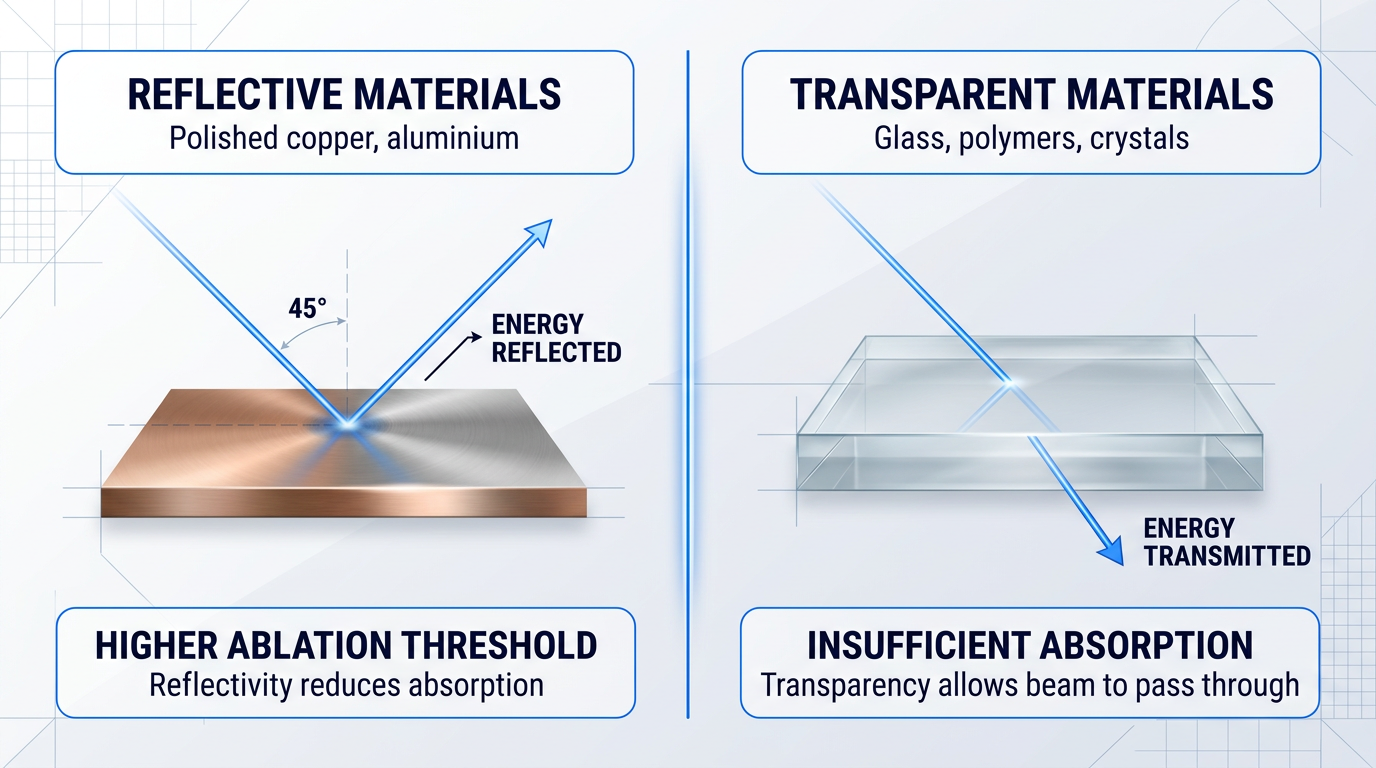
Two material classes present genuine challenges rooted in how laser energy interacts — or fails to interact — with the target surface.
Highly reflective materials such as polished copper or aluminium at near-infrared wavelengths reflect a large fraction of incident laser energy before it can be absorbed. Since only absorbed energy drives ablation, high reflectivity raises the effective ablation threshold and reduces process efficiency — in some cases to the point where the process becomes impractical at standard parameters.
Transparent materials — certain glasses, polymers, and crystals — present the opposite problem: they do not absorb at common laser wavelengths, so ordinary linear absorption deposits too little energy to drive ablation. As the RP Photonics encyclopaedia explains, processing these materials requires either UV wavelengths where absorption is higher, or ultrashort pulses capable of triggering nonlinear multiphoton absorption at intensities sufficient to overcome the transparency.
Both constraints are real limitations on which laser types can be used for a given substrate — a point that will be developed further when material properties are examined in detail.
Safety Infrastructure Must Be Planned In Advance
Industrial laser ablation systems operate within a safety infrastructure that must be factored into facility and operational planning: beam enclosures or controlled-access areas, interlocks, fume and particle extraction, appropriate personal protective equipment, and operator training.
The specific measures required depend on the system's laser class, output power, and operational environment — and vary accordingly across different deployments.
This overhead is not a fundamental barrier to deployment, but it is a planning dimension that belongs in the facility design phase rather than the commissioning phase: the cost and complexity of retrofitting safety infrastructure into an existing production environment is substantially higher than integrating it from the outset.
Line-of-Sight Access Limits Geometric Reach
A laser beam must have unobstructed optical access to the surface it is processing — which means complex internal geometries, deep bores, undercuts, and surfaces occluded by surrounding structure are difficult or impossible to reach with a standard beam delivery setup.
Mitigation options exist: specialised optics, robotic beam delivery, and fibre delivery through small apertures can all extend geometric reach, but each adds complexity and cost to the system.
This is a meaningful constraint relative to chemical cleaning, which can reach internal surfaces by immersion — and it is worth factoring into the application assessment when the geometry of the parts in question includes enclosed or occluded surfaces.
Most of the limitations covered here are not fixed properties of laser ablation as a process — they are parameter-dependent constraints that shift as pulse duration, wavelength, fluence, and repetition rate are adjusted. The next section examines those parameters directly, and the levers they provide for managing the trade-offs introduced here.
Pulse Type and Laser Parameters: How They Shape the Trade-offs
The limitations of laser ablation — heat-affected zones, parameter sensitivity, constraints on reflective or transparent materials — are real, but they are not fixed properties of the process. They are outputs of specific parameter choices. Change those choices and you change the outcome, often dramatically. Understanding which parameters exist and what each one does is what separates a well-configured process from a poorly matched one.
Pulse Duration: Nanosecond, Picosecond, and Femtosecond
The single most consequential parameter in laser ablation is pulse duration — specifically, how it relates to the thermal diffusion timescale of the target material. When a laser pulse deposits energy faster than heat can conduct away from the ablation zone, that energy stays localised. When it deposits energy slowly enough for heat to spread during the pulse, a larger surrounding volume is affected.
At the extreme end of this spectrum, femtosecond pulses are shorter than the electron-phonon coupling time in metals — the time it takes for excited electrons to transfer their energy to the surrounding atomic lattice. In most metals, this coupling time is in the range of hundreds of femtoseconds to approximately 1 picosecond. A pulse shorter than this deposits energy into the electron system before that transfer can occur, so the lattice stays cold during irradiation. Ablation happens after the pulse ends, driven by rapid pressure-wave dynamics rather than conventional thermal vaporisation — a regime often called cold ablation, though local temperatures still reach extreme values during material ejection.
Picosecond pulses occupy the middle ground: their duration is shorter than or comparable to thermal diffusion timescales in many materials, confining deposited energy much more tightly than nanosecond pulses, though not with the same completeness as femtosecond pulses. Nanosecond pulses, by contrast, are long relative to those timescales — heat conducts away from the ablation site during the pulse itself, producing a larger melt zone and the recast layer and oxidation risk that accompany it.
| Pulse Regime | Thermal Behaviour | HAZ in Metals | Ablation Efficiency (copper) | Typical Application Fit |
|---|---|---|---|---|
| Nanosecond | Heat conducts away during the pulse; melt zone forms | Significant; recast and oxidation risk | – | Surface cleaning, rust/paint removal, bulk material removal where some thermal effect is tolerable |
| Picosecond | Energy deposited faster than diffusion in most materials; reduced melt | Reduced; less recast, cleaner edges | ~0.20 mm³/W/min at 10 ps; ~0.05 mm³/W/min at 50 ps | Industrial micromachining, precision cutting, mid-range quality/cost balance |
| Femtosecond | Pulse shorter than electron-phonon coupling time; lattice stays cold during irradiation | Less than 5 µm in metals | ~0.35 mm³/W/min at 500 fs | High-precision micro-structuring, transparent and reflective materials, sub-micron features |
Pulse duration regimes compared across thermal behaviour, heat-affected zone, ablation efficiency, and application fit. Ablation efficiency figures are for copper at 1030 nm. – indicates no comparable published efficiency figure is available for nanosecond pulses on this basis.
The efficiency data reveals something counterintuitive: femtosecond pulses are not only cleaner but more efficient per watt at removing material from metals. Research published by SPIE found that femtosecond ablation of copper is approximately twice as efficient as picosecond ablation, because the higher heating rate produces greater thermal stress and a larger pressure wave, ejecting more material at the same fluence. For transparent dielectrics the relationship reverses — picosecond pulses can outperform femtosecond pulses because the extreme peak powers of femtosecond pulses can cause optical breakdown that reduces ablation rates.
For many industrial micromachining applications, picosecond pulses represent a practical sweet spot: substantially better quality and lower HAZ than nanosecond systems, at lower system cost and higher average power than femtosecond platforms. Femtosecond systems earn their premium where the application demands sub-micron precision, near-zero HAZ, or processing of materials — highly reflective metals, medical-grade polymers — where nanosecond or picosecond quality falls short. Nanosecond systems remain the workhorse where throughput dominates and some thermal effect is acceptable.
Wavelength, Fluence, and Repetition Rate
Wavelength determines how efficiently a material absorbs the laser energy and how tightly the beam can be focused. Each material has a characteristic absorption spectrum, and coupling efficiency drops sharply when the laser wavelength falls outside the material's absorption band. For highly reflective metals like copper, near-infrared wavelengths are absorbed at only 1–5% at room temperature, while green (515 nm) wavelengths achieve 40–45% absorption — a difference that fundamentally changes process stability and energy efficiency. Shorter wavelengths also focus to smaller diffraction-limited spot sizes, which directly enables finer feature resolution.
UV wavelengths (355 nm and shorter) are strongly absorbed by most materials and allow the tightest focus, making them the natural choice for the smallest features and for materials that are transparent at infrared wavelengths. The trade-off is that shorter wavelengths deliver lower available average power and higher system cost per photon. For ultrashort pulses specifically, nonlinear absorption effects partially decouple the wavelength-absorption relationship — a femtosecond infrared pulse can process materials that would normally require UV, because the extreme peak intensity drives multiphoton absorption regardless of the material's linear absorption at that wavelength.
Fluence — pulse energy per unit area, expressed in J/cm² — must be controlled within a specific operating range relative to the material's ablation threshold. Too far below threshold and ablation is incomplete or absent; too far above it and the excess energy is deposited as heat rather than contributing to material ejection, increasing the HAZ and reducing quality without improving removal rate. Research on ultrashort pulse processing identifies the optimal operating point at approximately 7.5 times the ablation threshold fluence, where the ablation rate per unit of average power is maximised. Finding and maintaining that optimal fluence for a given material and pulse regime is the central task of process development — a tractable engineering problem with a defined solution, not an arbitrary tuning exercise.
The interaction between repetition rate and thermal management is one of the most practically important — and most commonly underestimated — parameter relationships in laser ablation. Higher repetition rates increase throughput, but they also reduce the time between pulses. If the irradiated zone has not cooled sufficiently before the next pulse arrives, heat accumulates across pulses, raising the effective temperature of the work zone and potentially negating the HAZ benefits that a short pulse duration would otherwise provide.
This heat accumulation effect is especially pronounced in materials with low thermal conductivity. Research on high-repetition-rate femtosecond processing found that cumulative heating at high repetition rates lowers the ablation threshold and can induce microformations on the surface — an effect more significant in stainless steel than in copper, where high thermal conductivity dissipates inter-pulse heat more readily. The primary engineering tool for managing this is scan speed: moving the beam fast enough between pulses that each irradiated zone cools before the next pass. At 100 kHz with a 15 µm spot and 30% pulse overlap, for example, the beam needs to move at roughly 1 m/s to maintain adequate thermal management.
At high repetition rates, heat accumulates across pulses and can eliminate the thermal advantage of picosecond or femtosecond pulse durations entirely. Scan speed and spot overlap are the primary controls — pulse duration sets the ceiling on quality, but repetition rate and scan strategy determine whether that ceiling is actually reached.
Burst mode processing addresses a specific bottleneck: at very high repetition rates, the ablation plume from one pulse can absorb or scatter the next incoming pulse before it reaches the surface — a phenomenon called plasma shielding. By grouping pulses into tightly spaced bursts separated by longer inter-burst intervals, the system allows the plume to disperse between bursts while still delivering high intra-burst energy. For semiconductors and low-thermal-conductivity materials, burst mode can increase material removal rates by up to 5 times compared to equivalent single-pulse operation, with the inter-burst gap providing time for both plume dispersal and partial cooling.
The burst approach also enables higher average power to be used productively: rather than increasing the per-pulse fluence beyond the optimal point (which degrades quality), burst mode distributes that energy across multiple pulses at the right fluence each, maintaining efficiency while scaling throughput. Surface quality improves up to a point as pulses per burst increase, but excessive burst lengths eventually degrade it — the optimum number of pulses per burst is itself a process parameter to be determined for each material.
These laser-side parameters — pulse duration, wavelength, fluence, repetition rate, and burst configuration — do not operate in isolation. Their effect on process outcomes is shaped by the properties of the material being processed: its absorption characteristics, thermal conductivity, and surface geometry all set the constraints within which parameter choices must work. That material-side picture is the subject of the next section.
Material Properties That Affect Laser Ablation Performance
Process parameters — pulse duration, wavelength, fluence — are only half the equation. The other half is the material itself. Two substrates processed under identical laser conditions can yield completely different outcomes, because each material brings its own set of physical properties that determine how laser energy is absorbed, conducted, and converted into material removal.
Reflectivity and Its Effect on Process Efficiency
Reflectivity determines what fraction of incident laser energy enters the material versus bouncing away from the surface — and reflected energy cannot drive ablation.
Highly reflective materials at near-infrared wavelengths present a genuine process challenge: a larger proportion of the pulse energy is lost at the surface, the effective energy available for ablation is reduced, and higher fluence is needed to reach the ablation threshold.
Research on picosecond pulse ablation of metals confirms a strong dependence of reflectivity on wavelength, with measurements showing two to three times lower reflectivity at 355 nm compared to 1064 nm across a range of fluences — which is one reason UV wavelengths can deliver substantially higher material removal efficiency for metals.
The two primary engineering responses are wavelength selection — shifting to shorter wavelengths where the material is less reflective — and surface conditioning, which can alter surface state and reduce the reflective fraction before processing begins.
Absorption Coefficient and Wavelength Matching
Each material has a characteristic absorption coefficient that varies with the wavelength of incident light — and the degree to which the chosen laser wavelength couples into the material's absorption band is a primary determinant of process efficiency.
Energy that is not absorbed cannot drive ablation: a wavelength mismatch between laser output and material absorption band means the bulk of the pulse energy passes through or scatters without doing useful work.
The general tendency, as established in laser material processing literature, is that UV wavelengths couple well into polymers and many dielectrics — for example, polymers generally exhibit increased photon absorption at ultraviolet wavelengths and do not exhibit strong absorption in the infrared — while infrared wavelengths couple more effectively into metals through free-electron absorption mechanisms.
These are tendencies rather than universal rules: the absorption coefficient of any given material must be characterised at the specific processing wavelength, because the combination of laser type and material is always application-specific.
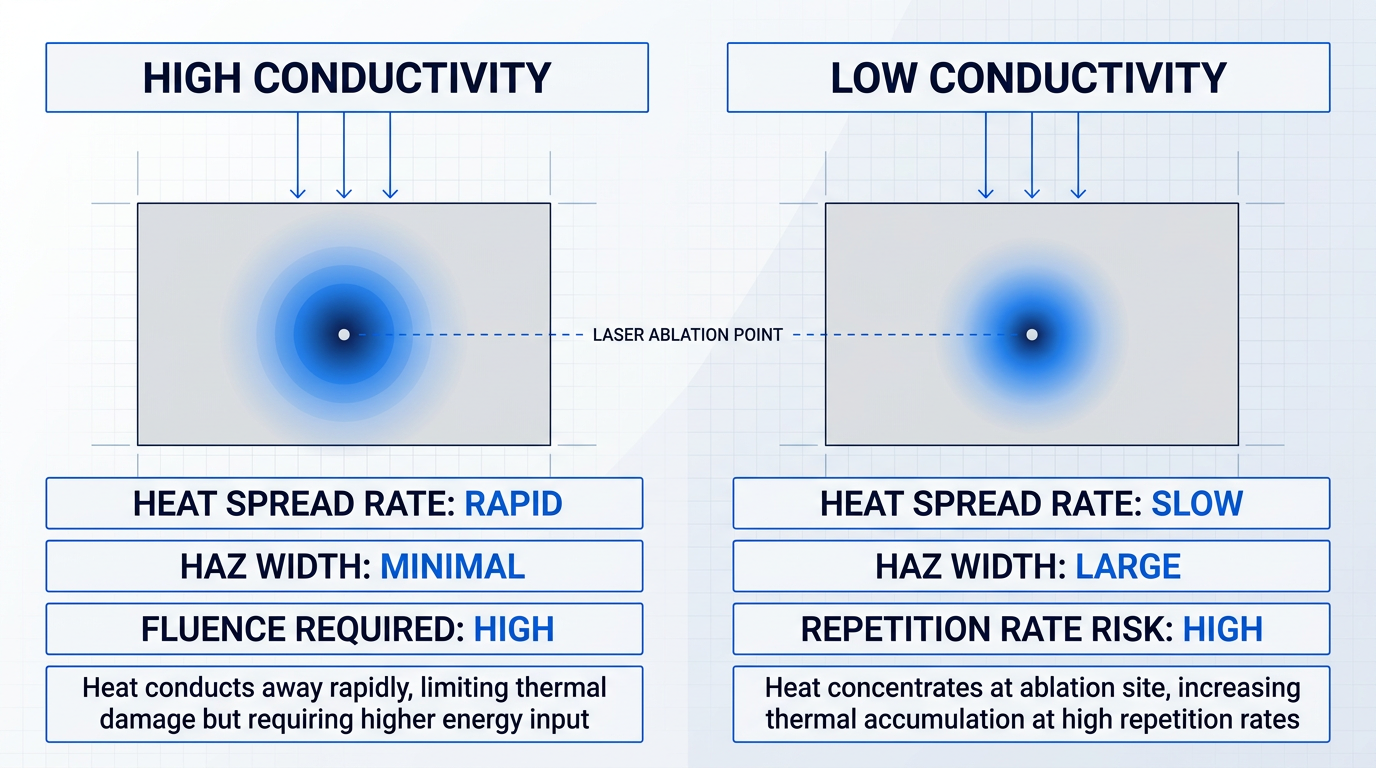
Thermal Conductivity: A Two-Sided Property
Thermal conductivity governs how quickly heat conducts away from the ablation site — and its effects cut in two directions depending on whether the material is a fast or slow conductor.
High-conductivity materials such as copper and aluminium draw heat away from the ablation zone rapidly, which limits the spread of the heat-affected zone but simultaneously means higher fluence is required to sustain ablation, because energy is constantly being conducted away before it can build to the removal threshold.
Low-conductivity materials — ceramics and many polymers — retain heat at the ablation site for longer, which concentrates energy usefully but also means thermal accumulation builds with each successive pulse.
At high repetition rates, where pulses arrive before the heat from the previous pulse has dissipated, low-conductivity materials are particularly susceptible to HAZ growth — a direct connection to the heat accumulation dynamics discussed in the pulse parameters section.
Ablation Threshold Variation Across Material Classes
The ablation threshold — the minimum fluence required to initiate material removal — is not a universal constant but a material-specific quantity that varies significantly across material classes.
Metals, ceramics, and transparent dielectrics each carry distinct threshold fluences, and these must be established from reference data or empirical testing before process development can begin — because operating below threshold produces no ablation, while operating far above it deposits excess energy as heat rather than driving efficient removal.
The ablation threshold also shifts with wavelength for the same material: single-pulse ablation studies on silicon at 343, 515, and 1030 nm using 50 ps pulses found that threshold fluence varied across a wide range, confirming a strong wavelength dependence even within a single material.
Beyond the material class and wavelength, the threshold is further influenced by surface condition and the number of pulses already applied — cumulative effects can lower the effective threshold over successive pulses, a phenomenon observed across multiple material types.
Transparent Materials: A Genuine Laser Type Constraint
Glass, certain polymers, and crystalline materials transmit rather than absorb common near-infrared laser wavelengths — which means conventional photothermal ablation simply does not occur at those wavelengths.
This is a genuine constraint on which laser types are viable, not a parameter optimisation problem: if the material does not absorb at the laser wavelength, no amount of fluence adjustment will initiate linear absorption-driven ablation.
Two routes address transparent materials. The first is wavelength selection toward the UV, where absorption is higher for many dielectrics — ultraviolet lasers with nanosecond pulses are useful where absorption is sufficiently strong at the chosen UV wavelength. The second route is ultrashort pulses at sufficient intensity to drive multiphoton absorption: at very high optical intensities, a material that is transparent at low intensity can absorb strongly through nonlinear processes, where the sum of multiple photon energies bridges the material's band gap.
Femtosecond pulses are particularly effective for this route because the same pulse energy produces much higher peak power — and consequently higher optical intensity at the workpiece — compared to longer pulses, making nonlinear absorption more readily achievable.
Surface Geometry and Condition
Surface geometry and condition affect beam-material interaction at both the macro and micro scale, with consequences for process consistency and ablation depth uniformity.
Rough or irregular surfaces scatter the beam and create local fluence variations across the interaction zone — high-fluence spots can cause unintended substrate damage or deeper-than-intended ablation, while low-fluence regions may fall below threshold entirely.
Surface condition also directly influences the ablation threshold: as RP Photonics notes, the threshold depends on the material, wavelength, pulse duration, surface condition, and number of applied pulses — meaning a nominally identical material with a different surface finish can behave differently under the same laser parameters.
On curved or complex three-dimensional geometries, maintaining a consistent working distance and focused spot size across the surface is an additional challenge: as the focal point shifts relative to the surface, the effective fluence changes, producing inconsistent ablation across the part.
Differential Absorption in Surface Cleaning
For surface cleaning applications, the critical material property is not the substrate's absorption in isolation, but the contrast between the absorption of the contaminant layer and the absorption of the substrate beneath it — a concept known as differential absorption.
The ideal scenario is strong absorption in the contaminant and weak absorption in the substrate: laser parameters are chosen so that the surface layer absorbs the energy and is removed, while the underlying material either reflects or minimally absorbs the beam and remains largely unaffected.
IPG Photonics describes this as preferential absorption — the contaminant couples efficiently to the laser energy, driving its removal through ablation, vaporisation, or spallation, while the substrate is left intact.
Differential absorption is the mechanism that makes selective laser cleaning possible. Where contaminant and substrate have similar absorption characteristics, the fluence range between effective contaminant removal and substrate damage collapses — demanding tighter parameter control and often empirical process development to avoid irreversible surface damage.
With both the process-side parameters and the material-side variables now established, the next step is to see how these factors combine in practice — and why the advantage and disadvantage balance of laser ablation shifts depending on the specific application.
Laser Ablation Advantages and Disadvantages by Application
The advantages and disadvantages of laser ablation do not sit in fixed positions — they shift depending on what you are cleaning, cutting, or structuring, and what the substrate beneath it demands. The same process that makes laser ablation ideal for nuclear decontamination creates a throughput constraint in precision micro-structuring. Understanding where the balance falls for each application cluster is what turns a general evaluation into a sound engineering decision.
Surface Cleaning and Decontamination: General Industrial
In general industrial surface cleaning, three advantages consistently dominate: non-contact processing, selective absorption between contaminant and substrate, and the complete absence of chemical consumables.
The selective absorption advantage is operationally significant: when parameters are correctly set, the beam couples into the contaminant layer and stops at the base material, leaving the substrate intact.
As IPG Photonics notes in their laser cleaning overview, laser parameters can be carefully chosen so that the surface layer strongly absorbs the light while the underlying material either reflects it or minimally absorbs it — enabling efficient removal without substrate damage.
The contaminant range this covers in practice is broad, spanning rust, oxides, mill scale, oil, grease, carbon and soot, mould, weld discolouration, tarnish, and adhesive residues across metal and masonry substrates.
The primary operational requirement is fume and debris extraction: ablation produces a plume of particles and vapour that must be captured at source, and a fume extraction system is a non-negotiable part of any laser cleaning setup, not an optional add-on.
On the parameter axis, power tunability across the full range — from the low fluence needed for light oxides through to the higher settings required for thick coatings — is what makes a single system operationally versatile across a mixed workload.
WSL's ELASER and ELASER-RHZ are a direct implementation of these principles in a portable industrial package. The ELASER-RHZ's world-first reduced hazard zone technology — a Class 4 laser system with patented engineering controls that prevent access to radiation above Class 1 — collapses the laser hazard zone to a fraction of conventional size, enabling cleaning in open workshops, mixed-use facilities, and public-facing settings without sealing off the area. With a handheld scanner under 3 kg, up to 50 m reach, power tunability from 0–100% across 100–300 W models, and consumable-free operation across metals, stone, brick, and masonry, it addresses the full contaminant range described above from a single wheeled unit operated by one person.
For production environments where the same cleaning task repeats part after part, WSL's AutoLASE takes a different approach: load the part and machine vision scans it, builds a 3D map, and generates the cleaning path automatically — no manual programming or path-setting required. The optional RHZ upgrade means AutoLASE can operate without an enclosure entirely, a capability no other automated laser cleaning system offers. Both systems carry CE and UKCA certification and are designed, built, and supported in-house by WSL, the only UK-based laser cleaning manufacturer.
Nuclear and Radioactive Decontamination
Radioactive decontamination is the application cluster where the advantage/disadvantage balance shifts most distinctively, and where laser ablation's characteristics are hardest to replicate with any alternative method.
The defining advantage is minimal secondary waste generation. US Department of Energy research documents that sand blasting uses around a hundred pounds of sand to remove one pound of coating, and that sand becomes contaminated waste — whereas laser ablation produces only captured particulate from the removed layer itself, with no added media entering the waste stream.
The same OSTI research notes that radioactive waste storage accounts for approximately 33% of the cost of decontamination and decommissioning work, at an average of $300 per cubic foot for storage, disposal, and monitoring — making waste volume reduction a direct cost driver, not merely an environmental consideration.
A second critical advantage is remote operation capability: laser power can be delivered via fibre optic cable and the ablation head manipulated by robotic systems, keeping workers out of the radiation field entirely.
OSTI-published research on concrete decontamination confirms that pulsed laser ablation systems are scalable and robust, that removal rates can be predicted for lasers of arbitrary power, and that the beam can be adapted to corners, cracks, and irregular surfaces — a practical advantage over mechanical scabbling, which cannot follow complex geometry.
The peer-reviewed scoping review published in the Journal of Radioanalytical and Nuclear Chemistry confirms that laser ablation for radioactive decontamination is a dry process that minimises secondary waste generation, allows remote operation, and offers high selectivity and precise control of removal depth — and that high decontamination efficiency above 90% can be achieved across a broad range of fluences on stainless steel substrates contaminated with Cs-137.
The key limitation to manage is aerosol and particulate characterisation: OSTI research on concrete decontamination found that cesium and strontium segregate into particles of differing sizes within the ablation effluent, meaning the waste stream requires careful characterisation and capture — the effluent composition can differ substantially from the original contaminated material.
Chemical and abrasive decontamination methods generate large volumes of contaminated secondary waste that must itself be managed as radioactive material. Pulsed laser ablation produces only captured particulate from the removed surface layer — no added media, no chemical effluent — making waste volume reduction a direct operational and cost advantage in nuclear decommissioning contexts.
Coating and Paint Removal
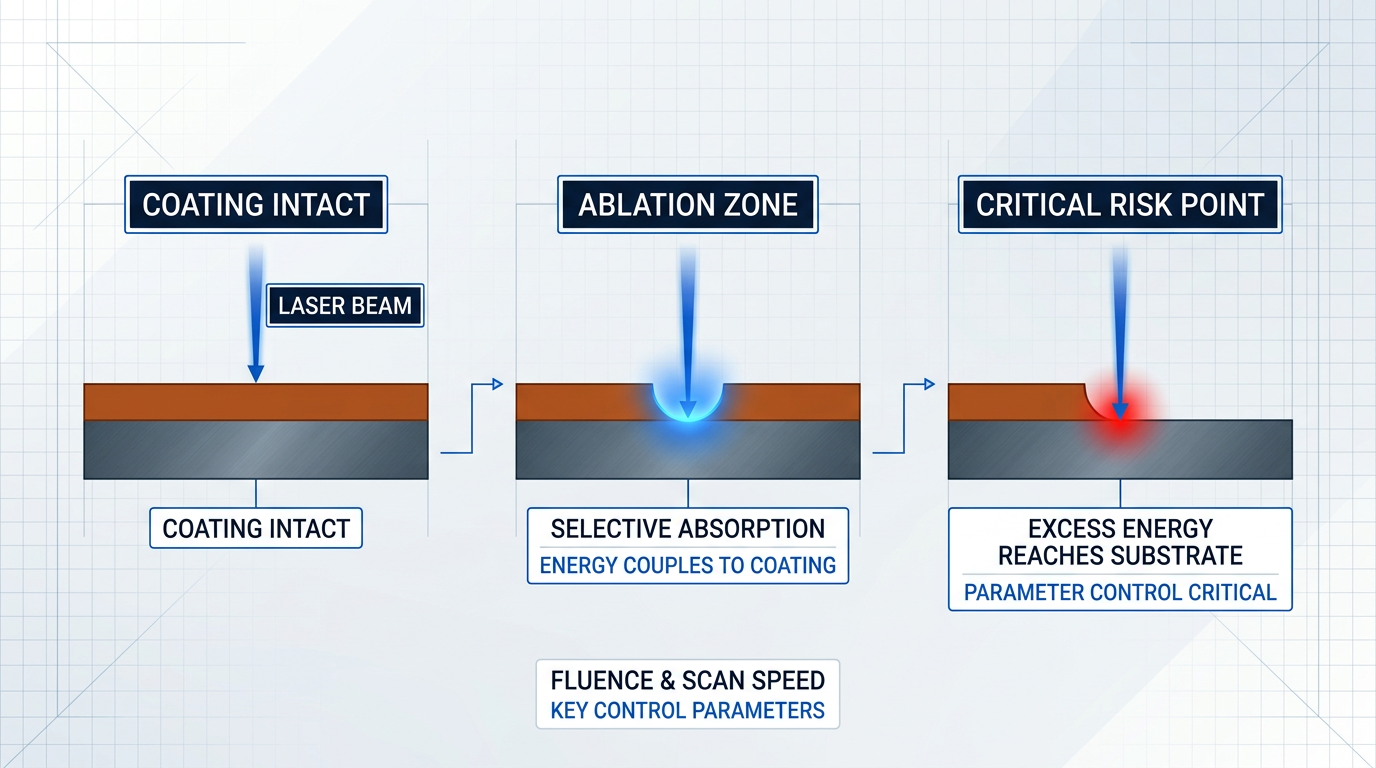
Organic coatings — paint, primer, lacquer, powder coating — absorb laser energy efficiently and are ejected as flakes or vapour, making this one of the most well-matched application areas for laser ablation.
Nanosecond-regime pulsed systems are the workhorse here, as established in §6: the pulse characteristics allow the coating to be removed faster than heat can propagate into the substrate, protecting the base material while achieving effective layer removal.
The critical limitation is parameter control at the coating boundary: once the coating layer has been cleared, excess energy reaches the substrate directly, making precise fluence and scan control essential to avoid substrate damage at that transition point.
In aerospace surface preparation, the stakes of this control requirement are particularly high — and the payoff particularly large. NASA research on laser ablation surface preparation of Ti-6Al-4V alloy documents that the process imparts both topographical and chemical changes that lead to increased bond durability, providing an alternative to chemical-immersion, manual abrasion, and grit blast processes that are expensive, hazardous, and less precise.
The same NASA research confirms that laser ablation is amenable to process automation, which can improve reproducibility to meet quality standards for surface preparation — a direct advantage for aerospace production environments where certification of bonded joints depends on process consistency.
For CFRP surfaces, a Springer IJAMT study using a UV picosecond laser on compression-moulded CFRP laminates found that laser treatment led to increases in ultimate tensile strength of up to 303% compared to untreated surfaces, with fracture behaviour transitioning from adhesive to cohesive failure — confirming that laser surface preparation can simultaneously remove release agent contamination, modify surface morphology, and enhance chemical reactivity, without mechanical damage to the carbon fibres.
The process avoids the hazardous wet chemistry — including caustic dip tanks and acid etching — required by conventional aerospace surface preparation, eliminating both the environmental burden and the handling risk those methods carry.
Micro-Structuring and Precision Drilling
This is the application cluster where ultrashort-pulse laser ablation — femtosecond and picosecond regimes, as covered in §6 — operates without peer.
The combination of minimal heat-affected zone and tight spatial control enables feature sizes and surface quality that mechanical and chemical methods cannot approach at the same scale, across metals, ceramics, glass, and polymers.
In PCB depaneling, Coherent's published technical documentation describes UV laser ablation as offering high dimensional accuracy, vibration- and friction-free cutting, low HAZ that prevents bulk substrate changes, and compatibility with virtually every PCB construction including traditional copper-clad flex laminate and low-κ dielectrics.
For fuel injector drilling, Laser Focus World's industry reporting documents that femtosecond laser drilling of gasoline direct injection nozzles achieves hole diameters in the range of 150–250 µm with tolerances as tight as ±1 µm — performance that electrical discharge machining, the legacy technology, cannot match at production volumes.
In stent cutting, industry sources document femtosecond laser machining of nitinol stents with strut widths as narrow as 35 µm from tube wall thicknesses of 45 µm — with clean edges and no heat-induced damage or distortion, eliminating the manual de-burring and chemical etching steps that conventional laser cutting requires.
The SPIE microstructuring literature confirms that high-repetition-rate femtosecond laser systems can achieve ablation rates up to 1.8 mm³/min, with processing times up to 40 times shorter than kilohertz femtosecond systems — though this remains substantially lower than nanosecond or CW systems operating on bulk material.
That throughput constraint is the central limitation of this regime: material removal rates for ultrashort-pulse systems are lower than for longer-pulse or CW alternatives, making them unsuitable for bulk material removal over large areas.
This is not a fundamental weakness of laser ablation — it is a regime-specific trade-off. The ultrashort-pulse regime is optimised for precision, not volume. Where the application demands sub-micron feature fidelity and minimal collateral damage, no alternative process achieves the same result; where the application demands high-volume removal, a different laser regime or process is the right tool.
Precision Manufacturing and Surface Texturing
Laser ablation's capacity for controlled, repeatable surface modification makes it the enabling technology for functional surface engineering — applications where the texture itself is the product.
Micro-dimples and laser-induced periodic surface structures (LIPSS) created by laser ablation modify tribological properties, wetting behaviour, and optical characteristics in ways that are difficult to achieve through any other manufacturing route.
In engine applications, peer-reviewed research on piston ring surface texturing documents friction reductions ranging from 4% in engine testing with dimple-textured rings through to 54% in cylinder liner applications — with the specific outcome dependent on texture geometry, lubrication regime, and operating conditions.
Femtosecond laser-fabricated crosshatch textures on grey cast iron have achieved friction reductions above 90% under dry sliding conditions in laboratory tribometer tests, attributed to efficient wear debris trapping and exposure of graphite phases acting as solid lubricants.
On the wettability axis, laser ablation can shift surfaces from hydrophilic to hydrophobic — or the reverse — by controlling surface morphology and chemistry, with contact angles tunable across a wide range depending on material, pulse parameters, and post-processing treatment.
The defining requirement across all surface texturing applications is repeatability: the texture must be reproduced consistently across production runs, because tribological and wetting performance depend on geometry, density, and depth being held to specification.
Laser ablation's parameter precision and automation compatibility make that repeatability achievable — but reaching the right texture in the first place requires empirical parameter optimisation, and the relationship between laser parameters and tribological outcome is application-specific rather than universal.
The expertise and process development overhead is the real limitation here: surface texturing by laser ablation is not a plug-and-play application, and the investment in parameter development is a genuine entry cost that should be factored into any evaluation.
Understanding how laser ablation performs against each application cluster is one side of the evaluation; the other is how it compares to the alternative processes it displaces — chemical etching, abrasive blasting, and mechanical machining — which is where the next section focuses.
See Laser Cleaning in Practice
If laser ablation fits your application, the next step is seeing what the right machine looks like. Explore our laser cleaning systems and find the one built for your process.
Laser Ablation vs. Alternative Processes
Most engineers evaluating laser ablation are already running one of three established processes: abrasive blasting, chemical etching or cleaning, or mechanical grinding and machining. Each has decades of industrial track record. The question is not whether laser ablation is modern — it is — but whether it is the right choice for a specific combination of material, tolerance, volume, and operational environment. The comparison below addresses that question directly.
Abrasive Blasting
Abrasive blasting propels media — steel grit, garnet, glass bead, or other abrasives — at high velocity onto a surface, removing contamination and coatings through kinetic impact.
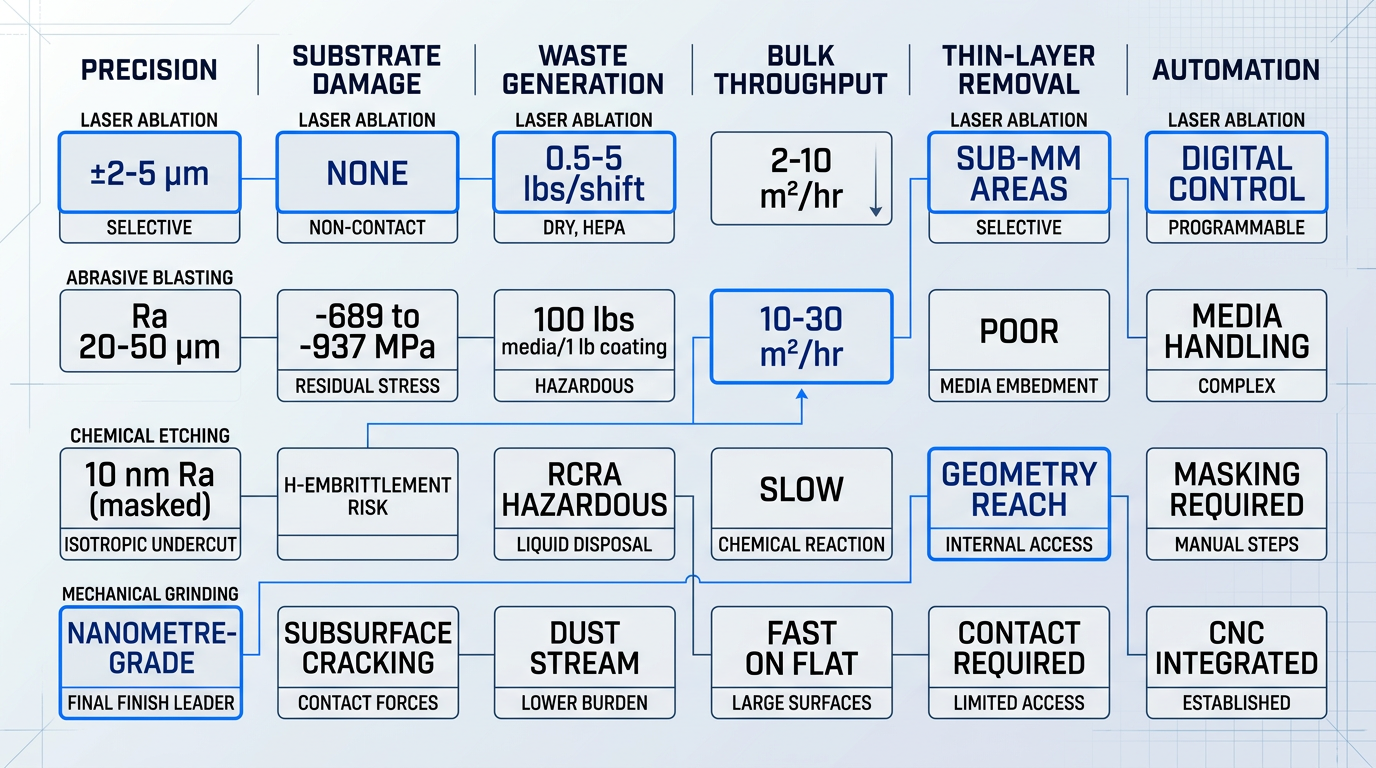
On throughput for bulk removal, abrasive blasting holds a genuine advantage over standard laser systems. Experienced blast crews on open structural steel routinely achieve 10–30 m² per hour; standard pulsed laser systems typically cover 2–10 m² per hour on comparable surfaces, though high-power continuous-wave systems can approach or exceed blasting speeds on specific flat-surface applications.
On precision and substrate damage, the comparison reverses. Abrasive blasting removes base material by design, creating surface profiles of Ra 20–50 µm and introducing residual compressive stresses that can reach −689 to −937 MPa in titanium alloys depending on impact angle. Abrasive particles can embed in the substrate surface, creating stress concentration zones and potential micro-galvanic corrosion — a documented risk on non-ferrous alloys and composites.
The secondary waste burden is substantial. According to a DOE technical report, abrasive blasting uses approximately 100 pounds of sand to remove one pound of coating, and all of that media becomes contaminated waste. When the stripped coating contains lead or heavy metals, the spent media is classified as hazardous waste under EPA RCRA regulations, requiring manifested disposal. One industry source estimates spent abrasive disposal at $250–$600 per drum for lead-contaminated grit, with total blast media and disposal costs running $35,000–$90,000 per year for a mid-size fabrication operation.
On operator safety setup, abrasive blasting requires the most intensive controls of the three alternatives. OSHA mandates NIOSH-certified Type CE airline respirators, hearing protection (nozzle discharge generates 112–119 dB), full body PPE, blast enclosures or exclusion zones, and ventilation systems. Silica-containing media carries silicosis risk; the practice is banned in the UK and restricted in many jurisdictions, driving operators toward steel grit or garnet alternatives.
Abrasive blasting integrates reasonably well into automated production environments, but the media handling, containment, and recovery infrastructure add complexity and footprint compared to laser systems.
Chemical Etching and Cleaning
Chemical etching and cleaning use strong acid or alkaline solutions — hydrofluoric acid, ferric chloride, sodium hydroxide, and similar reagents — to dissolve or loosen surface material through controlled chemical reaction.
The most significant genuine advantage chemical methods hold over laser ablation is geometry reach. Chemical solutions can penetrate internal bores, deep channels, and complex enclosed geometries that block laser optics entirely. As IPG Photonics notes, chemical cleaning is often the only viable solution for items with no line of sight. Laser ablation is inherently a line-of-sight process; where the beam cannot reach, the surface cannot be treated.
On precision, chemical etching can achieve fine feature resolution through masking — wet etching of glass microfluidic channels achieves surface roughness as low as 10 nm Ra — but the process is isotropic, meaning it undercuts mask edges, and selective etching of specific areas requires additional photolithography steps that add cost and process complexity.
The waste generation and regulatory burden of chemical processes is the most significant operational liability. Spent acid baths, contaminated rinse water, and sludges from metal finishing operations are governed by EPA RCRA Subtitle C. Acid and alkaline baths used in surface finishing are classified as corrosive characteristic waste (D002); electroplating wastewater treatment sludge carries the F006 listing. Spent solvents used in chemical cleaning may qualify as F001–F005 listed hazardous wastes. Licensed carrier collection and regulated disposal are recurring operational costs that day-rate comparisons routinely undercount.
Chemical cleaning also requires significant operator safety infrastructure: chemical-resistant PPE, face shields, emergency eye-wash stations, ventilation to control VOC emissions and acid mists, and OSHA Hazard Communication compliance. Confined-space chemical work carries additional regulatory requirements.
Chemical methods are poorly suited to selective cleaning of specific zones without masking, and they introduce no mechanical or thermal energy to the substrate — which is an advantage for substrate integrity, but the wet process requires drying steps and can introduce hydrogen embrittlement risk on certain alloys.
Mechanical Grinding and Machining
Mechanical grinding uses abrasive wheels, diamond tools, or bonded abrasive media to remove material through direct contact, cutting, and plastic deformation of the workpiece surface.
On surface finish and dimensional precision, high-quality mechanical grinding leads the field for applications requiring nanometre-level surface finish. Ultra-precision diamond grinding can achieve surface roughness in the range of a few nanometres and form deviation in the sub-micrometre range — performance that laser ablation alone cannot match for final optical or mirror-grade finishes.
The trade-off is substrate damage risk from contact forces. Mechanical grinding introduces residual compressive stress, work hardening, and — at high material removal rates — subsurface cracking and micro-fractures. On hard brittle materials, the material transitions from plastic removal to brittle fracture when local stress exceeds the crack initiation threshold. Thin-walled aluminium parts below 1.5 mm wall thickness risk deformation at standard blast pressures; threaded features and precision bores require masking or post-process dimensional acceptance criteria.
Mechanical grinding generates tooling consumable costs that accumulate continuously: grinding wheel wear necessitates periodic dressing and replacement, and diamond tooling for hard materials is expensive. Dust from grinding and polishing operations is classified as a waste stream at metal finishing facilities under EPA guidance, though the volumes and regulatory burden are generally lower than abrasive blasting or chemical cleaning.
On automation compatibility, CNC grinding integrates well into production environments. Robot-loaded surface grinders with automatic dressing and touch-off detection are established technology. However, mechanical grinding remains a contact process — the tool must physically reach the surface — which limits access to complex three-dimensional geometries in the same way as laser optics, though with less geometric flexibility than a laser scanning head.
For bulk material removal, mechanical grinding is generally faster and lower capital cost than laser ablation at scale, particularly for large flat surfaces where throughput per dollar is the primary metric.
Where Laser Ablation Leads Decisively
Across all three alternatives, laser ablation's advantage is most consistent on two axes: thin-layer selective removal and dry, chemical-free operation.
IPG Photonics notes that laser cleaning can remove material from surface areas less than a square millimetre in size, with substrate profile preserved within ±2–5 µm and no abrasive embedment — precision that neither blasting nor mechanical grinding can approach for selective, non-contact work. The DOE OSTI technical report confirms that pulsed-repetition laser systems can be designed to remove coatings faster than a thermal wave propagates into the substrate, resulting in no thermal damage to the base material.
On waste, the contrast is sharp. Laser ablation produces 0.5–5 lbs of dry particulate per shift, captured by HEPA extraction, with no media disposal requirement and no hazardous waste classification in most cases. The DOE report projects waste volume reductions of approximately 75% compared to abrasive blasting for equivalent coating removal tasks.
Laser ablation also leads on automation and repeatability. Because the process is controlled numerically — power, pulse parameters, scan pattern, and speed are all digitally programmable — it delivers consistent results across identical parts without the variability introduced by media degradation in blasting or wheel wear in grinding.
For applications where substrate damage is unacceptable — aerospace composites, precision mould tools, electronics, heritage conservation — laser ablation is the only process among the four that combines non-contact operation with programmable selectivity and zero chemical residue.
Laser ablation is the only process that simultaneously eliminates contact forces, chemical waste streams, and abrasive media — making it the default choice whenever substrate integrity and environmental compliance are both non-negotiable, regardless of application.
Where alternatives hold genuine ground: abrasive blasting remains faster and lower capital cost for heavy bulk removal on large open surfaces where anchor profile is needed for coating adhesion. Chemical methods retain the geometry access advantage for internal bores and enclosed cavities that laser optics cannot reach. Mechanical grinding leads for final nanometre-grade surface finish. These are not marginal cases — they are real operating conditions where switching to laser ablation would be the wrong decision.
With the process-level comparison established, the logical next step is translating these axes into a structured evaluation framework for a specific application — which is exactly what the following section addresses.
How to Decide: Key Factors for Evaluating Laser Ablation
A list of advantages and disadvantages tells you what laser ablation is capable of — it does not tell you whether it is the right process for your specific substrate, coating, facility, and budget. Working through seven structured evaluation axes will give you that answer.
- Material and laser compatibility: Does your substrate absorb laser energy at available wavelengths? Highly reflective metals and wavelength-transparent materials may require specialised, costlier laser configurations.
- Contamination or coating type: Organic coatings, oxides, rust, and thin layers suit laser ablation well. Very thick coatings over large areas may favour abrasive methods on throughput grounds.
- Tolerance and substrate sensitivity: Where any substrate damage is unacceptable — aerospace composites, precision tooling, heritage surfaces — laser ablation's non-contact selectivity is a decisive advantage.
- Volume and throughput requirements: High-volume repetitive tasks suit automation; low-volume or field tasks suit portable systems; bulk removal over very large areas may still favour abrasive methods on speed.
- Operational environment: Can the facility accommodate laser safety controls, beam containment, and fume extraction? These are genuine feasibility gates, not afterthoughts.
- Regulatory and environmental pressure: Industries facing strict chemical handling rules or high waste disposal costs gain disproportionate benefit from laser ablation's dry, consumable-free operation.
- Capital vs. running cost balance: Laser ablation carries a higher upfront method cost than abrasive or chemical alternatives, offset by near-zero consumables and reduced rework over time.
These axes are not equally weighted for every evaluator — the sequence above reflects a logical filter, not a rigid scoring rubric. Start with the technical gates (axes 1 and 2); if the process is not feasible for your material and coating, the commercial axes are irrelevant.
Material Compatibility: The First Technical Gate
The primary question is whether your substrate absorbs laser energy at the wavelengths a practical system can deliver. As RP Photonics notes, a material transparent at the processing wavelength deposits too little energy for ablation under ordinary linear absorption — requiring nonlinear absorption at very high intensity, which typically means ultrashort pulses and significantly higher system cost.
Highly reflective materials — polished copper, aluminium at near-infrared wavelengths — present a related challenge: low absorption efficiency and increased risk of specular reflections that complicate safety management. Neither scenario makes laser ablation impossible, but both narrow the viable process window and push system requirements toward specialised, more expensive configurations.
Contamination Type and the Selective Absorption Principle
IPG Photonics describes the core mechanism clearly: laser parameters are chosen so the surface layer strongly absorbs the light while the underlying material either reflects it or absorbs minimally. When that absorption contrast exists — organic coatings, rust, oxides, light contamination — ablation is efficient and substrate-safe.
When the contaminant and substrate have similar absorption characteristics, parameter control becomes more demanding and the process window narrows. IPG Photonics also notes that laser cleaning is typically less economical for removal of layers over roughly 0.5 mm in thickness, especially across large areas — an order-of-magnitude indicator rather than a hard threshold, but a useful early filter.
Substrate Sensitivity: Where the Non-Contact Advantage Matters Most
Think of substrate sensitivity as a spectrum. At one end: applications where any surface alteration is unacceptable. NASA Langley Research Center's work on aerospace CFRP demonstrates that laser ablation can remove contamination and prepare surfaces for bonding without damage to underlying carbon fibres, and without the surface embrittlement or undesirable grain structures that can accompany chemical or abrasive processes on metal alloys.
At the other end of the spectrum are applications where surface roughening is not just acceptable but desirable — pre-paint preparation on structural steel, for example. There, abrasive blasting reliably delivers the mechanical anchor profile the coating system requires, and at lower capital cost. The evaluator's task is to locate their application on that spectrum honestly.
Volume, Throughput, and the Right System Configuration
Volume and throughput interact: a process that is economical at production scale may be impractical for occasional field work, and vice versa. IPG Photonics frames this directly — small-area or low-volume work suits handheld or portable units; continuous production suits inline automated or robotic systems; on-site or field use suits mobile configurations.
For high-volume, repetitive cleaning tasks, automated robotic laser systems — with machine-vision scanning, no manual programming, and load-and-run operation — remove the labour burden and deliver consistent, repeatable results at scale. For lower-volume or field-based work, portable single-operator systems with handheld scanners suit deployments where bringing parts to a fixed cell is impractical.
Where the task is bulk removal over very large open areas — large-area structural rust removal where throughput is the primary metric — abrasive blasting retains a genuine competitive edge on speed. Sandblasting covers 10–30 m²/hour on open structural steel; laser cleaning typically covers 1–8 m²/hour on comparable surfaces. That gap is real and should be accounted for honestly in any evaluation.
Operational Environment: The Feasibility Check
Laser ablation's operational requirements are specific, and underestimating them at the evaluation stage is a common source of project overruns. Before committing to the process, work through a practical feasibility checklist for your facility.
- Laser safety controls: Industrial laser cleaning systems operate in the Class 4 hazard category. A defined controlled work area, appropriate beam containment, and trained personnel are required.
- Fume extraction: Laser ablation vaporises contaminants, generating fine particulate and VOCs. Local exhaust ventilation with appropriate filtration is a non-negotiable operational requirement.
- Power supply: High-power systems typically require industrial-grade electrical supply (220V or 400V). Verify that existing facility infrastructure can support the system and auxiliary equipment.
- Cooling and ambient conditions: Most laser systems require stable temperature and humidity. Extreme heat, high dust levels, or flammable atmospheres may constrain or preclude operation.
- Line-of-sight access: Laser ablation requires direct optical access to the surface. Complex internal geometries, deep bores, or enclosed passages that block the beam path are not candidates.
None of these requirements are insurmountable in a properly prepared facility — but each represents a real infrastructure commitment that belongs in the evaluation, not the implementation phase.
Regulatory and Environmental Pressure as a Value Amplifier
For industries where chemical handling is tightly regulated or waste disposal carries significant cost, laser ablation's dry, consumable-free operation delivers a compounding benefit that goes beyond process performance. NASA's work on Ti-6Al-4V alloy surface preparation illustrates this directly: laser ablation eliminated the need for hydrofluoric acid and caustic treatment steps that required costly chemical tankline facilities and generated environmentally unfriendly liquid waste.
Industries facing stricter chemical handling obligations — whether through hazardous waste disposal rules, solvent regulations, or environmental compliance requirements — see a materially larger financial benefit from switching to laser ablation than industries where chemical handling is routine and low-cost. If your current process generates significant compliance overhead, that overhead is part of the cost comparison.
Capital vs. Running Cost: A Method-Level Trade-off
Laser ablation as a method carries a higher upfront capital cost than abrasive or chemical alternatives. Running costs are structurally lower: no consumable media, no chemical replenishment, no disposal fees, and less rework from substrate preservation. This is a method-level comparison — it describes the economics of the process, not the pricing of any specific system.
The balance tips in laser ablation's favour as utilisation rate increases. Analysis of five-year total cost of ownership across cleaning methods consistently shows that laser cleaning has the highest Year 1 cost but becomes the lowest-cost option at meaningful throughput, with the gap widening each subsequent year as consumable and disposal savings compound. For occasional or large-area structural work where abrasive infrastructure is already in place, the economics may still favour the incumbent method.
A facility running precision cleaning at production scale typically reaches TCO payback within one to three years. A facility running occasional large-area blasting at low frequency may never reach it. Utilisation rate — not upfront cost — is the number that determines which method wins economically.
With these seven axes mapped to your specific situation, you have the framework to make a grounded decision rather than a generic one — which is exactly what the final section of this guide is designed to help you act on.
Conclusion
Making the Laser Ablation Decision
Laser ablation earns its place when precision, non-contact processing, and chemical-free operation are the priority — its limitations are real, but they are bounded and respond well to informed parameter choices.
The balance shifts with every application, which is why the right question is never whether laser ablation is good, but whether it fits your material, your contamination type, and your tolerance requirements.
If that evaluation leads you toward laser cleaning, our laser cleaning specialists are here to help.
Laser Ablation: Frequently Asked Questions
These questions cover industrial and scientific laser ablation — process mechanics, material constraints, automation, safety, and environmental considerations. For guidance on a specific application, get in touch with our team.
The heat-affected zone (HAZ) is the region of material adjacent to the ablation site whose microstructure or properties are altered by thermal energy conducted outward from the ablation zone. It is not the material removed — it is the material changed by heat spreading beyond the intended processing area. The primary lever for minimising it is pulse duration: picosecond and femtosecond pulses deposit energy faster than thermal diffusion times, confining heat to the optical absorption depth and leaving a far smaller HAZ than nanosecond or continuous-wave processing. Operating at optimal fluence also matters — excess energy above the ablation threshold is deposited as heat rather than contributing to useful material removal. Repetition rate and scan speed must be managed together: even ultrashort pulses can accumulate heat when successive pulses strike the same region before it has cooled, producing a substantial HAZ over a full processing sequence. Finally, selecting wavelengths with strong absorption in the target material ensures energy couples efficiently into the surface rather than penetrating deeper into the bulk.
The most commonly challenging category is highly reflective polished metals — copper, gold, and aluminium at near-infrared wavelengths reflect a large fraction of incident laser energy, raising the effective ablation threshold and reducing process efficiency. Higher power densities or shorter wavelengths (green or UV) can overcome this, but the constraint is real. Transparent materials — glass, certain polymers, and optical crystals — present a different problem: at common laser wavelengths, they absorb too little energy to initiate ablation. UV wavelengths or ultrashort pulses capable of driving nonlinear (multiphoton) absorption are required; without the right regime, the material simply transmits the beam. Very thick coatings over large surface areas — broadly, layers well above a fraction of a millimetre — are technically ablatable but may be less economical than abrasive or mechanical methods at scale, where throughput becomes the governing factor. In most cases the constraint is efficiency or the need for a specific pulse regime, not an absolute physical barrier.
Yes — laser ablation is well-suited to automation. The beam is inherently programmable, scan paths can be defined and repeated with high precision, and the process requires no physical tool contact or consumable replenishment between cycles. The main automation modes are galvanometer-driven beam scanning, where the beam moves across a stationary workpiece via mirror-based optics (well-suited to flat or near-flat surfaces); robotic beam delivery, where the laser head is mounted on an articulated arm to process complex three-dimensional geometries; and inline integration with production lines for continuous or batch processing. Because the process is governed by repeatable parameter settings rather than operator skill, automated laser ablation systems can hold consistent cleaning or processing standards across high-volume production runs — a structural advantage over manual abrasive or chemical methods, where result quality varies with operator technique and consumable condition.
Industrial laser ablation systems typically operate within a layered safety setup whose specific elements depend on the system's laser class, output power, wavelength, and operating environment. Physical controls commonly include enclosures that fully contain the beam and any stray reflections, interlocked access panels that disable the laser if opened, and beam stops or dumps positioned behind optical elements. Administrative controls cover operator training, documented procedures, and restricted access to the laser control area — typically enforced via card readers or key systems. Engineering controls for the ablation plume are equally important: fume and particle extraction systems capture the particulates and gases generated during ablation, preventing accumulation in the working environment. Personal protective equipment — appropriate laser safety eyewear rated for the system's wavelength and class — is typically required where the beam or significant diffuse reflections may be present. Some purpose-built industrial systems incorporate enclosure designs that substantially reduce the required safety perimeter, enabling deployment in production environments with tighter space constraints.
Laser ablation is more precise, produces no secondary abrasive waste, and preserves the substrate more reliably. Sandblasting covers large surface areas quickly and carries a lower capital cost, but it removes material indiscriminately and generates contaminated abrasive media that must be collected and disposed of. A DOE-backed process comparison found that sandblasting uses roughly a hundred pounds of sand to remove one pound of coating — and that sand becomes contaminated waste requiring storage and disposal. Laser ablation, when parameters are correctly set, stops at the base material: the ablation threshold of rust, paint, or oxide is typically lower than that of the underlying metal, so the laser removes the contaminant without abrading the substrate surface. This selectivity makes laser ablation well-suited to applications where substrate integrity matters — heritage restoration, aerospace components, and precision metalwork. On waste: laser ablation produces a captured particulate stream, smaller in volume and more manageable than contaminated blast media. On consumables: sandblasting has ongoing media and disposal costs; laser ablation requires no consumable media once the system is installed.
Ablation is the removal of material from a solid surface by directing intense laser energy at it, causing localised vaporisation, sublimation, or mechanical ejection of material from the irradiated zone. The workpiece is not necessarily separated — material is removed from a surface or to a controlled depth, leaving the bulk intact. Cutting is through-material separation: the laser (or blade, or waterjet) passes entirely through the workpiece to produce two distinct pieces. The distinction is depth of intent — ablation is surface or layer removal; cutting is full-thickness division. Etching (wet chemical etching) works by an entirely different mechanism: liquid chemical etchants dissolve exposed regions of a substrate through oxidation-reduction reactions at a solid-liquid interface. It is a wet process governed by chemical selectivity and crystallographic properties, produces liquid waste streams requiring disposal, and offers limited geometric precision at small feature sizes. Laser ablation is a dry, non-contact, optically-directed process — no chemicals, no liquid waste, and material removal controlled by beam parameters rather than chemical reaction rates.
Compared to chemical cleaning and abrasive blasting, laser ablation has a meaningfully smaller environmental footprint in several respects. It generates no chemical waste streams — no acids, solvents, or strippers requiring hazardous waste disposal. It requires no consumable abrasive media — no contaminated grit or slurry to collect, transport, and dispose of. Research into nuclear decontamination applications found that laser ablation produces no secondary waste of the liquid or chemical kind that wet and abrasive methods generate, with the ablation plume captured on filters rather than dispersed as contaminated media. The honest balance: laser systems draw meaningful electrical power in operation, and the ablation plume itself — which may contain the contaminants being removed — must be captured by an adequate extraction system and handled appropriately. The environmental case for laser ablation is strongest in direct comparison with chemical stripping or abrasive blasting, where the process eliminates entire waste streams rather than simply reducing them. It is not a zero-impact process, but its impact profile is substantially different from the methods it typically replaces.