

Introduction
If you're an industrial buyer, maintenance engineer, or procurement professional evaluating surface preparation solutions, you already know the market isn't straightforward — multiple methods, competing standards, and a vendor landscape that rarely makes the trade-offs transparent.
This guide works through the full method landscape, from how each approach achieves the cleanliness and profile a coating or bond requires, to the quality benchmarks that define acceptable outcomes and how to match the right method to your substrate and contaminants.
It's written as decision-support, not a product catalogue — the kind of depth that leaves you better equipped to evaluate your options with confidence.
TL;DR
The method you choose for surface preparation isn't a commodity decision — it's an engineering one. Get it right and every coating, bond, or treatment downstream performs as specified. Get it wrong and no amount of premium product corrects it. Choosing well means understanding how substrate type, contaminant chemistry, and end-use requirements interact — and that's exactly what this guide unpacks.
This article covers:

Major surface preparation method categories compared
Surface cleanliness standards and profile grades
Matching method to substrate, contaminant, and environment
Automation, efficiency, and sustainability considerations
Practical method-selection decision framework
What are surface preparation solutions?
A coating is only as good as the surface it sits on — and that single fact is what makes surface preparation the most consequential step in any industrial coating, bonding, or plating process.
Industrial surface preparation is the treatment of a substrate surface prior to a downstream process such as coating, painting, bonding, plating, or welding — encompassing three distinct types of intervention: cleansing (removing contaminants), physical treatment (creating surface profile or texture to promote mechanical adhesion), and chemical modification (altering surface chemistry to improve adhesion or corrosion resistance).
That three-part scope matters because surface preparation is frequently mistaken for simple cleaning — but removing visible dirt is only one part of the task, and often not the most critical one.
Coating adhesion is determined primarily by the quality of surface preparation, not by the specification of the coating itself: contaminants on the substrate surface act as a barrier between the coating and the base material, preventing the mechanical and chemical bonds that give a coating its service life.
The principal contaminants that drive adhesion failure are oils and greases, chlorides, sulfates, oxides, and mill scale — each undermining the coating-to-substrate bond through different mechanisms, and each requiring a different approach to remove effectively.
Inadequate surface preparation is widely recognised across the coatings industry as the leading cause of premature coating failure — the coating specification matters far less than the condition of the surface it is applied to.
The commercial consequence of getting this wrong is substantial: corrosion accelerated by coating failure represents one of the largest categories of industrial maintenance cost globally, and the majority of that damage is attributable to inadequate surface preparation rather than coating material deficiencies.
This means surface preparation is an engineering and commercial risk decision, not a commodity task — and it requires a structured framework to specify correctly.
Every surface preparation decision is governed by three variables, and no method choice is defensible without first establishing all three.
- Substrate material: Steel, stainless steel, aluminium, concrete, and stone each have different tolerances for mechanical impact, chemical exposure, and heat — constraining which methods are viable.
- Contaminant type and severity: Oils, rust, mill scale, chlorides, old paint, and weld discolouration each require different removal strategies; severity determines whether pre-treatment steps are also needed.
- Downstream application: Coating, bonding, welding, and plating each set different targets for surface cleanliness and profile — defining what the preparation must achieve before work proceeds.
No single surface preparation method is universally correct — the right choice emerges from the intersection of substrate, contaminant, and application, which is why the field supports four distinct method categories rather than a single dominant solution.
Those four categories are abrasive blasting (the most widely used industrial method), mechanical methods (hand and power tools for localised work), chemical treatment (cleaning, pickling, passivation, and conversion coatings), and laser cleaning (the precision alternative for sensitive substrates and complex geometries) — each explored in full in the sections that follow.
Before evaluating any of those methods, though, there is a prior question to answer: what does a correctly prepared surface actually look like, and how is it measured? The next section covers the international cleanliness standards and surface profile requirements that define the target every preparation method must hit.
Surface Cleanliness Standards and Profile: the Benchmarks
When a specification reads "prepare to SP-10 with a profile of 50–75 µm," that instruction is either a precise quality target or meaningless noise — depending entirely on whether you know the grading system behind it. Every method section that follows this one will reference cleanliness grades and surface profile requirements. This section gives you the vocabulary to read those requirements without guessing.
The SSPC, NACE, and AMPP Standards Framework
SSPC (Society for Protective Coatings) and NACE International (National Association of Corrosion Engineers, founded in 1943) were the two principal bodies that developed surface preparation standards for steel in the protective coatings industry.
Although they approached the problem from different angles — SSPC from coatings application, NACE from corrosion control — both recognised that specifiers, contractors, and inspectors needed a shared language to agree on what an acceptable surface condition looked like before coating application.
Their jointly developed standards became the global reference for surface cleanliness in protective coatings work. In 2021, SSPC and NACE merged to form AMPP (Association for Materials Protection and Performance), which now maintains and publishes these standards.
SSPC standards are used to define the required degree of surface cleanliness for steel substrates before coating — giving specifiers a contractually enforceable benchmark, inspectors a measurable pass/fail criterion, and contractors a defined preparation target. The numbering system is not intuitive (higher SP numbers do not mean higher cleanliness), which is why understanding each grade individually matters.
Blast-Cleaning Cleanliness Grades: Brush-Off to White Metal
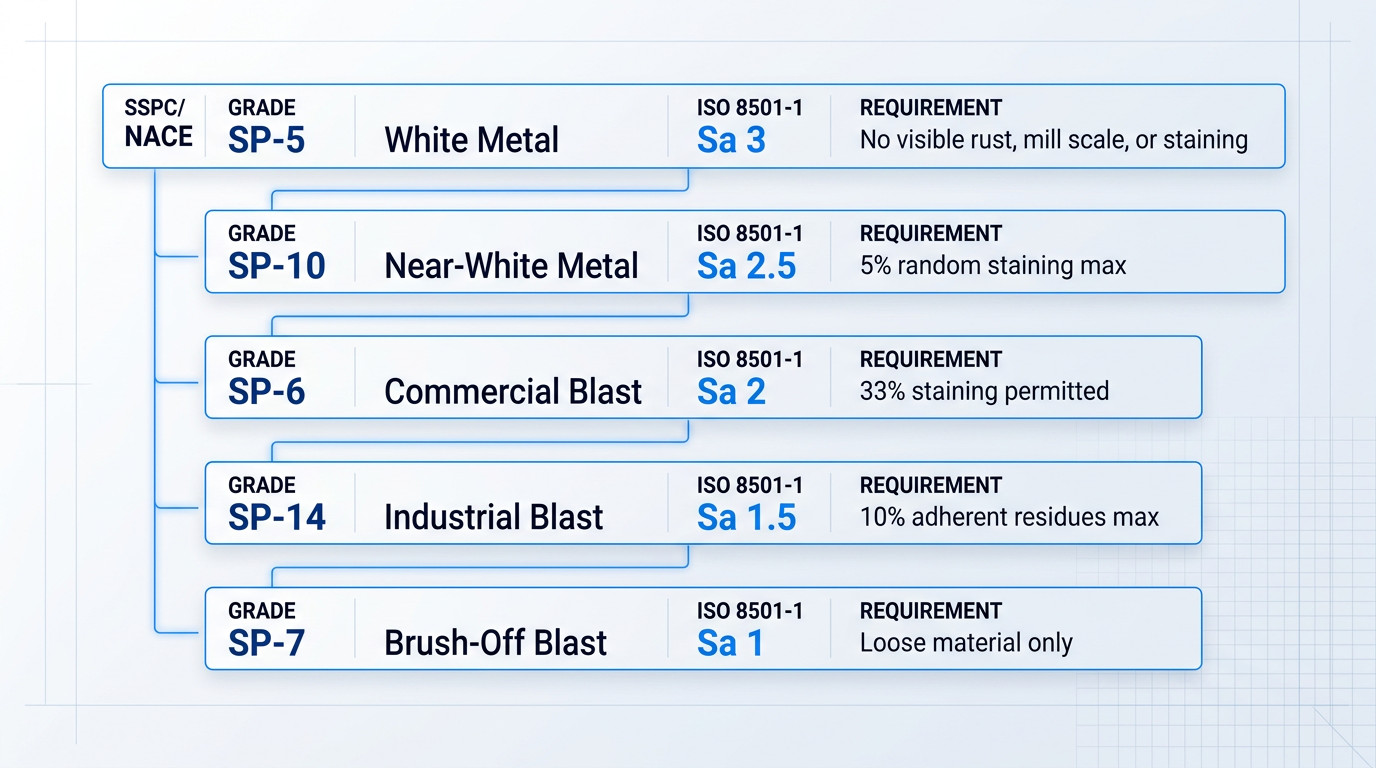
AMPP maintains six dry abrasive blast-cleaning standards for carbon steel, five of which appear routinely in industrial specifications. They are listed here from most to least stringent — the order in which a specifier evaluates them when deciding what the application demands.
- SP-5 / NACE 1 — White Metal: The most stringent grade. No visible rust, mill scale, paint, or staining of any kind permitted to remain on the surface.
- SP-10 / NACE 2 — Near-White Metal: Random staining limited to 5% of each unit area. The most commonly specified grade for aggressive service environments.
- SP-6 / NACE 3 — Commercial Blast: Staining from rust, mill scale, or old coating permitted on up to 33% of each unit area. Widely used for moderate service conditions.
- SP-14 / NACE 8 — Industrial Blast: Tightly adherent residues permitted on up to 10% of each unit area; shadows and streaks acceptable on the remainder.
- SP-7 / NACE 4 — Brush-Off Blast: Removes only loose material. Tightly adherent mill scale, rust, and coating may remain. The lowest blast-cleaning standard.
Reading a specification that calls for SP-10 Near-White Metal tells you that the surface must be free of all visible oil, grease, dust, mill scale, rust, and coating — with random staining limited to no more than 5% of each unit area of approximately 5,800 mm². That precision is what makes the standard contractually useful.
SP-10 is the dominant specification for aggressive environments — offshore structures, chemical plant pipework, and immersion service — because it delivers cleanliness close to white metal without the additional cost and time that SP-5 demands.
Below the blast-cleaning grades sit SP-2 (hand tool cleaning) and SP-3 (power tool cleaning), which remove loose rust, loose mill scale, and loose paint but cannot match blast-cleaning cleanliness levels. Critically, neither SP-2 nor SP-3 creates a surface profile — a limitation that becomes significant when mechanical adhesion is required. These grades are covered in detail in the mechanical surface preparation section.
ISO 8501-1: The International Parallel Standard
ISO 8501-1 is the international counterpart to the SSPC/NACE grade system, widely used in European and international specifications. It defines two things: rust grades (A, B, C, D) that describe the initial condition of the steel before preparation, and preparation grades that define the required condition after cleaning.
For blast cleaning, ISO 8501-1 uses the Sa designation: Sa 1 (light blast), Sa 2 (thorough blast), Sa 2.5 (very thorough blast), and Sa 3 (blast to visually clean steel). For mechanical cleaning, it uses St 2 and St 3, which correspond broadly to SP-2 and SP-3 in terms of the surface condition achieved.
The cross-system mapping is broadly: Sa 3 = SP-5 (White Metal), Sa 2.5 = SP-10 (Near-White Metal), and Sa 2 = SP-6 (Commercial Blast). UK and European specifications routinely reference ISO grades; anyone working across international projects needs fluency in both systems.
Surface Profile: the Anchor Pattern for Coating Adhesion
Surface profile — also called the anchor pattern — is the microscopic peak-and-valley texture created on steel by abrasive blasting. It is what gives a coating its mechanical grip on the substrate: the coating flows into the valleys and locks around the peaks, creating a physical bond that chemical adhesion alone cannot match.
The key measurement is peak-to-valley depth, expressed as Rz or anchor profile depth and measured in microns (µm) or mils. Both insufficient and excessive profile create problems: too shallow, and the coating has no mechanical key; too deep, and coating film over the peaks is thinner than the nominal dry film thickness, leaving those peaks vulnerable to premature rust bloom and coating breakdown.
The correct profile range is not a universal figure — it is determined by the specific coating system being applied. A coating manufacturer's data sheet or the project specification will define the required profile window; the inspector's job is to verify that the prepared surface falls within it.
Measuring Surface Profile: Three Field Methods
ASTM D4417 defines three accepted methods for measuring surface profile in the field, each suited to different inspection contexts.
- Visual Comparators (Method A): Physical or photographic reference panels per ISO 8503-2. Allows rapid tactile or visual comparison against known profiles — used for quick pass/fail field checks.
- Replica Tape / Testex (Method C): Compressible foam tape pressed onto the surface takes a negative impression; peak-to-valley depth read with a spring micrometer. Gives a quantitative Rz reading per NACE SP0287.
- Digital Depth Micrometer (Method B): A needle probe measures profile depth directly. Precise but less common in field use; also applicable to power-tool-prepared surfaces per ASTM D4417.
In practice, replica tape (commonly Testex Press-O-Film) is the most widely used quantitative method on industrial sites because it produces a documented, measurable result without requiring calibrated electronic equipment. Visual comparators remain useful for rapid screening during ongoing blast operations.
Invisible Contaminants: Soluble Salts and Osmotic Blistering
Achieving a high cleanliness grade does not mean the surface is ready to coat. Soluble salts — primarily chlorides and sulfates — are invisible to the naked eye and can remain on steel even after thorough blast cleaning.
Chlorides are particularly dangerous because of the mechanism they trigger under a coating: water molecules are drawn through the semi-permeable coating film toward the higher salt concentration at the steel surface, building osmotic pressure until the coating blisters and debonds. Research has shown that cathodic disbonding increases nearly linearly with chloride contamination level, and that abrasive blasting alone does not reliably remove chlorides entrenched in corrosion pits.
Blasting a steel surface to SP-10 does not eliminate soluble chlorides. Salt contamination testing per the ISO 8502 series is a separate, mandatory verification step — not an optional quality check — in immersion service, marine, and aggressive industrial applications.
The ISO 8502 series provides the testing framework for verifying salt contamination levels before coating. ISO 8502-6 (the Bresle patch method) extracts water-soluble contaminants from the surface for conductometric analysis; ISO 8502-2 specifically targets chloride-containing salts. Industry-accepted thresholds are generally 3 µg/cm² for immersion service and 5 µg/cm² for atmospheric service — limits recognised by bodies including the US Navy and referenced in SSPC good painting practice guidance.
Skipping salt testing in high-risk applications is not a cost saving — it is a liability. A contractor who coats over chloride contamination without testing creates a documented failure pathway, with osmotic blistering the near-certain result in any wet or immersion environment.
With the standards vocabulary established, the next section examines abrasive blasting in depth — the method most directly responsible for achieving the cleanliness grades and surface profiles defined here, and the one against which all other preparation methods are typically benchmarked.
Abrasive Blasting: Mechanism, Media, and Trade-offs
No other surface preparation method does two jobs at once quite as effectively as abrasive blasting: in a single pass, it strips contaminants from the surface and deforms that surface into the roughened anchor pattern that coatings need for adhesion.
That dual function — simultaneous cleaning and profiling — is precisely why abrasive blasting became the reference standard for industrial coating preparation, and why the cleanliness grades covered earlier (SP-5, SP-10, and the ISO 8501-1 equivalents) were built around it.
The physics are straightforward: abrasive particles are propelled at high velocity toward the target surface, and the kinetic energy released on impact removes rust, mill scale, and old coatings while simultaneously deforming the steel into peaks and valleys that mechanical bonding depends on.
Pressure-pot (pressure blast) systems hold abrasive in a pressurised vessel and push it through a single hose to the nozzle — the most common configuration for portable site work.
Suction (Venturi) systems draw abrasive from an unpressurised hopper using the Venturi principle, with two hoses running to the blast gun; they are generally lower in output than pressure systems.
Centrifugal wheel-blast machines use a high-speed rotating wheel to fling abrasive at the surface centrifugally, and are used in fixed installations for high-throughput work on structural sections — at significantly lower operating cost per unit area than air blasting.
Blast Media Types and Selection Criteria
Choosing the wrong abrasive is one of the most common causes of poor surface preparation outcomes — and the choice involves more variables than most buyers initially expect.
Five variables govern media selection: particle size relative to coating thickness (finer particles for thin-film coatings; coarser for high-build systems); particle shape (angular for profile creation, spherical for peening or gentle finishing); particle strength and recyclability (tougher grains convert more energy into cutting and survive more cycles); dust generation in the operating environment; and surface contamination risk from media embedment, which matters on non-ferrous substrates and in food-grade or pharmaceutical applications.
The table below summarises the principal dry blast media types across these dimensions, drawing on published abrasive selection data.
| Media | Shape | Recyclability | Dust Level | Profile Range (mil) | Key Applications | Health / Environment Notes |
|---|---|---|---|---|---|---|
| Steel grit | Angular | High (many cycles in wheel-blast) | Low–Medium | 1.5–5.5 | Structural steel, bridges, tanks, blast rooms | Arsenic commonly present; check SDS |
| Steel shot | Spherical | High (many cycles in wheel-blast) | Low | 0.25–1.5 (rounded profile) | Wheel-blast peening, foundry castings, floor prep | Suitable for peening; not for profile creation |
| Garnet (GMA) | Sub-angular | Moderate (recyclable in blast rooms) | Low (7.5–8.0 Mohs hardness) | 0.5–4.0 (mesh-dependent) | New steel, ferrous and non-ferrous substrates, blast rooms | No toxic heavy metals; environmentally preferable to slag |
| Aluminium oxide | Angular | Moderate (recycled in cabinets) | Medium | Varies with mesh | Non-ferrous substrates, precision/turbine blasting | No steel contamination risk; used where iron embedment is prohibited |
| Crushed glass | Angular/irregular | Low (single-use typical) | Medium | 0.5–4.5 | Steel, concrete, masonry, elastomeric coating removal | 100% recycled glass; no free silica; no heavy metals |
| Glass beads | Spherical | Moderate (7/10 recyclability rating) | Very low | 0.25–1.0 | Cosmetic finishing, soft metals (brass, aluminium, die-cast) | No free silica; no toxic residue; no dimensional change to substrate |
| Coal slag / copper slag | Angular | Low (1/10; single-use) | High | 1.5–4.5 | One-shot open blasting, general industrial | HAP metals (As, Be, Cr, Pb, Mn) released on impact per EPA AP-42; hazardous waste in some jurisdictions |
| Staurolite | Sub-angular | Low | Low–Medium | Not specified in available data | New steel prep, light coating removal | Low free silica (<1% typical); lower dust than slag; safer silica profile than sand |
Comparison of principal dry blast media types across shape, recyclability, dust level, profile range, and key application and health/environment notes — to support media selection decisions.
The table makes two patterns clear. First, the angular media (steel grit, garnet, aluminium oxide, crushed glass) are the workhorses for coating preparation — they create the anchor profile that coatings require — while the spherical media (steel shot, glass beads) serve peening or cosmetic finishing roles where aggressive profiling would be counterproductive.
Second, the environmental and health column is not a footnote: slag abrasives offer low unit cost and are widely available, but their dust and HAP emissions profile means the true cost — including containment, disposal, and health controls — is considerably higher than the media price alone suggests.
Recyclability also changes the economics significantly. Steel grit and steel shot can be cycled many times in wheel-blast systems, which is why they dominate fixed-installation blast rooms. Mineral abrasives like garnet are recyclable in enclosed environments but are typically single-use on open sites.
Slag abrasives are almost entirely single-use: their friable structure means they shatter on impact, generating high fines and requiring full replacement after each use — and leaving sharp embedded particles on the blasted surface that can reduce coating adhesion.
Wet Abrasive Blasting: Dust Suppression and Trade-offs
When dust generation is the primary constraint — indoor applications, confined spaces, sites near the public, or environments with strict air quality requirements — wet abrasive blasting introduces water into the blast stream to suppress airborne particulate.
Water injection nozzles (WIN nozzles) inject jets of water into the abrasive-air stream as it exits the nozzle, while halo nozzles encircle the blast stream with a curtain of water that dampens dust after impact. Both are bolt-on additions to standard dry blast equipment and offer dust suppression in the range of 50–85%, but at the cost of high water consumption — potentially 1–3 gallons per minute.
Vapour abrasive blasting takes a fundamentally different approach: water and abrasive are combined under water pressure inside the pot, then injected into the airflow as a moist abrasive stream. Third-party testing has demonstrated dust suppression of up to 92% compared to dry blasting, using approximately 0.5–1.0 litres of water per minute — significantly less than WIN or halo nozzle systems.
The trade-offs of wet blasting are real and should factor into any deployment decision.
- Flash rust risk: Bare steel exposed to water begins to oxidise rapidly. Rust inhibitor additives in the water supply, or immediate coating application, are required to prevent flash rust.
- Wastewater containment: Wet blasting produces contaminated water mixed with spent media and surface debris — requiring collection, treatment, and compliant disposal rather than dry grit disposal.
- Increased operational complexity: Water supply, rust inhibitor dosing, and wastewater management add steps and cost that dry blasting does not require.
- Slurry mess with nozzle systems: WIN and halo nozzle systems at high water flow rates produce significant mud and runoff, complicating site management on open or marine sites.
Vapour abrasive systems address the slurry problem more effectively than WIN or halo nozzle attachments, but the flash rust risk and wastewater obligation remain regardless of which wet system is used.
Health, Environment, and Regulatory Considerations
The health and environmental dimension of abrasive blasting is not a compliance checkbox — it is an active driver of media selection, equipment specification, and site management decisions across the industry.
Crystalline silica is classified as a Group 1 carcinogen by the International Agency for Research on Cancer (IARC), meaning there is sufficient evidence of carcinogenicity in humans. Silica sand was the default blast abrasive for decades; it has been progressively phased out of regulated environments, with the UK banning it for blasting as far back as 1949 and NIOSH advising against its use since 1974.
OSHA's 2016 Respirable Crystalline Silica Standard reduced the permissible exposure limit to 50 micrograms per cubic metre (8-hour TWA) and tightened engineering control requirements for any operations still using sand — with the maritime sector, where abrasive blasting with sand is the primary silica exposure source, a specific focus of enforcement.
The phaseout of silica sand did not eliminate the health risk from abrasive blasting — it shifted the risk profile. Coal slag and copper slag, which displaced silica sand in many applications due to their low free-silica content, carry their own hazard: according to EPA AP-42 Section 13.2.6, these materials release hazardous air pollutants (HAPs) including arsenic, beryllium, cadmium, chromium, manganese, nickel, and lead as airborne particulate during blasting.
Abrasive blasting generates significant particulate matter regardless of media type — both from the abrasive itself and from the substrate material and coatings being removed. Particles smaller than 10 microns (respirable dust) remain suspended in air and can penetrate deep into the respiratory system. Containment infrastructure — blast rooms, shrouded nozzles, vacuum-blast systems — and respiratory PPE are standard requirements for compliant operations.
OSHA's 2016 silica standard actively tightened exposure limits and engineering control requirements. Media selection decisions made today — choosing staurolite, garnet, or crushed glass over slag — are direct responses to this regulatory landscape, not legacy preferences.
Containment and waste disposal requirements vary by jurisdiction, operating environment, and the nature of the substrate being blasted — particularly where lead-based paints or other hazardous coatings are present. Readers should consult applicable SSPC, NACE, EPA, and OSHA standards, and seek professional guidance on compliance obligations for their specific project context.
An Honest Assessment of Where Abrasive Blasting Stands
Abrasive blasting is highly effective, well-standardised, and capable of achieving the highest surface cleanliness grades — including SP-5 White Metal and SP-10 Near-White Metal — that demanding coating systems require.
It also generates substantial waste streams: spent media, contaminated grit, and in wet variants, contaminated wastewater — all requiring compliant disposal. It demands containment infrastructure and respiratory PPE that restrict where it can be deployed, and produces dust that limits its use in indoor, confined-space, or public-facing environments.
These constraints are not reasons to dismiss abrasive blasting — they are the factors that determine whether it is the right choice for a specific application. In most heavy industrial contexts, it remains the dominant method for good reason.
But those same constraints — containment, dust, waste streams — are precisely what makes mechanical surface preparation methods relevant when blasting cannot be deployed, which is where the next section picks up.
Mechanical Surface Preparation: Hand Tools, Power Tools, Limits
Abrasive blasting dominates industrial surface preparation for good reason — but it cannot be deployed everywhere. Confined spaces, live plant environments, thin substrates, and small-area spot repairs all present conditions where blast equipment is impractical or disproportionate to the task. Mechanical methods, using hand and power tools, fill that gap. They are not a lesser imitation of blast cleaning; they are a distinct category with a defined role, specific governing standards, and honest limitations that every maintenance engineer should understand.
Before any mechanical preparation begins, SSPC-SP 1 (Solvent Cleaning) is a mandatory prerequisite. Oils and greases must be removed first — abrading over contamination does not remove it; it drives it deeper into the surface, compromising adhesion beneath any coating that follows. SP-1 is an automatic requirement to virtually every surface cleanliness standard that follows it.
Hand Tool Cleaning: SSPC-SP 2
Hand tool cleaning, governed by SSPC-SP 2, uses non-powered handheld tools — wire brushes, hand sanders, scrapers, and chipping hammers — to clean steel surfaces. The standard requires removal of all loose mill scale, loose rust, loose paint, and other loose detrimental foreign matter.
The operative word is loose. SP-2 explicitly does not require removal of adherent mill scale, rust that has bonded to the substrate, or old paint that is still well-adhered. According to SSPC, a contaminant is considered adherent if it cannot be lifted off with a dull putty knife — and anything that passes that test survives hand tool cleaning. This makes SP-2 the lowest-capability tier of mechanical preparation, suited only to surfaces with minimal corrosion and no tightly bonded contamination.
Power Tool Cleaning: SP-3, SP-11, and Tool Types
Power tools represent a meaningful step up in cleaning energy, but the category is not uniform. There are two fundamentally different mechanisms at work, and understanding the distinction matters for specifying the right approach.
Shear-action tools — angle grinders, rotary wire brushes, and sanding discs — remove material by cutting or abrading across the surface. They are effective on the high points of a corroded or contaminated substrate, but their geometry prevents them from reaching into pits, depressions, and surface irregularities. Like SP-2, SSPC-SP 3 (Power Tool Cleaning) requires removal of all loose contaminants but does not require removal of adherent material, and it does not require the creation of a surface profile.
Impact tools — needle guns and needle scalers — work through a completely different mechanism: repeated high-frequency impact rather than shear. Because the needle tips strike the surface perpendicularly and individually, they can reach into surface depressions that rotary tools physically cannot contact. Needle scalers are particularly effective at dislodging tightly adhering mill scale and rust that grinders would simply pass over.
Grinders and rotary wire brushes clean the peaks of a corroded surface — but contamination sitting in pits and depressions survives untouched. A surface that looks visually clean can still harbour rust, mill scale, or old coating in its recesses. This is not operator error; it is the geometry of how rotating tools contact an uneven substrate. On heavily pitted steel, no amount of grinding technique overcomes this structural limitation.
SSPC-SP 11 (Power Tool Cleaning to Bare Metal) is a distinct and more demanding standard that sets mechanical preparation apart from the SP-3 tier. Where SP-3 tolerates residual adherent material, SP-11 requires the surface to be completely free of all visible oil, grease, dirt, rust, paint, oxides, mill scale, and other foreign matter — taken to bare metal. Critically, it also mandates a minimum surface profile of 1 mil (25.4 microns), requiring the creation or preservation of a profile that SP-3 does not address.
SP-11 is the standard specified when abrasive blasting is not possible or feasible. On oil and gas pipelines, for instance, SSPC-SP 11 is the required standard for pipeline ends and girth weld areas where blast equipment cannot be deployed. Unlike SP-3, SP-11 does not permit staining from mill scale, rust, or paint — making it the closest mechanical equivalent to a blast-cleaned standard, even though it cannot replicate the profile depth achievable by blast media.
Knowing when mechanical methods are the right choice — rather than a fallback — is what separates professional specification from habit. The use cases below are contexts where hand or power tool preparation is the professionally appropriate answer.
- Localised spot repairs: Where corrosion or coating failure affects a small area, full blast mobilisation is disproportionate. SP-2 or SP-3 with hand and power tools is the standard maintenance approach.
- Access-constrained environments: Confined spaces, live plant areas, and restricted access zones where blast equipment cannot safely or practically be deployed.
- Thin and sensitive substrates: Sheet metal, thin-wall pipe, and galvanised surfaces that cannot withstand the impact energy of abrasive blast media without distortion or damage.
- Pre-weld joint preparation: Pipe ends and structural steel weld areas require adequate surface condition; mechanical preparation to SP-11 is commonly specified for field girth welds.
- Touch-up between coating cycles: Maintenance painting programmes routinely use SP-2 and SP-3 for localised preparation of corroding areas while well-adhered coating is permitted to remain.
The professional takeaway is this: mechanical methods are not a degraded version of blast cleaning. They are the correct tool for a specific set of deployment conditions — and specifying them deliberately, against the right standard, for the right substrate and environment, is what produces reliable results.
Mechanical preparation addresses what physical tools can reach. The next category — chemical surface treatment — operates on a different logic entirely, targeting contaminants and substrate conditions that no tool can scrub away, from acid pickling of mill scale on new steel to conversion coatings that alter the substrate surface chemistry itself.
Chemical Surface Treatment: Cleaning, Pickling, Passivation, and Conversion Coatings
Abrasive blasting creates surface profile and removes loose contamination; mechanical methods handle localised rust and scale. But neither category can dissolve chemically bonded mill scale, remove the chromium-depleted layer left by welding heat, or strip free iron embedded in a stainless steel surface. Chemical treatment occupies a fundamentally different role in the surface preparation toolkit — and one chemical step, performed before any other method begins, is non-negotiable regardless of what follows.
Solvent Cleaning: The Mandatory First Step
SSPC-SP 1 (Solvent Cleaning) defines the end-condition required before any other surface preparation method can proceed: a metal surface from which all visible oil, grease, dirt, cutting compounds, and other soluble contaminants have been removed.
The reason this step is mandatory rather than optional comes down to physics: blast media and grinding wheels cannot lift oils and greases off a surface — they drive them deeper into any profile created, contaminating the very anchor pattern that coatings depend on for adhesion.
SSPC-SP 1 permits several methods to achieve the required end-condition, including solvent wiping, vapour degreasing, emulsion cleaning, and steam cleaning — the choice depending on the nature and volume of contamination present.
Acid Pickling: Removing Scale and Depleted Layers
Acid pickling is the chemical removal of high-temperature scale, heavy rust, and the chromium-depleted surface layer that forms on stainless steel after welding or heat treatment — contamination that mechanical methods cannot reach because it is chemically bonded to the substrate.
For stainless steel, pickling typically follows a two-stage sequence: sulphuric acid is applied first to soften and loosen the scale, followed by a mixture of nitric and hydrofluoric acids (HNO₃/HF) that removes both the scale and the underlying chromium-depleted layer, restoring the base metal's corrosion resistance. ASTM A380/A380M governs cleaning, descaling, and passivation of stainless steel parts, assemblies, and systems, and is the primary reference standard for this process.
Common conditions requiring pickling include post-weld heat tint on stainless steel fabrications, heavy mill scale on carbon steel where mechanical descaling is impractical, and any situation where the chromium-depleted layer must be fully removed before a protective coating or passivation treatment is applied.
Passivation: Restoring the Passive Film
Passivation is not a cleaning step — it is a surface chemistry treatment, and conflating it with pickling is one of the most common specification errors in stainless steel surface preparation.
Where pickling removes scale and chromium-depleted layers, passivation addresses a different problem: free iron contamination on the stainless steel surface, introduced through contact with carbon steel tooling, grinding media, or blast media. Per ASTM A967, passivation treatments — using nitric acid or citric acid solutions — remove this exogenous iron and promote the spontaneous formation of the protective chromium-oxide passive film that gives stainless steel its corrosion resistance.
Pickling removes scale and the chromium-depleted layer formed by heat — it is a descaling operation. Passivation removes free iron contamination and promotes the chromium-oxide passive film — it is a surface chemistry treatment. Both may be required sequentially on the same component; ASTM A380 notes that descaling may be necessary before passivation can be effective.
ASTM A967 specifies several acceptance tests for confirming passivation effectiveness, including copper sulfate, high humidity, salt spray, and free iron detection tests — providing verifiable quality criteria rather than relying on visual inspection alone.
Phosphating: Conversion Coatings for Carbon Steel
Phosphating is a chemical conversion process in which carbon steel or cast iron is immersed in a dilute phosphoric acid solution, causing the metal surface to react and form an integral layer of microscopic phosphate crystals — not a deposited coating sitting on top of the metal, but a chemically bonded layer that becomes part of the surface.
This distinction matters practically: phosphating simultaneously improves paint adhesion and corrosion resistance, making it a surface chemistry modification rather than a primer substitute. Three principal crystal types are produced depending on the solution chemistry used, each with a different performance profile.
- Iron phosphate: Lightest coating weight; lowest corrosion resistance of the three. Cost-effective for indoor equipment and parts not exposed to high wear or aggressive environments.
- Zinc phosphate: Heavier coating weight; superior corrosion resistance. The standard pre-paint treatment in automotive and industrial applications requiring durable weather-resistant finishes.
- Manganese phosphate: Heaviest and most absorbent coating; primary use is wear resistance and lubrication retention in mechanical components, not maximum corrosion protection.
The practical selection logic between the three types follows the application environment: zinc phosphate is the default for painted exterior or industrial components requiring corrosion resistance; manganese phosphate is specified where metal-on-metal wear and lubrication retention are the primary concerns (gearboxes, engine components, firearms); iron phosphate suits lower-cost, lower-demand interior applications where the economics of heavier phosphate treatments are not justified.
Chromating: Conversion Coatings for Aluminium and Zinc
Chromating (chromate conversion coating) deposits a chromate layer on aluminium or zinc alloy surfaces that functions simultaneously as a corrosion inhibitor and a paint adhesion promoter. Per ASTM B449, chromate conversion coatings on aluminium are classified by coating thickness and applied by dipping, spraying, roller coating, or wipe-on techniques — the method selected to suit geometry and production volume.
Primary application contexts include aerospace aluminium components, zinc-plated hardware and fasteners, and general aluminium fabrication destined for painting. The coating is initially gelatinous and hardens to a hydrophobic film; darker coatings generally provide higher corrosion resistance.
The regulatory picture for chromating has shifted materially. Hexavalent chromium (Cr6+) compounds — including chromium trioxide and sodium dichromate used in surface treatment — are listed in REACH Annex XIV as substances of very high concern, classified as carcinogenic and mutagenic. The European Commission has mandated ECHA to prepare a restriction proposal covering these substances, with a restriction potentially adopted by end-2027 or 2028. This is driving a transition toward trivalent chromium (Cr3+) alternatives, which do not carry the same carcinogenic classification.
Aluminium: A Substrate Demanding Specific Treatment
Aluminium is amphoteric — it dissolves in both strongly acidic and strongly alkaline conditions — and its protective oxide film is only stable within a pH range of approximately 4.5 to 8.5. A treatment chemistry appropriate for carbon steel can etch or damage an aluminium surface if applied without substrate-specific selection.
ASTM D1730 provides the governing framework for aluminium surface preparation prior to painting, covering four treatment types: solvent cleaning (Type A), chemical treatments including alkaline cleaners, acid etching, and phosphate and chromate treatments (Type B), anodic treatments (Type C), and mechanical methods (Type D). The standard makes explicit that service conditions dictate which treatment type is appropriate, and that results vary with alloy composition — there is no generic surface preparation logic that transfers safely from steel to aluminium.
The Regulatory and Handling Reality
Spent pickle liquor from steel finishing operations is classified under EPA hazardous waste code K062 and is subject to RCRA management requirements — meaning acid rinse water and spent pickling solutions cannot be disposed of as general industrial waste and require documented treatment and disposal through permitted facilities.
Solvent cleaning operations using halogenated solvents are regulated under the EPA's National Emission Standard for Hazardous Air Pollutants (NESHAP) for halogenated solvent cleaning, which establishes emission limits and requires facilities to track solvent consumption and demonstrate compliance. VOC emissions from non-halogenated cleaning solvents are regulated at the state level, with most jurisdictions imposing content limits or control efficiency requirements. Hexavalent chromate treatments face the additional burden of REACH Annex XIV authorisation requirements in Europe, with a restriction trajectory that makes long-term process planning around Cr6+ chemistries increasingly difficult.
None of this means chemical treatment should be avoided — for specific substrates and contaminant types, it is simply irreplaceable. But the waste classification, regulatory compliance overhead, and facility requirements are genuine engineering selection criteria that belong in the method evaluation alongside technical performance, not treated as a separate compliance function.
Chemical treatment covers the contamination and substrate conditions that mechanical and blast methods cannot address — but it is not the only approach available where waste generation or precision substrate treatment are constraints that change the calculus.
Laser Cleaning as a Surface Preparation Method
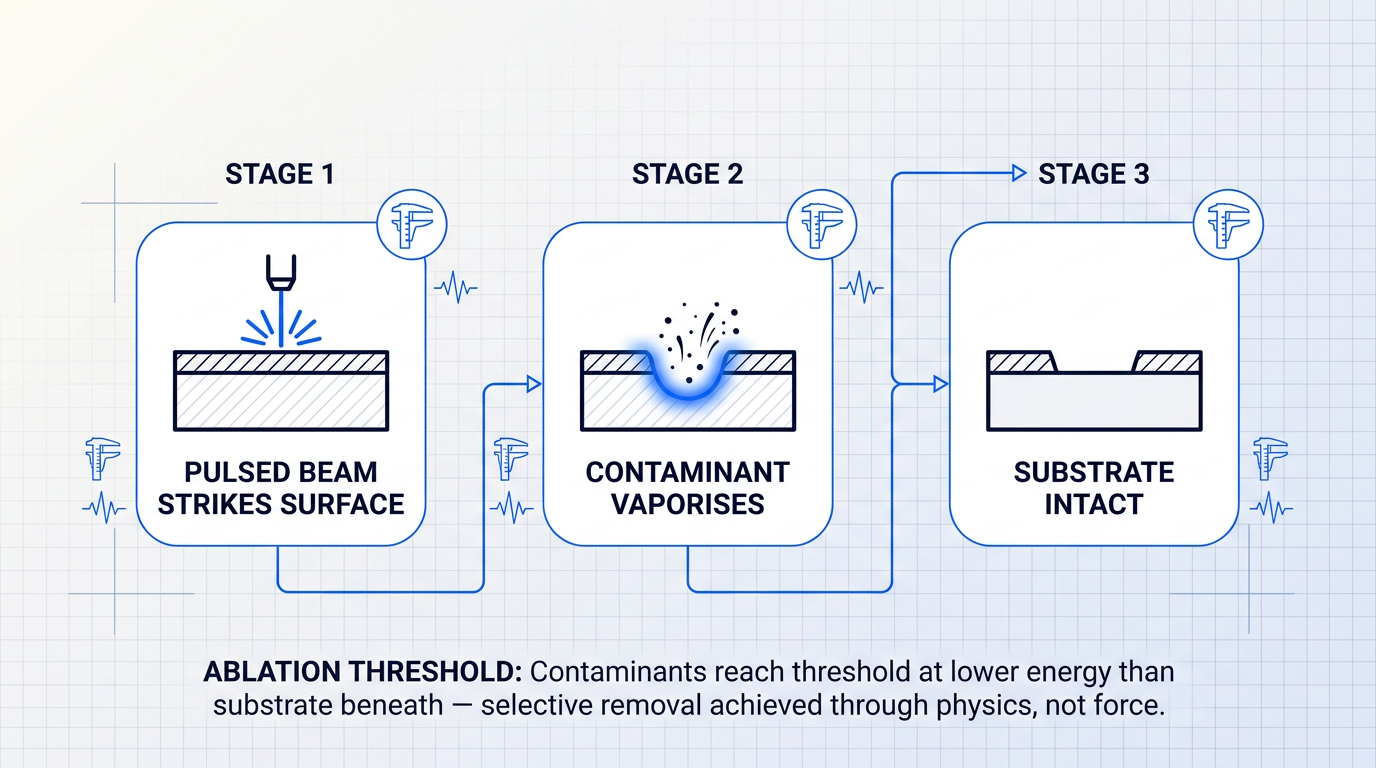
Every other surface preparation method discussed in this guide removes contamination by physical force, chemical reaction, or both — and in doing so, inevitably affects the substrate beneath. Laser ablation works differently: it removes contamination while leaving the base material essentially untouched, because the physics of the process make selective removal possible at a fundamental level.
When a pulsed laser beam strikes a contaminated surface, the contaminant layer absorbs the energy and reaches its ablation threshold — the point at which molecular bonds break and the material vaporises or is ejected from the surface. The critical insight is that contaminants reach this threshold at a lower energy level than the base substrate beneath them. The beam removes the contamination and, when correctly configured, stops at the base material. No grinding, no media impact, no chemistry required.
Contaminants and Substrates: What Laser Cleaning Handles
The range of contaminants laser cleaning removes effectively is broader than most industrial buyers expect from a single method: rust, oxides, mill scale, paint, powder coating, lacquer, primer, oil and grease, weld discolouration, carbon and soot, mould release agents, adhesives and residues, and tarnish — all without consumables or chemistry.
One honest limitation is worth noting: on very heavy mill scale deposits at production scale, abrasive blasting remains faster for bulk removal. Laser cleaning is the stronger choice where precision, substrate integrity, and contamination breadth matter more than raw throughput on thick scale.
The substrate range is equally wide, spanning metals and non-metals alike:
- Steel and carbon steel: Including galvanised steel — cleaned without abrasive damage to the zinc layer.
- Non-ferrous metals: Aluminium alloys, copper, brass, bronze, and titanium — all suited to tunable laser power.
- Cast iron: Rust and oxide removal without the surface damage risk that abrasive methods carry on brittle substrates.
- Stone, brick, and masonry: Soiling, paint, and biological growth removed without abrasive erosion of the original surface.
- Concrete: Coatings, adhesives, and contamination removed from concrete surfaces across industrial and heritage contexts.
This substrate breadth — from aerospace-grade titanium to heritage sandstone — reflects the tunability of the method itself. Power is adjusted to match the material and contaminant combination, which is why a single laser cleaning system can serve applications as different as mould cleaning and monument restoration.
Advantages Over Traditional Methods
Having worked through abrasive blasting, mechanical methods, and chemical treatment earlier in this guide, the practical advantages of laser cleaning land with more force in context. The method is consumable-free: no blast media to procure, contain, and dispose of; no chemicals to handle, store, or treat as hazardous waste. Energy is the only input.
Because nothing contacts the surface physically, there is no risk of media embedment — one of the less-discussed downsides of abrasive blasting, where media particles become lodged in the substrate surface and can compromise coating adhesion. Laser cleaning carries no equivalent risk.
The beam can also be directed with precision to targeted areas, removing contamination selectively without masking surrounding surfaces — a meaningful operational advantage for spot repairs, in-situ maintenance, and components where only part of the surface needs treatment.
Evaluated on total cost of ownership, laser cleaning presents a strong case for professional buyers. Zero consumable costs, reduced downtime from faster setup and cleanup, and significantly less rework caused by substrate damage combine over the system's working life to produce economics that traditional methods cannot match on the same basis. The professional evaluation lens is TCO, not sticker price.
With no consumables, no media disposal, no chemical waste streams, and minimal substrate damage requiring rework, laser cleaning's total cost of ownership over its working life consistently outperforms traditional methods — even when the capital cost of the system is higher at the point of purchase.
The Safety Barrier — and How It Has Been Removed
The single factor that has historically limited laser cleaning adoption in industrial settings is not capability — it is the safety overhead. Conventional laser cleaning systems operate as Class IV laser sources, which under standard regulations require the working area to be sealed off and evacuated before operation can begin. In open workshops, mixed-use facilities, or public-facing environments, that requirement has made laser cleaning impractical.
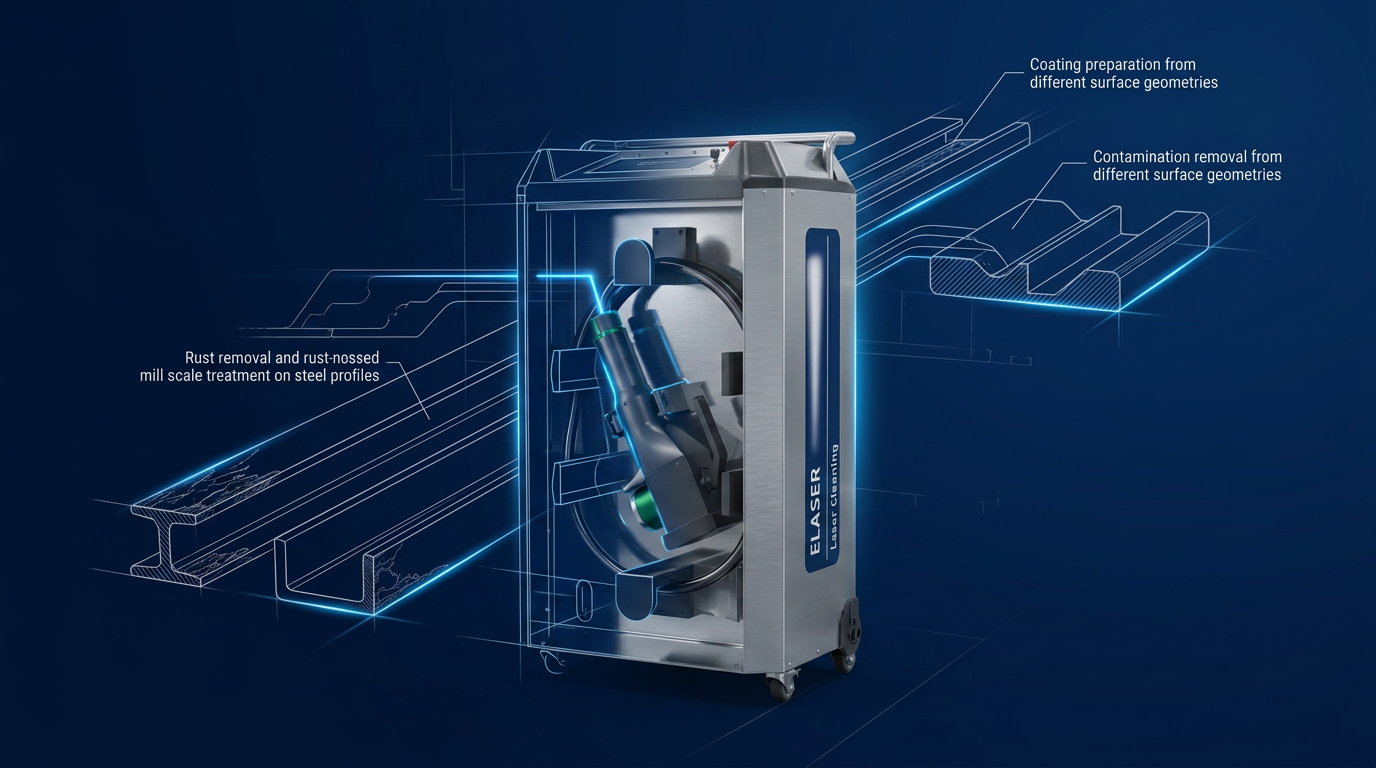
That barrier has now been addressed. Woodrow Scientific's ELASER-RHZ uses patented eye-safe technology operating at a 1550 nm wavelength to collapse the laser hazard zone to a fraction of its conventional size — making it the only laser cleaner of its kind in the world. The reduced hazard zone is confined to a small area immediately around the work, enabling continuous operation in open-plan manufacturing, mixed-use facilities, and publicly accessible spaces without sealing off the area or halting other work nearby.
The system itself is designed for single-operator deployment: a handheld scanner weighing under 3 kg, connected via a delivery cable of up to 50 m, drawing up to 300 W of fully tunable fibre laser power from a wheeled unit under 50 kg. Air-cooled and consumable-free, it requires no compressor, chiller, or media supply. CE and UKCA certified, with full operator safety and training provided by WSL as standard. Bespoke engineering and customisation options are available for operators with specific requirements.
It is also worth noting how Woodrow Scientific differs from much of the laser cleaning market. Many suppliers presenting themselves as manufacturers are in practice resellers or importers rebadging third-party machines — which means limited in-house engineering capability, slower spares and support, and no real ability to develop or improve the product. WSL, founded in 2012, is the only UK-based laser cleaning manufacturer: it designs, builds, services, and improves its machines entirely in-house. That distinction matters when a system requires maintenance, modification, or support over a working life of many years. The ELASER is also competitively priced among comparable industrial laser cleaning systems in Europe — a reflection of WSL's manufacturing efficiencies rather than any compromise on specification.
Industrial Applications for Laser Cleaning
- Pre-weld surface preparation: Remove oxides, mill scale, oil, and primer from weld zones precisely, without abrasive damage or masking.
- Rust and oxide removal: Strip corrosion from steel, cast iron, and non-ferrous metals while leaving the base substrate intact.
- Mould cleaning: Clean injection moulds and tyre moulds in place — no disassembly, no abrasives, no mould wear.
- Pre-coating preparation: Achieve clean, contamination-free surfaces for coating adhesion without chemical pre-treatment.
- Weld discolouration removal: Remove heat tint and oxide discolouration from weld seams on stainless steel and other alloys.
- Heritage and restoration: Lift soiling, paint, and corrosion from stone, masonry, and metal with minimal impact on the original surface.
Across all of these applications, fume extraction is a standard operational requirement. Vaporised contaminants must be captured and filtered at source — this is not a limitation unique to laser cleaning. Abrasive blasting demands dust containment and respiratory PPE; chemical treatment generates hazardous waste streams that require licensed disposal. Fume extraction for laser cleaning is simply responsible operation, consistent with good practice across all surface preparation methods.
For high-volume or highly repetitive applications, portable handheld laser cleaning is the starting point — but the method's capabilities extend further when automation is introduced. That is covered in the next section.
See Laser Cleaning in Action
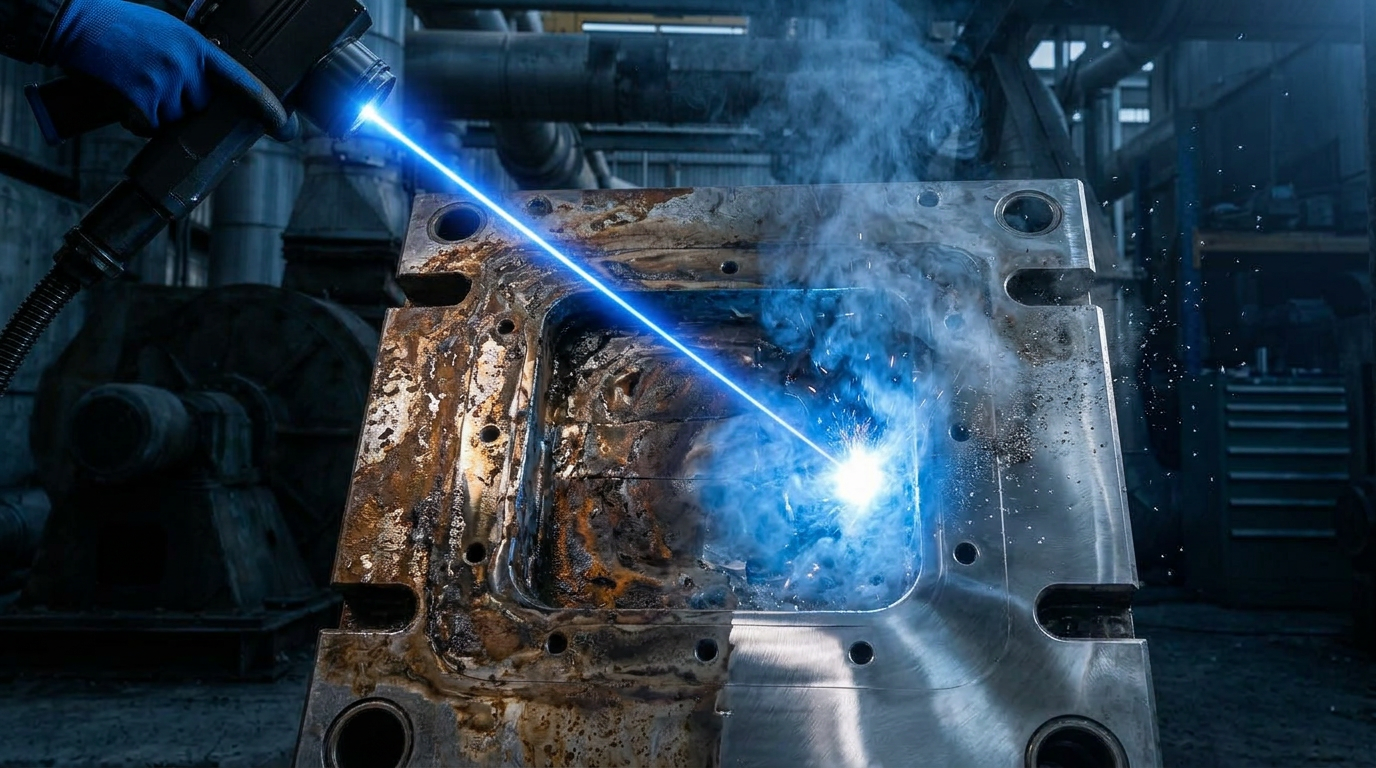
Laser ablation removes rust, oxides, and coatings without touching the substrate beneath. Explore the ELASER range to find the right laser cleaning solution for your application.
Automated Surface Preparation: Consistency, Throughput, and ROI
Even the most skilled operator cannot hold a blast nozzle at a perfectly consistent angle for eight hours, maintain identical standoff distance across a complex weld seam, or reach every recess of a confined space without compromise — and that structural reality, not any failure of craft, is what makes manual surface preparation inherently variable.
The consequences flow directly into coating performance: a surface prepared inconsistently will accept a coating inconsistently, and when that coating fails, the failure pattern is irregular enough to make root-cause diagnosis difficult and remediation expensive — SSPC research links poor surface preparation to coating failures that force full repaints years ahead of their intended service life.
Automation addresses this at its root, converting surface preparation from an operator-dependent activity into a repeatable, measurable production process — and across the three principal method categories where it is now deployed, the gains in quality consistency and throughput are well documented.
Automated Abrasive Blasting
Automated abrasive blasting is the most established form of surface preparation automation, with robotic blast systems in widespread use across shipyards, offshore fabrication facilities, and large-scale infrastructure maintenance programmes.
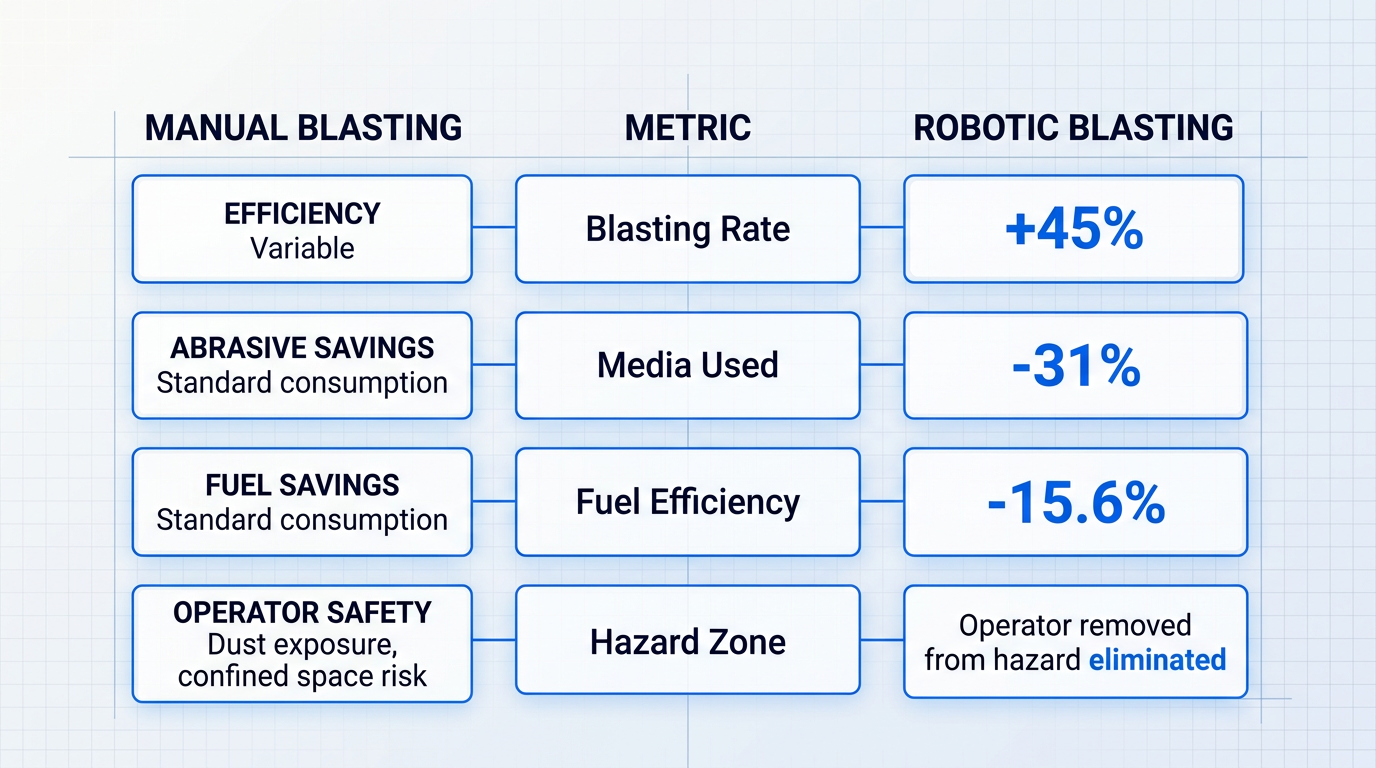
Robotic systems hold blast hoses at consistent angles and standoff distances across every pass, maintaining constant nozzle-to-surface geometry without fatigue — and the productivity gains are substantial: research cited by PaintSquare projects that robotic blasting can be up to 40% more efficient than a human blaster in confined-space applications, with an average 45% increase in blasting rate, 31% less abrasive media consumed, and 15.6% savings in fuel consumption.
The safety benefit is equally significant: as BlastOne International's marketing manager noted to AMPP, robotics gets the blaster out of the dust and allows the work to be done safely from a distance — in one documented confined-space project, robotic deployment eliminated eight hours of confined-space entry per project entirely.
Automated UHP Waterblasting
Robotic UHP waterblasting systems operate at pressures up to 40,000 psi and are deployed extensively in shipyards and large infrastructure maintenance — accessing ship hulls, internal tanks, bridges, and offshore structures without the scaffolding and manlift requirements that manual waterblasting demands.
The environmental case for this automation vector is particularly strong: waterblasting produces no air pollution, generates significantly less waste than solid abrasive blasting, and modern systems reclaim water through separation to leave only non-hazardous sludge for disposal — a profile that aligns with the sustainability commitments now standard in shipyard and infrastructure procurement.
Automated Laser Cleaning
Robotic laser cleaning cells mount the laser head on a multi-axis articulated arm, enabling repeatable cleaning of complex 3D geometry — contours, recesses, and angles that manual operation struggles to reach with consistent results.
Our automated laser cleaning system, AutoLASE, takes this a step further with a capability that distinguishes it from other robotic laser cleaning equipment: load a part and the system's machine-vision 3D scanning automatically builds a map of that part and generates the cleaning path — no manual programming, no path-setting, no knowledge of the part's geometry required.
The practical implication is that anyone can operate AutoLASE: the technical burden of robotic path programming is removed entirely, making it viable for production environments where specialist robotics knowledge is not available and where part changeover speed matters.
AutoLASE can be configured with WSL's Reduced Hazard Zone (RHZ) technology, making it the only automated laser cleaning system in the world that can operate without an enclosure — a capability no other manufacturer currently offers.
AutoLASE's Reduced Hazard Zone configuration removes the enclosure requirement entirely: WSL's eye-safe RHZ technology is the only such system available worldwide, opening deployment options — floor space, workflow integration, part size — that enclosed robotic cells cannot accommodate.
On the investment side, AutoLASE is competitively priced as the European cost leader in automated laser cleaning, and its total cost of ownership case is strong: zero consumables, no chemicals, no abrasive media, automated labour savings on repetitive cleaning tasks, and minimal rework from the substrate-preserving nature of laser ablation.
When Automation Justifies the Investment
Automation is not the right answer for every surface preparation task — but for quality-critical production environments, it is increasingly the engineering standard rather than an optional upgrade.
- High volume, repetitive tasks: Where the same cleaning operation repeats across large batches, automated systems deliver labour savings and cycle-time consistency that manual methods cannot match.
- Tight quality or regulatory requirements: When cleanliness grade and surface profile are contractual or specification requirements, repeatability becomes a compliance issue, not just a quality preference.
- Hazardous operator environments: Confined spaces, toxic dust, and high-pressure blast environments all carry occupational health risk that automation eliminates by removing the operator from the hazard zone.
- High cost of coating failure: Where premature coating failure triggers costly remediation, shutdown, or reputational consequences, the consistency premium of automation is well justified by risk avoidance alone.
For high-volume repetitive tasks in particular, the labour savings and consistency gains from automation typically build a compelling return against capital cost — especially when the full picture includes reduced abrasive consumption, lower rework rates, and the elimination of confined-space entry costs.
With an understanding of how each method can be deployed — manually or through automation — the remaining question is how to bring all of these variables together into a selection decision for a specific application, substrate, and operating environment: that is the focus of the next section.
Choosing the Right Surface Preparation Method
Every method covered in this guide has been described in terms of how it works. But knowing the mechanism is not the same as knowing when to specify it — and that gap is where coating failures, rework costs, and compliance problems actually live.
A competent specification decision runs six dimensions simultaneously: substrate material, contaminant type and severity, required cleanliness grade and surface profile, operating environment constraints, volume and throughput requirements, and environmental or regulatory obligations.
None of these dimensions can be evaluated in isolation. The substrate determines which methods are safe to use; the contaminant determines which are effective; the environment determines which are permitted; and volume determines which are economically rational.
Substrate: Matching the Method to the Material
The substrate material is the first filter in any selection decision — it immediately rules out methods that would damage the surface, embed contaminants, or compromise the metallurgical properties the coating depends on.
- Carbon steel: Abrasive blasting for large-area preparation; laser cleaning for precision work or where media contamination cannot be tolerated; mechanical methods for localised spot repairs.
- Stainless steel: Pickling and passivation are often mandatory after welding or mechanical damage; non-ferrous blast media for surface profile; laser cleaning is particularly effective for weld discolouration removal.
- Aluminium: Chemical treatment per ASTM D1730 is the reference standard; blast media selection is critical — aluminium is susceptible to media embedment; laser cleaning for precision components.
- Non-metals (stone, brick, concrete): Laser cleaning and wet abrasive blasting are well-suited for most applications; chemical cleaning for specific contaminant types.
The aluminium and stainless steel cases illustrate why substrate-specific selection matters beyond preference: media embedment in aluminium creates a contamination problem that defeats the preparation entirely, while skipping passivation on stainless steel after welding leaves the chromium-depleted heat-affected zone unaddressed — a corrosion initiation point that no coating can compensate for.
Contaminant Type: What You're Removing Determines How
Solvent cleaning to SSPC-SP 1 is the universal first step regardless of which method follows — abrading or blasting over oil or grease contamination does not remove it; it drives it deeper into the surface profile, where it will undermine adhesion from below.
The soluble salts and chloride case is the most frequently mishandled in industrial practice: abrasive blasting to a high cleanliness grade removes visible contamination and creates the required surface profile, but it does not remove soluble salts embedded in the substrate.
Chloride removal requires water washing or purpose-formulated chemical salt removers, and confirmation requires testing per ISO 8502 — visual inspection cannot detect soluble salt contamination, and a visually clean blasted surface may still carry chloride levels that will drive osmotic blistering under the applied coating.
A surface blasted to SP-10 can still carry chloride levels high enough to cause osmotic blistering. Water washing or chemical salt removers are required, and removal must be confirmed by testing per ISO 8502 — not by visual inspection.
The same logic extends across all contaminant types: the method must match what is actually present on the surface, not simply what is most familiar or most available on site.
- Oils and greases: Solvent cleaning (SSPC-SP 1) always first — no other method is effective over oil contamination.
- Rust and mill scale: Abrasive blasting for large surface areas; laser cleaning for precision work or substrates sensitive to blast impact.
- Chlorides and soluble salts: Water washing or chemical salt removers required; blasting alone is insufficient; confirm removal by testing per ISO 8502.
- Weld discolouration and heat tint: Laser cleaning is particularly effective; pickling paste for stainless steel where laser access is limited.
- Thick coatings: High-power abrasive blasting or high-power laser cleaning; chemical stripping for substrates sensitive to mechanical impact.
Contaminant severity also scales the method requirement: light surface rust on a small component is a different problem from heavy mill scale across a large fabrication, and the method selection should reflect that difference in intensity rather than defaulting to a single approach for all contamination.
Operating Environment: What the Site Permits
The operating environment can override substrate and contaminant preferences entirely — a method that is technically optimal may be practically unavailable depending on where the work takes place.
| Environment | Appropriate Methods | Key Constraint or Rationale |
|---|---|---|
| Open industrial site with containment | Abrasive blasting (dry or wet) | Standard approach where blast media containment and dust management are feasible |
| Confined space | Automated blasting, waterblasting, laser cleaning | Media containment and operator safety limit dry blast options; laser cleaning avoids media entirely |
| Public-facing or heritage site | Laser cleaning (reduced hazard zone), wet abrasive blasting with dust suppression | Evacuation zone requirements for conventional methods are incompatible with public access |
| Live plant or operational facility | Laser cleaning, mechanical methods | Blast media and chemical waste generation are typically prohibited in live operational environments |
| Environment with zero chemical waste tolerance | Laser cleaning | Produces no chemicals, no blast media, no liquid waste stream — eliminates disposal obligation entirely |
Maps operating environment scenarios to the appropriate surface preparation methods with a brief rationale for each selection.
The public-facing and heritage environment case is worth particular attention: reduced hazard zone laser cleaning opens access to locations where conventional laser cleaning (which requires full area evacuation) and abrasive blasting (which requires containment and dust control) are both operationally impractical.
In environments where chemical waste streams cannot be tolerated — whether for regulatory, operational, or site-access reasons — laser cleaning is the only method that eliminates the concern entirely, generating no media, no solvents, and no liquid effluent requiring disposal.
Volume, Throughput, and Scale
Scale changes the method calculus in two directions: high-volume production makes automation economically compelling, while low-volume or one-off work makes it unjustifiable — and the right answer at one end of that spectrum is the wrong answer at the other.
- High-volume repetitive production: Automated laser cleaning or automated blasting — consistency, throughput, and reduced operator variability justify the capital investment.
- Large surface areas: High-power abrasive blasting or waterblasting for coverage rate — no other method matches the area throughput on large fabrications or infrastructure.
- Low-volume or one-off work: Portable laser cleaning or manual mechanical methods — flexibility and low setup overhead outweigh throughput considerations.
Environmental and sustainability considerations belong in this calculus as legitimate engineering selection criteria, not as compliance footnotes added after the technical decision is made.
Waste stream generation, chemical handling risk, blast media disposal, and VOC emissions all carry operational cost and regulatory exposure that belongs in a total cost of ownership assessment alongside throughput and upfront method cost.
Methods that eliminate waste streams — particularly laser cleaning in environments where media and chemical disposal are constrained — carry a genuine operational advantage that grows as regulatory requirements tighten and disposal costs rise.
The professional standard is to evaluate all six dimensions before specifying a method: substrate, contaminant, cleanliness grade, environment, volume, and sustainability obligations. Defaulting to a single method across all jobs without this analysis is not a cost-saving strategy — it is a process maturity gap that will eventually produce a coating failure the specification never anticipated.
With the selection framework in hand, the final consideration is how to take this analysis forward — translating it into a specification decision and understanding where the broader trends in industrial surface preparation are heading.
Conclusion
Surface preparation: the decision that determines everything downstream
Surface preparation quality is the primary determinant of what follows — coating adhesion, bond strength, weld integrity. No downstream product or process corrects a surface that wasn't properly prepared.
The right method is never a matter of habit or lowest upfront cost. Substrate, contaminant type, cleanliness grade, environment, volume, and sustainability all belong in that decision — that is the professional standard.
Automation and cleaner methods are raising the bar further still, and the operations that treat preparation as a genuine engineering discipline will be best placed to meet it.
Frequently asked questions about surface preparation
Direct answers to the questions industrial buyers and engineers ask most often about surface preparation methods, standards, and selection criteria.
Chemical treatment is required — not merely an option — in three specific situations: when stainless steel needs passivation after welding or mechanical damage; when pickling is the only way to remove tightly adherent mill scale; and when a coating system specification mandates a conversion coating as the prepared substrate. In each case, no mechanical or blast method substitutes. After welding or grinding on stainless steel, the chromium-oxide passive film is disrupted and free iron becomes embedded in the surface. Passivation — governed by ASTM A380 and ASTM A967 — chemically restores that film; blasting cannot. Mill scale formed during hot rolling or heat treatment is too hard and adherent for mechanical tools to remove reliably; acid pickling dissolves it. Where a specification calls for phosphating (carbon steel) or chromating (aluminium and zinc), the conversion layer is integral to the coating's adhesion mechanism — mechanical preparation alone cannot replicate it.
Yes — in any professional or specification-driven context, testing is required. Visual inspection cannot detect chlorides or sulfates, and their presence is one of the primary causes of premature coating failure. Abrasive blasting removes visible rust and scale but does not remove soluble salts; in fact, blasting can concentrate them within the surface profile, where they sit beneath the applied coating. Osmotic blistering — the mechanism by which trapped salts draw moisture through a coating film — can destroy an otherwise well-applied coating system from underneath. Testing is carried out per the ISO 8502 series, which covers the relevant methods for measuring soluble salt levels on prepared steel surfaces. It is particularly critical for immersion service assets (tanks, pipework, marine structures, offshore installations) and for any surface previously exposed to marine or industrial atmospheric contamination. If measured salt levels exceed the specification limit, the surface must be washed and re-blasted before coating proceeds.
Laser cleaning can achieve high levels of surface cleanliness consistent with ISO 8501 preparation grades, and AMPP's SC 05 committee — the standards body responsible for surface preparation — explicitly includes laser ablation within its scope as a recognised surface cleaning method. However, comparing the two methods grade-for-grade misses the more useful question: which is the right tool for the application? Laser cleaning is particularly well-suited to precision components, sensitive substrates, and environments where blast media contamination or chemical waste cannot be tolerated. For large-area, heavily contaminated surfaces — thick mill scale on structural steel, for example — abrasive blasting delivers higher throughput and remains the practical standard. The professional framing is that laser cleaning and abrasive blasting occupy different optimal application zones. They are complementary methods, not direct substitutes competing on the same performance scale.
SP-2 is hand tool cleaning, using non-powered tools such as wire brushes, scrapers, and sandpaper. SP-3 is power tool cleaning, using powered equipment including rotary wire brushes, grinding discs, and needle guns. Both are SSPC/AMPP standards for mechanical surface preparation of steel. SP-2 removes only loosely adhering material — loose rust, loose mill scale, loose old paint — and leaves anything tightly bonded in place. SP-3 is more aggressive and removes more contamination, but it still cannot achieve the cleanliness of blast cleaning and cannot dislodge mill scale or paint that is firmly bonded to the substrate. Critically, neither SP-2 nor SP-3 creates a surface profile (anchor pattern). This is a structural limitation of both standards, not a technique failure. Where a surface profile is required for coating adhesion, blast cleaning or power tool cleaning to bare metal (SP-11) is the appropriate specification.
There are four major categories of industrial surface preparation method. Abrasive blasting propels abrasive particles at high velocity to remove contaminants and create a surface profile simultaneously; it is the most widely used method for steel in industrial and marine coating applications. Mechanical methods cover hand tools (wire brushes, scrapers) and power tools (grinders, needle guns) for localised cleaning where blasting is impractical; they are less effective than blasting but well-suited to maintenance work and spot repair. Chemical treatment includes solvent cleaning, acid pickling, passivation, and conversion coatings such as phosphating and chromating; these address specific substrates and contaminants that mechanical methods cannot reach. Laser cleaning uses pulsed laser energy to ablate contaminants from the surface without consumables, chemicals, or physical contact; it is suited to precision components, sensitive substrates, and environments where contamination from blast media or chemicals cannot be tolerated.
SSPC (Society for Protective Coatings) and NACE International were two separate professional standards bodies that jointly developed many of the surface preparation standards used across the coatings and corrosion industries. In 2021, they merged to form AMPP (Association for Materials Protection and Performance), which now maintains all of these standards. SSPC historically focused on protective coatings and surface preparation for the coatings industry; NACE International focused on corrosion engineering and control. Their joint work produced the SP series of surface preparation standards — SP-1 through SP-14 — which became the industry reference for cleanliness grades and preparation methods for steel before coating application. Since the merger, the standards are maintained under the AMPP brand, though the legacy SSPC and NACE designations remain in widespread use across specifications, contracts, and inspection documentation.
SSPC standards define cleanliness grades and preparation methods for steel surfaces before coating application. They are the reference specifications used by coating specifiers, contractors, and inspectors to agree on — and verify — acceptable surface condition before work proceeds. The SP series (now maintained by AMPP) spans the full range of preparation methods: from solvent cleaning (SP-1) through hand and power tool cleaning (SP-2, SP-3) to blast cleaning grades including SP-6 (Commercial Blast), SP-10 (Near-White Metal), and SP-5 (White Metal). These standards give the industry a shared, measurable language for surface cleanliness. Without them, "clean enough" is a subjective judgement with no verifiable basis. In professional industrial coating work, the coating specification will typically call out an SSPC/AMPP cleanliness grade as a contractual requirement, and an inspector verifies compliance against that grade before any coating is applied.