

Introduction
On this page, a slag removal tool means one thing: a tool or machine used to remove hardened molten material that builds up on the support slats of laser and plasma cutting tables.
During cutting, molten material falls onto the slats, cools, and bonds — how aggressively depends on your machine, settings, and material mix.
Leave it unchecked and the consequences are real: parts welding to the table, back-reflections threatening optics, and uneven support causing poor cut quality.
Every entry is evaluated against the same criteria: tool type, use case fit, material compatibility, ease of use, maintenance burden, and pricing.
The list runs from laser-based systems at the top down to manual scrapers, so you can jump straight to the category that fits your operation.
TL;DR
The right slag removal tool is determined by your laser power, table type, and cleaning frequency — and picking the wrong category costs far more in lost labour and slat wear than the price difference between tools ever would.
This article covers:

Five tool categories: laser-based to manual scrapers
Consistent evaluation criteria for every entry
Why slag hardness varies by cutting process
Decision guidance matching operations to tool categories
How to evaluate a slag removal tool
Picking the wrong slag removal tool for your operation is not merely a minor inconvenience — it can accelerate slat wear, add hours of unproductive labour every week, and generate consumable costs that quietly exceed the price of the tool itself within a single year.
The seven criteria below form the evaluation framework applied to every tool in this guide — work through them against your own setup before settling on a category.
Seven criteria that separate a good tool
- Tool type and mechanism: Manual impact, motorised rotary, or laser-based — the mechanism determines cleaning effectiveness and cumulative risk to slat geometry over repeated use.
- Best-fit use case: Cutting volume, cleaning frequency, table type (laser vs plasma), and shift pattern all dictate which tool category is operationally appropriate.
- Material compatibility: Not every cleaner suits mild steel, stainless, copper, or hybrid slat configurations; minimum slat spacing is a hard constraint for motorised tools.
- Ease of use and operator burden: In-situ vs slat-removal cleaning, single vs multi-operator requirements, ergonomics, and learning curve all determine real-world labour overhead.
- Maintenance and consumables: Blade, insert, and cutter-head replacement frequency compounds into significant ongoing cost in high-volume shops; consumable-free operation is a meaningful differentiator.
- Total cost of ownership: Purchase price, labour per cleaning cycle, consumable spend, slat replacement frequency, and table downtime together form the correct 12-month cost picture.
- Safety considerations: Manual tools bring vibration and strain hazards; motorised cleaners bring rotating-part and noise hazards; laser-based systems introduce optical radiation hazards.
Not all seven axes carry equal weight for every operation: a low-volume job shop running occasional cuts will rightly prioritise ease of use and upfront cost, while a multi-shift fabrication plant will find that total cost of ownership and consumable spend dominate the decision.
One axis that deserves particular attention before any category decision is made is slat surface integrity — specifically, what each mechanism does to slat geometry over repeated cleaning cycles.
Manual and motorised mechanical tools rely on physical contact: scrapers, chisels, and rotating cutters remove slag through abrasion or impact, which is effective but introduces cumulative dimensional change to the slat edge with every pass. Laser ablation, by contrast, removes slag without any physical contact, leaving the slat surface undisturbed.
Why slag hardness varies and why it matters
Slag hardness is not a fixed property — it varies considerably depending on your cutting setup, and a tool adequate for one process can be entirely outmatched by another.
Three variables in your cutting process have the most direct bearing on how hard and adhesive the resulting deposits will be, and therefore on which tool category can realistically cope with them.
- Cutting process type: Plasma cutting generally produces heavier, more pronounced deposits than laser cutting. Among laser processes, fibre laser cutting tends to produce denser, more adhesive slag than CO2 laser cutting.
- Laser power level: Higher-power laser systems tend to produce harder, denser slag deposits than lower-power equivalents, increasing the performance threshold a cleaning tool must meet.
- Cutting gas selection: The choice of cutting gas influences how readily slag bonds to the slat surface — compressed air cutting is generally associated with greater slag adhesion than nitrogen or oxygen.
The practical implication is direct: a tool well-suited to the lighter deposits from a low-power laser may be wholly inadequate against the harder, more adhesive slag produced by a high-power fibre laser or a plasma table.
Assess your own cutting process, power level, and cutting gas before deciding which tool category is worth evaluating — slag hardness sets the minimum performance threshold your chosen tool must clear.
A tool that eliminates consumables, meaningfully shortens each cleaning cycle, and extends slat life can recover its upfront cost well within a year — purchase price alone tells you very little about true value.
With this framework established, the entries that follow apply each of these criteria to the five tools that best represent the current market for industrial slat cleaning.
Product 1
Woodrow Scientific ELASER / ELASER-RHZ
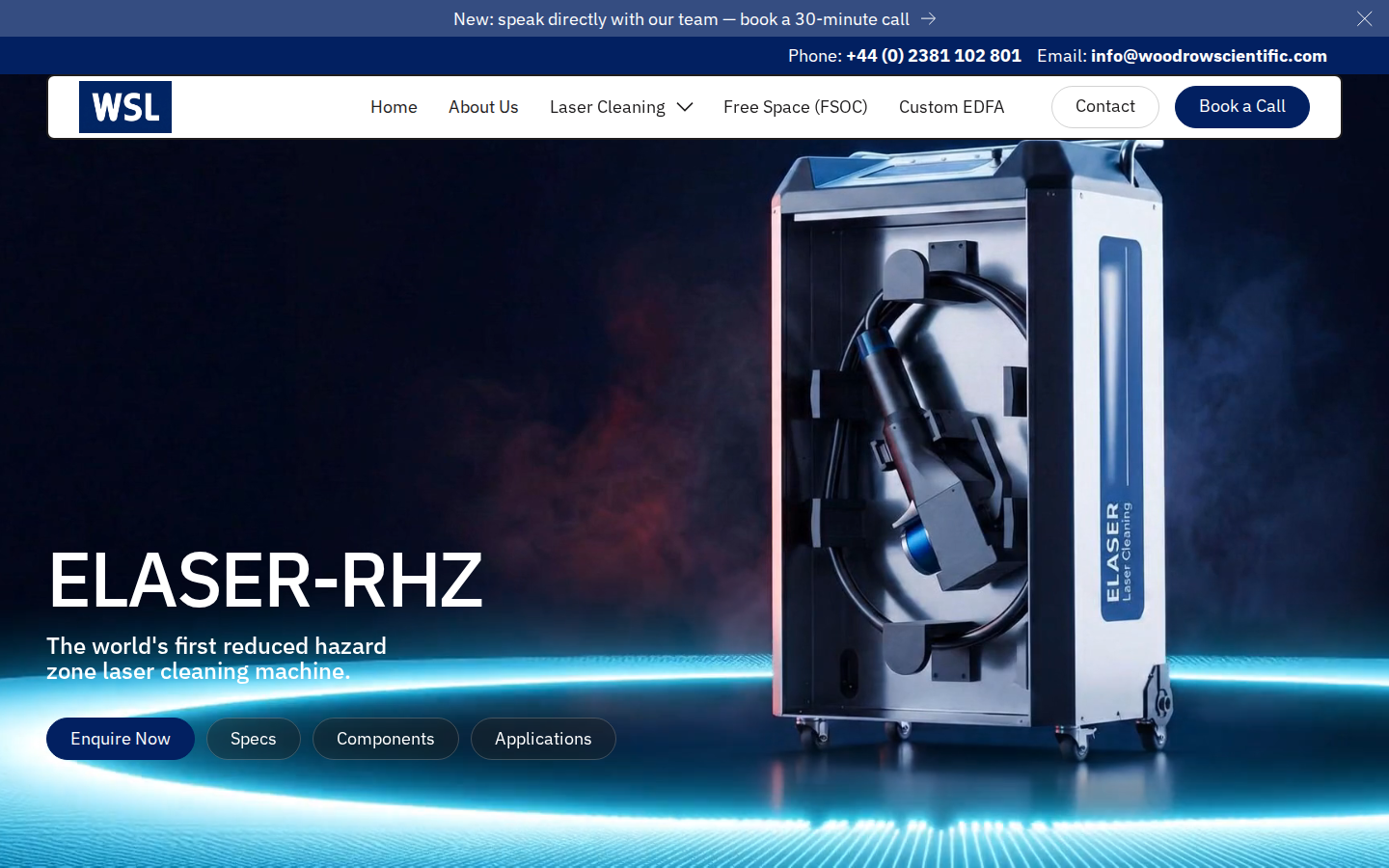
The Woodrow Scientific ELASER and ELASER-RHZ are industrial fibre laser cleaning systems that remove slag from laser and plasma cutting table slats by laser ablation, with zero physical contact with the slat surface. Designed for high-volume fabrication operations, precision-critical environments, and any shop where slat longevity and consumable costs are a genuine business concern, they represent the most capable slag removal tool category available today.
The ELASER and ELASER-RHZ are industrial fibre laser cleaning systems built around a single defining principle: the laser beam removes slag by ablation, stopping precisely at the base material, so the slat itself is never touched, scored, or deformed.
That zero-contact mechanism is what separates this category from every mechanical slag removal tool on this list — and it has direct, compounding consequences for slat longevity, surface integrity, and total operating cost.
The ELASER-RHZ uses WSL's patented Reduced Hazard Zone technology to collapse the laser hazard zone to a fraction of the size produced by conventional laser cleaning systems. This is the only laser cleaner of its kind in the world — it enables cleaning in open workshops, mixed-use manufacturing facilities, and public-facing settings without sealing off the area or evacuating the floor. No other laser cleaning machine offers this capability.
For fabrication shops running multiple shifts, the practical implication is significant: cleaning can happen continuously, in place, without interrupting adjacent operations or clearing the floor.
WSL provides full operator training as standard, ensuring teams are equipped to work safely and effectively with the system from day one.
Who the ELASER Is Best Suited To
This is a tool for operations where cleaning performance and slat condition have a direct impact on cut quality and table uptime — not for occasional-use shops cleaning one table every few weeks.
- High-volume, multi-shift fabrication: Slag accumulates fast under continuous production. The ELASER cleans without table downtime and without consumable replenishment cycles.
- Stainless steel slat applications: Food processing and medical fabrication environments where iron contamination between jobs is a real quality concern — laser ablation removes slag without introducing cross-contamination risk.
- Operations prioritising slat longevity: Laser ablation carries no blade-induced deformation risk, regardless of slat geometry or condition. Slats last longer, and replacement intervals extend.
- Shops where consumable costs compound: Any operation running motorised mechanical cleaners will be familiar with ongoing cutter replacement costs. The ELASER has no cutting parts to replace — electricity is the only running cost.
Material compatibility spans steel, carbon steel, copper, stainless steel, and hybrid steel/copper slats — the full range of slat types found in laser and plasma cutting tables.
ELASER Specifications at a Glance
| Specification | Detail |
|---|---|
| Laser power | Up to 300 W fibre laser, tunable 0–100% |
| Scanner weight | Under 3 kg (handheld) |
| System weight | Under 50 kg (wheeled) |
| Delivery cable | Up to 50 m (5 m / 15 m standard) |
| Cooling | Air-cooled — no compressor, water or chiller |
| Interface | Touchscreen GUI, password-protected, per-user logins |
| Certifications | CE and UKCA certified |
| Manufacture | Made in Britain |
Gives the reader concrete, scannable specs to evaluate the ELASER against practical requirements — weight, reach, power, and certifications are the four axes fabrication buyers check first.
The sub-3 kg handheld scanner and up to 50 m delivery cable mean a single operator can clean an entire table bay from one machine position — a practical advantage in large-format cutting environments.
The touchscreen GUI includes password-protected access and per-user logins with usage tracking, giving shop managers visibility over who is operating the system and when.
The Company Behind the ELASER
Woodrow Scientific Limited is the only UK-based laser cleaning manufacturer — it designs, builds, services, and improves its machines entirely in-house, backed by 200+ years of combined engineering experience.
This matters in a market where many apparent laser cleaning manufacturers are, in practice, resellers or importers rebadging third-party hardware — which translates to limited engineering support, slower spares, and no genuine ability to improve the product over time.
WSL's in-house model means fast, expert support from the engineers who built the machine, CE and UKCA certification, and bespoke engineering capability for operations with specific requirements — contact WSL directly to discuss customisation options.
ELASER Pricing and Total Cost of Ownership
Pricing is available on request from Woodrow Scientific — there is no published price list, which means buyers will need to engage WSL directly for a quote.
The ELASER is the European cost leader among comparable industrial laser cleaning machines, and the right frame for evaluating that cost is total cost of ownership across a 12-month horizon: zero consumables, reduced slat replacement frequency, and less table downtime from cleaning cycles all contribute to a TCO that is strongly competitive against mechanical alternatives when volume is factored in.
WSL also offers automated laser cleaning solutions for high-throughput production lines where a handheld system is not the right fit — worth noting for operations considering future scale.
See the ELASER Laser Cleaning System in Detail
The ELASER and ELASER-RHZ remove slag from cutting table slats by laser ablation, with zero contact with the slat surface. Explore the full specifications and see which system fits your operation.

Product 2
TRUMPF TruTool TSC 100 / TSC 200
The TRUMPF TruTool TSC 100 and TSC 200 are motorised electric slat cleaners for laser cutting tables, using dual rotary cutters to remove hardened slag mechanically — without removing slats from the table — with automatic adaptation to slag thicknesses up to 25 mm.
The TSC 100 and TSC 200 are motorised electric slat cleaners that use dual rotary cutting tools positioned on either side of each slat, mechanically lifting and removing hardened slag as the operator drives the unit along the slat's length.
The two models share the same core mechanism but are calibrated for different operating environments — the distinction matters when specifying the right tool for your laser power range.
| Specification | TruTool TSC 100 | TruTool TSC 200 |
|---|---|---|
| Laser power range | CO2 and fibre lasers up to 10,000 W | Fibre lasers above 6,000 W |
| Slag type | Standard laser slag | Hard or mixed slag from high-power fibre lasers |
| Max slag thickness | 25 mm (auto-adapting) | 25 mm (auto-adapting; feed support recommended above 15 mm) |
| Slat thickness range | 2 mm – 3.9 mm | 2 mm – 4 mm |
| Cleaning time (standard 1500 x 3000 mm pallet) | Approx. 30 minutes | Approx. 15 minutes |
| Motor power | 1,700 W | 1,700 W |
| Max working speed | 8 m/min | 8 m/min |
Directly compares the two models across the key differentiating dimensions — laser power suitability, slag type, and cleaning time — so the reader can identify the right model for their operation at a glance.
Both models operate via a two-stage process: serrated cutting edges break up the slag in a roughing pass, then continuous cutting edges scrape the surface clean in a finishing pass.
Best For
The TSC 100 is the practical choice for job shops running CO2 lasers or mid-power fibre lasers producing standard slag deposits, where a well-supported, proven mechanical tool is the priority.
The TSC 200 is designed for operations using high-power fibre lasers — particularly those in the 12–24 kW range — where slag is denser and harder and a standard tool struggles to clear it efficiently.
Shops already running TRUMPF laser cutting equipment will find the brand's service network and parts availability a practical advantage, though both models are marketed as compatible with laser cutting machines from any manufacturer.
Material Compatibility and Slag Adaptation
Both tools are compatible with stainless steel, mild steel, and aluminium slats, and the automatic slag-thickness adaptation — up to 25 mm — means the operator does not need to manually adjust the tool between passes or for different slag build-up levels.
Two cutter tool sizes are available: tool no. 2 for slat thicknesses of 2–2.9 mm, and tool no. 3 for 3–4 mm slats (the TSC 100 tops out at 3.9 mm).
Ease of Use
Both models are designed for single-operator use with a long handle that allows the operator to clean from one side of the machine without reaching across the table.
Slats remain in the table throughout — no removal, no re-seating, no production interruption beyond the cleaning window itself.
On laser cutting machines equipped with a pallet changer, cleaning can run in parallel with active cutting on the second pallet, making the process effectively zero-downtime in that configuration.
TRUMPF states that regular cleaning with the TSC series can reduce slat costs by up to 75% compared with routine slat replacement, and extend slat service life by up to four times. These figures are published on TRUMPF's own product pages and are consistent with third-party trade reporting.
The TSC 200 includes an optional feed support accessory for slag thicknesses above 15 mm, which attaches to the machine and is driven by the tool's own motor, reducing the physical effort required from the operator on heavily loaded pallets.
Maintenance and Consumable Costs
The rotary cutting tools are consumable items — they wear with use and must be replaced periodically.
TRUMPF has designed the tools with wear indicator notches (similar in concept to tyre tread markers): when the notches are no longer visible, the tool should be rotated 180 degrees; once both orientations are worn, the tool is replaced via a tool-free quick-change system.
Replacement cutter pricing and quantified service intervals are not published by TRUMPF or accessible resellers at the time of writing — contact TRUMPF Power Tools or an authorised reseller directly for current consumable costs before factoring them into your total cost of ownership calculation.
TSC 100 / TSC 200 Pricing
Neither TRUMPF nor accessible authorised resellers publish list prices for the TSC 100 or TSC 200 online.
Contact TRUMPF Power Tools directly (UK: +44 1582 725335; North America: +1 800-660-6126) or an authorised reseller in your market to obtain a current quotation — pricing will vary by region and distributor.
Trade-offs to Consider
Because the TSC series makes direct mechanical contact with each slat, repeated cleaning cycles carry a cumulative risk to slat surface geometry over time — this is a characteristic of the mechanical abrasion method as a category, not a defect specific to TRUMPF's implementation.
The TSC series is optimised for laser cutting tables; it is less effective on the heavier, more irregular slag deposits typical of plasma cutting tables.
Ongoing cutter replacement is a running cost that consumable-free cleaning approaches do not carry — factor this into the total cost of ownership alongside the tool's headline cost savings claim.
Product 3
SlatPro SLAGHOG
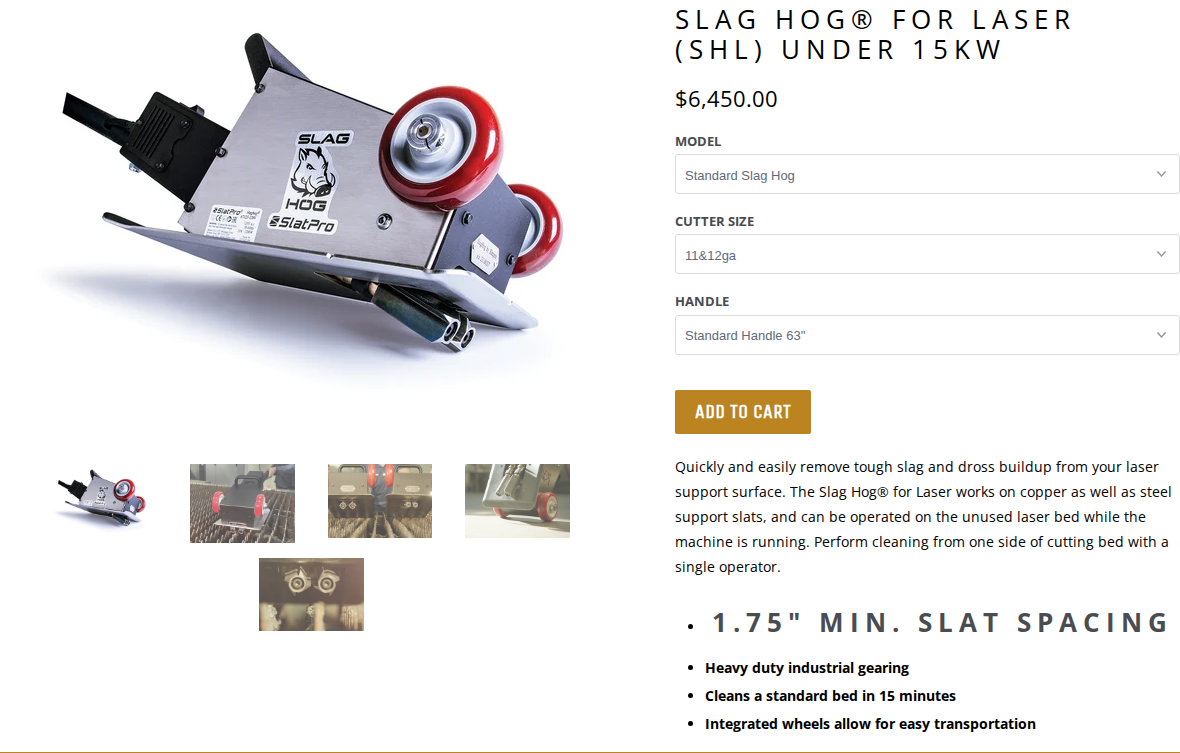
The SlatPro SLAGHOG is a patented motorised slat cleaner available in dedicated laser and plasma models, making it the go-to mechanical slag removal tool for shops that run both cutting table types — particularly where heavy plasma slag demands more than a standard laser slat cleaner can deliver.
The SLAGHOG's defining characteristic in this list is straightforward: it is one of the few slag removal tools available in a purpose-built plasma variant, the SLAG HOG for Plasma (SHP), alongside its laser-specific models — a distinction that matters when plasma slag is significantly heavier and more tenacious than what laser tables produce.
The laser lineup covers three configurations: the standard SLAGHOG (#67123) for lasers 12 kW and under, the SLAGHOG HD (#67123 HD) with a heavy-duty motor for machines over 12 kW, and the SLAGHOG Narrow (#67182) for tighter slat spacing.
SLAGHOG Model Variants and Slat Compatibility
| Model | Motor | Min Slat Spacing | Notes |
|---|---|---|---|
| SLAGHOG (#67123) | Standard (up to 12 kW) | 1.75" | Interchangeable cutters for 14ga–1/4" slats |
| SLAGHOG Narrow (#67182) | Standard | 1.25" | Made for 11-gauge slats; cutters included |
| SLAGHOG HD (#67123 HD) | Heavy-duty (over 12 kW) | 1.75" | Interchangeable cutters for 14ga–1/4" slats |
| SLAG HOG for Plasma (SHP) | Heavy-duty quad cutter | Verify with SlatPro | For plasma and oxyfuel tables; downdraft or water tables |
Presenting the three laser model variants side by side — with slat spacing minimums and motor type — lets readers quickly identify which configuration suits their machine without parsing dense prose.
All laser models work on copper, steel, and stainless steel support slats, with interchangeable cutters to match slat thickness from 14 gauge through 1/4 inch — a practical detail for shops running mixed slat inventories.
The plasma model, the SHP, uses a heavy-duty quad cutter design and is compatible with both plasma and oxyfuel tables, including downdraft and water table configurations (with the caveat that water must be lowered below the tool's contact point on water tables).
SLAGHOG Ease of Use
Per SlatPro's brochure, the laser models are designed for single-operator use, with integrated wheels for shop-floor mobility and the ability to operate on an unused bed while the machine is running — a useful capability for shops with pallet changers or dual-table configurations.
SlatPro claims a standard laser bed can be cleaned in approximately 15 minutes, which is consistent with comparable figures cited for other mechanical slat cleaners in this category.
The plasma SHP adds an adjustable tee handle that lets the operator stand either on the floor or on the slat surface during cleaning — a practical ergonomic accommodation given the heavier physical demands of plasma slag removal.
SLAGHOG Maintenance and Consumables
Like all mechanical slat cleaners, the SLAGHOG's cutter blades are a consumable: they wear with use and require periodic replacement. Replacement cutter sets for the plasma model are listed at $395 per set of four — laser model cutter costs should be confirmed with SlatPro or an authorised distributor, as pricing varies by gauge.
SlatPro's brochure highlights heavy-duty industrial gearing and longer-life drive shafts as durability features on the laser models, positioning the tool for sustained shop use rather than occasional cleaning runs.
As with any contact-based slat cleaner, repeated use carries a cumulative risk to slat surface geometry over time — this is a category-wide trade-off, not a SLAGHOG-specific weakness, and the rate of wear will depend on cleaning frequency and slat material.
SlatPro SLAGHOG Pricing
The standard laser SLAGHOG is listed at $6,450 and the HD variant at $6,950 on SlatPro's website; the plasma SHP is listed at $7,950. These figures should be verified directly with SlatPro or an authorised distributor, as pricing may vary by region or distributor.
For shops that need both laser and plasma coverage, the SLAGHOG's dual-model range means a single-brand mechanical solution is available for each table type — though the total investment across both models warrants factoring into any purchasing comparison.
Product 4
LISEN LSC 200 Slat Cleaner
The LISEN LSC 200 is a motorised electric slat cleaner that uses dual cutters to mechanically remove hardened slag from laser cutting table slats via push-and-pull operation. It is compatible with CO2 and fibre laser machines from most major brands — including Trumpf, Amada, Bystronic, Mazak, and Mitsubishi — and carries a publicly listed price of $4,980 USD, making it the value-accessible, brand-agnostic entry point in the motorised slat cleaner category.
The LISEN LSC 200 is an electrically powered motorised slat cleaner that uses dual cutters riding on each side of the slat, mechanically lifting and breaking away hardened slag through a push-and-pull operation along the slat's length.
Unlike OEM-branded slat cleaners that are designed primarily for the machines their manufacturers sell, the LSC 200 is explicitly brand-agnostic — compatible with laser cutting machines from Trumpf, Amada, Bystronic, Mazak, Mitsubishi, Messer, HAN*S, and others, across both CO2 and fibre laser types.
LISEN LSC 200 Specifications and Compatibility
The canonical product page at slatcleaner.com lists a slat thickness range of 2–6 mm and a minimum slat spacing of 33 mm; note that the plug-variant product pages quote slightly different figures (3–6 mm thickness, 35 mm spacing), so buyers should confirm their specific machine's slat geometry against the main product page before ordering.
| Specification | Value |
|---|---|
| Motor power | 2,300 W (220–240 V) |
| Slat thickness range | 2–6 mm (canonical product page) |
| Max. slag thickness | 30 mm |
| Min. slat spacing | 33 mm (canonical product page) |
| Slat materials | Steel, stainless steel, copper, hybrid steel/copper |
| Operation | Push and pull |
| Tool adjustment | Auto-adjusts to different slag thicknesses |
| Weight | 23 kg |
| Warranty | 12 months |
Presenting the LSC 200's key technical specifications in tabular form gives mid-funnel buyers a quick, scannable reference — the same shape of information used in the sibling TRUMPF and SlatPro entries — without requiring them to parse it from prose.
The 2,300 W motor includes resettable over-current protection, and the transmission system uses spur gears with high-temperature lubrication rated to 300°C — a design choice that reflects the heat environment typical of active laser cutting shops.
The LSC 200 ships with removable wheels for shop-floor mobility; once positioned on the slat bed, the wheels are removed and the machine sits directly on the slats for cleaning.
Ease of Use and Operational Workflow
The LSC 200 is designed for single-operator use, and slatcleaner.com states it can clean a standard laser bed in approximately 15 minutes — a figure drawn directly from the vendor's own product page.
A notable operational benefit: cleaning can take place while production continues on a flatbed laser fitted with a pallet changer, meaning the machine does not need to be taken offline for maintenance.
The vendor recommends a cleaning interval of once per week for operations running two shifts, and advises a 10-minute rest break for the operator every 40 minutes of use — practical guidance that reflects the physical demands of push-and-pull mechanical operation.
LISEN LSC 200 Pricing
The LSC 200 carries a published listed price of $4,980 USD at slatcleaner.com — one of the few mechanical slat cleaners on this list with a transparent, publicly accessible price that buyers can evaluate without submitting a quote request.
Four plug variants are available to order directly from the vendor: US (Type A/B), UK (Type G), European (Type C/E/F), and Australian (Type I) — each configured for the relevant local voltage standard.
Non-US buyers should note that import duties, VAT, and voltage compatibility will affect the final landed cost and should be confirmed before ordering.
Replacement cutting tools for the LSC 200 are available from slatcleaner.com at $260–$320 per set of two. As with all mechanical slat cleaners, cutter wear is an ongoing consumable cost that adds to total cost of ownership over time — factor this into any cost-of-entry comparison.
The vendor recommends one LSC 200 per one to three laser cutting machines under normal operating conditions, which is a useful planning figure for shops with multiple cutting cells.
Trade-offs to Consider
The mechanical contact method is a category-level trade-off shared by all motorised slat cleaners: repeated use carries a cumulative risk to slat surface geometry over time, and heavy or warped slats may reduce cleaning effectiveness.
The LSC 200 is designed for laser cutting tables and is not suited for heavy plasma slag — shops that run plasma cutting machines alongside laser tables should refer to the SlatPro SLAGHOG evaluation (covered earlier in this list) or LISEN's separate LSC-1000T plasma model.
The vendor's operating guidance explicitly caps slag width at 30 mm per pass and advises against swinging the machine laterally during operation, as this can damage the gearbox — points worth factoring into operator training for any new installation.
See How Laser Cleaning Compares to Mechanical Tools
Mechanical slat cleaners work — but laser-based systems remove slag with zero contact, zero slat wear, and no consumables. See the AutoLASE and how it fits high-volume fabrication operations.

Product 5
Anti-spatter compounds and manual scrapers
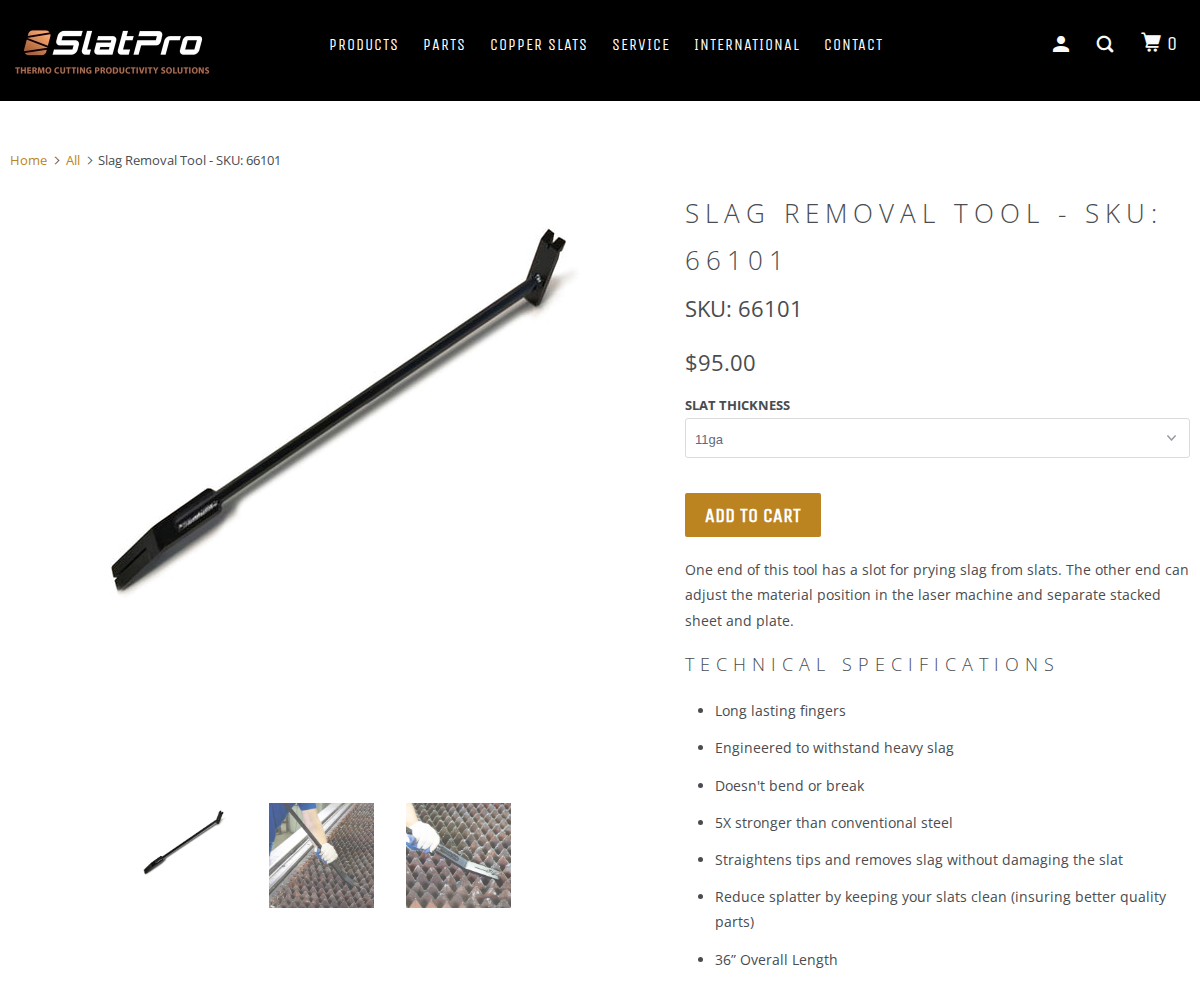
Manual scrapers, chisels, air chisels, and anti-spatter compounds are the entry-level baseline for slag removal — zero capital investment and the lowest upfront cost on this list, but physically demanding, slow, and largely inadequate as a primary solution for high-power fibre laser slag in active fabrication operations.
Before dedicated slag removal tools existed, every fabrication shop relied on some version of this category: hand scrapers, chisels, hammers, and air chisels to knock hardened deposits off slat surfaces by force. These methods remain the starting point for many low-volume operations today, and they are worth evaluating honestly.
A useful complement to any impact-based approach is the anti-spatter compound — a liquid spray applied to slats before cutting that creates a barrier preventing molten slag from bonding to the surface. Anti-spatter compounds do not eliminate slag, but they reduce adhesion and make subsequent cleaning easier, regardless of which primary cleaning method the shop uses.
Why is slag so hard to remove?
The difficulty of manual removal is not a technique problem — it is a materials problem. Several factors make modern laser and plasma slag significantly harder to dislodge than many operators expect.
- Fibre laser slag bonds more aggressively than CO2 slag: High-power fibre lasers produce denser, harder deposits on slat surfaces than CO2 lasers operating at equivalent power — an industry-established characteristic that dedicated tool manufacturers, including TRUMPF, have explicitly designed around.
- Higher laser power compounds the problem: As laser power increases (particularly above 6 kW), slag hardness increases correspondingly. Manual tools that were adequate on older, lower-power machines become increasingly ineffective on modern high-power fibre systems.
- Cutting gas choice affects adhesion: Cutting with compressed air rather than oxygen or nitrogen increases the likelihood of harder, more tenacious slag deposits, as the lower purity and variable moisture content of shop air affects how cleanly molten material ejects from the kerf.
- Oxygen cutting produces hard oxide slag: When oxygen is used as the assist gas for carbon steel, the resulting iron oxide slag can be particularly tenacious if cutting parameters are not optimal — creating deposits that resist impact-based removal.
Manual scrapers work on both steel and copper slats. Anti-spatter compounds are broadly compatible with fibre laser, CO2 laser, and plasma cutting tables, and are non-toxic and water-soluble, with no hazardous waste concerns.
The barrier to entry here is essentially zero — a hammer and chisel cost very little, and anti-spatter spray can be applied with a standard pump sprayer. But the labour burden is substantial. As The Fabricator notes, cleaning 60 slats on a laser bed with manual tools requires many hours; a purpose-built electric slat cleaner can accomplish the same task in roughly 10 to 30 minutes. That gap compounds quickly in any shop running more than one shift.
Maintecx describes manual hammers and homemade scraping tools as "not only slow and physically exhausting but also prone to damaging the slats" — a fair summary of the category's core limitation.
Cost considerations
Upfront cost is the lowest of any option on this list — basic scrapers and chisels are inexpensive, and air chisels are a modest investment. Anti-spatter compounds are a recurring consumable, typically applied weekly (or more frequently across multi-shift operations).
The real cost is labour time. In a high-volume shop, hours of manual scraping per cleaning cycle translate directly into operator cost and lost machine uptime — a total cost of ownership that can significantly exceed the price of a dedicated slat cleaner within months.
Impact tools also carry a risk that has no direct monetary line item until it occurs: bending or deforming slat geometry. Chiselling and hammering can warp slats, compromising the flat support surface that accurate cutting depends on and potentially shortening slat life rather than extending it.
Manual scrapers and chisels are a workable baseline for very low-volume operations or infrequent supplementary cleaning. For active fabrication shops — particularly those running high-power fibre lasers — they are largely inadequate as a primary cleaning method. Anti-spatter compounds, however, are genuinely useful as a preventive complement regardless of which primary cleaning tool a shop uses, and are worth incorporating into any maintenance routine.
Conclusion
Which slag removal tool is right for your operation?
The honest answer starts with your operation profile, not your budget.
High-volume, precision-critical, and multi-shift shops — particularly those cutting stainless, food-grade, or medical materials — have a clear benchmark in laser-based cleaning, with the ELASER/ELASER-RHZ representing that category at its most capable.
Mid-volume fibre laser operations will find motorised slat cleaners the practical middle ground; plasma table operators should look specifically at the SLAGHOG plasma model and confirm slat geometry compatibility before committing.
And if slats are warped or structurally compromised, no slag removal tool changes that — replacement is the right call.
Slag removal tool: frequently asked questions
Practical answers for fabrication professionals evaluating slag removal options for laser and plasma cutting tables.
Cleaning frequency is driven by laser power and material mix, not a fixed calendar schedule. Shops running high-power fibre lasers (12 kW and above) may need to clean slats every one to two days. Lower-power machines typically manage with weekly cleaning. Monitor cut quality — dross on the underside of parts is a reliable early indicator that slats need attention. Shops that switch between mild steel and stainless steel should clean slats before starting any stainless job. Iron oxide deposits from mild steel slag can transfer to stainless workpieces and cause surface defects, so cleaning between material changes is a practical quality-control step, not just a maintenance routine.
There are three main methods: motorised electric slat cleaners (using dual rotary cutters that ride along each side of the slat), laser-based cleaning systems (fibre laser ablation with no physical contact with the slat surface), and manual scrapers or chisels for light or infrequent use. For active fabrication operations, a motorised slat cleaner or laser-based system is the practical choice. Both allow a single operator to clean the table in place, without removing slats. Manual scrapers and anti-spatter compounds can reduce adhesion and supplement a primary method, but they are physically demanding and too slow to serve as a standalone solution for high-volume shops.
In the slat-cleaning context, three tool categories are used: motorised electric slat cleaners (dual rotary cutters that clamp each side of the slat and travel along its length), laser-based cleaning systems (fibre laser ablation with no physical contact), and manual scrapers or chisels for light or infrequent deposits. The right category depends on laser power, slag volume, and table type. High-volume fibre laser shops tend to outgrow manual tools quickly; motorised and laser-based systems are built for ongoing production cleaning.
Slag hardness varies significantly by cutting process and parameters. High-power fibre lasers produce denser, more adhesive deposits than CO2 lasers. Cutting with compressed air as the assist gas increases adhesion compared to oxygen or nitrogen. Plasma cutting generates heavy deposits along the lower cut edge that can be particularly stubborn. If manual scrapers are not getting the job done, that is a signal the operation needs a motorised slat cleaner or laser-based system — it is not a technique problem. Equally important: allowing slag to accumulate across multiple cutting sessions before cleaning makes removal significantly harder regardless of which tool you use. More frequent, shorter cleaning cycles reduce the effort required each time.