
Introduction
If you're an industrial buyer, procurement manager, or fabrication engineer with a specific surface problem to solve — slag removal, oxide stripping, edge rounding, scale removal, or weld discolouration — the challenge isn't finding machines; it's knowing which class of metal finishing machine addresses your job.
The market is fragmented: manufacturer catalogues are detailed but siloed, and no single resource maps finishing categories to credible machines across them.
This guide takes a different approach: one carefully selected machine per finishing category, chosen to represent what that category does well, where it falls short, and who it suits.
Every entry is evaluated on six consistent criteria — throughput, substrate compatibility, consumable cost, footprint, operator skill, and safety overhead. Pricing is quote-based capital equipment; factor total cost of ownership, not just the purchase figure.
TL;DR
The right metal finishing machine isn't the most powerful one — it's the one matched to your specific surface problem. Evaluated consistently across six criteria, each finishing category reveals clear strengths and real trade-offs, turning a fragmented, catalogue-heavy market into a tractable decision.
This article covers:

Six criteria for evaluating finishing machines
Laser cleaning for oxide and contamination removal
Abrasive deburring and edge rounding machines
Shot blasting for descaling and surface texturing
Electrochemical weld cleaning for stainless steel
Matching your finishing problem to the right machine
What Are the Types of Metal Finishing?
Metal finishing is not a single process — it is a family of distinct industrial problems, each requiring a different class of machine to solve it. Specifying the wrong category of equipment for a given finishing task is one of the most common and costly procurement mistakes in fabrication.
The six categories covered in this list map to six different surface conditions that fabricated metal parts present before they are ready for the next production stage.
- Laser Cleaning: Removes oxides, rust, weld discolouration, and surface contamination using a pulsed fibre laser — no consumables, no contact with the substrate.
- Abrasive Deburring and Edge Rounding: Removes mechanical burrs from shearing, punching, and laser cutting, and applies controlled edge treatment to cut sheet metal using belt and brush machines.
- Mechanical Deslagging: Knocks away heavy slag and dross left by plasma and oxy-fuel cutting — a different problem from mechanical deburring, requiring purpose-built tooling.
- Precision Surface Grinding: Achieves flatness, tight dimensional tolerances, and controlled stock removal on workpiece surfaces using surface grinding machines.
- Shot Blasting: Descales, de-rusts, and textures metal surfaces using turbine-propelled abrasive media, primarily for coating preparation and corrosion protection.
- Electrochemical Finishing: Removes weld heat tint and discolouration from stainless steel and restores the passive layer using an electrochemical cleaning system.
Within the deburring categories specifically, there is a distinction that catches buyers out: not all burrs are the same, and the machine that handles one type may be entirely unsuitable for the other.
Mechanical burrs are the thin, sharp projections left on a cut edge after shearing, punching, or laser cutting — typically removed by abrasive belt and brush deburring machines. Thermal burrs (also called slag or dross) are the fused, hardened material that adheres to the underside of a part after plasma or oxy-fuel cutting; this material is harder and more tenacious, and requires a dedicated deslagging machine rather than a standard deburring unit.
The practical implication: if your cutting process is plasma or oxy-fuel, confirm that any deburring machine you evaluate is rated for slag removal — many are not.
Finishing is also frequently underestimated as a determinant of downstream quality, rather than a tidying step at the end of production. Surface oxides and contamination cause paint and coating adhesion failures. Mill scale and oxides on a weld joint face compromise weld integrity. Residual contamination and incomplete passivation on stainless steel create corrosion initiation sites. Burrs and slag left on mating faces affect dimensional fit-up in assembly.
In each case, the finishing step is not cosmetic — it is a process input that determines the quality of what comes next.
A machine with lower capital cost but ongoing abrasive media, belt, or chemical consumable spend will frequently exceed the lifetime cost of a higher-capital machine with zero consumables. Evaluate on total cost of ownership, not headline price.
The consumable cost gap between categories is significant: laser cleaning systems carry no consumable cost once installed, while shot blasting, abrasive deburring, and electrochemical systems accumulate ongoing spend on blast shot, abrasive belts, and chemical solutions respectively across every hour of operation.
Finally, in any production environment running volume, automated and repeatable finishing is the appropriate standard — not manual or semi-manual operation. Operator-dependent finishing introduces cycle-to-cycle variation that compounds into rework and inspection failures at scale; removing the operator variable from a repetitive finishing task is an operational advantage, not just a labour efficiency.
With the category landscape mapped, the entries below cover one credible metal finishing machine per category — starting with laser cleaning and working through each finishing problem in turn.
Product 1
ELASER / ELASER-RHZ by Woodrow Scientific Limited — Laser Cleaning
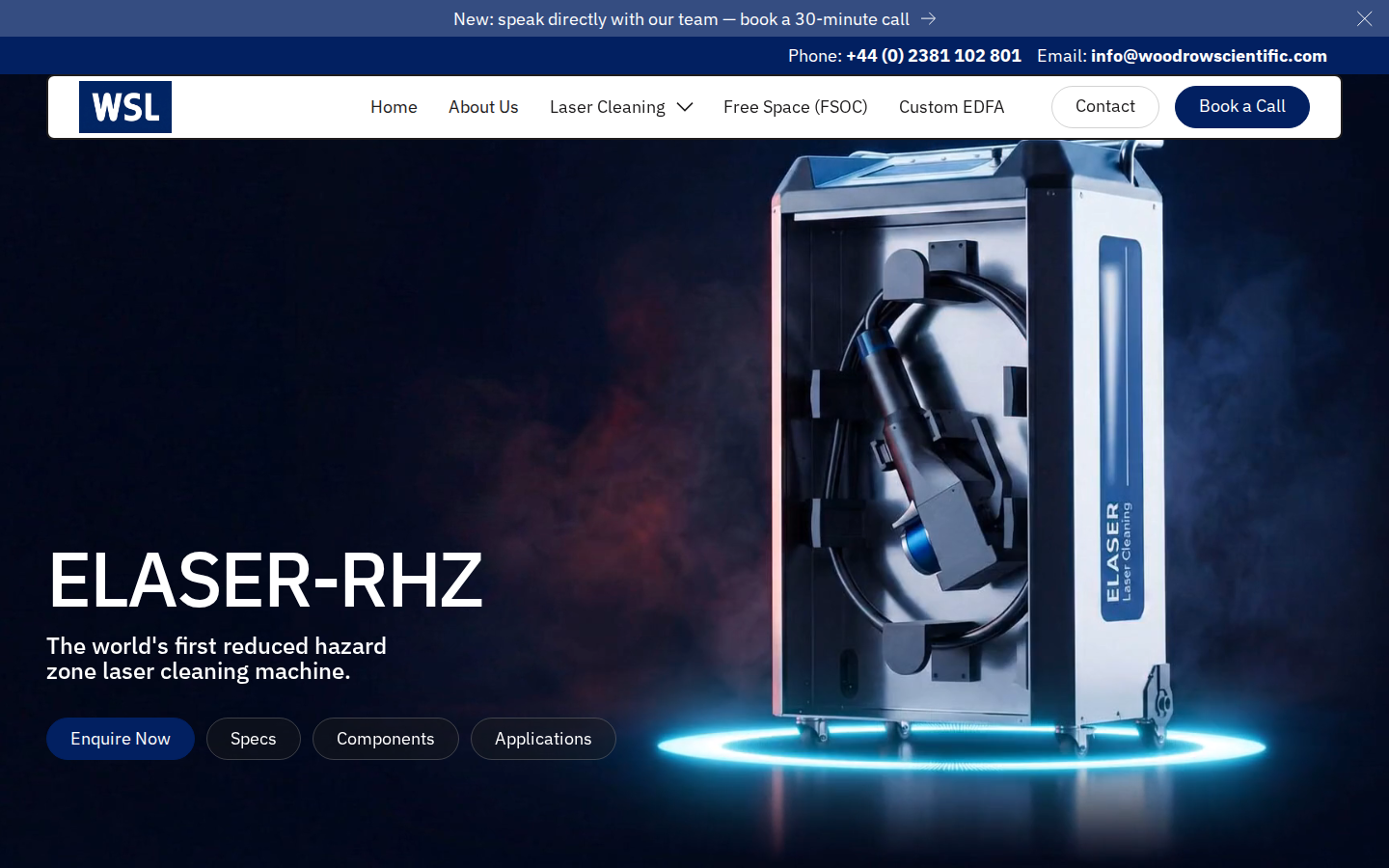
WSL's portable fibre laser cleaning system — carrying the world's only reduced hazard zone technology, enabling contamination removal in open workshops and mixed-use facilities without sealing off the area.
Pros:

World-first RHZ tech — open-workshop cleaning enabled
Zero consumables — no media, chemicals, or water
50 m cable reach vs competitors' 10 m
In-house UK manufacturer — not a reseller
Cons:

Not suited to heavy slag or burr removal
Quote-based pricing — no published list price
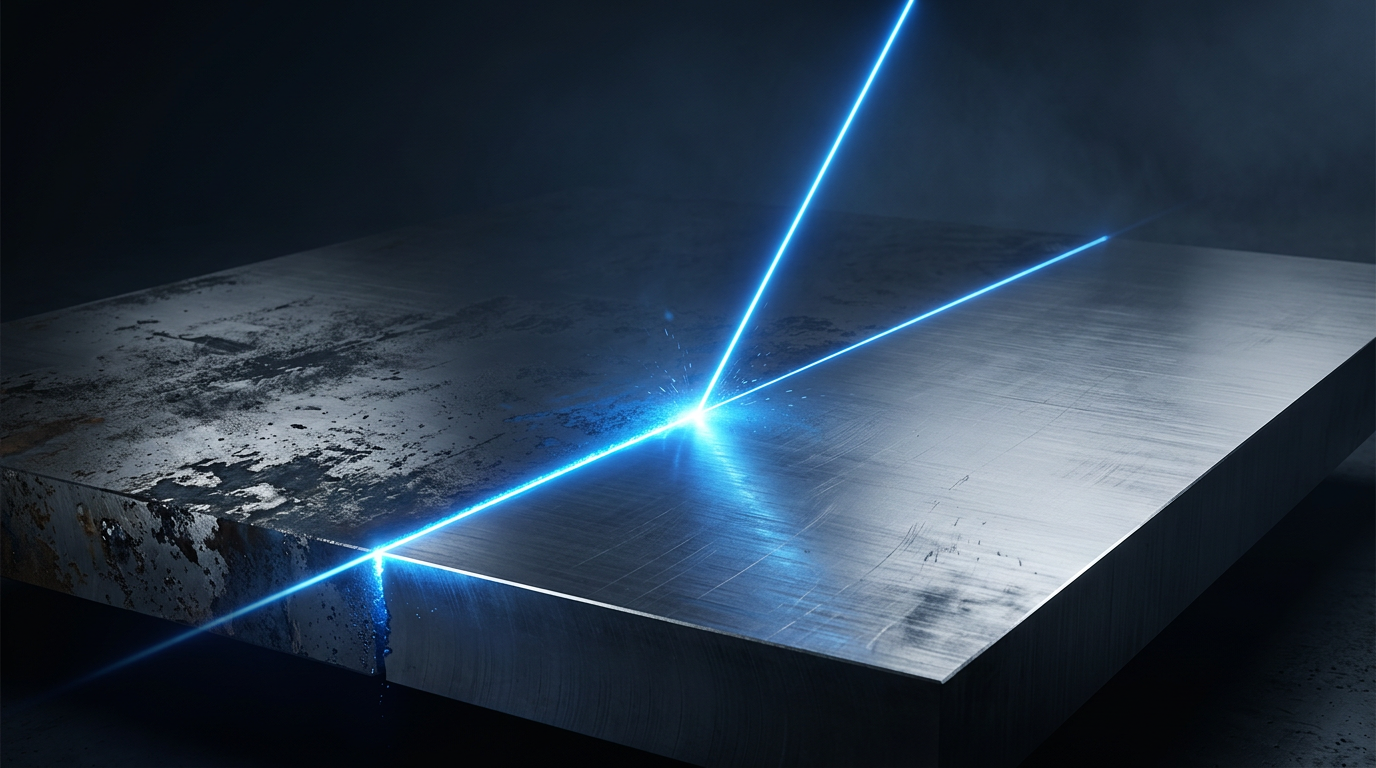
Laser cleaning works by directing a pulsed fibre laser at a contaminated surface, where the beam is absorbed by the contaminant and not by the base material — the contaminant is ablated away, leaving the substrate intact.
The ELASER and ELASER-RHZ are Woodrow Scientific Limited's portable laser cleaning systems, representing the laser cleaning category in this guide — the go-to technology for contamination removal, oxide stripping, and surface preparation without chemicals, abrasives, water, or consumable media.
Reduced Hazard Zone Technology
The single most significant barrier to laser cleaning adoption has historically been safety overhead: conventional systems require the working area to be sealed off and evacuated before cleaning can begin, making them impractical in open workshops, shared facilities, or public-facing environments.
The ELASER-RHZ removes that barrier entirely, carrying WSL's patented, world-first eye-safe technology that collapses the laser hazard zone to a fraction of conventional size.
This is the only laser cleaner of its kind: cleaning can proceed in open-plan manufacturing environments, mixed-use facilities, and publicly accessible spaces without shutting down the surrounding area.
The machine is CE and UKCA certified, and WSL provides full operator training — contact WSL directly for details on training delivery.
Portability and Cable Reach
The ELASER is a self-contained, wheeled unit weighing under 50 kg, with a handheld scanner under 3 kg — one operator can move and deploy it without additional equipment or support staff.
Where portability matters most is cable reach: the ELASER's delivery cable extends to 50 metres, allowing the operator to clean at significant distance from the main unit.
Most comparable portable laser cleaners on the market reach 10 metres or less, making the ELASER's reach a concrete operational advantage on large structures, plant equipment, and in-situ maintenance tasks.
The system requires only a standard single-phase power supply (110–250 VAC) and is air-cooled — no compressor, chiller, or water supply needed on site.
Substrate and Application Range
Fibre-laser power is tunable from 0–100% across 100 W, 200 W, and 300 W models, meaning a single machine handles everything from light surface oxides through to thick, bonded coatings — without swapping equipment or changing consumables.
- Rust and oxide removal: Strips rust, oxides, and tarnish from steel, cast iron, copper, brass, bronze, and aluminium alloys.
- Mill scale stripping: Removes mill scale from structural and fabricated steel ahead of coating or welding.
- Weld discolouration removal: Cleans heat tint and weld discolouration from stainless steel, titanium, and other alloys.
- Paint and coating removal: Lifts paint, powder coating, lacquer, primer, and adhesive residues from metal surfaces.
- Pre-weld surface preparation: Removes oil, grease, oxides, and contamination ahead of welding or bonding — without abrasive media or chemical residue.
- Mould and tooling cleaning: Strips release agents and build-up from injection moulds and tooling in place, with no disassembly required.
- Industrial maintenance cleaning: Cleans plant, equipment, and infrastructure on site — nothing to mask off, no media to clear up.
Substrate compatibility spans steel, carbon steel, aluminium alloys, cast iron, copper, brass, bronze, titanium, and galvanised metals, among others — a breadth that few other cleaning methods can match without process changes.
Pricing and Total Cost of Ownership
The ELASER is the European cost leader among comparable industrial laser cleaning machines — competitively priced through WSL's manufacturing and operational efficiencies, not by reducing quality.
Pricing is quote-based; contact Woodrow Scientific directly for a figure matched to your power requirement and specification.
When evaluating total cost of ownership, laser cleaning's economics are compelling: zero consumable spend, no media disposal, no chemical handling costs, and minimal substrate damage that reduces rework across the machine's working life.
Compared with sandblasting, chemical stripping, or water-jetting — where consumable, disposal, and rework costs accumulate continuously — the TCO case for laser cleaning strengthens significantly over time.
ELASER Against the Six Criteria
The table below maps the ELASER / ELASER-RHZ against the six evaluation criteria established in the introduction to this guide.
| Criterion | ELASER / ELASER-RHZ |
|---|---|
| Throughput | Continuous single-operator operation; 300 W maximum power; throughput scales with power model selected and contaminant type. |
| Substrate compatibility | Broad — steel, aluminium alloys, cast iron, copper, brass, bronze, titanium, galvanised, and more; tunable power spans light oxides to thick coatings. |
| Consumable cost | Zero — no media, chemicals, or water; air-cooled; only energy cost applies. |
| Footprint | Compact wheeled unit under 50 kg; handheld scanner under 3 kg; 50 m cable reach keeps the unit away from the work area. |
| Operator skill requirement | Moderate initial learning; touchscreen GUI with password-protected access; full training provided by WSL. |
| Safety overhead | Dramatically reduced vs conventional laser cleaning via RHZ technology; CE and UKCA certified; no area evacuation required with the ELASER-RHZ. |
Maps the ELASER / ELASER-RHZ against the six established evaluation criteria so the reader can assess performance on each axis at a glance, consistent with the framework introduced earlier in the guide.
WSL was founded in 2012 and is the only UK-based laser cleaning manufacturer — designing, building, servicing, and improving its machines entirely in-house, backed by over 200 years of combined engineering experience.
Many suppliers in the laser cleaning market are resellers or importers rebadging third-party machines, which typically means slower support, no in-house engineering capability, and no genuine route to product improvement — WSL's in-house model is a practical differentiator, not just a marketing point.
For buyers requiring fully automated, high-volume production cleaning, WSL also offers AutoLASE — a robotic cell with 3D machine-vision that generates cleaning paths automatically from a loaded part, built and supported by the same in-house engineering team.
See the ELASER Laser Cleaning System in Detail
The ELASER and ELASER-RHZ are portable fibre laser cleaning systems built by Woodrow Scientific. Explore the full specifications or view the eye-safe RHZ variant designed for open-workshop use.
Product 2
LISSMAC SBM-XL G2S2 — Abrasive Deburring and Edge Rounding
A fixed-installation throughfeed deburring machine by LISSMAC Maschinenbau GmbH that deburrs and rounds edges on flat sheet metal parts, processing both sides simultaneously in a single pass.
Pros:
Processes both sides of parts in one pass
Handles material from 0.5 mm to 120 mm
Dry process — no chemical handling required
Established dedicated deburring machine manufacturer
Cons:
Flat parts only — no complex 3D geometries
Large fixed installation; significant floor space required
Ongoing abrasive belt and brush consumable costs
The LISSMAC SBM-XL G2S2 is a conveyor-fed throughfeed machine built for abrasive deburring and edge rounding of flat sheet metal parts, manufactured by LISSMAC Maschinenbau GmbH of Bad Wurzach, Germany — a company with a focused product line dedicated to this finishing category.
Its application scope covers deburring of laser-cut, plasma-cut, and oxy-fuel-cut parts; edge rounding up to a 2 mm radius on both interior and exterior contours; slag removal; and oxide layer removal from CO2 laser-cut parts — the full range of finishing tasks that arise after thermal cutting of flat sheet.
| Criterion | SBM-XL G2S2 Assessment |
|---|---|
| Throughput | Double-sided processing in one pass; LISSMAC claims up to 60% work time savings versus single-sided machines |
| Substrate compatibility | Steel, stainless steel, and aluminium; material thickness 0.5 mm to 120 mm |
| Consumable cost | Ongoing — abrasive belts (corundum, silicon carbide, ceramic; P36–P180) and brush units; grit selection affects removal rate and tool life |
| Footprint | Large fixed installation requiring dedicated floor space; not portable |
| Operator skill | Moderate — feed rate, infeed depth, and grit selection must be balanced; electric unit adjustment reduces setup burden |
| Safety overhead | Dry process; dust extraction required; no chemical handling |
Applies the six evaluation criteria from the page's introduction framework to the SBM-XL G2S2, enabling direct comparison with other entries on the same axes.
The SBM-XL G2S2's defining capability is its double-sided, single-pass processing: grinding belts and brush units are mounted both above and below the workpiece, so the machine acts on both faces simultaneously as the part travels through on the conveyor.
For high-volume flat-part fabrication shops, this matters in a direct operational sense — heavy plasma- or oxy-fuel-cut plate no longer needs to be manually lifted and flipped between passes, a step that adds labour, handling risk, and cycle time at scale.
LISSMAC reports up to 60% work time savings compared to single-sided processing machines. The Fabricator documented a real-world installation where a fabricator reduced the number of times heavy parts had to be manually lifted from five lifts to two — a direct labour and safety benefit from eliminating the turn-over step.
The XL series is equipped with four processing units on both the top and bottom of the machine, and individual units can be switched on or off electrically — useful for adapting to different part sizes and production runs without a full reconfiguration.
Abrasive consumables are the machine's primary ongoing cost. Belt material — corundum, silicon carbide, or ceramic — is selected based on the required surface quality, aggressiveness, and the material being processed; grit ranges from P36 (coarse, high removal) to P180 (fine, lower aggression).
The removal rate on any LISSMAC machine is governed by three variables: abrasive material and grit, feed rate, and infeed depth. Getting the balance right for a given part and material is a learned skill — not a barrier for an experienced operator, but worth factoring into onboarding time.
SBM-XL G2S2 Trade-Offs
The machine's scope is flat parts only. It cannot process complex three-dimensional geometries or reach deep internal contours — buyers with a mixed part mix that includes formed or welded assemblies will need a separate finishing solution for those components.
As a fixed installation, the SBM-XL G2S2 represents a meaningful capital commitment and requires dedicated floor space in the fabrication shop — a real constraint for smaller operations or facilities without a planned finishing area.
LISSMAC SBM-XL G2S2 Pricing
Pricing is available on request from LISSMAC or their authorised distributors. As with any capital finishing installation, buyers should evaluate total cost of ownership — factoring in consumable replacement (belts and brush units), dust extraction infrastructure, and operator setup time — alongside the headline machine cost.
Product 3
ARKU EdgeBreaker 6000
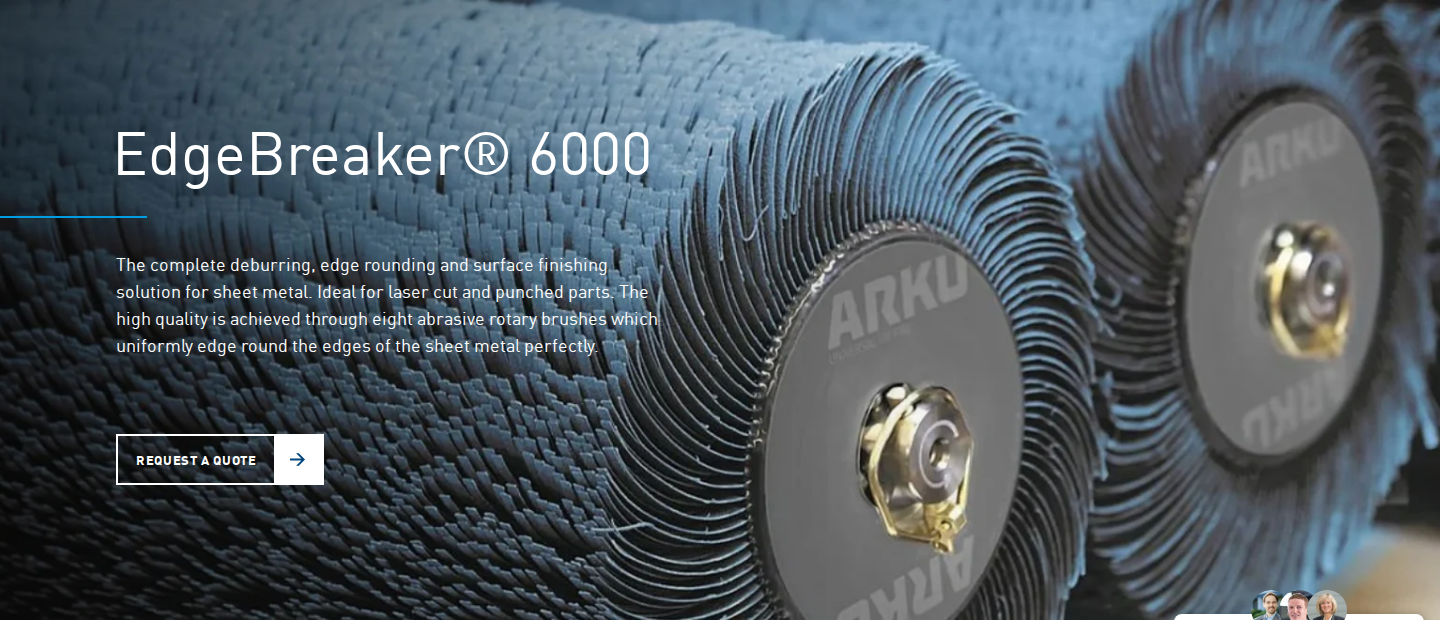
A single-pass throughfeed machine by ARKU Maschinenbau GmbH that combines deburring, edge rounding up to 2.0 mm radius, and surface finishing in one operation on laser-cut and punched flat sheet metal parts.
Pros:
Three finishing stages completed in one pass
Rotary brushes round all contour directions uniformly
ARKU Wizard: four-parameter setup, low skill needed
Vacuum table secures parts from 1.3 x 1.3 cm
Cons:
Single-sided only — second pass needed for both sides
Large fixed installation; significant floor space required
Three proprietary consumable types — ongoing tooling cost
Not suited to slag or heavy plate cutting
The ARKU EdgeBreaker 6000 is a conveyor-fed throughfeed machine manufactured by ARKU Maschinenbau GmbH of Baden-Baden, Germany — an established producer of deburring and levelling machines for sheet metal fabrication.
Where the LISSMAC SBM-XL G2S2 covered in the previous entry processes both faces of a part simultaneously, the EdgeBreaker 6000 is single-sided — but it adds a third finishing stage that the LISSMAC does not integrate in the same package: a surface finishing unit that produces a grained or non-directional finish in the same pass.
Three-Stage Tooling Sequence
The machine runs parts through three consecutive tooling stations in a single pass: a grinding belt that removes burrs from the cut edge, a rotor fitted with rotary brushes that rounds those edges, and a finishing fleece belt that applies a surface finish.
The rotary brush arrangement is a distinguishing design feature: because the brushes contact the sheet from multiple directions as the rotor turns, they produce consistent edge rounding on both outer and inner contours — including complex internal cut-outs — rather than acting only along a single axis.
Edge rounding radius reaches up to 2.0 mm, verified from ARKU's own product page. The surface finishing stage delivers either a linear grained finish or a non-directional matte finish depending on the tooling configuration.
Finishing Jobs the EdgeBreaker 6000 Handles
- Deburring: Removes burrs from laser-cut and punched sheet metal parts up to 25 mm material thickness.
- Edge rounding: Rounds cut edges uniformly on all contour directions, up to a 2.0 mm radius.
- Surface finishing: Applies a grained or non-directional finish to the part surface in the same pass.
- Small-part processing: Vacuum table secures parts as small as 1.3 x 1.3 cm alongside large-format sheet.
- Multi-alloy compatibility: Processes steel, stainless steel, aluminium, brass, copper, titanium, and special alloys.
The machine is not suited to heavy slag removal from plasma or oxy-fuel cutting, nor to descaling of structural plate — those finishing problems require a different machine category entirely.
Setup and Operator Experience
Setup is handled through the ARKU Wizard, a patented software interface built into the machine control system. The operator enters four parameters: material type, burr size, material thickness, and desired edge rounding radius.
The Wizard links those inputs to tool and machine data, then configures the processing settings automatically — including compensation for tool wear, which the machine measures and accounts for without requiring the operator to re-measure manually.
This reduces the operator skill requirement considerably relative to machines that require manual process parameter selection, making the EdgeBreaker 6000 accessible in fabrication environments where a dedicated finishing specialist is not available.
EdgeBreaker 6000: Six-Axis Evaluation
The table below maps the EdgeBreaker 6000 against the six evaluation axes used across this comparison.
| Axis | EdgeBreaker 6000 |
|---|---|
| Throughput | Continuous conveyor-fed throughfeed; single-sided, dry process. One pass per side. Suited to production volume on laser-cut and punched flat parts. |
| Substrate compatibility | Sheet metal up to 25 mm thick, up to 1,300 mm working width. Steel, stainless, aluminium, brass, copper, titanium, and special alloys. Flat parts only; not suited to heavy plate or slag-bearing cuts. |
| Consumable cost | Three consumable types: abrasive grinding belt, rotary brush elements, finishing fleece belt. All are proprietary ARKU tooling — an ongoing operational cost at each replacement interval. |
| Footprint | Approx. 4,200 x 2,100 x 2,350 mm (L x W x H); approx. 6,500 kg. Fixed floor installation; not portable. Requires dedicated floor space and dust extraction connection. |
| Operator skill requirement | Low to moderate. ARKU Wizard four-parameter setup; machine self-configures and compensates for tool wear automatically. |
| Safety overhead | Dry abrasive process; dust extraction required as standard. No chemical handling, no wet process. Lower safety complexity than chemical or electrochemical finishing methods. |
Presents the EdgeBreaker 6000 against the six evaluation axes established in the article introduction, giving the reader a structured reference that mirrors the framework used across sibling entries.
The single-sided processing constraint is the clearest trade-off in this table: parts with burrs on both the top and bottom face — common with certain punching operations or laser-cutting setups — require a second pass with the part flipped, or a double-sided machine.
The LISSMAC SBM-XL G2S2 eliminates that second pass by processing both faces simultaneously, but does not integrate a dedicated surface finishing stage in the same way. These are different trade-off profiles suited to different shop configurations and finishing output requirements — neither is categorically superior.
EdgeBreaker 6000 Pricing
The EdgeBreaker 6000 is capital equipment priced on request. No published list price is available; pricing can be obtained directly from ARKU Maschinenbau GmbH.
Product 4
Rösler RDGE Wire Mesh Belt Shot Blast Machine
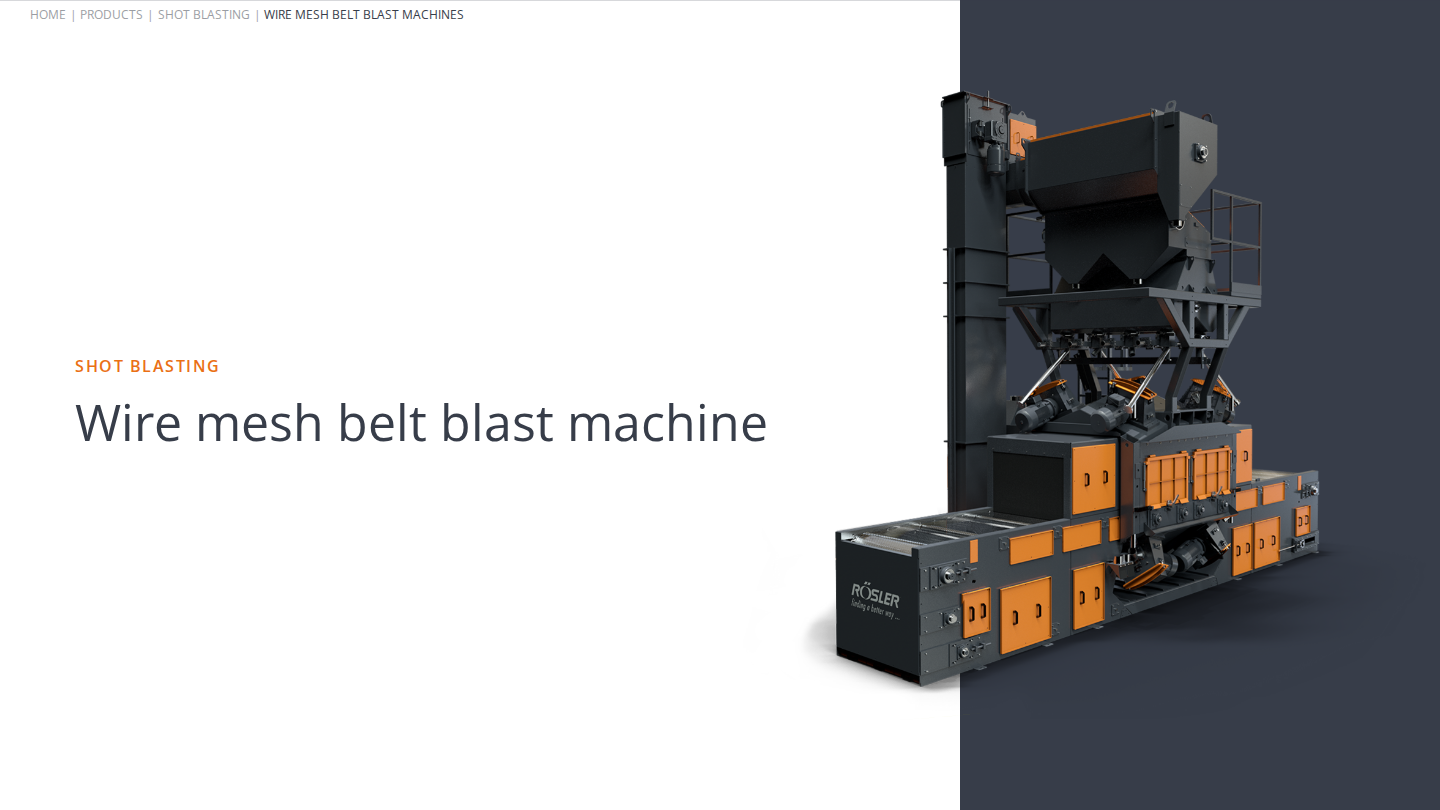
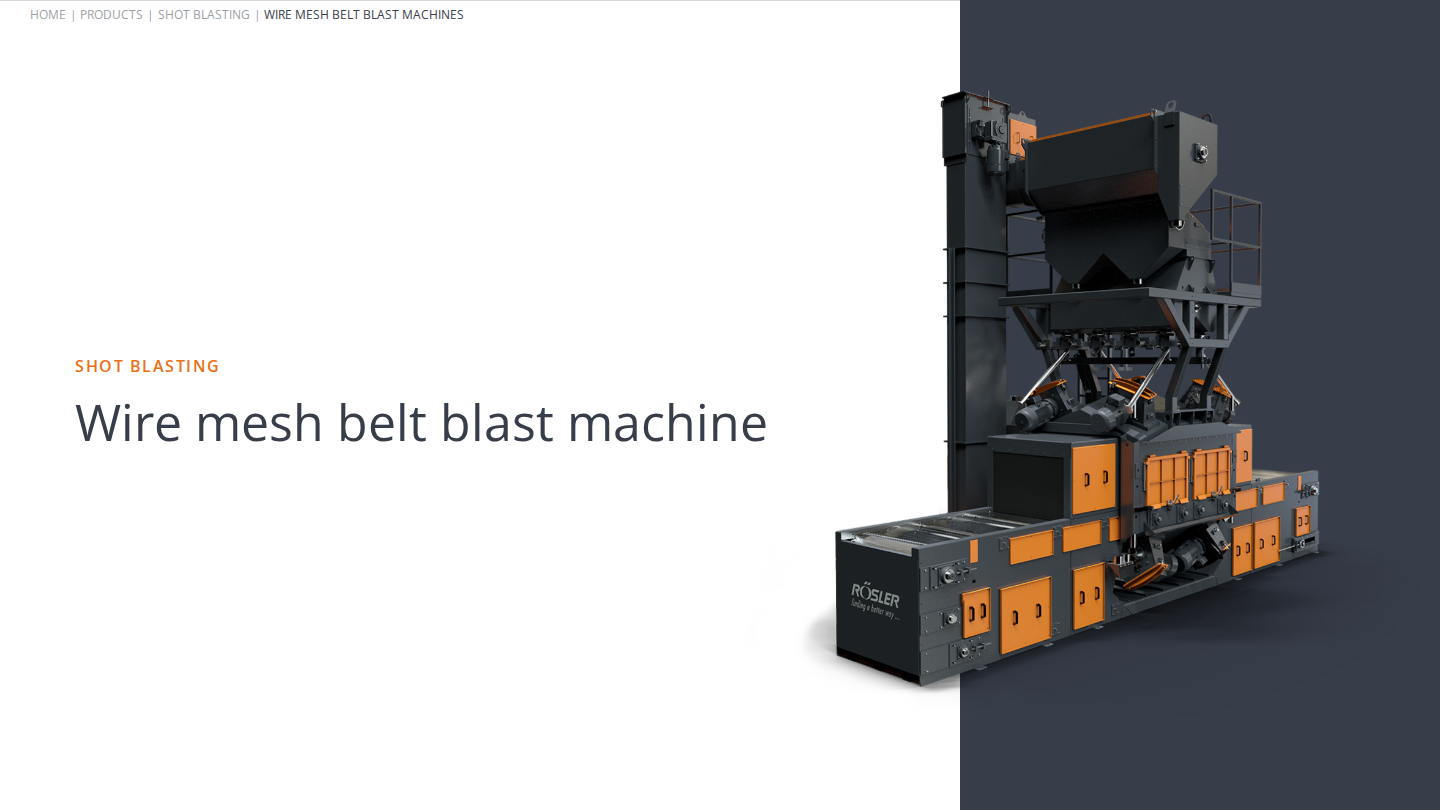
A wire mesh belt shot blast machine by Rösler, designed for high-volume descaling, de-rusting, and surface texturing of castings, forgings, flame-cut steel, and structural sections in heavy fabrication environments.
Pros:
High throughput via continuous conveyor feed
Up to eight turbines for broad coverage
Wire mesh belt minimises blast shadows on parts
Handles castings, forgings, and structural steel sections
Cons:
Significant ongoing blast media consumable costs
Large fixed installation; dedicated floor space required
High safety overhead: dust, noise, PPE required
Not suited to precision or delicate components
The Rösler RDGE is a wire mesh belt shot blast machine — a category of metal finishing machine built for a class of surface problem that abrasive belt and brush-based machines cannot address: heavy mill scale, heat-affected oxide on flame-cut and plasma-cut steel, foundry sand on castings, and rust on structural sections.
Shot blasting works by accelerating abrasive media (steel shot or steel grit) at high velocity using rotating blast turbines, driving the media against the workpiece surface to strip contamination and simultaneously create a defined surface texture.
RDGE Design: Belt Configuration and Turbine Arrangement
The defining feature of the RDGE within the Rösler shot blast range is its wire mesh belt transport system. Parts ride on a continuous, high-strength wire mesh belt through the blast chamber — and because the belt is open mesh, the lower turbines can blast through it, acting on the workpiece from below as well as above.
Rösler describes this arrangement as minimising the formation of blast shadows — the so-called "cover effect" — on complex geometries, because the workpiece is never shielded by a solid conveyor surface on its underside.
The standard RDGE configuration carries four Gamma G blast turbines; an eight-turbine configuration is available across multiple belt-width variants. Belt widths across the RDGE range run from 600 mm to 1,600 mm, with transport speed variable between 0.6 and 6.0 m/min, allowing operators to tune dwell time in the blast zone to match part type and contamination level.
The machine includes a multi-stage blast media cleaning and recirculation system: spent media and debris pass through vibratory screening conveyors and a magnetic separator before clean media is returned to the turbines. Rösler states the magnetic separator achieves a cleaning efficiency of up to 99.8%, and media dosing is handled automatically via a level sensor and replenishment system.
Rösler RDGE: Six-Criteria Evaluation
The table below maps the six evaluation criteria used across this comparison to the RDGE's characteristics, drawing from Rösler's own published specifications and product documentation.
| Criterion | Assessment |
|---|---|
| Throughput | High. Continuous conveyor feed supports volume processing; placing multiple small parts side by side on the belt increases throughput further. Well suited to foundry, forge, and structural steel environments where large quantities of parts require processing. |
| Substrate compatibility | Broad across robust part types: castings, forgings, flame-cut and plasma-cut steel, structural sections, weldments, and die castings. Not suited to thin-section, precision-finished, or delicate components that cannot withstand media impact. |
| Consumable cost | Significant ongoing cost. Steel shot and steel grit degrade over time and must be replenished; the integrated recirculation system recovers and cleans spent media, but does not eliminate replenishment. Turbine blades and wear liners are additional maintenance consumables. |
| Footprint | Large fixed installation. Requires dedicated floor space plus integrated dust extraction, media handling, and containment infrastructure. Not portable or easily relocated. |
| Operator skill | Moderate. Variable belt speed and turbine parameters allow process tuning; selecting the correct media type, shot size, and blast settings for a given part and contamination level requires process knowledge. |
| Safety overhead | High relative to abrasive belt or laser entries on this list. Blast media generates airborne dust and significant noise; hearing protection, respiratory protection, and eye protection are required. Dust extraction and containment are integral to the machine, not optional. |
Maps all six framework evaluation criteria to the Rösler RDGE's performance, allowing readers to compare this entry against the other machines on the list on the same axes.
Spent blast media classified as waste carries environmental disposal obligations and represents an ongoing compliance overhead that should be factored into total cost of ownership assessments.
Shot blasting is not a precision finishing method. The surface texture it produces is defined by media type and blast parameters, and it cannot substitute for grinding or machining where tight dimensional tolerances are required.
As capital equipment in the heavy fabrication category, the RDGE is sold on a quote basis — no list pricing is published, and machine cost will vary with belt width, turbine count, and site-specific infrastructure requirements.
The RDGE is part of a broader Rösler shot blasting range that includes roller conveyor, hanger, and drum configurations; the wire mesh belt variant is the design specifically suited to parts that would tip, jam, or be inadequately covered on a roller conveyor system.
Not Sure Which Finishing Process Is Right?
Woodrow Scientific works with industrial teams across finishing categories. Book a 30-minute call with a laser cleaning expert to talk through your specific surface problem and find the right solution.
Product 5
Walter SURFOX — Electrochemical Weld Cleaning and Passivation

Walter Surface Technologies' electrochemical weld cleaning system for stainless steel, removing heat tint and restoring passivation after welding — a portable, lower-hazard alternative to pickling pastes and acid dip tanks.
Pros:
Portable handheld units — no fixed installation needed
Safer chemistry than pickling pastes or acid dip
Electrolytes approved for food industry use
Cleans and passivates in seconds per weld zone
Cons:
Stainless steel only — narrow substrate scope
Chemical consumables and disposal required ongoing
Not suited to general surface finishing jobs
Electrochemical weld cleaning occupies a distinct position in the metal finishing machine landscape: it uses electrical current combined with an electrolyte solution to remove heat tint and weld oxide from stainless steel, simultaneously restoring the chromium oxide passive layer that welding heat destroys.
Walter Surface Technologies, headquartered in Windsor, Connecticut, manufactures the SURFOX range — an established product line spanning compact fieldwork units through heavier-duty industrial models, including the SURFOX Mini, SURFOX Turbo, SURFOX Max, SURFOX 206, and SURFOX 306. According to FF Journal, Walter introduced its sixth-generation system in 2024.
Walter SURFOX Applications
SURFOX removes heat tint from the heat-affected zones of TIG, MIG, plasma, spot, and laser welds on stainless steel, cleaning the surface and initiating passivation without altering the parent material's finish.
Walter positions SURFOX as a safer, faster, and more cost-effective alternative to pickling pastes and acid dip tanks — the relevant comparison for this finishing category, where traditional chemistry involves hydrofluoric and nitric acid hazards.
Substrate scope is narrow by design: stainless steel is the primary material, with aluminium supported on several models. Carbon steel and general surface contamination removal are outside the system's scope.
Walter SURFOX Performance and Portability
Walter's own documentation cites a cleaning speed of 3 to 5 feet per minute for heat tint removal and passivation — a meaningful throughput figure for weld-by-weld cleaning, where each individual weld zone takes only seconds to treat without scratching or damaging the surrounding surface.
The SURFOX range is built around handheld wand-and-unit configurations, with bench-top portability and no requirement for fixed installation or dedicated floor space — well suited to in-situ cleaning on fabricated structures, on-site maintenance, and fieldwork.
Walter SURFOX Consumables and Safety
The primary consumables are the electrolyte solutions: SURFOX-T for cleaning, SURFOX-G for general use, and SURFOX-N as the cleaning and neutralising formula applied after treatment. Walter's own user documentation describes these as phosphoric acid-based solutions approved for food industry use.
The electrolyte chemistry is less hazardous than traditional HF/nitric acid pickling pastes — the SURFOX-N neutraliser is classified as non-hazardous under GHS according to Walter's own safety data sheet — but chemical handling protocols, correct PPE, and proper disposal procedures remain obligations throughout.
Operator skill requirement is low: the primary PPE is nitrile gloves and safety goggles, and Walter's documentation notes that respiratory protection requirements are linked to ventilation conditions rather than being a blanket requirement under normal use.
| Criterion | SURFOX Performance |
|---|---|
| Throughput / Cleaning Speed | 3–5 feet per minute; seconds per weld zone |
| Substrate Compatibility | Stainless steel primarily; aluminium on select models |
| Consumable Cost | Ongoing electrolyte solutions (SURFOX-T, SURFOX-G, SURFOX-N); food-industry approved |
| Footprint | Handheld / bench-top; no fixed installation required |
| Operator Skill Requirement | Low; nitrile gloves and safety goggles as primary PPE |
| Safety Overhead | Lower than pickling pastes; chemical handling and disposal still required |
Maps the six evaluation criteria used consistently across all five entries to SURFOX's verified performance, giving the reader the same comparative scaffold in a scannable format.
The honest trade-off with SURFOX is scope: it is purpose-built for stainless steel weld cleaning and passivation, and cannot substitute for abrasive deburring, shot blasting, or laser cleaning when those finishing problems arise.
Chemical consumables and their disposal represent an ongoing operational obligation — one that a dry or consumable-free process would not carry.
"Electrochemical weld cleaning [is] a fast, safe and easy method to achieve passivation."
Conclusion
Matching Your Finishing Problem to the Right Machine
Across every category covered here, the pattern holds: the finishing problem defines the machine, not the other way around. Abrasive deburring suits cut sheet; shot blasting suits heavy scale at volume; electrochemical finishing suits stainless weld passivation. And when the job is contamination removal, oxide stripping, or weld prep where substrate integrity cannot be compromised, laser cleaning is the right category — with zero consumables shifting the total cost of ownership decisively in its favour.
For buyers in that space, the ELASER / ELASER-RHZ from Woodrow Scientific is the natural starting point.
Frequently Asked Questions About Metal Finishing Machines
Common questions about metal finishing equipment, finishing methods, and how to choose the right machine for your application.
Start by identifying the specific finishing problem you need to solve: contamination removal, burr removal, slag, surface texture, or weld passivation. Then evaluate candidate machines against six criteria — throughput, substrate compatibility, consumable cost, footprint, operator skill requirement, and safety overhead. The right machine is the one that addresses your finishing problem within the constraints your facility actually has. Beyond upfront price, total cost of ownership is the more reliable guide. Consumable cost, unplanned downtime, and rework reduction each compound over a machine's operating life — a machine that costs more to buy but eliminates consumables and rework can be significantly cheaper over three to five years than a lower-priced alternative with ongoing media or chemical spend.
For applications where substrate integrity matters — pre-weld preparation, oxide removal, mould cleaning — laser cleaning has a clear advantage. It removes only the contaminant layer without abrading the base material, produces no spent media or chemical waste, and carries lower total running costs once capital is accounted for. Sandblasting has genuine strengths of its own. It carries a lower upfront cost and delivers higher throughput on large structural steel applications such as descaling heavy plate or shot-peening fabrications at volume. The trade-off is selectivity: sandblasting removes material less precisely and generates significant waste streams, including spent media, airborne dust, and associated disposal obligations. The honest answer is that neither method is universally superior. Laser cleaning suits precision, contamination-sensitive, or waste-constrained applications; sandblasting suits high-volume structural work where surface selectivity is less critical.
Industrial metal finishing covers the surface treatment operations performed after cutting or forming — burr and slag removal, edge rounding, oxide and contamination removal, shot blasting for scale removal and surface texturing, and electrochemical treatment for passivation. Each operation addresses a specific surface condition left by the preceding manufacturing step. In practical terms, each finishing step prepares the part for what comes next. Paint adhesion, weld quality, corrosion resistance, and dimensional accuracy all depend on correct surface preparation — a part that skips or receives inadequate finishing is more likely to fail inspection, reject coating, or underperform in service.
The main categories of metal finishing machine are laser cleaning machines, abrasive deburring machines (belt and brush types), shot blast machines, and electrochemical finishing systems. Each is engineered for a distinct class of finishing problem, and they are not interchangeable. Laser cleaning machines remove surface contamination — rust, oxides, coatings — without touching the base material. Abrasive deburring machines handle burr removal and edge rounding on cut or punched flat sheet. Shot blast machines descale and texture surfaces at high volume, suited to castings, forgings, and structural steel. Electrochemical finishing systems address weld passivation on stainless steel, restoring corrosion resistance after welding. Selecting the wrong category for a given job will either fail to solve the problem or damage the workpiece.
Surface grinding machines are the primary class used to grind metal flat to tight dimensional tolerances. Wide-belt deburring machines also flatten surface irregularities as part of the deburring process on flat sheet metal, though flatness is a by-product of their primary deburring function rather than their core purpose. Surface grinding machines use abrasive wheels to remove stock progressively, achieving precise flatness across the workpiece. Wide-belt machines — the type used in abrasive deburring — run flat sheet parts through conveyor-fed abrasive belts and can reduce surface irregularities and weld spatter as part of the same pass that removes burrs and rounds edges.