
Introduction
If you are a procurement manager, engineer, or industrial buyer with a finishing requirement on the table, the hard part is not finding machines — it is working out which category of machine is right for your application.
The market spans genuinely different technologies, each built on different operating principles, suited to different materials, and carrying very different cost profiles. Choosing the wrong category means wasted capital, rework, and compliance exposure that can surface only after commissioning.
This guide gives you a practical framework for making that call — working through material compatibility, production volume, surface precision, and total cost of ownership in a way that maps to a real purchasing decision.
The evaluation is category-neutral: no single technology is the answer for every application.
TL;DR
The right metal finishing machine is rarely the most familiar option or the lowest sticker price — it is the one whose category genuinely fits your material, your volume, and your precision requirements. The evaluation framework is what determines a sound investment; the machine catalogue is secondary.
This article covers:

How mechanical, chemical, and laser systems differ
Matching machine category to your substrate
Production volume and throughput fit
Surface precision and finish quality by method
Total cost of ownership across categories
Environmental and regulatory compliance costs
What is a metal finishing machine?
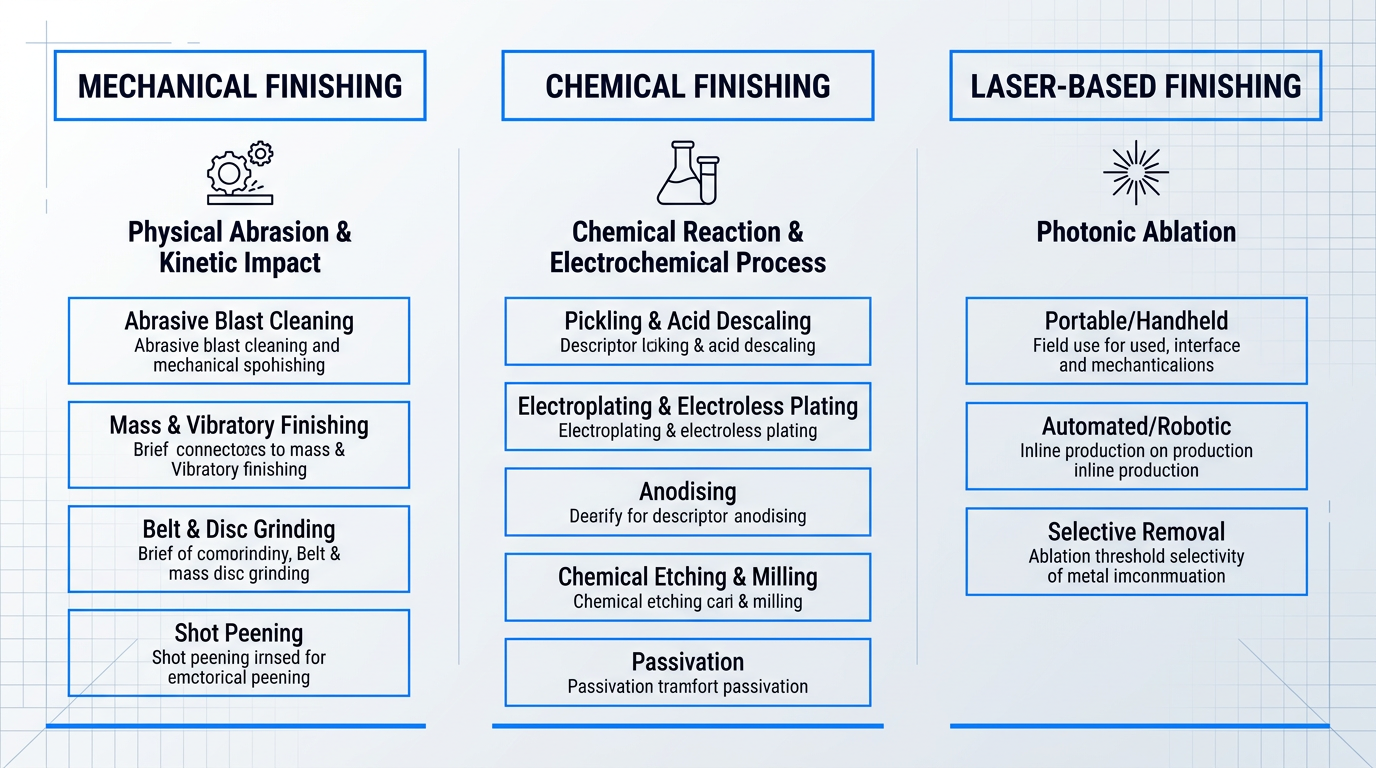
The term metal finishing covers a broader territory than many buyers initially expect. In its industrial sense, it encompasses any process that alters the surface of a metal workpiece to improve appearance, durability, or corrosion resistance — or to prepare it for a downstream operation such as coating, bonding, or welding. A metal finishing machine is the equipment that executes one of these processes at production scale. Across that wide territory, machines fall into three distinct families, each defined by a fundamentally different operating mechanism: mechanical, chemical, and laser-based.
Mechanical finishing: abrasion and kinetic impact
Mechanical finishing machines act on the workpiece through physical abrasion or kinetic impact — either propelling media against the surface or bringing an abrasive medium into sustained contact with it. The operating principle is direct: material is removed or surface stress is modified through mechanical force, with no chemical reaction involved.
- Abrasive blast cleaning: Shot blasting and grit blasting propel abrasive media via centrifugal wheels or compressed air to remove rust, mill scale, and weld spatter and prepare surfaces for coating.
- Mass and vibratory finishing: Parts are loaded with abrasive media in a container; applied motion causes the media to deburr, radius edges, and finish all exposed surfaces simultaneously.
- Belt and disc grinding / brush deburring: Abrasive belts, discs, or brush systems remove oxide layers, burrs, and weld spatter from flat or profiled parts.
- Shot peening: Kinetic media impact induces compressive residual stress in the surface layer — a surface engineering process for fatigue life improvement, not a cleaning operation.
Mechanical methods are the most broadly deployed family across general fabrication, handling everything from heavy descaling to fine edge radiusing. Their reliance on physical contact with the substrate is a defining characteristic that carries implications for substrate sensitivity — a dimension the guide examines in detail in later sections.
Chemical finishing: reaction and electrochemical processes
Chemical finishing machines process the workpiece through a chemical reaction with the metal surface or through an applied electrical current. The surface is transformed or coated at a molecular level rather than by physical abrasion. The EPA's Metal Finishing Effluent Guidelines (40 CFR Part 433) define six primary operations that trigger regulatory coverage: electroplating, electroless plating, anodising, coating, chemical etching and milling, and printed circuit board manufacture — all of which fall within this family.
- Pickling and acid descaling: Chemical immersion in acid solutions removes mill scale and oxides from hot-worked steel; a more aggressive treatment than general acid cleaning.
- Electroplating and electroless plating: A coating metal is deposited onto the substrate via electrical current (electroplating) or an autocatalytic chemical reaction (electroless plating).
- Anodising: Applied electrical current converts the aluminium surface to aluminium oxide, producing an integrated, corrosion-resistant layer rather than an applied coating.
- Chemical etching and milling: Controlled chemical dissolution removes surface material to produce specific geometries, tolerances, or surface appearances.
- Passivation: A passive oxide layer is formed for corrosion resistance, commonly applied to stainless steel, aluminium, and titanium.
Of the three families, chemical processes carry the most significant regulatory overhead. Any facility performing at least one of the six EPA-defined core operations is subject to 40 CFR Part 433 wastewater discharge standards — a compliance dimension that has no equivalent in mechanical or laser-based finishing.
Laser-based finishing: photonic ablation
Laser-based finishing machines remove surface contamination or coatings using a focused beam of light. The mechanism is photonic ablation: the beam delivers energy that vaporises the target layer — rust, paint, oxide, or other contamination — while stopping at the base material's ablation threshold, leaving the substrate intact.
Every material has a specific ablation threshold determined by its molecular bonds. When the difference between the threshold of the contaminant and that of the base metal is sufficiently large, the laser selectively removes one without affecting the other. Laser systems are available in both portable/handheld configurations for on-site or field use and automated/robotic configurations for inline production environments.
Mechanical methods act through physical contact, chemical methods through molecular reaction, and laser methods through selective photonic energy. The operating mechanism — not the application — is what determines substrate compatibility, regulatory exposure, and process flexibility. Category selection starts here.
This guide focuses on surface processing machinery for deburring, descaling, cleaning, and surface preparation. Decorative plating lines, printed circuit board manufacture, and other specialised downstream operations are outside its scope.
With the three category families and their operating principles established, the next step is understanding what each type of machine actually does — what specific contaminants it handles, what configurations it runs in, and what surface conditions it is designed to address.
Types of metal finishing machines explained
Every metal finishing machine belongs to one of three families — mechanical, chemical, or laser-based — each built around a fundamentally different way of acting on a metal surface. Within those families, distinct sub-categories target specific contaminants, surface conditions, and production configurations. Understanding what each type actually does is the foundation for every evaluation decision that follows.
Mechanical finishing machines
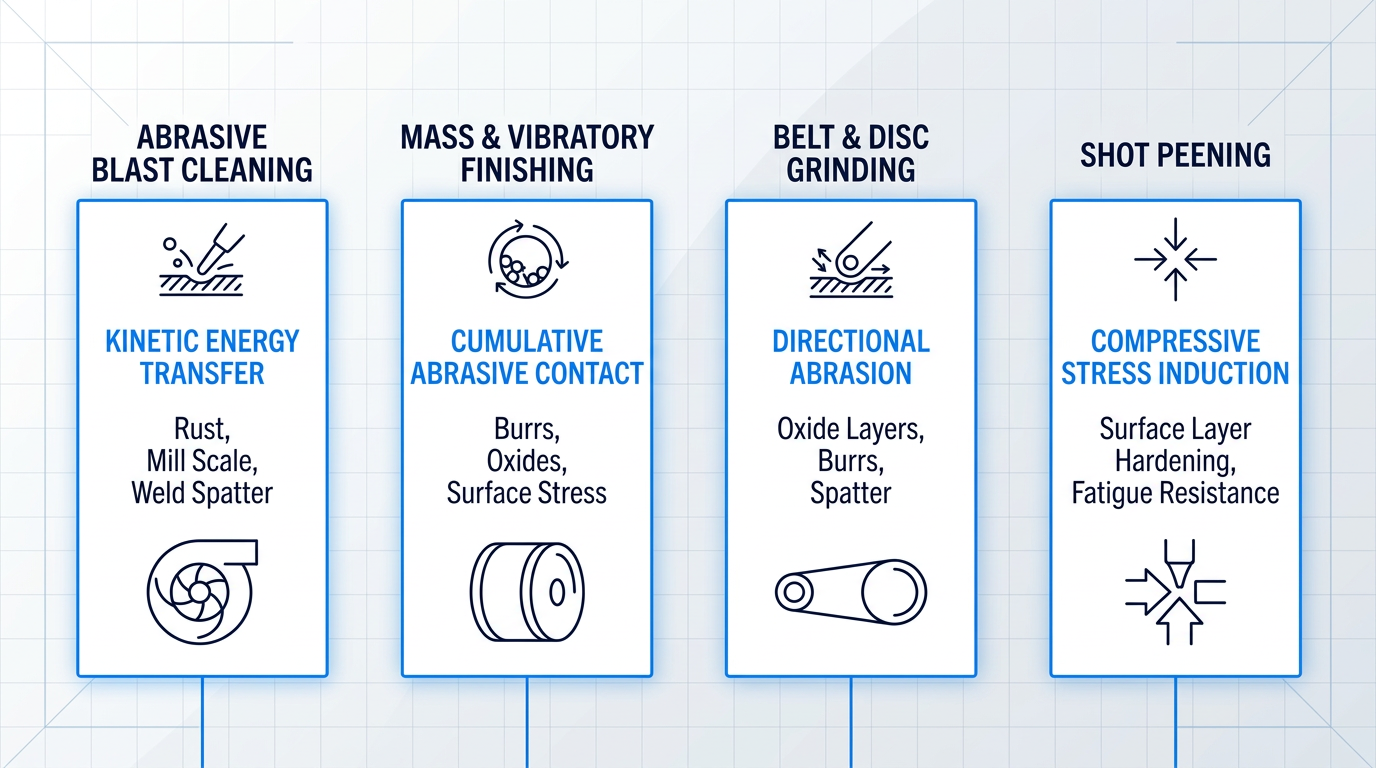
Abrasive blast cleaning — encompassing shot blasting and grit blasting — propels abrasive media at the workpiece surface using either centrifugal wheels or compressed-air nozzles. The operating principle is kinetic energy transfer: media impact physically dislodges rust, mill scale, weld spatter, and other surface contaminants, leaving a clean, profiled surface ready for coating or bonding.
Blast cleaning systems are available in inline conveyor-fed configurations for continuous production and in batch configurations for lower-volume or irregular workloads.
Mass and vibratory finishing — including barrel tumbling and centrifugal disc finishing — loads parts together with abrasive media in a bowl or barrel and applies controlled motion so parts and media move continuously against each other. The operating principle is cumulative abrasive contact across all exposed surfaces simultaneously, which deburrs edges, radiuses corners, cleans, and can modify surface stress without individual part handling.
This approach is particularly well-suited to high-volume runs of small-to-medium parts, where processing each component individually would be impractical.
Belt and disc grinding, along with brush deburring systems, removes oxide layers, burrs, and weld spatter from flat or profiled parts using abrasive belts, discs, or rotating brush heads. Unlike mass finishing, this category works on individual parts or surfaces and produces a directional finish — it is a common step in post-laser-cut and post-stamp workflows where a consistent surface texture is required.
Shot peening uses the same kinetic media impact as blast cleaning, but the intent and process parameters are entirely different. The goal is not surface cleaning: it is to induce compressive residual stress in the surface layer of the workpiece, which improves fatigue life. Shot peening is a surface engineering process, and its typical applications are aerospace and automotive components where fatigue performance is a design requirement.
Chemical finishing processes
Pickling and acid descaling immerses metal workpieces in acid solutions — sulphuric or hydrochloric acid are standard for steel — to remove mill scale and oxides produced during hot-working operations. The operating principle is chemical dissolution of the oxide layer rather than mechanical removal, making it applicable across a wide range of product forms including bar, sheet, strip, wire, and forgings.
Electrochemical and anodising lines use electrical current to apply or convert surface layers. Electroplating deposits a coating metal onto the workpiece; anodising converts the aluminium surface into a harder aluminium oxide layer. Both processes are driven by an electrochemical reaction — current is the mechanism — and both are EPA-regulated primary operations, a regulatory context covered in detail later in this guide.
Chemical etching and passivation are distinct wet-chemistry processes with different intents. Etching is the controlled chemical removal of surface material, used to prepare surfaces for bonding or to achieve a specific surface texture. Passivation forms a passive oxide layer that resists corrosion, commonly applied to stainless steel, aluminium, and titanium. One process removes material; the other adds a protective layer.
Laser-based surface preparation
Laser-based cleaning and surface preparation works through selective laser ablation: the beam's energy couples preferentially with the contaminant layer — rust, oxides, paint, mill scale, or release agents — vaporising it, while the base material's higher ablation threshold stops the process at the substrate surface. There is no abrasive media, no chemical solution, and no water involved in the process.
The selectivity of the ablation mechanism is what physically distinguishes laser-based methods from mechanical and chemical alternatives: the process stops naturally at the material boundary rather than requiring the operator to control removal depth through process time or media selection.
Laser-based systems span a wide deployment range, from single-operator portable and handheld units to robotic cells integrated into automated production lines — a range that has practical implications for how these systems fit different production environments, which the automation section of this guide addresses directly.
Mechanical systems act through kinetic or abrasive force. Chemical systems act through dissolution or electrochemical reaction. Laser-based systems act through photonic energy coupling. Because the underlying physics differ, so do the capability profiles, material compatibility constraints, and environmental obligations of each family — which is precisely why no single evaluation criterion applies equally across all three.
With the operating principles of each sub-category established, the natural next question is whether a given type is safe and effective for your specific substrate — and that is where the evaluation begins.
Matching Your Substrate to the Right Machine Category
Before production volume, before surface finish targets, before total cost of ownership — material compatibility is the first question to answer when evaluating a metal finishing machine. The wrong category for a given substrate does not just produce a suboptimal result; it can embed abrasive particles into a soft surface, trigger over-etching, cause incompatible chemical reactions, or strip a protective coating that was never meant to be removed.
Each finishing category acts on metal through a fundamentally different operating principle: kinetic abrasion, wet chemistry, or photonic ablation. That operating principle determines which substrates it can safely process — and understanding the mechanism is more useful than memorising a compatibility chart, because it gives you a mental model to apply to any substrate you encounter.
Laser ablation works selectively because contaminants — rust, oxides, paint — have a lower ablation threshold than the base metal beneath them. When the difference between thresholds is sufficiently large, the laser vaporises the contaminant layer and stops at the substrate. The same selectivity logic does not exist for abrasive or chemical methods, which is why substrate properties constrain those categories more tightly.
Abrasive methods carry the risk of media embedding — particles driven into a surface that is softer than the media itself — and of altering surface geometry through uncontrolled material removal. Chemical methods risk over-etching, incompatible reactions with specific alloy chemistries, and attack on applied coatings or platings.
Compatibility by Substrate: Practical Guidance
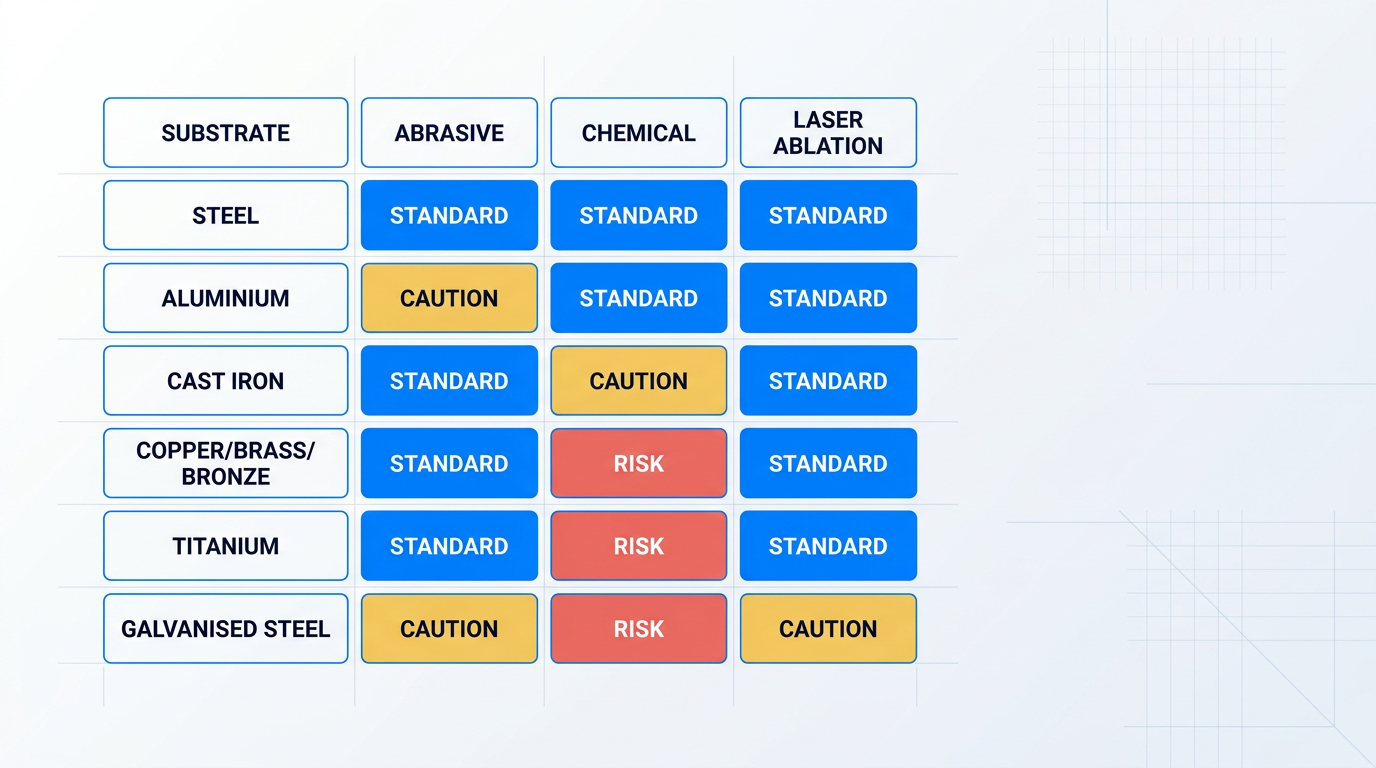
Steel and carbon steel are the least constraining substrates. Most finishing categories were developed with steel in mind, and the full range — abrasive blast cleaning, mass finishing, pickling and acid descaling, and laser ablation — is broadly applicable.
For abrasive blast cleaning of steel, industry practice targets standards such as SSPC-SP-10 / Sa 2½ (near-white blast), which removes mill scale, rust, and foreign matter to a defined cleanliness level. Acid pickling using sulphuric or hydrochloric acid is a well-established descaling route for steel mill products, forgings, and castings. Laser ablation is equally effective: research using pulsed Nd:YAG lasers at 1064 nm has demonstrated complete rust removal from carbon steel surfaces, with iron content recovering from approximately 62% to over 90% and oxygen content falling from 29% to 2–3% after cleaning.
Aluminium alloys require considerably more care in abrasive selection. Because aluminium is relatively soft, aggressive blasting can embed media particles into the surface — contaminating it for downstream bonding or coating processes in a way that is difficult to reverse.
Chemical etching is standard and well-characterised for aluminium. Both alkaline and acid routes are used depending on the downstream process: alkaline etching reduces surface scratches and die lines ahead of anodising; acid etching using hydrochloric, hydrofluoric, nitric, phosphoric, or sulphuric acids is used where smut formation must be controlled, particularly on die castings. For adhesive bonding preparation, ASTM D2651 specifies sulphuric acid-sodium dichromate or sulphuric acid-ferric sulphate solution etching, phosphoric acid anodising, and mechanical abrasion as validated surface preparation routes.
Laser ablation is effective on aluminium: the ablation threshold difference between the aluminium substrate and common contaminants such as surface oxides and paint coatings is sufficient for selective removal, and excimer lasers at 248 and 308 nm have established applications in preparing aluminium alloys for adhesion.
Cast iron is routinely processed by abrasive blast cleaning, vibratory finishing, barrel finishing, and shot peening — all well-established routes for descaling and deburring iron castings, as confirmed by ASM Handbook coverage of cast iron surface engineering. Acid pickling is also applicable to cast iron, though it requires careful process control and thorough rinsing to ensure complete removal of acid residues.
Copper, brass, and bronze are reactive with many of the acid systems used routinely for steel. Sulphuric and hydrochloric acid attack copper alloys aggressively, and the ASM Handbook notes that copper's susceptibility to rapid attack increases markedly under oxidising acid conditions. Chemical process selection for copper-based metals requires specific chemistry — pickling and bright dipping formulations developed specifically for copper alloys — and careful process control.
Mechanical finishing, including mass finishing and polishing, is widely used for copper alloys, particularly for decorative applications. Laser ablation handles these reflective metals with appropriate parameter settings: the high reflectivity of copper and its alloys is a known consideration for laser parameter selection, but it is manageable, and laser cleaning has confirmed applicability across brass and copper substrates.
Titanium is one of the most chemically sensitive substrates in industrial finishing. Standard steel pickling chemistry is not appropriate: applying it to titanium risks hydrogen embrittlement, because atomic hydrogen produced during acid pickling can be absorbed by the metal, forming brittle titanium hydride phases when hydrogen absorption exceeds approximately 150 ppm. Titanium pickling requires specific acid formulations; iron contamination on titanium surfaces is addressed using nitric acid-hydrofluoric acid solutions.
Mechanical abrasion — belt grinding and abrasive blasting — is used for titanium descaling and bonding surface preparation. Laser cleaning is well-established in aerospace for titanium surface prep: research on TA15 titanium alloy demonstrates complete paint and oxide removal at a laser fluence of 7.78 J/cm² without substrate damage, and studies using fibre lasers on Ti-3Al-2.5V hydraulic tubing confirm that laser-cleaned surfaces produce welds of consistently high quality. For titanium, where process errors carry significant downstream cost, the substrate-safe characteristics of laser ablation are a practical advantage.
Galvanised steel introduces a compatibility dimension that plain steel does not have: the zinc coating. Chemical processes effective on bare steel may strip or damage the zinc layer. Abrasive blasting can remove the zinc coating locally, compromising the corrosion protection it provides.
Laser systems can be tuned to remove surface contamination — rust bloom, oils, oxides — from galvanised steel without stripping the zinc layer, but this is highly conditional on process parameters. Once the beam reaches the contamination-to-zinc interface, aggressive settings or repeated passes can thin or remove the zinc. Where zinc retention matters, verification through magnetic, eddy-current, or X-ray fluorescence measurement is necessary — visual inspection alone is not adequate evidence that the coating has been preserved.
A Framework for Any Substrate
The six substrates above cover the most common industrial cases, but the same evaluation logic applies to any material. Before committing to a finishing category, three questions structure the compatibility assessment.
- What is the operating mechanism?: Kinetic abrasion, wet chemistry, or photonic ablation — each interacts with the substrate differently. Understand which mechanism you are applying before assessing risk.
- Does the mechanism suit your substrate?: Consider hardness (media embedding risk), porosity (acid retention risk), chemical reactivity (over-etching or incompatible reactions), and any applied coatings that must remain.
- What is the consequence of getting it wrong?: Embedded media, over-etching, coating damage, dimensional loss, or hydrogen embrittlement — quantify the rework or rejection risk before selecting a category.
Compatibility is a binary gate, not a sliding scale: a category that is fundamentally incompatible with your substrate cannot be rescued by adjusting throughput, reducing cycle time, or optimising cost.
With compatible categories identified for your substrate, the next question is whether those categories can match your production rhythm — which is where volume and throughput requirements come into the evaluation.
Production Volume and Throughput: Matching Machine to Scale
A metal finishing machine can be perfectly capable of achieving the required surface result and still be the wrong choice — if its production rhythm does not match yours. Buyers routinely evaluate finishing equipment on technical capability first and throughput fit second, which is the reverse of the order that actually narrows the field fastest.
Identifying your production pattern before assessing capability eliminates entire machine categories before the capability conversation even begins, saving significant evaluation effort.
Continuous, Batch, or Intermittent: The First Question
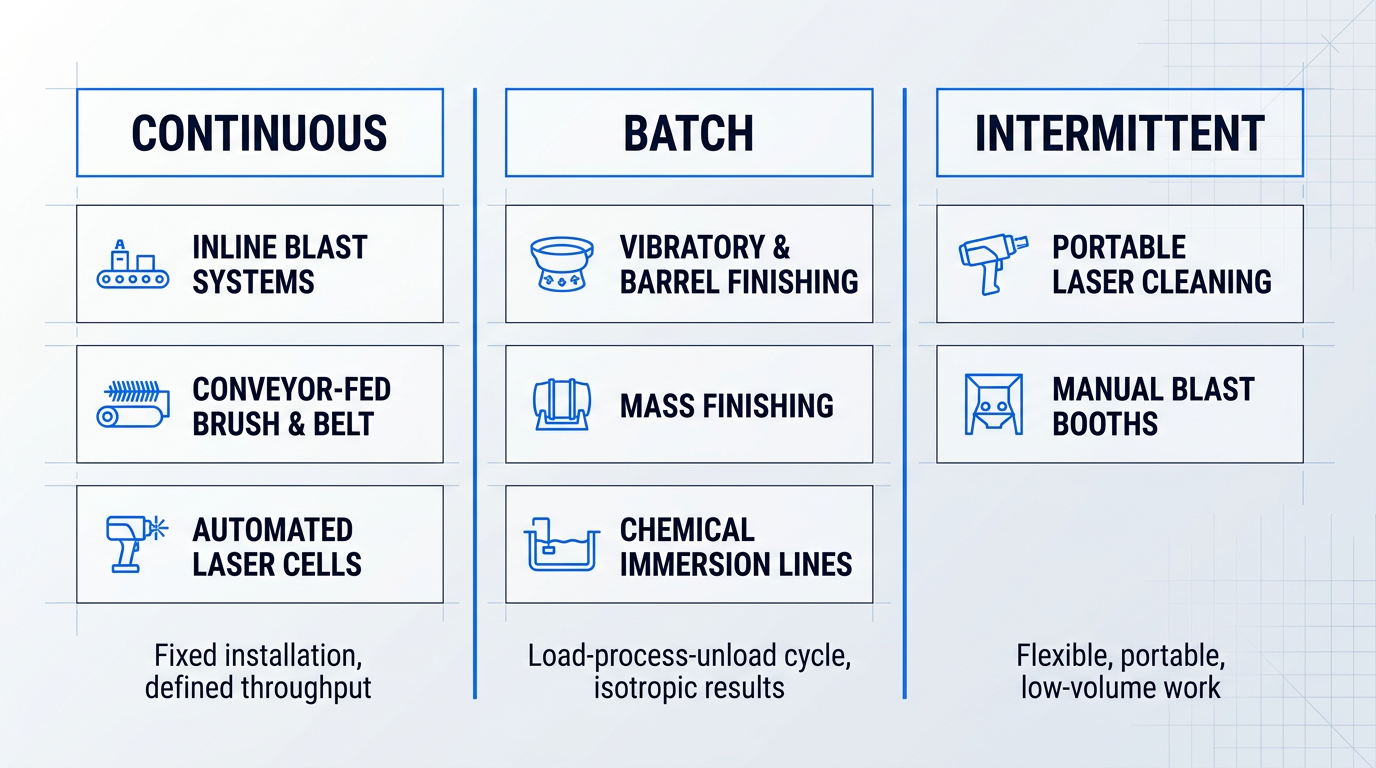
Continuous production — where parts move through a finishing stage as part of an uninterrupted line — demands fixed-installation systems with defined throughput rates and consistent part geometry.
Inline blast systems, including conveyor-fed centrifugal wheel machines, are the natural fit here: flat plate, structural sections, and fabricated assemblies move through at a governed feed speed, receiving consistent surface treatment without manual intervention between parts.
Conveyor-fed brush and belt machines serve a similar continuous role for oxide removal, deburring, and surface conditioning on parts coming off laser-cut or stamped operations, processing at defined feed rates that integrate cleanly into the line's cycle time.
Automated laser cleaning cells are also suited to continuous production when the application is repeatable and high-cycle — battery welding preparation in EV manufacturing and stamping lubrication removal are representative contexts where the laser cell operates as a fixed station, processing the same geometry at the same parameters thousands of times.
The common constraint across all continuous-production systems is inflexibility: they are optimised for a defined part geometry and a defined throughput rate, and they do not adapt easily to high-mix or irregular work.
Batch processing suits a different operational shape — where parts are grouped, processed together, and unloaded as a set, rather than flowing through individually.
Vibratory and barrel finishing (mass finishing) are inherently batch-oriented: a charge of parts and abrasive media is loaded, the cycle runs, and the batch is unloaded with consistent results across every part in the load — without any individual part handling during processing.
This makes mass finishing well-suited to high volumes of small-to-medium parts where isotropic finishing is acceptable, since every exposed surface receives equivalent treatment regardless of part orientation.
Chemical immersion lines — pickling, anodising, passivation — are also structurally batch processes: parts are racked, immersed in sequence through treatment and rinse tanks, and unloaded together, with throughput governed by tank capacity and the number of stages in the sequence.
For intermittent and maintenance-context work — low volumes, irregular schedules, in-situ requirements — the calculus shifts entirely toward flexibility and portability rather than throughput rate.
Portable laser cleaning systems bring the capability to the part rather than the part to the machine: no fixed installation, no minimum batch size, no production line integration required, making them practical for maintenance tasks, in-situ tooling cleaning, and field repair work.
Manual blast booths and handheld grinding tools also serve intermittent use, though they introduce more operator skill dependency and process variability than portable laser systems — a trade-off that is acceptable at low volume but becomes a quality risk as frequency increases.
Throughput, Automation, and Geometry: Three Variables That Determine Fit
Within any production pattern, the level of automation depth within a machine category significantly affects its suitability at different volume levels.
For high-volume repeatable cleaning, automated laser systems with robotic arms deliver cycle-after-cycle consistency without operator path-setting or skill variability — the capital investment is justified when the volume and repeatability are there to absorb it.
Manual and semi-manual methods introduce operator variability that is acceptable for low-volume or high-mix work, but becomes a genuine quality risk when the same operation is repeated at high frequency across large part quantities.
Mapping required throughput — whether measured in parts per hour or area per hour — against the practical output of each category reveals meaningful differences in fit: abrasive blast delivers high area throughput on large flat surfaces; mass finishing processes dozens of small parts simultaneously when batch sizes are large; laser ablation speed scales with power level and automation, closing the gap with blast for precision applications at higher power and automation levels, but slower per unit area at lower settings without automation.
Part geometry is the third variable, and the one buyers most frequently underestimate as a throughput constraint.
Mass finishing reaches all surfaces accessible to the media simultaneously — including recesses and internal features — which is a throughput advantage for geometrically complex small parts that would otherwise require individual attention.
Blast cleaning is less effective on deep recesses and complex internal geometry, where blast angle and media rebound limit consistent coverage — a limitation that does not appear on simple flat or convex parts.
Laser systems with multi-axis robotic reach can address complex 3D geometry, but the cycle time per part rises with path complexity: more geometry to cover means longer path length, and throughput falls accordingly — a factor that must be weighed against the precision and selectivity advantages the approach offers.
Effective throughput is the product of three variables: machine speed, automation level, and geometric access. A fast machine that cannot reach a part's critical surfaces, or that requires manual intervention between cycles, will underperform its rated output in real production conditions.
With production volume and throughput requirements used to narrow the field, the next evaluation axis is what level of surface quality each remaining category can actually deliver — which is where the selection process becomes more precision-sensitive.
Surface Precision and Finish Quality by Method
Choosing a finishing method on throughput or capital cost alone is a reliable way to create expensive problems downstream. Over-specify, and you pay for precision your application never needed. Under-specify, and you hand the next process a surface it cannot work with — triggering rework that routinely costs more than the savings from the cheaper method.
Surface quality is not a single axis. The criteria that matter depend on what comes next: surface profile (Ra or Sa grade), directionality of finish, substrate integrity, presence of embedded media or chemical residue, and dimensional tolerance preservation. Different machine categories perform very differently across these criteria, and the downstream process — not the machine's capability ceiling — should drive the specification.
Abrasive Blast Cleaning: Defined Profile, Genuine Constraint
Blast cleaning's quality output is a controlled, measurable surface profile — the anchor pattern left when abrasive particles impact and rebound from the substrate. SSPC standards define the cleanliness result: SP 5 (white metal), SP 10 (near-white, at least 95% free of all visible residues), SP 6 (commercial blast), and SP 7 (brush-off). The profile depth typically runs 1.5 to 3 mils for standard coating preparation, and can reach 65 µm or above when thermal spray coatings require it.
That intentional roughening is the point for coating adhesion applications: coating manufacturers test and specify adhesion performance against a defined profile range, and the data sheet will state which profile depth the coating system requires. Where blast cleaning earns its place is heavy mill scale removal, structural steel preparation, and any application where a defined anchor profile is a requirement, not a side effect.
The engineering constraint is equally clear: blast cleaning does not leave the substrate geometry as found. For precision parts where Ra values are tightly specified, or where a surface profile would interfere with downstream fit, sealing, or bonding, blast cleaning is the wrong tool regardless of how well it cleans.
Mass and Vibratory Finishing: Isotropic Finish, Batch-Level Precision
The defining quality characteristic of mass and vibratory finishing is the isotropic surface finish — random, non-directional, with no aligned tool marks or grinding patterns. This matters because directional surfaces produced by machining and grinding carry peak-and-valley distributions that concentrate contact stress; isotropic finishes distribute that stress more evenly, improving wear and fatigue resistance.
Precision capability is genuinely high. High-energy centrifugal barrel finishing can achieve a 1 Ra finish — the level cited for racing crankshafts, where oil flow across the surface directly affects power output. Chemically accelerated vibratory superfinishing (the ISF process) reaches 0.02 µm Ra, making it relevant for gears, bearings, and turbine components operating under high contact loads. Stream finishing has been documented achieving surface smoothness to 0.01 µm Ra.
The limitation is selectivity. Mass finishing treats all exposed surfaces simultaneously — edges, bores, and faces receive the same treatment. Where specific surfaces must be left untouched, or where internal features need protection, the process cannot be directed to a single feature. It is a batch-level quality tool, not a part-feature-level one.
Belt and Disc Grinding: Directional Finish and Its Consequences
Belt grinding, disc grinding, and brush deburring produce a directional finish — a defined scratch pattern aligned to the direction of abrasive travel. For oxide removal on laser-cut parts, this is often entirely adequate: the oxide layer that forms on oxygen-assist laser cuts prevents coating adhesion, and automated brush belt systems can remove it in a single pass, including on internal contours and cutouts.
The quality constraint appears when the downstream process demands something different. A directional scratch pattern may require a subsequent finishing step before bonding, anodising, or any application where surface isotropy or a specific low Ra value matters. Brush belts running perpendicular to part travel improve coverage on edges and cutouts, but the result remains a mechanically worked, directional surface — not an isotropic one.
This is a limitation in precision contexts, not a universal disqualifier. For deburring, edge rounding, and post-laser oxide removal ahead of powder coating, the directional finish is fit for purpose. The issue arises when buyers assume it is also fit for applications that require a fundamentally different surface character.
Chemical Etching and Pickling: Uniform Removal, Tight Process Control Required
Chemical pickling removes scale through immersion in aqueous acid solution, acting uniformly across the whole surface — a quality advantage where consistent descaling matters more than surface profile control. For hot-worked or hot-rolled steel, pickling is the standard method for removing oxide scale before subsequent processing, precisely because it reaches complex geometries that mechanical methods cannot.
The quality risk is over-etching. If concentration, temperature, or immersion time drift outside specification, chemical methods remove more material than intended. On parts with tight dimensional tolerances, that loss of material is an engineering problem, not merely a cosmetic one. Process control is the quality lever here, and it requires discipline to maintain.
One application where chemical treatment delivers a genuine quality benefit is alkaline etching of aluminium prior to anodising. Anodising is a conversion process that follows the surface topography exactly — it amplifies what is already there. Alkaline etching reduces surface scratches and imperfections before the conversion layer forms, improving the quality and consistency of the anodised finish.
Laser Ablation: Substrate Integrity as the Quality Baseline
The quality principle that distinguishes laser ablation from every other category is selectivity at the material level. The laser beam removes contaminants because their ablation threshold is lower than that of the base metal — the contaminant vaporises at an energy density that leaves the substrate unaffected. This is not a matter of careful operator technique; it is a physical property of the materials involved.
The downstream quality consequences are significant. No surface profile is introduced — the substrate geometry is preserved. No directional scratch marks are left. No abrasive media particles become embedded in the surface. No chemical residue remains. Laser power, pulse duration, and beam profile can all be adjusted so the process removes only what is intended and nothing else.
For high-value or complex-geometry parts, these properties matter most where any substrate damage creates rework costs that quickly exceed the savings from a cheaper cleaning method. The absence of mechanical damage and chemical contamination is not a premium feature — it is the quality baseline that certain applications require.
Laser capability extends beyond cleaning into laser texturing: using the same equipment to sculpt defined surface patterns that improve adhesive bonding. Where blast cleaning creates a random anchor profile, laser texturing creates a precise, engineered surface geometry — a quality-positive outcome that takes the method from surface preparation into surface engineering.
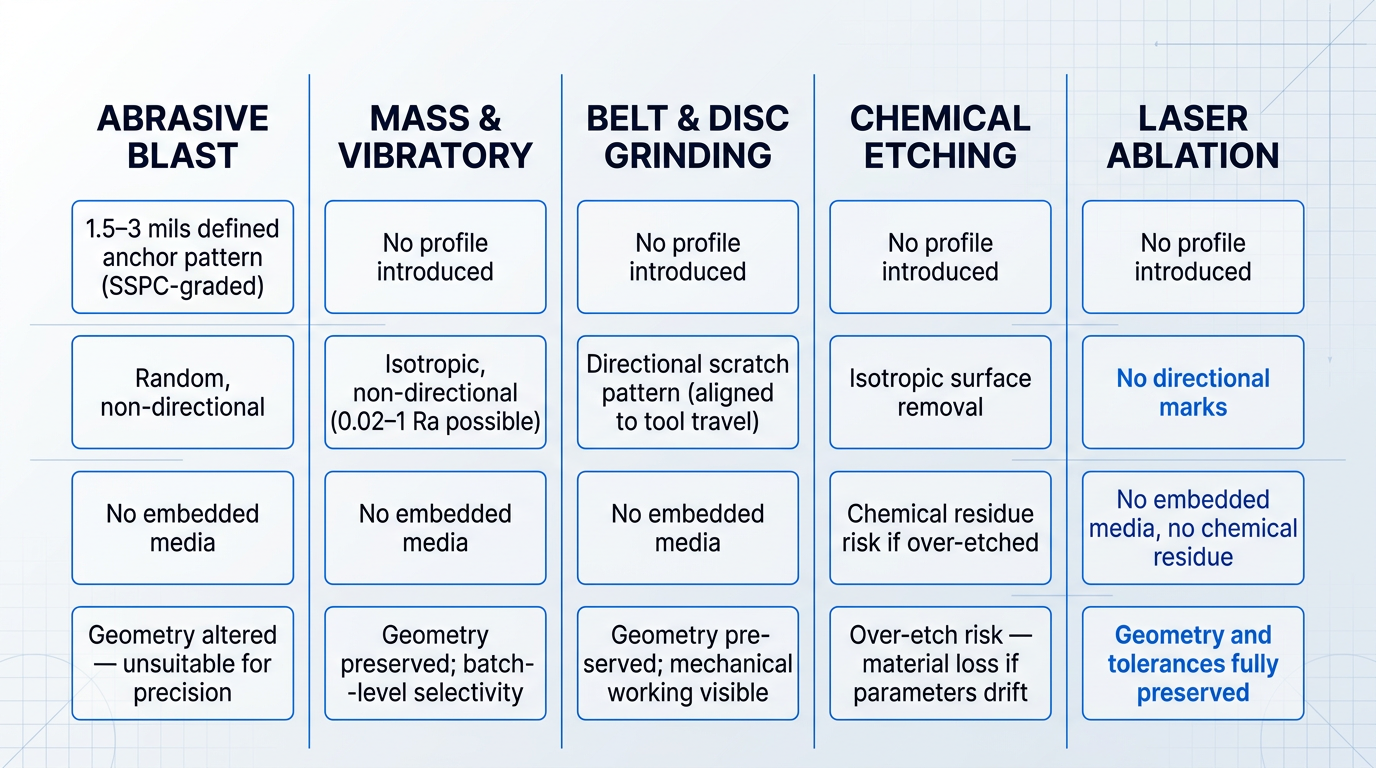
The comparison across methods reveals a clear pattern: the quality criteria each method satisfies are determined by its operating mechanism, and those mechanisms impose genuine limits that cannot be overcome by running the process more carefully or more slowly.
- Abrasive blast cleaning: Delivers defined SSPC-grade cleanliness and a measurable anchor profile (typically 1.5–3 mils). Introduces surface roughening — unsuitable where profile depth must be preserved.
- Mass and vibratory finishing: Produces an isotropic, non-directional finish. Precision variants reach 1 Ra (crankshafts) or 0.02 µm Ra (ISF). Non-selective — all exposed surfaces treated simultaneously.
- Belt and disc grinding: Removes oxide effectively in a single pass on laser-cut edges. Leaves a directional scratch pattern; may require subsequent steps for non-directional or low-Ra requirements.
- Chemical etching and pickling: Uniform surface removal across complex geometries. Over-etch risk if parameters drift; reduces pre-anodise imperfections on aluminium when controlled correctly.
- Laser ablation: No profile introduced, no directional marks, no embedded media, no chemical residue. Substrate geometry and tolerances preserved. Texturing capability available on the same equipment.
Reading across these characteristics against your downstream process requirements is the practical step that turns this comparison into a decision. The right question is not which method achieves the highest surface quality in absolute terms, but which method leaves a surface the next process can actually use.
The correct surface quality specification is not determined by what a machine is capable of — it is determined by what the downstream process requires. A method that exceeds that requirement wastes capital; one that falls short of it creates rework.
Different downstream operations impose specific surface quality demands that map directly onto method selection. Coating adhesion for structural applications requires a defined anchor profile — blast cleaning to SSPC SP 10 is appropriate, and the coating data sheet will specify the profile range. Adhesive bonding is more sensitive to surface chemistry and cleanliness than to Ra value; chemical residue or embedded abrasive media can compromise bond strength regardless of how smooth the surface appears.
For weld preparation, oxides and lubricants must be removed, but introducing a surface profile through blast cleaning can affect weld quality in precision applications where joint geometry is critical. Laser cleaning removes oxides and contamination without altering the substrate, which is why it is gaining ground in aerospace and precision fabrication weld prep. Laser texturing goes further still, creating engineered surface patterns that improve adhesive joint strength — a capability no other category in this guide offers.
For anodising pre-treatment on aluminium, the surface condition before conversion matters because the anodised layer follows the topography of whatever it is applied to. Scratches and mechanical marks from grinding are not hidden by anodising — they are preserved and sometimes amplified. Chemical etching reduces these imperfections; laser cleaning avoids introducing them in the first place.
Methods that damage the substrate, embed abrasive particles, or leave chemical residue do not simply produce a lower-quality surface — they create problems the next process must solve. The rework cost of rectifying those problems belongs in any honest evaluation of a finishing method's total value, which is precisely what the next section examines.
Total Cost of Ownership: Evaluating Any Finishing Machine
The purchase price of a metal finishing machine is the number that appears on the quote — but it is rarely the number that determines whether the investment was sound. Procurement teams that select on sticker price alone consistently undercount the operational costs that accumulate across a machine's working life: consumables, maintenance, unplanned downtime, waste disposal, labour, and rework.
A structured total cost of ownership (TCO) framework makes those costs visible before the purchase decision, not after it. Across the finishing machine categories covered in this guide, the TCO picture varies substantially — and the category with the lowest capital cost is not always, or even often, the one with the lowest lifetime cost.
Capital Cost vs. Operational Cost
Experienced procurement professionals understand this instinctively: a lower purchase price is only an advantage if the operational cost profile is comparable. A machine that costs less to acquire but carries high recurring consumable spend, frequent wear-component replacement, and significant waste disposal obligations can cost substantially more over five years of operation than a higher-capital alternative with a leaner running cost structure.
The finishing machine category is where this principle bites hardest, because the operational cost structures across categories are not variations on a theme — they are fundamentally different in kind.
Consumable Costs: Where the Gap Widens
Consumable spend is one of the highest-impact TCO differentiators across finishing machine categories, and it is the cost most consistently underestimated at the procurement stage.
Abrasive blast systems consume media continuously. The abrasive type, its breakdown rate — how quickly the media fractures and loses cutting effectiveness — and the replacement frequency all drive recurring costs that compound with throughput. Blast wheel wear components including nozzles, liners, and the wheels themselves require regular inspection and replacement, creating both scheduled and unscheduled downtime on top of the media spend itself.
Chemical finishing lines consume acids, plating chemistry, rinse water, and bath replenishment chemistry. These costs scale directly with throughput and are routinely underestimated at the procurement stage — particularly the bath dump-and-recharge cycles that represent planned production downtime as well as chemistry cost.
Laser-based systems operate on a fundamentally different cost structure: electricity only. No media, no chemistry, no consumables of any kind — this is not a marginal improvement over other categories, but a different class of running cost entirely.
Maintenance Burden, Downtime, and Waste Disposal
Maintenance requirements follow a similar pattern. Blast systems demand regular inspection and replacement of blast wheels, nozzles, and liners, alongside ongoing abrasive quality monitoring — wear components that degrade predictably but also fail unexpectedly, creating unscheduled downtime that disrupts production schedules.
Chemical lines require continuous bath monitoring, chemistry replenishment, and periodic full dump-and-recharge cycles — planned downtime that must be built into production scheduling. Laser systems require minimal maintenance by comparison, and the operational overhead is a fraction of either alternative.
Waste disposal costs are the TCO component buyers most reliably fail to account for fully. Chemical finishing processes generate wastewater containing heavy metals, acids, and toxic organics — all regulated under federal and state environmental frameworks, including EPA Metal Finishing Effluent Guidelines. Treatment, disposal, compliance monitoring, and regulatory reporting are real, recurring operational costs that appear nowhere on the machine's price tag.
Laser systems generate no wastewater and no chemical waste streams; the only output is vaporised contaminant captured by fume extraction, which carries dramatically lower regulatory overhead. The regulatory compliance dimension of this is significant enough to warrant its own examination — the next section covers it in detail.
Two further TCO components complete the picture: labour cost and rework cost.
- Labour cost per part: Manual blast and grinding operations are operator-skill-dependent — output quality varies with technique, and that variability has a direct cost. Automated systems of any category reduce labour cost per part.
- Training overhead: Laser systems with touchscreen interfaces and preset programmes reduce the skill threshold for consistent operation, lowering both training time and the cost of operator turnover.
- Rework cost: Methods that damage the substrate, embed media particles, or leave chemical residue create downstream rework costs. Those costs belong in the TCO calculation, not treated as a separate quality issue.
Each of these components compounds the others. High consumable spend combined with significant maintenance downtime, disposal obligations, and rework from substrate damage produces a total cost profile that can dwarf the original purchase price — particularly for chemical finishing methods operating at scale.
Across finishing machine categories, consumable spend, maintenance downtime, waste disposal compliance, and rework together routinely exceed the original capital cost over a machine's operational life. TCO is the only lens that makes this visible before the purchase decision.
Applied honestly, the TCO framework surfaces a consistent pattern for laser-based finishing systems: no consumables, minimal maintenance burden, no chemical waste streams, and minimal substrate damage that reduces rework. Across every operational cost dimension, the running cost structure is leaner than blast or chemical alternatives.
For buyers comparing laser cleaning machines specifically, Woodrow Scientific's ELASER and AutoLASE are competitively priced within the laser category — designed, built, and supported in-house in the UK, which means genuine engineering capability and faster support behind every machine.
Waste disposal and environmental compliance are a significant enough cost driver across finishing machine categories that they warrant dedicated examination. The next section covers the regulatory landscape in full — including the specific frameworks that govern chemical finishing waste and what compliance actually costs in practice.
Environmental and regulatory considerations: compliance costs buyers undercount
Of all the operating costs that buyers undercount when selecting a metal finishing machine, environmental compliance is among the most systematically overlooked — not because it is hidden, but because its full scope only becomes visible once a facility is already generating regulated waste streams and managing the obligations that come with them.
The primary federal framework for chemical finishing operations is 40 CFR Part 433, the EPA's Metal Finishing Effluent Guidelines. Any facility that performs electroplating, electroless plating, anodising, coating, chemical etching and milling, or printed circuit board manufacture must meet categorical discharge limits for a defined list of heavy metals — cadmium, chromium, copper, nickel, lead, and zinc — as well as cyanide and total toxic organics.
These are not edge-case operations. The 1982 proposed rule establishing Part 433 identified approximately 13,000 facilities in the electroplating and metal finishing categories subject to these limitations — a population drawn from fabricated metal products, industrial machinery, electronics, transportation equipment, and a wide range of other manufacturing sectors.
The compliance burden under Part 433 is ongoing, not one-time: discharge monitoring, reporting, and pretreatment programme obligations recur throughout the life of the equipment, regardless of how well the initial installation was managed.
The Resource Conservation and Recovery Act (RCRA) adds a second, parallel layer of obligation for facilities generating waste from electroplating and chemical finishing operations. Under 40 CFR Part 261, several waste streams from these processes are classified as F-listed hazardous wastes, each carrying its own management requirements.
- F006 — Electroplating sludge: Wastewater treatment sludges from electroplating operations; subject to RCRA land disposal restrictions and specific storage time limits.
- F007 — Spent cyanide baths: Spent cyanide plating bath solutions from electroplating operations; classified as both reactive and toxic hazardous waste.
- F008 — Cyanide bath residues: Plating bath residues from the bottom of cyanide-process plating baths; requires manifested disposal as hazardous waste.
- F009 — Spent stripping solutions: Spent stripping and cleaning bath solutions from cyanide electroplating operations; reactive and toxic classification applies.
Each of these waste codes triggers a chain of regulated activity: hazardous waste determination, EPA identification number registration, hazardous waste manifests for every off-site shipment, storage time limits, biennial reporting, and record retention for a minimum of three years.
This is not a line item in the accounts — it is an operational programme that requires dedicated personnel time, approved transporters, permitted disposal facilities, and continuous compliance monitoring for as long as the process is running.
Buyers who assume that switching from chemical to abrasive mechanical methods eliminates the environmental compliance overhead should be aware that air toxics standards introduce their own obligations. Under NESHAP 40 CFR Part 63, Subpart XXXXXX, EPA regulates dry abrasive blasting, dry grinding and polishing, and machining at area-source facilities in nine metal fabrication and finishing source categories — wherever those operations use or emit compounds of cadmium, chromium, lead, manganese, or nickel.
Enclosure and filtration control requirements apply to covered dry grinding and abrasive blasting operations, alongside initial notification, compliance status reporting, and annual certification obligations — a compliance structure that is lighter than the full RCRA and Part 433 suite, but far from negligible.
Wastewater generation is the thread connecting most of these obligations. Chemical cleaning and rinsing operations are the primary sources of process wastewater in metal finishing facilities, and the costs they create are not capital costs — they are recurring operational costs that compound across the full life of the equipment: bath monitoring, chemistry replenishment, downtime for bath changes, and the discharge compliance obligations that sit alongside all of it.
The regulatory profile of laser-based cleaning methods
Laser ablation presents a materially different regulatory profile. The cleaning process itself generates no wastewater, no chemical discharge, and no RCRA-listed waste streams — meaning no 40 CFR Part 433 discharge monitoring obligations and no F006, F007, F008, or F009 hazardous waste manifests arising from the cleaning process.
The only process waste produced is the vaporised contaminant, which is captured by a fume extraction system — typically a HEPA filter unit. This is a real operational requirement and should be costed accordingly, but it represents a substantially lighter compliance burden than the full suite of chemical finishing obligations.
There is no chemical storage compliance overhead, no bath management programme, no wastewater treatment infrastructure, and no manifested hazardous waste transport arising from the laser cleaning process itself — a contrast that becomes commercially significant when evaluated across a 10–15 year equipment horizon.
Chemical and cyanide-based finishing operations trigger 40 CFR Part 433 discharge monitoring, RCRA F-listed waste manifesting, and ongoing storage and reporting obligations. Laser-based cleaning generates none of those obligations from the cleaning process itself — only a fume extraction requirement. That is not a minor operational difference; it is a fundamentally different regulatory footprint.
Looking further ahead, environmental regulation of chemical waste, industrial air emissions, and energy consumption in manufacturing is not a fixed target. Buyers making capital investment decisions today are committing to operational horizons of a decade or more, and the trajectory of regulation in these areas is a legitimate commercial factor in that decision — not a prediction of specific rule changes, but a recognition that chemical-free and consumable-free methods are increasingly aligned with where industrial environmental policy is heading.
For site-specific compliance requirements, always consult your relevant regulatory authority or a qualified environmental consultant — the frameworks described here establish the federal baseline, but state-level requirements and facility-specific permit conditions can add further obligations.
With the regulatory and environmental cost picture established, the next consideration is how different machine categories fit into the production line itself — and what integration requirements look like across mechanical, chemical, and laser-based systems.
Automation and integration: fitting finishing equipment into production
When buyers think about automation, the instinct is to frame it as a throughput question — more parts per hour, fewer operators per shift. But the more useful frame is this: where does quality risk live in your production process? The answer to that question determines how much automation you actually need, and what kind.
Automation level is a genuine decision axis, not a quality ranking. The right point on the spectrum depends on your production volume, the consistency of your part geometry, how much your part mix varies, and what surface quality your downstream processes demand — a maintenance team cleaning tooling on an irregular schedule has fundamentally different requirements from an automotive line running the same component in continuous production.
The automation spectrum for finishing equipment
- Manual and handheld: Handheld laser, manual blast booth. Maximum flexibility for low-volume, high-mix, or maintenance applications. Results depend on operator technique and attention.
- Conveyor and inline blast: Parts fed at defined rates through fixed blast parameters. Consistent results for stable, simple-geometry parts at production volumes.
- Batch-automated vibratory: Load parts and media, run the cycle, unload finished parts. Isotropic finishing across all exposed surfaces without individual handling.
- Robotic and vision-driven cells: Multi-axis articulated arm carries the cleaning head to complex 3D geometries. Highest automation tier for precision, repeatable production cleaning.
At the manual end, operator variability is the primary quality risk — results shift with technique, fatigue, and experience level. For low-volume, high-mix, or irregular maintenance work, that trade-off is acceptable: the flexibility to move freely around an unusual part, or to adjust approach on the fly, is worth more than rigid repeatability.
Conveyor-fed blast systems remove most of that variability for flat or simple-geometry parts, processing at defined feed rates with consistent blast parameters throughout the run. The trade-off is installation rigidity — these systems are fixed assets, less adaptable when part geometry or mix changes, and best suited to production lines where both are stable.
Vibratory and mass finishing operates at the batch level: load parts and media, run the programmed cycle, and unload a consistent result without touching individual parts during processing. This is well-matched to high-volume small-part applications where isotropic finishing across all exposed surfaces is acceptable — but it is batch automation, not inline automation, and loading and unloading still require operator time.
For complex 3D geometries, robotic laser cleaning cells represent the high-automation option: the laser cleaning head is carried on a multi-axis articulated arm that reaches the angles, undercuts, and contours that blast or vibratory methods simply cannot access.
The limitation of the conventional robotic approach is a practical one: each new part type requires a technician to program the cleaning path — defining the arm trajectory, standoff distance, and scan parameters for that specific geometry. For a line running one part type continuously, that setup cost is absorbed quickly. For operations with a mixed or changing part portfolio, it becomes a recurring barrier: skilled-technician time before every new part can run.
It is not the capital investment that limits flexibility — it is the path-programming burden. Every new part type adds skilled-technician setup time before production can begin, making mixed-part runs significantly more costly than the machine's sticker price suggests.
AutoLASE, Woodrow Scientific's automated laser cleaning system, removes that burden entirely. Load a part and the system's 3D machine-vision software scans it, builds a spatial map, and generates the cleaning path automatically — no manual programming, no path-setting, no knowledge of the part's geometry required. Anyone on the line can load a part and run a clean to the same standard, every cycle, regardless of part geometry variation.
For buyers evaluating enclosure requirements, AutoLASE carries an additional differentiator: it can be configured with Woodrow Scientific's Reduced Hazard Zone (RHZ) technology, making it the only automated laser cleaning system in the world that can operate with no enclosure at all. WSL's RHZ technology is not available from any other supplier worldwide — if enclosure-free automated cleaning matters to your facility layout or workflow, this is an exclusive option.
AutoLASE is CE and UKCA certified, and Woodrow Scientific offers first-class laser cleaning safety and operation training as part of the package. For buyers with existing robot infrastructure, the system attaches to your collaborative or industrial robots rather than requiring a complete new cell; for those starting from scratch, it is also available as a fully integrated, bespoke custom cell. Interested buyers with specific integration or customisation requirements are encouraged to get in touch directly.
On the integration side more broadly, buyers evaluating any laser-based finishing equipment should confirm fieldbus interface compatibility early — most industrial laser systems support Ethernet-based control, but verifying that the machine's interface aligns with your line's control architecture avoids late-stage integration friction. The question of whether to attach a laser cleaning head to existing robot arms or commission a complete turnkey cell is largely a function of what infrastructure you already have and how much bespoke engineering the application demands.
Understanding where your operation sits on the automation spectrum is one input into the final decision. The next question is whether the application profile itself — the contaminant type, the substrate, the geometry, the downstream process requirements — points toward laser-based systems as the right category altogether.
When Laser-Based Systems Are the Right Fit
Every evaluation criterion covered in this guide — material compatibility, surface precision, total cost of ownership, environmental burden, automation depth — ultimately points toward the same question: which method is actually right for this application? For laser-based systems, the answer is not "always" and it is not "rarely." It is specific, and the specificity is the point.
Laser cleaning belongs to a well-defined set of engineering contexts where its characteristics are not merely convenient but genuinely superior to the alternatives. Outside those contexts, other methods may serve better. The skill is in the matching.
Where laser-based systems have a genuine advantage
The strongest case for laser cleaning is made on high-value or complex-geometry parts — aerospace components, precision tooling, injection moulds, EV battery components. Abrasive and chemical methods carry a real risk of substrate damage on these parts, and the rework cost of getting it wrong routinely exceeds the apparent capital saving of a cheaper cleaning method.
For applications involving bonding, welding, or coating, the surface condition entering the downstream process is the binding constraint. Laser cleaning removes oxides and lubricants without introducing a surface profile (as abrasive methods do) or leaving chemical residue (as wet chemical methods can) — delivering a clean, unaltered substrate that bonding adhesives and weld preparations can rely on.
Facilities under pressure to reduce chemical waste, media disposal, and water consumption find laser cleaning operationally straightforward: it runs on electricity alone, with no consumables to buy, store, or dispose of, and no wastewater stream to manage. The consumable-free operating model removes an entire category of recurring cost and compliance overhead.
Where the work cannot come to the machine — infrastructure maintenance, in-situ tooling cleaning, field repair — portable laser cleaning changes the equation entirely. Woodrow Scientific's ELASER is a sub-50 kg wheeled unit with a handheld scanner under 3 kg and up to 50 m of delivery cable, meaning a single operator can reach the work without moving it.
In open-plan workshops and mixed-use facilities, conventional laser cleaning has historically been impractical: areas must be sealed off and evacuated before work can begin, creating a significant operational barrier. Woodrow Scientific's patented reduced-hazard-zone (RHZ) technology removes that barrier entirely — it confines the laser hazard to a small area around the work, enabling cleaning to proceed in open workshops and public-facing settings where conventional laser cleaning cannot go. This capability is a world first, and it is exclusive to WSL.
WSL's patented RHZ technology is the only laser cleaning solution in the world that confines the hazard zone to the immediate work area — enabling cleaning in open workshops, mixed-use facilities, and public-facing settings without sealing off the area. No other laser cleaning system offers this.
For high-volume repetitive production cleaning, the differentiating question is not whether a system is automated — it is how easy it is to put a new part through it. With AutoLASE, the answer is: load the part, and it runs. Machine vision scans the part, builds a 3D map, and generates the cleaning path automatically, with no programming, no path-setting, and no technical skills required from the operator.
AutoLASE integrates with existing robots or is supplied as a complete custom cell, and is CE and UKCA certified. For facilities with bespoke integration requirements, Woodrow Scientific's in-house engineering team can advise — the company designs, builds, and improves its own machines, which is not the norm in a market where many apparent manufacturers are resellers rebadging third-party equipment.
Where laser is not the right fit
Laser cleaning has real constraints, and knowing them is as useful as knowing its strengths.
- Heavy bulk contamination: Very high volumes of contamination across large structural surfaces — such as heavy mill scale on steel plate — are often removed faster and more economically by high-power blast.
- Surface profile required: Where coating adhesion depends on a roughened anchor profile, abrasive blast is the right tool. Laser cleaning does not create surface profile — that is a strength in precision contexts, a limitation here.
- Low-value commodity parts: Very high volumes of low-value parts with thin margins may not support the capital investment. Payback period is the deciding factor in these cases.
These are genuine constraints, not edge cases. A buyer who recognises that their application falls into one of these categories has gained something valuable: clarity that redirects the evaluation toward the method that will actually perform.
With a clear picture of where laser-based metal finishing belongs — and where it does not — the final step is mapping that picture to your own production context, constraints, and priorities.
See Our Laser Cleaning Machines in Detail
You have the evaluation framework. Now see how our laser cleaning systems measure up against it. The ELASER and AutoLASE are built for application-specific industrial requirements.
Conclusion
Choosing the right metal finishing machine: next steps
The right metal finishing machine is never determined by a single criterion — it emerges from reading material compatibility, production volume, surface precision, TCO, and regulatory exposure together, because over-specifying wastes capital just as surely as under-specifying creates rework and compliance risk.
As sustainability and regulatory pressures continue to shift the industry toward chemical-free, consumable-free methods, buyers evaluating new installations should weigh that trajectory alongside today's requirements — and if your application points toward precision, clean-facility operation, or automated production cleaning, Woodrow Scientific's laser-based range is worth exploring.
Frequently asked questions about metal finishing machines
This guide covers a broad landscape of finishing equipment and methods. If your question isn't answered below, get in touch and a specialist will be happy to help.
Laser cleaning is well-suited when one or more of these indicators apply: you are processing high-value or complex-geometry parts where abrasive or chemical methods risk substrate damage and costly rework; your application requires precision surface preparation for bonding, welding, or coating where chemical residue or altered surface profiles would compromise downstream quality; aggressive methods risk damaging the base material; or your facility is under pressure to eliminate chemical waste, media disposal, or wastewater generation. If open-plan working conditions make conventional laser cleaning's area-isolation requirements operationally impractical, that is also a relevant factor to discuss with a specialist. The best next step is an application assessment — contact a laser cleaning specialist with your part details, contamination type, and throughput requirements.
Metal finishing operations in the US are subject to three overlapping regulatory frameworks. The EPA Metal Finishing Effluent Guidelines (40 CFR Part 433) apply to facilities performing electroplating, electroless plating, anodising, coating, and chemical etching; they set discharge limits for heavy metals (cadmium, chromium, copper, nickel, lead, zinc), cyanide, and total toxic organics. Under RCRA, wastewater treatment sludges from electroplating (F006) and spent cyanide plating baths (F007, F008, F009) are listed hazardous wastes with regulated generation, storage, transport, and disposal requirements. The NESHAP air toxics standards (40 CFR Part 63, Subpart XXXXXX) cover dry abrasive blasting, grinding, and polishing at facilities emitting cadmium, chromium, lead, manganese, or nickel compounds, with enclosure and filtration requirements. Consult your relevant regulatory authority for site-specific obligations.
Shot blasting is a surface cleaning process; shot peening is a surface engineering process. Shot blasting propels abrasive media at the workpiece to remove contamination — rust, mill scale, weld spatter, old coatings — and prepare the surface for downstream operations such as painting or coating. Success is measured by surface cleanliness to Sa grades. Shot peening uses the same kinetic media impact not to clean, but to deliberately induce compressive residual stress in the surface layer, improving a component's fatigue life and resistance to stress corrosion cracking. The media may be identical; what differs is the intent, the controlled process parameters (coverage, intensity, Almen arc height), and the outcome measured.
Metal finishing falls into three primary families. Mechanical processes include abrasive blast cleaning (shot blasting, grit blasting), mass and vibratory finishing (barrel tumbling, centrifugal disc), belt and disc grinding and deburring, and shot peening. Chemical processes include pickling and acid descaling, electroplating, electroless plating, anodising, chemical etching, and passivation. Laser-based processes use focused laser light to ablate surface contamination or coatings without abrasives or chemistry. Each family suits different substrates, contamination types, precision requirements, and production volumes.
In a metal processing context, flattening or levelling is typically performed by roller levellers, straightening presses, or press brakes — these are forming and levelling machines, distinct from surface finishing equipment. That said, surface preparation machines such as wide-belt grinders, brush deburring machines, and flat-bed finishing machines can address surface irregularities on flat plate — flattening raised burrs, removing weld spatter, and reducing surface undulation — though their primary function is surface conditioning rather than dimensional levelling. If you are looking to correct bow or camber across the full thickness of a plate or sheet, a roller leveller or straightening press is the appropriate machine category.
It depends considerably on the method. Manual abrasive blast and grinding operations are physically demanding: operators manage heavy equipment, significant dust and noise exposure, and must develop consistent technique — PPE requirements are substantial and fatigue is a genuine factor. Chemical finishing lines are less physically intensive but technically demanding: bath chemistry must be actively managed, compliance monitoring is ongoing, and the regulatory overhead is real. Laser-based systems sit at the accessible end of the spectrum. Touchscreen interfaces, preset cleaning programmes, and per-user login tracking reduce the skill barrier considerably; vision-guided automated systems can operate on a load-and-go basis with no manual path-setting required. All finishing work requires training and attention to quality — but the physical demands and technical complexity vary greatly by method.