
Introduction
An industrial laser system is a laser-based machine used in manufacturing for material processing — cutting, welding, marking, engraving, cleaning, and drilling.
If you're here, you've likely moved past the basics and are now asking which type of system fits your application, your environment, and your operational requirements.
This list covers the major categories: laser cleaning in portable and automated configurations, fibre laser cutting, and laser marking and engraving.
Every entry is assessed on the same axes — laser type, primary applications, industries served, throughput and footprint, operational factors, and total cost of ownership.
In capital equipment, running costs, consumables, and downtime compound significantly over a system's working life — sticker price tells only part of the story.
TL;DR
Choosing the wrong industrial laser system rarely comes down to buying a bad machine — it comes down to buying the wrong category for the situation.
The gap between system types is far wider than laser power or price suggests. Buyers who get it right evaluate on application fit, operational context, and total cost of ownership.
This article covers:

Laser cleaning, cutting, and marking systems compared
Consistent evaluation axes across every entry
Portable vs automated laser cleaning configurations
Fibre laser cutting for metal fabrication
Laser marking and permanent part identification
Operational factors and total cost of ownership
How to evaluate an industrial laser system
Buying an industrial laser system is a capital commitment measured in tens of thousands of pounds — sometimes significantly more. The buyers who get it wrong rarely chose a bad machine; they chose the wrong machine for their situation, or they evaluated on the wrong criteria entirely.
The axes below are not a checklist. They are the questions that separate a sophisticated capital equipment purchase from an expensive lesson learned after installation.
Laser type and wavelength: more than a spec sheet detail
The two dominant technologies in industrial applications are fibre lasers and CO2 lasers, and the difference between them matters far beyond cutting speed.
Fibre lasers have no mirrors, no resonator gases, and no moving parts in the light-generating source — which translates directly into lower maintenance requirements and significantly lower operating costs compared to CO2 systems, which require mirror alignment, resonator gas replacement, and more frequent servicing.
Material compatibility is the other critical dimension: a CO2 laser's longer wavelength is absorbed well by plastics, wood, and some organics, while a fibre laser's shorter wavelength (~1 µm) passes straight through those materials. Conversely, fibre lasers can cut highly reflective metals such as copper, brass, and aluminium without the back-reflection risk that CO2 systems face.
For most metal cutting and cleaning applications, fibre laser technology has become the default — but the point is not to declare a winner. It is to ensure buyers understand what laser type is inside a system and what that means for their specific substrate, environment, and maintenance expectations before they sign a purchase order.
Application and material fit: the most important filter
If there is one axis that outranks every other on this list, it is application and material fit.
A technically impressive system that is mismatched to the buyer's contaminants, substrate, or process environment is wasted capital — and this is one of the most common and expensive mistakes in industrial laser procurement.
Before evaluating any system, buyers should be able to answer precisely: what am I cleaning, cutting, or marking? On what substrate? In what environment — a controlled production cell, an open shop floor, or an outdoor field site? Only once those answers are clear does it make sense to identify which system was designed for that combination.
Industries served: sector fit shapes everything else
Some industrial laser systems are genuinely generalist tools. Others have been developed specifically for sectors such as automotive, aerospace, tyre and rubber, heritage restoration, mould-making, or medical device manufacturing — and that specialisation matters.
Industry fit shapes integration expectations (does the system slot into an existing production line?), support expectations (does the supplier have engineers who understand your process?), and regulatory context (aerospace tolerances are unforgiving in ways that general maintenance work is not).
Buyers should ask directly: what industries make up the supplier's install base, and do their application engineers have hands-on experience in your sector? A supplier whose reference customers are all in automotive may not be the right partner for a heritage conservation project, even if the underlying laser technology is identical.
Throughput and footprint: two very different buyer profiles
Throughput and footprint look like a single axis but they serve two genuinely different buyer profiles — and conflating them leads to poor purchasing decisions.
Production-volume buyers running high-throughput, repetitive cleaning or cutting of batches of parts need cycle-time and area-rate data: parts per hour, surface coverage rate, uptime profile, and how the system integrates with existing conveyor or automation infrastructure.
On-site or flexible-use buyers — working across varied locations, open environments, or non-repetitive tasks — need entirely different data: how heavy is the handheld unit, how far does the delivery cable reach, and can a single operator move and set up the system without assistance?
A system with outstanding area coverage rates in a production cell may be completely impractical for field deployment. Asking the wrong throughput questions for your buyer profile means comparing data that is irrelevant to your actual use case.
Operational factors buyers routinely underestimate
This is where most buyers leave money on the table — not in the purchase negotiation, but in the years that follow. Four operational dimensions are consistently underweighted at the point of purchase.
- Consumable costs: Systems requiring abrasives, chemicals, gases, or replacement media accumulate running costs that can dwarf the upfront price difference over a 3–5 year horizon.
- Maintenance complexity: Simple servicing (lens cleaning, filter replacement) is operator-manageable. Complex servicing (mirror alignment, resonator gas replacement) requires a specialist engineer travelling to site.
- Downtime risk: When a production system goes down, every hour has a real cost. Are spares held locally, or do they ship from overseas? How quickly can the supplier respond?
- Safety overhead: Class 4 industrial lasers require hazard zone controls, operator training, and PPE. In open environments, this protocol overhead is a genuine operational cost — often discovered only after purchase.
None of these factors appear on a spec sheet. All of them will determine whether a system delivers its expected return — or quietly erodes it.
Total cost of ownership: the only honest evaluation lens
Upfront price is a poor proxy for value in capital equipment — and experienced buyers know it.
A system with a lower purchase price but high consumable costs, frequent downtime, and expensive maintenance will cost more over its operational lifetime than a higher-priced system with zero consumables and minimal servicing requirements.
No-consumable systems compound their cost advantage every year they run. A buyer who evaluates on purchase price alone is comparing only a fraction of the actual cost difference between options.
The mark of a sophisticated buyer is not negotiating the lowest sticker price — it is building a realistic total cost of ownership (TCO) model that accounts for consumables, maintenance intervals, downtime risk, and energy consumption across the system's working life.
Supplier quality: ask who actually built the machine
A significant portion of the industrial laser market is made up of resellers and importers selling rebadged third-party equipment under their own brand — and buyers often do not discover this until something goes wrong.
The problem with a reseller is structural: they cannot improve the product because they did not design it; their spares availability depends on a third party's supply chain; their engineers may not have deep knowledge of the machine's internals; and their ability to adapt the system for a buyer's specific application is limited to whatever the original manufacturer allows.
The due diligence question is simple: does your supplier design, build, and service their own machines in-house? Buyers should ask it directly and expect a direct answer.
On compliance: CE marking (for EU markets) and UKCA marking (for the GB market) are baseline requirements, not differentiators. Any credible supplier selling into these markets should clear this floor as a matter of course. Their presence confirms minimum conformity; their absence is a serious warning sign.
Laser cleaning vs legacy methods: the direction of travel
For surface preparation applications specifically, the broader industry context is worth understanding before evaluating any individual system.
Sandblasting, chemical stripping, and water-jetting have been the traditional workhorses of industrial surface preparation — but each carries significant ongoing costs: abrasive media must be purchased, recycled, and disposed of; chemicals generate hazardous waste with associated handling and disposal requirements; water-jetting produces contaminated effluent and requires drying steps.
Laser cleaning eliminates consumables entirely, generates minimal waste, and removes only the contamination layer while leaving the substrate intact — a precision that abrasive methods cannot match on delicate or complex surfaces.
The shift toward laser-based surface preparation is directional, not marginal. For repetitive industrial cleaning applications, the TCO case for laser cleaning strengthens considerably over a multi-year horizon compared to methods that require ongoing consumable spend.
With this framework established, the entries that follow apply each of these axes to a specific system type — so that readers can compare meaningfully across very different categories of industrial laser system, rather than weighing up spec sheets that were never designed to sit next to each other.
Product 1
ELASER / ELASER-RHZ — Portable Laser Cleaning by Woodrow Scientific
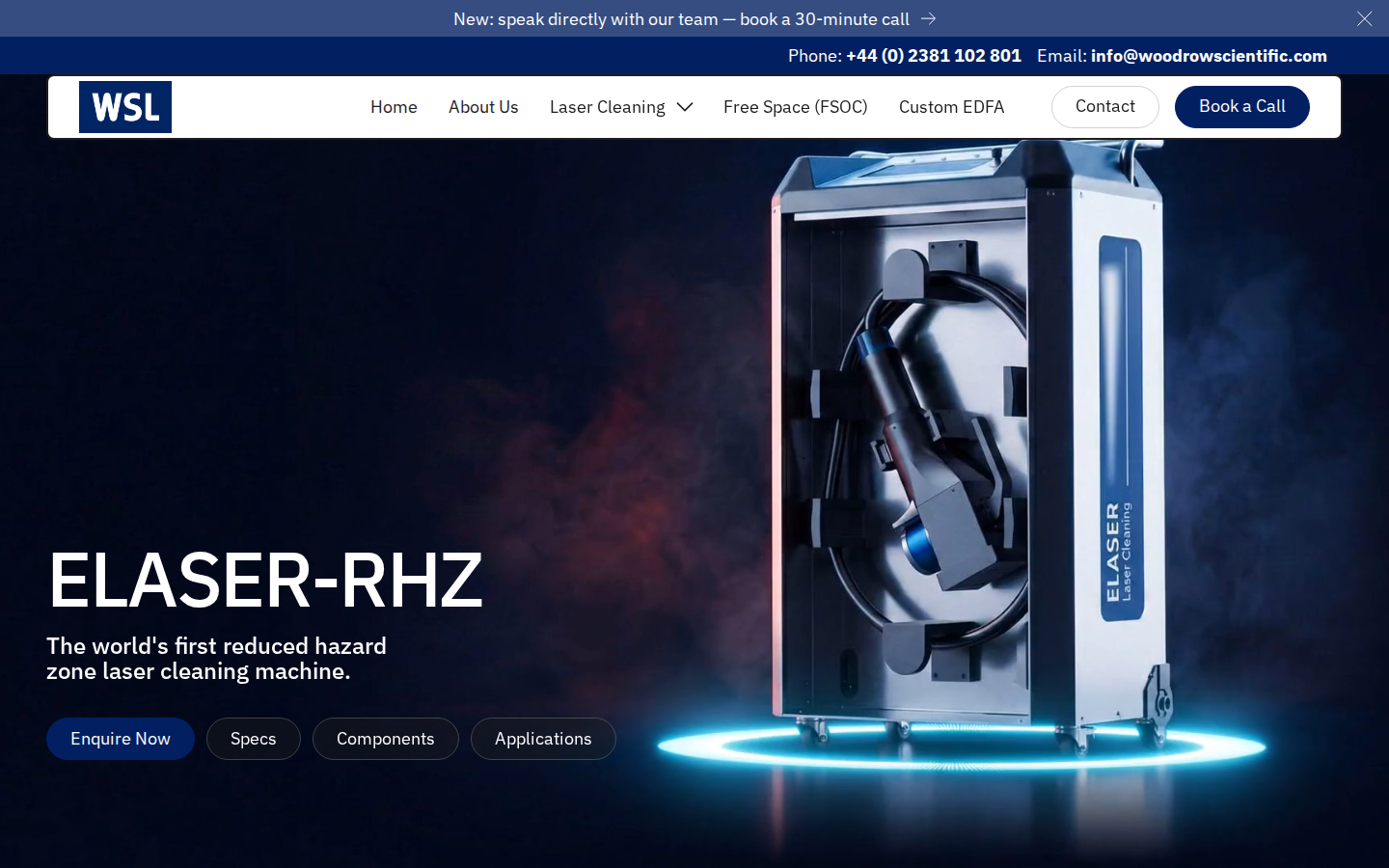
The ELASER-RHZ is Woodrow Scientific's portable fibre laser cleaning system — a wheeled, single-operator unit with a sub-3 kg handheld scanner and the world's only patented reduced-hazard-zone technology, enabling cleaning in open workshops and public-facing environments where conventional laser cleaning cannot go.
Pros:

World-first patented reduced hazard zone technology
Most competitive pricing among European laser cleaners
Only UK in-house laser cleaning manufacturer
Zero consumables — air-cooled, no media or chemicals
Cons:

Pricing on request — no public list price
Operator training required before use
Portable format; not suited to automated production lines
The ELASER-RHZ is a wheeled, self-contained fibre laser cleaning unit operated by a single person — no compressor, no water, no abrasive media, and a handheld scanner weighing under 3 kg with a delivery cable reaching up to 50 m.
Reduced Hazard Zone: Cleaning Where Others Cannot
The defining capability of the ELASER-RHZ is WSL's patented reduced hazard zone technology — the only system of its kind in the world — which collapses the laser hazard to a small area immediately around the work, rather than forcing the evacuation and sealing of an entire production zone.
This removes the single biggest operational barrier to laser cleaning adoption: the safety overhead that has historically made it impractical in open workshops, mixed-use facilities, and public-facing settings such as graffiti removal on street furniture or heritage restoration on publicly accessible monuments.
No other laser cleaning system in the world offers reduced-hazard-zone technology. Where conventional laser cleaning requires area shutdowns before work can begin, the ELASER-RHZ operates in open, shared, and public environments — unlocking applications that were previously out of reach for laser cleaning entirely.
The underlying laser is a fibre source tunable from 0–100% of its 300 W maximum output, spanning everything from light oxide removal to thick coating stripping on a single machine, with a touchscreen interface and fully programmable scan shapes for precise, repeatable control.
The system is air-cooled, requiring no water supply or chiller circuit — a practical advantage when deploying across varied sites or in locations where utilities access is limited.
Applications and Surface Compatibility
One machine, virtually any contaminant, virtually any surface: the ELASER-RHZ covers a breadth of cleaning tasks that few portable industrial laser systems can match.
- Injection moulding and tooling: Strip release agents, residue and build-up from moulds and tooling in place — no disassembly required.
- Automotive: Pre-weld surface prep on the line and rust or paint removal in the bodyshop.
- Tyre and rubber moulds: Clean mould vents and vulcanisation residue without abrasives or mould wear.
- Aerospace: Precise surface preparation and component cleaning to tight tolerances.
- Heritage and restoration: Lift soiling, paint and corrosion from stone, metal and masonry — gentle on the original substrate.
- Industrial maintenance: Clean plant, equipment and infrastructure on site with nothing to mask off and no media to clear away.
- Laser-cleaning service business: A portable system with full operator training provides a ready platform for launching a mobile laser-cleaning service.
Surfaces covered include steel, carbon steel, aluminium alloys, cast iron, copper, brass, bronze, titanium, and galvanised metal, as well as stone, concrete, brick, and masonry — with contaminants ranging from rust, oxides, and mill scale through to paint, powder coating, lacquer, primer, oil and grease, carbon and soot, graffiti, adhesives, tarnish, weld discolouration, and release agents.
The RHZ technology is particularly significant for industries that require cleaning in open or public environments — heritage bodies, local authorities, and contractors working on live sites — where the safety overhead of conventional laser cleaning has historically made the method impractical.
ELASER Operational Factors
The ELASER-RHZ is CE and UKCA certified, air-cooled, and entirely consumable-free — no replacement media, chemicals, or coolant to manage across the system's working life.
WSL provides first-class operator training as part of the package, and the system supports bespoke engineering and customisation for specific applications — contact WSL directly to discuss requirements.
WSL is the only UK-based laser cleaning manufacturer: it has designed, built, serviced, and improved its machines entirely in-house since 2012, backed by over 200 years of combined engineering team experience — it is not a reseller or importer of rebadged equipment.
This distinction matters to buyers: many laser cleaning suppliers in the market are resellers of third-party machines, which typically means slower spares, weaker support, and no genuine ability to improve the product — WSL's in-house capability means support comes from the engineers who built the machine.
| Evaluation Axis | ELASER-RHZ |
|---|---|
| Laser type | Fibre laser, up to 300 W, tunable 0–100% |
| Footprint / deployment | Wheeled unit under 50 kg; handheld scanner under 3 kg; cable up to 50 m; single operator |
| Application fit | Portable cleaning across varied locations, open environments, and public-facing settings |
| Operational factors | Air-cooled, zero consumables, CE & UKCA certified, touchscreen control |
| TCO | Zero consumables, minimal substrate damage reduces rework; competitive upfront pricing in Europe |
Summarises the ELASER-RHZ against the five evaluation axes declared in the buying framework, giving buyers a quick reference against the criteria they arrived with.
Pricing is competitive — the most competitive upfront cost among comparable industrial laser systems in Europe, achieved through WSL's engineering and operational efficiencies rather than any compromise in quality.
Evaluate the ELASER-RHZ on total cost of ownership: zero consumables across its working life, reduced downtime compared with media-based methods, and less rework thanks to the beam's minimal substrate impact all compound into a strong long-term cost position — contact WSL for a tailored quote.
Who Is the ELASER Best For?
The ELASER-RHZ is the right choice for buyers who need flexible, portable laser cleaning across varied locations, open or shared environments, or public-facing settings — and for any operation where the safety overhead of conventional laser cleaning has previously made the method impractical.
It is also well suited to buyers looking to launch a mobile laser-cleaning service business, where portability, surface breadth, and the ability to work without area shutdowns are commercial necessities.
See the ELASER-RHZ Full Specifications
The ELASER-RHZ is Woodrow Scientific's portable, single-operator laser cleaning system with patented reduced hazard zone technology. Download the datasheet or visit the product page for full technical details.

Product 2
AutoLASE — Automated Robotic Laser Cleaning System
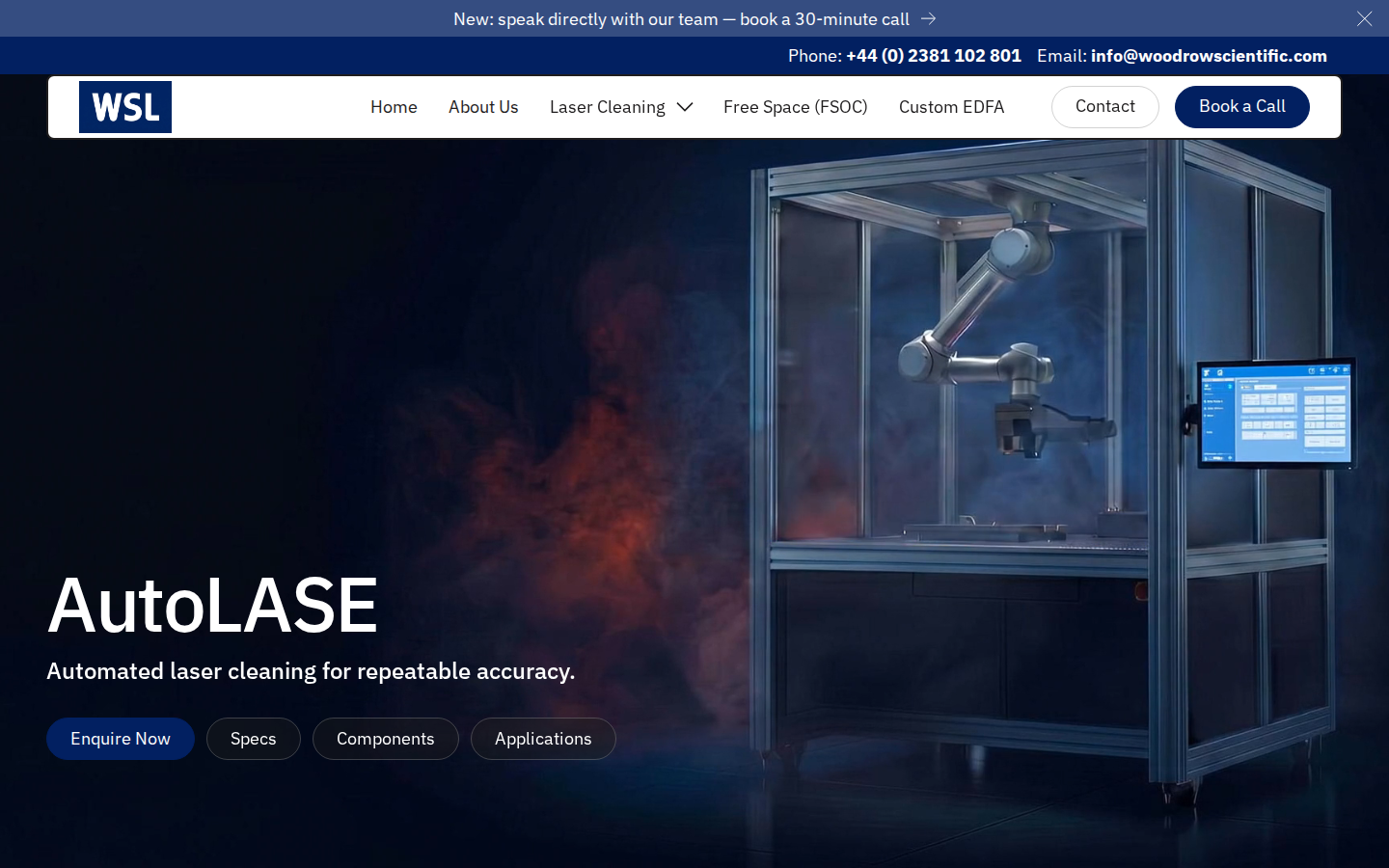
AutoLASE is Woodrow Scientific's automated robotic laser cleaning system: load a part and its 3D machine-vision software scans it, maps it, and generates the cleaning path automatically — no programming, no specialist skills, the same consistent result every cycle — purpose-built for high-volume repetitive production environments in automotive, aerospace, tyre and rubber, injection moulding, and remanufacturing.
Pros:
Load-and-go: 3D vision generates path automatically
Only automated cell with enclosure-free RHZ option
Zero consumables, air-cooled — low running costs
Built in-house by UK's only laser cleaning manufacturer
Cons:
Optimised for batch production, not varied on-site work
Pricing on request — no public list price
Where the ELASER is built for flexibility and on-site access, AutoLASE is built for production — an automated laser cleaning cell designed to run repetitive, high-volume cleaning tasks with no manual intervention and the same result on every cycle.
The defining characteristic of AutoLASE is how little it asks of the operator: load the part, and the system's machine-vision software scans it, builds a 3D map, and generates the cleaning path automatically — no programming, no path-setting, no knowledge of the part's geometry required.
Conventional automated laser cleaning cells require a technician to define the cleaning path for each new part type before the cell can run it. AutoLASE eliminates that step entirely, which means any operator on the production floor can load a part and start a job without specialist knowledge.
AutoLASE's 3D machine-vision software scans the loaded part, maps its geometry, and generates the cleaning path automatically — no programming, no path-setting, no technical skills required. It is the only automated laser cleaning cell that works this way.
AutoLASE can also be configured or upgraded with WSL's Reduced Hazard Zone (RHZ) technology, removing the need for a laser enclosure altogether — the only automated laser cleaning system in the world with this capability.
This opens up deployment scenarios that no other automated cleaning cell can serve: production environments where a fixed enclosure is impractical, space-constrained, or simply not wanted.
AutoLASE Specifications and Application Fit
| Axis | AutoLASE |
|---|---|
| Laser type | Fibre laser |
| Max power | Up to 300 W |
| Power tunability | 0–100% |
| Cooling | Air-cooled — no water or chiller circuit |
| Consumables | Zero — laser light only |
| Certifications | CE and UKCA certified |
| Delivery cable | Up to 50 m |
| Applications | Injection moulds, automotive parts, aerospace components, tyre/rubber moulds, remanufacturing |
| Industries | Automotive (incl. EV), aerospace, tyre and rubber, injection moulding, remanufacturing |
| Throughput | Repeatable to the same standard every cycle |
| Footprint | Attaches to buyer's existing robots, or supplied as a complete custom cell |
| Pricing | Contact WSL for quote |
Gives the industrial buyer a structured, scannable summary of the key evaluation axes — laser type, power, applications, industries, and operational factors — in a single reference block, consistent with the framework declared earlier in the article.
The fibre laser runs at up to 300 W with power tunable across the full 0–100% range, covering everything from light oxide removal on aerospace turbine blades through to thick coating or release-agent strip on injection mould cavities.
The cleaning head is mounted on an articulated robotic arm with multi-axis reach, handling the contours and recesses of complex 3D parts that a fixed-head system cannot access.
- Injection moulds and tooling: Strips release agents, residue, and build-up from cavities, cores, and inserts — restoring fine detail without disassembly or abrasive wear.
- Automotive and EV components: Engine, driveline, and battery parts cleaned of oxides, coatings, and contamination, or prepped for welding and bonding, part after part.
- Aerospace components: Turbine blades, vanes, and engine parts surface-prepped to tight tolerances, held to the same standard on every cycle.
- Tyre and rubber moulds: Vulcanisation residue and vent build-up removed without abrasives — no mould wear, no dimensional change.
- Remanufacturing and refurbishment: Corrosion, coatings, and contamination stripped from worn components in consistent batches before rebuild and inspection.
AutoLASE integrates with the buyer's existing collaborative or industrial robots from major suppliers, or WSL can supply it as a complete custom cell — contact WSL directly to discuss integration and bespoke engineering requirements.
Being air-cooled, it requires no water supply, chiller circuit, or coolant infrastructure, which simplifies installation and removes a common maintenance burden from the production environment.
AutoLASE: Total Cost of Ownership
Zero consumables, automated labour savings, reduced downtime, and less rework from minimal substrate damage combine to build a strong total cost of ownership case — particularly for high-volume production environments where those savings compound across thousands of cycles.
WSL designs, builds, services, and improves AutoLASE entirely in-house as the UK's only laser cleaning manufacturer — a meaningful distinction in a market where many suppliers are resellers of third-party machines, with the slower support chains and limited improvement capability that follows.
AutoLASE Pricing
AutoLASE carries the most competitive upfront pricing among comparable automated laser cleaning systems in Europe, achieved through WSL's engineering and operational efficiencies rather than any reduction in build quality.
Pricing is provided on request — contact Woodrow Scientific directly for a quote tailored to your application, robot configuration, and integration requirements.
Product 3
cleanLASER CL-Series Laser Cleaning Systems
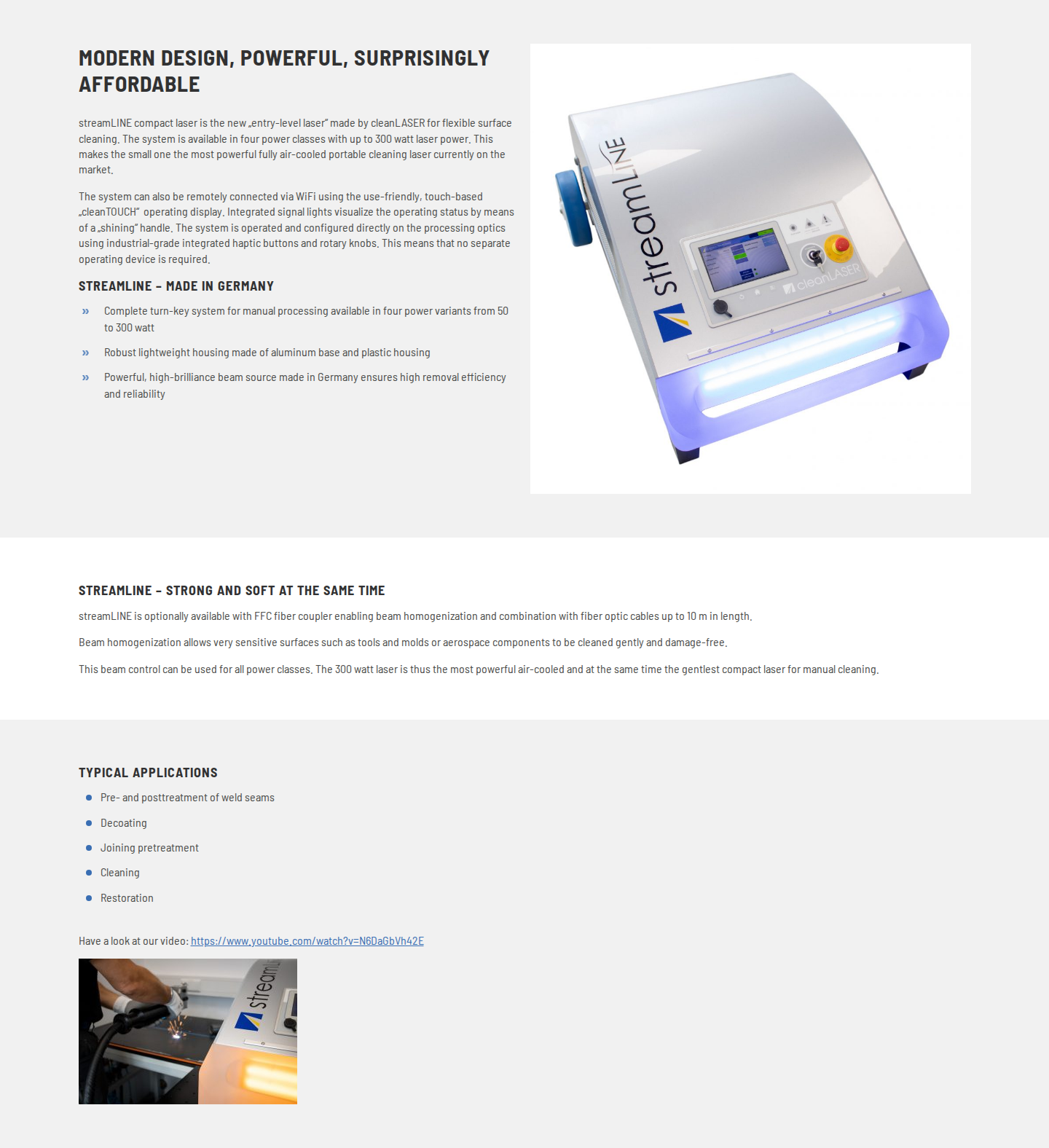
cleanLASER (Clean-Lasersysteme GmbH) is the originator of industrial laser cleaning, founded in 1997 in Germany, offering a full product range from portable compact units to high-power robotic production cells, with approximately 2,000 systems installed worldwide and now part of IPG Photonics.
Pros:
Originator of laser cleaning — founded 1997
Power range from 50 W to 1,700 W
~2,000 systems installed across 13+ industries
Full range: portable units to robotic cells
Cons:
Class 4 hazard zone — full enclosure required
No open-space or reduced-hazard-zone capability
IPG acquisition introduces ownership transition to assess
Founded in 1997 in Herzogenrath, Germany, Clean-Lasersysteme GmbH is the originator of industrial laser cleaning — the company that first commercialised the technology and has spent nearly three decades expanding its application across manufacturing industries worldwide.
With approximately 2,000 systems installed globally and around $30 million in annual revenue at the time of its acquisition, cleanLASER brings a depth of real-world deployment that few competitors in any equipment category can match.
The CL-Series spans one of the broadest power ranges available in a single laser cleaning product family, from compact portable units through to high-power production systems designed for large-area or high-throughput work.
| System Tier | Models | Power Range | Laser Source | Cooling |
|---|---|---|---|---|
| Portable compact | streamLINE compact | 50–300 W | Diode-pumped solid-state | Air-cooled |
| Mid-power trolley | CL 150 / CL 300 / CL 500 / CL 600 | 150–600 W | Diode-pumped solid-state | Air or water-cooled |
| High-power production | CL 1000 / CL 2000 / CL 1000iF | Up to 1,700 W | Diode-pumped solid-state / Fibre | Water-cooled |
A data table communicates the CL-Series product range span — system tier, power range, laser source, and cooling method — more efficiently and clearly than prose, helping the reader quickly grasp the breadth of the family.
This range means a buyer can select a portable air-cooled unit for flexible on-site work, a mid-power trolley system for workshop use, or a high-power production system for large-area de-coating — all within the same supplier relationship and product family.
Application coverage across the CL-Series is wide: paint removal and de-coating, mould cleaning, pre-treatment for bonding and joining, partial paint stripping of metallic components, weld seam preparation, and removal of process residues from tools and moulds.
- Automotive: Pre-treatment for bonding, selective paint stripping, weld seam preparation on aluminium alloys.
- Aerospace: Large-area de-coating and surface preparation prior to non-destructive testing.
- Electronics and medical technology: Precise, gentle cleaning of sensitive components and surfaces.
- Food, rubber and tyres, printing: Mould cleaning and removal of process residues without chemical waste.
- Nuclear decontamination: Large-area surface decontamination — a confirmed application of the high-power CL 2000.
- Restoration and conservation: Gentle removal of environmental dirt and weathering from stone and metal surfaces.
For buyers evaluating automation, cleanLASER's robotic-guided systems integrate into new or existing production lines via compact end effectors and flexible fibre-optic beam delivery, with connection to industrial robots through digital I/O or fieldbus interfaces such as PROFINET and PROFIBUS.
Global turnkey partners support system integration across a wide range of industries, giving buyers a route to a complete, ready-to-use automated cleaning cell rather than a standalone laser source.
cleanLASER completed its acquisition by IPG Photonics — the global leader in fiber laser technology — on December 2, 2024. cleanLASER continues to operate as Clean-Lasersysteme GmbH from its Herzogenrath headquarters. Buyers evaluating a long-term supplier relationship should factor this ownership change into their assessment.
On operational safety, all CL-Series systems are Class 4 laser systems — conventional laser hazard zone rules apply, requiring full enclosure or area evacuation for safe operation.
There is no eye-safe or reduced-hazard-zone open-space cleaning capability within the CL-Series range; buyers who need to operate in open workshops, mixed-use facilities, or environments where area evacuation is impractical should note this as a relevant operational factor.
cleanLASER CL-Series Pricing
cleanLASER does not publish list pricing for the CL-Series; buyers should contact cleanLASER directly for a quote tailored to their system configuration and application requirements.
Best for: Buyers with established laser cleaning requirements in conventional enclosed production environments who want the deepest install base, the longest track record, and the widest application coverage in the laser cleaning category.
Product 4
Fibre Laser Cutting Systems

Fibre laser cutting systems are the dominant industrial technology for sheet metal and tube cutting — flatbed machines using ytterbium-doped fibre laser sources (typically 1 kW to 12 kW and above) to cut mild steel, stainless, aluminium, copper, brass, titanium, and other metals from 0.5 mm thin sheet through to plate over 30 mm. They are the go-to system for metal fabricators and manufacturers who need high-speed precision cutting across a broad material range, with substantially lower operating costs than equivalent CO2 machines.
Pros:
Significantly faster than CO2 on thin sheet
Cuts reflective metals CO2 cannot handle
No mirrors or resonator gases to maintain
~70% lower energy use than equivalent CO2
Cons:
Assist gas is an ongoing consumable cost
Automation needed to match high cutting speeds
CO2 edge quality advantage on very thick plate
Fibre laser cutting systems are the dominant technology for industrial sheet metal processing — flatbed and gantry machines that use an ytterbium-doped fibre laser source operating at approximately 1,064 nm to cut metal with high speed and precision.
Unlike CO2 systems, the fibre laser source has no moving parts, no mirrors, and no resonator gases — the beam is generated by diode pumping and delivered directly to the cutting head via fibre-optic cable, which has direct implications for maintenance burden and operating cost.
Industrial power ranges run from around 1 kW at the entry end to 12 kW and above for high-production machines; Trumpf's TruLaser 5000-series, for example, is available with up to 24 kW of fibre laser power for the most demanding throughput requirements.
Materials and Application Fit
Fibre laser cutting handles the full range of industrially common metals: mild steel, stainless steel, aluminium, titanium, copper, and brass — including reflective non-ferrous metals that CO2 systems cannot process safely.
Trumpf specifies a sheet thickness range of 0.5 mm to over 30 mm, with performance varying by laser power and material type.
Tube and profile cutting is a distinct sub-application served by dedicated machine variants alongside standard flatbed configurations. The combination of small spot size, narrow kerf, and high beam quality makes these systems well suited to intricate contour work, fine feature cutting, and high-speed production blanking — with burr-free edges that typically require no post-processing.
Industries Served
Fibre laser cutting is in active use across a broad range of manufacturing sectors:
- Metal fabrication and subcontracting: The primary market — job shops and contract manufacturers cutting sheet metal across varied materials and thicknesses.
- Automotive: Body panels, structural components, heat shields, and precision parts for both conventional and electric vehicle production.
- Aerospace: Titanium and aluminium structural parts, brackets, and complex contour cutting where precision and material integrity are critical.
- Construction and white goods: High-volume sheet metal components for structural and consumer appliance applications.
- Medical device manufacturing: Fine-feature cutting of stainless steel and titanium for implants, instruments, and precision components.
Trumpf notes that fibre lasers are in use across virtually every manufacturing sector, with metals — including reflective materials — making up the majority of global laser processing applications.
Fibre vs CO2 Laser Cutting: Key Comparison
For buyers currently operating CO2 equipment or evaluating both technologies, the five axes below cover the comparisons that most directly affect the buying decision.
| Comparison Axis | Fibre Laser | CO2 Laser |
|---|---|---|
| Cutting speed (thin material, under ~5 mm) | Significantly faster — a 3 kW fibre machine cuts 1 mm mild steel three times faster than a comparable 4 kW CO2 machine in a straight line, and twice as fast at 2 mm (Laser Focus World) | Slower on thin sheet; speed advantage applies mainly to thicker plate |
| Energy efficiency | Around 70% lower overall energy consumption than an equivalent CO2 machine performing the same task (Laser Focus World); a 3 kW fibre machine uses approximately one third of the power of a 4 kW CO2 machine | High power draw from gas excitation and turbines; no laser diode efficiency advantage |
| Maintenance burden | No mirrors, no resonator gases, no beam alignment — 50% longer servicing intervals and 50% lower servicing costs reported (Laser Focus World) | Regular mirror replacement, resonator tuning, lasing gas replenishment, and beam alignment required |
| Reflective material handling | Cuts copper, brass, and aluminium without back-reflection risk — a clear capability advantage | Back-reflection from reflective metals poses a machine damage risk; these materials are not safely processed |
| Thick plate edge quality (oxygen assist) | Historically rougher striations vs CO2 on thick plate with O2 assist; modern beam-shaping closes the gap — a 2 kW fibre with correct mode settings matches 4 kW CO2 edge quality and speed (Laser Focus World) | Smoother surface finish on thick plate with oxygen assist — retains an edge quality advantage in this specific scenario |
A direct multi-axis comparison between fibre and CO2 laser cutting is the most efficient way to present this information — buyers evaluating both technologies can scan the trade-offs at a glance rather than parsing them from prose.
The thick-plate edge quality nuance applies specifically to oxygen-assisted cutting of plate material; for nitrogen-assisted cutting — covering the majority of stainless steel and aluminium work — fibre lasers are the dominant choice, with speeds reported at 3 to 4 times faster than equivalent-wattage CO2 machines.
Operational Factors
The primary ongoing consumable for fibre laser cutting is assist gas — nitrogen or oxygen, depending on the material and application.
Nitrogen consumption is higher than many buyers anticipate, particularly as higher-power fibre machines extend the processable thickness range beyond what CO2 systems could handle with nitrogen alone — a practical TCO input worth sizing carefully before purchase.
The fibre laser source itself is rated for 100,000+ hours of service life — approximately five times longer than a CO2 resonator — which substantially reduces both replacement costs and unplanned downtime across the machine's working life.
The focusing lens in the cutting head is sealed and is not a consumable item, unlike CO2 systems where optics require periodic replacement — a concrete cost advantage buyers moving from CO2 often underestimate.
At high throughput, material handling automation becomes near-essential: fibre laser cutting speeds are fast enough that manual sheet loading creates a bottleneck, with one real-world fabricator reporting that without automated material storage, operators would be loading sheets every 2.5 minutes.
Fibre laser cutting systems are Class 4 lasers and require appropriate machine enclosures and operator safety controls — the enclosed flatbed format standard across most industrial systems addresses this by design.
Studies cited in Laser Focus World report cost-per-part reductions of more than 50% when switching from CO2 to fibre laser cutting, accounting for both electricity and cutting gas. With no lasing gases, no mirror replacement, and no resonator tuning, fibre laser operating costs are substantially lower than CO2 — and the payback period is typically shorter as a result.
Fibre Laser Cutting System Pricing
Industrial fibre laser cutting systems are capital equipment sold on a quote basis — no major manufacturer, including Trumpf, Bystronic, or Mazak Optonics, publishes list prices for new machines.
Contact the manufacturer or an authorised distributor directly for pricing based on your power specification, bed size, and automation requirements. For scale reference, used-market pricing on Bystronic ByStar Fiber machines (6–12 kW, 2016–2020 build years) ranges from approximately €230,000 to €395,000 — new-machine pricing will differ, but this gives a sense of the capital involved.
Upfront cost is only one part of the picture: the operating cost advantage over CO2 means the total cost of ownership calculation often favours fibre even where the purchase price is higher.
Best For
Fibre laser cutting systems are the strongest choice for metal fabricators cutting sheet metal and tube at volume — particularly those processing thin-to-mid gauge material, or those who need to cut reflective metals such as copper, brass, or aluminium where CO2 is not a viable option.
CO2 may still be the better fit for operations focused primarily on very thick plate cutting where oxygen-assisted edge quality is the overriding priority — though this is an increasingly narrow use case as high-power fibre technology and beam-shaping advances continue to mature.
Product 5
Laser Marking and Engraving Systems
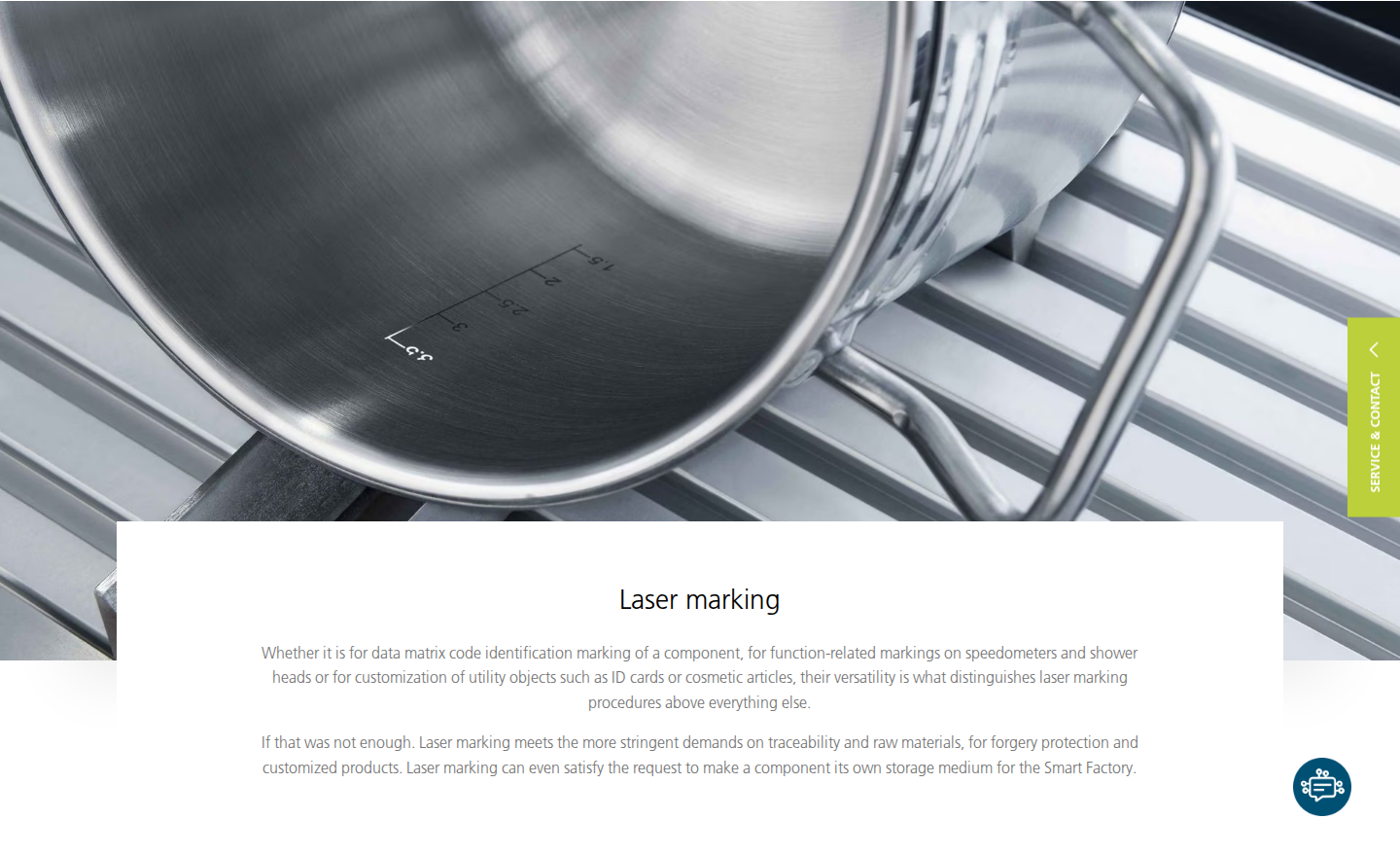
Laser marking and engraving systems are compact galvo-scanner units — or portable suitcase-format alternatives — that use fibre, CO2, or UV lasers to apply permanent, high-contrast marks to metals and non-metals alike. Used across virtually every manufacturing sector for traceability, serialisation, regulatory compliance (including medical UDI and automotive direct part marking), and counterfeit protection, they require no consumables, make no physical contact with the part, and integrate directly into automated production lines.
Pros:
Permanent marks — abrasion, chemical, and heat resistant
Zero consumables — no ink, chemicals, or ribbons
Non-contact — no tool wear or part stress
Meets medical UDI and automotive traceability mandates
Cons:
Higher upfront cost than inkjet or stamping
Process selection requires material-matching expertise
Class 4 open systems require hazard zone controls
Laser marking and engraving systems use a focused, pulsed laser beam to permanently alter a material's surface — producing high-contrast marks without inks, chemicals, or physical contact with the part.
The dominant format is the compact galvo-scanner unit: fast-moving mirrors direct the beam across the work surface at high speed, allowing the system to be mounted directly in a production line or workstation with a small footprint. For applications where the part cannot come to the machine, portable suitcase-format units exist — the Rocklin MobiLase, for example, is a 30 W fibre laser housed in a rolling suitcase weighing approximately 45 lb, with a 100 × 100 mm marking area and marking speeds up to 7,000 mm/s.
Three laser types cover the material range: fibre lasers (around 1,062–1,064 nm) are the most widely used, offering high-contrast marks on metals including steel, aluminium, and titanium; CO2 lasers handle non-metals such as plastics, glass, wood, and ceramics; and UV lasers (355 nm) suit heat-sensitive materials, medical plastics, and fine electronics where a cold photochemical marking process is needed to avoid thermal damage. Marking systems operate at much lower average power than cutting or cleaning systems — typically in the 20–200 W range — and use pulsed rather than continuous-wave operation to concentrate energy precisely.
The right marking process depends on the material and the legibility or durability requirement — this is an evaluation axis buyers must resolve before specifying a system. The five main process types are: annealing (local heating creates an oxide colour change on steel and titanium, leaving the surface intact — ideal for medical devices and precision components); engraving (material removal creates a depression, used in automotive, tooling, and electromechanics); ablation (removes a top coating to reveal the substrate, used for day/night button designs in automotive interiors); foaming (melts plastic to trap gas bubbles, producing a raised, light-coloured mark on dark plastics); and black marking (ultrashort laser pulses create nanoscale surface structures that produce deep-black, corrosion-resistant marks without material removal — the standard for medical UDI on implants and surgical instruments).
Applications and Industries
The primary commercial driver for laser marking investment is traceability and regulatory compliance, not aesthetics. Direct part marking (DPM) for serialisation, data matrix codes and QR codes for smart factory and Industry 4.0 integration, and UDI (unique device identification) for medical devices are the headline applications — each driven by a mandate rather than a preference.
On-the-fly marking systems can apply a unique, serialised data matrix code to each component as it moves along a conveyor, without pausing the production line — a capability that static marking or mechanical stamping cannot replicate at high volume.
Beyond compliance, laser marking covers logos and branding, counterfeit protection (marks that are difficult to reproduce or remove), and functional surface structuring for adhesion improvement before bonding or coating.
Laser marking is arguably the most cross-sector of all industrial laser applications. Key industries include automotive (engine parts, subassemblies, powertrain components), aerospace, medical device manufacturing, electronics and semiconductors, packaging, and tooling and mould-making — virtually any sector requiring permanent, machine-readable part identification is a potential user.
Laser Marking vs. Alternative Marking Methods
Buyers evaluating laser marking typically arrive from one of four incumbent technologies. The comparison below covers the axes that matter most in a production decision.
| Method | Mark Permanence | Consumables | Part Stress | Changeover for Serialisation | Environmental Profile |
|---|---|---|---|---|---|
| Laser marking | Permanent — abrasion, chemical, and thermal resistant | None — no ink, chemicals, or ribbons | Non-contact — no mechanical stress on part | Instant digital changeover — no tooling changes | No inks or solvents; no waste disposal required |
| Inkjet printing | Can fade, smear, or be removed; not suitable where permanence is required | Ongoing ink and cartridge costs | Non-contact | Fast changeover but requires consumable management | Inks and solvents require handling and disposal |
| Chemical etching | Permanent on metals | Chemicals required per batch; waste disposal costs apply | Non-contact but chemical exposure to part surface | Slow — not practical for incremental serial numbers or data matrix codes | Chemical waste and regulatory disposal obligations |
| Dot-peening | Permanent — mechanical indentation | Minimal — pin wear over time | Contact process — mechanical indentation of surface | Requires pin/tooling changes per character set | No inks or chemicals; low environmental burden |
| Mechanical stamping | Permanent | Tooling per character set | High — impact force applied to part | Slow changeover — tooling change required per part number | No inks or chemicals; low environmental burden |
A structured comparison across four alternative marking methods gives the buyer a direct, scannable reference for the decision axes that most commonly drive method selection — permanence, consumables, part stress, changeover, and environmental profile. Prose alone would require the reader to hold multiple comparisons in memory simultaneously.
For manufacturers with environmental compliance obligations, the absence of inks, solvents, and chemical waste is a concrete operational advantage that laser marking holds over inkjet and chemical etching alternatives.
Operational Factors
With no consumables to manage and no tooling to change between part numbers, laser marking systems have a low ongoing cost of ownership relative to inkjet or chemical etching over time — the upfront capital cost is higher, but the running cost differential narrows quickly in production environments.
Fibre laser sources are air-cooled, compact, and designed for long service lives — Rocklin's MobiLase laser generator is rated to up to 100,000 hours, a figure consistent with fibre laser technology more broadly. Minimal maintenance and no consumable replenishment cycles mean minimal unplanned downtime.
For Class 1 enclosed configurations, no dedicated laser safety room or heavy PPE is required — a significant operational simplification compared to Class 4 open systems, which do require hazard zone controls and appropriate operator training. Buyers should confirm classification with their supplier and consult the relevant laser safety standards for their jurisdiction.
Best For
Manufacturers requiring permanent, high-contrast, machine-readable part identification — particularly where traceability mandates, anti-counterfeiting requirements, or regulatory compliance (medical UDI, automotive direct part marking standards) drives the investment. Also a strong fit for operations that switch frequently between part numbers or serialisation sequences, where the absence of tooling changes delivers a meaningful throughput and flexibility advantage over mechanical alternatives.
Conclusion
Which industrial laser system is right for your operation?
For flexible, open-environment cleaning, the ELASER-RHZ is the natural fit; for high-volume repetitive cleaning, AutoLASE; for the broadest installed track record in laser cleaning, the cleanLASER CL-series; for sheet metal and tube cutting at scale, a fibre laser cutting system; for permanent part identification, a laser marking system.
The pattern across all five is the same: the right industrial laser system is the one that fits the application and delivers the lowest total cost over its working life — not the one with the lowest price tag on day one.
Frequently Asked Questions
Common questions about industrial laser systems, answered directly — from buying decisions and safety requirements to definitions and running costs.
Buy from an in-house manufacturer wherever possible. A manufacturer that designs, builds, services, and improves its own machines has the engineering capability to support you properly — faster spares, genuine product knowledge, and the ability to develop the system over time. A reseller or importer rebadges third-party equipment and has none of those capabilities in-house. Before committing, ask your supplier directly: do you design and build this machine yourself? The answer will tell you a great deal about the support you can expect after the sale. As a practical reference point, Woodrow Scientific Limited is the only UK-based laser cleaning manufacturer — every system is designed, built, serviced, and improved in-house. That is the standard worth holding any supplier to, regardless of the product category.
On a total cost of ownership basis, laser cleaning is the superior choice for most industrial applications. It uses no abrasive media, no chemicals, and no water — meaning zero consumable spend on cleaning materials and no hazardous waste disposal costs. Sandblasting and chemical stripping carry ongoing costs for media replenishment, chemical procurement, and waste handling, which compound significantly over a system's lifetime. Laser cleaning is also a dry, contact-free process that removes only the contamination layer while leaving the substrate intact — reducing the risk of substrate damage and the rework costs that follow. Sandblasting is an abrasive process that can alter or damage the base material, particularly on delicate or precision surfaces. Chemical stripping introduces similar risks alongside environmental and health and safety obligations. For repetitive industrial cleaning tasks — rust removal, paint stripping, oxide removal, pre-weld preparation — laser cleaning delivers greater repeatability, easier automation, and a cleaner process overall. Consult your supplier to assess which method is appropriate for your specific application and throughput requirements.
Most industrial laser systems are Class 4 lasers, which require a controlled hazard zone, laser safety eyewear rated to the system's wavelength and power level, and formal operator training. All personnel within the hazard zone must wear appropriate PPE; the area must be secured against unauthorised access during operation. Class 1 enclosed systems — where the laser is fully enclosed and interlocked — are inherently safe at the system boundary under normal operating conditions, shifting the safety burden to the enclosure design and interlock integrity rather than to ongoing PPE and zone management. For buyers evaluating laser cleaning specifically, Woodrow Scientific's systems include Reduced Hazard Zone (RHZ) technology — a patented capability that reduces the laser hazard zone, enabling use in open workshops and mixed-use facilities. Contact WSL directly for full technical specification of this capability. For the GB market, UKCA certification is the baseline compliance marker; CE marking applies for EU supply. Buyers should consult their supplier and refer to BS EN 60825-1 for guidance appropriate to their situation — laser safety is a regulated area and professional advice is recommended.
An industrial laser is a high-powered laser system used in manufacturing for material processing tasks including cutting, welding, marking, engraving, cleaning, and drilling. The defining distinction from consumer or hobbyist lasers is power output, duty cycle, and application scope. Industrial systems are engineered to run continuously at high power in production environments, with the reliability, safety certifications, and support infrastructure that manufacturing demands. System types vary widely by application: fibre laser cutting systems process sheet metal at high speed; laser marking and engraving systems apply permanent identification to parts; laser cleaning systems remove rust, paint, and oxides without chemicals or abrasives; laser welding systems join metals with precision and minimal heat-affected zones. Industries served include automotive, aerospace, medical device manufacturing, electronics, steel fabrication, and general engineering, among many others.
Industrial laser cutting machine prices vary widely and leading OEMs do not publish list prices — quotes are required directly from suppliers. The range depends on laser power, bed size, automation level, and whether the system is new or pre-owned, meaning two buyers with different requirements can face very different figures. Purchase price, however, is only part of the picture. Operating costs compound significantly over a machine's lifetime: assist gas (nitrogen or oxygen) is a major ongoing expense and can represent a substantial share of total running cost depending on application and volume; electricity consumption scales with laser power; consumables such as nozzles and cover glasses require regular replacement; and scheduled maintenance is essential to protect the investment and avoid costly unplanned downtime. One trade press estimate puts fibre laser cutting operating costs at approximately $4 per hour — considerably lower than CO2 laser or plasma alternatives — though actual costs vary by application and duty cycle. Evaluate any system on total cost of ownership, not purchase price alone. Request itemised quotes from multiple suppliers and ask each one to model operating costs for your expected material mix and annual hours.