

Introduction
If you are a procurement manager, plant engineer, or maintenance lead who already knows laser cleaning exists and now needs to understand the machine landscape well enough to make a confident purchase decision, this guide is written for you.
It covers the full set of variables that matter before issuing an RFQ: machine types, industrial applications, how to match power to your specific task, form factor trade-offs, safety requirements, and total cost of ownership.
By the end, you will have the framework to evaluate options clearly and ask the right questions before committing to a machine.
TL;DR
The right industrial laser cleaning machine is not the most powerful one available — it is the one matched to your application, environment, and form factor. Buyers who get this decision right almost always evaluate on total cost of ownership, not upfront price.
This article covers:

Machine types: pulsed vs continuous, portable vs automated
Applications: which tasks each configuration suits
Power selection: matching wattage to task and throughput
Laser cleaning vs sandblasting and chemical stripping
Safety: hazard zones, PPE, and RHZ technology
Buying checklist: key questions before specifying
What is an industrial laser cleaning machine?
An industrial laser cleaning machine removes rust, paint, oxides, coatings, and other surface contaminants using focused laser energy — without any mechanical contact, abrasive media, or chemical agents touching the underlying material.
That last point is what makes the technology distinctive: the substrate is left intact not because the operator is careful, but because the physics of the process protects it by design.
How laser ablation removes contaminants
The mechanism at work is laser ablation: when a focused laser beam strikes a contaminated surface, it delivers concentrated energy that causes the contaminant to vaporise, thermally decompose, or be ejected through rapid expansion.
The contaminant is removed entirely by energy delivery — there is no scrubbing, no solvent dissolving the material, and no abrasive particle grinding it away.
- Vaporisation: The contaminant converts directly to vapour or plasma under the beam's concentrated energy, leaving no residue on the surface.
- Thermal decomposition: Organic contaminants such as paint or grease break down into gaseous byproducts when the laser raises their local temperature rapidly.
- Spallation (ejection): Rapid thermal expansion causes the contaminant layer to fracture and eject from the surface before significant heat conducts into the substrate.
All three outcomes share the same root cause: energy absorbed at the contaminant layer, acting faster than that energy can spread into the material beneath.
The absorption differential: why the substrate stays safe
The reason a laser beam can remove rust from steel without damaging the steel itself comes down to a property called the absorption differential: contaminants such as rust, paint, and oxides absorb the laser's wavelength at a significantly higher rate than the base material beneath them.
Think of it this way: the contaminant is optically "hungry" for the beam's energy, while the clean metal surface is comparatively reflective or transmissive at the same wavelength.
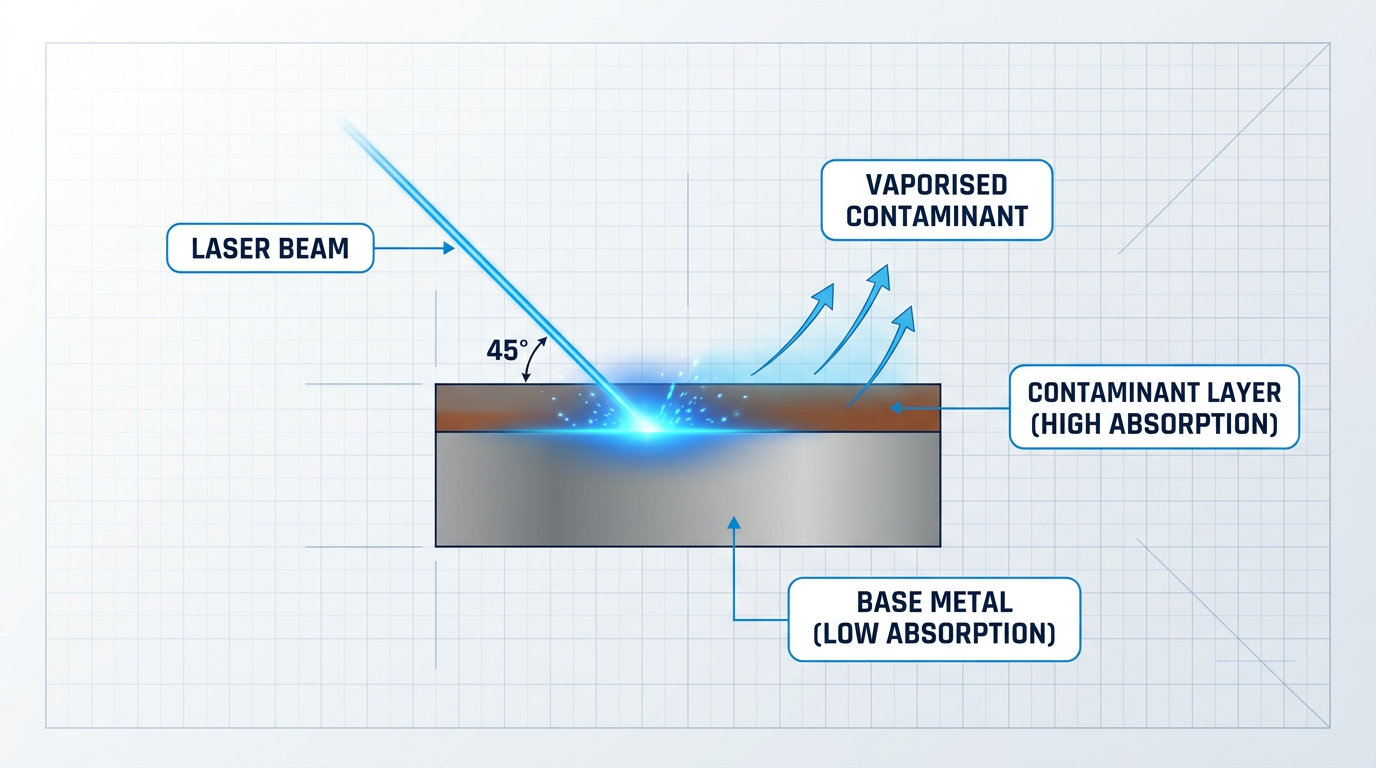
Because the contaminant absorbs so much more energy than the metal, the beam reaches its ablation threshold at the contamination layer first — the metal surface below simply does not receive enough energy to be affected.
The absorption differential means the beam selectively destroys the contaminant and spares the substrate — not because the operator sets the right parameters, but because the two materials respond to the same wavelength in fundamentally different ways.
This self-limiting nature is a critical concept for buyers evaluating substrate risk: once the contaminant layer is gone, the clean base material's lower absorption means the beam's effect at the surface drops sharply.
There is no mechanical wear continuing after the contaminant is cleared, no chemical reaction persisting in the substrate, and no abrasive medium left behind — the process simply stops doing meaningful work when there is nothing left to remove.
Pulsed and continuous wave energy delivery
Industrial laser cleaning machines deliver that ablative energy in one of two fundamental modes: pulsed or continuous wave (CW).
In pulsed mode, the laser fires in very short bursts, concentrating energy delivery and limiting how much heat transfers into the substrate between pulses; in continuous wave mode, the beam delivers a sustained thermal interaction with the surface.
Each mode has distinct implications for cleaning precision, throughput, and substrate sensitivity — distinctions that are central to choosing the right machine type, and covered in full in the next section.
Fibre lasers: the dominant industrial platform
The large majority of industrial laser cleaning machines are built around fibre laser technology, which generates the beam inside a rare-earth-doped optical fibre rather than a gas tube or crystal rod.
Fibre lasers offer high electrical-to-optical efficiency, long operational lifespans, and — critically — the ability to deliver the beam through a flexible fibre-optic cable to a compact scanner head.
That fibre-optic delivery cable is what makes handheld portable systems practical and robot-mounted scanner heads viable: the laser source can sit in a separate enclosure while the cleaning head goes wherever the work is.
With the physics of laser ablation and the fibre laser platform established, the natural next question is how different machine configurations put that mechanism to work across different industrial environments — which is exactly where the guide turns next.
Types of Industrial Laser Cleaning Machine
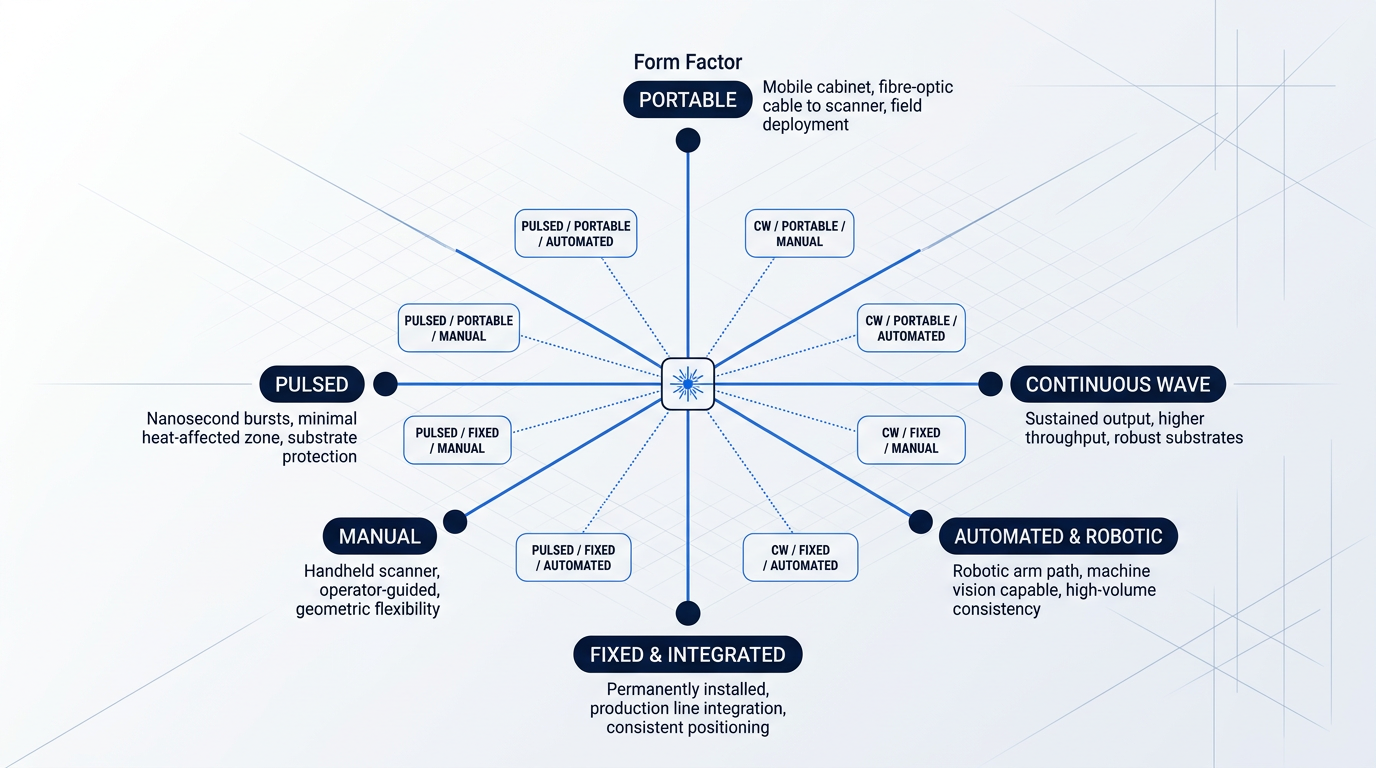
Understanding how laser ablation works is only the starting point. The more consequential question for any buyer is: which industrial laser cleaning machine configuration is right for your operation? The answer depends on three independent decisions — how the laser delivers its energy, where the machine lives relative to the workpiece, and how much of the cleaning process a human operator controls.
Energy Delivery Mode: Pulsed vs Continuous Wave
The physics distinction between pulsed and continuous wave (CW) lasers was introduced in the previous section. What matters here is what that distinction means when you are selecting a machine.
A pulsed fibre laser fires energy in nanosecond bursts, generating very high peak power within each pulse while keeping average power — and therefore total heat input — low. The practical result is a minimal heat-affected zone: the substrate beneath the contamination layer absorbs very little thermal energy, which protects it from distortion, oxidation, or metallurgical change.
This makes pulsed systems the preferred choice wherever substrate integrity is non-negotiable: mould cleaning, aerospace components, thin sheet materials, heritage conservation, and any surface where the base material is sensitive to heat.
A continuous wave laser delivers sustained, uninterrupted output. Because energy is applied to the surface without interruption, average power at the surface is higher — and so is throughput on large or robust substrates. The trade-off is greater heat input per unit area, which is acceptable when the substrate can tolerate it.
CW systems are well suited to structural steel preparation, large-area rust removal, heavy coating stripping, and high-volume industrial applications where the workpiece material is robust and cycle time is the primary constraint.
The application determines which energy delivery mode is appropriate. Pulsed lasers prioritise substrate safety and precision; CW lasers prioritise throughput on robust surfaces. Choosing by power rating alone, without considering pulse mode, is one of the most common specification errors buyers make.
Form Factor: Portable vs Fixed and Integrated
The second axis is about where the machine lives and how it reaches the work. Portable laser cleaning systems are self-contained, wheeled units: the laser source, cooling, and controls are housed in a mobile cabinet, and a lightweight cleaning head is connected to it via a fibre-optic cable.
The operator brings the machine to the workpiece rather than the reverse, which opens up a distinct set of use cases: field maintenance on large structures, in-situ cleaning of components that cannot be removed from service, multi-site operations, and any scenario where the workpiece is too large or too fixed to move to a cleaning station.
Cable reach is a meaningful differentiator between portable systems. A longer fibre-optic cable run allows the operator to cover more of a large structure — a bridge section, a ship hull, a wind turbine nacelle — without repositioning the machine unit itself, which directly affects productivity on extended surfaces.
Fixed and integrated machines take the opposite approach: they are permanently installed in a production line or dedicated cleaning cell, and the workpiece is brought to them. Consistent machine positioning enables consistent, repeatable cleaning results across high volumes of identical or near-identical parts.
Fixed installations also integrate naturally with upstream and downstream production processes — conveyors, part-handling systems, inspection stations — making them the logical choice for production environments where laser cleaning is one step in a defined manufacturing sequence.
Operation Mode: Manual vs Automated and Robotic
The third axis governs how the cleaning head moves across the surface. In manual operation, the operator guides a handheld scanner by hand, adapting path, speed, and overlap in real time to the surface in front of them.
This flexibility is the defining advantage of manual systems. Irregular geometries, variable contamination levels, and changing surface conditions are all handled by the operator's judgement — no pre-programming, no path definition, no setup overhead before cleaning can begin.
- Geometric flexibility: Adapts in real time to complex or irregular surfaces that would be difficult to program into an automated path.
- Minimal setup overhead: No path programming or part-fixturing required before the operator can begin cleaning.
- On-site and field capability: Suited to maintenance work, field repairs, and locations where bringing the part to a machine is impractical.
- High geometric variability: Works well when each part or surface presents differently — heritage objects, maintenance repairs, varied weld preparations.
In an automated system, the cleaning head is mounted on a robotic arm that moves it through a defined path. Every cycle follows the same trajectory, delivering consistent cleaning results across every part — human variability is removed from the process.
This consistency is the primary argument for automation in high-volume production: the same part geometry is cleaned the same way, every time, without operator fatigue or attention drift affecting the outcome.
It is worth noting that not all automated systems work the same way. Some follow a path programmed by a technician before production begins; others use machine vision to scan each loaded part, build a 3D surface map, and generate the cleaning path automatically. That distinction has significant implications for how flexible an automated system is across part variants — a point worth examining closely when evaluating automated options.
The Buyer's Decision Continuum
These three axes are independent, but they interact. The machine landscape runs from portable-manual at one end — maximum flexibility, single-operator deployment, minimal setup, suited to varied and unpredictable work — through to fixed-automated at the other: maximum throughput, consistent output, minimum operator involvement, suited to high-volume production of defined part geometries.
The right position on that spectrum is not a matter of which configuration is technically superior; it is a function of your specific combination of production volume, part geometry consistency, operating environment, and the degree to which cleaning is a standalone task or an integrated production step.
With the machine landscape mapped, the natural next question is how these configurations apply to specific industrial cleaning tasks — which is exactly what the applications section addresses.
Industrial Laser Cleaning Applications: What Can They Clean?
The range of surfaces an industrial laser cleaning machine can treat is wider than most buyers expect — the same underlying physics that removes rust from structural steel also strips insulating paint from EV motor hairpins, cleans vulcanisation residue from tyre moulds, and lifts centuries of soiling from limestone monuments. What changes between applications is not the principle but the machine configuration and power range, both of which are determined by the substrate's tolerance for heat and the nature of the contaminant.
Rust and Oxide Removal
Rust and oxide removal is the most immediately intuitive laser cleaning application because the physics is visually obvious: iron oxide and the steel beneath it are genuinely different materials, and the absorption differential between them does the work.
Iron oxide absorbs the laser wavelength at a significantly higher rate than the underlying steel, so the beam vaporises the rust layer while the base metal remains largely intact — no mechanical contact, no embedded abrasive, and a surface that is immediately ready for the next process step.
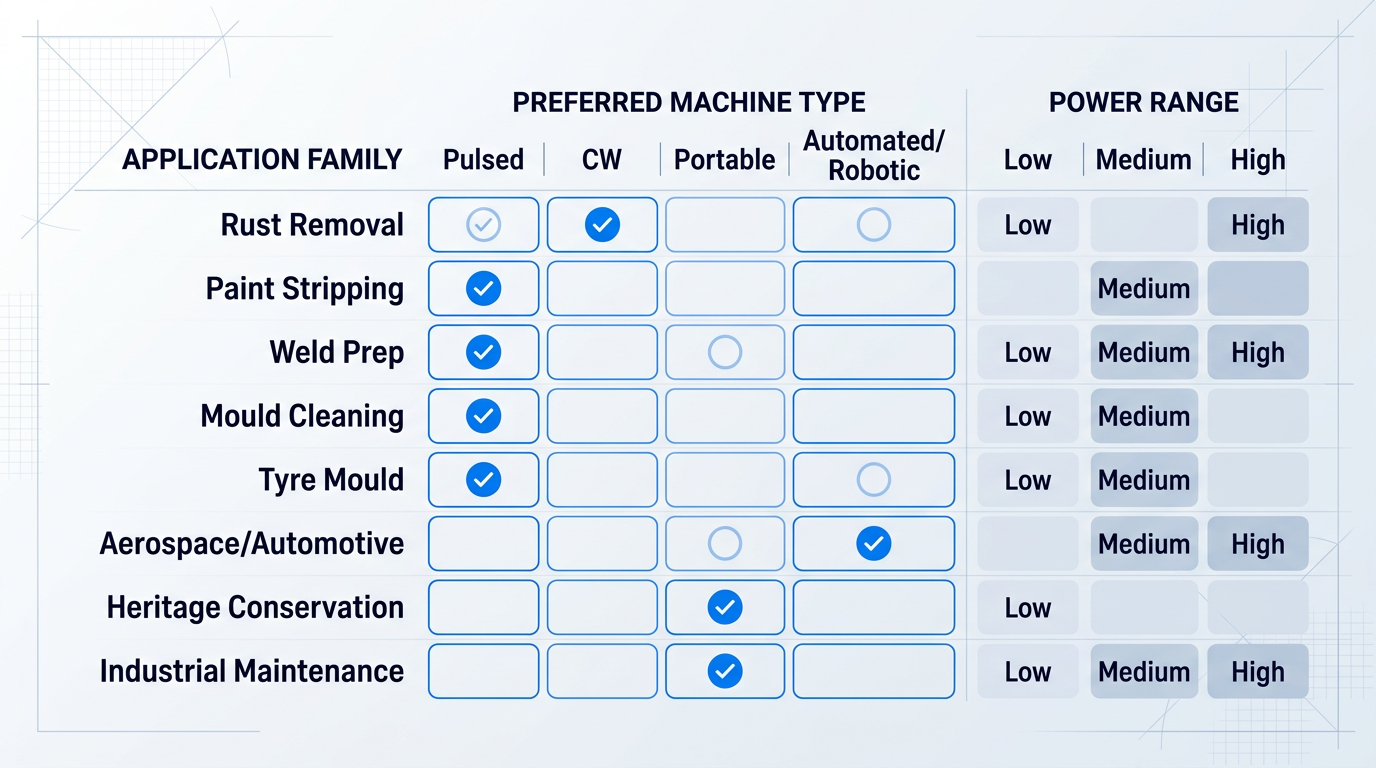
For large-area, high-throughput work on structural steel, rail infrastructure, or heavy plant equipment, continuous wave (CW) machines deliver the coverage rates needed; for thinner or more sensitive steel sections where tighter energy control matters, pulsed machines are the preferred choice because they minimise heat input to the substrate between pulses.
Peer-reviewed research on pulsed Nd:YAG laser cleaning of A3 steel has confirmed that rust layers can be removed completely at suitable parameters, and that the microhardness and corrosion resistance of the cleaned surface actually improve after laser treatment — a meaningful secondary benefit for structural applications.
Paint and Coating Stripping
The same absorption differential principle applies to organic coatings: the paint or coating layer absorbs the laser energy and is vaporised, while the metal substrate beneath reflects or dissipates enough of that energy to remain undamaged.
In aerospace depainting, this matters acutely. Regulatory pressure on methylene chloride — a chemical historically used for aircraft paint removal — has tightened significantly, with the EPA's 2024 TSCA rule phasing out most industrial and commercial uses; laser stripping is an established non-chemical alternative that meets zero-HAP-emission requirements for depainting operations.
Pulsed lasers are generally preferred for paint stripping because the controlled, short-duration energy delivery keeps substrate temperatures low — test results on aircraft aluminium sheet have shown maximum substrate temperatures of around 170°F with a pulsed system, which is well within safe limits for thin-gauge aerospace skins and automotive panels.
On production lines, laser cleaning also enables selective coating removal: the beam strips coating from precisely defined areas — weld flanges, bonding zones, electrical contact points — without requiring physical masking of the rest of the part.
Surface Preparation for Welding and Bonding
This is one of the highest-value laser cleaning applications and one of the most underappreciated in general coverage of the technology.
Laser cleaning leaves a dry, chemically clean surface with no embedded particles and no residue — which directly improves weld quality and adhesive bond strength. Residual lubricants, oxides, and greases are known causes of weld porosity and spatter; removing them with a laser before joining eliminates those defect pathways without introducing new contamination.
In automotive body-in-white production, short-pulse lasers clean and prepare bonding zones selectively, replacing whole-part chemical wash processes; manufacturers can dispense with post-processing steps such as demasking and drying. The same approach is used in EV battery assembly, where laser cleaning prepares battery tray surfaces and cell bonding areas before adhesive application, ensuring long-term stable adhesion without aggressive chemicals.
For hairpin welding in electric motors, short-pulse lasers strip the insulating paint from copper hairpin ends without damaging the copper beneath — a process that is both more precise and faster than mechanical stripping, and that delivers a weld-ready surface in a single step.
Both portable and automated machines are relevant here: portable units suit on-site structural steel joint preparation, while automated systems integrate directly into production-line welding cells.
Mould Cleaning
Injection moulding and die-casting moulds accumulate release agent residue and polymer build-up over production cycles, and conventional cleaning methods require disassembly and downtime.
The critical operational advantage of laser cleaning here is in-situ cleaning without disassembly: the mould can be cleaned directly in the press, significantly reducing production interruptions. When the fibre laser beam contacts the mould surface, it interacts with the coating — transforming release agent and polymer residue into vapour or dust — while leaving the mould surface itself unaffected.
Pulsed lasers are strongly preferred for mould cleaning because the precision of energy delivery is essential to avoid dimensional damage to mould cavities, which are manufactured to very tight tolerances. A MOPA pulsed fibre laser's precise heat control is a critical advantage here: any thermal distortion or surface erosion from an incorrectly specified machine would compromise the mould geometry and the quality of every part it subsequently produces.
The laser's power can be adjusted based on the contaminant type, and because the process is non-contact, there is no wear and tear on the mould surface — extending mould service life alongside the cleaning benefit.
Tyre Mould Maintenance
Tyre moulds are a specialist case where the substrate preservation requirement is particularly demanding: vulcanisation residue and build-up accumulate in mould vents and across mould surfaces, and the vent geometry must be preserved exactly — even minor dimensional change affects tyre quality.
Laser cleaning removes the residue without abrasive contact, exploiting the significantly higher ablation threshold of the mould surface compared to the moulding residue — the process cleans efficiently without touching the underlying metal geometry. The mould can be cleaned cold or hot, eliminating the need to heat the mould outside the press as required by dry ice blasting.
Pulsed lasers at appropriate power settings are the preferred machine type, and the application is well-suited to automated robotic systems for consistent coverage of complex tread patterns, including winter tyre moulds with intricate three-dimensional sipe arrangements.
Aerospace and Automotive Components
Turbine blades, engine components, and EV battery parts represent the tight-tolerance end of the application spectrum, where the dimensional change or surface contamination that abrasive methods introduce simply cannot be tolerated.
Laser cleaning is the preferred method for surface preparation, contaminant removal, and oxide removal on these components because the beam stops at the base material and leaves no residue — a property that is critical for components that will be coated, welded, or bonded in subsequent steps.
Automated and robotic laser cleaning is common in this application family for two reasons: consistency requirements (every part must be cleaned to the same standard) and component geometry (turbine blades and complex castings require multi-axis reach that a robotic arm provides). Both pulsed and CW machines are used depending on the specific component and contaminant type.
Across every application family, the correct machine type and power range are determined by the substrate's tolerance for heat and the contaminant's thickness — not by the industry sector. A tyre mould and an aerospace turbine blade both demand pulsed precision for the same reason: tight dimensional tolerances that cannot absorb thermal error.
Heritage Conservation and Restoration
At the opposite end of the power spectrum from structural steel cleaning, laser cleaning of stone, masonry, metal monuments, and artefacts requires low power, extremely precise control, and a gentle approach that preserves the original surface.
The Getty Conservation Institute notes that laser cleaning of stone is now routine in large-scale commercial conservation, with its great attraction being that it entails no physical contact and therefore suits very delicate surfaces — and that there are no solvents or water to redistribute potentially harmful salts within porous materials like limestone and sandstone.
Peer-reviewed research has demonstrated that femtosecond pulse lasers can clean a range of contaminants — biofilm, environmental soiling, rust, and spray paints — from heritage monuments while preserving the integrity of the underlying substrate, with the ultra-short pulse duration preventing heat or shock waves from travelling into the stone.
Portable machines are the natural form factor for heritage work: the object stays in place, and the operator brings the machine to it, whether that is a cathedral facade, a public monument, or a museum artefact. The ability to operate in situ without dismantling or moving irreplaceable objects is a defining advantage of the technology in this context.
Industrial Maintenance and Field Cleaning
On-site cleaning of plant, equipment, and infrastructure — pipework, structural steelwork, machinery, electrical contacts — is the application family where the portable form factor delivers its most direct operational value.
The defining advantage here is not just portability but the combination of portability with no-media operation: there is no abrasive to clean up, no chemical to handle, no water to manage, and no secondary waste stream to dispose of. The machine comes to the workpiece, cleans it, and leaves nothing behind except the extracted fume captured by the integrated extraction system.
This makes laser cleaning particularly well-suited to confined spaces, access-controlled environments, and locations where waste management is difficult — situations where conventional cleaning methods generate handling and disposal problems that add cost and complexity beyond the cleaning task itself.
Understanding what an industrial laser cleaning machine can do across these application families is the foundation for the next evaluation step: how it performs against the sandblasting, chemical stripping, and other legacy methods it is increasingly replacing.
Laser Cleaning vs Sandblasting vs Chemical Stripping
Knowing what laser cleaning can do is only half the evaluation. The harder question — the one that determines whether a capital investment is justified — is how it compares to the methods already running on your shop floor. For most industrial operations, that means sandblasting or chemical stripping. Both work. Both have decades of industrial history behind them. And both carry a category of operational overhead that laser cleaning eliminates not by being better-engineered, but by being a fundamentally different physical process.
The Hidden Overhead of Sandblasting
Sandblasting's core problem is not that it cleans poorly — it's that the mechanism of cleaning introduces a second problem at the same time. Propelling abrasive media at high velocity removes contamination by physically impacting the surface, and that impact creates an anchor profile: increased surface roughness from abrasive contact that permanently alters the substrate geometry.
For precision parts, tight-tolerance components, and soft metals like aluminium or copper, that roughening is not incidental damage — it compromises dimensional integrity and can embed abrasive particles into the surface, creating corrosion initiation points and coating adhesion failures downstream.
The occupational hazard profile compounds the operational burden. Silica dust generated during abrasive blasting is a serious inhalation risk, associated with silicosis — a progressive and incurable lung disease — making enclosed-space or indoor blasting operations particularly constrained from a worker safety standpoint.
Spent media waste adds a further layer of complexity: when the surface being stripped carries lead-based paint or heavy metal coatings, the spent abrasive becomes classified hazardous waste, triggering specialist disposal requirements, licensed carrier collection, and environmental documentation — costs that rarely appear in an initial sandblasting budget.
Chemical Stripping: Cycle Time and Waste Overhead
Chemical stripping solves the anchor profile problem — immersion chemistry reaches complex geometries without mechanical contact — but it substitutes one set of operational constraints for another. The process is inherently multi-step: soak, rinse, and neutralisation phases each add time and handling, extending cycle times in ways that become production bottlenecks at scale.
The hazard profile is distinct but equally constraining. VOC exposure from solvent-based strippers and chemical burn risk from acid or alkali reagents require extensive ventilation, respiratory protection, and chemical handling qualifications for operators. These requirements make chemical stripping a controlled-environment process — it cannot be performed on-site, in the field, or near active production without significant infrastructure.
Waste disposal is the method's most persistent cost driver. Spent acids, solvents, and rinse water almost always require formal hazardous waste reporting, licensed carrier collection, and processing at specialist facilities — expenses that recur with every batch and scale directly with throughput.
What Laser Cleaning Eliminates by Design
The advantages of laser cleaning over these methods are not incidental. They are structural consequences of how the physics works: the beam interacts selectively with the contamination layer and stops at the base material, meaning there is nothing to contain, dispose of, or clean up afterwards.
- No consumables: No abrasive media to purchase, store, contain, or dispose of. Running cost is electricity and periodic filter replacement — nothing else.
- No chemical waste: Zero hazardous liquid streams. No specialist disposal contracts, no licensed carrier collection, no environmental reporting for the cleaning process itself.
- No abrasive residue: The surface is left free of embedded particles — no secondary cleaning step before coating, bonding, or inspection.
- Process-ready surface: The cleaned surface is dry and chemically clean immediately. For welding preparation and adhesive bonding, this means the next process step can follow without delay.
- No secondary clean-up: No media containment teardown, no rinse cycle, no neutralisation wait. The cleaning step ends when the laser stops.
The substrate profile difference is where laser cleaning separates from both alternatives on quality grounds, not just cost. Because the beam stops at the base material, the original surface geometry is preserved — dimensional tolerances are held, and no foreign material is introduced.
Sandblasting creates an anchor profile that is useful for structural paint adhesion on steelwork but damaging for precision parts where tolerances must be maintained. Chemical stripping carries a residue risk: if rinse or neutralisation steps are incomplete, chemical contamination remains on the surface and creates problems for subsequent bonding or coating — a failure mode that laser cleaning cannot produce.
| Factor | Laser Cleaning | Sandblasting | Chemical Stripping |
|---|---|---|---|
| Consumable cost per m² | $0.02 (electricity only) | $2.50–$4.00 (abrasive media) | Ongoing chemical purchase + replenishment |
| Waste disposal per m² | $0 | $1.50–$3.00 (spent media; hazardous if lead paint present) | Specialist liquid waste disposal — licensed carrier required |
| Substrate damage risk | Minimal — beam stops at base material | High — anchor profile created; grit embeds in soft metals | Moderate — residue risk if rinse/neutralisation incomplete |
| Selective zone cleaning | Yes — µm precision on defined areas | No — entire surface affected by media dispersal | Limited — masking required for selective treatment |
| Field / on-site use | Yes — portable units available | Possible but requires containment and media handling | Not practical — controlled environment required |
| Waste classification risk | None — dry particulate captured by extraction | Hazardous if heavy metal coatings present | Almost always requires formal hazardous waste reporting |
Comparison of laser cleaning, sandblasting, and chemical stripping across key operational and cost dimensions using figures from published sources.
The consumable cost gap is the table's most consequential row: at $0.02/m² for laser cleaning versus $2.50–$4.00/m² for sandblasting media alone, the per-unit economics shift dramatically at any meaningful cleaning volume — before waste disposal costs are factored in at all.
It is worth being direct about where legacy methods remain the right tool, because the case for laser cleaning is stronger when it is made honestly. Sandblasting retains a genuine advantage for large-area structural rust removal on steelwork where a specific anchor profile is required by the coating specification — laser cleaning preserves the existing surface profile and does not create the roughness that heavy industrial coatings often need. Chemical stripping remains the correct choice for full-immersion batch passivation of complex geometries, where the chemistry must reach internal passages and recesses that a laser beam cannot access.
The relevant comparison is not 'what does the machine cost?' but 'what does cleaning cost per part over five years?' Upfront machine cost is higher than an abrasive blaster — but consumable spend, waste disposal, downtime, and rework costs accumulate on the other side of that ledger every single year.
The multi-year economics are where laser cleaning's case becomes compelling. With near-zero consumable spend, no recurring waste disposal contracts, and no media containment setup or soak cycle adding to cycle time, the operating cost per part trends toward a fraction of either legacy method at sustained production volumes.
Lower rework rates add a further lever: substrate damage from abrasive blasting and chemical residue from incomplete stripping both trigger rework and rejection costs that rarely appear in a headline cost-per-hour comparison but accumulate materially across a year's production.
The correct framework for any procurement evaluation is total cost of ownership — consumables, waste handling, downtime, rework, PPE, and compliance overhead — calculated per part, over the machine's working life. That is the number that determines whether the investment is justified, and for any operation cleaning at meaningful frequency and precision, it consistently favours laser cleaning.
With the method case established, the next practical question is machine specification: specifically, how to size an industrial laser cleaning machine by power output to match the task at hand — which is what the next section addresses.
See Laser Cleaning in Action
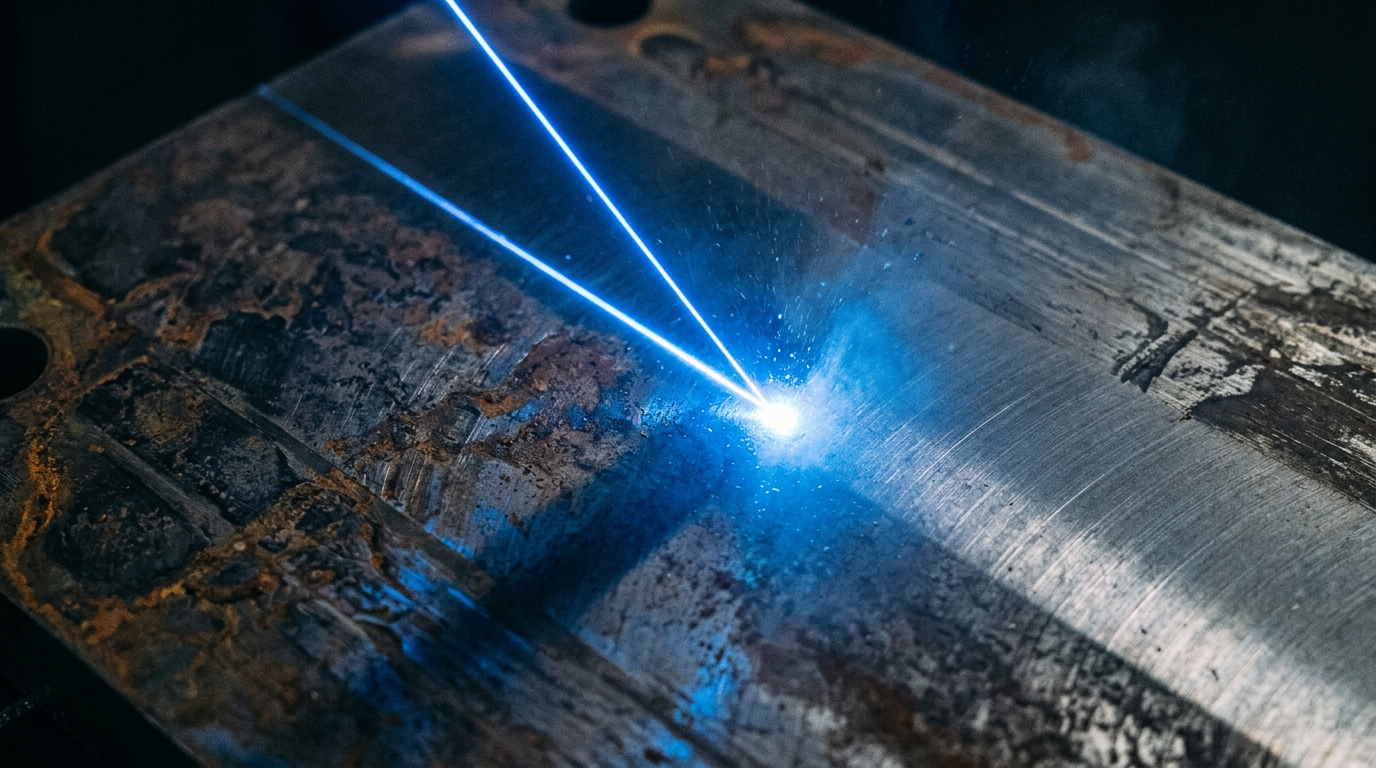
The numbers make the case — but seeing it removes any doubt. Watch a portable industrial laser cleaning machine strip a graffiti wall, or explore the ELASER product page to review full specifications.
Choosing the Right Laser Power: 100W to 3000W
The most common mistake buyers make when specifying an industrial laser cleaning machine is asking "what's the most powerful system available?" when the more useful question is: what power does my specific task actually require?
Wattage is not a quality dial. It is a throughput and capability dial — higher power means more energy delivered to the surface per second, which translates to either faster cleaning of the same contamination or the ability to tackle thicker, harder deposits that lower power cannot shift in a practical timeframe.
Before looking at power ranges, it helps to define the four inputs that determine where on the spectrum a given application sits. These inputs are the framework; the power ranges are the output.
- Substrate type and sensitivity: What material are you cleaning? Sensitive substrates — thin metals, composites, heritage artefacts — constrain how much energy can be applied safely.
- Contaminant type and thickness: What are you removing, and how thick or hard is it? Heavy rust, mill scale, and multi-layer coatings demand significantly more energy than thin oxide films.
- Surface area to be cleaned: How much ground must the laser cover? Larger surface areas push requirements toward higher power to keep cycle times viable.
- Required cycle time or throughput: How fast does cleaning need to happen? A production line with tight cycle times needs more power than a maintenance operation with flexible scheduling.
With those four inputs defined, the power ranges below become a practical sizing guide rather than a specification sheet.
Low Power: 50–200W
At the lower end of the power spectrum, the defining characteristic is precision and substrate safety rather than speed.
This range suits sensitive substrates, mould and tooling cleaning, heritage conservation and restoration work, and any application where fine control over energy delivery matters more than area coverage rate.
Pulsed delivery is typical here — short energy bursts minimise heat transfer to the base material, which is critical when the substrate itself cannot tolerate thermal stress.
Mid Power: 200–500W
The 200–500W band is the workhorse range for most industrial maintenance and surface preparation tasks, and it is where the majority of buyers evaluating a portable laser cleaning machine will land.
General rust and coating removal, surface preparation for welding and bonding, and maintenance cleaning in live facilities all sit comfortably here.
To illustrate the throughput step-up within this band: cleaning aluminium before welding at 100W achieves a line speed of around 2.96 cm/s; at 300W that rises to 5.85 cm/s; at 500W it reaches 7.27 cm/s — a meaningful productivity gain across the same power tier.
Systems in this range are typically air-cooled at the lower end, transitioning toward water cooling as power approaches 500W — an important operational consideration covered below.
High Power: 500W–1000W
Above 500W, the buyer's primary requirement shifts from precision to area coverage per hour.
This range is suited to large-area rust removal, heavy coatings, structural steel, and shipbuilding applications where throughput is the governing constraint.
At this power level, systems begin to move away from fully portable handheld configurations and toward fixed or semi-fixed installations, often mounted on gantries or robotic arms to manage the additional cooling and power infrastructure.
Ultra-High Power: 1000W–3000W+
At 1kW and above, the operational context changes entirely: these systems are almost always integrated into automated cells or production lines rather than deployed as standalone handheld units.
Ultra-high-power systems use multimode fibre lasers, which produce a larger spot size than single-mode lasers — ideal for covering large surface areas efficiently rather than targeting precise, localised zones.
Water cooling is mandatory at this power level, and total power consumption ranges from approximately 10 kVA at 1kW to over 20 kVA at 3kW — site infrastructure planning is a genuine prerequisite, not an afterthought.
The Variable Buyers Most Often Miss
Power requirements are frequently underestimated because buyers focus on surface area and overlook contamination thickness and hardness as equally important inputs.
Contamination thickness and hardness are equally critical inputs. A thick layer of mill scale or heavy rust on a small part may demand more power than a thin oxide film on a much larger workpiece — the energy required per unit area scales with what you are removing, not just how much area you are covering.
Industry guidance on rust removal, for instance, points toward 800–1000W to penetrate heavy Fe₂O₃ layers effectively, while paint stripping on the same steel structure may be handled at 500–700W — the substrate is identical, but the contaminant's energy demand differs.
Air-Cooled vs Water-Cooled: Operational Implications
Cooling requirement is a direct consequence of power level, and it has practical implications for site deployment that buyers should factor in early.
Air-cooled systems are generally suitable up to around 300W — no chiller unit, no coolant plumbing, simpler site setup, and straightforward portability for field or multi-location use.
Water cooling becomes mandatory at 500W and above: closed-loop chiller systems maintain the laser source at 20–25°C, preventing the efficiency degradation that air cooling cannot manage at sustained high-power operation.
The practical implication is that a water-cooled system requires a chiller unit, coolant circuit, and associated maintenance — all of which need to be planned into the site installation before purchase, not discovered after it.
The table below maps each power tier to its reference cleaning speed, cooling requirement, and typical deployment context, drawing on traceable industry data points.
| Power Range | Reference Speed Data Point | Cooling Type | Typical Deployment |
|---|---|---|---|
| 50–300W | 300W system: 0.3–0.6 m²/hr on light rust | Air-cooled | Portable handheld; precision work, mould cleaning, maintenance tasks |
| 200–500W | 500W system: 7.27 cm/s line speed cleaning aluminium (1.5 cm beam width) | Air- or water-cooled | Portable or semi-fixed; surface prep for welding, general industrial cleaning |
| 500W–1000W | High-power systems generally: up to 50 cm²/s on light rust; ~5 cm²/s on heavy rust | Water-cooled | Fixed or semi-fixed; large-area rust removal, structural steel, shipbuilding |
| 1000W–3000W+ | 1,500W system: 2–3 m²/hr on heavy rust on steel plate | Water-cooled (chiller required) | Automated cell or production line; high-volume industrial applications |
Comparison of laser power tiers by traceable reference speed data, cooling requirement, and deployment context to help buyers identify the right specification tier for their application.
The data points in the table are reference figures for specific conditions, not universal cleaning rates — actual throughput on your application will depend on all four buyer inputs, particularly contamination thickness, which can reduce effective speed by an order of magnitude even within the same power tier.
For most buyers, the decision is not simply "more power is better" — it is finding the tier where cycle time requirements are met without over-specifying into a form factor or infrastructure commitment that does not suit the operation.
Defining your four inputs clearly — substrate, contaminant type and thickness, surface area, and required cycle time — gives you a defensible power specification before you approach a manufacturer, and prevents both over-specification and under-specification.
With your power range identified, the next decision is how that power is best delivered: in a portable handheld system for flexible field use, or in an automated robotic cell for high-volume production. That form factor choice is explored in the next section.
Portable vs Automated: Choosing Your Machine Form Factor
The right industrial laser cleaning machine isn't the most powerful one, or the most advanced — it's the one that fits where the work happens and how parts move through your operation.
Power specification, covered in the previous section, tells you what the machine needs to do. Form factor tells you how it gets there.
Portable Laser Cleaning: Bringing the Machine to the Work
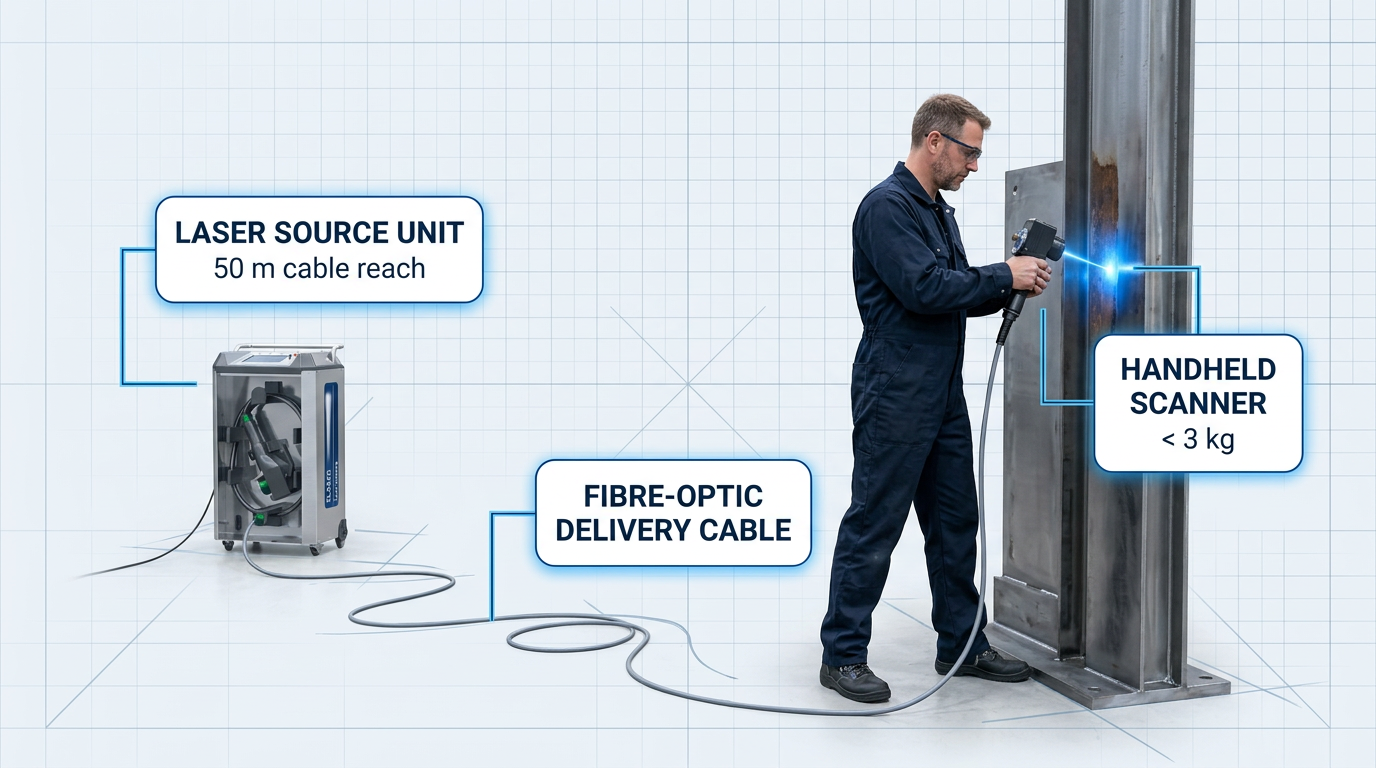
A portable laser cleaning system is a wheeled, self-contained unit housing the laser source, with a lightweight handheld scanner connected to it via a fibre-optic delivery cable.
One operator can deploy it without a compressor, chiller, or any consumables — unpack, connect, clean.
The cable reach between the wheeled unit and the handheld scanner is a more operationally significant spec than it might first appear.
In a live facility, the laser source often cannot be positioned directly at the workpiece: it may need to sit outside a confined space, at the base of a structure, or in a safe zone while the operator works overhead or around an obstruction.
Cable reach varies considerably across the portable market — some systems are limited to 5–10 m, which constrains where the unit can be parked relative to the work.
WSL's ELASER and ELASER-RHZ — the company's own portable laser cleaning systems, designed and built in-house in the UK — offer up to 50 m of cable reach with a sub-3 kg handheld scanner, giving operators genuine freedom to position the source unit well away from the workpiece.
That reach matters in the field: cleaning a bridge span, a large fabrication, or a structure inside a live plant where the laser unit cannot follow the operator step for step.
The core logic of portable systems is simple: bring the machine to the workpiece, not the workpiece to the machine.
That logic makes portable the right answer for field maintenance and on-site rust or coating removal, heritage restoration in publicly accessible locations, industrial maintenance inside live facilities where taking equipment offline is impractical, multi-site operations where one machine travels between locations, and operators building a laser cleaning service business where the portable unit is the service vehicle itself.
The ELASER-RHZ variant adds a capability that changes where a portable system can operate, not just how it performs.
WSL's patented Reduced Hazard Zone (RHZ) technology — a world first — collapses the laser hazard zone to a small area around the work surface, enabling cleaning in open workshops, mixed-use facilities, and publicly accessible settings without sealing off the surrounding area.
Conventional portable laser cleaners require the working area to be cleared and controlled before operation — a significant logistical overhead in busy or public environments.
The ELASER-RHZ removes that constraint, making it the only portable laser cleaner of its kind in the world and unlocking deployment contexts that are simply not accessible to standard portable systems.
Both systems are CE and UKCA certified, air-cooled, and competitively priced among comparable European industrial laser cleaning machines.
WSL is the only UK-based laser cleaning manufacturer — founded in 2012, designing, building, servicing, and improving its machines entirely in-house rather than rebadging third-party equipment, which is worth noting because a significant portion of the portable laser cleaning market consists of importers and resellers whose support capability is limited to what the original manufacturer provides.
First-class operator training and bespoke engineering options are available; contact WSL directly for customisation requirements.
Automated Laser Cleaning: When the Work Comes to the Machine
Automation makes sense when the operational problem is volume, consistency, and labour — not location.
If you are cleaning high volumes of similar or near-similar parts on a production line, manual operator time per cycle becomes the constraint: the laser is fast enough, but the human setup and handling is not.
Automated laser cleaning removes the operator from the repetitive cycle, holds the same cleaning standard on every part regardless of who loaded it, and integrates into the production flow as a fixed cell.
Most automated laser cleaning systems on the market use programmed-path automation: a technician sets the cleaning path during commissioning, the robot follows that path, and the system repeats it reliably for as long as the part geometry stays consistent.
That model works well for highly uniform batches, but it has a structural dependency: when part geometry changes, the path must be reprogrammed, which requires technical expertise and setup time.
Programmed-path systems are repeatable but brittle: a new part geometry means a new program. Machine-vision-driven automation eliminates that dependency entirely — the system scans the part, builds its own 3D map, and generates the cleaning path without any manual input.
WSL's AutoLASE takes a fundamentally different approach: load a part, and the system's 3D machine-vision software scans it, builds a 3D map of its geometry, and generates the cleaning path automatically.
No programming, no path-setting, no knowledge of part geometry required — anyone can load a part and run it.
The cleaning head is carried on a multi-axis articulated robotic arm, which traces the angles and contours of complex 3D parts that a fixed-head system cannot reach.
AutoLASE attaches to a customer's existing collaborative or industrial robot arms, or can be supplied as a complete turnkey cell — whichever fits the integration path.
The optional RHZ upgrade for AutoLASE extends WSL's eye-safe technology to the automated context: with RHZ configured, the cell requires no enclosure at all, enabling automated laser cleaning in environments where a full safety enclosure is impractical or impossible.
No other automated laser cleaning system in the world offers enclosure-free operation — every competing system requires a full enclosure as standard.
AutoLASE is CE and UKCA certified, competitively priced, and backed by the same in-house WSL engineering and support that underpins the ELASER range.
Choosing Between Portable and Automated
The decision isn't about which form factor is more capable — it's about which one fits your operation's actual constraints.
- Volume and repetition: High-volume cleaning of consistent parts points to automation. Varied, occasional, or on-site cleaning points to portable.
- Geometry consistency: Consistent part geometry that can be mapped and repeated is automation's natural territory. Varied geometries or unpredictable field conditions suit portable.
- Labour reduction: If repetitive cleaning is consuming skilled operator time at scale, an automated cell pays for itself. Varied on-site work does not justify a fixed cell.
- Operating environment: Open, multi-site, or publicly accessible settings call for portable — especially with RHZ. An enclosed production cell suits automation, standard or RHZ-upgraded.
These are questions to ask about your own operation, not a rigid filter — some facilities will run both form factors for different tasks.
Both the ELASER-RHZ and AutoLASE introduce RHZ technology as a deployment-unlocking feature, but the full picture of what that means for laser hazard classification, compliance, and operator safety is covered in the next section.
Laser Cleaning Safety: Hazard Zones, PPE, and RHZ
Most buyers reach the safety question late — after they've chosen a power level, settled on a form factor, and started thinking about deployment. That's when the real question surfaces: where can you actually run a Class IV laser in your facility? The answer shapes everything from site preparation costs to which applications are even viable.
Industrial laser cleaning machines are typically classified as Class IV lasers — the highest hazard class under international laser safety standards. Class IV lasers are capable of causing serious eye and skin injury from direct, reflected, or scattered beam exposure, and this classification mandates defined engineering and administrative control measures. Compliance is not discretionary.
One route to a safer system classification is full enclosure: a sealed cell with interlocked access can bring a laser system to Class I at the system level, because no hazardous radiation escapes the enclosure during normal operation. This is how many automated cleaning cells achieve their safety rating — but it comes with the operational overhead of the enclosure itself, which is not always practical.
For open-beam operation — the mode used by handheld and semi-automated systems — the critical concept is the Nominal Hazard Zone (NHZ): the region within which laser radiation levels exceed the Maximum Permissible Exposure (MPE) for the eye or skin. In practical terms, the NHZ for an industrial laser cleaning machine can extend several metres from the point of work, and every person and surface within that zone must be controlled.
That NHZ is the source of the real operational cost. Conventional Class IV open-beam laser cleaning requires the NHZ to be treated as a restricted zone: the area must be sealed or cordoned off, cleared of all personnel before work begins, fitted with warning signs and interlocked access, and kept off-limits for the duration of the cleaning operation.
In a dedicated cleaning booth or enclosed production cell, that overhead is manageable. In an open workshop, a mixed-use manufacturing facility, or a publicly accessible space, it becomes a genuine barrier — laser cleaning simply cannot proceed alongside other workers or members of the public without shutting down the surrounding area first.
Beyond the NHZ controls, Class IV open-beam operation carries a set of non-negotiable baseline requirements that every operator must meet. For specific compliance obligations, buyers should consult the relevant safety standards and a qualified laser safety officer for their jurisdiction.
- Laser-rated eye protection: Optical density-rated goggles matched to the operating wavelength — non-negotiable for all personnel within or near the NHZ.
- Appropriate protective clothing: Skin coverage to guard against reflected or scattered beam exposure; specific requirements depend on power level and application.
- Operator training: Formal laser safety and machine operation training for all operators — a regulatory requirement, not an optional add-on.
- Fume extraction: Laser cleaning vaporises contaminants into fumes and fine particles; a fume extraction system with appropriate filtration is required regardless of laser class.
These requirements are well-understood and manageable for facilities with dedicated cleaning areas. The harder constraint, for many buyers, is not the PPE — it's the NHZ overhead that makes open-environment deployment impractical with conventional systems.
Reduced Hazard Zone Technology: Cleaning Without Clearing the Area
WSL's patented Reduced Hazard Zone (RHZ) technology addresses that constraint directly. The ELASER-RHZ is the world's only laser cleaner of its kind: WSL's patented approach collapses the laser hazard zone to a small area around the work itself, fundamentally changing the deployment calculus for any buyer who needs to clean outside a sealed enclosure.
It is also worth understanding who builds it. WSL is the only UK-based laser cleaning manufacturer — designing, building, servicing, and improving its own machines in-house. Many suppliers in the laser cleaning market are resellers or importers rebadging third-party hardware, which means limited engineering support, slower spares, and no genuine ability to develop the product further. The RHZ technology exists precisely because WSL engineers its own machines from the ground up.
Operationally, RHZ technology unlocks applications that are simply not viable with conventional open-beam systems. Cleaning can proceed in open workshops without sealing off surrounding areas, in mixed-use facilities alongside other workers, and in publicly accessible spaces — graffiti removal from monuments, heritage restoration on listed structures, on-site infrastructure maintenance — environments where conventional laser cleaning would require clearing the public before a single pass of the beam.
Conventional laser cleaning requires clearing and sealing the area around the work. With RHZ technology, the hazard zone is confined to a small area around the work itself — the area doesn't need to be cleared at all. That's not a compliance convenience; it's an entirely different set of applications made accessible.
WSL provides full operator training for the ELASER-RHZ — because even with a dramatically reduced hazard zone, professional training remains the right foundation for safe, effective operation. The machine carries both CE and UKCA certification, meeting the conformity requirements for the UK and European markets.
With the safety and operating environment picture now clear, the logical next step is pulling all the decision variables together — power, form factor, automation level, and operating environment — into a practical framework for specifying the right machine. That's exactly what the buying checklist in the next section is designed to do.
Ready to Specify Your Laser Cleaning Machine?
You have covered the key technical decision points. Book a call with a laser cleaning expert to discuss your specific application, facility constraints, and power requirements before you commit.
Buying Checklist: Key Questions Before You Specify
Nine questions, in the order a procurement team would naturally work through them — take this into a supplier conversation and you will not leave with the wrong machine.
- Application and substrate: What is being cleaned, from what base material, and what must the surface be ready for afterwards: welding, bonding, coating, or immediate use?
- Contamination type and thickness: Is the contaminant rust, paint, oxide, mill scale, release agent, or mould residue? How thick or hard is the layer? These inputs drive power selection.
- Surface area and geometry: Is the surface flat or complex 3D? Are parts small components or large structures? Geometry determines whether manual or robotic form factor is appropriate.
- Throughput requirement: What cycle time or area-per-hour is required? This sets the minimum power specification and determines whether automation is necessary.
- Operating environment: Open workshop, mixed-use facility, or enclosed cell? The answer determines whether conventional Class IV controls are feasible or whether reduced hazard zone technology is required.
- Portability vs fixed installation: Is the machine needed at multiple sites, or does work come to a fixed cell? On-site deployment and in-plant use demand fundamentally different form factors.
- Manufacturer due diligence: Does the manufacturer design and build in-house, or are they rebadging third-party machines? Ask directly — it affects spares availability and genuine engineering support.
- Certifications and compliance: Confirm CE and UKCA certification for UK and EU markets. Verify the laser safety class and what controls your specific operating environment requires.
- Training and support: What operator training is provided at handover? What is the spares and servicing model? Training is non-negotiable regardless of laser class.
When evaluating cost, apply the correct financial lens: the right question is not what the machine costs today, but what total cost of ownership looks like over five years — factoring in the absence of consumables, chemical disposal, and abrasive media that traditional methods require.
A machine that appears more expensive at purchase can deliver a substantially lower cost per part across a production lifetime, particularly in high-volume or continuous-operation environments.
A significant portion of the laser cleaning market consists of resellers importing and rebadging third-party machines. In-house manufacturing means faster spares, genuine engineering support, and a supplier who can actually fix a design problem — not just escalate it to an overseas OEM.
With these questions answered, you are in a strong position to evaluate specific solutions rather than react to a sales pitch — the next section brings the guide's key conclusions together and outlines practical next steps.
Conclusion
Choosing your industrial laser cleaning machine: next steps
The right industrial laser cleaning machine is not the most powerful one available, nor the cheapest — it is the one that fits your application, your operating environment, and your throughput requirement.
Approached as a multi-year investment rather than a line-item cost, that matched machine will almost always prove the better financial decision.
When you are ready to move from evaluation to specification, WSL builds every machine in-house — which means the conversation starts with your process, not a product catalogue.
Frequently asked questions about industrial laser cleaning machines
Still have questions after reading the guide? The answers below cover the most common queries buyers and operators ask about industrial laser cleaning machines.
Industrial laser cleaning machines span a wide price range depending on power, form factor, and automation level. Portable systems represent the lower end of the capital investment; high-power automated cells are a significantly larger outlay. The right financial lens, however, is total cost of ownership rather than sticker price. Zero consumables, reduced downtime, and lower rework rates — because the beam stops at the base material — change the multi-year economics substantially compared to abrasive or chemical methods. Among comparable European industrial laser cleaning machines, the ELASER and ELASER-RHZ are competitively priced, an outcome of Woodrow Scientific's in-house design and manufacturing efficiencies rather than any compromise on quality. Pricing is available on request.
Yes — and the economics are attractive for operators with sufficient demand. A portable laser cleaning system enables a service business model built on near-zero consumable running costs: no abrasive media, no chemicals, no water. That low cost base, combined with the high hourly rates a specialist industrial cleaning service can command, creates a strong margin structure. Demand is also growing as industries move away from abrasive and chemical methods. WSL provides first-class operator training to support a successful service launch, covering both safe operation and practical technique.
Laser cleaning machines work on a wide range of materials. On the metals side: steel, carbon steel, aluminium alloys, cast iron, copper, brass, bronze, titanium, and galvanised steel. For stone, masonry, and concrete: brick, stone, concrete, and masonry are all suitable substrates. Contaminants are equally varied — the same machine handles rust, oxides, mill scale, paint, powder coating, lacquer, primer, oil and grease, carbon and soot, mould residue, graffiti, adhesives and residues, tarnish, weld discolouration, and release agents. The beam's selectivity means it removes the contaminant while leaving the base material intact, making it suitable for precision applications alongside heavy industrial cleaning.
At minimum: laser-rated eye protection matched to the operating wavelength, appropriate operator clothing, and a fume extraction system. For standard Class IV open-beam operation, a defined Nominal Hazard Zone (NHZ) with controlled access is also required under ANSI and OSHA laser safety frameworks. Fume extraction is non-negotiable regardless of laser class — the cleaning process vaporises contaminants into fumes and fine particles, and filter specification should match the contaminant type. Operator training is a safety requirement, not optional. The ELASER-RHZ uses WSL's patented reduced hazard zone technology to confine the laser hazard to a small area around the work, significantly reducing the access-control overhead compared to conventional Class IV systems. The ELASER and ELASER-RHZ are both CE and UKCA certified.
Yes — and the physics behind it is well established. Laser cleaning works through selective ablation: the contaminant absorbs the laser's wavelength far more readily than the underlying substrate, so it vaporises or is ejected while the base material remains intact. This is not an experimental method. The technology is deployed at production scale across aerospace, automotive manufacturing, mould cleaning, and heritage conservation — industries where precision and repeatability are non-negotiable. The selectivity of the process is also what makes it superior to abrasive methods for sensitive substrates: the beam stops when it reaches clean material.
There are genuine trade-offs worth knowing. Upfront capital cost is higher than an abrasive blaster or chemical stripping setup — though the multi-year economics typically favour laser cleaning once consumable costs, disposal, and rework are factored in. Throughput on very large structural areas can be slower than high-volume sandblasting where an anchor profile is the goal and surface precision is not a factor. Operator training and PPE are required — this is not a plug-and-play tool, and treating it as one creates safety risk. Fume extraction is mandatory, adding to initial setup requirements. None of these are reasons to rule out laser cleaning — but they are real considerations for any buyer doing an honest evaluation before committing to the technology.