

Introduction
A laser ablation system is industrial equipment that directs a focused laser beam at a surface to remove contamination, coatings, oxides, or residues — stopping precisely at the base material and leaving the substrate intact.
This page covers industrial surface treatment, cleaning, coating removal, and surface preparation in manufacturing environments, not laboratory instruments or medical applications.
Fibre-laser systems are the dominant technology for metal cleaning, rust removal, and paint stripping, while CO2 and UV variants serve specialist roles in organics, polymers, and precision micro-machining.
The evaluation framework below walks through the criteria that separate one system from another, so you can read the entries that follow with a clear sense of what to weigh.
TL;DR
The industrial laser ablation market spans an enormous range — from sub-10 kg handheld units to multi-kilowatt robotic cells with machine vision and automated path generation. Form factor, laser source, power level, and automation depth all interact, and the wrong choice for your operational context is an expensive mistake. The systems reviewed here are mapped against the axes that actually drive procurement decisions.
This article covers:

The main types of industrial laser ablation systems
How to evaluate and compare laser ablation systems
Five systems reviewed against consistent criteria
Matching system type to your application
Safety considerations and what drives cost differences
How to Evaluate Laser Ablation Systems: Criteria That Matter
Two laser ablation systems can share an identical wattage rating and still be entirely wrong for each other's application — one optimised for precision micro-machining on sensitive substrates, the other built for stripping heavy coatings across large production surfaces at speed.
Buying on spec sheets alone leads to poor procurement decisions; the entries that follow are each assessed against the same eight criteria, so understanding these axes first turns the list into a genuine shortlisting tool rather than a catalogue to scroll through.
- Laser Source Type: Fibre lasers (around 1064 nm) dominate metal cleaning and surface prep. CO2 suits organics and polymers. UV enables precision micro-machining with minimal heat-affected zone.
- Power Range: Low-power systems (10–100 W) suit precision and delicate substrates. Mid-range (200–500 W) covers most industrial tasks. High-power (500 W–3 kW+) targets large-area, high-throughput production.
- Portability vs. Fixed Installation: Portable or wheeled systems enable multi-site and on-equipment use. Fixed robotic cells deliver repeatability for high-volume, identical-part production runs.
- Automation Level: The spectrum runs from manual handheld to fully robotic with machine-vision path generation, directly affecting labour cost, cycle-time consistency, and minimum viable volume.
- Application Suitability: Coating removal, rust treatment, weld prep, mould cleaning, and micro-machining each demand different power, wavelength, and pulse parameters — not every system suits every task.
- Safety Architecture: Conventional Class 4 systems require a defined nominal hazard zone with area controls. Some systems offer reduced-hazard-zone technology, enabling open-environment operation without full shutdown.
- Total Cost of Ownership: Upfront capital is one input. No consumables, low maintenance, and minimal rework compound over time — a higher-capital system can be the lower-cost choice over three to five years.
- Supplier Type: In-house manufacturers offer direct engineering accountability and faster support. Resellers rebadging third-party hardware may have slower spares access and no ability to improve the product.
The total cost of ownership criterion deserves more than a bullet description, because it is the frame that most procurement processes get wrong.
Laser ablation carries structural cost advantages that compound over time: no abrasive media, no chemical consumables, no disposal costs, and minimal substrate damage that would otherwise generate rework — factors that a capital-price comparison entirely misses.
The sophisticated buyer's approach is to model operating costs across a three-to-five-year horizon, not to anchor on the purchase invoice; a system priced higher upfront can easily outperform a cheaper alternative once consumable spend, downtime, and rework rates are factored in.
Safety architecture is the criterion most buyers underweight at the shortlisting stage, yet it can determine whether a system is operationally viable in a given environment.
According to OSHA guidance grounded in ANSI Z136 classifications, Class 4 laser systems — which cover the majority of industrial laser ablation equipment — require a defined nominal hazard zone (NHZ): the space within which direct, reflected, or scattered radiation exceeds the applicable maximum permissible exposure level, and within which area controls must be in place before operation begins.
Some systems incorporate reduced-hazard-zone technology that dramatically shrinks the NHZ, making operation in open workshops, mixed-use facilities, or public-facing environments feasible without a full area shutdown — a capability that is operationally irrelevant in a sealed production cell but critical in any other setting.
If your environment cannot support conventional NHZ controls — cleared zones, interlocked access, dedicated laser areas — then reduced-hazard-zone capability moves from a differentiator to a prerequisite, and systems without it are not viable candidates regardless of their other specifications.
With these criteria established, the following entries evaluate the leading industrial laser ablation systems available today, each assessed against the same eight axes so you can compare like-for-like across very different system types.
Product 1
ELASER / ELASER-RHZ
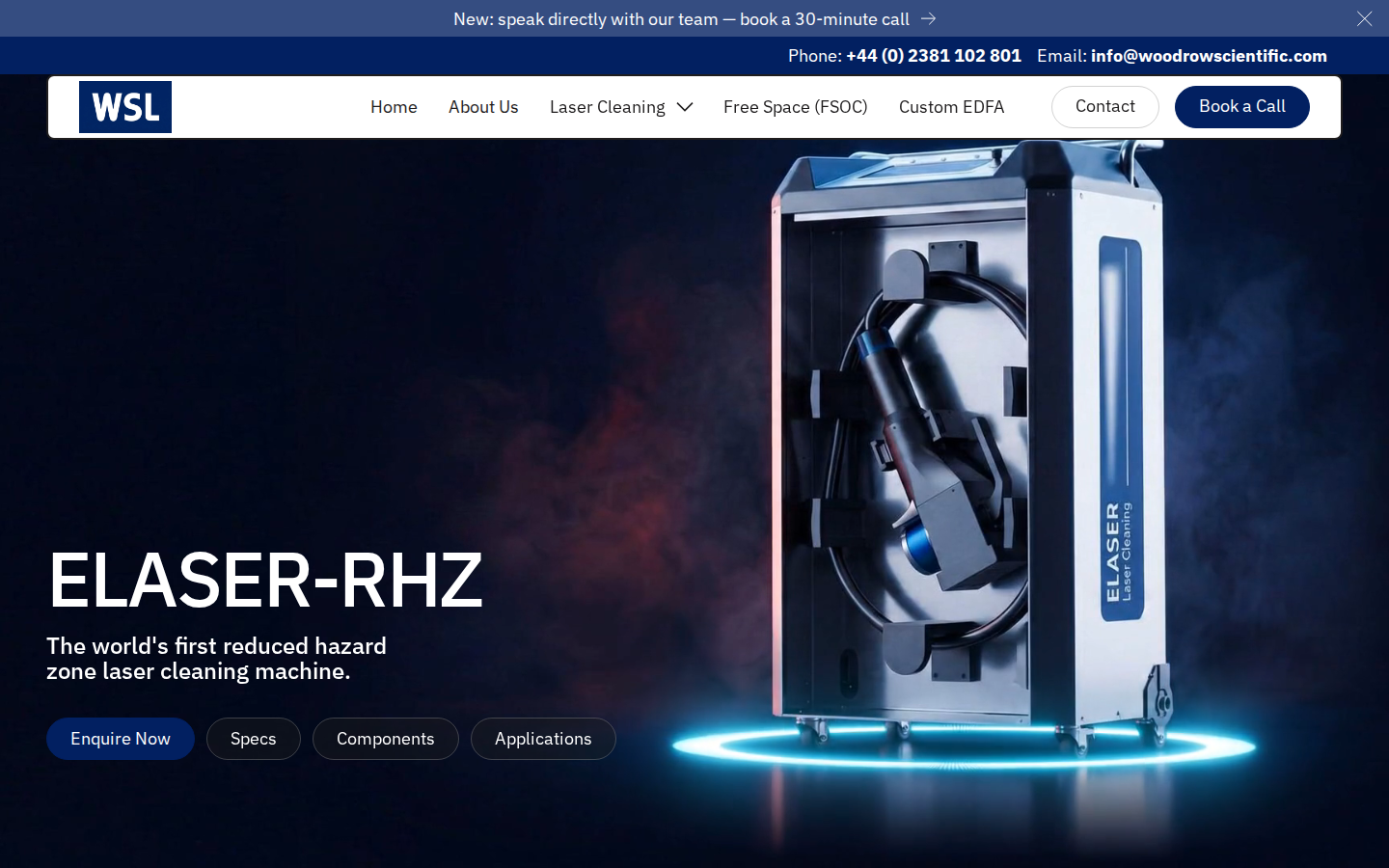
Best for industrial buyers who need a portable, single-operator laser cleaning system capable of working in open workshops, mixed-use facilities, or publicly accessible environments without sealing off the surrounding area.
Pros:

World-first patented reduced hazard zone technology
Competitive pricing from the only UK manufacturer
Sub-3 kg scanner with 50 m cable reach
CE and UKCA certified, made in Britain
Cons:

Throughput is operator-dependent for high-volume tasks
Manual operation suits flexible, not fixed-production, use
The ELASER-RHZ carries a capability no other portable laser cleaning system in the world currently offers: a patented reduced hazard zone (RHZ) that collapses the nominal laser hazard area to a fraction of the size produced by conventional systems.
In practical terms, this changes where laser cleaning can happen. Conventional laser cleaning systems require the surrounding area to be sealed off and evacuated before work begins — a significant operational constraint in open workshops, mixed-use manufacturing facilities, or any publicly accessible space. The ELASER-RHZ removes that barrier entirely, enabling cleaning to continue without shutting down adjacent operations or clearing the area.
WSL's patented 1550 nm wavelength is the foundation of the reduced hazard zone capability. No other portable laser cleaning system holds this classification — the ELASER-RHZ is the sole system of its kind worldwide.
The second differentiator is the company behind the machine. Woodrow Scientific Limited (WSL) is the only UK-based laser cleaning manufacturer that designs, builds, services, and improves its systems entirely in-house.
A significant portion of the laser cleaning market is supplied by resellers and importers rebadging third-party hardware. That model has real consequences for buyers: no in-house engineering capability means slower spares, weaker support, and no genuine path to product improvement. WSL's in-house manufacturing model is a direct answer to those pain points.
On pricing, the ELASER is positioned as the most competitively priced comparable industrial laser cleaning machine available in Europe — an outcome of WSL's technological and operational efficiencies rather than any compromise on build quality.
ELASER / ELASER-RHZ Key Specifications
The table below covers the specifications buyers typically compare at shortlist stage.
| Specification | ELASER / ELASER-RHZ |
|---|---|
| Laser source | Fibre laser, 1550 nm (patented wavelength) |
| Max power | Up to 300 W |
| Power tunability | 0–100% |
| Laser class | Class IV (standard) / Class I (RHZ variant) |
| Scanner weight | Under 3 kg |
| System weight | Under 50 kg (wheeled) |
| Delivery cable reach | Up to 50 m |
| Power supply | 110–250 VAC single-phase |
| Cooling | Air-cooled (no chiller required) |
| Certifications | CE and UKCA certified |
| Manufacture | Made in Britain |
Gives buyers a fast, scannable reference for the ELASER's core technical parameters — the same axes covered in the evaluation framework — without requiring them to hunt through prose.
The 1550 nm wavelength is not an arbitrary choice — it is the specific wavelength that underpins the RHZ capability and distinguishes the ELASER from fibre laser systems operating at the more common 1064 nm.
Power tunability across the full 0–100% range means a single machine handles everything from lifting light oxides and weld discolouration through to stripping thick paint and powder coating. Buyers do not need to specify separate systems for different cleaning intensities.
Portability and Automation
The ELASER is a genuinely self-contained, single-operator system. The wheeled unit sits under 50 kg; the handheld scanner comes in under 3 kg; and the delivery cable extends up to 50 m — a reach that matters significantly in practice, since many competing portable systems are limited to 10 m or less.
Operation is manual and handheld. For buyers whose cleaning tasks span multiple locations, involve cleaning on installed equipment, or require working across variable geometries, this is the correct configuration — a fixed automated cell would be impractical for those scenarios.
Application Suitability
The ELASER covers a wide range of contaminants and substrate types across a broad set of industrial sectors.
- Contaminants removed: Rust, oxides, mill scale, paint, powder coating, lacquer, primer, oil and grease, carbon and soot, mould, graffiti, adhesives and residues, tarnish, weld discolouration, release agents.
- Substrates: Steel, carbon steel, aluminium alloys, cast iron, copper, brass, bronze, titanium, galvanised, stone, concrete, brick, masonry.
- Sectors: Automotive, aerospace, tyre and rubber, injection moulding and tooling, industrial maintenance, heritage and restoration, graffiti removal, laser cleaning service businesses.
The RHZ variant extends the application set further still: graffiti removal and heritage restoration in publicly accessible spaces are now viable without cordoning off the work area — tasks that conventional laser cleaning systems cannot practically serve.
Safety Architecture
On the safety axis, the ELASER-RHZ's reduced hazard zone is the defining feature. Conventional portable laser cleaning systems require full nominal hazard zone (NHZ) controls — area evacuation, physical barriers, interlock systems — that constrain when and where cleaning can take place.
The ELASER-RHZ confines the hazard to a small area immediately around the work surface, removing the need for full-area evacuation. WSL provides comprehensive safety and operation training as standard, ensuring operators are fully equipped to work within the system's safety framework.
TCO and Running Costs
The ELASER is air-cooled and consumable-free — no chiller, no abrasive media, no chemical replenishment, no water supply. Running costs are therefore limited largely to electricity, with power consumption under 2,000 W.
Minimal substrate loss is a further TCO factor: because the beam stops at the base material, rework from surface damage is substantially reduced compared with abrasive or chemical methods. Over a machine's service life, these savings compound.
Bespoke Engineering and Customisation
WSL offers bespoke engineering and customisation capability for buyers with specific requirements. The scope of what is possible is best discussed directly with WSL's engineering team — interested buyers are encouraged to get in touch.
ELASER / ELASER-RHZ Pricing
Pricing is provided on a quote basis. As the European cost leader in comparable industrial laser cleaning systems, the ELASER delivers competitive upfront pricing alongside a strong total cost of ownership profile. Contact WSL directly for a quote tailored to your application.
Who Should Look at the Next Entry Instead?
Manual handheld operation means throughput is operator-dependent. For buyers running high-volume, repetitive production tasks where every part must be cleaned to a consistent standard on every cycle, the AutoLASE (Product 2) is the more appropriate fit. If that describes your procurement situation, the next entry covers it in full.
See the ELASER-RHZ Full Specifications
The ELASER-RHZ is the only portable laser cleaning system with a patented reduced hazard zone. Download the datasheet or visit the product page for full technical specifications.

Product 2
AutoLASE
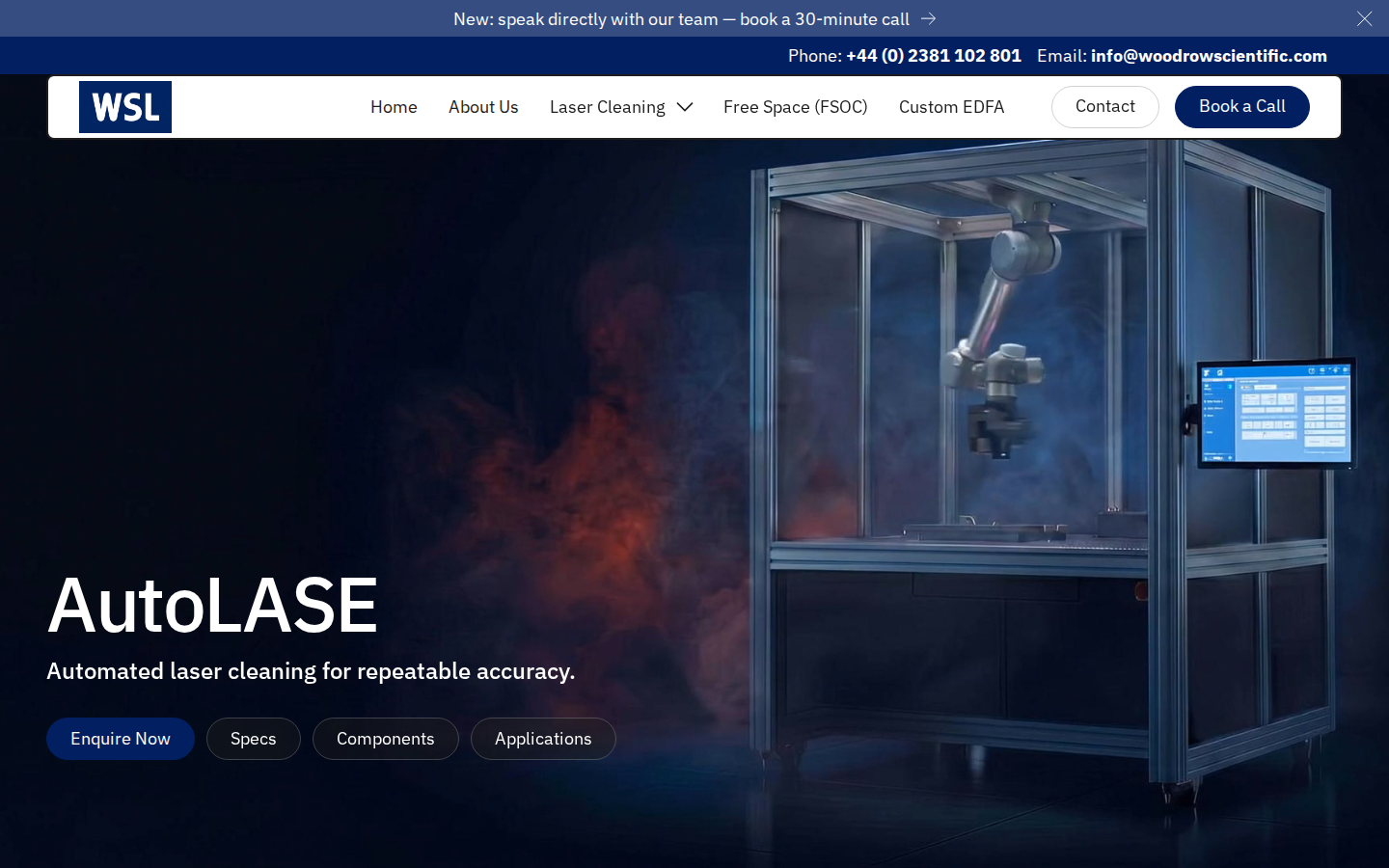
AutoLASE is Woodrow Scientific Limited's robotic automated laser cleaning cell: load a part, and the onboard machine vision scans it, builds a 3D map, and generates the entire cleaning path automatically — no programming, no path-setting, and no knowledge of part geometry required.
Pros:
Load-and-go: no programming or path-setting needed
Optional RHZ upgrade: runs without any enclosure
Competitively priced European cost leader
Built in Britain by an in-house manufacturer
Cons:
Fixed-cell only: not suited for on-site work
AutoLASE is best suited to production environments running repetitive, high-volume cleaning tasks where every part must be cleaned to the same standard, every cycle, with minimal operator involvement.
What separates AutoLASE from every other automated laser cleaning system on this list is not that it is automated — it is how effortlessly it runs. The onboard machine vision software scans each loaded part, constructs a full 3D map of its geometry, and generates the cleaning path autonomously: no manual programming, no path-setting, no technician setup, and no knowledge of part geometry required from the operator.
Anyone on the production floor can load a part and run a cycle to the same standard as a trained engineer — that skills-barrier removal is a meaningful operational advantage in environments where specialist availability is a constraint.
As covered in the ELASER evaluation, WSL's patented Reduced Hazard Zone (RHZ) technology is available as an optional upgrade on AutoLASE — making it the only automated laser cleaning cell in the world capable of operating without a full enclosure. No other automated cleaning cell on the market offers this capability.
AutoLASE Specifications
| Specification | Detail |
|---|---|
| Max power | Up to 300 W |
| Wavelength | 1550 nm (fibre laser) |
| Power tunability | 0–100% |
| Laser class | Class IV (Class I with optional RHZ upgrade) |
| Power supply | 110–250 VAC single-phase |
| Cooling | Air-cooled — no chiller required |
| Certifications | CE and UKCA certified |
| Manufacture | Made in Britain |
Presenting key technical specifications in tabular form allows production engineers and procurement leads to scan and compare AutoLASE's core parameters quickly, mirroring the format used for Entry 1 to support cross-entry scannability.
The 0–100% tunable power output means a single AutoLASE cell handles everything from light surface oxides through to thick coatings, across metals, stone, and masonry — the multi-axis articulated arm reaches the angles and contours of complex 3D parts that fixed-beam systems cannot access.
AutoLASE Applications
AutoLASE has been verified across a broad range of industrial cleaning and surface-preparation tasks, with applications spanning several high-demand sectors.
- Injection moulds and tooling: Strip release agents, residue, and build-up from mould cavities, cores, and inserts — restoring fine detail without disassembly or abrasive wear.
- Automotive parts: Engine, driveline, and EV battery components cleaned of oxides, coatings, and contamination, or surface-prepped for welding and bonding, part after part.
- Aerospace components: Turbine blades, vanes, and engine parts cleaned and surface-prepped to tight tolerances, held to the same standard on every cycle.
- Tyre and rubber moulds: Remove vulcanisation residue and build-up from moulds, segments, and vents — no abrasives, no mould wear.
- Remanufacturing and refurbishment: Strip corrosion, coatings, and contamination from worn components before rebuild — batches cleaned consistently and ready for inspection.
These are representative applications; if a component fits the cell, AutoLASE can clean it automatically — buyers with non-standard requirements are encouraged to get in touch with WSL directly to discuss bespoke engineering and integration options.
Every part cleaned to the same standard, every cycle. AutoLASE removes the cycle-to-cycle variability that manual handheld operation introduces — which matters not just for throughput, but for downstream quality and inspection pass rates.
From the same manufacturer as the ELASER, AutoLASE carries WSL's full in-house engineering pedigree: CE and UKCA certified, designed and built in Britain, with genuine product improvement capability and fast, expert support that comes from owning the entire manufacturing process.
It is worth noting that a meaningful portion of the laser cleaning market is made up of resellers and importers rebadging third-party hardware — buyers doing due diligence should confirm whether a supplier can genuinely service, improve, and stand behind what they sell. WSL designs, builds, and supports everything in-house.
First-class laser cleaning safety and operation training is available, and WSL's bespoke engineering capability means AutoLASE can be configured to work with a buyer's existing collaborative or industrial robots, or supplied as a complete custom cell — interested buyers should contact WSL to scope their specific integration requirements.
On total cost of ownership, the case is strong: zero consumables, automated labour savings on repetitive cleaning tasks, less downtime, and less rework through precise, substrate-preserving cleaning all contribute to a compelling long-run cost position. Pricing is available on request.
The one genuine scope boundary to acknowledge: AutoLASE's fixed-cell form factor means it is not the right choice for on-site, multi-location, or open-environment cleaning tasks. Buyers who need that deployment flexibility should refer back to the ELASER-RHZ (Product 1) — it is built precisely for that use case.
Product 3
IPG | cleanLASER
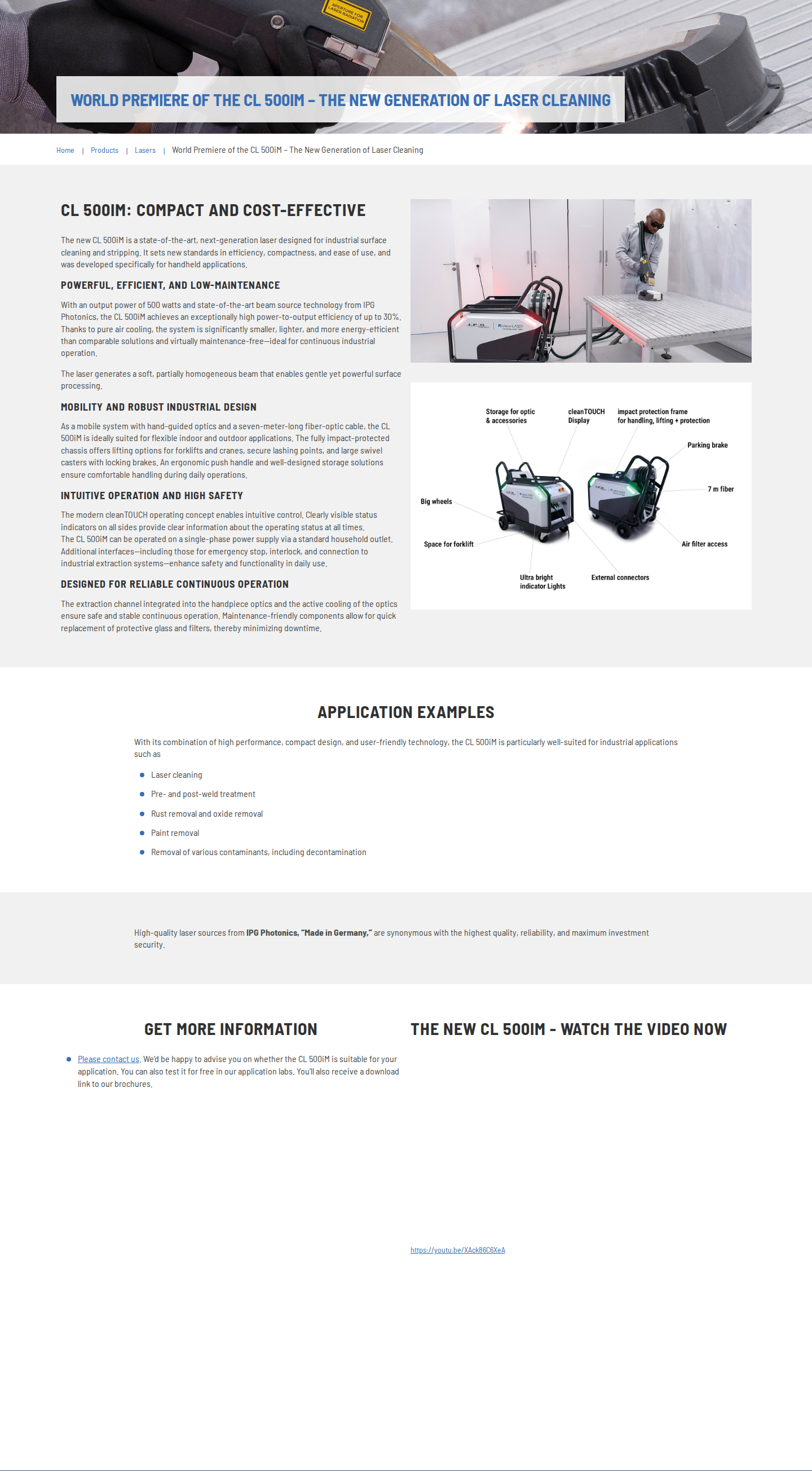
cleanLASER (now an IPG Photonics subsidiary) is an established German laser cleaning specialist with over 20 years of application experience, offering a broad range from the portable 500 W CL 500iM through to 1,700 W high-power fixed systems, with deep sector coverage across automotive, aerospace, and rubber and tyre manufacturing.
Pros:
Broad power range: 150 W to 1,700 W
Over 20 years of laser cleaning expertise
Full automation portfolio: handheld to gantry
Backed by IPG Photonics fibre-laser manufacturing scale
Cons:
Conventional Class 4 — no eye-safe option
High-power systems need three-phase and water cooling
Post-acquisition support structure should be verified
Best for: Industrial buyers who prioritise supplier heritage, a large verified install base, and a power range that spans from portable handheld use through to high-throughput fixed production — particularly those in automotive, aerospace, rubber and tyre, or nuclear decontamination sectors who want to see proven reference applications before committing.
cleanLASER Power Range and Laser Sources
The cleanLASER product line covers a genuinely broad power spectrum, from the CL 150/300/500/600 mid-power series through to the CL 1000 and CL 2000 high-power systems, with the CL 500iM sitting as the newest mobile entry point.
| System | Power (CW) | Laser Type | Cooling | Power Supply |
|---|---|---|---|---|
| CL 150 / 300 / 500 / 600 (mid-power series) | 150 – 600 W | Diode-pumped solid-state | Air or water (model-dependent) | Three-phase |
| CL 500iM (mobile) | 500 W | IPG beam source (type unspecified) | Air-cooled | Single-phase |
| CL 1000 | 1,000 W | Diode-pumped solid-state | Water-cooled | Three-phase |
| CL 2000 | Up to 1,700 W | Diode-pumped solid-state | Water-cooled | Three-phase |
A table communicates the power range and key technical distinctions across the CL series more clearly than prose — buyers comparing systems across entries benefit from seeing the spectrum at a glance.
That breadth is a practical buyer advantage: the same supplier can fulfil a portable field-cleaning requirement and a large-area production decoating requirement, reducing the number of vendor relationships a procurement team needs to manage.
The CL 2000 is positioned specifically for large-area applications with thicker layers — paint stripping, weld seam pre-treatment before non-destructive testing, and nuclear decontamination at scale are cited application areas on the cleanLASER product page.
cleanLASER Portability: CL 500iM vs. Higher-Power Systems
The CL 500iM is cleanLASER's most deployment-flexible system: air-cooled, single-phase power via a standard outlet, and a seven-metre fibre-optic cable feeding hand-guided optics — making it genuinely portable for both indoor and outdoor use without specialist power infrastructure.
Higher-power systems in the CL 1000 and CL 2000 range are mobile in the sense of being housed in wheeled cabinets, but they require a three-phase electrical connection and external cooling water supply. That distinction matters significantly for buyers comparing deployment flexibility across systems — site preparation requirements are meaningfully different.
cleanLASER Automation Options
cleanLASER offers one of the broader automation portfolios in the laser cleaning market, spanning from compact processing stations through to large-area gantry systems.
- cleanCELL turnkey cells: Modular, laser-safe production machines available in three width classes (cleanCELL 1170, 2220, 3220), designed for 3-shift operation with high positioning precision via recirculating ball screw linear axes.
- roboCELL and customer-specific robot cells: Robot-guided systems that connect cleanLASER units to industrial robots via digital I/O or fieldbus interfaces; conventional robot programming applies.
- cleanGANTRY portal systems: Turnkey gantry solutions for processing large components and assemblies — repeatability accuracies of well under one millimetre even at spans of several tens of metres, with optional contourSCAN software for synchronised axis and scanner movement.
- Customised OEM and integration solutions: cleanLASER technology can integrate with existing conveyors and material handling systems via digital I/O or fieldbus, and is available in tailored OEM configurations.
A buyer can enter the cleanLASER ecosystem at the handheld level and scale into a fully automated robotic or gantry cell from the same supplier — a continuity of vendor relationship that simplifies long-term procurement and service.
It is worth noting that cleanLASER's robotic cells use conventional robot programming workflows; automatic 3D part-scanning and self-generated cleaning path creation are not features of the cleanLASER automation portfolio.
Application Sectors and Depth of Experience
cleanLASER's application reference base spans automotive, aerospace, rubber and tyre manufacturing, electronics, food industry, nuclear decontamination, and cultural restoration — covering paint removal and decoating, bonding pre-treatment, mould cleaning, weld seam preparation, and surface structuring.
For buyers whose primary concern is finding a supplier that has already solved their specific application, that breadth of documented sector experience is a genuine differentiator worth verifying directly with cleanLASER's application team.
All cleanLASER systems operate as Class 4 lasers. Standard nominal hazard zone (NHZ) controls are required before operation — the surrounding area must be controlled and access restricted. There is no eye-safe or reduced-hazard-zone capability in the cleanLASER range. Buyers who need to operate in open workshops, mixed-use facilities, or environments where a full NHZ cannot be established will need to evaluate other options.
IPG Photonics completed its acquisition of Clean-Lasersysteme GmbH on 2 December 2024, with cleanLASER designated as IPG's Centre of Excellence for Laser Cleaning. The company continues to trade as Clean-Lasersysteme GmbH, with the same address, contacts, and existing management in place.
For buyers evaluating cleanLASER now, the practical due-diligence question is the post-acquisition support and service structure — particularly for UK and European customers. The integration is recent, and buyers should confirm current lead times, regional service availability, and the product roadmap directly with cleanLASER before proceeding.
Product 4
Laserax Robot Laser Cleaning Machine
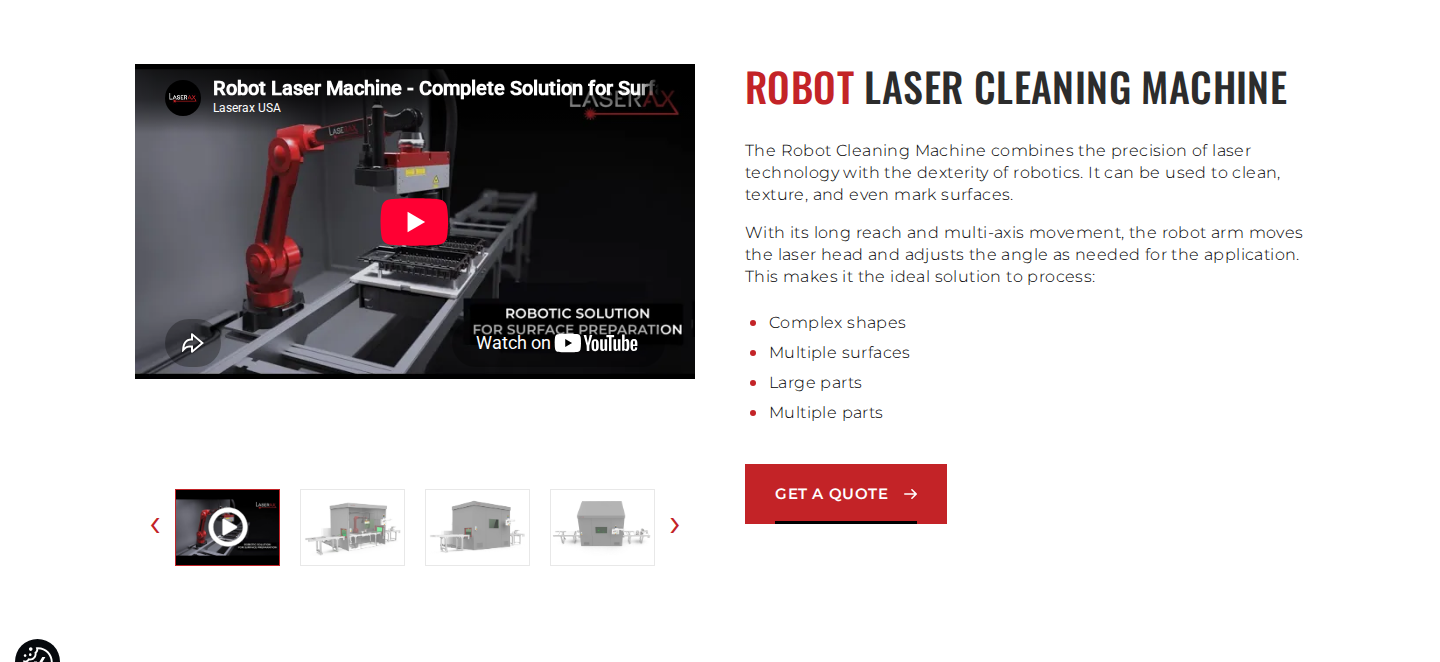
Laserax's robotic laser cleaning machine is a turnkey, fixed-cell system from a Canadian specialist with a strong EV and automotive track record, offering ytterbium-doped fibre laser power from 100 W to 3 kW, compatibility with major robot brands, and a 100,000-hour laser source MTBF — built for high-volume inline production where maximum throughput and complete integration are the priority.
Pros:
Very high laser power: up to 3 kW
Proven EV and automotive application track record
Turnkey integration with major robot brands
100,000-hour laser source MTBF
Cons:
Full enclosure required — no open-space cleaning
Robot paths need technician programming to set up
Fixed installation — not suited for multi-site use
Best for: High-volume inline production environments in EV battery manufacturing, automotive driveline, and aerospace component cleaning where very high laser power (up to 3 kW) and a complete, factory-ready turnkey integration are the primary requirements.
The Laserax robotic cleaning machine is built around an ytterbium-doped fibre laser spanning 100 W to 3,000 W, with single-mode configurations (up to 500 W) suited to precision cleaning of fine features, and multimode configurations (1–3 kW) designed for large-area, high-throughput production. The headline product in the range is the LXQ-UHP ultra-high-power series, which reaches 3 kW and is optimised for the most demanding industrial cleaning cycles.
Laserax Robotic Cleaning: Key Specifications
| Specification | Detail |
|---|---|
| Laser Type | Ytterbium-doped fibre |
| Laser Power Range | 100 W – 3,000 W (single-mode up to 500 W; multimode 1–3 kW) |
| Wavelength | 1,064 nm |
| Laser Source MTBF | 100,000 hours |
| Industrial Robot Brands | ABB, FANUC, KUKA, others |
| Part Loading Options | Front door, inline conveyor, rotary table |
| General Footprint (W x D x H) | 4 m x 4 m x 3 m (typical) |
| Robot Enclosure | Class-1 certified laser safety enclosure with interlocked doors |
| Fume Extraction | Localised, optimised per application |
| Pricing | Contact Laserax for quote |
Hard specification data is clearest in tabular form — it lets buyers cross-reference key parameters at a glance without hunting through prose.
The cell integrates with ABB, FANUC, KUKA, and other major six-axis robot platforms, with part loading configurable as front-door, inline conveyor, or rotary table to suit different production line layouts. Vision is available as an option, but it is used for QC and part positioning — robot cleaning paths require technician programming and setup before production begins.
Laserax has built a well-documented track record in EV and electrification applications: verified use cases include battery tray cleaning for adhesive bonding, EV battery module pole cleaning prior to welding, stator connector epoxy removal, driveshaft e-coating removal, and rotor shaft preparation. The system's six-axis reach and flexible fibre cable (up to 100 m on the LXQ-UHP) also make it well suited to aerospace components and complex 3D parts with multiple cleaning surfaces.
Throughput, Safety, and Supplier Profile
At up to 3 kW, the LXQ-UHP series delivers among the highest scanning speeds available in industrial laser cleaning — the power level is specifically designed to process large surfaces within short cycle times. The Class-1 certified enclosure with interlocked doors enables continuous high-power operation safely, and fume extraction is localised and optimised per application, with the nozzle mounted on the robot arm to capture particulates at the source.
The safety architecture is a conventional full-enclosure approach: the Class-1 certified cell physically contains the laser hazard, and there is no eye-safe or open-space cleaning capability. Buyers who need to operate in open workshops or mixed-use areas without sealing off the surrounding zone should evaluate a different system archetype.
Laserax is a Canadian manufacturer headquartered in Quebec, with offices in the USA and Germany, and UK representation through Innov8Surfaces in Manchester. Turnkey solutions encompass automation, fume management, laser safety compliance, and on-site and remote support — all from a single supplier. The company has a particularly strong reputation in EV and automotive automation, which is a meaningful differentiator for buyers in those sectors comparing generalist laser cleaning suppliers against a specialist.
Two scope boundaries are worth stating plainly for buyers shortlisting this system: it is a fixed production-floor cell (approximately 4 m x 4 m x 3 m footprint) and is not designed for portable, on-site, or multi-location deployment; and robot cleaning paths require technician programming before each new part type enters production, which carries a setup time and skills dependency that buyers should factor into their operational planning.
Not Sure Which System Fits Your Application?
Choosing between portable, automated, and high-power robotic laser ablation systems involves real trade-offs. Speak with a laser cleaning expert to narrow down the right fit for your production environment.
Product 5
Lasertronics Handheld and Robotic Systems
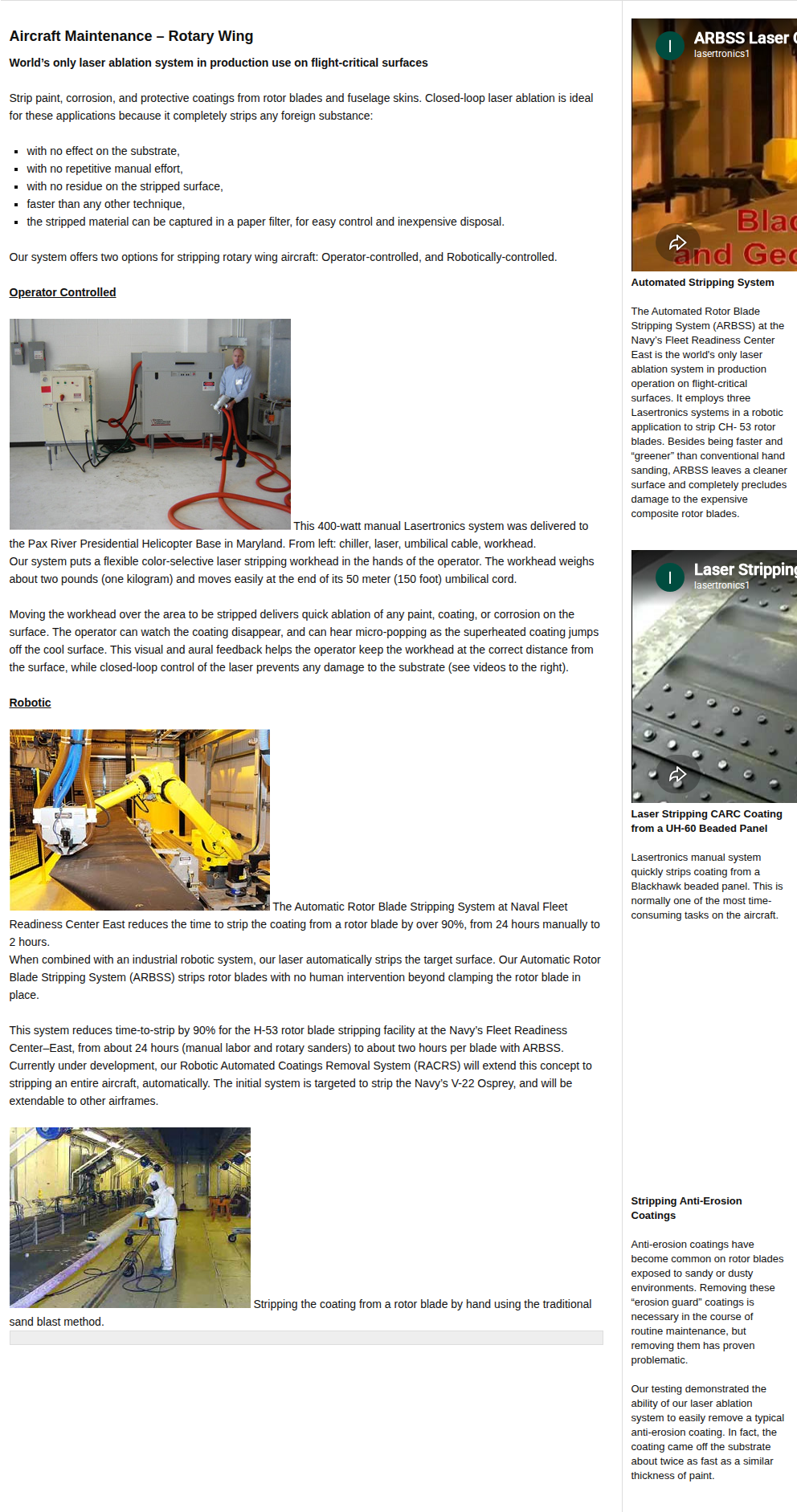
General Lasertronics Corporation (GLC) offers handheld and robotic laser ablation systems built specifically for aerospace and defence coating removal, with a colour-selective closed-loop control system that strips topcoat while leaving primer intact — the only laser ablation platform to have received a US FAA 'no objection' finding for use on all aluminium aircraft structures, including load-bearing and flight-critical surfaces.
Pros:
FAA-endorsed for flight-critical aluminium structures
Colour-selective control strips topcoat, preserves primer
ARBSS cuts H-53 rotor blade strip time dramatically
Portable handheld workhead for on-aircraft use
Cons:
Conventional hazard zone; no eye-safe capability
Integrates third-party laser sources, not in-house
UK/European sales via named reps; verify availability
Best for: Aerospace MRO facilities, defence contractors, and shipyard maintenance teams that need validated coating removal on flight-critical surfaces — particularly selective topcoat stripping that leaves primer undisturbed on aluminium aircraft structures.
Lasertronics occupies a genuinely distinct niche on this list: it is the only laser ablation system to have received a formal regulatory evaluation from the US FAA, and the only one whose core technology is built around selective layer discrimination rather than blanket surface cleaning.
Colour-Selective Closed-Loop Control
The defining technology in every Lasertronics system is its colour-selective closed-loop control: the workhead interrogates the surface before each laser pulse and fires only when the target colour or layer is detected.
In practice, this means the system can remove a polyurethane topcoat while leaving the primer coat completely intact — a capability that matters enormously on flight-critical surfaces where substrate integrity cannot be compromised.
This closed-loop approach is what underpins the FAA's confidence in the technology: testing confirmed that the system effectively prevents any damage to the aluminium used in commercial aircraft wings, fuselages, and control surfaces.
ARBSS: Robotic Rotor Blade Stripping
The Automatic Rotor Blade Stripping System (ARBSS), installed at the US Navy's Fleet Readiness Center East at Cherry Point, NC, uses three Lasertronics lasers mounted on a Fanuc robotic arm to fully strip an H-53 main rotor blade with no human intervention.
The time saving is substantial: a task that previously took approximately 24 hours with orbital sanders is completed in approximately 2 hours when the system is running at full specification.
The ARBSS received the Excellence in Maintenance award in 2009 from the Office of the Secretary of Defense, and the Defense Manufacturing Excellence Award in 2010 from the Aerospace Industries Association — independent recognition of its operational value in a demanding defence-depot environment.
Key Specifications
The table below summarises the core technical specifications for the GLC 500i handheld system, drawn from Lasertronics' published datasheet and product pages.
| Specification | Detail |
|---|---|
| Laser source | IPG Photonics ytterbium-doped pulsed fibre laser |
| Power range (system range) | 200 W to 1,000 W pulsed fibre |
| 500i system power | 500 W |
| Workhead weight | Approximately 1 kg (2 lbs) |
| Umbilical length | 15–50 m (standard); 150 m available for specialist applications |
| Power supply | Single-phase 220–240 VAC, 30 A maximum |
| Automation options | Handheld operator-controlled; Fanuc robotic (ARBSS) |
| Primary applications | Aircraft paint/sealant stripping, rotor blade depainting, composite surface prep, ship maintenance, radiological decontamination |
| Pricing | Quote-based — contact Lasertronics directly |
Presents the key buyer-relevant specifications for the Lasertronics 500i system in a scannable format, consistent with the spec summaries used across other entries in this listicle.
In 2010, the US FAA expressed "no objection" to the use of Lasertronics' system on all aluminium aircraft structures, including load-bearing and flight-critical surfaces on commercial aircraft — the only such regulatory evaluation any laser ablation system has received from an aviation authority.
It is worth being precise about what this finding means: it is a 'no objection' determination following extensive FAA testing, not a formal airworthiness certification or type approval — but for procurement purposes in aerospace MRO and defence, it carries real weight as independent regulatory validation.
Safety Architecture and Portability
Lasertronics systems operate within a conventional Class 4 laser hazard zone: operators wear protective eyewear, and a standard exclusion area is maintained around the workhead during operation.
There is no eye-safe or reduced-hazard-zone capability — buyers who require that architecture for open-workshop or mixed-occupancy environments should look at entries 1 and 2 in this list.
That said, the handheld form factor does not require any dedicated enclosure around the aircraft or structure being treated, which is a real operational advantage in MRO settings where moving the aircraft into an enclosed cell is not practical.
Supplier Profile and Availability
Lasertronics describes itself explicitly as a systems integrator: it designs and manufactures the control and delivery systems, then integrates these with off-the-shelf industrial pulsed lasers — currently IPG Photonics ytterbium-doped fibre sources for the 500i range.
Buyers evaluating long-term support and upgrade paths should factor this in: Lasertronics does not manufacture its own laser source, so the laser supply chain involves a third party.
For UK and European buyers, Lasertronics operates through named regional sales representatives rather than an independent distributor: Jan Orazem covers the UK, Leo Sexton covers Ireland, and Dr. Stephane Dana covers the EU and Israel — contact details are published on the Lasertronics website.
Pricing is quote-based; no list prices are published for the 500i or any other system, so buyers should contact Lasertronics or their regional representative directly to begin a procurement conversation.
Conclusion
How to Choose the Right Laser Ablation System
The clearest fork in the decision is this: operational flexibility points toward a portable system with reduced-hazard-zone capability; high-volume production consistency points toward an automated robotic cell; and validated aerospace coating removal points toward a colour-selective specialist.
Whichever archetype fits, evaluate on total cost of ownership — not upfront price — and ask whether your supplier designs and builds in-house, because that question determines the quality of support you will receive long after installation.
Laser Ablation Systems: Frequently Asked Questions
Common questions about industrial laser ablation systems, from system types and laser sources to cost and safety requirements.
Most industrial laser ablation systems are Class 4 devices, which means they require a defined nominal hazard zone (NHZ) with area controls during operation. For conventional systems, this typically means clearing the surrounding area, restricting personnel access, or installing a physical enclosure — all of which can disrupt nearby work in a busy facility. WSL's patented Reduced Hazard Zone (RHZ) technology, available on the ELASER-RHZ and as an optional upgrade on the AutoLASE robotic cell, changes this equation entirely. By dramatically shrinking the hazard zone, RHZ-equipped systems can operate in open workshops, mixed-use production facilities, and publicly accessible environments without sealing off the surrounding area or requiring a dedicated enclosure. For buyers in facilities where shutting down adjacent operations is impractical, this is a decisive operational advantage that no other laser cleaning system on the market currently matches.
Industrial laser ablation systems fall into three primary form-factor categories: portable handheld fibre-laser systems, automated robotic cleaning cells, and fixed high-power production systems. Handheld units suit flexible, on-site, or multi-location use; robotic cells target high-volume repetitive tasks; fixed production systems prioritise maximum throughput in a dedicated line. Beyond form factor, laser source type shapes application fit. CO2 lasers (10.6 µm) are well-established for organics, polymers, and non-metallic substrates where fibre lasers are less effective. UV lasers — excimer or frequency-tripled solid-state, 193–355 nm — enable precision micro-machining and cleaning of sensitive substrates with a minimal heat-affected zone, making them the preferred choice where thermal risk to the base material must be tightly controlled. The vast majority of industrial laser cleaning applications use fibre lasers in one of the three form factors above, given their efficiency, low maintenance requirements, and flexible beam delivery via fibre optic cable.
Pricing varies considerably by power level, form factor, and automation depth. Portable systems represent a lower entry point; automated robotic cells and high-power fixed production systems are a more substantial capital investment. All serious industrial systems are typically quote-based, as configuration requirements vary significantly between buyers and applications. As a market-level reference, 4JET publishes an indicative range of €40,000–€500,000 for mobile laser cleaning systems on their JETLASER product page — a credible indicator of the spread across the category. Buyers should contact suppliers directly for accurate pricing against their specific specification. The more useful economic lens for these systems is total cost of ownership. Laser ablation involves zero consumables, low maintenance overhead, and minimal substrate damage — which reduces rework costs. Over a three-to-five-year horizon, the TCO case frequently outperforms traditional methods such as sandblasting or chemical stripping, even where the upfront investment is higher.
Laser ablation has four main disadvantages worth understanding before purchasing. First, upfront capital cost is higher than traditional methods such as sandblasting or chemical stripping. Second, conventional systems require nominal hazard zone controls — area clearance, personnel restrictions, or enclosures — that can disrupt surrounding operations. Third, at lower power levels, throughput may be slower than abrasive methods for very large surface areas. Fourth, operator training is required to use the equipment safely and effectively. Some of these disadvantages are being actively addressed by technology advances. Reduced-hazard-zone technology — such as WSL's patented RHZ system — dramatically shrinks the safety overhead, enabling open-environment operation in mixed-use and publicly accessible facilities where conventional laser cleaning systems cannot be deployed without major operational disruption. For most industrial buyers, the long-term TCO advantages and process quality benefits outweigh these trade-offs — but they are real considerations that should factor into the procurement decision.
The three main laser source types used in industrial laser ablation systems are fibre laser, CO2, and UV. Each suits a different range of materials and applications, and the choice of source type is one of the most important specification decisions a buyer will make. Fibre lasers (near-IR, 1064–1550 nm) are the dominant choice for metal cleaning — rust removal, paint stripping, coating removal, and pre-weld surface preparation. They offer high wall-plug efficiency, very long maintenance intervals (often cited at 100,000 hours MTBF for the laser source), and fibre-delivered beam delivery that supports both handheld and robotic configurations. For buyers in metalworking, automotive, aerospace, and heavy industry, fibre laser is almost always the right starting point. CO2 lasers (10.6 µm) are well-suited to organics, polymers, composites, and non-metallic substrates that fibre wavelengths do not ablate efficiently. The trade-off is beam delivery: CO2 requires mirror-based optics rather than flexible fibre cable, which constrains system geometry and reduces portability. UV lasers (excimer or frequency-tripled solid-state, 193–355 nm) deliver very short wavelengths that ablate material with minimal thermal energy transfer, making them the preferred choice for precision micro-machining and cleaning of heat-sensitive substrates. Per-pulse cost is higher and average power is lower than fibre lasers, so UV systems are reserved for applications where thermal damage to the substrate is genuinely unacceptable.