Introduction
High-power fibre lasers use a rare-earth-doped optical fibre as the gain medium to generate intense, focused laser beams for demanding industrial and commercial applications.
For cleaning specifically, the choice between continuous wave (CW) and pulsed operation shapes everything: pulsed mode delivers controlled energy bursts that minimise heat input to the substrate, while CW prioritises sustained power for maximum throughput.
This list is built for engineers and procurement professionals comparing industrial fibre laser cleaning systems across a range of power levels and deployment scenarios — and every entry is assessed against a consistent evaluation framework, detailed in the next section.
Every system included here has been verified against authoritative sources; nothing appears on the strength of marketing claims alone.
TL;DR
No single fibre laser cleaning system wins across every deployment. The right choice depends on matching power range, operating mode, cooling infrastructure, form factor, and safety overhead to your specific application — and the differences between the five systems on this list are significant enough that the wrong pick creates real operational problems.
This article covers:

The buyer's framework for evaluating fibre laser cleaners
Five leading systems compared across consistent criteria
Portable vs. automated options: when each suits
How operating mode and cooling affect deployment
Guidance for matching system type to application
How to Evaluate High-Power Fiber Laser Cleaning Systems
Most poor purchasing decisions in this category share the same root cause: buyers compare headline wattage figures across systems with fundamentally different operating modes, beam characteristics, and deployment requirements, then wonder why the system they selected underperforms in the field.
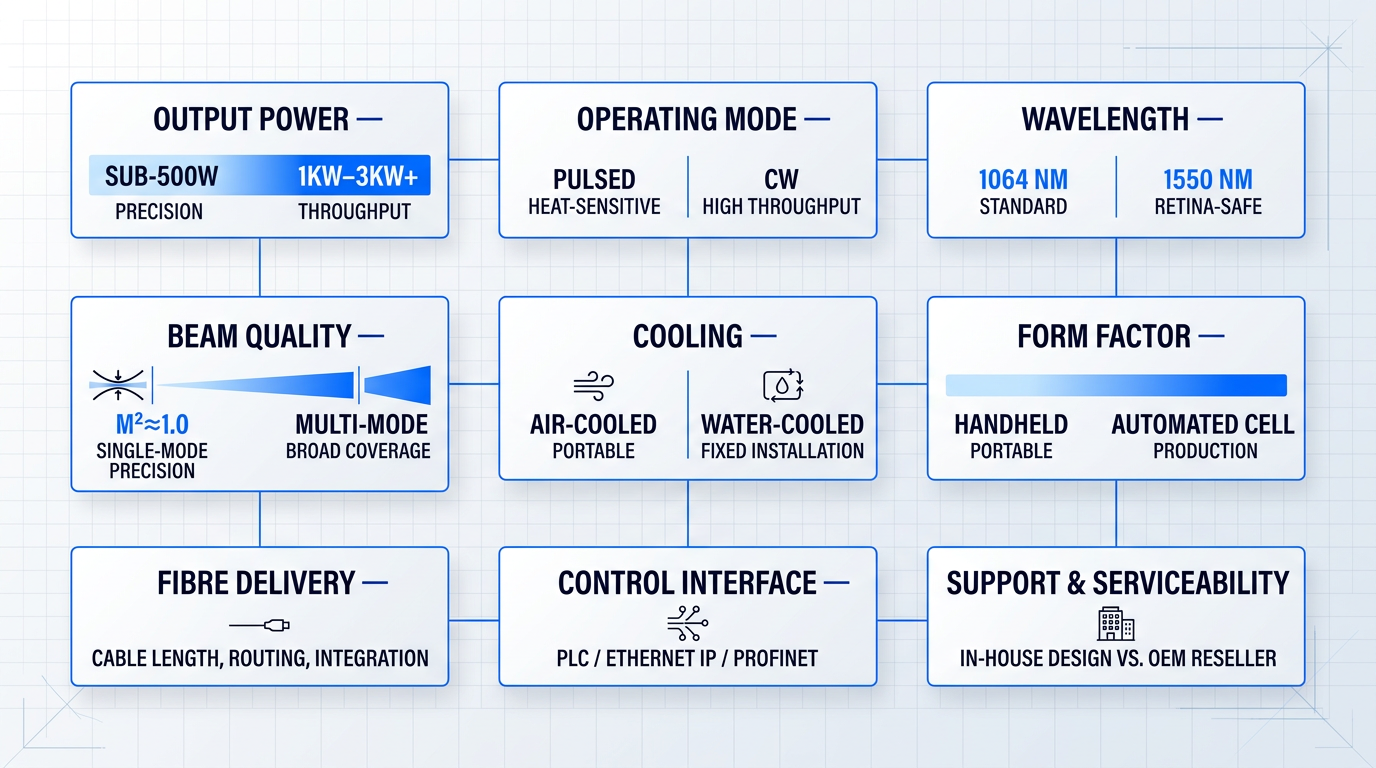
The nine axes below are the ones that actually differentiate high-power fiber laser cleaning systems at the procurement stage — not just technically, but in terms of what they cost to own, integrate, and operate over a system's working life.
Output Power: Context Over Headline Figures
Sub-500W systems are well-suited to selective, precision cleaning where preserving the substrate matters as much as removing the contaminant. Above 500W — and into the 1kW–3kW+ range — you are in the territory of large-area or high-throughput industrial cleaning where speed and coverage are the primary drivers.
The critical mistake is treating wattage as a direct performance proxy without accounting for pulse parameters and duty cycle. A 300W pulsed system delivering tightly controlled energy bursts behaves entirely differently from a 300W CW system — same number on the datasheet, very different results on the substrate.
Wavelength and Operating Mode
The vast majority of industrial fiber laser cleaning systems operate at 1064 nm (sometimes 1070 nm) — a wavelength that is well-absorbed by common metallic contaminants and has become the category standard for good reason.
Wavelength is worth asking about because it has consequences beyond absorption efficiency. WSL's ELASER/ELASER-RHZ, for example, operates at 1550 nm — a retina-safer wavelength that directly enables a reduced laser hazard zone, with practical implications for how and where the system can be deployed.
Pulsed operation minimises heat input to the substrate by delivering energy in controlled bursts, which is critical for heat-sensitive materials or tight-tolerance surfaces. CW systems sustain higher average power for throughput-intensive work where substrate thermal sensitivity is less of a concern — understanding this trade-off is essential before comparing power figures across systems with different operating modes.
Beam Quality: Matching M² to Your Application
An M² value close to 1.0 indicates a near-perfect Gaussian beam — maximum energy density at the focal point and minimum spot size, which is what precision and selective cleaning applications require.
Multi-mode systems trade beam quality for higher power and broader spot coverage, which suits large-area cleaning but is the wrong tool when the application demands fine detail or substrate selectivity. A high-power multi-mode system is not a substitute for a lower-power single-mode system when precision is the requirement.
Cooling, Form Factor, and Integration Reality
Air-cooled systems require no chiller circuit, no coolant maintenance, and no additional facility infrastructure — a genuine advantage for field deployment and facilities without dedicated cooling capacity. Water-cooled systems, typically required above certain power thresholds, add real integration overhead: chiller procurement, installation, ongoing maintenance, and the floor space to house it.
On form factor: portable and handheld systems are the right choice when the cleaning task moves rather than the part — field maintenance, multi-site deployment, and mixed-use environments. Automated or robotic cells suit repetitive production cleaning where consistency and throughput are the priorities and the part comes to the system.
The integration questions that rarely appear on marketing datasheets are often the ones that determine deployment cost and timeline: fibre delivery cable length, control interface compatibility (PLC, Ethernet/IP, PROFINET), fume extraction specification, and enclosure requirements for the laser hazard zone. Ask these before comparing prices.
Support, Serviceability, and Total Cost of Ownership
This is the most underserved evaluation axis in the category. The key question is whether the vendor designs and builds their own machine in-house or is rebadging a third-party OEM system. A genuine manufacturer can modify the machine for your application, source their own spares, and provide expert support. A reseller is dependent on the OEM for all of that — which typically means slower response times, less accountability, and no real improvement capability.
Ask three questions before signing: Does this vendor design and build this machine? Can they modify it for my application? What is the lead time for spare parts?
On running costs, laser cleaning systems are typically consumable-free — no abrasive media, no chemical stripping agents, no waste disposal — which changes the TCO calculation significantly compared to conventional surface preparation methods.
Downtime risk, maintenance overhead, spare parts availability, and the cost of substrate rework from poor beam quality all compound over a system's working life. TCO — not purchase price — is the only honest comparison metric.
With this framework in hand, the entries below apply each of these axes consistently across the five systems that earned their place on this list.
Product 1
WSL ELASER / ELASER-RHZ
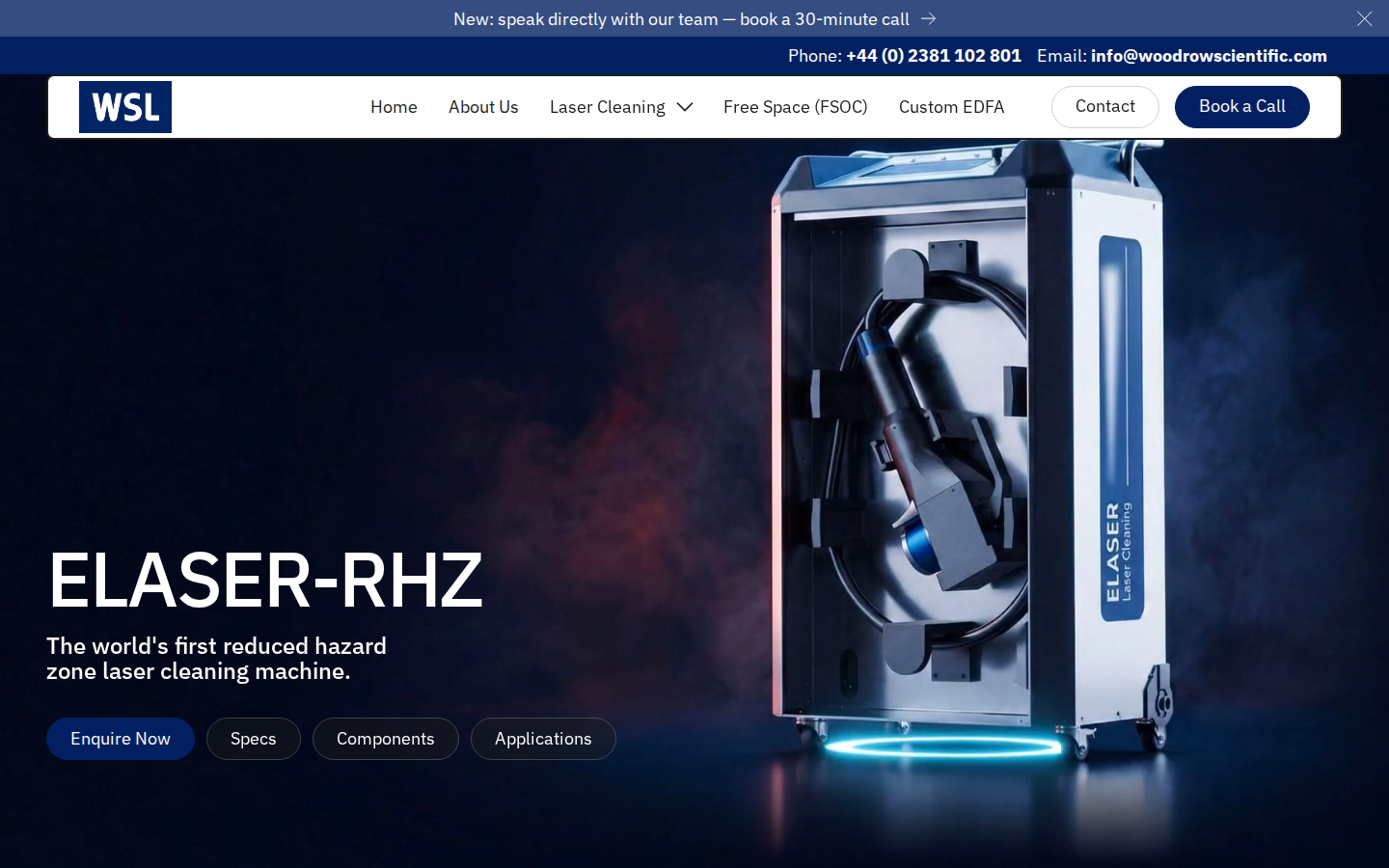
WSL's portable industrial fibre laser cleaning system — air-cooled, consumable-free, and the only laser cleaner in the world with patented reduced-hazard-zone technology that enables cleaning in open workshops and public-facing environments.
Pros:

World-first patented reduced hazard zone (RHZ)
Air-cooled — no chiller or coolant required
In-house UK manufacturer since 2012
CE and UKCA certified; sub-3 kg scanner
Cons:

300 W power ceiling — not ultra-high-power
Pulsed-only — no continuous-wave mode
The WSL ELASER and ELASER-RHZ sit at the top of this list for a straightforward reason: no other portable high-power fiber laser cleaning system combines field-deployable air-cooled operation, fully tunable pulsed power, and world-first reduced-hazard-zone technology in a single wheeled unit.
Reduced Hazard Zone: A World First
Conventional laser cleaning requires the surrounding area to be sealed off and evacuated before work can start — a significant operational overhead that makes it impractical in open workshops, shared facilities, or anywhere the public is present.
The ELASER-RHZ changes that entirely: WSL's patented technology collapses the laser hazard zone to a fraction of its conventional size, enabling continuous operation in open-plan manufacturing environments, graffiti removal on public infrastructure, and heritage restoration in publicly accessible spaces.
No other laser cleaning system in the world offers a reduced hazard zone. The ELASER-RHZ is the only laser cleaner that can operate as a Class I device — the result of WSL's patented engineering, not a rebadged import.
The technical foundation of this capability is the ELASER's 1550 nm wavelength — a deliberate engineering choice that sets it apart from the 1064 nm wavelength used by the majority of industrial fibre laser cleaners on the market.
At 1550 nm, the laser operates in a retina-safer spectral region, and it is this property that makes WSL's reduced-hazard-zone patent viable — the wavelength is not incidental to the RHZ capability, it is its technical prerequisite.
| Specification | ELASER / ELASER-RHZ |
|---|---|
| Max output power | Up to 300 W |
| Power tunability | 0–100% |
| Wavelength | 1550 nm |
| Pulse energy | Up to 15 mJ |
| Pulse duration | 100 ns |
| Pulse repetition rate | Adjustable up to 200 kHz |
| Scanner | 2-D galvanometer, 10 m/s max scan rate |
| Delivery cable | Up to 50 m (5 m / 15 m standard) |
| Handheld scanner weight | Under 3 kg |
| System weight | Under 50 kg (wheeled) |
| Cooling | Air-cooled — no chiller required |
| Power supply | 110–250 VAC single-phase |
| Power consumption | Less than 2000 W |
| Laser class | Class IV (standard) / Class I (RHZ variant) |
| Interface | Ethernet + touchscreen GUI |
| Certifications | CE and UKCA |
| Manufacture | Made in Britain |
Gives engineers and procurement professionals a fast, scannable reference for the ELASER's key specifications across every evaluation axis covered in the background section.
Pulsed operation at up to 200 kHz with 100 ns pulse durations and up to 15 mJ pulse energy delivers tightly controlled energy to the substrate surface — ablating contamination while leaving the base material intact, with minimal heat transfer between pulses.
For buyers whose evaluation framework flags substrate damage as a risk — weld prep on aerospace alloys, cleaning heritage stonework, or stripping coatings from precision tooling — this controlled pulsed delivery is the specification that matters most.
The air-cooled design means no chiller circuit, no coolant lines, and no facility infrastructure beyond a standard 110–250 VAC single-phase supply — the ELASER is genuinely self-contained and can be deployed wherever a standard power outlet exists.
Application Fit: Where the ELASER Works
The combination of portability, tunable power, and reduced-hazard-zone capability gives the ELASER an unusually broad application footprint for a single portable system.
- Injection moulding and tooling: Strip release agents, residue, and build-up from moulds and tooling in place — no disassembly, no abrasives, no mould wear.
- Automotive: Pre-weld surface prep on the production line and rust or paint removal in the bodyshop — tunable power handles both without changing equipment.
- Tyre and rubber: Clean moulds, vents, and vulcanisation residue precisely, with no abrasive contact that could shorten mould life.
- Aerospace: Precise surface preparation and component cleaning to tight tolerances, with controlled energy delivery that protects substrate integrity.
- Heritage and restoration: Lift soiling, paint, and corrosion from stone, metal, and masonry in publicly accessible spaces — made practical by the RHZ variant.
- Laser cleaning service businesses: A portable system with full operator training and a broad application range is a viable foundation for a commercial laser cleaning operation.
Power tunability from 0–100% means a single machine handles everything from light oxide removal through to thick coating stripping — operators adjust output for the task rather than changing systems.
WSL ELASER Pricing
The ELASER is competitively priced within its class — WSL's position as the only UK-based laser cleaning manufacturer, designing and building in-house, delivers pricing efficiencies that are passed through to the buyer without compromising build quality.
For capital equipment in this category, the correct evaluation lens is total cost of ownership: zero consumables, no coolant maintenance, minimal downtime, and reduced rework from substrate-safe cleaning typically deliver a stronger long-term cost position than lower-headline alternatives such as sandblasting or chemical stripping.
Pricing is available on request directly from WSL — the team can also advise on bespoke engineering and customisation requirements for specific applications or deployment environments.
Best for: Engineers and operators who need a portable, field-deployable laser cleaning system with the lowest safety overhead in the category — especially suited to open-plan manufacturing, mixed-use facilities, or public-facing environments where conventional laser cleaning's full evacuation requirement makes it impractical.
See the ELASER-RHZ Full Specifications
The ELASER-RHZ is the only portable high-power fiber laser cleaner with patented reduced-hazard-zone technology. Download the datasheet to review full technical specifications before your next step.
Product 2
WSL AutoLASE
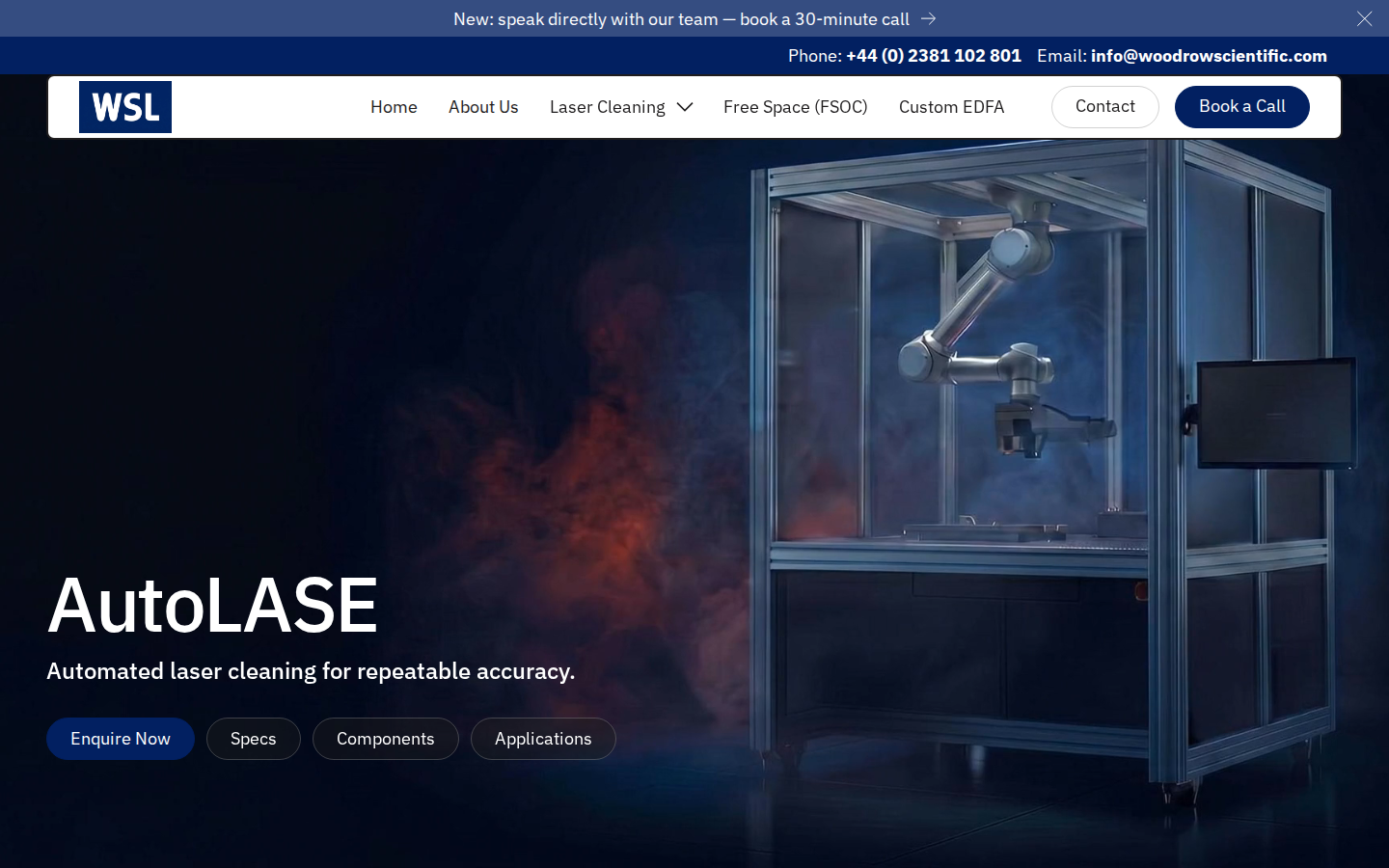
WSL's automated robotic laser cleaning cell — load a part, and 3D machine vision scans it, maps it, and runs the clean automatically, with an optional RHZ upgrade for enclosure-free operation.
Pros:
Load-and-go: 3D vision auto-generates path
RHZ option: no enclosure needed
Air-cooled; no chiller required
CE and UKCA certified
Cons:
Production cell — not a portable system
Requires integration into production line
AutoLASE brings the same WSL engineering that powers the ELASER into a production-cell format — built for facilities where cleaning is a repeating, high-volume task rather than a field deployment.
How AutoLASE Works
The defining characteristic of AutoLASE is not that it automates a cleaning path — it is that no path needs to be set at all.
Load the part, and the onboard 3D machine-vision software scans it, builds a 3D map, and generates the cleaning path automatically — no manual programming, no knowledge of part geometry, no specialist operator required.
Other robotic cleaning systems on the market require programmed cleaning recipes or operator-defined paths before a new part can be run; AutoLASE removes that requirement entirely.
AutoLASE's 3D machine-vision software generates the cleaning path automatically from a scan of the loaded part. No programming, no path-setting, no specialist skills — anyone can run it.
The optional RHZ upgrade takes this further: configured with WSL's eye-safe Reduced Hazard Zone technology, AutoLASE requires no enclosure at all.
Every other automated laser cleaning system on the market requires a Class 1 certified safety enclosure to operate safely — the RHZ configuration is the only way to run automated laser cleaning without one, and it is available exclusively from WSL.
AutoLASE Specifications
AutoLASE is a pulsed high-power fiber laser system operating at 1550 nm, with output fully tunable from 0–100% up to 300 W.
| Parameter | Specification |
|---|---|
| Output power | Up to 300 W, tunable 0–100% |
| Wavelength | 1550 nm |
| Pulse repetition rate | Up to 200 kHz |
| Pulse duration | 100 ns |
| Pulse energy | Up to 15 mJ |
| Cooling | Air-cooled — no chiller required |
| Form factor | Robotic cell; multi-axis articulated arm |
| Delivery cable | Up to 50 m |
| Power supply | 110–250 VAC single-phase |
| Power consumption | < 2000 W |
| Interface | Ethernet + touchscreen, secure user access |
| Certifications | CE and UKCA |
Presents the key technical specifications in a scannable format, allowing engineers and procurement professionals to quickly assess AutoLASE against their requirements and compare it with other entries on this page.
Air-cooled operation means no chiller circuit, no coolant plumbing, and no additional infrastructure beyond a standard single-phase supply — a practical advantage in production environments where utilities are already constrained.
The system attaches to the customer's existing collaborative or industrial robots, or WSL can supply it as a complete custom cell — the integration path is flexible by design.
AutoLASE Applications
AutoLASE is suited to any production environment where a consistent, repeatable cleaning standard is required across high part volumes.
- Injection moulds and tooling: Strip release agents, residue, and build-up from mould cavities, cores, and inserts — restoring fine detail without disassembly or abrasive wear.
- Automotive parts: Engine, driveline, and EV battery components — oxides, coatings, and contamination removed, or surfaces prepped for welding and bonding, part after part.
- Aerospace components: Turbine blades, vanes, and engine parts cleaned and surface-prepped to tight tolerances, held to the same standard on every cycle.
- Tyre and rubber moulds: Remove vulcanisation residue and build-up from moulds, segments, and vents — no abrasives, no mould wear.
- Remanufacturing and refurbishment: Strip corrosion, coatings, and contamination from worn components before rebuild — batches cleaned consistently and ready for inspection.
These verticals share a common requirement: consistent output, cycle after cycle, without manual variation — which is precisely what AutoLASE is built to deliver.
Support, Integration, and the WSL Difference
As covered in the ELASER entry, WSL is the only UK-based laser cleaning manufacturer — designing, building, and improving everything in-house, backed by 200+ years of combined engineering experience.
That matters in the automated cleaning space, where a significant portion of the market consists of resellers and importers rebadging third-party hardware — meaning slower spares, no genuine product improvement capability, and weaker integration support.
WSL offers full operator training, bespoke engineering and customisation, and ongoing in-house support — for specific integration requirements, the right step is to contact WSL directly.
AutoLASE Pricing
AutoLASE is competitively priced for a production-grade automated laser cleaning cell — contact WSL for a quote tailored to your application and integration requirements.
The total cost of ownership case is strong: zero consumables, automated labour savings on repetitive cleaning tasks, less downtime, and less rework through minimal substrate damage all contribute to a compelling long-run return.
Best for: Production environments with repetitive cleaning requirements where consistency, throughput, and minimal operator skill burden are priorities — and especially suited to facilities where the optional RHZ upgrade makes enclosure-free automated operation a practical advantage.
Product 3
IPG Photonics YLS / YLR Series
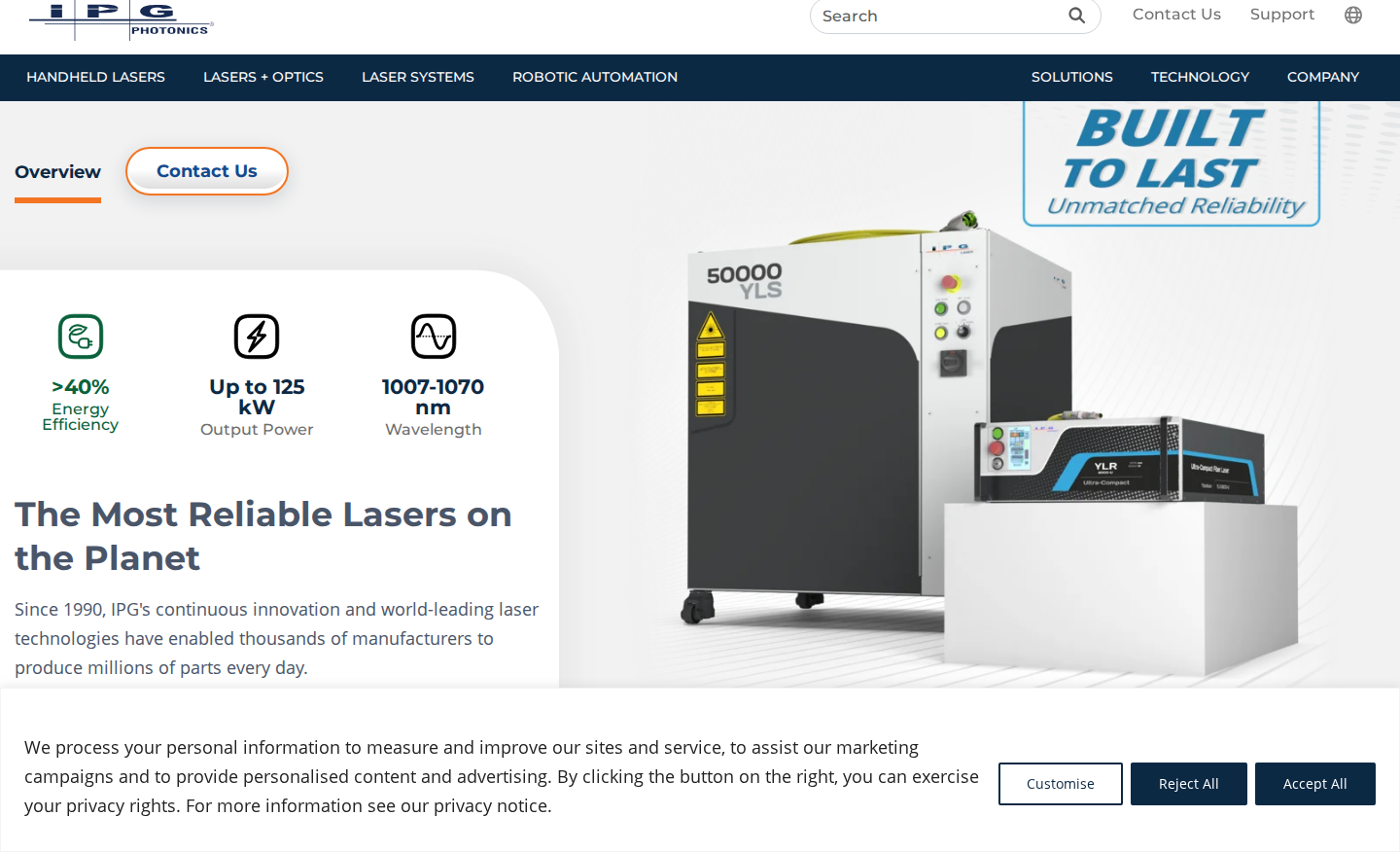
IPG Photonics is the world's largest fibre laser manufacturer, and its YLS/YLR series covers multi-mode output from 1 kW to 125+ kW — the broadest verified power range on this list — with the December 2024 acquisition of cleanLASER now adding a complete portfolio of turnkey cleaning systems under the same roof.
Pros:
Broadest power range: 1 kW to 125+ kW
Pulsed options: nanosecond (YLPN) and QCW series
cleanLASER acquisition adds turnkey cleaning systems
Global direct sales and service infrastructure
Cons:
Laser source only — system integration required
Water cooling required above 1.5 kW
IPG Photonics is the world's largest fibre laser manufacturer, and the YLS/YLR series represents the broadest verified power range on this list — spanning from 1 kW up to 125+ kW in the multi-mode cabinet format.
YLS / YLR Series: Key Specifications
| Specification | YLS Series (Cabinet) | YLR Series (Rack) |
|---|---|---|
| Output Power (Multi-mode) | 1 kW to 125+ kW | Up to 8 kW |
| Output Power (Single-mode) | Up to 10 kW | Up to 3 kW |
| Wavelength | 1070 nm | 1007, 1010, 1030, 1070 nm |
| Beam Quality (SM) | M² < 1.1 (≤2 kW); M² < 1.2 (≤5 kW); M² < 2 (≤10 kW) | M² < 1.1 |
| Power Tunability | 10–100% | 10–100% |
| Modulation Frequency | Up to 10 kHz | Up to 50 kHz |
| Cooling | Water or Air | Air up to 1.5 kW; water above |
| Form Factor | Cabinet (floor-standing) | Rack-mount |
| Pulsed Options | YLS-QCW: up to 2 kW avg / 20 kW peak | YLPN: up to 3 kW avg (nanosecond) |
| Pricing | Not published — contact IPG | Not published — contact IPG |
Presents the core evaluation framework axes for the YLS/YLR series in a scannable format, allowing readers to compare specs across entries on the list.
For buyers requiring ultra-high-power output, no other entry on this list comes close: the YLS multi-mode cabinet series can be configured well beyond 10 kW, with standard products reaching 125+ kW — a scale relevant to heavy industrial cutting, welding, and large-area surface treatment.
Beam quality on the single-mode variants is tightly specified: the YLS-SM cabinet achieves M² < 1.1 up to 2 kW, stepping to M² < 1.2 at 5 kW and M² < 2 at 10 kW, giving system integrators a clear basis for matching source to application precision requirements.
Both the YLS and YLR are continuous-wave laser sources — but IPG's broader portfolio covers pulsed applications too. The YLPN nanosecond series (up to 3 kW average power, 1064 nm) is explicitly positioned for high-precision cleaning and surface treatment, while the YLS-QCW delivers up to 2 kW average with 20 kW peak power for applications requiring high-energy pulse delivery at lower average power.
Integration Effort: A Laser Source, Not a Cleaning Machine
This is the most important framing point for buyers evaluating IPG for cleaning: the YLS and YLR are industrial laser sources, supplied in rack and cabinet formats for integration into a wider system architecture.
Choosing IPG at the source level means your team — or a system integrator — must design and build the delivery optics, scanner head, motion system, and control architecture around the laser. That is a significant engineering undertaking, and it is the defining trade-off of this entry compared with the turnkey cleaning systems elsewhere on this list.
Cooling infrastructure is a parallel consideration: air cooling on the YLR series is available up to 1.5 kW, but any application above that threshold requires a water-cooled chiller, adding facility cost and complexity that buyers should factor into the total integration budget.
It is also worth noting that IPG's YLS/YLR systems operate within a conventional laser hazard zone, requiring appropriate laser safety controls and enclosures — a standard requirement for industrial high-power fibre lasers at these power levels.
IPG + cleanLASER: A New System-Level Dimension
In December 2024, IPG completed the acquisition of Clean-Lasersysteme GmbH (cleanLASER), a pioneer in industrial laser cleaning founded in 1997, with approximately 2,000 systems installed worldwide and approximately $30 million in annual revenue.
Now operating under the IPG | cleanLASER brand, the combined entity offers a portfolio spanning handheld devices, mobile systems, automated cells, and turnkey gantry systems — meaning buyers who want a single-vendor relationship covering both laser sources and complete cleaning systems can now find that through IPG.
The cleanLASER product range includes high-power CW systems (the CL 1000 and CL 2000) as well as compact air-cooled portable units, with automation solutions including the cleanCELL, roboCELL, and portal systems for large-component processing. Buyers should consult cleanlaser.de or ipgphotonics.com directly for the current post-acquisition range and specifications.
IPG had been a laser source supplier to cleanLASER for nearly 25 years prior to the acquisition, so the integration of technology and application know-how between the two businesses is well-established rather than speculative.
Best For
IPG Photonics YLS/YLR is the right choice for buyers who need ultra-high-power fibre laser sources (multi-kW to 100 kW+) for integration into custom industrial systems, or for organisations that want a single-vendor relationship spanning both laser sources and complete cleaning systems through the IPG | cleanLASER portfolio.
It is not the right fit for buyers seeking a portable, turnkey, or field-deployable cleaning system — those buyers should evaluate the dedicated cleaning systems elsewhere on this list. List prices are not published; contact IPG directly for a quotation.
Product 4
Laserax LXQ-UHP Series
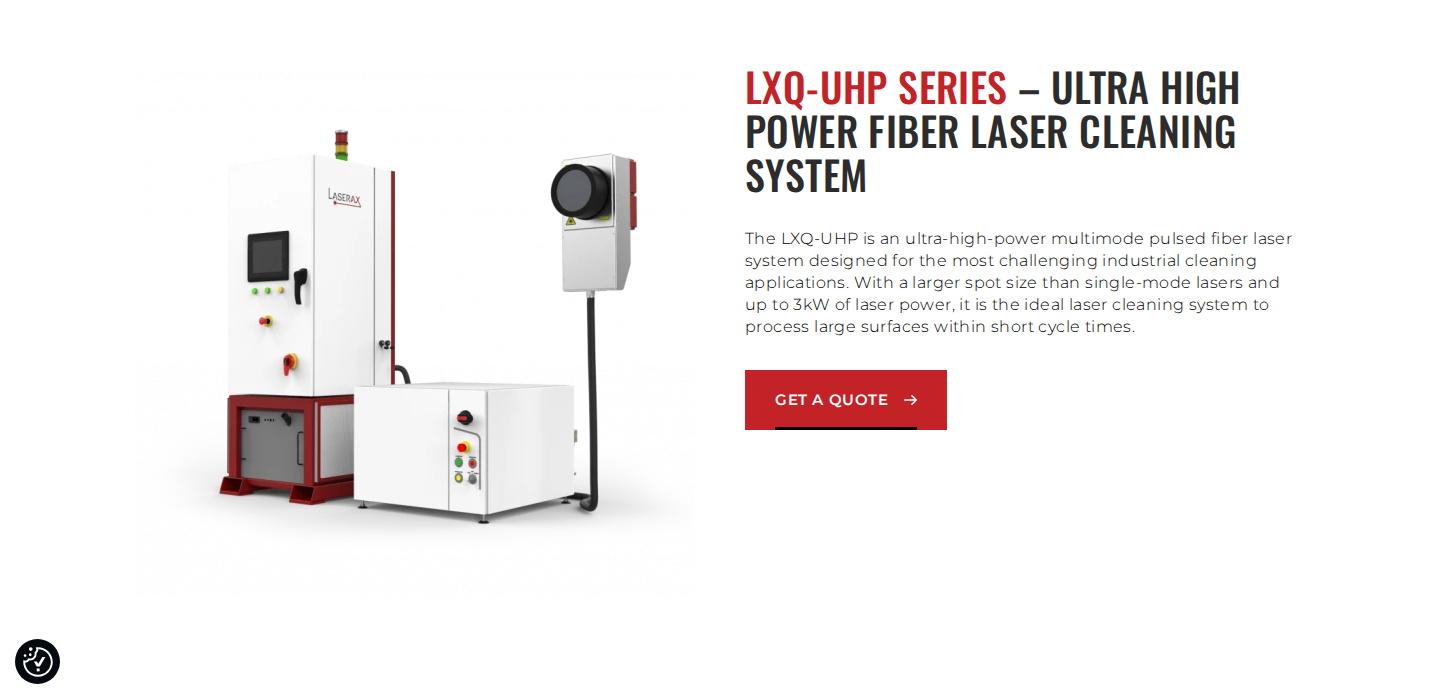
Laserax is a Canadian turnkey laser cleaning specialist; the LXQ-UHP is its ultra-high-power pulsed fibre laser cleaning system, available in 500 W to 3 kW configurations for high-throughput inline production applications in automotive, EV battery, and aerospace manufacturing.
Pros:
Highest power of any dedicated cleaner: up to 3 kW
PROFINET, Ethernet/IP, PLC quick-start programmes
Pulsed operation for substrate-safe production cleaning
Processes moving parts; combined cleaning and texturing
Cons:
Water cooling required — chiller infrastructure mandatory
Fixed inline asset — not portable or field-deployable
Laserax is a Canadian specialist focused entirely on turnkey industrial laser cleaning — not a general-purpose laser vendor, not a source-only supplier, but a company whose entire product identity is built around production-line automation at scale.
The LXQ-UHP is its ultra-high-power dedicated cleaning platform, and the headline figure is straightforward: 500 W, 1 kW, 2 kW, and 3 kW configurations are available, making it the highest verified average power of any dedicated cleaning system evaluated in this list.
LXQ-UHP Key Specifications
| Specification | Detail |
|---|---|
| Wavelength | 1064 nm (near-IR) |
| Power configurations | 500 W / 1 kW / 2 kW / 3 kW |
| Operation mode | Pulsed |
| Pulse energy | 25–150 mJ (varies by configuration) |
| Pulse width | 25–100 ns (adjustable) |
| Pulse repetition rate | 5–20 kHz |
| Beam profile | Multimode |
| Spot size | 0.8–2 mm typical |
| Depth of focus | Up to 20 mm |
| Fibre cable length | 10–100 m |
| Cooling | Water-cooled (chiller required at all power levels) |
| Total power consumption | 5.8 kVA (500 W) to 20.5 kVA (3 kW) |
| Ingress protection | IP54 |
| Laser source MTBF | 100,000 hours |
The LXQ-UHP spans four power configurations with distinct pulse parameters and power consumption figures — a table communicates this multi-dimensional spec data far more clearly than prose.
Operating at 1064 nm, the LXQ-UHP uses standard near-IR wavelength — well-absorbed by common industrial contaminants on metals, and unremarkable as a differentiator, but the right choice for the application.
Pulsed delivery throughout all configurations keeps heat input controlled, reducing the risk of substrate distortion or surface damage — a practical requirement for production environments where part integrity is as important as cleaning throughput.
The multimode beam profile produces a larger spot size (0.8–2 mm typical) and a generous depth of focus up to 20 mm, which reduces positioning sensitivity when handling varied part geometries on a production line.
Buyers who need fine-detail precision cleaning should note the multimode profile — it is the right trade-off for large-area coverage at speed, not for intricate surface work.
Cooling and Infrastructure Requirements
Water cooling is required at every power level — there is no air-cooled configuration available in the LXQ-UHP range.
For a production facility already operating water-cooled equipment, the chiller infrastructure is routine overhead; for a buyer expecting plug-and-play simplicity, it is a genuine integration cost to factor into the project budget and timeline.
Form Factor and Deployment
The LXQ-UHP is an inline production asset, not a portable or field-deployable tool — the laser source, control cabinet, and chiller are separate units, and the 2D scanning head mounts on a robot arm, gantry, or conveyor.
For complex 3D part geometries, Laserax offers a complementary robot cleaning machine (100–3000 W) compatible with 6-axis robots from ABB, FANUC, and KUKA, extending the platform's reach to curved and irregular surfaces.
Cell setup requires technician path programming before production can begin — there is no autonomous path generation from part geometry.
Industrial Integration Credentials
- PROFINET and Ethernet/IP: Standard industrial protocols supported out of the box, covering the two dominant automation network standards in automotive and aerospace production.
- Allen-Bradley and Siemens PLC quick-start: Pre-built integration programmes for the two most common PLC platforms reduce commissioning time for facilities already running Rockwell or Siemens control architectures.
- Web-based HMI: Browser-accessible interface removes the need for dedicated operator terminals and simplifies remote monitoring.
- OpenVPN remote access: Encrypted remote access for diagnostics and support, enabling Laserax engineers to assist without requiring an on-site visit.
- IP54 protection rating: Rated for dusty and splash-prone production environments — appropriate for the automotive and aerospace shop floors this system targets.
These credentials are a genuine strength for production engineers specifying inline systems — the combination of standard protocols, PLC quick-start programmes, and remote access compares favourably with what most industrial automation buyers will require at specification stage.
Application Fit
The LXQ-UHP is designed for high-volume inline production: automotive body and component cleaning, EV battery electrode and casing preparation, aerospace structural part treatment, and other applications where large surface areas need to be processed at production-line speed.
The system can perform cleaning and surface texturing in a single pass, and is capable of processing parts while they are moving on a conveyor — both capabilities that directly support cycle-time reduction in continuous production environments.
The LXQ-UHP requires a full-enclosure safety cell for operation. There is no open-space or reduced-hazard-zone cleaning capability — buyers must factor enclosure design, footprint, and access into their facility planning.
Laserax does not publish list prices for the LXQ-UHP; pricing depends on power configuration, scanning head setup, and integration scope. Contact Laserax directly for a project-specific quotation.
Laserax LXQ-UHP: Verdict
For production engineers whose primary requirement is maximum cleaning throughput on large surfaces in a fixed inline cell, the LXQ-UHP delivers the highest verified average power of any dedicated cleaning platform on this list, backed by strong industrial integration credentials and a claimed laser source MTBF of 100,000 hours.
It is the right choice for automotive, EV battery, and aerospace facilities where cleaning speed and large-area coverage are the specification drivers — and the wrong choice for anyone who needs portability, air-cooled simplicity, or open-space operation.
Product 5
P-Laser QF Series
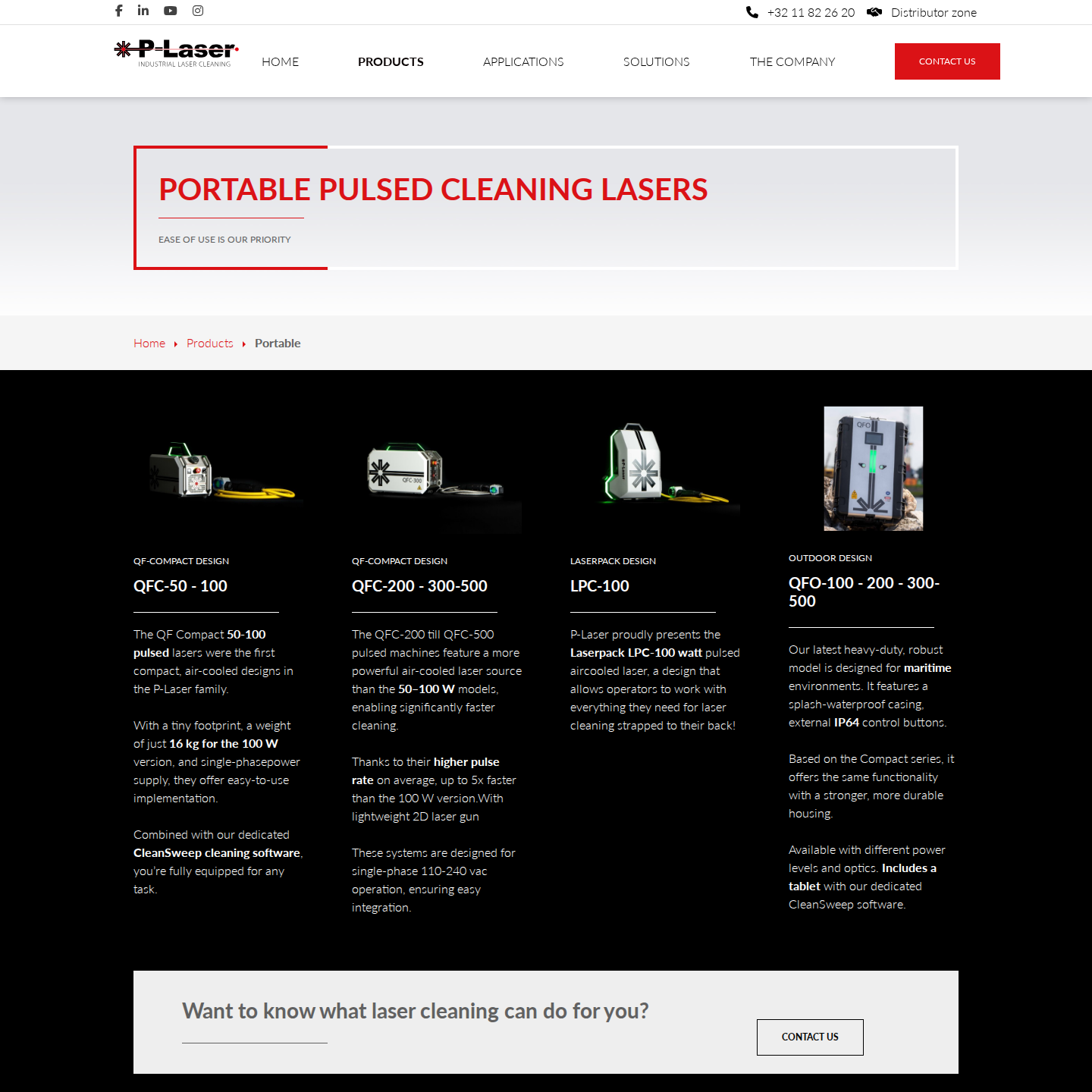
P-Laser is a Belgian laser cleaning specialist whose QF Series spans 50W air-cooled portable units to 3000W water-cooled inline systems, making it one of the widest power-range offerings from any dedicated cleaning vendor on this list. Suited to buyers who want a single vendor relationship from field deployment through to high-throughput production-line integration.
Pros:
Widest power range from one cleaning vendor: 50W–3000W
Air-cooled portability at 50W and 100W; no chiller
QF-Arol magnetic robot for vertical steel structures
Inline spectral monitor (patent pending) for cleaning verification
Cons:
QF-Compact carries the whole unit, not a handpiece
Water cooling required from 200W; conventional hazard zone
P-Laser is a Belgian laser cleaning specialist, founded in 2008 as a division of an industrial cleaning company and operating independently since 2012–2013, with more than 450 systems installed worldwide according to its trade profile.
Its defining characteristic is the breadth of the QF range: a single cleaning-focused vendor covering 50W air-cooled portable units through to 3000W water-cooled inline systems, with every configuration operating in pulsed mode to minimise heat input to the substrate.
QF Series: Power Tiers and Cooling Requirements
Matching the right sub-product to your cooling infrastructure is one of the most practical decisions in the QF range — the table below maps each family to its power tier, form factor, and cooling requirement.
| Product Family | Power Range | Cooling | Primary Use Case |
|---|---|---|---|
| QFC-50 / QFC-100 (QF-Compact) | 50W – 100W | Air-cooled (no chiller) | Precision / selective cleaning; field portable |
| QFC-200 / QFC-300 (QF-Compact) | 200W – 300W | Water circuit (cooling unit required) | General industrial field work; higher throughput portable |
| QF-500 / QF-1000 (Inline) | 500W – 1000W | Water-cooled (integrated chiller) | Production line / robotic integration; large-area cleaning |
| QF-2000 (Inline) | 2000W | Water-cooled (dual closed-circuit chillers) | High-throughput inline; large steel structures |
| QF-3000 / Cubeline (Inline) | 3000W | Water-cooled | Heavy-duty industrial; marine paint removal |
Maps the QF product families to power tier, cooling type, and primary use case so buyers can quickly identify which sub-product matches their infrastructure and deployment requirements.
The 50W and 100W QF-Compact units weigh 13 kg and are genuinely air-cooled with no chiller required, making them the lowest-barrier entry point in the range for field teams.
Buyers considering the 200W or 300W configurations should note that these require a water cooling circuit, despite being marketed within the portable family — this is a meaningful infrastructure consideration before purchase.
Form Factors: Portable, Inline, and Vertical Robot
The QF range spans three distinct deployment formats: the QF-Compact for field portability, the inline cabinet series for production-line or robotic integration, and the QF-Arol magnetic robot for vertical steel structures.
The QF-Arol is a magnetic wheeled robot that crawls up metal walls to clean vertical steel surfaces — bridges, ship hulls, storage silos, and large steel tanks. A second-generation Arol 2 (Segway-type, two-wheel) offers greater manoeuvrability inside tanks and ship hulls. This capability is not widely available from other vendors on this list and is worth specific attention for buyers in maritime, infrastructure, or heavy fabrication sectors.
The inline cabinet series is designed for fixed production-line or robotic integration, with fibre lengths from 16 m to 50 m available on higher-power models to reach around large steel structures or hard-to-access areas.
Integration: Software, Scanner, and Spectral Monitor
P-Laser's CleanSweep software handles programme creation and storage across the range, with wireless connectivity on the QF-Compact allowing job editing via tablet on the shop floor.
The machine optic includes a 2D scanner for fixed-position or robotic use, enabling selective spot cleaning of specific geometries — useful for weld-line cleaning or precision surface preparation.
P-Laser also offers an inline spectral monitor (patent pending) for real-time cleaning progress verification — a notable feature for quality-critical production environments where confirming cleanliness inline reduces downstream inspection overhead.
Custom Projects and Specialist Sector Capability
P-Laser has delivered custom solutions for shipbuilding, NDT inspection (magnetic robots for weld cleaning prior to quality control), and welding preparation applications.
- Shipbuilding and maritime: Hull cleaning, marine paint removal, and weld preparation on large steel structures — including via the QF-Arol magnetic robot for vertical surfaces.
- NDT inspection preparation: Magnetic robot configurations for cleaning weld strips on storage silos and steel fabrications prior to non-destructive testing.
- Welding preparation: Inline and robotic cleaning for pre-weld surface preparation, removing oxides and contaminants to achieve consistent weld quality.
Buyers with non-standard requirements — unusual substrates, extreme environments, or specialist regulatory contexts — should engage P-Laser's custom-projects team directly, as the vendor's track record spans bespoke system builds rather than off-the-shelf configurations alone.
Trade-offs to Consider
The QF-Compact's carry-the-whole-unit design (13 kg for the 50/100W models; 30–35 kg for the 200/300W) means the operator carries the entire system rather than a lightweight fibre-fed handpiece — less suited to overhead work, confined-space access, or scenarios requiring free movement with a minimal handheld scanner.
Like all systems on this list except those with patented reduced-hazard-zone technology, the QF range operates at a conventional laser hazard zone: buyers working in open, mixed-use, or public-facing environments will need to implement standard laser safety protocols including area clearance, barriers, and PPE.
Water cooling is required from 200W upwards, so buyers seeking mid-to-high power output without chiller infrastructure will find the effective air-cooled ceiling is 100W.
P-Laser QF Series Pricing
P-Laser does not publish list prices for the QF range — configuration, power tier, and application requirements all influence the final specification, so buyers should contact P-Laser directly for a quote tailored to their use case.
Best for: buyers who need a single vendor spanning the full power spectrum from air-cooled portable field cleaning to high-throughput 3000W inline production, or who have specialist requirements in maritime, infrastructure, or heavy fabrication sectors that benefit from P-Laser's custom-projects and magnetic-robot capability.
Conclusion
Choosing the right high-power fibre laser cleaning system
If your work takes you into open environments, mixed-use workshops, or public-facing sites, the ELASER-RHZ is the only system on this list — or anywhere — that removes the hazard-zone barrier entirely.
For automated production cleaning where ease of operation matters as much as throughput, AutoLASE's load-and-go 3D vision makes it the clearest choice, with optional enclosure-free running via the RHZ upgrade.
At ultra-high power or source-plus-systems scale, IPG leads; for maximum inline throughput, Laserax; for the widest portable-to-inline range from a single cleaning specialist, P-Laser.
If you're still working out which direction fits your application, WSL is the right conversation to have.
High-power fibre laser cleaning: frequently asked questions
Evaluation-stage questions for engineers and procurement professionals comparing high-power fibre laser cleaning systems.
Conventional laser cleaning requires the entire surrounding area to be sealed off and evacuated before work begins. In open workshops, mixed-use facilities, or publicly accessible environments, this is a significant operational overhead — sometimes making laser cleaning entirely impractical. Reduced Hazard Zone (RHZ) technology, patented by WSL, solves this by confining the laser hazard to a small area immediately around the work surface, rather than requiring the whole space to be cleared. This opens up cleaning applications in environments where conventional systems simply cannot operate. RHZ is currently exclusive to WSL worldwide — no other manufacturer offers this capability. It is available on two systems: the ELASER-RHZ (portable, field-deployable) and the AutoLASE (automated production cell, with RHZ as an optional upgrade). WSL is the only vendor in the world offering RHZ in both portable and automated form factors.
Portable systems suit field work, on-site maintenance, and multi-site deployment — the system goes to the part. Automated systems suit repetitive, high-volume production cleaning where parts arrive at a fixed location and consistency matters more than mobility. The practical test: if cleaning is a recurring production step with predictable part flow, automation removes manual labour and delivers repeatable results. If the task is varied, on-site, or spread across locations, a portable system's flexibility is the priority. Some vendors, including WSL, offer both form factors under one roof — meaning you do not have to switch suppliers as your requirements evolve. WSL's ELASER and ELASER-RHZ cover portable deployment; AutoLASE covers the automated production end. One configuration worth noting: automated cleaning without an enclosure is only achievable with WSL's AutoLASE combined with the RHZ upgrade — a meaningful advantage where enclosure footprint or installation cost is a constraint.
The vendor relationship matters as much as the product specification. The most important question to resolve early is whether the vendor actually designs and builds the system, or whether they are reselling or rebadging third-party hardware. This distinction directly affects support quality, spare parts availability, and whether the vendor can genuinely adapt the system to your application. Five questions that reveal the difference: Do you design and manufacture in-house, or are you importing a third-party machine? What is your typical lead time for spare parts? Can you customise the system for my specific process or substrate? What operator training do you provide, and is it included? What is the laser source MTBF, and what does your service contract cover? A genuine manufacturer — one that designs, builds, services, and continuously improves its own systems — will answer all five with specifics. A reseller dependent on an OEM will struggle with at least three of them.
Air-cooled systems dissipate heat through the unit itself and require no external chiller circuit. Water-cooled systems require a separate chiller to manage thermal load, typically becoming necessary above certain average power thresholds — commonly cited around 200–300 W for pulsed fibre laser systems, though this varies by design and duty cycle. For buyers, the practical difference is integration overhead. Air-cooled systems need no coolant infrastructure, no chiller installation, and no ongoing coolant maintenance — making them better suited to portable, field-deployed, or space-constrained production settings. Water cooling enables higher sustained average power output but adds facility requirements that can be significant in retrofit or multi-site scenarios. WSL's ELASER and AutoLASE are both air-cooled at up to 300 W, which simplifies deployment in both portable and production environments. Other systems on the market are also air-cooled at lower power levels; water cooling becomes the norm as average power scales into the kilowatt range.
M² (M-squared) measures how closely a laser beam resembles a theoretically perfect Gaussian beam. A value of 1.0 is the ideal; higher values indicate the beam diverges more from perfect focus. For laser cleaning, this matters because a lower M² allows the beam to be focused to a smaller spot, which concentrates energy more precisely at the focal point. This is critical for precision cleaning of fine surfaces, intricate geometries, mould cavities, aerospace components, or heritage materials where tight energy control is essential to avoid substrate damage. For large-area applications — structural steel preparation, wide-surface de-rusting, or high-throughput production cleaning — multi-mode systems with higher M² and larger spot sizes are often more productive, covering more area per pass. The practical guidance: match M² specification to your application. Near-single-mode beam quality benefits precision work; a larger, multi-mode spot benefits throughput-driven surface preparation.
For most industrial applications, laser cleaning offers a significantly better total cost of ownership than sandblasting or chemical stripping, even though the upfront capital investment is higher than either traditional method. The running-cost advantage is substantial: there are no abrasive media to purchase, store, or dispose of; no chemicals to handle, contain, or treat as hazardous waste; no masking or post-clean media clearance; and the laser beam stops at the base material, so substrate loss and rework costs are minimised. For applications where substrate integrity is critical — precision components, thin-walled parts, heritage surfaces — laser cleaning's selectivity is not simply a cost advantage. It may be the only method capable of achieving the required result without damage. Sandblasting and chemical stripping carry lower upfront costs and remain appropriate for very high-volume, low-precision bulk applications where substrate condition is less critical. For most precision and production cleaning contexts, the lifetime economics of laser cleaning are considerably stronger.