

Introduction
Every entry on this list meets a single hard threshold: 10 W (40 dBm) average output power — the level at which EDFA applications move beyond standard telecom amplification into LiDAR, free-space optical communications, fibre sensing, and related high-demand work.
This list is written for engineers and procurement professionals who are actively specifying or purchasing, not for readers looking for a technology primer.
One due-diligence point worth raising upfront: a meaningful number of suppliers in this space are importers or resellers rather than manufacturers, and that distinction has real consequences for customisation depth, post-sale support, and long-term reliability.
TL;DR
Above 10 W, the high power EDFA market splits sharply between fixed-catalogue products and application-engineered builds. Every evaluation axis — output power, wavelength band, pulse regime, form factor, control interfaces — shifts the result, and who makes the amplifier turns out to matter as much as what it specifies.
This article covers:

Five verified high power EDFA products compared
Evaluation axes: power, gain, band, form factor
Output power and scalability across all entries
Wavelength band options: C-band, L-band, dual-band
Manufacturer vs. reseller: what buyers should ask
How to Evaluate a High Power EDFA
The differences between high power EDFAs that matter most in practice are rarely the ones that surface first in a datasheet — and a purchase decision made on headline output power alone is one of the more reliable ways to end up with a device that doesn't fit the application.
Every entry in this list is assessed against the same ten axes. Understanding each axis is what separates a well-specified procurement from a mismatch — so this section covers them in full before the products appear.
Performance Parameters
Output power and scalability is the first filter. Standard core-pumped EDFAs typically deliver up to around 500 mW (27 dBm); cladding-pumped architectures push this into the watt class, and the 10 W / 40 dBm threshold used in this list places every entry at the upper tier of what catalogue suppliers routinely stock.
Above 50 W average output power, the available field narrows sharply. Devices at this level are built to order rather than pulled from a shelf, and buyers operating in that range should expect a substantially shorter list of credible suppliers.
For pulsed applications, average output power is an insufficient specification on its own. What matters is pulse energy (relevant at the mJ scale for many sensing and processing applications) and peak power (which can reach the kW scale when pulse durations are short). A device with modest average power can deliver very high peak power if the pulse is short enough — a distinction critical for LiDAR, ranging, and materials processing that catalogue datasheets frequently omit.
Gain and noise figure determine amplifier quality in any signal-chain application. Noise figure quantifies how much the amplifier degrades the optical signal-to-noise ratio: lower is better, and according to IEEE sources, high-quality EDFAs typically achieve noise figures in the 4–6 dB range, approaching the 3 dB quantum limit with careful design.
For signal-quality-sensitive applications, anything above 6–7 dB warrants scrutiny. In multi-channel WDM and DWDM systems, gain flatness across the operating band is a related but separate concern: untreated EDFAs have a non-uniform gain spectrum, and unequal channel amplification accumulates destructively over cascaded spans.
Wavelength range is a specification axis that is often treated as binary when it is actually three-way. The C-band (approximately 1530–1565 nm) dominates telecom backbone, DWDM, and most sensing applications. The L-band (approximately 1565–1625 nm) is used for extended-reach WDM and some specialised sensing scenarios where nonlinear effects in C-band dispersion-shifted fibre are a concern.
Dual C+L-band coverage from a single amplifier source eliminates the need for two separate devices and the combiner/bandsplitter architecture that comes with them — a meaningful integration advantage for applications requiring both windows. Not all catalogue products offer this; it is a capability distinction worth raising explicitly with any supplier.
Integration and Logistics
Form factor is the practical filter buyers apply before evaluating specifications. The three principal categories are: benchtop instruments (suited to laboratory and test-and-measurement use), rackmount units in 1U or multi-U configurations (suited to telecom headend, data-centre, and field-cabinet deployment), and OEM plug-in modules (compact designs intended for integration into a larger system by a system integrator).
Mismatching form factor to deployment environment creates integration problems that no specification advantage can resolve — a benchtop chassis does not belong in a 19-inch rack, and a plug-in module without a host chassis is not a deployable unit.
Control and integration interfaces are the axis most often underweighted during evaluation and most often regretted during integration. Common interfaces include RS-232 and USB; operating modes include ACC (automatic current control), APC (automatic power control), and AGC (automatic gain control).
ACC holds pump current fixed, meaning output power varies with input conditions. APC actively regulates output power regardless of input — the right mode depends entirely on how the amplifier sits within the wider system. Interface capability also constrains how readily a device can be folded into a networked or automated environment, so it warrants the same scrutiny as any performance parameter.
Application context is a legitimate specification filter, not a secondary concern. The right high power EDFA for a CATV headend and the right one for a pulsed LiDAR system share almost no common requirements beyond the wavelength band — and treating them as interchangeable is a procurement error.
- Telecom backbone and DWDM: Multi-channel long-haul and metro networks requiring high gain, low noise figure, and gain flatness across dense channel plans.
- CATV and FTTH distribution: Watt-class CW output for passive splitting to multiple homes; reliability and low noise are primary requirements.
- Fibre sensing (DAS and structural): Distributed acoustic sensing and structural monitoring; often requires high output power with specific pulse or CW regimes.
- Free-space optical comms (FSOC): High-power 1550 nm transmission through open air; eye-safety headroom and beam quality matter alongside output power.
- LiDAR and ranging: Pulsed operation with defined pulse energy and peak power; 1550 nm band preferred for eye-safety and detector availability.
- Defence and directed-energy: High peak power, ruggedised form factors, and bespoke firmware; catalogue products rarely meet these requirements without modification.
- Laboratory and research: Flexible benchtop instruments with precise control modes and interface options for experimental setups.
Customisation depth is where supplier capability becomes most visible. The parameters that vary across demanding applications — operating band, pulse regime (CW vs. pulsed), cooling method (air vs. water), delivery cable length and termination, form factor, firmware behaviour, and communication standards — define a configuration space that a fixed-catalogue product cannot fully traverse.
A supplier that can configure output power, pulse regime, cooling, form factor, firmware, and communication interfaces per project is solving a fundamentally different engineering problem than one that ships from a fixed catalogue. For demanding or non-standard applications, a catalogue product will often require compromise — and that compromise is usually discovered after the purchase order, not before.
Logistical factors — lead times, geographic support, and the manufacturer-vs-reseller supply chain — are evaluation axes that product datasheets ignore entirely, but experienced procurement professionals treat as standard due diligence.
A supplier that designs and builds its own amplifiers in-house can resolve integration issues, modify firmware, and turn around replacement units in ways that a reseller or importer structurally cannot. "Does this vendor design and build its own amplifiers?" is a straightforward question that belongs on every RFQ.
Finally, eye safety is a relevant evaluation axis for any field-deployed or open-air application. The 1550 nm erbium-fibre platform operates at a wavelength where the cornea and lens absorb incident light before it reaches the retina, producing a materially higher maximum permissible exposure than the 1064 nm neodymium/ytterbium sources it often displaces in LiDAR, FSOC, and sensing deployments — a distinction that directly affects hazard-zone management and operational constraints in the field.
With the framework established, the five entries below are each assessed against these axes in turn.
Product 1
Woodrow Scientific Custom EDFA

A fully bespoke high power EDFA engineered end-to-end to the application — the highest average power commercially available, with pulse energies and peak powers that fixed-catalogue suppliers do not reach.
Pros:

Output scalable to 200 W+ average power
Fully bespoke engineering per project
In-house UK manufacturer on patented technology
Eye-safe 1550 nm with reduced-hazard-zone builds
Cons:

Pricing is project-specific, not catalogue-listed
Lead times vary with specification complexity
The Woodrow Scientific Custom EDFA is not a catalogue product with a datasheet to download — every unit is engineered from the ground up to the client's specific application, making it the most deeply customisable high power EDFA available commercially.
On the primary evaluation axis — output power — WSL leads the commercial market. Most EDFAs top out below 50 W average power; WSL builds to 200 W or more, with pulse energies above 10 mJ and peak powers above 100 kW, with output fully controllable from 0 to 100% of rated power.
| Parameter | Options / Scope |
|---|---|
| Operating band | C-band (1530–1565 nm), L-band (1565–1625 nm), or dual C+L |
| Output power | Specified per project — from low-power units to 200 W or more |
| Pulse regime | CW, short-pulse (100–500 ns), or custom |
| Pulse energy | Configurable — above 10 mJ achievable |
| Peak power | Configurable — above 100 kW achievable |
| Cooling | Air or water |
| Delivery cable | Length and termination per project |
| Form factor | Custom integration envelope |
| Control firmware & comms | Custom firmware and communication standards |
The configurable parameters are enumerable and span multiple dimensions — parameter name plus options. A table communicates this more clearly than prose and gives procurement engineers a fast reference.
This breadth of configuration is possible because WSL designs, builds, qualifies, and supports its amplifiers entirely in-house — the tailoring process is not a reseller negotiating with a manufacturer, but the manufacturer itself setting every parameter.
Many suppliers in the high power EDFA market are resellers or importers rather than manufacturers, which constrains their ability to modify, deeply integrate, or support a product post-delivery. WSL's in-house model is the structural alternative to that.
Founded in 2012 and based in Southampton, UK, WSL draws on 200+ years of combined engineering experience with roots in Southampton's Optoelectronics Research Centre (ORC) — the institution where the EDFA was originally developed. The platform is built on patented technology, and direct engineering support from the original developers is available throughout integration.
Southampton's Optoelectronics Research Centre is the birthplace of the EDFA. WSL's engineering lineage runs directly through it — meaning buyers get access to amplifier expertise at its deepest source, not filtered through a reseller chain.
The erbium-fibre platform operates across 1530–1625 nm using a MOPA (master oscillator power amplifier) architecture, covering the full C-band and L-band window in a single source.
Dual C+L-band delivery is available through a single cable — both bands from one source, with no second amplifier required, which simplifies system architecture and reduces integration complexity.
Operating at 15xx nm, the platform carries a higher eye-damage threshold than legacy 1064 nm sources. Reduced-hazard-zone builds are available, which is a meaningful operational advantage for LiDAR systems, free-space optical communications (FSOC), field-deployed sensing, and any application where open-air beam paths are involved.
The platform is CE and UKCA certified, and is supplied with air- or water-cooling depending on the thermal requirements of the deployment.
Woodrow Scientific Custom EDFA Applications
The Custom EDFA serves a wide range of demanding application areas — the following are illustrative rather than exhaustive.
- LiDAR: Eye-safe high-power amplification for airborne, terrestrial, and vehicle-mounted LiDAR systems.
- FSOC (free-space optical communications): Ground-station uplink and beacon amplification, including the EDF-UL-10 reference build configured specifically for FSOC uplink.
- Defence and directed-energy: High-power fibre amplification for defence programmes and directed-energy research.
- DAS and structural fibre sensing: Amplification for distributed acoustic sensing and structural health monitoring systems.
- Quantum sensing and communications: Tailored amplifiers for quantum sensing and quantum communication platforms.
- Surface processing: Laser source for cleaning, paint removal, marking, and texturing — including OEM laser system builds where the amplifier serves as the engine.
- Scientific and medical: Bespoke amplifiers for research instrumentation and medical laser applications.
Two named reference builds illustrate what bespoke configuration looks like in practice: the EDF-UL-10 is configured for FSOC uplink applications, and the EDF100 is a short-pulse build — both are examples of per-project engineering, not off-the-shelf units.
Woodrow Scientific Custom EDFA Pricing
Pricing is quoted per project, based on the specific configuration required. The procurement process begins by submitting your requirements for specialist evaluation, after which WSL's engineering team assesses the application and provides a tailored proposal.
This model reflects the nature of the product: because every parameter is set to the application, there is no catalogue price list — the quote is the specification process, not a separate step after it.
Need a High Power EDFA Built to Spec?
Woodrow Scientific engineers custom EDFAs from the ground up, scalable beyond 200 W average power and built to your application, not a catalogue. Explore the full custom EDFA offering.

Product 2
Keopsys (Lumibird) CEFA-C-BO-HP
Keopsys's highest-power C-band booster, reaching 43 dBm (~20 W) saturated output, with M² <1.1 beam quality and pulsed variants up to 1 kW peak — from an established French photonics manufacturer within the Lumibird group.
Pros:
Up to 43 dBm saturated output in C-band
M² <1.1 beam quality for sensing applications
Pulsed variants up to 1 kW peak power
Benchtop and OEM module form factors available
Cons:
C-band and L-band are separate product lines
No public pricing; quote required
Output Power and Product Range
The CEFA-C-BO-HP is Keopsys's highest-power C-band booster, delivering up to 43 dBm (~20 W) of saturated output power — a figure that places it clearly above the 40 dBm threshold that separates high-power EDFAs from standard amplifiers.
The broader Keopsys high-power CW range includes the multi-stage CEFA-C-PB-HP, which also reaches 43 dBm, and the L-band variant CEFA-L-PB-HP, which delivers up to 37 dBm across the 1565–1605 nm window.
| Model | Band | Max Saturated Output | Configuration |
|---|---|---|---|
| CEFA-C-BO-HP | C-band | 43 dBm (~20 W) | Single-stage booster |
| CEFA-C-PB-HP | C-band | 43 dBm (~20 W) | Multi-stage |
| CEFA-L-PB-HP | L-band (1565–1605 nm) | 37 dBm | Multi-stage |
Summarises the Keopsys high-power CW EDFA product family across band and output power, giving the reader a clear at-a-glance comparison of the range.
C-band and L-band amplifiers are offered as distinct product lines. There is no verified single-source dual-band delivery through one cable across the Keopsys range — buyers requiring simultaneous C+L-band output from a single unit should note this as a structural characteristic of the product line.
Beam Quality
The CEFA-C-BO-HP carries a stated M² value of less than 1.1, which Keopsys describes as essential for applications involving free-space coupling through a lens, such as sensing and LiDAR.
This is a meaningful specification for any application where spatial mode quality at the output affects downstream system performance — it is a stated characteristic of this specific series, not a claim that applies universally across the Keopsys catalogue.
Pulsed Capability
Beyond the CW range, Keopsys offers a dedicated pulsed erbium fibre amplifier portfolio. The company claims to have been the first manufacturer to propose pulsed erbium-doped fibre amplifiers, and the current range reaches up to 1 kW peak power with polarisation-maintaining options available.
Pulsed variants are designed to avoid non-linear effects even at high peak power. The short-pulse model PEFA-SP-C specifically accepts pulse widths from 300 femtoseconds to 10 picoseconds and repetition rates from 10 MHz to 100 GHz, delivering up to 33 dBm average power across the C-band.
This pulsed portfolio breadth is relevant for ranging, sensing, and scientific applications, and distinguishes Keopsys from suppliers whose high-power EDFA offering is limited to CW operation.
Form Factors and Integration
The CEFA-C-BO-HP is available in both benchtop instrument and compact OEM module configurations, with Keopsys noting particularly compact OEM modules up to 30 dBm for tighter integration requirements.
The CEFA-C-PB-HP benchtop can be driven from the front panel or via RS232/USB interface, with RJ45 available for units below 33 dBm — relevant for buyers evaluating remote monitoring and system integration options.
Application Targeting
- Defence: Counter-measure, illumination, range-finding, and on-board measurements — stated by Keopsys/Lumibird as a primary application sector.
- Environmental monitoring and LiDAR: Wind sensing, time-of-flight, remote sensing, and aerosol detection; Keopsys Industries is described by Lumibird as a recognised specialist for LiDAR in defence, industrial, and scientific sectors.
- Scientific research: Atom cooling, spectroscopy, nanotechnology, and non-linear optics are among the stated scientific application areas across the CW range.
- DWDM telecom: LEA Photonics (part of Keopsys Industries) developed amplifiers for long-haul telecoms networks, FTTH, and complex urban fibre networks — this heritage informs the telecom application positioning.
These application areas are stated by Keopsys and Lumibird across their product pages and group documentation; they reflect the vendor's own market positioning.
Company Context
Keopsys Industries is based in Lannion, France, and operates as the fibre laser and amplifier manufacturing subsidiary within the Lumibird group — a publicly listed European photonics company trading on Euronext under the LBIRD ticker.
All fibre laser R&D and manufacturing resources are consolidated at the Lannion site, which Lumibird's own registration documents describe as housing design, fabrication, and after-sales for the fibre amplifier range. This is a manufacturer with in-house production capability, not a reseller — a relevant point for procurement teams applying standard due-diligence criteria.
Pricing is not publicly listed across the Keopsys range; commercial engagement begins with a quote request, consistent with the custom-configured nature of high-power photonics equipment.
Product 3
Nuphoton Technologies EDFA-CW-C0-RS-42.6-42.6-FCA
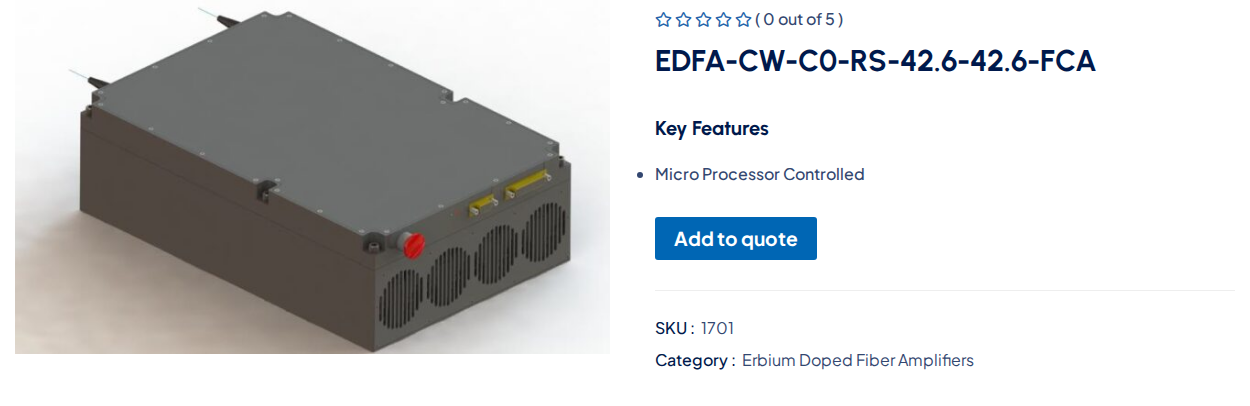
A US fibre amplifier manufacturer based in Murrieta, CA. The EDFA-CW-C0-RS-42.6-42.6-FCA delivers a verified 42.6 dBm (18.2 W) C-band output, backed by a broad catalogue of form factors, PM variants, and band options.
Pros:
Verified 42.6 dBm (18.2 W) C-band output
Broad form factor range: sub-mount to rackmount
Polarisation-maintaining variants available up to 37 dBm
C-band, L-band, and dual C+L catalogue coverage
Cons:
Catalogue-based; not fully bespoke per-project engineering
42.6 dBm unit is physically large
Operating temperature limited to 0-50°C
Pricing not listed; contact factory required
Nuphoton Technologies, headquartered in Murrieta, California, is a fibre amplifier manufacturer with a catalogue spanning C-band, L-band, Super C-band, and dual C+L-band configurations across multiple physical formats.
The EDFA-CW-C0-RS-42.6-42.6-FCA is the highest-power unit in the Nuphoton catalogue, delivering up to +42.6 dBm (18.2 W) output power with up to 42.6 dB gain — a continuous-wave device that clears the 40 dBm / 10 W threshold that defines the high-power EDFA category with meaningful margin.
EDFA-CW-C0-RS-42.6-42.6-FCA: Key Specifications
| Parameter | Specification |
|---|---|
| Output Power | +42.6 dBm (18.2 W) |
| Gain | Up to 42.6 dB |
| Noise Figure | ≤6.5 dB (at 42 dB gain, 1560 nm) |
| Wavelength Range | 1545–1565 nm (C-band, single channel) |
| Operation Modes | ACC (constant pump current), AOPC (constant output power) |
| Supply Voltage | +28 VDC ±5% |
| Control Interface | RS-232; DB-9 and DB-25 connectors |
| Dimensions (with heat sink) | 381 × 254 × 115 mm |
| Operating Temperature | 0 to +50°C |
Presents the headline unit's key evaluation-framework parameters in a scannable format, allowing readers to compare directly against other entries on this page.
The noise figure of ≤6.5 dB at 42 dB gain is at the upper end of the 4–6 dB range typical of high-quality devices, which is a real consideration for noise-sensitive links — though it is a characteristic figure for a booster operating at this gain level rather than an anomaly.
Nuphoton's catalogue spans a notably wide range of physical formats, giving integrators genuine options at the form factor selection stage.
Form Factor and Catalogue Breadth
- Sub-mount module: 80 × 50 × 12 mm — the smallest footprint in the range, suited to OEM sub-assembly integration. PM sub-mount variants are also available.
- Standard module (SMR): 130 × 125 × 15 mm — a compact module format with ACC/AOPC operating modes and RS-232 interface via LVTTL UART.
- Standard module (PM): 200 × 100 × 49 mm — the polarisation-maintaining variant (EDFA-CW-C0-PM-RS-37-47-FCA) delivering +37 dBm with ≥20 dB polarisation extinction ratio.
- Rackmount (PR): 483 × 280 × 38 mm (1U) — AC-powered (100–240 VAC) with front-panel RS-232 access, suited to rack-integrated telecom and CATV deployments.
- Headline high-power unit: 381 × 254 × 115 mm including the integrated heat sink — the 42.6 dBm flagship, requiring dedicated thermal management space.
On band coverage, the catalogue includes standalone C-band, L-band (1570–1610 nm), and dual C+L-band products, as well as a Super C-band family covering 1524–1574 nm.
It is worth noting that the headline 42.6 dBm unit operates in a narrower 1545–1565 nm window, and that dual-band coverage requires selecting separate C-band and L-band products from the catalogue rather than drawing on a single configurable source.
Nuphoton EDFA: Applications and Pricing
Nuphoton's own datasheets list application areas for the high-power range as high-power telecom booster amplification, CATV distribution, test and measurement, laboratory R&D, and defence and aerospace optical systems.
The catalogue also notes that custom configurations are available across the range, though Nuphoton operates primarily as a catalogue-based manufacturer rather than a fully application-engineered supplier in the manner of a bespoke-per-project house.
The 42.6 dBm unit's physical footprint (381 × 254 × 115 mm with heat sink) and its 0–50°C operating temperature ceiling are practical constraints worth factoring into any integration assessment alongside the performance figures.
Pricing is not publicly listed; prospective buyers should contact Nuphoton Technologies directly for quotation.
Product 4
Agiltron EDFA
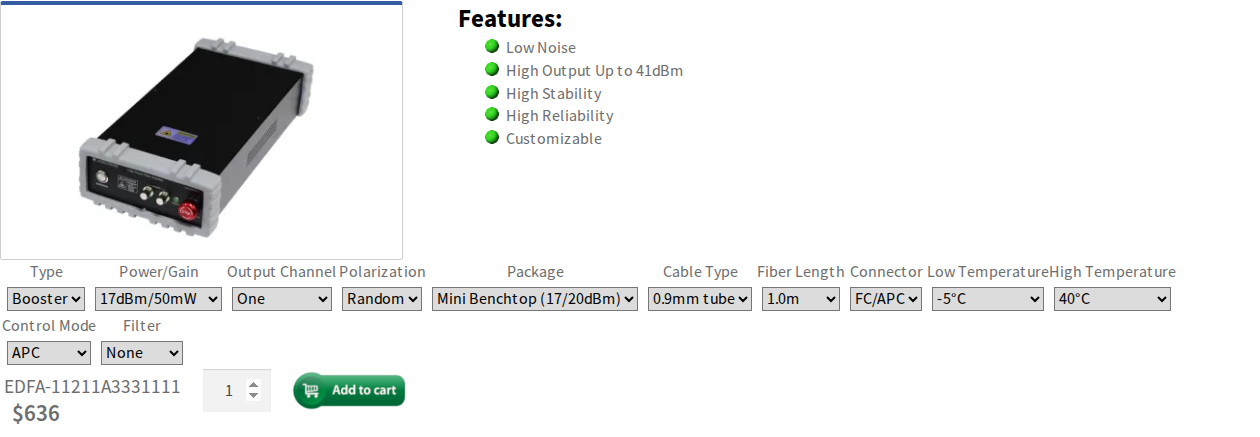
A US fibre optic amplifier manufacturer based in Woburn, MA. Agiltron's EDFA range reaches up to 43 dBm C-band output, spanning OEM modules through to rack formats with multiple control interface options.
Pros:
C-band output up to 43 dBm
Five package formats from OEM to rack
USB, RS-232, and GUI control interfaces
Extended temperature option available
Cons:
Wavelength narrows to 1535–1565 nm above 26 dBm
Catalogue-based range; not per-project engineered
High-power C-band units not catalogue-priced
Output Power and Wavelength Coverage
Agiltron (Woburn, MA) offers a C-band booster range reaching up to 43 dBm, with a wavelength window of 1535–1565 nm at that power level.
Below 25 dBm, the operating wavelength broadens to 1528–1565 nm — a wider C-band window relevant for applications requiring coverage across the full conventional C-band.
The L-band amplifier line extends to 30 dBm across 1530–1625 nm, while polarisation-maintaining (PM) variants reach up to 42 dBm with a 1543–1605 nm operating range.
| Variant | Max Output Power | Wavelength Range | Noise Figure |
|---|---|---|---|
| C-band Booster (standard) | 43 dBm | 1535–1565 nm (above 26 dBm) / 1528–1565 nm (below 25 dBm) | ≤5 dB |
| L-band Amplifier | 30 dBm | 1530–1625 nm | — |
| PM EDFA | 42 dBm | 1543–1605 nm | — |
Presents the key specifications across Agiltron's three main EDFA product lines side by side, allowing engineers to quickly identify which configuration matches their power and wavelength requirements.
Above 26 dBm, Agiltron employs EYDFA (erbium-ytterbium co-doped fibre amplifier) technology to sustain C-band output at high power levels.
This architecture is what constrains the operating window to 1535–1565 nm at those power levels — a characteristic of the EYDFA approach to achieving high C-band output rather than an anomaly in the design.
Noise Figure
Agiltron's published spec sheet states a booster noise figure of ≤5 dB, which is competitive for amplifiers operating at these output power levels.
Package Formats
One of the range's clearest strengths is its breadth of physical packaging, spanning five distinct formats.
- OEM component module: Bare module format for integration into customer-designed systems and instruments.
- MSA plug-in module: Multi-source agreement form factor for slot-based system integration.
- Mini benchtop: Compact standalone unit suited to lab evaluation and space-constrained deployments.
- Standard benchtop: Full benchtop instrument with USB, RS-232, and GUI software interfaces.
- Net-control rack: Rack-mounted format for system-level deployment with network control capability.
This range of formats means buyers at different integration stages — from early OEM design-in through to finished rack deployment — can select a form factor without switching supplier.
Control Interfaces and Operating Modes
The standard benchtop and rack formats support USB and RS-232 connectivity, with GUI software provided for remote monitoring and power adjustment.
Three operating modes are available: ACC (automatic current control), APC (automatic power control), and CC (constant current) — giving system integrators the flexibility to match the amplifier's behaviour to their control architecture.
Options: Temperature Range, Gain Flatness, and Pulsed Operation
An extended operating temperature range is available as an option, with the upper bound reaching +70°C — relevant for field-deployed or outdoor sensing applications.
A gain flattening filter is also available as an option, broadening the range's suitability for multi-channel applications where spectral flatness matters.
Pulse-optimised EDFA variants are offered as an option for buyers working with pulsed signal formats.
Application Fit
Agiltron's product documentation cites application fit for BOTDR, OTDR, LiDAR, and fibre sensing — a spread that reflects the range's orientation towards sensing and measurement contexts.
Pricing and Procurement
Agiltron's L-band product page lists an example entry-level configuration at $2,392, providing a useful reference point for budget scoping at the lower end of the range.
Higher-power C-band units are not catalogue-priced; procurement requires direct contact with Agiltron for a quote.
Agiltron's EDFA range is catalogue-based across its format and configuration options. Per-project engineering to custom band, power regime, cooling, or firmware specification is not a documented feature of the range.
Product 5
BKtel Photonics THPOA / UHPOA
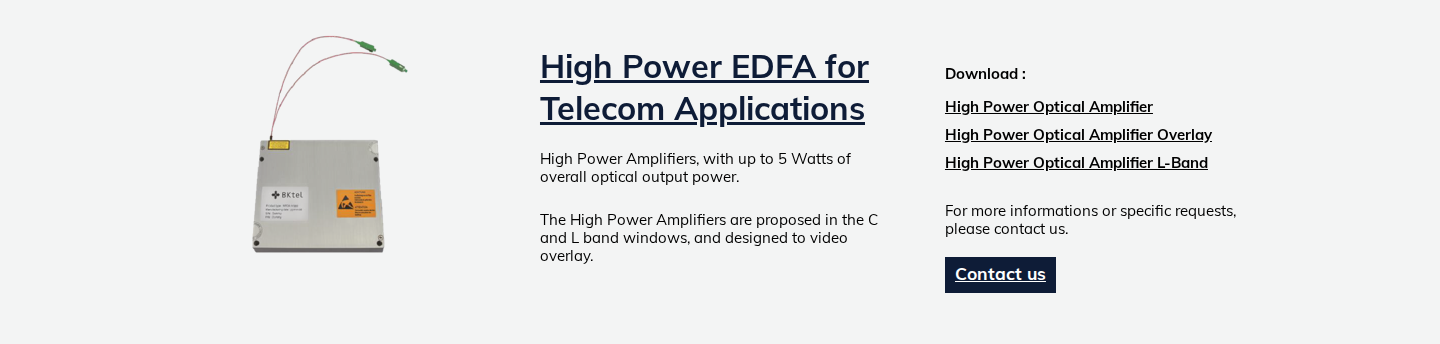
A French fibre amplifier manufacturer based in Lannion, offering a verified 10 W / 40 dBm ultra-high-power 1.55 µm amplifier in benchtop and module formats, with explicit LiDAR, FSO, and CATV application targeting.
Pros:
Verified 10 W / 40 dBm output (UHPOA-1.5)
Multi-port output options for CATV and FTTH
Explicit LiDAR and FSO application targeting
Benchtop, rack, and compact module formats
Cons:
Gain specs not publicly listed
Pricing requires direct contact
Customisation depth not established from public sources
Output Power and Product Range
BKtel Photonics, headquartered in Lannion, France, is a manufacturer of fibre amplifiers and fibre lasers with over 20 years of activity in the field — fibre amplification is stated as its core technology, not a secondary product line.
The range relevant to high-power buyers spans three product lines: the HPOA-1.5 compact module (up to 5 W / 37 dBm), the UHPOA-1.5 ultra-high-power amplifier (up to 10 W / 40 dBm), and the THPOA benchtop/rack-mounted unit, also rated to 40 dBm.
| Model | Format | Output Power | Wavelength | Noise Figure | Control Interface |
|---|---|---|---|---|---|
| HPOA-1.5 | Compact module | Up to 5 W (37 dBm) | 1540–1565 nm | <5.5 dB | RS-232 |
| UHPOA-1.5 | Module (single or multi-port) | Up to 10 W (40 dBm) | 1535–1565 nm | 5.5 dB | RS-232 |
| THPOA | 3U benchtop / rackmount | Up to 40 dBm | 1540–1565 nm | 5.5 dB | RS-232 / GUI |
Comparing the verified specifications of BKtel's three high-power 1.55 µm amplifier models side by side helps buyers assess which format and power level fits their deployment.
The THPOA is the only model in BKtel's 1.55 µm range to offer a graphical user interface alongside RS-232, making it the most accessible option for laboratory and test-and-measurement setups.
Multi-Port Capability and Distribution Applications
BKtel's multi-port architecture is a standout feature at this power level: the HPOA-1.5-M multi-port variant supports up to 64 output ports, with per-port output figures of +24 dBm (16 ports), +20 dBm (32 ports), and +17.5 dBm (64 ports).
BKtel's multi-port high-power amplifier supports up to 64 output ports from a single unit — a configuration directly suited to CATV headend and FTTH distribution scenarios where a single high-power source feeds multiple downstream fibres simultaneously.
A separate multi-port ultra-high-power amplifier is also listed in BKtel's product catalogue, extending the multi-port architecture to the 10 W power tier.
Application Targeting
BKtel's datasheets name application targets explicitly, which is useful for buyers arriving with a specific use case.
- LiDAR: Stated on both the UHPOA-1.5 and HPOA-1.5 datasheets; BKtel's homepage and About page reinforce LiDAR — including autonomous driving, 3D scanning, and telemetry — as a primary market.
- FSO (Free-Space Optical): Listed on the UHPOA-1.5 and HPOA-1.5 datasheets as a target application; also covered by the THPOA datasheet under Free Space Optics.
- CATV / Video Overlay: Explicitly targeted by the UHPOA-1.5 and the multi-port HPOA-1.5-M; BKtel describes its high-power amplifiers as a well-established solution for CATV distribution.
- Test and Measurement: Named on the UHPOA-1.5 and THPOA datasheets; the THPOA's benchtop format and GUI interface make it the natural fit for this use case.
- Telecom / FTTH: Covered by the HPOA-1.5 and multi-port HPOA-1.5-M; BKtel positions its amplifier range across long-haul down to access and FTTx networks.
The breadth of explicitly named applications — particularly the combination of LiDAR and FSO alongside CATV — is less common at this power tier and reflects BKtel's positioning as a specialist rather than a general-purpose supplier.
BKtel Photonics THPOA / UHPOA Pricing
No pricing is published on BKtel's product pages or datasheets; procurement requires direct contact with BKtel, consistent with the broader pattern across this category.
Ready to Specify Your High Power EDFA?
You have compared the field. If your application demands something beyond a catalogue product, speak directly with a high power EDFA specialist at Woodrow Scientific.

Conclusion
Choosing the right high power EDFA: what separates these options
Across every entry here, the separating factor was never the headline power figure — it was whether the supplier can engineer the amplifier to what the application actually demands, across band, pulse regime, form factor, and integration envelope.
For applications where a fixed catalogue product falls short, the Woodrow Scientific Custom EDFA is the natural fit: a UK-manufactured, in-house engineered build on patented technology, with direct engineering support from specification through to integration.
High power EDFA: frequently asked questions
Technical and procurement questions answered for engineers and buyers evaluating high power EDFA options.
10 W (40 dBm) average output power is where the high-power EDFA category begins. Most commercial EDFA catalogues top out well below this — standard telecom booster configurations are typically specified at 20 dBm or below, and even higher-tier catalogue products rarely reach 37–38 dBm. At 40 dBm, the product transitions into genuinely high-power territory relevant to LiDAR, free-space optical communications, fibre sensing, and directed-energy research. The engineering challenges above 10 W are qualitatively different from those at 1–2 W. Thermal management becomes a primary design concern, component power ratings shift substantially, and laser safety classifications change. A device that operates reliably at 1 W and one that operates reliably at 10 W+ are not the same class of product — they involve different pump architectures, different fibre designs, and different qualification requirements.
Average power (watts) is the total optical energy delivered per second, averaged across the full duty cycle — including the off-time between pulses. Pulse energy (millijoules) is the energy delivered in a single pulse. Peak power (kilowatts) is the instantaneous power at the pulse maximum. All three matter, and specifying only average power for a pulsed application is a common and consequential mistake. Consider two systems both delivering 10 W average power: one firing 1 µs pulses at 10 kHz, the other firing 100 ns pulses at 100 kHz. The average power is identical, but the pulse energy and peak power differ by an order of magnitude. For LiDAR ranging, the peak power determines detection range. For surface processing, pulse energy governs material interaction. For directed-energy research, both may be primary constraints. If your application is pulsed, require the supplier to specify all three parameters — average power alone tells you very little about whether the amplifier will actually perform.
C-band (1530–1565 nm) is the right choice for the majority of applications: telecom backbone, DWDM, CATV, FTTH, and most fibre sensing platforms. Erbium gain is highest in this window, and the widest ecosystem of compatible components — isolators, couplers, WDMs, gain-flattening filters — is available here. L-band (1565–1625 nm) becomes relevant when C-band channel capacity is exhausted in dense WDM systems, or when the application specifically requires longer wavelengths. L-band amplifiers require significantly longer erbium-doped fibre lengths to achieve comparable gain, which affects form factor and cost. Dual C+L from a single integrated source is advantageous when the application needs simultaneous coverage across both windows — particularly relevant for wideband distributed sensing (DAS, BOTDR), certain free-space optical link designs, and research or test platforms requiring flexibility. Note that wideband C+L amplification uses a band-splitting architecture internally, with separate parallel gain sections for each band. Not all suppliers offer this as a single integrated unit; some provide C-band and L-band as entirely separate product lines, requiring two units to be procured and integrated independently.
Yes, in a meaningful and quantifiable sense. At 1550 nm, the cornea, lens, and intraocular fluid absorb the vast majority of incident radiation before it reaches the retina. At 1064 nm (neodymium or ytterbium sources), light passes through the eye's optics and is focused directly onto the retina, where it causes permanent damage at much lower power levels. The maximum permissible exposure (MPE) at 1550 nm is substantially higher than at 1064 nm as a direct consequence of this absorption difference. In practice, this means the nominal ocular hazard distance — the radius within which a beam poses an eye hazard — is considerably shorter for a 1550 nm system at equivalent output power compared to a 1064 nm source. A shorter hazard distance means a smaller controlled zone around the beam path, which is a practical operational advantage for open-air and field-deployed applications such as LiDAR, free-space optical communications, and distributed sensing. That said, "eye-safe" is a relative term. High-power 1550 nm systems can damage the cornea at sufficient power levels — the thresholds are simply higher than for retinal damage at shorter wavelengths. Some suppliers offer reduced-hazard-zone builds specifically designed to minimise the operational footprint of the hazard zone.
Ask directly: Does the supplier design the amplifier in-house? Does it build and qualify units itself, or source them from a third-party manufacturer? Can it modify the design if integration issues arise post-delivery? Does it hold the full technical documentation and firmware? Are there in-house engineers who worked on the original design? If the answers are vague, deflected, or qualified with phrases like "our manufacturing partner," you are likely dealing with a reseller or importer rather than a manufacturer. This distinction matters considerably in practice. A reseller cannot modify the product when an integration problem surfaces. It cannot resolve deep technical issues independently, because the people who built the amplifier are elsewhere. Spares availability, firmware updates, and custom firmware requests all depend on a third party whose priorities and capacity the reseller does not control. In-house manufacture means the engineers who answer the phone are the engineers who designed and built the unit — which changes the quality of support, the speed of resolution, and the buyer's ability to get a genuinely non-standard problem solved.
High-power EDFAs are almost universally quoted per project rather than catalogue-priced. The variables that drive cost include output power level, operating band (C-band, L-band, or dual C+L), pulse regime (CW or pulsed, pulse duration, repetition rate), cooling configuration (air or water), physical form factor and integration envelope, control firmware and communication interface standards, and delivery fibre specification. Because each of these parameters shifts the engineering scope, a fixed list price carries no practical meaning for this product class. Approach procurement by preparing a clear written specification covering all of the parameters above. State the application context explicitly — whether the system is for LiDAR, FSOC, fibre sensing, CATV, or research — as this helps the supplier propose the right configuration rather than the nearest catalogue equivalent. Ask at quotation stage whether the supplier manufactures in-house (see the previous question). Also ask for an indicative lead time: delivery timelines vary with configuration complexity and supplier capacity, and understanding this early avoids schedule surprises later.