

Introduction
The free-space optical communication market is not a single industry — it is several overlapping ones, each with its own vendors, standards, and procurement logic.
Engineers evaluating terrestrial links, procurement teams shortlisting satellite terminal suppliers, defence contractors assessing partners, and investors mapping the sector are all searching for the same thing: a clear, structured picture of who actually operates in this space.
Every entry in this list was selected on verifiable evidence and assessed on the same axes: what the company makes, which markets it serves, its technology differentiators, geographic footprint, and company scale or stage.
The six profiles span three broad segments — last-mile and enterprise, satellite ground links, and defence/government — so you can quickly identify which part of the landscape is relevant to your context.
TL;DR
The FSO vendor landscape is far more segmented than most roundups acknowledge. A terrestrial link vendor and a satellite lasercom specialist share a technology name but almost nothing else — different customers, different qualifications, different commercial models. Knowing which segment a company operates in is the single most useful lens for making sense of the field.
This article covers:

Six FSO companies profiled
Consistent evaluation axes applied
Industry segmentation explained
Curation criteria outlined
Decision guidance by use case
Key standards and benchmarks
How to evaluate free space optical communication companies: key criteria
Comparing free space optical communication companies using a single set of criteria is a category error — the attributes that make a space-qualified terminal manufacturer credible are almost entirely irrelevant when assessing a terrestrial last-mile vendor, and vice versa.
The profiles in this guide apply six consistent evaluation axes to every company: what they make or deploy, which markets they serve, their technology differentiators, geographic footprint, company scale and stage, and — where relevant — funding data as a market-validation signal.
What the company makes or deploys
The FSO industry spans materially different business models, and understanding where a company sits in the supply chain is the most foundational question a procurement team or investor can ask.
System integrators build complete, end-to-end FSO links and are typically the vendor a procurement team buys from directly; terminal manufacturers produce space-qualified optical communication hardware that goes on satellites; optical ground station operators build and run the Earth-side infrastructure; component and amplifier suppliers form the upstream technology layer that system vendors depend on; and a smaller cohort of software and network management providers is becoming increasingly relevant as constellation scale demands automated link management.
These are not interchangeable roles — each carries a different supply chain position, risk profile, and relevance to different reader types, which is why the distinction opens every profile in this list.
Markets served
Three primary segments define the FSO market, and they differ not just in size but in maturity, growth trajectory, and technical demand — factors that carry very different implications depending on whether you are procuring, investing, or partnering.
- Last-mile and enterprise: The highest-volume commercial segment; terrestrial, building-to-building links that are commercially mature with established vendor ecosystems and proven deployment models.
- Satellite ground links: The highest-growth segment, driven by LEO constellation proliferation; technically demanding, with rapidly evolving interoperability standards and significant on-orbit heritage requirements.
- Defence and government: The longest-established and most demanding segment; requires security certifications, programme compliance, and often allied-nation supply chain constraints.
Procurement teams prioritise segment maturity and long-term vendor support; investors focus on growth trajectory, making the satellite lasercom segment particularly attractive; defence and government buyers place compliance and supply chain provenance above almost everything else.
Technology differentiators and quality signals
Marketing language in the FSO sector tends toward the generic — phrases like "high throughput" and "long range" appear across vendor websites without the specifics that would allow meaningful comparison.
The quality signals that actually distinguish credible vendors are: published, verifiable technical specifications rather than headline claims; a demonstrable deployment track record in the form of on-orbit heritage, operational installations, or named programme references; compliance with open interoperability standards such as the SDA Optical Communications Terminal Standard for satellite applications; and a history of operating in regulated markets — defence and satellite — as a proxy for having survived external technical scrutiny.
Published specifications, on-orbit heritage, and compliance with open interoperability standards are the clearest quality signals in a market where credible-sounding claims are easy to make and almost impossible to verify from marketing materials alone.
Geography, scale, and company stage
The FSO industry has distinct regional concentrations that matter practically for procurement: European manufacturers, particularly in Germany and France, lead in satellite lasercom terminal development; US defence contractors and LEO constellation players dominate the American market, where ITAR and EAR export controls create real supply chain constraints for non-US buyers; and Asia-Pacific activity is growing, particularly in satellite ground station infrastructure.
Company stage is equally consequential: publicly traded companies offer transparent financials and market accountability; established private vendors bring long commercial track records; subsidiaries of large defence or aerospace groups provide supply chain stability, though FSO may not be the parent's core focus; and growth-stage startups offer technical innovation at the cost of higher supply chain risk for long-programme commitments.
For startups operating in emerging FSO segments — satellite lasercom, high-altitude platforms, quantum-secured links — venture funding data serves as a useful, if imperfect, proxy for market validation: it signals that sophisticated investors have assessed the technology and the commercial thesis, even if it says nothing about delivery certainty.
With this framework established, the profiles that follow apply each of these axes consistently — giving you a comparable, structured view of every company on the list.
Product 1
Woodrow Scientific Limited: uplink amplifiers for optical ground stations
UK manufacturer of the EDF-UL, a 10 W erbium-doped fibre amplifier that powers optical ground-station uplinks to satellites in any orbit, carrying tracking beacon and uplink data in one beam.
Pros:

Beacon and uplink data in one beam
Modulation switchable between CCSDS and SDA
Serves ground links to any orbit
In-house UK build on patented technology
Cons:

Amplifier subsystem only, not a full terminal
Class 4 laser: safety procedures required
Built to order, not off the shelf
Woodrow Scientific Limited (WSL) builds the amplifier at the ground end of a satellite optical link: its EDF-UL raises a ground station's beacon and uplink signal to 10 W before it is sent to the satellite.
Where the terminal makers on this list build hardware that flies, WSL supplies a subsystem that stays on the ground, sold to the integrators who assemble optical ground stations.
What WSL makes and who it serves
WSL is a Southampton laser technology company founded in 2012, working in two fields, laser cleaning and laser communications, where its specialism is erbium-doped fibre amplifiers (EDFAs).
Its FSO customers are optical ground station integrators building optical uplinks to satellites, and the EDF-UL serves links to LEO, MEO or GEO with no orbit limitation.
The amplifier also suits multi-station and multi-emitter networks built for site and emitter diversity, and WSL technology is part of global space programmes today.
The EDF-UL uplink amplifier
The EDF-UL comes as a C-band and an L-band model, each built as a 3U rack unit for installation in the ground station.
| Parameter | EDF-UL |
|---|---|
| Role | Ground-station uplink and beacon amplifier (EDFA) |
| Models | EDF-UL-10-C (C-band), EDF-UL-10-L (L-band) |
| Seed wavelength | C-band 1532–1537 nm or 1550–1570 nm; L-band 1588–1592 nm |
| Average output power | 10 W; higher on request |
| Beam quality | M² < 1.1 |
| Tracking beacon | CW to 10 MHz; sinusoidal or rectangular; 0–100% depth |
| Uplink data (OOK) | Up to 10 Mbps with integrated seed; external input for your own transmitter |
| Orbits served | LEO, MEO and GEO |
| Form factor | 3U 19-inch rack, under 20 kg, 110–250 VAC |
| Laser class | Class 4 (IEC 60825-1) |
The EDF-UL's core parameters for ground-station integrators assessing fit.
The EDF-UL is a Class 4 laser product: its 15xx nm wavelength has a higher eye-damage threshold than 1064 nm, but laser-safety eyewear and procedures are still required on site.
Technology differentiators
The defining design choice is that one amplified beam does both jobs an uplink needs: the tracking beacon rides low in the signal and the uplink data sits above it, so a single module covers the beacon and uplink roles.
WSL's Modulation-on-Demand software sets the amplitude modulation, square or sinusoidal with adjustable frequency and modulation index, and switches it between CCSDS and SDA standards at high power across C-band and L-band.
Optical ground-link standards are still evolving, so an amplifier whose modulation is set in software can stay compatible as they change, protecting the ground station's investment.
- Band: C-band, L-band, or dual-band from a single source.
- Direction: Beacon-only or bi-directional builds.
- Emitter arrays: 2- and 4-emitter arrays with multi-station synchronisation for site and emitter diversity.
- Third-party transmitters: An external optical input lets the EDF-UL act purely as the power amplifier, handling external OOK signals up to 20 Mbps from a 2 mW minimum seed.
- Cooling: Air-cooled as standard, with water cooling as an option.
Requirements beyond the published specification, such as a different power level, environment or form factor, are assessed with WSL's engineers rather than ruled out in advance.
Footprint, scale and stage
WSL designs, builds, qualifies and supports its amplifiers in-house in the UK on its own patented technology, with 10 patents to date, and it is not a reseller.
A team of more than 20 laser specialists brings over 200 years of combined engineering experience, and its fibre-amplifier expertise traces to Southampton's Optoelectronics Research Centre, the birthplace of the EDFA.
Units ship worldwide direct from WSL, so buyers in any country order without an intermediary, and the EDF-UL carries CE and UKCA certification.
WSL is an established specialist manufacturer, founded in 2012 by a fibre-laser specialist with a PhD from Southampton's ORC and 25+ years in the field. It serves optical ground station customers worldwide, including large programmes. Its scope is the amplifier subsystem: the rest of the ground station comes from the integrator.
Product 2
TESAT-Spacecom: leader in space laser terminals
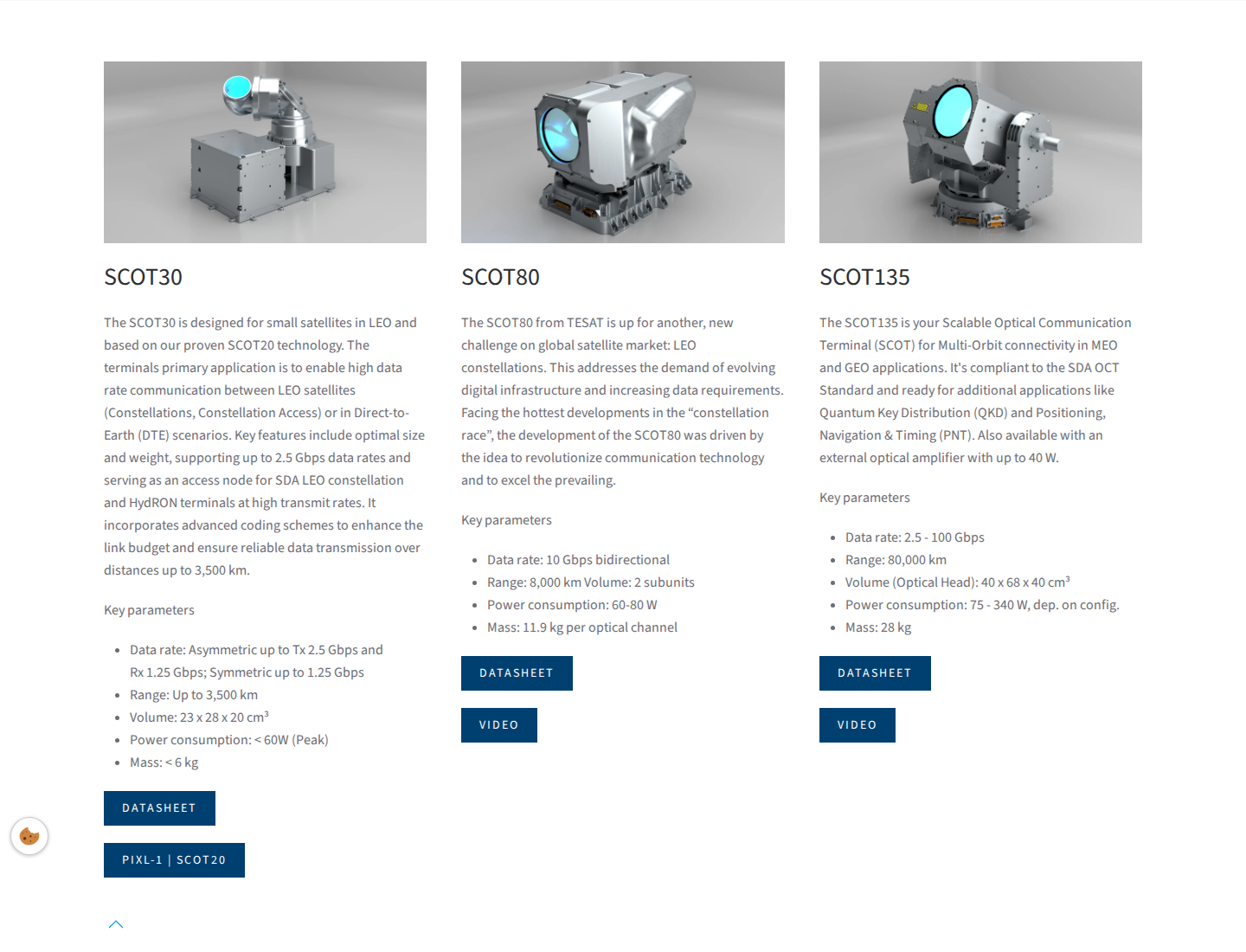
TESAT-Spacecom is a German satellite communications equipment manufacturer and wholly-owned subsidiary of Airbus Defence and Space, with around 1,100 employees at its Backnang headquarters. The company produces the SCOT family of scalable optical communication terminals, covering small LEO nanosatellites through to GEO and multi-orbit relay applications. TESAT is the technology leader for in-orbit-verified optical communication terminals and serves as the primary OCT supplier for major European institutional programmes and US government constellation architectures including the SDA Transport Layer.
Pros:
Unmatched on-orbit heritage
Full SCOT family across all orbital regimes
Serial production at constellation scale
SDA OCT Standard 3.1 compliant
Cons:
US-restricted programmes need TESAT Government
TESAT-Spacecom is the field's heritage benchmark: the first organisation to develop and deliver in-orbit-verified optical communication terminals, and the one with the deepest operational track record in satellite lasercom of any company active today.
The SCOT Terminal Family
TESAT's Scalable Optical Terminal (SCOT) family is a deliberate product architecture — not a collection of one-off designs — engineered to cover every orbital regime from small LEO nanosatellites through to GEO and multi-orbit relay missions.
| Terminal | Target Orbital Regime | Data Rate | Max Range | Primary Application |
|---|---|---|---|---|
| SCOT20 | Small LEO / MicroSat / NanoSat | Up to 1 Gbps | — | Compact optical comms for CubeSat and microsat missions; SDA and ESTOL standard compliant |
| SCOT80 | LEO constellation ISL | 10 Gbps bidirectional | 8,000 km | Inter-satellite links for broadband LEO constellations; SDA OCT Standard 3.1 compliant |
| SCOT135 | MEO / GEO / Multi-orbit | 2.5–100 Gbps | 80,000 km | High-throughput relay for MEO, GEO, and cross-orbit links; SDA OCT Standard compliant |
The SCOT family spans three distinct terminals with materially different capabilities and target markets — a table communicates these differences more clearly than prose.
The SCOT80's compliance with the SDA OCT Standard 3.1 — and its documented path to Standard 4.0 compatibility — is a critical quality signal for procurement teams evaluating suppliers for US government-affiliated constellation programmes, where interoperability across multiple prime contractors is a hard requirement.
TESAT successfully completed SDA Tranche 1 interoperability testing, demonstrating that its terminals can establish consistent data links both with a reference modem and with optical terminals made by other suppliers.
On-Orbit Heritage and Track Record
TESAT's claim to leadership rests on a concrete operational record: its laser communication terminals have accumulated more than 51,000 optical inter-satellite links completed on orbit, with the 10,000-link milestone reached as early as April 2018 — a depth of in-orbit verification that no other free space optical communication company currently matches.
As of late 2025, 62 SCOT80 terminals were confirmed in orbit across multiple prime contractors' satellites, with cross-contractor optical links demonstrated between SDA Tranche 0 spacecraft — a practical proof of interoperability at constellation scale.
TESAT's production facility in Backnang, opened in 2024, is the world's first purpose-built industrial facility for high-volume laser terminal manufacture, capable of producing up to 100 units per month.
Key Programmes and Deployments
TESAT's programme portfolio spans European institutional, US government defence, and commercial constellation customers — a breadth that reflects both the maturity of its technology and the reach of its institutional relationships.
- EDRS / SpaceDataHighway: TESAT supplied the Laser Communication Terminals for both EDRS-A (launched January 2016) and EDRS-C, forming the backbone of Airbus's European Data Relay Satellite system — the world's first commercial optical data relay service.
- SDA Transport Layer Tranche 0 and Tranche 1: Selected as primary OCT supplier to Lockheed Martin for both tranches of the US Space Development Agency's Transport Layer, covering 10 satellites in Tranche 0 and 42 in Tranche 1.
- MDA Space / Telesat Lightspeed: Contracted to supply almost 800 laser terminals for the Telesat Lightspeed LEO broadband constellation — one of the largest single optical terminal orders placed to date.
- Kepler Communications ÆTHER: SCOT80 terminals selected for Kepler's ÆTHER constellation; the first tranche of 10 satellites launched in January 2026, with optical inter-satellite links validated in orbit.
- GPS III Demonstration: TESAT Government delivered SCOT80 terminals to Lockheed Martin in October 2025 for demonstration on a GPS III spacecraft in medium Earth orbit — a significant expansion into the navigation satellite segment.
The GPS III programme is particularly notable because it extends TESAT's reach beyond LEO constellation supply into MEO navigation infrastructure, broadening the company's footprint across orbital regimes.
Geographic Footprint and US Market Access
TESAT's primary manufacturing base is its 63,000 m² facility in Backnang, Germany, where approximately 1,100 employees develop, assemble, integrate, and test terminals and satellite payload equipment.
For US security-restricted programmes, TESAT established TESAT Government — a dedicated US subsidiary based in Merritt Island, Florida, with its own manufacturing facility completed in April 2024 — specifically to combine TESAT's proven optical technology with US security-protected content for the American government market.
Procurement teams requiring US-origin hardware for classified or security-sensitive applications should engage TESAT Government directly rather than the German parent entity; the two operate as complementary rather than competing routes to market.
TESAT is a mature industrial manufacturer, not a startup. As a wholly-owned subsidiary of Airbus Defence and Space, it carries the supply chain stability and institutional relationships of a large European aerospace group, with serial production infrastructure already running at constellation scale.
Product 3
Mynaric AG
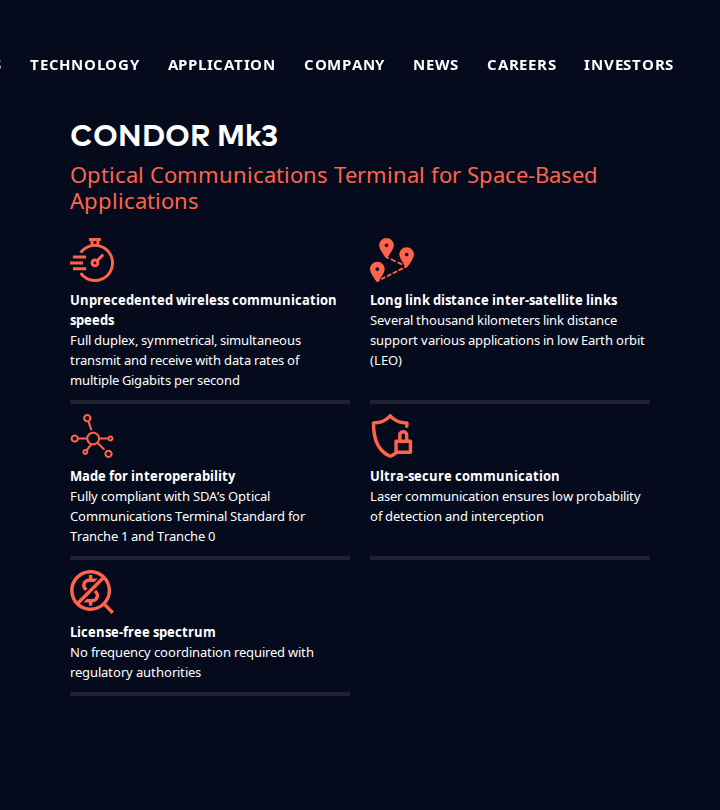
Mynaric AG is a publicly traded, pure-play laser communications terminal manufacturer founded by DLR alumni in Gilching, Germany, producing the CONDOR Mk3 space terminal and HAWK airborne terminal for LEO constellation and tactical communications markets.
Pros:
Serial production underway for LEO constellations
NRL-verified SDA OCT Standard T0/T1 compliance
Strategic supplier to Northrop Grumman, SDA Tranche 1
L3Harris strategic investment and preferred provider status
Cons:
Operating losses; growth-stage risk
Revenue tied to LEO programme timelines
Pure-play concentration in single market
Mynaric AG is a Munich-based, publicly traded laser communications company founded in 2009 by former scientists from the German Aerospace Center (DLR), with its registered office in Gilching, Germany.
Where TESAT brings decades of heritage as an Airbus subsidiary, Mynaric's defining bet is different: it is an independent, pure-play terminal manufacturer whose entire commercial thesis rests on serial production of standardised optical communications terminals for LEO constellations and airborne platforms.
The company is dual-listed on NASDAQ (ticker: MYNA) and the Frankfurt Stock Exchange (ticker: M0YN), a structure that reflects its ambition to serve both US defence programmes and European commercial markets from a single product platform.
CONDOR Mk3 and HAWK Terminal Portfolio
Mynaric's two primary terminals address distinct markets: the CONDOR Mk3 targets inter-satellite links in LEO constellations, while the HAWK serves airborne and tactical communications platforms.
| Terminal | Platform | Data Rate | Link Distance | SDA OCT Compliance |
|---|---|---|---|---|
| CONDOR Mk3 | Space (LEO inter-satellite) | 0.313 to 2.5 Gbps | Greater than 6,500 km | T0/T1 compliant |
| HAWK | Airborne / tactical | 7 Gbps full-duplex (1–9 Gbps variable) | Air-to-air: 50 km; Air-to-ground: 30 km | Not applicable |
Comparing the two primary Mynaric terminals side by side across key performance parameters helps procurement teams and engineers quickly assess fit for their application.
The CONDOR Mk3 features an 80 mm aperture, hyper-hemispherical field of regard, and a modularised design separating the optical head from the optical communications controller — a configuration suited to integration across multiple satellite bus form factors.
The HAWK terminal is designed for UAV and manned aircraft platforms, with its full-duplex symmetrical link and compact SWaP profile making it a practical choice for tactical communications where RF alternatives are undesirable.
Mynaric also offers GATE optical ground systems as part of its product family, providing the ground-segment complement to its space and airborne terminals.
SDA Compliance and NRL Interoperability Testing
In September 2023, the CONDOR Mk3 passed optical verification and Phase 1 interoperability testing in the context of the SDA's Tranche 1 programme — conducted at the Naval Research Laboratory — successfully demonstrating optical interconnection with terminals from other vendors.
For procurement teams evaluating SDA programme suppliers, this milestone matters beyond the compliance checkbox: it confirms that CONDOR Mk3 can function within multi-vendor constellation architectures where terminals from different manufacturers must establish optical inter-satellite links.
Strategic Relationships: Northrop Grumman and L3Harris
Northrop Grumman selected Mynaric as a strategic laser communications supplier for its SDA Tranche 1 Transport Layer programme — a contract in which Northrop Grumman is delivering 42 satellites to the SDA's Proliferated Warfighter Space Architecture.
This relationship positions Mynaric inside one of the most significant US government LEO constellation programmes, with CONDOR Mk3 terminals integrated into Northrop Grumman's satellite architecture alongside Innoflight encryption hardware.
L3Harris made a strategic investment of EUR 11.2 million, taking a 7.2% stake in Mynaric, and was designated as a preferred customer for Mynaric laser communications systems — an arrangement that followed joint airborne laser communications demonstrations using the HAWK terminal.
L3Harris also indicated it would expand its use of Mynaric systems beyond airborne applications into space, which connects the HAWK and CONDOR product lines within a single strategic relationship.
Serial Manufacturing: The Defining Strategic Claim
Mynaric's central argument to constellation operators is that the satellite lasercom market needs a supplier capable of delivering terminals at industrial scale — not just demonstrating prototype performance.
Serial production of CONDOR Mk3 terminals began in the first quarter of 2024, with the first flight model optical head shipped in March 2024; by mid-2025, Mynaric had delivered more than 100 CONDOR Mk3 terminals to customers, including the first complete launch set to a prime customer for SDA Tranche 1.
The company has also manufactured more than 150 optical heads to date, and is developing the next-generation CONDOR Mk3.1 targeting up to 100 Gbps for SDA Tranche 2 and commercial constellation applications.
Geographic Footprint and US Market Access
Mynaric's primary R&D and manufacturing operations are based in Gilching (near Munich), with US commercial operations in Los Angeles and government affairs functions in Washington D.C.
Mynaric Government Solutions, Inc., a wholly owned subsidiary incorporated in Arlington, Virginia, is the company's vehicle for US government and defence market access — serving state and local governments, federal agencies, defence missions, and national security customers.
Mynaric has also been expanding its US manufacturing capabilities in the Los Angeles area, with assembly, integration, and test capabilities for electronic components designed to meet the requirements of security-sensitive US customers.
Mynaric is a growth-stage company that has recorded operating losses since inception, including an operating loss of EUR 79.2 million for FY2023. The company has invested heavily in production infrastructure ahead of revenue ramp, and its annual report classifies liquidity risk as high severity. Procurement teams should evaluate financial stability alongside technical capability — Mynaric's programme relationships and production milestones are genuine, but the company's financial trajectory warrants standard due diligence appropriate for a growth-stage public company.
As a pure-play laser communications company, Mynaric's order flow is structurally coupled to LEO constellation programme timelines — delays in SDA tranches or commercial constellation deployments translate directly into revenue timing risk.
This concentration risk is the honest trade-off that distinguishes Mynaric from larger defence contractors for whom FSO is one revenue line among many: the upside of focus is depth of capability; the downside is exposure to a single market segment's deployment schedule.
Product 4
CACI International
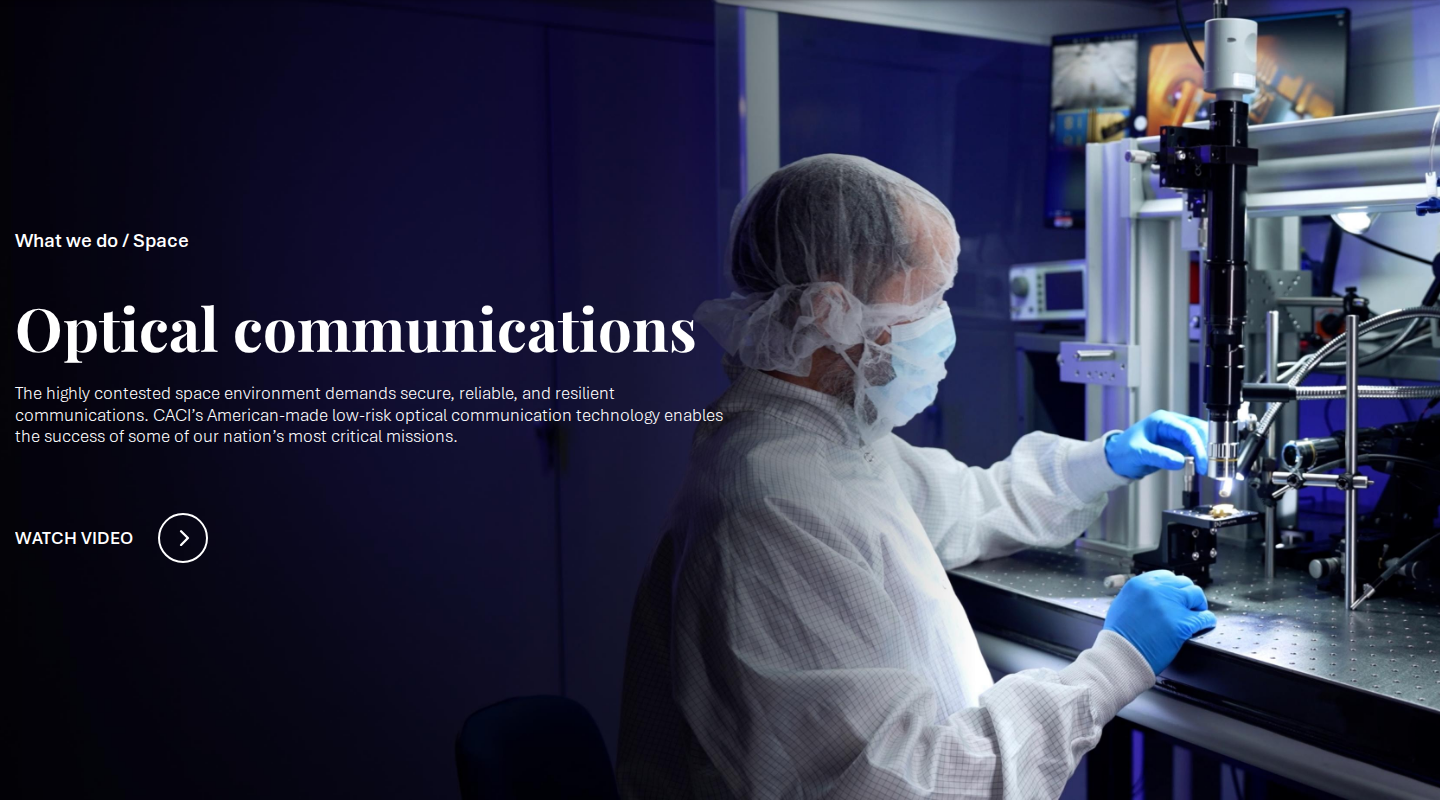
CACI International is a large US defence and intelligence contractor with a dedicated Optical and Photonic Solutions group, producing the CrossBeam OCT — described as the first and only American-made, SDA-compliant terminal with verified on-orbit performance across multiple DARPA and SDA programmes. Its primary market is the US government and intelligence community, with programme reach spanning LEO satellite crosslinks through to deep-space and airborne optical communications missions.
Pros:
On-orbit verified, US-made SDA terminal
First SDA terminal to pass NRL interoperability test
All 16 OCTs on DARPA Blackjack constellation
Orlando facility built for volume production
Cons:
Large contractor processes may slow engagement
FSO competes internally for investment priority
CACI International Inc (NYSE: CACI), headquartered in Reston, Virginia, is a large US defence and intelligence contractor with approximately 23,000 employees — not a pure-play photonics company, but one with a dedicated Optical and Photonic Solutions group that has been developing free-space optical communications systems for nearly two decades.
Where TESAT brings European heritage and Mynaric brings pure-play specialisation, CACI's defining characteristic is its depth in US government and intelligence missions, backed by a purpose-built space manufacturing and testing facility in Orlando, Florida, that opened in June 2022.
CrossBeam OCT: on-orbit verified, American-made
The CrossBeam OCT is CACI's flagship product and the centrepiece of its positioning in the free space optical communication companies landscape: it is described by CACI as the first and only American-made, SDA-compliant optical communications terminal with verified on-orbit performance.
CrossBeam is designed for compliance with the SDA's Tranche 0/1/2/3 satellite crosslinks in LEO, with a variable data rate modem supporting operation up to 2.5 Gbps and link distances reaching 6,750 km in its later tranche variants.
A core design choice distinguishes CrossBeam from competing terminals: its patented all-fibre-optic transmit and receive optics architecture, which is specifically engineered to provide robustness against the shock and vibration stresses of launch and on-orbit environments.
In September 2023, CACI became the first SDA-compliant terminal to successfully establish a consistent data communication link with the Naval Research Laboratory's reference modem — a standards-interoperability milestone that cleared CrossBeam to advance toward full optical payload interoperability testing under the Tranche 1 Transport Layer programme.
CrossBeam has since received a fourth Edison Award, cited by CACI as recognition of its status as an American-made innovation in optical communications terminal technology.
Broader product portfolio
CrossBeam is the headline product, but CACI's photonics portfolio extends meaningfully beyond it.
- SkyLight OCT: An ultra-low SWaP (size, weight, and power) terminal designed specifically for CubeSat and smallsat applications — filling a segment of the market where CrossBeam's form factor is not appropriate.
- CICADA family: Compact inter-satellite link terminals available in two variants (Ultra-Lite and Enhanced), developed initially for a US Government customer and now offered more broadly. Two CICADA Ultra-Lite flight terminals have been delivered.
- Amplifiers, modems, and LiDAR: High-power optical amplifiers, FSO communications modems, and LiDAR systems for intelligence, surveillance, and reconnaissance (ISR) missions — evidence of a photonics capability that extends well beyond terminal hardware.
The combination of CrossBeam for SDA-class missions, SkyLight for smaller platforms, and CICADA for compact inter-satellite links gives CACI a portfolio that spans a wider range of mission classes than a single-product terminal manufacturer can address.
Key programme deployments
CACI's on-orbit track record is the most concrete differentiator it holds over competitors whose terminals may meet the SDA standard on paper but have not yet accumulated equivalent flight heritage.
- DARPA Mandrake 2 (2021): Two CrossBeam terminals launched in June 2021 successfully closed both space-to-space and space-to-ground optical links — the first on-orbit demonstration of optical inter-satellite links using CrossBeam hardware, conducted jointly with DARPA and SDA.
- DARPA Blackjack constellation (2023): CACI provided all 16 OCTs for the Blackjack constellation, which launched in June 2023 and has been performing on orbit since.
- SDA Tranche 0/1/2 (ongoing): CrossBeam terminals are currently performing on SDA's Tranche 0, 1, and 2 satellite crosslink programmes, supplied as part of a team led by Lockheed Martin for the Tranche 1 Transport Layer.
Across these programmes, CrossBeam has accumulated a flight record that spans multiple DARPA and SDA missions — a level of on-orbit verification that is directly relevant to procurement teams assessing programme risk.
SA Photonics acquisition and manufacturing scale
In December 2021, CACI completed its acquisition of SA Photonics, a San Jose-based provider of multi-domain photonics technologies, for approximately $275 million.
The acquisition was not simply a talent or IP transaction — it brought with it a portfolio of lower-cost, LEO-optimised terminals (including the early CrossBeam hardware that flew on Mandrake 2) and significantly expanded CACI's manufacturing throughput, adding major California and Florida facilities to its existing New Jersey footprint.
The Orlando facility, which opened in June 2022 and has since expanded to approximately 36,000 square feet, was purpose-built for full-rate production and testing of space flight hardware — a deliberate manufacturing scale-up investment, not a relocation.
Scale, stability, and trade-offs
CACI's scale as a publicly traded, large-cap defence contractor is a genuine procurement advantage: supply chain resilience, financial stability, and the institutional relationships that come with decades of US government programme delivery are all real factors.
The honest counterpoint is that FSO and photonics, while a growing focus, remain one business line among many within CACI's broader portfolio — which means the optical communications roadmap competes internally for investment priority against other CACI programmes.
Procurement teams evaluating long-term roadmap commitment should factor this in alongside the undeniable on-orbit track record that CrossBeam has already established.
Product 5
Cailabs
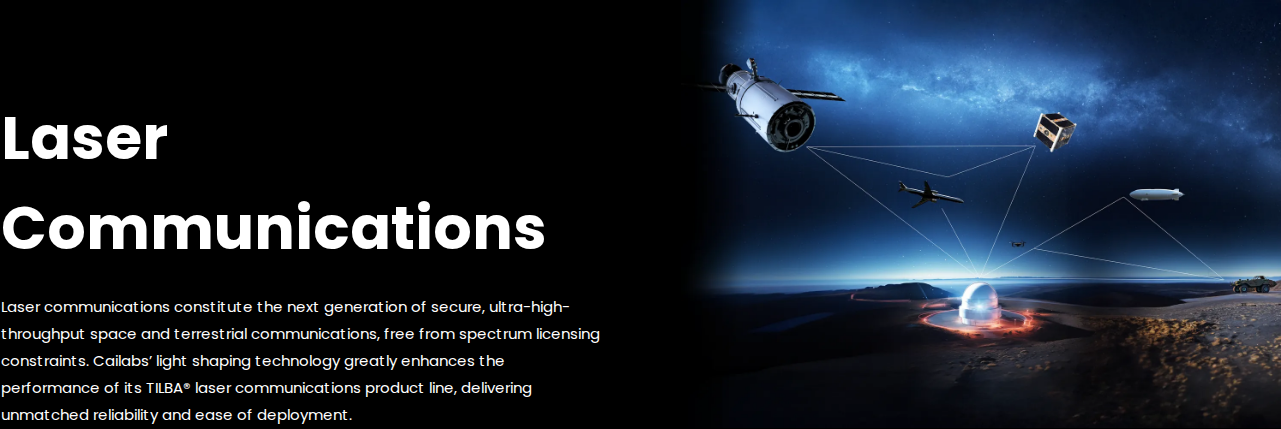
Cailabs is a French deep-tech photonics company founded in 2013 in Rennes, France, producing the TILBA product line for optical ground stations and FSO communications. Its proprietary Multi-Plane Light Conversion (MPLC) technology enables passive atmospheric turbulence mitigation — removing the need for mechanical adaptive optics — and underpins both the TILBA-OGS space-to-ground system and the TILBA-CBC high-power coherent beam combining capability.
Pros:
Passive turbulence mitigation without mechanical adaptive optics
DLR-validated TILBA technology
OGS deployments across Europe, Asia, and North America
TILBA-CBC coherent beam combining, up to 100W
Cons:
Specialist supplier — broader system integration required
Private company with limited public financial disclosure
Cailabs is a French deep-tech photonics company founded in 2013 and headquartered in Rennes, France, with a US presence in Washington D.C. — a private specialist whose core intellectual property, Multi-Plane Light Conversion (MPLC), underpins a focused range of FSO and laser communication products.
Where TESAT, Mynaric and CACI address the space segment — terminals, inter-satellite links, and orbital communications infrastructure — Cailabs occupies a different position: it builds the ground-side infrastructure that makes space-to-ground optical links operationally viable.
TILBA-ATMO: Passive Turbulence Mitigation
The most technically distinctive element of Cailabs's offering is TILBA-ATMO, a passive atmospheric turbulence mitigation technology built on MPLC — it corrects wavefront distortions introduced by atmospheric turbulence without any mechanical adaptive optics.
Traditional adaptive optics systems require motorised deformable mirrors, real-time wavefront sensors, and control loops that add mechanical complexity, maintenance burden, and cost — factors that constrain where optical ground stations can realistically be deployed at scale.
Cailabs's passive approach removes those constraints, and the technology has been independently validated by DLR (German Aerospace Center), providing a credible third-party endorsement of TILBA-ATMO's performance in an operational context.
The TILBA Product Family
The TILBA line spans both the space-to-ground and terrestrial FSO segments, with distinct products for each application.
- TILBA-OGS: Optical ground stations for space-to-ground links, delivering 10+ Gbps throughput with TILBA-ATMO turbulence mitigation integrated as standard.
- TILBA-LOS: Point-to-point FSO terminals for terrestrial, airborne, and maritime applications, achieving 10+ Gbps over distances exceeding 10 km.
- TILBA-CBC: Coherent beam combining module that combines multiple laser sources to reach up to 100W class output power — relevant for high-power uplink and feeder link applications where single-source power limits are a constraint.
- TILBA-ATMO / TILBA-IBC: Technology building blocks available as standalone components: TILBA-ATMO for passive turbulence mitigation and TILBA-IBC for incoherent beam combining.
- PROTEUS: Spatial mode multiplexers for spatial division multiplexing (SDM), primarily serving FSO research and development applications.
The TILBA-CBC coherent beam combining capability deserves particular note for feeder link applications: by combining multiple laser sources, it overcomes the power ceiling of any single laser, enabling higher-throughput uplink architectures without requiring new laser technology.
Markets Served
Cailabs addresses four primary segments: satellite operators and defence networks requiring space-to-ground optical links; terrestrial defence and government communications via TILBA-LOS; telecom infrastructure; and aerospace and defence optronics, including laser beam shaping for directed energy and rangefinder applications.
The space-to-ground segment is the most strategically significant for Cailabs's current positioning, sitting squarely in the highest-growth area of the FSO market as LEO constellation operators accelerate demand for capable optical ground station infrastructure.
Deployment Footprint and Key Programmes
Cailabs has active OGS deployments across Europe, Asia, and North America, with the DLR relationship serving as a flagship validation programme for TILBA technology in an operational research environment.
A second OGS deployment in South Korea — with CONTEC, completed in April 2026 — demonstrates a growing international footprint and the company's transition from technology licensor toward active system integrator for OGS installations.
As a private company, Cailabs has received French government funding (under the national recovery plan) specifically for TILBA-CBC development, reflecting state-level recognition of the technology's strategic relevance to French and European space infrastructure.
Cailabs is a specialist technology company and system supplier, not a full-system prime contractor. Procurement teams seeking a single vendor for a complete, turnkey FSO network will need to integrate Cailabs technology within a broader system architecture. This is a scope boundary, not a capability gap — the technology is proven, but the integration responsibility sits with the prime.
Product 6
Wireless Excellence (CableFree)

Wireless Excellence Limited (trading as CableFree) is a UK-based terrestrial FSO vendor founded in 1996, with commercial FSO deployments since 1997 and products installed in over 90 countries. Its UNITY hybrid FSO-plus-radio architecture addresses FSO's weather availability limitation, and its ISO 9001-certified Oxford facility supports a broad wireless portfolio spanning FSO, microwave, millimetre-wave, and 4G/5G LTE.
Pros:
Longest commercial FSO track record
UNITY hybrid architecture: up to 99.9999% availability
Deployed in 90+ countries across six continents
Full wireless portfolio: FSO, microwave, mmWave, 5G LTE
Cons:
Terrestrial only — no satellite or space-to-ground capability
4 km maximum range
Wireless Excellence Limited, trading as CableFree and headquartered at the Oxford Science Park, UK, is the longest-running commercial terrestrial FSO vendor in the industry — founded in 1996, with its first FSO products shipping in 1997.
Where the preceding entries on this page address satellite terminals, space-to-ground links, and deep-tech photonics components, CableFree occupies a fundamentally different segment: carrier-grade, building-to-building FSO for last-mile, enterprise campus, and telecom backhaul applications.
CableFree claims to have shipped the world's first commercial 622 Mbps FSO link in 1997, and the world's first commercial Gigabit Ethernet FSO link at 1.25 Gbps in 1999 — milestones the company cites as evidence of the longest continuous track record among commercial FSO vendors.
The FSO portfolio spans three product tiers, covering speeds from 2 Mbps up to 1.5 Gbps and ranges from 200 m to 4 km, with Ethernet/IP, TDM, and SDH interface support across the range.
| Product Line | Max Speed | Max Range | Interfaces |
|---|---|---|---|
| Gigabit FSO | 1.5 Gbps | Up to 2,000 m | Ethernet/IP, TDM, SDH |
| 622 FSO | 622 Mbps | Up to 4 km | Ethernet/IP, TDM, SDH |
| Access FSO | Up to 155 Mbps | Up to 4 km | Ethernet/IP, TDM, SDH |
Tabulating the three FSO product tiers with their key speed and range parameters makes the portfolio immediately scannable for procurement readers comparing options.
Beyond FSO, CableFree manufactures licensed microwave links (4–42 GHz), millimetre-wave backhaul (60/70/80 GHz E-band and V-band, up to 10 Gbps), 4G and 5G LTE macro and small-cell base stations, and carrier-grade Wi-Fi — positioning the company as a full wireless connectivity vendor rather than a single-technology specialist.
UNITY Hybrid FSO Architecture
The most strategically distinctive element of the CableFree portfolio is UNITY — a hybrid architecture that combines FSO with microwave or millimetre-wave radio over the same transmission path, using what CableFree terms Wide Wavelength Diversity.
The design exploits the complementary fade characteristics of the two media: FSO degrades in dense fog but is largely unaffected by rain, while millimetre-wave radio fades in heavy rain but not fog — conditions that, in practice, do not occur simultaneously.
CableFree claims UNITY links can achieve availability up to 99.9999% (six nines), with capacity and range both extended relative to either technology deployed alone.
ATPC (Automatic Transmit Power Control) is a standard feature across carrier-class CableFree FSO products, dynamically adjusting laser transmit power by up to 12 dB to compensate for atmospheric attenuation from fog, rain, dust, or sandstorms — improving uptime on links where UNITY is not deployed.
Primary markets include telecom operators deploying FSO for 4G/LTE fronthaul and 5G small-cell backhaul (with CPRI interface options), enterprise campus connectivity where trenching fibre is cost-prohibitive or time-constrained, broadcast and satellite uplink connections, and government and public-sector networks.
CableFree's manufacturing facility in Oxford holds ISO 9001 certification, and the company sells through a channel partner network spanning Europe, the Americas, the Middle East, Africa, Asia, and Australasia — with products installed in over 90 countries.
As a privately held company with nearly three decades of continuous commercial operation, CableFree presents a materially different supply-chain risk profile from growth-stage entrants — a relevant consideration for procurement teams evaluating long-term vendor stability.
The scope boundary is clear: CableFree's FSO products are terrestrial and building-to-building, with a maximum range of 4 km, and the portfolio does not address satellite, space-to-ground, or long-range tactical military applications.
Conclusion
Choosing the right FSO company for your use case
The core insight across these six profiles is that FSO is not one market — it is several, each with its own credible suppliers and evaluation criteria.
For satellite and space programmes, compliance documentation and on-orbit heritage are the decisive filters; for optical ground-station uplinks, Woodrow Scientific supplies a configurable amplifier that carries beacon and data in one beam, while Cailabs addresses atmospheric turbulence with passive mitigation; for terrestrial last-mile, CableFree offers the deepest commercial track record.
FSO is also a fast-moving field — programme affiliations and product roadmaps shift quickly, and these profiles reflect the market as it stands today.
Frequently asked questions about FSO communication companies
Common questions about the FSO vendor landscape, company types, key standards, and what is driving growth across the market.
The three primary suppliers are TESAT (SCOT80, SDA OCT Standard compliant), Mynaric (CONDOR Mk3, SDA OCT Standard compliant), and CACI (CrossBeam, SDA-compliant, US-origin). The SDA Optical Communications Terminal (OCT) Standard is the key interoperability benchmark governing how terminals from different manufacturers must work together on multi-vendor constellation architectures. TESAT and Mynaric are both European-headquartered, with dedicated US government subsidiaries — TESAT Government and Mynaric Government Solutions respectively — to serve security-restricted programmes. CACI CrossBeam is the only American-made SDA-class terminal with a verified on-orbit track record, a distinction that carries significant weight for US-origin procurement requirements and classified constellation programmes.
The distinction is business model and product scope. Optical terminal manufacturers — TESAT, Mynaric, and CACI — produce the space-qualified optical communication hardware that satellite prime contractors integrate into their spacecraft. System vendors like CableFree deliver complete, end-to-end terrestrial FSO link systems ready for deployment by network operators. Cailabs occupies a hybrid position, supplying both optical terminals and optical ground station infrastructure. Woodrow Scientific is a component supplier: its EDF-UL amplifier is built into ground stations by the integrators who assemble them. This distinction matters practically for procurement: terminal manufacturers sell into satellite prime contractor supply chains, not directly to end operators in most cases. Terrestrial system vendors, by contrast, sell directly to network operators and enterprise customers. Knowing which category a supplier occupies tells you who their customer is — and whether your procurement team is actually in their sales channel.
Four free space optical communication companies have dedicated government programmes: CACI (US government and intelligence community as its primary market), TESAT Government (US security-restricted programmes, based in Florida), Mynaric Government Solutions (US and allied government programmes), and Cailabs (European defence, covering naval, airborne, and directed energy applications). Defence budgets for secure, jam-resistant optical communications are a major industry driver — optical links are inherently immune to radio-frequency jamming, which makes them strategically attractive for military use. Most established FSO companies operating at scale have some government exposure. Even terrestrial vendors like CableFree serve government and public sector customers, though without the dedicated classified programme structures that the four companies above maintain.
For satellite lasercom applications, the SDA Optical Communications Terminal (OCT) Standard is the primary interoperability benchmark. Compliance is what enables terminals from TESAT, Mynaric, and CACI to interoperate on multi-vendor constellation architectures — without it, a terminal is effectively proprietary. For quality management systems, ISO 9001:2015 is the relevant certification; CableFree holds this for its terrestrial FSO product line. Procurement teams should request formal compliance documentation and independent interoperability test results, not just vendor assertions. The SDA OCT Standard has versioned iterations — T0/T1 compliance levels, Standard 3.1, and a Standard 4.0 roadmap — and teams should confirm precisely which version a supplier's terminal is certified against. Equally important is the upgrade path: a terminal certified to an earlier version may require hardware changes to meet future constellation requirements.
The FSO market is genuinely fragmented because it spans three technically and commercially distinct segments: terrestrial last-mile and enterprise, airborne and tactical, and satellite lasercom. Each segment has different technical requirements, regulatory environments, and customer bases. Vendors rarely compete across segment boundaries. Within those segments, the structure varies considerably. The satellite lasercom segment — specifically SDA-class inter-satellite links — is relatively concentrated, with TESAT, Mynaric, and CACI as the primary terminal suppliers. The terrestrial FSO segment has more players, with CableFree the longest-established commercial vendor. The optical ground station and space-to-ground segment is still emerging, with Cailabs supplying turbulence-mitigating ground-station optics and Woodrow Scientific supplying the uplink amplifiers inside ground stations. This is why mapping the vendor landscape requires understanding which segment a company operates in before drawing any meaningful comparison to its peers.
Three demand drivers are shaping growth across the FSO market. First, LEO constellation proliferation: programmes including the SDA Proliferated Warfighter Space Architecture (PWSA), Starlink, and Project Kuiper are generating large-volume demand for optical inter-satellite link terminals. Second, 5G backhaul and last-mile connectivity: terrestrial FSO adoption is being pulled forward by 5G small cell backhaul requirements and fibre-alternative deployments where trenching is impractical or cost-prohibitive. Third, defence budgets for secure communications: optical links cannot be jammed by radio-frequency jamming, making them a strategic priority for military programmes globally. The satellite lasercom segment is the highest-growth area within the market. Research firms including MarketsandMarkets, Future Market Insights, and Roots Analysis consistently project strong compound annual growth rates for this segment, driven by constellation deployment timelines accelerating through the late 2020s.