

Introduction
Optical communication terminals are hardware devices that use laser technology to transmit data across space links — between satellites, from spacecraft to ground stations, and across deep-space distances — without the licensed spectrum constraints and throughput ceilings of conventional RF systems.
Demand is accelerating sharply, driven by LEO constellation build-out, but the qualified supplier base has not kept pace. Industry studies have identified optical inter-satellite link terminals as a documented production bottleneck, making supplier selection a genuinely consequential decision.
Each entry in this list is evaluated against six axes: data rate, operational wavelength, link range, SWaP (size, weight, and power), mission class, and maturity and availability status. Only terminals with verifiable specifications from authoritative sources are included; development-stage entries are flagged clearly.
TL;DR
The qualified OCT supplier landscape is narrow, the gap between demonstrated and production-ready hardware is real, and procurement teams who enter conversations without a clear framework risk mismatched specifications or supply delays. Five terminals are mapped here against six verifiable axes — giving you a structured basis for comparison before any procurement conversation begins.
This article covers:

Five verified OCT entries across mission classes
Six-axis evaluation framework applied consistently
Supply chain constraints and maturity status flagged
SDA-compliant and heritage terminal options compared
Decision guidance for matching mission to terminal
Standards, Supply Constraints, and What to Evaluate
Selecting an optical communication terminal looks, on the surface, like a specification exercise: compare data rates, check the SWaP envelope, confirm wavelength compliance. The harder work sits underneath — navigating a standards landscape that is still actively evolving, a supply chain that has repeatedly caught programme managers off guard, and a set of technical trade-offs that vendors rarely surface unprompted.
Free-space optical (FSO) communication transmits data via collimated laser beams through vacuum or atmosphere, without fibre or licensed RF spectrum — offering higher throughput, narrower beams that are harder to intercept, and no spectrum licensing overhead. What it does require, in the space context, is rigorous interoperability standards, because a laser link only works if both ends speak the same protocol.
The Standards Landscape: SDA OCT Standard and CCSDS
For US government and defence programmes, the SDA OCT Standard is the dominant interoperability framework. Version 3.2.0 (released April 2025) defines two operating wavelengths — 1536.61 nm and 1553.33 nm (both in the optical C-band, on the ITU-T G.694.1 100 GHz grid) — along with OOK-NRZ modulation, a PAT acquisition time requirement of no more than 100 seconds, and a minimum link margin of 3 dB for both communications and PAT channels across all specified geometries.
The standard has moved quickly: the original OISL Standard was first published in 2020 for Tranche 0, was renamed and substantially revised through versions 2.x, and has since progressed to v3.2.0 and v4.0.0 in parallel — with SDA designating v3.2.0 as the standard of record for Tranche 3 and v4.0.0 as the target for a smaller subset of terminals requiring burst-mode waveform capability. Both versions are stated to be backward compatible with earlier iterations, but the pace of revision is itself a signal: terminals locked to a fixed modulation scheme or a single standard version carry interoperability risk as requirements continue to develop.
For non-SDA programmes — NASA missions, scientific payloads, and international agency partnerships — the parallel framework is CCSDS 141.0-B-1 (Optical Communications Physical Layer, August 2019) and CCSDS 142.0-B-1 (Optical Communications Coding and Synchronisation, August 2019), both contributed to the Consultative Committee for Space Data Systems by NASA and adopted across its eleven member agencies.
Critically, neither standard is a universal baseline. Amazon's Project Kuiper — a 3,236-satellite LEO constellation — confirmed to IEEE Spectrum that it will not adopt the SDA standard, citing throughput and latency requirements that differ from the SDA maximum data rate. Kuiper's proprietary approach means its optical mesh network is not directly interoperable with SDA-compliant terminals. For procurement teams, "SDA-compliant" is a meaningful procurement filter, not a given.
As of 2025, major commercial LEO operators including Amazon Kuiper are using proprietary optical link designs that are not interoperable with SDA OCT Standard-compliant terminals. SDA compliance must be explicitly verified — it cannot be assumed.
Supply Chain Constraints: The Production Bottleneck Reality
The supply constraint affecting optical communication terminals runs deeper than terminal integrators. SDA Director Derek Tournear confirmed that the agency has taken the unusual step of directly engaging with lower-tier suppliers — even establishing contracts to incentivise production capacity — after vendors struggled to scale up manufacturing for Tranche 1. The bottleneck is not only at the prime contractor level; it extends to sub-components that programme teams had not anticipated as risks.
The GAO has separately flagged that interoperability between multiple vendors' OCTs remains an unresolved risk for Tranche 1. Officials told GAO that SDA's OCT standard differs from commercial standards, and that vendors hold different interpretations of its requirements — meaning that even where terminals exist and have flown, cross-vendor optical links have not been fully demonstrated in space as originally planned. As of December 2024, SDA reported that a link between two different OCT developers had not yet been achieved on orbit. Procurement teams should treat multi-vendor interoperability as an open technical risk, not a solved problem.
The practical implication: build contingency into programme timelines and engage potential terminal vendors well before programme milestones. Tranche 0 provided a documented lesson that ordering long-lead items only after milestone reviews is incompatible with the production realities of the current OCT market.
Four trade-off axes consistently catch procurement teams out when evaluating terminals against these constraints.
- SWaP is mission-class determinative: A terminal sized for a GEO platform will not fit a CubeSat. Smaller form factors typically involve real compromises in data rate, link margin, or PAT performance.
- Data rate and range are interdependent: Headline data-rate figures are geometry-specific. Push vendors for link budget data at your actual mission range, not their best-case demonstration distance.
- Demonstration heritage is not production readiness: A terminal that has flown once on a demonstration mission is a different procurement risk from one in active serial production. Conflating them is a documented source of programme delay.
- Software-definability reduces standards risk: Terminals reconfigurable in software can track evolving SDA and CCSDS standard versions. Fixed-function hardware carries growing interoperability risk over long operational lives.
Of these, the maturity distinction is the one most likely to create programme-level problems. Flight heritage is real and valuable — but a single demonstration flight and active serial production are separated by tooling investment, yield rates, supply chain qualification, and factory throughput, none of which appear in a TRL number. Evaluating terminals across the entries below, it is worth holding that distinction consistently.
One further consideration applies regardless of which terminal a programme selects: the space segment is only one component of the link budget. Ground-station capability, pointing accuracy, atmospheric compensation, and amplifier configurability all shape end-to-end link performance in ways that a terminal datasheet alone cannot capture. Readers evaluating terminals should be thinking about the full link stack from the outset.
Terminal 1
Tesat-Spacecom LCT135 / SCOT135: Flight-Proven GEO/MEO Terminals
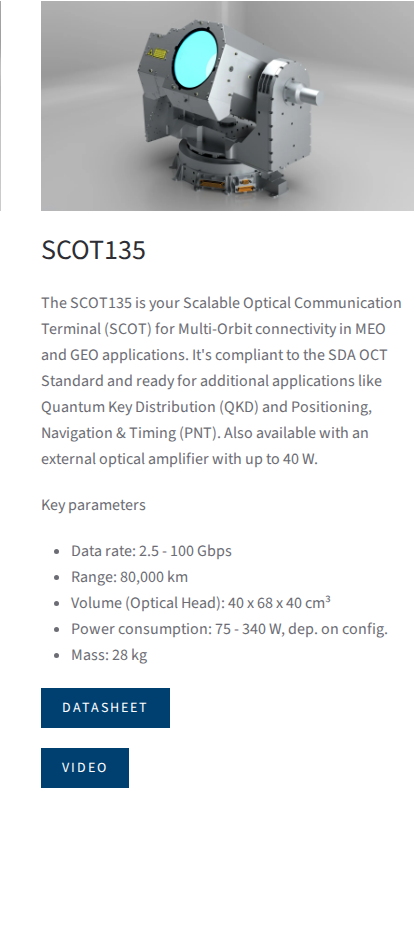
Tesat-Spacecom is the German supplier behind the world's most flight-proven optical communication terminal: the LCT135 (TRL9, serial production) and its next-generation successor the SCOT135 (up to 100 Gbps, SDA OCT Standard compliant). Both terminals target large-platform GEO/MEO missions.
Pros:

TRL9 with 15+ years of flight heritage
SCOT135 delivers 100 Gbps at 45,000 km
SCOT135 is SDA OCT Standard compliant
QKD and PNT ready for dual-use missions
Cons:

Large SWaP: unsuitable for SmallSat platforms
SCOT135 in early production; verify lead times
LCT135 data rate limited to 1.8 Gbps
Tesat-Spacecom is the German supplier with the deepest flight pedigree in space optical communications, and this entry covers its two complementary GEO/MEO terminals — the LCT135 and the SCOT135 — evaluated together because procurement teams targeting large-platform relay missions will weigh both in the same conversation.
LCT135: Specifications and Flight Heritage
The LCT135 holds the most extensive flight record of any optical communication terminal in the world, with deployments spanning GEO relay and LEO Earth observation missions including EDRS-A, the backbone node of the European SpaceDataHighway, as well as TerraSAR-X, Alphasat, and the Sentinel series.
Tesat confirmed the terminal had been produced 16 times as of the time of that report, and it carries TRL9 status — the highest technology readiness level, meaning it is in serial production and commercially available with an established supply chain.
The heritage LCT135 operates at 1064 nm using homodyne binary phase shift keying with coherent detection; the LCT135-INTEROP variant adds 1550 nm capability, enabling cross-vendor interoperability with other terminals operating in the telecom C-band window.
| Axis | LCT135 | SCOT135 |
|---|---|---|
| Data Rate | Up to 1.8 Gbps | 2.5 – 100 Gbps (configurable) |
| Wavelength | 1064 nm (INTEROP: also 1550 nm) | Optical C-band (SDA OCT Standard compliant) |
| Link Range | Up to 80,000 km | Up to 80,000 km |
| SWaP | 60x60x70 cm, 53 kg, 150 W | Optical head: 40x68x40 cm, 28 kg, 75–340 W (config. dependent) |
| Mission Class | GEO relay, LEO Earth observation | MEO/GEO large-platform |
| Maturity / Availability | TRL9, serial production, commercially available | First unit delivered; early production — verify lead times with Tesat |
Side-by-side comparison of LCT135 and SCOT135 across all six evaluation axes, giving procurement readers a single reference to compare both terminals on the dimensions that matter for mission selection.
The table above makes the maturity distinction plain: the LCT135 is a fielded, serialised product, while the SCOT135 is transitioning from development into production — a difference that carries real programme risk implications.
SCOT135: Next-Generation MEO/GEO Performance
The SCOT135 is Tesat's scalable successor, designed for demanding MEO and GEO missions requiring much higher throughput: it supports a configurable data rate range of 2.5 to 100 Gbps, and Tesat and MPB Communications demonstrated 100 Gbps transmission over a distance of more than 45,000 km in a laboratory environment using a 40 W external optical amplifier.
The terminal is compliant with the SDA OCT Standard and also supports optional Quantum Key Distribution (QKD) and Positioning, Navigation and Timing (PNT) functions, making it relevant for government and dual-use missions with requirements beyond raw throughput.
On maturity: Tesat has confirmed delivery of the first unit of the SCOT135, but this is early-stage production. Procurement teams should contact Tesat directly to verify current lead times before committing programme schedules — do not treat first-unit delivery as equivalent to the serial production availability that characterises the LCT135.
Both terminals are engineered for large GEO/MEO platforms where SWaP constraints are secondary to link performance requirements. Neither is compatible with CubeSat or SmallSat form factors, and programme managers on smaller spacecraft should look to the subsequent entries in this list for more appropriate options.
Terminal 2
Mynaric CONDOR Mk3: Industrialised LEO Crosslink Terminal
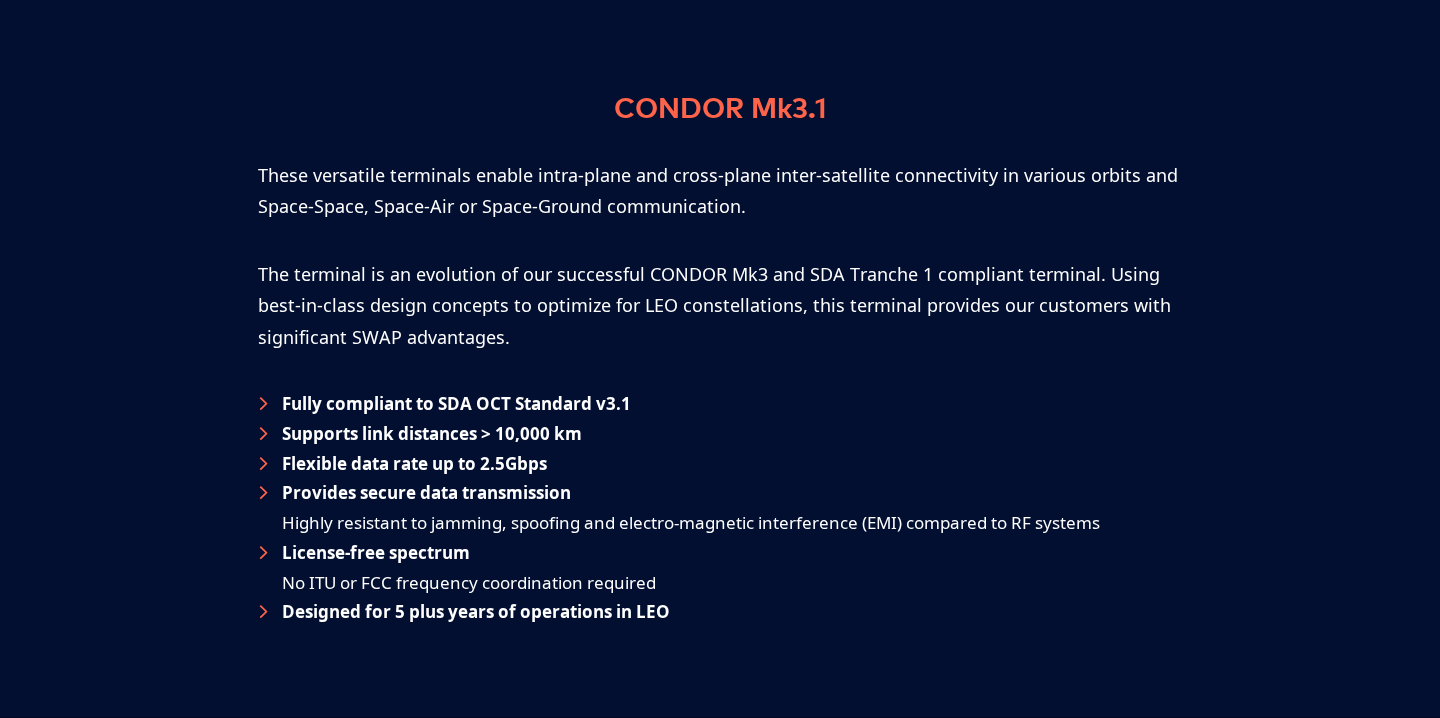
The Mynaric CONDOR Mk3 is a purpose-built LEO optical inter-satellite link terminal designed for mass deployment in government and commercial satellite constellations. Fully compliant with SDA OCT Standard v3.1, it has been selected by Northrop Grumman, Raytheon, and Loft Federal for SDA PWSA Tranche 1 programmes — giving it the broadest Tranche 1 contract footprint of any single OCT supplier. With over 100 units delivered as of mid-2025 and higher-rate OOK and DP-QPSK configurations available, it is the reference terminal for industrialised LEO crosslink supply — though procurement teams should factor in documented 2024 production delays and the March 2025 Rocket Lab acquisition when assessing timelines. Pricing is not publicly listed; contact the vendor directly.
Pros:
SDA OCT Standard v3.1 compliant
Broadest SDA Tranche 1 contract footprint
Demonstrated multi-vendor interoperability on-orbit
Over 100 units delivered as of mid-2025
Cons:
Documented 2024 production delays on record
Corporate structure in transition post-acquisition
Mk3.1 successor signals current-gen maturity ceiling
The Mynaric CONDOR Mk3 is the reference terminal for industrialised LEO optical inter-satellite link supply: it holds the broadest contract footprint of any single OCT supplier across the SDA's Proliferated Warfighter Space Architecture (PWSA) Tranche 1 Transport and Tracking Layer programmes, with prime contractors Northrop Grumman, Raytheon, and Loft Federal all having selected it for their SDA satellite builds.
SDA OCT Standard v3.1 compliance is not a feature of the CONDOR Mk3 — it is its defining characteristic. The terminal was purpose-built for the SWaP-C constraints of LEO constellation platforms, offering a compact two-unit architecture (optical head plus optical communications controller) sized for integration into the small-satellite class spacecraft that make up the PWSA constellation.
| Evaluation Axis | CONDOR Mk3 Value | Notes |
|---|---|---|
| Data Rate | 0.313 to 2.5 Gbps (SDA-compliant); 10 Gbps (OOK) and 100 Gbps (DP-QPSK) options | SDA OCT Standard v3.1 range is the operationally relevant spec for Tranche 1; higher-rate options target future programmes |
| Wavelength | Tx: 1553.33 nm / Rx: 1536.61 nm (optical C-band); tuneable across C-band for 100 Gbps configuration | Aligned with SDA OCT Standard; tunability relevant for DP-QPSK option only |
| Link Range | Greater than 6,500 km (SDA OCT Standard v3.1 compliant) | Covers LEO intra-plane and cross-plane crosslink geometry requirements |
| SWaP | OH: 372 x 282 x 257 mm; OCC: 158 x 170 x 207 mm; 4 W optical Tx power (EOL); 22–38 V DC input | Two-unit architecture sized for LEO constellation smallsat integration |
| Mission Class | LEO inter-satellite link (crosslink); intra-plane and cross-plane OISL; space-to-air and space-to-ground also supported | Primary use case: SDA PWSA Tranche 1 Transport and Tracking Layer constellations |
| Maturity / Availability | Over 100 units delivered (as of June 2025); over 150 optical heads manufactured; CONDOR Mk3.1 in development for Tranche 2 | Volume production underway; see supply chain risk notes below; pricing not publicly disclosed — contact vendor |
Structured comparison of the CONDOR Mk3 against the six evaluation axes declared in the introduction, enabling procurement readers to assess the terminal against their programme requirements at a glance.
The terminal's link range of greater than 6,500 km exceeds the typical intra-plane crosslink distances in a LEO constellation at 1,000–2,000 km altitude, providing geometric headroom for cross-plane links where inter-satellite distances can approach the upper bound of the SDA-compliant range.
Higher-rate configurations — 10 Gbps via OOK modulation and 100 Gbps via DP-QPSK — are available for programme teams evaluating future-generation requirements beyond the current Tranche 1 SDA-compliant operating range.
Interoperability and SDA Compliance Milestones
Mynaric was the first company to demonstrate SDA OISL Standard compliance over-the-air, achieving an industry-first transmission between its CONDOR terminal and an independently built, standards-compliant testbed — a milestone reported by SpaceNews in May 2021 and confirmed in Mynaric's own announcement.
Mynaric's CONDOR Mk3 subsequently demonstrated interoperability with the CACI CrossBeam terminal on Northrop Grumman Tranche 1 satellites, with tests conducted at the U.S. Naval Research Laboratory under SDA oversight. Mynaric's CEO described this as confirmation that the terminal meets SDA standards and is 'fully interoperable with other terminals implementing the same standard.' For SDA-programme procurement teams, this is a documented, independently overseen risk-reduction signal — not a vendor claim.
The CONDOR Mk3 passed optical verification and Phase 1 interoperability testing under the SDA Tranche 1 programme in September 2023, formally confirming compliance with the SDA OCT Standard ahead of volume production.
Production History and Procurement Risk
The production risk context for the CONDOR Mk3 is a matter of public record and directly relevant to any programme manager assessing delivery timelines. In August 2024, Mynaric reduced its 2024 revenue forecast to €16–24 million from a previous guidance of €50–70 million, citing lower-than-expected production yields, component shortages, and higher production costs — as reported by SpaceNews.
SpaceNews also reported that industry sources described Mynaric as having underestimated the complexity of mass-manufacturing a product previously built only in small numbers, a challenge compounded by limited resources — and that the delays caused frustration at SDA, which identified optical terminals as a choke point in its supply chain.
Mynaric's own statements characterise H1 2025 as a rebound period: the company reported triple-digit production yields in the first half of 2025 and, as of June 2025, had delivered over 100 CONDOR Mk3 units and manufactured over 150 optical heads. These figures come from Mynaric's own June 2025 announcement and have not been independently verified.
On 11 March 2025, Rocket Lab announced a non-binding term sheet to acquire a controlling equity stake in Mynaric, with an initial purchase price of approximately $75 million, subject to completion of Mynaric's StaRUG debt restructuring proceedings under German law and applicable regulatory approvals. This acquisition changes the corporate structure of the CONDOR Mk3 supply chain in a way that is material for procurement teams.
Programme managers should verify current production status, delivery lead times, and corporate ownership directly with the vendor at the procurement stage — the situation described here reflects publicly available information as of mid-2025 and may have evolved.
CONDOR Mk3: Best-Fit Use Case
The CONDOR Mk3 is the strongest candidate for LEO constellation programme managers who require SDA OCT Standard v3.1 compliance, a demonstrated multi-vendor interoperability track record, and a supplier with volume production experience across multiple Tranche 1 prime contracts.
Due diligence at procurement stage should include direct verification of current delivery timelines, production capacity under the post-acquisition corporate structure, and the status of the CONDOR Mk3.1 development programme — which Mynaric has indicated is targeting Tranche 2 and commercial applications with higher data rates and reduced SWaP.
Terminal 3
CACI CrossBeam (SA Photonics)
CACI CrossBeam is a flight-demonstrated LEO optical inter-satellite link terminal with the deepest US defence programme integration of any terminal on this list, selected for DARPA Blackjack and SDA Tranche 0 through Tranche 3 programmes, and the incumbent terminal for Lockheed Martin's Tranche 1 Transport Layer satellites.
Pros:
On-orbit demonstrated via Mandrake II (2022)
First terminal to pass SDA v3.0 testing
Incumbent for Lockheed Martin Tranche 1 satellites
Cross-vendor interoperability proven with CONDOR Mk3
Cons:
Primarily government/defence market; limited commercial availability
Production capacity data not publicly disclosed
CACI CrossBeam is a free-space optical inter-satellite link terminal originally developed by SA Photonics, a California-based photonics firm that CACI International acquired in 2021 for $275 million. Under CACI ownership, CrossBeam has become the most deeply embedded optical communication terminal in the US government and defence OISL ecosystem, with verified flight heritage, SDA compliance across all four Tranche generations, and an incumbent position on Lockheed Martin's Tranche 1 Transport Layer satellites.
Mandrake II: On-Orbit Demonstration
The most significant credibility marker for CrossBeam is the Mandrake II programme, a DARPA-sponsored risk-reduction mission that launched two small satellites in June 2021. On 14 April 2022, CrossBeam terminals aboard those satellites successfully established a closed-loop optical link, transmitting more than 200 gigabits of data over a 100+ km link distance during a test lasting over 40 minutes.
DARPA's Blackjack programme manager described the terminals as weighing approximately 10 kg and drawing around 50 W of power — characterising them as substantially smaller and cheaper than any previously demonstrated space optical terminals, and at a price point roughly an order of magnitude lower than prior government-class systems.
"The Mandrake-2 terminals will provide 100 Mbps data rates up to 5,000 km link distance."
Pechner noted at the time that SA Photonics planned to scale data rates to 2.5 Gbps in later versions. That figure aligns with the SDA-standard rate for Tranche 2 and Tranche 3 crosslinks, but programme managers should verify the current production specification directly against the CrossBeam datasheet rather than treating it as a confirmed delivered rate.
SDA Compliance and Interoperability Milestones
In September 2023, CACI announced that CrossBeam had become the first SDA-compliant terminal to establish a consistent data link with the SDA reference modem, completing interoperability testing to the SDA's version 3.0 standard. This milestone cleared CrossBeam to proceed with cross-terminal interoperability testing and is a concrete compliance proof point that carries weight for SDA programme managers evaluating supplier risk.
Cross-vendor interoperability was subsequently demonstrated on Northrop Grumman's Tranche 1 satellites: Mynaric confirmed that its CONDOR Mk3 terminal — selected for Northrop Grumman's constellation — demonstrated interoperability with the CACI terminal selected for Lockheed Martin's Tranche 1 satellites, with testing conducted at the US Naval Research Laboratory. For SDA programme managers, this cross-vendor proof point matters because the PWSA mesh network requires terminals from different suppliers to communicate seamlessly.
CrossBeam Specifications at a Glance
The table below summarises CrossBeam across the six evaluation axes used throughout this listicle. Cells marked "Verify with vendor" reflect axes where no figure was available in open-source material at the time of writing; contact CACI directly for current datasheet values.
| Evaluation Axis | CrossBeam (Published / Sourced) | Notes |
|---|---|---|
| Data rate | 1.25 Gbps (T0/T1); 2.5 Gbps (T2/T3) | Mandrake II demonstrated 100 Mbps at up to 5,000 km. 2.5 Gbps is the T2/T3 standard rate; verify current production spec with CACI. |
| Operational wavelength | Not published in open sources | SDA OCT Standard specifies 1536.61 nm Rx / 1553.33 nm Tx for compliant terminals. Confirm with CACI/SA Photonics at procurement stage. |
| Link range | 6,500 km (T0/T1); 6,750 km (T2/T3) | Mandrake II demonstrated at 100+ km. Production link range figures are from the CACI CrossBeam fact sheet. |
| SWaP | 10 kg mass; 50–75 W typical power; 10.3 in. H x 8.2 in. diameter | SA Photonics cited payloads half the size of comparable RF systems. Absolute figures from CACI CrossBeam datasheet. |
| Mission class / target orbit | LEO inter-satellite links; defence constellations | Primary customers: DARPA, SDA, Lockheed Martin, Northrop Grumman. Not positioned for commercial LEO operators. |
| Maturity and availability | Flight-demonstrated (Mandrake II, April 2022); SDA T0/T1/T2/T3 compliant; 40 terminals delivered to DARPA | Production ramp underway at CACI's Orlando facility. Verify current lead times and production capacity directly with CACI. |
Applies the six declared evaluation axes to CrossBeam in a scannable format, consistent with the framework used across all list entries. Sourced figures are drawn from the CACI CrossBeam fact sheet and trade press; gaps are flagged for procurement-stage verification.
CrossBeam's SWaP profile is notable in context: the CACI datasheet lists beam director mass at 10 kg and power draw at 50–75 W typical, consistent with the figures cited by DARPA's programme manager during the Mandrake II demonstration period. SA Photonics originally characterised CrossBeam payloads as half the size of comparable RF systems, though this is a relative marketing claim rather than a direct RF-to-optical comparison with a named reference system.
Programme Integration and Market Positioning
CrossBeam's defining characteristic is the depth of its US defence programme integration. It was selected for DARPA's Blackjack programme (40 terminals delivered under a $16.3M contract originally awarded to SA Photonics), qualified as one of four SDA Tranche 0 OCT suppliers, and is the incumbent terminal for Lockheed Martin's 42 Tranche 1 Transport Layer satellites. No other terminal on this list holds equivalent breadth of US government programme selection across DARPA and SDA simultaneously.
CACI has been expanding manufacturing capacity at a new facility in Orlando, Florida, with stated plans to reach several hundred terminals per year. Unlike Mynaric, which publishes delivery milestones publicly, CACI does not routinely disclose production counts — procurement teams should engage CACI directly to assess current capacity and lead times.
For programme managers outside the US government and defence market, CrossBeam is not the natural fit. It is not positioned for commercial LEO constellation operators, and its procurement pathway runs through US government contracting channels. Teams evaluating commercial LEO crosslinks should consider the other entries in this list; those with US defence programme requirements will find CrossBeam's SDA compliance history and flight-demonstrated performance among the strongest credentials available.
Terminal 4
Skyloom OCT
Skyloom is an SDA-compliant LEO OISL terminal supplier and one of four named SDA Tranche 0 OCT vendors. In March 2025, the company confirmed delivery of 42 flight-ready OCTs to York Space Systems for the SDA Tranche 1 Transport Layer — a concrete production milestone. Detailed public specifications (SWaP, aperture, link range) are not extensively published; procurement teams should contact Skyloom directly for a datasheet before programme evaluation.
Pros:
Delivered 42 flight-ready Tranche 1 OCTs
Named SDA Tranche 0 OCT supplier
Honeywell partnership for SDA qualification
Viable alternative for SDA LEO diversification
Cons:
Detailed SWaP specs not publicly available
Thinner public specification footprint than peers
Skyloom is one of four named SDA Tranche 0 optical communication terminal suppliers — alongside Mynaric, Tesat, and CACI — and its most significant public milestone to date is the confirmed delivery of 42 flight-ready OCTs to York Space Systems for the SDA Tranche 1 Transport Layer programme, completed in March 2025.
That delivery is not a prototype demonstration or a qualification unit — it is contracted flight hardware delivered under an active US government programme, making it one of the clearest production-readiness signals among the terminals on this list.
Beyond SDA LEO, Skyloom has signalled broader programme ambitions: a contract with Satellogic to integrate its OCT into Earth observation satellites, and the SkyCompass-1 GEO lasercom network infrastructure developed in partnership with Space Compass, which completed its Critical Design Review and was targeting network service availability in 2025.
Skyloom OCT: Six-Axis Evaluation
The table below applies the six evaluation axes used consistently across this listicle. Where verified public data exists, it is cited; where it does not, the cell is flagged explicitly rather than omitted or inferred.
| Axis | Skyloom OCT | Notes |
|---|---|---|
| Data Rate | Up to 10 Gbps cited for OISL applications | Figure comes from the Axiom Space / Kepler partnership announcement — a partnership context, not a datasheet. SDA-standard data rates apply for Tranche 1. Contact vendor for confirmed spec. |
| Wavelength | SDA OCT Standard C-band (implied) | No Skyloom-specific wavelength is publicly confirmed. Tranche 1 compliance implies optical C-band per SDA OCT Standard requirements. Contact vendor to confirm. |
| Link Range | Not publicly specified | No verified link range at rated data rate is available in open sources. Contact Skyloom directly. |
| SWaP | Not publicly specified | Mass, power, and volume figures are not published in verified open sources. Contact Skyloom for datasheet. |
| Mission Class | LEO OISL (SDA Tranche 1 Transport Layer); GEO lasercom (SkyCompass-1, in development); EO satellite integration (Satellogic) | Primary focus is SDA LEO OISL. GEO and EO integrations signal broader mission-class ambition. |
| Maturity / Availability | 42 flight-ready units delivered to York Space Systems (March 2025); additional batch of 42 in progress for York Plane 2 | Strong production-readiness signal for SDA-aligned LEO programmes. Volume track record smaller than Mynaric's 100+ units but delivery under contract is confirmed. |
Presents the six standard evaluation axes in a scannable format consistent with sibling entries, clearly distinguishing verified claims from specification gaps that require direct vendor engagement.
Honeywell announced in December 2021 that it had teamed with Skyloom to qualify laser communications terminals for the SDA, with Honeywell bringing an active space-qualified hardware production line in Cambridge, Ontario, capable of manufacturing approximately 1,000 terminals per year.
For procurement teams, the Honeywell partnership is a meaningful qualification signal: it pairs Skyloom's OCT design with an established aerospace manufacturer's production infrastructure and SDA qualification process experience.
The honest caveat for this entry is that Skyloom's public specification footprint is thinner than the other three terminals on this list — detailed SWaP figures, aperture, and link range at rated data rate are not available in verified open sources. This is a transparency gap, not a disqualifier, but it does mean procurement teams cannot complete a full six-axis comparison without requesting a datasheet directly from Skyloom.
Skyloom OCT Pricing
Skyloom does not publish public pricing for its optical communication terminals. Programme pricing is negotiated directly and will depend on order volume, delivery schedule, and programme requirements. Procurement teams should contact Skyloom directly for a programme quote.
In a market where OCT supply chain constraints have contributed to Tranche 1 launch delays — as noted in GAO reporting and SDA programme updates — Skyloom's confirmed delivery record makes it a credible alternative for programme managers seeking to reduce single-vendor dependency. Its Tranche 0 supplier status and Tranche 1 delivery milestone are the grounding facts; the supplier-diversity value follows from the constrained landscape, not from editorial promotion.
Terminal 5
NASA LLCD / LCRD Heritage Terminals
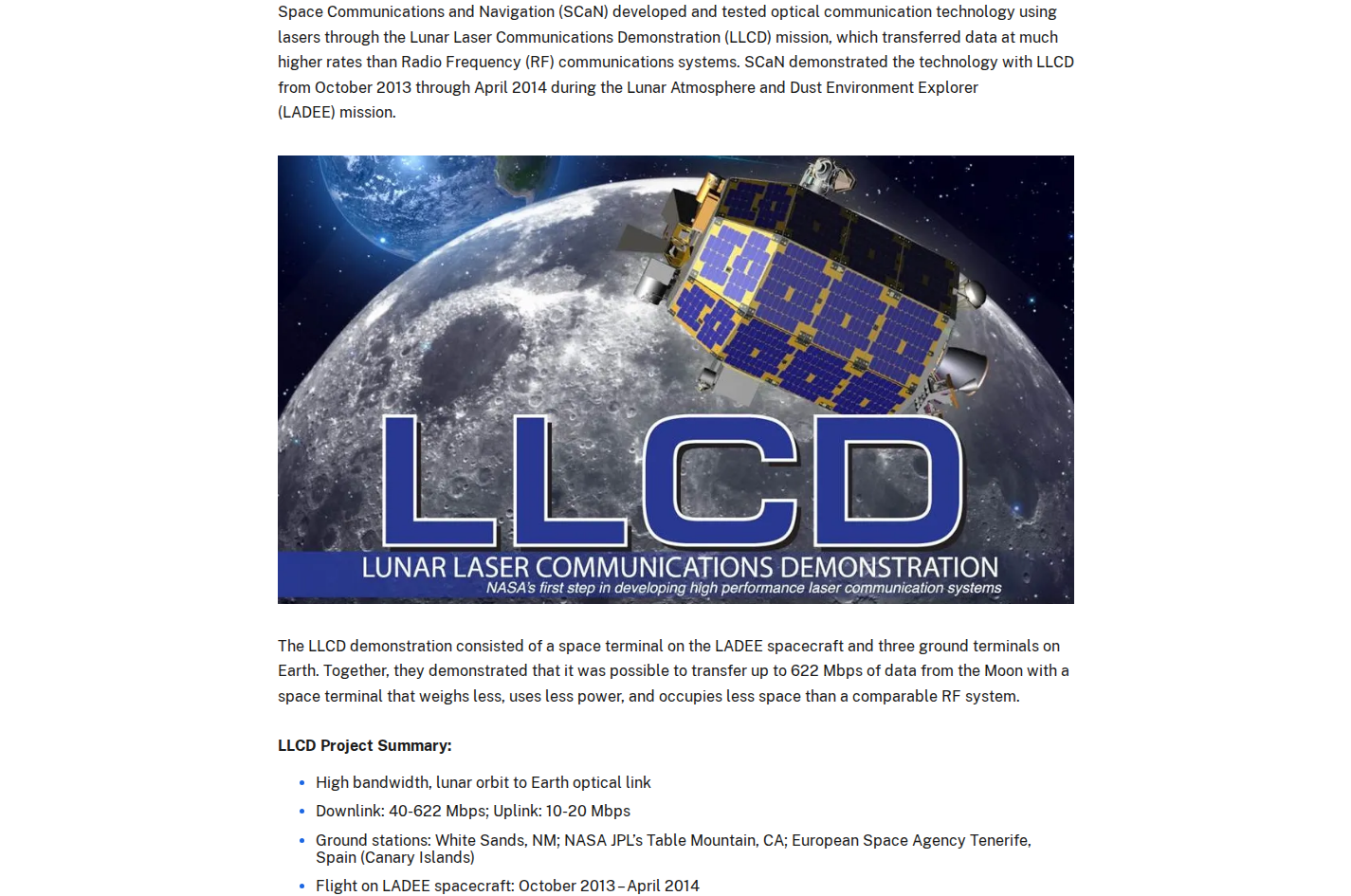
NASA's LLCD (2013-2014) and LCRD (launched December 2021) are government demonstration programmes whose terminals are not available for procurement. They are included here as the only entries on this list where performance figures have been independently verified by a government agency rather than reported by a commercial vendor — making them the definitive reference benchmarks for optical link performance at lunar distances and from GEO relay orbit.
Pros:
Independently verified NASA performance benchmarks
Covers lunar-distance and GEO relay performance
CCSDS USLP protocol validated on-orbit
Cons:
Not available for procurement
Full LCRD terminal mass not publicly disclosed
A procurement list that omits the only independently verified performance benchmarks in the public domain would be less useful than one that includes them honestly — which is exactly why LLCD and LCRD appear here despite being non-procurable government demonstration programmes.
| Axis | LLCD (2013–2014) | LCRD (launched Dec 2021) |
|---|---|---|
| Data Rate | 622 Mbps downlink; 20 Mbps uplink | Up to 1.244 Gbps coded (DPSK); 311 Mbps (16-PPM); 1.2 Gbps demonstrated via ILLUMA-T relay |
| Wavelength | 1550 nm (optical C-band) | 1550 nm (optical C-band) |
| Link Range | ~384,000 km (lunar orbit to Earth) | GEO (~35,786 km) to ground; GEO relay to ISS at LEO |
| SWaP | Space terminal: ~30 kg, ~90 W; 10 cm transmit aperture; 0.5 W laser | Two optical terminals: 10.8 cm aperture each, 0.5 W transmitter each; integrated terminal mass not publicly disclosed |
| Mission Class | Deep-space / lunar demonstration | GEO optical relay demonstration |
| Maturity / Availability | Heritage — NOT available for procurement | Operational demonstration — NOT available for procurement |
Maps the six evaluation axes across LLCD and LCRD side by side, making the framework application explicit and scannable for procurement readers comparing these benchmarks against vendor claims.
The SWaP efficiency result from LLCD is the most directly actionable benchmark for procurement readers: the space terminal — at roughly 30 kg and 90 W — delivered 622 Mbps from lunar orbit while weighing half as much and consuming approximately 25% less power than a comparable RF system at equivalent capability, as documented in NASA mission records.
LCRD extended this work by demonstrating NASA's first two-way, end-to-end optical relay from GEO, with both flight modems supporting DPSK (up to 1.244 Gbps coded) and PPM (311 Mbps) modulation. The ILLUMA-T experiment on the ISS then completed the relay chain, transferring data to LCRD at 1.2 Gbps — the independently verified GEO relay performance figure that programme managers can use as a ceiling reference for vendor claims at comparable link geometries.
Both programmes leveraged high-reliability commercial off-the-shelf (COTS) telecom components in their terminal designs — a philosophy explicitly carried forward in subsequent NASA optical communications work — and LCRD served as an on-orbit platform for testing CCSDS USLP protocol compliance, providing live validation of the standards framework covered in §3 of this page.
"Costs for NASA's Laser Communications Relay Demonstration terminals were on the order of $30 million and the space agency is likely to pay $10 million to $15 million for Orion crew capsule laser terminals. NASA's TeraByte InfraRed Delivery, a cubesat to demonstrate optical links from the ground to low Earth orbit, will employ $100,000 terminals."
That cost arc — from $30M government demonstration terminals down to $100,000 cubesat hardware — is the trajectory within which the four commercial terminals covered in this listicle sit, and it frames the scale of cost reduction the industry has achieved.
For programme managers, the practical application is straightforward: if a vendor claims data rates or link ranges comparable to LLCD or LCRD from a terminal with significantly lower SWaP, the NASA figures provide the reference frame to interrogate that claim — the only benchmarks on this list produced under independent government verification rather than commercial self-reporting.
Conclusion
Matching your mission requirements to the right optical communication terminal
The five terminals here span genuinely distinct mission classes — Tesat's GEO/MEO backbone, Mynaric and Skyloom's SDA-compliant LEO supply, CACI's US defence integration, NASA's independent benchmarks. The right choice is never the most capable terminal in the abstract; it is the one whose mission class, SWaP, data rate, and maturity profile match your programme's actual requirements.
The space terminal is only one part of the link. For the ground-segment side, a software-definable uplink amplifier switchable between SDA and CCSDS standards — such as the Woodrow Scientific EDFA — is worth evaluating alongside it.
Frequently Asked Questions: Optical Communication Terminals
Answers to common questions about free-space optical communication terminals, standards, and procurement considerations for space applications.
The SDA Optical Communications Terminal (OCT) Standard is a specification published by the Space Development Agency that defines the interoperability requirements for optical terminals aboard PWSA satellites. The current version is v3.2.0 (finalised March 2025), with v4.0.0 released concurrently for select Tranche 3 applications. It specifies the parameters — wavelengths, modulation scheme, pointing/acquisition/tracking (PAT) requirements, and link margin — that terminals from different vendors must conform to in order to communicate with one another on the same constellation. For SDA programme procurement, compliance is a hard requirement, not a preference. Non-SDA programmes — commercial operators and allied government constellations using proprietary approaches — are not bound by this standard. SDA compliance is therefore a requirement filter specific to PWSA: if your programme is not part of the SDA architecture, you should evaluate whether the standard is relevant to your interoperability needs before treating it as a baseline.
Look for three concrete signals. First, TRL level: TRL 9 means the terminal is flight-qualified in its operational environment — anything below that indicates ongoing development or qualification work. Second, on-orbit demonstration history: has the terminal flown and operated in the mission class you are targeting, or only in a technology demonstrator? Third, production evidence: units delivered under contract to a prime, not just prototypes or engineering models, indicate a functioning supply chain. A successful demonstration mission and serial production are different things — both matter, but they answer different questions. A terminal that has flown once is not necessarily available at volume with predictable lead times. When evaluating a supplier, ask specifically how many flight units have been delivered and to whom, and what the current production rate is. Those answers will tell you more than TRL alone.
Optical inter-satellite links (OISLs) are among nine critical space components identified with production capacity gaps in a 2026 study by the Aerospace Industries Association (AIA) and PricewaterhouseCoopers (PwC). SDA Director Derek Tournear has publicly cited optical terminals as a supply chain constraint for the Tranche 1 PWSA programme, noting that subcontractors were unable to scale up production as quickly as required. GAO reporting has similarly flagged OCT production and interoperability as risk areas for SDA's constellation schedule. This is a known industry condition, not an acute crisis — but it carries real programme implications. Procurement teams should engage vendors early on production lead times rather than waiting until after contract award. A vendor's demonstrated delivery record — units actually shipped versus units on backlog — is a meaningful differentiator. The supplier base for qualified OCTs remains narrow, with many critical components supported by a small number of domestic sources, so contingency planning in programme timelines is prudent.
A free-space optical (FSO) system transmits data using collimated laser beams through free space — vacuum or atmosphere — rather than through optical fibre or radio-frequency spectrum. In space applications, FSO systems enable satellite-to-satellite and satellite-to-ground links at data rates and security levels that RF cannot match at comparable size, weight, and power (SWaP). The optical spectrum is also unregulated, removing the licensing constraints that apply to RF bands. In the space context, FSO links operate in vacuum, which removes atmospheric turbulence as a dominant impairment. The critical engineering challenge shifts instead to pointing, acquisition, and tracking (PAT): maintaining a sub-microradian laser beam alignment between two moving spacecraft over thousands of kilometres. Terrestrial FSO — building-to-building links through the lower atmosphere — faces the inverse trade-off: PAT is simpler over short ranges, but atmospheric turbulence, fog, and scintillation become the dominant link impairments.
Optical terminals are the hardware endpoints of a free-space optical communications link — the physical devices that establish and maintain a laser link between two nodes. Each terminal integrates several core subsystems: a telescope or aperture to collect and transmit light, a laser transmitter, a receiver and photodetector, a modem for signal modulation and demodulation, and a pointing, acquisition, and tracking (PAT) subsystem that keeps the narrow laser beam aligned between the two endpoints. In the space segment, optical terminals are mounted aboard satellites or spacecraft and used to create inter-satellite links (ISLs) — passing data directly between spacecraft in a mesh network — or satellite-to-ground optical links that relay data to Earth. They are distinct from RF or SATCOM terminals, which use radio frequencies rather than laser light. The term is sometimes shortened to OCT (optical communications terminal) in the context of government space programmes such as the SDA's Proliferated Warfighter Space Architecture.