

Introduction
Four-wave mixing sits at a fascinating crossroads — it is simultaneously a precision tool and an unwanted impairment, a classical signal-processing mechanism and a quantum resource, depending entirely on how and where it arises.
Wherever you are approaching this from, the underlying physics is the same, and that physics repays careful study.
This guide is both rigorous and readable: the mathematics is built up from first principles, and physical intuition is established before the formalism takes over.
The journey moves from FWM's physical origins through its governing equations, phase-matching conditions, and spontaneous regimes, out to applications in amplification, wavelength conversion, quantum photonics, and fibre-optic systems.
TL;DR
Four-wave mixing is one phenomenon with many faces — the same third-order nonlinearity that corrupts a DWDM channel can, under controlled phase-matching conditions, generate entangled photon pairs or amplify a weak signal without added noise. Phase matching is the lever that determines which outcome you get, and understanding it unifies the classical and quantum sides of the field.
This article covers:

FWM's origin in χ³ susceptibility and the Kerr effect
Coupled wave equations and phase-matching conditions
Degenerate vs. nondegenerate, stimulated vs. spontaneous FWM
Parametric amplification, wavelength conversion, phase conjugation
Photon-pair generation, heralded photons, and squeezing
FWM as a WDM/DWDM impairment and mitigation
What is four-wave mixing?
Whenever high-intensity light propagates through an optical medium — a silica fibre, a silicon waveguide, even a simple glass window — the material's response to the electric field becomes subtly nonlinear. One consequence of that nonlinearity is four-wave mixing (FWM): a process in which multiple optical fields interact within the medium to generate new fields at frequencies that were not present in the original input.
More precisely, FWM is a parametric process — the medium mediates the interaction without absorbing net energy, acting as a catalyst rather than a sink. Two or three input fields mix through the medium's nonlinear response to produce one or two new fields, with the output frequencies determined entirely by photon-energy conservation: the total energy of the incoming photons equals the total energy of the outgoing photons.
The term intermodulation captures the frequency-mixing character of the process: new spectral components appear at sums and differences of the input frequencies, in direct analogy to intermodulation distortion in RF and microwave systems, where two tones at frequencies f₁ and f₂ produce spurious products at 2f₁ − f₂, 2f₂ − f₁, and so on. Engineers familiar with that RF picture will find FWM conceptually immediate.
FWM sits within the broader framework of nonlinear polarisation, described by the susceptibility expansion P(t) = ε₀[χ⁽¹⁾E + χ⁽²⁾E² + χ⁽³⁾E³ + …], where each term represents the material's response at increasing orders of field strength. The first term, χ⁽¹⁾, governs ordinary linear refraction and absorption. The second term, χ⁽²⁾, drives second-order effects including second-harmonic generation (SHG), sum-frequency generation (SFG), and difference-frequency generation (DFG). FWM arises from the third term, χ⁽³⁾ — a four-photon interaction in which three photons are annihilated and one new photon is created, or two photons are annihilated and two new photons are created.
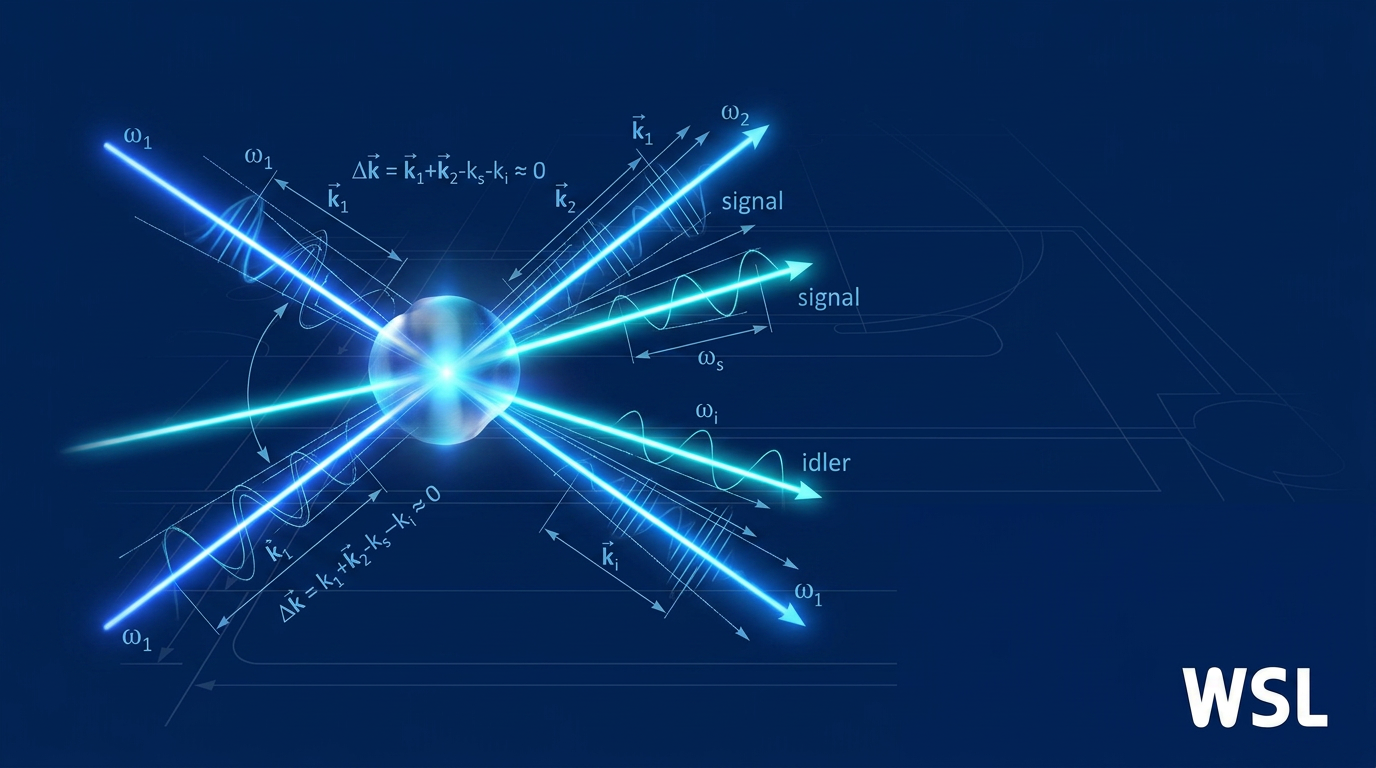
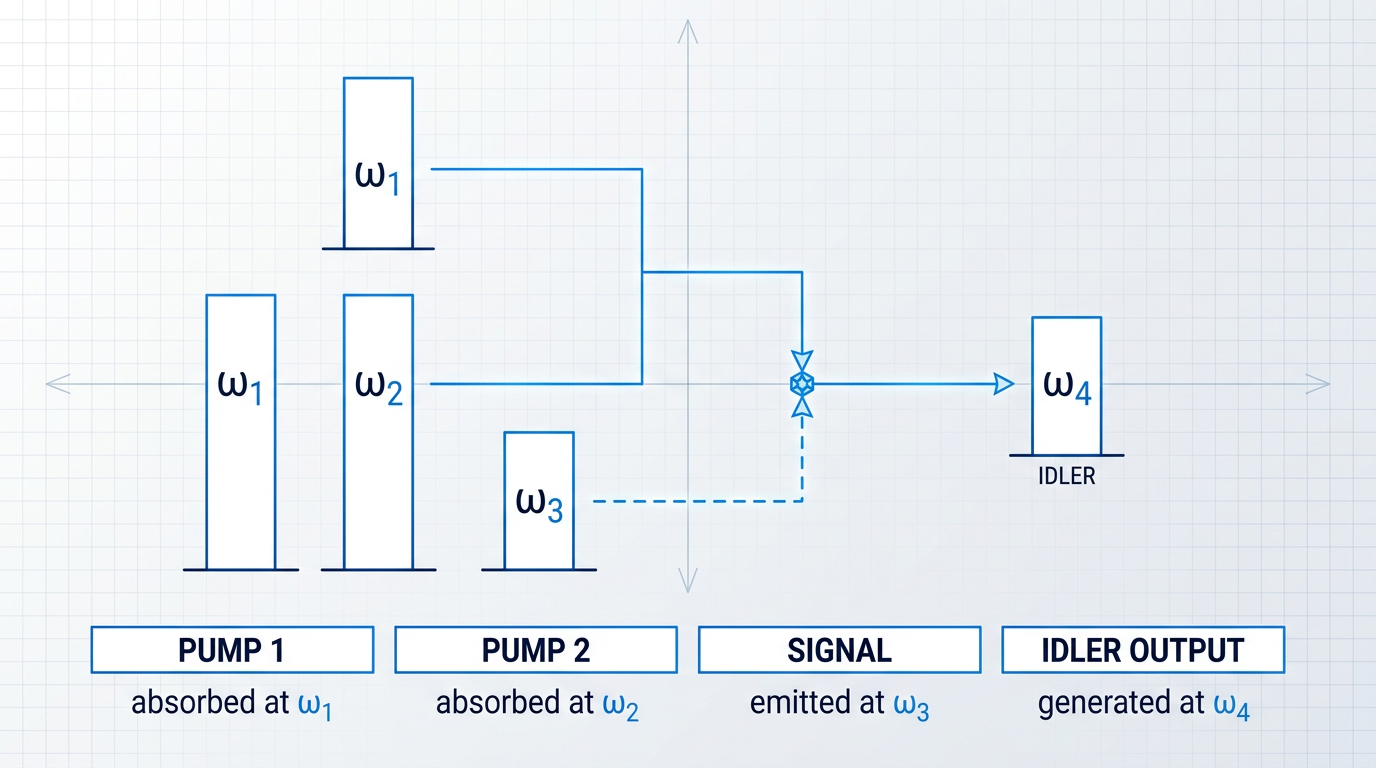
The general frequency-conservation rule for FWM is ω₄ = ±ω₁ ± ω₂ ± ω₃, with the signs chosen to satisfy energy conservation. The most practically significant case is ω₄ = ω₁ + ω₂ − ω₃: two pump photons at ω₁ and ω₂ are absorbed, one photon is emitted at the signal frequency ω₃, and a new photon is generated at the idler frequency ω₄. The name "four-wave" mixing reflects this directly: four optical fields — three inputs and one newly generated output — participate in the interaction.
The reason FWM is encountered so widely — in optical fibres, integrated waveguides, and any isotropic optical medium — comes down to a fundamental symmetry argument. The second-order susceptibility χ⁽²⁾ is non-zero only in non-centrosymmetric materials: crystals that lack inversion symmetry, such as lithium niobate, KTP, or BBO. In centrosymmetric and isotropic materials, the symmetry of the lattice forces χ⁽²⁾ to vanish identically. χ⁽³⁾, however, is permitted by symmetry in every material, including isotropic media such as silica glass.
Because χ⁽³⁾ is non-zero in every optical material — including centrosymmetric and isotropic media such as silica glass — four-wave mixing occurs wherever high-intensity light propagates, regardless of the medium's crystalline symmetry. This universality is what makes FWM both a powerful engineering tool and a persistent source of system impairment.
This symmetry distinction has direct practical consequences. Second-order effects (SHG, SFG, DFG) require carefully chosen non-centrosymmetric crystal platforms. FWM requires no such constraint: it is the dominant frequency-generating mechanism in optical fibres, silicon-on-insulator waveguides, and any other isotropic photonic platform where χ⁽²⁾ is effectively zero.
FWM is also a phase-sensitive process: the efficiency with which the new frequency component grows along the propagation direction depends critically on whether the phases of all four waves remain synchronised. This condition, known as phase matching, is a momentum-conservation requirement — the wavevectors of the interacting fields must satisfy a specific relationship for efficient energy transfer to the new frequency. Phase matching is introduced here as an essential concept; its full analysis is developed in the phase-matching conditions section later in this guide.
FWM is not the only nonlinear effect that arises from χ⁽³⁾ in optical fibres. Several related phenomena share the same physical origin and are encountered in the same systems.
- Self-phase modulation (SPM): An intensity-dependent phase shift accumulated by a pulse on its own field, causing spectral broadening. Governed by χ⁽³⁾ via the Kerr effect.
- Cross-phase modulation (XPM): A phase shift imprinted on one channel by the intensity of a co-propagating channel. Also a χ⁽³⁾ Kerr-effect process.
- Stimulated Raman scattering (SRS): Energy transfer from a pump to a red-shifted Stokes wave via optical phonon interactions. A χ⁽³⁾ inelastic scattering process.
- Stimulated Brillouin scattering (SBS): Coupling between the optical field and acoustic phonons, producing a back-scattered Stokes wave. Dominant at narrow linewidths and high CW powers.
All four effects share the χ⁽³⁾ origin as FWM, and all are relevant to fibre-optic system design — but this guide is specifically concerned with FWM. SPM, XPM, SRS, and SBS appear here only to establish that FWM belongs to a broader family of third-order nonlinear effects; they are not examined further except where they provide useful contrast.
With the definition and vocabulary now in place, the next step is to understand the physical mechanism through which the χ⁽³⁾ term actually drives the generation of new frequency components: the optical Kerr effect and the intensity-dependent refractive index it produces.
The Kerr Effect and Intensity-Dependent Refractive Index
The χ⁽³⁾ susceptibility identified in the previous section as the origin of four-wave mixing does not act in isolation — it produces observable effects through a specific physical mechanism: the optical Kerr effect. Understanding this mechanism is what transforms the abstract notation of χ⁽³⁾ into an intuitive picture of why new frequency components are generated when intense light propagates through a nonlinear medium.
The optical Kerr effect is the phenomenon by which the refractive index experienced by a wave depends on the optical intensity of the light present in the medium, expressed as n(ω, I) = n₀(ω) + n₂I, where n₀ is the ordinary linear refractive index and n₂ is the nonlinear refractive index coefficient.
The coefficient n₂ is proportional to the real part of χ⁽³⁾ — the same third-order susceptibility established earlier as the origin of FWM. This is the first key connection: Re{χ⁽³⁾} is not an abstract bookkeeping quantity; it is the physical parameter that makes the refractive index intensity-dependent.
The microscopic origin of this intensity dependence lies in the χ⁽³⁾E³ term of the nonlinear polarisation. When expanded for a monochromatic field, this term produces a contribution oscillating at the fundamental frequency — not at a new harmonic. That contribution modifies the effective susceptibility the wave sees, and since susceptibility determines refractive index, the result is an index that shifts with intensity.
From self-phase modulation to four-wave mixing
The simplest consequence of the Kerr effect is self-phase modulation (SPM): a wave propagating through a Kerr medium accumulates a nonlinear phase shift that depends on its own intensity, given by φ_NL = (2π/λ)n₂IL, where L is the propagation length.
SPM is the single-wave manifestation of the Kerr effect — the wave reshapes its own phase without involving any other field. It is the entry point to a progression of increasing complexity.
When a second wave co-propagates with the first, each wave's intensity modifies the refractive index seen by the other: this is cross-phase modulation (XPM). The nonlinear index contribution takes the form n_NL = n₂(|A₁|² + b|A₂|²), where the cross-Kerr coupling factor b quantifies the strength of the mutual interaction.
For co-polarised waves in an isotropic medium such as silica glass, b = 2, meaning the cross-coupling is twice as strong as the self-coupling. Physically, this asymmetry arises from the tensor structure of χ⁽³⁾: a wave driven by a cross-field has access to more tensor components than one driving itself.
The transition from XPM to four-wave mixing occurs when the χ⁽³⁾E³ term is expanded for a multifrequency field. Cross-products of the fields at different frequencies appear, and some of these products oscillate at frequencies of the form ω₁ + ω₂ − ω₃ — combinations not present in the input. These are the FWM mixing terms: they drive polarisation oscillations at new frequencies, which then radiate new optical fields. This is the physical origin of four-wave mixing product generation.
The logical chain runs from SPM (one wave, self-coupling) through XPM (two waves, cross-coupling) to FWM (multiple waves, cross-coupling at new frequencies) — each step adds one layer of complexity to the same underlying Kerr interaction. It is also worth noting that these mixing terms are only efficient when a phase condition between the interacting waves is satisfied, a point addressed fully in the phase-matching section that follows.
The quantum photon picture of four-wave mixing
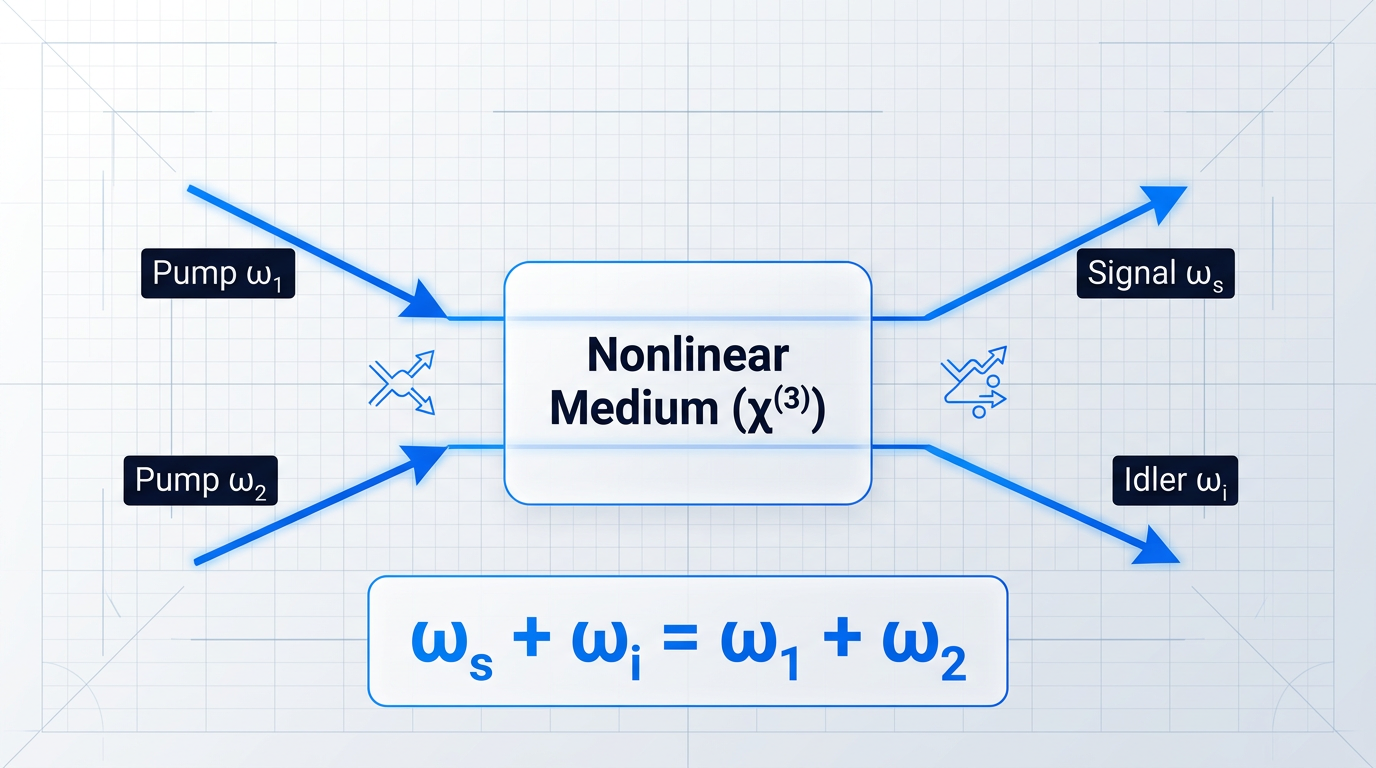
The wave picture above has a complementary quantum description that offers a different but equally valid intuition. In the quantum view, four-wave mixing corresponds to the annihilation of two pump photons (at frequencies ω₁ and ω₂) and the simultaneous creation of a signal photon at ωs and an idler photon at ωi, with energy conservation requiring ωs + ωi = ω₁ + ω₂.
This is a four-photon interaction — two photons in, two photons out — which is precisely why the process is called four-wave mixing. The quantum picture does not replace the wave description; it illuminates the same physics from a different angle, and it will become indispensable when this guide reaches spontaneous FWM and quantum optics applications.
It is at this point that the real and imaginary parts of χ⁽³⁾ become important to distinguish. The real part of χ⁽³⁾ governs refractive-index modification and parametric frequency generation — SPM, XPM, and FWM all arise from Re{χ⁽³⁾}. The imaginary part, by contrast, is responsible for stimulated scattering processes: stimulated Raman scattering (SRS) and stimulated Brillouin scattering (SBS) arise from Im{χ⁽³⁾}, where it mediates gain and absorption.
FWM, SPM, and XPM are all Re{χ⁽³⁾} phenomena — they modify phase and generate new frequencies. SRS and SBS are Im{χ⁽³⁾} phenomena — they mediate gain and loss. Knowing which part of χ⁽³⁾ is engaged tells you immediately whether to expect parametric frequency generation or stimulated scattering.
One further property of the Kerr effect is worth noting for context: in silica optical fibre, the Kerr nonlinearity arises from the electronic response of the glass, which operates on a femtosecond timescale. This makes it orders of magnitude faster than mechanisms such as electrostriction or thermal effects, and faster than the nuclear contribution that underlies Raman scattering.
That ultrafast response is precisely what makes FWM — and Kerr nonlinearities generally — relevant for high-speed photonics and broadband signal processing: the medium responds essentially instantaneously to the optical field. In fibres, the overall strength of the Kerr interaction is captured by the nonlinear coefficient γ = n₂ω/(cA_eff), which combines the material parameter n₂ with the effective mode area A_eff of the waveguide.
With this physical picture in place — the Kerr-induced index change, the progression from SPM through XPM to parametric mixing, the quantum four-photon interaction, and the role of Re{χ⁽³⁾} — the coupled wave equations that govern FWM propagation become interpretable rather than opaque, which is exactly where the next section picks up.
The Coupled Wave Equations Governing Four-Wave Mixing
The Kerr effect described in the previous section — the intensity-dependent refractive index underlying SPM, XPM, and the generation of new frequency components — can now be cast in a precise propagation framework. The coupled wave equations translate that physical intuition into a set of differential equations that track exactly how each field amplitude evolves as it travels through the fibre, exchanging phase and energy with its co-propagating partners.
For four co-propagating fields at frequencies ω₁ through ω₄, the propagation equation for the slowly-varying amplitude A₁ of the first field takes the standard form (following Agrawal's Nonlinear Fiber Optics): dA₁/dz = iγ [ |A₁|²A₁ + 2|A₂|²A₁ + 2|A₃|²A₁ + 2|A₄|²A₁ + 2A₂*A₃A₄ exp(iΔkz) ], with analogous equations governing A₂, A₃, and A₄.
Three structurally distinct contributions appear on the right-hand side, each with a different physical role.
The three Kerr contributions to field evolution
- Self-phase modulation (SPM): The term iγ|A₁|²A₁ shifts the phase of wave 1 in proportion to its own instantaneous intensity — the Kerr effect acting on a single field.
- Cross-phase modulation (XPM): Terms 2iγ|Aₖ|²A₁ (k ≠ 1) shift the phase of wave 1 via the intensities of the other fields. The factor of 2 relative to SPM arises from the degeneracy factor in the third-order polarisation for non-degenerate frequency pairs.
- FWM parametric coupling: The term 2iγA₂*A₃A₄ exp(iΔkz) transfers amplitude between waves — the mechanism responsible for generating new frequency components and exchanging energy among fields.
The SPM and XPM terms are the Kerr physics from the previous section now written in propagation-equation form: they rotate the phase of A₁ but do not change its magnitude, so they cannot by themselves generate new frequencies or move energy between fields.
The FWM parametric coupling term is the qualitatively new element. Where SPM and XPM only shift phase, this term changes the amplitude of A₁ — it is the mechanism by which energy flows between the four fields and by which four-wave mixing generates signal and idler components from pump photons.
Central to the coupling term is the phase mismatch parameter Δk, defined as Δk = β₁ + β₂ − β₃ − β₄, where each βⱼ = n(ωⱼ)ωⱼ/c is the propagation constant of field j at its angular frequency ωⱼ.
Δk is the optical analogue of momentum conservation in a particle collision: it measures whether the four interacting photons satisfy the condition ℏβ₁ + ℏβ₂ = ℏβ₃ + ℏβ₄. Because each βⱼ carries the full frequency dependence of the refractive index, Δk encodes the chromatic dispersion of the medium — a point that becomes central in the phase-matching discussion that follows this section.
The factor exp(iΔkz) in the coupling term oscillates sinusoidally along the propagation direction z whenever Δk ≠ 0, with a spatial period of 2π/|Δk|.
This oscillation has a direct physical consequence: the coupling term alternates sign periodically, so amplitude transferred from the pump into A₁ over one half-cycle is returned over the next. Integrated over a fibre length much greater than 2π/|Δk|, the net amplitude growth is negligible — not because four-wave mixing fails to occur, but because it occurs and then reverses repeatedly.
When Δk ≠ 0, four-wave mixing happens and then un-happens over each spatial period 2π/|Δk|. Efficient, cumulative energy transfer requires Δk ≈ 0, so that each incremental contribution adds constructively rather than cancelling the last.
In many practical scenarios, the signal and idler fields are far weaker than the pump, which motivates the undepleted-pump approximation: when pump power greatly exceeds signal and idler powers, the pump amplitude Aₚ is treated as constant along z, since the energy it surrenders to the other fields is negligible.
This approximation linearises the coupled equations for the signal and idler amplitudes, yielding a pair of linear ODEs whose solutions, in the phase-matched case (Δk = 0), grow exponentially with propagation distance — the hallmark of parametric gain.
The overall scale of every Kerr interaction — SPM, XPM, and FWM alike — is set by the nonlinear coefficient γ = n₂ω/(cAeff), which appears as the prefactor multiplying all terms in the coupled wave equations.
Here, n₂ is the nonlinear refractive index of the material, and Aeff is the effective mode area — the cross-sectional area over which the optical mode is confined in the fibre. A larger n₂ or a smaller Aeff both increase γ, strengthening all Kerr-based interactions at a given power level; this is why tightly confining waveguides in integrated photonic platforms can achieve γ values orders of magnitude higher than standard single-mode fibre.
With the coupled wave equations established and the roles of γ, Δk, and the exp(iΔkz) factor defined, the key question becomes: under what conditions can Δk be made to vanish, and how does the dispersion of the medium determine whether that is achievable? That is the subject of the next section.
Phase-Matching Conditions in Four-Wave Mixing
Whether four-wave mixing builds coherently to produce usable gain or cancels itself into noise comes down to a single condition: the four interacting waves must remain phase-locked as they propagate. Get this right and FWM is a precision tool; get it wrong and the process averages to nothing — or, in communications systems, generates crosstalk that cannot be filtered away.
The requirement is stated formally as the phase-matching condition Δk = β₁ + β₂ − β₃ − β₄ = 0, where the βⱼ are the propagation constants of the four interacting waves at their respective frequencies. This is the optical analogue of momentum conservation: just as a particle interaction must conserve momentum to proceed, the FWM interaction requires the net momentum of the photons involved to balance.
Δk does not arise from a single source — it has two physically distinct contributions that must be understood separately before they can be managed together. The first is the linear phase mismatch ΔkL, which originates entirely from chromatic dispersion in the medium.
Taylor-expanding the propagation constant β(ω) around the pump frequency ωₚ reveals the structure of ΔkL: to leading order it is governed by the group-velocity dispersion coefficient β₂ (the second derivative of β with respect to ω), with higher-order corrections from β₄ and beyond. The physical logic is direct: in a dispersive medium, different frequencies accumulate phase at different rates along the fibre, so the four waves progressively drift out of step unless the dispersion profile is engineered to hold them together.
The second contribution is the pump-induced nonlinear phase shift, which enters through cross-phase modulation. The pump modifies the effective refractive index seen by the signal and idler via the Kerr effect, adding a term +2γP to the total mismatch, where γ is the nonlinear coefficient and P is the pump power. The complete phase-matching condition is therefore Δk = ΔkL + 2γP = 0.
Critically, the nonlinear contribution +2γP is always positive and grows with pump power. This asymmetry between the two contributions is what determines which dispersion regime can support efficient phase matching — and it is the reason the sign of β₂ matters so profoundly in practice.
Dispersion Regimes and Phase-Matching Mechanisms
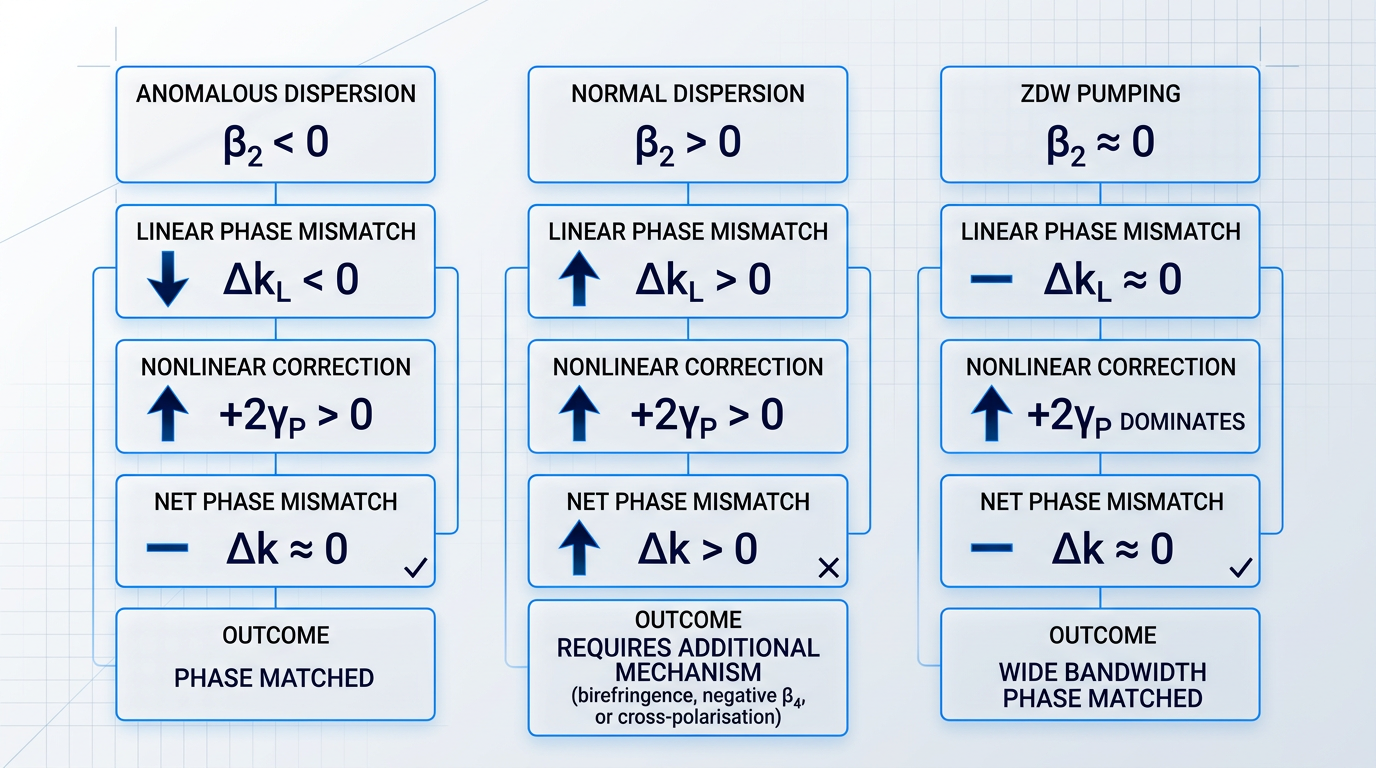
In the anomalous dispersion regime (β₂ < 0), the linear phase mismatch ΔkL is negative. This creates the conditions for a natural balance: the positive nonlinear phase shift +2γP can exactly cancel ΔkL, driving Δk to zero. Pump photons generate signal and idler photons at frequencies symmetrically displaced from the pump, and the dispersion-induced drift and the nonlinear phase shift counteract each other — a balance that is self-consistent and tunable through pump power.
In the normal dispersion regime (β₂ > 0), the linear mismatch ΔkL is positive, and the nonlinear term +2γP reinforces it rather than cancelling it. The simple two-term balance fails entirely. Phase matching in this regime requires additional degrees of freedom: birefringence (exploiting the polarisation of the interacting waves), higher-order dispersion engineering via a negative β₄ term that can reverse the sign of the total linear mismatch at large signal-idler frequency offsets, or cross-polarisation schemes. This is not a dead end — normal-dispersion phase matching underpins important classes of photon-pair sources and broadband parametric amplifiers — but it demands more deliberate design.
| Regime | Sign of β₂ | Sign of ΔkL | Phase-matching mechanism | Typical application context |
|---|---|---|---|---|
| Anomalous dispersion | Negative (β₂ < 0) | Negative | Balanced by positive nonlinear phase shift +2γP | Fibre parametric amplifiers, WDM crosstalk generation near ZDW |
| Normal dispersion | Positive (β₂ > 0) | Positive | Birefringence, negative β₄ at large detuning, or cross-polarisation | Photon-pair sources, broadband OPAs with engineered waveguides |
| ZDW pumping (β₂ ≈ 0) | Near zero | Near zero | Nonlinear phase shift +2γP dominates; wide bandwidth phase-matched | Wideband parametric amplification, highly efficient FWM |
Comparison of the three principal dispersion regimes for FWM phase matching, covering the key parameters that determine feasibility and the engineering approach required in each case.
The table makes the asymmetry concrete: anomalous dispersion is the path of least resistance for phase matching because the signs of ΔkL and +2γP are naturally opposed. Normal dispersion requires an additional mechanism to flip or offset the positive linear mismatch, which is achievable but constrains the design space considerably.
The most favourable operating point of all is when the pump wavelength sits at or near the zero-dispersion wavelength (ZDW) of the fibre or waveguide, where β₂ ≈ 0. With ΔkL ≈ 0, the nonlinear phase shift alone governs the phase-matching condition, and the gain bandwidth is maximised: phase matching is satisfied across a wide range of signal-idler frequency offsets rather than a narrow window. Choosing the pump wavelength relative to the ZDW is consequently one of the most consequential design decisions in any FWM-based system.
Near the ZDW — and whenever the signal-idler frequency detuning is large — the fourth-order dispersion coefficient β₄ becomes the dominant dispersion term rather than β₂. The sign and magnitude of β₄ then determines both the phase-matching bandwidth and whether phase matching is achievable at all. A negative β₄ can enable phase matching in the normal dispersion regime at large frequency offsets, and engineering β₄ through waveguide geometry is the basis of the hyper-dispersion design strategies used in broadband integrated photonic parametric devices.
The engineering implication running through all three regimes is the same: dispersion is not a passive property of the medium to be accepted — it is the primary design variable for controlling FWM. Fibre design, waveguide cross-section, material selection, and pump wavelength choice all feed directly into the dispersion profile, and through it into whether Δk = 0 is achieved.
A practitioner who controls the dispersion profile of their fibre or waveguide controls whether FWM is an asset or a liability. Every design decision that follows — pump wavelength, waveguide geometry, material platform — is ultimately a decision about where Δk lands.
The phase-matching framework established here applies regardless of how many pump frequencies are involved — but the practical consequences differ substantially depending on whether the two pump photons share the same frequency or not. That distinction is the subject of the next section.
Degenerate vs. Nondegenerate Four-Wave Mixing
The choice of how many pump frequencies to use is not a minor experimental detail — it is a fork in the design space that determines which phase-matching strategy applies, how much spectral flexibility is available, and which applications become accessible.
In degenerate FWM (DFWM), both pump photons share the same frequency: ω₁ = ω₂ = ω₀. The process generates a signal and an idler placed symmetrically about the pump at ω₀ + Δω and ω₀ − Δω respectively. Although four photons participate — two pump photons annihilated, one signal and one idler created — only a single pump source is required experimentally, which is why the interaction is sometimes loosely described as a three-wave process in the frequency domain. This is a naming subtlety, not a departure from the χ⁽³⁾ origin: the underlying nonlinearity is unchanged.
In nondegenerate FWM, the two pump photons carry distinct frequencies: ω₁ ≠ ω₂. A signal at ω₃ interacts with both pumps to produce an idler at ω₄ = ω₁ + ω₂ − ω₃, a true four-frequency interaction that demands two independent pump sources and correspondingly greater experimental complexity — but also substantially greater freedom in placing the signal and idler across the spectrum.
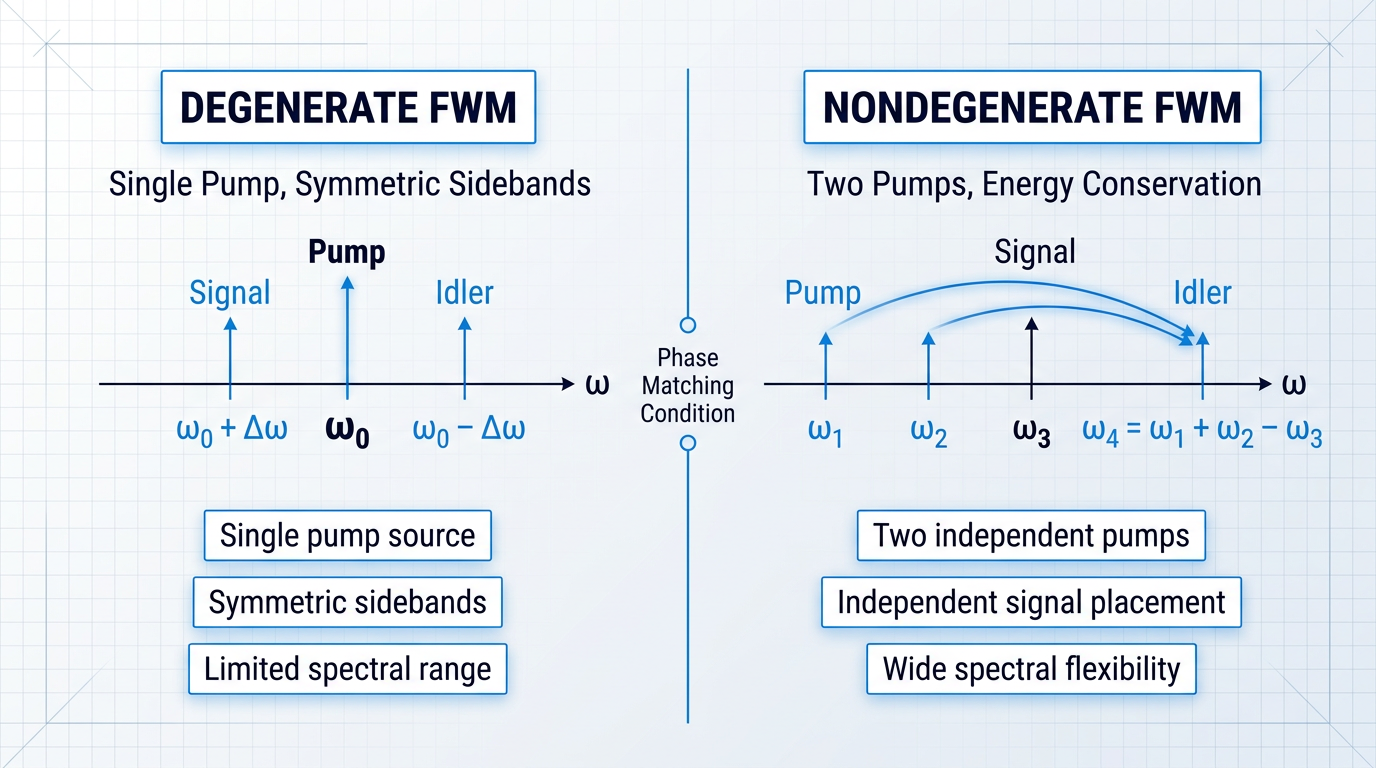
The single-pump simplicity of DFWM carries several direct practical consequences worth enumerating before examining the deeper physics.
- Simpler experimental setup: One pump laser, one phase-matching condition to satisfy — DFWM imposes fewer degrees of freedom than its two-pump counterpart.
- Modulational instability: DFWM in the anomalous dispersion regime is the physical mechanism underlying MI: small perturbations on a CW pump grow exponentially via parametric gain.
- Cavity oscillation and combs: When DFWM gain exceeds round-trip cavity loss, oscillation builds — the basis for microresonator optical parametric oscillators and frequency combs.
- WDM crosstalk: A single channel pair can act as a degenerate pump pair, producing crosstalk products at predictable intermodulation frequencies across a WDM grid.
The trade-off is spectral constraint: because both pump photons sit at ω₀, the signal and idler are locked in symmetric positions about that frequency, and their separation is governed entirely by the dispersion profile rather than by independent pump tuning.
Modulational Instability: DFWM in Disguise
Modulational instability (MI) is not a phenomenon separate from DFWM — it is DFWM viewed from the perspective of the pump wave itself.
In the anomalous dispersion regime (β₂ < 0), the negative linear phase mismatch ΔkL is compensated by the pump's nonlinear phase shift, as established in the phase-matching section: the effective mismatch Δk = ΔkL + 2γP can reach zero, enabling exponential growth of any small perturbation riding on the pump. Those growing perturbations are precisely the signal and idler sidebands of DFWM, appearing at ±Δω from the pump and amplified by parametric gain. The sideband frequencies at which gain is maximised, and the gain coefficient itself, are both derivable directly from the DFWM coupled wave equations.
Modulational instability is not a distinct nonlinear effect — it is degenerate four-wave mixing in the anomalous dispersion regime, where the pump's own nonlinear phase shift satisfies the phase-matching condition and drives exponential sideband growth.
Nondegenerate FWM trades this single-pump elegance for spectral reach: by independently tuning ω₁ and ω₂, the idler frequency ω₄ = ω₁ + ω₂ − ω₃ can be positioned across a far wider spectral range than DFWM's symmetric constraint permits.
- Wide wavelength flexibility: Independent tuning of ω₁ and ω₂ allows the idler to be placed well outside the spectral range accessible to any single-pump configuration.
- Large-span conversion: Nondegenerate FWM is the mechanism of choice for broadband wavelength conversion, where signal and idler may be separated by hundreds of nanometres.
- Birefringent phase matching: Two orthogonally polarised pumps in a highly birefringent fibre can achieve phase matching in the normal dispersion regime via cross-polarisation coupling.
- Quantum photon-pair sources: Normal-dispersion birefringent phase matching suppresses Raman noise, enabling low-noise photon-pair generation even with nondegenerate pumps.
The birefringent phase matching case deserves particular attention. In a highly birefringent fibre pumped by two orthogonally polarised beams at different frequencies, the polarisation-dependent phase velocities introduce an additional contribution to the phase mismatch that can compensate the positive linear mismatch present in the normal dispersion regime. Phase matching is therefore achievable without anomalous dispersion — a critical advantage for quantum photon-pair sources, where operating in the anomalous regime exposes the generated pairs to spectrally broad, thermally noisy Raman scattering.
A counterintuitive consequence of this configuration is that cross-polarisation coupling can produce signal and idler photons at the same frequency — degenerate output — despite the pumps being nondegenerate: an experimentally verified result that underscores how the birefringent term reshapes the entire phase-matching landscape.
Both configurations feed directly into what follows: the degenerate case, with its single pump and symmetric sidebands, is the configuration that underpins spontaneous four-wave mixing and quantum photon-pair generation — the subject of the next section — while the nondegenerate case underpins the broadband wavelength conversion and parametric amplification schemes examined in §9.
Stimulated and Spontaneous Four-Wave Mixing
The coupled wave equations governing four-wave mixing were derived for the case where a pump and an explicit signal are both present in the medium. But consider what happens when the signal is removed entirely — when only the pump is launched into the waveguide. Classical field theory predicts silence. The actual physics does not.
Stimulated FWM: The Seeded Parametric Regime
In stimulated FWM, both a pump and an explicit input signal are injected into the nonlinear medium. The signal is coherently amplified and a phase-conjugated idler is generated at ωi = 2ωp − ωs (in the degenerate-pump case), exactly as the coupled wave equations from §5 predict.
The process is entirely deterministic: the output idler field has a well-defined phase relationship to both pump and signal, and the gain is set by the nonlinear coefficient, the pump power, and the phase-mismatch Δk. This is the classical parametric amplification regime.
Spontaneous FWM: The Vacuum-Seeded Regime
In spontaneous FWM (SFWM), only the pump is present. No classical signal seeds the interaction. Instead, signal and idler photon pairs are generated from vacuum fluctuations — the non-zero field fluctuations of the electromagnetic vacuum state.
This process, also known as parametric fluorescence, cannot be accounted for within a purely classical theory of light. It requires a quantum description of the electromagnetic field, in which the vacuum state carries sufficient energy to seed the parametric interaction even in the complete absence of an injected signal.
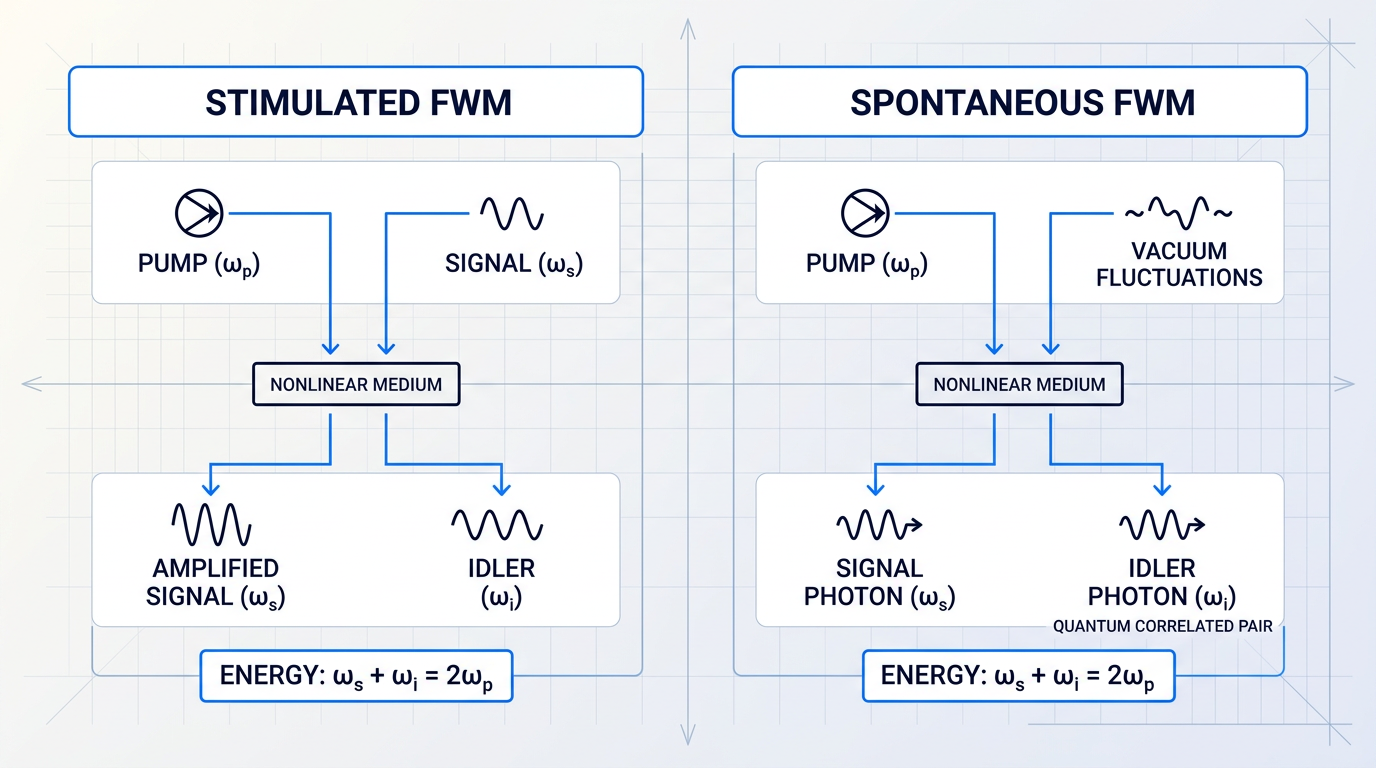
The conceptual boundary between the two regimes is not as sharp as the labels imply. Spontaneous emission is precisely the limiting case of stimulated emission as the seed power approaches zero — the same coupled wave equations govern both, with the quantum vacuum furnishing an effective seed field whose power corresponds to one photon per mode.
Stimulated and spontaneous FWM are not separate phenomena. They are the seeded and unseeded limits of the same parametric process, governed by identical coupled-wave equations. The only difference is what provides the seed: a coherent classical signal, or the quantum vacuum.
This continuum framing has a direct consequence for efficiency. Stimulated FWM is intrinsically far stronger than its spontaneous counterpart because a coherent classical signal carries orders of magnitude more energy per mode than vacuum fluctuations do.
The efficiency gap is not a property of any particular device geometry — it reflects the fundamental difference in seed strength between a classical coherent field and the quantum vacuum, and it holds across waveguide, fibre, and resonator platforms alike.
The conservation conditions governing SFWM are the same ones established in §6, now interpreted at the single-photon level: two pump photons at ωp are annihilated to create a signal photon at ωs and an idler photon at ωi, subject to energy conservation (ωs + ωi = 2ωp) and momentum conservation (Δk = ks + ki − 2kp = 0).
The phase matching condition Δk = 0 is therefore not merely an engineering constraint on classical gain — it equally constrains which photon-pair frequencies the quantum process can produce, linking the quantum output directly to the dispersion engineering framework discussed in §6.
The practical importance of SFWM lies in the nature of the pairs it generates. Signal and idler photons are produced with strong quantum correlations — entangled in energy-time and, depending on the source geometry, in polarisation.
This correlation enables heralding: detecting the idler photon projects the signal photon into a well-defined single-photon state, confirming its presence without measuring it directly. SFWM is therefore the physical basis for heralded single-photon sources and entangled-pair generation — applications that will be examined in detail in §10.
A further design dimension arises from the spectral structure of the generated pairs. The joint spectral amplitude (JSA) of a photon pair encodes the frequency correlations between signal and idler: it describes the probability amplitude for the pair to occupy a given combination of signal and idler frequencies.
Engineering the phase-matching bandwidth relative to the pump bandwidth controls whether the JSA is separable or correlated. A separable JSA yields spectrally factorable pairs suitable for heralded pure-state single photons; a correlated JSA yields pairs with strong energy-time entanglement. This spectral engineering is a central design consideration that §10 addresses in depth.
With the stimulated and spontaneous regimes now defined as a unified continuum, the sections that follow treat each limit in turn. The stimulated regime — deterministic, coherent, and efficient — underpins the classical beneficial applications of FWM covered next, while the spontaneous regime underpins the quantum photonic applications that follow.
FWM Applications: Amplification, Conversion, and Phase Conjugation
Phase matching, treated in earlier sections as a constraint to be satisfied, becomes an engineering lever once deliberately built into the medium — and the same coupled-wave physics that produces crosstalk in an uncontrolled DWDM link produces, under controlled conditions, a family of powerful classical applications.
Optical Parametric Amplification
In optical parametric amplification (OPA) via FWM, a strong pump and a weak signal co-propagate in a phase-matched nonlinear medium; the signal grows and a phase-conjugated idler is simultaneously generated at a frequency determined by energy conservation: ωi = 2ωp − ωs in the degenerate-pump case.
A defining feature of this process is that signal gain scales quadratically with pump power in the undepleted-pump regime — a fundamentally different scaling from the linear gain of an EDFA, and one that makes pump power a particularly sensitive control parameter.
The gain bandwidth of an OPA is set by the phase-matching bandwidth, which is engineered through dispersion control rather than fixed by atomic physics, giving OPA a tunability that rare-earth amplifiers cannot match.
Recent integrated photonic demonstrations illustrate how far dispersion engineering can push that bandwidth: using hyper-dispersion-engineered Si₃N₄ rib waveguides, researchers achieved a continuous-wave OPA gain bandwidth of 330 nm — among the widest reported for any continuous-wave optical amplifier.
On a gallium phosphide-on-silicon dioxide (GaP) platform, parametric gain reaches up to 35 dB within waveguides only a few centimetres long, with fibre-to-fibre net gain exceeding 10 dB across 140 nm (17 THz) — a gain window approximately three times wider than that of a C-band EDFA.
The GaP platform also demonstrates a high dynamic range spanning six orders of magnitude of input signal power, covering typical telecommunication power requirements and pointing to practical viability beyond the laboratory.
In DWDM systems operating across the 1530–1625 nm C/L-band window, EDFAs and FWM-based OPAs address complementary amplification needs.
EDFAs deliver fixed-band gain reliably at scale; OPAs offer tuneable, broader-band amplification where dispersion can be engineered to match the application.
Where demanding parametric amplification research requires pump infrastructure engineered to the application rather than sourced off the shelf, Woodrow Scientific Limited's Custom EDFA — designed, built, qualified and supported in-house in Southampton on patented technology, and configurable across the full C/L-band to leading commercially available power levels — is a relevant reference point for researchers working at the boundary of what erbium fibre can deliver.
Wavelength Conversion
In the nondegenerate FWM case, the idler emerges at a precisely determined new wavelength given by ωi = ω₁ + ω₂ − ωs, enabling wavelength conversion that is intrinsically transparent to the signal's modulation format.
Because the conversion process preserves the phase of the signal field, the idler carries the same encoded information regardless of whether the signal uses OOK, QPSK, 16-QAM, or any other format — a capability confirmed experimentally with 16-QAM signals, where the converted idler copies the data of the original signal exactly.
This modulation-format transparency is the key advantage over conversion mechanisms that operate on intensity alone and lose phase-encoded information in the process.
Integrated waveguide platforms have demonstrated spectral translation bridging the telecom C-band and the 2 µm band, with silicon nanowaveguides showing conversion bandwidths of 820 nm — illustrating the reach of FWM-based wavelength conversion across widely separated bands.
The practical consequence is a path to all-optical networking: signals can be routed across different wavelength bands without optical-to-electrical-to-optical conversion, preserving signal integrity and enabling transparent optical networks that are agnostic to modulation format.
Optical Phase Conjugation
Of the three applications, optical phase conjugation (OPC) is perhaps the most conceptually elegant: it exploits a property that is a direct mathematical consequence of the FWM process itself.
The FWM idler is the complex conjugate of the signal field, which means any dispersion-induced phase distortions accumulated by the signal are mirrored with opposite sign in the idler — a precise inversion, not an approximation.
This property underpins mid-span spectral inversion (MSSI): an OPC module placed at the midpoint of a transmission link generates a phase-conjugated copy of the signal, and the second half of the link then undoes the phase distortions accumulated in the first half.
MSSI is a purely all-optical approach to dispersion compensation that requires neither dispersion-compensating fibre nor electronic DSP, and it generalises naturally to nonlinearity compensation.
When the optical power profile of the link is symmetric around the OPC midpoint, the Kerr nonlinearity-induced distortions experienced in the second half of the link mirror those of the first half and can be cancelled — a condition that phase-conjugated twin-wave schemes have demonstrated reduces nonlinear distortion by more than 8.5 dB.
Because the FWM idler is the complex conjugate of the signal by construction, OPC compensates both chromatic dispersion and Kerr nonlinearity simultaneously — without modifying the transmission fibre or adding electronic processing.
The dispersion-symmetry condition required for full nonlinearity cancellation can be satisfied by pre- and post-dispersion compensation at the transmitter and receiver, without modifying the transmission link itself — making OPC a practical overlay on existing infrastructure.
All three applications — OPA, wavelength conversion, and OPC — operate in the stimulated FWM regime, seeded by an explicit input signal. When that seed is removed entirely and FWM is driven instead by vacuum fluctuations, a distinct set of applications emerges in quantum photonics, which the next section addresses.
Quantum Optics: Photon-Pair Generation, Heralded Photons, Squeezing
The photon pairs produced by spontaneous four-wave mixing are not merely a curiosity of vacuum-seeded generation — they are a practical quantum optical resource, and the engineering challenge is to extract that resource with sufficient purity, brightness, and platform compatibility to be useful.
Correlated Photon-Pair Generation and Heralded Single Photons
In SFWM, two pump photons are annihilated to create a signal-idler pair that is quantum-correlated in frequency and time, with the pair's joint state determined by the energy and momentum conservation conditions established in the preceding section.
The pair generation rate scales as (γPL)² — quadratically with both pump power and interaction length — which has a direct practical consequence: doubling the waveguide length or increasing pump power quadruples the source brightness, within the limits set by phase matching and nonlinear loss.
The heralding mechanism exploits this correlated generation directly: detecting the idler photon projects the signal into a well-defined single-photon Fock state, conditioned on the detection event.
Two figures of merit govern the quality of a heralded single-photon source (HSPS): heralding efficiency, the probability that detecting an idler actually yields a usable signal photon in the output mode; and single-photon purity, quantified by the heralded second-order autocorrelation function g⁽²⁾(0).
Values of heralded g⁽²⁾(0) approaching zero indicate high single-photon purity — the heralded state is predominantly a single-photon Fock state with negligible multi-photon contamination.
State-of-the-art integrated SFWM sources have reached heralded g⁽²⁾(0) values as low as 0.00094 ± 0.00002 in a silicon spiral waveguide operating at GHz repetition rates, with a coincidence rate exceeding 1.5 MHz at a coincidence-to-accidental ratio (CAR) of 16.77.
Spectral Factorability and Joint Spectral Amplitude Engineering
Achieving a low g⁽²⁾(0) is necessary but not sufficient for a high-quality heralded photon source — the heralded photon must also be in a spectrally pure quantum state, which requires that the joint spectral amplitude (JSA) be factorable.
Mathematically, factorability means the JSA can be written as F(ωs, ωi) = S(ωs) · I(ωi) — a product of independent signal and idler spectral functions with no cross-frequency correlations.
When the JSA is not factorable, the signal and idler photons are spectrally entangled: detecting the idler at a specific frequency projects the signal into a mixed state rather than a pure one, degrading the purity of the heralded photon regardless of how well the detector performs.
Achieving factorability requires that the phase-matching bandwidth and the pump spectral bandwidth be matched — a condition controlled through dispersion engineering of the waveguide geometry.
The same dispersion lever that controls classical FWM efficiency — waveguide geometry and zero-dispersion wavelength positioning — also determines whether the joint spectral amplitude is factorable and the heralded photon is in a pure quantum state. Spectral purity and source brightness are therefore engineered through the same physical handle.
This framing is important: spectral factorability is not a separate design problem from phase matching, it is its quantum-optical extension, and the dispersion engineering methods developed for classical FWM sources carry over directly.
Integrated Photonic Platforms for SFWM Pair Generation
Chip-scale SFWM sources are now demonstrated across several integrated photonic platforms, each presenting a distinct set of trade-offs across four axes: nonlinear coefficient γ, two-photon absorption (TPA), Raman noise, and fabrication maturity.
- Silicon-on-insulator (SOI): High γ from tight mode confinement; CMOS-compatible. Key limitation: TPA at telecom wavelengths generates free carriers that degrade CAR and g⁽²⁾(0) even at single-pair generation rates.
- Silicon nitride (Si₃N₄): Larger bandgap eliminates TPA and free-carrier noise; lower Raman background than silicon. Lower γ than SOI, but high-Q resonators compensate through resonant enhancement.
- Silicon carbide (SiC): Wide bandgap (above 2.3 eV) avoids TPA; relatively high nonlinear coefficient; low Raman noise. CAR exceeding 600 demonstrated at 0.17 mW pump power in 4H-SiC microring resonators.
- AlGaAs nanowaveguides: Very high γ; direct bandgap above telecom photon energy avoids TPA at 1550 nm; narrow Raman linewidth. Less fabrication maturity than silicon-family platforms.
These platforms are not ranked by overall merit — the right choice depends on which axis is the binding constraint for a given application: a source requiring maximum brightness may favour AlGaAs or SOI, while one requiring low noise at milliwatt-level pump powers will favour SiC or Si₃N₄.
Two-Photon Absorption: The Intrinsic Silicon Limitation
TPA in silicon deserves dedicated treatment because it is not merely a practical inconvenience — it is an intrinsic material constraint that imposes a ceiling on silicon-based SFWM sources regardless of device geometry.
Silicon's bandgap (~1.1 eV) is less than twice the energy of a telecom photon (~0.8 eV), meaning that two-photon absorption is energetically allowed: two 1550 nm photons together carry sufficient energy to excite a valence-band electron across the gap.
The resulting free carriers introduce additional optical loss and noise through free-carrier absorption (FCA), degrading both the coincidence-to-accidental ratio and the heralded g⁽²⁾(0) even at the very low pump powers used in single-photon-pair generation regimes.
Materials with bandgaps substantially larger than twice the telecom photon energy — including Si₃N₄, SiC (bandgap above 2.3 eV), and AlGaAs (with appropriate alloy composition placing the bandgap above the two-photon energy at 1550 nm) — avoid this process by design, which is the primary motivation driving the shift toward wide-bandgap integrated platforms in quantum photonics research.
The SiC result illustrates what wide-bandgap platforms can achieve: a CAR of 620 at an on-chip pump power of just 0.17 mW in a 4H-SiC microring resonator, with heralded g⁽²⁾(0) values between 0.2 × 10⁻³ and 2.5 × 10⁻³ — performance that would be inaccessible in crystalline silicon at comparable pump powers due to free-carrier-induced noise.
Quadrature Squeezing via Four-Wave Mixing
Photon-pair generation is not the only quantum optical resource that FWM can produce — both degenerate and nondegenerate FWM can generate squeezed states of light, in which the variance of one quadrature (amplitude or phase) is reduced below the standard quantum limit (shot noise), at the expense of increased variance in the conjugate quadrature.
The physical mechanism is the parametric gain process itself: FWM amplifies one quadrature and de-amplifies the other, producing squeezing in the de-amplified quadrature.
FWM-based squeezing was first demonstrated in atomic vapour systems — notably rubidium — where nondegenerate four-wave mixing in a double-Λ configuration produces correlated twin beams with intensity-difference noise suppressed below the shot-noise level, with measurements showing approximately 5.5 dB of intensity-difference squeezing in free space.
On-chip demonstrations have followed: a dual-pumped FWM process in a silicon nitride microresonator has produced quadrature-phase squeezed states with 3.1 dB (± 0.5 dB) of on-chip squeezing, and more recent work in a photonic crystal microresonator using the same Si₃N₄ platform has achieved an estimated 7.8 dB of on-chip squeezing through suppression of parasitic nonlinear processes.
Squeezed states are a distinct quantum optical resource from photon pairs — they are the primary resource for continuous-variable quantum information processing, quantum sensing, and quantum metrology — but they arise from the same underlying FWM parametric gain process, just operated in a regime where the output is a coherent superposition of quadrature-squeezed field modes rather than discrete photon pairs.
Integrated Photonics as the Convergence Direction
The trajectory across all of the above — photon-pair sources, heralded single photons, and squeezing — points consistently toward chip-scale integrated platforms as the direction in which quantum photonics is converging.
The arguments are structural rather than incremental: tighter mode confinement on chip increases the effective γ; dispersion engineering is more precise and reproducible in lithographically defined waveguides than in drawn fibre; CMOS-compatible fabrication enables scaling to large device counts; and co-integration of SFWM sources with on-chip filters, routing elements, and eventually detectors removes the coupling and alignment losses that limit fibre-based systems.
This is not a future projection — the benchmarks discussed above (sub-10⁻³ g⁽²⁾(0), CAR exceeding 600 at sub-milliwatt pump powers, MHz-rate coincidence counting) have all been achieved in chip-scale devices operating at room temperature, demonstrating that integrated SFWM sources are already competitive with bulk and fibre-based alternatives on the metrics that matter for quantum applications.
The same FWM process that enables these quantum photonic applications also manifests in a very different operational context — as an unwanted source of crosstalk and signal degradation in classical wavelength-division multiplexed fibre systems, which is where the guide turns next.
FWM in Fibre-Optic Communications: Impairments and Mitigation
The same four-wave mixing physics that enables parametric amplification and photon-pair generation becomes a significant liability the moment multiple channels share a single fibre — and in WDM and DWDM systems, every channel is a potential pump for every other.
FWM Crosstalk in WDM and DWDM Systems
When N channels at equally spaced frequencies f₁, f₂, f₃, ... co-propagate in a fibre, FWM generates new spectral components at frequencies fijk = fi + fj − fk for every distinct triplet (i, j, k) — and with equal channel spacing, these intermodulation products land precisely on other signal channels.
This is not random noise: it is FWM crosstalk with a fully deterministic frequency structure, which makes it particularly damaging because the interference is coherent and accumulates constructively over the length of the link.
The conditions that maximise FWM efficiency in a WDM context are low chromatic dispersion (operating near the zero-dispersion wavelength, ZDW), high per-channel launch power, equal channel spacing, and long effective interaction length — exactly the conditions under which Δk ≈ 0 and phase matching is satisfied, as established in the phase-matching section.
FWM product power scales as P³, where P is the per-channel launch power, and also as L²eff — so a 1 dB increase in launch power raises FWM crosstalk power by approximately 3 dB, and longer spans or lower-loss fibres accumulate substantially more FWM product power.
Because FWM product power scales with the cube of per-channel launch power, a 1 dB increase in launch power produces roughly a 3 dB increase in FWM crosstalk — making launch power the most leveraged single variable in system design.
In a multi-span DWDM link, erbium-doped fibre amplifiers (EDFAs) operating across the C- and L-bands (1530–1625 nm) periodically restore per-channel power between spans — but in doing so, they reset the power conditions under which FWM accumulates, allowing crosstalk products to build span by span across the full link.
The gain bandwidth and output power of the EDFA infrastructure therefore directly set the spectral density and power regime in which FWM crosstalk operates; for system designers specifying that infrastructure, Woodrow Scientific's Custom EDFA is engineered end-to-end to the application — configurable across operating band, output power, pulse regime, cooling, and firmware, and manufactured in-house in the UK on patented technology rather than assembled from catalogue components.
Mitigation Strategies for FWM in DWDM Links
Four principal strategies suppress FWM crosstalk in deployed systems, each targeting a different term in the phase-matching or power-scaling relationship.
- Non-zero dispersion-shifted fibre: NZ-DSF maintains non-zero dispersion across the C-band, keeping Δk ≠ 0 and preventing coherent FWM build-up — the standard fibre choice for modern DWDM infrastructure.
- Dispersion-compensating fibre and FBGs: DCF and fibre Bragg gratings manage accumulated dispersion in standard single-mode fibre links, restoring phase mismatch and suppressing FWM along the span.
- Unequal channel spacing: Non-equally spaced channel frequencies shift FWM intermodulation products away from signal channels, eliminating coherent crosstalk at the cost of reduced spectral efficiency.
- Power control and polarisation interleaving: Reducing launch power cuts FWM product power cubically; alternating adjacent-channel polarisation states reduces FWM efficiency for orthogonally polarised pairs, with substantial suppression reported.
NZ-DSF is the infrastructure-level solution — it removes the phase-matching condition at the fibre level and requires no operational trade-off once deployed; dispersion-compensating fibre and fibre Bragg gratings serve the same function in legacy SSMF plant.
Unequal channel spacing is an elegant system-design solution that requires no additional hardware but sacrifices some spectral efficiency, while polarisation interleaving offers substantial suppression with no spectral efficiency penalty — though power control remains the most direct lever, at the cost of reduced signal-to-noise ratio (SNR) margin.
Experimental Characterisation of FWM
Predicting FWM product power in a real system requires accurate knowledge of two fibre parameters: the nonlinear coefficient γ = n₂ω/(cAeff) and the chromatic dispersion coefficients β₂ (and higher-order terms such as β₄).
γ is typically measured via SPM spectral broadening — where the self-phase-modulation-induced spectral width of a short pulse yields γ directly — or via dual-frequency beat techniques; accurate γ is essential for predicting FWM product power levels in system planning.
Chromatic dispersion (β₂ and β₄) is characterised using modulation phase-shift or interferometric techniques, and knowing β₂ accurately is precisely what allows an engineer to predict where Δk ≈ 0 — and therefore where FWM will be most efficient across the operating band.
Isolating FWM products experimentally presents a practical challenge: in an equally spaced WDM system, the intermodulation products at fijk = fi + fj − fk overlap with signal channels, making direct power measurement impossible without removing one channel or switching to an unequal channel grid.
The spectral signature of FWM is nevertheless distinctive: SRS produces a broad Stokes spectrum, SBS produces a narrow backward-propagating peak, and SPM produces spectral broadening of the original channel without generating any new discrete sidebands — FWM is the only mechanism that creates discrete new frequency components at predictable intermodulation frequencies, and this is its experimental fingerprint.
With the impairment landscape and its mitigations now understood, the full picture of four-wave mixing — from quantum photon-pair sources to DWDM crosstalk — resolves into a single coherent phenomenon governed by the same phase-matching physics, a unification the conclusion draws together.
Conclusion
Four-wave mixing: one phenomenon, many manifestations
From DWDM crosstalk to parametric amplification to entangled photon pairs, every manifestation explored in this guide is the same χ³ interaction — what changes is only the phase-matching condition, which acts as the lever that determines whether FWM works for you or against you.
That is why the coupled wave equations and phase-matching conditions are not merely theoretical scaffolding: dispersion engineering, power management, and platform selection are all, at root, ways of setting that lever deliberately.
For those working on integrated photon-pair sources, the spontaneous FWM platform literature is advancing quickly and is the natural next destination.
Frequently asked questions about four-wave mixing
Direct answers to the most commonly asked questions about four-wave mixing, covering its definition, behaviour in optical fibres, the spontaneous regime, phase-matching conditions, the degenerate versus nondegenerate distinction, and its role as a crosstalk impairment in DWDM systems.
Four-wave mixing (FWM) is a third-order (χ³) nonlinear optical process in which two or three input waves interact inside a medium to generate one or two new waves. The new frequencies are set by energy conservation: ω₄ = ω₁ + ω₂ − ω₃. The process is parametric (photon energy is conserved across all four waves) and phase-sensitive (efficiency is governed by momentum conservation, or phase matching). FWM arises from the χ³ term in the nonlinear polarisation expansion P(t) = ε₀[χ⁽¹⁾E + χ⁽²⁾E² + χ⁽³⁾E³ + …]. Crucially, χ³ is non-zero in all optical media — including isotropic materials and silica optical fibres — unlike χ², which requires a non-centrosymmetric crystal structure. For readers from an RF or microwave background, FWM is the optical analogue of intermodulation distortion: multiple input tones mixing to produce spurious output frequencies through a nonlinear transfer function.
Four-wave mixing in optical fibres arises from the ultrafast Kerr nonlinearity of silica glass (χ³). It is most efficient when the pump wavelength is near the fibre's zero-dispersion wavelength (ZDW), where phase matching is easiest to achieve. In fibres, FWM underpins optical parametric amplifiers (OPAs), wavelength converters, and spontaneous FWM photon-pair sources — and is a significant crosstalk impairment in DWDM systems. The strength of FWM in a given fibre is characterised by the nonlinear coefficient γ = n₂ω/(cA_eff), where n₂ is the nonlinear refractive index and A_eff is the effective mode area. Highly nonlinear fibres (HNLFs) with small A_eff and elevated n₂ maximise γ for applications such as OPAs and wavelength conversion. On the harmful side, FWM-induced crosstalk in DWDM systems is most severe near the ZDW, which is why non-zero dispersion-shifted fibre (NZ-DSF) was developed: by shifting the operating wavelength away from the ZDW, phase matching is broken across the C-band and FWM crosstalk is substantially suppressed.
Spontaneous four-wave mixing (SFWM) is the quantum-noise-seeded regime of FWM in which only the pump is launched into the nonlinear medium. Signal and idler photons are generated from vacuum fluctuations rather than from an injected seed, producing quantum-correlated photon pairs. This makes SFWM the basis for heralded single-photon sources, entangled-pair generation, and quantum sensing. The distinction from stimulated FWM — where an explicit seed drives classical parametric amplification — is best understood as a continuum governed by seeding conditions, not a hard binary. The generated photon pairs satisfy energy conservation (ωs + ωi = 2ωp), so detecting one photon of the pair immediately heralds the presence of the other. SFWM is the dominant photon-pair generation mechanism in integrated photonic platforms such as silicon microring resonators and silicon nitride waveguides. These centrosymmetric materials have no χ² response, so parametric down-conversion is unavailable; χ³-based SFWM fills that role and is compatible with standard CMOS fabrication processes.
Phase matching governs whether FWM builds coherently or is suppressed. When the phase mismatch Δk ≠ 0, the FWM coupling term oscillates along the propagation direction and averages to near zero — energy transfer between the waves is negligible. Efficient FWM requires Δk ≈ 0, achieved through dispersion engineering: anomalous dispersion, pumping near the zero-dispersion wavelength, or birefringent phase matching. Physically, Δk = β₁ + β₂ − β₃ − β₄ represents the momentum mismatch between the four interacting waves, where each β is the propagation constant at the corresponding frequency. The full phase-matching condition also includes a nonlinear correction from the pump's cross-phase modulation: the total mismatch is Δk_total = Δk_L + 2γP, where 2γP is the XPM-induced phase shift from pump power P. This means pump power itself contributes to phase matching — a useful lever in fibre OPA design. Ultimately, phase matching is the central engineering control: a practitioner who commands dispersion decides whether FWM is a precision tool or a noise source.
Degenerate FWM uses a single pump frequency (ω₁ = ω₂), so both pump photons share the same energy, producing signal and idler sidebands placed symmetrically around the pump. Nondegenerate FWM uses two distinct pump frequencies (ω₁ ≠ ω₂), providing greater flexibility in positioning signal and idler wavelengths across a broader spectral range. Degenerate FWM underlies modulational instability (MI), microresonator optical parametric oscillators (OPOs), and most integrated photon-pair sources, where a single pump is experimentally simpler to implement. Nondegenerate FWM is preferred for broadband wavelength conversion spanning large spectral gaps, and for birefringent phase-matching schemes using two cross-polarised pumps — an approach that can achieve phase matching even in the normal dispersion regime, where single-pump degenerate FWM would otherwise fail. In DWDM systems, the crosstalk mechanism is primarily a degenerate or near-degenerate FWM process: pairs of signal channels act as pump sources, generating interference products that fall directly onto neighbouring channels.
In DWDM systems with equally spaced channels, FWM generates new frequency components at f_ijk = f_i + f_j − f_k that fall precisely on other signal channels, creating coherent crosstalk that degrades the signal-to-noise ratio. The impairment is worst near the fibre's zero-dispersion wavelength, where phase matching is most easily satisfied, and FWM power scales as P³ with channel launch power. FWM crosstalk also scales as L²_eff, accumulating across multiple amplified spans — making long-haul DWDM systems particularly vulnerable. Three principal mitigation strategies address this: non-zero dispersion-shifted fibre (NZ-DSF) breaks phase matching across the C-band by shifting the operating wavelength away from the ZDW; unequal channel spacing moves FWM products off signal frequencies so they no longer coincide with any channel; and per-channel power reduction exploits the cubic scaling to suppress FWM products disproportionately relative to the signal power reduction. Polarisation interleaving of adjacent channels — alternating their polarisation states — can also reduce FWM efficiency substantially, since orthogonally polarised channel pairs couple less effectively through the FWM interaction.