

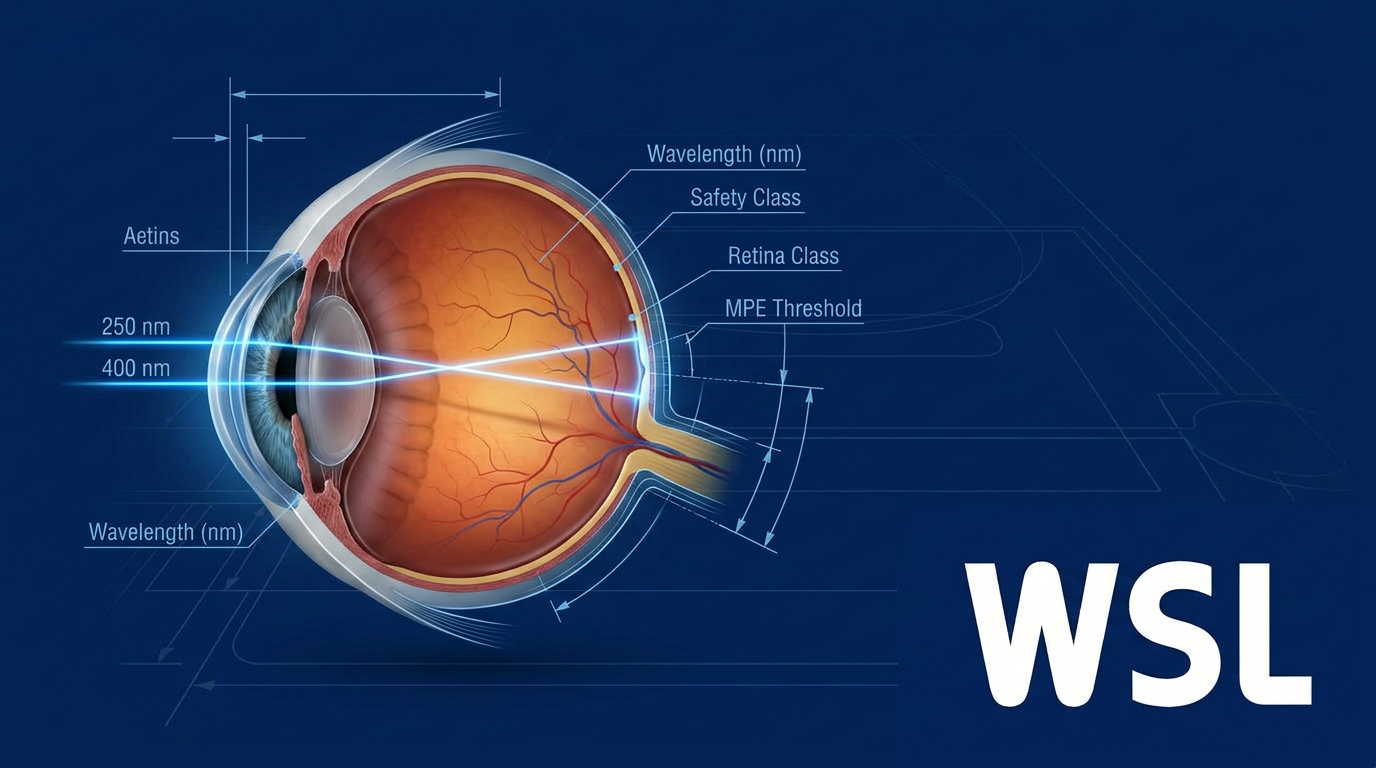
Introduction
This guide is written for engineers, safety professionals, procurement specialists, and technically curious practitioners who have encountered the term eye-safe laser in a professional context and want to understand it properly.
The label circulates widely — yet it is routinely treated as a simple binary, as though a laser either is safe or it isn't.
The honest picture is more nuanced: the classification is grounded in real physics and carries genuine meaning, but it is relative rather than absolute, and conflating the two has real consequences for anyone specifying, deploying, or working alongside these systems.
What follows unpacks that distinction fully — the underlying science, the technologies involved, their applications across industries, and what the classification actually tells you about risk.
TL;DR
The eye-safe classification is rooted in wavelength physics and meaningfully reduces retinal risk — but it does not eliminate all ocular hazard.
Understanding the gap between classification and actual safety is what separates informed deployment from a false sense of security — and that distinction is precisely what this guide works through.
This article covers:

The physics behind the eye-safe classification
Laser types and technologies that qualify
Safety standards and classification frameworks explained
LIDAR, medical, and industrial applications
System design and integration considerations
Common misconceptions and FAQs addressed
What Is an Eye Safe Laser?
The term eye-safe laser is widely used across defence, industrial sensing, and medical fields — yet it is routinely misunderstood. It does not mean a laser that cannot harm the eye. It means something more precise: a laser whose wavelength places it outside the retinal hazard region, shifting the site of potential ocular injury away from the retina and towards the anterior structures of the eye. Understanding that distinction is the foundation for every safety and design decision that follows.
The Retinal Hazard Region and Why It Matters
The human eye is, in optical terms, a remarkably effective concentrating instrument. Within the wavelength range of approximately 400 nm to 1,400 nm — defined by ICNIRP as the retinal hazard region — the ocular media (cornea, aqueous humour, lens, and vitreous) are largely transparent to radiation and actively focus it onto the retina.
This focusing effect is the core of the hazard. As confirmed in peer-reviewed literature, the refractive properties of the cornea and lens produce an increase in irradiance between the corneal surface and the retina of up to 100,000 times: a laser delivering 1 W/cm² at the cornea arrives at the retina as approximately 10 kW/cm².
The retina has no pain receptors and very limited regenerative capacity — peer-reviewed evidence confirms that adult mammalian retinal tissue does not regenerate spontaneously once damaged, making injuries effectively permanent. This is why retinal injury thresholds are far lower than those for any other ocular tissue, and why the 400–1,400 nm range warrants its own classification.
Why Wavelengths Above ~1.4 µm Are Different
Above approximately 1,400 nm, the optical behaviour of the eye changes fundamentally — not because of a regulatory decision, but because of the water absorption properties of biological tissue.
The ocular media are composed predominantly of water. Analysis of the spectral transmittance data for the cornea, aqueous humour, lens, and vitreous confirms that their absorption characteristics in the near-infrared are well described by the absorption coefficient of pure water. Above ~1,400 nm, water absorption rises sharply: the absorption coefficient of water at 1,440 nm is over 60 times greater than at the 970 nm near-infrared peak.
The practical consequence is that radiation above ~1,400 nm is intercepted and absorbed by the anterior structures of the eye — principally the cornea — before it can reach the retina. The eye's own water content acts as a broadband absorber, and the retina is no longer the primary site of risk.
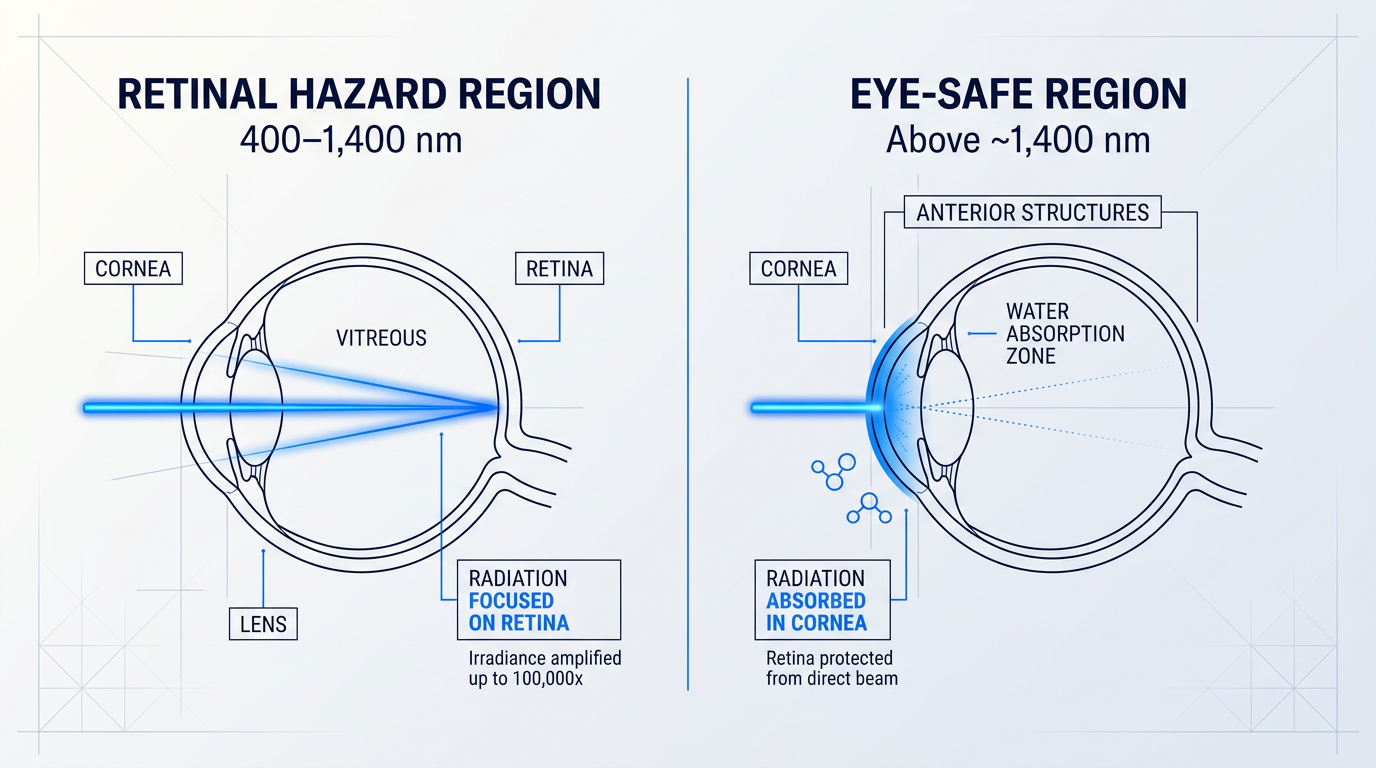
The table below summarises the two regions as defined in the ICNIRP laser guidelines and supporting peer-reviewed literature, showing the wavelength range, primary site of ocular absorption, and the dominant injury risk in each region.
| Region | Wavelength Range | Primary Absorption Site | Dominant Ocular Injury Risk |
|---|---|---|---|
| Retinal hazard region | 400–1,400 nm | Retina (ocular media largely transparent; radiation focused onto retinal surface) | Retinal thermal and photochemical damage; irradiance amplified up to ~100,000x at the retina |
| Eye-safe region | Above ~1,400 nm | Cornea and anterior segment (water absorption intercepts radiation) | Corneal thermal injury at sufficient irradiance levels; retina not at risk from direct beam |
Comparison of the retinal hazard region and eye-safe region by wavelength, primary absorption site, and dominant ocular injury risk, grounded in ICNIRP guidelines and peer-reviewed sources.
The contrast between these two regions is stark in terms of injury mechanism — but the table also makes visible a point that is frequently overlooked: the eye-safe region carries its own injury pathway, with a different anatomical target and a different threshold, not the absence of risk.
Eye-Safe Is Relative, Not Absolute
Because the cornea absorbs radiation above ~1,400 nm, it is also the tissue that heats when irradiance is sufficient. ICNIRP guidelines explicitly define separate exposure limits to protect the cornea in the infrared wavelength range above 1,400 nm — a direct acknowledgement that corneal thermal injury is a real and codified hazard in this spectral region.
At wavelengths around 3 µm, the corneal penetration depth falls well below 0.1 mm, meaning radiation is deposited in an extremely thin surface layer — making corneal damage easier to induce than at ~1.5 µm, despite both wavelengths sitting within the eye-safe region. The label describes a category of reduced retinal risk, not a uniform guarantee of safety across all power levels and wavelengths.
'Eye-safe' describes a meaningful reduction in retinal risk, not the absence of all ocular risk. The cornea absorbs radiation above ~1,400 nm and can sustain thermal injury at sufficient power levels. The classification is a starting point for safety assessment, not a conclusion.
The OSHA laser safety directive reinforces this point: direct exposure to any laser beam should always be avoided, regardless of wavelength classification. Formal frameworks including IEC 60825-1 and ANSI Z136.1 codify the eye-safe boundary and define the exposure limits that govern it — these standards are examined in detail in §6.
The Transitional Zone: 1,300–1,400 nm
The boundary at ~1,400 nm is meaningful and well-established, but the region immediately below it — roughly 1,300–1,400 nm — is genuinely complex. Peer-reviewed studies confirm that in this range, the water absorption coefficient rises sharply (from approximately 1.35 cm⁻¹ at 1,300 nm to 13.7 cm⁻¹ at 1,400 nm), and the most vulnerable ocular tissue shifts gradually from the retina to the cornea.
In this transitional zone, absorbed energy is distributed across multiple ocular structures — cornea, lens, and retina — with the dominant risk depending on beam parameters such as spot size, pulse duration, and total energy. Safety standards including ANSI Z136.1 define independent MPE limits for both retinal and corneal protection across this sub-region, reflecting its documented complexity. §4 examines this in greater detail.
The physics behind the 1,400 nm boundary — how the eye's optics focus radiation, how water absorption varies across the infrared spectrum, and how tissue response changes with irradiance and exposure duration — is what the next section examines in full.
Why Wavelength Determines Retinal Risk
The answer to why wavelength matters so much for ocular safety is not found in the laser itself — it is found in the optics of the eye. The human eye is, by design, an extraordinarily effective concentrating system, and that concentration is precisely what makes certain wavelengths so dangerous.
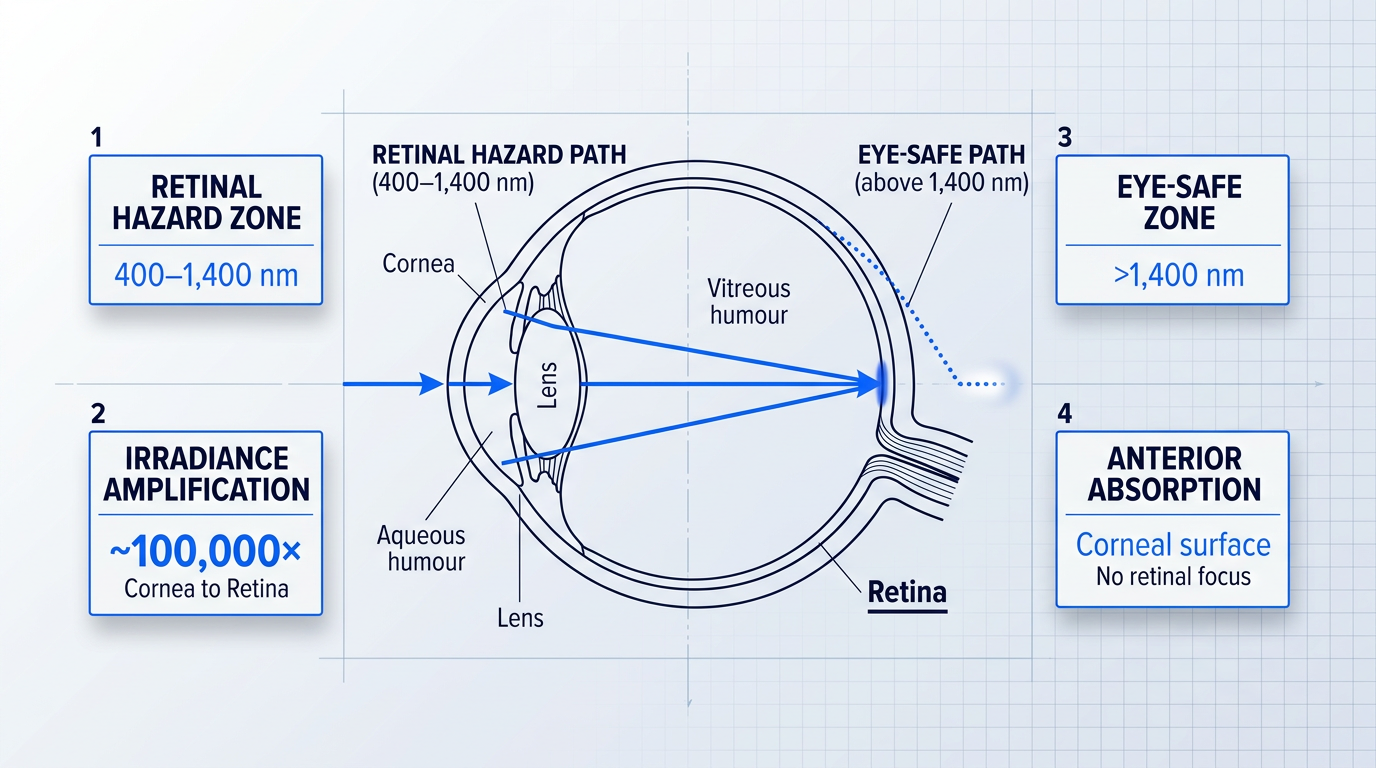
Within the retinal hazard region (400–1,400 nm), the cornea and lens together focus incident radiation onto a very small spot on the retina. According to the ICNIRP laser guidelines, for a point source of light the increase in irradiance from the cornea to the retina is approximately 100,000-fold — meaning a laser producing 1 W/cm² at the corneal surface delivers roughly 100 kW/cm² at the retinal image.
This amplification is why even modest power levels in the visible and near-infrared can cause permanent retinal damage before the blink reflex has any chance to respond. The eye's own optics are the hazard mechanism.
Water Absorption and the 1.4 µm Threshold
The structures of the ocular media — the cornea, aqueous humour, lens, and vitreous humour — are predominantly water. The vitreous humour is approximately 98–99% water by composition, and the aqueous humour is similarly water-dominant at around 99.7%.
Below roughly 1,400 nm, these structures are largely transparent to radiation, allowing it to pass through and be focused onto the retina. Above ~1,400 nm, water absorption increases sharply — driven by overtone and combination bands of O–H molecular vibration — and the ocular media become progressively opaque.
The consequence is straightforward but critical: radiation above ~1.4 µm is absorbed within the anterior eye before it can reach the retina. The focusing mechanism that creates the 100,000× irradiance amplification is never engaged. The retina is simply not in the beam path.
This is the physical basis of the eye-safe classification. The eye does not become invulnerable above 1.4 µm — it becomes vulnerable in a different, and substantially less severe, way.
When radiation above ~1.4 µm is absorbed in the anterior eye, the primary site of energy deposition is the cornea. This causes thermal effects at the corneal surface rather than at the retina. The distinction matters enormously for hazard assessment: corneal damage thresholds are orders of magnitude higher than retinal damage thresholds.
The retina is exquisitely sensitive precisely because of the irradiance amplification described above — a small amount of energy at the cornea becomes an enormous irradiance at the retinal image. The cornea, by contrast, is a robust surface tissue with no such focusing disadvantage, and it can tolerate far higher incident irradiance before thermal injury occurs.
How Penetration Depth Varies with Wavelength
Not all wavelengths above 1.4 µm interact with the anterior eye identically. Penetration depth — the distance over which incident radiation is absorbed — varies substantially with wavelength, driven by the shape of water's absorption spectrum across the infrared.
Research from PMC7899507 confirms that penetration depth in the anterior eye varies from approximately 1 cm at 1,000 nm to less than 1 µm at wavelengths around 3 µm, where water absorption reaches its highest peak. The table below captures the key data points available from the research literature across this range.
| Wavelength | Spectral Band | Water absorption coefficient (cm⁻¹) | Approximate penetration depth | Primary absorbing structure |
|---|---|---|---|---|
| 1,064 nm | IR-A (retinal hazard) | 0.12 | ~1 cm | Retina (focused) |
| ~1,450 nm | IR-A/IR-B boundary | ~24.8 | ~400 µm | Anterior cornea |
| ~2,100 nm | IR-B | ~26.9 | <400 µm | Cornea |
| ~2,940 nm | IR-B (absorption peak) | ~12,000 | <1 µm | Corneal epithelium (tear film) |
Comparison of water absorption coefficient and penetration depth across infrared wavelengths relevant to eye-safe laser classification, showing how tissue interaction changes with wavelength. Absorption coefficients at 1,064 nm, 1,450 nm, and 2,100 nm are sourced from PMC5829688 (µágua values); 2,940 nm coefficient from PMC3840494; penetration depth trend confirmed by PMC7899507.
The pattern in this data has direct implications for hazard profiles. At wavelengths around 1.4–1.5 µm, radiation penetrates meaningfully into the anterior eye, reaching the corneal stroma and potentially deeper anterior structures. At ~2.94 µm, where water absorption reaches approximately 12,000 cm⁻¹, the 1/e penetration depth falls below 1 µm — incident radiation is almost entirely absorbed within the tear film and corneal epithelium before it can interact with deeper tissue. The trend continues beyond 2.94 µm: according to ICNIRP infrared guidance, the minimum penetration depth across the IR-B band occurs near 3 µm, where water absorption is at its strongest.
For system designers, this distinction is not merely academic. A laser operating near 1.5 µm and one operating near 2.94 µm are both classified as eye-safe, but their corneal interaction depths differ by several orders of magnitude — a factor that shapes both their damage thresholds and their tissue effects at any given power level.
Maximum Permissible Exposure and the Operational Consequence
The maximum permissible exposure (MPE) is defined as the level of laser radiation to which an unprotected person may be exposed without suffering biological damage. MPE values are set by standards bodies including ICNIRP, ANSI, and IEC, and they reflect the underlying injury thresholds for each wavelength and exposure condition.
Because eye-safe wavelengths deposit energy in the cornea rather than the retina, and because corneal damage thresholds are substantially higher than retinal thresholds, MPE values for eye-safe wavelengths are correspondingly higher than those for the retinal hazard region. The 100,000× irradiance amplification that makes the retina so vulnerable simply does not apply when radiation is absorbed before it reaches the posterior eye.
The practical magnitude of this difference is significant. Laser Focus World reports that at 1,550 nm versus 905 nm, the permitted energy exposure is approximately 12 to 300 times higher depending on the specific exposure conditions — a range that reflects the substantial engineering headroom that eye-safe wavelengths provide.
Higher MPE values at eye-safe wavelengths mean laser systems can operate at substantially greater power levels in open environments while remaining within permissible exposure limits. This is not just a classification label — it is the physical reason why eye-safe wavelengths dominate applications requiring high-power outdoor operation.
The region between approximately 1,300 nm and 1,400 nm deserves particular attention because it does not behave cleanly as either retinal hazard or eye-safe. As wavelength increases through this band, water absorption rises sharply — from roughly 1.35 cm⁻¹ at 1,300 nm to approximately 13.7 cm⁻¹ at 1,400 nm — but the transition is gradual, not a cliff.
In this transitional NIR zone, the distribution of absorbed energy across the cornea, lens, and retina depends on beam spot size, exposure duration, and other parameters. Research at 1,338 nm demonstrates this directly: at small corneal spot sizes, threshold-level damage occurs at the cornea; at larger spot sizes, the retina becomes the most sensitive tissue. Neither purely corneal nor purely retinal risk dominates — the hazard shifts with the beam geometry.
Standards bodies recognise this complexity explicitly: ANSI Z136.1 defines separate and independent MPEs for retinal and corneal protection within the 1,300–1,400 nm range, precisely because a single limit cannot capture the wavelength- and parameter-dependent hazard distribution in this region.
With these physical mechanisms established — the focusing geometry, the role of water absorption, the wavelength-dependence of penetration depth, and the MPE consequence — the next question is which laser technologies are actually built around these wavelengths, and how their specific emission wavelengths shape both their hazard profiles and their suitability for different applications.
Eye-Safe Laser Types: A Technology Taxonomy
The term eye-safe laser does not describe a single device — it describes a family of architecturally distinct technologies spanning nearly 1.5 µm of the infrared spectrum, each shaped by a different host material, pumping scheme, and set of application demands.
What follows is a map of that landscape, moving from the most established defence-grade platforms at ~1.54 µm through to the medical workhorse at 2.94 µm — the five laser families a reader is most likely to encounter across sensing, defence, medical, and industrial contexts.
Er:Glass Lasers (~1.54 µm)
Erbium glass (Er:glass) lasers operate at approximately 1.54 µm, using a phosphate or silicate glass host doped with erbium ions (Er³⁺) as the gain medium — a solid-state bulk architecture that is distinct from both crystalline hosts and fibre-based systems.
These lasers are typically diode-pumped and passively Q-switched, producing nanosecond pulses well suited to time-of-flight ranging — a combination that yields compact, rugged transmitters operable across military temperature ranges (typically −40 °C to +71 °C).
L3Harris manufactures an extensive family of Er:glass laser transmitters — including the MK-11, MK-85, MK-88, and the Miniature Laser Range Finder (MLRF) — all based on diode-pumped, passively Q-switched erbium glass operating at 1.535 µm, with applications spanning laser rangefinding, range-gate imaging, LIDAR, and LIBS.
Elbit Systems' CIL (Compact Integrated Laser) is a representative defence-grade example: a diode-pumped erbium glass transmitter at 1.54 µm delivering a minimum of 10 mJ output energy, a repetition rate of up to 10 pulses per second, and a maximum ranging capability of 20,000 m in a 6.1 kg package designed to MIL-STD.
Er:Yb Co-doped Fibre Lasers (~1.55 µm)
Erbium/ytterbium (Er:Yb) co-doped fibre lasers operate at approximately 1.55 µm — overlapping with the C-band telecom window — and represent the fibre architecture counterpart to Er:glass, sharing a similar wavelength but with a fundamentally different form factor and power-scaling profile.
The co-doping rationale is practical: Yb³⁺ has a broad absorption band and a much higher pump absorption cross-section than Er³⁺ alone, allowing it to absorb pump light efficiently and transfer that energy to the erbium ions — increasing pump absorption by more than two orders of magnitude compared with singly Er-doped fibres.
These fibres support both CW and pulsed operation; in pulsed amplifier configurations, Er:Yb large-mode-area (LMA) fibre systems have demonstrated peak powers exceeding 30 kW at 1.55 µm, with pulse energies in the 100 µJ range from single-mode outputs.
A practical system-level advantage is InGaAs photodetector compatibility: InGaAs PIN and APD detectors have their peak sensitivity wavelength at 1.55 µm (with responsivity typically ~0.95 A/W at 1550 nm), and the mature telecom supply chain has made these detectors widely available — a direct benefit for LIDAR and sensing system designers.
Er:YAG Lasers (2.94 µm)
Er:YAG is a fundamentally different laser type from Er:glass and Er:Yb fibre, despite the shared erbium dopant: it uses a crystalline YAG (yttrium aluminium garnet) host rather than a glass matrix, and it operates at 2.94 µm — a wavelength nearly twice as long as the 1.54–1.55 µm Er:glass/Er:Yb fibre band.
The 2.94 µm wavelength coincides with the peak water absorption band in tissue: the absorption coefficient of water at this wavelength is approximately 13,000 cm⁻¹, giving an optical penetration depth in tissue of roughly 1 µm — the shallowest of any clinically used laser type, enabling precise layer-by-layer tissue removal with minimal collateral thermal damage.
This tissue interaction profile makes Er:YAG the established technology for skin resurfacing, dental ablation, and hard-tissue surgery — domains where the combination of high water absorption, shallow penetration, and minimal thermal spread is precisely what clinical outcomes require.
Thulium Fibre Lasers (~1.9–2.0 µm)
Thulium (Tm) fibre lasers operate across a broad range of approximately 1.9–2.1 µm in silica fibre, with the gain peak for high-efficiency operation typically cited around 1.94–2.05 µm depending on fibre composition and cavity design.
Pumped at approximately 790–793 nm, Tm-doped silica fibres benefit from a cross-relaxation mechanism — one pump photon can produce approximately 1.8 upper-level excitations — enabling slope efficiencies of 53–65% in demonstrated high-power systems, figures well above what is achievable with Er:Yb fibre at comparable power levels.
Both CW and pulsed operation are well-established: CW Tm fibre lasers have demonstrated output powers exceeding 300 W with near-diffraction-limited beam quality, while pulsed configurations serve LIDAR and medical applications requiring controlled pulse delivery.
The strong water absorption at ~2 µm — roughly four times higher than at the Ho:YAG wavelength of 2.1 µm — translates directly into efficient tissue ablation in medical use and effective coupling to water-containing organic materials in industrial processing.
Also worth noting in this wavelength region: Ho:YAG lasers at ~2.1 µm are the long-established clinical standard for urological procedures including lithotripsy and BPH treatment, though thulium fibre lasers are increasingly positioned as a higher-efficiency alternative in this space — a comparison the Medical Applications section covers in depth.
Eye-Safe Laser Wavelength Map
The table below maps the main eye-safe laser types across wavelength, operating mode, primary application domain, and the technical characteristic most responsible for their adoption in that domain.
| Laser Type | Wavelength | Operating Mode | Primary Application Domain | Key Technical Characteristic |
|---|---|---|---|---|
| Er:glass (phosphate/silicate host) | ~1.535–1.54 µm | Pulsed (passive Q-switch) | Defence rangefinding, LIDAR, LIBS | Compact, rugged solid-state transmitter; diode-pumped; field-deployable |
| Er:Yb co-doped fibre | ~1.55 µm (C-band) | CW and pulsed | Eye-safe LIDAR, sensing, telecom amplifiers | High peak power in pulsed configs (>30 kW); InGaAs detector compatibility at 1.55 µm |
| Er:YAG (crystalline YAG host) | 2.94 µm | Pulsed | Medical: skin resurfacing, dental, hard-tissue surgery | Water absorption ~13,000 cm⁻¹; optical penetration depth ~1 µm in tissue |
| Thulium fibre (Tm:silica) | ~1.9–2.1 µm (peak ~1.94 µm) | CW and pulsed | Medical (urology, soft tissue), LIDAR, industrial processing | Slope efficiency 53–65% via cross-relaxation; ~790 nm pump; silica-fibre compatible |
| Ho:YAG (crystalline YAG host) | ~2.1 µm (2,090–2,120 nm) | Pulsed | Medical urology (lithotripsy, BPH) | Established clinical gold standard; strong water absorption; pulsed photothermal ablation |
Multi-axis comparison of eye-safe laser types across wavelength, operating mode, application domain, and key technical characteristic — enables readers to orient themselves across the technology landscape at a glance.
Three distinct wavelength clusters emerge from the data: the 1.54–1.55 µm cluster (Er:glass and Er:Yb fibre) dominates sensing and defence, where compact transmitters and InGaAs detector compatibility are the system-level drivers; the 1.9–2.1 µm cluster (Tm fibre and Ho:YAG) dominates medical urology and soft-tissue applications, where water absorption depth and ablation efficiency govern outcomes; and 2.94 µm (Er:YAG) stands apart as the only type with sub-micron optical penetration depth, which is precisely why it owns hard-tissue and precision skin applications.
For system designers, knowing which cluster a requirement maps to is the first decision gate: the 1.55 µm band offers the most mature component ecosystem and the best detector economics, while the 2 µm band offers higher wall-plug efficiency and stronger tissue coupling, and 2.94 µm is the choice only when extreme surface precision is the primary requirement.
Er:glass and Er:Yb fibre lasers operate at ~1.54–1.55 µm and are built for sensing and defence. Er:YAG operates at 2.94 µm in a crystalline host and is built for medical tissue ablation. Same dopant element — fundamentally different laser types, wavelengths, hosts, and application domains.
With the technology landscape mapped, the next step is understanding how these systems are formally evaluated and classified under international safety standards — the framework that governs how eye-safe lasers are specified, tested, and deployed in practice.
Classification Frameworks: How Eye-Safe Lasers Are Rated
Physics explains why wavelengths above ~1.4 µm are less hazardous to the retina — but physics alone does not determine how a laser product is regulated, labelled, or controlled in practice. That work falls to a set of international standards and scientific guidelines that translate biological injury thresholds into enforceable classification rules. Understanding these frameworks is essential for anyone working with eye-safe laser systems, because the frameworks reveal a critical truth: operating at an eye-safe wavelength and holding a Class 1 designation are not the same thing.
IEC 60825-1: The International Product Standard
IEC 60825-1 is the primary international standard governing the safety of laser products, applicable to laser radiation across the wavelength range 180 nm to 1 mm — covering virtually every laser technology in commercial use today.
The standard's classification scheme runs from Class 1 through Class 4 (with subclasses 1M, 2, 2M, 3R, and 3B), ordered by increasing optical radiation hazard. The basis for every classification decision is the concept of the Accessible Emission Limit (AEL): the maximum level of accessible radiation permitted within a particular class, measured at the point where human access is possible under normal use conditions.
Class 1 is the classification that matters most for eye-safe system design. A Class 1 product cannot emit radiation above the applicable AEL under any condition of normal use — meaning the accessible radiation is controlled to a level considered safe without additional user precautions. Critically, a more powerful laser may sit inside a Class 1 product; what matters is that hazardous radiation cannot escape the enclosure or reach a person under normal operating conditions.
Class 1 can be achieved through enclosure (containing the beam so it is not accessible), beam geometry (engineering divergence so irradiance falls below the AEL at any accessible distance), or by using a source whose output is itself below the AEL threshold. Wavelength is not a mechanism for achieving Class 1 — it influences where the AEL threshold sits, but the classification is always determined by the accessible emission picture.
ANSI Z136.1: The US National Standard
ANSI Z136.1 is the American National Standard for the safe use of lasers, covering laser systems operating from 180 nm to 1,000 µm. It shares the same seven-class hazard classification structure as IEC 60825-1 and is referenced by the US Occupational Safety and Health Administration, making it the operative standard for US-based system designers and facilities.
ANSI Z136.1's distinctive contribution is its detailed definition of Maximum Permissible Exposure (MPE) values — the maximum level of laser radiation to which a person may be exposed without suffering adverse biological effects, expressed in units of irradiance or radiant exposure (power or energy per unit area). MPE values are wavelength-dependent, exposure-duration-dependent, and form the biological foundation on which AEL thresholds are built.
ANSI Z136.1 has its own publication cycle and some technical differences from IEC 60825-1 — the 2022 edition introduced 19 new definitions and updated exposure levels — but for the reader's purposes the classification logic and the relationship between MPE, AEL, and hazard class are directly comparable between the two standards.
ICNIRP: The Scientific Basis for Exposure Limits
Behind both product standards sits an independent scientific body: the ICNIRP (International Commission on Non-Ionizing Radiation Protection). ICNIRP is not a product classification framework — it does not assign laser classes or AELs. Instead, it publishes guidelines on biological exposure limits derived from injury threshold data across the electromagnetic spectrum, covering laser radiation from 180 nm to 1,000 µm.
The ICNIRP guidelines directly inform the MPE values in both IEC 60825-1 and ANSI Z136.1. The AELs for Class 1, 1M, 2, 2M, and 3R in IEC 60825-1 Edition 3 were explicitly updated to reflect the 2013 ICNIRP laser guidelines — making ICNIRP the upstream scientific authority whose findings flow downstream into enforceable product standards.
The reason this matters for eye-safe systems is rooted in biology, as covered in the physics section of this guide: the injury threshold for corneal damage (the relevant mechanism above ~1.4 µm) is substantially higher than for retinal damage. ICNIRP's guidelines reflect this directly — MPE values for eye-safe wavelengths are significantly more permissive than for wavelengths in the retinal hazard region. That biological fact, formalised by ICNIRP and encoded in the product standards, is what makes operating at eye-safe wavelengths advantageous from both a safety and an engineering standpoint.
A laser emitting at 1.55 µm is not automatically Class 1. A high-power 1.55 µm fibre laser with an open beam is still Class 4 — because classification is determined by accessible emission relative to the AEL, not by wavelength. The eye-safe wavelength reduces retinal hazard; it does not, by itself, determine the product's hazard class.
This distinction is one of the most practically important in laser safety. The term "eye-safe" describes a wavelength region with a more favourable biological hazard profile — it is not a safety classification in itself, and it does not exempt a product from the AEL-based classification framework.
What operating at an eye-safe wavelength does provide is an engineering advantage: because the MPE is substantially higher than for retinal-hazard wavelengths, the AEL thresholds for each class are more permissive. A 1.55 µm system can achieve Class 1 designation at higher output levels than a 1,064 nm system would, because the accessible emission it is measured against is a higher MPE-derived threshold. The eye-safe wavelength widens the Class 1 envelope — it does not guarantee entry into it.
Nominal Hazard Zone: The Operational Consequence
Both IEC 60825-1 and ANSI Z136.1 support a concept that translates MPE values into spatial terms: the Nominal Hazard Zone (NHZ). The NHZ is defined as the region within which the level of laser radiation may exceed the applicable MPE — in other words, the zone where exposure could cause harm and where access must be controlled.
For eye-safe wavelengths, the substantially higher MPE means that, at a given output power, the NHZ is significantly smaller than it would be for a retinal-hazard wavelength laser of equivalent power. This has direct operational consequences: eye-safe systems can often be deployed in open or mixed-use environments with less physical access control than equivalent-power visible or near-infrared systems would require.
- Higher MPE, smaller NHZ: Eye-safe wavelengths carry a higher MPE, so the hazard zone at a given power level is substantially smaller than for retinal-hazard wavelengths.
- Reduced access control overhead: A smaller NHZ means less physical area requiring restricted access, PPE, or warning signage — a key operational advantage in field deployments.
- NHZ is power- and geometry-dependent: Beam divergence, pulse energy, and working distance all affect NHZ size. Engineering these parameters is how system designers manage hazard zones in practice.
The NHZ concept will recur throughout the application and system design sections of this guide, where beam geometry and working distance become active design variables rather than fixed parameters. Understanding the NHZ as an output of the MPE framework — not a fixed property of the laser type — is the foundation for that discussion.
FDA and CDRH: The US Regulatory Picture
For US-market readers, the regulatory picture has a further layer: the FDA's CDRH (Center for Devices and Radiological Health) oversees compliance with federal radiation safety performance standards for laser products sold in the United States.
Under Laser Notice No. 56, issued in 2019 and updated in 2023, the FDA does not intend to enforce the applicable requirements of 21 CFR 1040.10 and 1040.11 for manufacturers whose laser products conform to the relevant clauses of IEC 60825-1 Ed. 3 and IEC 60601-2-22 Ed. 3.1. In practical terms, this means US laser product manufacturers can use IEC 60825-1 Edition 3 compliance as the basis for FDA regulatory conformance — the international standard and the US federal standard are aligned at the classification level.
With the classification frameworks established — and the critical distinction between eye-safe wavelengths and Class 1 designation clearly in view — the next step is to examine how these frameworks play out in the real operational demands of specific applications, starting with LIDAR and rangefinding, where MPE limits and NHZ engineering are most visibly consequential.
See Eye-Safe Laser Technology in Practice
The physics and standards are clear. Now explore how eye-safe laser products are built around them. Woodrow Scientific offers laser cleaning and communications solutions operating at eye-safe wavelengths.

Eye-Safe Lasers in LIDAR and Rangefinding
The earliest generation of automotive LIDAR systems relied on 905 nm silicon diode lasers — cheap, mature, and plentiful. The problem is fundamental: the higher maximum permissible exposure (MPE) limits established by IEC 60825-1 and ANSI Z136.1 (covered in the previous section) constrain 905 nm pulse powers so tightly that practical detection range tops out at roughly 30–100 m. At highway speeds, that margin is barely sufficient. The move to 1.55 µm is not a compliance upgrade — it is a range-enabling engineering decision with measurable consequences for what the system can actually detect.
Automotive LIDAR: Why 1.55 µm Won
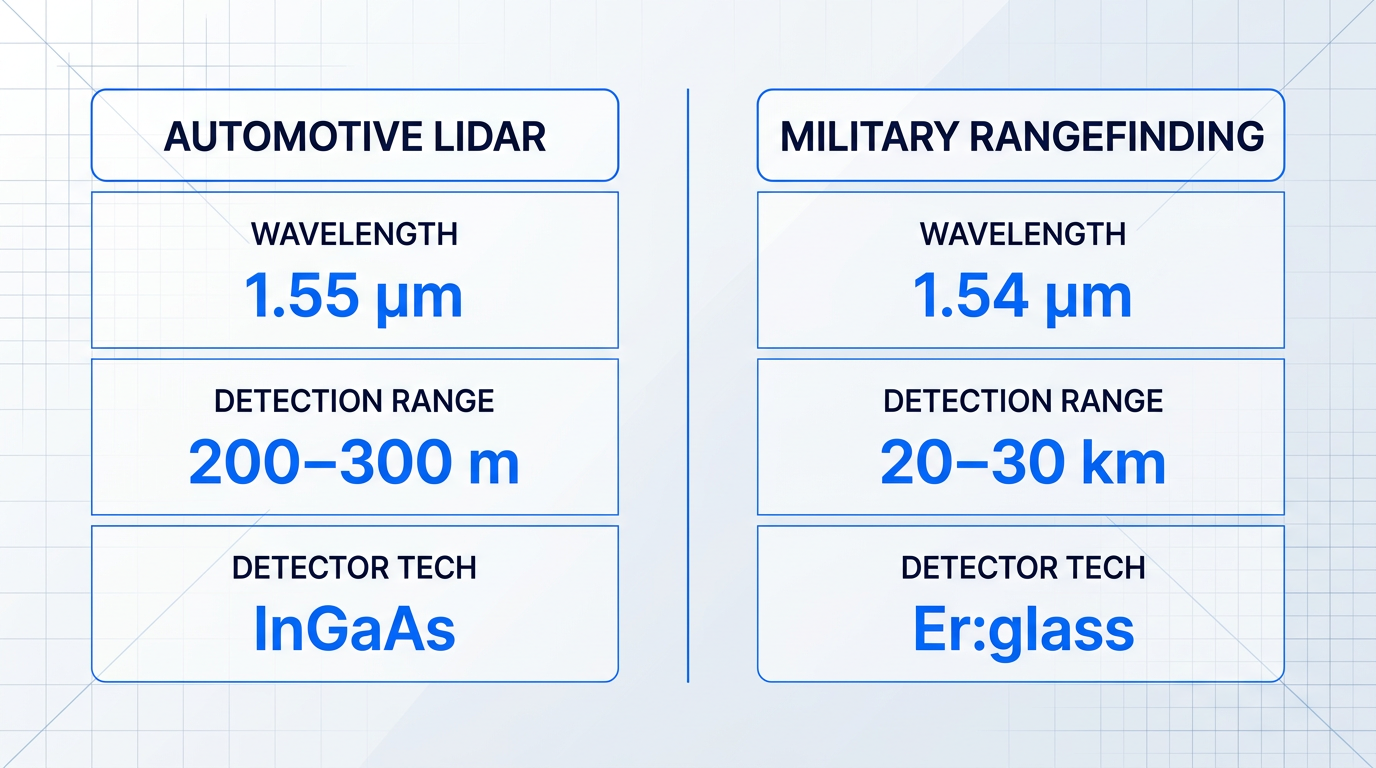
The higher MPE limits at 1.55 µm translate directly into pulse power headroom. According to Luminar Technologies' own published analysis, 1.55 µm lasers can emit 17 times more photons than sub-1,000 nm systems under the same safety framework — which translates to up to four times the detection range or up to 17 times the resolution, or some blend of both.
IEEE Spectrum's reporting on Luminar's long-reach LIDAR puts the pulse power differential at 40 times greater at 1.55 µm compared to 905 nm, with Luminar achieving 200 m range in early demonstrations and subsequently reaching 300 m — sufficient for a vehicle travelling at highway speed to stop safely before an obstacle.
The wavelength advantage is compounded by a second factor: the telecom supply chain. At 1.55 µm, decades of fibre-optic communications investment have produced a deep, competitive ecosystem of erbium-doped fibre amplifiers (EDFAs), single-mode fibre components, and precision pulsed sources — all commercially available at scale.
Luminar's own engineering rationale makes this explicit: 1.55 µm LIDAR uses components developed for demanding automotive requirements, drawing on telecom-grade infrastructure rather than repurposed consumer silicon. This lowers development cost, improves component availability, and gives system designers access to a mature supply base rather than a bespoke one.
The third reinforcing factor is detector compatibility. InGaAs photodetectors are the established receiver technology for the 1.55 µm band, and Luminar's published analysis notes that 905 nm systems face a significantly higher solar background noise floor than 1.55 µm systems — more sunlight reaches Earth at 905 nm, raising the detection threshold for silicon-based receivers in bright conditions.
Higher MPE limits, a mature telecom supply chain, and InGaAs detector compatibility reinforce each other. No single factor alone explains why 1.55 µm dominates long-range automotive LIDAR — the three together do.
The honest counterpoint is the detector cost and complexity this wavelength demands. Silicon photodetectors and silicon SPADs (single-photon avalanche diodes) — the cheapest, highest-performing single-photon detectors available — do not respond to 1.55 µm. The silicon bandgap is too wide to absorb photons at this wavelength.
InGaAs/InP SPADs, which do cover the 1.55 µm band, carry substantially higher dark count rates and more afterpulsing than silicon equivalents, and typically require thermoelectric (Peltier) cooling — operating at temperatures between approximately −80 °C and −20 °C — to achieve adequate sensitivity, according to RP Photonics' technical reference on single-photon avalanche diodes.
InGaAs p-i-n photodiodes are also available at significantly higher prices than silicon equivalents, particularly for larger active areas, as RP Photonics notes in its infrared detector reference. The cooling requirement adds electrical load, thermal management complexity, and packaging constraints — real system-level costs that designers must account for, even if they do not change the fundamental wavelength case.
Military Rangefinding: Erbium Glass at 1.54 µm
In defence applications, the operational stakes of wavelength choice are different in character but equally concrete. Conventional military laser rangefinders have historically used Nd:YAG lasers at 1.064 µm — a wavelength that penetrates to the retina and poses significant injury risk at operational ranges. Erbium glass (Er:glass) at 1.54 µm changes this fundamentally.
The critical operational benefit is training safety. Military rangefinders are routinely directed at personnel during field exercises, and the reduced retinal hazard at 1.54 µm allows use in training environments without the fratricide risk that 1.064 µm systems carry. As Northrop Grumman's press release for its M1A2 Abrams Main Battle Tank ELRF contract explicitly states: "the rangefinder allows U.S. forces to train safely against each other."
This is not a marginal safety improvement — it is a mission-critical operational requirement that expands the usable envelope of the system from combat-only to combat and training alike.
L3Harris's ELRF (Eye-safe Laser Range Finder) product family illustrates the maturity of this technology. The ELRF-2, built around an erbium glass laser at 1.54 µm, is rated Class 1 to both ANSI Z136.1-2007 and EN 60825-1, and provides ranging capability up to 20 km with an APD receiver. The larger ELRF-3 variant extends maximum range to 30 km with a 70 mm receiver aperture.
The diode-pumped DP-ELRF family extends the platform further still: the MLRF-2B, weighing just over 1 kg, provides ranging to 25 km using a diode-pumped Er:glass transmitter at 1535 nm.
The DP-ELRF V is rated to 50 km and incorporates a TE-cooled APD receiver — underlining that thermoelectric cooling is a practical reality in fielded military hardware at this wavelength, not merely a laboratory consideration.
Elbit Systems' CIL (Compact Integrated Laser) represents a similar capability in a different form factor. Operating at 1.54 µm with a diode-pumped Er:glass transmitter, the CIL delivers a minimum output energy of 10 mJ at up to 10 pulses per second, with a maximum range of 20,000 m and range accuracy of ±5 m — suitable for integration into air defence weapon systems, gunfire control, and electro-optical payloads.
Northrop Grumman's contract to supply eye-safe laser rangefinders for the M1A2 Abrams Main Battle Tank — covering more than 500 systems for the U.S. Army — provides further evidence that Er:glass at 1.54 µm is now the established standard for main battle tank fire control, not an emerging alternative.
Beyond automotive and defence, wind LIDAR and atmospheric sensing systems also operate preferentially at 1.5 µm for the same underlying reason: these are open-air deployments where the beam traverses uncontrolled environments, and eye-safe classification eliminates the need for exclusion zones and reduces bystander risk — a practical operational advantage for systems deployed in urban areas, near airports, or during field research campaigns.
The pattern across all these domains is consistent: eye-safe wavelength choice is an active engineering decision that expands the operational envelope of the system, not simply a compliance label applied after the fact. In the next section, we turn to medical applications — where the wavelength choice is driven not by MPE-enabled power margins, but by how specific infrared wavelengths interact with biological tissue at the point of treatment.
Eye-Safe Lasers in Medical Applications
In LIDAR and rangefinding, the eye-safe classification is the engineering motivation — clinicians choose wavelengths above ~1.4 µm to protect bystanders from accidental retinal exposure. In medicine, the logic runs in the opposite direction: the wavelengths used in surgical and dermatological lasers are chosen because of how they interact with tissue, and the eye-safe classification is simply a consequence of that underlying physics.
Biological tissue is predominantly water, and the water absorption spectrum is the primary selection driver for clinical laser wavelengths. Several of the most clinically significant wavelengths in this space sit squarely within the eye-safe region — not because surgeons are concerned about retinal hazard zones, but because those wavelengths happen to match the absorption characteristics that make precise tissue ablation possible.
Dermatology: Er:YAG and Thulium at 1927 nm
The Er:YAG laser at 2940 nm has the highest water absorption coefficient of any clinical laser type — its wavelength coincides with the peak of water's absorption spectrum. When an Er:YAG pulse strikes tissue, the interstitial water absorbs the energy almost instantaneously, undergoes a rapid phase transition, and vaporises explosively, ejecting a very thin layer of tissue with minimal heat conducted to the surrounding structures.
This mechanism — sometimes described as thermo-mechanical ablation — enables layer-by-layer tissue removal with a zone of peripheral thermal damage that peer-reviewed studies have measured at approximately 25–50 µm under optimised parameters. Clinical applications include skin resurfacing, ablation of benign lesions, and broader dermatological treatments where precision and minimal collateral injury are priorities.
A distinct wavelength, the 1927 nm thulium laser, has emerged as an active area of clinical development in dermatology. Its water absorption coefficient is intermediate — substantially lower than Er:YAG at 2940 nm — which means it penetrates deeper into the epidermis and upper dermis (approximately 200–300 µm) without causing the same degree of surface ablation. A 2025 systematic review covering 17 studies and 448 participants found that the 1927 nm wavelength promoted improvements in skin texture, pigmentation reduction, and scar appearance, with a mild and transient adverse event profile.
The 1927 nm thulium laser is best characterised as a semi-ablative device: at lower pulse energies it produces subepidermal effects with an intact stratum corneum, while higher fluences can extend into superficial ablation. Its clinical applications include treatment of pigmentation disorders, acne scarring, and photoageing — areas where it is increasingly studied, though it remains less established than Er:YAG in dermatological practice.
Urology: Ho:YAG and Thulium Fibre Laser
The Ho:YAG laser at approximately 2100 nm has been the established standard in urological lithotripsy and soft tissue surgery since the mid-1990s. Its wavelength is strongly absorbed by water, enabling photothermal fragmentation of urinary stones and efficient soft tissue ablation; its safety profile in aqueous endourological environments is well characterised. Ho:YAG remains the global reference point against which newer technologies are benchmarked.
The thulium fibre laser (TFL) at approximately 1940 nm operates at a wavelength closer to the near-infrared water absorption peak, giving it a water absorption coefficient approximately four times higher than Ho:YAG at its operating wavelength. This translates directly into lower stone ablation thresholds and higher ablation efficiency at equivalent energy settings.
In urological lithotripsy, the higher water absorption of TFL contributes to a clinically relevant advantage: reduced stone retropulsion. Because TFL achieves comparable ablation at lower peak energies, the pressure wave generated at the fibre tip — which is what drives stone migration during fragmentation — is substantially lower than with Ho:YAG. Multiple in vitro studies have reported retropulsion forces with TFL that are significantly lower than Ho:YAG under equivalent settings, with some studies reporting a retropulsion threshold two to four times higher for TFL.
TFL is also applied in soft tissue surgery, including treatment of benign prostatic hyperplasia (BPH). Thulium fibre laser enucleation of the prostate (ThuFLEP) is an increasingly studied minimally invasive approach for BPH, with published data indicating it is safe and effective across a range of prostate volumes. The FDA 510(k) clearance for the IPG Medical Family of Thulium Fiber Lasers explicitly covers urology, lithotripsy, and soft tissue applications, confirming the regulatory pathway for this technology.
Across all of these clinical domains, the pattern is consistent: wavelength selection is driven by tissue water absorption characteristics, not by the eye-safe classification per se. The fact that these wavelengths fall above the ~1.4 µm threshold is a consequence of the same physics that makes them clinically useful — the cornea and lens absorb them before they reach the retina for the same reason tissue water absorbs them so efficiently.
IEC 60825-1 states explicitly that its MPE values are not applicable to intentional human exposure to laser radiation for the purpose of medical or cosmetic/aesthetic treatment. Clinical laser systems operating at eye-safe wavelengths are still classified as Class IV devices under both IEC and FDA frameworks, and ANSI Z136.3 requires full safety protocols — laser protective eyewear for staff, controlled access, and a designated laser safety officer — for all Class 3B and Class 4 healthcare laser systems.
This means the eye-safe wavelength classification carries no special status in the clinical environment. Staff present during Er:YAG, TFL, or Ho:YAG procedures are required to wear appropriate laser protective eyewear calibrated to the operating wavelength, and all standard clinical laser safety procedures apply without reduction. The classification tells you something about accidental retinal hazard — it says nothing about the power levels, tissue heating, or plume hazards that govern clinical safety protocols.
The wavelength physics that define the eye-safe region are equally relevant in industrial settings, though the engineering motivations and safety frameworks differ substantially from both medical and sensing applications — a distinction the next section examines in the context of laser cleaning and material processing.
Eye-Safe Lasers in Industrial Applications
Conventional industrial laser cleaning systems — typically Class IV, operating at 1064 nm on ytterbium fibre platforms — impose a hard operational constraint: before work begins, the nominal hazard zone must be cleared, access controlled, and the space sealed off entirely.
In open-plan manufacturing, mixed-use facilities, heritage restoration sites, and publicly accessible environments, that overhead is not merely inconvenient — it can render laser cleaning completely impractical, regardless of how well-suited the technology would otherwise be for the task.
The engineering answer is a wavelength shift. As established in the physics and standards sections of this guide, radiation at 1550 nm is absorbed in the cornea and lens before it can reach the retina, which pushes the maximum permissible exposure (MPE) threshold orders of magnitude higher than at 1064 nm — and it is the MPE that governs how large the nominal hazard zone must be.
A dramatically higher MPE means the nominal hazard zone can be engineered down to a small area immediately around the work surface, rather than encompassing an entire room or production bay — this is the engineering basis for reduced-hazard-zone (RHZ) operation, and it is a direct consequence of the wavelength physics, not a regulatory workaround.
The platform that makes this possible in practice is the same Er:Yb co-doped fibre laser already covered in this guide's treatment of LIDAR and atmospheric sensing: operating at 1550 nm, it can be configured for high-pulse-energy surface ablation, making the wavelength engineering that enables eye-safe LIDAR directly transferable to eye-safe industrial cleaning.
Reduced-Hazard-Zone Laser Cleaning in Practice
Woodrow Scientific Limited (WSL) has translated this engineering principle into the world's first and only reduced-hazard-zone laser cleaner: the ELASER-RHZ, built on WSL's patented RHZ technology, which collapses the laser hazard zone to a fraction of conventional size.
That capability is not a compliance label — it is what allows the ELASER-RHZ to operate in open workshops, mixed-use facilities, and publicly accessible settings where a conventional Class IV system at 1064 nm would require full area lockdown and evacuation before a single pulse could fire.
WSL is also the only UK-based laser cleaning manufacturer: it designs, builds, services, and continuously improves its machines entirely in-house, backed by over 200 years of combined engineering experience. A significant proportion of the laser cleaning market consists of resellers and importers rebadging third-party machines — an arrangement that limits support capability and eliminates any genuine path to product improvement. WSL's in-house model is the alternative.
The operational applications this unlocks are substantial: graffiti removal on public infrastructure, heritage and monument restoration in publicly accessible spaces, and continuous cleaning in open-plan manufacturing environments — all settings where conventional laser cleaning was previously impractical or impossible.
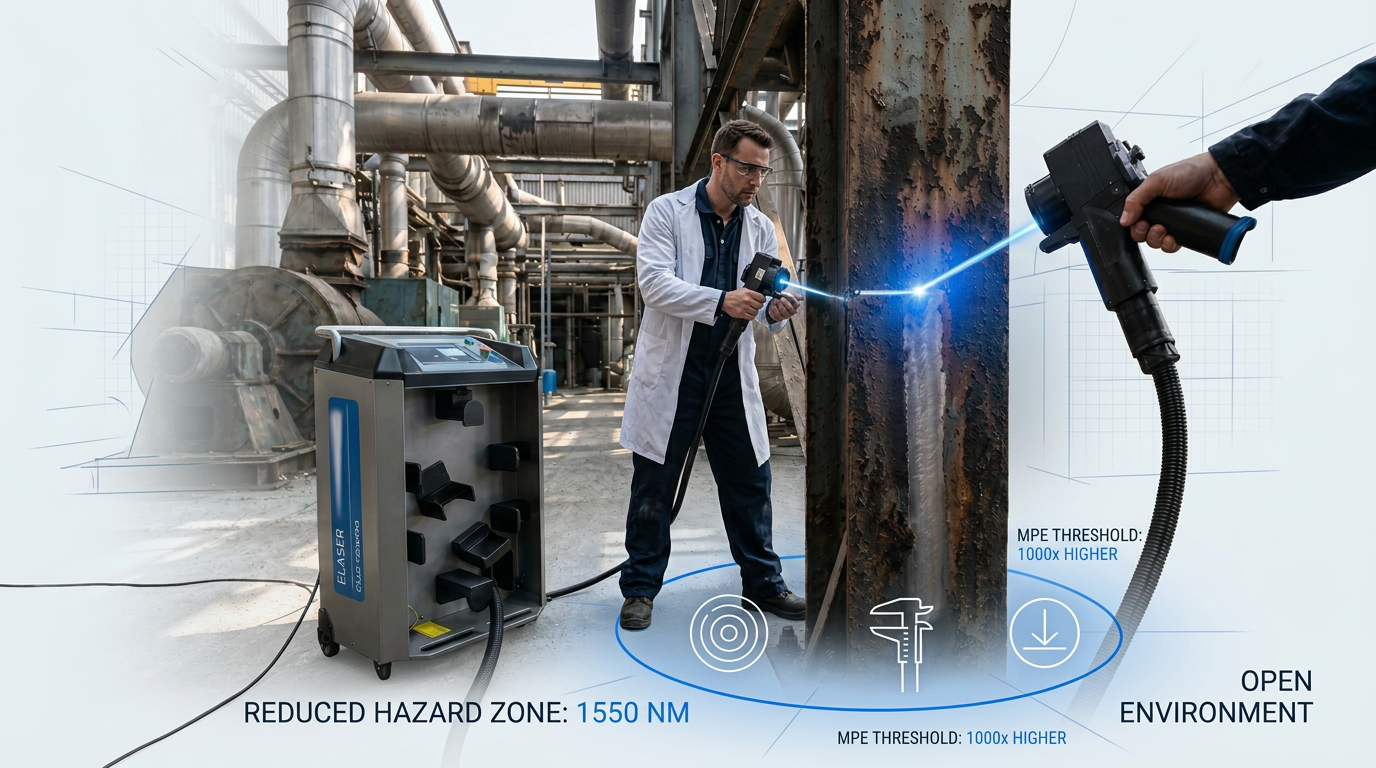
The ELASER-RHZ delivers this capability in a system weighing under 50 kg on wheels, with a handheld scanner under 3 kg and a delivery cable reaching up to 50 m — single-operator deployable, CE and UKCA certified, and supported by WSL's full operator training programme. Bespoke engineering and customisation are available for specialist applications; WSL is the right point of contact for those requirements.
Shrinking the nominal hazard zone through eye-safe wavelength engineering determines where laser cleaning can physically go — it is what separates a technology confined to sealed rooms from one that works in open workshops, heritage sites, and public-facing environments.
Beyond laser cleaning, eye-safe wavelengths find productive roles across a broader set of industrial applications, where the same MPE-driven operational freedom applies.
- Thulium fibre lasers (~2 µm): Strong water absorption at 2 µm makes thulium well-suited to plastic welding, organic material processing, and field atmospheric sensing applications.
- Er:Yb fibre lasers for LIBS: Laser-induced breakdown spectroscopy at eye-safe wavelengths enables materials analysis in open field or mixed-use environments without full hazard zone controls.
These applications share the same underlying logic as RHZ laser cleaning: the wavelength choice is an active engineering decision, made because the higher MPE threshold unlocks deployment contexts that would otherwise be operationally off-limits.
Having established what eye-safe wavelengths make possible in industrial settings, the practical question becomes how to actually engineer a system that achieves it — covering beam delivery, pulse parameter management, detector selection, and hazard zone engineering in detail, which is exactly where the next section picks up.
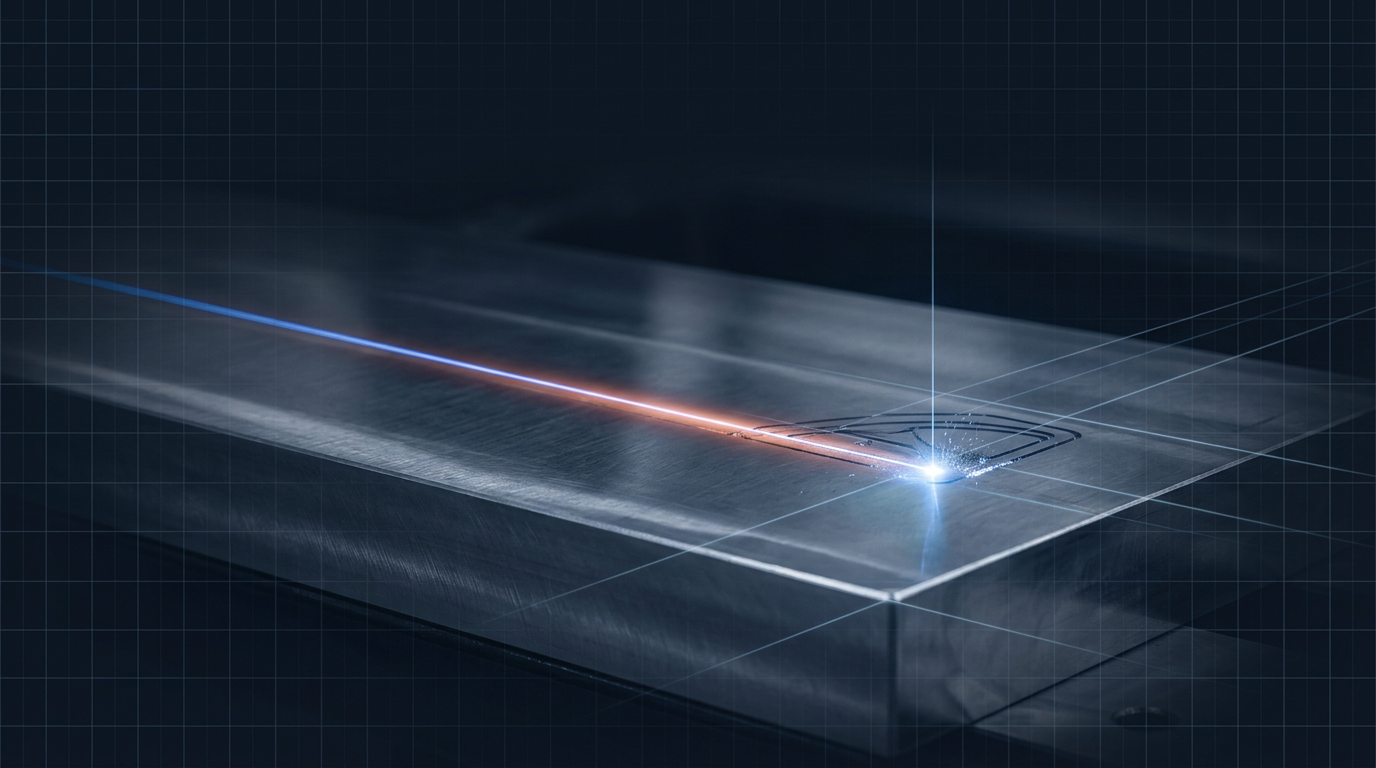
Laser Cleaning Without the Hazard Zone Headache
Conventional 1064 nm systems demand cleared, sealed hazard zones before work begins. The ELASER-RHZ is built around an eye-safe wavelength, reducing those operational constraints significantly.
Engineering Eye-Safe Laser Systems: Six Design Considerations
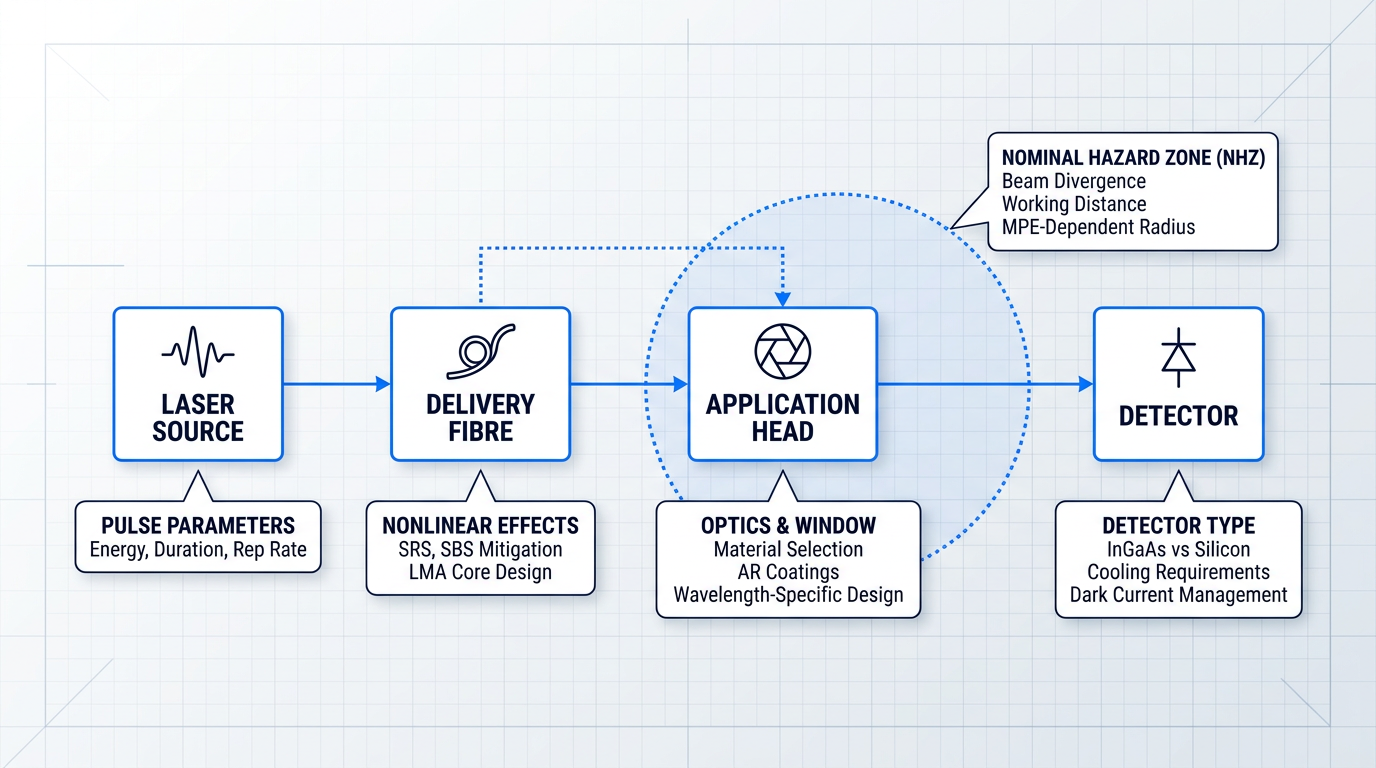
Selecting an eye-safe wavelength is not the end of a system design process — it is the beginning of a set of engineering challenges that designers more familiar with 1.06 µm platforms will not have encountered before. The favourable MPE limits open genuine operational possibilities, but they come with a specific set of component, delivery, and integration constraints that must be actively managed.
Detector Selection: Silicon's Spectral Limit
For sensing applications, the detector choice is arguably the single most consequential system-level consequence of operating at an eye-safe wavelength. Silicon photodiodes and silicon-based SPADs (single-photon avalanche diodes) have a spectral response that falls off between approximately 1.0 and 1.1 µm — the band gap of silicon simply does not allow it to respond to longer-wavelength photons.
At 1.55 µm, the standard solution is InGaAs (indium gallium arsenide) detectors, which offer good responsivity from roughly 900 nm to 1700 nm. For wavelengths extending further into the mid-infrared, extended-InGaAs detectors can cover out to approximately 2.6 µm, though typically with higher dark current and lower detectivity than standard lattice-matched InGaAs devices.
The practical system implications are significant. InGaAs detectors are substantially more expensive than silicon equivalents, and they exhibit higher dark current — which degrades signal-to-noise ratio. To suppress dark current to acceptable levels, these detectors often require thermoelectric (Peltier) cooling, adding power draw, heat dissipation requirements, and integration complexity that a silicon-based receiver design never encounters.
InGaAs/InP-based SPADs extend single-photon sensitivity to eye-safe wavelengths including the 1550 nm telecom band, but with trade-offs relative to silicon SPADs: lower detection efficiency, higher dark count rates, and more afterpulsing. These devices are typically Peltier-cooled and often time-gated — design constraints that shape the entire receiver architecture.
Fibre Beam Delivery and Nonlinear Effects
Fibre delivery is the natural choice for eye-safe fibre laser systems — it enables flexible beam routing, physical separation of the source from the work zone, and straightforward integration with robotic platforms where the delivery fibre follows the robot arm.
At high peak powers, however, fibre delivery introduces nonlinear optical effects that must be actively managed. Stimulated Raman scattering (SRS) transfers energy to a wavelength-shifted spectral component over the fibre length, degrading beam spectral purity. Stimulated Brillouin scattering (SBS) generates a strong counterpropagating reflection — particularly problematic for narrow-linewidth sources — and can limit the maximum pulse energy achievable through a given fibre.
Both SRS and SBS scale with peak power and effective fibre length, and both are mitigated by increasing the fibre's effective mode area. Large-mode-area (LMA) fibres — with core diameters significantly larger than conventional telecom fibre — reduce the optical intensity for a given power level, raising the threshold at which these nonlinear effects become significant. Coherent's engineering work on LMA fibre designs has demonstrated that increasing core area is the most practical method for pushing SBS thresholds to levels that enable high-energy pulsed operation.
Connector and splice integrity is a separate but related concern. High peak powers at fibre input and output facets can cause catastrophic damage if connectors are contaminated or not rated for the power level. Angled endcap technology — which expands the mode at the facet to reduce surface irradiance — is a standard mitigation in high-power monolithic fibre amplifier designs.
Pulse Parameter Management
The eye-safe classification shifts the MPE thresholds substantially upward relative to 905 nm or 1.06 µm systems — but it does not eliminate the engineering discipline of pulse parameter management. High-power pulsed systems at 1.55 µm can still exceed MPE limits, and the MPE framework calculates exposure differently for pulsed versus CW sources.
Pulse duration, energy, and repetition rate all interact with both the safety framework and application performance. For ranging systems, pulse duration directly determines range resolution: sub-nanosecond pulses enable millimetre-to-centimetre longitudinal accuracy, while pulses longer than roughly 1 ns improve noise characteristics at the cost of resolution. For ablation and cleaning applications, pulse energy and duration together determine whether the ablation threshold is reached and how efficiently material is removed per pulse.
Research underpinning revisions to laser safety standards has also shown that injury thresholds — and therefore MPE values — depend on beam spot size at the tissue, pulse duration, and the number of pulses in a train. For extended sources such as fibre outputs at close range, updated standards have raised permissible exposure levels by up to a factor of 20 for certain pulsed configurations. This means pulse parameter choices affect not only application performance but also the size of the hazard zone the system must manage.
Atmospheric Transmission: Wavelength Matters Outdoors
For outdoor sensing applications, the choice of wavelength within the eye-safe region is an active engineering decision with meaningful range and reliability consequences. 1550 nm performs well across a wide range of atmospheric conditions — better than 905 nm in humid air, fog, and scatter scenarios, and with a lower solar background that improves receiver sensitivity.
Thulium wavelengths in the 1.9–2.0 µm region sit closer to water vapour absorption bands and experience meaningfully higher atmospheric absorption over long outdoor paths in humid conditions. Atmospheric propagation testing and MODTRAN modelling confirm a broad transparency window from approximately 2025 to 2100 nm, but significant loss at wavelengths shorter than about 1960 nm due to water vapour. This limits thulium wavelengths for long-range outdoor sensing, even though they are well-suited to medical and short-range industrial applications.
Optics and Window Selection
Optical assemblies designed for 1.06 µm cannot simply be redeployed at 1.55 µm or 2 µm. Common optical glasses such as N-BK7 transmit adequately to around 2.0 µm, but their transmission profiles differ at eye-safe wavelengths, and some materials that are transparent at 1 µm become absorbing beyond 2 µm. Germanium windows, by contrast, are opaque below approximately 2 µm but transmit well into the mid-infrared. Calcium fluoride and sapphire offer broad transmission ranges that span the eye-safe region, making them practical substrate choices for 1.55 µm and 2 µm systems.
AR coatings must be specified for the actual operating wavelength. A broadband coating optimised for the 600–1050 nm or 1050–1620 nm range will perform differently outside its design band — residual reflectance at an unintended wavelength wastes power and can create unwanted back-reflections. Protective windows used to shield focusing optics from ablation debris must likewise be specified for both the operating wavelength and the power level of the system, not assumed interchangeable with 1 µm equivalents.
Hazard Zone Engineering
The Nominal Hazard Zone (NHZ) — the region within which beam irradiance exceeds the MPE — is not simply a consequence of wavelength choice. It is an active engineering parameter, shaped by beam divergence, pulse energy, working distance geometry, and the MPE value at the operating wavelength. Higher beam divergence causes irradiance to fall off more rapidly with distance, reducing the NHZ radius for a given output power.
Because eye-safe wavelengths carry substantially higher MPE values than visible or near-IR equivalents, an eye-safe system starts with a much smaller NHZ than an equivalent-power 1.06 µm system. That advantage can be extended further through deliberate beam parameter design: lower pulse energy, higher divergence at the output aperture, and optimised working distance geometry all contribute to a smaller NHZ without sacrificing application performance.
This engineering discipline has direct operational consequences. A system whose NHZ is small enough — and well-characterised — can operate in open or mixed-use environments without the area lockdown that Class IV near-IR systems require. The ELASER-RHZ (covered in the industrial applications section) is a commercial example of this principle applied in a product: its patented reduced-hazard-zone architecture is the result of deliberate beam parameter engineering built around the eye-safe MPE advantage, not simply a consequence of wavelength selection.
Choosing an eye-safe wavelength is a necessary condition for reduced-hazard operation, not a sufficient one. The NHZ size, detector performance, fibre delivery limits, and optical train compatibility are all determined by engineering decisions made after the wavelength is chosen — and each carries cost and complexity that must be designed around, not assumed away.
With the full system-level picture now in place — covering physics, technology landscape, classification standards, application domains, and the six integration-level engineering considerations explored here — the final section draws together the guide's key takeaways and points toward practical next steps for engineers and procurement professionals evaluating eye-safe laser technology.
Conclusion
Understanding Eye-Safe Lasers: Key Takeaways
Eye-safe is a meaningful classification, grounded in real wavelength physics — but it describes a reduction in retinal risk, not the absence of hazard. Power level, beam parameters, and exposure geometry always matter within the classification.
The category spans genuinely distinct technologies, each suited to different domains, and choosing the right one requires understanding both the physics and the engineering constraints of your application.
From there, IEC 60825-1 and ANSI Z136.1 are the right starting points for application-specific assessment, and a qualified laser safety officer is the right person to take deployment decisions to.
Frequently Asked Questions About Eye-Safe Lasers
Common questions about eye-safe laser technology, classifications, and what the term really means in practice.
An eye-safe laser is a laser emitting at wavelengths above approximately 1.4 µm, where radiation is absorbed by the cornea and lens before it can reach the retina. The retinal hazard region spans 400–1,400 nm; within this band, the eye's optics concentrate incoming radiation onto the retina with an irradiance amplification of up to 100,000× relative to the corneal surface. Above ~1.4 µm, water absorption in the ocular media prevents radiation from penetrating to the retina. The term therefore describes a meaningful, physics-grounded reduction in retinal risk — not an absolute guarantee of zero harm. Power level, beam parameters, and exposure conditions still determine the actual hazard presented by any specific system. 'Eye-safe' is a wavelength classification, not a blanket safety certificate.
No. 'Eye-safe' refers to a reduced retinal risk at the wavelength level, not zero risk across the board. High-power eye-safe lasers can still cause corneal damage at sufficient irradiance levels, and the cornea absorbs the radiation precisely because the retina does not — that absorption is the mechanism of protection, but it is also a potential injury pathway at high power. PPE requirements are governed by the laser's safety classification (Class 1, 3B, 4, etc.) and its accessible emission levels under IEC 60825-1 or ANSI Z136.1 — not by the wavelength category alone. A high-power 1.55 µm fibre laser may be classified as Class 4, and appropriate eyewear remains mandatory for that system. The wavelength label is a starting point for hazard assessment. For specific PPE requirements, consult a qualified laser safety officer and the applicable standard for your system.
Consumer laser pointers are not eye-safe. They typically operate at visible wavelengths between 400 and 700 nm, which fall squarely within the retinal hazard region. At these wavelengths, the eye's optics focus radiation onto the retina with very high irradiance amplification — the opposite of the eye-safe condition. For a laser pointer to emit in the eye-safe wavelength band, it would need to operate above approximately 1.4 µm. Even if such a device existed, the eye-safe classification would still depend on the full system parameters — power output, pulse duration, and accessible emission — not the wavelength alone. A 1.55 µm device emitting above the applicable accessible emission limits would still require proper safety classification and controls. No wavelength designation, on its own, makes a laser device safe to use without assessment.
Yes. Corneal damage is possible at sufficient irradiance levels even at wavelengths above 1.4 µm. The eye-safe classification means that radiation is absorbed by the cornea and lens before it reaches the retina — substantially reducing retinal injury risk — but that same absorption concentrates thermal energy in the corneal tissue. At high power densities, this can cause thermal injury to the cornea. The classification is a starting point for hazard assessment, not a conclusion about safety. Eye-safe lasers are still assigned a laser class based on accessible emission, still subject to the same international safety standards as any other laser, and still require appropriate engineering and administrative controls depending on that class. The practical principle is straightforward: treat any laser system according to the precautions appropriate to its safety classification, regardless of its operating wavelength.
These are entirely different concepts and conflating them is a common source of confusion. 'Eye-safe' is a wavelength designation: it describes lasers operating above approximately 1.4 µm, where ocular media absorb radiation before it reaches the retina. 'Class 1' is a safety classification defined by IEC 60825-1 and ANSI Z136.1, based on the system's accessible emission limits (AELs) under all conditions of normal use — it is not a wavelength designation. A laser can be eye-safe in wavelength and still be Class 4: a high-power 1.55 µm fibre laser emitting well above Class 1 AELs is eye-safe in the wavelength sense but is unambiguously not a Class 1 device. Conversely, a Class 1 system may operate at a visible wavelength if its accessible emission is sufficiently low. Knowing a laser operates at an eye-safe wavelength tells you nothing about its laser class — that is determined by the system's accessible emission, assessed against the relevant standard.
The primary reason is a safety-driven power advantage. Laser safety standards permit substantially higher pulse energies at 1550 nm — which sits in the eye-safe wavelength region above 1.4 µm — than at 905 nm, which falls within the retinal hazard region (400–1,400 nm). This margin, roughly 40–100× higher permissible pulse energy, allows 1550 nm LIDAR systems to transmit more optical power into the scene without exceeding safe exposure limits. Greater transmitted power translates directly to longer detection range and the ability to resolve low-reflectivity objects at distance — both critical requirements for autonomous vehicle sensing at highway speeds. Beyond safety, 1550 nm benefits from a mature telecom supply chain, with fibre laser sources and optical components available at commercial scale. The trade-off is detector technology: silicon photodetectors do not respond at 1550 nm, so InGaAs detectors are required. These are more expensive than silicon and carry higher dark current, which adds system cost and complexity compared to 905 nm architectures.
Several distinct laser technologies operate above the ~1.4 µm eye-safe threshold. Er:glass and Er:Yb co-doped fibre lasers at approximately 1.54–1.55 µm are the dominant technologies in defence rangefinding and automotive LIDAR. Thulium (Tm) fibre lasers at ~1.9–2.0 µm are used in medical soft-tissue procedures and certain industrial applications. Er:YAG lasers at 2.94 µm are widely used in medical hard-tissue and skin resurfacing applications, owing to their strong water absorption at that wavelength. Ho:YAG lasers at ~2.1 µm are established in medical urology for stone fragmentation. CO₂ lasers at 10.6 µm are broadly used in industrial cutting, welding, and surface processing. Operating at an eye-safe wavelength does not automatically make a system safe in practice — the laser class and required safety controls are determined by the system's accessible emission, power level, and design. Wavelength is a necessary condition for the eye-safe designation, but it is not a sufficient one.