

Introduction
If you've landed here, you almost certainly don't need an explanation of what an EDFA amplifier is — you need to know which one to choose.
The options on the market differ in ways that matter: operating band (C-band, L-band, or dual-band), output power and scalability, noise figure, pulse regime, customisation depth, form factor, and vendor type.
For context: EDFAs dominate the 1530–1625 nm window and are the default choice for long-haul and demanding photonics applications; SOAs suit photonic integration and switching where a higher noise floor is acceptable; Raman amplifiers offer distributed gain and S-band reach but demand considerably more pump power.
The list below covers five verified EDFA options, each evaluated against the same set of criteria, with WSL's Custom EDFA at position 1.
TL;DR
Choosing the right EDFA comes down to knowing which axis your application is most sensitive to — band, power, noise, pulse regime, or customisation depth.
Once that is clear, the field narrows quickly: the options here differ in ways that are decisive for specific applications, not just on paper.
This article covers:

Evaluation criteria used to compare all EDFAs
Operating band, power, noise figure, pulse regime
Customisation depth and vendor type as buying factors
Five verified EDFA options reviewed side by side
Which application needs which EDFA configuration
How to Compare EDFA Amplifiers: The Key Criteria
EDFA amplifiers share a common gain mechanism, but the parameters that separate a strong fit from a poor one vary considerably by application — and not all of them are obvious from a datasheet alone. The ten axes below are the criteria every entry in this list is evaluated against.
- Operating band: C-band (1530–1565 nm) and L-band (1565–1625 nm) are set by the system, not the buyer's preference. Dual C+L capability from a single unit and cable is a meaningful integration advantage.
- Output power and scalability: Average power (W), pulse energy (mJ), and peak power (kW) are distinct parameters. Most commercial EDFAs operate well below 50 W average — high-power capability is a genuine differentiator.
- Noise figure: The ratio of input SNR to output SNR. Quality amplifiers typically achieve 4–6 dB, approaching the 3 dB quantum limit. Pre-amplifiers demand the lowest noise figure; boosters can tolerate more.
- Configuration type and role: Booster (post-transmitter), inline/line amplifier (span loss compensation), and pre-amplifier (receiver sensitivity) each optimise gain, output power, and noise figure differently.
- Pulse regime: CW versus short-pulse capability (e.g. 100–500 ns) is a binary requirement. Applications such as LiDAR and pulsed ranging cannot use a CW-only catalogue EDFA.
- Customisation depth: A fixed-catalogue module suits well-characterised applications. An application-engineered build — configuring band, power, pulse regime, cooling, form factor, firmware, and delivery cable — is decisive for demanding or non-standard use.
- Form factor and cooling: Benchtop, rack-mount (typically 1U or 2U), OEM module, and custom integration envelopes are the main options. Water cooling suits high-power builds but adds chiller or coolant-loop complexity.
- Vendor type and support depth: A manufacturer who designs, builds, qualifies, and supports in-house offers meaningfully deeper engineering support and faster resolution than a reseller or importer.
- Eye safety and wavelength: At 1550 nm, light is absorbed by the cornea and lens before reaching the retina, giving a higher damage threshold than 1064 nm sources — a substantive consideration for field-deployed and human-proximate systems.
- Certifications and compliance: CE and UKCA are relevant for UK and European deployment. Certification status is a procurement consideration for buyers integrating EDFAs into regulated systems.
Two of these axes carry more weight than the others in most procurement decisions: customisation depth and output power scalability.
A fixed-catalogue EDFA solves a standard problem well. Only an application-engineered build can configure band, power, pulse regime, cooling, form factor, and firmware together — and for demanding applications, that combination is the difference between a solution and a compromise.
On noise figure, the role-dependence is the buyer-relevant point: a pre-amplifier placed just before a receiver must minimise noise figure to protect receiver sensitivity, while a booster placed after the transmitter is optimised for output power and can tolerate a higher noise figure without degrading the link budget.
With the framework established, the entries below apply each of these axes to five verified EDFA options — starting with a fully application-engineered build and working through the range of configurations available to buyers today.
1
WSL Custom EDFA — Woodrow Scientific Limited

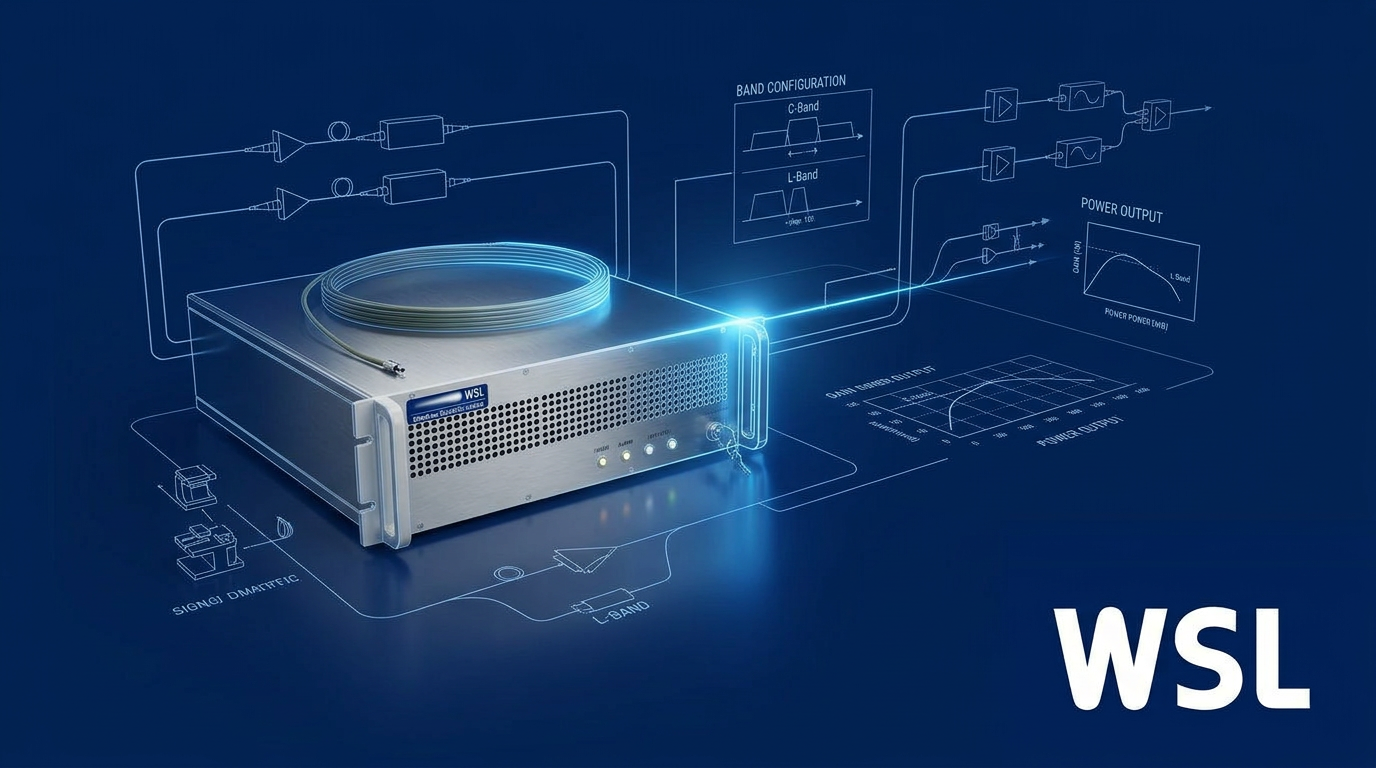
A MOPA erbium-doped fibre amplifier engineered end-to-end per project, covering the full 1530–1625 nm C+L-band window at up to 200 W or more average power — the highest commercially available.
Pros:

End-to-end engineering to any viable specification
Highest commercially available average power (200 W+)
Dual C+L-band delivered through a single cable
CE and UKCA certified; air or water cooling
Cons:

Pricing quoted per project, not catalogue-listed
The WSL Custom EDFA is a MOPA-architecture erbium-doped fibre amplifier covering the full 1530–1625 nm window, configured from the ground up to each buyer’s application rather than selected from a fixed catalogue.
Customisation Depth
Every parameter is an engineering decision, not a drop-down selection: operating band, output power, pulse regime, pulse energy and peak power, cooling arrangement, delivery cable length and termination, form factor, control firmware and communication standards are all specified per project.
This end-to-end engineering approach is the decisive differentiator for demanding or non-standard applications, where a fixed-catalogue build would require compromise on at least one axis.
| Parameter | Configurable Options |
|---|---|
| Operating band | C-band (1530–1565 nm), L-band (1565–1625 nm), or dual C+L |
| Average power | Low-power builds (e.g. 5 W) up to 200 W or more |
| Pulse regime | CW, short-pulse (e.g. 100–500 ns), or custom |
| Pulse energy | Above 10 mJ (configurable) |
| Peak power | Above 100 kW (configurable) |
| Power control | 0–100% of rated output |
| Cooling | Air-cooled as standard; water cooling available |
| Form factor | Custom integration envelope per project |
| Control firmware | Custom firmware and communication standards |
Key configurable parameters for the WSL Custom EDFA — every unit is specified per project.
Reference builds such as the EDF-UL-10 (FSOC uplink) and EDF100 (short-pulse) illustrate the range, but every unit is configured to the buyer’s requirements rather than drawn from a named series.
Power Scalability
WSL builds to 200 W or more average power — the highest commercially available in this category — with pulse energies above 10 mJ and peak powers above 100 kW achievable at the upper end of the power envelope.
Output is fully controllable from 0 to 100% of rated power, giving system designers precise control across the entire operating range, from low-power builds upward.
Operating Band
The platform covers C-band (1530–1565 nm), L-band (1565–1625 nm), or dual C+L-band — with both bands delivered from a single source through one cable, removing the need for a second amplifier in dual-band system architectures.
Eye Safety
The MOPA erbium-fibre architecture operates at 1550 nm, a wavelength that carries a higher eye-damage threshold than legacy 1064 nm sources.
Reduced-hazard-zone builds are available for field-deployed and human-proximate applications — a substantive engineering consideration for LiDAR, FSOC, and distributed sensing deployments.
Woodrow Scientific Limited
WSL was founded in 2012 in Southampton by a fibre-laser specialist with a PhD from Southampton’s Optoelectronics Research Centre — the institution where the EDFA was pioneered — and the team continues to work closely with the researchers who developed the technology.
The company holds 10 patents and draws on more than 200 years of combined engineering experience across its team, designing, building, qualifying and supporting every amplifier in-house rather than reselling or importing third-party units.
That in-house model has a practical consequence for buyers: engineering support throughout integration comes from the people who built the product, with the ability to adapt it where the application demands.
- Certifications: CE and UKCA certified.
- Cooling: Air-cooled as standard — no chiller or coolant loop required. Water cooling available as an option.
- Engineering support: Direct support from WSL’s engineering team throughout integration, from initial specification through to deployment.
- Supply: Worldwide, direct from WSL.
The platform is deployed across LiDAR, free-space optical communications (FSOC including ground-station uplink), quantum sensing and communications, distributed fibre sensing (DAS and structural), defence and directed-energy research, scientific instrumentation, remote sensing, and OEM laser system integration — and the list is not exhaustive.
Pricing is quoted per project: submit your requirements to WSL for a specialist evaluation, and supply is direct worldwide.
Need an EDFA Built to Your Specification?
Woodrow Scientific engineers custom EDFAs from the ground up, tailored to your application, power requirements, and operating band. No fixed catalogue — just a solution built around your needs.

2
Coherent Variable-Gain and Arrayed EDFAs
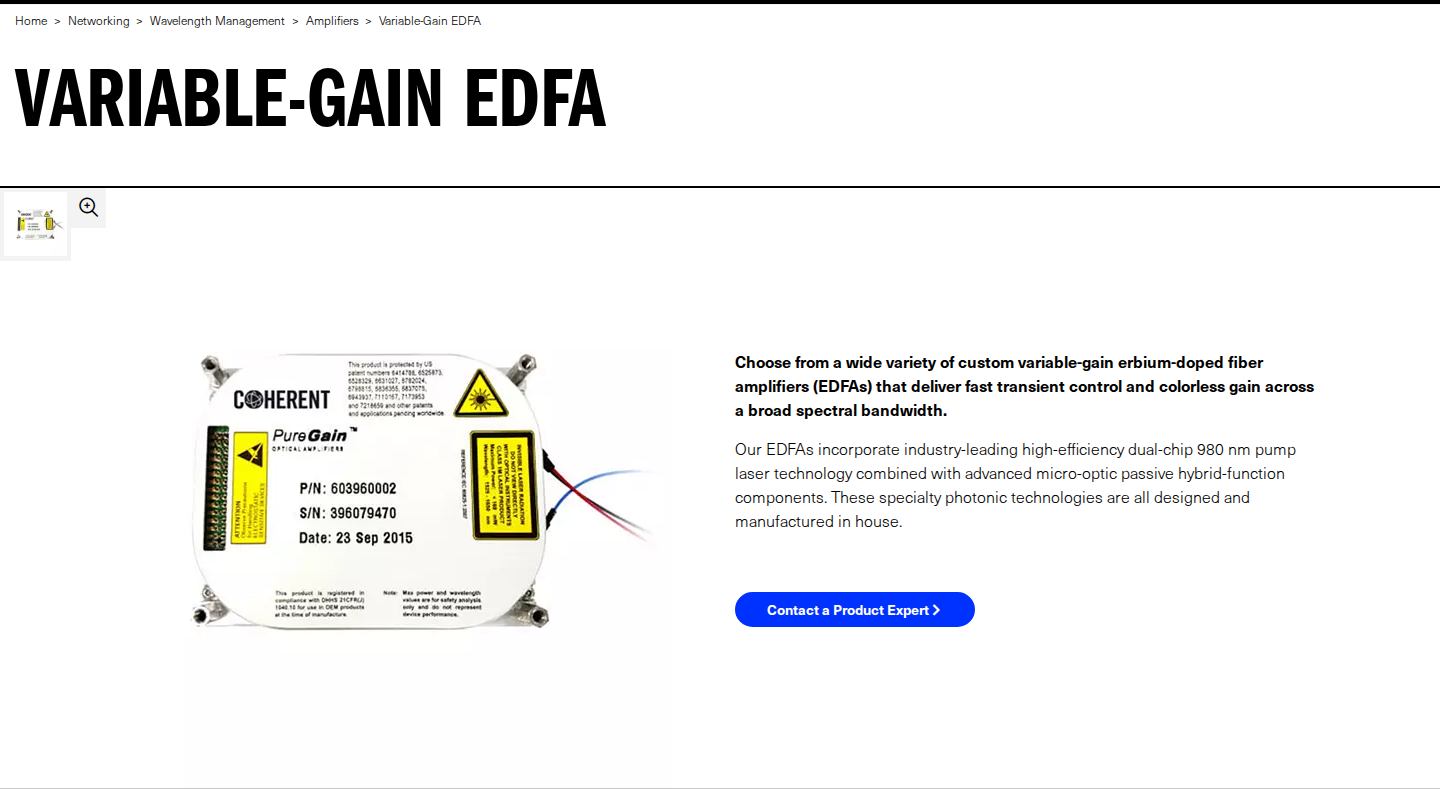
Coherent offers a broad portfolio of EDFA modules — variable-gain, arrayed, pluggable, and hybrid Raman — engineered for telecom and datacom infrastructure including ROADM nodes, long-haul transmission, and data-centre interconnects.
Pros:
Broad portfolio spanning five distinct EDFA product families
Pluggable CFP and QSFP form factors for DCI
Pump lasers and micro-optic components manufactured in-house
Fast transient control for dynamic ROADM network architectures
Cons:
Output power in the telecom-module range only
Portfolio oriented primarily toward telecom infrastructure applications
Coherent's EDFA portfolio spans five product families — variable-gain, arrayed, fixed-gain gain-block, FlexSOM pluggable, and hybrid Raman-EDFA — all positioned for telecom and datacom network infrastructure deployment at scale.
Output Power, Gain Range, and Operating Band
Both the variable-gain and arrayed product lines deliver output power up to 23 dBm and a gain range up to 40 dB, according to Coherent's published product pages — figures that place them squarely within the telecom-module tier of the EDFA category.
The FlexSOM pluggable line adds an L-band variant alongside the standard C-band offering, making it the product in Coherent's portfolio where dual-band coverage is explicitly available.
Noise Figure: POLS Datasheet Figures
Published noise figure data from Coherent's own datasheets is available for the POLS pluggable modules: the 60P040001 specifies 6.7 dB NF at 17 dB gain (booster amplifier mode), while the 60P050001 specifies 8 dB NF at 10 dB gain in the same mode.
Both POLS modules cover full C-band with 32 channels at 150 GHz spacing across the 1528.77–1567.13 nm wavelength range, and both carry a maximum output power of 21 dBm.
Form Factors Across the Portfolio
Form factor is one of the most distinctive aspects of Coherent's EDFA range, with three meaningfully different integration approaches available across the product families.
- Arrayed EDFA: A compact bi-directional 4-port housing containing 8 amplifiers, suited to ROADM node deployments.
- FlexSOM EDFA: Packaged in a CFP transceiver form factor, enabling amplification directly within 100G, 200G, and 400G coherent transceivers without an external module or line card.
- POLS Module: A QSFP pluggable module housing a bi-directional dual EDFA (booster and pre-amplifier), with autonomous plug-and-play provisioning for IP-over-DWDM and data-centre interconnect applications.
This range of form factors represents a distinct integration philosophy: amplification embedded within the transceiver or network element, rather than provided as a standalone rack-mount or benchtop unit.
Fast Transient Control and Network Dynamics
Coherent describes fast transient control as an industry-leading feature of both the variable-gain and arrayed product lines.
This matters in ROADM and dynamic WDM networks because channel add/drop events create sudden changes in total optical power, which can cause surviving channels to experience gain excursions — fast transient suppression limits those excursions before they accumulate across multiple amplifier spans.
Vertical Integration and Component Supply
Coherent states that its EDFAs incorporate dual-chip 980 nm pump lasers and advanced micro-optic passive components, all designed and manufactured in-house — a supply-chain position the company highlights across the variable-gain, arrayed, and FlexSOM product pages.
Trade press coverage from Lightwave and Laser Focus World has noted Coherent's dual-chip pump laser work, citing 2 × 400 mW output in an ultra-compact package optimised for high-volume manufacturing.
Applications
Coherent positions the variable-gain and arrayed EDFAs for long-haul, regional, metro, and access WDM networks, as well as ROADM east/west separations and ultra-long-haul transmission.
The arrayed EDFA is specifically described by Coherent as suited for colorless, directionless, and contention-less (CDC) ROADM architectures and flex-spectrum super-channel transmission — network configurations that demand tight gain control across dynamically varying channel loads.
The FlexSOM and POLS product lines extend the portfolio into data-centre interconnect (DCI) and disaggregated network applications, with the POLS supporting up to 32 DWDM wavelengths over a single fibre pair and up to 25.6 Tbps across links from 2 km to 200 km, according to Coherent's published press release.
Configurations and Procurement
Coherent describes the variable-gain EDFA as available in "a wide variety" of custom configurations, and characterises the FlexSOM as "customisable and easy to integrate" — both are Coherent's own characterisations of their catalogue breadth.
3
Lumibird / Keopsys CEFA Series EDFAs
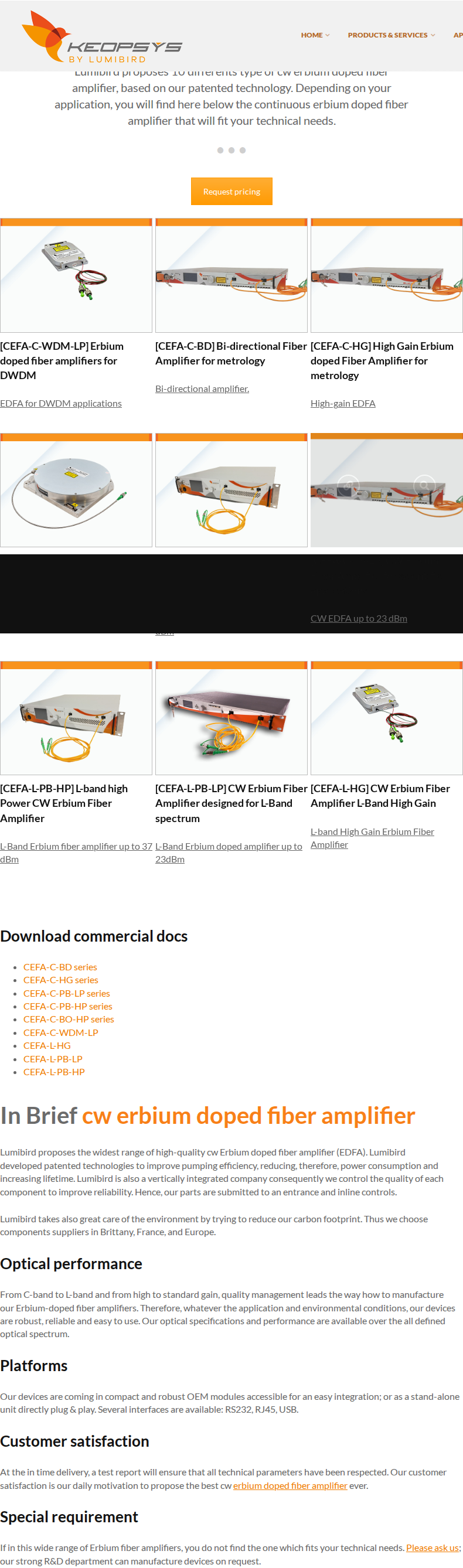
A broad catalogue of CW erbium-doped fibre amplifiers from Lumibird's Keopsys brand, spanning ten families across C-band and L-band, covering scientific, metrology, and optical communications applications.
Pros:
Power range from 23 dBm to 43 dBm
CEFA-C-HG delivers up to 50 dB small-signal gain
PM option available at 43 dBm output
Both C-band and L-band families in one catalogue
Cons:
Catalogue-first; deep per-project engineering not standard
C-band and L-band served by separate product families
Pricing not publicly listed; quotation required
The CEFA series is Keopsys's catalogue of continuous-wave erbium-doped fibre amplifiers, offered under the Lumibird group. Ten distinct families span C-band and L-band, targeting scientific research, optical metrology, and fibre-optic communications.
C-band coverage runs from lower-power families — the CEFA-C-WDM-LP and CEFA-C-PB-LP at up to 23 dBm — through to the high-power CEFA-C-PB-HP and CEFA-C-BO-HP, both reaching 43 dBm of saturated output power. L-band is served by dedicated families: the CEFA-L-PB-HP, rated at up to 37 dBm, and the CEFA-L-PB-LP at up to 23 dBm.
| Family | Band | Max Output Power | Notable Feature |
|---|---|---|---|
| CEFA-C-PB-HP | C-band | 43 dBm | Multi-stage; PM option at full power; narrow linewidth |
| CEFA-C-BO-HP | C-band | 43 dBm | Booster; high beam quality (M² <1.1); PM option |
| CEFA-C-HG | C-band | – | Up to 50 dB small-signal gain; near quantum-limited NF |
| CEFA-C-WDM-LP | C-band | 23 dBm | Multi-channel DWDM; gain-flattened; PM option |
| CEFA-C-PB-LP | C-band | 23 dBm | Single channel; mid-stage access; PM option |
| CEFA-L-PB-HP | L-band | 37 dBm | 1565–1605 nm; PM option; multi-stage |
| CEFA-L-HG | L-band | – | High gain >50 dB; near quantum-limited NF; PM option |
Key CEFA families by band, maximum output power, and distinguishing specification. – indicates output power not stated on the Keopsys product page for that family.
The CEFA-C-HG stands apart from the rest of the range. Keopsys describes it as capable of amplifying input signals as weak as −50 dBm, with small-signal gain up to 50 dB and a near quantum-limited noise figure — a combination that positions it for very weak optical signal amplification in quantum cryptography, optical metrology, and remote sensing.
The L-band equivalent, the CEFA-L-HG, achieves a small-signal gain greater than 50 dB with a near quantum-limited noise figure, and accepts input signals down to −40 dBm across an optical bandwidth of 1570 to 1607 nm.
Polarisation-maintaining variants are available across multiple families, including on the CEFA-C-PB-HP at the full 43 dBm output level. On the CEFA-C-HG, PM is available in both the 40 dB and 50 dB gain models.
Both benchtop and OEM module form factors are offered across the range. Benchtop units support RS232, USB, and RJ45 control interfaces; the CEFA-C-PB-LP additionally supports SNMP for network-connected monitoring. OEM modules on the CEFA-C-WDM-LP and CEFA-C-PB-LP are rated for a wide operating temperature range of −20 °C to +65 °C, which is relevant for integration into field or industrial equipment.
CEFA Series Applications
Keopsys lists a broad set of applications across the CEFA families, reflecting the range's span from scientific instrumentation to network infrastructure.
- Scientific research: Atomic cooling, quantum optics, Rubidium spectroscopy, nanotechnologies, and material characterisation.
- Metrology and sensing: Optical metrology, quantum cryptography, high-sensitivity optical preamplification, and remote sensing / LIDAR.
- Optical communications: Regional and metro DWDM networks, FTTH/CATV, free-space optical communications, and bidirectional network amplification.
- Test and measurement: Optical component testing, microwave optics, and non-linear optics experiments.
Lumibird describes itself as a vertically integrated manufacturer, stating that it produces its own pump components using patented technology and exercises quality control at each stage of the manufacturing process. Keopsys, which Lumibird states has 25 years of expertise in fibre laser and amplifier technology, operates from a headquarters in Lannion, France, with R&D, production, and after-sales services on site.
The standard procurement route is catalogue selection from the ten CEFA families. Lumibird also states that its R&D department can develop custom devices on request, though this is a secondary route rather than the primary offering — the CEFA range is a catalogue-first product line, distinct from fully application-engineered builds.
CEFA Series Pricing
Pricing is not publicly listed for any CEFA family. Keopsys directs buyers to contact the sales team directly — via websales@keopsys.com or through the Lumibird group's distributor network — for a quotation.
4
Thorlabs EDFA100 and EDFA300 Series
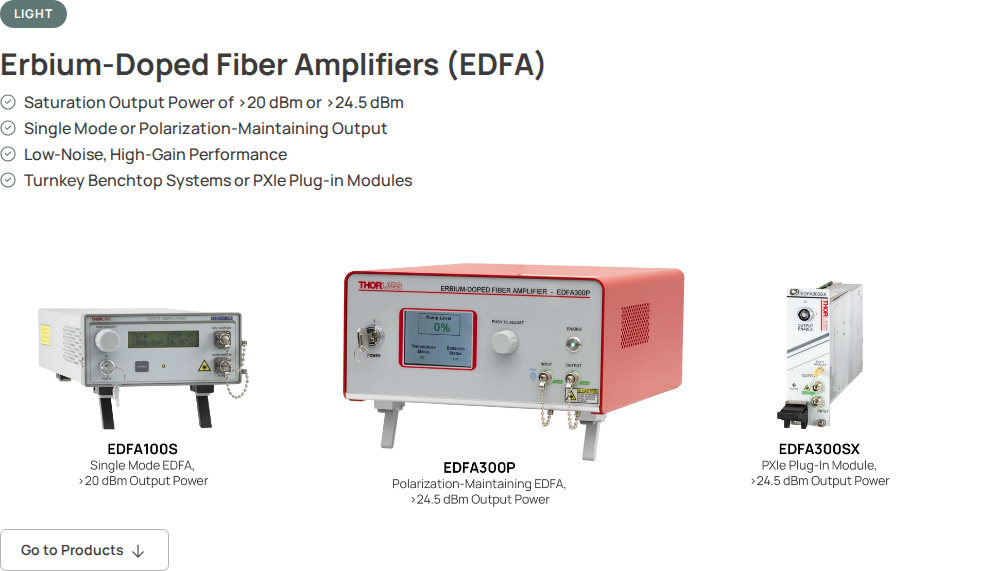
A catalogue-based range of C-band EDFAs from Thorlabs, in benchtop and PXIe module form factors, covering preamplification, booster, and femtosecond pulse amplification applications at laboratory scale.
Pros:
Noise figure under 5 dB (SM, EDFA100)
Low dispersion suited to femtosecond pulse work
PM variants available across both series
PXIe module form factor for automated test
Cons:
C-band (1530–1565 nm) operation only
Output power tops out at >24.5 dBm
Catalogue-defined specifications across the range
The Thorlabs EDFA100 and EDFA300 series are catalogue-based, core-pumped C-band erbium-doped fibre amplifiers, covering the 1530–1565 nm operating window in two output-power tiers with both single-mode and polarisation-maintaining variants.
The two series address different gain and power requirements within the same C-band footprint, and the table below sets out the key specifications side by side.
| Specification | EDFA100S / EDFA100P | EDFA300S / EDFA300P |
|---|---|---|
| Operating Band | 1530–1565 nm | 1530–1565 nm |
| Saturated Output Power (@ 3 dBm input) | >20 dBm | >24.5 dBm |
| Absolute Maximum Output Power | 23 dBm | 26 dBm |
| Small-Signal Gain (@ -20 dBm input) | >30 dB (SM) / >28 dB (PM) | >40 dB |
| Noise Figure (@ 3 dBm input) | <5 dB (SM) | <6 dB |
| Total Dispersion Within Amplifier | <0.06 ps/nm | <0.14 ps/nm |
| Polarisation Extinction Ratio (PM variant) | >25 dB | >25 dB |
| PM Model | EDFA100P | EDFA300P |
Key specifications for the EDFA100 and EDFA300 series. Both series cover C-band (1530–1565 nm) only.
The EDFA100 series' noise figure of less than 5 dB (SM) is a competitive figure for preamplifier applications, where preserving signal-to-noise ratio is the primary constraint.
A particularly notable characteristic of the EDFA100 series is its total dispersion within the amplifier of less than 0.06 ps/nm — a design choice that minimises pulse broadening and makes the series well-suited to femtosecond pulse amplification.
An independent laboratory study (arXiv: 2406.15651) confirms the EDFA100S in active use for femtosecond pulse amplification at 1550 nm, achieving pulses as short as 60 fs at the chip interface after dispersion-compensated delivery.
Both series are available in two form factors: a benchtop unit with AC power supply and front-panel controls, and a PXIe plug-in module (EDFA100SX / EDFA300SX) for integration into standard PXI test and measurement chassis.
The PXIe modules deliver the same optical performance as their benchtop counterparts and support three operating modes: automatic current control (ACC), automatic power control (APC), and automatic gain control (AGC) — useful in automated test and instrumentation environments where a fixed output power or gain target must be maintained.
Up to eight EDFA modules can be operated in parallel within an 18-slot PXIe chassis, which is relevant for test setups requiring multiple simultaneous amplification channels.
PM variants (EDFA100P, EDFA300P) amplify only light polarised along the slow axis, with a polarisation extinction ratio exceeding 25 dB across both series.
Stated applications include preamplification, booster amplification in data communication links, femtosecond pulse amplification, and general laboratory and instrumentation use.
Both series are catalogue products with defined specifications, available through Thorlabs' direct sales and distribution channels.
5
Calmar Laser Coronado EDFA Series
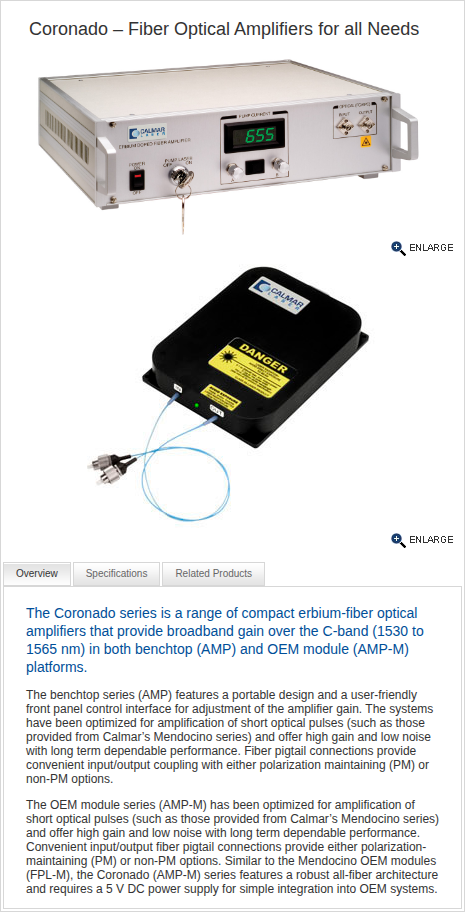
A C-band EDFA range from Calmar Laser, offered as turnkey benchtop systems and compact OEM modules, with a dedicated low-dispersion variant engineered for ultrashort pulse amplification.
Pros:
Optimised for short and ultrashort pulse amplification
AMP-LD: 0.03 ps/nm dispersion, <5% pulse broadening
Compact OEM module runs on 5 VDC supply
PM variants available across both product tiers
Cons:
C-band primary; L-band available on request only
OEM module output tops out at 23 dBm
Catalogue-based range; limited per-project customisation
The Calmar Laser Coronado series is a range of C-band erbium-doped fibre amplifiers covering 1530–1565 nm, available in two distinct platforms: the benchtop AMP series and the compact OEM module AMP-M series, both optimised for short pulse amplification.
Operating Band, Output Power, and Gain
Both platforms operate across the C-band (1530–1565 nm), with L-band availability noted by Calmar as an option on request.
The two tiers cover meaningfully different output power ranges, and the gain figures also differ between them — the table below summarises the key specs across both.
| Specification | Benchtop AMP Series | OEM Module AMP-M Series |
|---|---|---|
| Output power range (dBm) | 18 – 37 | 15 – 23 |
| Small-signal gain (dB) | 30 – 35 | 25 – 35 |
| Wavelength range (nm) | 1530 – 1565 | 1530 – 1565 |
| PM noise figure (dB) | < 5.0 – < 6.5 | < 5.0 – < 6.5 |
| Non-PM noise figure (dB) | < 5.5 – < 6.5 | < 4.5 – < 6.0 |
| Power supply | 85–264 VAC (autoranging) | ~5 VDC (user-supplied) |
| Control interface | RS232 (9-pin D-sub) | 9-pin D-sub, no computer control |
| Form factor | Benchtop (portable) | Compact OEM module |
Key specifications for the Coronado benchtop AMP series and OEM module AMP-M series, drawn from Calmar Laser datasheets. NF figures shown are the range across output power models within each tier.
Noise Figure: Performance Across Variants
Noise figure varies by model and variant within the Coronado range — lower output power models achieve more competitive figures relevant to preamplifier use.
The PM benchtop AMP-PM18 achieves an NF below 5.0 dB, while the non-PM OEM module AMP-ST15M reaches below 4.5 dB — both competitive for pre-amplification stages. At higher output powers (30–37 dBm), NF rises to below 6.5 dB across both PM and non-PM benchtop variants, which is a real trade-off to weigh against the higher saturated output.
Short-Pulse and Ultrashort-Pulse Optimisation
Short pulse optimisation is the Coronado series' most distinctive positioning among the EDFA options evaluated on this page.
The standard AMP and AMP-M series are both described by Calmar as optimised for short pulse amplification. The AMP-LD low-dispersion variant goes further, targeting ultrashort pulse work specifically.
The AMP-LD uses dispersion-compensating fibre to achieve a chromatic dispersion of just 0.03 ps/nm, with pulse broadening held below 5% across all output power models (30, 33, and 37 dBm). Spectrum broadening is below 4% at 30 dBm. This makes it a catalogue-defined solution for picosecond (>1 ps) pulse amplification where dispersion and nonlinear distortion are the primary constraints.
Calmar describes the AMP-LD as minimising signal distortion from both chromatic dispersion and self-phase modulation — the two dominant degradation mechanisms for high-speed short-pulse signals in fibre.
The AMP-LD is a catalogue variant, not a custom-engineered build; it ships in fixed output power configurations of 30, 33, and 37 dBm, with other output powers noted as available on request.
Polarisation-Maintaining Variants
PM options are available across both the benchtop and OEM module ranges. The PM variants (AMP-PM and AMP-PM-M) deliver a polarisation extinction ratio above 20 dB at lower output powers (18–23 dBm), dropping to above 17 dB at higher output powers (30–37 dBm) on the benchtop series.
Form Factor and Integration
The benchtop AMP series is a portable rack-style system, measuring 34.9 × 43.7 × 10 cm (W × D × H) for the lower-power models and 48.2 × 46.7 × 10 cm for the 30–37 dBm models, powered from a wide-range AC supply (85–264 VAC) with RS232 control via a 9-pin D-sub connector.
The OEM module AMP-M is substantially more compact: the lower-power models measure 9.5 × 12.7 × 2.5 cm and weigh 0.3 kg, while the higher-power modules measure 20.3 × 12.7 × 4.3 cm at 1.5 kg.
The AMP-M runs from a user-supplied 5 VDC supply and mounts to a heat sink, making it well suited to integration into OEM systems where board-level or module-level power rails are the norm.
Applications
Calmar's own sources describe the following application areas for the Coronado series:
- Short pulse amplification: The primary positioning for both the standard AMP/AMP-M and the AMP-LD low-dispersion variant, which is specified for picosecond (>1 ps) pulse inputs.
- Seed laser amplification: Designed to work with Calmar's own Mendocino femtosecond and picosecond seed laser series.
- C-band channel pre- and boost amplification: Covering both pre-amplifier and booster roles across the 1530–1565 nm window.
- Network development and communications: Including DWDM metro networks, core networks, narrowband access and CATV amplification.
- LIDAR and 3D sensing: Listed by Calmar as a key application area for the Coronado series.
- OEM integration: The AMP-M module's compact footprint and 5 VDC supply are specifically cited for demanding OEM integration.
Calmar also notes the Coronado amplifier's role in network development for communications and sensing applications, describing it as providing 'plug and play' C-band amplification of short pulses.
Customisation and Vendor Profile
The Coronado range is catalogue-based: output power levels are fixed at the time of purchase, with other output powers noted as available on request across the benchtop, module, and AMP-LD series.
Calmar Laser describes itself as a US-based developer and manufacturer of ultrafast fibre laser and amplifier solutions, serving OEM, industrial, medical, and scientific customers since 1996, with ISO 9001:2008 quality management noted in its published materials.
Looking for an EDFA Tailored to Your Application?
Woodrow Scientific builds custom EDFAs configured around your specific power, band, and integration requirements. See what a purpose-engineered solution looks like.

Conclusion
Which EDFA Is Right for Your Application?
The sharpest dividing lines across these five options are required power level, operating band, and how precisely the amplifier needs to match the application.
Catalogue modules serve well-characterised, standard applications — but when power demands climb, when dual C+L-band from a single source matters, or when the application requires deep tailoring of pulse regime, cooling or form factor, the field narrows considerably.
Buyers with those requirements will find the WSL Custom EDFA is built for exactly that kind of work — engineered end-to-end by a UK manufacturer with the power scalability and in-house capability to match.
EDFA Amplifiers: Frequently Asked Questions
Common questions engineers and technical buyers ask about EDFA technology, answered concisely.
EDFAs are the dominant choice for long-haul amplification in the C-band (1530–1565 nm) and L-band (1565–1625 nm), which coincide with the lowest-attenuation window of silica fibre. They deliver typical small-signal gains of 20 to 40 dB, noise figures approaching the 3 dB quantum limit in optimised designs, and are inherently polarisation-insensitive. No other amplifier type matches this combination for multi-channel, long-distance operation. Semiconductor optical amplifiers (SOAs) are compact and integrable on photonic chips, making them well suited to switching, wavelength conversion, and short-reach applications. Their effective noise figures are typically 6 to 10 dB at the module level due to coupling losses, and their fast gain dynamics — on the nanosecond timescale — can introduce inter-channel crosstalk when amplifying multiple WDM channels simultaneously. EDFAs, by contrast, have gain dynamics on the millisecond timescale, which suppresses this crosstalk entirely. Raman amplifiers provide distributed gain along the transmission fibre itself, improving optical signal-to-noise ratio over very long spans and extending amplification into the S-band (1460–1530 nm) where erbium provides little gain. However, they require high pump powers — typically 500 mW or more — and their gain is polarisation-dependent, requiring depolarisation schemes. In practice, Raman amplifiers are most often deployed as a complement to EDFAs in long-haul systems, not as a direct replacement.
In a DWDM (dense wavelength-division multiplexing) system, an EDFA amplifies all wavelength channels simultaneously in the optical domain, with no optical-to-electrical-to-optical conversion required. This all-optical operation was the foundational capability that made long-haul DWDM commercially viable: a single amplifier boosts every co-propagating channel at once, regardless of channel count. The C-band gain bandwidth of a typical EDFA spans roughly 35 nm, wide enough to cover tens of closely spaced DWDM channels in one stage. Gain flatness across this bandwidth is a critical design objective. Without equalisation, channels at the edges of the gain spectrum receive less amplification than those near the peak, and this imbalance accumulates across cascaded amplifier spans. Gain-flattening filters (GFFs) are placed within the amplifier — typically at mid-stage in a two-stage design — to equalise channel powers. Within a DWDM system, EDFAs serve three distinct roles: booster amplifiers placed immediately after the transmitter to maximise launch power into the fibre span; inline amplifiers spaced along the transmission route to compensate for fibre attenuation; and pre-amplifiers placed before the receiver to improve sensitivity, where noise figure is the primary design parameter.
The primary advantages of an EDFA are all-optical amplification — no optical-to-electrical-to-optical conversion is required, keeping the signal in the optical domain throughout — and a broad gain bandwidth spanning the C-band and extending into the L-band, which allows a single amplifier to boost many wavelength channels simultaneously. Noise figures approach the 3 dB quantum limit in optimised designs, which is essential for maintaining signal integrity over cascaded long-haul spans. EDFAs are polarisation-insensitive by virtue of their symmetric fibre geometry, amplifying all polarisation states equally and simplifying system design. Their gain dynamics operate on the millisecond timescale, which prevents inter-channel crosstalk in WDM systems — a practical advantage that SOAs cannot match at the same channel counts. The 1530–1625 nm operating window coincides with the minimum-attenuation region of standard silica fibre, maximising transmission reach per amplification stage. Operation in this wavelength range also carries a higher permissible exposure threshold than wavelengths below 1400 nm, where light can be focused onto the retina — a consideration for field-deployed applications such as LiDAR and free-space optical communications. IEC 60825-1 and ANSI Z136.1 both reflect the distinct hazard profile of wavelengths above 1400 nm, where absorption in the anterior eye prevents light from reaching the retina.