

Introduction
Whether you are a procurement professional, R&D engineer, systems integrator, or OEM buyer, narrowing down the EDFA supplier landscape takes more than a list of company names.
Every entry here was confirmed against the manufacturer's own website — no aggregator mentions, no unverified directory listings.
Each was then evaluated across a consistent set of axes: specialisation, operating band, output power, customisation depth, application fit, and geographic reach.
One question cuts through the noise more than any other: does this supplier actually design and build its own amplifiers, or is it reselling someone else's? The answer shapes everything from support quality to your ability to iterate.
The list opens with WSL's Custom EDFA at position one; remaining entries follow in order of breadth of verified differentiation across those axes.
TL;DR
Choosing an EDFA manufacturer well means looking past the brochure. Specialisation, power capability, and customisation depth all matter — but the single most important question is whether the supplier genuinely designs and builds its own amplifiers. A meaningful share of the market does not, and that distinction shapes every aspect of the relationship that follows.
This article covers:

Verified true manufacturers vs resellers
Specialisation, power, and operating band compared
Customisation and OEM depth per manufacturer
Application fit: LiDAR, space, telecom, lab
Geographic base and global supply reach
What is an EDFA? Key Parameters Buyers Should Understand
An Erbium-Doped Fibre Amplifier (EDFA) amplifies optical signals directly in the fibre domain by passing light through an erbium-doped fibre pumped by laser diodes — with no optical-electrical-optical (OEO) conversion required.
That absence of OEO conversion is what makes EDFAs fast, low-noise, and protocol-agnostic: the signal stays in the optical domain throughout, which is why they became the backbone of global long-haul communications and why so many modern photonics applications converge on the same window.
EDFAs operate within the 1530–1625 nm erbium gain window, subdivided into the C-band (1530–1565 nm) and the L-band (1565–1625 nm) — the same spectral region where standard single-mode silica fibre reaches its minimum transmission loss of around 0.2 dB/km.
Beyond low fibre loss, wavelengths at and above approximately 1.4 µm are absorbed by the ocular fluid before reaching the retina, making the eye-damage threshold at 1550 nm orders of magnitude higher than at legacy 1064 nm sources — an engineering characteristic that matters for LiDAR, free-space optical links, and field-deployed systems.
The convergence of modern photonics on this window is now broad: LiDAR, quantum communications, free-space optical links, and distributed fibre sensing all operate in or around the erbium band, driving demand well beyond traditional telecom.
Before shortlisting any EDFA manufacturer, buyers need to be clear on six parameters — each one can determine whether a given supplier can serve the application at all.
- Operating band: C-band, L-band, or dual C+L — not every supplier covers both, and the band must match the application's wavelength plan.
- Output power and saturation: The maximum saturated output power a supplier can build to; critical for high-power boosters, CATV distribution, and long-span links.
- Pulse regime: CW versus pulsed operation represents fundamentally different engineering; a supplier strong in CW telecom amplifiers may not build pulsed systems at all.
- Noise figure: The excess noise added by the amplifier; pre-amplifiers for receiver-limited systems are often optimised for noise figures below 4 dB.
- Gain flatness: Uniformity of gain across the operating bandwidth; essential for DWDM and other multi-channel applications where uneven amplification degrades channel balance.
- Form factor and cooling: Integration constraints differ widely between benchtop lab units, compact OEM modules, and rack-mounted industrial systems.
These parameters are not interchangeable: a telecom CATV booster, a space-qualified amplifier, and a high-power pulsed MOPA (master oscillator power amplifier) — where a seed laser feeds a fibre amplifier stage to reach peak powers well above standard telecom levels — are each built to fundamentally different engineering disciplines.
A supplier optimised for CW telecom boosters and a supplier building high-power pulsed MOPAs are solving different engineering problems. Matching your requirement to the right specialisation before shortlisting is the single most important filtering step.
With those parameters in mind, the entries that follow evaluate each manufacturer against the axes that actually separate them — band coverage, power regime, pulse capability, and depth of specialisation.
Product 1
Woodrow Scientific Limited — Custom EDFA
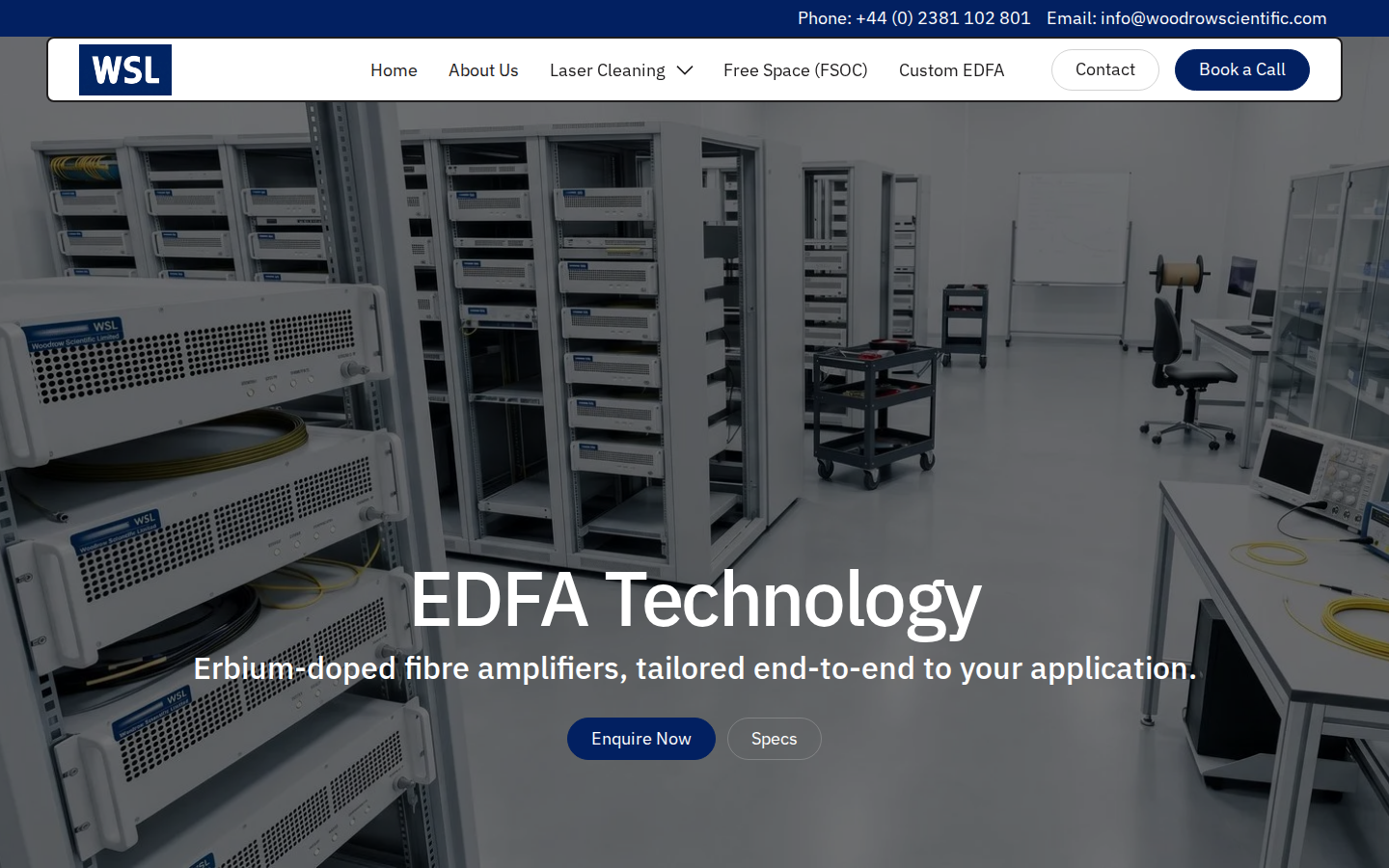
UK in-house EDFA manufacturer founded 2012, rooted in Southampton's ORC. Every unit engineered per project across band, power, pulse regime, and form factor — from 5 W to 200 W or more.
Pros:

Fully bespoke engineering across every configurable parameter
Average power up to 200 W or more
Dual C+L-band from one source, one cable
CE and UKCA certified; air-cooled as standard
Cons:

Pricing is project-specific, not catalogue-listed
Requires requirements submission before ordering
Woodrow Scientific Limited (WSL) is a UK manufacturer founded in 2012 that designs, builds, qualifies, and supports its own erbium-doped fibre amplifiers entirely in-house — not a reseller or importer — with fibre-amplifier expertise rooted in Southampton's Optoelectronics Research Centre, the birthplace of the EDFA.
WSL holds patented technology and draws on over 200 years of combined engineering experience, supplying its Custom EDFA directly to buyers worldwide from its Southampton facility.
End-to-End Bespoke Engineering
The defining characteristic of the WSL Custom EDFA is the depth of tailoring available: only the erbium physics and the underlying platform are fixed, and every other parameter is configured per project with direct engineering support throughout integration.
Because WSL designs and manufactures its amplifiers in-house, the tailoring process is seamless — there is no intermediary between the buyer's requirements and the engineers who build to them, and post-supply support carries the same depth.
| Parameter | Options / Range |
|---|---|
| Operating band | C-band (1530–1565 nm), L-band (1565–1625 nm), or dual C+L |
| Output power | Specified per project (e.g. 5 W to 200 W or more) |
| Pulse regime | CW, short-pulse (e.g. 100–500 ns), or custom |
| Pulse energy | Configurable; above 10 mJ achievable |
| Peak power | Configurable; above 100 kW achievable |
| Cooling | Air-cooled as standard; water cooling available |
| Delivery cable | Length and termination per project |
| Form factor | Custom integration envelope |
| Control firmware | Custom firmware and communication standards |
Configurable parameters on the WSL Custom EDFA — every entry is set per project rather than selected from a fixed catalogue.
Power Capability
WSL builds across the full power range — from compact low-power units (e.g. 5 W) up to 200 W or more average power, representing the highest commercially available average power levels in this class of amplifier.
Pulsed configurations reach pulse energies above 10 mJ and peak powers above 100 kW, with output continuously controllable from 0 to 100% of rated power.
C-Band, L-Band, and Dual C+L Coverage
The Custom EDFA covers C-band (1530–1565 nm), L-band (1565–1625 nm), or both simultaneously — with dual C+L-band output delivered from a single source through one cable, removing the need for a second amplifier in dual-band applications.
The MOPA architecture operates at the eye-safer 1550 nm wavelength, and reduced-hazard-zone builds are available for applications where a smaller laser hazard zone is a design requirement.
Application Fit
The platform is used across a broad range of high-power, eye-safe erbium-fibre applications — the following list is illustrative, not exhaustive.
- LiDAR: Eye-safe high-power amplification for LiDAR systems.
- Free-space optical communications (FSOC): Ground-station uplink and beacon amplification for high-bandwidth free-space links.
- Quantum sensing and communications: Amplification for quantum sensing instruments and quantum communication systems.
- Defence and directed-energy research: High-power fibre amplification for defence programmes and directed-energy research.
- Distributed acoustic sensing (DAS): Amplification for distributed acoustic and structural fibre sensing deployments.
- Remote sensing: High-power 15xx nm amplification for atmospheric and environmental remote sensing.
- Surface processing: Laser source for surface cleaning, paint removal, surface texturing, and laser marking.
- Medical applications: Amplification for medical laser systems requiring eye-safe 1550 nm operation.
- OEM laser system integration: The amplifier as the power engine for OEM laser products, including laser cleaning machines.
Air-cooled operation is standard across the range, meaning no chiller or coolant loop is required — a practical advantage that simplifies system integration; water cooling is available as an option for those who need it.
WSL Custom EDFA Pricing
Pricing is quoted per project: buyers submit their requirements for a specialist evaluation, and WSL's engineers scope the build accordingly.
The Custom EDFA carries CE and UKCA certification and is supplied worldwide, direct from WSL's Southampton facility — buyers in any country order direct with no intermediary.
Explore WSL's Custom EDFA Range
Woodrow Scientific designs and builds every EDFA in-house, engineered to your exact requirements across band, power, and form factor. See what a true UK manufacturer can configure for your application.

Product 2
Keopsys (Lumibird Group)

French EDFA manufacturer under the Lumibird Group umbrella, with 25 years of fibre laser and amplifier expertise. Product range spans scientific benchtop units through to space-qualified modules for OISL and optical ground stations.
Pros:
Space-qualified HPAs and LNAs for LEO, MEO, GEO
Separate C-band and L-band EDFA product families
Pulsed PEFA family with MOPA architecture for LiDAR
OEM modules and turnkey benchtop options available
Cons:
Pricing not publicly listed
Keopsys is the fibre laser and amplifier brand within the Lumibird Group — the self-described European leader in laser technologies, formed from the 2017 merger of Keopsys and Quantel, with more than 1,000 employees, presence in Europe, America, and Asia, and €225.6 million in revenue in 2025.
Headquartered in Lannion, France, Keopsys draws on 25 years of fibre device expertise to serve scientific research, defence, space, and optical communications markets — with an EDFA product family that runs from laboratory benchtop units to radiation-tolerant space-grade modules.
Keopsys CEFA Product Family
Keopsys organises its continuous-wave erbium amplifiers under the CEFA series, split into two distinct product families by operating band: the CEFA-C series for C-band amplification (1530–1565 nm) and the CEFA-L series for L-band amplification (1565–1605 nm).
| Product | Band | Saturated Output Power | Key Variants |
|---|---|---|---|
| CEFA-C-PB-HP | C-band | Up to 43 dBm | Multi-stage; polarization-maintaining; OEM module or benchtop |
| CEFA-C-BO-HP | C-band | Up to 43 dBm | Booster; high beam quality (M² <1.1); narrow linewidth |
| CEFA-C-PB-LP | C-band | Up to 23 dBm | Scientific; 1U benchtop; SNMP; mid-stage access |
| CEFA-L-PB-HP | L-band | Up to 37 dBm | Multi-stage; polarization-maintaining; OEM module or benchtop |
| CEFA-L-HG | L-band | – | High gain (>50 dB); near quantum-limited noise figure; metrology and quantum cryptography |
Keopsys CEFA product family by band, output power, and primary variant. – indicates output power not publicly listed for that model.
The CEFA-C-PB-HP multi-stage design accepts input signals as low as −20 dBm and maintains output stability across amplification stages, with a polarization-maintaining option available even at maximum output.
The CEFA-L series covers the extended L-band from 1565 to 1605 nm, with extended wavelength ranges available on request — a practical consideration for applications that sit at the edge of the standard window.
Space-Grade and Aerospace Capability
Space qualification is Keopsys's most distinctive specialisation on this page. Lumibird's aerospace programme covers Optical Inter-Satellite Link (OISL) amplifiers, Optical Ground Station (OGS) amplifiers, and coherent and time-of-flight LiDAR systems — all developed with in-house electronic, mechanical, and optical design expertise.
For satellite constellation projects, Keopsys offers High Power Amplifiers (HPA) delivering up to 10 W output with excellent optical signal-to-noise ratio, Low Noise Amplifiers (LNA) with gain up to 60 dB and very low noise figure, and dual HPA+LNA packages in a single housing for mass and cost optimisation.
Orbit qualification spans LEO, MEO, and GEO applications, with TID ratings from 10 Krad to 100 Krad and mission duration ratings up to 12 years.
Electronics integration is configurable: amplifier modules are available as bare optical gain blocks (no electronics) or as OEM units with full control electronics, using radiation-tolerant or radiation-hard electronics depending on mission requirements.
Modules compatible with the CubeSat form factor are offered alongside larger configurations, and all products are ruggedised to survive launch conditions including shocks and vibrations.
For Optical Ground Station uplink, Keopsys offers high-power fibre amplifiers and lasers delivering output up to 40 W, with high beam quality suited to earth-to-satellite transmission and support for both high bit-rate data signals and low-frequency beacon applications.
Pulsed EDFAs and Scientific Applications
Keopsys's pulsed amplifier range sits under the PEFA family, built on a MOPA architecture that keeps seeder properties intact through the amplification chain regardless of output power.
- PEFA-LP-C: Long-pulse erbium fibre amplifier designed for wind monitoring and aerosol detection LiDAR; polarization-maintaining with near-Gaussian output beam; pulse energy up to 110 µJ at 200–400 ns pulse duration.
- PEFA-SP-C: Short-pulse amplifier for picosecond pulse amplification (300 fs to 10 ps input); up to 33 dBm average output power; up to 1 kW peak power without pulse distortion; operates across the full C-band from 1533 to 1565 nm.
Keopsys describes itself as the first manufacturer to offer pulsed erbium-doped fibre amplifiers, and the PEFA line is available in compact OEM modules that operate across a wide temperature range while maintaining constant optical parameters.
Scientific applications served by the broader Keopsys fibre portfolio include atomic cooling, spectroscopy, non-linear optics, quantum optics, and metrology — with pulse temporal width control available in custom models.
OEM Options and Application Range
Across the CEFA and PEFA families, Keopsys offers both turnkey benchtop configurations and compact OEM modules — the latter designed for integration into larger optoelectronic systems via RS232 or USB interfaces.
The confirmed end-use application range spans OISL and free-space optical communications, optical ground stations, coherent and time-of-flight LiDAR, defence applications including range finding, target designation, and countermeasures, scientific research, DWDM optical communications, and environmental remote sensing.
Lumibird's manufacturing and sales infrastructure — 10 production sites and 15 sales subsidiaries across Europe, America, and Asia — supports international supply for Keopsys products from the Lannion, France headquarters.
Product 3
Lumentum

US photonics manufacturer supplying EDFA and Raman amplifiers to network equipment manufacturers and operators globally, with a portfolio purpose-built for DWDM telecom and datacom infrastructure across metro, long-haul, and DCI deployments.
Pros:
Broad portfolio: preamp, postamp, high-power, switchable-gain
C-band and L-band coverage, including hybrid configurations
In-house 980 nm pump lasers to 900 mW
8-unit EDFA array for CDC ROADM nodes
Cons:
Pricing not publicly listed
Supplied via OEM/operator channel, not direct retail
Portfolio is infrastructure-oriented, not general-purpose
Lumentum is a publicly traded US photonics manufacturer that describes itself as a market and technology leader in optical amplifiers for over two decades, supplying network equipment manufacturers (NEMs) and network operators rather than end-user lab buyers.
Its EDFA portfolio is built specifically for DWDM telecom and datacom infrastructure — covering metro, regional, long-haul, ultra-long-haul, DCI, and submarine optical networks.
Lumentum EDFA Portfolio Overview
The portfolio spans eight distinct amplifier families, giving it unusual breadth within the telecom segment.
| Amplifier Family | Key Characteristic | Primary Application |
|---|---|---|
| Preamp and Postamp EDFAs | Fixed, variable, and switchable gain; multiple output power levels | ROADM nodes, ILA sites |
| High-Power EDFAs | Up to 25 dBm output; based on 980 nm pump technology | Point applications, long-haul spans |
| Switchable-Gain EDFAs | Single model covers wide span-loss range | Metro, regional, long-haul networks |
| L-Band Amplifiers | EDFAs and Raman; geography- and fibre-scarce applications | C+L band expansion deployments |
| Compact EDFA Arrays | 8 EDFAs in one package (4 add, 4 drop path) | CDC ROADM nodes |
| Single-Channel SFF Amplifiers | Uncooled pump; space- and power-constrained design | Transponder line cards |
| Raman Amplifiers | 14xx pump lasers; autonomous gain control | High-OSNR long-haul spans |
| Raman/EDFA Hybrid Amplifiers | Low effective noise figure combined with high output power | High bit-rate long-haul applications |
Lumentum's eight amplifier families and their primary application domains, as described on Lumentum's own product pages.
Lumentum's own product pages describe its switchable-gain EDFA portfolio as the broadest in the industry, with the largest number of network deployments to date — a self-characterisation worth noting for buyers evaluating inventory and operational simplicity.
Operating Band and Power
C-band is the core of the EDFA portfolio, with dedicated L-band amplifiers (both EDFA and Raman variants) available for geography-specific or fibre-scarce applications.
C+L configurations are achievable through Raman/EDFA hybrid modules, which combine Raman's low effective noise figure with EDFA's high output power for demanding long-haul OSNR requirements.
High-power EDFAs in the portfolio support up to 25 dBm output power, per Lumentum's own product page, for point applications where nonlinear penalties are less critical.
Vertical Integration and Pump Lasers
Lumentum describes itself as leveraging vertical integration across all active and passive technologies, including the design and manufacture of its own 980 nm pump lasers.
Its internally developed pump laser portfolio includes modules rated at 900 mW — the M31 small form factor module and the M2 Series dual-chip module both operate at 900 mW — supporting the high-power EDFA product line.
All EDFA solutions in the portfolio are built around these internal pump lasers, per Lumentum's product descriptions.
Key Technical Differentiator
Lumentum's product pages describe its automatic gain control with fast transient suppression as having been hailed by NEMs and network operators as setting the industry benchmark for robustness, resilience, and survivability in demanding DWDM deployment scenarios. This is Lumentum's own characterisation of the feature, not an independent editorial verdict.
This feature is described by Lumentum as a core element of every EDFA in the portfolio, not an optional add-on.
Application Domains
- ROADM nodes: Preamp and postamp EDFAs, plus compact EDFA arrays for colorless, directionless, contentionless (CDC) ROADM architectures.
- In-line amplifier (ILA) sites: Customisable preamp and postamp solutions matched to span loss and noise figure requirements.
- Metro and regional networks: Switchable-gain EDFAs that simplify inventory across varying span-loss distributions.
- Long-haul and ultra-long-haul backbone: Raman and Raman/EDFA hybrid modules for high-OSNR, high bit-rate transmission.
- Hyperscale data centre interconnect (DCI): Including the DCI Line Amplifier Graybox with switchable-gain EDFAs for extended system reach.
- Submarine optical networks: Portfolio explicitly covers submarine applications alongside metro and long-haul.
Lumentum reports that over 200,000 of its designed EDFAs have been deployed across DCI, meshed ROADM, and high-capacity long-haul networks.
Geographic Reach and Supply Channel
Lumentum is headquartered in the United States and supplies its amplifier portfolio globally to network equipment manufacturers and operators.
Pricing is not publicly listed on Lumentum's product pages; the company's route to market is through the NEM and operator channel rather than direct catalogue sales.
Product 4
Nuphoton Technologies — Precision EDFA Modules

US EDFA manufacturer based in Murrieta, California, operational since 1996. Catalogue spans defence, aerospace, space, LIDAR, and precision OEM applications, with modules designed for demanding terrestrial and space environments.
Pros:
Broad band coverage including 50 nm super C-band
Space flight heritage across multiple LEO missions
Wide power range from compact OEM to high-power
Polarisation-maintaining variants available across the range
Cons:
Pricing not publicly listed
Catalogue-based offering; customisation is factory-quoted
L-band and super C-band selection narrower than C-band
Nuphoton Technologies has been designing and manufacturing fibre amplifiers and light sources since 1996, operating from its facility in Murrieta, California.
The company describes itself as a pioneer in fibre amplifier and light source technologies, with a customer base spanning universities, national laboratories, and Fortune 100 companies worldwide.
Specialisation and Market Focus
Nuphoton's catalogue is built around precision module performance in demanding environments — the product range explicitly targets defence, aerospace, space, LIDAR, and scientific research rather than commodity telecom deployment at scale.
The vendor's homepage lists GR-1312 Telcordia and MIL-STD-810E modules as part of its offering, indicating a defence and high-reliability orientation across its product lines.
Operating Band Coverage
The EDFA catalogue covers a notably broad range of operating bands for a module-catalogue supplier.
| Band | Wavelength Range | Example Model |
|---|---|---|
| C-band | 1530–1565 nm | EDFA-CW-C4-HR-16-20-FCA |
| C-band (variant) | 1535–1565 nm | EDFA-CW-C0-SMR-30-30-FCA |
| Super C-band | 1524–1574 nm (50 nm bandwidth) | EDFA-CW-XC4-RS-17-20-FCA |
| L-band | 1570–1610 nm | EDFA-CW-L0-RS-36-30-FCA |
| C+L combined | 1535–1563 nm / 1570–1605 nm | EDFA-CW-RS-CL0-30-27-FCA |
Operating band coverage across the Nuphoton EDFA catalogue, drawn from published product listings and datasheets.
The super C-band variant (EDFA-CW-XC4-RS-17-20-FCA) is a particular standout: its 50 nm bandwidth from 1524 to 1574 nm extends beyond the standard C-band window, making it relevant for wideband DWDM and extended-range applications.
Power Range and Form Factor Diversity
The catalogue spans from ultra-compact OEM modules to high-power rackmount units, covering a wide range of integration scenarios.
| Model | Output Power | Gain | Form Factor | Dimensions |
|---|---|---|---|---|
| EDFA-CW-C4-HR-16-20-FCA | +16 dBm | 20 dB | Module | 71×43×12 mm |
| EDFA-CW-XC4-RS-17-20-FCA | +17 dBm | 20 dB | Module | 124×114×17 mm |
| EDFA-CW-C0-SMR-30-30-FCA | +30 dBm | 30 dB | Module | 100×75×15 mm |
| EDFA-CW-PM-C0-SubMR-30-20-FCA | +30 dBm | 20 dB | Module (PM) | 80×50×12 mm |
| EDFA-CW-C0-PR-34-40-FCA | +34 dBm | 40 dB | Rackmount | 483×280×38 mm |
| EDFA-CW-C0-RS-42.6-42.6-FCA | +42.6 dBm | – | Module | – |
Selected Nuphoton EDFA models illustrating the power and form-factor range of the catalogue. – not publicly listed.
Polarisation-maintaining (PM) variants are available across the catalogue, including sub-mount, module, and combined C+L configurations.
Space-Grade Capability
The EDFA-CW-C0-VRS-30-30-FCA is Nuphoton's space-heritage module, with stated flight heritage across multiple short LEO missions (two years or less in duration).
The module delivers +30 dBm output power with 30 dB nominal gain and uses an RS-232 communication interface; a PM version is also available.
Its compact footprint and low DC power consumption (under 15 W) make it suited to integration within satellite payloads where size and power budgets are tightly constrained.
Application Fit
Nuphoton's stated application domains span a broad range of precision and demanding-environment use cases.
- LEO Optical Communications: Space-grade module with verified flight heritage for satellite optical links.
- Defence Systems: Ruggedised modules designed for 24/7 operation in harsh environments.
- Aerospace: Compact form factors and wide temperature ranges suited to airborne integration.
- LIDAR: 30 years of stated experience in LIDAR and related precision sensing applications.
- Fibre Optic Sensing: Multi-channel and broadband variants for distributed sensing networks.
- Telecom Infrastructure Testing: High-power rackmount units for component characterisation and test.
- Medical and Industrial: Catalogue coverage stated across biomedical and industrial application areas.
- Laboratory R&D: Compact modules available for optical amplification experiments and research.
Nuphoton also states a presence in undersea applications, with its about page citing products designed for terrestrial, undersea, and space environments.
Customisation and OEM Integration
Nuphoton states that it offers individualised footprints and specifications to meet custom system requirements, with custom configurations available across its EDFA product lines.
Modules support OEM integration via RS-232, LVTTL, and UART interfaces, with pin-level control for enable/interlock, alarm, and power monitoring — as confirmed across multiple published datasheets.
The company's about page describes its core strength as the ability to customise products for form, fit, and function while maintaining reliability and quality, with all products available in multiple package options.
Nuphoton Technologies Pricing
Nuphoton does not publicly list pricing across its website or datasheets. Procurement enquiries are handled directly through the company at its Murrieta, CA facility.
Product 5
Thorlabs — Benchtop and Laboratory EDFA Systems
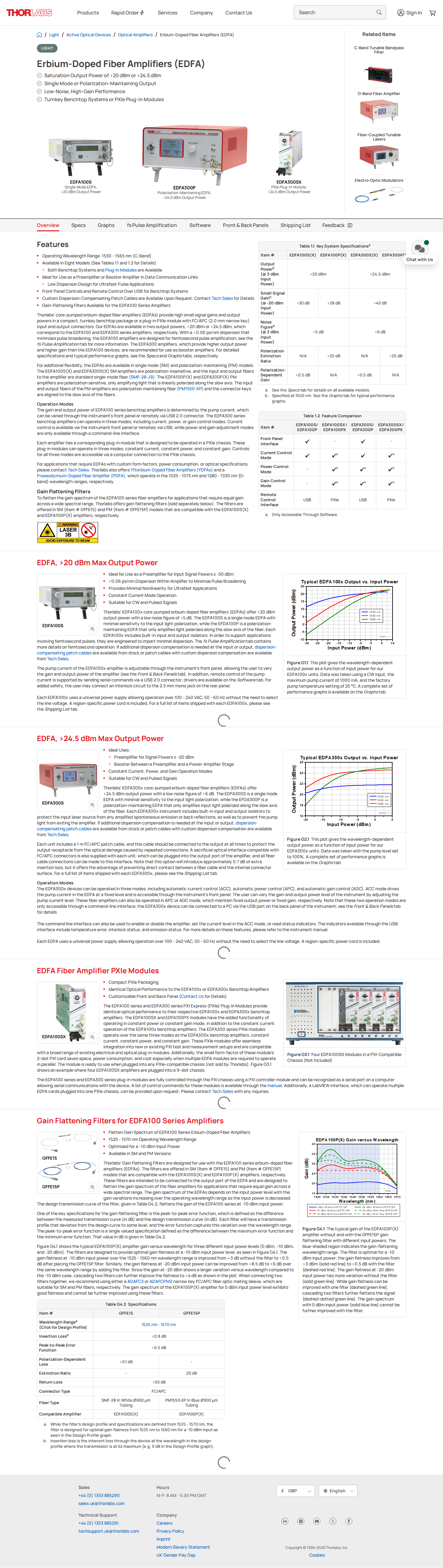
US photonics manufacturer Thorlabs offers a focused C-band EDFA range purpose-built for laboratory, R&D, and test-and-measurement use, available as turnkey benchtop instruments or PXIe plug-in modules.
Pros:
Turnkey benchtop systems with front-panel controls
PXIe plug-in modules for chassis-based instrumentation
PM and SM variants across the full range
Low dispersion enables femtosecond pulse amplification
Cons:
Saturated output tops out at >24.5 dBm
OEM customisation via Tech Sales request only
Thorlabs is a US-headquartered photonics manufacturer with a global distribution network, supplying research institutions and laboratories across a wide range of optical disciplines.
Its EDFA range is purpose-built for laboratory, test-and-measurement, and R&D environments, with the product line covering the C-band (1530–1565 nm) operating wavelength range.
Thorlabs EDFA Product Series
Thorlabs offers two core series — the EDFA100 and the EDFA300 — each available in both benchtop and PXIe plug-in module form factors, and in both single-mode (SM) and polarisation-maintaining (PM) variants.
| Series | Saturated Output Power | Small Signal Gain | Noise Figure | Key Differentiator |
|---|---|---|---|---|
| EDFA100 | >20 dBm | >30 dB (SM) / >28 dB (PM) | <5 dB | <0.06 ps/nm dispersion for femtosecond pulse amplification |
| EDFA300 | >24.5 dBm | >40 dB | <6 dB | Constant current, power, and gain control modes |
Key specifications for the Thorlabs EDFA100 and EDFA300 series. Both series operate across 1530–1565 nm (C-band) and are available in SM and PM variants.
Both series use a core-pumped architecture and support both CW and pulsed signal operation.
Form Factors: Benchtop and PXIe
The benchtop instruments feature front-panel controls and remote control via a USB 2.0 interface, making them straightforward to integrate into existing lab setups.
The PXIe plug-in modules slot directly into a PXIe chassis and are controlled entirely through a computer connection to the chassis — an architecture well suited to automated test environments where multiple instruments share a single platform.
One notable difference between form factors: the EDFA100 series PXIe modules add constant power and constant gain operating modes on top of the constant current mode available on the benchtop units, giving chassis-based users additional measurement flexibility.
Technical Differentiators
The EDFA100 series' dispersion specification of less than 0.06 ps/nm is the standout technical differentiator for ultrafast research: Thorlabs states that, when used with a femtosecond erbium oscillator and precompensating fibre, the EDFA100P can produce pulses below 100 fs with peak powers of 6 kW.
The EDFA300 series supports three operating modes — automatic current control (ACC), automatic power control (APC), and automatic gain control (AGC) — accessible via front panel or USB command-line interface, depending on the mode.
Gain-flattening filters (sold separately) are available for the EDFA100 series in both SM and PM versions, covering a 1525–1570 nm wavelength range and reducing gain variation to below 0.5 dB at the optimal input power.
SM and PM Variants
Single-mode variants are polarisation-insensitive with standard SMF-28 fibre; polarisation-maintaining variants amplify only light polarised along the slow axis, using PM1550-XP fibre with connector keys aligned to that axis.
The PM variants are designed for applications where maintaining the polarisation state of the signal is critical, including polarisation-sensitive sensing and coherent communications research.
Thorlabs EDFA Applications
- Preamplifier and booster amplifier: Thorlabs positions the EDFA100 series as a preamplifier and the EDFA300 series as a booster amplifier for data communication link test setups.
- Femtosecond pulse amplification: The EDFA100 series' low-dispersion design is specifically engineered for ultrafast pulse applications, minimising pulse broadening in femtosecond laser research.
- Polarisation-sensitive sensing: PM variants support applications where the polarisation state of the amplified signal must be preserved throughout the measurement chain.
- Laboratory R&D: The turnkey benchtop format and USB control interface are designed for optical laboratory workflows requiring repeatable, instrument-grade amplification.
Thorlabs notes that custom form factors, power consumption, or optical specifications are available on request through its Tech Sales team — OEM customisation is accessed via that route rather than as a standard catalogue option.
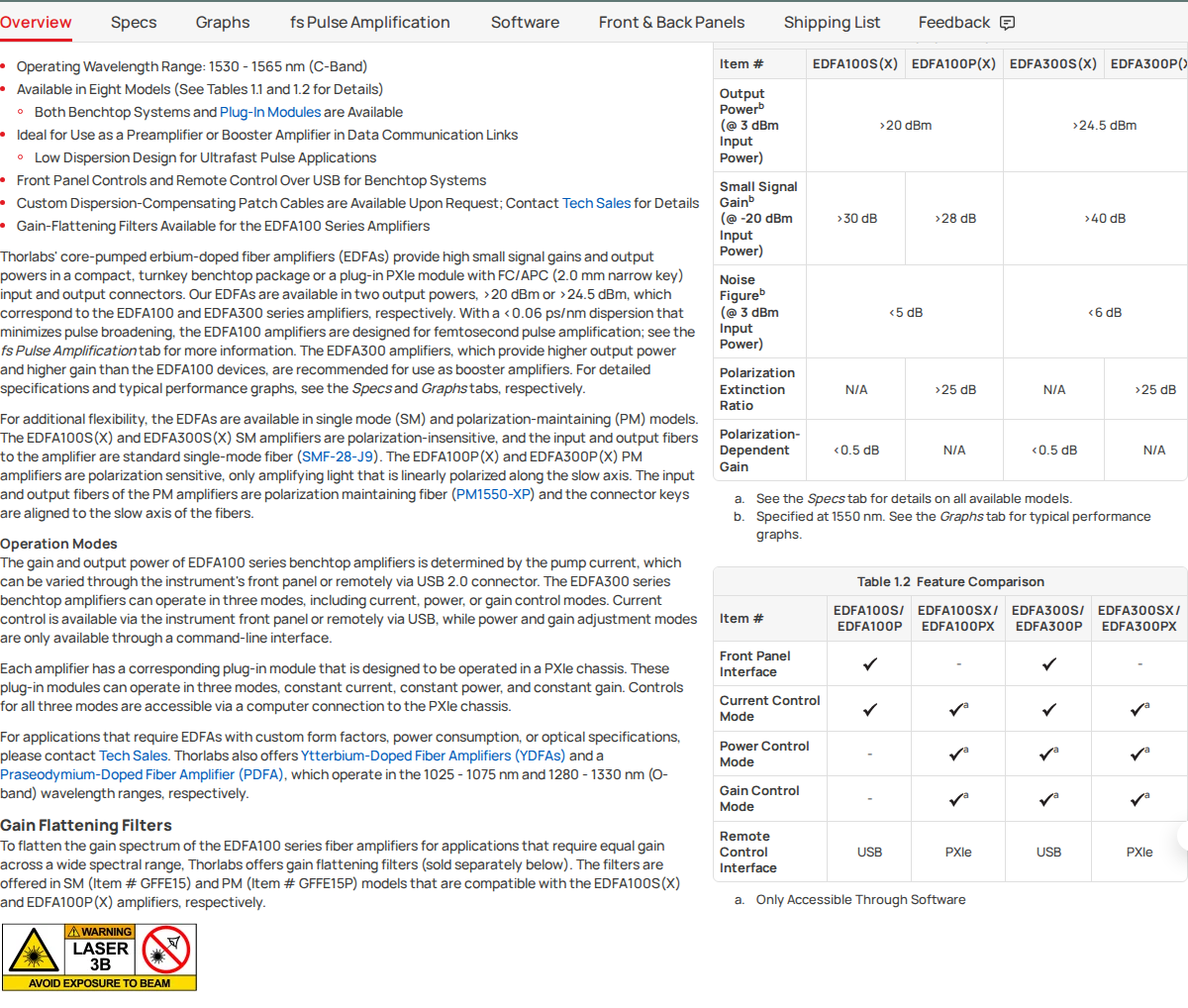
The range spans two output power tiers, two form factors, and two fibre types — a combination that covers a broad set of C-band laboratory amplification requirements within a single, catalogue-available product family.
Need a Custom EDFA Built to Your Spec?
Woodrow Scientific designs and builds EDFAs entirely in-house, tailored across band, power, and form factor. If your application needs more than a catalogue product can offer, see what a bespoke build looks like.

Conclusion
Choosing the Right EDFA Manufacturer for Your Application
The question that matters most before shortlisting is whether the supplier genuinely designs and builds its own amplifiers — because that single fact determines support quality, the ability to iterate on a design, and the depth of engineering available after delivery.
Map your requirement against the axes that separate these manufacturers: operating band, power range, pulse regime, and customisation depth — and for the most demanding requirements, WSL's Custom EDFA is the natural first conversation, with power scalable to 200 W or more, dual C+L-band from a single source, and every parameter engineered to your project.
Frequently Asked Questions About EDFAs
Quick, authoritative answers to the most common questions about erbium-doped fibre amplifier technology.
EDFA stands for Erbium-Doped Fibre Amplifier. It is an optical amplifier that uses a length of erbium-doped optical fibre, pumped by a laser diode, to amplify optical signals in the 1530–1625 nm wavelength window — directly in the fibre domain, with no optical-electrical-optical (OEO) conversion required.
An EDFA (Erbium-Doped Fibre Amplifier) is a type of optical amplifier that boosts light signals directly in the fibre domain, without converting them to electrical signals and back. It is the dominant amplification technology in long-haul and metro optical communications, and it also serves a growing range of photonics-intensive applications including LiDAR and free-space optical communications (FSOC).
EDFAs amplify in the 1530–1625 nm region. The C-band (1530–1565 nm) is the most common operating window and the foundation of most DWDM telecom deployments; the L-band (1565–1625 nm) extends capacity for high-channel-count DWDM systems where C-band alone is insufficient. Some manufacturers offer dual C+L-band amplifiers that cover the full 1530–1625 nm window from a single unit through a single cable.