
Introduction
If you're here, you're already past the basics — you know what dry ice cleaning is and you're now weighing up which system actually fits your operation.
Every machine on this list is evaluated against the same six axes: cleaning power, portability, running costs, substrate compatibility, safety overhead, and total cost of ownership.
Dry ice cleaning genuinely excels on organic contamination and complex geometries, leaving no secondary waste — but it carries real trade-offs in pellet logistics, CO₂ ventilation requirements, and ongoing consumable costs.
Two laser cleaning systems also appear on this list, assessed on those same six axes as legitimate alternatives — not filler.
TL;DR
Dry ice cleaning is a proven industrial method, but its ongoing consumable costs and safety overhead are consistently underestimated at the buying stage.
Laser cleaning has matured to the point where it belongs on the same shortlist — and for some operations, it changes the total cost of ownership calculation significantly.
This article covers:

Five machines evaluated across six buying criteria
Dry ice vs laser cleaning compared directly
Running costs and CO2 logistics explained
Portability and substrate compatibility per machine
Which system suits your operation and budget
How to Evaluate a Dry Ice Cleaning Machine
A dry ice cleaning machine can look compelling on a spec sheet — high blast pressure, generous hopper capacity, a competitive price — and still be the wrong choice for an operation within six months of purchase.
The gap between spec-sheet appeal and operational fit is where procurement mistakes happen, and the six axes below are what close it: they translate the numbers into questions a buyer can actually answer about their own environment, their workflow, and their long-term cost structure.
Cleaning Power
Cleaning power in a dry ice blaster is not a single number — it is the interaction of three adjustable parameters: blast pressure, pellet feed rate, and particle size.
Blast pressure on commercial and industrial machines typically ranges from around 20 PSI at the low end — suited to delicate surfaces like electronics or precision tooling — up to 250 PSI or more on high-throughput production units used for aggressive coating removal and heavy industrial fouling.
Pellet feed rate, measured in pounds per hour, determines how much dry ice reaches the surface per unit time; standard systems meter pellets at roughly 80–250 lb/hr, and the rate interacts directly with particle size: standard 3mm pellets deliver maximum kinetic impact for heavy contamination, while micro-particle formats (shaved to around 0.3mm) enable precision cleaning on surfaces where standard pellets carry too much force.
The practical implication is that a machine with wide adjustability across all three parameters is significantly more versatile than one optimised for a single point on the spectrum — and versatility matters if the operation covers multiple substrate types or shifts between maintenance and production cleaning tasks.
Portability and Deployment Flexibility
The portability spectrum in dry ice cleaning is genuinely wide: compact single-operator units light enough for one person to move sit at one end, while heavy industrial machines requiring planned positioning and dedicated compressor hookups sit at the other.
Key sub-dimensions to evaluate are overall machine weight and footprint, whether the unit is wheeled and manoeuvrable within a facility, hose and delivery reach (how far from the machine the operator can work), and whether the unit is genuinely field-deployable for off-site jobs or effectively a facility-fixed asset.
Deployment context shapes this requirement sharply: a maintenance team cleaning across a large facility needs a different portability profile than a production team servicing a fixed line, and a contractor taking the machine to client sites has different needs again.
Running Costs and Total Cost of Ownership
This is the axis most buyers underweight at procurement and most regret underweighting within the first year of operation.
The dominant cost driver for any dry ice machine is pellet consumption: dry ice pellets are priced per pound, typical machines consume 80–200 lb/hr depending on machine class and application intensity, and at market rates of roughly $1.20–$2.50 per pound, consumable cost alone can run $100–$500 per operating hour.
Pellet consumption rate also varies significantly between machine quality tiers — a less efficient machine consuming more pellets per minute to achieve the same cleaning result can erode any purchase-price savings within a single operating season.
Compressor requirements are a second cost that buyers frequently underestimate: most standard pellet systems need 90–165 CFM at 80–100 PSI, while higher-throughput production machines can require 185–250 CFM — which either means an existing compressor of sufficient capacity or a capital investment in one, with new mobile compressors running $12,000–$25,000.
Add CO₂ storage and logistics — pellets in an insulated cooler lose roughly 5–10 lb per 24 hours, and sourcing requires a reliable supply chain within practical delivery distance — and the true cost picture diverges substantially from the sticker price.
For a production operation running 500 hours per year, pellet costs alone can reach $40,000–$120,000 annually — before factoring in compressor capital, CO2 logistics, and unscheduled downtime. TCO is the number that matters, not the number on the invoice.
Substrate and Contaminant Compatibility
Dry ice cleaning genuinely excels on organic contamination — grease, oils, food residue, moulds, and release agents — on non-conductive surfaces including electrical equipment and electronics, and on complex geometries where the sublimation effect reaches into cavities and undercuts that abrasive methods cannot access.
It struggles, however, with heavy rust and strongly bonded coatings where the kinetic and thermal action may be insufficient without multiple passes or pre-treatment, with soft or pliable surfaces where thermal shock from the -109°F pellets poses a risk, and with oil or grease contamination that has polymerised or hardened and may require pre-treatment before blasting is effective.
Honest compatibility assessment at the application-selection stage prevents the common mistake of deploying dry ice cleaning on a substrate or contaminant type where it will underperform, and it is the foundation for a fair comparison with alternative methods.
Safety and Regulatory Overhead
Dry ice cleaning carries real safety requirements that affect operational planning — not reasons to avoid the method, but genuine overhead that adds cost and logistical complexity depending on the deployment environment.
- CO2 exposure limits: OSHA sets the PEL for CO2 at 5,000 ppm as an 8-hour TWA (29 CFR 1910.1000 Table Z-1), with NIOSH setting a 15-minute STEL of 30,000 ppm.
- Ventilation requirements: Enclosed and confined spaces require active ventilation to prevent CO2 accumulation; this becomes a serious planning constraint in rooms with low air exchange rates.
- PPE requirements: Hearing protection is non-negotiable — blasting noise can exceed 120 dB. Face shield, gloves, and in enclosed environments respiratory protection are also required.
- Confined-space protocols: OSHA requires employers to evaluate whether permit-required confined space conditions exist and post appropriate warnings where they do.
The overhead varies significantly by environment: open industrial facilities are manageable with standard PPE and basic ventilation, while enclosed rooms, confined spaces, or areas with limited air exchange require substantially more planning — and in some cases may make dry ice cleaning impractical without infrastructure investment.
Maintenance and Reliability
The most consequential reliability failure mode in dry ice machines is hopper freeze-up: moisture in the compressed air condenses and flash-freezes when it contacts the -109°F pellets, fusing them into clumps that block the feed system and halt operation — a problem that worsens in humid conditions and with intermittent use.
Beyond freeze-up, nozzle wear is an ongoing consumable cost, pellet feed consistency affects cleaning quality and efficiency, and unscheduled downtime carries a real production cost — one vendor analysis puts the average annual cost of hopper-clog downtime at $5,625 per year for lower-quality machines, based on a $250/hr downtime rate.
The right questions to put to any vendor on this axis: what is the service network coverage, what is parts availability like, and how does the machine's feed system handle humid operating conditions — because the answers determine how much of your uptime the machine will actually protect.
Why Laser Cleaning Belongs on This List
A buyer evaluating industrial cleaning equipment benefits from knowing the full landscape, and laser cleaning approaches these same six axes from a structurally different starting point: no consumables, no CO₂ supply chain, no pellet logistics, and none of the CO₂ safety overhead that shapes dry ice cleaning's operational planning.
That is not a claim that laser cleaning is always the better choice — it is a statement that the TCO profile, the safety overhead, and the substrate compatibility answers are different enough to be worth knowing before a procurement decision is made, which is why two laser cleaning entries appear in this list alongside the dry ice machines.
With this framework in place, here is how each of the five machines on this list actually performs across these criteria.
Product 1
ELASER / ELASER-RHZ (Woodrow Scientific Limited)
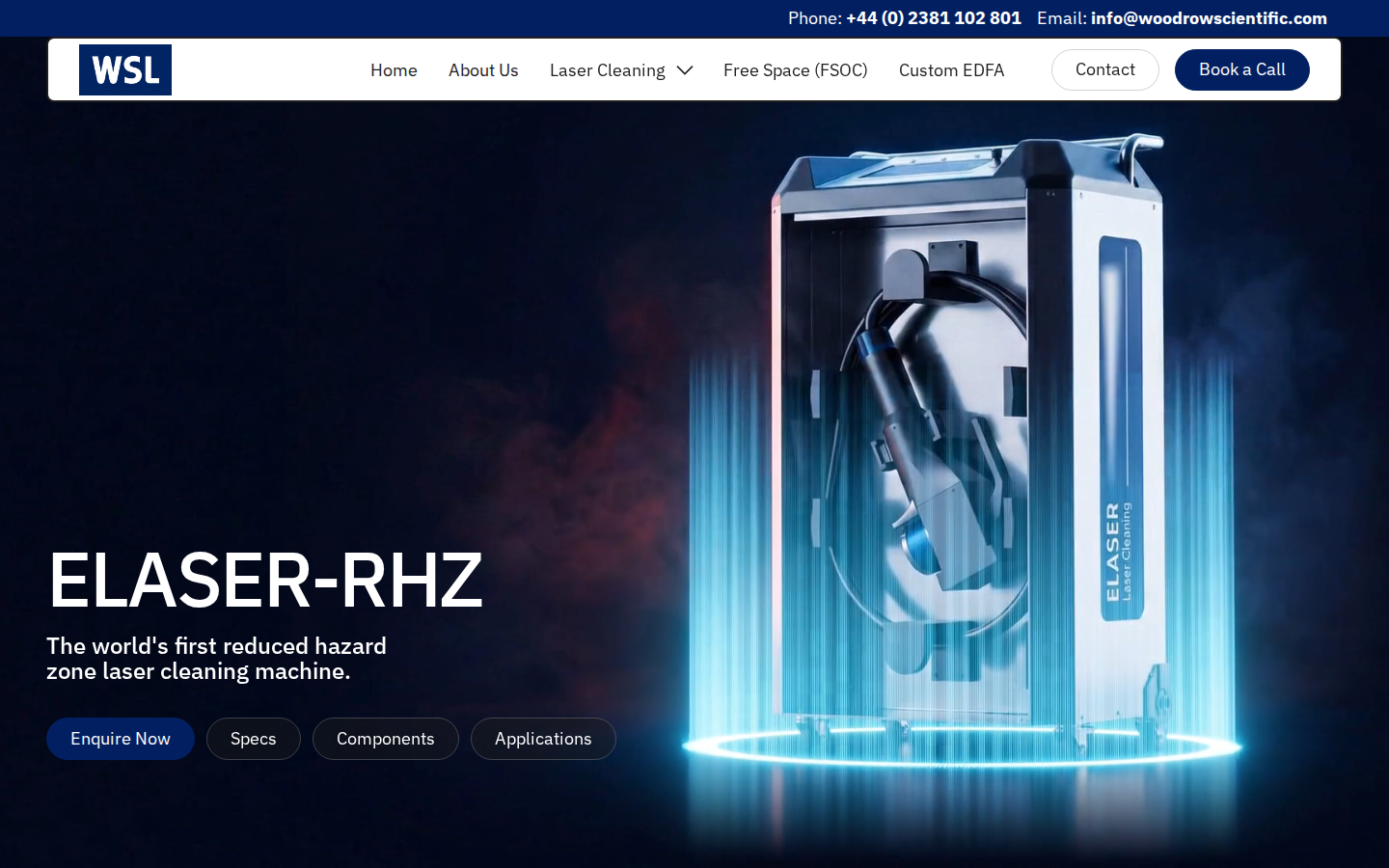
The ELASER and ELASER-RHZ are Woodrow Scientific Limited's portable industrial laser cleaning systems — consumable-free, single-operator, and featuring the world's only reduced hazard zone technology for open-space cleaning. Best for buyers who need deployment flexibility, zero ongoing consumable costs, and the ability to clean in open workshops, mixed-use facilities, or public-facing settings.
Pros:

Zero consumables — no pellets or CO2 costs
World-first reduced hazard zone technology
Sub-3 kg scanner, 50 m reach, no compressor
Only UK-based manufacturer, full in-house support
Cons:

Pricing is contact-for-quote only
Not suited to non-conductive surface cleaning
Laser cleaning less effective on plastics
The ELASER and ELASER-RHZ are best suited to industrial buyers who need a portable, single-operator cleaning system that works across a wide range of substrates and contaminants — without the ongoing costs of consumables, the logistics of a CO₂ supply chain, or the safety overhead of sealing off an area before work can begin.
Cleaning Power and Substrate Compatibility
The ELASER runs a fibre laser of up to 300 W with power fully tunable from 0 to 100%, giving a single machine the range to lift light surface oxides through to thick paint and mill scale without changing equipment.
Substrates covered include steel, aluminium alloys, cast iron, copper, brass, bronze, titanium, galvanised metal, stone, concrete, brick, and masonry — and the beam stops at the base material, so substrate loss is minimal and rework is reduced compared with more aggressive cleaning methods.
Contaminants removed span rust, oxides, mill scale, paint, powder coating, oil and grease, carbon and soot, adhesives, release agents, weld discolouration, graffiti, and more — a breadth that makes this a genuinely versatile single-system solution across industries.
Portability and Deployment
The handheld scanner weighs under 3 kg and connects via a delivery cable of up to 50 m, while the wheeled main unit comes in at under 50 kg — meaning one operator can position the unit and reach the work without assistance.
Unlike dry ice blasting systems, the ELASER requires no compressor, no pellet supply, and no secondary media of any kind — the system is entirely self-contained, which simplifies both transport and on-site setup considerably.
The deployment flexibility this portability enables is meaningful in practice: injection mould cleaning in-place without disassembly, pre-weld prep on the automotive line, heritage restoration on stone and masonry, and graffiti removal in publicly accessible spaces — all from a single wheeled system.
Running Costs and TCO
The ELASER's cost structure is straightforward: electricity to run the laser, and occasional replacement of the lens protection window — that is the full list of ongoing consumable costs.
Dry ice cleaning systems carry ongoing pellet and CO₂ procurement costs that accumulate with every hour of operation; laser cleaning eliminates that cost structure entirely, which over a machine's working life represents a material difference in total cost of ownership.
| Evaluation Axis | ELASER / ELASER-RHZ Assessment |
|---|---|
| Cleaning power | Up to 300 W, tunable 0–100%; spans light oxides to thick coatings across metals, stone, and masonry |
| Portability | Sub-3 kg scanner; system under 50 kg, wheeled; 50 m cable reach; single-operator, no compressor |
| Running costs | Zero consumables — electricity and occasional lens window replacement only |
| Substrate compatibility | Metals (steel, aluminium, cast iron, copper, brass, titanium, galvanised), stone, concrete, brick, masonry |
| Safety overhead | World-first reduced hazard zone (ELASER-RHZ); CE and UKCA certified; full operator training available from WSL |
| Total cost of ownership | No pellet or CO₂ logistics costs; less rework through minimal substrate loss; strong long-run TCO |
Gives the reader a quick-reference view of how the ELASER/ELASER-RHZ performs across the six evaluation axes established in the methodology section, enabling fast comparison with the dry ice entries that follow.
Pricing for the ELASER and ELASER-RHZ is available on request directly from WSL — the right conversation to have once the TCO picture is clear.
Safety: The ELASER-RHZ Reduced Hazard Zone
Historically, the biggest operational barrier to laser cleaning has been safety overhead: conventional systems require the work area to be sealed off and cleared before cleaning can start, which is impractical in open workshops, mixed-use facilities, and public-facing environments.
The ELASER-RHZ removes that barrier entirely — WSL's patented, world-first technology collapses the laser hazard zone to a small area around the work itself, enabling continuous operation in open-plan manufacturing facilities, shared spaces, and publicly accessible settings where conventional laser cleaning cannot go.
Both the ELASER and ELASER-RHZ carry CE and UKCA certification, with UKCA marking particularly relevant for UK buyers, and WSL provides full operator safety and operation training as standard.
Made in Britain by WSL
Woodrow Scientific Limited is the only UK-based laser cleaning manufacturer — it designs, builds, services, and continuously improves its machines entirely in-house, drawing on over 200 years of combined engineering experience across the team.
A notable share of apparent 'manufacturers' in the laser cleaning market are in practice resellers or importers rebadging third-party machines, which tends to mean slower spares, no in-house engineering capability, and no real ability to develop the product further — WSL's in-house model is a meaningful structural difference in terms of support quality and long-term reliability.
For buyers with specific requirements, WSL also offers bespoke engineering and customisation capability — the best starting point is a direct conversation with the WSL team to discuss what the application demands.
Product 2
AutoLASE — Best Automated Laser Cleaning Alternative
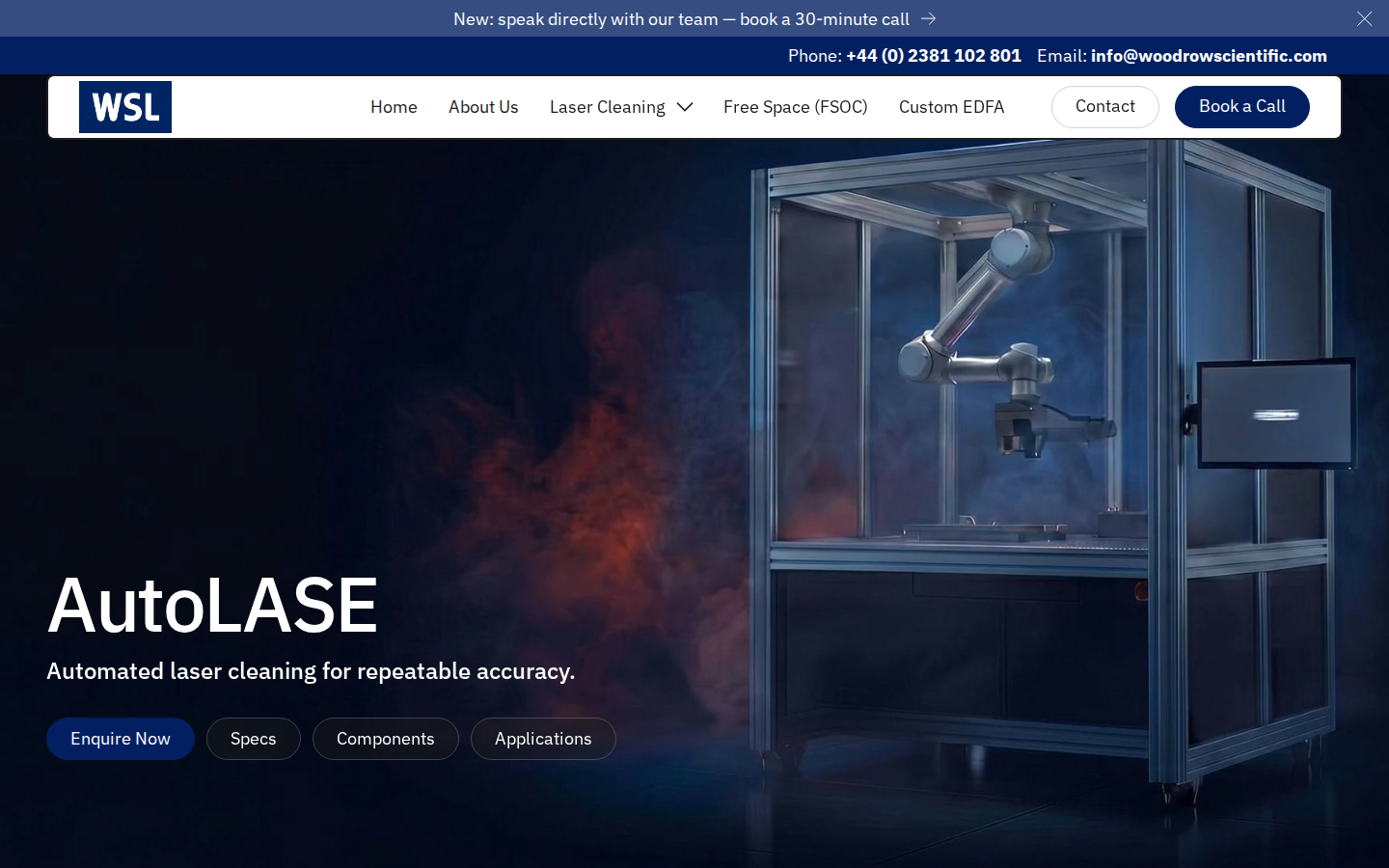
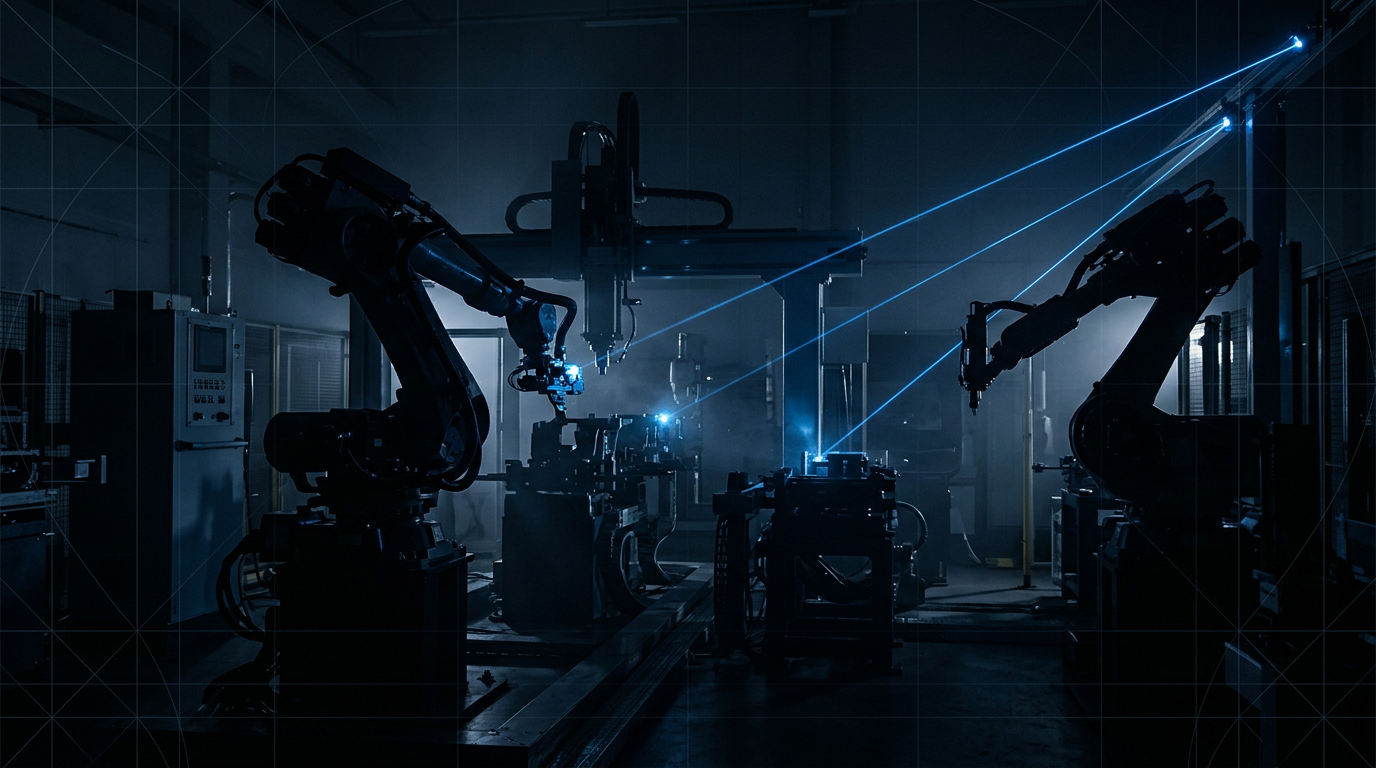
AutoLASE is Woodrow Scientific Limited's automated laser cleaning system, built for high-volume production environments where consistency and hands-off operation matter most. The cleaning head is mounted on a multi-axis articulated robotic arm; load a part, and the machine-vision system scans it, builds a 3D map, and generates the cleaning path automatically — no programming, no path-setting, no specialist skills required. With zero consumables and the option to integrate with your existing robots or deploy as a complete custom cell, AutoLASE is the choice for production managers who need repeatable, unattended cleaning at scale.
Pros:
Load-and-go machine vision — no programming needed
Optional RHZ upgrade — no enclosure required
Zero consumables — no pellets or CO2 supply
Use your robots or supplied as complete cell
Cons:
Fixed production cell — not a portable system
Pricing is contact-for-quote only
Where the ELASER is built for a single operator moving between jobs, AutoLASE is a production cell — a fundamentally different system designed for buyers who run the same cleaning task repeatedly, at volume, and need the labour taken out of it.
The distinction matters: AutoLASE is not a heavier or more capable version of the ELASER. It is a different product for a different buyer requirement, evaluated here on the same six axes applied across this list.
Load the Part — AutoLASE Does the Rest
The standout capability of AutoLASE is not automation itself — many industrial cleaning cells offer repeatable, programmed cycles. What sets AutoLASE apart is how easy it is to run: load the part, and the machine-vision system scans it, builds a 3D map, and generates the cleaning path automatically.
There is no manual programming, no path-setting, and no requirement for the operator to know anything about the part's geometry. Anyone on the production floor can run it from day one.
Paired with this is WSL's optional Reduced Hazard Zone (RHZ) upgrade — the same eye-safe technology available on the ELASER, now applied to an automated cell. AutoLASE configured with RHZ is the only automated laser cleaning system in the world that can operate without a full safety enclosure, which has significant implications for facility layout and installation cost.
AutoLASE: Six-Axis Evaluation
| Evaluation Axis | AutoLASE Position |
|---|---|
| Cleaning Power | Up to 300 W fibre laser, tunable 0-100%; multi-axis robotic arm reaches complex 3D geometries; spans light oxides through thick coatings in a single cell. |
| Portability | Fixed production cell — not portable. Integrates with customer's existing robots or supplied as a complete custom cell. |
| Running Costs | Zero consumables. No pellets, no CO2 supply chain, no logistics overhead. Automated cycles remove manual labour from repetitive cleaning tasks. |
| Substrate Compatibility | Metals (steel, aluminium, cast iron, copper, brass, titanium, galvanised), stone, concrete, brick, masonry. Minimal substrate loss — beam stops at base material. |
| Safety Overhead | CE and UKCA certified. Optional RHZ upgrade eliminates the need for a full enclosure. Full operator training available. |
| Total Cost of Ownership | Zero consumables, automated labour savings, and consistent output with less rework compound over time. TCO is the correct lens for evaluating the investment. |
Structured comparison of AutoLASE against the six evaluation axes declared in the methodology section, allowing readers to assess the system at a glance and compare directly with the ELASER entry.
Across all six axes, AutoLASE performs as a purpose-built production system: the trade-offs (fixed installation, contact-for-quote pricing) are inherent to the deployment model, not weaknesses of the technology.
Cleaning Power and Substrate Range
The up-to-300 W fibre laser is power-tunable from 0 to 100%, giving the cell the range to handle light oxide removal and thick coating strip in the same installation, without reconfiguration.
The articulated robotic arm carries the laser head through precise multi-axis paths, reaching angles and contours that a fixed-head system cannot access — making it genuinely suited to complex 3D parts like turbine blades, mould cavities, and engine components.
Contaminants removed include rust, oxides, mill scale, paint, powder coating, lacquer, primer, oil and grease, carbon and soot, adhesives, release agents, and weld discolouration. The beam stops at the base material, so substrate loss is minimal and rework rates are low.
AutoLASE Applications
AutoLASE is deployed across a broad range of production cleaning tasks — the following are representative examples, not a comprehensive list.
- Injection moulds and tooling: Strip release agents, residue and build-up from mould cavities, cores and inserts — restoring fine detail without disassembly or abrasive wear.
- Automotive parts: Engine, driveline and EV battery components cleaned of oxide, coatings and contamination, or surface-prepped for welding and bonding, part after part.
- Aerospace components: Turbine blades, vanes and engine parts cleaned and surface-prepped to tight tolerances, held to the same standard on every cycle.
- Tyre and rubber moulds: Vulcanisation residue and build-up removed from moulds, segments and vents — no abrasives, no mould wear.
- Remanufacturing and refurbishment: Corrosion, coatings and contamination stripped from worn components before rebuild, with consistent results across batches.
If a component fits the cell, it can be cleaned automatically — WSL's engineering team can advise on bespoke integration and customisation for specific production requirements.
The Manufacturer Behind AutoLASE
WSL designs, builds, services and improves AutoLASE entirely in-house at its UK facility — it is not a reseller or importer rebadging a third-party machine. In a market where many laser cleaning suppliers source their hardware externally, that distinction has real consequences: in-house manufacturing means faster support, genuine engineering expertise, and the ability to actually improve the product over time.
AutoLASE carries both CE and UKCA certification, and WSL offers first-class safety and operation training — so production teams are equipped to run the system safely and confidently from the outset.
AutoLASE Pricing and ROI
AutoLASE is priced on a contact-for-quote basis. As the European cost leader in automated laser cleaning, WSL's pricing is competitive among comparable industrial systems — achieved through manufacturing efficiency, not compromised specification.
The right lens for evaluating the investment is total cost of ownership: zero consumables eliminate ongoing supply-chain costs, automated cycles remove manual cleaning labour from repetitive production, and consistent output reduces rework. Those savings compound with every cycle the cell runs.
AutoLASE suits production managers, manufacturing engineers, and procurement leads evaluating cleaning systems for repetitive, high-volume lines — where consistency, labour elimination, and zero consumables matter more than portability. If your requirement is field deployment or single-operator flexibility, the ELASER is the right entry on this list. If you run the same cleaning task at scale, AutoLASE is built for it. Contact WSL directly to discuss integration options and receive a quote.
See AutoLASE: Automated Laser Cleaning for Production
AutoLASE is built for high-volume production cells where consistency and hands-off operation matter most. No pellets, no CO2 supply, no operator fatigue — just repeatable cleaning at scale.
Product 3
Cold Jet Aero2 PCS 60
The Cold Jet Aero2 PCS 60 is the category leader's flagship smart dry ice blaster, built around a patented Particle Control System that delivers 28 selectable particle sizes from a single machine. It is the go-to choice for operations that need genuine versatility across both precision and aggressive industrial dry ice cleaning without running multiple machines.
Pros:
28 particle sizes from one machine
MicroParticle mode for delicate surfaces
SureFlow system minimises hopper freeze-ups
16 service centres across 11 countries
Cons:
Ongoing pellet consumable costs required
Requires substantial industrial compressor supply
CO2 ventilation management needed indoors
122 kg — not field-portable
The Cold Jet Aero2 PCS 60 is best suited to operations that need a single dry ice blasting machine capable of handling the full spectrum of cleaning demands — from MicroParticle precision work on delicate electronics and plastic moulds to aggressive blasting of heavy industrial contamination — without switching equipment.
Cleaning Power: The Particle Control System
The machine's defining feature is Cold Jet's patented Particle Control System (PCS), which accepts standard 3mm dry ice pellets and cuts them into precisely calibrated, diamond-shaped particles across 28 distinct sizes ranging from 3mm down to 0.3mm.
In practice, this means an operator can dial from coarse pellet blasting for stubborn contaminants to fine MicroParticle cleaning for sensitive surfaces — all from a single machine, without changing equipment or nozzle sets.
| Specification | Value |
|---|---|
| Dry ice particle size (output) | 0.3 mm – 3.0 mm (28 distinct sizes) |
| Blast pressure range | 20 – 145 psi (1.4 – 10 bar) |
| Variable feed rate | Up to 4 lb/min (1.8 kg/min) |
| Hopper capacity | 60 lb (27 kg) |
| Nozzle air consumption | 12 – 100 cfm at 80 psi (0.3 – 2.8 m³/min) |
| Compressed air supply required | 40 – 145 psi (2.8 – 10 bar) |
| Weight | 269 lb (122 kg) |
| HMI display | 7-inch LCD colour screen |
Presents the verified technical specifications from Cold Jet's official 2020 spec sheet in a scannable format, allowing buyers to quickly assess whether the machine meets their operational requirements.
Blast pressure and feed rate are programmable via the 7-inch LCD touchscreen, and operators can save password-protected application recipes — locking in the correct settings for each cleaning task to prevent user error and ensure consistent results.
Portability
At 122 kg (269 lb), the Aero2 PCS 60 is a wheeled industrial unit built for facility-wide mobility — it moves between production areas on its integrated wheel system, but it is not a field-portable or handheld system.
Buyers who need to deploy across multiple sites or in locations without a fixed compressed air supply should factor in compressor logistics alongside the machine itself.
Running Costs and Total Cost of Ownership
Dry ice pellet consumption is the dominant ongoing cost for any blasting machine. According to Cold Jet's own TCO analysis, precision systems like the Aero2 PCS 60 consume approximately 1.8 lbs/min to clean effectively, compared to roughly 3.5 lbs/min for budget-tier units — a 48% reduction in media expenditure.
Cold Jet calculates that over 500 operating hours per year (at $0.40/lb dry ice cost), a precision system saves approximately $20,400 annually in dry ice alone versus a budget blaster. The SureFlow system's near-zero freeze-up rate eliminates an estimated $5,625/year in unscheduled downtime costs that budget units typically incur.
The compressor requirement is a significant procurement consideration: the Aero2 PCS 60 requires a compressed air supply of 40–145 psi, with nozzle air consumption ranging from 12 cfm (MicroParticle mode) up to 100 cfm at full pellet blasting — meaning a capable industrial compressor is a prerequisite, not an optional accessory.
Cold Jet's smart dry ice blasters are priced from approximately $41,950 to $54,950 (US, per Cold Jet's published pricing). UK and European pricing is not publicly listed; prospective buyers in the UK and Europe should contact Cold Jet's European headquarters in Zellik, Belgium directly for current pricing and availability.
Application and Substrate Compatibility
The Aero2 PCS 60 covers a broad range of dry ice cleaning applications across more than 52 industries, according to Cold Jet's own application data.
- Plastics and aerospace: MicroParticle mode enables online mould cleaning at operating temperature — no cool-down required — and precision cleaning of composite tooling and aerospace components without surface damage.
- Food and beverage: Removes grease, carbonised residue, biofilms, and protein build-up from processing and packaging equipment without water, chemicals, or disassembly.
- Automotive: Fine-tunes cleaning aggression across the full range of vehicle components, from weld line cleaning and e-coat roller maintenance to restoration detailing on sensitive painted surfaces.
- Printing and electrical equipment: Lower particle sizes allow safe cleaning of printing presses, electrical panels, and precision tooling where abrasive or wet methods would cause damage.
Cold Jet's own blog notes the Aero2 PCS 60 as a top-seller specifically because the PCS makes it versatile across a wide range of industrial cleaning tasks that would otherwise require multiple machines.
Safety Overhead
Standard dry ice blasting safety requirements apply. Cold Jet's own definitive guide records noise levels of up to 118 dB at the operator's ear at maximum blast pressure, which places the machine firmly within the range requiring hearing protection under both UK HSE Control of Noise at Work Regulations and OSHA standards.
CO₂ ventilation management is required when operating in enclosed or confined spaces, and full PPE — including hearing protection, respiratory protection, eye and face protection, and appropriate gloves — is standard practice for dry ice blasting operations at this power level.
The IoT-enabled Cold Jet CONNECT platform provides remote monitoring and diagnostics, giving supervisors visibility of machine utilisation, feed rates, and dry ice consumption without needing to be physically present at the machine.
Maintenance and Reliability
Cold Jet's patented SureFlow feeder system — combining an insulated hopper, thumpers, ramrods, electric vibrators, and continuous hopper agitation — is designed to prevent the hopper freeze-ups and pellet clogging that are a known operational pain point in dry ice blasting.
For service support, Cold Jet operates 16 service centres across 11 countries, including its European headquarters in Zellik, Belgium, with regional offices in Germany, Poland, Denmark, and Spain — giving UK and European buyers accessible in-territory support coverage.
Product 4
Kärcher IB 15/120
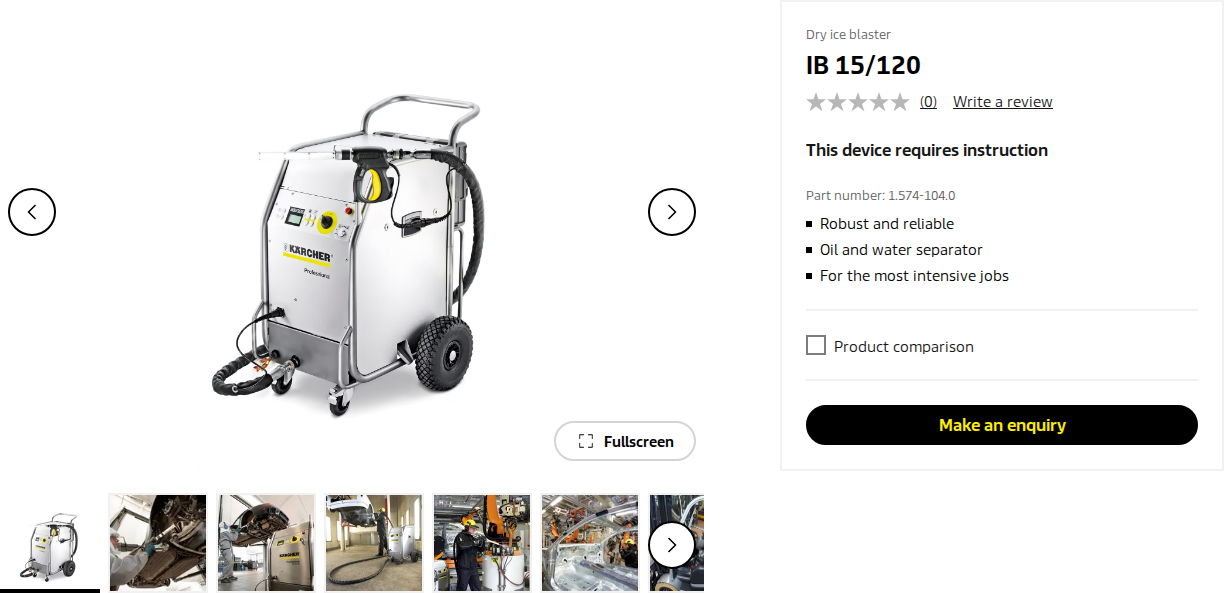
The Kärcher IB 15/120 is the most powerful machine in Kärcher's professional dry ice blasting range, delivering up to 120 kg/hr of dry ice throughput at blast pressures from 2 to 16 bar. Built from stainless steel and designed for sustained industrial use, it suits large-area, heavily contaminated surfaces — moulds, turbines, conveyor systems, heat exchangers — where raw blasting performance takes priority. Best for facilities that need maximum throughput, broad application coverage, and the confidence of a globally recognised service network behind them.
Pros:
Up to 120 kg/hr throughput
Stainless steel build for industrial durability
Broad application range across heavy industry
Kärcher global service and parts network
Cons:
125 dB(A) — hearing protection essential
91 kg weight limits rapid repositioning
High pellet consumption raises ongoing running costs
The Kärcher IB 15/120 is built for one job: sustained, high-volume dry ice blasting on large industrial surfaces where cleaning speed and throughput matter above all else.
It is best suited to facilities running planned, regular cleaning programmes — production plants, foundries, print shops, power generation sites — rather than operations that need a machine to be moved quickly between locations or deployed at short notice.
Kärcher IB 15/120 Key Specifications
| Specification | Value |
|---|---|
| Dry ice throughput | 30–120 kg/hr |
| Blast pressure | 2–16 bar |
| Air flow requirement | 2–12 m³/min |
| Hopper capacity | 40 kg |
| Pellet size | 3 mm |
| Machine weight (excl. accessories) | 91 kg |
| Sound pressure level | 125 dB(A) |
| Cable length | 7 m |
A comparison-minded buyer needs the core performance figures at a glance before reading the evaluative narrative. This table surfaces the specs that most directly affect procurement decisions: throughput, pressure range, air demand, hopper size, and machine weight.
Those figures tell a clear story: this is a machine calibrated for maximum output, not for fine-tuned precision or light-duty flexibility.
Cleaning Power and Application Range
At up to 120 kg/hr and a pressure ceiling of 16 bar, the IB 15/120 handles the heaviest contamination loads that dry ice cleaning is asked to tackle.
- Moulds and casting tools: Removes release agents and residue from injection moulds and die-casting tools without abrasive damage to the mould surface.
- Forging tools and conveyor systems: Cleans heavy grease, scale, and carbon deposits from forging dies and conveyor components.
- Ovens and printing presses: Effective on baked-on inks, coatings, and thermal residues across large surface areas.
- Woodworking machines: Removes sawdust, resin, and adhesive build-up from cutting and pressing equipment.
- Generators, turbines, and heat exchangers: Handles large, complex components in power generation and process industries where thorough cleaning is critical.
The 3 mm pellet size and high pressure range make this a machine for durable, robust surfaces — it is not the right tool for delicate substrates or precision component cleaning.
Portability and Deployment
The IB 15/120 is a wheeled unit, which allows it to be moved within a facility, but at 91 kg (without accessories) and with a 7 m cable, it is designed for fixed or semi-fixed deployment rather than rapid repositioning.
Buyers should plan for it to operate from a defined station within a production area, serviced by a compressor installation nearby — this is not a machine for spontaneous single-operator use or field deployment away from a facility.
Running Costs and Total Cost of Ownership
Running cost is the axis that deserves the most careful attention at this performance level.
At 30–120 kg/hr dry ice consumption, pellet costs accumulate quickly during sustained operation. Add the capital and running cost of a compressor capable of supplying 2–12 m³/min at up to 16 bar, and the total cost of ownership is considerably higher than the machine purchase price alone. Budget for both before committing.
This is not a criticism unique to the IB 15/120 — it applies to any high-throughput dry ice blaster — but buyers who focus only on the machine price risk underestimating what it costs to run at scale.
Safety Overhead
The IB 15/120's stated sound pressure level of 125 dB(A) means hearing protection is a non-negotiable requirement for anyone operating or working near the machine.
Standard dry ice blasting safety protocols also apply: adequate CO₂ ventilation in enclosed spaces, appropriate PPE, and operator training. The machine includes an electronic control system relevant to safe and consistent operation. None of these requirements are unusual for industrial-grade dry ice cleaning equipment, but they all need to be built into the deployment plan.
Maintenance and Reliability
Stainless steel construction gives the IB 15/120 genuine durability in demanding industrial environments, and the electronic control system includes an oil and water separator — a practical feature for consistent performance and reduced maintenance overhead.
The most meaningful reliability consideration for many buyers, however, is Kärcher's global service and parts network. For facilities where unplanned downtime is costly, knowing that service engineers, spare parts, and technical support are accessible through a widely distributed brand is a real operational advantage.
Kärcher IB 15/120 Pricing
Kärcher does not publish a list price for the IB 15/120 through its online channels. Buyers should contact Kärcher's UK or European distribution network directly for a current quote.
When evaluating cost, factor in the compressor specification required to run the machine at target throughput, plus ongoing pellet consumption at your expected usage rate — the machine price is the starting point, not the full picture.
Product 5
CRYONOMIC COMBI 7: Best for Long-Distance Dry Ice Cleaning
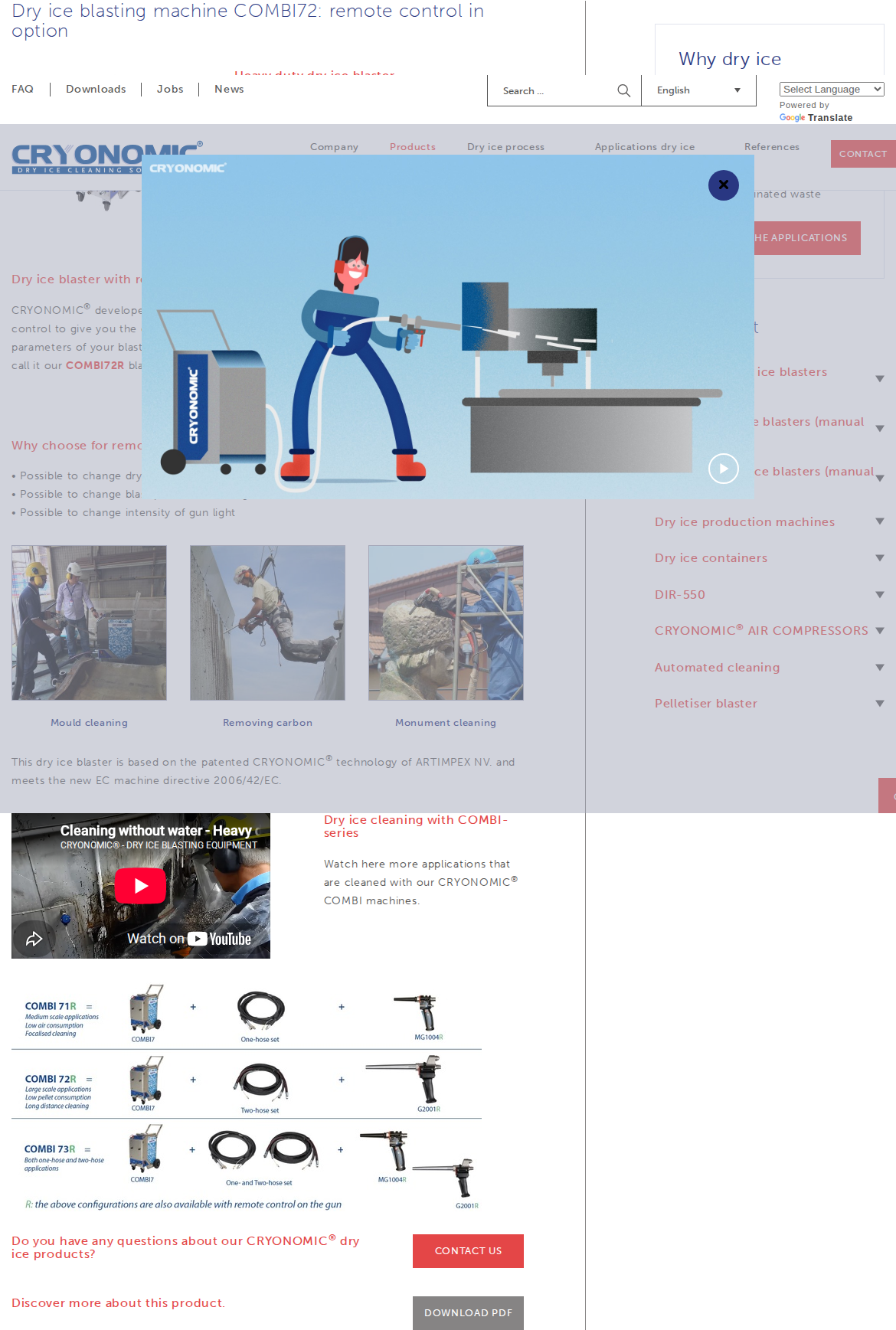
The CRYONOMIC COMBI 7, made by Belgian specialist ARTIMPEX NV, is the only machine on this list that switches between one-hose and two-hose dry ice blasting modes. In two-hose mode, operators can clean at up to 100 metres from the machine — making it the go-to choice for large industrial facilities, long-distance cleaning jobs, and large-scale applications where dry ice consumption efficiency is a genuine cost consideration.
Pros:
Switchable one-hose and two-hose architecture
Up to 100 m reach in two-hose mode
30+ years of dedicated dry ice blasting specialism
Remote control option for in-blast adjustments
Cons:
100 kg — not easily repositioned mid-job
Ongoing CO2 pellet logistics and supply costs
No publicly listed pricing — quote required
The CRYONOMIC COMBI 7 is built by ARTIMPEX NV, a Belgian specialist that has been manufacturing dry ice blasting equipment for more than 30 years — making it one of the most experienced dedicated dry ice blasting companies in Europe.
Where the other dry ice entries on this list commit to a single hose architecture, the COMBI 7's defining characteristic is its ability to switch between one-hose and two-hose operation, giving operators a genuinely different machine depending on which gun and hose set they connect.
| Evaluation Axis | CRYONOMIC COMBI 7 |
|---|---|
| Cleaning Power | 1–12 bar (one-hose); 1–16 bar (two-hose); pellet consumption 25–100 kg/hr; 30 kg hopper; optional abrasive module for grit blasting |
| Portability | 100 kg wheeled unit (665 x 570 x 876 mm); machine stays stationary — two-hose mode allows operator to work up to 100 m away |
| Running Costs | Pellet consumption adjustable and digitally displayed; CRYONOMIC claims considerable dry ice savings in two-hose mode vs single-hose systems; CO2 pellet logistics apply as with all dry ice blasters; pricing on request |
| Substrate Compatibility | Broad industrial range: printing, automotive, rubber/tyre, food industry, chemical plants, turbines, renovation, façade cleaning; pellet crusher accessory available for delicate surfaces |
| Safety Overhead | Standard dry ice PPE and ventilation required; optional remote control allows pressure and feed rate adjustment from the gun position during blasting |
| Maintenance & Reliability | Self-diagnosis on start-up; hour counter; acoustic and visual error indication; pneumatic hopper agitation to prevent pellet bridging; CE certified |
Covers all six declared evaluation axes for the COMBI 7 in a scannable format, consistent with the structured comparison approach used for the Cold Jet and Kärcher entries.
The one-hose/two-hose switchability is the COMBI 7's most operationally significant feature, and it is worth understanding what each mode actually offers.
In one-hose mode (up to 12 bar), the machine suits focused and medium-scale cleaning where the operator works at close range and air consumption is a priority. In two-hose mode (up to 16 bar), a separate low-pressure hose carries pellets to the gun independently of the blast air, enabling cleaning at hose lengths of up to 100 metres — vertically and horizontally — from the machine's position.
CRYONOMIC states that the two-hose system delivers considerable savings on dry ice consumption compared with single-hose systems, attributing this to the controlled low-pressure pellet transport that keeps pellets intact until they reach the gun. This is a manufacturer claim rather than independently verified data, but it is a consistent theme across CRYONOMIC's product documentation.
COMBI 7 Application Areas
CRYONOMIC's own documentation identifies the following as primary application categories for the COMBI 7 series.
- Large-scale industrial cleaning: Cleaning of machines, tanks, and tools of significant size — applications where two-hose speed and low pellet consumption are the priority.
- Long-distance and vertical cleaning: Façade cleaning, building restoration after fire or flood, and vertical surfaces up to 30 m high — enabled by the two-hose 100 m hose reach.
- Printing and automotive: Mould cleaning, tooling, and machinery maintenance across print and automotive production environments.
- Rubber, tyre, and chemical plant: Heavy contamination removal in rubber and tyre manufacturing and chemical processing facilities.
- Food industry and turbines: Food-safe cleaning applications and turbine housing maintenance where access constraints make distance blasting practical.
- Dry ice grit blasting: Rust removal, paint stripping, and surface preparation using the optional abrasive module — using less than 10% of the abrasive material required by traditional grit blasting, per CRYONOMIC.
The optional pellet crusher accessory extends the COMBI 7's usable substrate range by breaking 3 mm pellets into finer particles for delicate surfaces or complex geometries — a practical addition for operations that need to shift between aggressive and sensitive cleaning on the same day.
On the safety and operational control front, the optional remote control is a meaningful feature for large-scale work: it lets the operator adjust blast pressure and pellet feed rate from the gun position without returning to the machine, which matters when the machine is stationed 50 or 100 metres away.
For maintenance, the COMBI 7 includes self-diagnosis on start-up, an hour counter, and both acoustic and visual error indication — practical features for industrial users managing planned maintenance schedules. Pneumatic hopper agitation is built in to reduce pellet bridging, a common operational issue with dry ice blasters in general.
Pricing for the COMBI 7 series is not publicly listed. Buyers should contact CRYONOMIC directly via cryonomic.com or their UK and European distributors for a current quote.
The COMBI 7 is the right choice for large industrial facilities, contract cleaning teams working on large structures, and operations where the machine cannot be positioned close to the work. It is not the machine for buyers who need a lightweight, quickly repositioned unit or who are new to managing dry ice pellet logistics at scale.
Consider Laser Cleaning Before You Decide
Every dry ice machine on this list carries ongoing pellet and CO2 supply costs. The ELASER removes that overhead entirely — no consumables, no supply chain, same industrial cleaning capability.
Conclusion
Which cleaning machine is right for your application?
If total cost of ownership is the priority, laser cleaning changes the economics entirely — the ELASER/ELASER-RHZ for portable single-operator work, or AutoLASE where production volume justifies automation.
Where dry ice blasting's specific mechanism genuinely fits — food processing, non-conductive surfaces, complex organic contamination — the Cold Jet Aero2 PCS 60 and Kärcher IB 15/120 are proven choices.
For large structures or cleaning at distance, nothing on this list matches the CRYONOMIC COMBI 7's 100 m reach.
If there's any chance your application suits laser cleaning, Woodrow Scientific Limited is worth a conversation.
Frequently asked questions about dry ice cleaning machines
Can't find what you're looking for? Get in touch and we'll point you in the right direction.
Entry-level dry ice blasting machines start at roughly £3,000–£6,000 (approximately $3,490–$6,999 USD). Mid-range professional units run £6,000–£25,000, and heavy industrial systems reach £25,000–£65,000+. For context, Cold Jet's smart IoT-enabled machines start from approximately $41,950 USD. The machine purchase price is only part of the picture. A suitable compressor is a separate procurement cost — one that many buyers underestimate at the outset. Add ongoing dry ice pellet spend, CO₂ logistics (storage, delivery, top-up), and nozzle wear, and the total cost of ownership diverges significantly from the sticker price. Evaluate TCO across your projected operating hours, not just the day-one outlay.
The dominant cost driver is dry ice pellets. Retail pricing typically runs $1.00–$3.00 per pound, with bulk rates lower — industrial buyers on contract can pay $0.60–$1.20/lb. Consumption varies widely by machine class: precision units use roughly 30 lbs/hr, while large industrial machines can consume 100 lbs/hr or more. At 100 lbs/hr and $1.50/lb across 1,000 operating hours annually, pellet spend alone reaches $150,000 over five years. Beyond pellets, factor in compressor electricity, nozzle wear, and CO₂ logistics — delivery scheduling, storage, and top-up costs that accumulate quietly in the background. This is why total cost of ownership matters far more than machine price alone when comparing dry ice cleaning options.
The two primary hazards are CO₂ accumulation and noise. CO₂ is heavier than air and builds up quickly in enclosed or below-grade spaces. The OSHA permissible exposure limit is 5,000 ppm as an 8-hour time-weighted average — concentrations above this cause physiological effects, and high concentrations can be life-threatening. Adequate ventilation is essential whenever dry ice cleaning is carried out indoors or in confined spaces. On the noise side, dry ice blasting machines are loud; hearing protection (ear muffs or plugs) is standard PPE for all operators. Additional PPE includes a face shield, gloves (protection from both debris and cryogenic contact), and a breathing mask to prevent inhalation of dislodged particulate. Confined-space entry protocols apply where relevant. This answer provides general industry guidance only — consult your relevant health and safety authority and your own advisors for compliance requirements specific to your workplace and jurisdiction.
Dry ice cleaning genuinely excels on organic contamination — grease, oils, food residue, mould, and mould-release agents — and performs well on non-conductive surfaces and complex geometries where abrasive media blasting would be impractical or leave secondary waste. Food processing equipment, electrical enclosures, and injection moulds are classic use cases. Where it struggles: heavy rust and deeply bonded coatings are resistant, because dry ice cleaning is essentially non-abrasive and cannot achieve the metallurgical cleanliness that hard oxide removal demands. Soft or pliable surfaces — soft woods, soft plastics — can be damaged by the combination of kinetic impact and thermal shock at operating pressures. Any substrate sensitive to sudden temperature change (the pellets arrive at −78.5°C) warrants careful pressure and standoff testing before committing to a full cleaning run.
Yes — for many applications, laser cleaning is worth evaluating directly alongside dry ice. The core advantage is no consumables: no pellets to procure, no CO₂ supply chain to manage, and no CO₂ accumulation hazard in enclosed spaces. That changes the total cost of ownership profile fundamentally, particularly at volume. For facilities running several hundred or more cleaning hours per year, the absence of ongoing consumable spend typically narrows — and often reverses — the gap with dry ice over a multi-year horizon. WSL's ELASER-RHZ is worth specific attention: it is the world's first reduced hazard zone laser cleaner, enabling open-space use without sealing off the surrounding area — a capability no other laser cleaning system currently offers. That said, dry ice cleaning retains genuine strengths: it is the better choice for heat-sensitive assemblies, energised electrical switchgear (CO₂ is non-conductive), and sites where reliable three-phase power is unavailable. The right answer depends on your application — evaluate both side by side before committing.
Dry ice cleaning propels solid CO₂ pellets through a nozzle using compressed air, accelerating them to near-supersonic velocity. On impact, three effects act simultaneously. Kinetic impact fractures the bond between the contaminant and the substrate. Thermal shock follows instantly — the pellets arrive at −78.5°C, causing the contaminant layer to contract rapidly and detach. Then sublimation: the CO₂ transitions directly from solid to gas, expanding approximately 800 times in volume and physically lifting the loosened contamination away from the surface. Crucially, the cleaning medium leaves no secondary waste — the CO₂ simply evaporates, leaving only the dislodged contaminant to be collected.
Requirements vary considerably by machine class. MicroParticle and precision units can operate on as little as 12–50 CFM at 80 PSI — compatible with many standard shop compressors. Mid-range standard commercial machines typically require 50–165 CFM. Large heavy-duty industrial blasters in the Aero2 class generally require 50–165 CFM at 80 PSI, rising to 185 CFM or more at higher blast pressures. Integrated production systems — such as Cold Jet's COMBI-PCS, which combines a dry ice maker with a blasting unit — sit in a different category entirely, with nozzle air consumption running 106–388 CFM depending on nozzle configuration. The practical implication: compressor specification is a procurement decision that sits alongside the machine itself, not after it. Buyers who undersize their compressor will see blast pressure drop and rated cleaning performance will not be achieved. Before purchasing any machine, confirm the CFM and PSI requirements at your intended operating pressure, then size your compressor with headroom above that figure.