

Introduction
If you've come across dry ice blasting as a potential solution to a surface cleaning problem, you're probably looking for a straight answer on whether it actually delivers — and whether it's the right fit for your situation.
This guide gives you the full picture: what the method does well, where it genuinely struggles, and how it stacks up against the alternatives.
From the underlying mechanism and key benefits through to equipment requirements, cost drivers, limitations, and a direct comparison with other cleaning methods, everything you need to make an informed decision is here.
TL;DR
Dry ice blasting occupies a specific, well-defined niche in industrial cleaning — one where its combination of properties is genuinely hard to replicate. Whether it's the right choice depends entirely on whether your application matches that niche. The details that determine that fit are exactly what this guide works through.
This article covers:

How dry ice blasting works — the mechanism
Core benefits and why they matter operationally
Key industry applications and where it's deployed
Cost drivers and what shapes the price
Limitations and where the method falls short
Comparison with alternative cleaning methods
What is blasting dry ice?
Most blasting methods work by throwing something abrasive at a surface and then cleaning up the mess left behind. Dry ice blasting works differently — the blasting medium itself disappears on contact, leaving nothing behind but the contaminant it just removed.
Dry ice is solid carbon dioxide (CO₂), and its defining physical property is sublimation: at atmospheric pressure, it transitions directly from solid to gas, bypassing the liquid phase entirely.
In a dry ice blasting system, CO₂ pellets are loaded into an insulated hopper equipped with an agitation mechanism to prevent clumping, then metered into a high-pressure compressed air stream that accelerates them through an insulated hose to a specialised nozzle — where they exit at high velocity and strike the target surface.
The three-phase cleaning mechanism
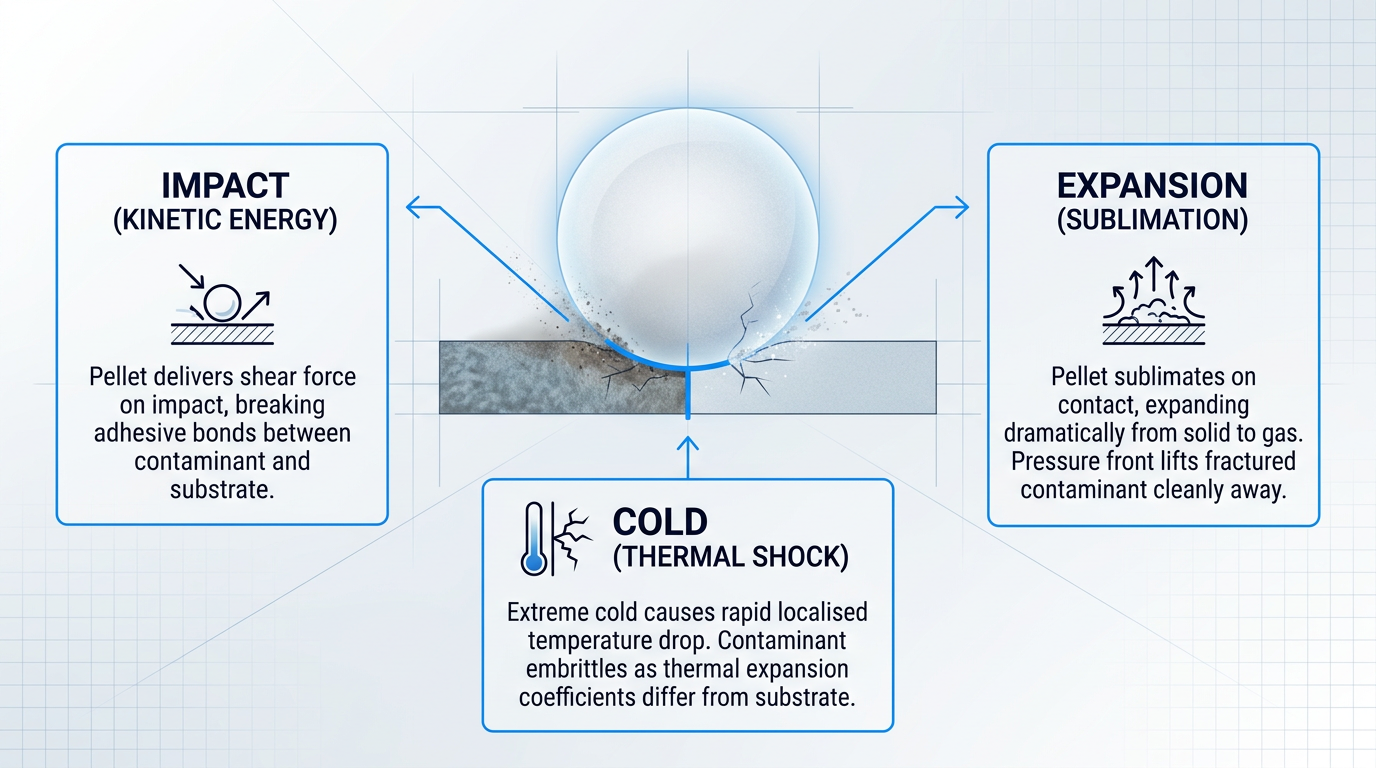
What happens in the milliseconds after a dry ice pellet strikes a contaminated surface is best understood through three distinct but simultaneous physical mechanisms, known collectively as the ICE framework: Impact, Cold, and Expansion.
- Impact (kinetic energy): Pellets travelling at high velocity deliver a shear force on impact, beginning to break the adhesive bonds between the contaminant and the substrate.
- Cold (thermal shock): The extreme cold of the pellet causes a rapid, localised temperature drop. Contaminants embrittle and micro-crack as their thermal expansion coefficient differs from the substrate.
- Expansion (sublimation): The pellet sublimates on contact, expanding dramatically from solid to gas. This rapid pressure front lifts the fractured, embrittled contaminant cleanly off the surface.
None of these three mechanisms is sufficient on its own — kinetic impact alone would not embrittle the contaminant, thermal shock alone would not dislodge it, and sublimation expansion alone would lack the initial mechanical disruption needed to fracture the bond.
Pressure washing delivers kinetic force but no thermal shock and no sublimation lift. Sandblasting delivers kinetic force but no thermal shock and leaves secondary waste. Dry ice blasting is the only method where all three mechanisms act together — which is why it removes contaminants that single-mechanism methods cannot, without abrading the substrate.
The practical consequence of sublimation is decisive: once the pellet has done its work, it ceases to exist as a solid. The CO₂ disperses as gas into the surrounding atmosphere, and the only material remaining at the cleaned surface is the dislodged contaminant itself.
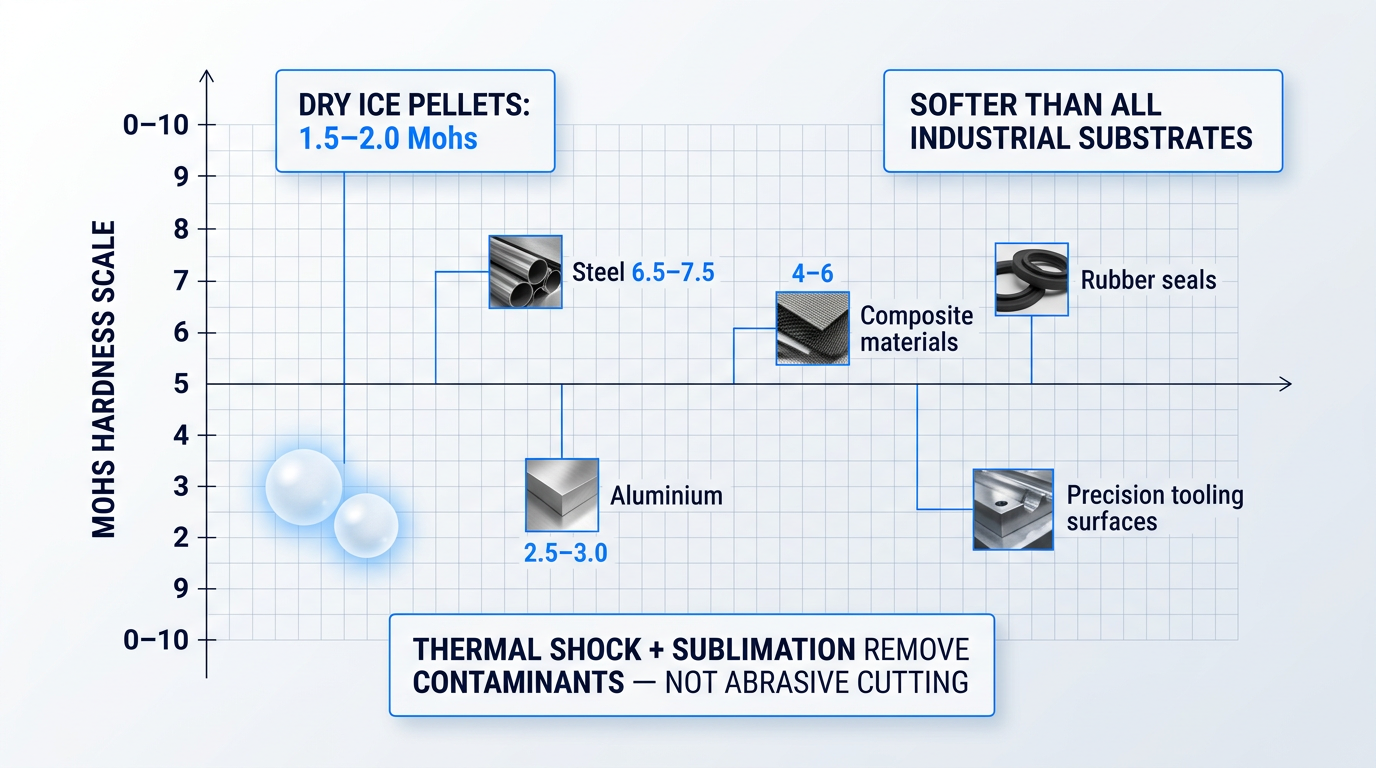
Despite their high delivery velocity, dry ice pellets are significantly softer than virtually every industrial substrate — including aluminium, steel, rubber, and most plastics — which is why the process is correctly described as non-abrasive.
The cleaning action derives entirely from the ICE mechanism, not from the pellet grinding or scratching the surface the way sand, grit, or glass bead would.
Within the broader media blasting family — which includes sandblasting, soda blasting, bead blasting, and grit blasting — all methods share the same core principle: a medium is accelerated by compressed air to dislodge a contaminant from a surface.
The decisive difference is what happens after impact: sand, soda, grit, and glass bead all remain as physical residue that must be collected, contained, and disposed of as secondary waste. Dry ice is the only blasting medium that disappears.
That physical property — a blasting medium that sublimates on contact — is what gives rise to the operational and environmental characteristics that make dry ice blasting attractive as an industrial cleaning method, explored in the next section.
Why Dry Ice Blasting Works So Well
The properties that make blasting dry ice work also define where it excels — and once the mechanism is understood, each operational benefit follows directly from the physics.
Because the blasting medium sublimates on contact, because pellets rate just 1.5–2.0 on the Mohs hardness scale, and because no liquid phase is ever introduced, the process behaves in ways that most conventional cleaning methods simply cannot replicate.
No Blasting Media to Collect or Dispose Of
When the CO2 pellets strike a surface, they transition directly from solid to gas — there is no spent media left on the floor, no bags to fill, and no secondary blasting material to classify and dispose of.
This is a genuine operational simplification: sandblasting and soda blasting both leave behind a volume of contaminated media that must be contained, collected, and managed as waste — often at significant cost and time.
It is worth being precise about what no secondary waste actually means, because this claim is frequently overstated in promotional material.
The CO2 disappears; the dislodged contaminants do not.
In most industrial cleaning scenarios — grease, carbon deposits, release agents, mould, paint overspray — the freed contaminants can simply be swept or vacuumed away, which is genuinely easier than managing spent blasting media alongside them.
Dry ice blasting eliminates blasting media waste — the CO2 sublimates and leaves nothing behind. But dislodged contaminants remain and must be managed. Where the contaminant itself is hazardous (lead paint, asbestos-containing coatings), appropriate containment, PPE, and disposal protocols apply regardless of the cleaning method used.
No Water, No Chemicals, No Residue
The process uses only solid CO2 and compressed air, which means no water is introduced at any point and no chemical cleaning agents are involved.
The operational consequences of this are substantial.
- No drying time: Surfaces are immediately ready for production, coating, or reassembly — there is no wait for moisture to clear.
- No moisture-related damage: Corrosion, biological growth, and electrical damage from water ingress are eliminated as cleaning-related risks.
- No chemical storage obligations: Without solvents or degreasers on-site, facilities avoid the storage, handling, and compliance requirements that chemical cleaning agents require.
- No chemical residue on surfaces: Nothing from the cleaning process remains on the substrate — critical where surface cleanliness directly affects product quality or safety.
For food-grade and pharmaceutical environments, the absence of chemical residue is not just convenient — it is a regulatory requirement, and it is one that dry ice blasting meets without compromise.
Pressure washing, by contrast, generates contaminated wastewater that must be contained and disposed of, and it leaves surfaces wet enough to require significant drying time before equipment can return to service.
Non-Abrasive: Substrate Integrity Preserved
At 1.5–2.0 on the Mohs hardness scale, dry ice pellets are softer than virtually every industrial substrate they are directed at — metals, composites, plastics, rubber seals, and precision tooling surfaces.
Despite being accelerated at high velocity, the pellets do not etch, profile, or alter the dimensions of the surface being cleaned.
This matters because it is the thermal shock and sublimation expansion that do the primary contaminant-removal work — not abrasive cutting — which is precisely why the substrate is left intact.
For mould and tooling cleaning, this is critical: the process preserves parting lines, shutoffs, and dimensional tolerances that abrasive methods progressively wear away over repeated cleaning cycles.
Unlike abrasive blasting, dry ice blasting does not create an anchor profile — a key consideration for precision surfaces where any change to surface geometry affects part quality or coating adhesion consistency.
Non-Conductive: Safe for Live Electrical Equipment
Dry ice does not conduct electricity, and because the process introduces no water, the combination creates a cleaning method that is safe for use on live electrical equipment — panels, motors, sensors, PLCs, and wiring — without shutdown or lockout/tagout procedures.
This is an underappreciated differentiator: most other cleaning methods require electrical equipment to be powered down, masked, dried, and re-commissioned before and after cleaning.
Pressure washing introduces highly conductive water; chemical solvents can leave conductive residues; even some media blasting methods require extensive masking of electrical components before work begins.
The ability to clean energised electrical components safely is a practical capability with real operational value — not a footnote.
In-Place, Online Cleaning Reduces Downtime
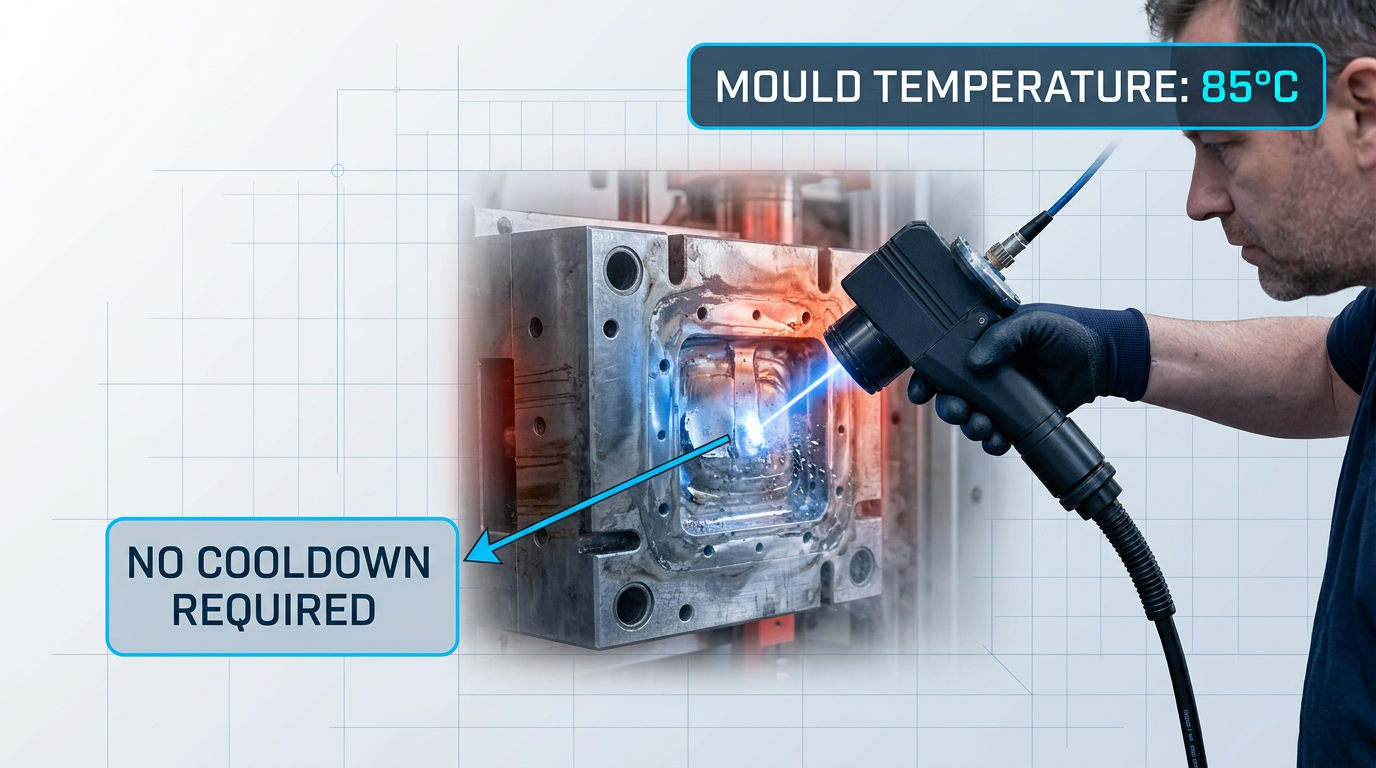
Because the process is non-abrasive and non-conductive, equipment does not need to be removed, disassembled, or cooled before cleaning — it can be cleaned at operating temperature, in place, while still assembled.
The downtime reduction this enables is not marginal.
A conventional cleaning cycle for production machinery typically involves cooldown, disassembly, cleaning, reassembly, and reheat — a sequence that can consume several hours per cleaning event.
Dry ice blasting eliminates each of those steps: the machine stays assembled, stays at temperature, and returns to service as soon as cleaning is complete.
For injection moulding presses, conveyor systems, and continuous production lines, this translates directly into measurable production time recovered per cleaning event — and more frequent cleaning becomes operationally viable rather than a reluctant concession to downtime.
Food-Grade Credentials and Regulatory Approvals
The dry ice used in blasting is a food-grade medium, approved by the FDA, USDA, and EPA for use around food manufacturing.
These approvals cover the CO2 itself as a food-contact substance — dry ice is colorless, tasteless, odorless, and non-toxic, and it leaves no residue on cleaned surfaces.
Combined with the absence of water and chemical cleaning agents, this makes dry ice blasting compatible with hygiene-critical environments where the cleaning method must not introduce foreign substances into the production environment.
Facilities can document their cleaning procedures with confidence that the process itself will not be a source of contamination — a meaningful advantage where regulatory audits and food safety standards demand traceability.
These properties translate into a specific set of industries and applications where dry ice blasting consistently outperforms alternative methods — which the next section explores in detail.
Where Dry Ice Blasting Is Used
The same core properties that define how blasting dry ice works — non-abrasive, dry, in-place, no secondary waste — show up as very different operational advantages depending on where the method is deployed.
The six verticals below represent the method's strongest fits, each chosen because the application's specific constraints align closely with what dry ice blasting actually delivers.
- Food Processing & Packaging: Dry ice is approved by the FDA, USDA, and EPA for use around food, making in-place cleaning of ovens, conveyors, mixers, and packaging lines safe without water or chemical residue.
- Automotive & Manufacturing: Paint booths, robot weld cells, and conveyor systems can be cleaned at operating temperature without disassembly, preserving precision surfaces that abrasive methods would degrade.
- Aerospace & Composites: Composite moulds and tooling require tight tolerances across many cleaning cycles; dry ice blasting removes release agents and resins without altering surface dimensions or finish.
- Mould & Tooling Cleaning: Moulds can be cleaned in the press while still hot, eliminating the cooldown and reheating cycles that represent significant, measurable production time losses.
- Electrical & Electronic Equipment: Dry ice is non-conductive and leaves no moisture, making it the only media blasting method safe for energised motors, sensors, and control panels without shutdown.
- Heritage & Restoration: Non-abrasive cleaning at controlled settings removes grime and residues from stone, metal, and ceramic artefacts where chemical or abrasive methods risk irreversible damage.
The mould-in-press application deserves particular attention: because dry ice blasting can clean a mould while it remains hot and under operating conditions, manufacturers avoid the full cooldown-and-reheat cycle that traditional cleaning demands.
According to Cold Jet's composite tool cleaning documentation, this eliminates the downtime associated with cooldown, disassembly, and reassembly — and because moulds can be cleaned more frequently, rejection rates decrease and production output increases.
The electrical and electronic equipment vertical is equally distinctive: dry ice is non-conductive and leaves no moisture behind, which means it is safe for energised components including connected circuit boards, active control panels, PLCs, and sensitive sensors.
Service Tech Corp, an independent industrial cleaning contractor, confirms this directly: dry ice is the only media blasting approach safe for live electrical components, and their crews routinely clean live robot cells and PLC rooms with no production shutdown required.
In heritage and restoration, the stakes of method selection are at their highest: surfaces are irreplaceable, and damage from an abrasive or chemical approach cannot be undone.
The Auschwitz-Birkenau Memorial conservation project illustrates this precisely — conservators used dry ice blasting to clean prisoners' metal bowls, spoons, and ceramic artefacts ahead of display, removing resin coatings and dirt without abrasion or moisture, and with no secondary waste requiring disposal.
In food processing, one documented case study found a chocolate manufacturer reduced its clean-up time by more than 60% after switching to dry ice blasting — cleaning equipment in place while still hot, with fewer staff required and no water or chemicals introduced to the production environment.
Across every vertical, it is the combination of non-abrasive, dry, in-place cleaning with zero secondary waste that makes dry ice blasting the right choice — not any one property acting alone.
Understanding where dry ice blasting is used gives context to the next practical question: what equipment and infrastructure does each of these applications actually require?
Equipment and Operational Requirements
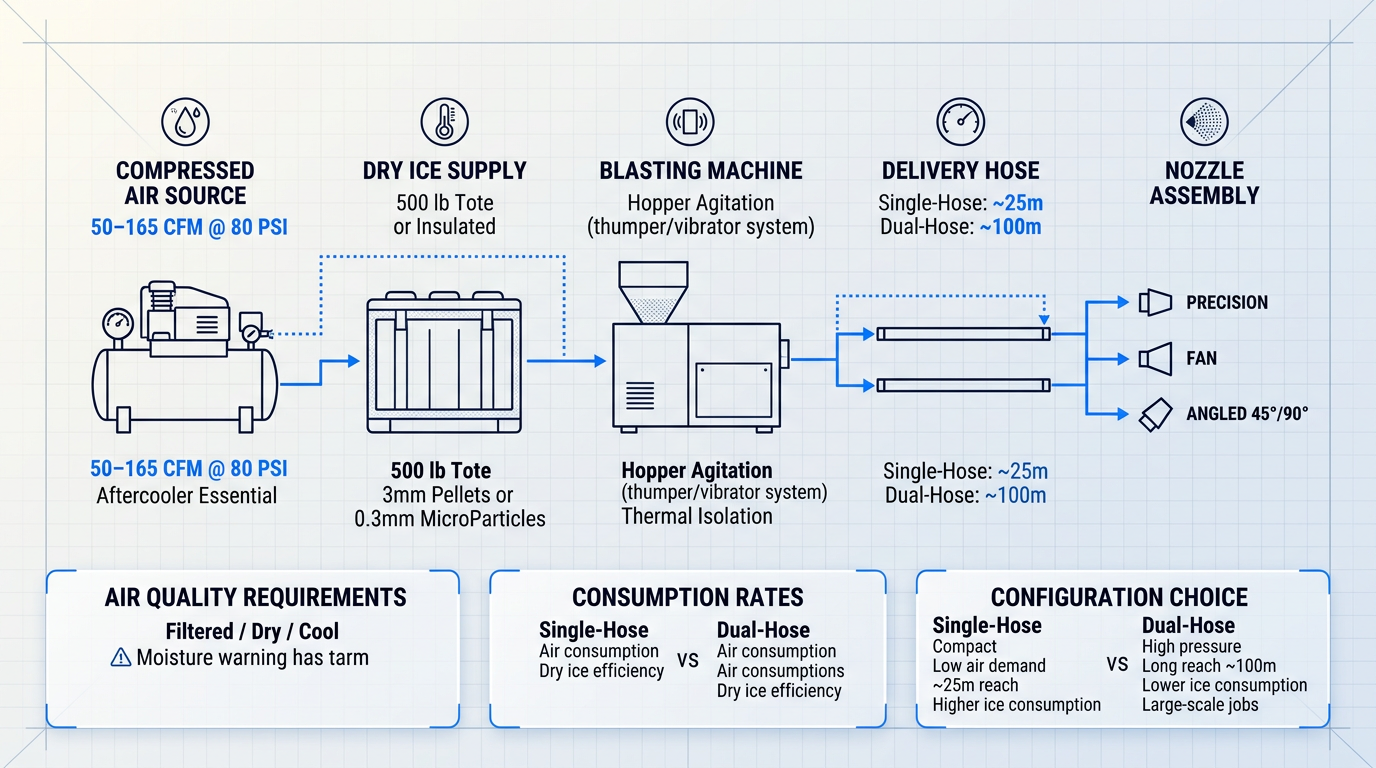
A dry ice blasting machine is only one part of what you actually need to run a cleaning operation. The full system — compressed air source, dry ice supply, hopper management, and nozzle selection — each carries its own requirements, and understanding the complete picture is essential before evaluating costs or committing to a setup.
Machine Configurations: Single-Hose vs Dual-Hose
Industrial dry ice blasters are built around one of two fundamental architectures: single-hose and dual-hose (sometimes called two-hose) systems, and the difference between them goes well beyond a spec sheet distinction.
In a single-hose system, the dry ice pellets and the accelerating compressed air share the same delivery hose — the pellets are pushed through together with the air stream all the way to the nozzle.
A dual-hose system separates these two functions: one hose carries the pellets at low pressure to the gun, whilst a second hose delivers the high-pressure air that accelerates them at the nozzle itself.
This architectural difference has direct consequences for hose reach, cleaning power, dry ice consumption, and the scale of job each configuration suits best.
| Characteristic | Single-Hose | Dual-Hose |
|---|---|---|
| Air Consumption | Lower — typically 0.5–6.5 m³/min (1–12 bar) | Higher — typically 1–13 m³/min (1–16 bar) |
| Maximum Hose Reach | Up to ~25 m from the machine | Up to ~100 m from the machine |
| Maximum Blast Pressure | Up to ~12 bar (single-hose gun) | Up to ~16 bar (two-hose gun) |
| Dry Ice Consumption | Higher at elevated pressures | Lower — controlled low-pressure pellet transport reduces waste |
| Best-Fit Application Scale | Focused, small-to-medium jobs; in-house use | Large-scale, high-speed jobs; long-distance and outdoor blasting |
Comparison of single-hose vs dual-hose dry ice blasting configurations across key operational axes to help readers choose the right architecture for their application.
The single-hose configuration wins on compactness, lower air demand, and ease of manoeuvre — it is the natural choice for in-house maintenance, focused cleaning tasks, and sites where a smaller compressor is all that is available.
The dual-hose configuration justifies its added weight and larger compressor requirement when the job is large-scale, when the operator needs to work 50–100 metres from the machine, or when dry ice consumption efficiency matters at high blast pressures — the separate pellet transport hose keeps pellets intact and flowing at speed, delivering more cleaning energy per kilogram of dry ice consumed.
Compressed Air: The Critical Dependency
Compressed air is the single most important operational dependency in a dry ice blasting system — without an adequate, clean air supply, the machine cannot function effectively regardless of pellet quality or operator skill.
At 80 PSI, standard commercial and heavy-duty industrial blasters typically require between 50 and 165 CFM to operate efficiently; heavy-duty models can push blast pressure up to 300 PSI for the most aggressive cleaning tasks.
MicroParticle systems are considerably less demanding — low-flow nozzle configurations can operate on as little as 12 CFM at 80 PSI, making them viable on smaller air supplies.
Air quality is just as important as volume and pressure: the supply must be filtered, dry, and cool. Moisture in the air line freezes instantly on contact with the sub-zero pellets, fusing them into clumps that block the feed system and reduce blast pressure — a direct operational consequence that is covered further in the limitations section.
When using a diesel-powered mobile compressor, an aftercooler is essential to remove heat and water vapour from the air before it reaches the blaster; diesel compressors typically output hot, moisture-saturated air that is incompatible with reliable dry ice blasting without this conditioning step.
The air source itself can be existing plant air — provided the facility line has sufficient capacity to supply the blaster alongside any other pneumatic tools drawing from the same system — or a dedicated mobile industrial compressor. New mobile compressors rated for dry ice blasting requirements typically cost in the region of $12,000 to $25,000, which represents a significant infrastructure investment on top of the blasting machine itself.
Dry Ice Supply, Pellet Types, and Sublimation
Dry ice is a consumable that behaves unlike any other blasting medium: it cannot be stockpiled, it changes state continuously, and its quality at the point of use directly affects cleaning performance.
Standard pellets are 3 mm in diameter — roughly rice-sized — and are used for the majority of industrial cleaning applications where aggressive contaminant removal is required.
For delicate or precision work, MicroParticles of approximately 0.3 mm are used instead; their smaller size means more particles strike the surface per second, giving greater coverage area with less aggressive impact — suitable for electronics, plastic moulds, and sensitive substrates.
Pellet density and consistency are meaningful quality variables: low-density or degraded pellets carry less kinetic energy on impact, reducing cleaning effectiveness even at the same blast pressure and feed rate.
This makes supplier selection and storage discipline operationally significant — pellets should be sourced from a reliable supplier and stored in well-insulated containers to preserve density and minimise sublimation loss before use.
Dry ice stored in insulated containers sublimates at approximately 2–10% per 24 hours, with 10% as the practical upper-bound planning figure. Unused stock is a direct cost — supply timing and order quantities need to account for this from the outset.
The industry standard storage vessel is a 500 lb insulated tote, supplied by the dry ice vendor and returned at the next delivery; the thicker the insulation, the slower the sublimation rate.
Hopper Agitation Systems
Dry ice pellets are extremely cold and hygroscopic — they attract moisture from the surrounding air, which causes them to stick together and form clumps that can block the machine's feed system.
Well-engineered machines address this through dedicated hopper agitation mechanisms: thumpers, ramrods, and electric vibrators work together to keep pellets moving and separated throughout the hopper and feeder path.
The presence and sophistication of these agitation systems is one of the clearest differentiators between machine quality tiers — a machine without adequate agitation is far more susceptible to feed interruptions during continuous operation.
Hoppers on quality machines are also thermally isolated to slow the rate at which ambient moisture reaches the pellets, complementing the mechanical agitation with a passive protective measure.
Nozzle Selection
Nozzle selection is a genuine operational decision, not an afterthought — the geometry of the nozzle determines the blast swath, the CFM consumed, and how well the cleaning energy is concentrated on the target surface.
Precision or pencil nozzles produce a narrow, focused blast swath suited to fine detail work and tight cavities; fan nozzles spread the blast across a wider area for faster coverage of flat surfaces; angled nozzles (available at 45° and 90°) allow access to recessed geometry and confined spaces.
Nozzle choice also affects consumable consumption rates: a wider fan nozzle covering more surface area per pass will consume air and dry ice at a different rate than a precision nozzle working a small zone — operators typically select nozzles as part of the job setup rather than using a single configuration for all tasks.
With the full equipment ecosystem now mapped out, the natural next question is what each element actually costs — and why the total investment in dry ice blasting can be considerably higher than it first appears.
Dry Ice Blasting Cost and Cost Drivers Explained
The sticker price on a dry ice blasting machine is not the cost of dry ice blasting. That distinction matters enormously — because the machine price covers only the blaster, hoses, and nozzles, and the real investment begins the moment you ask what else is needed to actually run a job.
Understanding the full cost picture means working through several distinct layers, each of which can surprise a first-time buyer who has only seen the machine price.
The Cost Layers: What You Are Actually Paying For
- Equipment capital: Entry-level units run $3,490–$6,999; mid-range $8,499–$9,999; heavy industrial systems $11,499–$65,000. Machine price excludes compressor and dry ice supply.
- Compressed air infrastructure: A new mobile industrial compressor costs $12,000–$25,000; used units $3,500–$11,000. Rental runs $150–$250/day. An aftercooler adds $2,500–$15,000 new or $150–$250/day to rent.
- Dry ice consumables: Bulk pellet pricing ranges from $0.30–$1.50/lb depending on volume and supplier. Consumption varies from 0.5 lbs/sqft (light contamination) to 5.0 lbs/sqft (heavy coatings).
- Sublimation loss: Dry ice sublimates 2–10% per day in storage. Unused stock is a direct cost; ordering 10–20% extra buffer is standard practice to avoid running short mid-job.
- Labour and safety overhead: Most jobs require two operators — one blasting, one managing the hopper and hoses. PPE (insulated gloves, face shield, hearing protection) and CO2 ventilation add further overhead.
- Ongoing maintenance: Nozzles, hoses, and internal seals wear under regular use. Annual maintenance budgets of $300–$700 for parts are typical for moderate industrial use.
The compressed air infrastructure cost is consistently the layer that surprises buyers most: the machine price is visible on a product page, but the compressor requirement only becomes real when the equipment arrives and existing shop air proves insufficient.
As covered in the equipment section above, pellet blasting systems typically require 100 CFM at 80 PSI — a demand that many facility air lines cannot sustain concurrently with other pneumatic tooling, making a dedicated compressor a practical necessity rather than an optional upgrade.
Contractor Rates: The Service-Cost View
For facilities that hire a contractor rather than own equipment, the cost question shifts from capital to day rate — and the figures are equally layered.
| Cost Component | Typical Rate (USD) | Notes |
|---|---|---|
| Supervisor + Technician + Labour | $96/hr | Two-person crew; overtime rates apply for nights and weekends |
| Machine + Aftercooler + Compressor | $124/hr | Equipment charge; varies by contractor and job duration |
| Dry Ice Consumables | $175/hr | Largest single variable; reflects pellet consumption at working rates |
| Total Contractor Rate | ~$395/hr | US market (Detroit, Chicago, Toledo); excludes mobilisation and travel |
| Industrial day rate | $2,500–$4,500/day | Full-day industrial jobs; alternatively quoted at $3.50–$5.00/sqft |
Breakdown of professional dry ice blasting contractor hourly rate by cost component, based on US market data
The breakdown is instructive: dry ice consumables alone account for roughly 44% of the total hourly contractor rate, which explains both why the service feels expensive and why owning equipment changes the economics so dramatically for regular users — once capital is amortised, the main variable becomes pellet cost.
For one-off or infrequent jobs, contractor rates are often the more rational choice: the capital outlay for machine, compressor, and aftercooler can easily exceed $30,000–$40,000 before a single job is cleaned.
Machine Quality and Running Cost
Buyers comparing machine tiers should factor in a counterintuitive dynamic: a lower purchase price often produces a higher total cost of ownership over any meaningful operating period.
Industry data comparing budget and precision-tier machines illustrates this clearly: budget units consume approximately 3.5 lbs of dry ice per minute versus 1.8 lbs/min for precision systems — a 49% difference in media consumption rate that compounds across every operating hour.
At 500 operating hours per year and $0.40/lb for dry ice, that consumption gap translates to roughly $20,400 in additional annual pellet cost for the budget machine — before accounting for the downtime cost of more frequent hopper freeze-ups, which one industry analysis estimates at $5,625/year in lost labour at $250/hr.
Budget dry ice blasters (typically $1,000–$8,000) often consume 49% more dry ice per minute than precision-tier systems. Over 500 operating hours, that media inefficiency alone can exceed $20,000 in additional annual cost — more than the price difference between tiers.
The TCO Reframe: Full-Job Cost, Not Day Rate
The most useful cost comparison is not day rate versus day rate — it is full-job cost, including every cost that alternative methods generate and dry ice blasting eliminates.
Because the CO2 sublimates completely, there is no secondary waste stream to collect, bag, or dispose of — a cost that chemical and abrasive cleaning methods carry as a direct line item, and that becomes substantial when the contamination involves hazardous coatings or regulated materials.
Because blasting dry ice can be performed on equipment in place and online, the disassembly, reassembly, and production downtime costs that offline cleaning methods incur are reduced or eliminated — and in high-throughput manufacturing environments, those downtime costs often dwarf the cleaning service cost itself.
A realistic TCO calculation covers: machine purchase, compressor investment or rental, dry ice and energy over expected annual hours, maintenance parts, training and safety overhead, and the differential in production downtime versus whatever method it replaces.
When the Economics Favour Dry Ice Blasting
The TCO case for blasting dry ice is strongest in specific scenarios — and weakest in others.
- Recurring production cleaning: Regular users amortise capital quickly. Facilities cleaning equipment weekly or monthly see payback periods that justify ownership over contracting.
- High downtime-cost environments: Where every hour of production stoppage is expensive, in-place cleaning that avoids disassembly delivers savings that far exceed the cleaning cost itself.
- Hazardous waste applications: Jobs involving lead paint, asbestos-adjacent coatings, or other regulated contaminants generate expensive secondary waste under abrasive or chemical methods. Dry ice eliminates that disposal cost.
- In-place cleaning of complex assemblies: Avoiding disassembly and reassembly of electrical panels, moulds, or production machinery removes labour costs and re-qualification time that can be substantial.
Conversely, the economics are less compelling for infrequent, low-volume jobs on simple surfaces with no downtime sensitivity — in those cases, contractor rates or alternative methods may offer a lower full-job cost without the capital commitment.
Cost is one of several operational realities that inform the decision to adopt dry ice blasting — and it sits alongside a set of practical limitations and challenges that are worth examining with equal honesty.
Limitations and Challenges of Dry Ice Blasting
The benefits of blasting dry ice are real — but any professional making a serious procurement decision deserves the full picture, including where the method creates friction, where the economics work against it, and where a different approach would simply serve them better.
Day-to-Day Operational Challenges
Four operational challenges recur consistently across dry ice blasting deployments: hopper freezing, CO2 supply logistics, storage losses, and noise.
- Hopper freezing and pellet clumping: Moisture in compressed air flash-freezes on contact with pellets, fusing them into clumps that block the feed line and halt blasting. Budget machines with minimal agitation suffer this most acutely.
- CO2 supply chain vulnerability: Dry ice cannot be stockpiled indefinitely. Supply constraints caused significant shortages in Europe and the US in 2022, and the structural mismatch persists.
- Storage loss through sublimation: Dry ice sublimates at roughly 10–25% per 24 hours even in insulated storage. Unused stock is a direct cost — and airtight containers risk pressure build-up and rupture.
- Noise levels: The blasting process generates approximately 85–115 dB at the operator position. Hearing protection is mandatory; sustained unprotected exposure risks permanent hearing damage.
The hopper freezing problem is directly tied to machine quality tier: well-engineered machines incorporate agitation systems — thumpers, ramrods, electric vibrators — alongside dry air supply to prevent ice dam formation in the feed system.
The supply chain risk deserves particular attention because it is structural, not historical. Dry ice consumption has been growing at roughly 5% per year, while CO2 supply has grown only about 0.5% annually — a mismatch that drives periodic shortages and volatile spot pricing, with surges of up to 300% recorded during supply crunches.
Geographic distance from a dry ice supplier compounds this: longer logistics chains mean more sublimation loss in transit, higher delivered cost, and less resilience when supply tightens.
Cost, Training, and Safety Constraints
As covered in the cost section, the capital investment in equipment and compressed air infrastructure is substantial — but the strategic implication for low-frequency users is worth stating plainly: the economics of dry ice blasting rarely justify the setup for occasional or simple cleaning tasks where pressure washing or chemical cleaning would suffice.
Effective operation also requires genuine training — on blast pressure settings, nozzle selection, pellet handling, and CO2 ventilation protocols — which creates real overhead for organisations considering bringing cleaning in-house rather than contracting it out.
The most serious safety constraint is CO2 accumulation in enclosed spaces: sublimating CO2 is heavier than air and displaces oxygen in poorly ventilated areas without any visible or olfactory warning.
According to NIOSH and OSHA guidance, the time-weighted average exposure limit for CO2 is 5,000 ppm over an 8-hour shift; the IDLH (immediately dangerous to life or health) threshold is 40,000 ppm. Adequate ventilation is a non-negotiable operational requirement, and confined space work requires active CO2 monitoring — resources such as the CDC/NIOSH pocket guide and OSHA's cryogen quick-facts sheet provide authoritative detail on exposure management.
Dry ice demand is growing at roughly 5% per year while CO2 supply grows at only ~0.5% annually — a 10x gap that makes supply shortages and price spikes a structural risk, not a one-off event.
Applications Where Dry Ice Blasting Is Less Effective
Beyond operational burdens, there are application categories where the non-abrasive nature of dry ice blasting shifts from being a benefit to being a genuine limitation.
- Heavy corrosion and mill scale: Dry ice blasting cannot create the anchor profile that coatings need to bond. Abrasive blasting is the appropriate method where surface profiling is required.
- Soft or thermally sensitive materials: Soft woods and some softer plastics can be damaged by the combination of high-velocity impact and the extreme cold of −78.5°C pellets.
- Thick, strongly bonded coatings: Very hard coatings with strong substrate adhesion — such as baked-on enamel on cast iron — may resist removal or require extended effort that erodes the efficiency advantage.
- Deeply embedded contamination: Discolouration or residues that have bonded chemically into a material's structure are beyond the reach of a surface-acting, non-chemical process.
These are not failures of the method — they are genuine fit boundaries that any professional should map against their specific application before committing.
The right-tool-for-the-job principle applies here as it does anywhere: dry ice blasting excels where non-abrasive, dry, in-place cleaning is needed, but it is not a universal replacement for abrasive or chemical methods in every scenario.
The operational challenges discussed here — particularly the CO2 supply dependency and the ventilation requirements — are distinct from a broader question that professionals increasingly ask: is dry ice blasting actually environmentally sound, given that CO2 is both its medium and its by-product? That question is worth examining carefully on its own terms.
Is Dry Ice Blasting Actually Green?
The environmental claims made about blasting dry ice span a wide spectrum — from "carbon neutral" and "zero waste" at one end to "it pumps CO2 into the atmosphere" at the other. Neither framing is accurate, and both do the reader a disservice.
The CO2 Misconception: Where Dry Ice Actually Comes From
The most common environmental objection to dry ice blasting is the most easily resolved: the assumption that releasing CO2 during cleaning means adding CO2 to the atmosphere.
In practice, the CO2 used to make dry ice is not extracted from the atmosphere or synthesised from new sources — it is captured as a byproduct of existing industrial processes, including ammonia refining, ethanol fermentation, and petroleum refining, as confirmed by peer-reviewed research.
This is the principle of carbon capture and utilisation (CCU): CO2 that would otherwise be vented from an industrial facility is instead captured, purified, and converted into dry ice pellets, giving it a second life as a cleaning medium.
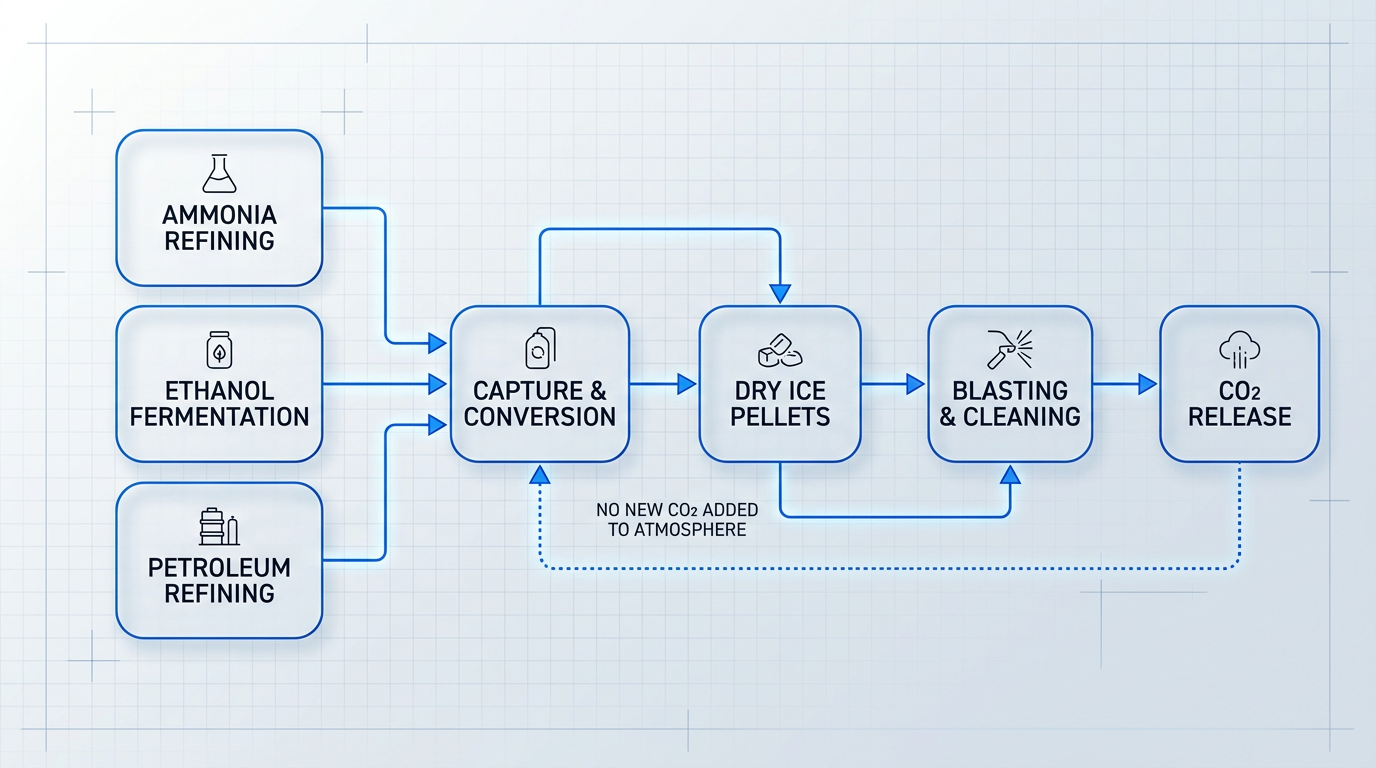
Because the CO2 was already circulating within the industrial economy before it became dry ice, using it as a cleaning medium does not introduce new carbon into the atmosphere in the way that burning fossil fuels does.
This distinction has regulatory weight. According to Cold Jet's environmental documentation, both the EPA and the California Air Resources Board (CARB) have noted that dry ice cleaning does not contribute to a user's greenhouse gas emissions score — because CO2 is accounted for at the producer level, not counted a second time at the point of use.
Cold Jet's environmental documentation cites both the EPA and CARB as confirming that dry ice cleaning does not add to a user's greenhouse gas score. The CO2 is accounted for upstream, at the producer level — it is not counted again when released during cleaning. This is a GHG accounting rule, not a claim that the process has zero carbon footprint.
The EPA's Greenhouse Gas Reporting Programme (Subpart PP) requires CO2 suppliers — not end users — to report the mass of CO2 they supply, which structurally confirms that greenhouse gas reporting obligations sit at the production stage rather than at the point of use.
Genuine Environmental Advantages Over Conventional Methods
With the CO2 accounting established, the genuine environmental advantages of dry ice blasting over chemical cleaning, abrasive blasting, and pressure washing are worth stating clearly.
- No chemical waste stream: Eliminates solvents, acids, and cleaning agents entirely — removing the associated storage, handling, and hazardous disposal obligations.
- No wastewater generation: Unlike pressure washing, dry ice blasting produces no contaminated water requiring treatment, containment, or licensed disposal.
- No secondary blasting media: Spent abrasive media — which can itself be hazardous when contaminated with lead paint or coatings — is eliminated entirely. The WJTA confirms no secondary waste is generated.
These are operational realities with direct environmental consequences: fewer waste streams means fewer disposal obligations, lower contamination risk, and a reduced regulatory burden for the facility.
Where the Environmental Picture Gets More Complicated
The CCU framing and the absence of chemical or secondary waste are genuine advantages — but they do not make dry ice blasting environmentally cost-free, and the honest counterpoints deserve equal attention.
Compressor energy consumption is the most significant factor. According to the US Department of Energy, compressed air generation accounts for approximately 10% of electricity consumed in a typical industrial facility — and for some operations, that figure exceeds 30%.
The electricity powering those compressors carries a carbon footprint that varies with the local energy grid mix; a facility running on coal-heavy grid power will have a materially higher operational footprint than one drawing from renewables.
The CO2 supply dependency discussed in the limitations section also has environmental implications: dry ice sublimates continuously and cannot be stored indefinitely, which means regular deliveries from the production facility.
The transport emissions associated with those deliveries are a real, if often modest, environmental cost — and refrigerated delivery vehicles consume more fuel and release more N2O than standard vehicles, as Cold Jet's own environmental documentation acknowledges.
Finally, the CCU framing should not be read as a guarantee of complete recapture. CO2 capture efficiency varies by industrial source and process: NETL analysis shows that high-purity streams such as ethanol fermentation can achieve 99–100% capture, while lower-purity sources require deeper treatment and may achieve 90–99% removal — meaning the environmental quality of the dry ice supply chain is not uniform across all producers.
The Balanced Verdict
Taken together, the picture is clear enough to state plainly: dry ice blasting carries a genuinely lower environmental footprint than chemical cleaning, abrasive blasting, and pressure washing across most dimensions — the elimination of chemical waste streams, wastewater, and secondary media waste are real, measurable advantages.
But "carbon neutral" and "zero environmental impact" are overstatements. The electricity consumed by industrial compressors, the logistics of regular dry ice delivery, and the variability in upstream CO2 capture efficiency all contribute a real, if smaller, environmental cost.
The accurate framing is lower footprint relative to conventional alternatives — not zero footprint. That distinction matters for any organisation making a genuine sustainability case for the technology.
For operations where even the CO2 supply dependency and compressor energy load are unacceptable, laser-based cleaning methods represent a further step in this direction — eliminating both the CO2 supply chain and the compressed air requirement entirely, which the next section examines in a structured comparison.
Dry Ice Blasting vs Alternative Cleaning Methods
Knowing how a cleaning method works is only half the decision — the other half is knowing when to use it and, just as importantly, when not to. Every industrial cleaning method has a context where it is the right tool: the question is whether your application matches that context.
The table below compares dry ice blasting, abrasive blasting, pressure washing, and chemical cleaning across the seven axes that matter most to a maintenance professional making a method selection decision.
| Axis | Abrasive Blasting | Pressure Washing | Chemical Cleaning | Dry Ice Blasting |
|---|---|---|---|---|
| Substrate Impact | High — creates surface profile; removes substrate material; unsuitable for precision surfaces or thin-walled components | Low to moderate — kinetic action can erode softer surfaces; hot water increases abrasive effect | Variable — wrong chemistry can attack seals, plastics, or metals; correct match leaves surface intact | None — CO2 pellets are soft; no surface profile change, no dimensional alteration |
| Secondary Waste | High — spent abrasive media plus dislodged contaminant must be collected, contained, and disposed of | Moderate — generates 90–480 gallons of contaminated wastewater per hour, requiring containment and disposal | High — contaminated rinse water and spent chemical solutions require regulatory-compliant disposal | None — CO2 sublimates on impact; only the dislodged contaminant remains for collection |
| Electrical Safety | Not compatible — dust-proof enclosures required for all electrical equipment; live panels must be shut down | Not compatible — water is highly conductive; live electrical equipment must be isolated and dried before restart | Not compatible — most chemical solutions are conductive; water rinsing step creates additional electrical risk | Compatible — dry ice is non-conductive; live electrical panels, motors, and sensors can be cleaned safely |
| In-Place Capability | No — extensive masking and disassembly required; blast debris risks damage to surrounding equipment | Limited — equipment must be disassembled or isolated; wastewater containment required before cleaning begins | Limited — dwell time, rinsing, and drying steps require equipment to be offline; residue must be fully removed | Yes — equipment cleaned in installed state, often while warm; no disassembly, masking, or cooldown needed |
| Downtime | High — includes enclosure setup, blast time, media cleanup, and drying before recoating; cleanup can take 3x blast time | High — includes prep, cleaning, full drying cycle (hours), and drying verification before electrical restart | High — chemistry contact time (acid descaling: 20 min to 12 h; alkaline degreasing: 5–10 min), plus rinsing and drying | Low — minimal prep; equipment returns to service immediately after cleaning; no drying or rinsing step |
| Cost Profile | Lower upfront equipment cost; high secondary waste disposal and containment infrastructure costs on sensitive sites | Low equipment cost; disposal of contaminated wastewater and extended drying downtime add to total operational cost | Low chemical cost per application; hazardous waste storage, disposal obligations, and regulatory reporting add ongoing cost | Medium-high equipment and CO2 consumable cost; offset by minimal secondary waste disposal and reduced downtime |
| Environmental Footprint | High — spent abrasive and contaminant waste stream; dust containment and HEPA filtration required; potential hazardous waste classification | Moderate — high water consumption; contaminated wastewater requires treatment before discharge; no chemical waste if detergent-free | High — chemical waste streams carry RCRA hazardous waste classification risk; VOC emissions from solvent-based products | Low — CO2 is recaptured industrial by-product; no chemicals, no wastewater; compressor energy is the primary environmental overhead |
Side-by-side comparison of four industrial cleaning methods across seven decision-relevant axes for method selection.
The table reveals a clear pattern: secondary waste and downtime are the axes where the methods diverge most sharply, and they are directly linked.
Methods that generate secondary waste — spent abrasive, contaminated wastewater, or chemical rinse water — require containment infrastructure, cleanup time, and disposal logistics that extend the total maintenance cycle well beyond the cleaning time itself.
Dry ice blasting's advantage on downtime is structural, not marginal: because the blasting medium sublimates, there is no secondary media to collect, no surface to dry, and no rinsing step — which is why equipment can return to service immediately after cleaning.
The electrical safety row is equally decisive for facilities with motors, control panels, and sensors: abrasive dust, water, and chemical residues all require electrical equipment to be isolated, powered down, and dried before restart, while dry ice blasting is the only method in this comparison that is safe to use on live electrical equipment.
The right cleaning method is always determined by the application's constraints — substrate sensitivity, secondary waste tolerance, electrical safety requirements, and downtime budget — not by a universal ranking.
Abrasive blasting's genuine strength is on the substrate impact axis — but only when that impact is desired: creating a surface profile for coating adhesion on structural steel is exactly the job it was designed for, and no other method in this comparison does it as effectively.
Pressure washing earns its place where large outdoor surfaces need fast coverage and drainage infrastructure is available — conditions under which its wastewater generation is manageable and its low equipment cost is a genuine advantage.
Chemical cleaning is the right choice when the contamination is highly specific — mineral scale, oil deposits, or oxidation — and the chemistry can be precisely matched to the contaminant, with dwell time built into the maintenance schedule.
Laser Cleaning: A Further Evolution
For applications where substrate precision is paramount and CO2 supply dependency or compressor requirements are a constraint, laser-based cleaning represents a further evolution of the non-abrasive, dry, no-secondary-waste approach.
Woodrow Scientific Limited's ELASER is an example of this technology: consumable-free, air-cooled, and requiring no compressed air or CO2 supply, it removes contamination through laser ablation while leaving the base material intact — with total cost of ownership shaped by zero consumables, minimal downtime, and reduced rework rather than by day-rate comparisons.
Choosing the Right Method: Scenario Guide
Based on the comparison above, the following scenario mapping gives a direct starting point for method selection.
- Heavy rust, structural steel: Abrasive blasting. Surface profile is required for coating adhesion; substrate damage is acceptable and the anchor pattern is the goal.
- Large outdoor surfaces: Pressure washing. Drainage infrastructure available, bulk contamination removal needed, and low equipment cost is a priority.
- Specific chemical contamination: Chemical cleaning. Mineral scale, oil deposits, or oxidation where chemistry can be matched precisely and dwell time is acceptable.
- Sensitive or electrical equipment: Dry ice blasting. Non-abrasive, non-conductive, in-place cleaning — food/pharma environments, live panels, precision tooling, and moulds.
- Maximum substrate precision, no CO2 dependency: Laser cleaning. No consumables, no compressor, no secondary waste — suited where substrate preservation and operational flexibility are paramount.
With a clear method-selection framework in place, the final step is applying it to your own application — weighing your specific substrate, contamination type, downtime budget, and operational constraints to arrive at the right answer for your situation.
Conclusion
Is dry ice blasting right for your application?
The method earns its place when the application genuinely needs what it uniquely offers: non-abrasive, dry, in-place cleaning with no secondary waste — and when those requirements justify the supply chain and capital investment that come with it.
If that fit is there, the most productive next step is to trial the process on your specific substrate and contamination type, and to evaluate the economics on total cost of ownership rather than equipment price alone.
Frequently asked questions about dry ice blasting
Practical answers to the questions readers most commonly ask about dry ice blasting as an industrial cleaning method.
Yes — this is one of dry ice blasting's most valued capabilities. Because the process is completely dry and the CO2 pellets sublimate on contact, there is no conductive residue left behind. Electrical panels, motors, switchgear, and control cabinets can be cleaned without disconnection or disassembly, significantly reducing downtime. The non-abrasive nature of the process means sensitive components, wiring insulation, and circuit boards are not damaged by the cleaning medium itself. Operators should consult their site's health and safety adviser and any applicable electrical safety regulations before working near live equipment — the cleaning method is compatible with electrical environments, but safe working practice around live systems remains the operator's responsibility.
The main problems with dry ice blasting fall into several categories. Hopper freeze-ups and pellet clumping interrupt cleaning and require active equipment management. CO2 supply dependency is a structural vulnerability — dry ice sublimates continuously, so storage and logistics must be tightly managed. High noise levels at the operator position require hearing protection as standard. CO2 concentration risk in enclosed or poorly ventilated spaces is a genuine safety concern, as sublimating gas can displace oxygen; NIOSH and OSHA both publish occupational exposure guidance for CO2 that operators must follow. The method also has significant capital and operating costs, and it cannot create a mechanical anchor profile on surfaces being prepared for recoating — it cleans, but does not abrade. Many of these limitations are manageable with the right equipment, ventilation planning, and operator training. They are real operational considerations, however, and should factor into any purchasing or contracting decision.
Dry ice blasting is compatible with a wide range of surfaces: metals including steel, aluminium, cast iron, copper, brass, titanium, and galvanised steel; composites and plastics; stone, masonry, and brick; and electrical or electronic equipment. In terms of contaminants, the process is effective against grease, oil, paint, resins, release agents, adhesives, carbonised residue, mould, and biofilm. The method is not well suited to very porous or soft materials that may be damaged by thermal shock, nor to surfaces where abrasion is required to create a mechanical anchor profile for subsequent coating adhesion — structural steel being prepared for recoating is a common example where a profiling method is needed instead.
Core PPE requirements include: insulated (cryogenic) gloves to prevent frostbite from direct contact with dry ice; safety glasses or a full face shield to protect against rebounding particles; and hearing protection, as noise levels at the operator position are significant. Adequate ventilation is critical, particularly in enclosed or confined spaces, where sublimating CO2 can displace oxygen to dangerous concentrations. NIOSH and OSHA publish specific occupational exposure limits and confined space guidance for CO2 that should be consulted and followed. Oxygen monitoring is required for confined space work. Operator training is also a safety requirement, not just a performance consideration — undertrained operators create genuine safety risks, including inadequate ventilation management and improper handling of cryogenic media. Consult your site's health and safety adviser and the relevant regulatory guidance for the full requirements applicable to your working environment.
Both methods are non-abrasive, completely dry, and leave no secondary waste stream — they share a strong application overlap on sensitive surfaces, precision equipment, and in-place cleaning where disassembly is impractical. The key differences come down to infrastructure and operational environment. Laser cleaning eliminates CO2 supply dependency and compressed air infrastructure entirely — no pellets, no sublimation loss, no consumables, and no noise at the operator level. Dry ice blasting can cover larger surface areas more quickly in many applications, which suits certain high-throughput industrial tasks. The right choice depends on application specifics: CO2 supply access, noise constraints, surface area, substrate sensitivity, and working environment. For facilities where dry ice logistics or noise levels create operational friction, laser cleaning is worth serious consideration. Woodrow Scientific Limited's ELASER-RHZ is a portable laser cleaning system built around WSL's patented, world-first reduced hazard zone technology, which collapses the laser hazard zone to a fraction of conventional size — enabling cleaning in open workshops and mixed-use facilities without sealing off the area. That is a genuine practical advantage in environments where conventional laser cleaning would otherwise be impractical. WSL is the only UK-based laser cleaning manufacturer, designing and building its systems entirely in-house, which translates to faster support and genuine in-house engineering capability.
Dry ice is solid carbon dioxide (CO2) produced by capturing CO2 as a byproduct of other industrial processes — most commonly ammonia refining, ethanol production, and biogas facilities. That captured CO2 is compressed and liquefied, then allowed to expand rapidly, causing it to solidify into a snow-like form. That snow is then compressed into the pellets used in blasting systems. The key point is that dry ice is not newly produced CO2 — it is a recaptured industrial waste stream being put to a second use. Using it as a cleaning medium does not add net CO2 to the atmosphere; the gas would have been emitted regardless. This is the basis for the claim that dry ice blasting is carbon-neutral in its use of the cleaning medium itself.