

Introduction
If you have arrived here, the case for laser cleaning is already settled in your mind.
The question you are actually trying to answer is sharper: between a continuous wave and a pulsed laser cleaning machine, which one belongs in your operation?
It is a more consequential choice than it might first appear, with real implications for surface quality, throughput, heat input into the substrate, and how the machine fits your working environment.
What follows covers how the two technologies differ, which applications each one suits, what cost and operational factors to weigh, and a practical framework for arriving at a confident decision.
TL;DR
Neither technology is universally superior. A continuous wave laser cleaning machine and a pulsed unit each excel in a distinct domain — and the buyers who get the decision right are the ones who match the technology to their application, not the ones who chase the highest wattage or the latest specification.
This article covers:

How CW and pulsed laser cleaning differ in practice
Matching technology to your application and substrate
Cost and total cost of ownership
A decision framework for CW vs pulsed
What is a Continuous Wave Laser Cleaning Machine?
The choice between CW and pulsed laser cleaning comes down to one thing: how energy reaches the surface. Get that distinction clear, and every subsequent decision — substrate risk, throughput, application fit — follows logically.
A continuous wave laser cleaning machine emits a steady, uninterrupted beam at its rated output power. The laser is always on: its peak power, minimum power, and average power are all approximately equal.
A pulsed laser delivers energy in discrete bursts — typically in the nanosecond range — with gaps between pulses during which no light is emitted at all.
Those gaps are what make the difference. Because pulse energy is compressed into an extremely short duration, the peak power during each pulse is vastly higher than the average power — often by several orders of magnitude.
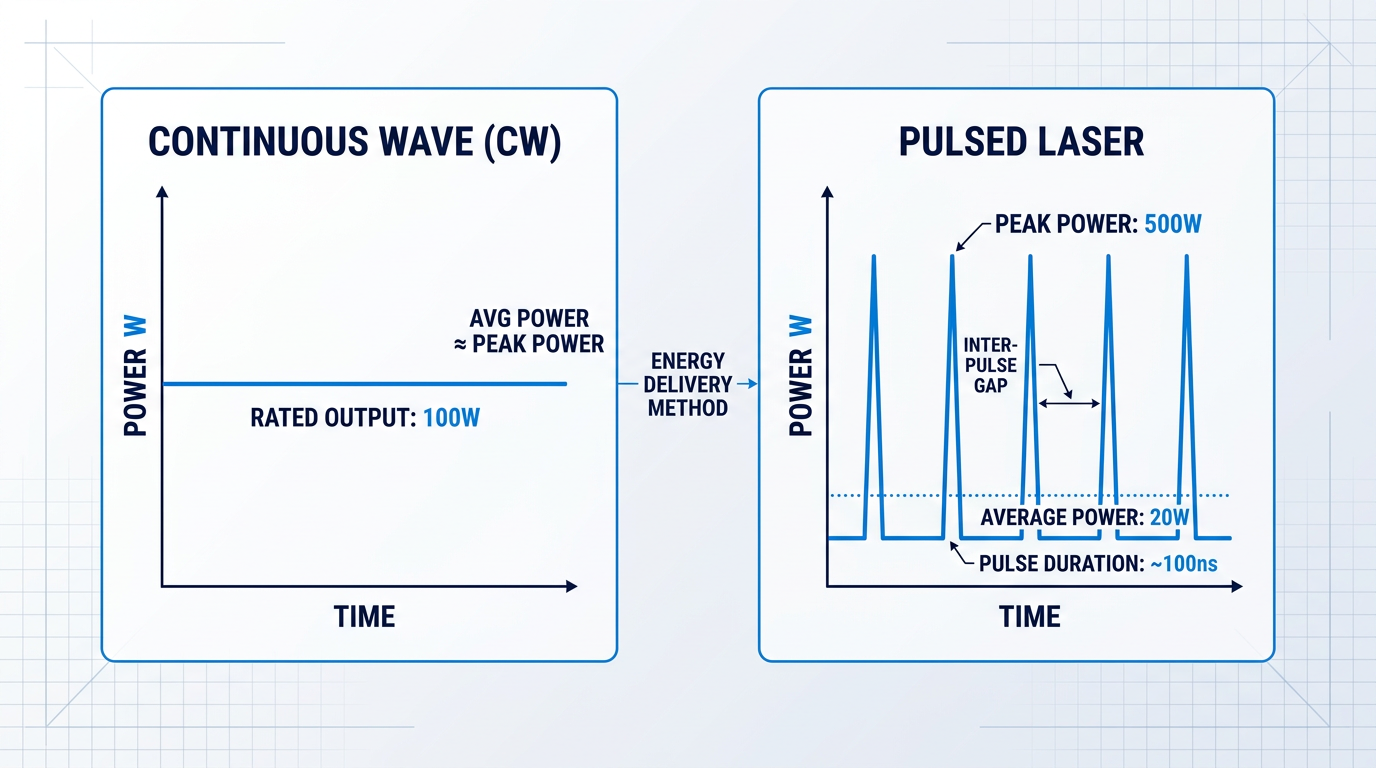
It is the peak power — not the average power — that drives the ablation mechanism in pulsed cleaning, which has significant consequences for how each mode interacts with the surface beneath the contaminant.
How Energy Delivery Shapes the Cleaning Process
CW operation delivers sustained thermal energy: the substrate is exposed to the laser's heat continuously for the full dwell time of the beam.
Pulsed operation works differently. Each nanosecond-range burst deposits an intense spike of energy into the contaminant, which absorbs it and ablates — vaporising or being ejected — before significant heat has time to conduct downward into the substrate beneath.
The underlying principle is thermal diffusion: heat spreads through a material over time, so a shorter interaction time limits how deeply thermal energy penetrates.
This is where the heat-affected zone (HAZ) becomes relevant — the region of the substrate that experiences thermal alteration as a result of laser exposure. Short pulses limit HAZ depth; a continuous beam allows heat to conduct further into the substrate over its longer interaction time.
Despite this difference in energy delivery, both modes share the same fundamental cleaning principle: selective ablation based on differing ablation thresholds between contaminant and base material.
The laser is set to exceed the contaminant's threshold while remaining below the substrate's — so the contaminant is removed and the underlying surface stays intact.
CW and pulsed are not competing technologies — the entire difference lies in how each delivers energy, and that delivery profile determines everything about application fit.
One further variant is worth noting to avoid confusion: modulated CW, where a CW laser is switched on and off at medium-to-high frequency to reduce average thermal input compared to unmodulated CW.
Modulated CW is not equivalent to true pulsed laser cleaning — it cannot replicate the nanosecond-range pulse durations or the extreme peak powers that a genuine pulsed system generates. The misconceptions section covers the practical consequences of this distinction in more depth.
These differences in energy delivery translate directly into different strengths, limitations, and application fits — which the rest of this guide works through systematically, starting with the most consequential practical implication: heat input and substrate risk.
Heat Input and What It Does to Your Substrate
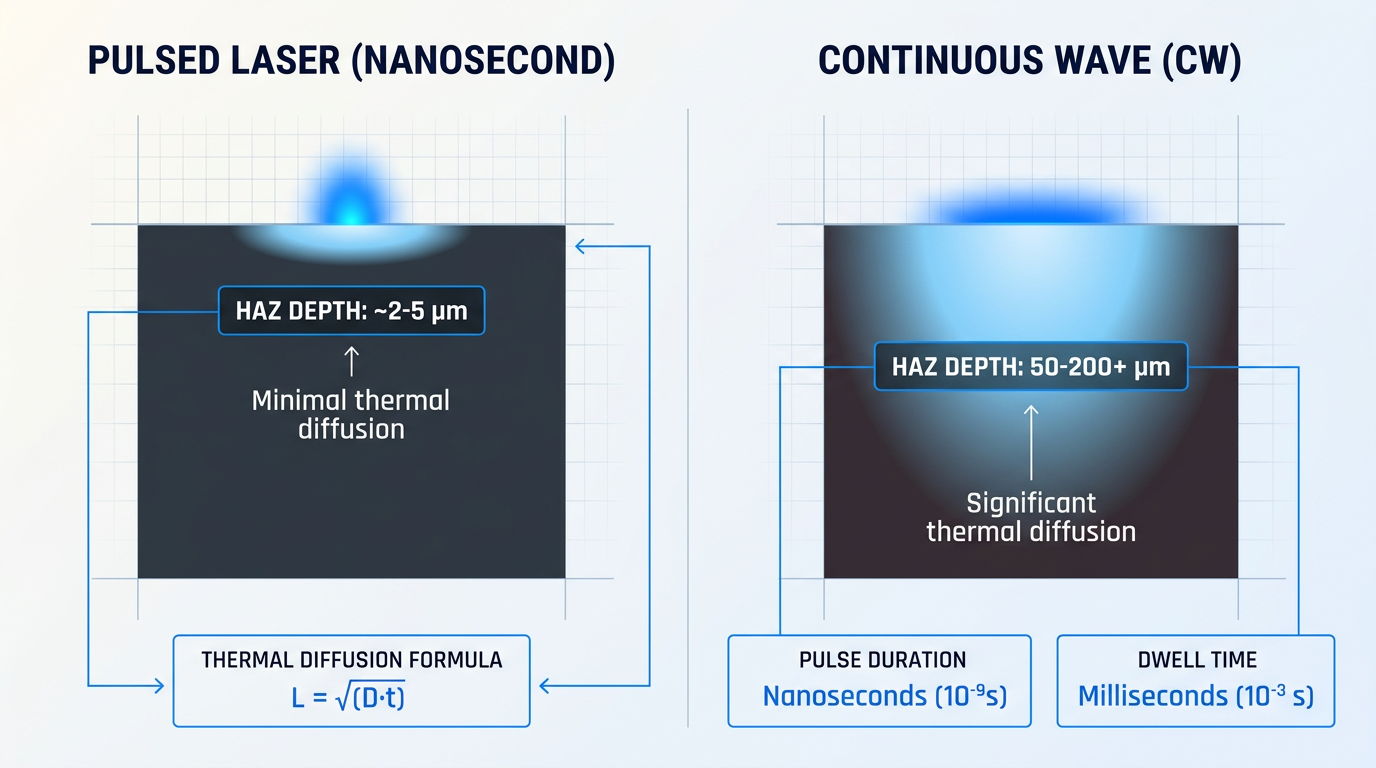
The same laser mode that cleans one substrate perfectly can permanently alter another. Understanding why comes down to a single physical reality: thermal diffusion depth scales with how long the beam dwells on the surface, and the two laser modes differ by orders of magnitude on that measure.
HAZ Depth: An Orders-of-Magnitude Difference
Thermal diffusion length follows the square root of time — as established in peer-reviewed laser-material interaction literature, the relationship is L = √(D·t), where D is thermal diffusivity and t is pulse duration or dwell time.
A nanosecond-range pulse keeps heat penetration to a very shallow layer — on the order of a few micrometres — because the interaction time ends before heat can conduct meaningfully into the substrate.
A continuous wave beam dwelling on the surface for even a millisecond allows heat to conduct far deeper: the diffusion depth grows dramatically, reaching depths that can represent a functionally significant fraction of thin substrate thicknesses.
This is not a marginal difference in degree. It is a structural difference in kind — the two modes operate in entirely separate thermal regimes.
Surface Roughness: What the Research Shows
HAZ depth is only part of the substrate impact story. Surface roughness outcomes diverge sharply between the two modes, and roughness is a functional property — not a cosmetic one — for surfaces destined for bonding, coating, or precision inspection.
According to Laser Focus World's comparative analysis of CW versus pulsed fiber laser cleaning, CW-cleaned surfaces showed a roughness value approximately 1.5× higher than the original surface.
MOPA pulsed fiber laser cleaning, by contrast, produced roughness values close to or even lower than the original surface — the pulse energy was sufficient to ablate the contaminant while leaving the base finish largely intact.
For any application where the cleaned surface feeds directly into a downstream process — adhesive bonding, thermal spray coating, precision measurement — that roughness delta is an engineering constraint, not a preference.
The CW Operating Window Is Narrow
The risk with a continuous wave laser cleaning machine is not that it always damages surfaces — it is that the parameter window in which it cleans without damaging is narrow.
Scan too slowly, or allow power density to build at a single point, and localised overheating follows: the surface can melt, and the heat effect creates secondary oxide formation — a new contamination layer generated by the cleaning process itself.
As the P-Laser FAQ frames it, CW delivers a constant energy stream that cannot be controlled with the same precision as pulsed delivery — the bandwidth of usable operating conditions is far narrower, and overheating in the melt pool produces the very oxides the process was meant to remove.
This is a practical process control challenge, not a theoretical one. It is the reason CW laser cleaning demands more operator skill and tighter parameter discipline than pulsed systems.
Matching Substrate Thermal Tolerance to Laser Mode
The practical question is not which mode is thermally gentler in the abstract — it is whether your substrate can absorb the thermal input without functional consequence.
- Thermally robust substrates: Thick structural steel, cast iron, and heavy industrial sections have large thermal mass. CW heat input represents a negligible fraction of total thickness with no effect on mechanical properties.
- Thin sheet metal: Low thermal mass means CW diffusion depth becomes a significant fraction of total wall thickness. Distortion and surface damage risk are real.
- Aluminium alloys: High thermal conductivity spreads heat rapidly. Low melting point (~660°C) and sensitivity to temper loss make CW a high-risk default on aerospace-grade alloys.
- Precision components: Tight dimensional tolerances and fine surface finish requirements (Ra below ~1.5 µm) cannot accommodate the roughness increase and HAZ depth that CW cleaning introduces.
- Heritage and conservation materials: Any thermal alteration to patina, surface chemistry, or microstructure is irreversible. Pulsed is the only defensible choice where substrate integrity cannot be compromised.
The pattern is consistent: when a substrate has the thermal mass and mechanical tolerance to absorb CW heat input without consequence, the HAZ becomes a secondary concern. When it does not, pulsed is the lower-risk default — not because pulsed is categorically superior, but because it keeps the thermal impact within the substrate's tolerance.
A cleaning machine that removes the contaminant but damages the base material has failed at its primary task. Establish whether your substrate can tolerate CW thermal input before any other selection criterion applies.
With substrate risk established as the foundational criterion, the next question for thermally robust materials becomes one of cleaning speed and throughput — where the continuous wave laser cleaning machine holds a genuine and significant advantage.
Cleaning Speed and Throughput: Where CW Has the Advantage
The substrate risk trade-off covered in §4 is real — but on thermally robust surfaces, the productivity case for a continuous wave laser cleaning machine is compelling enough to be the deciding factor for many industrial buyers.
The root cause of CW's throughput advantage is duty cycle: a CW machine operates at 100%, meaning every rated watt reaches the surface continuously for as long as the trigger is held.
A pulsed machine delivers energy in nanosecond-range bursts separated by gaps during which no light touches the surface; its average power is therefore a fraction of its peak power, and it is average power — not peak power — that governs area coverage rate.
A pulsed laser advertised at '50 kW peak power' at 200 W average will clean no faster than any other 200 W average system. Throughput is governed by average power delivered per unit time, not by the peak intensity of individual pulses.
The practical consequence becomes clear when you put specific figures against a representative scenario: heavy rust on carbon steel, targeting Sa 2–Sa 2.5 cleanliness.
| Contaminant | Layer Thickness | Pulsed Speed | CW Speed | Advantage |
|---|---|---|---|---|
| Heavy rust | 100–200 µm | 0.5–1.5 m²/h | 6–10 m²/h | CW dominates; 5×–8× faster across an eight-hour shift |
| Thick epoxy paint | 150 µm+ | 0.3–0.8 m²/h | 8–12 m²/h | CW dominates; sustained energy drives thermal decomposition of thick coatings |
| Light rust | 10–30 µm | 3–5 m²/h | 2–4 m²/h (burn risk) | Pulsed competitive; CW risks surface damage on thin layers |
| Oil / grease | Thin film | 8–12 m²/h | 4–6 m²/h | Pulsed faster; sharp ablation threshold suits nanosecond pulses |
| Heavy mill scale | 200 µm–2 mm | 1–5 m²/h | 8–20 m²/h | CW preferred; pulsed cannot match energy density per pass |
Throughput comparison between CW and pulsed laser cleaning across contamination types, showing m²/hour figures from published sources.
The table makes the pattern clear: CW's advantage is concentrated on thick, tenacious contamination where sustained high-power energy delivery outpaces the intermittent bursts of a pulsed system.
Across an eight-hour shift, that gap compounds significantly: a 1000 W CW machine clearing heavy rust at 8–15 m²/hour finishes 64–120 m², while a 100 W pulsed unit on the same surface at 1–3 m²/hour finishes 8–24 m².
It is worth noting that this comparison also reflects a tenfold power difference — the throughput gap reflects both higher average power and the 100% duty cycle of CW delivery working together.
Contamination thickness amplifies CW's advantage in a non-linear way: when deposit depth exceeds roughly 500 µm, pulsed systems cannot match the energy density a high-power CW laser removes per pass, because each pulsed burst removes only 10–50 µm of material at a time.
Doubling contamination thickness pushes this gap further still, since the energy required to remove thicker deposits per pass scales in a way that favours sustained high-power delivery — a practical concern for anyone dealing with heavy marine coatings, thick mill scale, or deeply corroded structural steel.
Where CW Dominates and Where It Does Not
Mapping the throughput comparison across contaminant types gives a practical picture of where each technology belongs on the selection spectrum.
- Heavy rust and mill scale: CW's throughput advantage is decisive. Sustained energy density removes thick oxide layers far faster than pulsed systems can manage per shift.
- Thick epoxy and industrial coatings: CW dominates where coating thickness exceeds 150 µm. Thermal decomposition of dense binders favours continuous energy over intermittent pulses.
- Light rust (10–30 µm): Pulsed is competitive and safer. CW risks surface burn on thin oxidation layers; pulsed delivers better substrate control at comparable speed.
- Oil and grease contamination: Pulsed is faster. The sharp ablation threshold of thin organic films suits nanosecond pulses better than continuous energy delivery.
- Precision surface preparation: Pulsed only. CW cannot deliver the selective, low-heat-input ablation required for thin substrates or tight surface tolerances.
The practical implication is that contaminant thickness is the primary selector: above roughly 100–200 µm on a thermally robust substrate, CW's throughput advantage is real and production-relevant; below that threshold, pulsed systems are competitive or superior.
A secondary contributor to CW's area coverage rate is spot size and scan width: CW machines typically use larger spot diameters of 1–5 mm, with some line-spot configurations reaching 30 mm wide per pass, versus 0.05–0.5 mm spots and 5–20 mm scan widths on pulsed systems.
This wider footprint per pass means CW covers more surface area per sweep of the scan head — a real contributor to throughput, though secondary to the duty cycle and average power advantage that is the fundamental driver.
For large-area, high-throughput industrial cleaning of heavy contamination on thermally robust substrates — structural steel, heavy weldments, shipbuilding plate — CW is the more productive technology by a meaningful margin.
That advantage disappears on precision work, heat-sensitive materials, or light contamination, where pulsed systems match or exceed CW performance. The next section maps these technology choices to specific contaminant types and substrate materials, giving you the application-level guidance to make a confident selection.
Matching Technology to Contaminant and Surface Type
You know what you are cleaning — now the question is which technology handles it. The answer is not always obvious, and getting it wrong costs you either in substrate damage or in throughput you did not need to sacrifice.
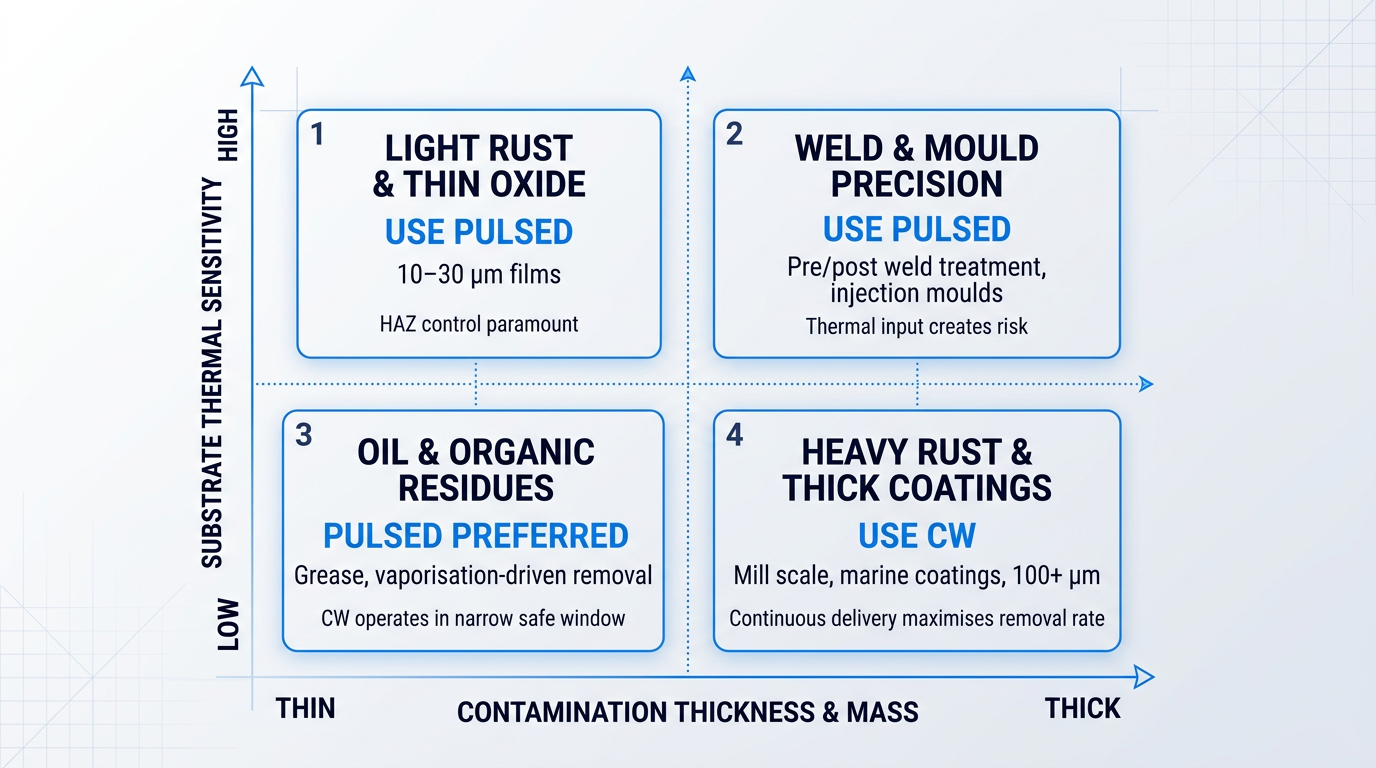
Every application recommendation in this section traces back to two axes: substrate thermal sensitivity (the HAZ risk established in §4) and contamination thickness and mass (the throughput dimension from §5). Once you understand those two axes, you can apply the logic to your own situation rather than just looking up your category.
Application-by-Application Technology Guide
The categories below cover the most common industrial and specialist cleaning tasks, each matched to a technology recommendation with the reasoning behind it.
- Light rust and thin oxide films (10–30 µm): Use pulsed. Thin layers sit close to the substrate boundary, so HAZ control is paramount. Pulsed cleaning efficiency on thin rust matches or exceeds CW at equivalent average power — the throughput trade-off is minimal.
- Heavy rust, mill scale, thick marine coatings (100 µm+): Use CW on thermally robust substrates (structural steel, cast iron). Thick contamination absorbs substantial energy before the beam reaches the substrate, and CW's continuous delivery maximises removal rate.
- Weld pre- and post-treatment: Use pulsed. Precision, minimal HAZ, and consistent repeatability across joint geometries are required. Pulsed cleaning reduces weld porosity and restores stainless steel passivation without altering the base metal.
- Mould cleaning (injection, tyre moulds, release agents): Use pulsed. Precision-machined surfaces cannot tolerate thermal distortion or dimensional change. Pulsed cleaning preserves fine mould detail without degrading surface finish or mould geometry.
- Oil, grease, and organic residues: Pulsed preferred. High peak power drives efficient vaporisation of light organics. CW can remove oil and grease but operates in a narrower safe window, with higher risk of surface discolouration.
The weld treatment and mould cleaning cases are both precision-process applications where CW thermal input creates risk rather than benefit — the substrate sensitivity axis dominates the decision entirely, regardless of contamination thickness.
Paint and Powder Coating: The Substrate Decides
Paint and powder coating removal is the most nuanced category in this guide, because the right technology depends on the substrate beneath the coating, not on the coating itself.
On thin aluminium sections or any heat-sensitive substrate, pulsed is the correct choice. Research from Laser Focus World confirms that MOPA pulsed cleaning on aluminium alloy produces surface roughness at or below the pre-clean baseline, while CW cleaning on the same material increases roughness by a factor of roughly 1.5x — a meaningful change for a substrate that will be bonded, coated, or held to a dimensional spec.
On thick steel structures — bridges, ship hulls, large fabrications — CW is preferred for throughput. The substrate has sufficient thermal mass to absorb the heat input without functional consequence, and CW's area coverage rate (up to 12 m²/hour on thick paint at high power) is decisive when large areas need stripping.
The third sub-case is the most technically demanding: selective layer removal, where the requirement is to remove a topcoat while leaving the primer intact. This demands pulsed operation. With each pulse removing a controlled, thin stratum, pulsed systems can stop at a specific layer boundary with precision — the ablation depth can be controlled within 5–10 µm. A continuous wave laser cannot reliably stop at a layer boundary; its thermal delivery is non-selective by nature.
Heritage and Restoration: Pulsed Only
Stone, masonry, bronze, and historic metalwork represent the clearest case of pulsed-only territory in laser cleaning.
These materials are irreplaceable, often heterogeneous in composition, and frequently heat-sensitive in ways that are not visually predictable. Any thermal alteration — even one that is not immediately obvious — can cause irreversible structural or aesthetic damage. The substrate sensitivity axis does not just favour pulsed here: it rules out CW entirely.
Trade press documentation of heritage conservation work consistently uses pulsed Nd:YAG and nanosecond fibre sources operating at carefully controlled low fluence. The self-limiting ablation behaviour of pulsed systems — where the beam stops reacting once the contaminant layer is gone and a more reflective substrate is exposed — is a critical safety property for conservation work that CW systems cannot replicate.
On irreplaceable substrates like historic stone, bronze, and metalwork, CW thermal input is not a trade-off to be managed — it is a disqualifying risk. Pulsed cleaning at controlled parameters is the only approach consistent with conservation requirements.
The pattern across all seven categories is consistent: when substrate sensitivity is high, pulsed wins regardless of contamination thickness; when the substrate is thermally robust and contamination is heavy, the throughput advantage of a continuous wave laser cleaning machine becomes the decisive factor.
With the application-to-technology mapping established, the next practical question is whether your deployment environment can actually support the technology your application demands — site infrastructure, portability requirements, and cooling logistics all play a role, and that is what the next section addresses.
See the ELASER-RHZ Specifications
If substrate preservation is your deciding criterion, the ELASER-RHZ is built for exactly that requirement. Review the full specifications to see how it handles sensitive surfaces.
Portability, Power Supply, and Cooling: Can You Deploy It?
You may have already converged on a technology preference based on your substrate and contaminant type — but application fit and deployment fit are two separate questions, and buyers regularly discover that the technology they want cannot actually reach the work.
Site infrastructure, system weight, cooling logistics, and power supply availability can each independently rule out a technology class before a single specification is compared.
Operational Comparison: CW vs Pulsed at a Glance
The table below captures the key deployment parameters where the two technologies diverge most sharply — figures drawn from published specifications across the portable industrial laser cleaning market.
| Operational Factor | Pulsed (200–300 W avg) | CW (1000 W+) |
|---|---|---|
| Cooling method | Air-cooled (internal fans, no water loop) | Water chiller required; chiller adds 15–30 kg and 1–2 kVA draw |
| Power supply | Single-phase 110–240 V, 16–32 A circuit | Three-phase 380–480 V; 15–20 kVA generator for field use |
| Total system weight | 25–45 kg (cabinet + head) | 55–90 kg (cabinet alone); 70–120 kg+ with external chiller |
| Handheld head weight | 0.85–2.5 kg | 1.5–3.5 kg |
| Duty cycle capability | 80–100% system duty cycle in ambient up to ~35°C | 100% continuous at rated power when properly cooled |
| Fume extraction scale | Standard portable LEV unit typically sufficient | Higher particulate volume; extraction capacity must be specified accordingly |
Side-by-side comparison of operational deployment parameters for pulsed and CW laser cleaning systems, using real figures to help buyers assess site feasibility.
The weight and power supply rows are the ones that most often catch buyers off-guard: a 1000 W continuous wave laser cleaning machine plus a water chiller can exceed 120 kg combined, and it will not run from a standard site socket or a small portable generator.
The weight gap also widens once chiller logistics are factored in — the chiller is a separate unit that must be transported, positioned, and connected with coolant lines before cleaning can begin.
Cooling: Air vs Water and What It Means On-Site
Pulsed systems up to roughly 300 W average power are typically air-cooled — internal fans handle waste heat, there is no water loop, and deployment is genuinely plug-and-play.
CW units above 300 W continuous output require a water chiller, which adds real operational overhead: coolant level management, filter maintenance, and — critically — freeze risk in outdoor winter deployments or cold-climate sites where ambient temperatures drop below 2°C.
One documented real-world case involved a customer deploying a CW rust-removal system in Peru, where night temperatures dropped below freezing — the solution required either keeping the machine running overnight or adding glycol antifreeze at the correct concentration ratio to prevent coolant damage.
That is a manageable problem on a fixed production site; it becomes a serious logistics burden on a remote field maintenance job or an outdoor winter cleaning programme.
Power Supply: A Hard Constraint, Not a Preference
Most pulsed portable units draw 1–3 kVA from a standard single-phase 220–240 V supply — the same circuit available in most workshops, site offices, and from a 5–8 kVA portable generator.
High-power CW systems at 1000 W and above typically require three-phase 380–480 V supply, and field deployment demands a 15–20 kVA three-phase generator — below that threshold, voltage sag under load can trigger the laser's under-voltage fault and interrupt the cleaning cycle.
On remote maintenance sites, older industrial buildings without three-phase distribution, and offshore platform utility outlets, this is a hard constraint that eliminates CW from consideration entirely — not a preference to be weighed against other factors.
Duty Cycle: Where CW Has a Genuine Advantage
A properly cooled CW system is designed for 100% duty cycle at rated power — no thermal accumulation ceiling forces rest periods, and no pause-and-cool cycles interrupt production flow.
For high-volume production-line cleaning of large steel structures, where the machine runs continuously across full shifts, this is a meaningful operational advantage that should not be understated.
Air-cooled pulsed systems in the 100–200 W range can sustain 80–100% system duty cycle in ambient temperatures up to around 35°C — which covers the majority of indoor industrial environments — but the ceiling is real and matters in high-ambient or sustained high-frequency operation.
Laser Safety Class: The Same for Both
A common assumption among buyers is that pulsed systems carry a lower hazard classification than CW systems — this is incorrect.
CW and pulsed industrial laser cleaning systems are both Class 4 laser products in industrial cleaning configurations under IEC 60825-1. Operator training, appropriate PPE, and controlled hazard zone management are required for both — neither mode carries a lower safety classification than the other.
HSE guidance (INDG224) notes that high-power lasers above approximately 500 mW can burn skin on contact and present a fire risk — a threshold that both CW and pulsed industrial cleaning systems exceed by a significant margin.
The practical implication: buyers cannot offset safety infrastructure costs by choosing pulsed over CW, or assume that a pulsed system requires less formal hazard zone management.
Fume Extraction: Scale to Your Power Level
Both CW and pulsed systems require local exhaust ventilation (LEV) with HEPA filtration — this is a shared operational overhead governed by COSHH regulations, with HSE requiring LEV systems to be examined and tested at least every 14 months.
A high-power CW system generates greater total particulate volume and more thermal oxidation byproducts than a pulsed system at equivalent average power, so extraction capacity must be specified accordingly — a standard portable LEV unit that suits a 200 W pulsed system may be undersized for a 1000 W+ CW installation.
Where Portability Becomes the Deciding Factor
There are deployment scenarios where the CW throughput advantage is simply irrelevant, because the system cannot physically reach the work — and in those contexts, pulsed units under 200 W average power carry a decisive portability advantage.
- Confined-space entry: Vessel tanks, pipe interiors, and enclosed structures with access hatches as narrow as 600 mm require a system under 35 kg that a single operator can manoeuvre through the opening.
- Rope access or scaffolding: Working at height above three metres, where a wheeled trolley cannot follow, demands a backpack or split-unit carry configuration well under 35 kg total.
- Remote or off-grid sites: Heritage building facades, rural infrastructure, and sites without mains power are served by a 5–8 kVA generator — a requirement pulsed systems meet and CW systems at 1000 W+ cannot.
- Field maintenance and on-site repair: Mobile maintenance teams moving between multiple locations need a system one technician can load, transport, and set up without mechanical handling equipment.
In each of these scenarios, the question is not which technology performs better — it is which technology can be deployed at all.
With the operational picture now clear, the remaining variable before a technology choice can be finalised is cost — and specifically, total cost of ownership across the working life of the machine, including electricity consumption, chiller maintenance, and consumables.
Price, Running Costs, and Total Cost of Ownership
Most buyers open the cost conversation with a single question: what is the sticker price? That is the wrong starting point. The more useful question is: what will this machine actually cost to own and operate over five years, given my specific application and production volume?
The structural reason CW units carry a lower upfront price at equivalent average power is straightforward: a continuous wave laser cleaning machine uses a simpler source architecture — no pulse-shaping electronics, no high-peak-power resonator design — which reduces manufacturing cost.
That gap is real in the 100–500 W mid-range, but it narrows considerably at higher power levels, where the cost of the CW source, chiller, and three-phase infrastructure closes the distance to pulsed alternatives.
| Technology Type | Power Range | Indicative Market Price Range (USD) |
|---|---|---|
| Pulsed fiber (entry-level portable) | 20–100 W average | $8,000–$25,000 |
| Pulsed fiber (mid-range portable) | 200–500 W average | $25,000–$60,000 |
| CW fiber (lower-power portable) | 100–500 W | $3,000–$15,000 |
| CW fiber (higher-power) | 1,000–2,000 W | $12,000–$25,000 |
Indicative market price ranges by laser technology type and power tier, to support the upfront capital cost comparison between CW and pulsed units.
The pattern is clear: at comparable average power in the mid-range, a CW unit can cost roughly one-third to one-half the price of a pulsed unit — but that upfront saving does not automatically translate into lower total cost of ownership.
These are indicative market ranges; actual pricing varies by configuration, scan head quality, country of origin, and supplier margin. Buyers should obtain direct quotes for their specific requirements before drawing firm budget conclusions.
Running Costs: Electricity and Chiller Maintenance
Both technologies share a significant structural advantage over abrasive or chemical methods: near-zero consumable costs, with no media replenishment, no solvent contracts, and no hazardous waste disposal. This is a shared benefit, not a differentiator between the two laser types.
The dominant recurring cost for both platforms is electricity consumption. A 1,000 W CW unit running a full eight-hour shift draws roughly 8–10 kWh per day once the chiller and controls are included; a 100 W pulsed unit on the same schedule draws under 1.5 kWh per day.
At industrial electricity rates of $0.08–$0.15/kWh, that gap is modest in absolute terms for lower-volume operations — a few dollars per day at most. At scale, running multiple shifts across multiple machines, it compounds into a meaningful budget line.
The more consequential recurring cost differentiator is chiller maintenance. Water-cooled CW systems above roughly 300 W carry ongoing costs that air-cooled pulsed systems simply do not: coolant replenishment, pump seal replacement, radiator servicing, and the risk of freeze damage in cold environments.
For a 500 W pulsed system operating roughly 2,000 hours per year, chiller maintenance runs approximately $400–$800 annually; a capital chiller addition for a higher-power CW system can add $1,500–$15,000 to the initial outlay depending on cooling capacity required.
This is not a fatal flaw for CW — it is simply a cost that must appear in the five-year ownership model, not be discovered after installation.
A cheaper CW machine that causes thermal damage or surface roughening on even 5% of precision parts generates rework costs that can dwarf both its electricity bill and its upfront price advantage. The true cost of a laser cleaning machine includes the substrate damage it prevents, not just the power it consumes.
Upfront price and electricity are visible line items; rework cost is invisible until it happens. A pulsed machine that prevents thermal damage, secondary oxide formation, or surface roughening on precision components may deliver better total economics than a lower-priced CW machine — even if the CW unit's running costs are nominally similar.
This principle does not mean pulsed is always the cheaper option overall — it means the TCO calculation must include the value of substrate integrity, not just power draw and capital amortisation.
Production Volume and the Five-Year TCO Picture
The TCO balance shifts decisively when production volume enters the calculation. A 1,500 W CW system on structural rust removal can achieve 10–15 m²/hour on moderate mill scale — delivering 20,000–30,000 m² over a five-year period at a cost of roughly $0.07–$0.20 per m² once TCO is spread across that area.
A 100 W pulsed system on precision work, by contrast, clears 1.5–3 m²/hour and produces 3,000–6,000 m² over five years at an all-in cost of roughly $2.00–$11.00 per m², with the wide range driven primarily by utilisation rate.
For operations cleaning heavy contamination across large surface areas — 100 m² or more of heavy rust per day is a useful illustrative threshold — a CW machine's speed advantage can generate enough productivity gain to justify its higher electricity and maintenance costs over a five-year horizon.
For precision or lower-volume work, where substrate integrity is the governing specification and throughput is secondary, pulsed TCO is typically stronger: lower running costs, no chiller maintenance, and the avoided cost of rework combine to outweigh the higher upfront price.
The practical decision axis is this: map your contamination type and surface area per shift against the TCO picture, not just the purchase order value. The machine that looks cheaper on the invoice is not always the one that costs less by year five.
The cost picture, as it turns out, is frequently distorted by misunderstandings about what each technology actually delivers — which is exactly what the next section addresses.
5 Common Misconceptions About Laser Cleaning
Vendor literature, forum threads, and even well-intentioned comparison articles have seeded the laser cleaning market with a set of persistent half-truths. These misconceptions do not arise from bad faith — they arise from oversimplifying a technology whose performance is deeply context-dependent. The result is that buyers arrive at purchasing decisions carrying assumptions that do not hold across all applications, and the wrong assumption at the wrong moment leads to a machine that damages substrates, underperforms, or costs far more to run than it should.
Each of the five corrections below follows the same structure: the myth, why it sounds plausible, and what the evidence actually shows.
Misconception 1: Higher Wattage CW Means Better Results
More power sounds like more capability, and on heavy contamination it does increase throughput — but it simultaneously narrows the safe operating window.
As the substrate risk section of this guide established, thermal diffusion depth scales with dwell time and energy density. A high-power continuous wave laser cleaning machine running above 1000 W pushes more heat into the substrate per pass, demanding precise scanning speed control to avoid surface damage.
The operational consequences compound the problem: machines above roughly 1000 W typically require three-phase power and a dedicated water chiller, adding infrastructure cost and maintenance overhead that a lower-powered, correctly specified machine would not need.
The correct principle is matching power to the application, not maximising wattage. A 500 W CW unit on structural steel mill scale removal is a well-matched tool; the same job on aluminium sheet would be a substrate liability regardless of wattage.
Misconception 2: Pulsed Is Always Gentler
The gentleness advantage of pulsed systems is real, but it is conditional — not unconditional.
Pulsed lasers are gentler on substrates at equivalent average power because ultra-short pulse durations limit thermal diffusion depth and produce a shallower heat-affected zone (HAZ). That physics is sound.
The problem is the leap from "pulsed is gentler" to "pulsed cannot damage a surface." A high-energy pulsed system running at low frequency with excessive pulse energy on a sensitive substrate can still cause surface alteration. As the application matching section of this guide noted, parameter selection — pulse energy, frequency, scanning speed — governs the outcome, not the laser mode alone.
Buying a pulsed machine reduces substrate risk; it does not eliminate it. Correct configuration for the specific substrate and contaminant is still required.
Misconception 3: Modulated CW Equals a Pulsed Laser
Some vendors market modulated CW systems as offering pulsed-equivalent precision. This claim conflates two physically distinct operating modes.
A modulated CW laser works by switching the beam on and off at medium-to-high frequency, building in brief surface cooling periods between bursts. This does reduce thermal input compared to unmodulated CW operation — it is a genuine improvement over running the beam continuously.
But the similarity to true pulsed operation ends there. During the "on" periods of a modulated CW system, the peak power delivered to the surface is identical to the laser's rated average CW power — typically in the range of hundreds of watts to a few kilowatts. A true nanosecond pulsed fibre laser, by contrast, compresses its energy into pulses of 10–200 ns duration, achieving peak powers of 10–500 kW even at modest average powers. The inter-pulse gaps in a pulsed system are not the same as the off-periods in a modulated CW system: the fundamental energy delivery mechanism is different.
A modulated CW laser's peak power during its 'on' periods equals its rated CW output — typically a few kilowatts at most. A true nanosecond pulsed fibre laser reaches 10–500 kW peak power at the same average wattage. The physics are not equivalent, and no amount of modulation frequency adjustment closes that gap.
The practical consequence is that modulated CW systems cannot replicate the ablation precision of a true pulsed system on sensitive substrates, thin oxide films, or precision components — regardless of how the marketing frames it.
Misconception 4: Pulsed Lasers Are Always Slower
This is a partial truth that has been over-generalised into an absolute rule.
Pulsed systems are slower than CW on thick, heavy contamination at equivalent average power — the throughput section of this guide covered that in detail, with CW reaching 6–12 m²/h on thick epoxy paint versus 0.3–1.5 m²/h for a pulsed unit on the same task.
The comparison inverts on lighter work. For thin oxide films, light rust, and precision surfaces, pulsed systems can match or exceed CW cleaning rates — and on heat-sensitive substrates where CW cannot operate without surface damage, pulsed is the only viable choice, making the speed ranking irrelevant.
Speed is a contaminant- and substrate-dependent variable, not a fixed property of either technology. The correct question is not "which is faster?" but "which is faster on my specific application?"
Misconception 5: CW Cannot Clean Surfaces
This is the mirror overcorrection to the "pulsed is always gentler" myth — and it is equally misleading.
Some buyers, having absorbed that pulsed is the precision cleaning technology, conclude that CW lasers are only suited to cutting and welding. As established in the background section of this guide, that conclusion overstates the limitation. CW lasers can and do clean surfaces — large steel structures, pipes, and other thermally robust substrates with thick contamination layers are applications where CW performs well, precisely because their mass provides fast heat dissipation and substrate damage tolerance is higher.
The accurate statement is narrower: CW's operating window is tighter, substrate risk is higher than with pulsed at equivalent average power, and the technology is poorly matched to precision cleaning, thin films, or heat-sensitive materials. CW cleans — it is just not the right tool for every cleaning task.
With these five misconceptions addressed, the mental model is now accurate enough to support a real purchasing decision. The next section brings together all of the guide's technical, operational, and cost analysis into a practical decision framework for choosing between CW and pulsed laser cleaning.
How to choose: a practical decision framework
You now have the full picture: how each technology delivers energy, what that means for your substrate, how throughput and operational constraints differ, and where the cost curves cross. The only question left is which criteria match your application.
When to choose pulsed laser cleaning
Choose pulsed when any of the following conditions describe your application.
- Heat-sensitive substrate: Aluminium, titanium, thin sheet metal, and heritage materials demand minimal thermal input — pulsed peak power removes contamination before heat conducts into the base.
- Light to moderate contamination: Surface oxides, weld discolouration, light rust, and release agents respond cleanly to pulsed energy without requiring the sustained power of a CW system.
- Precision and minimal HAZ: Weld prep, aerospace component cleaning, and mould maintenance require tight control over the heat-affected zone — pulsed systems give you that control reliably.
- Portability and single-phase power: Site work, in-place maintenance, and facilities without three-phase supply all favour pulsed systems, which run on standard single-phase power and require no chiller.
- Complex or varying geometries: Pulsed systems maintain consistent, repeatable results across curved, recessed, and intricate surfaces where dwell time and energy density are harder to control.
When the opposite conditions apply — thermally robust materials, heavy contamination, and maximum throughput on large flat areas — a continuous wave laser cleaning machine is the stronger choice.
When to choose CW laser cleaning
Choose CW when your application fits all of the following conditions together.
- Thermally robust substrate: Thick structural steel and cast iron tolerate sustained heat input without distortion or surface damage — the prerequisite for CW deployment.
- Heavy contamination: Thick mill scale, heavy marine coatings, and deep rust layers benefit from CW's sustained average power, which drives higher ablation rates per pass.
- Maximum throughput priority: When cleaning large flat surfaces at the highest possible rate is the primary requirement and substrate preservation is a secondary concern, CW delivers.
- Three-phase power and chiller available: CW systems typically require three-phase site power and water cooling infrastructure — confirm both are available before specifying a CW system.
For applications that span both sides — where you need throughput on robust sections but precision on adjacent heat-sensitive areas — modern high-repetition-rate pulsed fibre lasers offer the broadest application range of any single system, approaching CW-level average power delivery while retaining pulsed peak-power benefits.
Woodrow Scientific's ELASER is a practical illustration of this middle-ground capability: a pulsed fibre laser with repetition rate adjustable up to 200 kHz, up to 300 W output, air-cooled, and running on single-phase 110–250 VAC — no chiller, no three-phase supply, and power tunable from 0–100% so one machine spans light oxides through thick coatings.
The ELASER-RHZ variant goes further, deploying WSL's patented world-first reduced-hazard-zone technology: the laser hazard zone is collapsed to a small area around the work surface, enabling cleaning in open workshops, mixed-use manufacturing facilities, and public-facing settings without sealing off or evacuating the surrounding area — a deployment capability no other laser cleaner currently offers.
For buyers who need to clean in open or mixed-use environments, the laser hazard zone determines whether the job is even possible on site. WSL's patented ELASER-RHZ technology is the only solution in the world that resolves this constraint — collapsing the hazard zone so cleaning can proceed without shutting down the surrounding facility.
Beyond technology selection, experienced capital equipment buyers verify one more thing: whether the supplier actually designs and builds its own machines, or is a reseller rebadging third-party units — because in-house manufacturers can diagnose faults faster, supply genuine spares, and genuinely improve their products over time, while resellers cannot.
Map your application against the full set of criteria — substrate material, contamination type and depth, throughput requirement, portability needs, site power infrastructure, and budget — and the technology choice follows directly; once that choice is clear, the next step is validating it against a real application before committing capital.
Ready to Choose the Right Laser Cleaning Machine?
You have worked through the full comparison. Speak with a laser cleaning expert to confirm the right technology for your specific application, substrate, and throughput requirements.
Conclusion
Conclusion
Neither a continuous wave laser cleaning machine nor a pulsed unit is the objectively better tool — the right choice is always the one that fits the application: the contaminant, the substrate, the throughput requirement, and the operational constraints you are working within.
When other factors are close, let substrate preservation be the deciding criterion — the technology that removes the contamination without altering the base material is the correct one for the job.
Before committing to a capital purchase, seek a demonstration on your specific application with a reputable manufacturer. Seeing the process on your actual material is worth more than any specification sheet.
Frequently asked questions
Common questions about CW and pulsed laser cleaning technology, safety, power selection, and costs.
Yes — a CW laser can clean surfaces without damage, but only within a narrow operating window and on thermally robust substrates such as structural carbon steel. On those materials, correct scan speed and power settings keep the process controlled and repeatable. The risk profile is meaningfully higher than with pulsed systems. CW lasers deliver continuous energy to the surface, which gives far less time for the substrate to cool between passes. Surface roughening, localised melting marks, and secondary oxide formation are genuine risks if parameters drift — and the safe scanning speed range is tight enough that operator error carries greater consequence. For heat-sensitive applications — thin sheet metal, aluminium alloys, or heritage materials — pulsed laser cleaning is the safer default.
No. Matching power to the application is the correct principle — maximising wattage is a common procurement mistake that creates problems rather than solving them. High-power CW machines above 1000 W demand greater operator skill to avoid substrate overheating. They also require heavier infrastructure: water chillers, three-phase 380 V power supply, and dedicated circuit capacity that many facilities simply do not have. Running costs scale with wattage too. A 1000 W CW system draws substantially more electricity per hour than a 200 W pulsed unit, and chiller maintenance adds further ongoing cost. The right power level is the one that removes the contaminant efficiently on your specific substrate, at your required throughput, without thermal damage or unnecessary running cost. Buying more power than the application needs delivers no cleaning benefit and increases every cost category.
Yes. Both CW and pulsed laser cleaning machines operating above 500 mW are Class 4 laser products under IEC 60825-1 — the highest hazard classification. Appropriate PPE (wavelength-matched laser safety eyewear, skin protection), hazard zone management, and documented operator training apply to both types equally. The laser mode — CW versus pulsed — does not determine the safety class; power level and beam accessibility do. That said, not all machines present the same operational footprint. Some laser cleaning systems incorporate reduced-hazard-zone technology that dramatically shrinks the area within which laser safety controls must be applied. This opens up applications in open-plan manufacturing environments, mixed-use facilities, and public spaces — locations where sealing off a full laser controlled area would be impractical. Operators working with these systems still complete structured training, and the expanded deployment flexibility they unlock makes them well suited to applications that conventional laser cleaners simply cannot reach.
The right power depends on your contaminant type, contamination thickness, substrate, and required throughput. There is no universal answer, but industry practice maps broadly as follows: 20–50 W pulsed — light oxide film removal, pre-bonding surface preparation, precision cleaning of small components. 100–200 W pulsed — paint stripping on thin sections, moderate rust removal, weld seam prep. 200–500 W pulsed or CW — medium-throughput industrial cleaning on robust substrates, heavier coatings, mould release removal. 1000 W+ CW — large-area heavy contamination at production rates: thick mill scale, heavy rust on structural steel, high-speed coating removal. These are indicative ranges. The gap between your contaminant ablation threshold and your substrate damage threshold is what actually governs the choice. Before committing to a specific power level, seek an application trial or demonstration with a reputable manufacturer using your actual substrate and contamination type — this is the only reliable way to confirm cycle time, cleanliness grade, and surface condition outcomes.
Laser cleaning machine prices vary considerably by type and power. As indicative market reference ranges: entry-level pulsed units (50–100 W) typically run $6,000–$18,000 USD (roughly £5,000–£14,000); mid-range pulsed (100–300 W) roughly $8,000–$25,000 USD (£6,500–£20,000); CW fiber laser cleaners (1000–3000 W) roughly $18,000–$80,000+ USD (£14,000–£63,000+), with 1000 W units commonly in the $15,000–$40,000 range and 2000 W units from $25,000–$60,000+. Buyers should obtain quotes for their specific configuration, as fiber source brand, scan head quality, cooling specification, and bundled accessories all affect final pricing. Purchase price is only part of the picture. Total cost of ownership — covering electricity, cooling system maintenance, optics servicing, and the rework costs avoided through lower substrate damage risk — is the more meaningful comparison for a capital equipment decision. Fiber laser sources typically carry 100,000+ operating hours of rated lifespan, which changes the economics substantially over a five-year horizon.