

Introduction
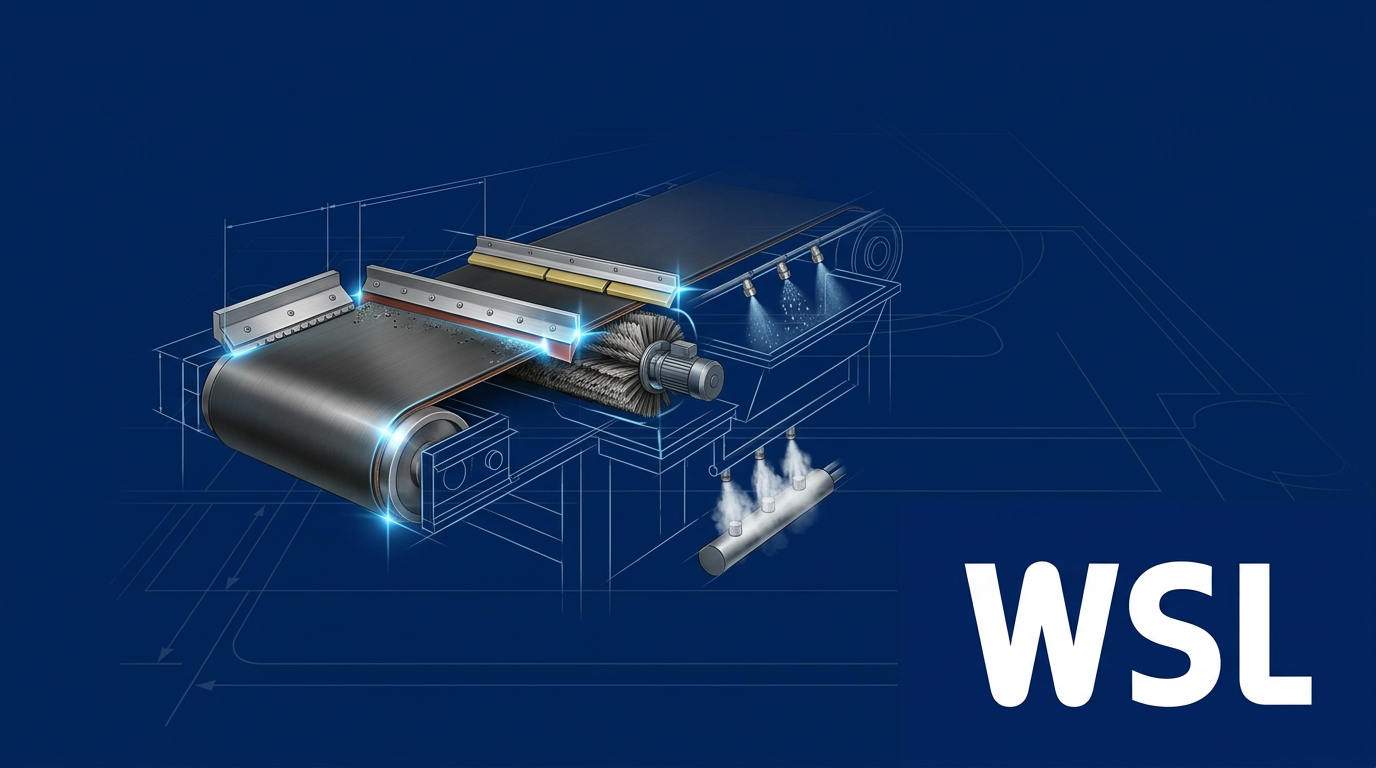
This page evaluates five conveyor belt cleaning system types side by side: primary scrapers, secondary scrapers, brush cleaners, washboxes, and steam and dry-steam units — covering both carryback removal and belt sanitation.
It is written for procurement managers, plant engineers, and facility managers in industrial and food processing environments who are comparing system types before shortlisting or purchasing.
Each entry is assessed on the same five axes: carryback removal effectiveness, belt and material compatibility, industry fit, maintenance demands, and installation considerations.
The entries progress from primary scrapers — the most fundamental cleaning stage — through to steam and dry-steam units, the most specialised.
TL;DR
The single decision that drives cleaning performance and long-run operating cost is matching system type to belt type, conveyed material, and hygiene requirement.
No single system suits every application — and the gap between a well-specified choice and a mismatched one shows up quickly in carryback levels, belt wear, and maintenance burden.
This article covers:

Five conveyor belt cleaning system types compared
Consistent evaluation framework applied across all types
Belt type and material compatibility for each system
Industry fit: bulk handling vs food processing
Maintenance demands and installation considerations
When to use single-stage vs multi-stage cleaning
How to choose the right belt cleaning system
Choosing the wrong conveyor belt cleaning system rarely announces itself at the point of purchase — it shows up six months later as premature belt wear, inconsistent carryback removal, or a tensioner that needs constant attention. The variables that determine the right system type are knowable upfront; the framework below is how experienced engineers work through them.
Belt characteristics: speed, width, and splice type
Belt speed is the first compatibility filter. As Martin Engineering's selection guidance states, faster belts demand stronger mainframes — exceeding a cleaner's rated speed causes vibration, deflection, and potential mainframe failure, all of which compromise blade-to-belt contact and cleaning performance.
Belt width and troughing angle determine blade width: the cleaner blade should match the material path width at the point of discharge, not the full belt width, to ensure even wear and effective carryback removal.
Splice type is one of the most underappreciated variables in cleaner selection, and under-specifying it is a frequent source of blade damage. Vulcanised splices are the preferred method — they allow cleaners to maximise performance and blade life. Where mechanical splices are present, blade material choice becomes critical: polyurethane blades are gentler and more splice-tolerant, while tungsten carbide tips are generally not recommended for belts with mechanical splices unless those splices are properly skived or recessed.
Conveyed material: the primary performance driver
Material characteristics — whether the conveyed product is wet, dry, sticky, abrasive, fine, or coarse — directly determine which system type will perform. Sticky, high-moisture materials behave entirely differently from dry abrasives or fine powders, and a cleaner optimised for one will underperform on the other.
Material temperature and chemical composition also influence blade material selection: urethane formulations are rated to specific temperature ranges, and applications that exceed those ranges cause premature wear and degraded cleaning performance. These details are inputs to system selection, not afterthoughts.
Cleaning stage efficiency and multi-stage systems
Primary cleaners are designed to remove roughly 60–70% of initial carryback, targeting the larger material adhering to the belt at the head pulley. That figure, cited consistently by both Flexco and Martin Engineering, is the baseline from which system design should start — not the target.
Adding a secondary cleaner, positioned just past where the belt leaves the head pulley, can push combined cleaning efficiency to 90% or more by targeting the fines and residue the primary stage misses. According to Martin Engineering's Foundations knowledge base, the addition of secondary and tertiary cleaners can provide as much as 90 to 95% of carryback removal.
A primary cleaner alone is appropriate only where carryback loads are light and material is dry. For sticky, wet, or high-volume applications, a multi-stage system — primary plus secondary, or scraper plus washbox — is the professional standard, not an upgrade.
Reducing carryback from 3% to 1% has been shown to cut conveyor maintenance costs by 67%, based on a NIOSH Mining Safety study cited in Flexco's published Smart Solutions guide — a figure that reframes the economics of multi-stage investment against the cost of doing less.
Blade material and tensioning: the underrated differentiators
Blade material choice is more operationally significant than many buyers realise. Polyurethane blades are forgiving on the belt and splice, suit a wide range of applications, and are available in food-grade and chemical-resistant formulations. Tungsten carbide tips deliver superior cleaning efficiency and longer wear life, particularly for abrasive materials on vulcanised belts. Under-specifying blade material is a common cause of both premature belt wear and inconsistent cleaning performance.
The tensioning mechanism is equally consequential. Spring, pneumatic, and manual bolt tensioners differ substantially in their ability to maintain consistent blade-to-belt pressure over time. As Martin Engineering's tensioning guidance notes, a tensioning device must provide consistent blade-to-belt pressure throughout the blade's life — poor tensioning is a primary cause of both belt wear and cleaning failure, and it is one of the most common sources of performance problems after installation.
Industry context: bulk handling versus food and pharma
In heavy bulk-handling operations — mining, aggregates, cement, ports — cleaning efficiency and system uptime are the primary evaluation drivers. Belt speeds tend to be higher, materials more abrasive, and the CEMA class rating of a cleaner is a meaningful shorthand for application suitability.
In food processing and pharmaceutical environments, the baseline requirements are different in kind, not just degree. Stainless steel construction, CIP compatibility, elimination of harborage points, and food-grade blade materials are not premium features — they are the minimum specification for any cleaner operating in a food contact or hygienic zone, as established by EHEDG GL 43 and 3-A Sanitary Standards principles.
CEMA Standard 576: a structured scoring reference
CEMA Standard 576, published by the Conveyor Equipment Manufacturers Association, provides a points-based framework for determining the application class of any individual belt cleaner. As Flexco's Belt Cleaning Products Introduction Guide describes it, the classification is built on five key criteria: belt width, belt speed, splice type, material abrasiveness, and material stickiness/moisture content.
Each criterion scores points, with wider belts, faster speeds, mechanical splices, more abrasive materials, and higher moisture content all adding to the total. The cumulative score places an application into one of five classes, with higher classes indicating more demanding conditions requiring a higher-rated cleaner. Manufacturers voluntarily rate their cleaners against these classes, giving buyers an objective basis for comparison.
Total cost of operation: the right evaluation lens
Purchase price is a poor proxy for system value. Blade replacement intervals, access requirements for re-tensioning, and the downstream maintenance costs driven by inadequate carryback removal all belong in the evaluation — and they frequently outweigh the initial cost difference between a basic and a well-specified system.
With that framework in place, the five system types can be assessed on their own terms — starting with the most fundamental cleaning stage and building outward from there.
Product 1
Primary scrapers
Primary scrapers are the standard first-stage conveyor belt cleaning system, mounted at the head pulley to remove the bulk of carryback at source before it migrates down the return run.
Pros:

Removes 50–70% of carryback at source
Wide duty range from standard to extreme-duty
Food-grade variants available for processing environments
Compatible with polyurethane, carbide, or stainless blades
Cons:

Single stage tops out at 50–70% removal
Carbide blades unsafe on damaged mechanical splices
Manual tensioners need regular inspection and adjustment
Primary scrapers — also called precleaners — are mounted on the face of the head pulley, positioned just below the material trajectory, with the blade held at a positive-rake (peeling) angle against the moving belt surface.
That geometry is deliberate: the peeling angle, combined with low blade-to-belt pressure of roughly 2 psi (13.8 kPa), allows the blade to shear coarse material from the belt face without endangering the belt, splice, or cleaner itself.
Matching the cleaner size to the head pulley diameter and belt width is critical — an undersized cleaner loses blade-to-belt contact at the edges, while an oversized one creates uneven wear patterns that accelerate blade consumption.
According to Martin Engineering Foundations, primary scrapers with urethane blades typically remove between 50 and 70 percent of material carryback — enough for many standard industrial applications, but not the full picture for demanding or sticky-material conveyors.
Flexco primary scraper range
Flexco's precleaner lineup spans from light-duty to extreme-duty mining, covering belt widths from 300 mm to 3,000 mm (12" to 120") and belt speeds from 2.5 m/s up to 10.0 m/s.
The EZP1 is the standard entry point — a CEMA Class 2 unit rated to 3.5 m/s (700 fpm) for belt widths 300–1,800 mm, with a polyurethane ConShear blade and a minimum 250 mm pulley diameter. The MSP Standard Mine-Duty shares the same speed rating but steps up to a 73 mm pole and belt widths to 2,100 mm, rated CEMA Class 3.
Moving up the duty scale: the MMP Medium Mine-Duty handles belt speeds to 5.0 m/s and widths to 2,400 mm; the MHCP Heavy-Duty Cartridge Precleaner reaches 6.0 m/s with a quick-change SuperShear blade cartridge; and the MHP Heavy-Duty tops out at 7.5 m/s with dual PST2 spring tensioners and an optional Pneumatic Air Tensioner (PAT) for continuous automatic tension.
At the top of the Flexco range, the MXP Extreme-Duty Precleaner is rated to 10.0 m/s (2,000 fpm) with a minimum 1,200 mm pulley diameter and belt widths from 1,050 to 3,000 mm — CEMA Class 5, designed for underground and hard rock mining applications.
For food processing, the FGP and FGP-ES primary cleaners feature stainless steel components, UHMW blades in blue or white, and metal-detectable variants for facilities using detection equipment. The FGP-ES adds an external spring tensioner for easy visual inspection and cleaning access, covering belt widths from 305 to 1,219 mm.
Martin Engineering primary scraper range
Martin Engineering's primary cleaner portfolio is organised around the QC1+ family, the SHD Series for super heavy-duty mining, the ECOSAFE for reduced-waste blade changes, the H1 HD for carbide performance, and the CleanScrape Primary as a distinct design category.
The QC1+ HD and XHD cleaners use patented CARP (Constant-Angle/Constant-Area Radial Pressure) blades that maintain consistent cleaning geometry through all stages of blade wear. The Martin Engineering Product Catalog lists the XHD at belt widths to 3,048 mm at 6.0 m/s (1,200 fpm), with both Twist Tensioner and spring tensioner options available.
The SHD 600 and 1200 Series are built specifically for the punishing demands of mine-grade applications. Structural steel mainframes prevent bending under high tonnages, and massive urethane blades deliver up to 305 mm (12 inches) of wear life. The SHD 600 Series suits pulleys from 600–1,200 mm; the SHD 1200 Series handles pulleys above 1,200 mm, with belt widths to 3,000 mm. Martin Engineering's international product catalog lists the SHD Series at speeds up to 10.0 m/s.
The ECOSAFE Primary Cleaner addresses maintenance efficiency through a split-track blade cartridge design that requires 26% less urethane in the blade base, produces 60% less discarded urethane from a used blade, and allows tool-free blade changes outside the chute — reducing both downtime and the physical demands of service work.
The H1 Primary Cleaner HD pairs precision-cast stainless steel components with tungsten carbide tips, delivering two to three times the wear life of conventional urethane blades on belt widths to 2,500 mm at speeds to 7.5 m/s. Martin's own product page notes that carbide tips are not recommended for belts with mechanical fasteners or significant cover damage.
The CleanScrape Primary takes a fundamentally different approach: installed diagonally across the discharge pulley, it forms a three-dimensional curve rather than a straight transverse blade. A matrix of tungsten carbide tips applies extremely low contact pressure to the belt, making it safe for mechanical splices — an unusual characteristic for a carbide cleaner. Martin Engineering states it typically delivers up to four times the service life of urethane primary cleaners, and after initial installation tensioning, requires no re-tensioning over the life of the blade.
Metso Trellex primary cleaner range
Metso's Trellex ABC primary cleaner family covers a structured duty progression from standard to extra-large heavy-duty, with models spanning a wide range of belt widths, pulley diameters, and speed ratings.
The ABC-ONE70 and ABC-ONE90 are the entry-level models, suited to construction and light mining applications (sand and gravel, limestone) on belt widths from 300 to 1,800 mm with head pulleys from 300 to 600 mm, rated to 3.5 m/s. The ABC70 and ABC90 step up to medium duty — the ABC70 for abrasive or adhesive materials such as iron ore and clay, the ABC90 for soft rock and low-abrasive ores — both covering belt widths to 3,000 mm at the same 3.5 m/s speed rating.
The ABC70-HD and ABC90-HD extend capability to 4.5 m/s on pulleys from 600 to 1,000 mm, suitable for granite and iron ore in mining and aggregates. The ABC70-HD-L and ABC90-HD-L are the large heavy-duty variants, rated to 6 m/s on pulleys from 800 to 1,600 mm and belt widths from 600 to 3,000 mm. The ABC90-HD-XL is the range's largest, designed for extreme applications with pulleys from 1,000 to 2,000 mm, belt widths to 3,000 mm, and a 6 m/s speed rating.
The ABC-ECO 70 is a premium variant for very abrasive or adhesive materials, incorporating a hollow-core polyamid base that reduces weight and end-of-life waste, with a soft polyurethane wear element engineered to last 12 to 24 months in service.
REMA TIP TOP primary scraper range
REMA TIP TOP's primary scraper offering is narrower in scope, centred on two products: the REMACLEAN KWA T-Bar and the REMACLEAN PUR.
The KWA T-Bar incorporates three rotatable rubber scraping strips in a single bar — when one strip wears, the bar is rotated to present a fresh edge, extending service life economically. It covers belt widths from 500 to 1,800 mm at speeds up to 3.5 m/s, and is compatible with both hot-vulcanised and mechanical splices. The REMACLEAN PUR uses REMATHAN polyurethane (90 Shore A) for oil and grease resistance, covering belt widths from 500 to 1,600 mm at the same 3.5 m/s speed limit, and is also suitable for use with mechanical fasteners.
Blade materials: the key selection variable
Blade material is a more consequential specification decision than many buyers initially appreciate — it determines not just wear life, but belt compatibility, splice safety, and total cost of ownership.
| Blade material | Key characteristics | Best suited for | Splice compatibility |
|---|---|---|---|
| Polyurethane | Gentler on belts; economical; specialty formulations for high heat and chemical resistance | Standard to heavy-duty applications; sticky or moderately abrasive materials | Mechanical and vulcanised splices |
| Tungsten carbide | Superior cleaning efficiency; extended wear life; suited to high belt speeds and abrasive materials | Hard rock mining, aggregates, iron ore, high-speed conveyors | Vulcanised splices preferred; some grades safe for mechanical splices (e.g. CleanScrape) |
| Stainless steel (components) | Corrosion-resistant frame and hardware; paired with food-grade blade materials | Food processing, chemical environments, salt and phosphate handling | Compatible with both splice types depending on blade material |
How the three main blade material types compare across key selection dimensions for primary scrapers.
The splice compatibility column is worth dwelling on: standard tungsten carbide blades in a positive-rake primary position can snag on raised mechanical splice edges, risking belt damage. Products like the Martin CleanScrape Primary and Flexco's C-Tip carbide blades are specifically engineered to address this, but the constraint still applies to conventional carbide designs.
Tensioning mechanisms
Tensioning quality determines whether a blade maintains consistent contact with the belt through its full wear life — and inconsistent tension is one of the most common causes of premature blade failure and uneven belt wear.
- Spring tensioners: The most common type across primary scraper products. Self-adjusting within a range, with visual tension check indicators on models such as the Flexco MSP and EZP1. Require periodic inspection and re-tensioning as the blade wears.
- Pneumatic / air tensioners: Provide continuous automatic tension throughout blade life. Available on the Flexco MHP (as an optional PAT) and the Martin ECOSAFE.
- Manual / bolt tensioners: Used on the Martin SHD Series (turnbuckle tensioner). Set at installation and adjusted as part of routine service.
Martin Engineering's Twist Tensioner is a notable design: a twisted rubber coupling stores energy to supply consistent blade-to-belt pressure with minimal ongoing adjustment, and allows mechanical splices to pass without damage — a meaningful advantage on belts with frequent or multiple splices.
The CleanScrape Primary takes this further: after initial installation and a short run-in period, Martin states no re-tensioning is required for the life of the blade — a claim that, if it holds in a given application, substantially reduces the maintenance burden associated with primary scraper upkeep.
When a primary scraper alone is sufficient
A single primary scraper is a reasonable endpoint for applications carrying dry, non-sticky materials at moderate belt speeds, where 50–70% carryback removal meets operational and housekeeping requirements.
For wet, fine, or adhesive materials — or where compliance, product loss, or idler contamination demand a cleaner belt — a primary scraper alone will leave enough residual material on the return side to create ongoing problems. In those cases, additional cleaning stages exist to take removal rates considerably higher.
Primary scrapers are the standard first-stage system across mining (coal, iron ore, hard rock, aggregates, cement, potash), ports and bulk terminals, power plants, and — using food-grade variants — food processing. They are the baseline from which virtually every belt cleaning installation starts.
Across these industries, the evaluation axes introduced earlier apply directly: carryback removal effectiveness sits at 50–70% for a single primary stage; belt and material compatibility is governed primarily by blade material and splice type; maintenance demands vary significantly by tensioner design; and installation considerations — pulley diameter, belt width, available clearance — determine which specific model is appropriate before any other factor is weighed.
Product 2
Secondary scrapers
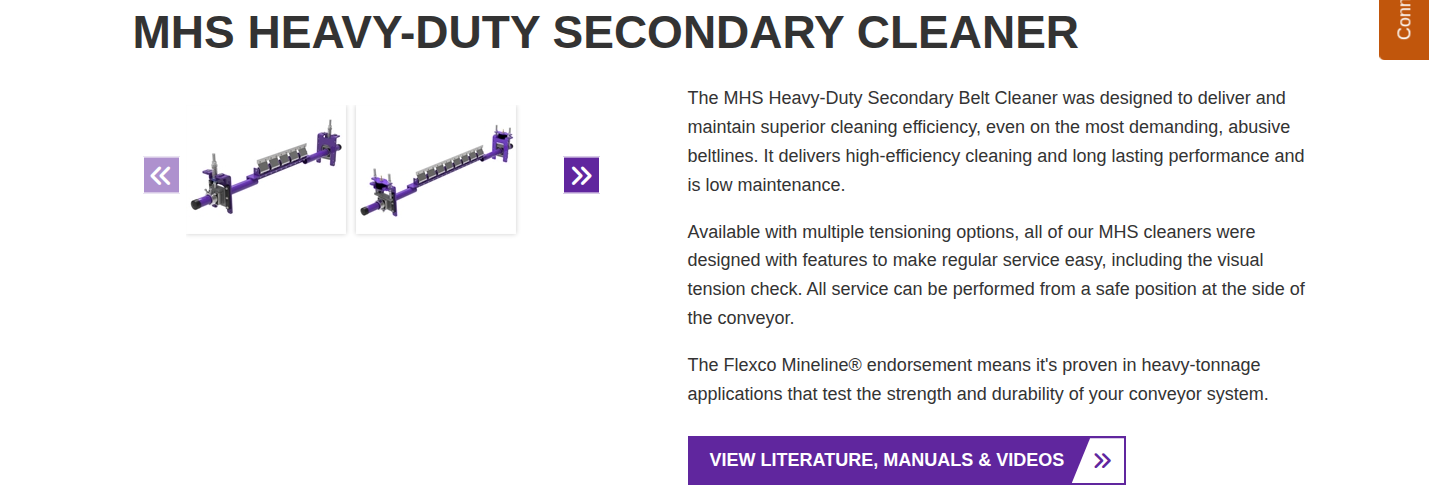
Secondary scrapers mount on the flat return run just past the head pulley, operating at a negative rake angle to scrape residual fines and sticky carryback that the primary cleaner leaves behind.
Pros:
Targets sticky fines the primary cleaner misses
Combined system can reach 90–95% carryback removal
Reversing-belt and food-grade variants available
Blade options span carbide, polyurethane, stainless steel
Cons:
Standard designs unsuitable for reversing belts
Carbide tips risk damage on worn mechanical splices
Adds maintenance access needs versus single-stage cleaning
Where the primary scraper removes the bulk of carryback at the head pulley, a secondary cleaner addresses what remains — the finer particles and higher-moisture residue that cling to the belt surface after the first pass.
Secondary cleaners are installed on the flat return run, just past the point where the belt leaves the head pulley, and operate at a negative rake angle — blades inclined in the direction of belt travel rather than opposed to it, producing a scraping action rather than a peeling one.
This geometry, combined with higher blade-to-belt pressure than a primary cleaner applies, makes secondary cleaners well-suited to the finer, stickier residue that survives the primary pass.
A properly specified, installed, and maintained multiple-cleaner system — primary plus one or more secondary cleaners — can reliably achieve 90 to 95% carryback removal from the conveyor belt, according to Martin Engineering's product catalogue and Foundations technical reference.
One important limitation of the negative-rake geometry is reversing belt incompatibility: standard secondary cleaners are designed for one-directional belts, and running them on a reversing conveyor risks belt and blade damage. Reversing-compatible variants exist across most product ranges and are flagged in the table below.
The four vendors covered in this listicle — Flexco, Martin Engineering, Metso (Trellex), and REMA TIP TOP — each offer secondary scraper products, though the depth and breadth of their ranges differ considerably.
| Vendor / Model | CEMA Class | Max Belt Speed | Blade Materials | Reversing Belt Compatible | Food-Grade Variant |
|---|---|---|---|---|---|
| Flexco Y-Type SD (polyurethane) | Class 2 | 3 m/s (600 fpm) | Polyurethane (purple, white/food-grade, ultra high-temp) | Yes | Yes (white food-grade blade) |
| Flexco Y-Type SD (carbide) / HD | Class 3 | SD: 3 m/s / HD: 3.75 m/s | Tungsten carbide, polyurethane, ultra high-temp PU | Yes | Yes (white food-grade blade) |
| Flexco FMS Secondary | Class 4 | 5 m/s (1000 fpm) | Tungsten carbide (C-Tip for mechanical splices, V-Tip for vulcanised) | No | No |
| Flexco R-Type Reversing Secondary | Class 4 | 5 m/s (1000 fpm) | Tungsten carbide (C-Tip / V-Tip) | Yes | No |
| Flexco MHS Heavy-Duty Secondary (ESAC) | Class 5 | 6 m/s (1200 fpm) | Tungsten carbide (C-Tip / V-Tip) | No | No |
| Flexco U-Type Secondary | Class 5 | 6.6 m/s (1300 fpm) | Tungsten carbide, urethane | No | No |
| Flexco FGS Food Grade Secondary | – | – | Food-grade UHMW, UHMW with stainless steel, urethane | – | Yes (304 stainless steel construction) |
| Martin Engineering SQC2S | – | 7.5 m/s (1500 fpm) | Tungsten carbide, urethane, stainless steel | Yes (Scorpio / Reversing blades) | No |
| Martin Engineering CleanScrape CS2 | – | 5 m/s vulcanised / 3 m/s mechanical | Tungsten carbide (stainless steel mainframe) | No (handles rollback only) | No |
| Martin Engineering DT2S Reversing Cleaner | – | 4.6 m/s (900 fpm) | Tungsten carbide, stainless steel, urethane | Yes | No |
| Martin Engineering Durt Hawg DH2 | – | – | Mild steel, stainless steel, tungsten carbide | – | No |
| Metso Trellex ABC-T-HMS RU | – | 3.5 m/s | NR rubber with tungsten carbide tip | – | No |
| Metso Trellex ABC-T-HMS PU | – | 3.5 m/s | Polyurethane with tungsten carbide tip | – | No |
| REMA TIP TOP REMACLEAN CAB Green | – | – | Three-ply NR/BR combi scraping rubber | – | No |
| REMA TIP TOP REMACLEAN CAB Grey | – | – | Three-ply NR/BR combi scraping rubber (harder profile) | – | No |
Secondary scraper ranges from Flexco, Martin Engineering, Metso Trellex, and REMA TIP TOP compared across CEMA class, belt speed, blade materials, reversing belt compatibility, and food-grade availability. – indicates the specification is not publicly listed by the vendor for that model.
The Flexco range spans the widest CEMA class spread of the four vendors — from Class 2 (Y-Type SD with polyurethane blades) through to Class 5 (U-Type and MHS), giving procurement teams a structured ladder from light-duty aggregate applications to the most demanding mining beltlines.
The MHS with Enhanced Service Advantage Cartridge (ESAC) is particularly notable for maintenance access: its twist-and-remove cartridge design allows blade replacement without tools, even in heavily contaminated conditions, and the dual-spring mechanism provides clearance to extract the cartridge from within the chute structure.
Martin Engineering's CleanScrape CS2 takes a distinctly different engineering approach. Rather than a conventional segmented blade on a pole, it uses independent 6-inch-wide blades, each supported on spring-loaded arms at both ends.
The load springs allow each blade to rotate both forward and back and up and down independently, providing equal load pressure across the blade, absorbing obstructions, and conforming to belt undulations — all with low blade-to-belt contact pressure.
"Many carbide-tipped belt cleaners require high pressure against the belt in order to be effective, and they typically need to be re-tensioned often throughout their service life. Like the CS1, this design is extremely effective with light tension against the belt, which helps avoid the damage to belts and splices that can occur with other carbide-tipped secondary cleaners. And because it only needs tensioning once during its lifespan, the maintenance requirements are very low."
The CS2's all-stainless-steel construction and temperature rating up to 260°C make it well-suited to corrosive and high-temperature environments, while its Safe-To-Service option allows maintenance from outside the chute wall without breaking the safety plane.
Martin Engineering's DT2S Reversing Cleaner addresses the reversing belt gap with a split-track blade cartridge that slides in and out on a stainless steel mandrel — its lean profile, just 178 mm deep, allows installation in spaces where most secondary cleaners cannot fit.
Metso's Trellex secondary range is narrower than Flexco's or Martin Engineering's, but deliberately so: the ABC-T-HMS RU and PU models are both rated for up to 3.5 m/s and target abrasive mining and aggregates applications specifically, with tungsten carbide tips moulded into either rubber or polyurethane bodies.
REMA TIP TOP's REMACLEAN CAB Green and Grey are blade elements rather than complete cleaner systems — they are designed to be mounted onto existing scraper devices already installed on the conveyor, making them a cost-effective upgrade path for sites that already have a scraper framework in place.
Blade material selection at the secondary position
The secondary position applies higher blade-to-belt pressure than the primary stage, which makes material choice more consequential — particularly for belt and splice protection.
- Tungsten carbide: The preferred choice for abrasive materials and high-speed belts on vulcanised splices. Carbide tips deliver long wear life and high cleaning efficiency. However, Martin Engineering's product specifications explicitly caution against using carbide blades on belts with multiple mechanical splices, or mechanical splices in poor condition, as rapid wear or damage to both blade and splice may result.
- Polyurethane: Gentler on the belt surface and more forgiving on mechanical splices. Appropriate for lighter-duty applications and where splice condition is variable. The Metso ABC-T-HMS PU uses a hard polyurethane body (90 Shore A) to maintain a precise 90-degree angle to the belt — though Metso notes it should not be used on mechanically spliced or heavily worn belts.
- Stainless steel / food-grade UHMW: The material of choice for corrosive or food-processing environments. Flexco's FGS Secondary uses solid 304 stainless steel construction with FDA-compliant UHMW blades. Martin Engineering's CS2 uses a stainless steel mainframe with carbide tips for combined corrosion resistance and cleaning performance.
The carbide-on-worn-mechanical-splice risk is worth stating plainly: the combination accelerates wear on both the blade tip and the splice hardware, and can lead to splice failure in severe cases. Where mechanical splices are present and in variable condition, polyurethane or rubber-bodied blades are the safer specification.
Tensioning at the secondary position
For one-directional belts, radially adjusted tensioners are the standard recommendation: they can be adjusted from one side of the belt, rotate away from the belt to absorb splice shock, and are easier to service than linear designs.
Air tensioners suit automated or remote applications where consistent blade-to-belt pressure needs to be maintained without manual intervention — Martin Engineering offers air tensioner options across its SQC2S and DT2S ranges.
The CleanScrape CS2 sidesteps conventional tensioning almost entirely: its spring-loaded independent blade arms maintain consistent load pressure across each blade throughout the blade's life, with Martin Engineering describing a single re-tensioning requirement over the cleaner's lifespan.
When one secondary stage is not enough
A single secondary cleaner is sufficient for most standard applications, but certain conditions — particularly highly sticky or abrasive materials, or sites with strict environmental carryback standards such as overland conveyors and port facilities — may require multiple secondary stages.
Flexco's FAQ notes that overland conveyors and port facilities with environmental standards are among the applications where multiple secondary cleaners, or a washbox, may be necessary. When scraper-based cleaning alone cannot achieve the required cleanliness level, a washbox is the next escalation step.
Industry fit and evaluation framework summary
Secondary scrapers are deployed across mining (coal, iron ore, copper, phosphate, potash), cement and aggregates, power generation, port and load-out facilities, and food processing — the last via food-grade variants such as the Flexco FGS and Martin Engineering's stainless-steel CS2.
- Carryback removal effectiveness: A primary-plus-secondary combination reliably achieves 90–95% carryback removal, versus 50–70% for a primary alone. The CS2 paired with a CleanScrape primary has been shown to remove as much as 99% in most applications, according to Martin Engineering.
- Belt and material compatibility: Splice type is the critical selection variable. Carbide blades suit vulcanised splices and abrasive materials; polyurethane or rubber-bodied blades are safer on mechanical splices or worn belts. Reversing belts require specifically designed variants (Flexco R-Type, Martin DT2S).
- Industry fit: Standard-duty models (CEMA Class 2–3) suit aggregate, sand and gravel, and cement. Heavy-duty models (CEMA Class 4–5) are specified for mining and port applications. Food-grade variants cover food processing and industrial baking.
- Maintenance demands: Cartridge-based designs (Flexco MHS ESAC, Martin DT2S) minimise blade change time. The CS2's spring-loaded arm design reduces re-tensioning frequency to once over the blade's lifespan. REMA TIP TOP's CAB elements mount on existing frameworks, reducing hardware investment.
- Installation considerations: Secondary cleaners should be positioned 50–100 mm past the head pulley departure point, contacting the belt against a firm surface. Tight-space installations favour the DT2S (178 mm profile) or the FMS Secondary (compact tensioner). Dual tensioners are recommended for belts wider than 1200 mm.
Product 3
Brush cleaners
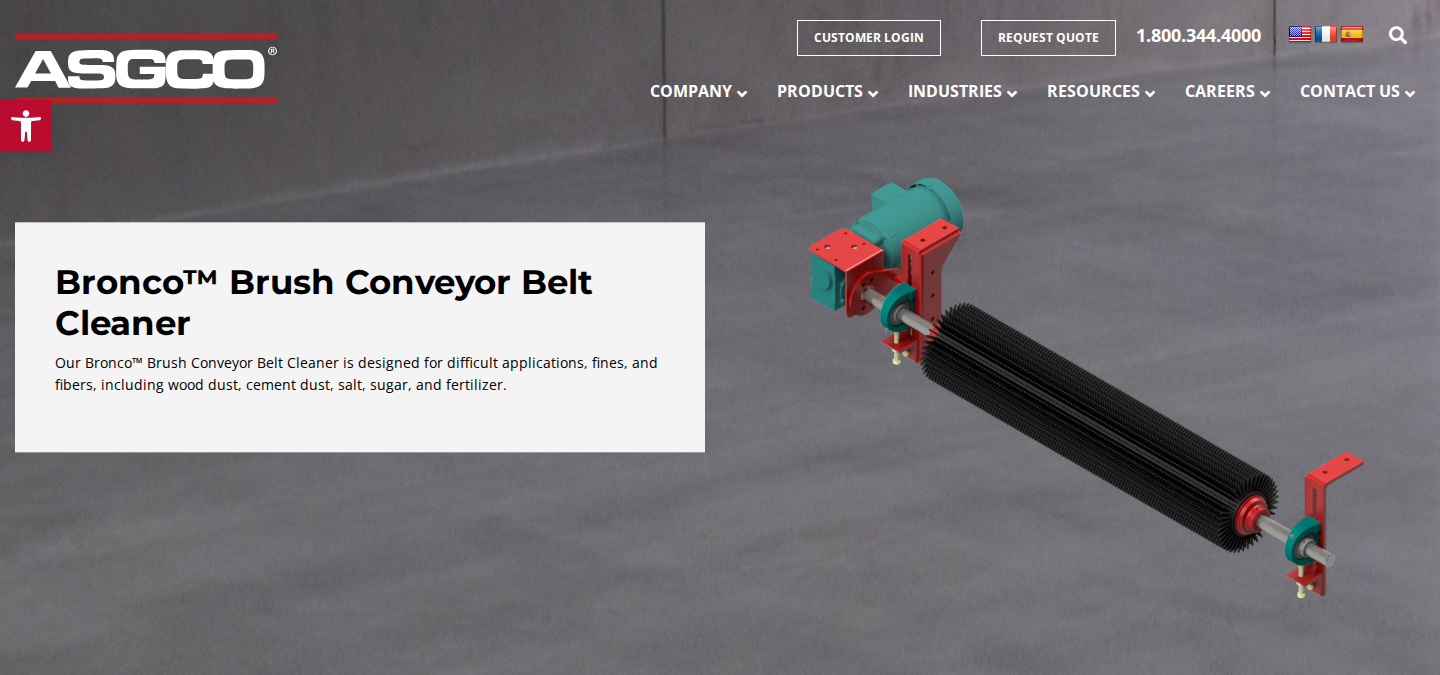
Brush cleaners use a motorised rotating brush spinning counter to belt travel to dislodge carryback — no blade contact. Purpose-built for cleated, chevron, and raised-rib belts, and for fine, powdery materials that blade scrapers miss.
Pros:
Cleans cleated, chevron, and raised-rib belts effectively
Handles fine, powdery carryback blade scrapers miss
ATEX and food-grade variants available (REMA GRB)
Works on worn or pitted belt surfaces
Cons:
Speed ceiling lower than heavy-duty blade scrapers
Typically secondary or tertiary role, not primary
Motorised drive adds electrical maintenance overhead
Where blade scrapers work by holding a static edge against the belt surface, a brush cleaner takes a fundamentally different approach: a motorised brush drum spins in the opposite direction to belt travel, using bristle impact and sweeping action to dislodge and fling carryback clear of the belt.
There is no blade-to-belt contact pressure, which is precisely what makes brush cleaners useful where blade geometry fails — on profiled belts where a flat blade cannot maintain consistent contact across cleats or chevrons, and on fine or powdery materials that a blade simply passes over without engaging.
Where brush cleaners outperform blade scrapers
Three conditions consistently favour a brush cleaner over a blade-based system.
- Profiled belt surfaces: Cleated, chevron, and raised-rib belts prevent a flat blade from maintaining consistent contact across the belt face. Flexco rates its Motorized Brush Cleaner for chevrons and cleats up to 1/2" (13 mm); ASGCO's Bronco Brush explicitly covers smooth, chevron, ribbed, and cleated belts; and REMA TIP TOP's SGB is designed specifically for incline conveyors with chevron belts and cleats up to 24 mm.
- Fine, powdery, or lightly adhered carryback: ASGCO positions the Bronco Brush for materials including wood particles, limestone fines, soda ash, fertilisers, sugar, and salt — exactly the fine, dry, or lightly adhered residues that pass under a blade without being lifted. Martin Engineering describes its brush cleaners as suited for fines and fibres, including coal and biomass dust.
- Worn or pitted belt surfaces: Flexco notes that the Motorized Brush Cleaner performs well as a second or third cleaner on belts with worn or pitted surfaces, where bristle flexibility allows effective contact that a rigid blade cannot replicate consistently.
These three conditions often overlap in practice: an incline conveyor carrying fertiliser on a chevron belt with a worn surface is a case where blade scrapers will underperform on all three axes simultaneously.
Brush cleaner product comparison
Five product families cover this category, each with distinct differentiators across belt width range, speed rating, bristle material, and application focus.
| Product | Belt Width Range | Max Belt Speed | Bristle Material | CEMA Class |
|---|---|---|---|---|
| Flexco Motorized Brush Cleaner | 18"–84" (450–2100 mm) | 700 fpm (3.5 m/s) | Polypropylene | Class 4 |
| Flexco Belt-Driven Brush Cleaner | 24"–72" (600–1800 mm) | 700 fpm (3.5 m/s) | Polypropylene | Class 4 |
| Martin Engineering Spiral Brush | 18"–72" (450–1800 mm) | 500 fpm (2.5 m/s) | Polypropylene (nylon/wire options) | – |
| Martin Engineering Strip Brush | 18"–60" (450–1500 mm) | 500 fpm (2.5 m/s) | Polypropylene (0.040"/1 mm bristles) | – |
| Metso Trellex ABC-BRUSH | 500–1800 mm (24"–72") | <2.5 m/s (<500 fpm) | Nylon; nylon/steel (glass recycling) | – |
| REMA TIP TOP REMACLEAN GRB | 400–2000 mm | 2.5 m/s | Rubber | – |
| REMA TIP TOP REMACLEAN TMB | 400–1400 mm | 6.5 m/s | Plastic | – |
| REMA TIP TOP REMACLEAN SGB | 400–1400 mm | 2.5 m/s | Rubber | – |
| ASGCO Bronco Brush | 18"–84" (450–2100 mm) | 700 fpm (3.5 m/s) | SBR rubber fingers | Class 4 |
Key specifications across brush cleaner product families for belt width range, maximum belt speed, bristle material, and CEMA class. – indicates the value is not publicly listed by the manufacturer.
The speed ratings reveal an important selection constraint: most brush cleaners in this category top out at 2.5–3.5 m/s (500–700 fpm), which rules them out for high-speed bulk-handling conveyors where heavy-duty blade scrapers can operate at 5–7.5 m/s.
The notable exception is the REMA TIP TOP REMACLEAN TMB plastic brush, rated to 6.5 m/s — significantly higher than any other brush cleaner in this comparison, though its application is limited to dry materials and operating temperatures up to 80°C.
Product-by-product breakdown
The Flexco Motorized Brush Cleaner uses uniquely patterned polypropylene bristles specifically designed to reduce material buildup and clogging, with adjustable tensioners for wear compensation as bristles wear down. It can be mounted at any point from where the belt leaves the head pulley down the entire beltline — not just immediately after the head pulley — giving installation flexibility that blade-based secondary cleaners typically do not offer. A Belt-Driven Brush Cleaner variant eliminates the electrical installation requirement by using a hold-down roller and v-belt system to drive the brush from belt energy, covering 24"–72" (600–1800 mm) belt widths.
The Martin Engineering Brush Cleaner comes in two variants addressing different moisture conditions. The Spiral Brush wraps polypropylene bristles in a continuous spiral pattern, suited to dry fines on cleated, chevron, or ribbed belts. The Strip Brush uses 12 individual brush strips assembled on shaft-mounted hubs — a design that allows moist material to fall away from the brush rather than settle into the bristle base, which would plug a conventional spiral brush. Motor sizing scales with belt width: 1 hp for belts up to 42" (1050 mm), 2 hp for wider belts.
The Metso Trellex ABC-BRUSH is built around a fully encapsulated drum motor, which eliminates the dust and dirt ingress that can degrade external motor drives in dusty environments. The brush tube is constructed in 150 mm modular sections, allowing exact-fit sizing for any belt width in the 500–1800 mm range and straightforward section-by-section replacement rather than full brush replacement. Standard bristles are nylon; a nylon/steel combination is available for glass recycling applications where steel-reinforced bristles are needed. The ABC-BRUSH is a one-way belt direction unit only.
The REMA TIP TOP REMACLEAN range offers the most application-differentiated brush cleaner family in this comparison, with three distinct products. The GRB is an electrically driven rubber brush for sticky and powdery materials, available in ATEX and food-grade versions. The TMB plastic brush targets dry materials at higher temperatures (up to 80°C) and is also available for food industry applications; its compact drum motor design achieves the 6.5 m/s speed rating that separates it from every other brush cleaner here. The SGB rubber brush is designed specifically for incline conveyors and chevron belts, handling cleats up to 24 mm.
The ASGCO Bronco Brush uses SBR rubber fingers rather than polypropylene or nylon bristles, with a 9" (230 mm) brush diameter spinning at 180 RPM. Its Bolt-Up mounting system allows pitch adjustment with a wrench, without requiring structural modification. ASGCO rates it for smooth, chevron, ribbed, and cleated belts across the full 18"–84" (450–2100 mm) width range, with CEMA Class 4 rating.
Maintenance considerations
Brush cleaners introduce maintenance requirements that blade systems do not carry. Bristle wear is progressive and requires periodic adjustment to maintain effective brush-to-belt contact; most models address this with adjustable tensioners (Flexco, ASGCO) or spindle adjustment systems (REMA TMB), but the adjustment must actually be made — a worn brush that has not been re-tensioned loses cleaning effectiveness quickly.
Wet or moist materials present a specific challenge: as the Martin Engineering washbox knowledge base notes, brush cleaners in wet applications may require additional water to prevent material buildup that would otherwise impair bristle action. The Martin Strip Brush addresses this through its open strip design, which lets material fall free rather than accumulate.
The motorised drive on most models adds electrical maintenance requirements — motor checks, wiring integrity, and gearbox servicing — that a passive blade scraper does not demand. The Flexco Belt-Driven variant and the Metso ABC-BRUSH's encapsulated drum motor both reduce this exposure, the former by eliminating the motor entirely and the latter by protecting the motor from contaminant ingress.
Role in multi-stage cleaning systems
Brush cleaners are positioned as secondary or tertiary cleaners in a multi-stage system, not as standalone primary cleaners. Martin Engineering's product documentation consistently describes brush cleaners as designed for the secondary cleaning position, with a primary scraper always recommended on the head pulley face.
Within washbox configurations, brush cleaners take on a specific role: where flat blades struggle on heavily grooved or damaged belts, brush cleaners are used instead — their bristle flexibility giving effective contact that a rigid blade cannot maintain in those conditions.
Food processing: REMA GRB and TMB (both available in food-grade versions; GRB also available in ATEX version). Cement and aggregates: ASGCO Bronco Brush (limestone fines, soda ash), Flexco MBC (powdery materials). Wood processing and biomass: ASGCO Bronco Brush (wood particles), Martin Engineering (fibres and fines). Glass recycling: Metso ABC-BRUSH (nylon/steel bristle combination available). Incline conveyors with chevron belts: REMA SGB (cleats up to 24 mm), Flexco MBC (cleats up to 13 mm).
Selecting between these products ultimately comes down to belt profile, material moisture content, and belt speed — the three axes where brush cleaners earn their place in a well-designed conveyor belt cleaning system.
Product 4
Washboxes
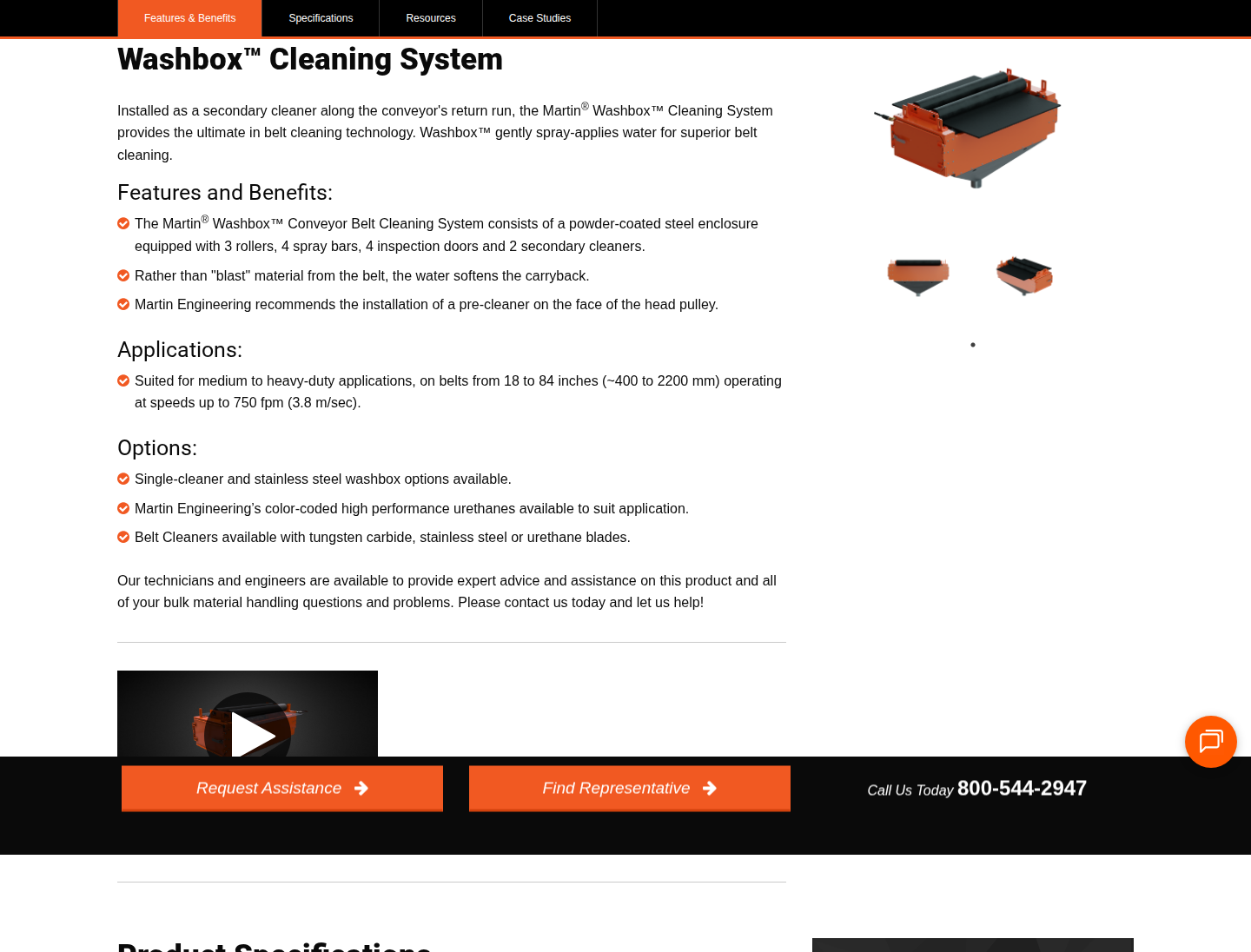
Washboxes are enclosed, multi-component systems combining spray bars, secondary cleaners, hold-down rollers, and drainage to achieve belt cleanliness that scraper-only approaches cannot match on sticky, high-moisture, or high-volume carryback.
Pros:
Removes carryback scraper-only systems cannot reach
Handles sticky, high-moisture carryback scrapers leave behind
Documented belt life extension in heavy mining applications
Enclosed system contains spillage and effluent on-site
Cons:
Requires water supply and effluent management infrastructure
Higher installation complexity than scraper-only systems
Multiple internal components require ongoing maintenance
Water consumption must be factored into site utilities
A washbox is an enclosed, multi-component cleaning system mounted on the conveyor's return run: the belt enters carrying residual material and exits clean, having passed through a sequence of spray bars, secondary cleaners, hold-down rollers, and a drain that removes the resulting slurry.
The architecture is what separates a washbox from any scraper-only approach — water from the spray bars wets and loosens carryback, secondary cleaners scrape the softened material from the belt surface, hold-down rollers stabilise the belt under cleaning forces, and a sized drain carries the waste slurry away.
Martin Engineering's Foundations knowledge base sets out the minimum specification for a washbox system: at least two secondary cleaners, a minimum of three hold-down rollers above the belt, at least one spray bar with engineered nozzles covering the full belt width, and a drain sized to prevent solids settling in the system.
A squeegee or pressure roller is typically added after the secondary cleaners to remove residual surface moisture before the belt returns to the carry run — particularly important on shorter conveyors where evaporation time is limited.
A washbox is warranted when primary and secondary scrapers alone cannot achieve the cleanliness the application demands: sticky, high-moisture, or fine carryback that blade scrapers leave behind; overland conveyors and port facilities operating under environmental discharge requirements; and applications where residual carryback causes accelerated belt wear, roller encapsulation, or safety hazards along walkways.
Flexco Wash Box
The Flexco Wash Box is constructed from 304 stainless steel and covers belt widths from 600 mm to 2,400 mm (24 in. to 96 in.), with a maximum belt speed rating of 1,500 fpm (7.6 m/s) and a temperature rating of -35°C to 82°C.
The enclosure accommodates any two secondary cleaners from the Flexco range, selected separately to suit the application; the box comes standard with pressure rollers, a belt wash spray bar on the inbye side, and a flushing spray bar on the outbye side.
Spray nozzles are spaced on 300 mm centres; Flexco's Australian Product Handbook (X6131) states an output of 5 L/min per nozzle at 500 kPa, with a typical operating pressure of 200–600 kPa and a maximum inlet pressure of 1,000 kPa.
The enclosure mounts to existing stringers via drill-and-bolt fitment, with hinged inspection doors on each side providing cleaner access without disassembly; drain options include a rear drain (suitable for most applications) and a centre drain for conveyors level to ground.
Where a standard size does not suit the structure, Flexco's in-house engineering team can custom-engineer the wash box to fit — a capability that has been applied to non-standard conveyor configurations at major mining and port operations.
At Port Kembla Coal Terminal in New South Wales, a custom-engineered Flexco wash box incorporating four squeegee rollers and two spray bars reduced carryback on conveyor NC14 by 94% — from an average of 32 kg/hour down to 2 kg/hour, meeting the terminal's specific target and eliminating 720 kg of coal spillage per 24-hour operating day.
At an iron ore hub in Western Australia's Pilbara region, a custom Flexco Wash Box installed on a 1,800 mm belt running 24/7 at 5 m/s extended belt life by an additional 9 months beyond the typical 3-year replacement cycle. On a $3 million belt, Flexco's application story records this as a cost saving of $250,000 to $330,000 per 4-year cycle. The 1,400 mm belt at the same site subsequently gained a further 6 months of belt life after its own wash box installation.
The immediate results on the 1,800 mm belt led the mine to install a wash box on their 1,400 mm belt as well, with further installations planned across the site — a pattern consistent with washboxes being adopted progressively once performance is demonstrated on the first conveyor.
Martin Engineering Washbox
The Martin Engineering Washbox is available in two configurations: the dual-cleaner system, equipped with a powder-coated steel enclosure containing three rollers, four spray bars, four inspection doors, and two secondary cleaners; and the more compact single-cleaner system, which houses one roller, one spray bar, two inspection doors, and one secondary cleaner.
Both configurations cover belt widths from 18 to 84 inches (approximately 400 to 2,200 mm) at speeds up to 750 fpm (3.8 m/s); stainless steel enclosure versions are available as an option alongside the standard powder-coated steel.
Spray bars are equipped with 10 to 30 nozzles delivering 5 to 60 psi (0.34 to 4.14 bar) of pressure, using 5 to 54 gpm (20 to 204 L/min) of potable or non-potable water across the full system range.
Blade options span polyurethane, tungsten carbide, and stainless steel, with colour-coded high-performance urethanes available for acidic or high-temperature materials — the same tensioner and blade selection approach used in standalone secondary cleaners applies inside the washbox.
An optional squeegee roller, set between the top rollers, lifts the belt slightly and reduces the layer of residual water on the belt surface from an average of 50 microns to approximately 20 microns — a meaningful reduction for shorter conveyors where the return trip does not provide sufficient evaporation time.
Effluent from the Martin Washbox drains through an outlet funnel below the box; this can connect to a disposal unit, a settling pond, or a vessel for reintroduction of recovered material back into the process.
The following table compares the published specifications of both products across the key axes a procurement manager or plant engineer will use to assess fit.
| Specification | Flexco Wash Box | Martin Engineering Washbox |
|---|---|---|
| Belt width range | 600–2,400 mm (24–96 in.) | 400–2,200 mm (18–84 in.) |
| Max belt speed | 1,500 fpm (7.6 m/s) | 750 fpm (3.8 m/s) |
| Enclosure material | 304 stainless steel (standard) | Powder-coated steel (standard); stainless steel option |
| Cleaner configuration | 2 secondary cleaners (any Flexco range) | Dual: 2 cleaners, 3 rollers, 4 spray bars; Single: 1 cleaner, 1 roller, 1 spray bar |
| Spray bar nozzle spacing | 300 mm centres | 10–30 nozzles per system |
| Spray pressure / output | – see text | 5–60 psi (0.34–4.14 bar); 5–54 gpm (20–204 L/min) total |
| Temperature rating | -35°C to 82°C | – |
| Squeegee roller option | Custom (e.g. Port Kembla) | Yes — reduces water layer from ~50 to ~20 microns |
| Custom engineering | Yes — in-house engineering team | – |
Key published specifications for the Flexco Wash Box and Martin Engineering Washbox. – indicates the value is not publicly listed by that manufacturer. – see text (Flexco spray pressure/output): see the Flexco Wash Box section above for the figure stated in Flexco's Australian Product Handbook (X6131).
Water management is integral to washbox specification, not an afterthought: the drain system must be sized to prevent bulk solids from settling in the drain line, and the options for handling the resulting effluent range from direct drainage to a sump, through a settling box for material reclaim, or via a customised recovery system that returns recovered material to the process.
For the Martin Washbox, the installation manual specifies connection to a 3/4-in. hose barb for water supply and a 4-in. NPT discharge pipe nipple for effluent; the Flexco system connects to existing plant water supply and discharge infrastructure, with water control manifolds available that include solenoid valves, pressure regulators, filter strainers, and lockable ball valves.
Both systems mount to existing conveyor stringers on the return run, positioned after the head pulley where the belt runs flat — the Martin manual specifies mounting via four hanger bracket weldments drilled into the stringers, while the Flexco system uses a drill-and-bolt panel construction designed to fit into tight spaces along the structure.
The modular construction of the Martin Washbox requires only 13 inches of clearance for installation in confined spaces, and the Flexco bolted panel design similarly allows fitment where access is restricted — a relevant consideration for retrofit installations on existing conveyors.
Maintenance requirements are concrete and predictable: Martin Engineering's installation manual specifies washing out the enclosure weekly until the buildup pattern is established (then as needed), inspecting spray nozzles for clogs every six months, and maintaining the internal belt cleaners and tensioners according to the same intervals as equivalent standalone secondary cleaners.
Inspection doors on both systems allow access to internal components without full disassembly — the Flexco Australian handbook specifies a solid outer door openable by hand during normal operation, with an inner mesh door requiring tools to remove, so cleaner tensioners remain accessible from outside the mesh.
Washboxes are the established system type for iron ore, coal, and other wet or sticky bulk mineral applications where scraper-only cleaning is demonstrably insufficient; port and terminal operations where environmental discharge standards govern carryback management; and overland conveyors where the combination of high throughput, continuous operation, and sticky material makes residual carryback a safety and maintenance liability.
Product 5
Steam and Dry-Steam Cleaning Units
Dry-steam cleaning units use superheated, low-moisture steam to sanitize food-grade and pharmaceutical conveyor belts without chemicals — leaving surfaces dry and production-ready where wet cleaning is impractical or prohibited.
Pros:
Chemical-free sanitation removes allergens, fats, and bacteria
Belt left dry and production-ready after cleaning
Up to 98% less water than wet cleaning
Fixed CIP variant cleans continuously during production
Cons:
Specialised scope: food and pharma environments only
Boiler-based system carries maintenance considerations
Every system covered so far addresses carryback through mechanical action or water-based spray. Dry-steam cleaning units work on an entirely different principle: superheated, low-moisture steam is applied directly to the belt surface, instantly breaking down fats, oils, sugars, allergens, mould, and bacteria on contact — without any chemical agents.
The critical distinction from conventional steam is moisture content. Goodway describes dry steam as regular steam that has been superheated to deliver cleaning and sanitation power with an adjustable moisture volume of just 5–15%. At that level, surfaces are dry to the touch almost immediately after cleaning, making the technology safe in dry-clean environments where wet cleaning is not recommended.
A connected vacuum simultaneously draws away the emulsified soils and any residual moisture, so the belt exits the cleaning head clean, dry, and ready for the next production run.
GVC-18000 Heavy-Duty Dry Steam Generator
All three PureBelt product lines are powered by Goodway's GVC-18000 Heavy-Duty Dry Steam Generator, a three-phase industrial unit built around twin stainless steel boilers that produce continuous steam without depressurisation between uses.
| Specification | GVC-18000 |
|---|---|
| Output steam pressure | Adjustable, 0–145 PSI |
| Output steam temperature | 290°F |
| Steam output (water consumption) | 7–9 gallons per hour |
| Adjustable moisture content | 5–15% |
| Boilers | Two stainless steel |
| Chemical injection tanks | Two (1.3 gallons each) |
| Certification | CE Certified |
Key published specifications for the Goodway GVC-18000, the steam generator that powers the PureBelt Fixed, Modular, and Flex belt cleaning systems.
The unit's twin-boiler design maintains consistent steam pressure and quality throughout a cleaning cycle, and an in-operation refillable water tank means cleaning can run continuously without stopping to refill.
The PureBelt Range: Three Lines, Three Belt Types
Goodway markets the PureBelt system in three distinct lines, each matched to a specific belt type and installation mode.
- PureBelt Fixed Brushless (GVC-FIXED): A permanent clean-in-place installation on flat continuous belts. The cleaning head bolts to the existing conveyor frame without belt removal, delivers steam across the full belt width, and uses vacuum extraction to leave the belt dry. It can clean during production, includes an optional motorised brush for more stubborn soils, and uses FDA-approved contact materials on all food-contact surfaces. Stainless steel construction throughout. Minimum water consumption from 7 gallons per hour with the GVC-18000.
- PureBelt Modular System (GVC-MODULAR): A portable unit designed for mesh-style, plastic modular, and metal wire mesh belts. Its programmable steam patterns give operators precise control over cleaning and sanitation, and its adjustable width allows the same system to be used across multiple belts of different widths within the same facility. Sensors automatically detect belt motion to optimise cleaning based on conveyor speed.
- PureBelt Flex (GVC-FLEX): A portable system for mesh-style plastic or metal belts, featuring a patented spinning steam head that allows precise targeting of specific belt sections with minimal manual adjustment. Goodway's PureBelt Flex product page states the system uses up to 98% less water than wet cleaning or spray methods, and the system is fully customisable to belt size with support for additional cleaning heads.
Belt type is the primary selection criterion across the three lines: PureBelt Fixed is designed specifically for continuous flat belts, while PureBelt Modular and Flex are both built for mesh-style, plastic modular, and wire mesh belts.
Compliance and Hygiene Positioning
Goodway positions its PureBelt systems as aligned with FSMA requirements and best-in-class cleaning and sanitation guidelines for food production facilities. Food-contact components use FDA-approved materials, and the systems are marketed as supporting rigorous food safety standards.
EHEDG Doc. 43 — the European Hygienic Engineering and Design Group's guideline on the hygienic design of belt conveyors for the food industry — is a relevant benchmark for food conveyor environments, noting that dry applications where water use must be avoided may require different cleaning systems than those covered by its wet-cleaning-focused guidance.
Real-World Impact: Maine Bread Producer
A large-scale bread producer at a facility in Lewiston, Maine, was allocating 48 hours of labour per week to clean spiral cooler conveyor belts — a slow, physically demanding process that cleaned only small sections at a time.
"When we use the Goodway PureBelt Modular System, we can clean the conveyors on all three spiral coolers in just one day using only four person-hours from set up to take down. That is saving a lot of time and labor costs."
Implementing the PureBelt Modular System reduced cleaning hours dramatically, according to Goodway's published account of the project — from 48 hours of labour per week to approximately four person-hours for all three spiral coolers.
Where This System Type Fits
Dry-steam cleaning units are purpose-built for food-contact conveyor applications: commercial bakeries, confectionery and snack plants, dry goods processing, pharmaceutical and medical device manufacturing, fulfilment centres, packaging lines, and spiral coolers.
If your facility operates a dry-clean regime — where wet cleaning is restricted or prohibited — and your conveyor belt carries food products susceptible to allergen cross-contact, mould, or fat and sugar residue, dry-steam technology is designed specifically for that environment. Goodway's PureBelt systems are built and positioned for food-grade and pharmaceutical conveyor sanitation.
Not sure which cleaning system is right?
Five system types, each suited to different belt profiles, materials, and hygiene requirements. If you want to talk through your specific application, we are happy to help.
Conclusion
Choosing the right conveyor belt cleaning system
The material your belt carries, and the profile of the belt itself, are the two variables that narrow the field fastest.
Where hygiene is a baseline requirement, it functions as a hard filter: systems that cannot meet it are out of scope, regardless of carryback performance.
What the five types covered here share is that each one is the right answer for a specific set of conditions — and the wrong answer outside them.
The most economical conveyor belt cleaning system is the one correctly matched to the application, not the lowest purchase price.
Conveyor belt cleaning system: frequently asked questions
Common decision points for procurement managers, plant engineers, and facility managers comparing conveyor belt cleaning system types.
For most applications involving sticky, wet, or fine carryback, yes. A primary scraper alone removes roughly 60–70% of carryback at the head pulley. Adding a secondary cleaner can push combined efficiency to 90% or more, according to both Flexco and Martin Engineering's published guidance. Single-stage primary cleaning is adequate only where carryback loads are light and the conveyed material is dry and non-adhesive. In those cases, a well-positioned primary scraper at the head pulley may be sufficient. For anything more demanding — humid conditions, sticky materials, or sites with environmental carryback standards to meet — a secondary cleaner is the professional standard, not an optional extra.
A secondary scraper is a standalone blade cleaner mounted on the return run just past the head pulley. It removes the residual fines and sticky material that the primary scraper leaves behind, operating at a different angle to the primary to address the belt's changing surface dynamics at that point. A washbox is an entirely different scale of installation. It is a fully enclosed, multi-component system that combines spray bars, multiple secondary cleaners, hold-down rollers, and a drainage system in a single enclosure. The belt enters carrying residual material and exits clean and dry. The key practical distinction: a washbox is specified when scraper-only cleaning — primary plus secondary — still cannot achieve the required belt cleanliness. It is the system of last resort for the most demanding carryback conditions, not a replacement for a secondary scraper in standard applications.
The choice depends primarily on your material, belt speed, and splice type. Polyurethane blades are gentler on belts, work well with mechanical splices, and are the economical choice for lighter-duty applications. They are available in specialist formulations for high heat, chemical resistance, and food-grade use. Tungsten carbide blades deliver superior cleaning efficiency and significantly longer wear life on abrasive materials and higher-speed belts with vulcanised splices. However, carbide tips are not suitable for belts with mechanical splices in poor condition — the hardness of the carbide and the splice hardware cause mutual accelerated wear. Flexco's published documentation distinguishes between C-tip carbide (compatible with mechanical splices) and V-tip carbide (vulcanised belts only), which matters when specifying. Stainless steel blades are the preferred choice in corrosive or food-grade environments where material compatibility and ease of sanitisation are the overriding priorities.
No. Brush cleaners are most effective on cleated, chevron, and raised-rib belts where flat blades cannot maintain consistent contact across the belt profile. They also perform well on fine or powdery materials that blade scrapers tend to miss or skip over. Their operating speed ceiling is lower than that of heavy-duty blade scrapers, which limits their use on high-speed bulk-handling conveyors. The Flexco Motorised Brush Cleaner, for example, is rated to a maximum of 3.5 m/s. Brush cleaners are generally deployed as secondary or tertiary cleaners rather than as the sole cleaning stage. On smooth, flat belts carrying coarse or heavy bulk material, a blade scraper system will typically outperform a brush cleaner in both cleaning efficiency and wear economy.
A food-grade conveyor belt cleaning system is defined by several design characteristics working together. Stainless steel construction is the baseline — it resists corrosion and withstands the wash-down and sanitisation cycles that food environments require. Blade materials must be food-contact approved: UHMW polyethylene, metal-detectable variants, and food-grade polyurethane formulations are common choices. Hygienic design principles for food processing equipment generally require surfaces to be smooth, accessible, and free of areas where food residues and microorganisms can accumulate — characteristics that apply equally to cleaning system components in contact with the belt. FDA cGMP requirements under 21 CFR §117.40 specify that food-contact surfaces must be corrosion-resistant, made of non-toxic materials, and designed to facilitate cleaning and maintenance. Clean-in-place (CIP) compatibility is a baseline expectation in higher-throughput food processing environments.
Steam and dry-steam cleaning units are suited to food processing and pharmaceutical environments where chemical-free sanitation, allergen removal, and dry-clean operation are the priorities. Goodway's published product documentation positions these systems for bakeries, confectionery plants, snack plants, and pharmaceutical facilities — environments where wet chemical cleaning is restricted or impractical and where belt hygiene standards are stringent. The dry-steam mechanism breaks down fats, oils, sugars, and biological soils without chemicals, and a connected vacuum removes the emulsified debris, leaving the belt dry and production-ready. Goodway's fixed brushless system is designed specifically for flat belts and supports continuous clean-in-place operation during production. The important scope boundary: these systems are designed for sanitation and soil removal on food-grade flat belts. They are not a substitute for mechanical scrapers or washboxes in heavy bulk-handling applications where the primary challenge is carryback removal at volume. In those environments, blade scrapers and washboxes remain the appropriate system type.
CEMA Standard 576 is a points-based classification system published by the Conveyor Equipment Manufacturers Association for selecting bulk material conveyor belt cleaners. It scores an application on five criteria: belt width, belt speed, splice type, material abrasiveness, and material stickiness and moisture content. Each criterion adds points; a more demanding application scores higher. The total score maps to one of five application classes (Class 1 through Class 5), with Class 1 representing the lightest duty and Class 5 the most demanding. As documented in Flexco's Belt Cleaning Products Introduction Guide, scores below 6 fall into Class 1, while scores above 24 reach Class 5. Belt cleaners are rated against these classes by their manufacturers. For procurement teams, CEMA 576 provides a structured, comparable basis for specifying cleaners: a cleaner's class rating should meet or exceed the calculated application class score. It turns a complex set of operating variables into a single, comparable number — useful when evaluating cleaners across different suppliers or duty ratings.