

Introduction
If you're shortlisting ground station as a service providers, this list is built for you — satellite operators and mission planners who need a structured, honest comparison to make a procurement decision.
Every provider here is verified against authoritative sources, operates a live commercial network, and offers services on a pay-per-use or managed basis.
Each entry is evaluated across six axes: network coverage, frequency bands, pricing transparency, cloud integration depth, data delivery capabilities, and vendor lock-in risk.
These axes map directly to real procurement variables — orbital fit, frequency compatibility, budget predictability, cloud alignment, time-to-data, and contractual flexibility.
Read end-to-end for a full landscape view, or scan vertically across one axis to compare providers on the criterion that matters most.
TL;DR
Picking the right GSaaS provider is a mission-specific decision, not a brand-recognition one. Orbital parameters, frequency requirements, cloud stack, and contractual flexibility all point to different providers — and the five evaluated here cover the full range of commercial mission profiles.
This article covers:

AWS, KSAT, Leaf Space, Viasat RTE, SSC Space — consistent criteria
Network coverage and frequency bands — all five providers
Pricing models — public rate cards to quote-only
Cloud integration depth and data delivery capabilities
Vendor lock-in risk and interoperability considerations
Matching provider strengths to mission profiles
What is ground station as a service?
Ground station as a service (GSaaS) is a cloud-based model that gives satellite operators on-demand, pay-per-use access to a managed global network of ground antennas, eliminating the need to own or operate any physical ground station infrastructure.
Rather than building, licensing, and staffing their own antenna sites, operators schedule passes programmatically through an API or web console, paying only for the antenna time they consume.
The cost context makes the model's appeal concrete: a dedicated S/X-band ground station antenna carries a capital cost of roughly €400,000 to €500,000, plus approximately €7,000 per month in ongoing maintenance — before accounting for site acquisition, regulatory licensing, or staffing. GSaaS converts that capital expenditure into per-minute or per-pass operational expenditure, with no long-term infrastructure commitment.
GSaaS moves the central decision from 'what do I build?' to 'which provider's network best fits my orbit, frequency, cloud stack, and budget?' — and that is precisely what the entries below answer.
With that framing established, the provider evaluations that follow assess each leading GSaaS network against the criteria that matter most to satellite operators making that selection.
Provider 1
AWS Ground Station

AWS Ground Station co-locates its antennas with AWS infrastructure regions and connects them via Amazon's global fibre backbone, enabling satellite data to reach a customer's VPC within seconds of reception. The service supports S-band and X-band frequencies only — Ka-band is absent, which limits suitability for high-throughput Earth observation missions — and operators outside the AWS ecosystem face high vendor lock-in risk. It is the strongest fit for AWS-native satellite operators who prioritise immediate cloud data processing.
Pros:

Cloud-native antenna co-location with AWS regions
Native integrations: SageMaker, Kinesis, Lambda, VPC
Real-time data delivery to EC2 or S3
Digital Twin for pre-launch integration testing
Cons:

No Ka-band support — limits high-throughput EO missions
High vendor lock-in risk
Reserved pricing requires contacting AWS directly
AWS Ground Station's defining architectural feature is the physical co-location of its antennas with AWS infrastructure regions, connected via Amazon's low-latency, high-bandwidth global fibre backbone — meaning downlinked satellite data reaches a customer's VPC within seconds of reception at the antenna.
| Evaluation Axis | AWS Ground Station Assessment |
|---|---|
| Network Coverage | 11 active sites across North America, Europe, Africa, Asia Pacific, the Middle East, and South America. Sites are co-located with or connected to AWS infrastructure regions. Well-suited to mid-inclination and sun-synchronous LEO missions; polar coverage is not the primary strength. |
| Frequency Support | S-band uplink (2025–2110 MHz) and downlink (2200–2290 MHz); X-band narrowband and wideband downlink (7750–8500 MHz). Ka-band is not supported — a meaningful constraint for high-throughput Earth observation missions. |
| Pricing Model | Per-minute billing, rounded up to the nearest minute. Two tiers: On-Demand (no commitment) and Reserved (discounted rate, monthly commitment, 12-month term). Narrowband and wideband bandwidth tiers apply. Specific per-minute rates are not publicly listed; Reserved pricing requires contacting an AWS representative. |
| Cloud Integration | Antennas interconnected with AWS global infrastructure via Amazon's fibre backbone. Native integrations with EC2, S3, Lambda, VPC, SageMaker, and Kinesis Data Streams. Wideband DigIF enables centralised SDR processing in the customer's own VPC. Digital Twin available for pre-launch testing. |
| Data Delivery | Real-time delivery to EC2 (VITA-49 format) or asynchronous storage to S3 (PCAP format). Demodulated and decoded downlink available. Cross Region Data Delivery supports simultaneous contacts across the global network from a single AWS Region. |
| Lock-in Risk | High. The service is tightly coupled to AWS APIs, IAM, and infrastructure. Operators outside the AWS ecosystem face significant migration overhead; multi-cloud and cloud-agnostic architectures are a poor fit. |
Applies the six declared evaluation axes to AWS Ground Station in a scannable format, enabling readers to compare this entry against sibling providers.
The Wideband DigIF capability is operationally significant: rather than running a software-defined radio at the antenna site, operators can centralise their SDR processing inside their own Amazon VPC in a separate AWS Region, receiving up to five channels (400 MHz total per polarity) delivered as VITA-49.2 data across AWS's global network.
The Digital Twin feature lets mission teams schedule test contacts and validate configurations against virtualised ground station infrastructure — without consuming production antenna capacity or waiting for spectrum licensing approvals — which meaningfully reduces integration risk ahead of launch.
AWS Ground Station Pricing
Billing is calculated per minute of antenna access, rounded up to the nearest minute, with rates determined by two factors: bandwidth tier (narrowband for contacts at or below 40 MHz instantaneous bandwidth, wideband for contacts above 40 MHz) and ground station location.
On-Demand scheduling carries no long-term commitment; Reserved scheduling offers a discounted rate and improved scheduling windows in exchange for a monthly usage commitment over a 12-month term — but specific per-minute rates are not published, and Reserved pricing requires direct contact with an AWS representative, which limits self-serve budget planning for mission teams.
This opacity is a genuine constraint for operators who need firm cost modelling before committing to a ground segment architecture — it is worth factoring into the vendor evaluation process alongside the technical fit.
Vendor lock-in is the most significant architectural risk to weigh against AWS Ground Station's cloud-native strengths: the service is tightly coupled to AWS APIs, IAM policies, and AWS-specific data pipeline tooling, meaning operators not already running their mission infrastructure on AWS will face substantial migration overhead if they later need to change providers or adopt a multi-cloud posture.
AWS Ground Station is the strongest choice for operators already running mission workloads on AWS who need sub-second data delivery into EC2 or S3 — particularly Earth observation and weather forecasting missions where immediate cloud processing is the priority. Operators with multi-cloud or cloud-agnostic architectures should weigh the lock-in implications carefully before committing.
Provider 2
KSAT (Kongsberg Satellite Services)
KSAT (Kongsberg Satellite Services) operates the largest commercial ground station network in the world by antenna count and geographic distribution, with a pole-to-pole backbone anchored at Svalbard in the Arctic and Troll in Antarctica that makes it the specialist choice for sun-synchronous orbit and polar missions requiring maximum contact frequency.
Pros:
Pole-to-pole coverage: up to 28/28 visible SSO passes
99.75%+ pass success rate on KSATlite
Ka-band downlink via KSATlite (25.5–27.0 GHz)
Multi-cloud flexibility: AWS and Azure partnerships
Cons:
No public rate card — quotes required
Cloud integration via partnerships, not co-located infrastructure
Where other providers optimise for cloud-native integration, KSAT optimises for network breadth — and the result is a ground segment backbone that no other commercial operator can match for polar and sun-synchronous orbit missions.
Network Coverage and Scale
KSAT's global network currently comprises more than 300 antennas across 28 sites, with a trajectory toward 35 locations by 2028 — a signal of sustained capital investment rather than a static footprint.
The structural differentiator is the polar backbone: Svalbard at 78°N is the largest polar ground station in the world, providing 14 out of 14 visible passes per day for sun-synchronous orbit spacecraft — every orbit, no exceptions.
Paired with Troll in Antarctica at 72°S (12/14 passes) and Punta Arenas in southern Chile (8/14 passes), the three-station combination delivers a record 28 out of 28 visible passes for SSO missions — a pole-to-pole contact frequency that is structurally unmatched in the commercial market.
The KSATlite sub-network is a distinct, purpose-built layer within this broader infrastructure, optimised specifically for smallsats and constellations.
| KSAT Global Network | KSATlite Sub-Network | |
|---|---|---|
| Antennas | 300+ | 150+ (approx. 200 per 2026 sources) |
| Stations / Sites | 28 | 26 (integrated with partner networks) |
| Frequency Support | S-band, X-band, Ka-band, UHF | S-band up/down, X-band down, Ka-band down (25.5–27.0 GHz) |
| Target Mission | Full-service enterprise and agency missions | Smallsats, constellations, LEO operators |
| Pass Success Rate | — | Above 99.75% historically |
Distinguishes the full KSAT enterprise network from the KSATlite sub-network across the key dimensions operators evaluate — antenna count, station count, frequency support, and target mission profile — so readers can quickly identify which tier applies to their mission.
KSAT also operates a hybrid "network of networks" model, integrating its owned infrastructure with trusted partner sites to fill coverage gaps — a practical expansion mechanism that complements organic antenna deployment.
Frequency Support
Across the full network, KSAT supports S-band uplink and downlink, X-band downlink, and Ka-band downlink — with KSATlite's Ka-band capability covering 25.5–27.0 GHz, making it one of the few commercial GSaaS networks with operational Ka-band at polar latitudes.
KSAT is also investing in optical communications as a forward-looking capability: it operates the European Optical Nucleus Network and has demonstrated optical downlinks commercially, though optical ground station service is not yet a standard operational offering across the network.
KSAT Pricing
KSAT structures pricing on a per-pass or per-minute basis, with no upfront commitment required — the KSATlite model was built explicitly around pay-per-contact so operators can scale alongside their constellation without committing to reserved capacity.
No public rate card is published; operators must request a quote directly, which is a genuine friction point when doing comparative budgeting across providers before a contract decision.
Cloud Integration
KSAT holds active partnerships with both AWS and Microsoft Azure Orbital, making it one of the few GSaaS providers with formal integrations across two major hyperscalers rather than a single-cloud dependency.
The AWS collaboration, expanded in 2025, integrates AWS Ground Station capabilities into KSAT's commercial offerings — giving operators unified access to KSAT's global antenna network alongside AWS cloud services through a single interface.
The Microsoft Azure Orbital partnership, announced at general availability in 2022, connects KSAT's worldwide ground network with Azure's orbital platform, delivering downlinked data directly into a customer's Azure tenant for further processing.
Beyond these two partnerships, KSAT's cloud integration page positions compatibility with any public cloud platform as a design principle, alongside edge computing capability at remote sites — a meaningful architectural difference from offerings tightly coupled to a single provider.
Data Delivery and Reliability
Standard data delivery is near real-time, with segmented file transfer routable to any datacentre — operators are not constrained to a specific cloud region for data egress.
KSAT's Hyper service extends the network into orbit: a planned in-orbit relay layer using LEO relay satellites to close the latency gap between ground station passes, with the first Hyperion demonstration satellites targeting launch in late 2027.
Hyper is designed to integrate seamlessly with the existing KSATlite interface — operators book relay passes through the same scheduling system they already use, with the relay layer activating automatically when ground geometry demands it.
KSATlite's historical pass success rate, tracked above 99.75% globally, provides a concrete reliability baseline for operators evaluating service dependability.
Lock-In Risk
KSAT uses a common API across all network sites — both organic KSAT stations and partner network locations — so operators interact with the full footprint through a single, consistent interface rather than managing separate integrations per site.
The multi-cloud design principle and dual hyperscaler partnerships substantially reduce architectural lock-in relative to a service built around a single cloud provider's infrastructure, though KSAT's own scheduling interfaces are proprietary and operators should factor that into any long-term portability assessment.
KSAT is the strongest fit for SSO and polar-orbiting missions that require maximum contact frequency, large constellation operators who need proven scale and automation, and operators who want genuine multi-cloud flexibility without committing their ground segment architecture to a single hyperscaler.
Provider 3
Leaf Space
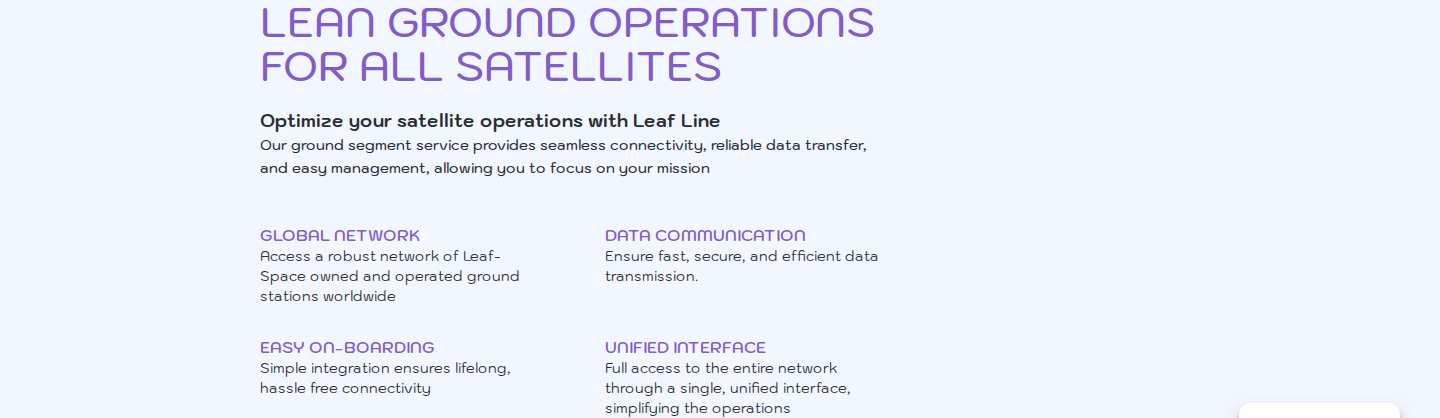
Leaf Space is a pure-play GSaaS provider operating a fully owned global ground station network, offering LEO and smallsat operators all-inclusive per-minute pricing with no minimum commitment and a dedicated mission manager for every mission.
Pros:
Fully owned network, consistent SLAs
14/14 SSO orbit coverage, no minimum commitment
All-inclusive per-minute pricing — no hidden line items
Dedicated mission manager, every mission
Cons:
Smaller network scale than KSAT
Not hyperscaler-native cloud integration
Exact rates require direct contact
Leaf Space stands apart from most ground station as a service providers on two axes that matter most to commercial LEO operators: a fully owned and operated network — no third-party antenna aggregation — and a published all-inclusive per-minute pricing structure that makes budgeting possible before a single contract is signed.
Leaf Space Network Coverage
The network comprises 40+ ground stations processing more than 23,000 passes per month, with a 2024–2026 deployment plan adding 18 new stations in high-demand regions.
For sun-synchronous orbit missions, the coverage record is 14/14 visible passes, and mid-inclination coverage reaches 26/28 — figures that translate directly into shorter data latency and fewer contact gaps for LEO operators.
At 550 km SSO altitude, the average gap between consecutive contacts is approximately 15 minutes, which is operationally significant for time-sensitive payload downlinks.
Frequency Support and SDR Flexibility
Leaf Space supports S-band uplink and downlink, X-band downlink, and Ka-band downlink (the latter covering the 25.5–27.0 GHz remote sensing window), with simultaneous S-band and X-band operation available on a single station.
The in-house Software Defined Radio suite supports CCSDS, DVB-S2, and DVB-S2X out of the box, and can integrate custom or proprietary waveforms within weeks — no hardware changes required.
Leaf Space Pricing Model
The all-inclusive per-minute pricing model covers ground station RF licensing, signal processing, data backhauling, and delivery to the customer environment — with no hidden line items added after the fact.
There is no minimum commitment on service usage or mission duration, which is a meaningful advantage for smallsat operators running shorter or phased missions.
Exact per-minute rates are not published on a public rate card and require direct contact with Leaf Space; volume discounts are available for higher-usage missions.
The transparency of the pricing structure — knowing what is and is not included — allows operators to build realistic ground segment budgets even before negotiating a specific rate, which is a genuine differentiator in a market where most providers are entirely quote-only.
Service Tiers
- Leaf Line: Shared multi-mission network with per-minute pricing; the standard entry point for most LEO operators.
- Leaf Key: Dedicated stations tailored to a specific mission profile — orbit, data rate, security, and sovereignty — operated by Leaf Space or the customer.
- Leaf Hosting: Customer-owned RF or optical ground stations deployed on Leaf Space sites, with Leaf Space providing land, power, connectivity, and first-level maintenance.
All three tiers operate through one unified API and software stack, so operators can transition between them — for example, starting on Leaf Line and scaling to Leaf Key — without re-integration work.
Data Delivery and Mission Support
Data is transferred near real-time to the customer environment, with a 99%+ pass success rate across UHF, S-band, X-band, and Ka-band.
Every mission is assigned a dedicated mission manager who provides support from onboarding through deorbit — a service-layer commitment that hyperscaler GSaaS products do not typically include.
Cloud Integration
Data delivery options include S3 bucket, TCP/IP, UDP, and GSE streams, accessible through a RESTful API that serves as the unified interface across all service tiers.
This is not cloud-native integration in the hyperscaler sense — there is no direct VPC delivery or AWS/Azure co-location — but the delivery options are broadly compatible with multi-cloud and on-premises customer environments.
A strategic MOU with Infostellar gives Japanese satellite operators access to Leaf Space assets via the StellarStation ground-station virtualisation layer, extending market reach into the Asia-Pacific region.
Lock-In Risk
Lock-in risk is moderate: the proprietary API and scheduling software create some switching friction, though the unified interface across all three tiers means operators do not face separate integration work when changing service model.
The fully owned network is a separate and positive dimension of risk management — SLA consistency does not depend on third-party antenna partners, which is a meaningful contrast to aggregated-capacity models.
Compared to the deeper platform dependency of AWS Ground Station, where data flows and processing are tightly coupled to AWS-native services, Leaf Space's API-based model carries lower ecosystem lock-in overall.
Leaf Space is best suited to commercial LEO and smallsat constellation operators who prioritise pricing transparency, all-inclusive service with no minimum commitment, and a dedicated mission manager — particularly those who want consistent SLAs backed by a fully owned network rather than aggregated third-party capacity.
Provider 4
Viasat Real-Time Earth
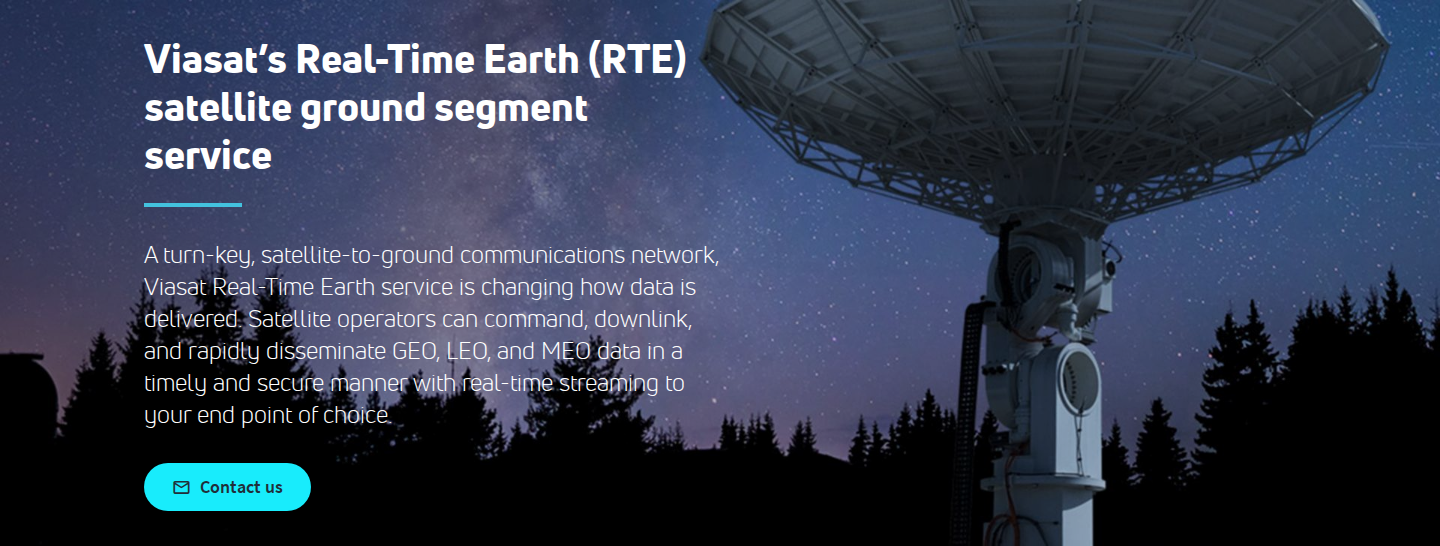
Viasat Real-Time Earth is a global ground station as a service network built and operated by the only antenna manufacturer in the GSaaS market, offering multi-orbit support across LEO, MEO, GEO, and HEO with S-, X-, and Ka-band capability across six continents.
Pros:
Vertical integration: antenna manufacturer and network operator
Multi-orbit support: LEO, MEO, GEO, and HEO
Large-aperture antennas enabling Ka-band at low elevation
NASA NSN contract selection — proven government credibility
Cons:
Premium positioning — not suited to commodity smallsats
Proprietary scheduling and modem virtualisation create moderate lock-in
Quote-only pricing — no public rate card
Viasat RTE occupies a structurally unique position in the GSaaS market: it is the only provider on this list that also manufactures the antennas in its own network, giving it an engineering depth that pure-play service aggregators cannot replicate.
That vertical integration is not an incidental detail — it means the antenna design and the service are co-optimised, producing consistent hardware standards across every site and the ability to support high-throughput Ka-band missions at scale.
The other axis that sets RTE apart from most providers on this list is orbit breadth: full support for LEO, MEO, GEO, and HEO in a single service.
For operators running MEO or GEO missions alongside LEO — a profile common in government and defence programmes — the number of GSaaS providers that can serve all four orbit classes is small, and Viasat RTE is one of them.
Viasat Real-Time Earth Network Coverage
The RTE antenna network spans six continents, with sites across North America, South America, Europe, Africa, and Asia Pacific — including a ground station in Japan and a partnership with the Ghana Space Science and Technology Institute confirming the Africa footprint.
| Evaluation Axis | Viasat RTE Assessment |
|---|---|
| Network Coverage | Six continents (North America, South America, Europe, Africa, Asia Pacific); LEO, MEO, GEO, and HEO orbit support |
| Frequency Support | S-, X-, and Ka-band; 5.4m and 7.3m full-motion antennas enable Ka-band closure at lower elevation angles; multi-gigabit downlink rates for high-data-rate EO missions |
| Pricing Model | Pay-per-use; quote-only — no public rate card |
| Cloud Integration | Microsoft Azure Orbital integration (five RTE sites via Azure Marketplace); ATLAS Space Operations Freedom platform access; ISAN adaptable transport architecture |
| Data Delivery | Real-time streaming to customer endpoint; machine-to-machine scheduling interface; virtualised modem instances per mission; multi-gigabit Ka-band payload downlink |
| Lock-in Risk | Moderate — proprietary scheduling and modem virtualisation create some dependency; Azure integration reduces cloud lock-in for Azure-aligned operators; ATLAS partnership adds a second access pathway |
Structured payoff for the six evaluation framework axes — allows readers to scan Viasat RTE's assessment on each axis in the same format used across sibling provider entries.
The large-aperture antennas — 5.4m and 7.3m full-motion dishes — are the engineering foundation behind RTE's Ka-band capability: their size allows link closure at lower elevation angles than smaller antennas can achieve, which is an antenna-manufacturer advantage, not just a service feature.
Viasat Real-Time Earth Cloud Integration
Five RTE sites are accessible directly through the Microsoft Azure Orbital integration via the Azure Marketplace, making RTE a practical option for operators whose processing pipelines are already Azure-aligned.
The ATLAS Space Operations partnership extends Freedom platform access to RTE antennas, adding a second cloud access pathway beyond Azure.
The Integrated Space Access Network (ISAN) concept underpins an adaptable transport architecture, allowing operators to select between RTE direct-to-Earth and space relay options depending on mission requirements — a meaningful differentiator for programmes that need flexibility in how data moves from orbit to ground to cloud.
Viasat Real-Time Earth Pricing
Pricing operates on a pay-per-use basis, but there is no public rate card — all pricing requires direct engagement with Viasat.
For comparative budgeting purposes, this is a genuine friction point: operators shortlisting providers cannot benchmark RTE costs against published per-minute rates from other vendors without initiating a commercial conversation.
Viasat's selection as part of the NASA Near Space Network (NSN) services contract — a $4.82B IDIQ programme — is a credibility signal that RTE pricing can be competitive within government contract vehicles, even if those rates are not publicly visible.
Who Should Use Viasat Real-Time Earth
RTE is best suited to high-throughput Earth observation and remote sensing missions requiring Ka-band downlink, government and defence operators who need proven, secure ground infrastructure with an established contract vehicle, and programmes spanning MEO or GEO orbits that most GSaaS providers do not serve.
It is not the right fit for commodity LEO smallsat operators who need transparent per-minute pricing, a self-serve scheduling interface, and a provider optimised for commercial small satellite cadence.
Provider 5
SSC Space (Swedish Space Corporation)
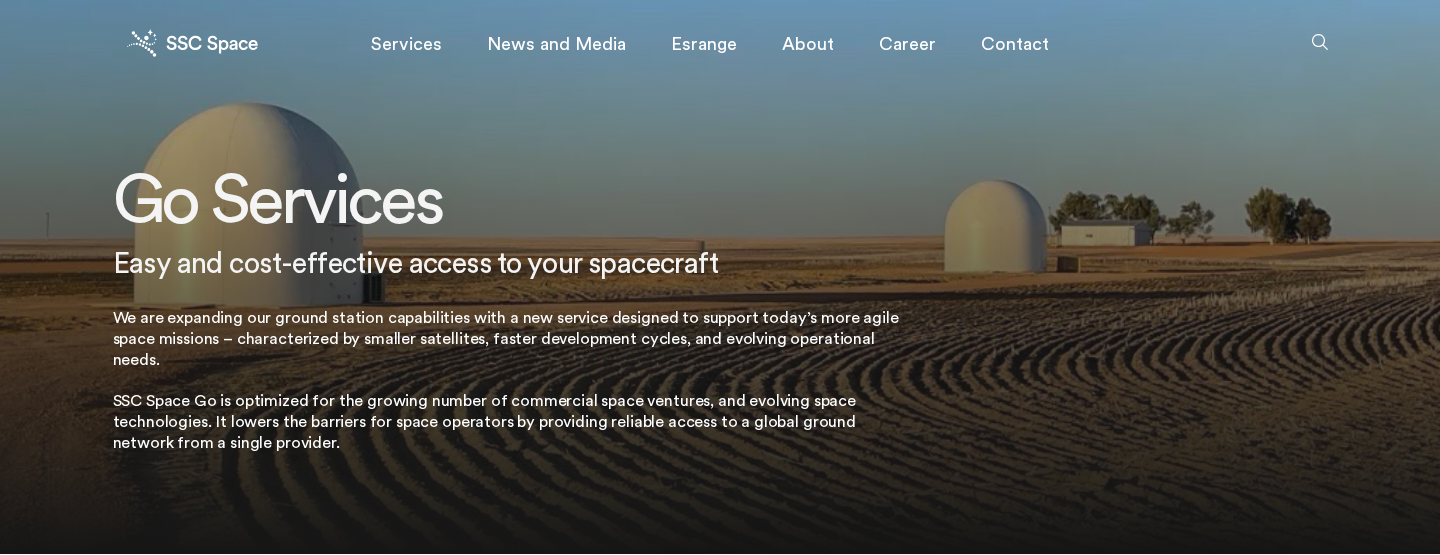
SSC Space (Swedish Space Corporation) is a heritage ground station operator offering cloud-native ground station as a service through its SSC Space Go tier, with 10 owned stations strategically anchored at polar locations and a unique commercial capability for lunar and deep-space communications that no other provider on this list can match.
Pros:
First commercial global Ka-band network for EO
Only provider with commercial lunar ground support
Polar anchoring: Kiruna, Inuvik, Alaska
Cloud-native Go tier, multi-cloud compatible
Cons:
Space Go available at five locations initially
Smaller antenna count than KSAT's network
No public pricing for either service tier
SSC Space brings something to the GSaaS market that no other provider on this list offers: decades of heritage ground station operations combined with a modern, cloud-native automated service tier and a verified commercial capability for lunar and deep-space communications.
Network Coverage
SSC operates 10 owned ground stations and more than 13 collaborative partner stations globally, with locations spanning Esrange/Kiruna (Sweden), Inuvik (Canada), North Pole Alaska (USA), South Point Hawaii (USA), WASC (Western Australia), Santiago and Punta Arenas (Chile), Clewiston Florida (USA), Si Racha (Thailand), and Irbene (Latvia).
The Kiruna-Inuvik pairing — sometimes referred to as the Kinuvik dual-station concept — is a notable architectural feature: together, these two high-latitude stations deliver all-orbit daily coverage for polar and high-inclination LEO missions without requiring additional mid-latitude passes.
SSC's owned network is smaller in absolute antenna count than KSAT's 300+ antenna infrastructure, but it is strategically distributed with strong polar anchoring — a meaningful distinction for operators whose orbits demand frequent high-latitude contacts.
SSC Space Go, the cloud-native automated service tier, is initially available at five locations: Esrange, Alaska, Inuvik, Western Australia, and Punta Arenas — covering both polar and southern-hemisphere equatorial windows.
Frequency Support
The full SSC network supports S-band, X-band, Ka-band, and Ku-band; SSC Space Go specifically supports S-band uplink and X- and Ka-band downlink on 4m-class antennas, with simultaneous dual-polarisation downlinks available for X- and Ka-band.
SSC was the first commercial provider to roll out a global Ka-band network for Earth observation missions spanning both polar and equatorial locations — a first-mover position that matters for high-throughput EO operators who require consistent Ka-band access across orbit geometries, not just at selected sites.
SSC Space Go Pricing
SSC Space Go uses scheduled access on a first-come, first-served basis, designed for cost efficiency and automation; larger premium services — full-aperture and dedicated configurations — are available on a quote basis.
Neither tier carries a publicly listed rate card, which makes comparative budgeting harder at the shortlisting stage — consistent with the pricing opacity seen across most providers on this page. Operators should contact SSC directly for a coverage analysis and indicative pricing.
Cloud Integration
SSC Space Go is cloud-native and software-defined, with API-based scheduling and compatibility with any public cloud platform — it is not tied to a single hyperscaler, which is a concrete advantage over AWS Ground Station for operators who want to retain cloud flexibility.
EnduroSat became the first commercial adopter of SSC Space Go, using X-band payload downlink at Esrange — a live proof point that the service is in active commercial operation, not just in development.
Data Delivery
The full SSC network handles 300+ satellite contacts per day, with near real-time data delivery achieved through cloud-based workflows on the Go tier.
Simultaneous dual-polarisation downlinks for X- and Ka-band are a technically meaningful capability for high-data-rate EO missions, reducing the number of passes required to clear a full data volume.
Lunar and Deep-Space Capability
SSC is the only commercial company with more than a decade of lunar communications support, covering 10+ lunar missions including heritage tracing back to the Apollo programme. SSC has been selected for the NASA Near Space Network expansion covering Earth Proximity and Beyond Cislunar regions — a contract no other provider on this list holds.
For operators who have — or anticipate — lunar or deep-space requirements alongside LEO operations, this is a genuine procurement differentiator: a single provider relationship can span both mission domains, avoiding the complexity of contracting a separate deep-space ground network.
This capability is irrelevant to LEO-only operators, but as cislunar activity grows and operators plan multi-phase programmes, the optionality it provides has real long-term value.
Lock-In Risk
Lock-in risk is moderate and lower than hyperscaler-native offerings: SSC Space Go uses standardised interfaces, API-based scheduling, and multi-cloud compatibility, meaning operators are not committed to a single cloud ecosystem as they are with AWS Ground Station.
Who SSC Space Is Best Suited For
- Polar and high-inclination LEO missions: Operators running sun-synchronous or polar orbits who need heritage-backed, high-latitude coverage from Kiruna, Inuvik, and Alaska — with the Kinuvik dual-station concept delivering all-orbit daily contacts.
- Smallsat and constellation operators: Teams wanting a cloud-native, automated ground access service from an established operator, with API scheduling and multi-cloud data delivery via SSC Space Go — without minimum commitment to a single hyperscaler.
- Operators with lunar or deep-space requirements: Missions that include or anticipate cislunar, lunar, or deep-space communications phases alongside LEO operations — where SSC's NASA NSN selection and 10+ lunar mission heritage make it the only commercial single-provider option.
Conclusion
Choosing the right GSaaS provider for your mission
The clearest shortlisting signal is whether your mission is cloud-native first or network-scale first: AWS Ground Station wins when your pipeline lives in AWS; KSAT wins when pole-to-pole coverage and multi-cloud flexibility take priority.
For commercial LEO operators, Leaf Space's all-inclusive pricing removes a budgeting friction that most providers quietly leave in place.
Viasat RTE suits multi-orbit and high-throughput missions; SSC Space serves operators who need heritage polar coverage today and may need lunar ground support tomorrow.
Bring your orbital parameters, frequency requirements, and cloud stack to your shortlisted providers — most offer coverage analysis before any contract commitment.
Ground station as a service: frequently asked questions
Procurement and operational questions for satellite operators evaluating ground station as a service providers.
GSaaS pricing follows two dominant models: per-minute billing (used by AWS Ground Station) and all-inclusive per-minute pricing (Leaf Space's model, which bundles all line items into a single rate). Some providers also offer per-pass structures. Most providers — including KSAT, Viasat RTE, and SSC — are quote-only, with no published rate card. For context on the alternative: building and operating a dedicated S/X-band ground antenna runs into the hundreds of thousands of euros in capital outlay, plus ongoing monthly maintenance costs. GSaaS converts that CapEx into a flexible OpEx model with no infrastructure ownership. To get meaningful pricing from any shortlisted provider, approach them with your orbital parameters and expected monthly contact volume — those two inputs drive the quote.
S-band and X-band are universal across the five leading GSaaS providers covered on this page — AWS Ground Station, KSAT, Leaf Space, Viasat RTE, and SSC all support both. Ka-band is available from KSAT, Leaf Space, Viasat RTE, and SSC, but not from AWS Ground Station — a meaningful constraint for high-throughput Earth observation missions that require Ka-band downlink capacity. Band selection is ultimately a function of your spacecraft's transponder design and mission data rate requirements, not provider preference alone. If your mission depends on Ka-band, AWS Ground Station is not a viable primary provider, and that should be a first-pass filter in your evaluation.
Shared access is the standard GSaaS model: operators book time on antennas that serve multiple customers simultaneously across the network, with scheduling managed via API or provider console. It is cost-efficient and suits the majority of LEO missions with moderate contact frequency requirements. Dedicated access provides exclusive antenna resources for a single customer. Leaf Space offers this through Leaf Key, its dedicated station tier; AWS Ground Station also provides a dedicated antenna option. Dedicated access makes sense for missions with high duty-cycle requirements, security-sensitive or classified payloads where shared infrastructure is architecturally unacceptable, or missions that require guaranteed pass windows without the risk of scheduling contention during peak demand periods.
The most common mistake operators make is treating a provider's total global station count as a proxy for coverage quality. It is not. What matters is how many of those stations are geometrically visible to your specific orbit — and that depends on your inclination, altitude, and RAAN, not the provider's headline number. A polar SSO mission benefits enormously from high-latitude stations: Svalbard at 78°N, for example, is visible on virtually every SSO pass, which is why KSAT and SSC's polar anchoring translates directly into contact frequency for those missions. A low-inclination mission gets far less value from the same polar infrastructure, regardless of how many total antennas a provider operates. The correct procurement step is to request a coverage analysis from shortlisted providers using your actual orbital parameters as inputs. Most providers offer this — it is the only way to compare coverage on a like-for-like basis for your mission.
Lock-in in GSaaS arises from three sources. First, proprietary scheduling APIs make switching providers technically complex once your operations are integrated. Second, cloud-specific data delivery pipelines — particularly acute with AWS Ground Station, where downlinked data lands directly in a customer VPC and is tightly coupled to AWS infrastructure, making migration non-trivial. Third, contractual minimums and reservation commitments create financial switching costs even where technical migration is feasible. To mitigate: prioritise providers with open or standard APIs where possible; maintain a secondary provider relationship for mission-critical contacts; and negotiate contractual flexibility from the outset, including exit provisions and minimum commitment levels. Lock-in is a legitimate architectural risk that deserves explicit evaluation during procurement — not an afterthought once the integration is complete.
Free-space optical (FSO) links offer substantially higher data throughput than RF links and sidestep congested, licensed RF spectrum — which is why optical ground stations are where high-throughput satellite downlink and uplink capability is heading. KSAT is actively investing in optical communications capabilities as part of its next-generation ground network development. A key component of any optical ground station is the uplink amplifier. Woodrow Scientific Limited (WSL) manufactures a high-power, software-definable EDFA for this role — a UK-built amplifier that nests the tracking beacon and uplink data in a single beam, with the beacon riding low and the data above it in one amplified output. WSL designs, builds, qualifies, and supports the amplifier entirely in-house on patented technology, configuring both the hardware and the software control layer to each client's ground station — including Modulation-on-Demand switchable across CCSDS and SDA standards. For operators evaluating optical-capable GSaaS providers, understanding the uplink amplifier layer is a practical procurement consideration.