

Introduction
Few materials are as quietly ubiquitous as aluminum alloys — present in the fuselage of a commercial aircraft, the body panel of your car, the window frame of your office, and the can in your hand.
Whether you are an engineer selecting a material for a new design, a procurement professional cross-referencing international specifications, or a technically curious reader building foundational knowledge, this guide is written for you.
By the time you reach the end, alloy selection will feel navigable rather than overwhelming — you will understand what the designation systems actually mean, and how choices made at the material stage ripple through fabrication, finishing, and long-term performance.
TL;DR
Aluminum alloys follow a logical, learnable system. Once you understand how composition, designation, and processing interact, what looks like an intimidating landscape of codes and trade-offs resolves into a clear framework — and confident alloy selection follows naturally.
This article covers:

Alloy classification — wrought series and casting families
Designation and temper systems — codes and standards
Per-series properties and applications
Fabrication — welding, machining, and forming
Finishing — anodising, painting, powder coating
Additive manufacturing and sustainability
What are aluminium alloys?
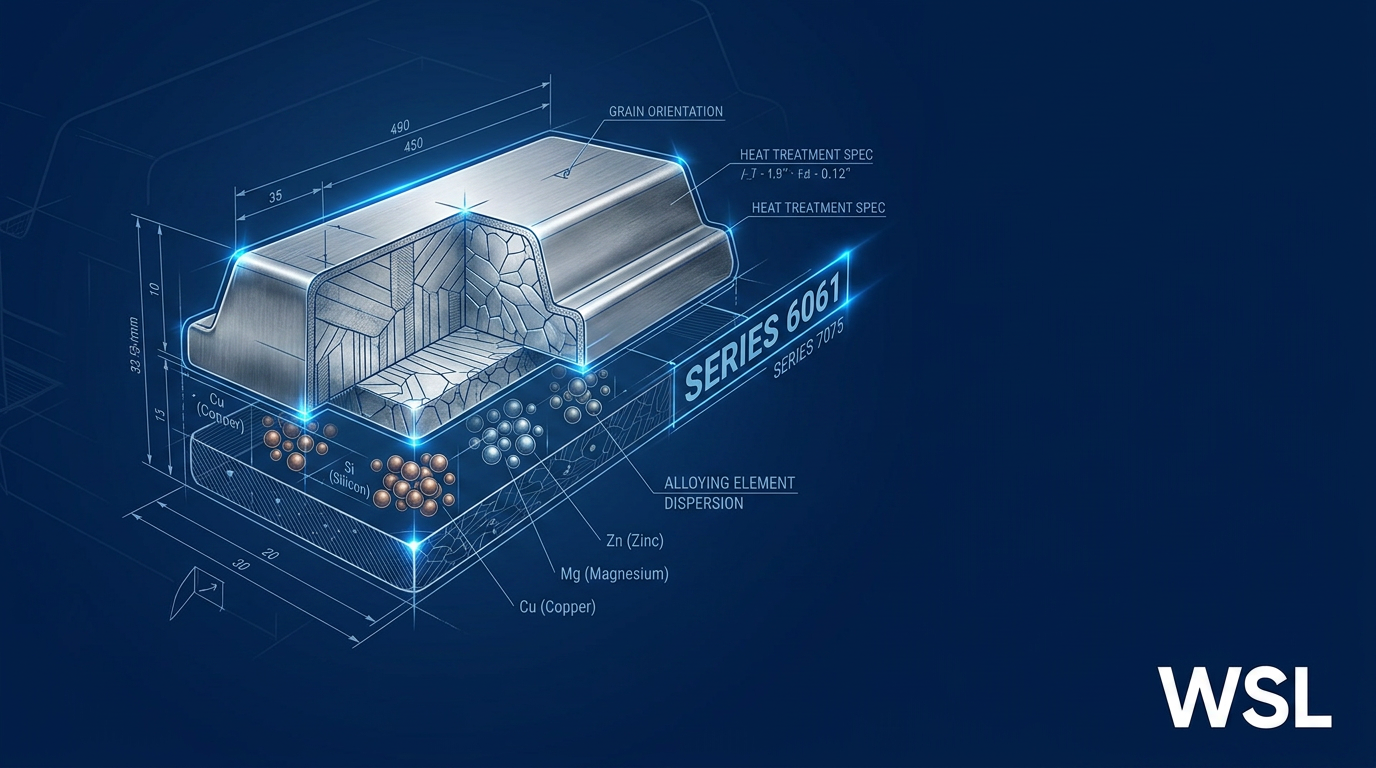
Aluminium is one of the most abundant metals on Earth and the backbone of modern aerospace, automotive, and construction engineering — yet in its pure form it is too soft to bear a structural load. The gap between that limitation and aluminium's ubiquity in load-bearing applications is bridged entirely by alloying.
Aluminium alloys are metallic materials composed primarily of aluminium combined with one or more other elements, where those additions are made deliberately to enhance properties that commercially pure aluminium cannot achieve on its own.
Commercially pure aluminium — containing 99% or more aluminium by weight — has genuine virtues: excellent corrosion resistance, high electrical and thermal conductivity, and good formability.
What it lacks is structural strength. That deficiency makes it unsuitable for most load-bearing or high-performance applications, and alloying is the engineering solution to that constraint.
Principal alloying elements
Each alloying element is chosen for a specific effect, and the same elements recur throughout the classification system — understanding them here makes every subsequent series immediately legible.
- Copper: Increases strength significantly and enables precipitation hardening, but reduces corrosion resistance — the central trade-off of the 2xxx series.
- Magnesium: Raises strength while improving corrosion resistance and weldability; the primary element in the 5xxx series and part of the 6xxx combination.
- Silicon: Improves castability and melt fluidity; reduces thermal expansion. Key to casting alloys, the 4xxx series, and the 6xxx magnesium-silicon pairing.
- Zinc: Delivers the highest strength potential of any alloying element when combined with magnesium and copper — the defining characteristic of the 7xxx series.
- Manganese: Provides moderate strength improvement and corrosion resistance; improves work hardenability. The primary basis of the 3xxx series.
In practice, most alloys combine two or more of these elements to achieve a balanced property profile. The primary alloying element — the one present in the greatest proportion — is what determines which series an alloy belongs to.
Wrought and cast: the two fundamental categories
All aluminium alloys divide first into two structural categories: wrought alloys, which are shaped by mechanical working processes such as rolling, extrusion, and forging, and cast alloys, which are poured as molten metal into moulds and solidify in their final form.
These two categories use separate designation systems, and their compositions are optimised for fundamentally different manufacturing routes — a distinction that the next section covers in full.
How aluminium alloys are strengthened
Two distinct mechanisms account for virtually all strengthening in aluminium alloys. Strain hardening (also called work hardening) applies to non-heat-treatable alloys: plastic deformation through rolling, drawing, or other mechanical processes increases strength by introducing dislocations into the metal's structure, and this is the basis of the H temper route.
Precipitation hardening (age hardening) applies to heat-treatable alloys: controlled heating and cooling causes strengthening phases to precipitate within the microstructure, and this is the basis of the T temper route.
Which mechanism applies to a given alloy is fixed by its alloying element composition, not by any choice made during production — and that distinction governs which temper designations are valid for it.
Whether an alloy can be strengthened by precipitation hardening — and therefore which temper designations apply to it — is set by its alloying elements. A non-heat-treatable alloy cannot be aged to higher strength regardless of the thermal treatment applied.
According to the Davis Aluminum and Aluminum Alloys reference published by ASM International and hosted by NIST, more than 500 alloy designations have been registered by the Aluminum Association — a figure that reflects the genuine breadth of the landscape this guide navigates.
With the foundational vocabulary in place, the practical next step is understanding how those alloys are systematically identified — which is what the designation system provides.
Aluminium Alloy Designations: Wrought, Cast, and International Standards
Pick up any aluminium datasheet and you might encounter 6061, EN AW-6061, or A96061 — three designations for exactly the same alloy, each from a different standard. Add casting alloys into the picture, and designations like 356.0 or A380 appear with a format that looks entirely different again. Before the per-series detail can mean anything, the reader needs a map of how these numbering systems work and why they look the way they do.
Wrought vs Cast: Processing Routes and Microstructure
Wrought aluminium alloys are mechanically worked after casting into an intermediate form — rolled into sheet or plate, drawn into rod or bar, extruded into profiles, or forged into structural shapes. That mechanical deformation refines and elongates the grain structure, producing higher achievable strength and ductility compared with an equivalent composition in cast form.
Cast alloys take a different route: liquid metal is poured into a mould and solidifies into a near-net-shape part. The as-cast grain structure is coarser than a worked microstructure, but the process offers geometric freedom that makes it the natural choice for intricate housings, engine blocks, and complex-geometry components.
One strengthening route is exclusively available to wrought alloys: strain hardening (the H temper system) is imparted by the mechanical working process itself and cannot be applied to a casting. Heat-treatable casting families — the 2xx.x, 3xx.x, and 7xx.x series — can be precipitation hardened, but the work-hardening path simply does not exist for cast products.
The Wrought Designation System: Decoding Four Digits
The Aluminum Association wrought designation is a four-digit number with no decimal point. The first digit identifies the alloy series — the principal alloying element class. The second digit indicates whether the alloy is the original registered composition (0) or a successive modification (1 through 9, assigned consecutively). The third and fourth digits identify the specific alloy within the series and carry no special sequential significance.
| First Digit | Series | Principal Alloying Element | Example Alloys |
|---|---|---|---|
| 1 | 1xxx | Aluminium ≥99.00% (commercially pure) | 1050, 1060, 1100 |
| 2 | 2xxx | Copper | 2024, 2014, 2219 |
| 3 | 3xxx | Manganese | 3003, 3004, 3105 |
| 4 | 4xxx | Silicon | 4043, 4047 |
| 5 | 5xxx | Magnesium | 5052, 5083, 5754 |
| 6 | 6xxx | Magnesium and silicon | 6061, 6063, 6082 |
| 7 | 7xxx | Zinc | 7075, 7068, 7050 |
| 8 | 8xxx | Other elements (e.g. iron, tin, lithium) | 8011, 8090 |
| 9 | 9xxx | Unassigned | — |
Maps each wrought alloy series first digit to its principal alloying element and representative example alloys, giving readers a reference for decoding any wrought designation.
The first digit is the highest-level classification signal in any wrought designation. Reading it tells you immediately which principal element governs the alloy's behaviour — copper for the high-strength 2xxx family, magnesium and silicon together for the structurally versatile 6xxx family, zinc for the highest-strength 7xxx alloys used in aerospace. The 9xxx series remains unassigned.
The Cast Designation System: Four Digits and a Decimal Point
The visual cue that distinguishes a casting alloy designation from a wrought one is the decimal point. Cast alloys use a four-character format — three digits, a decimal point, then a fourth digit — structured as xxx.x. The digit after the decimal point indicates product form: .0 denotes a casting, while .1 and .2 denote ingot grades with composition limits matched to the corresponding casting alloy.
A capital letter prefix preceding the number — such as the A in A356.0 — indicates a composition modification of the base alloy, with A denoting the first modification, B the second, and so on. This prefix convention is entirely separate from the wrought system's second-digit modification indicator, and the two systems' series numbers, while sharing the same principal-element logic, are independent registrations.
The cast series groups are: 1xx.x (commercially pure aluminium), 2xx.x (copper), 3xx.x (silicon with added copper and/or magnesium), 4xx.x (silicon), 5xx.x (magnesium), 7xx.x (zinc), 8xx.x (tin), and 9xx.x (other elements). The 6xx.x series is currently unused.
UNS and European EN Designations
The Unified Numbering System (UNS), governed by ASTM Practice E527, provides a cross-industry alphanumeric identifier for metals and alloys. For wrought aluminium alloys, the UNS number is formed by preceding the four-digit Aluminum Association designation with "A9" — so alloy 2024 becomes A92024, and 7075 becomes A97075. The Aluminum Association administers the UNS designations for aluminium alloys. For cast alloys, the AA designation is preceded by "A" followed by "0" where no letter precedes the casting designation, or by 1, 2, 3, and so on where the AA designation carries a prefix letter.
The European designation system is governed by BS EN 573 for wrought alloys and BS EN 1706 for castings. Wrought alloys carry the prefix EN AW- (Aluminium Wrought) followed by the four-digit AA designation; an alternative chemical symbol form is also valid, such as EN AW-Al Mg1SiCu for alloy 6061. Cast alloys carry the prefix EN AC- and use a five-digit numeric designation per EN 1780-1. BS EN 573-3 explicitly states that its composition limits are completely identical with those registered with the Aluminum Association for the corresponding alloys.
AA 6061, EN AW-6061, and A96061 describe identical alloy chemistry. An engineer procuring the same material in the US, Europe, and via a UNS-referenced document is reading three designations for one composition — the prefix encodes the standard's origin, nothing more.
When working across specification documents from different markets, the Aluminum Association's Table 1.2 is the standard cross-reference tool for mapping between AA, UNS, EN, ISO, and national designations — an essential resource for procurement and engineering teams operating across borders.
Knowing which alloy you have is only the first layer of the designation system. The letters and numbers that follow the alloy designation — the temper designation — describe what processing the alloy has received after it was cast or worked, and that is where the next section picks up.
Heat Treatment and Temper Designations Explained
The alloy number tells you what is in the metal. The temper designation tells you what has been done to it — and that second piece of information is just as important as the first. 6061-O and 6061-T6 share identical chemistry, yet their mechanical properties differ so dramatically that they are effectively different engineering materials: one is soft and highly formable, the other is a high-strength structural alloy.
In a full alloy designation, the alloy number and temper code are separated by a hyphen. The number identifies the composition; the temper code describes the processing history that produced the final property state. Together, they form a complete specification — and neither half is optional.
The Five Basic Temper Designations
The Aluminum Association's temper designation system uses five top-level letters: F, O, H, W, and T. Each represents a fundamentally different processing route — and therefore a fundamentally different property profile.
F (as-fabricated) is the default condition as the alloy leaves the production process — rolling, extrusion, or casting — with no special control over thermal or strain-hardening conditions. No mechanical property limits are specified for the F temper; it is not a controlled condition.
O (annealed) is the softest and most ductile condition achievable, produced by controlled heating and slow cooling to relieve work hardening and dissolve strengthening precipitates. It delivers maximum formability at the cost of minimum strength, and is specified wherever forming operations demand the greatest ductility.
H (strain hardened) applies exclusively to wrought alloys and is always followed by two or more digits. It is produced by cold working — rolling, drawing, or similar processes — that raises dislocation density and increases strength. The digits that follow encode both the type of treatment and the degree of hardening achieved.
W (solution heat treated) is an unstable, time-qualified temper that applies only to alloys which age naturally at room temperature after quenching. Because the alloy continues to change properties as natural ageing proceeds, the W designation is always time-qualified (for example, W ½ hr). It is rarely specified for finished product — it describes the condition immediately after quenching, before ageing has run its course.
T (thermally treated) covers all stable tempers produced by heat treatment other than annealing, always followed by one or more digits. It applies to heat-treatable alloys that are solution treated and then aged to a stable property state. The T family is commercially the most significant of the five.
H Temper Subdivisions: Strain Hardening Type and Degree
The first digit after H identifies which strain-hardening route was used. H1x means strain hardened only, with no subsequent thermal treatment. H2x means strain hardened and then partially annealed — some strength is sacrificed to recover ductility and improve formability. H3x means strain hardened and then stabilised by a low-temperature thermal treatment; this sub-family applies specifically to magnesium-bearing alloys (particularly the 5xxx series), where stabilisation prevents gradual age softening at room temperature.
The second digit indicates the degree of residual cold work: H_8 is full hard (roughly 75% reduction in area for 1xxx and 3xxx alloys, varying by series); H_4 is half hard; H_2 is quarter hard. H_9 denotes extra hard, beyond the full-hard condition, used in some specialist specifications. A third digit, when present, signals a specific variation in the sequence of operations or a special property requirement — H321, for instance, is a controlled variant of H32 used for 5xxx series plate with defined mechanical property limits.
The T Tempers: Precipitation Hardening in Practice
To understand why T tempers produce such different property profiles, you need to understand the underlying mechanism: precipitation hardening. This three-step process is what makes heat-treatable aluminium alloys capable of strengths that rival many steels at a fraction of the weight.
- Solution heat treatment: The alloy is heated into the single-phase solid solution field, dissolving soluble alloying phases into the aluminium matrix to form a homogeneous supersaturated solid solution.
- Quenching: Rapid cooling — typically a water quench — traps solute atoms in solution, creating a thermodynamically unstable supersaturated state that slow cooling would never produce.
- Age hardening: Over time, solute atoms cluster and precipitate as fine particles within the matrix. These precipitates impede dislocation movement, raising strength and hardness progressively.
The strengthening effect is physical: the fine precipitate particles act as obstacles to dislocation motion through the crystal lattice, and it is this interference that raises yield strength and hardness. When ageing occurs at room temperature, the process is called natural ageing (producing T4); when accelerated at elevated temperature, it is artificial ageing (producing T6, T7, or T8). This distinction — not just whether the alloy is heat-treatable, but how far along the ageing curve it has been taken — is precisely what the T digit encodes.
| Temper | Processing description | Typical alloy series | Key application context |
|---|---|---|---|
| T4 | Solution heat treated, then naturally aged at room temperature to a substantially stable condition. | 2xxx, 6xxx | Alloys to be formed after solution treatment, before artificial ageing is applied. |
| T5 | Cooled directly from an elevated-temperature shaping process (e.g. extrusion), then artificially aged. No separate solution treatment. | 6xxx | Extruded profiles where shaping temperature is sufficient to dissolve soluble phases. |
| T6 | Solution heat treated, then artificially aged to peak or near-peak strength. | 2xxx, 6xxx, 7xxx | General high-strength structural applications; the most widely specified T temper. |
| T7 | Solution heat treated, then artificially aged beyond peak strength (overaged). | 7xxx | Aerospace structures in corrosive environments requiring stress-corrosion cracking resistance. |
| T8 | Solution heat treated, cold worked, then artificially aged. Cold work accelerates precipitation and raises final strength. | 2xxx | High-strength sheet and plate where maximum strength is required; e.g. 2024-T851. |
Key T temper designations — processing sequence and typical application context for the five most commercially significant T tempers.
Reading across the table, a clear pattern emerges. T6 is the peak-strength workhorse — the temper specified when maximum strength is the primary objective. T4 is the pre-ageing forming temper, used when the part needs to be shaped before strength is locked in. T8 adds a cold-working step between solution treatment and ageing, pushing strength higher still through combined mechanisms. T7 is the outlier: it deliberately accepts lower strength than T6 in exchange for substantially improved resistance to stress-corrosion cracking. When you read a temper designation on a datasheet, it tells you exactly where on the strength-ductility-corrosion trade-off curve the alloy has been positioned.
Ageing beyond the peak-strength condition causes precipitates to coarsen and lose coherency, reducing strength — but overaged microstructures are significantly more resistant to stress-corrosion cracking (SCC). For 7xxx series alloys in aerospace environments, SCC is a critical failure mode, which is why T73 and T7351 are specified for structural components even though T6 delivers higher peak strength. The strength reduction is an intentional engineering decision.
With the temper designation system now in hand, the per-series descriptions that follow will carry immediate meaning: when you encounter 6061-T6, 5083-H321, or 7075-T73 in the next sections, you will know not just what the alloy contains, but precisely what processing produced its properties.
Wrought Aluminium Alloys: 1xxx to 7xxx Series Guide
The wrought alloy series system is, at its core, a map of engineering trade-offs. Each series number signals not just a chemical recipe but a characteristic set of compromises between strength, corrosion resistance, weldability, and formability — and understanding those compromises is what separates confident alloy selection from guesswork.
1xxx Series: Commercially Pure Aluminium
The 1xxx series is the baseline: aluminium at 99% purity or above, with no deliberate alloying additions of significance.
That purity delivers excellent corrosion resistance from the natural oxide layer, high electrical and thermal conductivity, and outstanding formability — but yields low strength, with tensile strengths in the range of 70–175 MPa depending on temper (Davis/ASM Table 2).
This series is not heat-treatable; the only strengthening route is strain hardening via H tempers, as established in the temper designation section.
The application logic follows directly: where conductivity and corrosion resistance outweigh strength requirements, 1xxx is the natural choice. Alloy 1350 is the established electrical conductor grade, specified for overhead transmission cable, bus conductors, and transformer strip — applications where electrical conductivity is the primary design criterion.
Other typical uses include foil, packaging, and chemical processing equipment, where formability and resistance to corrosive media matter more than load-bearing capacity.
2xxx Series: High-Strength Copper-Bearing Alloys
Copper is the principal alloying element in the 2xxx series, and its effect is transformative: precipitation hardening of the CuAl₂ phase produces yield strengths that place 2xxx alloys among the strongest in the wrought aluminium family, with tensile strengths spanning 170–520 MPa across the series (Davis/ASM Table 2).
Alloy 2024 is the canonical example — selected for aircraft fuselage skins and lower wing structures primarily for its superior resistance to fatigue crack growth, a property that matters acutely in structures subjected to millions of load cycles over a service life.
As the Campbell NIST reference confirms, 2024-T3 is normally chosen for tension-tension applications because of its superior fatigue performance compared with 7xxx alloys in the 10⁵ cycle range.
Alloy 2011 is the series' free-machining representative: it machines to an excellent surface finish at high speed and feed, with finely broken chips, making it the preferred choice for high-production machining operations — a point the fabrication section will develop further.
The trade-off for all this strength is corrosion resistance: copper additions reduce resistance to general and galvanic corrosion relative to other series, which is why Alclad cladding — a thin layer of high-purity aluminium bonded to the surface — is common on 2xxx sheet product in aerospace applications.
Peak-aged 2xxx tempers are also susceptible to stress-corrosion cracking (SCC); overaged T7x tempers deliberately sacrifice a portion of peak strength to achieve substantially improved SCC resistance, a trade-off the temper designation section has already established.
3xxx Series: Manganese and General-Purpose Formability
Manganese is a moderate strengthener that improves on pure aluminium without sacrificing the corrosion resistance or formability that make the 3xxx series so widely applicable.
Tensile strengths fall in the 140–280 MPa range via strain hardening, and this series is not heat-treatable — but for the applications it dominates, that is rarely a constraint.
Alloy 3003 is the most widely used general-purpose aluminium alloy by volume, combining reasonable strength, excellent corrosion resistance, good formability, and good weldability — a combination that makes it the workhorse of everyday aluminium fabrication.
Heat exchangers are a particularly illustrative application: the combination of thermal conductivity and corrosion resistance makes 3xxx the natural fit for radiators, air conditioning coils, and similar components.
Other applications include cookware, storage tanks, building sheet products, and beverage can bodies — wherever moderate strength, easy forming, and reliable corrosion performance are required at scale.
4xxx Series: Silicon, Filler Wire, and Brazing
Silicon is the defining element of the 4xxx series, and its primary effect is to lower the melting point and improve fluidity — properties that make 4xxx alloys ideal as welding filler wire and brazing materials rather than as structural alloys in their own right.
The series spans a wide tensile strength range of 105–350 MPa (Davis/ASM Table 2), reflecting the variety of compositions within it, though structural use remains uncommon.
Alloy 4043 is one of the most widely used filler alloys for welding 6xxx series base metals in structural and automotive applications; 4047 is commonly used for brazing sheet where a lower solidus temperature is required.
Some 4xxx alloys are heat-treatable, but the series is best understood as a specialist category: it appears in fabrication contexts rather than as a primary structural material.
One important characteristic to note for finishing purposes: silicon content reduces anodising quality, producing a dark or grey appearance rather than the clear or coloured anodic layer achievable with 5xxx or 6xxx base metals — a point the finishing section will address in detail.
5xxx Series: Magnesium, Marine, and Weldability
Magnesium provides solid-solution strengthening in the 5xxx series, along with excellent corrosion resistance — including in marine salt-spray environments — that makes this series the dominant choice for shipbuilding and offshore structures.
This series is non-heat-treatable, strengthened only by strain hardening, and that characteristic is actually an advantage for welding: because there are no strengthening precipitates to dissolve in the heat-affected zone, the weld region retains most of its strength — a contrast with the heat-treatable 6xxx and 7xxx series that the fabrication section will develop.
Tensile strengths run from 140–280 MPa in the lower-magnesium alloys; 5083 and 5086 — with higher magnesium content — are specified for structural marine work, pressure vessels, and cryogenic storage tanks.
There is a genuine engineering constraint for sustained elevated-temperature service: in alloys with more than approximately 3–4 wt% Mg, the beta phase (identified across ASM and NIST sources variously as Mg₅Al₈, Al₃Mg₂, or Mg₂Al₃) tends to precipitate at grain boundaries, making the alloy susceptible to intergranular corrosion and sensitisation.
As the Campbell NIST reference notes, this precipitation occurs slowly at room temperature but accelerates at elevated temperatures or under highly work-hardened conditions — a constraint that matters for any 5xxx application involving prolonged service above ambient temperature.
6xxx Series: The All-Round Structural Workhorse
No series is more widely specified for structural applications than the 6xxx series, where magnesium and silicon combine to form the Mg₂Si precipitate that gives this heat-treatable family its characteristic property balance.
That balance — good strength in T6 temper, excellent corrosion resistance, good weldability, good formability, and outstanding extrudability — is why 6xxx dominates everything from architectural extrusions to general engineering structural members.
Alloy 6063 is the architectural extrusion standard: window frames, curtain walling, and structural glazing systems, where surface quality and anodising response are as important as strength.
According to ASM International, alloy 6061 — with a yield strength comparable to that of mild steel — is one of the most widely used of all aluminium alloys for general construction, covering structural members, marine fittings, transportation components, and general engineering.
The 6xxx series anodises well, producing clear, consistent anodic layers suited to both protective and decorative finishes — a property the finishing section will cover in depth.
One fabrication-relevant limitation to note: welding 6xxx alloys in T6 temper causes dissolution of Mg₂Si precipitates in the heat-affected zone, permanently reducing local strength — a challenge the fabrication section will address directly.
7xxx Series: Maximum Strength, Aerospace Specialist
The 7xxx series achieves the highest yield strengths of any wrought aluminium family, with zinc combined with magnesium (and copper in the highest-strength variants) producing MgZn₂ precipitates via precipitation hardening.
The Davis/ASM reference confirms tensile strengths of 520–620 MPa are achievable, and NIST test data places 7075-T6 at an average yield strength of approximately 502 MPa — approaching medium-strength steels at a fraction of the density.
The primary application domain is aerospace structural components where maximum strength-to-weight ratio is the design driver: upper wing skins, spars, and fuselage frames, where the 7xxx alloys' strength advantage over 2xxx is decisive.
The engineering constraint that shapes 7xxx selection is stress-corrosion cracking: peak-aged T6 temper maximises strength but carries significant SCC susceptibility, particularly in the short-transverse direction.
Overaged tempers — T73 and T7351 — deliberately sacrifice a portion of peak strength to achieve dramatically improved SCC resistance; MatWeb data sourced from the Aluminum Association places 7075-T7351 typical yield strength at 372 MPa, against approximately 502 MPa for 7075-T6, illustrating the real magnitude of that trade-off.
Weldability is a further constraint: most 7xxx alloys are not readily fusion-welded due to hot cracking susceptibility, so mechanical joining and adhesive bonding are the standard fabrication routes in aerospace structures — a pattern the fabrication section will examine.
8xxx Series: A Brief Note
The 8xxx series covers alloys with principal elements outside the 1xxx–7xxx categories; the two commercially significant sub-families are lithium-bearing Al-Li alloys (which reduce density and increase elastic modulus, making them attractive for aerospace weight reduction) and iron-bearing alloys suited to elevated-temperature applications.
Wrought Series Compared: Key Property Data
The table below draws on Davis/ASM Table 2 strength range data and Aluminum Association mechanical property limits to place the seven principal series side by side across the axes that matter most for alloy selection.
| Series | Principal Element | Tensile Strength Range (MPa) | Heat-Treatable | Corrosion Resistance | Primary Applications |
|---|---|---|---|---|---|
| 1xxx | Aluminium (≥99%) | 70–175 | No (H tempers only) | Excellent — natural oxide, no alloying penalty | Electrical conductors (1350), foil, chemical processing |
| 2xxx | Copper | 170–520 | Yes — precipitation hardening (CuAl₂) | Reduced — copper promotes galvanic corrosion; Alclad used for sheet | Aerospace structures, fatigue-critical components, free-machining bar (2011, 2024) |
| 3xxx | Manganese | 140–280 | No (H tempers only) | Excellent — comparable to 1xxx | Heat exchangers, cookware, packaging, building products (3003) |
| 4xxx | Silicon | 105–350 | Some alloys yes | Good — silicon does not significantly impair resistance | Welding filler wire, brazing sheet (4043, 4047) |
| 5xxx | Magnesium | 140–280 | No (H tempers only) | Very good — outstanding in marine environments; sensitisation risk above ~3–4% Mg at elevated temperature | Marine structures, shipbuilding, pressure vessels, cryogenic tanks (5083, 5086) |
| 6xxx | Magnesium + Silicon | 280–380 | Yes — precipitation hardening (Mg₂Si) | Excellent — best overall balance in the heat-treatable series | Structural extrusions, architectural profiles, general engineering (6061, 6063) |
| 7xxx | Zinc + Magnesium (+ Copper) | 520–620 | Yes — precipitation hardening (MgZn₂) | Moderate — SCC susceptibility in T6; T73/T7351 tempers improve resistance at strength cost | Aerospace primary structure, upper wing skins, high-stress components (7075) |
Comparison of wrought aluminium alloy series by tensile strength range (from Davis/ASM Table 2), heat-treatability, corrosion resistance character, and primary application domain — to support alloy selection decisions.
Reading across the table, the pattern is consistent: as tensile strength rises from 1xxx through to 7xxx, corrosion resistance and weldability tend to become more constrained — not as a coincidence, but as a direct consequence of the alloying additions that produce the strength.
Copper (2xxx) and zinc (7xxx) are powerful strengtheners precisely because they create reactive second phases and galvanic couples that also reduce corrosion resistance; magnesium (5xxx, 6xxx) offers a better corrosion-strength balance, but the highest strengths still come with trade-offs in SCC resistance and weldability.
No wrought aluminium series simultaneously maximises strength, corrosion resistance, and weldability — every series encodes a specific compromise, and the engineer's task is to identify which constraint the application can afford to accept.
For alloy selection in practice, the question is rarely 'which is the best series?' but rather 'which trade-off does this application tolerate?' — a fatigue-critical aerospace structure tolerates reduced corrosion resistance (managed with Alclad or protective coatings) but cannot tolerate inadequate strength; a marine hull tolerates moderate strength but cannot tolerate sensitisation risk.
The wrought series system described here has a direct parallel in the casting alloy world, where composition priorities shift to accommodate the demands of mould filling and solidification rather than rolling or extrusion — that system, with its own designation format, is the subject of the next section.
Aluminium Casting Alloys: Families, Castability, and Applications
Casting alloys are not simply wrought alloys poured into a mould — they are engineered around a fundamentally different set of priorities, and silicon is the element that makes this possible. The 3xx.x series (Al-Si with copper and/or magnesium additions) alone accounts for nearly 90% of all shaped aluminium castings produced, a dominance that has no parallel among the wrought series and that traces directly to silicon's unique role in the casting process.
Three properties define castability as a design criterion: fluidity (how readily liquid metal fills a complex mould), hot-tearing resistance (resistance to cracking as the casting contracts during solidification), and feeding ability (the capacity of liquid metal to compensate for volumetric shrinkage as the alloy solidifies).
Silicon addresses all three simultaneously: it increases fluidity, reduces volumetric shrinkage, and narrows the solidification range — the temperature interval between liquidus and solidus — which is the single most important factor in hot-tearing susceptibility.
Within the 3xx.x family, three alloys dominate commercial practice: A356.0 (Al-Si-Mg) is heat treatable and widely used in automotive wheels and aerospace structural castings, with the T6 temper commonly applied to develop precipitation-hardened strength; 380.0 / A380.0 (Al-Si-Cu) is the workhorse of high-pressure die casting, valued for its excellent fluidity and good strength in automotive components and consumer electronics housings, though the copper addition limits its corrosion resistance; and 319.0 (Al-Si-Cu) is the standard choice for engine blocks and cylinder heads, where elevated-temperature strength and machinability are required alongside reliable castability.
| Family | Composition Type | Castability (ranked by decreasing ease) | Heat Treatable | Typical Applications |
|---|---|---|---|---|
| 3xx.x | Al-Si + Cu and/or Mg. Examples: A356.0, 380.0, A380.0, 319.0 | 1st — Excellent. Near-eutectic silicon gives high fluidity and narrow solidification range. | Yes (2xx.x, 3xx.x, 7xx.x are heat treatable per ASM) | Automotive wheels, engine blocks, cylinder heads, aerospace structural castings, electronics housings |
| 4xx.x | Al-Si (binary; no Cu or Mg). Example: 413.0, 443.0 | 2nd — Excellent fluidity; good for intricate, thin-walled castings. Not heat treatable limits strength. | No — non-heat-treatable | Intricate castings requiring pressure tightness; applications needing moderate strength with high ductility and corrosion resistance |
| 5xx.x | Al-Mg (magnesium as principal element). Example: 514.0 | 3rd — Tougher to cast than silicon-based families; magnesium increases casting difficulty. | No — non-heat-treatable | Food-processing equipment, marine applications; valued for excellent corrosion resistance and surface appearance |
| 2xx.x | Al-Cu (copper as principal element). Examples: 201.0, 204.0, A206.0 | 4th — Challenging; wide solidification range increases hot-tearing risk; requires careful process control. | Yes — highest strengths of any casting family (UTS up to 448 MPa) | High-strength structural castings for aerospace and defence where maximum mechanical performance is the primary requirement |
| 7xx.x | Al-Zn (zinc as principal element, with possible Cu and Mg) | 5th — Harder to cast; sand and permanent mould only per ASM data. | Yes — heat treatable; excellent machinability and appearance | Hardware, fittings, and applications requiring good machinability; UTS range 207–379 MPa |
Family-by-family comparison of aluminium casting alloys across composition, castability rank, heat treatability, and typical applications — enabling engineers to identify the right family for their requirements at a glance.
The table makes the pattern clear: castability and peak mechanical performance pull in opposite directions across the families. The 3xx.x series dominates production precisely because silicon allows it to satisfy both castability requirements and a useful property envelope simultaneously — a balance no other family achieves.
The 2xx.x family achieves the highest strengths of any casting group (up to approximately 448 MPa UTS), but it does so at significant castability cost: without silicon's fluidity and solidification-range benefits, these alloys demand tighter process control to avoid hot tearing and feeding defects.
Casting defects: porosity, hot tearing, and shrinkage
Porosity is the most commercially significant defect in aluminium castings, and it comes in two distinct forms that must not be conflated: gas porosity, which produces roughly spherical, uniformly distributed voids, and shrinkage porosity, which produces irregular, often interconnected voids concentrated at the last regions to solidify.
Gas porosity originates from hydrogen, which is highly soluble in liquid aluminium but largely insoluble in solid aluminium — as the metal solidifies, dissolved hydrogen precipitates as bubbles that become trapped in the casting. Melt cleanliness and moisture control during melting and holding are therefore primary quality determinants, not secondary considerations.
Studies on A356 alloy show that the elimination of porosity can increase average fatigue life by several orders of magnitude. Castings with defects show at least an order of magnitude lower fatigue life compared to defect-free material — making defect management a structural engineering requirement, not a cosmetic concern.
Shrinkage porosity is worsened by elevated iron content: iron promotes the formation of Al-Fe and Al-Fe-Si intermetallic phases that impede liquid metal flow through the semi-solid network, reducing feeding ability and leaving unfed voids. Higher silicon content counteracts this by improving fluidity and extending the period during which liquid metal can flow to feed contracting regions — which is a key reason that 3xx.x alloys with near-eutectic silicon compositions are preferred for geometrically complex castings.
Hot tearing (also called hot cracking) produces irregular cracks at inside corners, section changes, and constrained areas where thermal contraction during the late stages of solidification is resisted by the mould or by already-solidified metal. Alloys with wide solidification ranges are most susceptible because the semi-solid casting has little strength but is already contracting under thermal stress. A380.0 is notably resistant: its high silicon content and near-eutectic composition produce a narrow solidification range and maintain high fluidity throughout solidification.
- Alloy selection: Prefer near-eutectic or hypereutectic silicon compositions for complex geometries; these narrow the solidification range and maximise fluidity.
- Grain refinement: Finer grains distribute thermal contraction stress more uniformly across the solidifying network, reducing the local stress concentrations that initiate tears.
- Mould design: Avoid sharp inside corners, use adequate draft angles, and minimise constrained sections to allow the casting to contract without restraint.
Shrinkage — the volumetric contraction aluminium undergoes as it transitions from liquid to solid — is a distinct mechanism from gas porosity, though the two can coexist in the same casting. The primary engineering mitigation is gating and riser system design: risers (reservoirs of liquid metal) are positioned to feed shrinkage-prone hot spots, and gates are designed to promote directional solidification from thin sections toward the risers, ensuring liquid metal is always available to compensate for contraction.
The central tension every engineer must navigate is that the alloy characteristics that make casting easiest — high silicon content, near-eutectic composition, narrow solidification range — are not the same characteristics that produce the best mechanical properties. 380.0 is the die-casting workhorse because it is optimised for processability, but it sacrifices some strength and corrosion resistance compared to alloys like 201.0, which achieves the highest mechanical performance of any casting alloy at the cost of much more demanding process control.
With the casting alloy families and their principal failure modes established, the next section turns to fabrication and joining — covering how these same alloys behave during welding, machining, and forming.
Welding, Machining, and Forming Aluminium Alloys by Series
Knowing which series an alloy belongs to tells you its strength and corrosion resistance — but it also tells you something equally practical: how it will behave when you try to weld, machine, or form it. Fabrication behaviour is not independent of composition; it is a direct consequence of it.
Welding: HAZ Softening and Hot Cracking
Every fusion weld in aluminium creates a heat-affected zone (HAZ) — a band of material adjacent to the weld pool that is altered by the welding thermal cycle without melting. The softening that occurs in this zone follows different mechanisms depending on whether the alloy is heat-treatable or not.
For non-heat-treatable alloys such as the 5xxx series, the strength gained through cold working and strain hardening is partially undone by the welding heat: grain growth occurs and the strain-hardened structure recovers, reducing hardness in the HAZ adjacent to the weld.
For heat-treatable alloys — 6xxx, 2xxx, and 7xxx — the mechanism is more consequential. The welding thermal cycle dissolves the fine strengthening precipitates that precipitation hardening produced: Mg₂Si in 6xxx alloys, and the equivalent hardening phases in 2xxx and 7xxx. Research on 6082-T6, for example, confirms that precipitate coarsening, dissolution, and phase transformation — not grain growth — are the primary drivers of strength loss in the HAZ of heat-treatable alloys.
Studies on 7xxx alloys show that HAZ softening begins at peak temperatures above approximately 200 °C, with the zone subdividing into a dissolution region (above ~380 °C) and an overageing region (~230–380 °C), each driven by distinct precipitate behaviour.
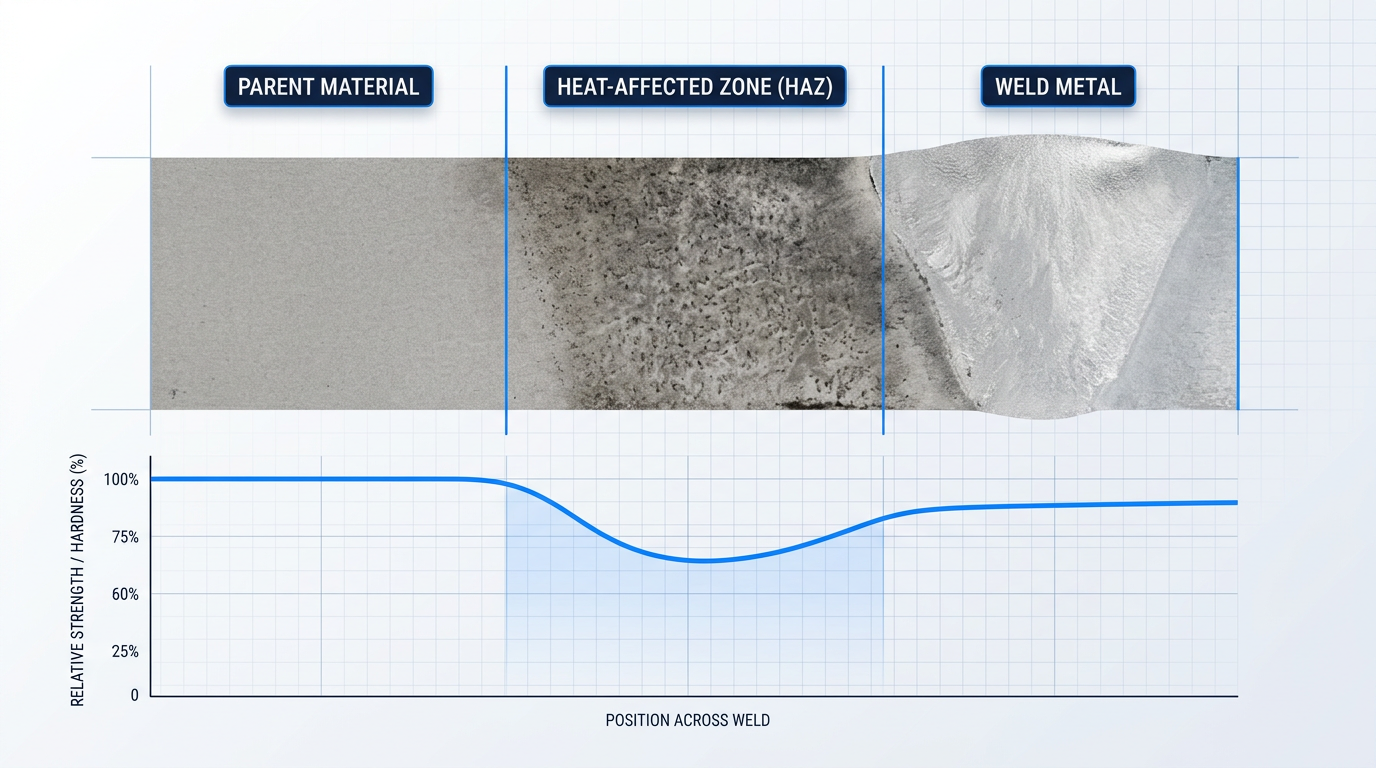
Critically, for heat-treatable alloys in the T6 temper, the HAZ strength loss cannot be recovered by natural ageing alone — restoring full properties requires a complete post-weld solution heat treatment and ageing cycle, which is rarely practical once a fabricated structure has been assembled.
In 6xxx, 2xxx, and 7xxx alloys welded in T6 temper, the HAZ is permanently weaker than the parent material. Recovery requires a full post-weld heat treatment cycle — solution treatment followed by ageing — which is almost never feasible on an assembled structure. Engineers must design for the HAZ as the weakest zone, not treat it as an anomaly.
Beyond softening, solidification cracking (hot cracking) is a separate risk that varies significantly by series. The 2xxx and 6xxx series are most susceptible: their copper and magnesium-silicon compositions place them in a wide solidification range, making the weld pool prone to hot tearing as it contracts during cooling. According to TWI, high-strength 7xxx alloys (such as 7010 and 7050) and most 2xxx alloys are not recommended for fusion welding because of their susceptibility to liquation and solidification cracking.
The 5xxx series is considerably more weld-friendly: its magnesium-dominant composition does not produce the same solidification cracking susceptibility, and 5xxx alloys have excellent weldability. The 7020 alloy — a medium-strength 7xxx — is also fusion-weldable, unlike the higher-strength 7xxx grades.
Filler metal selection is the primary engineering lever for managing hot cracking risk. The correct filler modifies weld pool composition to move it away from the crack-susceptible range. Per BS EN 1011 Part 4, the recommended fillers for commonly welded alloys are as follows: 4043A or 5356 for 6061; 5556A for 5083 and 7020.
The choice between 4043A and 5356 for 6061 involves a real trade-off: 4043A silicon dilutes the susceptible Mg-Si weld pool composition and gives better crack resistance, but produces lower weld strength than 5356 for most 6xxx applications. Where the finished weld must be anodised, 5356 is preferred — 4043A welds darken noticeably under anodising due to their silicon content.
Surface Preparation as a Weld Quality Determinant
Surface condition at the point of joining is not a separate housekeeping step — it is part of weld quality itself. Two mechanisms connect surface contamination directly to weld defects.
The first is the aluminium oxide layer (Al₂O₃). This film forms on any exposed aluminium surface immediately on atmospheric contact and has a melting point of approximately 2060 °C — far above the ~660 °C melting point of the base metal. It does not melt at aluminium welding temperatures. If present at the joint interface, it causes fusion defects, inclusions, and porosity.
The second mechanism is hydrogen porosity. Oils, greases, and machining residues on the surface contain hydrocarbons that break down in the arc plasma to release atomic hydrogen. Hydrogen has very high solubility in molten aluminium but approximately 20 times lower solubility in solid aluminium — so as the weld pool solidifies, hydrogen is expelled and forms gas pores trapped in the weld metal.
Critically, aluminium re-oxidises almost immediately on atmospheric exposure after cleaning — stringent porosity requirements can demand that oxide removal be completed within hours of welding, not days. Contaminated or re-oxidised surfaces produce welds with porosity, reduced fusion, and unpredictable mechanical properties regardless of how well the welding parameters are set.
Machinability by Series
Most wrought aluminium alloys machine significantly more easily than steels, with high achievable cutting speeds, relatively low tool forces, and good surface finish potential. However, machinability varies considerably across series — and the differences matter at production scale.
The 2xxx series machines exceptionally well. Alloy 2011, in particular, contains free-machining additions of bismuth and lead (or tin in lead-free variants) that promote short, well-broken chips by creating low-melting-point phases in the microstructure that melt in the cutting zone, reducing chip continuity and tool adhesion.
The 7xxx series also machines very well, producing short chips and good surface finishes — it is a preferred series for precision-machined aerospace components where its high strength is needed and welding is minimised.
The 6xxx series — with 6061-T6 being the most commonly machined grade — has adequate machinability, but chip management requires attention. Chips from 6061 turning and drilling tend to be long and continuous; chip-breaker tooling is recommended, and peck drilling is standard practice for deep holes.
The 5xxx series with high magnesium content (above approximately 3%) presents greater challenges: elevated magnesium increases cutting forces and promotes long, stringy chips that are harder to manage and evacuate. Machinability decreases progressively as magnesium content rises.
High-silicon alloys — those with more than 10% Si, primarily the 3xx.x casting families and some 4xxx wrought alloys — are the most difficult to machine. Per ASM International, hard free-silicon particles cause rapid tool wear and prevent the bright, smooth surfaces achievable with other aluminium alloys; carbide tooling with appropriate geometry is required. Alloys above 5% Si will not finish to the same surface quality as silicon-free grades even with optimised tooling.
Formability: Temper Matters as Much as Series
Formability in aluminium alloys is as much a function of temper as it is of series. The same alloy can range from highly formable to crack-prone depending on its heat treatment state.
In the O temper (fully annealed), aluminium alloys are at their most ductile and are well suited for severe forming operations including deep drawing and tight-radius bending. The T4 temper (solution heat-treated and naturally aged, without artificial ageing) allows moderate bending and forming with acceptable springback. The T6 temper — artificially aged to peak strength — has significantly limited formability and is prone to cracking at tight bend radii; ASM guidance is explicit that T6-temper alloys are generally unsuitable for forming operations.
The practical solution for heat-treatable alloys requiring both complex geometry and high final strength is to perform forming in T4 temper, then artificially age to T6 after forming. This sequence is standard practice for 6061 and similar alloys: the Caltech/Alcoa 6061 datasheet confirms that 6061-T4 has good formability for bending and can subsequently be aged to full T6 properties.
The 3xxx series (manganese-based, non-heat-treatable) offers a different proposition: good formability and corrosion resistance at moderate strength, without the need to manage heat treatment sequences. It is a natural choice for deep-drawn components or complex forms where subsequent ageing is not available or desired.
Series-Level Fabrication Trade-offs: Summary
The table below summarises fabrication characteristics across the principal wrought series, giving a practical decision framework for alloy selection by fabrication route.
| Series | Primary Alloying Element(s) | Weldability | Machinability | Formability | Best Fabrication Use Case |
|---|---|---|---|---|---|
| 1xxx | None (commercially pure Al) | Excellent — no HAZ softening concern; low strength limits structural use | Good; soft alloy can cause built-up edge on tools | Excellent in O temper; very ductile | Chemical plant, electrical conductors; forming-intensive applications |
| 2xxx | Copper | Poor for most grades — high hot-cracking risk; mechanical fastening preferred in aerospace | Excellent; 2011 with Bi/Sn additions produces short chips | Moderate in T4; limited in T6 | Precision-machined aerospace and structural parts where welding is avoided |
| 3xxx | Manganese | Good — non-heat-treatable; no precipitate dissolution in HAZ | Adequate; similar to 1xxx | Excellent; good for deep drawing and complex bends | Roofing, heat exchangers, packaging; deep-drawn components |
| 5xxx | Magnesium | Excellent — best series for fusion welding; low hot-cracking susceptibility | Moderate; high-Mg grades (>3%) increase cutting forces and produce stringy chips | Good in O/H tempers; non-heat-treatable so no T4-to-T6 sequence needed | Marine, transport, and structural weldments where post-weld heat treatment is unavailable |
| 6xxx | Magnesium + Silicon | Good with correct filler (4043A or 5356 per EN 1011 Pt 4); HAZ softening is permanent in T6 | Adequate; 6061-T6 requires chip-breaker tooling for turning/drilling | Good in T4; limited in T6 — form in T4, age to T6 after | All-round structural, extrusions, and fabrications requiring weldability plus strength |
| 7xxx | Zinc | Poor for high-strength grades (7010, 7050) — solidification cracking risk; 7020 is weldable with 5556A | Excellent; short chips and good surface finish | Moderate in T4; limited in T6 | High-strength aerospace structures; precision-machined parts where welding is minimised |
Series-level comparison of weldability, machinability, formability, and primary fabrication use case to support alloy selection decisions
The pattern across the table is clear: 5xxx dominates for welded structures where post-weld heat treatment is not available; 6xxx offers the best all-round balance of weldability, extrudability, and strength; 2xxx and 7xxx deliver maximum strength but require fabrication routes that avoid or minimise fusion welding; and 3xxx fills the gap where good formability and corrosion resistance are needed at moderate strength.
The trade-offs bite hardest in the 6xxx and 7xxx series: both deliver attractive strength-to-weight ratios, but the permanent HAZ strength loss in T6 temper means that welded joint design must account for a weaker zone that cannot be recovered in the assembled structure.
The same surface condition logic that governs weld quality — oxide removal, contamination management, timing — applies with equal force to finishing processes. The next section examines how alloy composition affects anodising, painting, and powder coating outcomes, and why surface preparation before finishing is as critical as it is before joining.
Finishing Aluminium Alloys: Anodising, Painting, and Powder Coating
Most alloy selection decisions are made on mechanical and fabrication grounds: strength, machinability, weldability, weight.
Finishing response is the variable that gets discovered too late — usually when a part has already been machined, assembled, and delivered to the anodising line.
Alloy composition is a finishing variable, and the right moment to consider it is during alloy selection. An alloy series that performs beautifully in the machine shop can produce a non-uniform, poorly sealed anodic layer simply because its intermetallic content was never factored into the finishing specification.
Anodising response by alloy series
The 1xxx series offers the most predictable anodising result: high-purity aluminium anodises to a clear, uniform coating with consistent oxide growth across the surface.
The 5xxx and 6xxx series are well-suited for both decorative and functional anodising, with the magnesium content in these alloys contributing to an aesthetically pleasing colour response. The 6xxx series in particular is most associated with architectural and decorative anodising, combining good oxide uniformity with strong colour consistency.
The 2xxx series presents a fundamental compositional trade-off. The copper intermetallic CuAl₂ dissolves preferentially during anodising, attacked by the sulphuric acid electrolyte at a faster rate than the surrounding aluminium matrix.
This preferential dissolution leaves voids in the anodic layer, reducing oxide hardness, compromising thickness uniformity, and degrading sealing quality. The copper content that makes 2xxx alloys among the strongest aluminium alloys available is precisely what makes them problematic for decorative anodising.
The 7xxx series introduces a different set of intermetallic complications. MgZn₂ and other intermetallic phases interact with the anodising electrolyte differently from the aluminium matrix, disrupting oxide uniformity across the surface.
Functional hard anodising of 7xxx alloys is achievable under controlled conditions, but decorative anodising with consistent colour and appearance is considerably more difficult to achieve reliably.
Silicon's effect on anodising operates through a fundamentally different mechanism than copper or zinc intermetallics. Silicon particles in 4xxx wrought alloys and, more critically, in high-silicon die casting alloys are chemically inert during anodising — they do not dissolve into the electrolyte, and they do not oxidise into the anodic layer.
Instead, silicon particles physically interrupt oxide formation, blocking uniform oxide growth and reducing layer thickness, hardness, and sealing quality across the affected areas.
In die casting alloys with high silicon content, the distribution of silicon through the microstructure can visibly interrupt the anodic layer — a phenomenon sometimes described as rivers of silicon running through the oxide. This makes most high-silicon casting alloys poor candidates for decorative anodising, a constraint that must be accounted for at the alloy selection stage.
Unlike copper or zinc intermetallics, which dissolve during anodising and leave voids, silicon particles are chemically inert. They physically prevent oxide formation in the areas they occupy. It is silicon's inertness, not its reactivity, that makes high-silicon alloys problematic for anodising.
Surface preparation before anodising
Even the most anodising-compatible alloy will produce a defective coating if the surface entering the bath is not properly prepared. Machining residues, cutting oils, and the pre-existing native oxide layer must all be removed so the electrolyte contacts clean, reactive aluminium rather than a contaminated or passivated interface.
The process of deoxidising — sometimes called deox or desmutting depending on the specific chemistry used — accomplishes this, but timing is a process-critical variable.
Aluminium re-oxidises rapidly on exposure to air: a surface deoxidised and then left for several hours before entering the anodising bath may have reformed a partial native oxide layer sufficient to compromise coating uniformity. Deoxidising should be performed as close in time as possible to anodising — the gap between the two steps is an engineering parameter, not an administrative detail.
A contaminated or re-oxidised surface entering the bath produces a coating that is thinner in some areas, absent in others, and poorly sealed throughout — not a marginal quality reduction, but a process failure.
Paint and powder coating: preparation determines adhesion
For both liquid paint and powder coating, the single greatest determinant of adhesion quality is the surface preparation sequence — not the coating chemistry, not the application method, and not the cure cycle.
An aluminium substrate that has not been properly prepared will produce adhesion failures regardless of what is applied to it. The standard preparation sequence follows four stages, each with a specific function in conditioning the surface.
- Degreasing: Removes machining oils, handling contamination, and organic residues that would prevent subsequent chemical stages from contacting the metal surface.
- Alkaline cleaning and etching: Removes surface oxides and creates a micro-textured surface profile that provides mechanical keying for the coating system.
- Desmutting: Removes smut — the dark residue of insoluble intermetallics left on the surface after alkaline etching — using an acidic solution.
- Conversion coating: Applies a chemically bonded interface layer — chromate or chrome-free alternatives such as zirconium-based treatments — providing corrosion protection and a chemically active surface for adhesion.
Desmutting is the step most often underestimated, and its importance scales directly with the intermetallic content of the alloy. Alloys with higher copper or heavy metal content — including 2xxx series and many casting alloys — leave substantially more smut after alkaline etching, because the insoluble intermetallic phases are now sitting on the surface as a dark, adherent residue.
Skipping desmutting on these alloys does not produce a marginally worse coating; it produces adhesion failures, because the coating bonds to the smut layer rather than to the aluminium substrate beneath it.
Conversion coating serves a dual function that justifies its position as the final preparation stage. It provides a corrosion-resistant interface layer protecting the aluminium substrate beneath the paint film, and it creates a chemically reactive surface that promotes strong adhesion between the substrate and the organic coating above.
These two functions are inseparable: a conversion coating that provides corrosion protection but poor adhesion, or good adhesion but no corrosion barrier, fails at its engineering purpose. This is why conversion coating should not be omitted even when the substrate appears visually clean after desmutting.
The choice of preparation method — not just whether to prepare, but how — is itself a finishing engineering decision with consequences beyond coating quality. Conventional chemical preparation sequences introduce waste streams: spent etchants, desmut solutions, and conversion coating rinses all require treatment and disposal.
As the aluminium industry increasingly positions itself around recyclability and low-embodied-carbon credentials, preparation processes that generate significant chemical waste sit in tension with that sustainability narrative. Chemical-free preparation approaches are gaining traction precisely because they align with the direction the industry is moving — a theme developed further in the sustainability section of this guide.
With the conventional finishing landscape mapped, the guide turns to a newer frontier: how aluminum alloys behave in additive manufacturing, where the constraints on alloy selection — and the surface challenges that follow — are different again.
Aluminium Alloys in Additive Manufacturing
Aluminium dominates conventional manufacturing, yet it is one of the most difficult metals to process reliably in laser powder bed fusion (PBF-LB) — the dominant metal additive manufacturing process today.
The reason comes down to a concept that will be familiar from the fabrication section: autogenous weldability. PBF-LB is, at its core, a rapid, repeated, localised welding process — each laser pass melts and re-solidifies a thin layer of powder without filler metal or controlled preheat.
This matters because conventional weldability and autogenous weldability are not the same thing. Many aluminium alloys that can be joined successfully in fabrication — using filler wire, preheat, and post-weld treatment — cannot weld to themselves without cracking under the thermal conditions PBF-LB imposes.
The consequence is that several of the highest-performing wrought alloys covered in this guide — 2024, 6061, and 7075 — are problematic or outright unprocessable in standard PBF-LB, precisely because their compositions make them susceptible to hot cracking during rapid solidification.
Material-level challenges in aluminium AM
Hot cracking is the central challenge, but aluminium presents a cluster of additional material-level difficulties in PBF-LB that compound the problem.
- High laser reflectivity: Aluminium reflects a large proportion of energy at typical fibre laser wavelengths, reducing absorption efficiency and demanding higher power input.
- High thermal conductivity: Rapid heat dissipation from the melt pool makes it harder to sustain a stable melt and requires greater energy density to compensate.
- Oxide layer interference: Aluminium's natural Al₂O₃ surface oxide has a far higher melting point than the base metal; oxide films on powder surfaces resist melting and can cause fusion defects.
- Poor powder flowability: Low-density aluminium particles spread inconsistently across the powder bed, increasing the risk of layer defects and porosity.
- Humidity sensitivity: Aluminium powder absorbs moisture readily, requiring tight inert-atmosphere and moisture-controlled build chamber conditions to avoid hydrogen porosity.
These challenges are inherent to aluminium as a material, not artefacts of any particular machine or parameter set — they apply across any AM process that uses aluminium powder feedstock.
AlSi10Mg emerged as the dominant AM aluminium alloy directly because of the constraints above. Its near-eutectic Al-Si composition delivers excellent melt pool fluidity and a narrow solidification range, both of which suppress hot-cracking susceptibility and allow reliable PBF-LB processing.
The trade-off is mechanical performance: AlSi10Mg achieves only cast-level properties at best, and AlSi12 and AlSi7Mg0.6 follow the same compositional logic for the same reasons. It is, bluntly, the best alloy for the process rather than the best alloy for the application — a pragmatic compromise the field is actively working to move beyond.
High-strength aluminium alloys for PBF-LB
One route to processing otherwise-incompatible alloys is the nanoparticle nucleant approach: introducing zirconium-based or other ceramic nanoparticles into 7075 or 6061 powders refines the solidification microstructure sufficiently to suppress hot cracking, making previously unprocessable compositions viable in PBF-LB without fundamentally altering the base alloy chemistry.
The most commercially significant development is Scalmalloy, an aluminium-magnesium-scandium alloy developed by APWORKS (an Airbus subsidiary) specifically for additive manufacturing. Containing approximately 0.7% scandium, the alloy forms Al₃Sc precipitates during solidification and aging that refine grain structure, pin grain boundaries, and dramatically reduce hot-cracking susceptibility.
The result is a PBF-LB-processable alloy with a tensile strength of 520 MPa and elongation of 13% — specific properties that, at its density of 2.67 g/cm³, approach those of Ti-6Al-4V at room temperature, according to APWORKS and Metal-AM.com.
Scalmalloy is listed as an approved material under FIA regulations for Formula 1 additive manufacturing applications — a concrete signal of its maturity for high-performance, safety-critical structural parts. The main constraint on wider adoption is the cost and supply availability of scandium.
The principal drawback of Scalmalloy is the cost of scandium, which is expensive and supply-constrained — a real barrier to adoption outside aerospace, motorsport, and defence applications where the performance premium justifies the material cost.
NanoAL's Addalloy 5T represents a different design philosophy: a 5000-series-based alloy formulated from the ground up for AM, which can be peak-aged without quenching in a single stress-relief step after fabrication — a significant processing simplification over conventional heat-treatable alloys.
The broader trajectory is a shift from adapting conventional alloys to work in AM towards designing alloys that exploit AM's characteristics — rapid solidification, steep thermal gradients, and fine microstructures that conventional processing cannot replicate. This is a rapidly evolving space, and the commercial maturity of emerging alloys varies considerably.
Wire arc additive manufacturing for larger aluminium structures
Wire arc additive manufacturing (WAAM) uses welding wire feedstock and an electric arc heat source rather than a laser and powder bed, making it better suited to large aluminium structures where PBF-LB's constrained build volume is a limiting factor.
Al-Mg alloys (5xxx series) are well-suited to WAAM because they can be work-hardened after deposition to improve strength. Heat-treatable alloys from the 6xxx and 7xxx series present a harder challenge: achieving full T6-equivalent properties requires post-deposition stretching or mechanical working to generate the nucleation sites needed for effective precipitate formation — without that step, the precipitation hardening response is significantly reduced.
Porosity is a persistent defect in WAAM aluminium, arising from hydrogen uptake during deposition. Specialised arc waveforms — pulsed arc or cold metal transfer modes — combined with high-quality wire consumables are the primary mitigations, though process optimisation remains an active area of development.
WAAM for aluminium is less mature than PBF-LB and is not yet a routine production process, but it fills a genuine gap for large structural components where powder-bed systems simply cannot compete on scale.
AM's near-net-shape approach also means significantly less material waste than subtractive machining from billet — a dimension that connects naturally to the broader sustainability picture explored in the next section.
Aluminium Alloys and the Circular Economy
Aluminium is theoretically infinitely recyclable — a claim rooted in physical chemistry rather than marketing. When aluminium is remelted, the metallic bonds reform on solidification and the metal recovers its original properties, meaning recycling loops do not degrade the material the way they do for many polymers or composite materials. The practical result of this is striking: according to the International Aluminium Institute (IAI), approximately 75% of all aluminium ever produced is estimated to still be in productive use today.
The most compelling dimension of aluminium's sustainability case is not the recyclability principle itself, but the energy economics behind it — and the numbers are extraordinary.
| Metric | Primary Aluminium (mine to cast house) | Secondary Aluminium (gate-to-gate) | Saving |
|---|---|---|---|
| Energy intensity | 186 GJ per tonne | 8.3 GJ per tonne | ~95.5% |
| GHG intensity | 15.1 t CO2e per tonne | 0.52 t CO2e per tonne | ~96.6% |
Comparison of primary and secondary aluminium production by energy intensity and greenhouse gas intensity
The gap between those two columns is not a marginal efficiency gain — it is a near-total transformation of the energy footprint. Producing one tonne of secondary aluminium from recycled scrap requires roughly the same energy as producing just 4.5 kg of primary production aluminium from bauxite. For engineers and procurement professionals specifying aluminium at scale, the recycled content of an alloy is not just an environmental credential; it is a direct proxy for embodied energy in the supply chain. (Data: IAI, 2019 energy figures and 2022 GHG figures.)
This energy story is not theoretical: more than 30 million tonnes of aluminium scrap is recycled globally every year, according to the IAI, making aluminium one of the most recycled industrial materials on the planet.
Industrial recycling rates in Europe exceed 90% in the automotive and building sectors, and the aluminium beverage can holds the distinction of being the world's most recycled drinks container — achieving a global recycling rate of 75% in 2023, well ahead of glass (42%) and PET (47%), per IAI data. Readers who have worked through the earlier sections on wrought alloy series will recognise the can as a 3xxx/5xxx application: the same alloy knowledge that governs its fabrication also shapes its recyclability, as the next subsection makes clear.
The Sorting Challenge: Alloy Identity at End of Life
Mixed alloy scrap is the central obstacle to closed-loop recycling. A 7xxx aerospace alloy cannot simply be co-melted with a 1xxx commercial-purity alloy without diluting or downgrading the output — the zinc, copper, and magnesium additions that give 7xxx alloys their strength become contaminants in a 1xxx melt.
Approximately 42% of aluminium scrap currently arrives in mixed or casting alloy form (per European Aluminium's Circular Aluminium Action Plan), and the industry target is for at least 75% of scrap to circulate in closed-loop systems by 2050 to prevent systematic downgrading of high-value alloys into lower-grade applications.
When producing can body stock (3xxx/5xxx) from mixed scrap containing high-silicon casting alloys, approximately 978 kg of primary aluminium is required per tonne of output just to dilute silicon to acceptable levels — per IAI Can-to-Can Recycling analysis (November 2025). This is the precise, quantifiable penalty of poor alloy sorting in the recycling stream.
The industry's response to the sorting problem is advancing on two fronts. The first is recycling-friendly alloy design: development of compositions with broader tolerance for mixed scrap inputs, reducing the sensitivity to minor elemental variations that currently force downgrading. Projects such as the EU-funded SALEMA initiative are working to minimise dependence on primary-sourced critical raw materials by maximising scrap utilisation in new alloy formulations.
The second front is advanced alloy sorting technology — specifically, laser-induced breakdown spectroscopy (LIBS)-based sensor sorting systems, now deployed at industrial scale by operators including Constellium, AMAG, and Gerhard Lang Recycling. LIBS directs a high-energy laser pulse at each scrap piece, analyses the emitted elemental spectrum in milliseconds, and sorts pieces into alloy-family streams with purity levels exceeding 95%.
At the regulatory level, European proposals for the revised End-of-Life Vehicle Directive include a mandatory requirement to separate recovered aluminium into four distinct alloy families based on silicon, copper, magnesium, and zinc thresholds — a framework that European Aluminium estimates could unlock more than one million tonnes of sorted, high-quality wrought aluminium annually from end-of-life vehicles alone.
There is one further dimension worth noting for engineers making process decisions upstream of end-of-life: the choice of surface preparation method during fabrication and finishing carries sustainability consequences that either align with or work against aluminium's cradle-to-cradle credentials. Processes that introduce chemical waste streams — acid deoxidisers, conversion coating chemistries, solvent degreasers — or that embed abrasive media into the surface add environmental burden at the fabrication stage, offsetting a portion of the energy advantage that makes secondary aluminium so compelling. Preparation approaches that rely on energy alone, without consumables or chemical waste outputs, sit more naturally within the lifecycle logic that makes aluminium the structural metal of choice for circular economy applications.
With the full arc of aluminium alloys covered — from classification and properties through fabrication, finishing, additive manufacturing, and now end-of-life recyclability — the final section draws together the key threads to help orient your next steps.
Conclusion
Navigating the aluminium alloy landscape: key takeaways
Every alloy selection decision is, at its core, a negotiation between competing properties — and no single alloy wins on every axis.
The series system, together with the designation and temper frameworks, gives you a structured map for that negotiation: one that holds whether you are reading a wrought datasheet, a casting specification, or an international procurement document.
For the next decision you face, alloy datasheets and the Aluminum Association's registration records are the primary reference tools; the series-level guidance here provides the starting framework for fabrication and finishing.
Frequently asked questions about aluminium alloys
Quick answers to the questions readers most commonly ask about aluminium alloy classification, properties, and selection.
The answer depends on context. There is no single most common aluminium alloy across all applications. For structural wrought applications, 6061 is among the most widely specified alloys globally, appearing in aerospace, automotive, and structural engineering specifications worldwide. For general-purpose fabrication by volume, 3003 is widely cited as the leader, used in cookware, heat exchangers, storage tanks, and sheet metal work. For die casting, A380 (380.0) is the industry workhorse, used extensively for automotive components and consumer electronics housings.
The core distinction is heat treatability. 6061 is a heat-treatable Mg-Si alloy (6xxx series) that can be precipitation-hardened to achieve significantly higher yield strength, particularly in T6 temper. It machines well and anodises with good cosmetic uniformity, making it the standard choice for structural parts where strength and machinability are the priorities. 5052 is a non-heat-treatable Mg alloy (5xxx series) that cannot be precipitation-hardened but responds well to strain hardening (H tempers). It offers superior corrosion resistance in marine and salt-spray environments, better formability, and easier weldability. The practical rule: choose 6061 when peak strength and machinability matter; choose 5052 when the application demands formability, weldability, or resistance to marine corrosion.
T6 means the alloy has been solution heat treated and then artificially aged. In practice: the alloy is heated to dissolve soluble alloying phases into a uniform solid solution, then rapidly quenched to trap those elements in supersaturated solution. It is then held at an elevated temperature to precipitate fine strengthening particles — for example, Mg₂Si in 6xxx alloys. The result is peak or near-peak strength for that alloy. T6 is the most common high-strength temper across the heat-treatable 2xxx, 6xxx, and 7xxx series. 6061-T6 and 7075-T6 are among the most widely specified temper-alloy combinations in engineering practice.
Most wrought aluminium alloys can be anodised, but the quality of the oxide layer varies significantly by series. The 5xxx and 6xxx series produce the best results for both decorative and functional anodising: the magnesium content supports a clear, uniform oxide layer with consistent colour response. The 1xxx series also anodises to a clean, uniform coating, though it offers limited cosmetic interest. The 2xxx series is problematic for decorative anodising: copper intermetallics dissolve preferentially during the process, creating porosity and reducing oxide uniformity and hardness. 4xxx alloys and most casting alloys perform poorly for decorative anodising — silicon particles are inert during oxide formation and interrupt layer continuity. Functional hard anodising of casting alloys is possible but results in reduced layer quality compared to wrought alloys.
Yes, most aluminium alloys can be welded, but weldability varies considerably by series. The 5xxx series is the most weldable, often tolerating autogenous welding without solidification cracking, with excellent results using fillers such as 5356 or 5556. The 6xxx series is weldable with correct filler selection (4043A or 5356), though some susceptibility to solidification cracking in the weld metal must be managed through filler choice. The 2xxx series presents significant hot-cracking challenges and is frequently joined by mechanical fastening or adhesive bonding in aerospace applications instead. The 7xxx series carries the highest hot-cracking susceptibility and welding is generally avoided for structural joints. For all heat-treatable alloys, HAZ softening is a critical design consideration: the heat-affected zone is permanently weaker than the parent material in T6 temper, regardless of filler selection.
Yes, and with substantial energy savings. Recycling aluminium requires up to 95% less energy than producing primary aluminium from bauxite ore. Aluminium is theoretically infinitely recyclable: metallic bonds reform on re-solidification and the metal retains its properties through repeated recycling loops, with no inherent degradation in quality from the recycling process itself. The practical challenge is alloy sorting: mixed scrap streams can cause composition drift when remelted, making closed-loop recycling — where a specific alloy is recovered into the same alloy grade — difficult without advanced sorting. Industry investment in sensor-based sorting technologies is addressing this, but it remains the key technical barrier to fully closed-loop aluminium recycling.