

Introduction
That chalky white film on an old window frame, the dull grey cast across a boat fitting, the faintly pitted surface of a structural section — if any of those brought you here, you're asking exactly the right question before reaching for a cleaning product.
What you're looking at is oxidised aluminium, and the story behind it is more interesting than it first appears: the same chemical process that dulls the surface is also what protects the metal underneath.
This guide covers the chemistry of how it forms, how to identify it at different stages, why it sometimes tips from protective to damaging, and what you can do to prevent that progression — written for engineers, facilities managers, and capable DIYers alike.
TL;DR
Aluminium oxidation is a natural, self-limiting process that is usually protective rather than harmful. The oxide layer that forms on the surface shields the metal beneath — but certain conditions can break that protection down, turning a beneficial film into active corrosion. Knowing which side of that line you're on determines the right response.
This article covers:

Why aluminium oxidises and how it happens
What oxidised aluminium looks like at different stages
How aluminium oxidation differs from rust
When the protective oxide layer becomes damaging corrosion
Types of aluminium corrosion and their risk profiles
How to prevent aluminium oxidation and corrosion
What is oxidised aluminium?
The moment aluminium metal is exposed to air, it begins to oxidise — not slowly, not gradually, but within milliseconds. Yet this is not a flaw in the material. The thin aluminium oxide layer that forms at the surface is one of the metal's most valuable properties: a self-generated, self-limiting shield that keeps the underlying metal chemically intact.
The reaction is straightforward in principle: aluminium atoms at the surface combine with oxygen from the atmosphere to produce aluminium oxide, or Al₂O₃. This compound forms a continuous film bonded directly to the metal surface.
The process by which this oxide film renders the surface resistant to further chemical attack is called passivation. Once passivated, the aluminium beneath is effectively sealed off from the environment — at least under normal ambient conditions.
The reason oxidation happens so readily comes down to thermodynamics. The Gibbs free energy of Al₂O₃ formation is approximately −1,582 kJ/mol — a strongly negative value that means the reaction releases a large amount of energy. In practical terms, the reaction does not need to be coaxed; it wants to happen, and it will proceed the instant aluminium encounters oxygen.
What prevents this thermodynamic drive from consuming the metal entirely is the Cabrera-Mott mechanism. As the initial oxide film forms, it creates an internal electric field across its thickness. This field drives the ion migration — aluminium cations outward, oxygen anions inward — that sustains oxide growth. But because the tunnelling electron current that generates this field decreases exponentially as the film thickens, the growth rate drops sharply and the oxidation essentially stops at a limiting thickness.
In plain terms: the oxide layer seals itself off. The thicker it grows, the harder it becomes for ions to migrate through it, until growth slows to a near-standstill. This self-limiting behaviour is the key distinction between aluminium oxidation and destructive corrosion processes such as rusting.
Whether an oxide film is actually protective depends on its physical relationship to the metal beneath it — and this is where the Pilling-Bedworth ratio (PBR) becomes useful. The ratio compares the volume of oxide produced to the volume of metal consumed in forming it. If the oxide occupies roughly the same volume as the metal it replaced, the film will be dense, continuous, and adherent. If it occupies far more or far less, the film will crack, spall, or fail to cover the surface.
Al₂O₃ has a Pilling-Bedworth ratio of 1.28 — sitting squarely within the protective range of approximately 1 to 2. This means the oxide occupies slightly more volume than the aluminium consumed, producing a dense, adherent film that covers the surface continuously rather than pulling apart under internal stress.
The contrast with iron is instructive. Iron (III) oxide — the primary component of rust — has a Pilling-Bedworth ratio of approximately 2.14, and some iron oxide phases reach even higher values. At those ratios, the oxide occupies far more volume than the metal consumed, generating compressive stresses that cause the film to crack and flake away, perpetually exposing fresh metal to attack. That is why rust propagates while aluminium oxide does not. The full comparison is explored in a later section.
With a Pilling-Bedworth ratio of 1.28, Al₂O₃ sits in the ideal protective range (1–2): dense enough to seal the surface, adherent enough not to crack — which is why aluminium passivates rather than corrodes progressively.
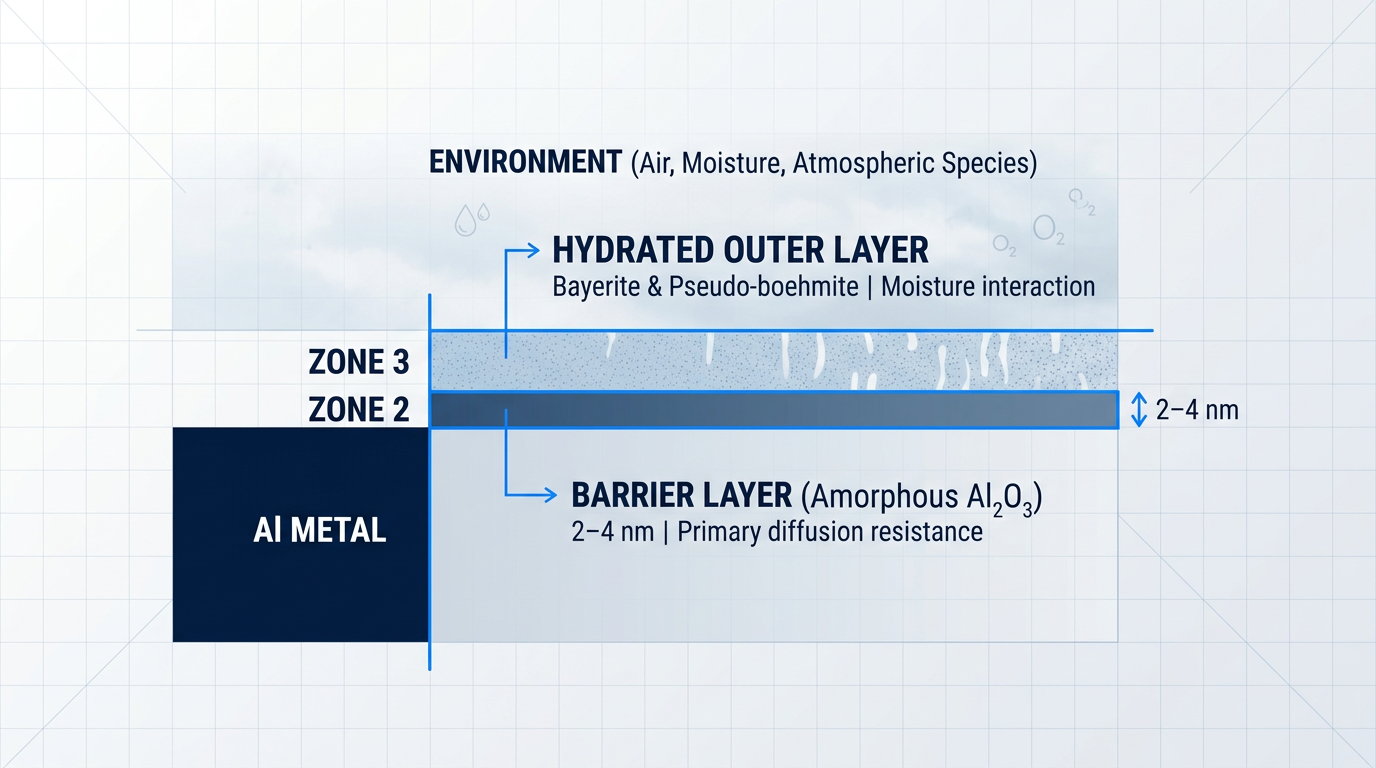
Under ambient conditions, this self-limiting process produces a natural oxide film approximately 2–4 nm thick. That is extraordinarily thin — far too thin to see or feel — yet dense enough to function as an effective diffusion barrier against further oxidation.
The structure of the natural oxide film
The natural oxide film is not a single uniform layer. It has a two-part structure: a compact, amorphous barrier layer of Al₂O₃ at the metal-oxide interface, and a thicker, more permeable hydrated outer layer — composed of aluminium hydroxide phases such as bayerite and pseudo-boehmite — in contact with the environment.
The inner barrier layer, with an initial thickness of roughly 2–4 nm, is an almost perfect electrical insulator and provides the primary resistance to ion diffusion. The outer hydrated layer forms as the natural oxide reacts with moisture in the air, and is porous and less compact than the barrier beneath it.
These two layers respond differently to environmental conditions. The barrier layer is what makes aluminium so corrosion-resistant under normal circumstances; the hydrated outer layer is what interacts with moisture, atmospheric species, and changes in the surrounding chemistry.
With the chemistry of the oxide layer established, the natural next question is what this actually looks like — and how an invisible nanometre-scale film relates to the visible changes that appear on aluminium surfaces over time.
What does oxidised aluminium look like?
The chemistry of Al₂O₃ formation is one thing; knowing what to look for when you pick up a window frame, inspect a boat fitting, or examine a structural section is quite another. Oxidised aluminium does not present a single, fixed appearance — it has a visual spectrum, and where a piece of metal sits on that spectrum tells you a great deal about the severity of what is happening beneath the surface.
That spectrum runs through four recognisable stages, from a film so thin it is physically invisible, through progressive surface changes, to localised structural damage. Each stage carries a different practical implication, so identifying which stage you are looking at matters.
- Invisible oxide layer: The natural Al₂O₃ film (roughly 2–4 nm thick) is completely transparent. Freshly exposed aluminium looks identical to unoxidised metal — this is the normal, healthy default state.
- Surface dulling: The bright metallic sheen fades to a flat, grey or matt finish. The oxide film is now visible but remains a surface-only change with no structural significance.
- White powdery deposits: Visible white or off-white powder and chalky films appear. These are aluminium hydroxide compounds formed as the outer hydrated oxide layer grows under moisture exposure.
- Pitting: Small dark spots, rough patches, or shallow craters appear where the oxide film has broken down locally — marking the transition from surface oxidation to damage of the base metal.
Most readers will encounter Stages 2 and 3 in everyday settings: the dull grey finish on aged aluminium window frames, the chalky white film on marine fittings and boat hulls, or the powdery deposits that accumulate on architectural extrusions in coastal or urban environments.
It is worth being precise about the difference between those middle two stages, because they are often confused. The grey, matt appearance of Stage 2 is the oxide film itself becoming visible as it thickens slightly — it is a dull, metallic grey, still flush with the surface. The white deposits of Stage 3 are chemically distinct: they are aluminium hydroxide and other hydrated compounds that form as atmospheric moisture converts the outer oxide layer, producing a loose, powdery or chalky residue that sits proud of the metal surface.
White deposits and surface films can mask what lies beneath them. A coating of chalky corrosion product may look like a minor cosmetic issue while concealing pitting or localised attack in the metal underneath. Visual assessment of the surface alone is not a reliable measure of the true extent of damage.
Pitting, the most severe stage, is examined in depth later in this guide when we cover the specific types of aluminium corrosion. For now, the key point is that pitting is qualitatively different from dullness or white deposits: it represents actual material loss from the base metal, not just a surface film.
Having seen what oxidized aluminium looks like across this visual range, a natural question follows: the white deposits and surface discolouration can look strikingly similar to rust on steel — so is this actually the same process?
Does aluminium rust?
No — aluminium cannot rust. Rust is specifically iron oxide, the product of an electrochemical reaction between iron, oxygen, and moisture. Because aluminium contains no iron, it is chemically incapable of forming rust, full stop.
What aluminium does instead is form aluminium oxide (Al₂O₃) when exposed to atmospheric oxygen. This is a chemically and physically distinct compound from rust — not a different name for the same thing, but an entirely different substance with fundamentally different behaviour.
The difference in behaviour comes down to a metric established in the Background section: the Pilling-Bedworth ratio (PBR), which compares the volume of oxide formed to the volume of metal consumed in its formation.
Iron oxides have a PBR well above 2. According to the NIST technical literature, the various iron-oxide phases that make up rust produce volumetric expansion factors on the order of 2–6 times relative to the original metallic iron. A PBR this high generates significant compressive stress within the oxide layer, causing it to crack, spall, and flake away from the surface — continuously exposing fresh iron to further attack.
Rust is therefore self-propagating: the very act of forming destroys the protection the oxide might otherwise offer, and the base metal is consumed progressively.
Aluminium oxide, by contrast, has a PBR of approximately 1.28 — firmly within the protective range of 1 to 2. As confirmed by peer-reviewed research published in PMC and corroborated by NASA technical reports, this value means the oxide occupies just enough volume to remain dense, adherent, and mechanically stable on the surface rather than cracking under its own growth stress.
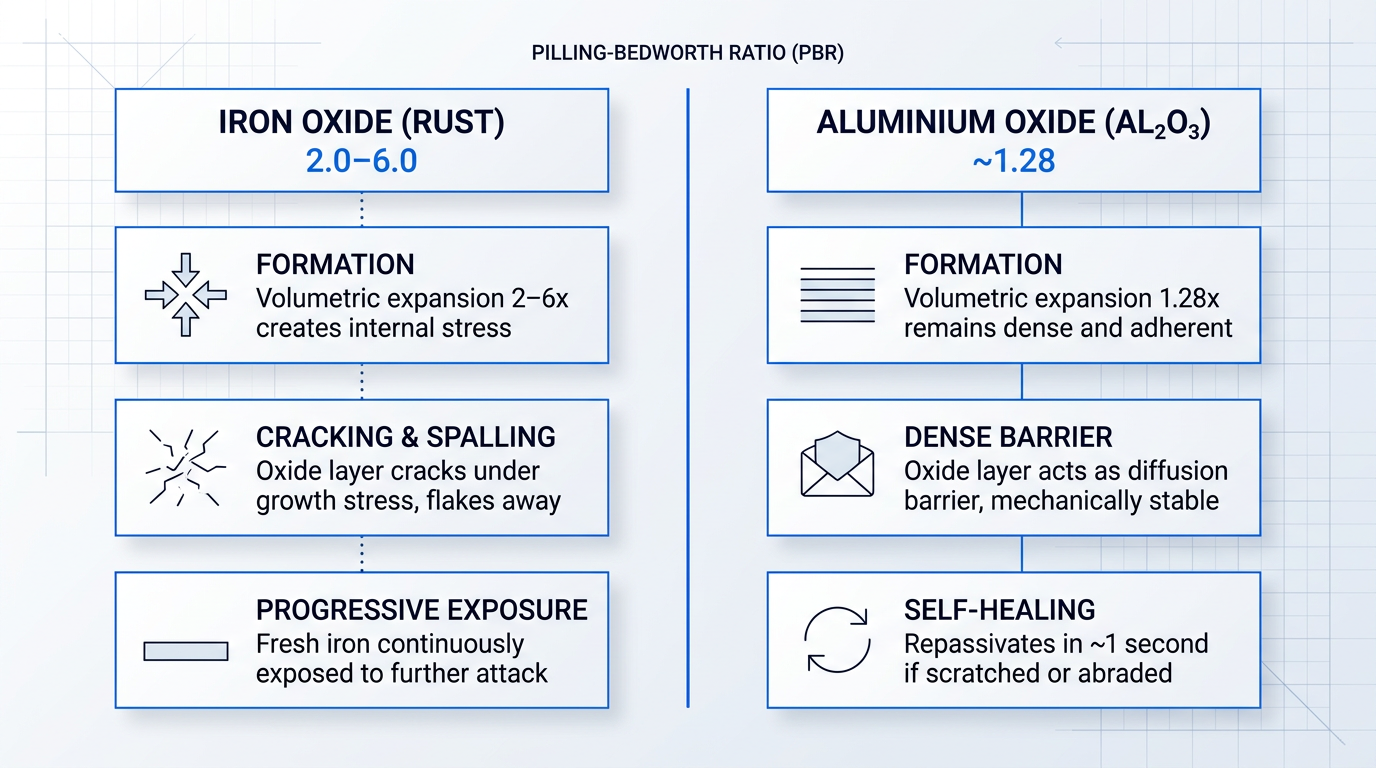
Once formed, the Al₂O₃ layer acts as a diffusion barrier, dramatically slowing the movement of oxygen and aluminium ions through it — a mechanism described in NASA technical reports and peer-reviewed materials science literature. The oxide essentially seals itself against further attack.
This brings us to one of aluminium's most practically significant properties: self-healing. If the oxide layer is scratched or abraded, it reforms almost instantaneously on re-exposure to air.
Research published in the journal Wear measured the repassivation kinetics of aluminium and found nucleation time constants on the order of 0.13 seconds, with the thickening phase completing within roughly 1 second. The Corrosionpedia aluminium corrosion reference similarly notes that the oxide film "heals itself automatically upon further disruption" — a property with no meaningful equivalent in iron or steel.
Bare steel left exposed after its oxide is removed continues to rust unchecked. Bare aluminium left exposed after scratching undergoes repassivation within seconds, restoring its protective layer before significant further oxidation can occur.
Rust is iron oxide. Aluminium contains no iron and cannot form it. The white deposits or dullness you see on aluminium are Al₂O₃ — a protective compound, not a destructive one.
The practical consequence for real-world use is significant. Bare aluminium left outdoors does not progressively consume itself the way bare steel does. The oxide layer is a feature of the metal's behaviour, not a failure mode — which reframes the white powder or surface dullness covered in the previous section as protection rather than damage.
That said, "aluminium doesn't rust" is not the same as "aluminium doesn't corrode." Under specific conditions — including chloride exposure from seawater or road salt, galvanic coupling with more noble metals, and pH extremes — aluminium can suffer serious corrosion damage that goes well beyond the benign surface oxide.
Whether that corrosion poses a safety or structural risk depends on its form and severity — which is exactly what the next section addresses.
Is oxidised aluminium safe to use?
The honest answer is: it depends on the severity of the oxidation and what the aluminium is being used for. For most people, in most situations, oxidised aluminium presents no meaningful hazard. But that reassurance carries an important qualifier — it applies to surface oxidation, not to every form of corrosion that aluminium can develop.
The natural aluminium oxide (Al₂O₃) layer and the white aluminium hydroxide deposits that form in wetter environments are chemically stable compounds. They do not flake off aggressively, do not leach toxic substances under normal conditions, and do not weaken the metal beneath them — the oxide layer is protective, not destructive.
One concern that comes up regularly is aluminium cookware. Both plain and anodised aluminium pans are used widely across the world, and the oxide layer present on their surfaces is chemically stable under normal cooking conditions. It does not leach meaningfully into food during everyday use, and the oxide itself is not the source of meaningful dietary risk.
For load-bearing aluminium in service — window frames, structural extrusions, architectural cladding, boat hulls — light surface oxidation is the normal condition, not an exception. The oxide layer is protective, and its presence does not compromise structural integrity. No intervention is required on structural grounds for surface oxidation alone.
When oxidation becomes a structural concern
The picture changes when corrosion has progressed beyond the surface. Pitting corrosion that has penetrated significantly into the metal reduces the component's cross-sectional area. In load-bearing or pressure-containing applications, that material loss can reduce the component's capacity to carry its design load and can initiate fatigue cracks under cyclic loading — a genuine structural risk, not a cosmetic one.
More insidious still is intergranular corrosion, where attack travels along grain boundaries within the metal. Certain aluminium alloys are particularly susceptible to this form of degradation, and it can cause significant loss of mechanical strength even when the surface appears relatively normal. A component may look acceptable on visual inspection while its internal properties have already been substantially compromised.
With both pitting and intergranular corrosion, the depth and extent of damage can far exceed what is visible at the surface. This is why visual inspection alone is not sufficient for safety-critical aluminium components — what you can see may be only a fraction of what has occurred.
The practical question, then, is not simply whether oxidation is present, but what kind of oxidation it is and what the component is expected to do. The right response varies considerably by application type.
- Non-structural applications: Window frames, decorative extrusions, garden furniture, architectural panels: surface oxidation is cosmetic. No structural concern; any action is aesthetic, not safety-driven.
- Structural or safety-critical applications: Load-bearing extrusions, boat hulls, pressure vessels, vehicle components: visible pitting or suspected intergranular attack warrants professional assessment. Visual inspection alone is not sufficient.
- Cookware and food-contact surfaces: The stable oxide layer on aluminium cookware does not present a meaningful leaching risk under normal cooking conditions. No special action is required.
The most important variable is not whether surface oxidation is present — it almost always is — but whether corrosion has progressed to the point of measurable material loss. Understanding what drives that progression is the next piece of the picture, and that is exactly what the following section addresses.
When does aluminium oxidation become damaging corrosion?
The oxide layer that forms on aluminium is genuinely protective — but its protection is conditional, not absolute. It holds within a specific environmental window, and outside that window the film either dissolves, breaks down locally, or is undermined by electrochemical forces the oxide cannot resist. Understanding those boundary conditions is what separates aluminium that performs for decades from aluminium that corrodes within months.
The most conceptually clear trigger is pH. According to both NIST and Corrosionpedia's analysis of the Pourbaix diagram, the Al₂O₃ passive film is stable only across approximately pH 4 to pH 9; outside this range, the oxide becomes soluble in aqueous solution and can no longer maintain the passive film. At the acidic end, strong industrial acids dissolve the film directly. At the alkaline end — the less intuitive failure mode — strongly alkaline cleaning agents and prolonged contact with fresh concrete or mortar are sufficient to push past the upper threshold and destroy the film.
Chloride ions are the most consequential real-world trigger, and they operate through a different mechanism than pH extremes. Rather than dissolving the oxide wholesale, chlorides attack the passive film at discrete, localised sites — adsorbing onto the oxide surface, displacing oxygen, and initiating local thinning and breakdown of the film at those points. This localised passive film breakdown, confirmed by multiple peer-reviewed studies and NIST's NBSIR 82-2477 report, is what enables pit initiation to begin. The practical sources are familiar: seawater, road salt, coastal atmospheres, and certain industrial process environments all deliver chloride concentrations capable of triggering this attack.
Further conditions that undermine the passive film
Galvanic coupling becomes a threat whenever aluminium is in direct electrical contact with a more noble metal — copper, stainless steel, or carbon steel — in the presence of an electrolyte. Because aluminium sits lower in the galvanic series than these metals, it acts as the anode in the resulting electrochemical cell, corroding preferentially while the more noble metal is protected. Real-world scenarios include aluminium window frames touching copper flashing, aluminium fasteners used with steel structural members, and aluminium conduit running near steel reinforcement embedded in concrete. The key variables are the contact geometry and the presence of moisture — remove the electrolyte and the galvanic cell cannot function.
The oxide layer's protective function depends on its physical continuity. Scratching, abrasion, or impact can remove the film faster than it regenerates, exposing bare metal beneath. In a dry, neutral, chloride-free environment this matters little — the film reforms rapidly and no lasting damage results. In a corrosive environment, however, repassivation may be impeded or the freshly exposed metal attacked before the layer can re-establish itself. Abrasive cleaning methods carry exactly this risk, and repeated mechanical rubbing within a confined interface — a phenomenon known as fretting — is a particular concern because it continuously disrupts the film in a geometry that traps corrosive species.
Three further variables modulate how quickly and severely these primary triggers act.
- Moisture and humidity: The passive film is stable in dry air. Moisture is the electrolyte that activates galvanic coupling and the medium through which chlorides reach and attack the oxide surface.
- Elevated temperature: Higher temperatures accelerate oxide growth and drive phase changes in the Al₂O₃ structure from amorphous toward crystalline forms, which can alter the film's protective character in industrial applications.
- Alloy composition: Copper-containing 2xxx alloys carry the lowest corrosion resistance; CuAl₂ precipitates at grain boundaries create internal galvanic cells. Magnesium-containing 5xxx alloys offer substantially better resistance.
These triggers rarely act in isolation — the most damaging scenarios almost always involve combinations. Chloride exposure combined with moisture and a mechanical breach of the oxide creates conditions far more aggressive than any single factor alone; galvanic coupling in a permanently wet joint accelerates attack that would be negligible in a dry one.
Most of the triggers that break down aluminium's passive film — galvanic coupling, chloride attack, pH-driven dissolution — require an electrolyte to activate. Moisture is almost always that electrolyte, making it the thread connecting nearly every corrosion failure mode.
With the conditions that compromise the oxide now mapped out, the logical next step is understanding the distinct forms of corrosion those conditions produce — pitting, galvanic attack, crevice corrosion, and intergranular degradation each follow from the triggers described here in characteristic ways.
Types of aluminium corrosion
Not all aluminium corrosion is the same problem. The triggers that cause the protective oxide to break down — chlorides, pH extremes, galvanic coupling, mechanical damage — each set in motion a distinct form of attack with its own visual signature, risk profile, and structural implications. Treating them as a single phenomenon means misdiagnosing the problem, and misdiagnosis leads to the wrong response.
Pitting corrosion
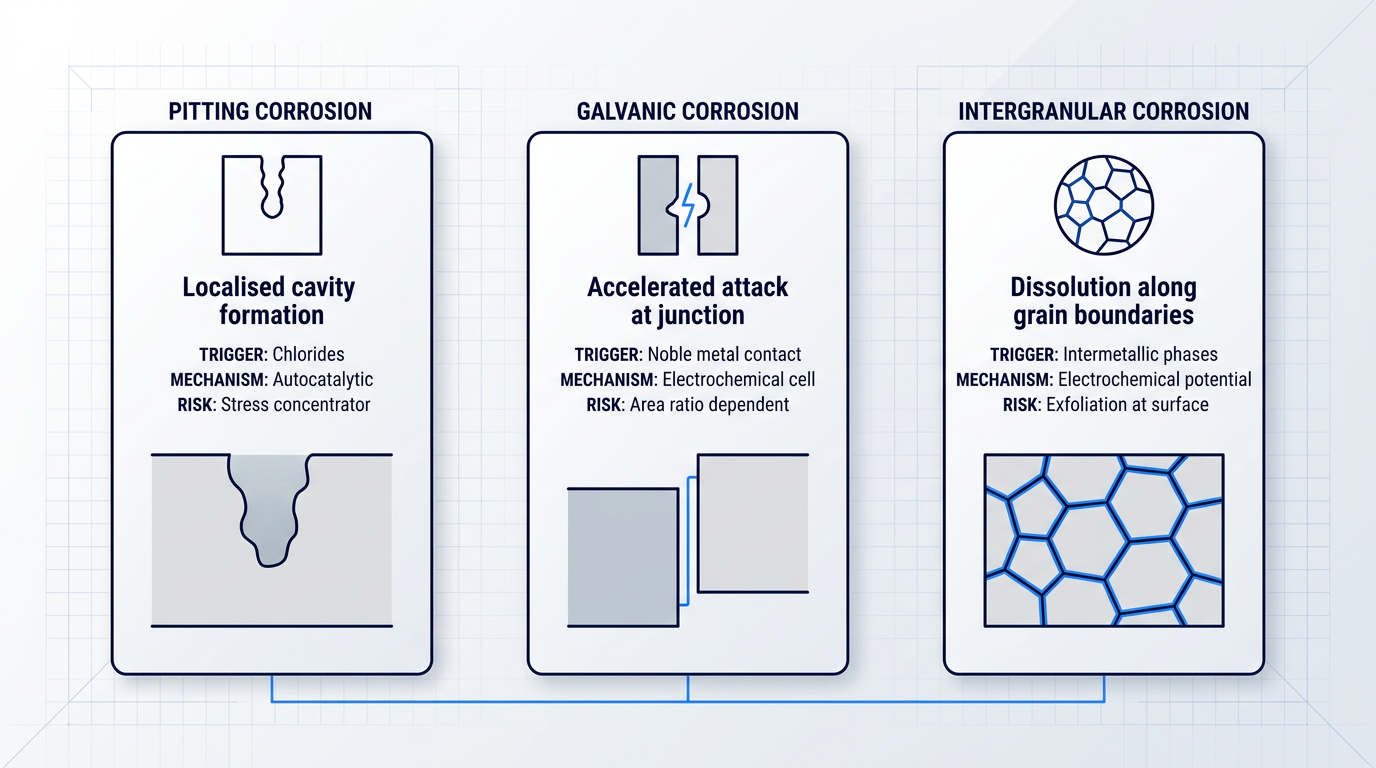
Pitting corrosion is a localised form of attack in which the passive oxide film breaks down at specific sites, producing cavities — pits — in the metal surface.
What makes pitting particularly dangerous is its autocatalytic nature: once a pit forms, the chemistry inside it diverges sharply from the surrounding surface — the local environment becomes acidic, oxygen-depleted, and enriched in chloride ions, which accelerates further dissolution at that same site so the pit deepens faster than it widens.
AMPP describes pitting as more dangerous than uniform corrosion precisely because it is harder to detect, predict, and design against — pits can be small in diameter and obscured by corrosion products, making their true depth impossible to assess from visual inspection alone.
The structural risk extends beyond material loss: research published in Corrosion (AMPP) shows that pits act as stress concentrators, and in load-bearing or cyclically stressed components a pit can initiate a fatigue crack — a progression from surface cavity to structural failure that has been documented in a sequence from pit initiation through crack propagation to fracture instability.
Galvanic corrosion
Galvanic corrosion occurs when aluminium is in electrical contact with a more noble metal in the presence of an electrolyte: aluminium becomes the anode of the galvanic cell and corrodes preferentially, while the more noble metal is protected.
The galvanic series — which ranks metals by their electrochemical potential in a given electrolyte — is the framework for assessing risk: aluminium sits toward the active end, well separated from copper and passive stainless steel, both of which are significantly more noble and therefore highly problematic as coupling partners.
Real-world examples are common: aluminium window frames in contact with copper flashing or exposed to copper roof runoff, aluminium fasteners used in steel structures, and aluminium conduit embedded in concrete alongside steel reinforcement are all classic galvanic couples documented by AMPP.
The area ratio between anode and cathode matters significantly — a small aluminium anode coupled to a large noble cathode concentrates the galvanic current on a small surface area, producing rapid, localised attack; the reverse configuration (large aluminium area, small noble cathode) is far less damaging.
Crevice corrosion
Crevice corrosion develops in confined, occluded spaces — lap joints, under gaskets, beneath deposits, and between mating surfaces in bolted or riveted assemblies — where the local chemistry inside the crevice diverges from the bulk environment.
The mechanism is well established by AMPP: oxygen diffusion into the crevice is restricted, creating a differential aeration cell; the interior becomes anodic, metal ions hydrolyse to produce an acidic micro-environment, and chloride ions migrate inward to maintain electroneutrality — the result is a concentrated, aggressive solution that sustains metal dissolution in the occluded zone.
Marine environments and industrial settings with bolted or riveted aluminium joints carry the highest crevice corrosion risk — crevice geometry effectively amplifies the same chloride and pH triggers that cause general oxide breakdown, concentrating them in a zone where the metal cannot repassivate.
Intergranular corrosion
Intergranular corrosion is localised attack concentrated at grain boundaries rather than across the metal surface — the electrochemical potential difference between grain-boundary phases and the surrounding aluminium matrix drives preferential dissolution along the boundaries while the grain interiors remain largely unaffected.
The specific intermetallic phases responsible depend on the alloy family: in 5xxx series alloys (aluminium-magnesium), the β-phase Al₃Mg₂ precipitates at grain boundaries and is anodic relative to the aluminium matrix, making sensitised 5xxx alloys susceptible to intergranular attack in the presence of seawater or other aggressive electrolytes; in 2xxx series alloys (aluminium-copper), precipitation of CuAl₂ at grain boundaries depletes copper from the adjacent zones, rendering those regions anodic and prone to rapid intergranular dissolution.
The FAA Advisory Circular AC 43-4B identifies high-strength aluminium alloys such as 2014 and 7075 as particularly susceptible to intergranular corrosion when improperly heat-treated and then exposed to a corrosive environment — a finding consistent with AMPP and NIST materials data showing that 2xxx and 7xxx alloys carry greater intergranular risk than 5xxx and 6xxx series.
At its most advanced, intergranular attack produces exfoliation corrosion: corrosion products building up along grain boundaries parallel to the surface exert pressure that lifts and separates the surface layers in a characteristic leafing or delamination pattern, as documented in both AMPP and FAA sources for extruded and heavily worked aluminium sections.
Intergranular corrosion can cause serious loss of mechanical strength with very limited visible surface damage — AMPP notes that the alloy can disintegrate internally (grains fall out) while the surface appears only mildly affected. Visual inspection alone is an unreliable guide to structural integrity in susceptible alloys.
Alloy selection is a meaningful upstream variable: 2xxx and 7xxx alloys are significantly more susceptible to intergranular corrosion and stress corrosion cracking than 5xxx and 6xxx alloys, which offer better overall corrosion resistance — a distinction that makes alloy choice one of the most powerful prevention levers available at the design stage.
For completeness, it is worth noting that certain high-strength aluminium alloys under sustained tensile stress in corrosive environments can suffer stress corrosion cracking — a synergistic failure mode combining mechanical stress and electrochemical attack; this is a specialist concern for aerospace and structural engineers and is not developed further here.
Each corrosion type described here has a distinct cause, a distinct risk profile, and — critically — a distinct set of prevention strategies: the right approach to a galvanic problem at a bolted joint is not the same as the right approach to intergranular susceptibility in a high-strength alloy, which is exactly why the prevention strategies covered in the next section are mapped to these specific vulnerabilities.
How to prevent aluminium oxidation and corrosion
The most effective corrosion prevention decisions are not made during maintenance — they are made at the design or specification stage, before a component ever enters service. Alloy selection, surface treatment specification, joint geometry, and dissimilar-metal management are all upstream choices that determine how well aluminium's natural oxide holds up across its working life.
Alloy choice is the most upstream lever available. According to NIST materials data, 2xxx series alloys — where copper is the primary alloying element — are the least corrosion-resistant of all aluminium alloy families, with copper content promoting intergranular attack and pitting in aggressive environments. By contrast, 5xxx series (Al-Mg) alloys offer corrosion resistance comparable to commercially pure aluminium, with particular suitability for marine and seawater environments, while 6xxx series alloys combine good corrosion resistance with excellent extrudability, making them the standard choice for architectural applications.
Anodising: controlled oxidation, not an applied coating
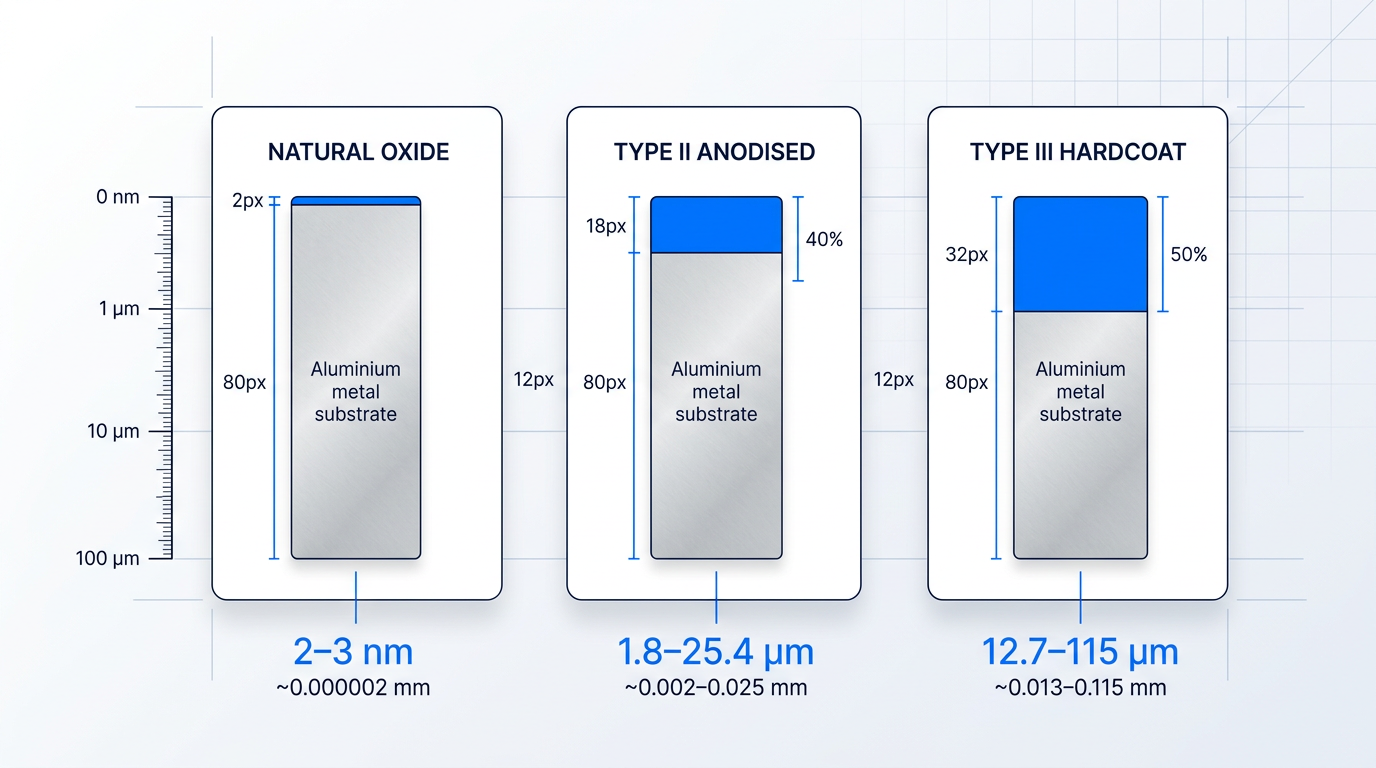
Anodising is an electrochemical process that thickens and toughens the naturally occurring Al₂O₃ layer deliberately and dramatically. Where the natural oxide sits at roughly 2–3 nm thick, Type II sulphuric acid anodising produces a layer of 1.8–25.4 µm, and Type III hardcoat anodising — carried out at lower temperatures and higher current density — can reach 12.7–115 µm.
The critical distinction is that the anodic oxide is not applied to the surface: it penetrates into the substrate as much as it builds up on it, meaning it is fully integrated with the base metal and cannot chip, peel, or delaminate the way a paint or lacquer can. This is controlled oxidation working with aluminium's chemistry, not against it.
Organic coatings — paint and lacquer — protect aluminium by creating a barrier layer that isolates the metal surface from corrosive species such as chlorides and moisture. Their effectiveness depends entirely on adhesion quality and the absence of defects: blistering, filiform corrosion, and anodic undermining typically initiate at coating edges or surface defects, not across intact film areas.
This is why surface preparation before painting is critical, and why anodising or a conversion coating is commonly specified as a primer base rather than painting directly onto bare aluminium.
Chromate conversion coatings (CCCs) are thin, chemically active layers that serve a dual function: they improve corrosion resistance in their own right and provide an excellent bonding surface for subsequently applied paint systems. The hexavalent chromium in traditional CCCs poses toxicity and carcinogenic risks, and chromate-free alternatives — particularly titanium/zirconium-based coatings — have gained significant traction in automotive and aerospace sectors as environmentally preferable substitutes, with research confirming adhesion and corrosion resistance on par with conventional CCCs on key alloy series.
Environmental controls complement surface treatments, particularly for components that cannot be permanently coated. Limiting exposure to the triggers identified earlier — chlorides from seawater, road salt, and industrial atmospheres; pH excursions outside the stable range; and elevated humidity during storage — reduces the rate at which the passive film breaks down, buying time and reducing maintenance burden for fasteners, tooling, and structural elements in transit or temporary storage.
Design-stage measures for galvanic and crevice corrosion
Where surface treatments address the oxide layer directly, design decisions determine whether the conditions for galvanic corrosion and crevice corrosion can arise in the first place — and these decisions are made on the drawing board, not in the field.
- Electrical separation of dissimilar metals: Non-conductive gaskets, sleeves, or spacers prevent the electrical contact between aluminium and more noble metals — copper, stainless steel, carbon steel — that drives galvanic attack.
- Manage the anode-to-cathode area ratio: A small aluminium anode coupled to a large noble cathode concentrates galvanic current and accelerates metal loss rapidly. AMPP guidance confirms this is the worst-case configuration to avoid.
- Coat the cathode, not the anode: Where dissimilar metals must be used together, coating the more noble metal (the cathode) limits the cathodic surface area and reduces the driving current for galvanic attack on the aluminium.
The area-ratio principle is particularly relevant for fastened connections: stainless steel fasteners through aluminium plate represent exactly the unfavourable configuration — a large aluminium anode driven by a relatively noble cathode — and are a documented cause of accelerated localised corrosion in load-bearing aluminium structures.
Crevice corrosion risk is similarly addressed at the design stage, by eliminating the occluded geometries where aggressive local chemistry develops.
- Minimise crevice geometries: Tight gaps in joints and connections trap electrolyte and create the oxygen-depleted, chloride-concentrated conditions that make crevice attack so aggressive.
- Seal occluded spaces: Sealants applied to joints before assembly exclude electrolyte from crevice spaces, preventing the localised chemistry from developing.
- Favour continuous welds: Continuous welds eliminate the lap-joint crevices that are common initiation sites; where lap joints are unavoidable, sealing the overlap is the next-best measure.
In industrial contexts where oxide build-up must be removed from aluminium components before recoating, welding, or inspection, the removal method itself has prevention implications: laser cleaning removes oxides while the beam stops at the substrate, preserving base material integrity and avoiding the micro-roughening that abrasive methods introduce — micro-roughening that can compromise coating adhesion and accelerate subsequent corrosion.
The natural Al₂O₃ layer on untreated aluminium sits at roughly 2–3 nm. Type III hardcoat anodising produces an oxide up to 115 µm thick — a difference of nearly five orders of magnitude — while remaining fully integrated with the substrate rather than sitting on top of it.
With the full arc now covered — from the chemistry of Al₂O₃ formation through to the engineering decisions that keep it protective — the final section draws together the guide's key distinctions and points toward the practical next step for readers dealing with oxidation that has already taken hold.
Conclusion
Understanding aluminium oxidation: the key takeaways
The aluminium oxide layer is not a sign that something has gone wrong — it is the metal doing exactly what it is designed to do, sealing itself against further attack the moment it meets air.
Whether that protection holds depends on what the metal is exposed to: chloride-rich environments, galvanic coupling, pH extremes, and unfavourable geometries are what tip the balance from passive film to active corrosion.
Readers ready to move from understanding to action will find removal and treatment guidance in related content on this site.
Frequently asked questions about oxidised aluminium
Answers to the most common questions about aluminium oxidation, its effects, and what you can do about it.
Yes — surface oxidation can be removed and the metal treated to resist recurrence. The right approach depends heavily on severity. Light oxidation (surface dullness, chalky white deposits) responds well to appropriate cleaning methods. Deep pitting or structural corrosion is a different problem entirely, and a method suited to surface deposits will not address it. Severe structural corrosion may warrant professional assessment rather than DIY treatment. Oxidised aluminium is not automatically beyond saving, but the spectrum from a dull window frame to a structurally compromised component is wide — and the treatment must match the condition.
Yes, vinegar (acetic acid) can dissolve light aluminium oxide deposits. Al₂O₃ is soluble in mild acids, so dilute acetic acid does have a genuine chemical effect on surface oxidation. That said, this is a surface-level DIY approach with real limitations. It is only suitable for light oxidation on non-critical surfaces. There is also an important nuance: removing the oxide layer with acid temporarily leaves the bare metal unprotected. The passive film must reform on re-exposure to air, which it will do naturally — but the window of vulnerability is real. Vinegar is not appropriate for structural components, severe corrosion, or deep pitting. For procedural guidance on application, dedicated removal content will give you a more reliable method than this FAQ can.
WD-40 is a water-displacing lubricant, not a chemical oxide remover. It does not dissolve Al₂O₃ the way an acid would, so it cannot treat actual oxidation corrosion. What it can do is displace moisture from the surface, provide short-term protection against further moisture ingress, and help loosen very light surface deposits mechanically. Think of it as a maintenance aid rather than a corrosion treatment. If you are dealing with visible oxidation beyond a light surface film, WD-40 alone will not resolve it — you need a product or method designed specifically for oxide removal.
Faster than almost any other common metal. The initial oxide monolayer forms within fractions of a second on fresh aluminium exposed to air. At ambient temperature, the natural passive film reaches its self-limiting thickness of approximately 2–4 nm within minutes to hours — after which the Cabrera-Mott mechanism slows further growth to a near-halt. Visible oxidation products (surface dullness, white deposits) take considerably longer, developing over weeks to months depending on humidity, temperature, chloride exposure, and pollutants. Crucially, the speed of initial film formation is precisely what makes aluminium so corrosion-resistant: the oxide seals the surface before any meaningful metal loss can occur.
Anodised aluminium is dramatically more resistant to corrosion than untreated aluminium, but it is not immune. Anodising is a controlled electrochemical process that deliberately thickens the Al₂O₃ layer from the natural 2–4 nm to 5–25 µm (Type II) or up to around 115 µm (Type III hardcoat). This engineered oxide is fully integrated with the substrate and far harder to attack than the natural passive film. Very aggressive environments — strong acids, strong alkalis, prolonged chloride exposure — can still degrade the anodic layer over time. The key point is that anodised aluminium is not oxidation-proof; it has a much thicker, denser version of the same Al₂O₃ chemistry, built to withstand conditions that would quickly overwhelm the natural film.