
Introduction
Each entry is assessed on six consistent axes: scale of work, location, substrate condition, regulatory environment, surface profile requirement, and equipment access and running cost.
Every entry covers a method category — not a specific branded machine — so the same framework applies across all five and the comparisons hold.
Laser cleaning leads the list as the publisher's own method, assessed on exactly the same criteria as every other entry here.
If you want to map your specific project conditions to a method recommendation, the closing section does that work.
TL;DR
No single alternative to sandblasting wins on every axis for steel — the right method depends on where you are working, what the steel looks like, what the coating system demands, and what your regulatory and cost constraints allow.
Knowing which variables matter most for your project is what makes the difference between a method that works and one that creates new problems.
This article covers:

Laser cleaning for steel surface preparation
Mechanical power tools: when and where they work
Chemical stripping and rust converters on steel
Wet abrasive blasting and UHP water jetting
Dry ice blasting for steel cleaning
How to choose the right method
Why Professionals Are Moving Away from Sandblasting Steel
Sandblasting steel works — when you have the space, the infrastructure, the trained crew, and the compliance budget to run it properly. On many real projects, one or more of those conditions is missing, and that is where the method breaks down.
Silica Dust: The Compliance Burden That Leads
When silica-containing abrasives are used, sandblasting generates respirable crystalline silica (RCS) — fine particles that penetrate deep into the lungs and are a recognised cause of silicosis, COPD, and lung cancer.
OSHA's general industry standard (29 CFR 1910.1053) sets a permissible exposure limit (PEL) of 50 µg/m³ as an 8-hour time-weighted average, with an action level of 25 µg/m³ that triggers mandatory exposure assessment, regulated areas, and written exposure control plans.
Medical surveillance obligations under 29 CFR 1910.1053 apply when workers are exposed at or above the action level for 30 or more days per year — a threshold that is easily reached in any operation using sandblasting regularly.
In the UK, HSE's COSHH guidance CN7 requires employers to establish an exclusion zone around blasting operations, provide the shot blaster with an air-fed abrasive blasting helmet carrying an assigned protection factor (APF) of at least 40, and maintain health surveillance for silicosis where exposure is a reasonable likelihood.
CN7 also specifies that only abrasive materials containing less than 1% silica should be used — a requirement that rules out conventional sand outright and shapes every procurement decision around the operation.
Containment: A Logistical and Cost Constraint
Dry abrasive blasting on steel demands more than a nozzle and a compressor. OSHA's guidance on abrasive blasting operations identifies isolation and containment as primary engineering controls, requiring blast rooms or curtain-walled enclosures, exhaust ventilation systems, and dust collection.
Outdoor and on-site blasting adds a further layer of environmental obligation. EPA guidance under the NPDES stormwater programme requires facilities to enclose, cover, or contain blasting activities to the extent practical, preventing spent abrasives and debris from reaching storm sewers or receiving waters, with spent abrasive materials collected, stored, and managed for offsite disposal.
The practical effect is that containment setup and teardown consumes significant project time, and the infrastructure required is simply not transportable to many job sites — making sandblasting a poor fit for any work that cannot come to a fixed, equipped facility.
Substrate Risk: When Precision Matters
Abrasive blasting removes material by high-velocity impact, which is inherently aggressive and difficult to modulate.
On steel, this creates real risk of damaging thin-gauge sections, distorting dimensional tolerances, and producing an inconsistent surface profile when operator technique varies across a job — and over-removal cannot be undone.
For any project where substrate integrity and dimensional accuracy are requirements rather than preferences, the irreversibility of abrasive impact is a genuine quality constraint, not a theoretical one.
Portability and Access: Where Sandblasting Cannot Go
A conventional sandblasting setup requires a compressor, blast pot, abrasive supply, and containment infrastructure — a combination that is difficult or impossible to deploy in confined spaces, on elevated structures, or in public-facing environments.
Even where access is physically possible, scheduling around containment erection and teardown adds project time that alternatives do not carry, making sandblasting impractical for a wide range of in-situ steel surface preparation tasks.
Silica dust rules in both the US and UK have tightened in recent years — OSHA's general industry standard took effect in 2016, and the compliance obligations it introduced are real and ongoing costs for any operation that uses sandblasting regularly.
The five methods that follow are evaluated specifically against these constraints — scale, substrate sensitivity, regulatory exposure, and deployment practicality — so you can identify which fits your project conditions, not just which works in theory.
Method 1
Laser Cleaning

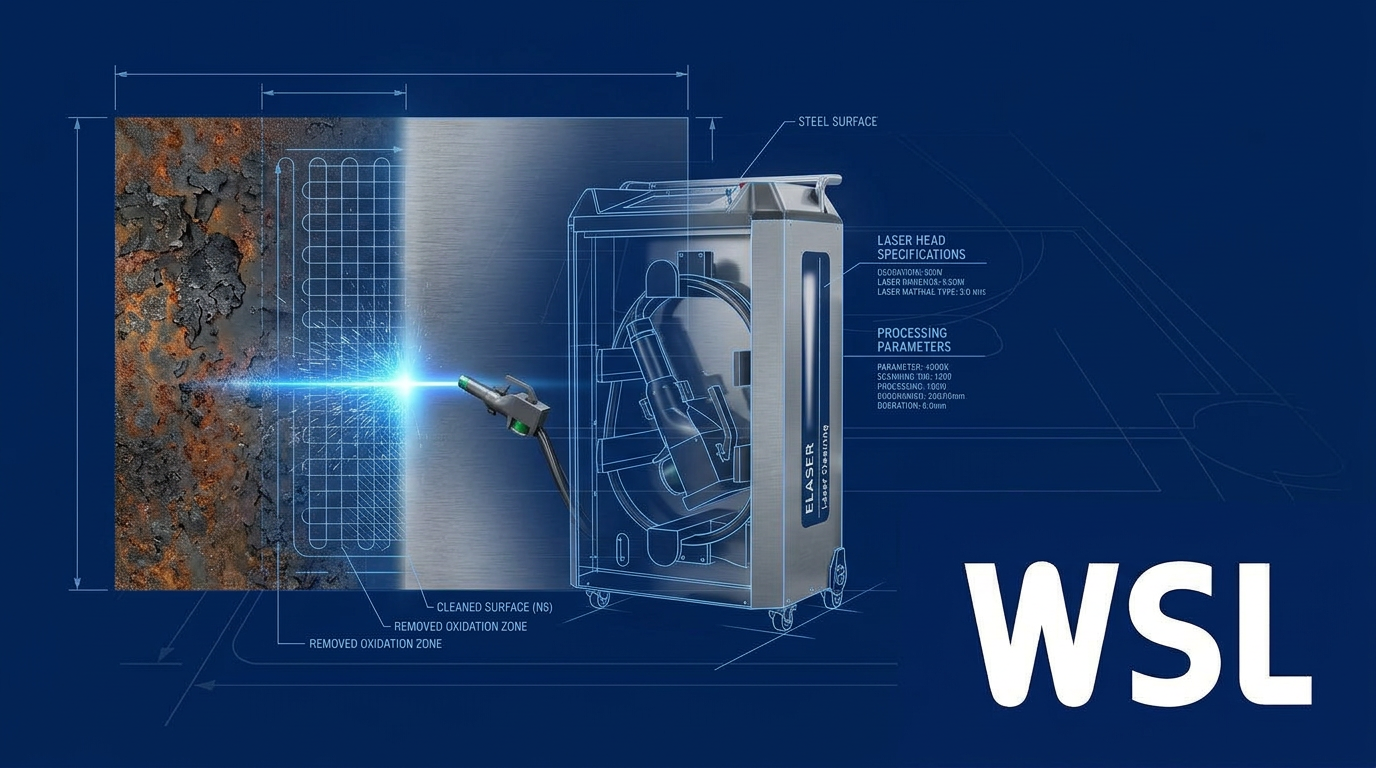
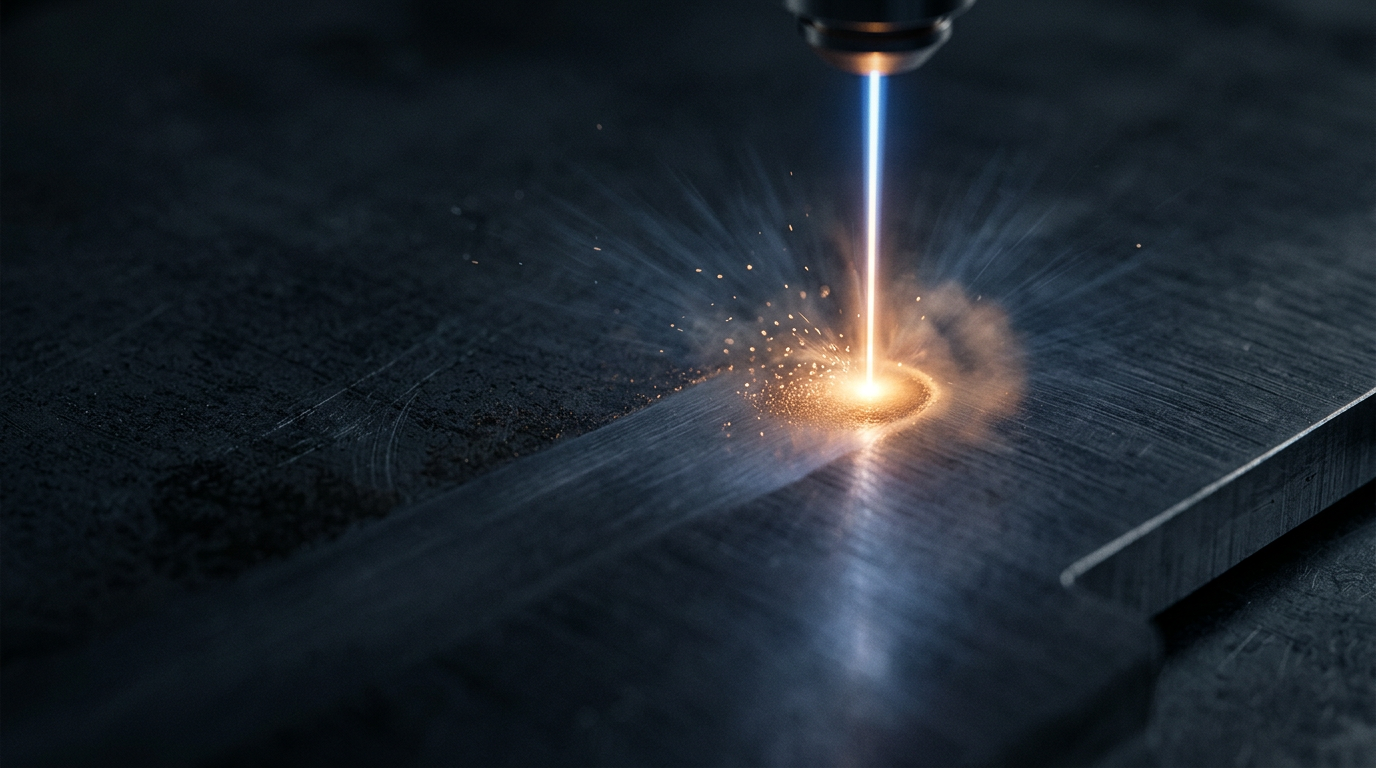
Laser cleaning uses pulsed fibre laser ablation to vaporise rust, scale, paint and oxides from steel — leaving the substrate intact, generating no waste media, and requiring no chemicals or consumables.
Pros:

No consumables, chemicals or abrasive media
Minimal substrate loss — beam stops at steel
Tunable power spans all contaminant types
ELASER-RHZ enables open-environment operation
Cons:

Does not inherently create a mechanical anchor profile
Mill scale removal is slower than lighter oxides
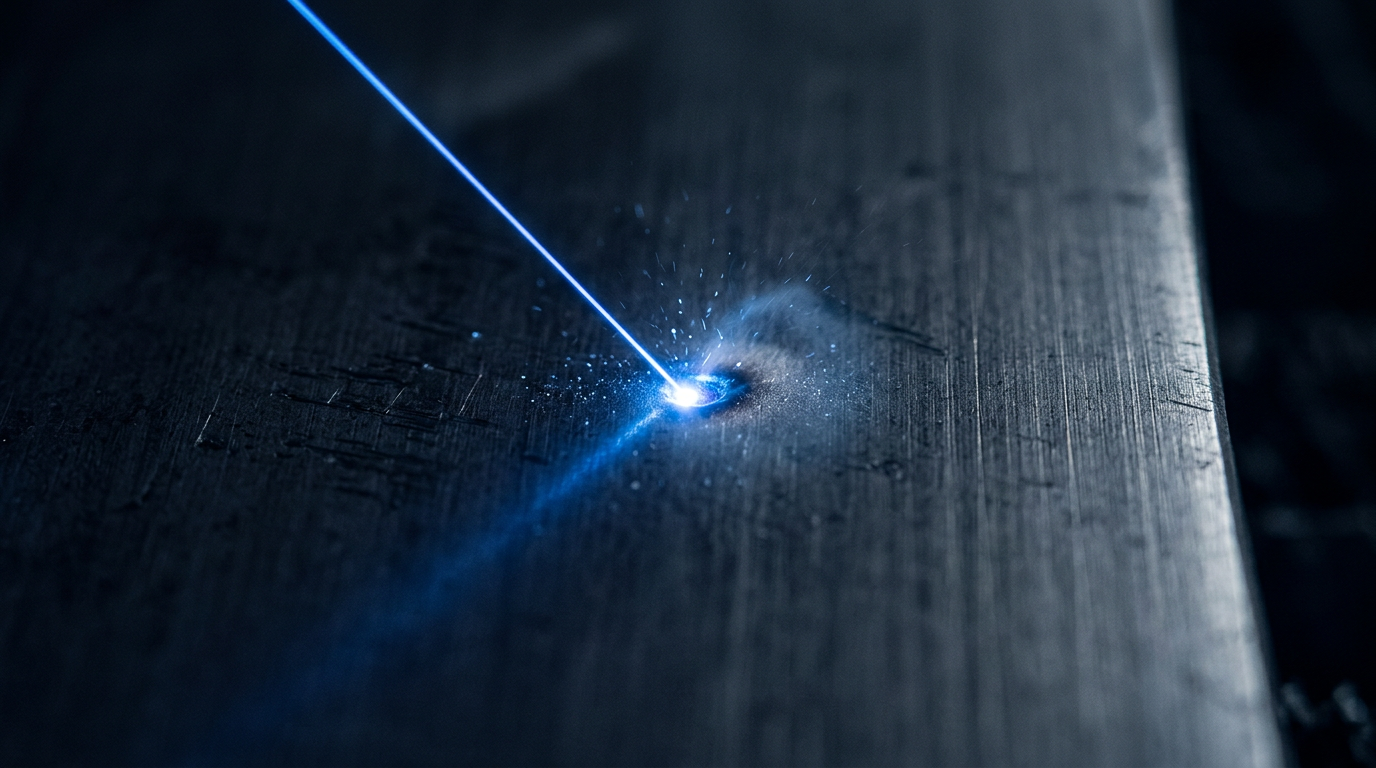
Laser cleaning works by directing a pulsed fibre laser beam at the steel surface, where contaminants absorb the energy and vaporise at their ablation threshold — a point that rust, oxides, paint and mill scale all reach well before the steel beneath them does.
Because the ablation threshold of the base metal is higher than that of the contaminants sitting on it, the cleaning process stops at the steel substrate naturally, without the operator needing to moderate pressure or technique.
This selectivity is what makes laser cleaning a well-controlled method for steel: tolerances are preserved, and the rework that follows over-removal with abrasive or mechanical methods is largely eliminated.
What Laser Cleaning Removes from Steel
A single laser cleaning machine handles the full range of steel surface conditions by tuning power from 0–100%, spanning light flash oxidation at the low end through to thick adherent coatings at the high end.
- Rust and corrosion: Surface rust through to heavy corrosion, removed without pitting or profiling the steel beneath.
- Mill scale: The dense oxide layer formed during hot rolling — removable by laser, though thick scale requires more passes than lighter oxides.
- Paint, powder coating, lacquer and primer: Organic coatings of varying thickness, vaporised selectively — including partial removal where only a specific area needs stripping.
- Weld discolouration and oxides: Heat-affected zones and post-weld oxide layers, cleaned without damaging the weld or surrounding steel.
- Oil, grease, carbon and soot: Organic contamination and combustion residues, removed ahead of welding, bonding or coating operations.
This breadth means laser cleaning is not a specialist tool for one contaminant type — it is a single method that adapts to the surface condition presented.
No Consumables, No Chemicals, No Water
Laser cleaning runs on electricity alone — there is no abrasive media to procure, store and dispose of, no chemical agents to handle, and no water to manage or treat.
Compared with sandblasting and chemical stripping, this removes the entire consumable supply chain from the operation: no ongoing media cost, no disposal obligations, and no containment infrastructure for hazardous waste.
Running costs over time are substantially lower than abrasive or chemical alternatives — no consumable media, no disposal costs, less downtime, and less rework from substrate damage all contribute to that gap.
How Laser Cleaning Performs Across Six Key Axes
The table below applies the six evaluation axes that frame this comparison to laser cleaning as a method.
| Axis | Laser Cleaning Performance |
|---|---|
| Scale of work | ELASER suits varied-scale field and workshop tasks, from individual components to structural steel sections. AutoLASE suits high-throughput production batches where the same part type is cleaned repeatedly. |
| Location | The ELASER-RHZ's patented reduced hazard zone technology enables use in open workshops, mixed-use facilities and confined spaces without evacuating the area — a fundamental change from conventional laser cleaning, which requires a sealed, controlled zone. |
| Substrate condition | Power tunable 0–100% covers the full range: light surface rust and flash oxidation at low settings, heavy mill scale and thick adherent coatings at high settings. One machine spans the entire spectrum. |
| Regulatory environment | No silica dust, no chemical VOCs, no abrasive media waste. Laser cleaning sidesteps the main regulatory pressures driving professionals away from sandblasting — a meaningful forward-looking compliance advantage. |
| Surface profile | Laser cleaning removes contaminants without creating a mechanical anchor profile. Where a specified roughness profile is required for coating adhesion, laser texturing can provide surface structure — contact WSL to discuss your specification. |
| Equipment access and running cost | Self-contained and electricity-only — no compressor, no water supply, no abrasive supply chain. Running costs are substantially lower than abrasive or chemical alternatives over time. |
How laser cleaning performs against the six axes used to evaluate every method in this guide.
ELASER: Portable Laser Cleaning for Steel
The ELASER is WSL's portable laser cleaning system — a wheeled unit under 50 kg with a handheld scanner weighing under 3 kg, operable by a single person, with a delivery cable reaching up to 50 m.
Available in 100 W, 200 W and 300 W models, it is air-cooled, CE and UKCA certified, and made in Britain.
The ELASER-RHZ is the most significant development in portable laser cleaning. It is a Class 4 laser with advanced engineering controls that prevent access to radiation above Class 1 — WSL's patented technology confines the hazard to a small area around the work. Conventional laser cleaning requires areas to be sealed off and evacuated before work can start. The ELASER-RHZ removes that constraint entirely, enabling cleaning in open workshops, mixed-use facilities and public-facing settings. No other portable laser cleaner offers this.
The removal of the evacuation requirement is not a marginal improvement — it is the single biggest barrier to laser cleaning adoption resolved, opening up applications in environments where the method was previously impractical.
The ELASER carries the most competitive upfront pricing among comparable industrial laser cleaning machines in Europe, achieved through WSL's technological and operational efficiencies rather than any reduction in build quality.
AutoLASE: Automated Laser Cleaning for Production
AutoLASE is WSL's automated laser cleaning system: the cleaning head is mounted on an articulated robotic arm, and machine vision scans the loaded part, builds a 3D map, and generates the cleaning path automatically.
No manual programming, no path-setting, and no knowledge of part geometry is required — the operator loads the part, and the system does the rest.
This ease of operation is the key differentiator: where most automated cleaning systems require a technician to program each cleaning path, AutoLASE simply runs when a part is loaded, holding the same cleaning standard on every cycle.
AutoLASE can be configured with WSL's RHZ technology, meaning it operates with no enclosure at all — a capability unavailable from any other automated laser cleaning system.
Like the ELASER, AutoLASE is competitively priced within the European market and ships worldwide direct from WSL.
WSL: The Manufacturer Behind the Machines
Woodrow Scientific Limited (WSL) is the only UK-based laser cleaning manufacturer — founded in Southampton in 2012, it designs, builds, services and improves its own machines entirely in-house.
Much of the laser cleaning market is supplied by resellers and importers rebadging third-party machines, which limits their ability to support, improve or customise what they sell. WSL's in-house engineering means it can do all three.
The team brings over 200 years of combined engineering experience and holds 10 patents, including the world-first RHZ technology.
Machines ship worldwide direct from WSL, with a typical lead time of one week from order (customised builds take longer). First-class safety and operation training is available from the manufacturer — contact WSL for details. Bespoke engineering and customisation are also available; get in touch to discuss your requirements.
Pricing for both the ELASER and AutoLASE is available on request — contact WSL for a quote.
See Laser Cleaning in Action on Steel
The ELASER delivers precise, media-free surface preparation on steel. No consumables, no blast enclosure, and no secondary waste. Explore the full specification and see where it fits your project.
Method 2
Mechanical Power Tools
Angle grinders, flap discs, and wire brushes cover spot repairs, weld prep, and confined-space work on steel — but deliver inconsistent surface profiles and slow down sharply at scale.
Pros:
No blast infrastructure needed — electric or air only
Suited to confined spaces and restricted-access areas
Effective for weld prep, post-weld cleaning, spot repairs
Cons:
Inconsistent surface profile compared to abrasive blasting
Grinding wheels can gouge or undercut thin steel
Wire brushes defeated by heavy mill scale
Slow and labour-intensive across large surface areas
This category covers three distinct tool types, each with a different mechanism and a different effect on the steel substrate: grinding wheels (bonded abrasives), flap discs (coated abrasives), and wire brushes and wire wheels.
How Each Tool Acts on Steel
Grinding wheels and flap discs remove material by abrasion — they are designed to cut into the steel surface, which is what makes them effective against heavier mill scale and adherent coatings, and also what makes them capable of removing base material if pressure or angle is excessive.
Flap discs offer a softer, more forgiving action than bonded grinding wheels, and their layered construction allows for grinding, blending, and finishing in a single pass — a practical advantage for weld preparation work.
Wire brushes operate on an entirely different principle: the wire tips function as small impact tools, striking the surface repeatedly to dislodge loose rust, weld spatter, slag, and surface contamination without cutting into the base metal.
Substrate Condition Fit
The right tool for a given steel substrate depends on what is present on the surface and how firmly it is adhered.
| Tool Type | Best-Fit Substrate Condition | Key Risk on Steel |
|---|---|---|
| Grinding wheel | Heavy mill scale, adherent coatings, jagged seams | Base material removal; gouging on thin sections |
| Flap disc | Mill scale, moderate coatings, weld prep and blending | Loading on heavy coatings; undercutting if too aggressive |
| Wire brush / wheel | Light rust, weld spatter, surface contamination | Polishing the surface under excessive pressure |
Each tool type in the mechanical power tool family suits a different substrate condition on steel — and carries a different risk if misapplied.
A point worth noting on wire brushes: applying excessive pressure causes the wire tips to flex and bend so they are no longer striking the surface — the wires begin wiping rather than impacting, which can polish the steel and reduce coating adhesion.
Heavy mill scale can also defeat even the most aggressive wire brush, at which point an abrasive disc is the appropriate choice.
Surface Preparation Standards
Power tools on steel are governed by two key SSPC standards: SSPC-SP 3 (Power Tool Cleaning) and SSPC-SP 11 (Power Tool Cleaning to Bare Metal).
SP 3 targets the removal of all loose mill scale, rust, paint, and other detrimental contaminants — but does not require the creation of a surface profile. SP 11 goes further: it requires the surface to be taken to bare metal and specifies a minimum surface profile, and is intended for situations where abrasive blasting is not possible or feasible.
SSPC-SP 11 is the standard to reference when a coating specification demands bare metal and a minimum anchor profile, but blasting is off the table. Unlike SP 3, it does not permit mill scale, rust, or paint stains to remain on the surface.
Unlike blast-prepared surfaces, the profile produced by power tools varies with operator technique, tool selection, and pressure — there is no equivalent to the consistency that abrasive blasting delivers across large areas.
Scale, Location, and Equipment
These tools require no blast pot, no blast cabinet, and no containment enclosure — angle grinders run from a standard power supply, keeping the barrier to deployment low for on-site and maintenance work.
That accessibility makes them practical for spot repairs in the field, weld preparation, and confined or restricted-access areas where blasting equipment simply cannot be positioned.
Where they fall short is at scale: covering large steel surfaces with hand-held power tools is slow, labour-intensive, and produces variable results — the method does not translate well to situations where throughput and profile consistency both matter.
Where This Method Fits
Mechanical power tools are the practical default for spot repairs, weld preparation, post-weld cleaning, and maintenance work on steel where blasting infrastructure is unavailable or impractical.
Where a coating specification demands a consistent, verified surface profile across a large area, this method category reaches its limits — the profile variability inherent in hand-held tool operation makes it difficult to meet tight specification requirements reliably at anything beyond a small scale.
Method 3
Chemical Stripping and Rust Converters
Chemical rust converters and acid removers treat steel through chemical reaction rather than abrasion — suited to light-to-moderate rust, complex geometry, and thin-gauge steel where mechanical methods risk distortion.
Pros:
Reaches confined spaces and complex geometries
No mechanical stress — safe for thin-gauge steel
Low capital cost — no specialist equipment needed
No silica dust generated during treatment
Cons:
Does not create a mechanical anchor profile
Ineffective on heavy corrosion or mill scale
PPE required; chemical disposal obligations apply
Chemicals are an ongoing consumable cost
Chemical approaches to steel surface preparation fall into three distinct sub-types: phosphoric acid-based rust converters, which chemically transform iron oxide into a stable compound; acid-based rust removers and dissolvers, which strip rust through acid action; and alkaline or solvent-based paint strippers, which lift existing coatings.
How Rust Converters Work
Phosphoric acid-based rust converters work by reacting with iron oxide (rust) to form iron phosphate — an inert, hard compound that turns the treated surface black and provides a paintable base.
Light rust can be treated directly; heavy rust typically requires wire brushing to remove loose material before application, and a second coat may be needed on heavily corroded areas.
The result is a converted, paintable primer surface — not bare metal. This is a meaningful distinction: the rust is stabilised in place rather than removed, which is precisely what makes converters useful where complete removal is impractical.
How Acid Rust Removers Work
Acid rust removers and dissolvers — typically phosphoric or hydrochloric acid formulations — work differently: they dissolve rust through acid action rather than converting it.
On iron and steel, phosphoric acid-based dissolvers require the surface to be kept wet during treatment. According to Rust-Oleum product TDS documents, medium to light rust dissolves in 10–30 minutes; heavier deposits may need a second application.
Once rust is dissolved, the surface must be rinsed with clean water and dried promptly. Leaving treated steel wet invites flash rusting — a practical constraint that limits how quickly work can progress in humid or outdoor conditions.
The Rust-Oleum Stops Rust Rust Stripper TDS notes that the hydrochloric acid formulation should not be used on aluminium, chrome, or galvanised steel. Compatibility varies by formulation, so verifying the product's substrate guidance before use is important.
Framework Evaluation
The table below assesses chemical stripping and rust converters across the same six axes applied to every method in this comparison.
| Axis | Assessment |
|---|---|
| Scale | Practical at small to medium scale. Not suited to large-area surface preparation — coverage rates are limited and application is labour-intensive across wide surfaces. |
| Location | Can be applied in workshops, on-site, and in confined spaces with no compressor or blasting infrastructure. Chemical fumes and disposal obligations may limit use in enclosed or public environments. |
| Substrate condition | Well-suited to light to moderate rust on steel. Rust converters are useful where complete rust removal is impractical. Not effective on mill scale or heavy corrosion. |
| Regulatory environment | Phosphoric acid products are severe eye and skin irritants requiring PPE. Spent chemical and rinse water disposal may be subject to local environmental regulations. The EPA prohibited methylene chloride in consumer paint and coating removers effective November 2019 under TSCA Section 6(a). |
| Surface profile | Chemical treatment does not create a mechanical anchor profile. Where a coating specification requires a defined roughness profile, a subsequent mechanical step is needed. |
| Equipment and running cost | Low capital requirement — no specialist equipment. Chemicals, PPE, and disposal are ongoing costs. Multiple applications may be needed for heavier rust. |
How chemical stripping and rust converters perform across the six evaluation axes used throughout this comparison.
The geometry axis is where chemical methods most clearly outperform mechanical and blasting alternatives.
- Internal surfaces: Liquids and gels reach inside hollow sections, tubes, and box sections that grinding tools cannot access.
- Threaded fasteners: Rust converters and dissolvers penetrate thread roots and recesses where wire brushes leave rust behind.
- Intricate fabrications: Complex weldments, brackets, and assemblies with tight corners can be treated without disassembly.
Chemical treatment also avoids the mechanical stress and heat that grinding introduces on thin-gauge steel. Where distortion is a concern with abrasive tools, chemical methods offer a lower-risk route to a paintable surface.
Regulatory and Safety Considerations
Phosphoric acid is classified as a severe eye and skin irritant. Rust-Oleum TDS documents for rust converters and dissolvers consistently require avoiding contact with eyes and skin, and the Monsanto MSDS for phosphoric acid specifies chemical safety goggles and impervious gloves as minimum PPE.
Disposal of spent acid solutions and contaminated rinse water may be subject to local environmental regulations. The UK Special Waste Regulations list phosphoric and phosphorous acid as hazardous waste, and the EU List of Wastes classifies aqueous rinsing liquids containing hazardous substances under a separate hazardous code — obligations vary by jurisdiction and volume.
On paint stripping specifically: the EPA issued a final rule in March 2019 under TSCA Section 6(a) prohibiting the manufacture, processing, and distribution of methylene chloride in all paint removers for consumer use, effective November 22, 2019.
Surface Profile Limitation
Chemical treatment leaves the steel surface chemically stabilised but topographically unchanged. It does not create the mechanical anchor profile that many industrial coating specifications require for adhesion.
Where a specified roughness profile is part of the coating system's requirements, chemical treatment alone is insufficient — a subsequent mechanical step would be needed to achieve it.
Confined geometries, thin-gauge steel, and light to moderate rust where mechanical access is limited or distortion risk is high. Maintenance applications where a rust converter provides a paintable surface without full removal. Not suited to heavy corrosion, mill scale, large areas, or projects where a specified surface roughness profile is required.
Method 4
Wet Abrasive Blasting and Hydroblasting
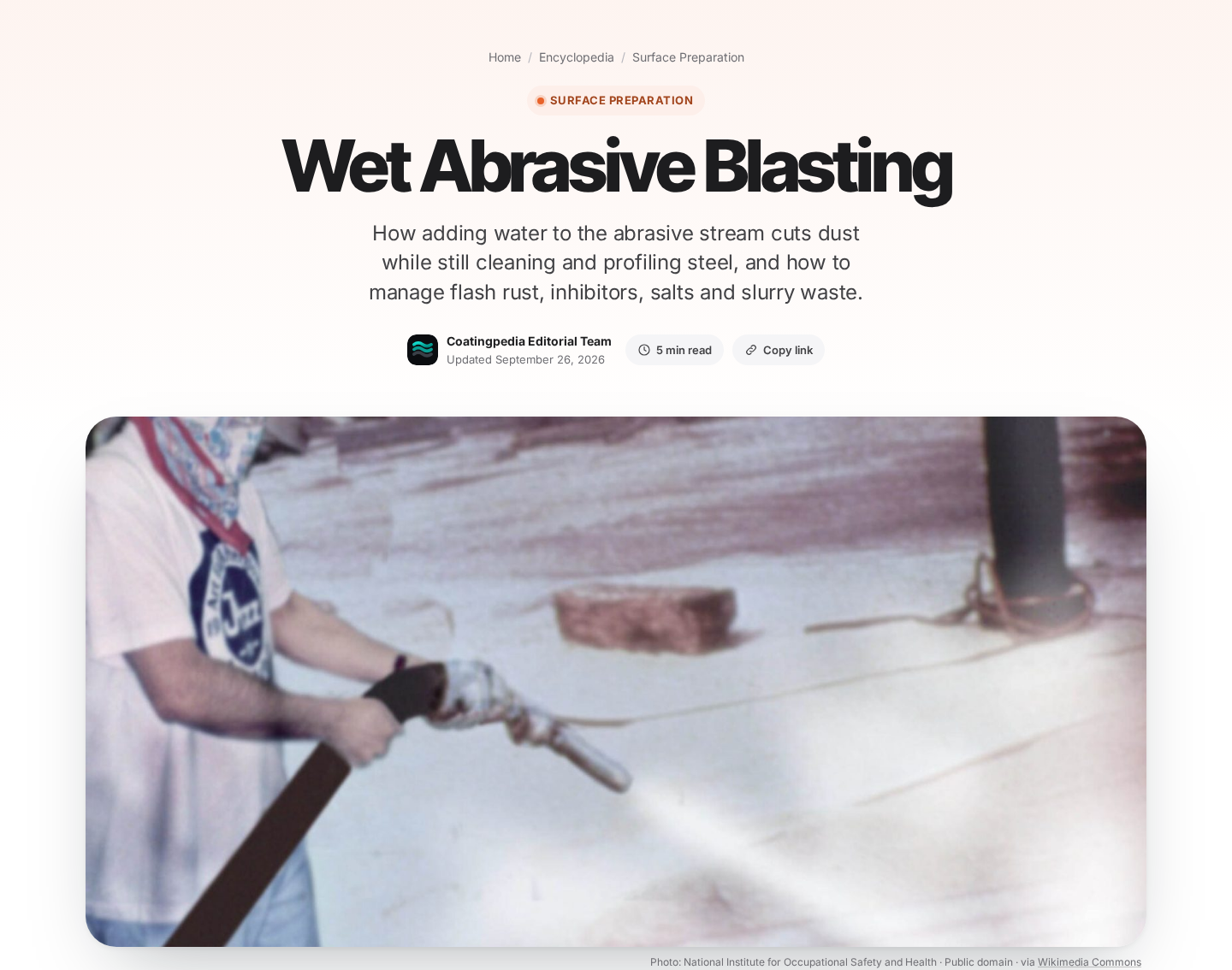
Both methods use water to suppress dust on steel. Wet abrasive blasting still cuts a surface profile; ultra-high-pressure water jetting does not — it exposes whatever profile already exists.
Pros:
Sharply reduces airborne dust versus dry blasting
WAB creates a full anchor profile on steel
Hydroblasting excels at soluble salt removal
Sidesteps dry blasting silica dust containment obligations
Cons:
WAB causes flash rust on bare steel
Slurry waste requires careful disposal management
Hydroblasting cannot create a new surface profile
High-pressure water jets pose injection injury risk
Wet Abrasive Blasting (WAB)
Wet abrasive blasting introduces water into the abrasive blast stream in one of two ways: injected at or near the nozzle via a water ring or induction attachment, or pre-mixed with abrasive as a slurry in a pressurised pot before being propelled by compressed air.
In both configurations, the abrasive still strikes the steel surface and cuts an anchor profile — the same mechanical action as dry blasting — while the water surrounds the particles, weighing them down and preventing their dispersion as airborne dust.
Graco's published figures for their vapour abrasive blasting equipment put dust suppression at up to 92% compared with dry blasting; Dustless Blasting cite up to 95% reduction for their wet blasting equipment.
Surface cleanliness after WAB is specified using dedicated NACE/SSPC standards that run parallel to the dry blast grades, covering the same hierarchy from white metal down to brush-off.
| Grade | Standard | Description |
|---|---|---|
| White Metal WAB | NACE WAB-1 / SSPC-SP 5 WAB | All rust, scale, coating and foreign matter removed; no staining permitted |
| Near-White Metal WAB | NACE WAB-2 / SSPC-SP 10 WAB | All rust, scale and coating removed; staining on no more than 5% of each unit area |
| Commercial WAB | NACE WAB-3 / SSPC-SP 6 WAB | All rust, scale and coating removed; staining on no more than 33% of each unit area |
| Brush-Off WAB | NACE WAB-4 / SSPC-SP 7 WAB | Adherent coating allowed to remain; surface roughened before recoating |
| Industrial WAB | NACE WAB-8 / SSPC-SP 14 WAB | Tightly adherent paint, mill scale and rust allowed on no more than 10% of each unit area |
WAB cleanliness grades and their NACE/SSPC standard designations, as defined in the joint NACE/SSPC WAB standards. Flash rust grade is specified separately and must be agreed between contractor and coating manufacturer.
Flash rust is the principal trade-off of WAB: bare steel exposed to water will begin to rust as it dries, and the coating must be applied promptly after blasting to prevent this from compromising adhesion.
Corrosion inhibitors can be added to the blast water or applied immediately after blasting to extend the working window, but the SSPC/NACE joint technical report is explicit that inhibitors must be checked for compatibility with the coating system — some inhibitive treatments interfere with coating cure and performance.
WAB produces a slurry of water, spent abrasive, and removed coating material that must be contained and managed as project waste.
Where the coating being removed contains lead or other hazardous materials, both the solid debris and the contaminated water may require treatment as hazardous waste under applicable regulations — a genuine project constraint that affects scheduling, containment design, and disposal cost.
On the silica question: WAB substantially reduces airborne dust compared with dry blasting, but if silica-containing abrasives are used, a silica exposure assessment is still required. The OSHA shipyard guidance notes that alternative abrasive agents can reduce but may not eliminate silica exposures, particularly in confined or enclosed spaces. Low-silica abrasives — garnet, crushed glass, and steel grit — are standard practice in WAB for exactly this reason.
WAB fits best on maintenance repainting of structural steel, bridges, and industrial plant where dust is unacceptable; on removal of hazardous coatings such as lead paint where wet methods reduce airborne particulate; and on any situation where a surface profile is required but dry blasting cannot be used.
Ultra-High-Pressure Water Jetting (Hydroblasting)
Hydroblasting uses pressurised water without abrasive to remove coatings, rust, and contaminants from steel.
The joint SSPC/NACE waterjetting standards define pressure ranges by application: high-pressure water jetting (HPWJ) operates from 10,000 to 30,000 psi (70 to 210 MPa), while ultra-high-pressure water jetting (UHPWJ) operates above 30,000 psi (210 MPa).
Hydroblasting exposes whatever surface profile the steel already has but cannot create a new one. On previously blasted and coated steel, the original profile is typically still present under the old coating and is simply re-exposed. On new, smooth, or mill-scaled steel — or where the existing profile is too shallow for the intended coating — hydroblasting is not sufficient on its own.
Cleanliness after hydroblasting is specified to SSPC-SP WJ-1 through WJ-4 / NACE WJ-1 through WJ-4, or internationally to ISO 8501-4 Wa 1, Wa 2, and Wa 2½ grades, with flash rust grades (light, moderate, or heavy) specified separately to define the acceptable condition at the moment of coating application.
Where hydroblasting leads the field is in soluble salt removal: chlorides and sulfates that sit at the bottom of corrosion pits are hard to dislodge with dry abrasive, which can drive them deeper, but a high-velocity water stream dissolves and flushes them out.
This makes hydroblasting the method of choice for maintenance recoating of marine, coastal, and offshore steel structures, where soluble salt contamination is the primary driver of premature coating failure.
The safety hazard that distinguishes hydroblasting from every other method on this page is the injection injury risk: the OSHA shipyard guidance states plainly that water blasted at ultra-high pressures can sever operators' limbs.
OSHA guidance for hydroblasting operations includes the use of deadman control devices at the nozzle end of the blasting hose, ensuring only one employee operates each blast nozzle where possible, and appropriate exclusion zones to protect workers in the vicinity from the high-pressure stream.
The OSHA shipyard PPE guidance also notes that hydroblasting PPE must protect the worker from injury from the high-pressure water stream, and that the work is physically demanding — frequent rotation of employees is necessary to prevent fatigue.
WAB and Hydroblasting: Framework Comparison
The two methods share a dust-suppression characteristic but diverge sharply on profile creation, waste profile, and safety requirements — which is why the framework axes below are worth reading across both columns before committing to either.
| Axis | Wet Abrasive Blasting (WAB) | Ultra-High-Pressure Water Jetting |
|---|---|---|
| Scale of work | Medium to large; portable equipment suits on-site work | Large-scale; high capital cost, suited to industrial and marine projects |
| Location | On-site, open-air, and enclosed spaces; dust suppression enables work near other personnel | On-site and marine; no abrasive containment needed; exclusion zone required for operator safety |
| Substrate condition | Heavy corrosion, mill scale, paint, and weld discolouration; creates profile on steel | Previously coated steel with existing profile; removes rust and coatings; cannot address inadequate profile |
| Regulatory environment | Reduced silica dust obligations; slurry and hazardous waste disposal obligations apply | No spent abrasive; flash rust and wastewater management required; strict operator safety requirements |
| Surface profile | Creates anchor profile — specifiable to WAB cleanliness grades | Does not create profile; re-exposes existing profile only |
| Equipment and running cost | Compressor, water supply, and slurry management infrastructure required; abrasive is an ongoing consumable | High-pressure pump, water supply, and wastewater handling required; no abrasive consumable |
How WAB and ultra-high-pressure water jetting compare across the six evaluation axes for steel surface preparation.
Seen All Five Methods? Laser Cleaning Goes Further.
No blast media, no consumables, no secondary waste. The ELASER brings precise, media-free surface preparation to steel across a wide range of conditions. Explore the full product page to see where it fits your project.
Method 5
Dry Ice Blasting
Dry ice blasting propels solid CO2 pellets at steel surfaces, removing contaminants through kinetic impact, thermal shock, and gas expansion — leaving no blast media, no moisture, and no secondary waste.
Pros:
No secondary waste — CO2 sublimates completely
No moisture introduced; no flash rust risk
Non-abrasive; preserves substrate dimensions
No silica dust, no chemical agents generated
Cons:
Does not create a mechanical anchor profile
Ineffective on pitted rust or heavy corrosion
Dry ice supply chain adds logistical complexity
CO2 ventilation required in confined spaces
How Dry Ice Blasting Works on Steel
When a solid CO2 pellet strikes a steel surface, three effects act simultaneously within milliseconds. According to Cold Jet's published technical guide, these are kinetic impact, thermal shock, and rapid gas expansion — and each plays a distinct role in breaking the bond between contaminant and substrate.
The pellets are rated at approximately 1.5–2 on the Mohs Scale of Hardness, making them significantly softer than steel. Because so little impact energy transfers into the surface, the process is classified as non-abrasive.
Dry ice arrives at the surface at −78.5 °C (−109.3 °F). That extreme cold causes the contaminant layer to embrittle, contract, and micro-crack — breaking its adhesion to the steel beneath before any mechanical force is even needed.
On impact, the pellet sublimates instantly from solid to gas, expanding up to 800 times in volume within milliseconds. Cold Jet's definitive guide describes this as an "explosion shock front" that lifts thermally fractured contaminant particles cleanly away from the surface.
Because the CO2 reverts entirely to gas, no blast media remains on the surface. The only material left behind is the dislodged contaminant itself, which can be swept or vacuumed away.
Surface Profile: The Critical Limitation for Steel Prep
The non-abrasive character that makes dry ice blasting gentle on substrates is also its most significant constraint in a steel surface preparation context. Because the pellets are softer than steel, the process does not etch or mechanically profile the surface.
Cold Jet's own FAQ states plainly: dry ice blasting alone will not create a surface profile or achieve a white metal finish. Where a coating specification requires a measured anchor profile, standard dry ice blasting is not sufficient as a standalone preparation method.
Cold Jet markets a proprietary hybrid system that combines dry ice with an abrasive medium. According to Cold Jet's published coatings and corrosion removal application sheet, this system has been third-party verified to reduce dust levels by up to 97% and is stated to achieve SSPC-SP 10 / SA 2.5 / NACE 2 with a 2–5 mil profile — addressing the profile limitation while retaining the dust-reduction advantage.
Rust Removal Capability and Limits
Cold Jet's rust removal application page specifies the conditions where dry ice blasting is effective on steel: surface rust, flash rust, light oxidation, and early-stage corrosion.
The same source is equally direct about where it falls short: the process is not suitable for pitted rust, heavy corrosion, or applications requiring a white metal or near-white metal finish. For deeply adhered or pitted oxidation, the non-abrasive character of dry ice is insufficient.
No Moisture, Immediate Recoating
Dry ice sublimates without leaving any water on the surface. There is no drying time, no flash rust from residual moisture, and surfaces can be recoated immediately after cleaning.
This is a concrete operational advantage in maintenance scenarios where turnaround speed matters — and a meaningful contrast to any water-based cleaning method that introduces moisture to bare steel.
Regulatory Profile
Dry ice blasting generates no silica dust, uses no chemical agents, and leaves no spent abrasive media to collect or dispose of — sidestepping the three main regulatory pressures that make sandblasting operationally demanding.
The primary safety consideration specific to dry ice blasting is CO2 accumulation in enclosed or confined spaces. Because CO2 is heavier than air, sublimating gas can displace oxygen. OSHA's published exposure data sets the permissible exposure limit (PEL) for CO2 at 5,000 ppm as an 8-hour TWA, with an IDLH of 40,000 ppm. The UK HSE's EH40 workplace exposure limits set a long-term WEL of 5,000 ppm and a short-term WEL of 15,000 ppm over 15 minutes.
OSHA's confined space standard (29 CFR 1910.146) requires atmospheric testing and continuous monitoring before and during entry into permit-required confined spaces where CO2 could accumulate. Adequate ventilation must be confirmed before work begins.
Cold Jet's handling guidance recommends insulated gloves and appropriate eye protection when working with dry ice in solid form.
Dry Ice Supply Chain
Dry ice pellets cannot be stored indefinitely. Cold Jet's published FAQ notes that typical sublimation loss is approximately 2–10% per day depending on insulation quality, and pellets last up to a week in proper storage.
Most major metropolitan areas are served by dry ice suppliers within a roughly 100-mile delivery radius, according to Cold Jet's sourcing guidance. Outside those coverage areas, or where sustained high-volume operations are needed, securing a reliable supply adds genuine logistical overhead that other methods on this list do not carry.
Dry ice pricing varies by region and order volume, with Cold Jet's startup guide citing a range of approximately $0.30–$3.00 per pound depending on supplier and market conditions.
Dry Ice Blasting: Six-Axis Evaluation
The table below maps dry ice blasting against the six evaluation axes used throughout this comparison.
| Axis | Dry Ice Blasting |
|---|---|
| Scale of work | Targeted and maintenance-scale; not suited to large-area structural steel preparation |
| Location | In-place cleaning without disassembly; confined-space use requires CO2 ventilation monitoring |
| Substrate condition | Light to moderate contamination, surface rust, flash rust, early-stage oxidation; not suitable for pitted or heavy corrosion |
| Regulatory environment | No silica dust, no chemical waste, no spent media; CO2 accumulation monitoring required in enclosed spaces per OSHA/HSE limits |
| Surface profile requirement | Creates no anchor profile; unsuitable as standalone prep where a mil profile is specified |
| Equipment access and running cost | Dry ice consumable cost at $0.30–$3.00/lb; per-hour running costs typically higher than conventional blasting; supply chain logistics vary by region |
How dry ice blasting performs across the six evaluation axes used to compare all methods in this guide.
Dry ice blasting occupies a specific and well-defined niche in steel surface preparation. Its strongest fit is in-place cleaning of installed equipment and plant where disassembly is impractical, weld line and fixture cleaning, and light surface rust or contamination removal in situations where no moisture, no secondary waste, and no substrate damage are the primary requirements.
Dry ice blasting is a specialist tool for maintenance-type steel cleaning — not a general replacement for abrasive blasting. It excels where the substrate must be preserved, no moisture can be tolerated, and secondary waste is a problem. It does not create a surface profile and is not effective on heavy or pitted corrosion.
Conclusion
Choosing the Right Method for Your Steel Project
None of the five methods here wins on every axis — the right choice is always a function of your project conditions: scale, location, substrate state, regulatory environment, profile requirement, and equipment access.
Mechanical tools, chemical treatment, wet abrasive blasting, and dry ice blasting each fit specific conditions — spot repairs, confined geometries, large-scale recoating, in-place cleaning with no secondary waste.
When substrate integrity, no consumables, no chemicals, and deployment flexibility are what the project demands, laser cleaning is the strongest modern answer.
The team at WSL builds the portable ELASER and the production-scale AutoLASE — get in touch to discuss your application.
Frequently Asked Questions: Alternatives to Sandblasting Steel
Practical answers to the most common questions about surface preparation methods for steel when abrasive blasting is not the right fit.
Power tools — angle grinders fitted with flap discs or grinding wheels, wire wheels, and needle scalers — remove rust, mill scale, and surface scale from steel through mechanical abrasion and impact, with no blasting media required. They are well-suited to spot repairs, weld preparation, confined spaces, and on-site work where blast infrastructure cannot be set up. The key limitation is consistency: the surface profile produced is less uniform than abrasive blasting, and large-area coverage is slow and labour-intensive.
There are five established methods, each suited to different project conditions. Laser cleaning uses a pulsed fibre laser to vaporise rust and oxides from steel with no consumables, no chemicals, and minimal substrate loss — applicable across light to heavy rust in workshop and field settings. Mechanical power tools (angle grinders, wire brushes, needle scalers) are portable and accessible, best suited to spot repairs and small-scale work. Chemical rust converters and acid removers treat light to moderate rust through chemical reaction rather than abrasion, making them appropriate for confined geometries and thin-gauge steel where mechanical methods risk distortion. Wet abrasive blasting suits larger areas where a surface profile is required but dry blasting is not feasible. Dry ice blasting is suited to in-place light rust and surface contamination where no moisture and no secondary waste are priorities.
Thin-gauge steel is at risk of distortion, warping, and dimensional change when subjected to aggressive abrasive impact or heavy mechanical grinding — the substrate itself is vulnerable, not just the contamination on it. Methods that avoid mechanical stress and high-energy impact are the appropriate choices. Laser cleaning is particularly well-suited: tunable power and minimal substrate loss mean the beam stops at the base material, so over-removal is not a risk. Chemical rust converters and acid-based rust removers apply no mechanical stress or heat, making them appropriate for light to moderate rust on thin sections and accessible on complex geometries. Dry ice blasting is non-abrasive, introduces no moisture, and preserves substrate dimensions — suited to light surface contamination. Heavy grinding wheels, coarse flap discs, and high-pressure abrasive blasting carry the greatest distortion risk on thin steel and are best avoided.
Mill scale is a dense, tightly adherent iron oxide layer formed on steel during hot rolling. It is harder and more chemically stable than surface rust, and requires more aggressive removal — methods that work well on rust alone are often ineffective on tight mill scale. Laser cleaning is effective on mill scale on steel, with tunable power allowing the beam to be applied at the intensity the material requires. Wet abrasive blasting cuts an anchor profile into the steel surface, making it a capable option for mill scale removal on structural steel. By contrast, wire brushes and needle scalers alone generally cannot remove tightly adherent mill scale — they may dislodge loose or partially detached scale, but not the tight layer. Dry ice blasting lacks the kinetic energy and thermal differential to break the bond of tight mill scale. Chemical rust converters and acid removers are formulated for iron oxide (rust), not the denser mill scale layer, and are generally not effective on it.
The right treatment depends on the severity of the rust and the surface finish required — there is no single answer that fits every situation. For light to moderate rust, phosphoric acid-based rust converters chemically transform iron oxide into a stable iron phosphate compound, producing a paintable surface without full rust removal. Acid-based rust removers dissolve light rust chemically and suit confined geometries well. For heavier rust, mechanical tools — angle grinders with grinding wheels or flap discs, needle scalers — are needed to physically remove adherent rust and scale. Laser cleaning is also effective across the full range of rust severity, with power adjustable to the contamination level. Note that chemical rust converters do not create a mechanical anchor profile: where a specified surface roughness is required for coating adhesion, a subsequent mechanical step is needed.