

Introduction
If you're at the stage of comparing actual machines, you've already done the hard work of deciding that laser cleaning is the right tool for the job.
The next question — which is the cheapest laser cleaning machine worth buying — turns out to be more layered than a simple price search suggests.
This list covers five verified machines, evaluated consistently across laser type, wattage, portability, applications, and the costs that accumulate well beyond the initial purchase.
Every entry is an honest assessment: real trade-offs included, no catalogue padding.
TL;DR
The cheapest laser cleaning machine is rarely the one with the lowest price tag — it's the one that delivers genuine capability at the wattage you need, in a form factor that suits your work, without hidden costs eroding the saving after purchase.
This article covers:

Five verified laser cleaning machines reviewed
How laser type and wattage affect value
Pricing structures and what drives cost variation
Total cost of ownership beyond the sticker price
Reseller vs manufacturer risk for budget buyers
Matching machine to application and budget
What Does a Laser Cleaning Machine Actually Cost?
The laser cleaning machine market spans a genuinely wide range — from under $4,000 for a basic entry-level unit to well over $80,000 for a high-power industrial system. The sticker price, however, tells only part of the story: the technology type, wattage, and ongoing running costs all shape what a machine actually costs to own and operate.
The single biggest driver of price variation is the distinction between CW (continuous wave) and pulsed fibre laser technology — two fundamentally different tools that happen to share the same job description.
- CW (Continuous Wave): Delivers a constant beam; lower cost per watt, faster on large areas, but deposits heat into the substrate. Best for rust, paint, and mill scale on structural steel. Typically $4,000–$14,000 for 1,000W–3,000W systems from direct manufacturers.
- Pulsed Fibre Laser: Fires in nanosecond bursts at very high peak power, physically ejecting contamination without meaningful heat transfer — true cold cleaning. Safer for precision and heat-sensitive substrates. Typically $8,000–$45,000+ for 50W–500W systems.
This distinction is a buying decision, not just a spec. As independent analysis from The Maker's Chest puts it: a 1,500W CW machine on the wrong application will heat and damage the substrate, while a 100W pulsed machine on that same application will clean it perfectly without raising the substrate temperature meaningfully. Getting the technology wrong is more expensive than getting the wattage wrong.
The practical rule of thumb: if your substrate is durable structural steel, carbon steel machinery, or robust equipment that tolerates heat — CW is appropriate and far more cost-effective. If your work involves precision components, food-grade stainless, mould steel, aerospace alloys, or any surface where thermal damage is unacceptable — pulsed is required, and the price premium is justified.
| Power Class | Laser Type | Indicative Price Range (USD) | Typical Application |
|---|---|---|---|
| 50W–100W | Pulsed fibre | $8,000–$18,000 | Precision cleaning, light oxide, heritage restoration |
| 100W–500W | Pulsed fibre | $18,000–$45,000 | Mould cleaning, automotive parts, weld prep on medium components |
| 1,000W–2,000W | CW | $4,000–$14,000 (direct); $15,000–$30,000 (distributor) | High-throughput rust removal, paint stripping, general industrial decoating |
| 1,000W–2,000W | Pulsed fibre | $45,000–$80,000 | Structural steel, heavy weld seam prep, thick coating removal |
| 3,000W+ | CW | $13,500–$60,000+ | Heavy industrial lines, large surface area, production-rate stripping |
Indicative price ranges by power class and laser type, drawn from multiple third-party sources, to give price-sensitive buyers a calibrated market overview.
The table reveals a pattern worth noting: CW systems at equivalent average power cost 2–5 times less than pulsed systems, but pulsed units run at far lower electricity consumption per hour (roughly $0.40–$0.45/hr versus $0.75–$0.80/hr for CW, according to thelasertool.com). The right choice depends on application, not on which number looks cheaper at the point of purchase.
Wattage functions as both a price multiplier and a capability multiplier. A 100W pulsed system covers roughly 0.1–0.5 m² per hour on carbon steel rust; a 1,500W CW system covers 10–25 m² per hour on the same surface. On a large structure or a production line, that throughput gap becomes a real operational cost — underpowering a job is a genuine risk at the budget end of the market.
At the industrial end of the market, quote-based pricing is standard practice, not a red flag. Industrial systems are configured to application — wattage, cable length, scan head type, cooling architecture, accessories — and the final price reflects that configuration. Published list prices, where they exist, are a starting point; the fully-landed cost (including shipping, import tariffs, and installation) is what matters.
Beyond the purchase price, three recurring cost components shape the real cost of ownership for any laser cleaning machine.
- Electricity: A 200W pulsed system running a full shift draws 0.8–1.5 kWh of wall power per hour; annual energy cost typically runs under $2,000 even at heavy utilisation.
- Protective lens replacement: The primary wear consumable. Replacement lenses cost $20–$150 each and typically last 40–200 operating hours depending on contamination type and process discipline.
- Fume extraction filters: Required for safe operation. Filter sets for industrial extractors run $150–$600+ per replacement cycle, with intervals of one to six months depending on duty cycle.
- Zero media consumables: Unlike sandblasting (grit, sand) or dry ice cleaning (CO₂), laser cleaning requires no cleaning media at all — a structural cost advantage that compounds over time.
One source puts total annual consumables for a single laser cleaning system at typically under $500 — a figure that contrasts sharply with abrasive blasting, where media and waste disposal alone can run $35,000–$90,000 per year at production scale. The TCO picture is developed further in the conclusion; for now, the key point is that the purchase price is the largest single cost you will face.
A 1,500W CW machine typically costs $6,000–$14,000. A pulsed machine at equivalent average power costs $8,000–$45,000 or more. Choosing the wrong laser type for your application — and then discovering it either damages your substrate or is too slow for your throughput — costs far more than the price difference between the two technologies.
With the cost landscape mapped, the five machines below represent the best value at the affordable-to-mid-range end of the market — each evaluated on laser type, wattage, portability, application fit, and total cost signals.
Product 1
ELASER by Woodrow Scientific Limited
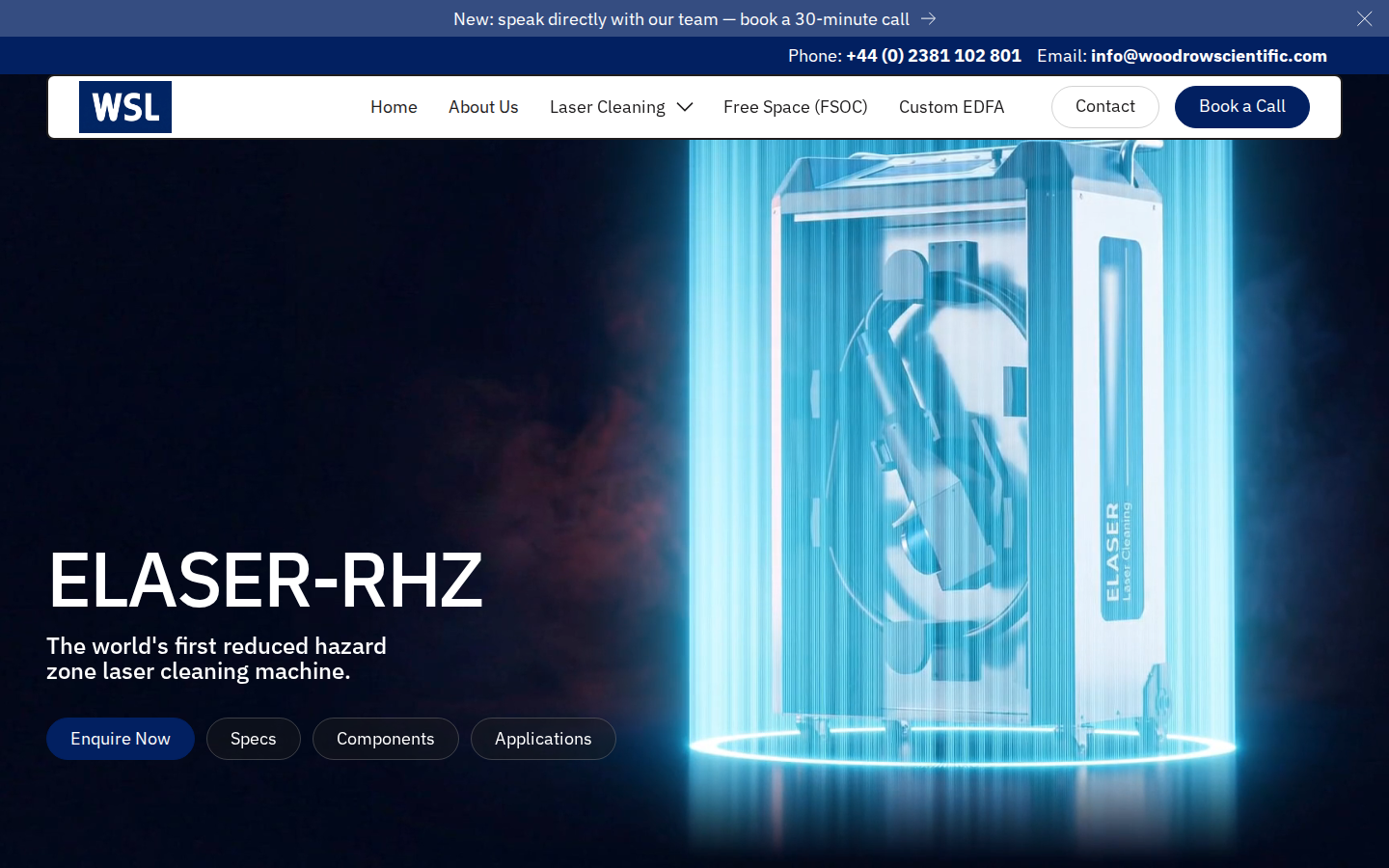
The ELASER is an industrial pulsed fibre laser cleaning system built and manufactured in the UK by Woodrow Scientific Limited — the only UK-based laser cleaning manufacturer. Delivering up to 300 W of tunable power, it covers everything from light oxide removal through to thick coatings, and its optional ELASER-RHZ configuration introduces a world-first patented Reduced Hazard Zone that enables cleaning in open workshops and public spaces without area evacuation. A 50 m delivery cable, a sub-3 kg handheld scanner, and air-cooled operation mean one person can deploy the full system with no compressor or chiller on site. Among comparable industrial laser cleaning machines in the European market, the ELASER holds the most competitive pricing — and with zero consumables and energy-only running costs, the total cost of ownership case is compelling.
Pros:

World-first patented Reduced Hazard Zone technology
Up to 50 m delivery cable reach
Zero consumables — energy-only running costs
CE and UKCA certified; UK manufactured
Cons:

Pricing by quote — no published list price
Industrial spec may exceed light-duty needs
The ELASER leads this list on the strength of a capability no other laser cleaning machine in the world currently holds: Reduced Hazard Zone (RHZ) technology, a WSL-patented system that fundamentally changes where laser cleaning can be used.
Conventional laser cleaning requires the work area to be sealed off and evacuated before the beam is active — a significant operational overhead that limits deployment in shared facilities, production lines, and public settings.
The ELASER-RHZ variant collapses the laser hazard zone to a small area immediately around the work surface, operating at 1550 nm, a retina-safe wavelength, and configurable as Class I (eye-safe) or Class IV depending on application requirements.
This unlocks cleaning in open-plan manufacturing facilities, mixed-use workshops, and even publicly accessible spaces — graffiti removal and heritage restoration in locations where a conventional laser cleaner simply cannot operate.
On portability, the numbers are concrete: the handheld scanner weighs under 3 kg, the wheeled system comes in under 50 kg, and the delivery cable reaches up to 50 m — with 5 m and 15 m lengths available as standard.
That 50 m reach is a meaningful practical advantage: many portable laser cleaning systems ship with cables of 5–10 m, which constrains where the operator can work relative to the power unit.
The system is air-cooled throughout — no water circuit, no chiller, no compressor required — which simplifies site setup and removes a category of ongoing maintenance cost entirely.
ELASER Specifications
| Specification | ELASER / ELASER-RHZ |
|---|---|
| Laser type | Pulsed fibre laser |
| Max power | Up to 300 W (tunable 0–100%) |
| Wavelength | 1550 nm (RHZ variant; retina-safe) |
| Pulse energy | Up to 15 mJ |
| Pulse duration | 100 ns |
| Scanner weight | Under 3 kg |
| System weight | Under 50 kg (wheeled) |
| Delivery cable | Up to 50 m (5 m / 15 m standard) |
| Power consumption | Under 2,000 W |
| Cooling | Air-cooled (no chiller or compressor) |
| Power supply | 110–250 VAC single-phase |
| Laser class | Class I or Class IV (configuration-dependent) |
| Certifications | CE and UKCA |
Gives the reader a scannable reference for the ELASER's key technical parameters, matching the evaluation axes declared in the introduction and enabling direct comparison with subsequent list entries.
Power tunability across the full 0–100% range means a single machine handles the full spectrum of cleaning tasks — from lifting light surface oxides without marking the substrate, through to stripping thick paint or powder coatings.
ELASER Applications
The ELASER's combination of tunable power, portable form factor, and RHZ capability makes it applicable across a notably wide range of industries.
- Automotive: Pre-weld surface preparation, rust removal, and paint stripping in bodyshop and production-line environments.
- Injection moulding and tooling: Strip release agents, residue, and build-up from moulds and tooling in place — no disassembly required.
- Industrial maintenance: Clean plant, equipment, and infrastructure on site with no masking or media cleanup.
- Tyre and rubber mould cleaning: Remove vulcanisation residue and clean vents without abrasives or mould wear.
- Aerospace: Precise surface preparation and component cleaning to tight tolerances.
- Heritage and restoration: Lift soiling, paint, and corrosion from stone, metal, and masonry with minimal substrate impact.
- Graffiti removal in public spaces: Enabled by RHZ technology — cleaning in publicly accessible locations without area evacuation.
The system is also well suited to operators looking to launch a laser cleaning service business — WSL provides full operator training as part of the package, and the portable, self-contained format is designed for multi-site deployment.
WSL is the only UK-based laser cleaning manufacturer, founded in 2012, and brings over 200 years of combined engineering experience to every machine it builds.
A meaningful share of the laser cleaning market is made up of resellers and importers rebadging third-party hardware — which translates in practice to slower spares, limited technical support, and no genuine ability to improve the product over time.
WSL designs, builds, services, and iterates on its machines entirely in-house, which is what makes patented, world-first technology like the RHZ possible — and what backs up every support call with real engineering capability.
ELASER Pricing
Pricing is available by quote directly from WSL — contact the team to discuss your application and receive a figure tailored to your configuration.
Running costs are essentially energy only: no consumables, no chiller, no compressor, and power consumption under 2,000 W. For a price-sensitive buyer evaluating total cost of ownership rather than sticker price alone, the ELASER's operating cost profile is one of the strongest arguments in its favour.
Among comparable industrial laser cleaning machines available in the European market, the ELASER carries the most competitive pricing — a position achieved through in-house manufacturing efficiency, not specification compromise.
Both CE and UKCA certifications are confirmed, which matters particularly for UK buyers evaluating compliance at the budget end of the market, where certification is not always a given.
WSL provides laser cleaning safety and operation training directly — it is part of the ownership package, not an optional add-on — and bespoke engineering is available for buyers whose application requirements fall outside the standard configuration.
See the ELASER-RHZ Specs in Full
The ELASER-RHZ brings patented Reduced Hazard Zone technology to industrial laser cleaning. Download the full datasheet to see power, delivery, and safety specifications in detail.
Product 2
Rocklin MobiLase
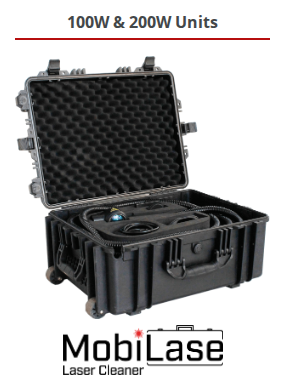
The Rocklin MobiLase is a US-made pulsed fibre laser cleaner housed in a single 60 lb suitcase-style unit, available in 100 W and 200 W configurations, and positioned at the accessible end of the pulsed fibre laser market.
Pros:
Suitcase form factor — genuine vehicle portability
Lightweight handheld applicator (~0.6 kg)
100,000-hour laser source life; one-year warranty
US-manufactured with direct factory support
Cons:
5 m cable limits reach on large structures
100 W ceiling slows heavy rust removal
Air cooling limits continuous heavy-duty shifts
The MobiLase's defining characteristic is its form factor: the entire system — laser source, controls, and cooling — ships and travels in a single rolling suitcase weighing approximately 60 lbs (~27 kg).
For buyers whose primary requirement is site-to-site vehicle deployment, this is a genuinely practical arrangement — load it into a vehicle boot, carry it to the job, and set up without a wheeled trolley or separate power unit.
Laser Technology and Power
The MobiLase uses a pulsed fibre laser, available in 100 W (standard) and 200 W (optional upgrade) configurations.
The short pulse duration delivers precise surface-level cleaning without transferring significant heat to the underlying substrate — a meaningful capability for operators working on components where thermal distortion would be a concern.
| Specification | MobiLase (100 W / 200 W) |
|---|---|
| Laser type | Pulsed fibre laser |
| Power output | 100 W (200 W option available) |
| Entire unit weight | ~60 lbs (~27 kg) |
| Handheld applicator weight | ~1.4 lbs (~0.6 kg) |
| Cable length | 5 m |
| Cooling method | Air |
| Wavelength | 1064 nm |
| Warranty | 1 year |
| Certifications | Not declared on manufacturer's website — verify with Rocklin directly |
Consolidates the MobiLase's key verified specifications in one scannable reference, saving the reader from hunting through prose for individual figures.
The 100 W entry configuration is the accessible starting point; the 200 W option suits buyers who anticipate moderately heavier contamination loads or faster cycle times.
Ergonomics and Cable Reach
At approximately 1.4 lbs (~0.6 kg), the MobiLase's handheld applicator is notably lighter than many comparable scan heads on the market, which is a genuine advantage for operators using the machine over extended periods.
Operator fatigue during prolonged cleaning sessions is a real practical concern, and a lighter applicator meaningfully reduces cumulative strain on the wrist and forearm across a working shift.
The cable connecting the applicator to the suitcase unit is 5 m in length — this is a firm constraint that buyers must weigh carefully.
For jobs on large structures, elevated surfaces, or any application where the suitcase unit cannot be positioned immediately adjacent to the work area, 5 m will be insufficient; some competing portable systems offer considerably longer delivery cables.
Applications
Rocklin rates the MobiLase for rust, paint, oil, grease, dirt, mould, and tool cleaning, as well as concrete, graffiti removal, and restoration work.
The machine is well-suited to light-to-moderate contamination on smaller parts and localised surfaces — it is not the right tool for heavy industrial rust removal across large structural areas, where higher wattage and longer cable reach would both be limiting factors.
Rocklin MobiLase Pricing
Rocklin Manufacturing does not publish list pricing for the MobiLase Laser Cleaner on its website — pricing for both the 100 W and 200 W configurations requires direct contact or a quote request via rocklinmanufacturing.com.
Rocklin positions the MobiLase as an affordable, accessible entry-level purchase within the pulsed fibre laser cleaning market; prospective buyers should contact Rocklin or a regional sales representative for a current figure.
Rocklin Manufacturing has operated from Sioux City, Iowa since 1934 and builds and supports the MobiLase from that same factory, with a North American sales representative network handling regional enquiries.
UK and EU buyers should note that no CE or UKCA certification information is published on the manufacturer's website — clarify certification status directly with Rocklin or a regional distributor before purchase.
The fibre laser source is rated for up to 100,000 hours of use with minimal maintenance required, and the unit ships with a one-year manufacturer's warranty backed by Rocklin's factory support team.
Honest Trade-offs
Three limitations are worth stating plainly for buyers evaluating the MobiLase against other options on this list.
- Wattage ceiling: At 100 W (or 200 W on the upgrade), the MobiLase will struggle with heavy rust deposits or thick coatings — buyers with demanding contamination loads will find cleaning speeds noticeably slower than higher-wattage systems.
- Cable reach: The 5 m cable is a hard constraint. If the suitcase unit cannot be positioned close to the work surface, the MobiLase simply cannot reach — this rules it out for elevated structures or large-area jobs.
- Thermal headroom: Air cooling inside a sealed suitcase enclosure provides less heat dissipation than open-frame or trolley-mounted systems. For continuous heavy-duty shifts, this limits how long the machine can run at full output before needing rest periods.
For buyers whose work is concentrated on smaller, accessible surfaces with light-to-moderate contamination, these trade-offs are manageable — the suitcase portability and lightweight applicator are genuine advantages within that use-case envelope.
Product 3
Narran ROD 300 AIR
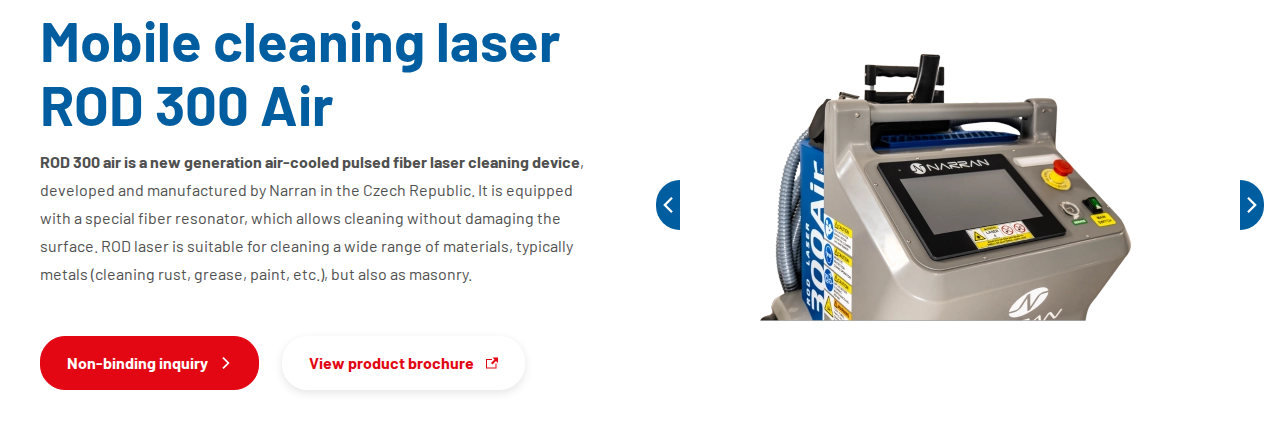
The Narran ROD 300 AIR is a 300 W air-cooled pulsed fibre laser cleaner developed and manufactured in the Czech Republic by Narran, a company that builds its own fibre resonator in-house rather than sourcing from a third party. Suited to mid-range professional use on metals and masonry, it operates without a water chiller and runs from a standard single-phase supply — making it a credible step up for buyers whose cleaning demands exceed what an entry-level unit can handle.
Pros:
In-house fibre resonator — genuine manufacturer
Air-cooled — no external water chiller needed
300 W pulsed with four pulse duration options
CE certified and FDA approved for US market
Cons:
10 m standard cable reach is limiting
Trolley format — less compact than suitcase units
Pricing by enquiry only — no published price
The ROD 300 AIR represents a genuine mid-range step up: 300 W average output power, a pulsed fibre laser operating at 1064 nm, and an integrated air-cooling system that removes the need for a water chiller entirely.
What distinguishes Narran from many competitors at this price tier is that it designs and manufactures its own fibre resonator in-house, rather than purchasing a laser source from an external supplier and rebadging it. That matters for buyers who care about long-term support, component continuity, and the depth of technical knowledge behind the machine they are buying.
The integrated air cooling is a practical operational benefit: there is no external chiller to purchase, install, or maintain, and the system is self-contained from the moment it arrives on site. At 300 W, many competing systems require water cooling — the ROD 300 AIR avoids that complexity without sacrificing output power.
| Specification | Value |
|---|---|
| Average output power | 300 W |
| Wavelength | 1064 nm |
| Peak power | 72,000 W |
| Pulse duration options | 60, 100, 250, 500 ns |
| System weight | 39 kg |
| Process head weight | 1 kg |
| Standard optical fibre length | 10 m (up to 100 m on request) |
| Power supply | 230/110 V, 50/60 Hz, 16 A, single-phase |
| Cooling | Integrated air cooling |
| Diode service life | Over 100,000 hours |
Presents the ROD 300 AIR's key specifications in a scannable format, allowing buyers to compare directly against other entries in the list without hunting through prose.
The four selectable pulse durations (60, 100, 250, and 500 ns) give operators meaningful control over how energy is delivered to the surface — shorter pulses for precision work on sensitive substrates, longer pulses where higher energy per pulse accelerates cleaning on tougher contamination.
In terms of applications, the ROD 300 AIR is rated for metals (rust, grease, and paint removal) and masonry. The scanning head supports both manual operation and robotic integration, which is a useful pathway for buyers who may want to automate cleaning tasks into a production line at a later stage.
Narran ROD 300 AIR Pricing
Pricing for the ROD 300 AIR is available on enquiry only — the product listing on narran.cz shows "Na dotaz" (on request), with no published list price. Buyers should contact Narran directly via narran.cz or reach the sales team at info@narran.cz for a current quote.
Enquiry-based pricing is standard practice at this tier of the market, where configuration options, delivery logistics, and regional distributor arrangements all affect the final figure.
On the trade-off side, the 10 m standard optical fibre is the most significant practical constraint for buyers who need extended reach on large structures or across wide working areas. Extensions up to 100 m are available on request, which mitigates this for most use cases — but the standard cable is notably shorter than systems such as the ELASER, which offers up to 50 m as standard. Buyers with reach-sensitive applications should factor this into the enquiry.
The trolley form factor also warrants an honest note: at 39 kg and configured as a wheeled unit measuring 54 × 66 × 69 cm, the ROD 300 AIR is a credible single-operator system for workshop and site use, but it is less compact for vehicle transport than suitcase-style units. It is a step up in capability and a step up in physical footprint.
On certifications, Narran holds ISO 9001:2016 and ISO 14001:2016 quality and environmental management certifications, and the ROD 300 AIR carries CE certification and FDA approval for the US market. UKCA certification was not confirmed on narran.cz at the time of writing — UK buyers should verify current status directly with Narran before purchase.
Product 4
Netalux Needle
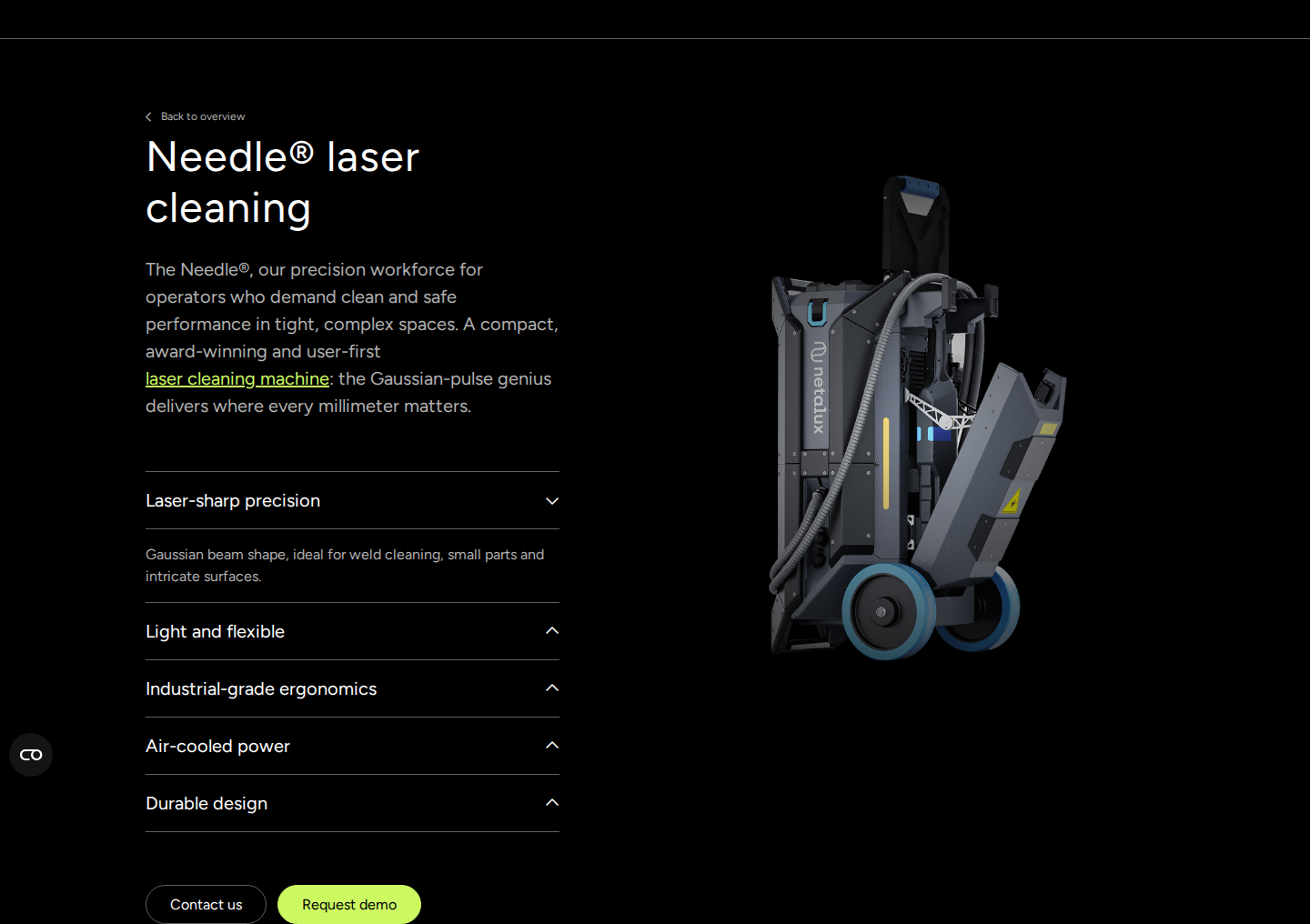
The Netalux Needle is a 100–300 W air-cooled pulsed fibre laser cleaner that has won two Red Dot Design Awards — jury-validated recognition of its ergonomic handset, rotatable head, and operator-focused engineering.
Pros:
Two Red Dot Awards for the Needle
Air-cooled across full 100–300 W range
Compact and lightweight for the wattage class
CE, FDA, IEC 60825-1, UL, CSA certified
Cons:
Short fibre reach (4.5–5.7 m)
Gaussian profile slower on large surfaces
300 W ceiling — higher power needs Jango
The Netalux Needle is a pulsed ytterbium fibre laser available in four power configurations — 100, 150, 200, and 300 W — all air-cooled and running from a standard single-phase supply.
Where the Needle distinguishes itself from every other entry on this list is not wattage or cable reach, but design: it is the only portable laser cleaner here to have won Red Dot Design Awards.
Ergonomics and Design
The Needle 100 W won Netalux's first Red Dot Award in 2020, with the jury noting that "each detail of this laser cleaning device was carefully conceived and ergonomically designed in order to achieve the greatest possible user-friendliness."
The Needle 200/300 W then won the Red Dot Award: Product Design 2023 — the jury citing its "technically mature design, which makes the device versatile and flexible to use." The 2022 award in the sequence went to Netalux's water-cooled Jango model, making the Needle's two wins part of a three-year run of consecutive Netalux recognition.
In practical terms, the awards recognise the ambidextrous handset, 115° rotatable laser head, LED work lighting, and handset-mounted controls — features that reduce postural strain during extended cleaning sessions and allow the operator to adapt the tool to the work rather than the other way around.
The table below summarises the verified specifications across the Needle range, drawn from the Netalux product page and brochure.
| Model | Power (W) | System Weight (kg) | Handset Weight (kg) | Fibre Reach (m) | Power Supply |
|---|---|---|---|---|---|
| Needle 100/150 | 100 or 150 | ~20 | ~2.3 | 4.5 | 1P, 110–240 V, 8 A |
| Needle 200/300 | 200 or 300 | ~40 | ~3.0 | 5.7 | 1P, 110–240 V, 11 A–5 A |
Allows the reader to compare the Needle configurations side by side on the axes most relevant to purchase decisions: power, system weight, handset weight, fibre reach, and power supply — all verified from netalux.com source data.
The 100/150 W models are notably compact at approximately 20 kg total system weight, making them among the lightest units in this comparison at their wattage class.
The Needle's Gaussian beam profile concentrates energy to a sharp focal point, which makes it well-suited to precision work: weld oxide removal, light rust, and paint or coating removal on stainless steel, aluminium, structural steel, and copper.
Netalux's own materials confirm the Needle is active across automotive, pharmaceutical, food industry, petrochemical, and aerospace sectors — applications where controlled, precise cleaning on smaller areas or intricate surfaces is the primary requirement.
The Gaussian profile is also the Needle's key coverage limitation: because energy is concentrated rather than distributed evenly, it cleans more slowly across large flat surfaces than a top-hat profile machine would.
Netalux Needle Pricing
Pricing for the Needle range is available on request via netalux.com — no list prices are published, and no price range is quoted here.
Certifications confirmed from the Netalux about page include CE compliance, ISO 9001, CSA, FDA performance standards (21 CFR 1040.10), IEC 60825-1, and UL compliance. UKCA status is not referenced anywhere on netalux.com at the time of writing; UK buyers should confirm this directly with Netalux before purchase.
Three trade-offs are worth stating plainly for buyers comparing across this list.
- Short fibre reach: 4.5 m on the 100/150 W models and 5.7 m on the 200/300 W models. Buyers who need to position the unit away from the workpiece, or who are cleaning large structures, will find this genuinely constraining.
- Gaussian beam profile on large surfaces: The concentrated beam profile that makes the Needle precise on small areas and intricate geometry also means slower coverage speeds on large flat surfaces compared to top-hat profile alternatives.
- Wattage ceiling at 300 W: The Needle's air-cooled range tops out at 300 W. Buyers needing higher sustained power would need to step up to Netalux's water-cooled Jango model, which is a substantially different class of machine.
Product 5
Allied Scientific Pro LaserBlast

Allied Scientific Pro's LaserBlast is a short-pulse laser cleaning system developed for the conservation market and used since 2017 in major North American infrastructure projects, including the restoration of the Canadian Parliament building. Available from 100 W to 2000 W, it offers both purchase and short-term rental options, making it a flexible choice for conservation, restoration, and infrastructure maintenance buyers.
Pros:
Verified conservation pedigree — Canadian Parliament project
Wide power range: 100 W to 2000 W
Entry model draws just 0.5 kW — field-viable
Short-term rental option available to buyers
Cons:
1000 W model at 260 kg — not portable
Entry model fibre reach limited to 10–13 m
Less published data on heavy industrial throughput
The Allied Scientific Pro LaserBlast is a short-pulse laser cleaning system developed by a Canadian company (Allied Scientific Pro, founded 2009, now part of ASP Laser Inc.) with a specific focus on the conservation and infrastructure restoration market.
Short-pulse operation means the laser delivers no thermal effect to the substrate — a critical property when working on sensitive materials such as stone, heritage metals, wood, and architectural surfaces where heat damage would be unacceptable.
Conservation Pedigree: Verified North American Projects
Allied Scientific Pro states that LaserBlast systems have been used since 2017 in large-scale conservation projects across North America, with the restoration of the Canadian Parliament building cited explicitly on their About Us page as one of the largest infrastructure projects undertaken.
The system also covers industrial cleaning applications — rust and oxidation removal, weld preparation, mould cleaning, and nuclear decontamination — but the conservation pedigree is what sets the LaserBlast apart from every other entry on this list.
LaserBlast Power Range and Model Specs
The LaserBlast lineup spans 100 W, 200 W, 300 W, 500 W, 1000 W, and 2000 W configurations — a broader range than any other product on this list, covering light conservation work at the entry end through to high-output industrial cleaning at the top.
Critically, these are not the same machine scaled up: the portability profile, power requirements, and physical weight change substantially across the range, and buyers must evaluate the specific configuration they intend to purchase.
| Specification | LaserBlast 100 W | LaserBlast 1000 W |
|---|---|---|
| Laser power range | 10–100 W | 100–1000 W |
| Machine weight | 16 kg | 260 kg |
| Electrical power draw | 0.5 kW | 5.5 kW |
| Electrical voltage | 110 V AC | 220–240 V AC |
| Fibre cable length | 10 or 13 m | 10 or 13 m |
| Cooling | Air-cooled | Not confirmed — verify with ASP |
Comparing the confirmed specs for the 100 W and 1000 W configurations side by side makes the portability and power-supply differences immediately legible — far clearer than prose alone.
The 100 W model's 16 kg weight and 110 V AC supply at just 0.5 kW make it genuinely field-deployable without specialist power infrastructure — a practical advantage for conservation work in heritage buildings or remote sites.
The 1000 W model, at 260 kg and requiring 220–240 V AC at 5.5 kW, is a different category of machine entirely: it is not portable in the handheld sense and requires appropriate site infrastructure.
LaserBlast Pricing and Rental
Pricing for the LaserBlast range is not published on Allied Scientific Pro's website and is available by enquiry — contact Allied Scientific Pro directly at alliedscientificpro.com for current pricing on the 100 W and 200 W configurations.
Allied Scientific Pro offers short-term rentals of the LaserBlast system — a genuine differentiator among the five entries on this list. The rental programme includes a security deposit that can be credited toward a purchase, making it a practical route for buyers who want to trial the system before committing or who have intermittent cleaning needs. Rental terms and conditions are available at alliedscientificpro.com.
For price-sensitive buyers, the rental pathway is worth evaluating seriously: it reduces upfront capital outlay while allowing the buyer to assess whether the LaserBlast meets their specific application requirements before purchasing.
Certifications and Trade-offs to Consider
Certification status (CE, UKCA, FDA, CSA, or equivalent) was not confirmed on Allied Scientific Pro's website at the time of writing — buyers should verify certification directly with Allied Scientific Pro before purchase, particularly for regulated or safety-critical applications.
- Fibre cable reach: Both the 100 W and 1000 W models list 10 or 13 m fibre cable options — shorter than the longest reach available from other entries on this list, which is a real constraint for large structures or hard-to-access surfaces.
- Portability is model-dependent: The 100 W unit at 16 kg is field-portable; the 1000 W unit at 260 kg is not. Do not assume the portability of the entry-level model applies across the range.
- Industrial throughput data: The LaserBlast's published material focuses heavily on conservation and restoration applications. Buyers with purely heavy industrial rust removal needs may find other entries on this list better evidenced for that specific use case.
For conservation specialists, heritage contractors, infrastructure maintenance teams, and buyers who want rental flexibility before committing to a purchase, the LaserBlast is a well-evidenced and distinctive option with a verifiable project track record.
Not Sure Which Machine Fits Your Needs?
Five machines, different trade-offs. If you want to talk through which is the right fit for your application and budget, our laser cleaning experts are available for a 30-minute call.

Conclusion
Choosing the right laser cleaner for your budget and application
The right machine is the one sized to the job — light occasional work and regular industrial use are different requirements, and the price gap between them reflects that.
Total cost of ownership is the honest number: zero consumables, low energy draw, and in-house support determine which machine is actually cheapest over time.
For buyers whose work calls for industrial-grade portable cleaning, the ELASER by Woodrow Scientific Limited — competitively priced among comparable European machines, UK-manufactured with in-house engineering, and the world's only reduced hazard zone laser cleaner — is the logical next step; getting in touch with WSL for a quote is where to start.
Frequently asked questions about cheap laser cleaning machines
The questions buyers ask most often when evaluating affordable laser cleaning machines — answered directly, without the waffle.
Yes — rental is a genuine option. Allied Scientific Pro offers both short-term rentals (four-month duration) and longer-term agreements across their LaserBlast range, from 100 W through to 2000 W. Rental rates are not published openly; contact them directly to get a quote for your configuration and term length. Rental makes practical sense for trialling a machine before committing to purchase, covering a one-off or short-run project, or bridging a gap while waiting for capital expenditure approval. For regular, ongoing use, ownership typically delivers better economics over time — you avoid recurring rental costs, build equity in the asset, and can negotiate maintenance terms directly with the manufacturer.
Yes — entry-level laser cleaning machines work for the applications they are rated for. A verified 100 W pulsed unit from a genuine manufacturer will remove light rust, oxide layers, and surface contamination effectively. The critical question is not whether the machine is cheap, but whether it is credibly cheap. At the lower end of the market, there is a meaningful distinction between budget-tier machines from verified manufacturers — with real engineering, traceable components, and proper certification — and unverified imports that list high wattage figures but use recycled or unspecified laser sources, carry no CE or UKCA certification, and offer no meaningful after-sales support. That distinction matters enormously when something goes wrong, or when you need the machine to perform consistently over years rather than weeks. CE or UKCA certification is a concrete check any buyer can perform before committing — if a supplier cannot confirm certification status, treat that as a significant red flag.
In 2026, laser cleaning machines range from roughly $2,500 to $200,000+ depending on laser type, power, and configuration. For most buyers, the relevant range is narrower: entry-level CW (continuous wave) handhelds start around $2,500–$8,000; mid-range pulsed portable systems typically run $8,000–$25,000; and heavy industrial configurations — high-power CW or pulsed systems with automation — begin around $40,000 and climb well beyond that. Pulsed technology costs two to five times more than equivalent average-power CW machines, which is why CW dominates the budget end of the market. At the industrial tier, published prices are a starting point rather than a final figure — machines are configured to application (power level, scan head, cooling, cable reach, automation), and suppliers quote accordingly. Always request an itemised quote that specifies the laser source brand, power output, and cooling specification — not just a headline wattage number.
The answer depends on which cost you mean: the machine purchase, or the ongoing cost of laser cleaning as a method. These are very different numbers. Upfront capital is higher than some traditional alternatives — a production-ready machine typically starts around $8,000–$12,000 for a capable CW system. But running costs are exceptionally low: laser cleaning consumes electricity only, with no abrasive media, no chemicals, and no waste disposal costs. Annual consumables for a single system typically run under $500. Compared to sandblasting or chemical stripping — which carry ongoing media, disposal, compliance, and labour costs running into tens of thousands of pounds or dollars per year — laser cleaning's total cost of ownership is substantially lower over any meaningful operating period. Documented payback periods when replacing abrasive or chemical workflows at production scale commonly run 12 to 18 months, after which the operational savings compound year on year.