

Introduction
Whether you're a student mapping out an industry, a professional who needs a reliable reference, or simply someone curious after reading a headline about a Moon landing, this guide is for you.
The spacecraft manufacturing industry is broader and more varied than most people expect, spanning everything from the builders of complete missions to the specialists behind individual components.
This guide covers the full picture: how the industry is structured, who the major players are, where they operate around the world, and how the sector evolved from Cold War origins to today's commercially competitive landscape.
No engineering background is needed — each section builds on the last, so you'll finish with a genuine mental map of the industry.
TL;DR
Spacecraft manufacturing was once the exclusive domain of governments and national agencies. Today it is a globally distributed, commercially competitive industry with private companies reshaping every tier — from launch to satellite production. Understanding who the players are, how they're structured, and how that transformation happened reveals an industry far more complex and dynamic than any single headline suggests.
This article covers:

Industry structure and company categories
Leading prime contractors and satellite builders
Global distribution of manufacturers
The shift from government to commercial spaceflight
New Space and private sector's role
What is a spacecraft company?
The term spacecraft company covers a surprisingly wide range of organisations — from the manufacturer of a complete interplanetary probe to the specialist supplier of a single propulsion thruster that goes inside it.
Broadly defined, a spacecraft company is any organisation whose primary business involves designing, building, launching, or operating spacecraft, or the systems that enable spaceflight — a definition deliberately wide enough to encompass both the firms that assemble complete rockets and those that supply the solar arrays, avionics, or structural panels that go into them.
Within that broad definition, the industry organises itself into five principal types of organisation, each with a distinct role in getting a spacecraft from concept to orbit.
- Prime contractors: Hold the main contract with the customer, integrate all subsystems into a complete vehicle, and bear ultimate accountability for cost, schedule, and performance.
- Launch vehicle manufacturers: Companies whose core product is the rocket or launch system that physically carries spacecraft to orbit or beyond.
- Satellite manufacturers: Specialise in building satellite platforms — the spacecraft bus and structure — and integrating customer payloads onto them.
- Propulsion and component specialists: Supply critical subsystems such as propulsion units, solar arrays, avionics, and structures to prime contractors rather than building complete vehicles.
- Operators and service providers: Operate spacecraft commercially to deliver services — communications, Earth observation, navigation — rather than primarily selling hardware.
Of these roles, the prime contractor is the most structurally significant concept in how spacecraft programmes are organised.
The prime contractor holds the primary contract with the customer — whether that customer is a government agency, a commercial satellite operator, or a defence ministry — and is responsible for integrating every subsystem into a complete, working system, while remaining accountable for the programme's cost, schedule, and technical performance.
Beneath the prime sits a tiered supply chain: subcontractors take on defined portions of the work, feeding into tier-1 suppliers who deliver large systems and assemblies, tier-2 suppliers who provide components and subsystems, and tier-3 and tier-4 suppliers who furnish the parts and raw materials at the base of the chain.
A common source of confusion is the distinction between space agencies and spacecraft companies: bodies like NASA, ESA, JAXA, and ISRO are government agencies that fund, direct, and oversee space programmes — they do not, as a rule, design or manufacture spacecraft themselves.
The actual hardware is built under contract by private-sector or state-owned companies: Lockheed Martin builds NASA's Orion crew vehicle; OHB and Thales Alenia Space manufacture ESA's Galileo navigation satellites.
NASA and ESA are customers and programme directors, not manufacturers. The spacecraft that carry their missions are designed and built by contracted spacecraft companies — a distinction that shapes the entire structure of the industry this guide describes.
It is also worth noting from the outset that these categories are becoming less rigid: companies such as SpaceX and Rocket Lab now function simultaneously as prime contractor, launch vehicle manufacturer, and satellite operator — a degree of vertical integration that would have been unusual a generation ago, and one the guide explores in depth in later sections.
The terms introduced here — prime contractor, subcontractor, payload, spacecraft bus, launch vehicle, and tier-1 supplier — are used consistently throughout the rest of this guide; with that shared vocabulary in place, the next section builds the full structural taxonomy of the industry.
How the Spacecraft Industry Is Structured
Put Boeing, SpaceX, and Planet Labs in a list and they all look like spacecraft companies — which they are, technically. But Boeing integrates complete spacecraft for government customers, SpaceX manufactures the rockets that reach orbit and operates its own satellite constellation, and Planet Labs builds and flies Earth observation satellites as a commercial data service. Without a classification framework, those distinctions are invisible.
The six categories below are the analytical tools that make the rest of this guide intelligible — not rigid boxes, but roles that companies occupy within the industry's structure.
Prime Contractors and Large System Integrators
A prime contractor holds the top-level contract with the customer — a space agency, a government department, or a commercial operator — and is ultimately accountable for delivering the complete spacecraft on cost, on schedule, and to specification.
What defines this role is integration: the prime does not necessarily manufacture every subsystem itself, but it selects, procures, and assembles components from across the supply chain into a working whole, and it carries the technical and contractual responsibility for the result.
In the United States, the dominant primes are Lockheed Martin, Boeing, and Northrop Grumman; in Europe, Airbus Defence and Space, Thales Alenia Space, and OHB occupy equivalent positions as the large system integrators through which ESA and national agencies commission their programmes.
Launch Vehicle Manufacturers
A launch vehicle manufacturer is defined by its primary product: the rocket or launch system that carries a payload to orbit, as distinct from the spacecraft payload itself.
This distinction matters because the rocket and the satellite are genuinely different engineering products, built to different requirements, often by entirely separate companies — though not always.
SpaceX (Falcon 9, Starship), Rocket Lab (Electron), Blue Origin (New Glenn), and ArianeGroup (Ariane 6) are companies whose industrial identity is built around the launch vehicle itself.
The category already begins to blur at its edges: Boeing manufactures the core stage of NASA's Space Launch System, and Mitsubishi Heavy Industries builds the H3 rocket for JAXA — both companies that also act as prime contractors on spacecraft programmes.
Satellite Manufacturers
Satellite manufacturers specialise in building satellite buses and integrating payloads onto them — a more focused discipline than the broad system integration role of a prime contractor, which may encompass any class of spacecraft.
Within this category there is a significant internal split, reflecting two genuinely different manufacturing philosophies.
At one end sit the large GEO platform builders — companies producing bespoke, high-value geostationary satellites on multi-year production cycles, where each spacecraft is essentially a custom engineering programme.
At the other end sit the smallsat and constellation manufacturers — companies such as Planet Labs and ICEYE, and platforms like Rocket Lab's Photon, where the logic is standardised, high-volume production on compressed schedules.
These two ends of the satellite manufacturing spectrum are not simply different in scale; they represent different industrial models, with different supply chains, cost structures, and lead times.
Propulsion and Component Specialists
Propulsion and component specialists are the tier-1 and tier-2 suppliers that underpin every spacecraft programme — companies whose product is a critical subsystem rather than a complete vehicle: propulsion systems, solar arrays, avionics, reaction wheels, structures.
Aerojet Rocketdyne is a canonical example, supplying propulsion systems across the industry to multiple primes and programmes simultaneously.
This category also illustrates a recurring feature of the industry's structure: large primes frequently act as component specialists within programmes where another company holds the prime contract — Northrop Grumman, for instance, supplies solid rocket boosters for NASA's Space Launch System while acting as prime contractor on entirely separate programmes.
Launch Service Providers
A launch service provider sells access to orbit as a commercial service: getting a customer's payload to the correct orbit at the agreed time, for an agreed price.
The distinction from launch vehicle manufacturing is conceptual but important: "launch service provider" is a commercial role, while "launch vehicle manufacturer" is an industrial role — and many companies occupy both simultaneously.
United Launch Alliance (ULA) — a joint venture between Boeing and Lockheed Martin that operates the Atlas V and Vulcan Centaur vehicles — is the clearest illustration of the separation: ULA sells launch services and operates the vehicles, but is not the original manufacturer of all their components.
SpaceX, by contrast, manufactures its own Falcon 9 and then sells launch services on it — holding both roles simultaneously, which is now the more common model among newer entrants.
New Space Commercial Operators
The most structurally novel category in the modern industry is the New Space commercial operator: a company that both builds and operates spacecraft as part of an integrated commercial service, collapsing the traditional boundary between manufacturer and operator.
SpaceX's Starlink programme — in which the company designs, manufactures, launches, and operates a broadband satellite constellation — is the most prominent example of this model at scale.
Planet Labs (Earth observation) and ICEYE (synthetic aperture radar) follow the same logic: building their own spacecraft and operating the resulting constellation as a data service, rather than selling the hardware to a separate operator.
In the traditional model, manufacturers built hardware and handed it off; in this model, the manufacturer and the operator are the same entity, which changes the economics, the incentives, and the pace of iteration entirely.
Why the Categories Overlap: Vertical Integration
The six categories above are analytical tools, not rigid compartments — and some of the most consequential companies in the industry today span several of them deliberately.
SpaceX functions simultaneously as a launch vehicle manufacturer, a launch service provider, a satellite manufacturer, and a commercial operator. Rocket Lab is a launch vehicle manufacturer, a launch service provider, a satellite manufacturer (Photon platform), and a component specialist — having acquired SolAero for solar panels and Sinclair Interplanetary for reaction wheels.
The strategic logic behind this is vertical integration: owning more of the supply chain in-house reduces dependency on external suppliers, compresses production schedules, and captures a greater share of the programme's total value internally.
The most significant spacecraft companies today occupy multiple categories simultaneously. Vertical integration — controlling more of the supply chain in-house — is the strategic axis that explains why, and it is actively redrawing the industry's boundaries.
With this taxonomy in place, the guide can now examine the most prominent companies within each category in depth — beginning with the prime contractors that sit at the top of the supply chain hierarchy.
Major Spacecraft Prime Contractors and What They Build
Behind every headline-grabbing mission — Artemis, the James Webb Space Telescope, Galileo — sits a prime contractor: the spacecraft company responsible for designing, integrating, and delivering the complete system to the customer. The names are less familiar than the missions themselves, but understanding who holds each prime contract is the clearest way to map the industry's real structure.
US prime contractors
Lockheed Martin is the prime contractor for NASA's Orion spacecraft, the crew vehicle at the heart of the Artemis programme, with contracts covering up to twelve vehicles across Artemis I through VIII and beyond.
Its space portfolio extends well beyond Orion: Lockheed Martin has built every satellite in the GOES-R weather satellite series for NOAA, and is producing up to 32 next-generation GPS III navigation satellites for the US Space Force.
A meaningful differentiator is the company's Mission Support Area (MSA) in Denver, which has flown 15 different Lockheed Martin-built missions for NASA — making it, by its own description, the only US industry company offering a design-build-fly turn-key service for planetary missions.
Boeing occupies an unusually broad position in the Artemis architecture: it is prime contractor for the SLS core stage and avionics (the rocket itself), and separately for the CST-100 Starliner crew vehicle under NASA's Commercial Crew Programme.
Being prime across both the launch vehicle and the crew spacecraft on the same programme is rare — Boeing is responsible for the machine that provides the thrust and the capsule that carries the astronauts, two distinct prime contracts within a single mission.
Boeing's space portfolio also includes the X-37B autonomous spaceplane, the long-running 702-family of commercial GEO communications satellites (with more than two dozen on orbit), and ongoing engineering and operations support for the International Space Station.
Northrop Grumman led the industry team for NASA's James Webb Space Telescope as prime contractor, responsible for the telescope structure, deployable sunshield, spacecraft bus, and total system integration.
Within the Artemis programme it contributes at multiple levels simultaneously: its five-segment solid rocket boosters provide 75% of SLS's thrust at launch, while it is also building the HALO habitation and logistics module for NASA's lunar Gateway.
The Cygnus cargo spacecraft has delivered over 138,000 pounds of supplies to the ISS since 2014, and the GEOStar platform serves the small-to-medium commercial comsat market — illustrating Northrop Grumman's reach across both the prime and component tiers of the industry simultaneously.
European prime contractors
Airbus Defence and Space builds the Orion European Service Module (ESM) under contract to ESA — the propulsion, power, and life-support module that sits beneath the Lockheed Martin-built crew capsule, making Artemis a genuinely transatlantic programme.
Airbus has been prime contractor across multiple Copernicus Sentinel Earth observation missions, including Sentinel-2 and Sentinel-6, and is a key industrial partner across all seven Sentinel families within Europe's environmental monitoring programme.
On the commercial side, the Eurostar Neo GEO telecom platform — first launched in 2022 — is Airbus's current-generation satellite product, while the Pléiades Neo very-high-resolution Earth observation constellation is funded, manufactured, owned, and operated entirely by Airbus itself.
Thales Alenia Space, a joint venture between Thales (67%) and Leonardo (33%), is a world leader in GEO telecommunications satellites through its Spacebus Neo all-electric platform, which had eight operational satellites in orbit and led the geostationary telecom market across multiple consecutive years.
In human spaceflight infrastructure, the company's contribution is striking: Thales Alenia Space has supplied fully half of the pressurised volume of the International Space Station, including Nodes 2 and 3, the Cupola, the Columbus lab structure, and the Multipurpose Logistics Modules.
Its exploration prime contracts span the ExoMars mission (industrial prime contractor), the Argonaut lunar lander descent element (a €862 million ESA contract signed in 2025), and the I-HAB and ESPRIT modules for the lunar Gateway — placing it at the centre of Europe's deep space exploration programme.
OHB, headquartered in Bremen, is described on its own exploration pages as Germany's largest space technology company — a label that distinguishes it from the defence-prime subsidiaries that dominate the European landscape.
OHB's defining programme is Galileo: the company was awarded the complete set of 34 Full Operational Capability (FOC) satellites for Europe's navigation system, leading the industrial consortium as prime contractor alongside Surrey Satellite Technology (SSTL).
Beyond Galileo, OHB is prime contractor for the Hera asteroid deflection mission (ESA's contribution to the international AIDA collaboration), is responsible for all six satellite platforms in the MTG (Meteosat Third Generation) weather satellite programme alongside prime Thales Alenia Space, and previously delivered the SAR-Lupe radar reconnaissance system — the German armed forces' first satellite-based reconnaissance capability.
The Artemis programme illustrates the industrial consortium model in concrete terms: Lockheed Martin holds the Orion prime contract, Boeing holds the SLS core stage prime contract, Northrop Grumman manufactures the solid rocket boosters, and Airbus builds the European Service Module under ESA contract — four separate prime contractors, each accountable for a distinct mission-critical element, all coordinated by NASA.
This consortium structure is the norm rather than the exception across large space programmes: the prime contractor model distributes technical risk, draws on specialised industrial capability across multiple companies and nations, and places overall system integration responsibility with a single accountable lead.
With the spacecraft prime contractors mapped, the next layer of the industry is the companies that build the rockets carrying these vehicles to orbit — the launch vehicle manufacturers who form their own distinct tier.
Launch Vehicle Manufacturers and Providers
For most of the space age, access to orbit was a government monopoly: a handful of state-funded rockets, operated by national agencies, with no meaningful competition on price or cadence. What changed that calculus was not a policy decision but an engineering one — the demonstration that orbital-class rocket boosters could land themselves and fly again, slashing the cost of each mission and forcing every other launch programme to reconsider its assumptions.
It is worth noting briefly that launch vehicle manufacturers (who design and build rockets) and launch service providers (who sell access to orbit) are not always the same entity. ULA operates vehicles whose heritage programmes were developed separately by Boeing and Lockheed Martin; Arianespace sells launch services on Ariane vehicles built by ArianeGroup. The distinction matters when reading the competitive landscape — but the taxonomy section of this guide has already covered the conceptual framework, so we will move directly to the players.
SpaceX: The Reusability Benchmark
SpaceX occupies a category of its own in the current launch market. Its Falcon 9 — described by SpaceX as the world's first orbital-class reusable rocket — achieved its first successful booster landing in December 2015, and its first reflight of an orbital-class rocket in March 2017.
The scale of what followed is striking: SpaceX marked its 300th successful Falcon booster landing in April 2024, with over 90 per cent of its missions now flying on previously flown boosters. Individual boosters have flown as many as 35 times, and SpaceX has articulated a target of 40 missions per booster.
Falcon Heavy, built from three reusable Falcon 9 cores, extends the same model to heavy-lift payloads — generating over 5 million pounds of thrust at liftoff and capable of lifting nearly 64 metric tonnes to low Earth orbit.
Beyond Falcon, SpaceX is developing Starship and Super Heavy — described by SpaceX as the world's most powerful launch vehicle ever developed, designed to carry more than 100 metric tonnes to orbit in a fully reusable configuration. The Super Heavy booster is designed to return to the launch tower and be caught, enabling rapid reuse without refurbishment.
SpaceX's vertically integrated model — designing, manufacturing, and launching under one roof at its Hawthorne campus — is a structural feature of how it achieves this pace. The company has become the primary launch provider for the US government alongside ULA, with the Space Force awarding SpaceX the majority of its most recent Phase 3 national security launch contracts.
United Launch Alliance: Government-Facilitated Consolidation
United Launch Alliance (ULA) was formed in December 2006 as a 50-50 joint venture between Boeing and Lockheed Martin, following a combination facilitated by the US Department of Defense to consolidate national security launch and ensure redundant access to space. The DoD approved the joint venture after a review, and the FTC cleared it in October 2006.
ULA brought together the Atlas and Delta vehicle fleets — two programmes with over 50 years of combined heritage. The Atlas programme alone has logged more than 600 launches. ULA has since launched over 100 national security missions for the US Space Force and National Reconnaissance Office.
The transition to ULA's next-generation vehicle is now underway. The Vulcan Centaur — powered by Blue Origin BE-4 engines and featuring a high-energy Centaur V upper stage — completed its first certification flight in January 2024, received Space Force certification in March 2025, and flew its first national security mission (USSF-106) in August 2025. Vulcan is designed to replace both Atlas V and Delta IV for the full range of national security and commercial missions.
Arianespace and ArianeGroup: Europe's Independent Access
Arianespace, officially incorporated on 26 March 1980, holds a notable place in launch history as the world's first commercial space transportation company. Since then, it has placed over 1,200 satellites into orbit for institutional and commercial customers worldwide.
Arianespace operates as a subsidiary of ArianeGroup — itself a joint venture between Airbus and Safran, formed in 2015 — which serves as the prime industrial contractor and design authority for the Ariane launcher family. The current vehicle, Ariane 6, made its inaugural flight in July 2024 and has since completed five flights within its first 18 months of operation, including missions for Europe's Copernicus and Galileo programmes. The four-booster Ariane 64 configuration, which delivered approximately 20 metric tonnes to orbit on its first flight in February 2026, extends the vehicle's capability to large-scale constellation deployments.
Rocket Lab: New Space Launch at Scale
Rocket Lab has built a credible launch business from scratch, in contrast to the legacy incumbents. Its Electron rocket — a small orbital launch vehicle operating from New Zealand and Virginia — has become the second most frequently launched US rocket annually since 2019, delivering satellites for NASA, the NRO, DARPA, and commercial operators.
Rocket Lab also operates HASTE (Hypersonic Accelerator Suborbital Test Electron), a suborbital testbed derived from Electron with a larger payload capacity of up to 700 kg, used for hypersonic and suborbital technology testing from its Virginia launch site. The company is developing Neutron, an 8-tonne payload class medium-lift vehicle designed for constellation deployment and human spaceflight.
Blue Origin: Reusability Beyond SpaceX
Blue Origin's New Shepard is a fully reusable, autonomous suborbital system built for human flight and research payloads, carrying passengers and scientific experiments above the Kármán line (100 km) before returning both booster and capsule to Earth. The programme has now flown more than 200 scientific payloads above the Kármán line across its missions.
Blue Origin's orbital-class vehicle, New Glenn, achieved a significant milestone in November 2025 when it successfully landed its reusable first-stage booster on a barge in the Atlantic Ocean on its second mission — the first successful offshore booster recovery in New Glenn's programme. In April 2026, New Glenn completed its inaugural successful reflight of that same booster, making Blue Origin the second company after SpaceX to recover and reuse an orbital-class booster.
Mitsubishi Heavy Industries: Japan's Launch Backbone
Mitsubishi Heavy Industries (MHI) is Japan's primary launch vehicle manufacturer, having taken over H-IIA launch operations from JAXA in 2007. The H-IIA flew 50 missions with a launch success rate of approximately 98 per cent before retirement, establishing a world-class reliability record.
MHI now serves as prime contractor for the H3 — Japan's next-generation flagship launch vehicle, developed in partnership with JAXA since 2014. H3 is designed to replace H-IIA and compete in the commercial launch market, with goals of both assured access to space and international competitiveness. MHI illustrates a category overlap worth noting: it is simultaneously a traditional industrial prime and an active launch vehicle manufacturer and service provider.
The H3 programme has performed consecutive successful launches since Test Flight 2 in February 2024, with multiple configurations in development and a commercial launch contract signed with ispace for a lunar mission in 2028.
Emerging Launch Nations
Launch capability is no longer concentrated in two or three nations. A new tier of national and commercial launch programmes has emerged across Asia, each with a distinct industrial model.
- India — HAL and SSLV: In September 2025, ISRO signed a technology transfer agreement with Hindustan Aeronautics Limited (HAL) for the Small Satellite Launch Vehicle (SSLV), a three-stage solid vehicle capable of placing up to 500 kg into LEO.
- South Korea — Hanwha Aerospace and Nuri: Hanwha Aerospace was selected as prime contractor for the Nuri (KSLV-II) programme in October 2022, taking on overall manufacturing management and launch operations from the vehicle's third launch onward.
- China — LandSpace and Zhuque-3: LandSpace conducted the first Chinese private reusable rocket test with Zhuque-3 in December 2025, though the booster did not achieve a controlled landing; a second attempt is planned for mid-2026.
These programmes signal a structural shift in who holds launch capability — a theme the geography section of this guide develops further. For now, the pattern is clear: the ability to reach orbit independently is increasingly treated as a national industrial priority, not a superpower prerogative.
SpaceX's Falcon 9 demonstrated that recovering and reflying an orbital-class booster was economically viable — not just technically possible. Every major new launch vehicle programme now exists in the context of that proof: New Glenn, Neutron, Ariane 6's evolving architecture, and H3's commercial ambitions all compete in a market where the cost floor was reset by reusability. The question for every new entrant is no longer whether to pursue reuse, but how quickly they can make it routine.
The launch vehicles profiled here are, ultimately, the delivery mechanism for everything the space industry produces. What they carry — satellites for communications, Earth observation, navigation, and science — is the subject of the next section, which covers the companies that build those payloads.
Satellite Manufacturers: Platforms, Constellations, and Smallsats
Satellites are by far the most numerous spacecraft type in orbit — and the way they are manufactured has changed more dramatically over the past two decades than almost any other part of the industry, splitting into two worlds that barely resemble each other: bespoke, multi-year programmes producing one high-value platform at a time, and assembly-line factories turning out standardised spacecraft at rates that would have seemed implausible a generation ago.
At the heart of both worlds is the satellite bus (or platform): the standardised structural and functional backbone onto which mission-specific payloads are integrated. Standardised buses compress development schedules, reduce per-unit cost, and allow customers to specify payloads without redesigning the entire spacecraft — making them the commercial foundation of the satellite manufacturing industry.
Large GEO Platform Builders
Geostationary (GEO) satellites sit in fixed positions 35,786 km above the equator, making them the backbone of commercial communications — broadband, TV broadcast, maritime and aviation connectivity — as well as meteorological observation. Because each satellite serves a large coverage area for 15 or more years, customers demand high reliability and significant payload capacity, which is why standardised high-power platforms have dominated this market.
- Boeing 702 family: Introduced in 1995, the scalable 702 line spans the 702HP, 702MP, and all-electric 702SP variants, supporting payload power from 3 to 25 kW. The 702X, introduced in 2019, adds fully software-defined payload capability.
- Airbus Eurostar Neo: Airbus's current-generation all-electric GEO telecom platform, developed with ESA and CNES support. Thuraya 4 is a recent delivery, with Al Yah 4 and Al Yah 5 under contract on the same platform.
- Thales Spacebus Neo: Thales Alenia Space's flagship GEO platform featuring all-electric propulsion, modular design, and payload power up to 22 kW. The first all-electric Spacebus Neo flew on Eutelsat's KONNECT satellite.
- Maxar 1300-class: In service since 1989, Maxar describes the 1300-class as the world's most popular commercial communications satellite platform, with more than 90 spacecraft on orbit across government and commercial customers.
What unites these platforms is a trend that has become the defining competitive pressure in the GEO market: the shift towards software-defined payloads. Boeing's 702X can digitally form and steer more than 5,000 beams in real time; Thales's Space Inspire solution (built on Spacebus Neo) allows full in-orbit reconfiguration of coverage zones and frequency allocation; Airbus's Eurostar Neo supports flexible payloads that can be adjusted on-orbit.
Despite the rise of LEO broadband constellations, GEO platforms remain commercially significant. As Maxar Space Systems CEO Chris Johnson noted at the Satellite 2024 conference, "GEO's not dead — by no means is it dead, but it has evolved," with software-defined reconfigurability extending the commercial life of the segment.
Earth Observation Satellite Manufacturers
Earth observation is one of the most diverse segments in satellite manufacturing, encompassing radically different approaches to resolution, revisit frequency, and sensor technology — from large high-resolution optical systems to sub-100 kg radar microsatellites.
Maxar Space Systems operates the WorldView Legion constellation, a six-satellite fleet designed to collect more than 6 million sq km of imagery per day, including 30 cm-class resolution imagery with up to 15 revisits per day of the most-monitored locations. Airbus operates the Pléiades Neo constellation — four identical 30 cm resolution satellites entirely funded, manufactured, owned, and operated by Airbus — while also serving as prime contractor for multiple ESA Copernicus Sentinel missions, including Sentinel-2 and Sentinel-6B.
ICEYE has built the world's largest synthetic aperture radar (SAR) constellation, having successfully launched 70 satellites since 2018. Its microsatellites weigh under 100 kg — a size once considered too small to carry functional SAR technology — and provide all-weather, day-and-night imaging capability that optical systems cannot match. Planet Labs takes a different approach entirely: its agile aerospace philosophy prioritises rapid iteration and in-house manufacturing across its Dove (SuperDove), SkySat, and Pelican constellation families, having built and launched over 500 satellites since the company's founding.
Planet's agile model deliberately inverts the traditional satellite development logic: rather than spending years perfecting a single design, the company makes short iterative improvements, accepts some early-generation imperfection, and incorporates the latest technology into each successive batch. The result is a constellation architecture optimised for revisit frequency and data freshness rather than peak per-image resolution.
Smallsat and Constellation Manufacturers
Alongside the traditional prime contractors and the vertically integrated operators, a distinct tier of dedicated smallsat and constellation manufacturers has emerged — companies whose entire business model is built around producing capable satellites at volume and speed, a category that barely existed two decades ago.
Rocket Lab has evolved from a launch provider into a full spacecraft manufacturer through its Photon platform — an integrated LEO spacecraft designed for civil, defence, and commercial missions. In January 2024, the Space Development Agency confirmed a $515 million contract for Rocket Lab to act as prime contractor for 18 Tranche 2 Transport Layer-Beta satellites for the US military's proliferated LEO network, a signal of how substantially the company has moved up the value chain from launch services.
Rocket Lab's satellite manufacturing is built on a vertically integrated component base: solar panels from its SolAero acquisition, reaction wheels and star trackers from Sinclair Interplanetary, in-house flight software, avionics, and radio. All 18 SDA satellites will integrate subsystems built entirely in-house at Rocket Lab's Long Beach complex.
MDA Space has invested in a 185,000-square-foot high-volume satellite manufacturing facility in Montréal, designed to simultaneously assemble, integrate, and test multiple MDA AURORA digital satellites. The facility — completed in under two years — is designed with capacity to deliver up to two satellites per day, with an initial order of 198 Telesat Lightspeed satellites anchoring its production pipeline. Millennium Space Systems, acquired by Boeing in 2018, operates as Boeing's agile smallsat subsidiary, combining 80% vertical integration with rapid production timelines for national security and commercial constellation customers.
The Manufacturing Model Shift
The structural contrast between traditional GEO satellite production and high-volume smallsat manufacturing is stark. A traditional bespoke GEO programme involves multi-year development schedules — historically 36 to 40 months from contract to delivery — deep customisation for each customer, small production volumes, and unit costs reflecting that complexity. As Thales Alenia Space CEO Jean-Loïc Galle observed, customers are now demanding lead times of 12 to 18 months, which is "extremely difficult" to achieve without standardised buses and off-the-shelf payloads.
The extreme illustration of where the manufacturing model has gone is SpaceX's Starlink factory. A SpaceX executive stated publicly that the company was producing approximately six Starlink satellites per day at its Seattle facility — a production rate that compresses into a single day what a traditional GEO programme might take months to achieve per unit. This cadence is made possible by treating satellite production more like consumer electronics manufacturing than aerospace engineering.
When SpaceX reported producing roughly six Starlink satellites per day, the traditional model — in which a good year for the entire industry might see 25 combined GEO orders — became a different industry entirely. High-volume standardised production has made large constellations economically feasible and forced every traditional manufacturer to rethink schedules, tooling, and supply chains.
Vertical Integration as Competitive Strategy
The manufacturing model shift has made vertical integration — designing and building key subsystems in-house rather than sourcing from external suppliers — a central competitive strategy. SpaceX designs everything internally, from laser communications systems to solar arrays; Rocket Lab has assembled an in-house component portfolio through acquisitions of SolAero (solar panels) and Sinclair Interplanetary (reaction wheels, star trackers); Planet Labs designs, manufactures, integrates, and tests all its satellites in-house as a core principle of its agile aerospace approach.
The logic is straightforward: every tier removed from the supply chain eliminates a supplier margin, and controlling production internally provides schedule certainty and intellectual property protection that external sourcing cannot guarantee. As one industry analysis noted, each supply chain tier removed can recover cost by a factor of roughly 2x — a compounding advantage at constellation scale.
Supply chain pressures have made this calculus more acute. COVID-era component shortages and ongoing geopolitical tensions around semiconductor supply have exposed the vulnerability of traditional multi-tier supplier networks, accelerating the move towards in-house production of the most critical and supply-constrained subsystems. A Northern Sky Research analysis found that the share of satellite constellations relying on in-house manufacturing jumped from 32% to 43% in a single year — a rapid structural shift driven by both IP control and schedule assurance.
The satellite manufacturers named throughout this section are distributed across a genuinely global industrial landscape — the next section maps where these companies operate, why certain regions have emerged as manufacturing centres, and what that geographic distribution reveals about the structure of the broader spacecraft industry.
The global geography of spacecraft manufacturing
The companies explored in the preceding sections — Boeing, Airbus Defence and Space, CASC, MHI, ISRO — are not simply businesses that happen to build spacecraft. They are, in almost every case, deliberate national industrial assets, created and sustained by government policy, procurement mandates, and institutional investment. Understanding where spacecraft are built, and why those capabilities exist where they do, is inseparable from understanding how states have chosen to compete in space.
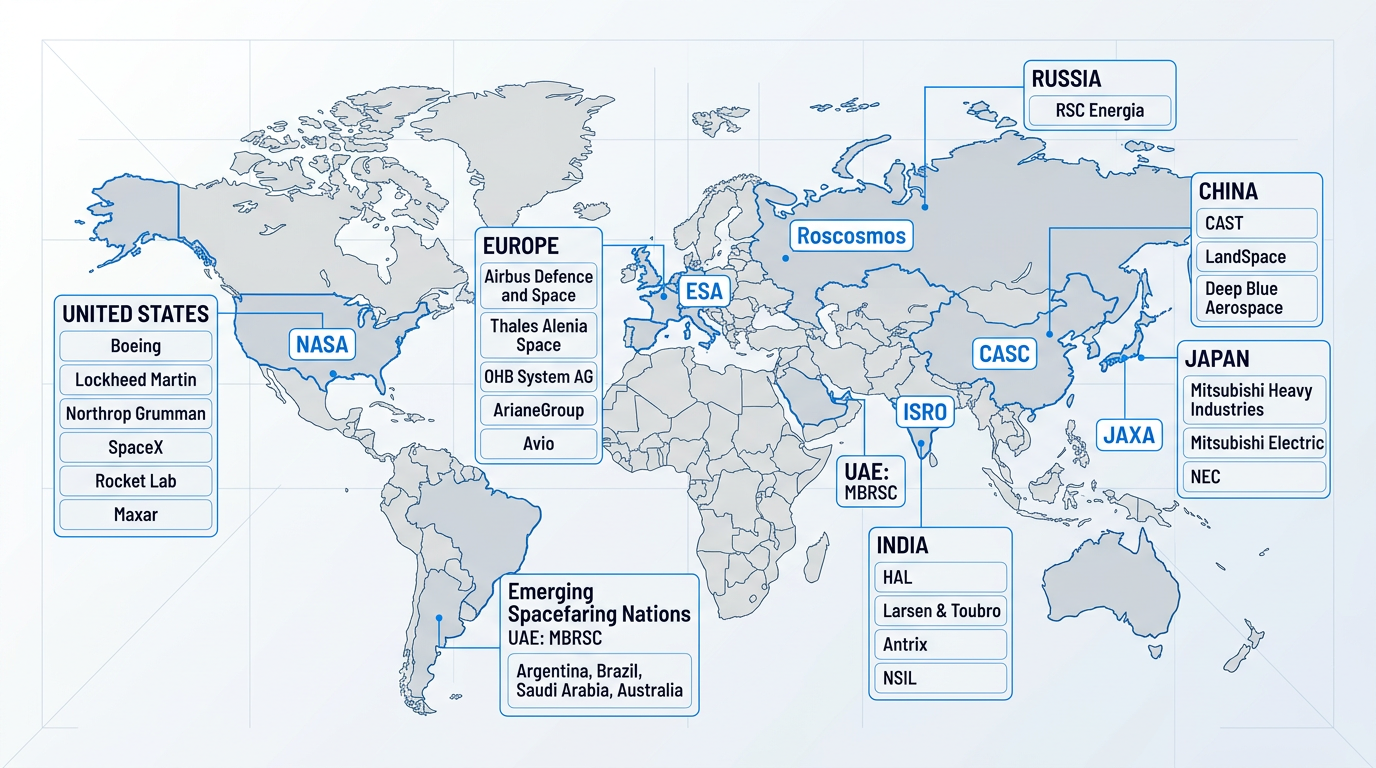
Every major spacefaring nation sits somewhere on a spectrum: at one end, fully state-owned vertically integrated structures (China, Russia); at the other, a commercially competitive industrial base anchored by government as the primary customer (the United States). The consistent pattern across all of them is that no significant spacecraft manufacturing base has emerged without active government intervention — through agency procurement, industrial policy, technology transfer mandates, or direct ownership.
United States
The United States hosts the world's largest and most commercially diverse spacecraft manufacturing base, with NASA serving as the foundational institutional customer around which the entire industrial ecosystem is organised.
That ecosystem has contracted sharply over the past four decades. According to the NASA Aerospace Commission Final Report, the US aerospace industrial base went from over 70 prime contractors in 1980 down to just five today — a consolidation that reflects both post-Cold War budget pressures and the economics of winner-take-most government procurement. The primes the reader has already encountered — Boeing, Lockheed Martin, Northrop Grumman — are the survivors of that contraction, now complemented by a new generation of commercially driven manufacturers including SpaceX, Rocket Lab, and Maxar.
Europe
ESA anchors the European industrial ecosystem through two interlocking policy mechanisms that directly shape which companies build what, and where.
The first is the Large System Integrator (LSI) framework — ESA's formal designation of a small number of companies as the prime integrators for large programmes. The current LSI list includes Airbus Defence and Space (operating across France, Germany, the UK, and Spain), Thales Alenia Space (France and Italy), OHB System AG (Germany's largest independent space company), ArianeGroup, and Avio.
The second mechanism is ESA's geographical return policy: member states' financial contributions to ESA programmes generate proportional industrial work back to those countries, ensuring every contributing nation maintains a stake in the supply chain. The practical effect is a distributed European industrial base rather than a single national champion.
According to the ESA 2026 Space Economy Report, European primes captured approximately 6% of the global upstream market and around 33% of their accessible upstream market in 2024 — the accessible market being the portion not locked away by captive institutional demand (US, Chinese, and Russian government programmes) or vertically integrated constellations such as Starlink. That 33% figure itself marks a significant decline from an average of roughly 60% of the accessible market in the decade 2005–2014.
Russia
Russia's spacecraft manufacturing industry is a state-dominated structure with deep roots in the Cold War design bureau system. RSC Energia is the historic prime contractor for Russian crewed systems, responsible for the Soyuz spacecraft and the Russian segment of the International Space Station — programmes that gave Russia a central role in human spaceflight for decades.
Russia held significant global launch market share historically: between 2002 and 2012, Russia conducted 40% of all successful space launches worldwide, and captured approximately 42% of the commercial launch market between 2004 and 2008, according to SpaceNews reporting on industry competitiveness data. That position has since eroded substantially, and the 2022 Ukraine conflict provided a sharp illustration of how geopolitics reshapes global supply chains: Northrop Grumman's Antares rocket depended on a Ukrainian-built first stage (manufactured by Yuzhmash in Dnipro) and Russian RD-181 engines from NPO Energomash — a dual dependency that became untenable overnight, forcing Northrop Grumman to partner with Firefly Aerospace to develop an entirely US-manufactured replacement vehicle.
China
CASC (China Aerospace Science and Technology Corporation) is China's dominant state-owned prime contractor, integrating launch vehicle development, satellite manufacturing, and spacecraft production under a single state-controlled enterprise. Within CASC, CAST (China Academy of Space Technology) — CASC's Fifth Academy — is the primary spacecraft and satellite manufacturer, responsible for the Shenzhou crewed spacecraft, Tianzhou cargo craft, and the Beidou navigation constellation, having served as prime contractor for more than 430 spacecraft as of 2023.
China's approach follows a deliberate state-led commercialisation model: state-owned enterprises build capability first, then selected segments are opened to private capital and market competition. As the JSIS/University of Washington analysis notes, the goal is not a retreat of state control but its restructuring — producing world-class manufacturers that remain state-backed while operating in market-oriented ways. Early-stage private players such as LandSpace and Deep Blue Aerospace represent the first visible results of this selective opening.
Japan
Japan's spacecraft manufacturing ecosystem is organised around JAXA as the institutional anchor, with a small number of large industrial partners carrying specific roles: Mitsubishi Heavy Industries (MHI) as prime contractor for launch vehicles (H-IIA and the successor H3), Mitsubishi Electric as the primary GEO satellite platform provider (DS2000 bus), and NEC as the developer of the NEXTAR satellite bus for smaller platforms.
Japan has deliberately structured its space programme to build domestic commercial capability alongside government missions. The H3 launch vehicle, developed by MHI as prime contractor in cooperation with JAXA from 2014, was explicitly designed with two stated objectives: assured access to space for Japanese government payloads, and competitiveness in the global commercial launch market — a recognition that domestic government demand alone cannot sustain a viable industrial base long-term.
India
ISRO remains the dominant actor in India's space sector, with HAL (Hindustan Aeronautics Limited) and Larsen & Toubro as the principal industrial partners — HAL handling SSLV technology transfer and crew capsule hardware for the Gaganyaan human spaceflight programme, and L&T supplying rocket boosters. India's commercial launch services are marketed internationally through two state-owned entities: Antrix Corporation (established 1992) and its successor NSIL (NewSpace India Limited), established in 2019.
The structural turning point came in June 2020, when the government opened the space sector to private companies for the first time — a deliberate policy shift that mirrors the intent of the US Commercial Crew model, if not yet its scale. India's space industry accounted for approximately $9 billion and 2–3% of the global space economy in 2023, with stated ambitions to quintuple its global market share by the end of the decade.
Emerging spacefaring nations
A growing cohort of nations has moved from buying space services to building domestic spacecraft manufacturing capability, following a recognisable pattern documented by the ESPI Report 79 on Emerging Spacefaring Nations: knowledge transfer from established partners, development of domestic industrial means, and eventual independent capability.
- UAE — MBRSC: Mohammed Bin Rashid Space Centre produced KhalifaSat (first 100% UAE-built satellite, 2018), the Hope Mars probe (with US university partners CU Boulder, ASU, UC Berkeley), and MBZ-SAT (launched January 2025).
- South Korea — KARI & Hanwha: KARI developed the Nuri (KSLV-II) three-stage launch vehicle; Hanwha Aerospace joined as prime contractor from the third launch onward, taking on manufacturing management and launch operations.
- Broader ESPI framework: Argentina, Brazil, Saudi Arabia, Australia, and others are at earlier stages of this same transition — acquiring capabilities before building independent manufacturing and launch infrastructure.
What the emerging-nations pattern reveals is that spacecraft manufacturing capability is not simply purchased — it is built through structured knowledge transfer, with government institutions deliberately engineering the conditions for domestic industry to absorb and eventually lead. The UAE's Hope probe is a clear illustration: the spacecraft was built in partnership with US universities precisely because the goal was capability acquisition, not just mission success.
About two-thirds of the global launch and manufacturing market is structurally inaccessible to European primes — locked away by captive US, Chinese, and Russian institutional programmes and vertically integrated constellations like Starlink. Europe's 33% share of its accessible market in 2024, down from roughly 60% a decade earlier, shows that competition is intensifying even within the reachable portion.
The geographic map of spacecraft manufacturing that exists today is not the product of market forces operating freely — it is the accumulated result of decades of Cold War competition, national industrial strategy, and government investment decisions. The next section traces how that map was drawn: from the Apollo-era industrial model through post-Cold War consolidation to the commercial era now reshaping every region covered here.
How Spacecraft Manufacturing Evolved to Its Current Form
No entrepreneur woke up in 1955 and decided to build a spacecraft company. The industry was not born from market demand — it was summoned into existence by geopolitical fear, and the structural choices made in those first urgent years still shape every prime contractor, every supply chain, and every commercial partnership visible in the industry today.
Cold War origins and the contractor model
The catalyst was Sputnik: the Soviet Union's launch of the world's first artificial satellite on 4 October 1957 sent a shockwave through Western governments that no commercial incentive could have replicated.
When Yuri Gagarin became the first human to orbit the Earth on 12 April 1961, the political pressure on the United States became existential — and President Kennedy's mandate to land a man on the Moon before the decade was out transformed that pressure into a procurement programme of unprecedented scale.
The US government's response was a structural choice that defined everything that followed: rather than building spacecraft in government facilities, Washington mobilised private industry through contractual relationships, with NASA acting as mission director and the technical integrator at programme level.
The Soviet model took the opposite path: state-owned design bureaux — most famously Sergei Korolev's OKB-1, the organisation that later became RSC Energia — were simultaneously customer, designer, and manufacturer, with the state holding all roles in a single institutional hand.
That American structural choice — government as customer and integrator, private industry as builder — produced the Apollo-era contractor ecosystem that established the template for the next fifty years of spacecraft manufacturing.
- North American Rockwell: Prime contractor for the Apollo Command and Service Module, the spacecraft that carried astronauts to and from the Moon.
- Grumman: Prime contractor for the Lunar Module, the only spacecraft designed to land humans on the Moon's surface.
- McDonnell: Prime contractor for the Mercury spacecraft, which carried the first American astronauts into orbit.
- Chrysler: Prime contractor for the Redstone rocket, which powered the first US suborbital human spaceflights.
- Convair: Prime contractor for the Atlas rocket, which launched the first American orbital crewed missions.
These companies were not simply suppliers filling a purchase order — they were cooperators embedded in a national programme, with engineers working alongside NASA counterparts in technical integration loops that blurred the boundary between government agency and private contractor.
Consolidation: from dozens of primes to a handful
The end of Apollo and the contraction of defence budgets through the 1970s and 1980s set off a long wave of mergers and acquisitions that fundamentally restructured the industry — the NASA Aeronautics Commission Final Report documents the result precisely: from over 70 suppliers in 1980 down to 5 prime contractors today.
The 1990s accelerated this dramatically: following the Cold War's end, the Pentagon signalled that defence spending would fall sharply, and contractors were told — explicitly — that there would not be enough work to sustain the existing number of independent primes.
The Evolved Expendable Launch Vehicle (EELV) programme produced one of the most visible consolidation outcomes: Boeing and Lockheed Martin, competing for national security launch contracts, ultimately merged their launch operations into United Launch Alliance, formed on 1 December 2006 as a DoD-facilitated joint venture.
The retirement of the Space Shuttle in July 2011 — after 30 years and 135 missions — removed the last major government-operated launch system and intensified the pressure on the remaining primes to absorb capability rather than compete for it.
By the early 2000s, US aerospace had consolidated from over 70 independent suppliers into 5 prime contractors. The barriers to entry were not just technical — they were relational: decades of cost-plus contracting had made deep government trust the industry's most durable competitive moat.
The first steps toward commercial spaceflight
The shift toward commercial spaceflight did not begin with any single company — it began with a series of structural cracks in the government-monopoly model, each one widening the space for private actors.
Arianespace, founded in March 1980, was the world's first commercial launch services company — created by ESA to sell launch capacity on the open market rather than serving government missions exclusively, establishing the legal and commercial precedent that space access could be a traded service.
The Challenger disaster on 28 January 1986 — which destroyed the orbiter 73 seconds after launch and killed all seven crew members — prompted the US government to deregulate the space transportation market, opening the door to private launch providers for the first time.
Russia's partial privatisation of RSC Energia in the 1990s, following the collapse of the Soviet Union, signalled that even the state-enterprise model was under pressure — though these were tentative steps rather than a clean break, and the legal frameworks they created mattered more than the immediate commercial volumes they generated.
NASA's pivot: buying services, not directing development
The most consequential structural shift of the modern era was NASA's deliberate decision to stop directing spacecraft development and start purchasing services from commercial providers — a model crystallised in the Commercial Orbital Transportation Services (COTS) programme and the Commercial Crew Program.
Under COTS, NASA provided seed funding and acted as anchor customer, but companies retained ownership of their vehicles and could sell capacity to other buyers — a fundamentally different incentive structure from the cost-plus contract model, which rewarded delivery to specification rather than commercial viability.
SpaceX's Dragon spacecraft became the clearest expression of this model: in 2012, Dragon became the first commercial spacecraft to deliver cargo to the International Space Station; in 2020, Crew Dragon carried the first operational commercial crew to the ISS under NASA's Commercial Crew Program.
The incentive shift was profound — manufacturers moved from a world of 'deliver to spec and bill cost-plus' to one where NASA was one customer among several, and building a sustainable commercial business was the measure of success.
Yet the legacy of the government-contract era did not simply dissolve: the Artemis programme's supply chain today spans more than 2,700 suppliers across 47 US states, a direct imprint of the Apollo-era model on the geography and structure of American aerospace manufacturing.
The commercial services model layers on top of this legacy rather than replacing it — the industry that emerged is not a clean break from its origins but a layered ecosystem, where the inherited architecture of government contracting coexists with a new generation of actors operating under entirely different rules, and it is that new generation the next section examines.
New Space: How Private Companies Reshaped the Industry
The term New Space gets used so loosely that it risks meaning everything and nothing — but the structural shift it describes is real, measurable, and still unfolding across every tier of the spacecraft manufacturing industry.
At its core, New Space is a cultural and structural distinction rather than a regulatory category or a measure of company age. Old Space — the traditional primes — grew up on cost-plus government contracts, where the incentive was technical perfection over schedule and cost efficiency. New Space companies entered with commercial capital, entrepreneurial governance, willingness to use commercial off-the-shelf (COTS) technology, and a deliberate intent to move faster than the government-contract model permitted.
According to analysis published in SpaceNews, the New Space economy has progressed through successive waves that differ in how private capital is deployed, where market activity is concentrated, and what the key success factors are.
- First Wave: Proving the model: SpaceX demonstrated that private capital could succeed in orbital launch, dramatically reducing cost through reusability and vertical integration — the foundational disruption.
- Second Wave: Enthusiastic expansion: Private capital flooded the broader space economy — smallsat constellations, Earth observation, broadband LEO networks — characterised by high investment and rapid company formation.
- Third Wave: Maturing market: Emphasis shifts from growth at any cost to business-model viability, selective outsourcing, and partnership with terrestrial market leaders. This is the wave the industry is currently navigating.
The Third Wave is defined by a qualitative shift: enthusiasm tempered by the realities of unclear government funding beyond initial demonstrations, abundant competition, and inevitable technical challenges, as SpaceNews analysis of the New Space economy has documented.
SpaceX sits at the centre of the First Wave's structural argument — not because of the company itself, but because of what it changed for everyone else. Reusable rockets altered the economics of launch across the entire industry; SpaceX's own analysis acknowledged that reusability, high launch rates, and low-cost access to space are closely linked elements of a virtuous circle.
Vertical integration — designing, manufacturing, launching, and operating in-house — became the competitive model that other companies had to respond to. Starlink is the clearest example of the self-funding incremental revenue model that Third Wave analysis prizes: the constellation generates revenue that funds continued launch development, creating a reinforcing loop that purely launch-focused competitors cannot easily replicate.
The manufacturing philosophy shift that New Space catalysed is equally significant. Where traditional satellite programmes were bespoke, multi-year endeavours built to exquisite specifications, New Space introduced assembly-line approaches, compressed schedules, and COTS components.
Planet Labs described its approach as "agile aerospace" — rapid iteration, in-house manufacturing, and a preference for testing in orbit rather than over-qualifying on the ground. ICEYE miniaturised synthetic aperture radar satellites to under 100 kg, enabling a constellation architecture that would have been unthinkable under the traditional bespoke model.
Rocket Lab extended the logic further, positioning itself as an end-to-end space company offering launch, spacecraft bus (Photon), and satellite components as an integrated service — selling access to a complete mission stack rather than individual hardware elements.
These manufacturing shifts connect directly to a broader business-model transformation: the rise of Space as a Service. Instead of selling hardware, companies sell access to capability — satellite as a service, ground station as a service, data as a service. The economics change fundamentally: capital expenditure shifts to the provider, and customers pay for outcomes rather than assets.
Two metrics distinguish viable Third Wave companies from Second Wave casualties. The first is the productive volume-to-support ratio: the proportion of a system that generates user value relative to what is required simply to keep it operating. The second is self-funding incremental revenue streams — clear stages of effort that generate revenue progressively, allowing internal reinvestment without depending on a single large funding event.
How Traditional Primes Have Responded
The narrative that New Space would displace established primes has not materialised. Instead, as Aviation Week's analysis of traditional OEMs noted, companies like Lockheed Martin, Northrop Grumman, and Boeing are leveraging their core advantages — cash, technology depth, and long-standing government relationships — to maintain a substantial role in the emerging architecture.
- Lockheed Martin: SDA Transport Layer: Won SDA satellite contracts totalling 88 spacecraft across Transport and Tracking Layer programmes, competing directly in the proliferated LEO architecture New Space helped create.
- Northrop Grumman: GEOStar-3 for PTS-P: Building Protected Tactical Satcom prototypes for the U.S. Space Force using its GEOStar-3 bus, combining legacy GEO capability with new protected-waveform mission requirements.
- Boeing: Millennium Space Systems: Boeing's subsidiary operates a dedicated smallsat factory in El Segundo, applying agile rapid-prototyping culture to constellation-scale production for defence and commercial customers.
The ecosystem is layering rather than replacing. Primes retain clear advantages for large exquisite GEO satellites and complex government programmes, while New Space challengers have carved out the high-volume, faster-cycle segments — and increasingly the two coexist and collaborate.
Across both established primes and New Space entrants, one structural shift is now a baseline requirement: software-defined satellite payloads. Boeing's 702X platform delivers fully software-defined payloads with thousands of steerable beams that can be reprogrammed on orbit to adapt coverage, power, and bandwidth as mission needs evolve. Thales Alenia Space's Space Inspire platform offers comparable in-orbit reprogrammability.
As SpaceNews reported, software-defined capability has shifted from a wish-list feature to an operator requirement — commercial customers now demand solutions that can adapt to evolving standards at every tier of the supply chain, from prime contractor down to component and ground infrastructure specialist.
That demand for configurability extends beyond the satellite itself to the ground infrastructure supporting it. As high-resolution Earth observation constellations and broadband LEO networks drive satellite data throughput higher, free-space optical communications are emerging as the path beyond congested RF spectrum for high-throughput satellite ground links.
NASA's TBIRD mission demonstrated 200 Gbps downlink from a LEO nanosatellite — orders of magnitude beyond what X-band RF links can support — and ESA's Hydron initiative is building towards a fully optical satellite communications network. Optical frequencies are currently unregulated, carry far greater bandwidth than radio, and sidestep the licensing constraints of the RF spectrum.
Woodrow Scientific Limited's EDFA for satellite ground links is a concrete example of the infrastructure component this shift demands. The amplifier's defining characteristic is its single-beam beacon-and-data architecture: the tracking beacon and uplink data are nested in one amplified beam, with the beacon riding low and the data above it — an approach that simplifies ground station design considerably.
The amplifier is configured end-to-end across both hardware and software to the client's ground station. Hardware parameters — band (C-band, L-band, or dual-band from a single source), output power, emitter configuration, and cooling — are set at build.
The software layer runs WSL's Modulation-on-Demand, providing software-selectable waveform, frequency, modulation index, and combined beacon-plus-data modulation, switchable to CCSDS or SDA standards at high power across C/L-band. This depth of end-to-end hardware-and-software configurability is WSL's distinguishing approach — not the kind of flexibility a reseller or catalogue supplier can offer.
Standards in optical ground communications are still evolving, so an amplifier that can switch between SDA, CCSDS, and proprietary standards in software protects the ground station investment as the ecosystem matures. WSL is a UK manufacturer — founded in 2012, designing, building, qualifying, and supporting its amplifiers entirely in-house on patented technology, with engineering expertise rooted in Southampton's Optoelectronics Research Centre, the birthplace of the EDFA.
In a supply chain where many optical amplifier suppliers are resellers or importers rather than original manufacturers, that distinction carries practical consequences: in-house design means deeper engineering support, faster resolution of technical issues, and the genuine ability to configure the product for a specific programme. The amplifier carries CE and UKCA certification.
Spacecraft manufacturing has moved from a government-directed, hardware-sales model to a commercially competitive ecosystem where software-definability, service-model economics, and self-funding revenue streams determine which companies survive the Third Wave.
The forces shaping the industry today — the interplay between established primes and New Space entrants, the globalisation of manufacturing capacity, and the deepening integration of software into every layer of the supply chain — are the themes the concluding section of this guide draws together.
Conclusion
The spacecraft industry: where it stands and where it's heading
What this guide has traced is not a story of disruption replacing tradition, but of layered coexistence: the established primes that were built by governments still anchor the most demanding missions, while a new generation of commercially driven manufacturers has reshaped every tier around them, from launch to satellite production, in ways that were structurally impossible two decades ago.
Each market segment and each emerging spacefaring nation carries its own next chapter — the map drawn here is a foundation, not a ceiling.
Frequently asked questions about spacecraft companies
Common questions about how the spacecraft manufacturing industry works, who the key players are, and how the sector has evolved.
Space agencies — such as NASA, ESA, ISRO, and JAXA — are government bodies that fund, direct, and oversee space programmes. Spacecraft companies are private-sector or state-owned enterprises that design, build, and sometimes operate the hardware. Crucially, most spacecraft are manufactured by industry under contract to a space agency, not built by the agency itself. That contractor relationship is the structural foundation on which the entire spacecraft manufacturing industry is organised.
A prime contractor holds the main contract with the customer — whether a government agency or a commercial operator — and is solely accountable for delivering the complete, functioning system on time, within budget, and to the agreed technical specification. It manages all subcontractors and suppliers beneath it. What distinguishes a prime from a component specialist or subcontractor is the integration role: the prime assembles subsystems sourced from dozens or even hundreds of suppliers into the finished vehicle, and carries full programme responsibility for the result.
The count is large and growing rapidly. ASU's NewSpace Initiative was tracking nearly 900 companies that had entered the industry — up from around 500 just a year earlier — illustrating the pace of growth. The ESA 2026 Space Economy Report values the upstream spacecraft manufacturing and launch services market at €75 billion, reflecting the industry's substantial scale. The precise total depends heavily on definition: a company building smallsat components counts differently from a prime contractor delivering complete spacecraft. The growth trajectory, rather than any single figure, is the key insight — the sector is expanding faster than any previous point in its history.
Old Space (or traditional space) companies are typically large defence and aerospace primes — Boeing, Lockheed Martin, Northrop Grumman, Airbus — that grew up on cost-plus government contracts, building bespoke hardware over long development cycles. New Space companies are entrepreneurial, commercially funded entities that apply modern manufacturing techniques, commercial off-the-shelf components, and business models built around services rather than hardware sales. The boundary between the two is increasingly blurred: some traditional primes have acquired New Space subsidiaries, and some New Space companies now win substantial government contracts.
The United States has by far the largest and most diverse spacecraft manufacturing industrial base, home to prime contractors, launch providers, satellite manufacturers, and a rapidly expanding commercial sector. Europe — led by France, Germany, the UK, and Italy — and China form the next largest clusters, each with established primes and growing commercial players. Japan, Russia, and India each maintain significant national programmes. The number of countries with active spacecraft manufacturing capability is growing, with South Korea and others establishing domestic industries in recent years.
Spacecraft companies serve six principal segments: human spaceflight (crew vehicles, space stations, lunar landers); Earth observation (optical and radar imaging satellites); communications (GEO broadband satellites and LEO constellations); navigation (GPS, Galileo, BeiDou); scientific and deep space exploration; and defence and national security (reconnaissance, missile warning, secure communications). Most large prime contractors serve multiple segments simultaneously across their programme portfolios, while New Space companies typically focus on one or two — often Earth observation or communications — where commercial demand is strongest.
The SpaceX Falcon 9 proved the concept: landing and re-flying orbital-class rocket boosters is economically viable, and it dramatically reduced the cost of access to orbit. With over 300 booster landings and individual boosters flown up to 20 times, the Falcon 9 established reusability as a commercial standard rather than an experimental ambition. The competitive response has been significant. Blue Origin's New Glenn became the second company to recover an orbital booster. Rocket Lab's Neutron, a reusable medium-lift vehicle designed from the outset for rapid re-flight, is in development targeting its debut in the second half of 2026. ArianeGroup and ESA are developing the Themis demonstrator to lay groundwork for European reusable systems. The downstream effect has been transformative: reusability underpins the economics of large LEO constellations such as Starlink that would have been financially unviable with expendable rockets alone.