

Introduction
This guide is written for engineers, operators, and procurement professionals who need to understand grit blasting at a working level — not just its name, but how it actually behaves.
You'll find coverage of the mechanics, the abrasive media options and what each one does to a surface, how to match media to substrate and application, and the operational layer that separates consistent results from costly rework.
Whether you're evaluating the process for the first time or looking to sharpen decisions you've been making by habit, the detail is here.
TL;DR
Grit blasting is a precision process, not a commodity task. The surface profile you achieve is a direct product of media choice, blast parameters, and process discipline — and that profile determines how well a coating bonds and how long a component lasts.
Getting it right means understanding the variables, not just repeating what worked last time.
This article covers:

How grit blasting works mechanically
Abrasive media types and surface outcomes
Matching media to substrate and application
Industrial applications and why grit blasting is preferred
Grit blasting vs sandblasting and modern alternatives
Process control, dust management, and media economics
What is Grit Blasting?
Before a coating can bond properly to steel, before a corroded structure can be returned to service, before a fabricated component can meet its specification — the surface has to be prepared. Grit blasting is the industrial process that makes that preparation possible, and it does so more completely than any other single method.
At its core, grit blasting propels abrasive media — hard, angular particles — at high velocity against a surface to simultaneously strip contaminants, clean the substrate to a defined standard, and create a textured profile that gives coatings something to grip.
How Abrasive Particles Are Propelled
There are two primary ways the abrasive is delivered to the surface, and the choice between them shapes the entire setup of a blasting operation.
- Compressed air (pressure blasting): A pressurised stream of abrasive is directed at the surface through a nozzle. Well suited to on-site work, selective-zone blasting, and components with complex or variable geometry.
- Centrifugal wheel: A high-speed rotating wheel flings abrasive across the surface mechanically. Suited to high-volume, automated applications such as structural steel fabrication shops.
Both mechanisms deliver the same fundamental outcome: abrasive particles strike the surface at speed, transferring kinetic energy into the substrate.
At the point of impact, that energy does two things at once: it physically dislodges contaminants — rust, mill scale, old coatings, surface oils — and it deforms the substrate surface itself, leaving microscopic indentations in its wake.
Across the entire treated area, those indentations accumulate into what practitioners call the surface profile: a microscopic peak-and-valley topography that replaces the original flat or corroded surface.
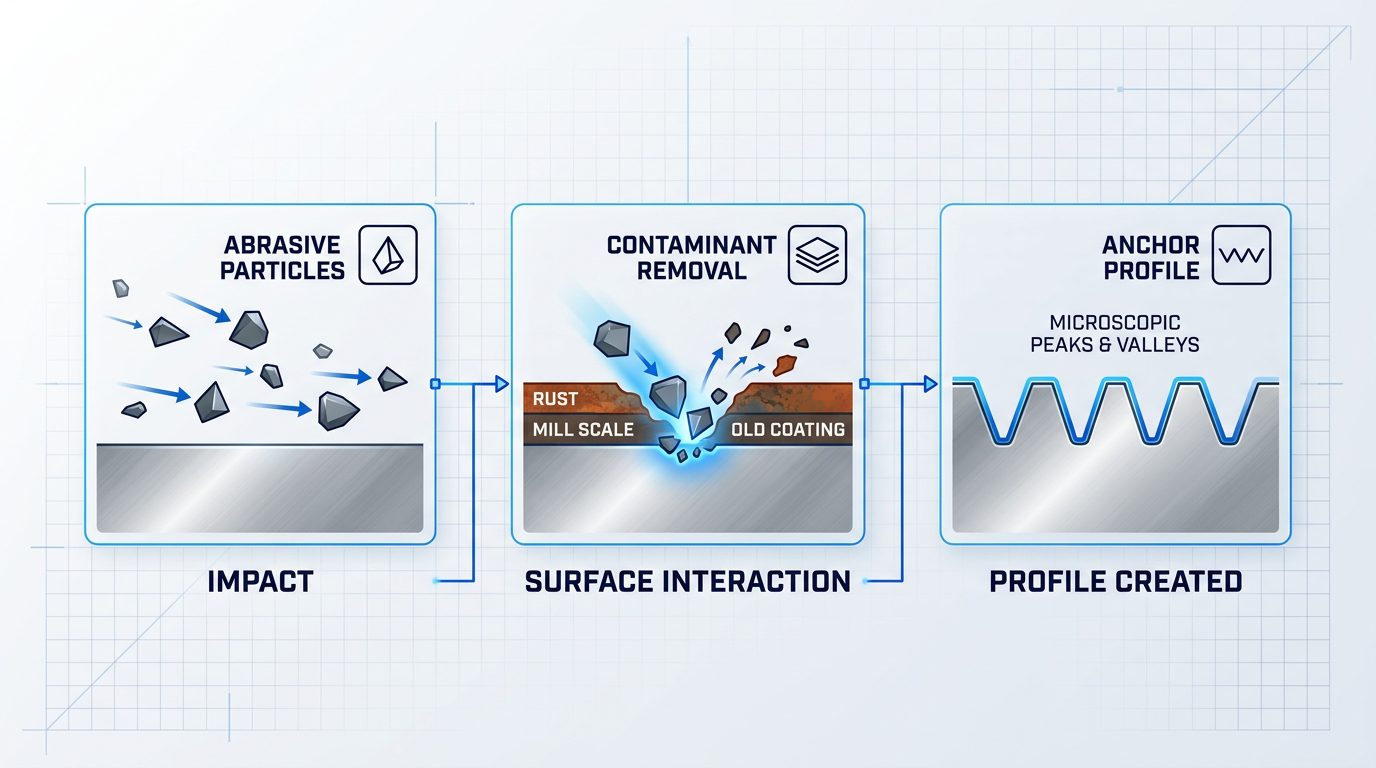
When that profile is created specifically to provide mechanical grip for a protective coating, it is referred to as an anchor profile — the term used throughout coating specifications to describe the controlled surface texture a coating system requires for adhesion.
Grit vs Shot: Why Particle Shape Matters
The term "grit" is not interchangeable with "shot," and the difference is more than nomenclature — it determines the character of the surface produced.
Grit particles are angular and irregular; they cut into the surface on impact, producing an etched, angular profile with sharp peaks that coating systems are designed to bond to.
Shot particles are spherical; they peen the surface rather than cut it, producing a smoother, compressive profile better suited to stress relief and surface hardening than to coating adhesion.
In coating and corrosion protection workflows, this distinction is decisive: where an anchor profile is specified, grit — not shot — is the correct choice.
Grit blasting simultaneously removes contamination, cleans the substrate to a defined standard, and creates a controlled anchor profile. No other single surface preparation method reliably delivers all three at industrial scale.
That combination is why grit blasting is the default surface preparation method across sectors where coating performance is safety- or service-critical: oil and gas, structural steel, marine, and aerospace all depend on it as the foundation of their coating and fabrication workflows.
Knowing what grit blasting achieves is the starting point — the more revealing question is how it achieves it, and that comes down to the physics of what happens in the fraction of a second an abrasive particle spends in contact with a surface.
How Grit Blasting Works: Energy, Impact, and Surface Profile
Every outcome in grit blasting — the depth of the texture, the quality of the coating bond, the service life of the finished structure — traces back to what happens in the fraction of a second when an abrasive particle strikes steel.
The Physics of Impact: Three Variables That Matter
Three input variables determine how aggressively a particle attacks a surface: its mass (a product of size and density), its velocity (set by blast pressure and propulsion method), and its angularity — the sharpness of its cutting edges.
Together, these three factors determine the energy delivered at the point of impact, which in turn determines the depth and character of the texture left behind.
A heavier, faster, sharper particle cuts deeper into the surface. A lighter, slower, or rounder particle peens rather than cuts, leaving a shallower, more uniform impression. This is not incidental — it means the profile outcome is directly controllable through media selection and blast parameters.
The Anchor Profile: What the Surface Looks Like After Blasting
When abrasive particles dig into a steel surface on impact, they displace material to create a landscape of microscopic peaks and valleys across the entire substrate. This textured result is called the surface profile, or anchor profile.
The scale is small but consequential: profiles are measured in microns (µm) or mils (thousandths of an inch, where 1 mil equals approximately 25 microns), typically ranging from around 25 µm to 100 µm for most industrial coating applications.
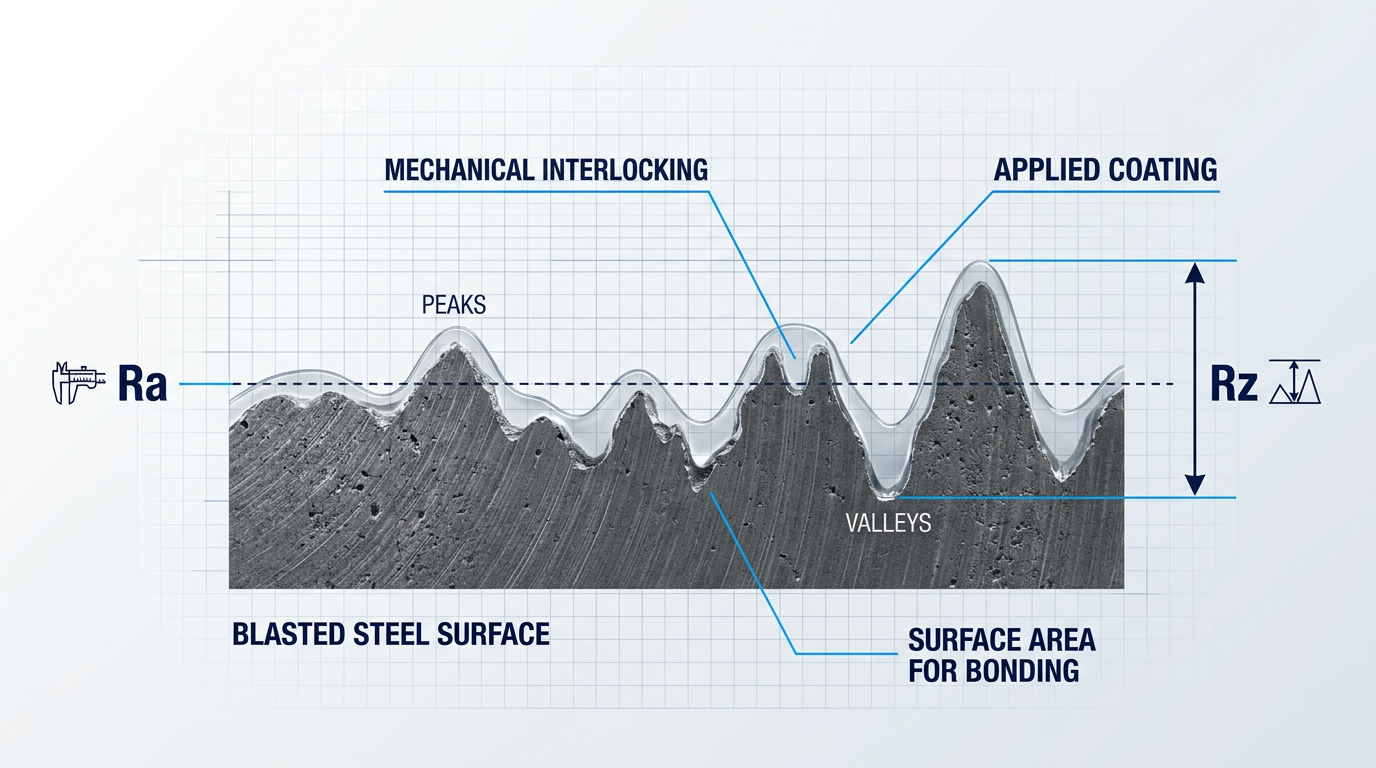
Two parameters appear repeatedly in coating specifications and inspection reports. Ra is the arithmetic mean roughness — it averages the height deviations across the profile to give an overall sense of surface texture. Rz is the mean peak-to-valley height — it captures the distance between the highest peaks and lowest valleys and is generally the more relevant measure for coating performance, since it reflects the extremes the coating must bridge.
Why the Profile Matters: Mechanical Interlocking and Adhesion
Coating adhesion to a blasted steel surface is primarily mechanical: the liquid coating flows into the peaks and valleys of the anchor profile and, once cured, is physically locked into the surface texture — a process known as mechanical interlocking.
A deeper, more uniform profile increases both the surface area available for bonding and the mechanical grip the cured coating achieves. This is the direct link between the grit blast process and the coating's long-term service life.
As one industry source notes, an improperly prepared surface is a reliable way to shorten a coating's service life — the profile must be correct before application, not merely adequate.
Measuring the Profile in the Field
Before any coating is applied, an inspector verifies that the blast has achieved the profile the specification requires. Two methods are used on real job sites.
- Replica tape: Standardised under ISO 8503-5 and NACE SP0287. A compressible tape is pressed into the blasted surface, taking a physical impression of the profile. The resulting thickness is measured with a micrometer to determine average peak-to-valley depth.
- Digital surface profile gauge: Standardised under ASTM D4417. An electronic instrument measures profile depth directly, providing rapid readings across the surface. Used alongside replica tape or as a primary method depending on specification requirements.
Both methods exist because the profile cannot be assessed reliably by eye or by touch alone — the texture operates at a scale where subjective judgement fails. ISO 8503-5 and NACE SP0287 govern the replica tape procedure; ASTM D4417 governs digital gauge measurement.
When the Profile Is Wrong: Under- and Over-Profiling
Under-profiling — a profile that is too shallow — provides insufficient mechanical interlocking. The coating may appear to adhere initially but lacks the grip to perform under service conditions, leading to delamination, blistering, and premature corrosion.
Over-profiling presents the opposite, and less intuitive, problem. When peaks are taller than the applied coating is thick, those high points are left exposed or inadequately covered by the coating film.
Peaks that exceed the applied coating thickness are the first points to corrode in service — a phenomenon known as rash rust or peak rust. The coating over the valleys may be performing well while the peaks are already failing. Achieving the right profile, not simply the deepest one, is what the specification requires.
This dual failure mode is the practical argument for measurement and process control: blasting aggressively is not the same as blasting correctly.
Cleanliness and Profile: Two Separate Specifications
Surface profile depth does not operate in isolation. Coating specifications typically define two distinct quality parameters: a cleanliness grade — how thoroughly contaminants, rust, and mill scale have been removed — and a profile depth requirement.
Cleanliness is governed by two parallel frameworks. ISO Sa grades (Sa 1 through Sa 3) define levels of blast-cleaned surface cleanliness under the international standard ISO 8501-1. SSPC-SP grades provide the equivalent North American framework — SSPC-SP 5 (White Metal), SSPC-SP 6 (Commercial Blast), and SSPC-SP 10 (Near-White Metal) are the three most commonly specified for protective coating work.
A surface blasted to SSPC-SP 10 / Sa 2.5 cleanliness but with an inadequate profile will still underperform. Neither parameter substitutes for the other — a complete specification demands both.
With the physics of impact and profile creation established, the natural next question is which abrasive media produces which profile outcome — and that is where the guide turns next.
Abrasive Media Types: Properties and Surface Outcomes
Two grit blast operations can use the same equipment, the same blast pressure, and the same substrate — and still produce completely different surfaces. The reason lies in the abrasive media itself. Once you understand what a surface profile is (as covered in the previous section), the next question is what creates it — and the answer comes down to three physical properties of the abrasive particle: its shape, its hardness and toughness, and its particle size.
Particle shape is the most immediately decisive factor. Angular particles cut aggressively into the surface, gouging out deep peaks and valleys that form a pronounced anchor profile. Subangular particles balance cutting speed with surface quality, producing a consistent profile with less risk of embedment. Rounded or spherical particles peen the surface rather than cutting it, compressing and smoothing the metal rather than etching it — which produces a fundamentally different outcome for coating adhesion.
The Main Abrasive Media Types in Grit Blasting
- Steel Grit: Angular tempered martensite structure. Cuts aggressively to produce a deep etched anchor profile. Available in four hardness grades (GS, GM, GL, GH: 40–60+ HRC) that directly control profile depth and aggressiveness.
- Brown Fused Aluminium Oxide: Mohs hardness 9, blocky shape with sharp cutting edges, no free silica. Produces consistent etched profiles on nonferrous and precision substrates without metallic contamination risk.
- Almandine Garnet: Naturally occurring mineral, Mohs 7.5–8.0, subangular shape. Balances fast cutting with surface quality; produces low dust and minimal particle embedment compared to more angular alternatives.
- Glass Bead: Spherical shape produces a smooth peened finish rather than an etched anchor profile. Used for surface brightening and finishing — not where high-adhesion coating profiles are required.
The pattern across these media is clear: angular metallic and mineral abrasives dominate applications where a coating must bond under demanding service conditions, because only an etched anchor profile provides the mechanical interlocking that makes that bond durable. Glass bead occupies a distinct category — its spherical particles cannot produce that profile, so it serves finishing and peening applications where the goal is surface brightness or compressive stress, not coating adhesion.
It is worth noting the distinction between steel grit and steel shot: shot particles are rounded, and like glass bead, they peen rather than etch. The two are sometimes blended to tune the profile outcome, but they are not interchangeable. A separate niche variant, stainless steel grit, is used where standard carbon steel grit would cause iron contamination on sensitive substrates such as stainless steel.
Hardness, Friability, and Particle Size
Hardness and toughness are related but distinct properties, and the distinction matters in practice. A hard particle cuts aggressively into the substrate — but hardness alone does not determine how long it keeps cutting. A friable particle shatters on impact, dissipating its kinetic energy as dust and fragments rather than transferring it to the surface. The ideal abrasive is both hard and tough: it cuts deeply on impact and maintains its cutting geometry through subsequent impacts.
Steel grit and brown fused aluminium oxide exemplify this combination. Steel grit's tempered martensite microstructure gives it both the hardness to etch aggressively and the toughness to survive repeated impacts — which is why it can be recycled approximately 200 times in enclosed blast-room operations. Aluminium oxide, with a Mohs hardness of 9 and a blocky crystalline structure, similarly resists fracture while maintaining sharp cutting edges across many cycles.
Particle size is the third tuning parameter. Larger particles deliver more kinetic energy per impact, producing deeper profile peaks — but they cover fewer impact points per unit area, so the profile is coarser. Smaller particles produce more impacts per cm², creating a denser, more uniform peak distribution and a lower average Ra/Rz value. Selecting particle size is therefore not just a procurement decision; it is a direct control over the profile characteristics the coating specification requires.
The toughness that makes steel grit cut aggressively without shattering is precisely what allows it to survive ~200 blast cycles. High recyclability in enclosed blast rooms is not a separate feature of steel grit — it is a direct consequence of its material structure. This is why media hardness grades matter beyond their effect on profile depth.
Understanding what each abrasive does to a surface is the foundation — but knowing the properties is only half the picture. The next question is how to match those properties to a specific substrate, coating specification, and operational context, which is where media selection logic comes in.
Choosing the Right Abrasive Media: Substrate, Profile, Application
Most media selection mistakes are not made by people who don't care — they're made by people who default to habit, or who optimise for the wrong variable.
The consequences show up later: a coating that delaminated, a component that corroded under the finish, a job that consumed twice the expected media volume.
Start With the Coating Specification
The coating specification is the correct starting point for any media selection decision — not the operator's preference, not what was used on the last job, and not what happens to be in the hopper.
The specification defines the required surface profile, and the guiding principle from there is to use the finest grade of media that will reliably achieve it.
Coarser is not inherently better: as covered in the surface profile section, over-profiling creates peaks that can rust through thin coatings, while also wasting media and accelerating substrate wear.
Substrate Sensitivity: Ferrous vs Nonferrous
Steel grit is not appropriate for stainless steel — ferrous particles from the media can become embedded in the substrate surface, creating conditions for galvanic corrosion that will undermine the stainless even beneath a coating.
For stainless steel, aluminium, copper alloys, and titanium, aluminium oxide and garnet are the preferred choices: chemically inert, non-contaminating, and capable of producing the angular profiles these substrates require.
Angularity: Matching Media Shape to Coating Type
Angular media — steel grit, aluminium oxide, garnet — cuts into the surface and creates the etched anchor profile that high-performance coatings such as epoxies, polyurethanes, and thermal spray systems rely on for mechanical interlocking.
Rounded media — glass bead, steel shot — peens the surface rather than etching it, producing a smoother, compressive finish suited to deburring and stress-relief applications, not to coating adhesion where a specific anchor profile is required.
Specifying a high-build coating system over a peened surface is a reliable route to adhesion failure: the coating has no anchor profile to key into, regardless of how well it is applied.
Match Media Aggression to Contamination Severity
Heavy rust, mill scale, thick paint systems, and weld spatter call for coarser, more aggressive media grades to reach the required cleanliness standard efficiently.
Light rust, thin primers, and surface oxides are better served by finer grades — deploying coarse media against light contamination over-profiles the surface and risks damaging a substrate that didn't need that level of aggression.
Recyclability and Operational Economics
In an enclosed blast room with media recovery, the economics favour highly recyclable media: steel grit and metallic garnet complete many cycles before degrading, and the cost-per-square-metre falls significantly across a production run.
On open sites, or in single-pass applications without a recovery system, the calculation shifts toward expendable media — mineral garnet or aluminium oxide used once — where cost-per-use rather than cost-per-cycle is the relevant metric.
The true economic measure of abrasive media is cost-per-square-metre of prepared surface — which accounts for consumption rate, cycle life, production speed, and disposal burden, not just the upfront purchase price.
A media that appears cheaper per tonne can cost significantly more in practice if it degrades faster, generates more waste, or requires additional passes to achieve the required cleanliness grade.
Common Selection Mistakes and Their Consequences
The most consequential media selection errors are repeating patterns — each with a clear, avoidable mechanism.
- Media too coarse for the task: Over-profiles the surface, accelerates substrate wear, and wastes abrasive without improving cleanliness grade or coating adhesion performance.
- Rounded media where angular is specified: Glass bead or shot on a surface requiring an etched anchor profile leads to adhesion failure — the peened surface cannot mechanically interlock with the coating.
- Buying on price-per-tonne alone: Ignores consumption rate, cycle life, disposal cost, and production speed — the variables that determine actual cost-per-square-metre on the job.
- Ferrous media on non-ferrous substrates: Embedded iron particles risk galvanic corrosion in stainless steel, aluminium, and copper alloys, undermining the substrate even when the coating appears intact.
Each of these mistakes reflects the same underlying error: treating media selection as a procurement decision rather than a technical one.
With the selection framework in place, it is useful to see how these principles apply across the industries where grit blasting is the established standard preparation method — and why the specific media and cleanliness grades used in each sector reflect exactly the reasoning covered here.
Where Grit Blasting Is Used and Why
Most surface preparation methods can clean a surface. Far fewer can simultaneously remove contamination, strip existing coatings, and create a controlled anchor profile to a verifiable standard — all in a single pass, at industrial scale. That combination is why grit blasting is not just one option among many in demanding industrial environments; it is the default method around which coating specifications are written.
High-performance coating systems fail for a predictable set of reasons: residual contamination undermining adhesion, inadequate surface profile preventing mechanical interlocking, or existing coatings not fully stripped before recoating. Abrasive blasting addresses all three in a single operation — which is precisely why AMPP's technical research identifies it as the preferred method for preparing steel for high-performance coatings.
Grit blasting is the preferred method in demanding industrial environments because it is the only field-applicable process that simultaneously removes contamination, strips existing coatings, and creates a controlled anchor profile to a verifiable cleanliness standard — no other single method delivers all three at scale.
Where Grit Blasting Is the Industrial Standard
Across the sectors below, the same logic repeats: the coating system's performance requirements drive the surface preparation standard, and grit blasting is the method that reliably meets those standards at the throughput industrial operations demand.
- Oil and Gas: Pipelines, storage tanks, and offshore structures require SSPC-SP 10 / ISO Sa 2.5 near-white blast as the minimum for immersion and high-performance coating systems. Grit blasting is the standard method because no other field-applicable process achieves this cleanliness grade reliably at scale.
- Structural Steel and Fabrication: Bridges, wind towers, and rail cars are typically prepared to SSPC-SP 6 commercial blast or SSPC-SP 10 near-white. Centrifugal wheel blast machines — where a single wheel matches the output of eight blast nozzles — handle the throughput demands of large fabrication programmes.
- Marine and Shipbuilding: IMO PSPC specifies Sa 2.5 cleanliness and a 30–75 µm surface profile for new-build ballast tanks, with abrasive blasting as the only specified preparation method. In confined tank spaces, low-embedment media also matters: embedded particles can cause premature coating failure.
- Automotive and Aerospace: Component cleaning, pre-weld prep, and surface preparation for thermal spray coatings demand tight profile consistency. In aerospace, bond coats on turbine components require a specific profile depth for the mechanical interlocking the coating system depends on.
The pattern across all four sectors is consistent: the coating system's performance requirements — not the preference of the operator — dictate the surface preparation standard, and grit blasting is the method that meets those standards reliably, verifiably, and at the throughput these industries require.
It is also worth noting that the standards themselves reflect the stakes. SSPC-SP 10 is not a specification written for administrative convenience — it exists because coating failure on an offshore structure or a pipeline has consequences that dwarf the cost of the surface preparation step. The same logic applies to IMO PSPC in shipbuilding: the 30–75 µm profile requirement and Sa 2.5 cleanliness standard are the minimum conditions under which a ballast tank coating system can be expected to deliver its intended service life.
Understanding why grit blasting is the standard in these sectors naturally raises a further question: what abrasive media does the process actually use, and how has that changed over time? That is the subject of the next section.
Grit Blasting vs Sandblasting: What Changed and Why
Many people use sandblasting and grit blasting interchangeably — and in terms of the propulsion process, they are describing exactly the same thing. The distinction that matters, and the reason the terminology shifted, comes down to one of the clearest occupational health cases in industrial history.
Both terms describe abrasive particles propelled at high velocity against a surface using compressed air or a centrifugal wheel. The difference is the medium: sandblasting originally used silica sand; grit blasting uses non-silica abrasive media such as steel grit, garnet, or aluminium oxide. The word "sandblasting" persists in everyday speech, but it is technically obsolete in professional and regulatory contexts — and the reason for that shift is not bureaucratic tidiness.
When silica sand is propelled at a surface at high velocity, it fractures into fine particles that become airborne. Inhaling those particles — known as respirable crystalline silica (RCS) — causes silicosis: a progressive, irreversible lung disease with no cure. According to the HSE, silicosis results in fibrosis of the lung tissue, severe shortness of breath, and can be fatal; the disease continues to develop even after exposure has stopped, and sufferers often become house- or bed-bound.
The health evidence was strong, well-documented, and acted upon. The UK was among the first to respond: the Blasting (Castings and Other Articles) Special Regulations 1949, made under the Factories Act 1948, prohibited the use of sand or any substance containing free silica as an abrasive in blasting apparatus, coming into force on 1 January 1950. That prohibition was later carried forward into the Control of Substances Hazardous to Health (COSHH) Regulations, Schedule 2 of which prohibits substances containing 1% or more of free silica for the blasting of articles.
Other jurisdictions followed. According to multiple CDC/NIOSH publications, the use of crystalline silica for abrasive blasting was restricted in other European countries in 1966. In the United States, NIOSH recommended in 1974 that silica sand — or any substance containing more than 1% free silica — be prohibited as an abrasive blasting material; OSHA, which under US law cannot ban substances outright, has regulated silica dust exposure through permissible exposure limits, most recently setting a PEL of 50 μg/m³ in its 2016 final rule.
The regulatory response across these jurisdictions was not precautionary — it reflected well-established evidence that silicosis among blasters was a clearly preventable occupational disease, and that the hazard could not be adequately controlled while silica sand remained the blasting medium.
Silicosis is entirely preventable by substituting less hazardous abrasive materials. The UK acted in 1950, European countries in 1966, and NIOSH made its recommendation in 1974 — yet the CDC estimated that 100,000 American sandblasters remained at risk as late as the 1990s, because the US regulatory framework could not impose an outright ban.
The shift to modern abrasives was not simply a safer substitution — it was a technical upgrade. As covered in the media types section of this guide, steel grit, garnet, and aluminium oxide each offer more consistent and controllable surface profiles, faster cleaning rates, lower embedment risk, and better recyclability than silica sand ever did. The industry did not lose a useful tool when silica sand was prohibited; it replaced an unpredictable, hazardous medium with abrasives that perform more reliably in every measurable respect.
Understanding the media is only part of the picture, however. How those modern abrasives are deployed — blast pressure, nozzle condition, dwell time, dust management, and media economics — is what determines whether a grit blast operation delivers consistent, specification-grade results in practice.
Process Control, Dust Management, and Media Economics
Understanding how grit blasting works is one thing; running an operation that consistently delivers the specified surface profile is another. The variables that govern outcome — blast pressure, nozzle condition, media state, environmental conditions — interact with each other, and operations that manage them deliberately get repeatable results. Those that treat them as background noise find out later, when coatings fail.
Process Control: The Variables That Govern Surface Profile
No single parameter controls surface profile in isolation. Changing blast pressure affects media breakdown rate; media breakdown affects the working mix; the working mix affects profile depth — and all of it is modulated by environmental conditions on the day. Systematic management of the four variables below is what separates consistent work from inconsistent.
Blast Pressure and Nozzle Condition
Higher blast pressure delivers more energy to the surface but accelerates both media breakdown and nozzle wear. As a nozzle's orifice enlarges through use, the blast pattern widens and pressure delivery drops — even with identical compressor settings.
Pressure losses also accumulate along hose runs. AMPP guidance cites a loss of 2–3 psi per 50 feet of additional line, meaning working pressure must be set at the compressor with that loss factored in — not assumed to be equivalent at the nozzle.
Nozzle condition is frequently overlooked. Graco's nozzle guidance recommends using a drill-bit shank as a wear gauge to check bore diameter against specification: a nozzle worn past its rated size will deliver less back pressure and reduce productivity in ways that are not obvious to the eye.
Stand-Off Distance, Angle, and Dwell Time
Stand-off distance determines how spread the blast pattern is when it reaches the surface. Perpendicular impact maximises profile depth; oblique angles reduce it and can introduce directionality into the profile texture.
Dwell time controls the energy deposited per unit area. Variation in any of the three parameters — distance, angle, or dwell — produces uneven profiles across the surface; consistent technique, or mechanical control where possible, is what makes them repeatable.
Media Condition and the Working Mix
As media recycles through a blast system, particles break down, round off, and reduce in size — all of which reduce cutting effectiveness. The working mix drifts from its specified starting condition unless virgin media is added regularly to compensate for breakdown and losses.
Barton's recycling guidelines recommend adding back approximately 25% make-up abrasive per recycle cycle to maintain the correct particle size distribution. An operation running on degraded media will produce shallower, less uniform profiles even with all other parameters held constant.
Environmental Conditions
Two thresholds govern when blasting should not proceed: relative humidity above 85%, and surface temperature less than 3°C above the dew point. Both create conditions where moisture compromises the freshly prepared surface, causing flash rust before coating can be applied.
These are not arbitrary rules — they reflect the direct mechanism by which moisture undermines surface preparation quality. Treating them as practical checkpoints, rather than compliance box-ticking, is what keeps prepared surfaces in specification long enough for coating to be applied.
Dust Management: Containment, Extraction, and Suppression
Dust is an inherent by-product of abrasive blasting — it cannot be eliminated, only managed. The management approach differs between enclosed operations and open-site work, and the choice of media affects how much dust is generated in the first place.
Dust generation increases as media breaks down: fine particles accumulate in the working mix and become airborne more readily than coarser ones. In enclosed blast rooms and cabinets, exhaust ventilation and dust collectors must be sized for the operation. Undersized extraction allows fines to recirculate, reducing visibility, contaminating the working mix, and increasing operator exposure.
The EPA's AP-42 data confirms that abrasive type matters significantly: blasting with grit generates approximately 24% of the total particulate emissions produced by sand blasting on a per-tonne-of-abrasive basis. On open sites, containment structures — sheeting, blast tents, or drapes — are required to prevent spent abrasive and stripped coating debris from leaving the work area.
Vapour abrasive blasting is a practical tool for situations where full containment is difficult — open-site work, confined spaces, or areas where erecting blast tents is impractical. Third-party testing cited by Graco confirms dust suppression of up to 92% compared to dry blasting, with reductions of 91–92% recorded for garnet and coal slag media specifically. For vapour blasting operations, partial containment using tarps is usually sufficient, and exhaust filtration is not required in most cases.
The important caveat is that the "dustless blasting" label is a marketing simplification. Graco's own published guidance states directly that there is no such thing as dustless blasting — all abrasive blasting produces dust, and 92% suppression represents the ceiling of what the most effective vapour blasting equipment achieves. Appropriate awareness and PPE remain necessary regardless of the blasting method used.
Media Economics: The True Cost Per Square Metre
The most common mistake in abrasive media procurement is optimising for cost per tonne. It is the wrong metric. The relevant figure is cost per square metre of prepared surface — and that calculation looks very different once consumption rate, production speed, recyclability, and disposal costs are all accounted for.
A cheaper-per-tonne media that is consumed faster, produces slower blasting speeds, or generates more disposal waste can cost significantly more per square metre of prepared surface. The GMA Garnet calculator example illustrates this directly: despite a purchase price of $500/Mt versus $180/Mt for coal slag fine, garnet's lower consumption and higher productivity resulted in a total project cost of $19.18/m2 versus $24.90/m2 for coal slag — a 23% lower cost per square metre.
The Paintsquare cost-per-square-foot framework captures the four components that feed into the real cost metric: media consumption rate (abrasive consumed per unit area), production speed (area cleaned per nozzle-hour), recyclability (how many cycles before disposal), and disposal costs (what it costs to remove spent media from site).
Recyclability is where differences between media types become most pronounced. Metallic abrasives can be recycled 25–30 times; garnet typically yields 4–5 recycle cycles; slag abrasives generally cannot be recycled at all. A media with high recyclability reduces both consumption costs and disposal volume — the GMA calculator data shows that garnet required 38% less abrasive by weight than coal slag fine on the same project, directly reducing cleanup and disposal costs alongside purchase costs.
The disposal dimension has a further complexity that project cost estimates often miss: contaminated spent abrasive. Abrasive used to blast lead-painted surfaces may be classified as hazardous waste under applicable regulations, requiring Toxicity Characteristic Leaching Procedure (TCLP) testing and controlled disposal through licensed waste contractors. The EPA's RCRA framework is explicit that sandblasting material from lead-painted surfaces is not treated as ordinary construction debris.
Even with non-hazardous substrates, Barton's guidance notes that the waste generator bears responsibility for verifying the proper waste classification of spent abrasive before disposal — a TCLP test is the standard mechanism for demonstrating that spent media is non-hazardous and eligible for standard solid waste disposal routes.
With process control, dust management, and media economics understood, the natural next question is whether grit blasting is always the right method for the job — or whether alternative approaches offer meaningful advantages in specific situations. That comparison is the subject of the next section.
Alternatives to Grit Blasting: When to Choose Differently
Grit blasting is the default surface preparation method for good reason — but defaulting to any method without evaluating the application is where preparation decisions go wrong. The right choice is determined by substrate sensitivity, contamination type, production volume, and total cost, not by habit.
Three alternatives earn serious consideration in the right circumstances: ultra-high pressure water jetting, chemical stripping, and laser cleaning. Each has a defined operational profile and a set of conditions where it outperforms abrasive blasting — and each has clear limits.
Ultra-High Pressure Water Jetting
UHP water jetting uses pressurised water — not abrasive media — to remove coatings, corrosion, and contamination from a surface.
Its defining characteristic, confirmed by both Hempel and AMPP guidance, is that it preserves the existing surface profile rather than creating a new one: the water removes coatings and rust but does not roughen the substrate.
This makes UHP water jetting well suited to maintenance recoating work where an adequate anchor profile already exists in the steel — the original blast profile is exposed once the degraded coating is removed.
Where bare metal must be prepared from scratch for a high-performance coating, water jetting is not appropriate: without a pre-existing profile, the coating has no mechanical anchor and adhesion will be compromised.
A genuine advantage of water jetting is its effectiveness at removing soluble salts — chlorides and sulphates — from the surface, which is particularly valuable in marine and coastal environments where salt contamination is a primary cause of premature coating failure.
Water jetting eliminates the spent abrasive media disposal stream, but it generates contaminated wastewater that carries its own handling and disposal requirements, particularly where hazardous contaminants such as lead paint are present.
It is also worth noting that the cleanliness standards for water jetting — WJ-1 through WJ-4 per SSPC/NACE — are an entirely separate grading framework from the Sa grades used for abrasive blasting. The two systems are not interchangeable, and specifying one when the other is intended is a common source of confusion.
Chemical Stripping
Chemical stripping uses acid, alkali, or solvent to dissolve coatings and contamination through chemical reaction rather than mechanical impact.
It is suited to batch processing and full-surface immersion in controlled workshop environments — components can be submerged and treated uniformly, which makes it effective for passivation and descaling of complex geometries.
It is impractical for on-site or field work: chemical containment logistics make it unsuitable for large structures, in-situ pipework, or any situation where components cannot be brought to a controlled environment.
Waste management is the primary operational constraint at scale. Spent chemical stripping compounds and rinse water may be classified as hazardous waste under RCRA regulations, carrying regulatory obligations for storage, handling, and licensed disposal that can dominate the economics of the method.
Critically, chemical stripping does not create a mechanical anchor profile.
As Jotun's own technical guidance states, pickling leaves the steel clean but without the anchor pattern — where a coating specification requires a defined surface roughness, a follow-on mechanical preparation step will still be needed.
Laser Cleaning
Laser cleaning works by selective ablation: the laser energy is absorbed preferentially by the contaminant layer — rust, paint, oxide, mill scale — which vaporises or is ejected, while the base material, having a different absorption coefficient, remains largely intact.
This selectivity is the reason laser cleaning causes minimal substrate damage and is suited to applications where abrasive impact or chemical contact would alter dimensions or compromise the base material.
The operational profile is distinct from both abrasive blasting and water jetting: no abrasive media, no chemicals, no water, no consumables. The system runs on electricity alone, with zero ongoing media cost and no media disposal logistics.
Framed on total cost of ownership — zero consumables, reduced downtime, and less rework from minimal substrate damage — laser cleaning's economics are compelling for the right applications over time.
It fits best where precision matters: post-weld zones, heat-affected areas, precision components, and substrates where contamination must be removed selectively without altering the underlying surface.
Where laser cleaning does not fit is equally important to state clearly: it does not create a mechanical anchor profile. For applications requiring a specific surface roughness for high-performance industrial coatings, grit blasting remains the correct preparation method.
One historically significant barrier to laser cleaning has been the safety overhead — conventional laser cleaning requires the working area to be sealed off and evacuated before work can begin, which is impractical in open workshops, mixed-use facilities, and public-facing settings.
Woodrow Scientific Limited's ELASER and ELASER-RHZ are portable industrial laser cleaners that address this directly. The ELASER-RHZ incorporates patented, world-first reduced hazard zone technology that collapses the laser hazard to a small area around the work, enabling laser cleaning in open and shared environments where conventional laser cleaners cannot operate without full area clearance.
The handheld scanner weighs under 3 kg with up to 50 m of delivery cable, making single-operator deployment practical across a wide range of industrial settings.
Grit blasting creates the anchor profile coatings need. Water jetting preserves an existing profile and removes soluble salts. Chemical stripping suits batch immersion but not field work. Laser cleaning removes contamination with minimal substrate impact but does not profile the surface. Match the method to the application — not the other way around.
Grit blasting remains the method of choice where an anchor profile must be created from scratch, where large surface areas need rapid preparation, and where the coating specification demands a cleanliness and roughness grade achievable only through abrasive impact.
Alternatives earn their place where substrate preservation, salt removal, operational constraints, or precision requirements make abrasive blasting impractical or inappropriate. Method selection is a technical decision — and with the full landscape in view, it is possible to make it on the criteria that actually matter.
Conclusion
Grit Blasting: Key Takeaways and Next Steps
Grit blasting is not a commodity step that happens before the real work begins — it is the real work, and its outcomes are decided by the choices made around media, parameters, and process discipline, not by the equipment alone.
Anyone evaluating the process for a real application should start with their coating specification's profile requirements, their substrate, and their operational context — those three anchors will determine both the right media and whether grit blasting is the right method at all.
Frequently Asked Questions About Grit Blasting
Specific answers to the questions readers most commonly ask about the grit blasting process, abrasive media, and surface preparation outcomes.
Grit blasting with angular media typically produces an anchor profile in the range of 25–75 µm (1–3 mils) for industrial coating work. The exact profile depends on media type, particle size, hardness, and blast parameters — finer grades produce shallower profiles and coarser grades produce deeper ones. The coating specification, not habit, should determine the grade selected. For reference, garnet grades range from around 25–50 µm for precision or sensitive substrates up to 90–115 µm for heavy industrial maintenance requiring removal of thick or specialised coatings. Steel grit produces an etched anchor pattern well suited to paint adhesion on structural steel. Profile depth is measured using comparators or profilometers and reported as Ra or Rz in microns, or in mils — always verify the required range against the coating manufacturer's data sheet before selecting media grade.
Yes, but media selection is critical. Steel grit is unsuitable for both aluminium and stainless steel. On stainless steel, iron particles from steel grit embed in the surface and reduce its corrosion resistance. On aluminium, the high density of metallic abrasives risks deformation and contamination of the softer substrate. Aluminium oxide and garnet are the correct choices for these materials. Both are hard enough to create a well-defined anchor profile without introducing iron contamination. Aluminium oxide is low in iron, leaving no residual particles that could cause future corrosion issues. Garnet is a non-ferrous inert mineral, making it suitable for aluminium surfaces, sensitive substrates, and environments where electromagnetic components preclude the use of steel media. For stainless steel, bead blasting followed by pickling is recommended where optimum corrosion resistance is required — but where mechanical surface preparation alone is acceptable, garnet or aluminium oxide are the appropriate abrasives.
Recyclability varies significantly by media type. Steel grit can be recycled approximately 200 times, making it highly economical in closed-loop blast rooms. Mineral garnet is typically recyclable 4–5 times; metallic (stainless steel) grit up to 25–30 times. Aluminium oxide can be reclaimed and returned to the manufacturer via closed-loop take-back programmes rather than recycled in-process. Coal slag, copper slag, and silica sand are single-use expendable media and cannot be recycled. Recyclability matters because the true cost of surface preparation is measured per square metre of prepared surface, not per tonne of media purchased. A media type with a high upfront cost but 200 reuse cycles can be substantially cheaper in practice than a cheap expendable abrasive that generates large volumes of spent material requiring disposal — particularly where contaminated spent media attracts hazardous waste handling costs.
There is no single figure — and the upfront price per tonne of media is the wrong metric to use. The meaningful measure is cost per square metre of prepared surface, which accounts for abrasive consumption rate, media recyclability, labour, equipment running costs, and cleanup and disposal. A formula used in industry captures: abrasive consumed per hour multiplied by delivered cost, plus disposal costs, plus labour, plus equipment costs, divided by the area blasted per hour. Two operations using different media at very different purchase prices can arrive at nearly identical or reversed cost-per-square-metre figures once consumption and recyclability are factored in. Disposal costs are a particular variable — contaminated spent media from certain substrates or environments may attract hazardous waste handling requirements that significantly increase total cost. For current market rates, consult abrasive suppliers directly, as pricing varies by region, volume, and media specification.
Sandblasting is an older term for abrasive blasting that used silica sand as the medium. Grit blasting uses non-silica abrasives such as steel grit, garnet, or aluminium oxide. The propulsion method — compressed air or centrifugal wheel — is identical. The difference is entirely in the media, and with it the health and surface outcome implications. The shift away from silica sand was driven by occupational health evidence. Silica sand fractures on impact, generating fine respirable crystalline silica (RCS) dust that causes silicosis when inhaled. Modern abrasives were adopted partly as a health measure, but many are also technically superior — producing more consistent profiles, generating less dust, and offering recyclability that silica sand cannot match.
Silica sand generates respirable crystalline silica (RCS) dust when used as a blasting medium. Inhaling RCS causes silicosis — a progressive, irreversible, and potentially fatal lung disease in which scar tissue forms in the lungs, making breathing increasingly difficult. The UK prohibited silica sand in abrasive blasting in 1949 under the Factories Act; this prohibition is now enforced through COSHH Regulations, Schedule 2, which bans substances containing 1% or more free silica for use as a blasting abrasive. The European Economic Community banned it from 1966 onwards. NIOSH recommended prohibition in the United States in 1974, describing uncontrolled abrasive blasting with silica sand as a severe silicosis hazard. Modern abrasives — steel grit, garnet, aluminium oxide — have replaced silica sand not merely as a regulatory accommodation, but because many deliver superior technical performance alongside the health and safety benefits.