

Introduction
Abrasive blasting grit is the abrasive media propelled at high speed against a surface to clean, strip, or prepare it for coating.
If you're a contractor, maintenance professional, or informed DIYer choosing between media types before committing to a purchase, this comparison is for you.
The options vary more than most people expect — different media produce different surface profiles, behave differently on different substrates, and carry very different costs once reusability is factored in.
Each entry is assessed against the same properties: material composition, Mohs hardness, particle shape, reusability, surface profile produced, primary applications, and relative running cost.
Grit sizing is also relevant — higher mesh numbers mean smaller particles, affecting both profile depth and blasting rate.
TL;DR
No single abrasive blasting grit suits every job. The five main media types differ so substantially in hardness, particle shape, reusability, and cost-per-use that choosing on price alone routinely leads to substrate damage, inadequate surface profiles, or running costs that dwarf the initial saving.
This article covers:

Five abrasive blasting grit types compared
How hardness, shape, and reusability affect selection
Surface profiles each media type produces
How to read grit sizing designations
A framework for choosing the right media
How to Choose the Right Abrasive Blasting Grit
Pick the wrong abrasive blasting grit and you pay for it twice: once at the supplier, and again in failed coatings, substrate damage, or disposal costs that dwarf what you saved on the bag price.
Before you evaluate any specific media, answer these five questions about your job. Each one eliminates candidates from the list — by the time you reach the last question, the right media is usually obvious.
Question 1: Surface preparation or cleaning?
This is the most important question you will answer. Surface preparation means removing contaminants and creating an anchor profile — a mechanical key that gives coatings something to grip. Cleaning means removing contaminants while leaving the substrate dimensionally and texturally intact.
That distinction drives the single most important variable in media selection: particle shape. Angular media cuts into the surface on impact, creating the jagged peaks and valleys a coating needs to bond. Spherical or rounded media peens the surface instead, producing a smooth, dimpled finish with no sharp peaks — right for cleaning, shot peening, and finishing work, but wrong for any job where a coating must adhere.
Question 2: Do you need a recyclable media?
Recyclability is the biggest single driver of running cost, and most buyers underestimate it because they anchor on purchase price per bag.
Media such as steel grit, steel shot, aluminium oxide, and garnet can all be reclaimed and reused across multiple cycles, spreading the purchase cost over a much larger area of prepared surface. Slag media — coal slag and copper slag — are effectively single-use: high friability means particles shatter on impact and cannot be economically recovered. A higher per-bag price for a recyclable media can be offset many times over by those reuse cycles, provided you have a reclaim system in place to capture it.
Question 3: How dust-sensitive is your environment?
Friability — how readily a media shatters into fine dust on impact — varies significantly across media types, and it has real consequences beyond housekeeping.
High-friability media such as slag and lower-quality garnet generates substantially more airborne dust than tougher, harder media. That dust affects worker health and exposure limits, reduces visibility inside a blast room (cutting productivity and raising safety risk), and creates compliance obligations on open sites or wherever other workers are nearby. Dust generation is a genuine selection criterion, not a footnote.
Question 4: What surface profile does your coating specify?
Coating systems are engineered to bond to a specific surface profile — typically specified in mils or microns — and the media must deliver a profile within that range.
The directional logic is straightforward: coarser, harder, more angular media produces deeper, more aggressive profiles; finer or spherical media produces shallower, smoother ones. Exceed the specified profile and you waste coating material filling deeper peaks and valleys. Fall short and you risk delamination — the coating lacks sufficient mechanical key to hold. This is the question that connects media selection directly to coating performance, so treat it as an engineering constraint, not a preference.
Question 5: How sensitive is your substrate?
Not every substrate can tolerate aggressive angular media, and substrate sensitivity can disqualify an otherwise suitable media outright.
Three categories demand particular care: non-ferrous metals (aluminium, copper alloys, stainless steel) are at risk of ferrous contamination if metallic media is used; thin-walled or precision components cannot absorb the dimensional change that aggressive profiling causes; and heritage or restoration materials — stone, masonry, decorative metalwork — require media gentle enough to clean without compromising surface integrity. If your substrate falls into any of these categories, several media types are off the table before you read a single spec sheet.
With the five questions answered, the final lens to apply is economic: total running cost, not purchase price per bag. The relevant calculation is cost-per-square-metre of surface prepared, which accounts for media consumption rate, reuse cycles, disposal costs for spent single-use media, and the productivity gains from faster-cutting media that finishes the job sooner.
A recyclable media used across many cycles has a fundamentally different cost profile than single-use slag — even when the slag's per-bag price is lower. Factor in reuse cycles, disposal costs, and productivity, and cost-per-square-metre is the only number that tells you what a media actually costs.
With these five questions answered, the entries below give you the specific properties of each media type — hardness, particle shape, profile range, recyclability, and typical applications — to match directly against your requirements.
Option 1
Steel Grit and Steel Shot
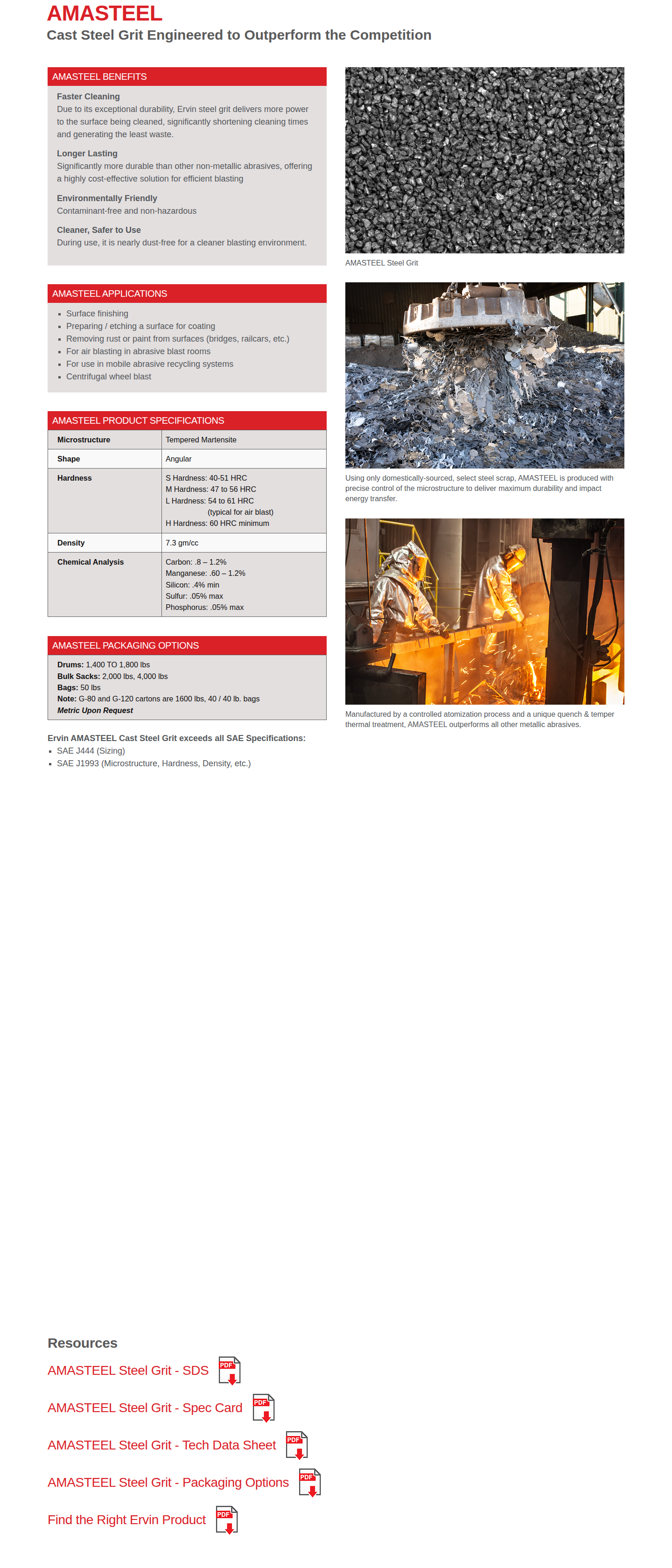
Manufactured cast steel media available in angular (grit) and spherical (shot) forms, with 200+ reuse cycles and near dust-free operation — the productivity benchmark for high-volume industrial blasting on carbon steel.
Pros:

Near dust-free: grit at 24%, shot at 10% of sand's PM emissions.
200+ reuse cycles in reclaim systems.
Angular grit and spherical shot variants available.
Fast cleaning on heavy scale and rust.
Cons:

Ferrous contamination risk on non-ferrous substrates.
Requires a reclaim system for cost advantage.
Grit too aggressive for precision components.
Both steel grit and steel shot are manufactured cast steel products — not industrial by-products — with a tempered martensite microstructure that resists deformation on impact and delivers consistent, repeatable results.
Hardness is selectable across four SAE grades (S, M, L, and H), letting operators dial in the right aggressiveness for their substrate and finish requirement — a level of control that single-use media simply cannot offer.
Steel Grit
Angular in shape, steel grit cuts into the surface on impact rather than bouncing off it, creating a deep, jagged anchor profile suited to high-build industrial coatings that need a strong mechanical key.
Primary applications include structural steel fabrication, bridges, railcars, pipelines, and blast rooms — anywhere a coarse, aggressive surface texture is the goal and a reclaim system is in place to recover the media.
Steel Shot
Spherical in shape, steel shot peens the surface rather than cutting it, producing a dimpled, lower-profile finish without the sharp peaks that grit leaves behind.
This makes shot the right choice for general blast cleaning, descaling, and — critically — shot peening, where the goal is to induce compressive stress in metal components to improve fatigue strength, not to create an anchor profile.
Shot peening is specified across automotive and aerospace component preparation, where controlled intensity and coverage are as important as cleanliness.
| Property | Steel Grit | Steel Shot |
|---|---|---|
| Shape | Angular | Spherical (Round) |
| SAE Standard | SAE J444 / J1993 | SAE J444 / J827 |
| Hardness Grades | S, M, L, H (40–60+ HRC) | S, M, L, H (40–60+ HRC) |
| Surface Finish | Deep, jagged anchor profile | Dimpled, lower-profile finish |
| Reuse Cycles | 200+ | 200+ |
| Typical Applications | Bridges, railcars, pipelines, blast rooms | Cleaning, descaling, shot peening, aerospace |
A side-by-side comparison of the two variants on the key evaluation axes helps readers map the grit/shot distinction to their own application quickly — this information is clearer in a table than in prose.
Both variants share the same exceptional reusability: the Clemco Infotools chart rates both steel grit and steel shot at 200+ reuse cycles in reclaim systems, making the per-use cost among the lowest of any abrasive blasting media over a full lifecycle.
Near dust-free operation is another shared advantage. According to the EPA, total particulate matter emissions from blasting with grit run at roughly 24% of those from sand blasting — and shot drops that further, to around 10%.
The critical limitation of both media is ferrous contamination risk: embedded iron particles from carbon steel media can cause galvanic corrosion on aluminium, stainless steel, and other non-ferrous substrates, making both grit and shot unsuitable for those surfaces.
The 200+ cycle economics also depend entirely on having a reclaim system in place. Without one, the cost advantage disappears and the case for metallic media weakens considerably.
Choose steel grit when you need an aggressive anchor profile on carbon steel for high-build coatings — bridges, structural steel, heavy industrial work. Choose steel shot when the goal is cleaning, descaling, or shot peening to improve fatigue strength, and a smoother, more consistent finish is what the application demands.
Option 2
Aluminium Oxide
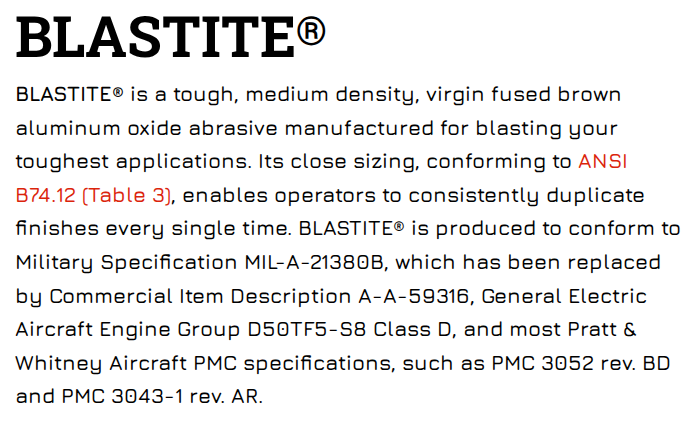
Aluminium oxide (brown fused alumina, Al2O3) is a synthetic abrasive produced by electrofusing bauxite, rated Mohs 9 — the hardest non-metallic blasting abrasive in common use. Its angular, sharp-edged particles cut aggressively at lower blast pressures and deliver precise, repeatable surface profiles, making it the benchmark choice for thermal spray preparation, aerospace component finishing, and any application where ferrous contamination from metallic media cannot be tolerated.
Pros:
Mohs 9 hardness — cuts faster at lower pressures.
No silica; no ferrous contamination risk.
Tight grit sizing; consistent, repeatable profiles.
6–8 reclaim passes; closed-loop manufacturer recycling.
Cons:
Higher purchase price per bag than slag media.
Lighter than metallic media — less impact energy.
Reclaim system needed to realise reuse savings.
Like steel grit, aluminium oxide is angular — but unlike metallic media, it carries zero ferrous contamination risk, making it the go-to choice when substrate sensitivity rules out steel entirely.
Composition and Manufacture
Brown fused alumina (Al₂O₃) is produced by electrofusing bauxite in electric arc furnaces — a purpose-engineered abrasive, not a mineral or an industrial by-product.
That manufacturing origin matters: it gives aluminium oxide a level of compositional consistency and grit-size precision that naturally occurring or slag-derived media simply cannot match.
Hardness: The Defining Characteristic
At Mohs 9, aluminium oxide is the hardest commonly used non-metallic blasting abrasive — harder than all slag media, harder than garnet, and harder even than steel grit on the Mohs scale.
That hardness advantage is not merely a spec-sheet number: it translates directly into faster cutting at lower blast pressures, more efficient removal of hard oxides and mill scale, and a sharper, more well-defined anchor profile.
| Property | Aluminium Oxide (Brown Fused) |
|---|---|
| Hardness | Mohs 9 |
| Particle shape | Angular, blocky, sharp-edged |
| Grit size range | Macro sizes 12–240 |
| Reusability | 6–8 passes in reclaim system |
| Recyclability | Closed-loop return to manufacturer |
| Relative cost tier | Higher than slag; comparable to garnet |
| Free silica | None |
| Ferrous contamination risk | None |
Gives comparison-minded readers a scannable reference across the key evaluation axes for aluminium oxide, consistent with the page's declared comparison framework.
The wide grit size range — macro sizes 12 through 240 — means profile depth is highly controllable, from fine etching at tight tolerances to deep anchor patterns for high-build coatings.
Primary Applications
Aluminium oxide is the benchmark abrasive for precision surface preparation across several demanding industries.
- Thermal spray coating preparation: The standard choice for oil and gas pipeline preparation, where a sharp, consistent anchor profile is critical for coating adhesion.
- Aerospace component preparation: Used in aircraft engine overhaul and aerospace part finishing, where ferrous contamination from metallic media is unacceptable.
- Investment casting cleaning: Removes ceramic shell residue from cast components without contaminating the substrate.
- Hard oxide and mill scale removal: High hardness makes it effective where softer media would slow down or require higher pressures.
- Glass etching and precision surface prep: Fine grit sizes allow controlled, repeatable etching on sensitive or decorative substrates.
The common thread across these applications is the need for a controlled, contamination-free surface — conditions where aluminium oxide's combination of hardness, angular shape, and non-ferrous composition is difficult to replace.
Brown vs White Grade: Which to Specify
Not all aluminium oxide is identical — the grade distinction is a genuine selection decision point, not a marketing distinction.
- Brown fused alumina (96% Al₂O₃): The general industrial standard. Suitable for the vast majority of blasting applications, including thermal spray prep, aerospace, and oxide removal. This is what most suppliers mean when they list aluminium oxide blasting media.
- White fused alumina (99.5%+ Al₂O₃): Specified where surface contamination must be completely eliminated — medical devices, electronics manufacturing, and food-contact surface preparation. Higher purity comes at a higher price; use it only when the application genuinely demands it.
For most industrial blasting tasks, brown fused alumina is the correct specification; white fused alumina is a niche choice driven by contamination-sensitivity requirements, not performance.
Reusability, Recyclability, and Running Cost
Aluminium oxide typically delivers 6–8 passes through a reclaim system before particle breakdown reduces its cutting efficiency — a meaningful reuse cycle that spreads the higher per-bag purchase price across multiple runs.
Beyond reclaim reuse, spent aluminium oxide can be returned to the manufacturer for closed-loop recycling, reducing disposal costs and waste volumes compared to single-use slag media.
Aluminium oxide costs more per bag than slag media, but the per-bag price is a poor proxy for cost-per-use. When reuse cycles and closed-loop recycling are factored in, the total running cost gap narrows considerably — and the performance consistency advantage remains throughout.
That said, realising the reusability advantage requires a reclaim system: operators running aluminium oxide on a single-use basis absorb the full purchase price premium without the offsetting cycle economics.
Option 3
Garnet
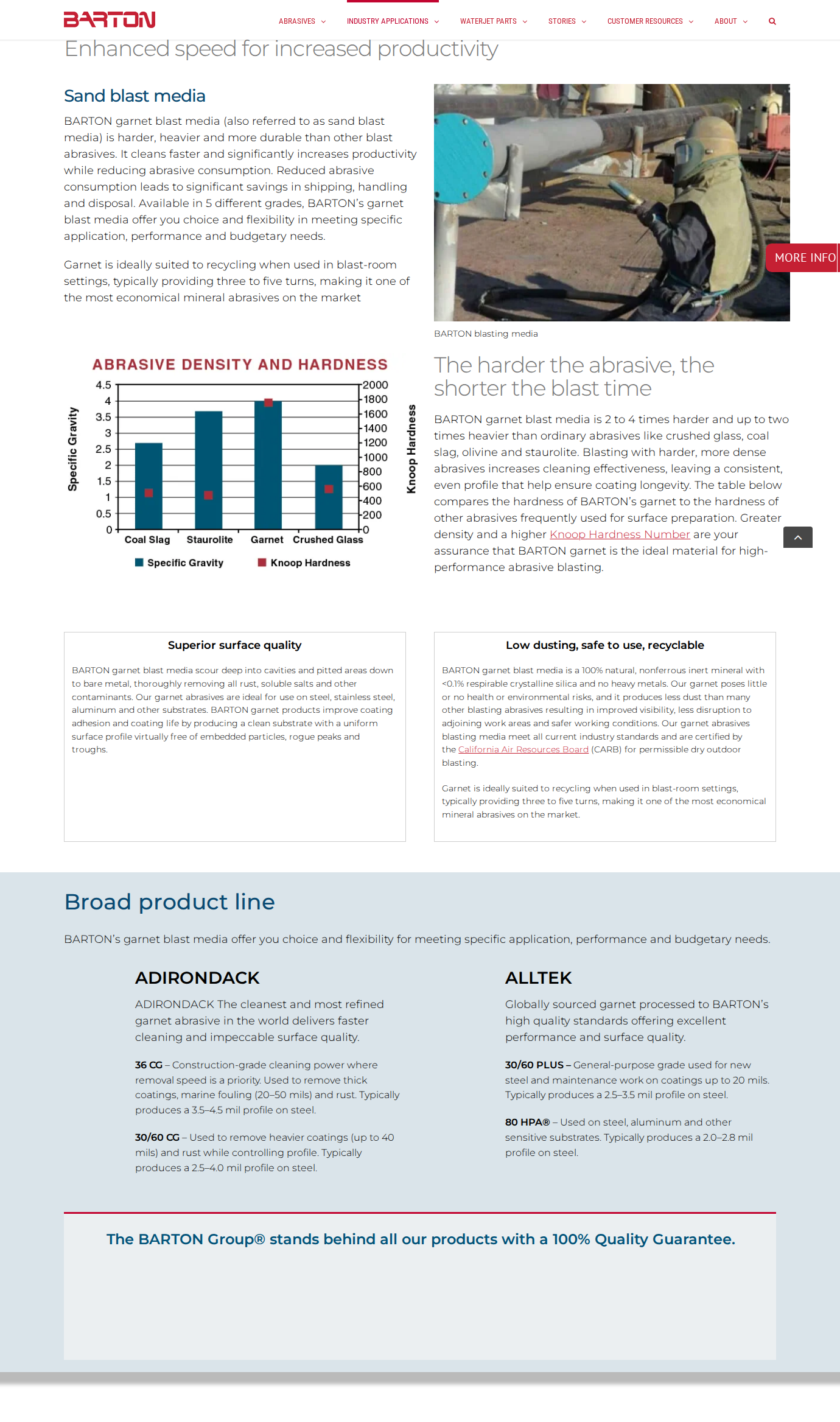
Garnet is a natural almandine mineral abrasive (Mohs 7.5–8.0) that delivers low dust generation, no ferrous contamination risk, and a consistent, rogue-peak-free surface profile across three to five blast-room recycle turns. It is the default choice for coating contractors in shipyard, oil and gas, and structural steel applications where surface quality and worker safety standards are non-negotiable.
Pros:
No ferrous contamination: safe on non-ferrous substrates.
Moderate reusability: 3–5 turns in blast-room reclaim systems.
Consistent, rogue-peak-free surface profile reduces coating waste.
Low dust: far less than slag or lower-grade garnets.
Cons:
Higher per-bag purchase price than slag media.
Quality varies significantly between suppliers.
Softer than aluminium oxide for demanding profiling tasks.
Garnet is a natural mineral abrasive — specifically the almandine variety (Fe₃Al₂(SiO₄)₃) — mined and processed rather than manufactured from industrial by-products or synthetically fused like aluminium oxide.
It occupies a deliberate middle ground in the abrasive landscape: harder and denser than slag media (Mohs 7.5–8.0 vs. slag's 6–7), yet softer than the aluminium oxide covered in the previous entry, and far more affordable than metallic abrasives on a per-project basis.
The defining physical characteristic of almandine garnet is its sub-angular particle shape — sharp enough to cut efficiently and generate a proper anchor profile, but not so aggressively angular that it embeds in the substrate or leaves rogue peaks that consume excess coating.
This balance between cutting speed and surface consistency is what separates garnet from both slag (which can embed due to its fractured, horn-like structures) and aluminium oxide (which is more aggressively angular and harder to control on profile depth).
Grade selection determines the surface profile produced, and the relationship is direct: coarser grades produce deeper profiles for heavy maintenance work, while finer grades deliver shallower, tighter profiles suited to new steel preparation.
| Grade | Particle Size Range | Surface Profile (µm) | Primary Use Case |
|---|---|---|---|
| 80 Mesh | ~180 µm (finer) | 40–55 µm | New steel mill-scale removal, new construction |
| 30/60 | ~250–600 µm | 50–75 µm | General-purpose maintenance and new construction |
| 25/40 | ~425–710 µm | 75–125 µm | Heavy industrial maintenance, thick coating removal |
Communicates the grade-to-profile relationship with specific sourced figures — more useful to a professional selecting a grade than an equivalent prose description.
The 30/60 grade is the industry-standard general-purpose choice for most maintenance and new-construction blasting — the grade designation means particles pass through a 30-mesh screen and are retained on a 60-mesh screen, producing a consistent particle size band.
The 80 mesh grade is the preferred option for fast mill-scale removal on new steel, where its finer particle size delivers high blasting rates (up to 35 m²/hr) at low consumption, and the shallower 40–55 µm profile suits thin-film coating systems.
Where Garnet Is the Professional Default
Garnet has become the de facto standard abrasive blasting grit in several professional settings where the combination of low dust, consistent profile, and no ferrous contamination risk is non-negotiable.
- Shipyard blasting: Hull and superstructure work in enclosed or semi-enclosed environments where dust control directly affects worker safety, visibility, and productivity in confined spaces.
- Oil and gas infrastructure: Tanks, pipelines, and offshore platforms — applications requiring compliance with regulated surface preparation standards and consistent, measurable anchor profiles.
- Structural steel maintenance: Bridge and industrial structure recoating where a uniform, rogue-peak-free profile reduces coating consumption and extends service life.
- Non-ferrous substrate blasting: Aluminium, stainless steel, and other non-ferrous surfaces where metallic abrasives must be excluded entirely to prevent ferrous contamination and corrosion.
Garnet is also the natural choice for blast-room recycling operations, where its moderate reusability — typically three to five turns with a reclaim system — makes it substantially more economical than single-use slag on a cost-per-square-metre basis.
A Barton shipyard case study found that switching from coal slag to garnet reduced abrasive consumption by 69%, disposal costs by 69%, and total blasting time by 36%. The higher per-bag price of garnet is routinely offset by lower consumption, lower disposal costs, and faster blast rates — making total running cost, not purchase price, the correct economic lens.
Garnet's reusability sits well above single-use slag (which shatters on impact and cannot be meaningfully recycled) but well below metallic abrasives, which can run 200+ cycles in a reclaim system.
For regulated and professional applications, garnet meets U.S. Navy MIL-A-22262B(SH) and SSPC-AB 1 (Type 1, Class A) standards — compliance markers that matter when working to government, naval, or major coating specification contracts.
Garnet Limitations
Garnet carries a higher per-bag purchase price than slag media — but as the total-cost data above shows, this premium is typically recovered through lower consumption, reduced disposal costs, and faster cycle times.
For the most demanding profiling tasks — extremely hard mill scale or applications requiring maximum cutting aggression — aluminium oxide's Mohs 9 hardness gives it an edge that garnet cannot fully match.
The most important practical caveat for buyers is supplier quality variation: not all garnet performs equally.
Independent respirable dust testing shows premium almandine garnet generating 0.078–0.325 mg/m³, while other garnets measured 0.175–0.488 mg/m³ — a meaningful difference in worker exposure and regulatory compliance that buyers sourcing lower-cost alternatives should factor in.
Option 4
Glass bead
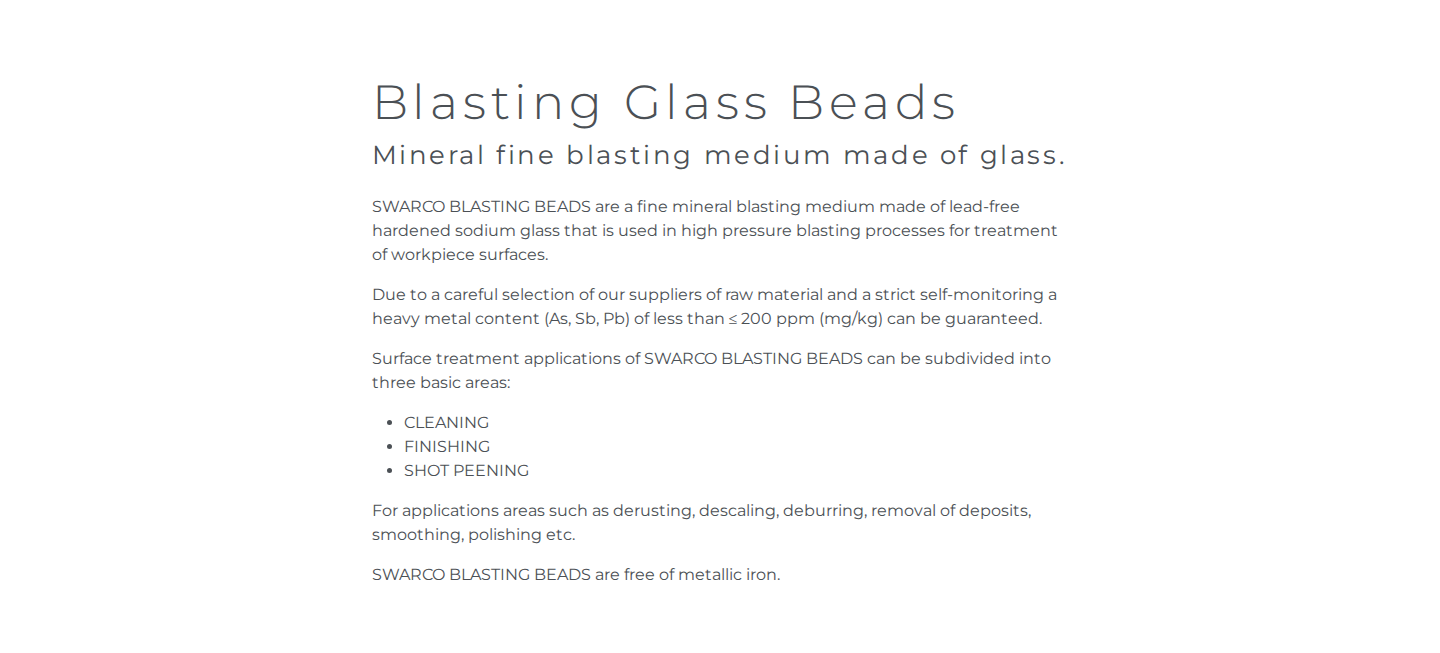
Glass bead is a spherical, lead-free, silica-free blasting media made from soda-lime glass — the standard choice for cleaning, finishing, and light peening on substrates where ferrous contamination or dimensional change cannot be tolerated.
Pros:
No ferrous contamination risk on sensitive substrates.
Four-in-one: clean, finish, peen, deburr.
Chemically inert: no toxic surface residue.
Moderate reusability: ~8–10 cycles in cabinet.
Cons:
Cannot produce deep anchor profiles.
Slow on heavy rust or thick coatings.
Pressure limit: 4 bar to avoid breakdown.
Glass bead is a spherical, chemically inert blasting media whose peening action produces a bright, satin surface without cutting into the substrate — a fundamentally different outcome from the angular media covered in the previous three entries.
Glass Bead Composition and Properties
Glass bead is manufactured from soda-lime glass — either virgin materials or recycled glass cullet — and carries no free silica, no lead, and no metallic iron.
Its hardness sits at approximately Mohs 5.5–6.0 (Vickers ~645), placing it well below garnet (Mohs 7–8) and substantially below aluminium oxide (Mohs 9). That relative softness is a deliberate advantage: it means gentler action on the substrate, making glass bead safe for stainless steel, aluminium, and precision components where harder angular media would cause unwanted material removal.
The spherical shape is the defining characteristic. Where angular particles cut and fracture the surface to create a jagged anchor profile, spherical particles strike and rebound — producing a dimpled, compressive finish with a consistent satin sheen and no dimensional change to the substrate.
Glass Bead Applications
Glass bead's applications share a common thread: each requires a clean, bright finish without surface profiling, and/or a substrate that cannot tolerate ferrous contamination or dimensional change.
- Food-processing equipment and abattoir machinery: Iron-free media with no toxic residue — safe for surfaces that contact food or require strict hygiene standards.
- Automotive restoration: Delivers a bright cosmetic finish on body panels, trim, and engine components without altering part dimensions.
- Stainless steel platforms, walkways, and fabrications: No ferrous contamination risk, preserving the corrosion resistance of austenitic stainless steel.
- Mould cleaning: Removes light residue and release-agent build-up without changing mould geometry or surface tolerances.
- Light-to-medium shot peening: Imparts compressive stress on precision components such as springs and gears, improving fatigue strength and reducing notch sensitivity.
- Carbon and heat-treat scale removal: Cleans scale from precision components without the aggressive cutting action of harder angular abrasives.
A single glass bead pass can clean, finish, peen, and deburr simultaneously — what suppliers describe as a four-in-one action — which reduces process steps on components that would otherwise require separate operations.
Sizing runs from #20–30 (coarser, for faster cleaning and heavier peening) through to #270 and finer (for smooth cosmetic finishes), with mil-spec sizing available for shot peening applications where precise particle distribution is specified.
In terms of reusability, glass bead achieves approximately 8–10 cycles in controlled blast-cabinet environments. Its spherical shape resists breakdown better than angular media of comparable hardness, because there are no sharp edges to fracture off on impact — making running cost per cycle moderate.
Processing pressure should not exceed 4 bar: above this threshold, particle breakdown accelerates sharply, shortening reuse life and increasing dust generation.
Glass Bead Limitations
Glass bead produces a low, smooth surface profile — which is precisely correct for finishing and cleaning work, but disqualifying for coating preparation on structural steel where a deep anchor pattern is specified.
Its lower hardness also means slower progress on heavy rust, thick coatings, or tenacious mill scale: glass bead is a finishing and light-cleaning media, not a heavy-duty stripping tool.
Where a stainless steel or aluminium substrate requires a surface profile — for example, to key a thermal spray coating — aluminium oxide (covered in Option 2) is the correct media choice, not glass bead.
Option 5
Slag Media: Coal Slag and Copper Slag
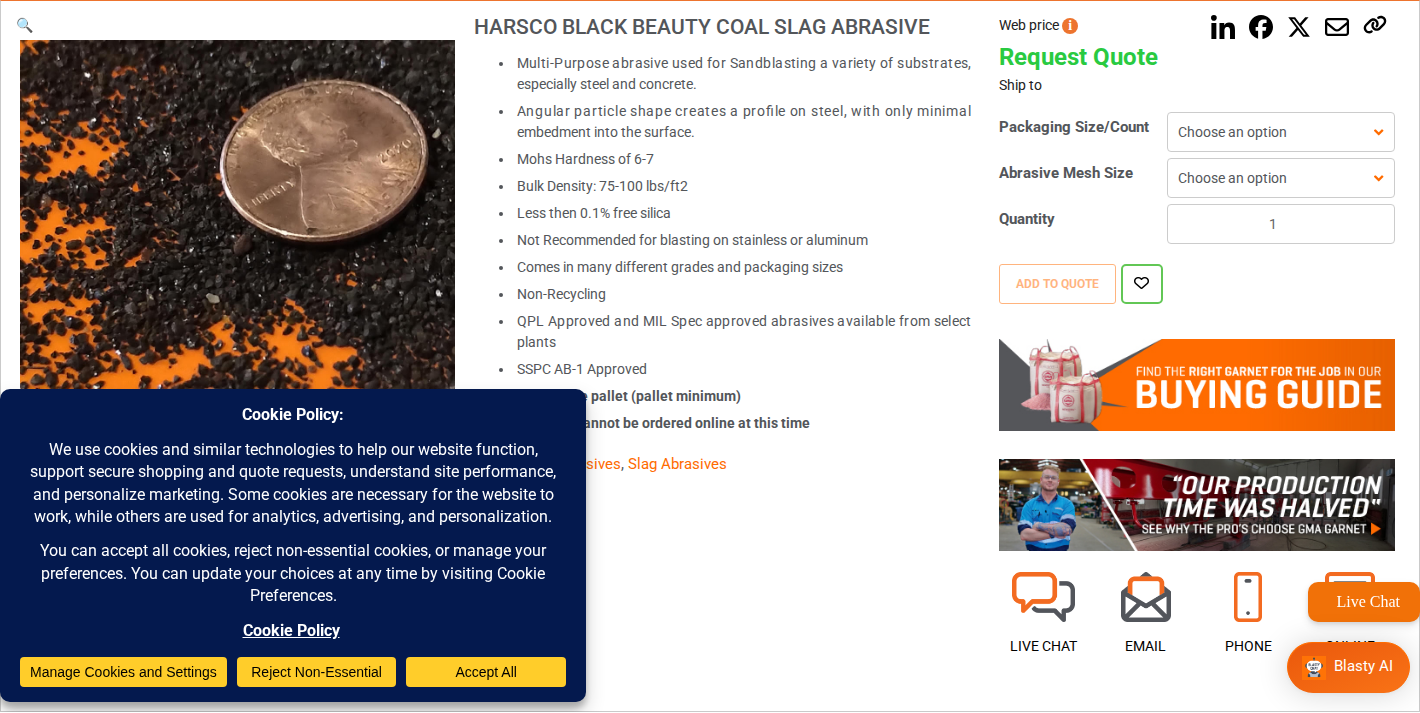
Coal slag and copper slag are low-cost, single-use industrial by-product abrasives — angular, widely available, and approved to SSPC-AB 1 and QPL MilSpec standards — suited to large-scale outdoor blasting of carbon steel and concrete where purchase price and throughput take priority over recyclability or precision profiling.
Pros:
Low purchase price; widely available.
Angular shape creates a usable anchor profile.
Under 0.1% free silica; SSPC-AB 1 approved.
Cons:
Effectively single-use; high friability, 1–2 cycles.
Documented hazardous air pollutant emissions per NIOSH/OSHA.
Spent media disposal may require hazardous waste classification.
Not suitable for stainless steel or aluminium.
Coal slag and copper slag are the only industrial by-products in this comparison — not manufactured abrasives, not mined minerals, but vitrified waste materials crushed and sized for blasting.
That origin defines their economics: low purchase price per bag, wide availability (especially coal slag), and zero recyclability — they shatter on impact and cannot be reclaimed.
| Property | Coal Slag | Copper Slag |
|---|---|---|
| Composition / origin | Alumina-silicate by-product of coal-fired power plants; vitrified fly ash, crushed and sized | Iron silicate by-product of copper smelting; rapidly cooled and crushed |
| Mohs hardness | 6.0–7.0 | 7.0–7.5 |
| Particle shape | Angular | Angular |
| Reusability | Non-recycling (1 cycle) | Non-recycling (1–2 cycles) |
| Surface profile by grade | Extra-Fine 30/60: 1–2.6 mil | Fine 20/40: 2–3.5 mil | Medium 12/40: 3–4.8 mil | Coarse 10/40: 3–5 mil | Fine 30/60: 1–2.5 mil | Medium 20/40: 2–3.5 mil | Coarse 12/40: 3.5–4.5 mil |
| Free silica content | <0.1% | <0.1% |
| Geographic availability | Broadly available across the US | Regionally concentrated near copper refineries (e.g. Texas, Louisiana) |
| Contamination risk during blasting | Arsenic, beryllium, cadmium, chromium, lead, manganese, nickel, vanadium documented in NIOSH field data | Arsenic and lead elevated — particularly from secondary smelters; chromium and nickel from primary smelters |
| Key approvals | SSPC-AB 1, QPL MilSpec, CARB (select plants), TCLP 40CFR 261.24a | SSPC-AB 1, QPL MilSpec (select locations) |
Side-by-side comparison of coal slag and copper slag across the key selection axes — hardness, surface profile, reusability, availability, and contamination risk — allows readers to distinguish the two media clearly before the shared-characteristics discussion.
The angular particle shape is the performance core of both media — it cuts into steel surfaces and creates a workable anchor profile for coatings, unlike the peening action of spherical media such as glass bead.
Profile consistency, however, is not slag's strong suit: moderate particle embedment is a known characteristic, and profile uniformity is less controlled than what garnet or aluminium oxide deliver.
Single-Use Economics: The Real Cost Calculation
High friability is the defining mechanical limitation of both slag types — particles shatter on impact, generating fines that cannot be reclaimed, making every blast a one-way consumption event.
The Clemco abrasive comparison chart rates mineral slag at just 1–2 cycles, versus 200+ for steel grit and 6–8 for aluminium oxide — a gap that changes the cost-per-square-foot calculation substantially once disposal and volume consumption are factored in.
A NIOSH Phase 1 study found that, despite silica sand having the lowest price per ton of delivered abrasive, it had the highest cost per square foot of steel surface cleaned once consumption rates were included. The same logic applies to slag: the low bag price does not account for the volume consumed per job, the disposal cost of spent media, or any regulatory overhead associated with hazardous waste classification.
Disposal of spent slag media may require hazardous waste classification depending on jurisdiction — a cost dimension that buyers focused on purchase price often miss entirely.
Slag is genuinely cost-effective for large outdoor projects where a reclaim system is not feasible and throughput matters more than per-use efficiency — the economics only break down when disposal costs and volume consumption enter the calculation.
Health and Environmental Limitations
Both media carry a documented hazardous air pollutant profile that goes beyond the free-silica risk that drove the original shift away from silica sand.
NIOSH Phase 2 field data found that coal slag produced greater geometric mean airborne concentrations than silica sand for all hazardous health-related agents tested except respirable quartz — including the highest concentrations of beryllium and vanadium among all abrasive categories studied.
For copper slag, the EPA Serageldin emissions study documented particulate lead emission factors (48.3 mg/kg abrasive) substantially higher than silica sand (0.232 mg/kg), and OSHA shipyard guidance notes that blasting with copper slag can generate arsenic, chromium, and lead levels that exceed OSHA Permissible Exposure Limits.
A NIOSH health hazard evaluation at a coal and copper slag processing facility found that copper slag processing produced higher levels of dust, silica, and metals than coal slag processing — and that five of six workers sampled at the copper slag facility were exposed to arsenic that approached or exceeded the OSHA PEL.
OSHA guidance notes that coal slag may cause lung damage similar to silica sand based on preliminary animal testing, and that slags can contain trace amounts of arsenic, beryllium, and cadmium.
These are documented regulatory findings, not fringe concerns — buyers and contractors should consult OSHA and EPA guidance and review the manufacturer's Safety Data Sheet before specifying either media, particularly for enclosed or semi-enclosed blasting environments.
Substrate Limits and When to Choose Slag
Neither coal nor copper slag is recommended for stainless steel or aluminium — ferrous contamination risk and the aggressive angular profile make both unsuitable for these substrates.
Slag earns its place on large-scale outdoor blasting of carbon steel and concrete where purchase price and availability dominate the decision, reclaim is not an option, and the site conditions support proper respiratory protection and waste management.
Copper slag's harder cutting action (Mohs 7.0–7.5 vs coal slag's 6.0–7.0) can be an advantage on heavy rust or thick coatings, but its regional availability near copper refineries makes it a less universal choice than coal slag for buyers outside the US Gulf Coast.
Conclusion
Choosing your abrasive blasting grit: a practical summary
Particle shape is the clearest guide: angular, recyclable media for jobs requiring a surface profile; spherical media for cleaning and finishing where profiling would cause harm; slag only where single-use economics make it the pragmatic call.
The per-bag price is the least useful number on the invoice — reusability, dust management, and disposal costs determine what you actually spend.
If your job involves precision components, heritage materials, or a site where containing blasting media is difficult, Woodrow Scientific's ELASER-RHZ offers consumable-free laser cleaning with the world's first reduced hazard zone technology — no sealed-off area required.
Abrasive blasting grit: frequently asked questions
Direct answers to the most common questions about abrasive blasting grit, media types, applications, and sizing notation.
The five main categories of abrasive blasting grit are: steel grit and steel shot (manufactured cast steel, angular or spherical), aluminium oxide (synthetic, Mohs 9, the hardest non-metallic option), garnet (natural mineral, sub-angular, low dust), glass bead (spherical, finishing and peening focused), and slag media — coal slag and copper slag (industrial by-products, single-use, low cost). The right choice depends on three factors: the substrate material, the surface profile depth required by your coating specification, and whether a reclaim system makes recyclable media cost-effective for your operation.
Surface preparation before coating is the primary use — abrasive grit blasting removes rust, mill scale, and old paint while creating a textured anchor profile that mechanical and chemical coatings bond to. Cleaning is the second major application: removing contamination, oxidation, or surface deposits without necessarily profiling the substrate — common in maintenance and restoration work. Shot peening uses controlled blasting to compress the surface layer of metal components, improving fatigue strength and resistance to stress cracking — critical in aerospace and automotive manufacturing. Specialist applications include deburring precision components, cleaning moulds and dies, and restoring heritage stonework and monuments where gentle, controllable media such as glass bead or fine garnet are used.
A 40-70 grit designation means the particles pass through a 40-mesh screen but are retained on a 70-mesh screen — so all particles fall within that size band. Higher mesh numbers have smaller openings, which means higher numbers equal smaller particles. In practice, 40-70 produces a finer surface profile than a coarser grade such as 30-60, because the smaller particles leave shallower peaks and valleys on the blasted surface.
A 30-60 grit designation means particles pass through a 30-mesh screen and are retained on a 60-mesh screen — making them larger than a 40-70 grade, which produces a coarser, deeper surface profile. 30-60 is the industry-standard general-purpose grade for garnet and many other blasting media. It balances cutting speed with profile control, delivering the anchor profile depth that most protective coating specifications require without over-profiling the substrate. For most maintenance blasting and new-construction surface preparation work, 30-60 is the default starting point. Contractors typically move to a finer or coarser grade only when a specific coating spec or substrate condition demands it.