

Introduction
If you have already settled on 500 W as your target power class, this list is built for you.
At this wattage, a pulsed fibre laser delivers enough average power for moderate-to-heavy rust, paint, mill scale, and oxide removal at production-relevant speeds, while nanosecond pulses keep thermal load low enough for substrate-sensitive work — a balance of throughput and precision that defines this class.
Every machine on this list is a verified 500 W pulsed fibre laser cleaning system; continuous-wave machines at this wattage are a different tool entirely and are not covered here.
TL;DR
All three machines share the same rated wattage — but wattage is where the similarities end. Cooling type, power supply, form factor, and support provenance vary significantly across this shortlist, and those differences, not the laser power itself, are what actually determine which machine fits your operation.
This article covers:

Laser type and pulse parameters for each machine
Portability and form factor compared
Cooling system: air-cooled vs water-cooled
Safety features and laser class
After-sales support and manufacturer vs reseller
Pricing transparency across all three options
What 500W Laser Cleaning Machines Deliver in Practice
Five hundred watts of pulsed fiber laser is the point on the power ladder where a machine stops being a precision tool for light work and becomes a genuine production workhorse — capable of tackling the contamination types that dominate real industrial maintenance and fabrication schedules.
Applications Where 500W Pulsed Earns Its Place
This power tier handles a wide range of demanding industrial cleaning tasks reliably at production-relevant throughput.
- Rust removal on structural steel: Moderate-to-heavy rust (ISO 8501-1 grades B–C) cleaned to Sa 2.5 near-white metal, suitable for recoating and galvanising pre-treatment.
- Paint and coating stripping: Single-pack and multi-layer industrial paint systems removed before recoating or weld preparation, with layer-by-layer control on thin substrates.
- Mill scale removal: Dense, adherent mill scale on hot-rolled plate cleared ahead of coating, thermal spray, or galvanising — demanding work that lighter power tiers cannot sustain at production rates.
- Weld oxide and heat tint removal: Chromium-iron oxide and heat tint removed from stainless steel and aluminium welds, restoring passivity without abrasive contact or chemical residue.
- Mould cleaning: Injection, tyre, and blow moulds cleaned in-situ — release agent residue and carbonised polymer ablated while cavity finish and dimensional integrity are preserved.
- Pre-NDT surface preparation: Contaminant-free surfaces for magnetic particle and dye penetrant inspection, opening crack entrances without the dimensional smearing that grit blasting causes.
The common thread is versatility: 500W pulsed handles demanding contamination while retaining the substrate-control advantages of pulsed operation, making it equally useful in a fabrication shop cleaning structural steel and a toolroom maintaining precision injection moulds.
Throughput Reality: What to Expect
Cleaning rate varies significantly with contamination type, and buyers who plan around a single figure will be caught out on site.
| Contamination Type | Typical Rate at 500W Pulsed | Notes |
|---|---|---|
| Light flash rust (thin, loosely bonded oxide) | 6–15 m²/h | Single fast pass typically sufficient |
| Moderate laminar rust, grades B–C (Sa 2.5) | 2–6 m²/h | Multiple overlapping passes at controlled fluence |
| Heavy mill scale on hot-rolled plate | 1–4 m²/h | Dense, adherent; demands higher fluence and slower traverse |
| Multi-layer paint / marine coating stack | 1–4 m²/h | Rate depends on total film build and number of layers |
Indicative cleaning rates for a 500W pulsed fiber laser by contamination type, based on published application data. Actual rates depend on pulse parameters, scan head width, required cleanliness grade, and operator technique.
The spread between light flash rust and heavy mill scale is large enough to matter for project planning: a job that looks manageable at 10 m²/h on loose oxidation may run at one-fifth of that rate if the contamination is dense mill scale requiring multiple passes.
Where 500W Sits in the Power Ladder
Compared to 200–300W pulsed systems, the 500W class roughly doubles throughput on heavy contamination — the difference between a machine that can technically do the job and one that can do it within a production shift.
Compared to 1,000W+ continuous-wave systems, 500W pulsed trades some bulk-removal speed for the substrate-control advantages of pulsed operation: shallower heat-affected zones, layer-by-layer selectivity, and the ability to work on thin, heat-sensitive, or dimensionally critical parts that CW power at production speed would damage.
The Cooling Decision at 500W
At lower power tiers, air cooling is the default and the decision is largely made for you; at 500W, the choice between air-cooled and water-cooled becomes a genuine operational question that buyers must answer against their site constraints before they select a machine.
Air-cooled 500W systems require no external chiller, run on standard single-phase supply (typically 220V), and are genuinely portable — the right configuration for intermittent or mobile work where setup simplicity and van-deployable weight matter.
Water-cooled 500W systems pair the same pulsed precision with a closed-loop chiller that holds the laser source at a stable operating temperature across a full shift of continuous operation — the right configuration for fixed production stations where duty cycle, not portability, is the governing constraint.
The practical consequence: an air-cooled unit running near its thermal ceiling in a hot shop may ease off output during long continuous runs, while a water-cooled unit holds nameplate power from the first part to the last — a meaningful difference when cleaning rate per shift drives the economics.
Safety Obligations Are Non-Negotiable
Every industrial pulsed laser cleaning machine at this power level is a Class 4 laser product under IEC 60825-1 — the international standard for laser product classification — and the practical obligations that classification carries are substantial.
OSHA's technical guidance on laser hazards describes Class 4 as requiring laser-controlled areas (encompassing the nominal hazard zone), mandatory wavelength-rated protective eyewear for all personnel within the controlled area, written standard operating procedures, and direct supervision by an individual knowledgeable in laser safety.
Buyers who underestimate the facility requirements for Class 4 laser operation — controlled areas, trained operators, written SOPs, and appropriate PPE — often end up with machines they cannot legally or practically operate in their existing facilities. Seek qualified professional guidance on your specific site requirements before committing to a purchase.
Manufacturer vs Reseller: Why It Matters
Before evaluating any specific machine, it is worth understanding whether the supplier manufactures the laser system in-house or sources it from a third party and resells it under their own brand.
The practical consequences of buying from a reseller or importer include slower access to spare parts, no in-house engineering capability to resolve hardware or firmware issues, and limited ability to support process development when parameters need adjustment for a new application.
This is a standing evaluation criterion for every machine on this list — and one worth resolving early, because the answer shapes the entire after-sales relationship for the working life of the equipment.
With those dimensions calibrated, here is how the leading 500W machines on the market compare against each of those criteria.
Product 1
cleanLASER CL 500iM
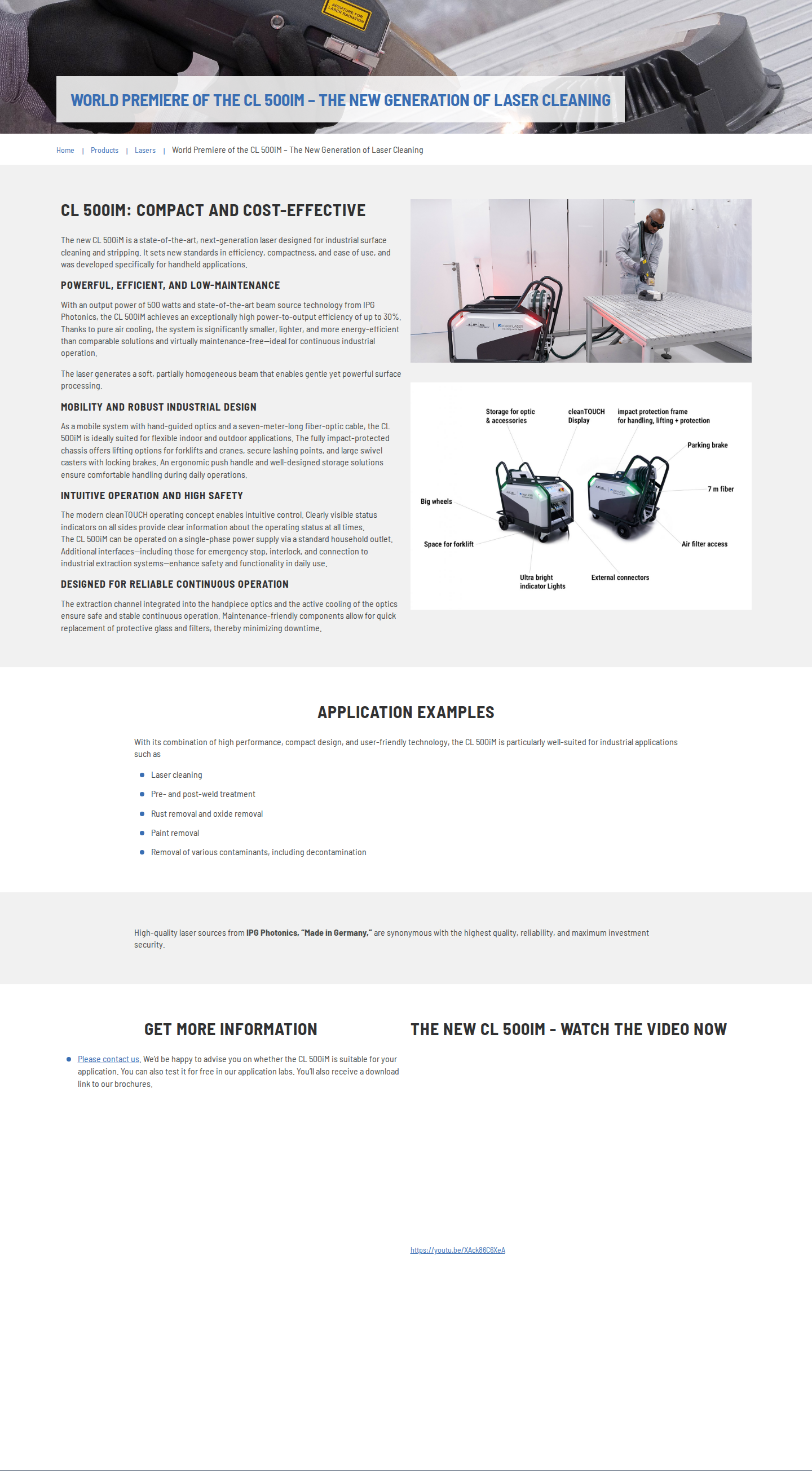
A 500 W nanosecond pulsed fibre laser cleaning system from cleanLASER (Germany), built around a named IPG Photonics laser source and fully air-cooled — no chiller or water circuit required.
Pros:

Named IPG Photonics source — independently verifiable
Air-cooled — no chiller or water circuit needed
Single-phase supply — standard outlet compatible
German manufacturer with global service network
Cons:

7 m cable — shorter than some alternatives
No published list price — quote required
Laser Source and Performance
The cleanLASER CL 500iM is a 500 W nanosecond pulsed fibre laser cleaning system, with the laser source supplied by IPG Photonics — a named, third-party-verifiable component rather than a generic fibre laser module.
That provenance matters to buyers doing due diligence: IPG Photonics is a publicly listed, globally recognised fibre laser manufacturer, so a buyer can independently confirm the core component before committing to a purchase.
The laser generates a soft, partially homogeneous beam, which cleanLASER describes as enabling gentle yet powerful surface processing. The system achieves a power-to-output efficiency of up to 30%, which cleanLASER attributes directly to the IPG fibre laser technology combined with the air-cooled architecture.
Portability and Form Factor
The CL 500iM is configured as a mobile, hand-guided system: the operator works with a lightweight handheld optics unit connected via a 7 m fibre-optic cable to the main chassis, which stays on the floor.
That 7 m cable reach is worth noting as a practical constraint — it is shorter than some other 500 W systems on the market, which affects how far from the chassis an operator can work without repositioning.
The chassis itself is built for industrial mobility: fully impact-protected, with forklift and crane lifting options, secure lashing points, and large swivel casters with locking brakes. An ergonomic push handle and integrated storage make it straightforward to move between work areas. The system is suited to both indoor and outdoor use.
Cooling and Power Supply
The CL 500iM runs on pure air cooling — there is no water circuit, no chiller, and no coolant infrastructure to manage on site.
cleanLASER states that this makes the system significantly smaller, lighter, and more energy-efficient than comparable water-cooled solutions, and virtually maintenance-free for continuous industrial operation.
Paired with this, the system operates from a single-phase supply via a standard outlet. For sites without three-phase infrastructure — or for deployments where running a dedicated power circuit is impractical — this is a genuine operational advantage.
| Specification | CL 500iM |
|---|---|
| Laser type | Nanosecond pulsed fibre laser |
| Output power | 500 W |
| Laser source | IPG Photonics |
| Fibre cable reach | 7 m |
| Cooling | Air-cooled |
| Power supply | Single-phase, standard outlet |
| Laser class | Class 4 |
Key technical specifications for the cleanLASER CL 500iM.
Together, the air-cooling and single-phase requirements represent a notably low site-infrastructure bar for a 500 W industrial laser cleaning system.
Control Interface
The cleanTOUCH touchscreen operating concept provides intuitive parameter control, with status indicators visible on all sides of the unit — a practical detail for operators working in busy production environments where a quick glance confirms system status without stopping work.
Safety Features
As with all machines in this power class, the CL 500iM is a Class 4 laser product, requiring appropriate controls, PPE, and trained operators.
Standard safety interfaces include emergency stop and interlock connections. The handpiece optics incorporate an integrated fume extraction channel, which draws particulates away at the point of generation — both a safety measure and a practical aid to keeping the work area clear.
- Active optics cooling: Keeps the optical components stable during extended continuous operation.
- Integrated extraction channel: Built into the handpiece, extracting fumes directly at the source.
- Maintenance-friendly design: Protective glass and filters are designed for quick replacement to minimise downtime.
The system also includes connection interfaces for industrial extraction systems, allowing integration with site-level fume management infrastructure where required.
Applications
The CL 500iM covers the core application range expected of a 500 W pulsed system: laser cleaning, pre- and post-weld treatment, rust and oxide removal, paint stripping, and decontamination.
Manufacturer and After-Sales Support
cleanLASER is a German manufacturer — not a reseller or importer — founded in 1997 and based in Herzogenrath, near Aachen. The company holds ISO 9001 and ISO 14001 certification and has relied on IPG Photonics as its laser source supplier for nearly 25 years.
After-sales support is backed by a global network of service partners, with spare parts warehouses in Asia, Europe, and North America. All systems ship with onboard remote-diagnosis capability as standard, and cleanLASER also offers augmented-reality remote support for faster resolution of technical issues.
The published warranty period is one year from the date of handover, per cleanLASER's General Terms and Conditions. Optical components and wear parts fall outside the warranty period, consistent with standard practice for industrial laser systems.
CL 500iM Pricing
cleanLASER does not publish a list price for the CL 500iM. Pricing is available on request directly from cleanLASER or through their authorised distributor network.
Product 2
P-Laser ECO-C500
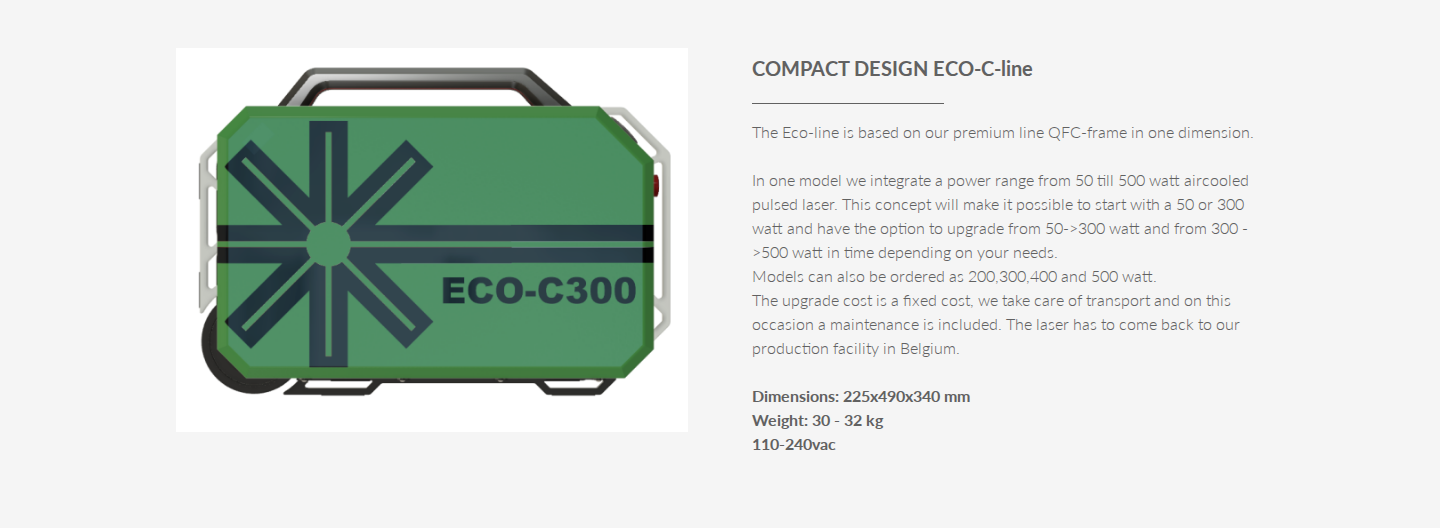
A 500 W air-cooled pulsed laser cleaning machine from P-Laser (Belgium), built on an upgradeable single-frame architecture that spans 50 to 500 W — in a 30–32 kg enclosure measuring 225×490×340 mm.
Pros:
Exceptionally compact form factor at 500 W
Air-cooled — no water or chiller infrastructure
Single-phase 110–240 V supply — standard site power
Upgradeable laser source within the same frame
Cons:
Upgrades require return to Belgium facility
No published list price — contact P-Laser directly
Manufacturer and Product Line
The P-Laser ECO-C500 is made by P-Laser, a Belgian manufacturer based in Heusden-Zolder that engineers and produces its laser cleaning systems entirely in-house. P-Laser describes itself as the European market leader in the development and production of laser cleaning machines, with over 35 years of expertise in surface treatment and more than 450 systems installed worldwide.
The ECO-C500 sits within the ECO-C (Compact) line — P-Laser's economical range of air-cooled pulsed laser systems, positioned as a functional, budget-conscious alternative to the company's premium Compact series while sharing the same premium materials and optical components.
Portability and Form Factor
The ECO-C500 measures 225×490×340 mm and weighs between 30 and 32 kg. P-Laser describes it as the first air-cooled laser in the world at this power level, with the smallest footprint possible at 500 W — these are P-Laser's own claims, stated on their products page.
The single-enclosure form factor is meaningfully more compact than trolley-based 500 W alternatives, which integrate water cooling and control units into a wheeled carriage. For sites where space, access, or portability are considerations, the physical difference is significant.
| Specification | ECO-C500 |
|---|---|
| Dimensions | 225 × 490 × 340 mm |
| Weight | 30–32 kg |
| Power supply | 110–240 V AC, single-phase |
| Cooling | Air-cooled |
| Laser type | Pulsed fibre laser |
| Power range (frame) | 50–500 W |
Key published specifications for the P-Laser ECO-C500, drawn from P-Laser's ECO-line product page.
The 110–240 V single-phase power requirement is a direct consequence of the air-cooled architecture and means the ECO-C500 runs from standard site power without dedicated electrical infrastructure.
Upgradeable Architecture
The ECO-C frame is designed to accommodate pulsed laser sources from 50 W through 500 W within the same enclosure. A buyer can enter at the ECO-C50 or ECO-C300 tier and upgrade the laser source over time as their application demands grow — up to the 500 W ceiling.
P-Laser states that the upgrade cost is a fixed cost, and that transport and a maintenance service are included in the upgrade process. The unit must return to P-Laser's production facility in Belgium to complete the upgrade.
The ability to grow from 50 W to 500 W within a single frame is a structural differentiator not found in the other entries on this list. The return-to-Belgium requirement is the honest counterweight: an upgrade is not a field swap, it is a factory service event. Buyers should factor that lead time into their planning.
Laser Type and Control
The ECO-C500 uses a pulsed fibre laser source. P-Laser's applications documentation notes that pulsed fibre lasers in their range deliver extremely high peak power during very short pulses — with peak powers across their systems typically reaching 10 to 50 kW — while average power remains comparatively low.
The laser gun is an xy two-dimension scanner system, controlled through P-Laser's proprietary Cleansweep software. Cleansweep runs on a wireless tablet interface and gives operators control over cleaning parameters — pulse energy, repetition rate, scan pattern — to optimise the process for each specific application and surface type.
A screen-assisted laser gun is available as an optional upgrade, integrating safety sensors, a working light, gyroscope, and distance sensor into the gun itself. This is not a standard inclusion on the ECO-C500.
Applications
P-Laser's pulsed systems — including the ECO-C500 — are suited to rust removal, paint and coating stripping, oxide removal, mould cleaning, and surface preparation across industrial maintenance and fabrication contexts. The pulsed architecture allows the surface beneath to be left untouched or structured as required, which extends the machine's usefulness beyond simple contamination removal.
ECO-C500 Pricing
P-Laser does not publish a list price for the ECO-C500. Contact P-Laser directly for current pricing. Note that rental pricing shown in some P-Laser documentation applies to the QF-500 — a separate, water-cooled trolley model — and does not represent ECO-C500 pricing.
Product 3
Senfeng SF500HC
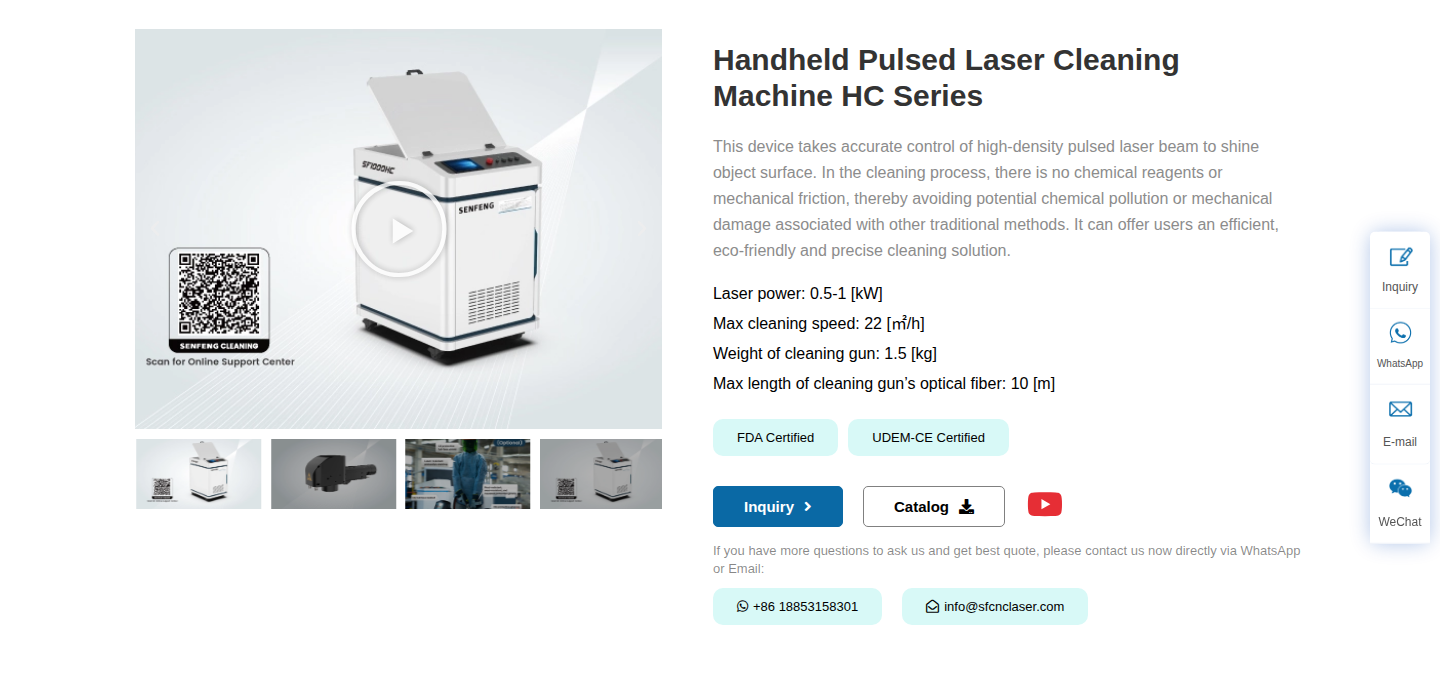
A 500 W handheld pulsed fibre laser cleaning machine from Senfeng (China), with a 1.47 kg cleaning gun, automation-ready I/O for direct robot integration, and a global subsidiary and service network.
Pros:
1.47 kg cleaning gun — low operator fatigue
I/O interface enables direct robot integration
Water-cooled for sustained high-duty-cycle use
Global subsidiaries and 260+ service engineers
Cons:
10 m cable reach from machine body
Three-phase 380 V supply — confirm site compatibility
Diversified manufacturer, not a laser-cleaning specialist
The Senfeng SF500HC is a 500 W handheld pulsed fibre laser cleaning machine produced by Senfeng, a Chinese manufacturer with over 20 years of laser technology R&D and a product range spanning cutting, welding, cleaning, and cladding.
Senfeng operates manufacturing bases covering more than 180,000 m² in China and has established subsidiaries in the USA (two locations), Germany, and the UAE — giving it a genuinely global commercial and service footprint.
SF500HC Laser Specifications
| Parameter | SF500HC |
|---|---|
| Laser type | Pulsed fibre |
| Average power | 500 W (0.5 kW) |
| Wavelength | 1064 nm |
| Maximum pulse energy | 50 mJ |
| Cleaning gun weight | 1.47 kg |
| Cable length | 10 m |
| Net machine weight | 215 kg |
| Overall dimensions (L × W × H) | 1010 × 745 × 1200 mm |
| Cooling type | Water-cooled |
| Power supply | Three-phase 380 V, 50/60 Hz |
Key published specifications for the Senfeng SF500HC.
At 1.47 kg, the SF500HC cleaning gun is notably light — a meaningful advantage for operators working extended shifts, where gun weight directly affects fatigue.
Portability and Form Factor
The SF500HC follows the same handheld configuration as the other entries on this list: the machine body stays stationary while the operator works with the cleaning gun.
The fibre cable extends to 10 m, which sets the operator's working radius from the machine body — a practical constraint on site layouts where the machine cannot be repositioned close to the work area.
The machine body itself is substantial, at 215 kg and 1010 × 745 × 1200 mm — sized accordingly for its integrated water-cooling circuit.
Cooling and Power Supply
The SF500HC runs on three-phase 380 V, 50/60 Hz — unlike the two air-cooled machines on this list, which operate on single-phase supply. Buyers must confirm site supply compatibility before purchase; not all industrial or workshop sites have three-phase power available at the point of use.
Water cooling enables the SF500HC to sustain higher duty cycles than air-cooled configurations — the water circuit adds infrastructure requirements but supports continuous high-power operation.
Control Interface and Automation
The SF500HC's control system offers 8 cleaning modes and supports 11 languages, including English and French — a practical consideration for multinational operations or sites with mixed-language workforces.
A dedicated I/O aviation plug interface allows direct connection to an industrial robot via a standard plug, supporting automated cleaning cycles and batch production applications.
Applications
Senfeng lists rust, paint, oxide layer, and oil removal as the primary applications for the SF500HC, across metal substrates in aerospace and electronics sectors.
Safety
The SF500HC is a Class 4 laser product.
Buyers should consult Senfeng's documentation and qualified safety professionals for site-specific safety planning and PPE requirements.
SF500HC Support Infrastructure
Senfeng's service page lists 260+ professional service engineers, 10+ overseas service centres (covering Pakistan, Vietnam, Indonesia, Japan, Jordan, Poland, Türkiye, and Australia), and 20+ spare parts warehouses globally.
Spare parts quotations are available within 24 hours, with delivery cited at 3–7 working days, prioritised through the nearest subsidiary or local service centre.
Technical support operates 24/7, with Senfeng citing a response target of within 5 minutes and a solution target of within 2 hours.
It is worth noting that Senfeng is a large, diversified manufacturer — its portfolio spans laser cutting, welding, cladding, bending, and CNC machining in addition to cleaning. Buyers assessing depth of application-specific expertise in laser cleaning should factor this into their evaluation alongside the breadth of the support network.
SF500HC Pricing
Senfeng does not publish a list price for the SF500HC; pricing varies by configuration and region.
As a general market orientation, 500 W pulsed laser cleaning machines from Chinese manufacturers are available at approximately USD 10,000–14,000 — this is a market-level reference, not a confirmed SF500HC figure.
For current SF500HC pricing, contact Senfeng directly or reach out to a regional distributor; Senfeng's FAQ confirms that a sales engineer will recommend a suitable model and provide a quote based on specific requirements.
See How Our Laser Cleaning Machines Compare
You have seen three strong options in this power class. The ELASER from Woodrow Scientific is another benchmark worth adding to your evaluation before you decide.
Conclusion
How to choose between these 500W laser cleaning machines
All three machines share the same rated output, which means the decision comes down to site constraints and operational realities: cooling type, power supply, cable reach, operator burden, laser source provenance, and where support actually lives.
Cooling is the most site-constraining of those axes — it determines your power supply requirement before anything else, and that is a hard constraint worth confirming early.
For buyers exploring lower power classes, Woodrow Scientific — the only UK-based laser cleaning manufacturer, designing, building, and supporting its own machines in-house — offers the ELASER range, up to 300 W.
Frequently asked questions about 500W laser cleaning machines
Answers to the questions buyers ask most often before committing to a 500W laser cleaning machine.
A 500W pulsed fiber laser cleaning machine handles moderate-to-heavy rust removal, paint and coating stripping, mill scale removal, weld oxide and heat tint removal, mould cleaning, and surface preparation before inspection — at throughput rates of roughly 3–10 m²/h depending on contamination type and required cleanliness grade. That range makes it a genuine production tool rather than a spot-cleaning device. Because the energy is delivered in nanosecond pulses, the average thermal load on the substrate stays low between bursts. That keeps it suitable for substrate-sensitive work — thin sheet, aluminium and titanium alloys, precision components — where a continuous-wave laser at the same power would risk distortion or surface damage.
There is no single best machine — the right choice depends on your specific requirements. The key decision axes are cooling preference (air-cooled for portable or intermittent use, water-cooled for continuous duty), site power supply (single-phase vs. three-phase), the fibre cable reach your application demands, the geographic coverage of the manufacturer's support network, and your budget. The three machines evaluated on this page represent the strongest verified options at 500W, each with different strengths across those axes. The entries and the decision guidance above map those trade-offs in detail — working through them against your own application is the most reliable way to identify which machine fits.
Prices vary considerably depending on laser source provenance (a named, third-party-verifiable laser source commands a premium over an unbranded one), cooling system type, scanning optics specification, and the support package included. As a general market reference, 500W pulsed machines from Chinese manufacturers are available from approximately USD 10,000 upwards. Machines built around named, independently verifiable laser sources typically cost more — the laser source brand is one of the most significant price variables in this category. None of the three machines covered on this page publish a list price — current pricing for each requires a direct quote from the manufacturer or distributor.