Introduction
If you've landed here, you've already done the groundwork: you know laser cleaning is the right approach, and you've settled on 300 W as your target power level. This list is for that buyer.
The 300 W tier sits in a productive middle ground — capable enough for moderate-to-heavy rust, paint, mill scale, weld prep, and mould cleaning, without the bulk or cooling complexity of high-power continuous wave systems.
Virtually every portable machine at this power level is a pulsed fibre laser, air-cooled as standard — no external chiller, instant startup, genuine field portability, with some trade-offs on sustained duty cycle.
Each entry is evaluated against the same six axes: form factor, cooling method, power tunability, after-sales support and manufacturer credibility, certifications and safety compliance, and pricing transparency.
TL;DR
At 300 W, the spec sheets look remarkably similar — but the machines are not. Portability, safety overhead, manufacturer credibility, and real-world versatility diverge sharply once you look past the wattage figure. The right choice depends on factors most buyers don't know to ask about until it's too late.
This article covers:

Pulse vs CW laser technology at 300W
Air-cooling trade-offs and field portability
Six evaluation axes applied to every entry
Certifications and safety compliance explained
Pricing transparency and total cost of ownership
Matching the right machine to your use case
What to look for in a 300W laser cleaning machine
Before comparing specific machines, it's worth asking the question that most buyers skip: is 300W actually the right power level for what you're doing?
A 300W pulsed laser cleaner sits firmly in the productive all-purpose tier for industrial maintenance and fabrication work — capable of moderate-to-heavy rust removal, paint and coating stripping, mill scale, weld prep and post-weld oxide, mould cleaning, and heritage or conservation applications.
If your work is primarily light oxide removal or precision cleaning on heat-sensitive substrates, a lower-power unit may actually serve you better — 100W pulsed delivers finer control with less risk of over-cleaning delicate surfaces.
At the other end, buyers running continuous heavy mill scale removal on large structural steel at production pace may find that higher-power continuous-wave systems offer the throughput they need — though those systems deposit significantly more heat into the substrate and are less forgiving on anything other than robust steel.
The 300W pulsed tier is not an entry-level machine and not an overkill system: it is the point where genuine field portability and serious industrial cleaning capability meet in one package.
Form factor and portability
Portability is an operational capability, not a convenience feature — and the distinction matters when you're evaluating a 300W laser cleaning machine.
The critical variables are scanner weight and cable reach: in a fibre-fed design, the main unit stays on the ground (or on a trolley) while the operator carries only the handheld scanner, connected via a delivery cable.
That cable length determines how far from the unit the operator can actually work — on scaffolding, inside a vessel, at height on a large fabrication — without repositioning the machine itself.
A short cable forces the unit close to the work, which is often impractical on elevated structures or confined spaces where a single operator needs to cover a large area.
The evaluation standard here is single-operator portability: can one person set up the unit, carry the scanner to the work, and clean without assistance or repeated repositioning of the main machine?
Cooling method at 300W
Air cooling is the prevailing approach at this power level, and it brings genuine operational advantages that go beyond simplicity.
With no external water chiller, no coolant circuit, no freeze risk, and near-instant startup, an air-cooled machine can be deployed in the field without any supporting infrastructure — it arrives on site, powers on, and cleans.
The trade-off is duty-cycle headroom at sustained full power: air-cooled systems have a thermal ceiling that water-cooled systems do not.
For most maintenance and fabrication applications — intermittent cleaning across a shift rather than continuous production-line operation — this ceiling is rarely reached in practice.
Buyers running sustained, high-throughput production cleaning should ask specifically about duty-cycle ratings at their expected ambient temperature, not just at the manufacturer's stated test conditions.
Air cooling at 300W is not a compromise — it is the right choice for portable and field applications, and it removes an entire subsystem (the chiller) along with its maintenance overhead, weight, and failure points.
Power tunability: why 0-100% matters
A machine that can only run at full power is a limited tool — it will strip heavy coatings efficiently, but it has no safe operating mode for lighter oxide, weld discolouration, or delicate substrate surfaces.
Different contaminants and substrates require different energy inputs: thin heat-affected zone tint on stainless requires far less fluence than thick epoxy coating on structural steel, and forcing both through the same power setting means either under-cleaning or risking substrate damage.
The evaluation standard is full continuous power adjustment from 0 to 100% — not a handful of preset modes, but genuine fine-grained control that lets the operator dial in exactly the right energy for the job at hand.
A machine with this range covers the full spectrum of cleaning tasks: from light tarnish and weld discolouration through to thick paint and heavy rust, with one machine and one operator.
After-sales support: manufacturer vs reseller
This is the axis most buyers overlook — and the one that causes the most pain after the purchase.
A significant proportion of branded laser cleaners on the market are rebadged imports: machines built by a third-party manufacturer and sold under a different name by a vendor with no genuine engineering capability of their own.
The practical consequence is straightforward: when something goes wrong, that vendor cannot diagnose the root cause, cannot supply genuine spares quickly, and cannot improve the product — they are entirely dependent on the original manufacturer, who has no obligation to them or to you.
Before committing, ask these questions of any vendor you're evaluating:
- Do you design and build this machine?: A genuine manufacturer can answer this specifically, naming their engineering team and facility.
- Do you hold spares in-house?: Fast parts availability requires stock on the shelf — not a re-order from an overseas supplier.
- Can your engineers service this machine?: In-house service capability means problems get solved, not passed back to a factory abroad.
- Can you demonstrate product improvements?: Genuine manufacturers iterate on their machines; resellers cannot.
A genuine manufacturer with in-house engineering, service, and spares is not just a commercial preference — it is what determines whether a problem gets solved in days or weeks.
Certifications: CE and UKCA marking
CE marking (required for the EU market) and UKCA marking (required for Great Britain) are meaningful quality and safety signals — not bureaucratic formalities.
CE marking confirms that the manufacturer has assessed the product against EU safety, health, and environmental requirements and declared conformity; it is the manufacturer's legal responsibility to ensure that declaration is accurate.
For UK buyers, the HSE is clear: products placed on the GB market must carry UKCA marking and meet the requirements of applicable UK product safety legislation — and that responsibility rests with the manufacturer, not the importer or reseller.
A machine without the appropriate marking for your market should prompt direct questions — serious manufacturers obtain these certifications as a matter of course, and resellers of non-compliant imports frequently cannot provide them.
These certifications are a baseline quality signal, not a complete quality assessment — but they are a meaningful one, and their absence is a red flag worth investigating before any purchase.
Reduced hazard zone (RHZ) technology
Every industrial laser cleaning machine above 500mW is a Class 4 laser product under IEC 60825-1 — which means managing the laser hazard zone is a mandatory operational requirement, not an optional precaution.
In conventional Class 4 laser operation, the nominal hazard zone (NHZ) — the space within which the beam poses a risk of eye or skin injury — must be controlled: the area sealed off, cleared of bystanders, and managed with appropriate PPE and barriers.
For buyers working in open workshops, mixed-use manufacturing facilities, or public-facing environments such as heritage restoration or graffiti removal, this overhead can be a genuine operational barrier that limits where and when cleaning work can be carried out.
Reduced hazard zone technology collapses that hazard zone to a small area immediately around the work surface, rather than the surrounding space — fundamentally changing the environments in which laser cleaning is operationally viable.
Conventional Class 4 laser cleaning requires area clearance and barrier controls across the full nominal hazard zone. Reduced hazard zone technology confines the laser hazard to the immediate work area — enabling cleaning in open workshops, shared facilities, and public-facing settings where conventional laser cleaning would require evacuation.
This is not a safety checkbox — it is an operational capability that determines whether a machine can be used in the environments where many buyers actually need to work.
Pricing and total cost of ownership
The right question when evaluating a 300W laser cleaner is not "what does it cost?" — it is "what does it cost to own and operate over five years?"
A laser cleaning machine runs on zero consumables: no abrasives to replenish, no chemicals to buy and dispose of, no water or blast media.
Non-contact cleaning also means minimal substrate damage and less rework — the machine removes the contaminant without disturbing the surface beneath, which reduces downstream finishing costs.
When comparing machines against each other, upfront price is a relevant input but should be weighed alongside support quality, machine longevity, and the cost of downtime if something needs fixing and the vendor cannot respond quickly.
A machine that costs less to buy but requires expensive third-party servicing, has long lead times on spares, or fails prematurely is not the lower-cost option when the full ownership picture is considered.
With these criteria in mind, here is how the leading 300W laser cleaning machines on the market actually stack up against each other.
Product 1
ELASER / ELASER-RHZ — Woodrow Scientific Limited
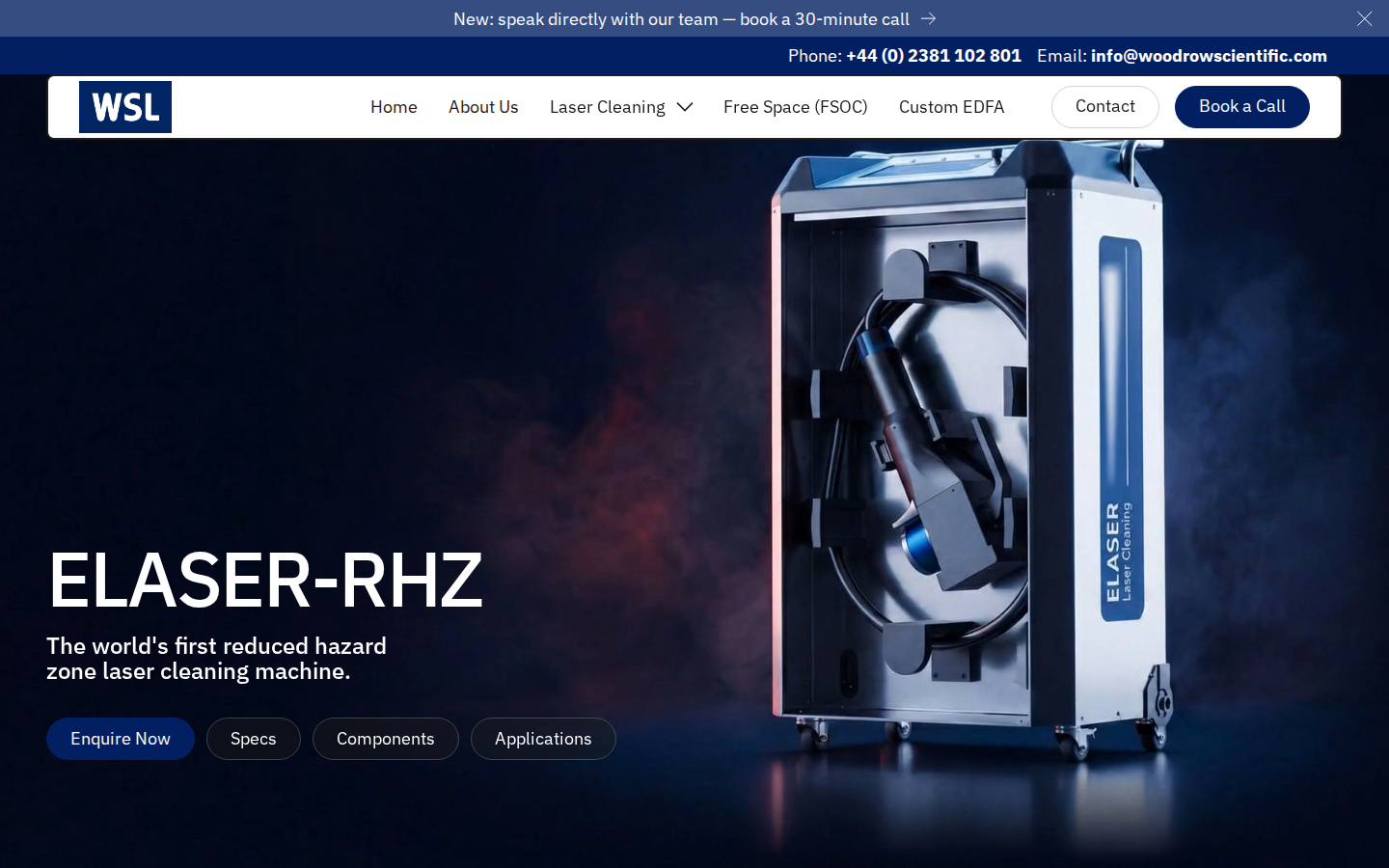
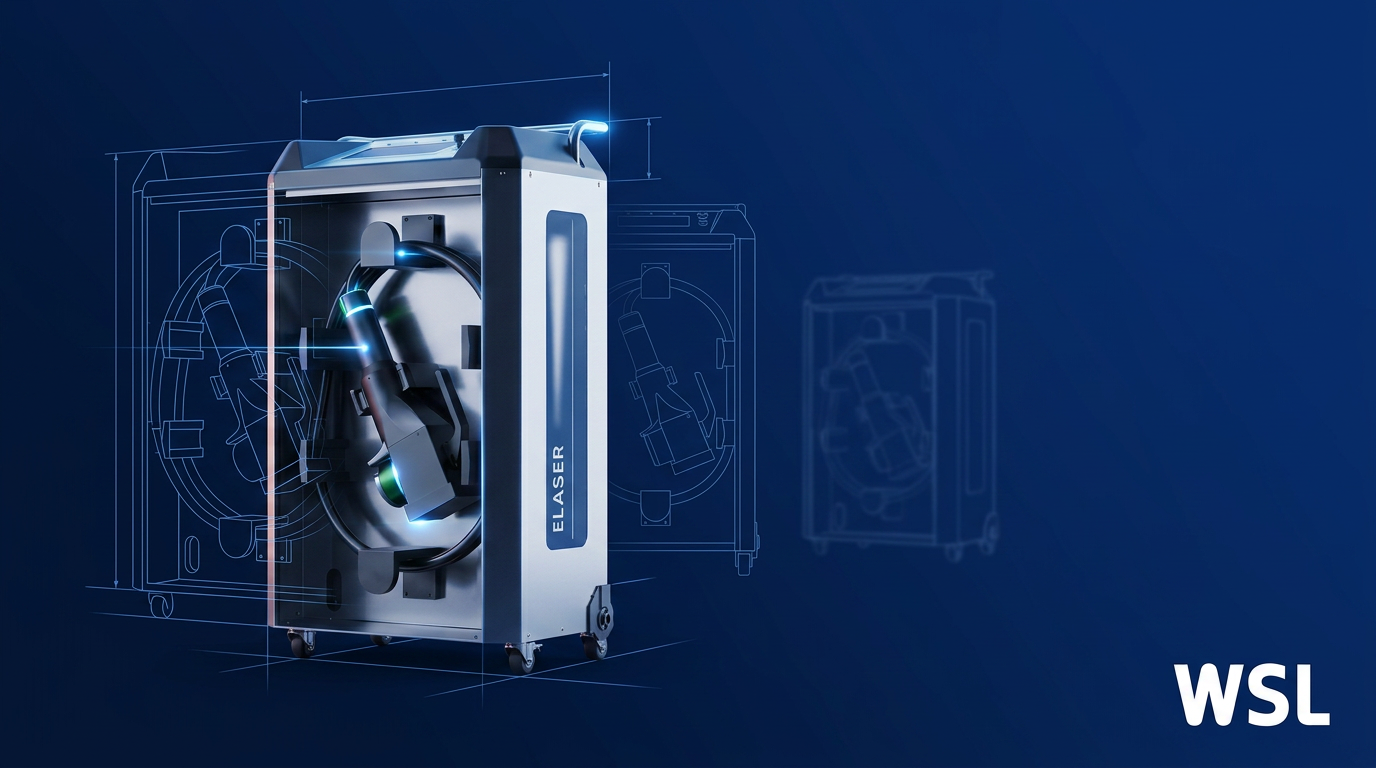
The ELASER and ELASER-RHZ are portable 300W industrial fibre laser cleaning systems from Woodrow Scientific Limited, distinguished by the world-first reduced hazard zone (RHZ) technology that collapses the laser hazard to a fraction of conventional size — enabling cleaning in open workshops and public-facing settings where conventional laser cleaning is simply impractical.
Pros:

World-first reduced hazard zone technology
Only UK-based manufacturer; in-house built
Competitive European pricing for its class
CE and UKCA certified
Cons:

Pricing by quote only; no public list price
Best for: Buyers who need a portable, air-cooled 300W industrial laser cleaner with the lowest safety overhead in the segment — particularly those working in open workshops, mixed-use facilities, or public-facing environments where conventional laser cleaning would require area evacuation.
Reduced Hazard Zone: A World-First Differentiator
The single capability that sets the ELASER range apart from every other machine on this list is WSL's patented reduced hazard zone (RHZ) technology, operating at a 1550 nm wavelength.
Conventional laser cleaners require the surrounding area to be sealed off and evacuated before work begins — a significant operational constraint in busy manufacturing environments or public spaces.
The RHZ technology collapses that hazard zone to a small area immediately around the work, removing the need for full area evacuation and enabling cleaning to continue in open-plan facilities, mixed-use workspaces, and publicly accessible settings.
The ELASER-RHZ variant achieves Class I laser classification — the only laser cleaning machine in the world to do so. The standard ELASER is Class IV. This is not a marginal safety improvement; it is a capability that unlocks entire categories of application that are impractical with conventional laser cleaning.
Practical examples include graffiti removal on public monuments, heritage restoration on accessible sites, and cleaning in open manufacturing facilities where shutting down adjacent operations is not viable.
In-House UK Manufacture: The Company Behind It
Woodrow Scientific Limited, founded in 2012, is the only UK-based laser cleaning manufacturer — and the distinction matters operationally, not just as a badge.
WSL designs, builds, services, and continually improves its machines in-house, drawing on over 200 years of combined engineering experience within the team.
A significant portion of the laser cleaning market is supplied by resellers and importers rebadging third-party equipment, which typically means slower spare parts, no genuine in-house technical support, and no real capacity to improve the product over time.
With WSL, buyers deal directly with the engineers who built the machine — a practical difference that shows up in support response times, bespoke engineering capability, and the confidence of knowing the manufacturer can actually fix what it sells.
Pricing and Total Cost of Ownership
The ELASER and ELASER-RHZ carry the most competitive pricing among comparable industrial laser cleaning machines in Europe, achieved through WSL's technological and operational efficiencies rather than any compromise on build quality.
Compared with traditional cleaning methods such as sandblasting, chemical stripping, or water-jetting, the total cost of ownership case is strong: zero consumables, reduced downtime, and less rework arising from the machine's precise, substrate-preserving ablation.
Pricing is by quote — contact Woodrow Scientific directly for a figure based on your specific requirements.
ELASER Key Specifications
| Specification | Detail |
|---|---|
| Max power | Up to 300 W |
| Wavelength | 1550 nm |
| Laser class | Class IV (ELASER) / Class I (ELASER-RHZ) |
| Power tunability | 0–100% |
| Pulse energy | Up to 15 mJ |
| Pulse duration | 100 ns |
| Scanner | 2-D galvanometer, 10 m/s max scan rate |
| F-Theta lenses | Interchangeable, 75–500 mm working distance |
| Delivery cable | Up to 50 m (5 m / 15 m standard) |
| Handheld scanner weight | Under 3 kg |
| System weight | Under 50 kg, wheeled |
| Power supply | 110–250 VAC single-phase |
| Power consumption | < 2000 W |
| Certifications | CE and UKCA |
Consolidates the core specs into a scannable reference so buyers can assess the machine against their requirements without hunting through prose.
The interchangeable F-Theta lenses (75–500 mm working distance) and fully programmable scan shapes via the touchscreen GUI give operators precise control over the cleaning geometry for each application.
Portability and Form Factor
The wheeled system weighs under 50 kg and the handheld scanner comes in under 3 kg, making this a genuine single-operator machine.
The delivery cable extends up to 50 m — a standout specification at this power class — meaning one operator can reach elevated structures, confined spaces, or remote areas of a facility without repositioning the unit.
Air-cooled throughout, the ELASER requires no water chiller or coolant circuit: it starts immediately, deploys in the field without infrastructure, and carries no freeze risk in cold environments.
Applications
The ELASER range covers a broad spread of industrial and specialist applications, including:
- Automotive: Pre-weld preparation, rust removal, and paint stripping on the production line or in the bodyshop.
- Aerospace: Precise surface preparation and component cleaning to tight tolerances.
- Industrial maintenance: On-site cleaning of plant, equipment, and infrastructure with no masking or media clean-up.
- Injection moulding and tooling: Strip residue, release agents, and build-up from moulds in place, without disassembly.
- Tyre and rubber: Clean moulds, vents, and vulcanisation residue without abrasives or mould wear.
- Heritage and restoration: Lift soiling, paint, and corrosion from stone, metal, and masonry with minimal substrate impact.
- Laser-cleaning service businesses: A portable system with full operator training to launch or expand a commercial cleaning service.
These are illustrative examples; the ELASER-RHZ in particular suits a wide range of further cleaning tasks across industries.
Support, Training, and Certifications
WSL provides first-class operator training and has bespoke engineering and customisation capability for buyers with specific requirements — contact the team directly to discuss what your application demands.
Both the ELASER and ELASER-RHZ are CE and UKCA certified, covering the compliance requirements for UK and European buyers without the need for additional certification steps.
The 300W laser cleaner with a reduced hazard zone
The ELASER-RHZ is the only machine in this segment that collapses the laser hazard zone — making it practical for open workshops and public-facing environments. See the full specification.

Product 2
cleanLASER streamLINE compact
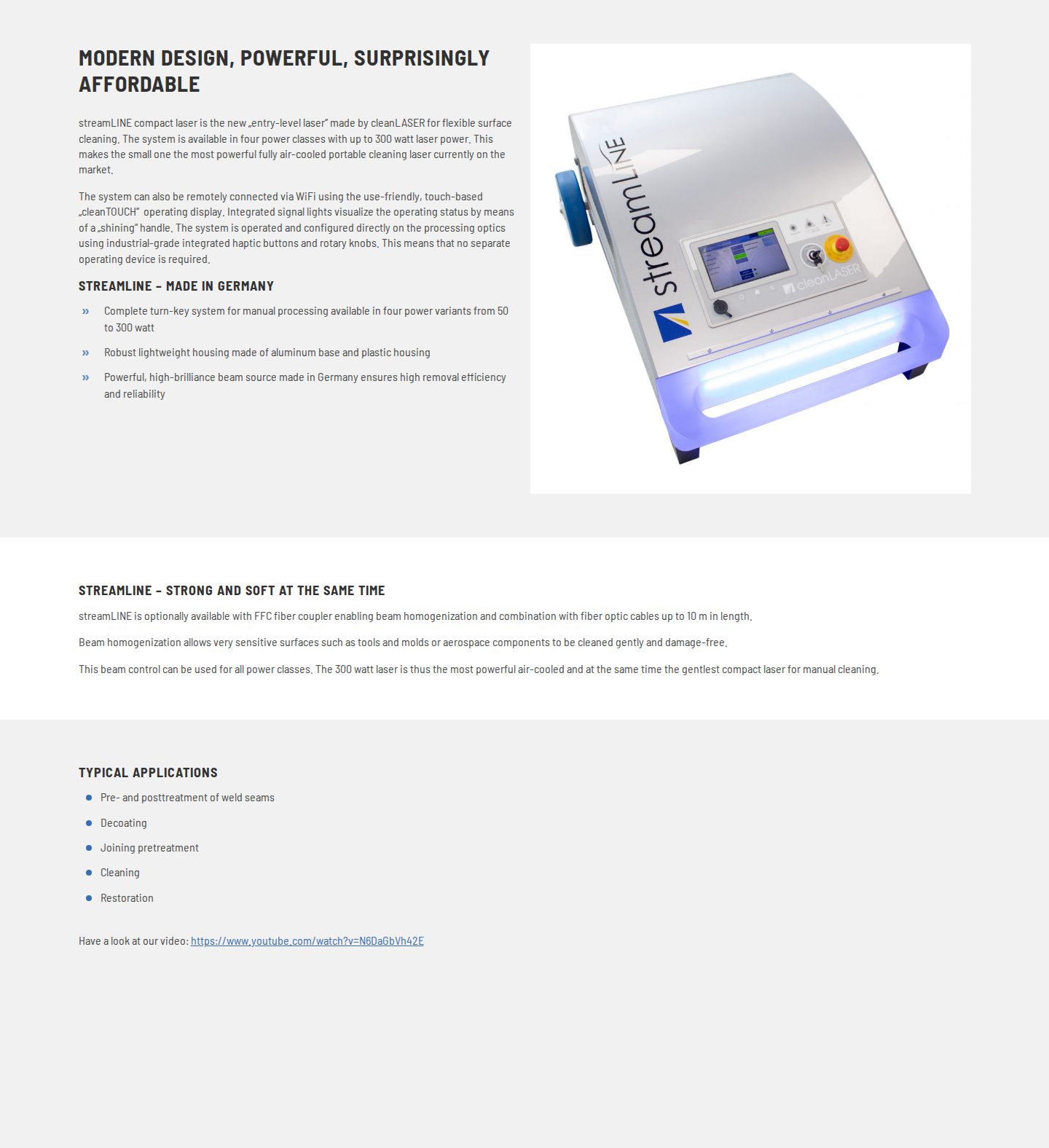
The cleanLASER streamLINE compact is a portable 300W laser cleaning system from Clean-Lasersysteme GmbH, a German manufacturer founded in 1997 with roots at the Fraunhofer Institute for Laser Technology. Available in four power variants from 50 W to 300 W, it is fully air-cooled and designed as a complete turnkey system for manual industrial cleaning — operating as a conventional Class 4 laser with standard hazard-zone requirements.
Pros:
Established German manufacturer; founded 1997
Fully air-cooled at 300 W; no chiller needed
Four power variants; continuous 0-100% adjustment
Approx. 2,000 systems installed worldwide
Cons:
Conventional Class 4; no reduced hazard zone
Standard cable 3 m; 10 m via FFC
Pricing not publicly listed; quote required
Best for: Buyers seeking a proven, fully air-cooled portable 300W laser cleaner from an established German manufacturer, particularly suited to industrial environments where conventional Class 4 hazard-zone management is already in place.
cleanLASER streamLINE compact: Key Strengths
Clean-Lasersysteme GmbH (cleanLASER) was founded in 1997 by two researchers from the Fraunhofer Institute for Laser Technology in Aachen — giving the company a deep engineering pedigree from the outset.
Today the company employs around 140 people, holds approximately 2,000 installed systems in operation worldwide, and distributes through partners in more than 20 countries — a scale that reflects genuine industrial adoption across automotive, aerospace, electronics, and restoration sectors.
Since 2024, cleanLASER has operated as part of IPG Photonics, while continuing to manufacture and trade as Clean-Lasersysteme GmbH from its headquarters in Herzogenrath, near Aachen.
The streamLINE compact is a complete turnkey system for manual laser cleaning, built with a robust lightweight housing of aluminium and plastic construction.
It is available in four power variants — 50 W, 100 W, 200 W, and 300 W — making it practical to select the right output for the application without over-specifying.
The standard delivery cable runs to 3 m, with an optional fibre-to-fibre coupling (FFC) extension available up to 10 m — a practical consideration for buyers who need to reach into confined or awkward positions.
At 300 W, the streamLINE compact is fully air-cooled — no external water chiller or coolant circuit is required, which means instant startup and straightforward field deployment without freeze-risk or coolant management.
cleanLASER describes the 300 W variant as the most powerful fully air-cooled portable cleaning laser currently on the market — a claim that appears on both the product page and the official datasheet.
Power is adjustable continuously from 0 to 100%, giving operators precise control over cleaning intensity across the full range — a meaningful advantage when working across varied substrates and coating types.
The system is operated directly on the processing optics via integrated haptic buttons and rotary knobs, with no separate control unit required; optional WiFi connectivity via the cleanTOUCH touchscreen display is also available.
cleanLASER is a genuine manufacturer — not a reseller or integrator — and has produced its own laser systems for over 25 years, certified to ISO 9001:2015 and ISO 14001.
UK buyers are served by Loop Technology Ltd, a dedicated Sales and Service Partner based in Dorchester, Dorset, with a direct cleanLASER contact route at cleanlaser@looptechnology.com.
European coverage spans France, Austria, Italy, Portugal, Spain, Finland, Sweden, Norway, and the Balkan region through named Sales and Service Partners — a well-established distribution network for buyers across the continent.
cleanLASER streamLINE compact: Safety and Certifications
The streamLINE compact operates as a conventional Class 4 laser system — the standard classification for industrial laser cleaning machines at this power level.
Class 4 operation requires standard hazard-zone protocols: appropriate PPE for all personnel within the hazard zone and controlled access to the working area during operation.
The streamLINE compact does not offer any eye-safe or reduced hazard zone technology. Buyers working in open workshops, mixed-use facilities, or environments without established laser safety infrastructure should factor the full Class 4 hazard-zone requirements into their operational planning.
As a German-manufactured product placed on the EU market, CE marking applies as a standard legal requirement; cleanLASER's quality systems are certified to ISO 9001:2015.
UKCA certification status is not confirmed on cleanlaser.de — UK buyers should verify this directly with Loop Technology Ltd or cleanLASER before purchase.
cleanLASER streamLINE compact: Pricing and Availability
Pricing for the streamLINE compact is not publicly listed on cleanlaser.de; buyers should contact cleanLASER directly or reach out to their regional Sales and Service Partner for a quote.
UK enquiries can be directed to Loop Technology Ltd (+44 1305 257108 / cleanlaser@looptechnology.com); buyers elsewhere in Europe should identify their nearest partner via the locations page at cleanlaser.de/en/locations/.
Product 3
P-Laser QFC-300
The P-Laser QFC-300 is a 300 W pulsed, air-cooled portable laser cleaning system from a dedicated laser cleaning specialist, built as a compact self-contained unit that can be lifted and carried to the workpiece — well suited to workshop buyers who already operate within conventional Class 4 laser safety protocols.
Pros:
Dedicated laser cleaning specialist manufacturer
Claimed most compact 300 W system available
Air-cooled at 300 W; no chiller required
Quick ~10s startup; very low maintenance
Cons:
Conventional Class 4 hazard zone applies
Carry-the-whole-unit design; no separable scanner
Pricing not publicly listed; quote required
Best for: Buyers who want a compact, self-contained 300 W pulsed laser cleaner from a manufacturer whose entire focus is laser cleaning — particularly those operating in workshop settings where conventional Class 4 hazard-zone protocols are already part of daily practice.
P-Laser: A Specialist Manufacturer
P-Laser is a dedicated laser cleaning specialist — it designs and produces its own pulsed industrial laser equipment, and laser cleaning is the entirety of what it does.
That specialist focus spans a wide power range: the portable line alone runs from 50 W to 300 W pulsed air-cooled, with trolley-mounted and inline systems extending up to 3,000 W. The QFC-300 sits at the top of the portable range.
P-Laser is based in Heusden-Zolder, Belgium. Buyers should verify founding date and full company history directly at p-laser.com/about.
Form Factor: Compact and Self-Contained
P-Laser positions the QFC-300 as the most compact laser cleaning system at the 200–300 W power level, with verified dimensions of 300 × 665 × 465 mm and a weight of approximately 30–35 kg.
The design philosophy here is worth understanding clearly: the QFC-300 is a carry-the-whole-unit system. The entire laser, optics, cooling, and controls are housed in a single portable enclosure fitted with an extendable handle and wheels for movement between locations.
This is a different architecture to designs that separate a wheeled main cabinet from a lightweight fibre-fed handheld scanner. In those designs, the scanner can reach elevated or distant work while the cabinet stays put. With the QFC-300, the operator works from the unit itself — the compactness is in the machine's overall footprint, not in a detachable scanning head.
Neither approach is inherently superior: the QFC-300's self-contained design suits applications where the machine can be positioned close to the work surface, and where moving the whole unit between jobs is straightforward given its size.
The QFC-300's 'most compact' claim refers to the overall machine envelope at the 300 W class — not to a separable lightweight scanner. Buyers who need the scanner to reach elevated or confined spaces while the main unit stays in position should weigh this distinction carefully.
Cooling and Startup
The QFC-300 is fully air-cooled, requiring no external water chiller — a practical advantage for field deployment and for sites without chiller infrastructure.
P-Laser notes a startup cycle of around 10 seconds and describes maintenance requirements as very low, with only periodic dust filter replacement needed. Buyers should verify the duty-cycle specification directly with P-Laser or their distributor, as this is not published on the product page.
CleanSweep Software and Cleaning Control
The QFC-300 is operated with P-Laser's proprietary CleanSweep software, which controls frequency, intensity, beam shape, and beam size.
P-Laser also offers inline sensor technology (patented) that measures reflected light at the cleaned surface to enable automated control of cleaning efficiency via spectral analysis — though this is a system-level capability rather than specific to the QFC-300's portable form factor. Buyers should confirm the precise power adjustment method (continuous range vs. preset programmes) directly with P-Laser.
Safety and Hazard Zone
The QFC-300 operates within a conventional laser hazard zone. Standard Class 4 protocols apply: area clearance, full PPE, and formal hazard-zone management are required during operation.
For buyers in open workshops or mixed-use environments, this is the standard operational overhead that applies to all conventional laser cleaning systems at this power level — it is a known quantity for most industrial users, but worth factoring into site planning.
Certifications
CE and UKCA certification status for the QFC-300 could not be confirmed from publicly accessible p-laser.com pages at the time of writing. Buyers should request written confirmation of certification status directly from P-Laser or from the UK distributor before purchase.
UK Availability and Support
P-Laser is represented in the UK and Ireland by LaserAge, based in Salford, Manchester. UK buyers have a direct in-country contact point for sales enquiries, demonstrations, and post-sale support.
LaserAge can be reached at Technology House, Lissadel Street, Salford, M6 6AP, or by phone on +44 161 818 9197.
P-Laser QFC-300 Pricing
Purchase pricing is not publicly listed. Contact P-Laser directly at sales@p-laser.com or reach out to LaserAge in the UK for a quote.
Product 4
Netalux Needle 300 — Netalux
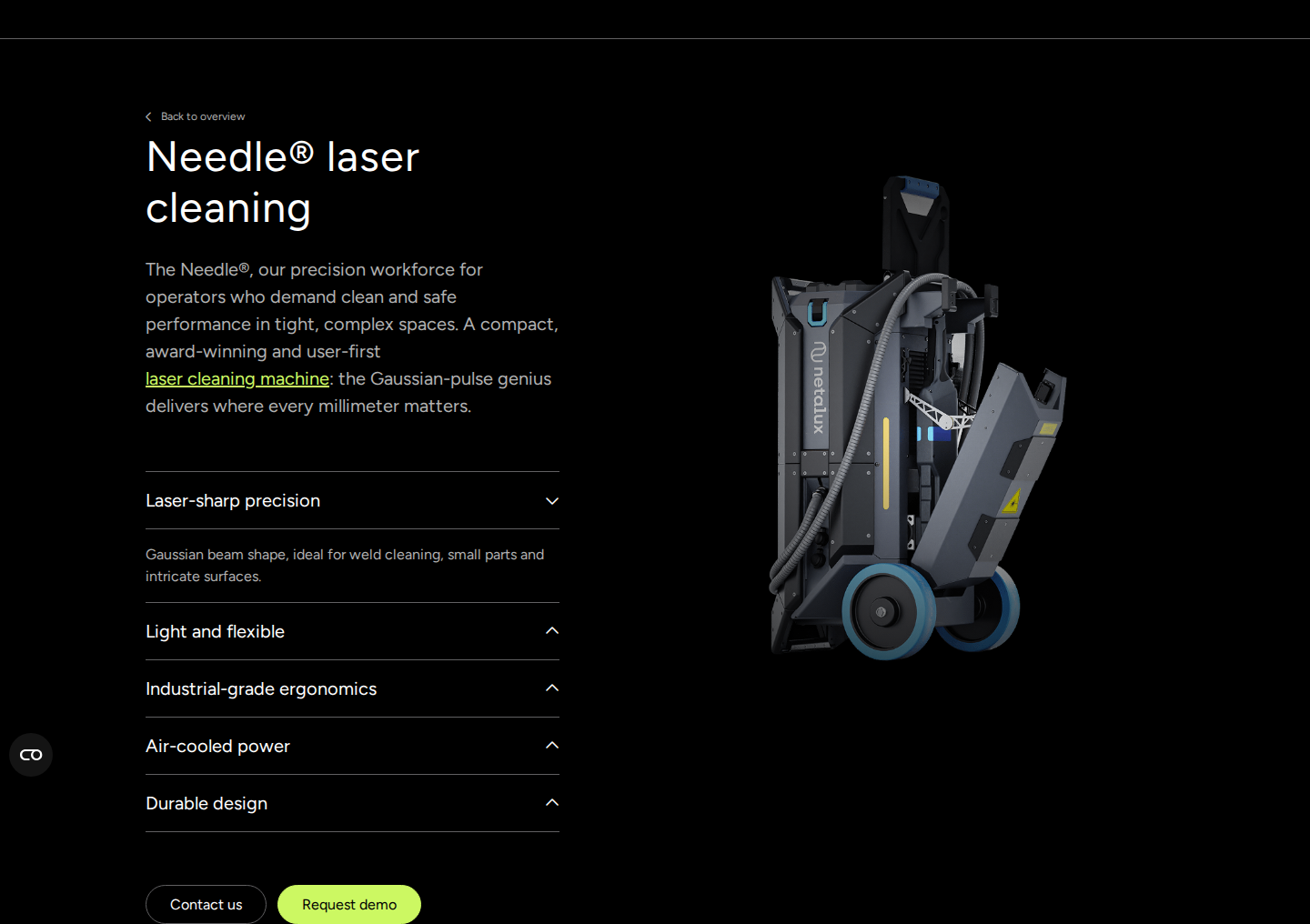
The Netalux Needle 300 is a compact, air-cooled, Class IV pulsed ytterbium fibre laser cleaner from Netalux, a Belgian manufacturer founded in 2017 and the winner of three consecutive Red Dot Product Design Awards. Its standout feature is a 115° rotatable laser head that delivers genuine ergonomic benefit when cleaning at awkward angles, paired with a Gaussian beam profile that suits precision and small-area work. At approximately 40 kg with a 5.7 m fibre in mobile configuration, it is best suited to buyers who prioritise operator comfort and detail cleaning over maximum reach.
Pros:
Three consecutive Red Dot Design Awards won
115° rotatable head; genuine ergonomic benefit
Gaussian beam profile suits precision cleaning
Air-cooled; no external water chiller needed
Cons:
5.7 m fibre reach; shorter than competitors
No UK distributor listed; verify availability
Conventional Class IV hazard zone applies
Best for: Buyers who prioritise operator comfort and precision cleaning — particularly those working on detailed surfaces or in confined spaces where a well-balanced, ergonomically considered handheld head makes a meaningful difference over a full shift.
Netalux was founded in 2017 in Belgium with a clear design-first philosophy, and its track record backs that up: the company has won three consecutive Red Dot Awards, with the original Needle taking the 2020 prize, the Jango winning in 2022, and the Needle 200/300 claiming the 2023 Red Dot Award: Product Design.
"When we started out in 2017, it was hard to imagine that we would already have 3 Red Dot Awards by now. This collective win is a reminder that design and engineering go hand in hand."
For buyers evaluating a 300W laser cleaner, that design pedigree translates directly into operational value: the Red Dot jury specifically cited user-friendliness and ergonomic consideration as the basis for the original Needle's award, and those principles carry through to the 300 W variant.
Netalux Needle 300: Form Factor and Portability
The Needle 300 unit weighs approximately 40 kg, with the handheld head at around 3 kg — compact enough to move between work areas without heavy lifting equipment.
The laser head rotates through 115°, which is a practical ergonomic feature when cleaning vertical surfaces, underside angles, or awkward joint geometries where a fixed-head machine would require repositioning the whole unit.
The most significant operational trade-off is fibre reach: in mobile configuration, the Needle 300 offers 5.7 m of fibre cable — enough for most bench-adjacent or close-proximity work, but meaningfully shorter than others on this list.
At 5.7 m, the Needle 300's mobile fibre reach is the shortest on this list. Buyers who need to position the unit away from the workpiece — cleaning elevated steelwork, large vessels, or remote access areas — should compare this directly against machines offering 10 m or more before committing.
The machine ships without a transport box in mobile configuration, which Netalux notes as a practical convenience for site-to-site movement.
Netalux Needle 300: Laser and Cooling
The Needle 300 is a Class IV pulsed ytterbium fibre laser operating at 1064 nm, with a maximum pulse energy of 2 mJ and a pulse length range of 20–500 ns.
Its Gaussian beam profile is specifically suited to small-area and detail cleaning — where a more diffuse Top-Hat profile would spread energy across a wider spot, the Gaussian concentrates it, making the Needle 300 a considered choice for fine or precision work.
Cooling is air-based throughout — no external water chiller is required, keeping the machine self-contained and field-deployable without additional infrastructure.
| Specification | Needle 300 Value |
|---|---|
| Laser type | Class IV pulsed ytterbium fibre laser |
| Wavelength | 1064 nm |
| Max pulse energy | 2 mJ |
| Pulse length | 20–500 ns |
| Beam profile | Gaussian |
| Unit weight | ~40 kg |
| Handset weight | ~3 kg |
| Fibre length (mobile) | 5.7 m |
| Cooling | Air-cooled |
| IP rating | IP54 |
| Operating temperature | 0–35°C |
Presents the Needle 300's verified key specifications in a scannable format, allowing mid-funnel buyers to compare figures directly against other entries on the list.
Standard Class IV laser hazard-zone protocols apply — operators require appropriate PPE and designated exclusion zones, consistent with any other machine on this list that does not carry a reduced-hazard-zone designation.
Netalux Needle 300: Certifications and Support
The Needle 300 carries CE certification, confirming conformity with applicable European safety and electromagnetic compatibility directives — a baseline requirement for commercial use across EU member states.
UKCA certification is not listed in Netalux's published sources. Buyers purchasing for use in Great Britain should verify current UKCA status directly with Netalux before procurement.
Netalux lists named regional contacts for Belgium/Luxembourg, France, Italy, and Germany, with its headquarters in Beringen, Belgium. No UK distributor or reseller is listed on netalux.com at the time of writing — UK buyers should contact Netalux directly to establish the appropriate supply and support route.
Netalux's support model includes maintenance contracts, guaranteed spare parts availability, and remote software access — the company states that regional teams can attend site for diagnosis, repair, or support.
Netalux Needle 300: Pricing
Pricing for the Needle 300 is not publicly listed. Contact Netalux directly at info@netalux.com or reach out to the relevant regional distributor for a quote.
Product 5
Narran ROD 300 AIR — Narran
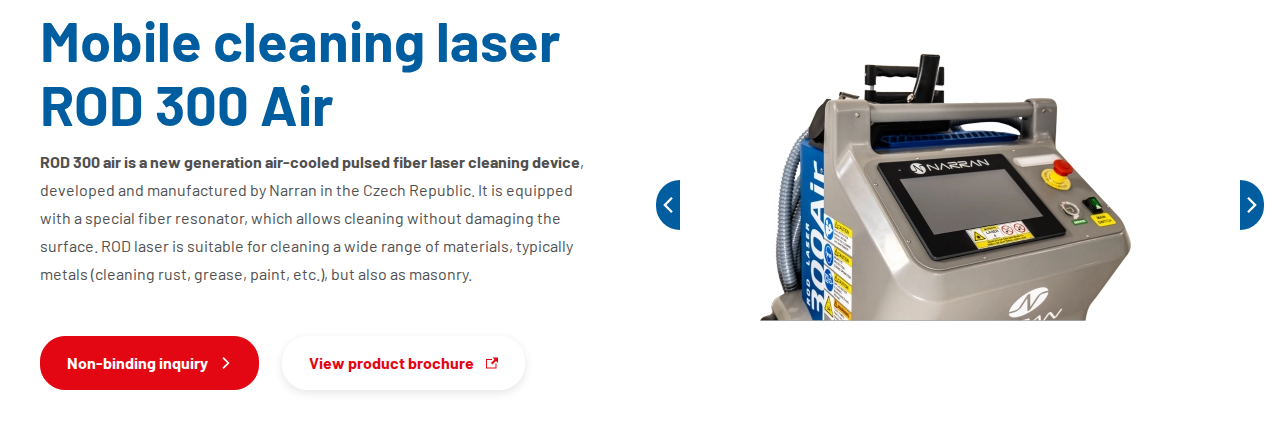
The Narran ROD 300 AIR is a 300 W air-cooled pulsed fibre laser cleaning system developed and manufactured in the Czech Republic by Narran, a direct maker that builds its own fibre resonator in-house. Its headline figure is the process head weight of 950 g to 1 kg — among the lightest at this power class — making it a practical choice for extended handheld operation where operator fatigue over a long shift is a genuine concern. The standard 10 m fibre is shorter than the longest-reach entries on this list, though longer runs are available on request; buyers who need to station the unit well away from the work area should confirm options directly with Narran.
Pros:
950 g process head; lightest at this power
Direct Czech manufacturer; in-house fibre resonator
Air-cooled; no external water chiller needed
CE certified; FDA approved for US market
Cons:
10 m standard fibre; shorter than longest rivals
No UK distributor; contact Narran directly
Pricing not publicly listed; quote required
Best for: Buyers for whom the weight of the process head is the deciding factor — particularly those carrying the head across long shifts or cleaning in positions where a lighter tool meaningfully reduces fatigue.
Brand and Manufacturer Background
Narran was founded in 2013 in the Czech Republic with an explicit focus on developing and manufacturing its own laser systems — it is not a reseller of imported machines.
The company designs, develops, and manufactures its laser systems primarily in Prague, holds ISO 9001 and ISO 14001 certification, and operates a showroom in the Prague area for prospective buyers.
A notable reference installation is CERN, which selected Narran to deliver a mobile laser cleaning system — a credential that speaks to the company's engineering capability and product reliability at the highest industrial level.
Narran describes itself as the first company to begin producing cleaning lasers in the Czech Republic and now exports internationally via a named international sales contact rather than a distributor network.
Form Factor, Portability, and Process Head Weight
The ROD 300 AIR is built as a mobile trolley unit with storage for the laser head, designed to be wheeled directly to the work area rather than carried as a whole.
| Specification | Narran ROD 300 AIR |
|---|---|
| Average output power | 300 W |
| System dimensions | 535 × 660 × 690 mm |
| System weight | 39 kg (English product page) / 45 kg (Czech product page) — verify with Narran before purchase |
| Process head weight | 950 g – 1 kg |
| Optical fibre length | 10 m standard (up to 100 m on request) |
| Max pulse energy | 10 mJ |
| Nominal pulse durations | 60, 100, 250, 500 ns |
| Peak power | 72,000 W |
| Wavelength | 1,064 nm |
| Cooling | Integrated air cooling |
| Laser safety class | Class 4 |
| Operating temperature | 5–45 °C |
| Power supply | 230/110 V, 50/60 Hz |
Presents the Narran ROD 300 AIR's key specifications in a scannable format, allowing readers to quickly assess dimensions, weight, head weight, fibre reach, pulse energy, and other critical buying criteria without hunting through prose.
Note: two Narran first-party pages list different system weights (39 kg and 45 kg respectively); prospective buyers should confirm the current figure directly with Narran before making logistics or handling decisions based on either number.
The standout figure is the process head weight of 950 g to 1 kg, which Narran positions as the lightest process head for laser cleaning on the market — a claim supported by its own product materials.
The fibre is 10 m as standard, with longer runs available on request up to 100 m — so buyers with a specific reach requirement should discuss options directly with Narran rather than assuming the standard configuration is the limit.
That said, the standard 10 m reach is shorter than what longer-reach alternatives on this list offer, and buyers who routinely need to station the unit at a distance from the work should weigh this carefully.
Cooling and Reliability
The ROD 300 AIR uses integrated air cooling throughout, including the processing head, with no external water chiller required.
Narran designed the AIR variant specifically to reduce component count relative to water-cooled systems — fewer parts in the cooling circuit means fewer potential failure points in the field.
Power Settings and Cleaning Modes
Rather than a continuous 0–100% power slider, the ROD 300 AIR uses four preset cleaning modes, each defined by a distinct pulse duration (60, 100, 250, or 500 ns) and corresponding pulse energy, giving the operator a meaningful range of surface interaction profiles.
Narran states that the character of effect between these four modes differs markedly and across a wide range — the intent being to give operators genuine flexibility when adapting to different materials and contamination types.
Power, beam shape, and beam width can all be adjusted while the laser is running, via an industrial Siemens PLC with a touch HMI interface for storing and recalling cleaning programmes.
Certifications and Safety
The ROD 300 AIR carries CE certification and, per Narran's product materials, FDA approval for the US market — the latter being relevant to buyers in North America or those supplying US-based customers.
UKCA certification status is not confirmed on narran.cz; UK buyers should verify this directly with Narran before purchase.
Like every other entry on this list except the ELASER-RHZ, the ROD 300 AIR operates as a conventional Class 4 laser — standard PPE and area control protocols apply during operation.
After-Sales Support and Availability
Narran sells internationally through a named international sales contact (Ing. Martin Boháč, bohac@narran.cz) rather than through a regional distributor network, so UK and European buyers deal directly with the manufacturer.
This direct model can be an advantage for technical queries and custom configurations, but there is no local UK service partner to call on for on-site support — a practical consideration for buyers who prioritise local after-sales coverage.
Narran ROD 300 AIR Pricing
Pricing is not publicly listed on narran.cz; prospective buyers should contact Narran directly to request a quotation for their specific configuration and geography.
Not sure which 300W laser cleaner is right?
You've compared five machines. If you still have questions about which fits your application, speak with a laser cleaning expert. A 30-minute call can save weeks of back-and-forth with manufacturers.

Conclusion
Which 300W laser cleaner is right for you?
The right machine is the one that fits your working environment and the vendor you can genuinely rely on.
If you clean in open workshops or public-facing settings, the ELASER-RHZ is the only machine in this segment with a reduced hazard zone — every other option here requires conventional hazard-zone management.
For maximum reach, the ELASER's 50 m cable and sub-3 kg scanner lead the segment; for the lightest handheld head, the Narran ROD 300 AIR stands out.
Whichever machine fits, confirm the vendor builds its own — WSL and Narran both do, and that matters when support counts.
Frequently asked questions about 300W laser cleaners
Common questions about 300W laser cleaning machines, answered directly for buyers in the research phase.
Reduced hazard zone technology collapses the laser hazard to a small area immediately around the work surface, so the operator does not need to seal off or evacuate the surrounding area before cleaning begins. The result is laser cleaning that can happen in open workshops, mixed-use facilities, and public-facing environments where conventional laser cleaning is impractical. Heritage restoration on a public monument, graffiti removal on a street-facing surface, or cleaning in a shared manufacturing bay — all become viable without the logistical overhead of a full area evacuation. The ELASER-RHZ from Woodrow Scientific Limited is the only machine in the world with this capability, and WSL provides full operator training so teams are ready to deploy it from day one.
Ask whether the vendor designs, builds, services, and improves its own machines in-house. A genuine manufacturer can answer yes to all four. Many machines sold under branded names in this market are rebadged imports with no real engineering team behind them — which means slower spares, limited technical support, and no capacity to genuinely improve the product over time. A reseller can sell you a machine; it cannot fix a design flaw or develop a new capability. Woodrow Scientific Limited (WSL) is the only UK-based laser cleaning manufacturer — founded in 2012, with 200+ years of combined engineering experience, designing, building, and supporting every machine in-house. That in-house structure is what makes fast, expert after-sales support possible.
For UK and European buyers, look for CE marking and UKCA marking. CE confirms compliance with EU safety, health, and environmental requirements. UKCA is the equivalent marking required for the GB (Great Britain) market following Brexit — the HSE confirms that products placed on the GB market must carry UKCA rather than CE alone. Both are meaningful quality and safety signals, not formalities: they confirm the machine has been assessed against defined standards. The ELASER and ELASER-RHZ carry both CE and UKCA certification.
Total cost of ownership (TCO) for a laser cleaning machine goes well beyond the purchase price. The key factors: zero consumables (no abrasives, chemicals, water, or media to buy and dispose of), reduced downtime versus methods that require masking, setup, and cleanup, and less rework because laser cleaning's precision leaves the substrate intact. Over a machine's service life, those running-cost advantages compound significantly. The upfront investment in a laser cleaner pays for itself — the question is not whether the TCO is competitive, but how quickly the payback occurs for your specific workload.
A 300W laser cleaner is used for moderate-to-heavy rust removal, paint and coating stripping, mill scale removal, weld preparation and post-weld oxide cleaning, mould cleaning, and heritage restoration. It is the productive all-purpose tier for most industrial maintenance and fabrication applications — enough power to clear meaningful surface area per shift without the bulk or cooling complexity of higher-power continuous-wave systems. If your work spans several of these applications, a 300W pulsed machine handles all of them from a single portable unit.
A pulsed laser cleaner delivers energy in short, high-peak-power bursts. This minimises the heat-affected zone, making it well suited to precision parts, heat-sensitive substrates, and applications where substrate integrity matters. A continuous wave (CW) laser cleaner delivers sustained power, which is faster on heavy scale and thick coatings on thermally tolerant materials — but deposits more heat into the substrate in the process. For buyers researching 300W portable machines: virtually all 300W portable laser cleaners in this segment are pulsed fibre lasers. CW systems at 300W exist but are uncommon in the portable category. Pulsed is the right choice for the vast majority of industrial cleaning applications at this power level.
Yes — for most portable and field applications, air cooling is sufficient at 300W pulsed. Air-cooled systems at this power level eliminate the need for an external water chiller, enabling instant startup, field deployment, and lower maintenance overhead. The nuance worth checking: in sustained production environments running at maximum power for extended periods, some air-cooled machines have duty-cycle limits. If your use case involves continuous high-power operation across long shifts, ask the manufacturer for the machine's continuous-use specifications before purchasing.
For most industrial maintenance and fabrication applications — moderate rust, paint, mill scale, weld prep, mould cleaning, heritage restoration — 300W pulsed is more than sufficient and is genuinely the productive all-purpose tier. At the upper end: buyers tackling very heavy mill scale on large structural steel at production pace may find higher continuous-wave power more efficient for throughput. At the lower end: if your work is primarily light oxide removal or delicate precision cleaning on sensitive substrates, 100W is often a better fit. For the broad middle ground that most buyers occupy, 300W pulsed hits the right balance of power, portability, and cooling simplicity.