

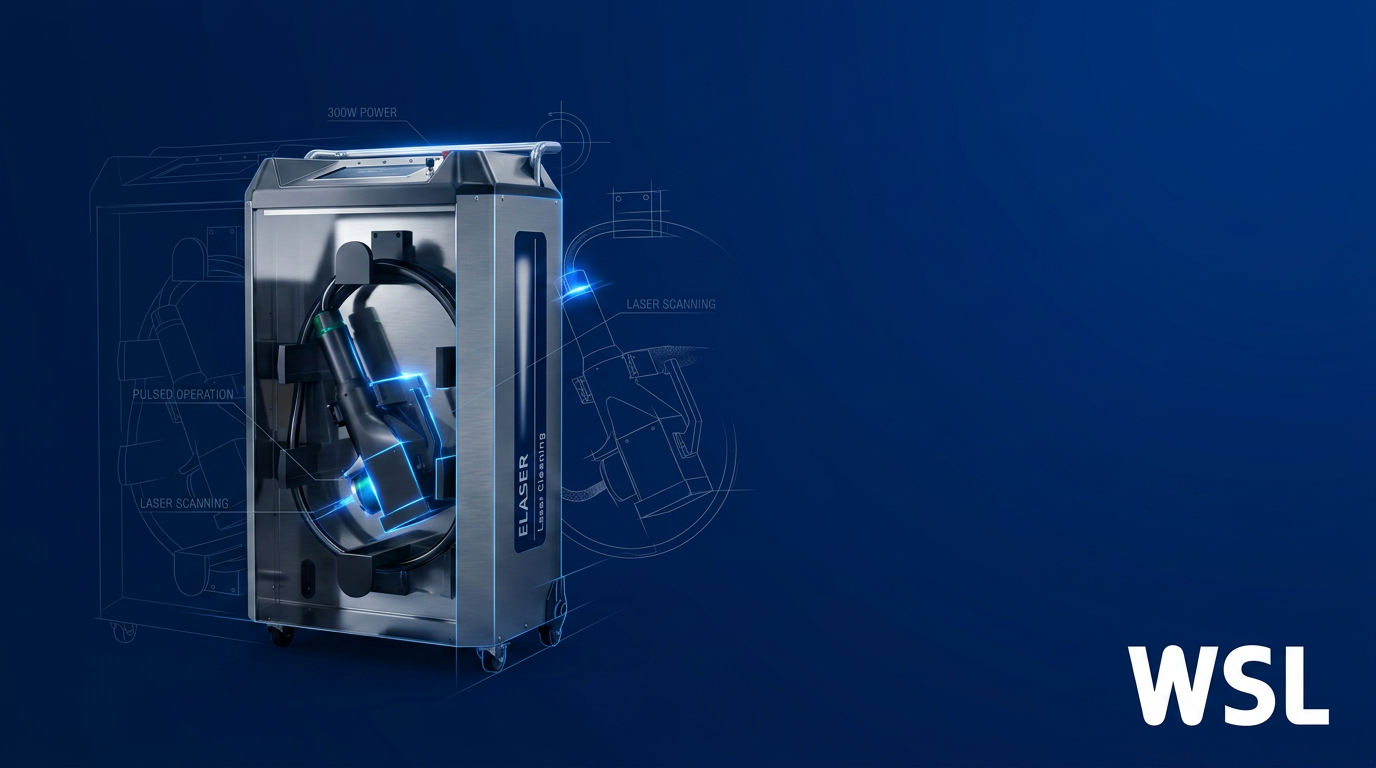
Introduction
If you have reached this point, you are not new to laser cleaning — you already know the technology works, and you have settled on 300W as the bracket worth exploring.
The harder questions are the ones most product pages quietly sidestep: whether 300W is genuinely the right fit for your application, and what actually separates a capable machine at this power level from one that looks identical on paper.
This guide works through those questions honestly — covering the specifications that matter, the operational factors suppliers rarely volunteer, and the due diligence that makes the difference between a confident purchase and an expensive lesson.
TL;DR
A 300W laser cleaning machine is a genuinely capable piece of equipment — but wattage alone tells you surprisingly little about whether a given machine will perform in your environment. Pulse energy, parameter control, cooling architecture, and supplier support are what separate machines that deliver from those that merely meet a spec sheet. This guide gives you the framework to tell them apart.
This article covers:

What 300W delivers in practical cleaning terms
Pulsed vs continuous-wave operation at this wattage
Key specifications to evaluate before buying
Where 300W excels and where it falls short
Safety, total cost of ownership and troubleshooting
What to ask a supplier before committing
What is a 300W laser cleaning machine?
"300W" is one of the most-searched specifications in laser cleaning — yet the number alone tells a buyer surprisingly little without understanding what kind of power it describes and how it is actually delivered to the surface.
The figure on the spec sheet refers to average output power: the sustained rate of energy delivery over time, measured in watts. It is not the instantaneous energy of any single pulse.
In pulsed operation, the instantaneous peak power per pulse is orders of magnitude higher than the 300W average — the laser concentrates its energy into extremely brief bursts, then rests between them. Two machines can share the same 300W average figure while delivering very different peak powers at the surface, which is why average power alone is an incomplete basis for comparing machines.
The 300W figure describes sustained average output. In pulsed operation, the peak power delivered per pulse is far higher than that average. Reading spec sheets accurately means understanding both numbers, not just one.
Understanding why average power matters at all requires the concept of the ablation threshold: every material has a minimum energy density that must be exceeded before material removal begins.
Below the contaminant's threshold, the laser energy is absorbed as heat but nothing is removed. Above the substrate's threshold, the base material itself begins to be damaged. The practical value of a 300W system is that it provides sufficient average power to exceed the ablation threshold of most industrial contaminants — rust, paint, oxide layers, and coatings — while keeping the process within a controllable process window for common substrates when parameters are correctly set.
This is the physical principle behind selective cleaning: the contaminant is removed and the substrate beneath it is not. More wattage is not automatically better — it narrows the process window and increases the risk of substrate damage if parameters are not dialled in precisely.
Placing 300W in the broader market context helps confirm whether this is the right power bracket for a given application. According to Laserax's published power categorisation, laser systems are typically grouped as follows: regular power (10–100W) for marking and cleaning precise areas; high power (200–500W) for precision cleaning at higher speed; and ultra-high power (500W–3kW) for cleaning large surface areas at high speed — a task generally considered too slow with systems at 500W or below.
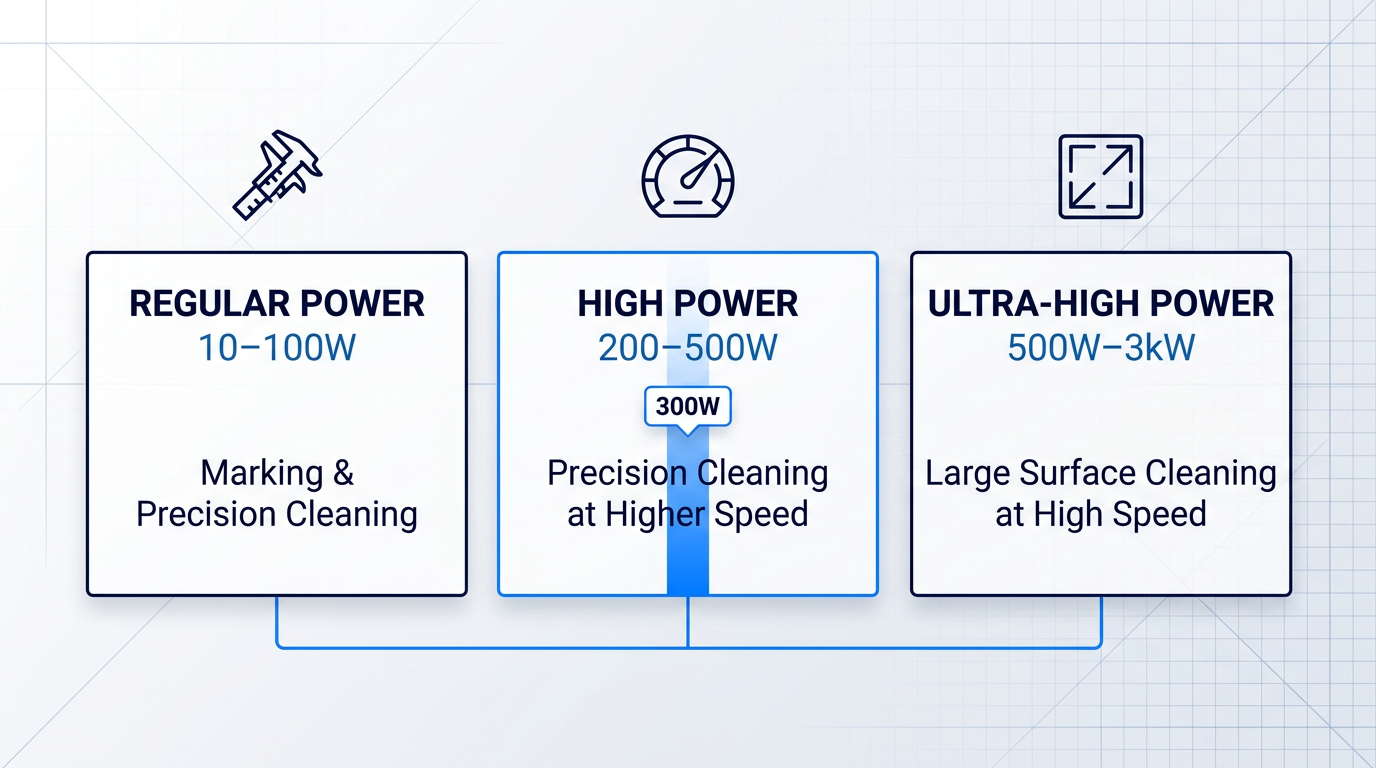
At 300W, a buyer is operating in the upper portion of the high-power tier — capable enough for demanding industrial cleaning tasks at meaningful throughput, while remaining within a segment that industrial laser manufacturers distinguish clearly from the ultra-high-power multimode systems used for large-surface stripping.
There is one further complication that the wattage figure alone does not reveal: the same "300W" label can describe two fundamentally different operating modes. Pulsed systems deliver energy in discrete nanosecond bursts; continuous-wave (CW) systems deliver a constant beam. The implications for substrate safety and cleaning selectivity are significant — and the right choice depends on what you are cleaning and what lies beneath it.
On the technology side, 300W machines in this market are predominantly fibre laser systems, with Yb-doped (ytterbium-doped) fibre lasers operating in the near-infrared wavelength region — typically around 1,030–1,080 nm, a range well-suited to processing metals. This wavelength affects how efficiently different materials absorb the laser energy, which in turn influences cleaning performance across different substrates and contaminant types.
It also has safety implications: near-infrared light at these wavelengths is invisible to the human eye, which carries specific consequences for hazard zone management — a topic covered in full in the safety section of this guide.
Of all the distinctions introduced here, the pulsed versus continuous-wave choice is the most consequential technical decision a buyer faces at this power level. The next section works through it in practical terms.
Pulsed vs Continuous-Wave Operation at 300W
Two machines can both carry a 300W label and perform very differently in practice — yet most product pages say nothing about why. The difference comes down to how that power is delivered: as a continuous stream, or in discrete bursts. That distinction shapes everything from substrate safety to the range of contamination types the machine can tackle.
A pulsed 300W machine concentrates its energy into nanosecond pulses — bursts lasting around 100 ns — rather than spreading it evenly across time. Because the same average energy is compressed into a fraction of a second, the peak power per pulse is orders of magnitude higher than the 300W average figure alone implies. It is this peak power, not the average, that drives ablation: the momentary intensity at the surface is what lifts and ejects the contaminant.
The gaps between pulses are not wasted time. They are the mechanism that gives pulsed operation its cleaning selectivity: the substrate has time to dissipate the heat deposited by each burst before the next one arrives, preventing thermal energy from accumulating to damaging levels.
A continuous-wave laser at 300W delivers energy without interruption, which means the substrate temperature rises steadily throughout exposure. This narrows the process window — the gap between the energy level needed to lift the contaminant and the level at which the substrate itself is damaged. Research published in Laser Focus World confirms that CW systems are more sensitive to scanning speed as a result: too slow and the substrate is damaged; too fast and cleaning is incomplete.
CW operation is not inherently the wrong choice — it is simply a different trade-off. For bulk stripping of large, thermally robust structures such as heavy structural steel, where the substrate can absorb and dissipate heat readily and throughput is the primary concern, CW at this power level is a legitimate and cost-effective option.
Pulse Energy and Repetition Rate: The Specs That Matter
Pulse energy, measured in millijoules (mJ), is the specification that translates pulsed mode into a practical capability statement. It defines how much energy is delivered in each individual burst: higher pulse energy per pulse means more force available to lift thick, adherent contamination such as heavy mill scale or multiple paint layers, whilst lower pulse energy is gentler and better suited to thin oxide films or delicate substrates where over-processing is a risk.
Pulse energy is the spec that determines the range of cleaning tasks a pulsed machine can handle — and it is not derivable from average wattage alone. Buyers should ask for it explicitly when evaluating any pulsed 300W machine.
Repetition rate, measured in kilohertz (kHz), controls how many pulses are delivered per second. A higher repetition rate means more pulses covering the surface in a given time, which directly increases area cleaning speed. But higher rates also reduce the inter-pulse interval, giving the substrate less time to cool between bursts — which can erode the thermal advantage of pulsed operation if pushed beyond the material's heat dissipation capacity.
The practical implication is that adjustable repetition rate is a more valuable capability than any single headline rate figure. A machine that can be tuned across a range of frequencies gives the operator the ability to optimise for different substrates and contamination types, rather than being locked to a fixed setting that may suit only one application.
- Confirm the operating mode: Establish whether the machine is pulsed or continuous-wave — identical average wattage does not mean identical cleaning capability.
- Ask for pulse energy range: Request the mJ figure. It determines whether the machine can handle both delicate oxide films and thick, adherent coatings.
- Ask for repetition rate range: A kHz range figure is more informative than a single rate; it tells you how much the machine can be tuned for different substrates.
- Confirm rate is adjustable: Ask whether repetition rate is operator-adjustable or factory-fixed — tunability is what enables the machine to serve multiple applications.
Together, pulse energy and repetition rate are the specifications that actually govern what a 300W pulsed machine can clean and on what substrates — not the average wattage figure that dominates the marketing headline. Two machines with identical 300W ratings but different pulse parameters can have fundamentally different application ranges.
Average output power tells you the power class of the machine. Pulse energy (mJ) and repetition rate (kHz) tell you what it can actually clean, on which substrates, and with what degree of selectivity. Always ask for both.
Pulse energy and repetition rate are two of several specifications worth interrogating before committing to a 300W machine. The next section builds a full evaluation framework across the complete spec sheet — covering scan width, cooling method, scanner type, and more — so you can assess any machine systematically.
Key Specifications to Evaluate on a 300W Laser Cleaner
A supplier's spec sheet for a 300W laser cleaning machine can look impressive and still tell you almost nothing useful. Average power is front and centre; the specs that actually determine what the machine can clean, how fast, and in what environment are often buried, omitted entirely, or presented in ways that flatter the marketing rather than inform the buyer.
What follows is a practical evaluation framework — seven specification axes, each connected to a real-world outcome or question you should put to any supplier before committing.
Pulse Energy (mJ)
You already know from the previous section that pulse energy sets the peak power available per pulse — and that peak power, not average power, is what physically drives ablation of thick or adherent contamination.
As an evaluation criterion, pulse energy tells you how capable the machine is at lifting heavy contamination in fewer passes: higher pulse energy means more aggressive ablation; lower pulse energy is gentler and safer for delicate substrates.
For a 300W air-cooled pulsed MOPA system, a maximum pulse energy of approximately 15 mJ is a realistic benchmark, with pulse widths adjustable from 13 to 500 ns — figures consistent with published specifications for this power class.
The first question to put to any supplier: what is the maximum pulse energy, and is it continuously adjustable across the full power range — or does adjustability drop out at certain repetition rates?
Scan Width and Scan Speed: The Throughput Pair
Scan width (the width of the cleaned strip per pass) and scan speed (how fast the beam traverses the surface) must be evaluated together — because throughput in m²/hour is the product of both, not either alone.
A machine with an impressive maximum scan speed but a narrow scan width may clean no faster than a slower machine with a wider field; a wide scan at low fluence may fail to lift the contamination at all, requiring multiple passes that erode the headline rate.
The standard enabling technology is a 2D galvanometer scanner, which sweeps the beam across an adjustable field — typically up to around 145 mm wide on a 300W portable system — and supports programmable scan patterns.
The table below shows published throughput figures for a 300W pulsed system across representative contamination types, illustrating how heavily the real-world rate varies with contamination grade rather than with scan speed alone.
| Contamination Type | Pulse Frequency | Scan Speed | Throughput (m²/hr) |
|---|---|---|---|
| Light flash rust (ISO Grade A/B) | 60–80 kHz | 4,000–6,000 mm/s | 8–15 |
| Heavy rust / moderate scale (Grade C) | 40–60 kHz | 3,000–4,500 mm/s | 5–9 |
| Heavy mill scale / pitting (Grade D) | 20–40 kHz | 2,000–3,500 mm/s | 3–6 |
| Weld prep oxide (BIW, zinc coating) | varies | varies | 3–6 |
| Single-layer industrial enamel (50–100 µm) | varies | varies | 8–12 |
| Two-component epoxy primer (200–400 µm) | varies | varies | 3–5 |
Throughput figures for a 300W pulsed laser cleaning machine across contamination types, showing that cleaning rate is determined by contamination grade — not headline scan speed.
The pattern is clear: throughput drops by a factor of two to four as contamination becomes heavier, regardless of what the scan speed specification says at the top of the brochure.
Suppliers frequently quote maximum scan speed (in mm/s or m/s) as a proxy for cleaning performance. It is not. Real throughput in m²/hour is set jointly by scan width, scan speed, pulse overlap, and contamination type. Always ask for throughput data on your specific contamination — not the headline scan speed.
When requesting quotations, specify your contamination type and layer thickness and ask the supplier for demonstrated throughput figures on that contamination — ideally from a test coupon, not a catalogue.
Delivery Cable Length
The delivery cable connects the laser source cabinet to the handheld scan head, and its length determines how far the operator can work from the trolley without repositioning.
A 5 m cable — common as a standard fit — confines the operator to a very tight radius, which is severely limiting on large fabrications, elevated structures, or confined-space work inside tanks and vessels.
Portable 300W systems typically ship with 5–10 m of delivery fibre; some configurations extend to 15 m, though reputable sources note that pushing a 300W beam through 15 m of fibre at sustained duty cycles introduces meaningful thermal load — confirm the rated maximum cable length for continuous use before ordering.
Map your largest likely workpiece or site layout against the cable length on offer, and ask the supplier explicitly whether longer cable options are available and what the beam quality trade-off is at extended lengths.
Cooling Method and Duty Cycle
At 300W, both air-cooled and water-cooled systems exist — and the choice is less about which is inherently superior than about what duty cycle your application demands.
Air-cooled systems are simpler, lighter, and require no water infrastructure, making them faster to deploy in field settings and on sites where running coolant lines is impractical.
Water-cooled systems can sustain higher duty cycles continuously, but they add weight, cost, plumbing requirements, and a chiller unit — factors that matter considerably when the machine moves between jobs.
The key question for air-cooled 300W systems is not whether air cooling works at this power level — it does — but what continuous-operation duty cycle the system is rated for, and whether that rating holds in elevated ambient temperatures (above roughly 35°C, duty cycle limitations become a real constraint for outdoor summer work).
Frame this as a use-case question when speaking to suppliers: how many hours per day will the machine run, at what ambient temperature, and on what contamination load?
Power Tunability (0–100%)
A machine that operates only at or near its rated 300W is a machine that cannot safely clean delicate substrates, thin-section components, or heritage materials — full stop.
Power tunability from 0 to 100% of rated output is what makes a 300W system genuinely flexible: it is the feature that allows the same machine to strip heavy mill scale at full power in the morning and clean a thin aluminium extrusion at reduced power in the afternoon.
Ask suppliers for the minimum stable operating power and whether tunability is continuous (a smooth dial) or stepped (fixed percentage increments) — stepped tunability with large gaps between settings limits precision on sensitive work.
Scanner Type and Programmable Scan Patterns
2D galvanometer scanners are standard at this power level; the differentiator between capable and basic machines is whether the scan pattern is programmable.
A programmable scanner lets the operator select or define the shape of the sweep — raster, circular, spiral, or Lissajous — to match the geometry of the workpiece, improving cleaning uniformity and reducing over-exposure at edges.
On irregular surfaces, complex weld geometries, or mould cavities, a fixed raster pattern leaves the operator fighting the machine; a programmable pattern lets the machine adapt to the job.
Ask whether custom scan patterns can be saved as parameter recipes — on multi-operator sites, saved recipes reduce setup time and eliminate parameter drift between shifts.
Working Distance and F-Theta Lens Options
Interchangeable F-Theta lenses with different focal lengths allow the operator to change both the working distance (the standoff from lens to substrate) and the focused spot size on the surface.
A shorter focal length produces a smaller, more intense spot suited to precision work; a longer focal length increases working distance, which is useful for accessing recessed areas or maintaining standoff on uneven surfaces.
As a concrete reference: a 254 mm focal length lens produces a nominal spot size of approximately 0.075 mm at a marking distance of 320 mm from the lens border, while a 420 mm focal length lens produces a 0.125 mm spot at 512 mm — a meaningfully different energy density at the surface for the same average power.
Changing the focal length also changes the energy density delivered to the substrate, which matters for buyers whose application mix spans a range of contamination types or substrate geometries with a single machine.
Ask the supplier which focal length options are available for the specific model, whether lenses are field-swappable without specialist tools, and what the scan field size changes to with each lens.
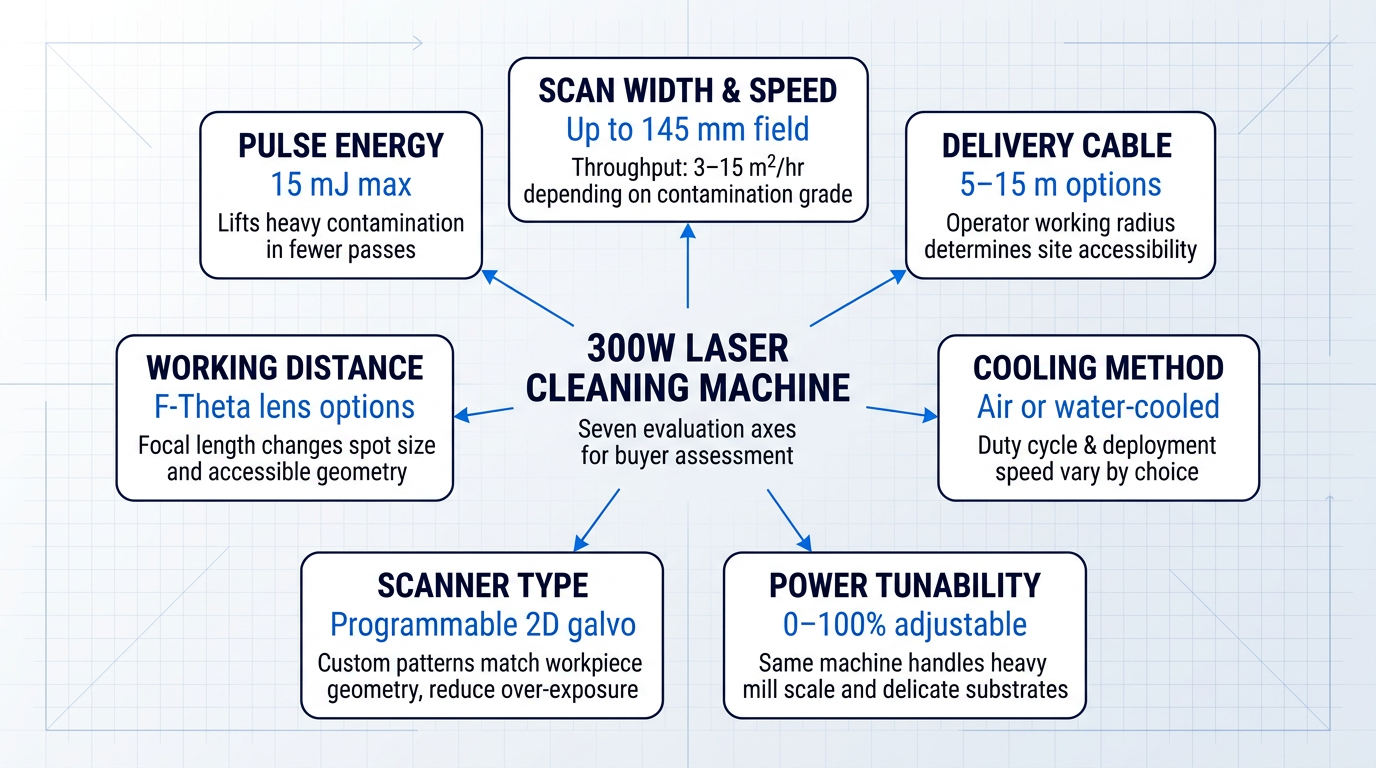
Knowing which specs to interrogate is only half the task — the other half is understanding how the machine physically deploys on your site, which is where cable length and cooling method stop being spec-sheet entries and start becoming operational realities.
Portability and Form Factor: What to Expect
"Portable" is one of the most overloaded words in laser cleaning marketing. Before you commit to a 300W system based on that label, it is worth understanding exactly what portability means at this power level — because the operational reality is more nuanced than a product page typically conveys.
A 300W laser cleaning machine is not a carry-in-a-bag device. The main unit is a wheeled trolley — a roll-in, not a carry-in — and single-operator deployment is genuinely achievable, but buyers should think carefully about site access: lifts, ramps, narrow corridors, and uneven ground all affect how easily the unit reaches the work area.
The configuration that makes this work in practice is a two-part system: a heavier main unit on wheels, connected via a fibre delivery cable to a lightweight handheld scanner that the operator actually holds and directs. Our own ELASER illustrates what a well-engineered system at this power level can achieve: the main unit weighs under 50 kg on a wheeled trolley, while the handheld scanner comes in at under 3 kg.
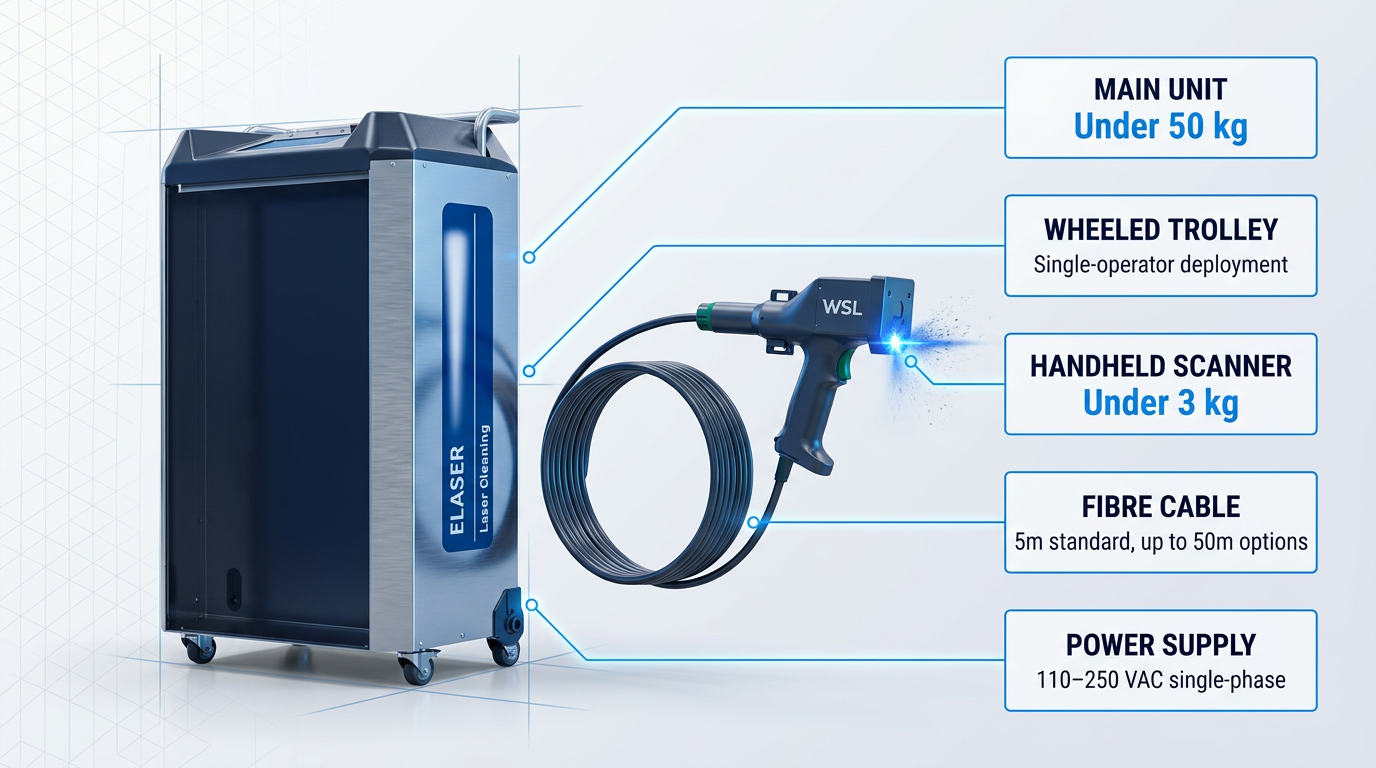
Scanner weight deserves more attention than it typically gets during the buying process, because it is the operator who carries it — not the trolley.
A heavy handset compounds fatigue over a working shift, and fatigue leads directly to inconsistent scan speed, uneven cleaning results, and a higher risk of operator error. When evaluating machines, ask about scanner weight as a separate figure from the main unit weight — the two numbers tell very different stories about day-to-day usability.
The other deployment constraint that buyers routinely underestimate is delivery cable length. A standard 5 m cable keeps the operator tethered close to the trolley — workable in a compact workshop, but limiting on large outdoor structures, wide production floors, or anywhere the trolley cannot be positioned directly adjacent to the work area.
Systems that offer longer cable options open up meaningfully more of the site to a single setup position. The ELASER ships with 5 m and 15 m cables as standard configurations, with options extending up to 50 m — a reach that allows the trolley to remain in a safe, accessible location while the operator works across a much larger area.
Before evaluating any specific machine, it is worth building a checklist of the deployment factors that most often catch buyers off guard after purchase. These are the considerations that rarely appear on a spec sheet headline but determine whether the machine actually works in your environment.
- Main unit weight and mobility: Confirm the system weight and wheel configuration. Consider whether your site has ramps, lifts, or thresholds that affect access for a unit in this range.
- Handheld scanner weight: Ask for this figure separately. A sub-3 kg scanner sustains operator endurance across a full shift; heavier handsets increase fatigue and inconsistency.
- Delivery cable length options: Check what lengths are available as standard and as options. A 5 m standard cable is restrictive on large or outdoor sites; longer options provide real flexibility.
- Cooling method and duty cycle: Air-cooled systems simplify site setup, but verify the rated duty cycle. Not every air-cooled 300W machine is cleared for full-shift continuous operation.
- Power supply requirements: Confirm whether the system needs single-phase or three-phase supply. Three-phase is not available on every industrial site and can add cost and delay.
What these five points share is that they are almost never the reason a buyer chooses a machine — but they are frequently the reason a machine causes friction after delivery. The ELASER's design addresses each of them as a set: air-cooled operation with no water, chiller, or coolant circuit required; a single-phase power supply rated at 110–250 VAC; and a delivery cable reach of up to 50 m — a combination that reflects engineering with site deployment in mind, not just peak performance on a test bench.
On air cooling specifically: the benefit is faster setup and no dependency on a water supply or chiller infrastructure on site. The honest caveat is that buyers should verify the duty cycle rating of any air-cooled 300W system they are evaluating — air-cooled does not automatically mean unlimited continuous use, and some machines have throughput limitations on extended tasks that only become apparent under sustained production conditions.
It is also worth noting that the ELASER platform has a variant — the ELASER-RHZ — that incorporates a reduced hazard zone architecture. That technology is covered in full in the safety section later in this guide.
One final category distinction is worth flagging for buyers with production volumes in mind: the same 300W laser source that powers a portable handheld system can also be mounted on a robotic arm for fixed-cell or production-line deployment. This is a fundamentally different operating model — the operator loads parts rather than directing a scanner, and cleaning paths are programmed rather than hand-guided. If you are evaluating both on-site portable use and potential future automation of high-volume tasks, treat these as separate evaluation tracks rather than variations of the same purchase decision.
Power supply compatibility is the deployment specification buyers most commonly overlook until installation day. A system requiring three-phase supply on a site with only single-phase available can delay commissioning by days or weeks. Confirm this before shortlisting, not after.
With a clear picture of what a 300W system physically demands from your site and your operator, the natural next question is whether 300W is the right power level for the specific cleaning tasks and environments you have in mind — and that is exactly what the next section addresses.
Where 300W Excels — and Where It Falls Short
Most buyers approach wattage as a one-directional question: is 300W powerful enough for my job? The more useful question is two-sided — is 300W the right level, or could it be too much? Getting the answer right affects surface quality, capital cost, and whether the machine you buy can actually be used safely on everything you need to clean.
Where 300W Pulsed Laser Cleaning Is Well-Matched
At 300W pulsed, you sit at the top of the precision-industrial range — enough average power to handle demanding contamination loads, while the pulsed delivery mode keeps peak fluence controllable and substrate risk manageable across a wide range of materials.
- Rust and oxide removal on steel: Structural components, plant, and equipment with Grade B–D rust respond well; 300W pulsed achieves Sa 2.5 to Sa 3 cleanliness across moderate to heavy contamination loads.
- Automotive paint and primer stripping: Vehicle bodywork and structural panels benefit from 300W's combination of speed and selectivity — cleaning without altering thin-gauge base metal microstructure.
- Mould and tooling cleaning: Injection moulds, tyre moulds, and press tooling accumulate polymer build-up and release agents that 300W pulsed removes without abrasive contamination of precision cavity surfaces.
- Weld preparation and post-weld oxide removal: 300W systems clean a 50–100mm weld flange to Sa 2.5 in a single pass, removing zinc, mill scale, and oxide simultaneously before or after welding.
- Heritage and restoration work: Stone, masonry, and metal surfaces benefit from pulsed operation's selectivity — contamination layers are removed while preserving substrate detail and original patina.
- Aerospace surface preparation: Pre-bond and pre-weld cleaning of aluminium alloys and titanium components at tight tolerances; parameters of 100–300W with short pulse durations (5–30 ns) protect thermally sensitive alloys.
For automotive weld seam preparation and rust removal, published throughput data places 300W pulsed systems in the range of 3–8 m²/hour depending on contamination severity — with light flash rust approaching the upper end and heavy mill scale or multi-layer coatings at the lower end.
For inline aluminium cleaning before welding, Laserax's published speed data shows a 300W system achieving a maximum line speed of 5.85 cm/s across a 1.5 cm cleaning width — a meaningful step up from 100W (2.96 cm/s) and 200W (4.71 cm/s), confirming that 300W is a practical fit for production-pace weld prep on aluminium.
These figures are reference points, not guarantees. Actual throughput depends on contamination thickness, required cleanliness standard, scan overlap, and operator technique — field conditions typically reduce bench-test rates by 20–35%.
Where 300W May Be More Than Needed
Not every application needs 300W, and over-specifying on power introduces unnecessary capital cost alongside a higher risk of substrate damage if parameters are not dialled in carefully.
Thin oxide films on small precision components — pre-weld joint cleaning on thin stainless, anodising removal from aerospace components, or post-weld heat tint on stainless steel — are well within the capability of a 100W pulsed system, which can achieve the required fluence range of 0.5–2 J/cm² with better inherent parameter stability at that power level.
Delicate conservation work on very fragile substrates presents a similar case. Heritage stone and ornamental metalwork require fluence control at the sub-1 J/cm² level; a lower-wattage system operating at its natural working range offers finer control than a 300W machine dialled down to a fraction of its capacity.
The honest framing: if your throughput requirement does not justify 300W, stepping down to a 100–200W machine saves capital cost and reduces the margin for error on substrate-sensitive work — without sacrificing cleaning quality.
Where 300W May Be Insufficient
300W is not the top of the pulsed range, and buyers with genuinely high-throughput industrial stripping requirements should be steered toward higher-power systems rather than led to believe 300W will meet their cycle time targets.
Large-area stripping of thick coatings on structural steel — mill scale removal before hot-dip galvanising, heavy epoxy anti-corrosion systems, or multi-layer marine paint — demands sustained high fluence that 300W pulsed cannot deliver at productive scan speeds. Laserax explicitly states that cleaning large surface areas is generally considered too long with lasers of 500W or less, positioning ultra-high-power systems (500W–3kW) as the appropriate tool for those jobs.
Shipyard depainting is the clearest example: hull sections and offshore structural steel involve large surface areas with thick, layered marine coatings and demanding cycle time requirements. A 500W water-cooled pulsed system represents the practical minimum for that class of work; 1000W–3000W continuous wave systems are the standard for full hull operations.
High-throughput inline production cleaning — where cycle time is set by an automated line rather than by operator pace — is similarly likely to exceed what a 300W system can deliver consistently. When the production requirement is 6 m²/hour or more on heavy contamination, a 300W machine operating at the lower end of its throughput range has no headroom for variation.
The right wattage is the minimum that meets the throughput requirement without exceeding the substrate's damage threshold. More power is not always better — it raises capital cost and narrows the safe operating window on sensitive materials.
The process window for the specific substrate and contamination combination is the real constraint. Wattage should be chosen to meet that window, not to exceed it — a machine over-specified for the job does not clean better; it simply introduces more risk at a higher price.
Power Tunability: The Enabler for Mixed-Substrate Work
The concern that 300W is inherently too powerful for delicate surfaces rests on a false assumption: that the machine operates at its rated output regardless of application. A 300W machine with full power tunability (0–100%) can be dialled down to 30–50W effective output, giving it meaningful capability on sensitive substrates that a fixed-power machine at the same nominal wattage cannot safely approach.
This is the characteristic that makes a single 300W machine viable across a wide range of substrates — from heavy rust on structural carbon steel down to oxide removal on thin aerospace aluminium — without requiring separate equipment for each application category.
When evaluating any 300W machine for mixed-substrate use, buyers should verify two things: the effective power range across the full tuning scale, and critically, the minimum stable operating point — the lowest output at which the laser source maintains consistent pulse characteristics. A machine that nominally offers 0–100% tunability but becomes unstable below 40% is not genuinely versatile at the lower end of the range.
With application fit now established, the next dimension buyers frequently underestimate is the safety architecture that governs where and how a 300W system can be deployed — and that is what the following section addresses.
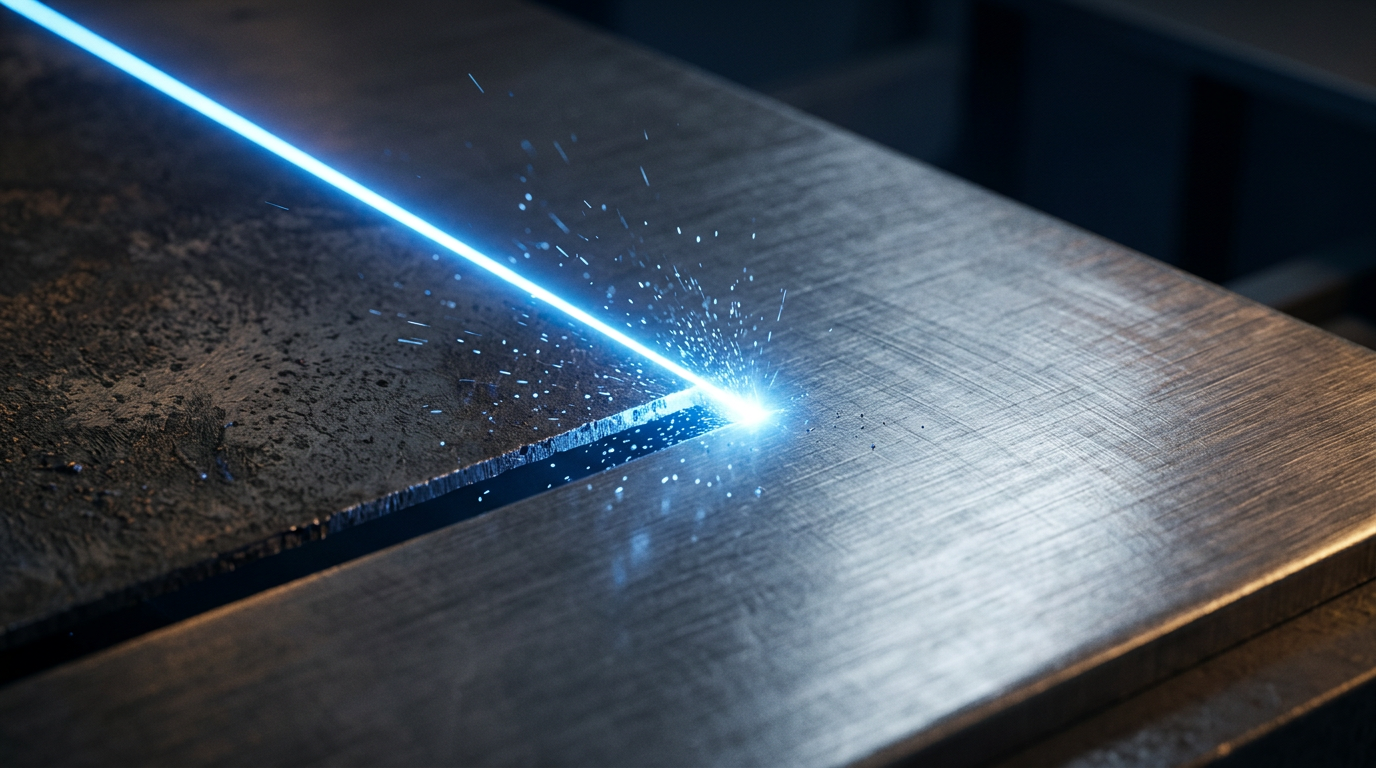
See how 300W laser cleaning performs in practice
Knowing the right power level is one thing — seeing the machine built around it is another. The ELASER is designed for exactly the applications where 300W pulsed cleaning earns its place.
Safety Architecture: Laser Hazard Zones at 300W
Most buyers evaluate a 300W laser cleaning machine on power, portability, and application fit — and only discover the full implications of its safety classification after the machine arrives on site.
Every 300W pulsed fibre laser cleaning machine is a Class 4 laser product under IEC 60825-1 — the highest hazard class in the standard.
Class 4 means the direct beam, specular reflections, and even diffuse reflections at close range can cause immediate and severe eye and skin injury, and the classification also carries a fire hazard risk.
The Nominal Hazard Zone: What It Means in Practice
The Nominal Hazard Zone (NHZ) is the space within which the level of direct, reflected, or scattered radiation during normal operation exceeds the Maximum Permissible Exposure (MPE) for eyes and skin.
For a Class 4 industrial laser, the NHZ is determined by a combination of factors: power output, beam diameter, beam divergence, pulse repetition frequency, wavelength, beam path including reflections, beam profile, and maximum anticipated exposure duration.
The practical consequence is that anyone inside the NHZ boundary is at risk — and the zone must be controlled before the beam fires.
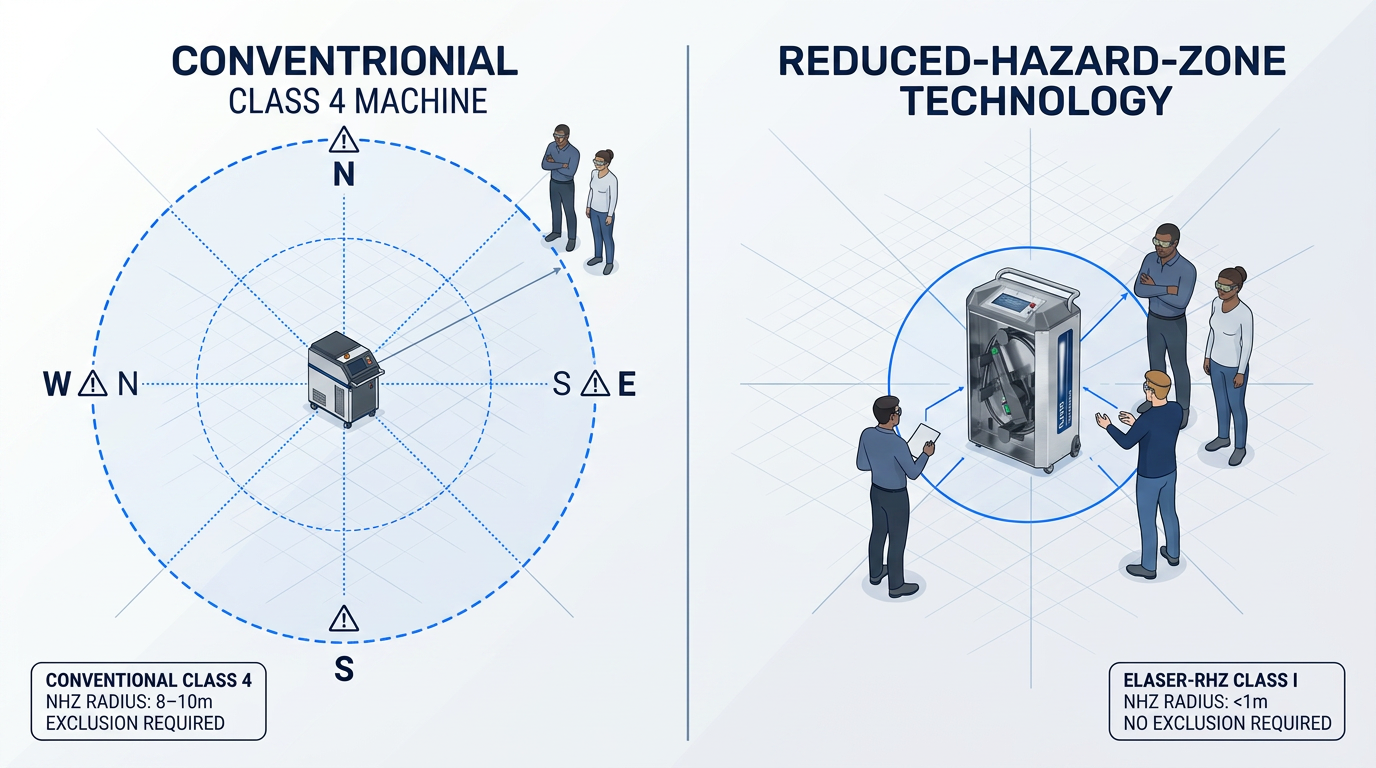
In a shared workshop, open manufacturing floor, or mixed-use facility, establishing and clearing the NHZ before every cleaning operation creates real workflow disruption: other workers must stop or leave the area, barriers and signage must be positioned, and the process repeats every time the machine moves to a new bay or site.
In some environments — public-facing settings, heritage sites, or busy production floors — the access restriction requirement can make conventional Class 4 operation impractical altogether.
Safety Controls to Expect on Any 300W Machine
A well-specified 300W laser cleaning machine should include a defined set of safety circuit features as standard — and buyers should ask any supplier to walk through these explicitly, not assume they are present.
- Key-switch activation: Prevents casual or unauthorised operation; controls who can enable the laser at the hardware level.
- Emergency stop: Hardwired stop that disables laser emission reliably — not merely a software command or display blank.
- Beam-path interlocks: Halt emission if a door, enclosure panel, or area barrier is opened during operation.
- Delayed emission warning: Audible or visual alert before the beam fires, giving bystanders time to look away or clear the area.
- Password-protected access: Locks parameter settings so only authorised users can adjust power, pulse rate, or scanning configuration.
A vague "system protected" statement from a supplier is not sufficient — ask for a clear description of what each safety circuit actually interrupts and how it behaves on fault or power recovery.
Reduced-Hazard-Zone Technology: A Category Shift
Until recently, the Class 4 NHZ was an immovable constraint — every laser cleaning machine carried it, and buyers simply had to engineer their workflows around it.
A development in laser cleaning machine design has changed this calculus: reduced-hazard-zone technology, which collapses the laser hazard boundary to a small area immediately around the work itself, rather than the large exclusion zone that conventional Class 4 machines require.
WSL's ELASER-RHZ is the only laser cleaning machine in the world to embody this technology — built around WSL's patented system that confines the hazard zone to a fraction of conventional size.
The ELASER-RHZ operates at 1550 nm wavelength and, when the RHZ technology is active, can be classified as Class I — the lowest laser hazard class under IEC 60825-1, and the class that is exempt from beam-hazard control measures.
Conventional 300W laser cleaners require a controlled exclusion zone that can shut down shared workspaces. The ELASER-RHZ's patented reduced-hazard-zone technology achieves Class I classification — enabling cleaning in open workshops, mixed-use facilities, and public-facing environments without sealing off the area.
This means cleaning operations that were previously impossible in open or public environments — graffiti removal, heritage restoration, in-line manufacturing — become viable without the access restriction overhead of conventional Class 4 operation.
WSL provides full operator training with the ELASER-RHZ, so buyers can deploy with confidence from day one.
Safety Architecture as a Due-Diligence Question
Safety architecture belongs on your evaluation checklist alongside power, portability, and application fit — because it directly determines where a machine can be deployed and at what operational cost.
Three questions worth putting to any supplier: What is the NHZ for your machine at maximum power? What controls are required, and what is the compliance burden on my facility? Are any reduced-hazard-zone options available?
The answers will reveal not just the machine's safety profile, but the real workflow overhead you are committing to — and that overhead has direct cost implications that belong in any honest total cost of ownership calculation.
Total Cost of Ownership: Beyond the Purchase Price
Sticker price is the wrong starting point for this category of equipment — and most buyers who have run the numbers know it within the first year of operation.
A sandblasting rig or a chemical stripping tank costs less to acquire than a 300W laser cleaning machine. That is simply true, and there is no point obscuring it. The argument for laser cleaning is not that it is cheap upfront — it is that the total cost of ownership over a machine's working life is structured so differently that the capital comparison becomes largely irrelevant once you model the full picture.
Consumable Costs: Where the Gap Opens Up
Abrasive blasting runs on blast media — garnet, aluminum oxide, steel grit — that degrades with every cycle and must be continually repurchased and disposed of. Garnet runs roughly $0.10–$0.50 per pound; a working blaster consuming 50–200 lbs per hour generates $10–$50 in media cost per hour before containment, clean-up, or disposal is counted.
Disposal is the line item that catches most procurement managers off guard. Contaminated blast media disposal runs $0.50–$2.00 per pound for regulated waste, and a single moderate job generating 500–1,000 lbs of spent grit produces a $250–$2,000 disposal charge before containment costs are added.
Chemical stripping carries a different but equally significant cost structure. Solvent or acid chemistry for a medium production line runs $5,000–$30,000 per year in chemical purchase cost alone; wastewater treatment and regulated liquid waste disposal adds another $10,000–$50,000 annually. Solvent disposal runs $2–$15 per litre for regulated waste streams, and OSHA and EPA compliance overhead typically adds 15–40% on top of the raw chemical spend.
Laser cleaning's consumable profile is categorically different. The only meaningful recurring consumable is the lens protection window on the scan head, which typically costs $20–$80 and needs replacement every 200–500 hours depending on contamination load and extraction quality. Total annual consumables for a laser cleaning system typically run under $500.
The annual cost comparison below uses data from a representative mid-scale operation processing approximately 500 m² of surface per month at 2,000 operating hours per year — figures drawn directly from documented cost modelling across the three methods.
| Cost Category | Abrasive Blasting (annual) | Chemical Stripping (annual) | Laser Cleaning (annual) |
|---|---|---|---|
| Consumables (media, chemistry, tooling) | $35,000–$90,000 | $5,000–$30,000 | $200–$500 |
| Labour (operators, setup, cleanup) | $80,000–$150,000 | $50,000–$90,000 | $30,000–$60,000 |
| Waste disposal and treatment | $20,000–$60,000 | $10,000–$50,000 | $0 |
| Regulatory compliance overhead | $15,000–$45,000 | $12,000–$40,000 | $1,000–$3,000 |
| Energy (compressor, heating, tooling) | $8,000–$20,000 | $4,000–$12,000 | $3,000–$8,000 |
| Estimated annual total | $158,000–$365,000 | $81,000–$222,000 | $34,000–$71,000 |
Annual cost comparison across abrasive blasting, chemical stripping, and laser cleaning for a representative mid-scale operation (approx. 500 m² surface treated per month, 2,000 operating hours per year). Figures sourced directly from documented cost modelling.
The structural pattern in this table is more significant than any individual figure: abrasive blasting and chemical stripping carry large, recurring obligations in consumables, disposal, and compliance that repeat every year, while laser cleaning's annual cost is dominated by labour — with consumables and waste disposal representing a small fraction of the equivalent traditional method.
At a mid-range 500W pulsed system, the all-in ten-year cost (capital plus operating) has been modelled at approximately $178,000 — a figure that becomes directly comparable to the annual operating cost alone of a busy abrasive blasting operation.
Labour, In-Situ Deployment, and Substrate Damage
Laser cleaning changes the labour model in ways that are real but harder to universalise. The most significant factors are the elimination of masking for most applications, the removal of post-job media containment and sweep-up logistics, and the ability to clean equipment in-situ without disassembly — which directly reduces the time cost of taking assets offline.
Single-operator capability is relevant here too: a laser cleaning station typically requires one operator, whereas abrasive blasting at production scale often involves additional personnel for containment management, media reclaim, and clean-up. The per-hour labour cost advantage compounds across a full year of operation.
Substrate damage is a less visible but financially real factor. Abrasive methods carry a risk of over-blasting, dimensional loss, and surface profile distortion that generates rework cost — particularly on precision components or thin substrates. Laser cleaning's selectivity reduces this risk: the beam stops at the base material rather than continuing to abrade it. The benefit is difficult to quantify upfront because it depends on the substrate, the operator, and the contamination type, but for facilities where rework from cleaning damage is a recurring cost, it belongs in the TCO model.
Laser Source Lifespan and Per-Hour Operating Cost
The component that defines a laser cleaning machine's long-run economics is the fibre laser source lifespan. Fibre laser sources are rated at 100,000+ operating hours — a figure confirmed by laser manufacturers and multiple trade publications. Laser Focus World notes this equates to approximately 45 years of use at typical single-shift utilisation rates.
At a single-shift schedule of roughly 2,000 operating hours per year, a 100,000-hour rated source represents decades of service before major component replacement is required. The capital cost of the machine spreads across an enormous number of productive hours, while consumable spend remains near-zero throughout — producing a very low amortised cost per operating hour.
Annual maintenance costs for a mid-range laser cleaning system typically run $800–$2,500 per year, covering optical path inspection, cooling system service, and periodic lens replacement. Compare this to a chemical strip line where bath chemistry replenishment and disposal alone commonly costs $4,000–$15,000 per year at mid-volume throughput.
Traditional cleaning methods are front-loaded: low capital cost, but compounding annual spend on media, chemistry, disposal, and compliance. Laser cleaning inverts this structure — annual consumables typically run under $500, meaning the economics improve every year the machine operates.
On payback period, documented industrial applications consistently point to a range of 12–36 months when laser cleaning directly replaces abrasive or chemical workflows at production scale. The lower end applies when the incumbent method carries significant disposal costs — chemical stripping with regulated waste streams is the clearest case. Buyers should build their own model using twelve months of actual cleaning-related invoices rather than relying on any published range, because payback depends heavily on cleaning volume, labour rates, and local disposal pricing.
For facilities processing 500 m² or more of surface per month, or running weekly cleaning cycles on recurring production assets, the TCO case is consistently strong across sectors including metal fabrication, automotive, and MRO operations.
Evaluating Machine Pricing on Value for Money
Once a buyer has established that laser cleaning is the right method for their application, the comparison axis shifts from method-vs-method TCO to value for money within the laser cleaning category itself.
Within the category, competitive pricing achieved through manufacturing efficiency — not component compromise — is a meaningful differentiator. The relevant question is not which machine has the lowest purchase price, but which delivers the best long-run value: reliable laser source, proven scan head quality, adequate cooling for the duty cycle, and supplier support that keeps the machine productive.
With a TCO framework in place, the logical next step is knowing which questions to put to a supplier — and that is exactly what the supplier evaluation section of this guide addresses.
Troubleshooting Common Issues at 300W
When a 300W laser cleaning machine does not deliver the expected result, the instinct is to blame the technology or the power level — but in the vast majority of cases, the root cause is a parameter mismatch, not a machine limitation. Understanding what actually goes wrong, and why, is one of the most useful things a buyer can know before choosing a system: it shifts the evaluation from "does this machine work" to "does this machine give me the controls to make it work for my application."
The five issues below cover the most common performance failures in handheld laser cleaning at this wattage: incomplete contamination removal, substrate marking, inconsistent surface results, optics degradation over time, and the operational consequences of inadequate fume extraction.
Incomplete Contamination Removal
The symptom — contamination partially lifted but not fully cleared after a pass — is frequently misread as a sign that 300W is not powerful enough, prompting buyers to consider higher-wattage machines.
In practice, the cause is almost always one of three parameter settings: pulse energy too low to fully ablate the contamination layer, scan speed too high so the beam does not dwell long enough on any point, or scan overlap too low leaving gaps between scan lines where material is never processed.
The fix is parameter adjustment, not more power — which means the machine you need is one with a wide, finely adjustable parameter range, not necessarily a higher wattage rating. Ask any supplier what the available range is for pulse energy, scan speed, and overlap, and whether that range has been validated against contamination profiles similar to yours.
Substrate Marking and Discolouration
When the base material shows colour shift, micro-roughening, or surface marks after cleaning, the ablation threshold of the substrate has been exceeded — the beam is removing more than just the contamination layer.
The trigger is typically pulse energy set too high, scan speed too low creating excessive dwell time on the surface, or a machine whose power tunability is too coarse to find the narrow safe process window between full contamination removal and substrate damage.
A machine with continuous, fine power control across the full output range — rather than stepped or coarsely graduated adjustment — gives the operator the precision to hold the process within that window. On high-value or delicate substrates, coarse power adjustment is not just inconvenient; it is a genuine liability.
Inconsistent Cleaning Across a Surface
When some areas clean and others do not, even after multiple passes, the problem is usually not the machine's output — it is variability in how the beam is being delivered to the surface.
Three factors drive this: variation in standoff distance as the operator moves the scanner (shifting the focal point and changing the energy density at the surface), inconsistent scan speed caused by operator fatigue on longer cleaning sessions, and lens contamination from ablated particles that gradually degrades beam quality mid-session.
These causes point to specific design features worth evaluating: an ergonomic, well-balanced scanner handset that reduces fatigue-induced drift, a lens protection window that intercepts ablated material before it reaches the optics, and effective fume extraction that clears the working environment before particles can settle on the lens.
Scanner and Optics Performance Degradation
Results that were consistent at commissioning but gradually worsen over weeks or months typically point to one cause: the protective lens window has accumulated contamination from ablated rust particles, paint vapour, or coating residue, and the degraded window is reducing both beam quality and energy delivery to the surface.
The lens window is the primary consumable on a laser cleaning system, and its condition directly determines cleaning consistency. This is expected and manageable — but it must be planned for as part of the system's running costs, a point already established when evaluating total cost of ownership.
Protective lens windows accumulate contamination during use and must be replaced periodically. Ask any supplier for the expected replacement frequency and cost per window under your specific contamination load — this is a real, recurring operational cost.
Replacement frequency varies with contamination type and session length, so there is no universal interval to quote — the right question is one for your supplier, framed around your specific application.
The Role of Fume Extraction
Inadequate fume extraction is not a cleaning failure in itself, but it is a reliable cause of several of the issues described above: ablated material that is not cleared from the working environment accumulates on the optics, degrades beam quality, reduces cleaning consistency, and creates air quality risks for the operator.
As covered in the safety section, fume extraction is a non-negotiable element of any laser cleaning deployment — but its relevance here extends beyond operator protection. Extraction that is undersized for the contamination type will allow particulate to reach the lens window faster, shortening replacement intervals and increasing running costs.
Extraction should be specified as part of the initial system deployment, not retrofitted when problems emerge. Ask suppliers what extraction is recommended or included with the system, and whether the specification is matched to your contamination type — paint vapour, rust particles, and chemical coatings each carry different extraction requirements.
Each of the root causes covered here maps directly onto a concrete question for any supplier you are evaluating — and the next section provides the framework for putting those questions to work.
What to ask a supplier before buying
By this point in the evaluation process, you have a clear picture of what a capable 300W laser cleaning machine should do — the specs that matter, the form factor that suits your deployment, the safety architecture required, and the operational challenges to anticipate. The harder question is whether the supplier in front of you can actually deliver on all of it, and stand behind the machine once it is on your floor.
Manufacturer or reseller? The first question to ask
The laser cleaning market contains a significant number of suppliers who present themselves as manufacturers but are, in practice, resellers or importers rebadging third-party machines with no in-house engineering capability of their own.
This matters for three reasons that have nothing to do with national pride: support quality, spare parts availability, and the ability to improve the product over time.
A reseller whose machine develops a fault cannot dispatch its own engineers to diagnose it — because it has none. Spare parts depend on an overseas supply chain with the lead times that implies. And if a firmware update or hardware revision is needed, the reseller has no leverage to request it, let alone deliver it.
The question to ask any supplier directly: Do you design and build your machines in-house, or do you source and rebadge? What engineering team do you have on staff, and where are they based?
Certifications and documentation
For UK and EU markets, CE and UKCA certification are the baseline — they confirm the machine has been assessed against the relevant safety and electrical standards. But the due-diligence move is not to accept a certificate at face value; it is to ask for the specific documentation.
Request the declaration of conformity, the laser safety classification documentation confirming the machine's class under IEC 60825-1, and any test reports tied to the specific model and power class you are purchasing — not generic component-level certificates that could apply to any number of configurations.
A supplier who cannot produce model-specific documentation for the exact machine being sold is a meaningful risk — both from a compliance standpoint and as a signal of the organisation's overall rigour.
Application-specific validation
Ask any supplier to run a test on your actual substrate and contamination type before you commit — not a polished demonstration on a clean steel plate chosen to show the machine at its best.
What you want from that test is documented output: before-and-after evidence, the parameters used (power level, scan speed, pulse settings), the cleaning speed achieved, and any observations about how the substrate responded.
A supplier who declines to do this, or who cannot produce documented results afterwards, is signalling either a lack of application engineering capability or a lack of confidence in the machine's real-world performance on anything other than ideal conditions.
A supplier who cannot or will not test on your actual substrate and contamination type is telling you something important — about their engineering depth, their confidence in the machine, or both. It is the single most reliable way to de-risk a 300W laser cleaning purchase before committing.
Training provision and after-sales support
As covered in the safety section of this guide, Class 4 laser operation is not self-certifying — it requires trained operators who understand controlled area protocols, appropriate eyewear, interlock systems, and the conditions under which work can safely proceed.
Ask any supplier what training is included in the purchase: does it cover laser safety as well as machine operation? Is it delivered on-site or remotely? Is it included in the purchase price or charged separately? Training quality is a real differentiator between suppliers and one that is easy to overlook when comparing on spec and price alone.
After-sales support is the hardest dimension to evaluate before purchase and the most consequential after it — a machine that goes down in a production environment costs money for every hour it is not running.
Ask who provides technical support after delivery: the manufacturer's own engineers, a regional distributor, or a general service desk? Ask about response times, spare parts lead times, whether remote diagnostics are available, and what the escalation path looks like for a fault that cannot be resolved remotely.
To give those questions a concrete reference point: our own ELASER range, built by Woodrow Scientific Limited (WSL), is the worked example of what genuine in-house manufacturing looks like in this market. WSL is the only UK-based laser cleaning manufacturer — it designs, builds, services, and continuously improves its machines in-house, drawing on over 200 years of combined engineering experience across its team.
That in-house capability maps directly onto the due-diligence framework above: WSL's own engineers provide support, parts are not dependent on an overseas supply chain, and product improvements come from the same team that built the machine in the first place.
The ELASER carries both CE and UKCA certification — the documentation buyers should require from any supplier — and WSL provides first-class laser safety and operation training as part of its offering, covering the Class 4 requirements that make training non-negotiable. The ELASER is also competitively priced, holding the position of European cost leader among comparable industrial laser cleaning systems.
With a structured framework for evaluating any supplier now in hand, the final section of this guide brings together the key decisions across the entire evaluation arc — and points toward the practical next step for buyers who are ready to move forward.
Ready to talk to a laser cleaning expert?
You have done the research. The next step is a conversation. Book a 30-minute call with a specialist who can match the right machine to your application, surface, and deployment requirements.
Conclusion
Evaluating a 300W laser cleaning machine with confidence
Wattage is where the search starts, not where the decision ends — the machines that perform reliably are the ones whose pulse energy, parameter control, and application fit have been matched carefully to the job, not simply the ones with the highest number on the spec sheet.
You now know what to ask, what to verify, and why substrate validation matters more than a supplier's brochure.
The natural next move is to put that framework to work: request a demonstration on your own material and see the numbers translate into results.
Frequently asked questions about 300W laser cleaning machines
Practical answers to the buying, safety, and specification questions that come up most often when evaluating a 300W laser cleaning machine — each answer stands on its own, so you can read any one independently.
Yes, with qualification. A 300W pulsed fiber laser is well within the ablation threshold for iron oxides and handles moderate rust and surface corrosion on steel at practical production rates — typically 5–9 m²/hr on Grade C rust and 3–6 m²/hr on heavy mill scale and Grade D pitting. The key variable is pulse energy: at 300W, a MOPA pulsed system can deliver 0.5–15 mJ per pulse with peak powers reaching 3,000–10,000 W at nanosecond durations, which is what actually lifts dense oxide layers. Very heavy mill scale or deeply pitted corrosion may require multiple passes or slower scan speeds to reach full cleanliness. In extreme cases — large structural surfaces with severe Grade D contamination where throughput is the primary constraint — a higher-wattage system (500W+) will deliver meaningfully faster area coverage. For component-level and moderate-duty rust removal, 300W pulsed is a capable and well-matched choice.
Both deliver the same average output power (300W), but they deliver it in fundamentally different ways. A pulsed system concentrates that energy into discrete nanosecond bursts, creating very high peak power per pulse — orders of magnitude above the average — while the gaps between pulses allow the substrate to cool. A continuous-wave (CW) system delivers energy as an uninterrupted stream, which raises substrate temperature more rapidly and narrows the safe process window significantly. In practice, pulsed operation is the standard choice where substrate protection matters: it removes contamination selectively while leaving the base material largely unaffected. Research comparing MOPA pulsed and CW cleaning at equivalent average power found that CW cleaning left surface roughness roughly 1.5 times higher than the original, and in some cases caused substrate melting, while pulsed cleaning left roughness at or below the original surface. CW at equivalent average power suits bulk stripping of thermally robust structures where speed matters more than selectivity.
Not necessarily. Air-cooled 300W systems are available and viable for most portable industrial cleaning applications. They use internal fans and heat sinks rather than a water chiller, which eliminates the need for a coolant circuit, water supply, or chiller maintenance — making them faster to deploy on-site and simpler to operate in the field. The practical consideration is duty cycle: buyers should verify the continuous-operation rating of any air-cooled 300W unit they evaluate, as not all are designed for uninterrupted full-shift use. Water-cooled systems can sustain higher continuous duty cycles and may be preferable for long production runs, but they add weight, infrastructure requirements, and ongoing chiller maintenance. For pulsed fiber laser cleaning, air cooling is generally practical up to around 500W — so at 300W, an air-cooled configuration is a legitimate and well-supported option, not a compromise.
A 300W fiber laser cleaning machine is a Class 4 laser product under IEC 60825-1 — the highest hazard classification. Any laser exceeding 500 mW accessible emission falls into Class 4, which means the beam (direct, specularly reflected, or diffusely scattered) can cause immediate injury to the eye and skin, and may also present a fire hazard. Operational controls required for Class 4 systems include a formally designated laser controlled area with physical access control, warning lights active during beam emission, appropriate laser safety eyewear rated for the operating wavelength, interlocks, and — in many jurisdictions — a named Laser Safety Officer responsible for the installation. It is worth noting that reduced nominal hazard zone technology exists as a category development, capable of collapsing the effective hazard zone around the cleaning head so that Class 4 operation becomes practical in tighter spaces. This does not change the machine's IEC classification, but it can significantly reduce the operational footprint of the controlled area required in practice.
For machines placed on the market in the EU, CE marking is mandatory — it confirms the machine has been assessed against applicable directives covering machinery safety, low voltage, and electromagnetic compatibility. For the UK market, UKCA marking applies; buyers should verify current requirements rather than assuming CE marking alone is sufficient. Beyond market access marks, the machine should carry IEC 60825-1 laser safety classification documentation tied to the specific model, power class, and wavelength being purchased — not a generic component certificate or one issued against a different model. Ask for the full declaration of conformity, laser safety classification statement, electrical test reports, and user manual before shipment. A critical check: confirm that the model, rated power, and laser type on the certificate match the machine you are actually buying. A certificate covering a lower-power variant or a different configuration does not satisfy compliance for your unit.
The longevity question centres on the fiber laser source, which is the core of the machine. The pump diodes at the heart of industrial fiber laser sources are rated to very long service lives: trade press and manufacturer data cite pump diode MTBF figures of 100,000 hours or more, with some tier-1 manufacturers reporting values exceeding 200,000 hours under rated operating conditions. At a typical industrial duty cycle of around 2,000 hours per year, a 100,000-hour source rating translates to roughly 10–15 years before the source requires replacement or refurbishment. The complete machine — including optics, cooling, scanner, cables, and electronics — realistically delivers 8–15 years of industrial service when maintained correctly. The primary consumable is the protective lens window in the cleaning head, which accumulates ablated material and needs periodic replacement; frequency ranges from a few days in heavy rust or paint work to several weeks in cleaner applications. Beyond that, maintenance requirements are minimal: no abrasive media, no chemicals, no hydraulic systems.
Yes, provided the machine offers genuine power tunability and the operator validates parameters on the specific substrate before production use. A 300W machine with 0–100% power adjustment can be dialled down to 10–30% of rated output, effectively operating as a much lower-power system. At those settings, it can find the safe process window for sensitive substrates including stone, masonry, bronze, and painted heritage surfaces — materials where the margin between cleaning and damage is narrow. The distinction from a fixed-power or limited-range machine is significant: a machine that can only operate near full power carries a very different risk profile for delicate work. Critically, parameter validation on a representative sample of the actual substrate is not optional — the process window for a specific alloy, temper, or historic coating must be established through test passes before any production cleaning begins. Operator skill and disciplined parameter control are as important as the machine's tunability range.