

Introduction
If you're a procurement professional, plant engineer, or operations manager sourcing a 3000W laser cleaning machine, this list is built for you — not for someone still deciding whether laser cleaning is the right method.
At this power tier, you're working with water-cooled systems on three-phase power, tackling rust, mill scale, heavy paint, and thick industrial coatings across large structural surfaces — shipyard work, heavy fabrication, high-throughput manufacturing.
Every entry here is confirmed at 3000 W from its manufacturer's own source. Machines that could not be verified at this output are excluded, regardless of brand recognition.
Each machine is evaluated on the same axes: laser type, cooling system, cleaning performance, portability, safety certifications, manufacturer credibility, and pricing transparency.
TL;DR
The verified field of genuine 3000W industrial laser cleaning machines is smaller than most buyers expect. This page maps it honestly — covering laser type, form factor, safety, and support depth across the three manufacturers whose 3000W output can actually be confirmed, giving buyers the structured comparison that no single vendor page can.
This article covers:

Verified 3000W machines from confirmed manufacturers
CW vs pulsed laser type comparison
Safety certifications and built-in protections
Portability, form factor, and fibre reach
Manufacturer credibility and support depth
How to Evaluate a 3000W Laser Cleaning Machine
Every 3000W laser cleaning machine on the market looks capable on paper. The specs are broadly similar, the vendor claims are nearly identical, and the brochure photography is immaculate. The axes that actually separate a genuinely capable industrial machine from a commodity import are specific — and not always the ones that get the most column inches.
CW vs Pulsed: Match the Source to the Application
Both continuous-wave (CW) and pulsed laser sources exist at 3000W, and this is the first question to settle before anything else.
CW at 3000W delivers a sustained, high-average-power beam: purpose-built for rapid, high-throughput removal of thick rust, mill scale, and heavy coatings across large steel surfaces, where cleaning speed is the priority and the substrate can tolerate thermal input.
Pulsed systems at 3000W concentrate energy into nanosecond bursts with very high peak power, limiting heat diffusion into the base material — the better choice where substrate thermal control matters, such as thinner sections or surfaces where geometry must be preserved.
This is an application-matching question, not a hierarchy. The rule of thumb: if the crew measures progress in square metres per shift on robust steel, CW wins on throughput; if the job demands tight thermal control, pulsed is the right tool.
Cooling, Power Supply, and Form Factor
Water cooling is the mandatory standard at 3000W. Air cooling cannot efficiently dissipate the heat density generated at kilowatt-class operation — at this power tier, a water-cooled chiller circuit is not optional, it is the engineering reality.
Practically, this means a chiller circuit (integrated or external), ongoing water quality and maintenance requirements, and additional site preparation costs that buyers often underestimate when comparing purchase prices.
All machines at this power tier also require three-phase power supply — a deployment constraint that must be verified against site electrical infrastructure before purchase, not after. It directly affects where and how these machines can be operated.
On form factor: water-cooled cabinet systems in the 1,500W–3,000W range typically weigh around 180 kg, trolley-mounted for repositioning. The critical practical variable is fibre cable length — the standard range is 5–12 m, with extended configurations available up to 50 m on some systems.
For shipyard, large-structure, or field applications, fibre reach is a selection criterion in its own right: a machine that requires repositioning every few metres adds time and complexity that a longer cable eliminates.
Performance Claims: Demand Specifics
Every vendor in this category claims excellent cleaning performance. Treat vague claims as a red flag.
The questions that matter: which contaminants (rust, mill scale, paint, powder coating), on which substrates (structural steel, aluminium, cast iron), at what cleaning speed (expressed in m²/h), and under what duty cycle.
Verifiable, application-specific data is the standard to hold vendors to. If a supplier cannot provide cleaning speed figures for your specific contaminant and substrate combination, that gap is itself informative.
Safety: Non-Negotiable at This Power Level
A 3000W laser cleaning machine is a Class 4 laser system. The HSE is clear that all Class 4 laser use requires engineering controls — enclosures, interlocks, access restrictions, and fume extraction — not just PPE.
For the GB market, buyers should verify CE or UKCA marking as the baseline for compliance: under The Product Safety and Metrology (Amendment) Regulations 2024, both CE and UKCA markings are recognised indefinitely for products placed on the GB market.
Beyond marking, evaluate the machine's built-in safety infrastructure: emergency stop, beam interlocks, access controls, and provisions for fume extraction. Underweighting safety at the selection stage creates compliance risk and operational disruption that is far more costly to address after installation.
The laser cleaning market includes both true manufacturers and resellers offering rebadged third-party machines. For a capital equipment decision at 3000W, the distinction matters: a true manufacturer designs, builds, and supports its own machines in-house, with faster engineering support and genuine accountability. Ask every vendor directly whether they manufacture or integrate bought-in sources — the answer shapes every aspect of long-term ownership.
After-sales support deserves equal weight alongside the purchase price. At 3000W, these machines operate in demanding production environments: the speed and depth of technical assistance, spares availability, and on-site service capability often determine true cost of ownership more than the headline figure.
Ask for evidence of comparable deployments under sustained, high-duty-cycle industrial operation — not just demonstration conditions. Durability in the field is a legitimate and underrated evaluation axis.
On pricing: at this power tier, few vendors publish list prices; most operate on a quote basis. The relevant questions are what drives cost variation (power configuration, fibre length, cooling specification, degree of integration), what the lead time is, and what after-sales support is included in the quote.
With this framework in hand, the following entries apply each of these criteria directly to the three leading 3000W laser cleaning machines on the market.
Product 1
P-Laser Cube Line 3000W
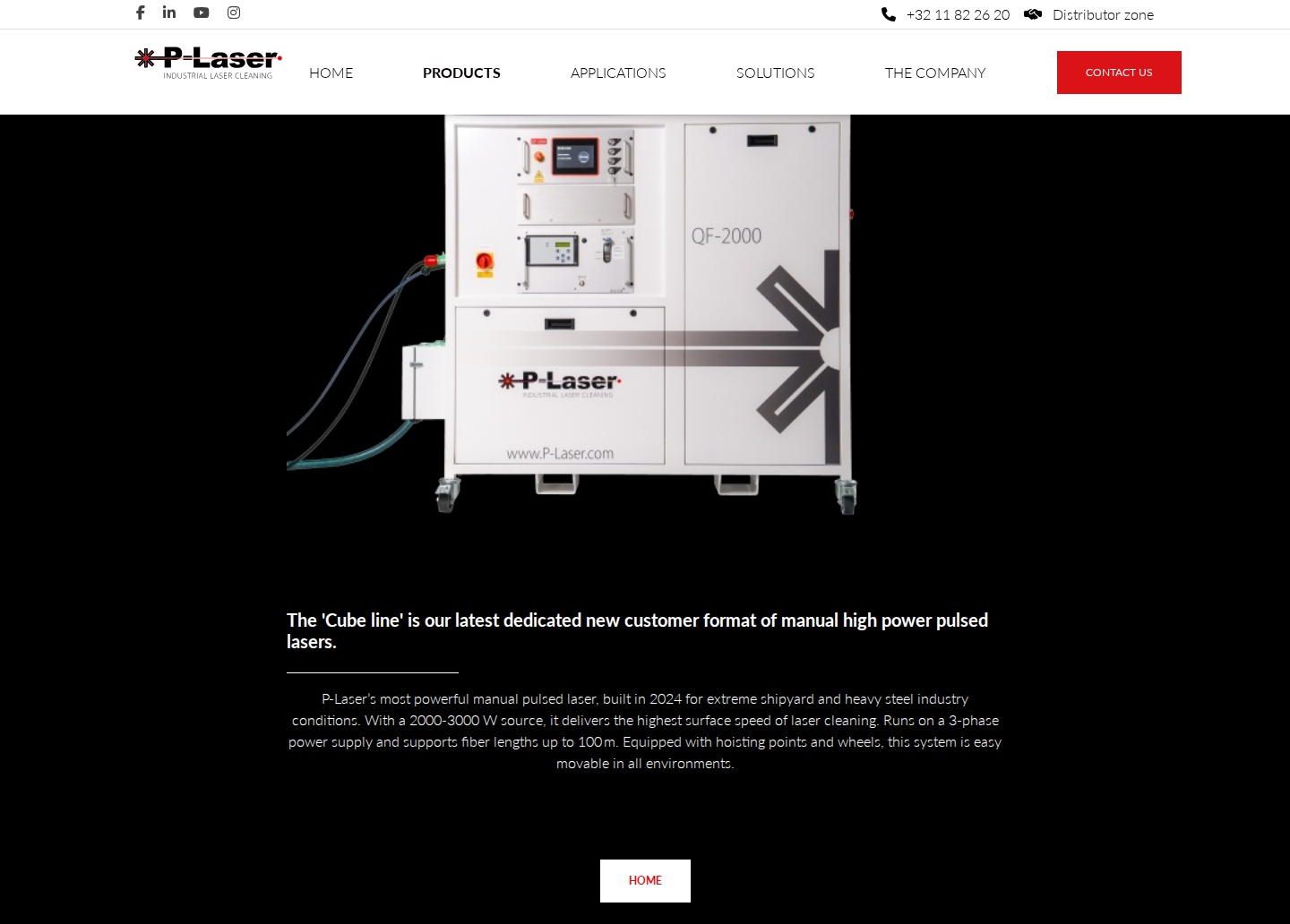
A pulsed 3000W manual laser cleaning system launched in 2024, built by Belgian manufacturer P-Laser for shipyard and heavy steel industry applications.
Pros:

150 MW peak power from pulsed source
Up to 100 m fibre reach
In-house engineered, Belgian-manufactured system
Built for shipyard and heavy steel cleaning
Cons:

Water cooling requires chiller infrastructure on site
2024 launch means limited multi-year field record
Trolley form factor limits quick repositioning
The Cube Line is P-Laser's highest-power manual pulsed laser cleaning system, available in 1000 W, 2000 W, and 3000 W configurations. This entry covers the 3000 W model, launched in November 2024 and positioned by P-Laser for extreme industrial cleaning in shipyards and heavy steel environments.
Technical Specifications
The Cube Line 3000W delivers its output as a pulsed beam rather than a continuous wave, and the distinction matters at this power level.
| Specification | Cube Line 3000W |
|---|---|
| Laser type | Pulsed |
| Average power output | 3000 W |
| Pulse energy | 150 mJ |
| Pulse duration | 100 ns |
| Peak power | 150 MW |
| Cooling | Water-cooled |
| Power supply | Three-phase (380–440 V) |
| Max fibre length | 100 m |
Key technical specifications for the P-Laser Cube Line 3000W.
At 100 nanoseconds per pulse, 150 mJ of energy is compressed into an extremely short burst, producing a peak power of 150 MW per pulse. That concentration of energy at the surface is what drives coating and contamination removal — it ablates the target material without the sustained thermal load that a continuous wave source applies.
The practical implication for buyers is selectivity: pulsed sources at this energy level can be tuned to lift coatings and rust from steel without damaging the substrate beneath. CW systems — covered in the third entry on this list — operate on a different thermal principle and suit different application profiles.
Cleaning Performance and Applications
P-Laser positions the Cube Line specifically for marine paint removal, heavy coating stripping, and rust cleaning on large steel structures.
P-Laser cites high surface speed as the defining performance characteristic of the 3000 W configuration — the higher the average power, the faster the beam can traverse a surface while delivering sufficient fluence per pulse to clean it.
- Marine paint removal: Designed for stripping multi-layer marine coatings from ship hulls and structural steel.
- Rust and oxide removal: Effective on heavy rust layers on large steel surfaces in shipyard and petrochemical environments.
- Pre-coating surface preparation: Prepares steel surfaces for re-coating by removing contamination without abrasive media.
- Oil and gas sector maintenance: Suited to maintenance cleaning in demanding industrial environments including oil and gas installations.
P-Laser delivered its first high-power system to Samsung Heavy Industries in 2019 and to Keppel in 2020, establishing an early track record in shipbuilding before the Cube Line's 2024 launch.
Form Factor and Portability
The Cube Line ships in a cubic frame designed to be transported across industrial sites or placed inside a sea container. It is equipped with hoisting points and wheels, enabling movement across concrete floors in shipyards and factories.
The 100 m fibre length is a concrete operational advantage for large-structure work: an operator can position the laser unit in one location and clean across an extended area without repositioning the machine itself. P-Laser notes 100 m as standard technology for their high-power systems.
The trolley configuration is genuinely mobile within a site, but it is not a lightweight or quickly repositioned unit. Moving the Cube Line requires the trolley and its infrastructure — buyers working in environments where the machine needs to move frequently between compact or confined spaces should factor this into their site planning.
The Cube Line 3000W runs on three-phase power at 380–440 V. Buyers must confirm that three-phase supply is available at their operating locations before purchase — this is a fixed infrastructure requirement, not an optional configuration.
Cooling
Water cooling is standard on the Cube Line, as it is across all high-power systems in P-Laser's range. Buyers need to account for chiller provision and water quality management as part of the operational setup. P-Laser's FAQ notes that mid and high-power water-cooled machines require monthly checks of filters and chillers.
Safety
P-Laser's November 2024 news release states that the Cube Line is equipped with state-of-the-art safety sensors providing protection against accidental emissions, covering both operator and workplace safety in industrial settings.
Manufacturer Credibility
P-Laser is an independent Belgian company based in Heusden-Zolder. It began operating in 2008 as a division of an industrial cleaning business and became fully independent in 2012, developing its own laser cleaning systems from that point.
The company is led by Jean-Claude Philippron, who brings over 30 years of expertise in surface treatment and industrial cleaning technology. P-Laser's homepage reports more than 450 systems installed worldwide, backed by a network of 42 international partners.
Every system is engineered and manufactured in-house in Belgium. P-Laser describes its technology as 100% proprietary, backed by patents and protected IP. For buyers evaluating manufacturing provenance, in-house design and production is a materially different proposition from sourcing through a reseller or system integrator.
P-Laser Cube Line Pricing
No list price is published for the Cube Line. P-Laser's FAQ states that low-power machines start from €60,000 — the 3000 W Cube Line sits at the top of P-Laser's range, and pricing is available on request through P-Laser or its distributor network.
P-Laser offers one day of training for every customer, covering safety, machine operation, and software use. Remote monitoring is available as a proactive service, allowing P-Laser staff to check system alarms, temperatures, and humidity. Pulsed systems at this power are noted by P-Laser as maintenance-free at the laser source level, with a yearly system check recommended.
Product 2
Laserax LXQ-UHP 3000W
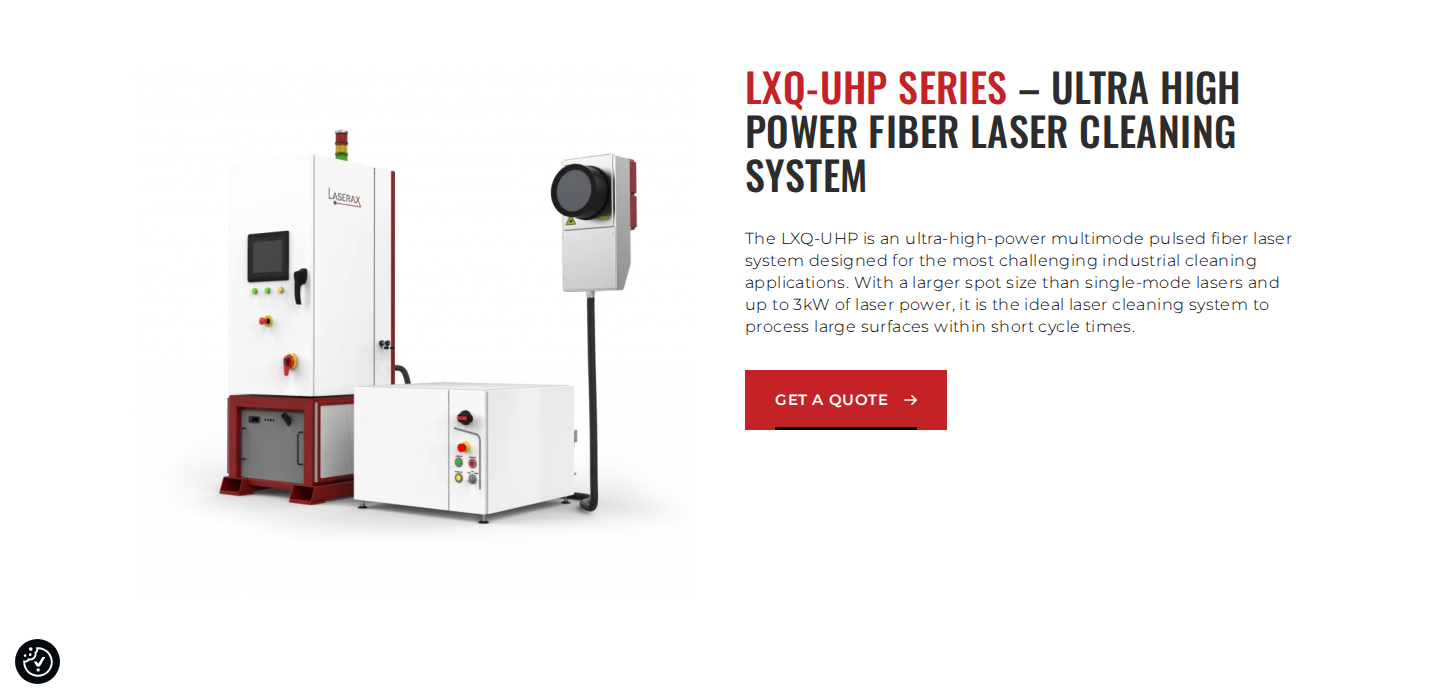
A 3000W multimode pulsed fibre laser cleaning system from Canadian manufacturer Laserax. Multi-component, robot-mountable, and built for fixed inline industrial production environments.
Pros:
Confirmed 3000W pulsed multimode fibre laser output
Robot-mountable scan head for inline automation
Up to 100m fibre cable reach available
ISO-certified in-house manufacturer, CE and UL approved
Cons:
Multi-component system, not a single unit
350kg chiller adds significant floor-space requirement
Requires robot arm integration before deployment
The Laserax LXQ-UHP-3000 is an ultra-high-power multimode pulsed fibre laser cleaning system rated at a confirmed 3000 W nominal output — the figure that qualifies it for this list.
Unlike the trolley-mounted systems that bracket it on this page, the LXQ-UHP is a multi-component installation: a separate laser source, control cabinet, chiller, and a 2D scan head that mounts to a robot arm.
That distinction shapes everything about how this machine is deployed, what it costs to integrate, and which production environments it suits.
Laser Specification
The LXQ-UHP-3000 operates at a wavelength of 1064 nm, a nominal pulse repetition rate of 20 kHz, and a pulse energy range of 33.3 to 150 mJ, with an adjustable pulse width of 25 ns to 100 ns.
As a multimode laser, it produces a larger spot size than single-mode systems — 0.8 to 2 mm typical — which Laserax states makes it suited to processing large surfaces and complex shapes without requiring tight positioning precision.
Laserax positions the LXQ-UHP as combining the most powerful pulsed laser output on the market with what it describes as the world's fastest scanning speed and a large spot size, making it suited to demanding inline applications with ultra-short cycle times.
The laser source carries a stated MTBF of 100,000 hours, as published in Laserax's own product documentation.
Form Factor and Integration
This is the characteristic that most clearly differentiates the LXQ-UHP from the other entries on this list: it is an integration project, not a plug-in machine.
The four-component system requires floor space, three-phase power infrastructure, and mechanical integration of the scan head onto a robot arm or gantry before any cleaning can take place.
| Component | Dimensions (W x H x D) | Weight |
|---|---|---|
| Laser source | 780 x 558 x 806 mm | 160 kg |
| Control cabinet | 772 x 2000 x 685 mm | 150 kg |
| Chiller | 815 x 1660 x 630 mm | 350 kg |
| 2D scan head | 270 x 397 x 623 mm | 45 kg |
LXQ-UHP 3000W system components: dimensions and weights as stated in Laserax's technical documentation. These figures apply to the 2 kW and 3 kW configurations.
The chiller alone weighs 350 kg and stands 1660 mm tall — a meaningful infrastructure commitment that buyers must plan for before purchase.
The scan head's robot-mounting capability is a genuine operational strength: with up to 100 m of fibre cable available (10 m is included as standard), the head can reach large parts across a wide work envelope and can be positioned in any orientation to access any surface.
Cooling and Power Supply
The LXQ-UHP-3000 is water-cooled, with the chiller included in the system.
Total power consumption at the 3 kW configuration is 20.5 kVA, requiring a 3× 400–480 VAC, 50/60 Hz three-phase supply with protective earth — infrastructure that must be confirmed and provisioned at the installation site before commissioning.
Cleaning Performance and Applications
Laserax positions the LXQ-UHP as capable of meeting ultra-short cycle times on smaller surfaces or processing large areas — with the combination of high pulsed power, fast scanning speed, and large spot size cited as the basis for that claim.
The system's 200-plus possible optical configurations allow Laserax's engineers to select components matched to a specific application, contaminant type, and cycle-time requirement.
- EV battery components: Surface preparation for welding and bonding on battery cells and modules.
- Automotive parts: Oxide removal, paint stripping, and pre-treatment across a wide range of metal parts for automotive production lines.
- Large industrial surfaces: Processing of complex shapes and large-area parts using the multimode spot size and long fibre reach.
- Parts with variable geometry: A depth of focus of up to 20 mm allows cleaning of bent or irregular parts without complex laser head adjustments.
Contaminants the system is designed to remove include oxides, coatings, rust, paint, oils, and electrolytes from metal surfaces.
Safety and Certifications
The LXQ-UHP-3000 is classified as a Class 4 laser product, certified to CSA-E60825-1:15, 21 CFR 1040.10, and IEC 60825-1, with UL and CE approvals and IP54 environmental protection.
Remote access is secured via an OpenVPN encrypted channel (OpenSSL), which supports Laserax's remote installation, training, and after-sales support services.
When configured as a robot cleaning machine, the system uses a Class 1 certified laser safety enclosure with interlocked doors — creating a fully laser-safe work environment that does not require personal protective equipment for operators working outside the enclosure.
Manufacturer Credibility and Support
Laserax was founded in 2010 by two laser physicists and is headquartered in Québec City, Canada, with a dedicated manufacturing centre on Avenue Dalton.
The company designs and manufactures its own laser systems in-house — it is not a reseller — and holds ISO 9001:2015 and ISO 14001:2015 certifications issued by the BNQ, a government-recognised certification body.
Its global footprint includes offices in North America (Québec City, Wixom MI, Atlanta GA, Santa Clara CA) and Europe (Bad Krozingen, Germany, including the acquired SLCR Lasertechnik GmbH operation in Langerwehe), plus distribution partnerships in Japan and other markets across more than 25 countries.
Laserax states that its robot cleaning machine is built for 10 or more years of operation with minimal maintenance and is designed to run 24/7 in harsh industrial environments.
Laserax provides worldwide technical support by phone and email, with European support available during business hours from its German office. Remote support via secure VPN is available as a standard feature of the LXQ series.
Laserax LXQ-UHP Pricing
Laserax does not publish list pricing for the LXQ-UHP-3000. Pricing is available on request directly from Laserax or via their regional offices and distribution partners.
Product 3
Narran DIVA 3000W
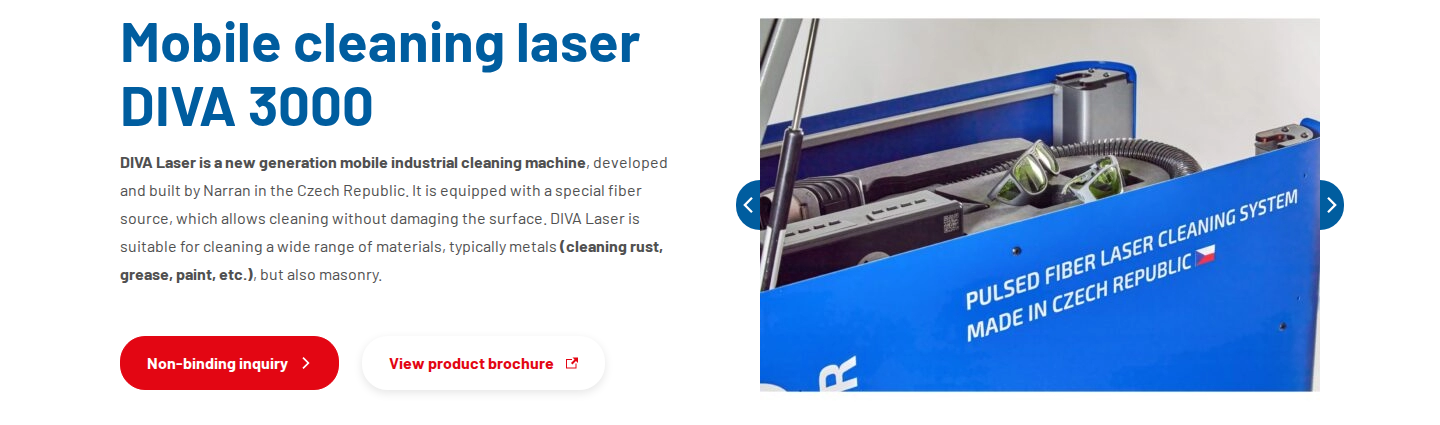
A 3000W continuous-wave laser cleaning machine from Czech manufacturer Narran. Trolley-mounted with integrated water cooling, a manual or robotic scan head, and a CERN reference installation.
Pros:
Integrated cooling — no external chiller needed
Up to 100 m fibre option available
CERN selected Narran for accelerator complex cleaning
Scan head supports manual and robotic operation
Cons:
CW emission delivers higher substrate thermal input
250 kg limits mobility beyond trolley movement
The Narran DIVA 3000W is a mobile industrial laser cleaning machine developed and built by Narran in Brno, Czech Republic — a company founded in 2013 and certified to ISO 9001:2016.
Where the two previous entries on this list use pulsed emission, the DIVA runs on continuous-wave (CW) output — the single most consequential technical distinction in this comparison.
CW emission delivers sustained, uninterrupted power at 3000 W average output — well suited to rapid bulk removal of thick rust, mill scale, and heavy coatings across large steel surfaces where throughput is the priority. The trade-off is higher thermal input to the substrate: CW is less appropriate for precision surfaces, thin-gauge materials, or applications where heat load to the base material is a concern. This is an application-fit distinction, not a quality difference — pulsed and CW systems are optimised for different jobs.
Narran confirms the DIVA's average output power at 3000 W at a wavelength of 1064 nm, with CW emission mode.
DIVA 3000W Specifications
| Parameter | DIVA 3000W |
|---|---|
| Average output power | 3000 W |
| Wavelength | 1064 nm |
| Emission mode | Continuous wave (CW) |
| Power supply | 3 + N + PE, 400 V, 50 Hz |
| Power consumption | 12,000 W |
| Dimensions (W × D × H) | 140 × 64 × 112 cm |
| Weight | 250 kg |
| Standard fibre length | 10 m (up to 100 m on request) |
| Working distance | 400–900 mm |
| Beam scanning | 1D and 2D |
| Laser safety class | Class 4 |
| Cooling | Integrated closed water circuit |
Key technical specifications for the Narran DIVA 3000W.
The DIVA's integrated closed water cooling circuit handles both heating and cooling functions internally, maintaining a constant operating temperature without any external chiller unit.
By contrast, the Laserax LXQ-UHP covered earlier in this list requires a separate 350 kg chiller as a distinct system component — the DIVA's self-contained cooling reduces both floor-space footprint and deployment complexity.
Form Factor and Portability
The DIVA is built into a robust welded mobile frame with industrial wheels and certified lifting points for crane or forklift use — practical for repositioning across a facility or between outdoor worksites.
At 250 kg, however, mobility is trolley-level: this is not a lightweight field-portable system, and any deployment plan should account for that mass.
The scanning head can be operated manually or mounted in automated and robotic production lines, giving the system flexibility across both manual cleaning tasks and integrated automation workflows.
The standard fibre is 10 m; an extended option of up to 100 m is available for special applications — practically significant for large-structure work such as shipyard hulls, bridges, or infrastructure where the machine cannot be positioned close to the cleaning surface.
Cleaning Performance and Materials
Narran describes the DIVA as suited to cleaning rust, grease, paint, and other contaminants from metals and masonry.
- Beam scanning: 1D and 2D scanning modes supported, with automatic focusing and beam shaping adjustable during operation.
- Working distance: 400–900 mm focus range accommodates varied surface geometries and standoff requirements.
- Filtration: An integrated multi-stage filtration unit (pre-filter, HEPA, activated carbon) captures fumes and particulate at source, with the exhaust hose connectable directly to the processing head.
- Control: Industrial Siemens PLC with touch HMI; supports OPC UA, Profinet, remote access, and robot system communication (KUKA, ABB, UR, Stäubli).
The control software allows work profiles to be saved and recalled, and the power, beam shape, and width can all be adjusted while the laser is running.
Safety and Certifications
The DIVA 3000W is a Class 4 laser system, and Narran holds ISO 9001:2016 certification across its operations.
Manufacturer Credibility
Narran's references page records that CERN selected the company to deliver a mobile laser cleaning system for the laboratories, surface buildings, and underground technical tunnels of its 27-kilometre accelerator complex.
Aker Solutions uses Narran pulsed laser cleaning systems for maintenance and surface preparation in offshore environments, with Narran's references page noting high performance and a significant reduction in waste and service time.
DIVA 3000W Pricing
Narran does not publish pricing for the DIVA 3000W; pricing is available on request, consistent with the norm across all three machines evaluated on this page.
Talk to Woodrow Scientific About Your Laser Cleaning Requirements
Woodrow Scientific designs and builds its laser cleaning systems in-house in the UK. Bring your application, substrate and throughput requirements and get a direct technical conversation with the engineers who make them.
Conclusion
Who makes the best 3000W laser cleaning machine?
The verified field at this power tier is genuinely small — and that is worth knowing before you start comparing brochures.
The answer to "best" turns on two things: laser type and deployment context. Where thermal input to the substrate is a concern, pulsed systems hold a clear advantage; where the priority is throughput in a fixed production environment, integration complexity becomes the deciding factor.
At 3000 W, three-phase power and water cooling are non-negotiable realities — confirm your site infrastructure, and ask any vendor for evidence of comparable installations running under sustained industrial duty.
Frequently asked questions about 3000W laser cleaning machines
Practical answers to common buying questions about 3000W industrial laser cleaning machines.
Pricing at the 3000 W tier is almost universally quote-based — published list prices are rare across the category. For context, P-Laser's own FAQ states that entry-level low-power machines start from €60,000; 3000 W systems sit at the high end of the range and are priced accordingly. Cost varies significantly depending on several factors: laser type (pulsed versus continuous-wave), cooling configuration and chiller specification, fibre cable length (standard 10 m versus extended runs of 50–100 m), and whether the system is a standalone trolley unit or a multi-component installation requiring integration work. After-sales support terms — including installation, commissioning, training, and ongoing service — also differ between contracts and affect the total figure. Buyers should request quotes from multiple verified manufacturers and ensure each quote explicitly covers installation, commissioning, operator training, and ongoing support, not hardware alone.
"Best" is application-dependent — there is no single-vendor answer. At 3000 W specifically, the field of credibly verified manufacturers is small. P-Laser (Belgium), Laserax (Canada), and Narran (Czech Republic) all have genuine in-house manufacturing credentials and established market presence at this power tier. The differentiators that determine the right choice for a given buyer are: application type (large-structure and shipyard work versus inline production versus mobile field deployment), required form factor (trolley-mounted unit versus multi-component fixed installation), laser type (pulsed versus continuous-wave, which affects thermal input and throughput), and the depth of after-sales support and operator training the manufacturer provides. Evaluating each machine against those axes — rather than looking for a universal verdict — is the most reliable path to the right decision.
Yes. Laser cleaning is a proven industrial process with a well-established track record across heavy industry. The technology removes rust, mill scale, paint, and coatings from metal surfaces without abrasives or chemicals, using focused laser energy to ablate contaminants cleanly from the substrate. At 3000 W, machines are deployed in genuinely demanding environments. Narran's published references include Aker Solutions, which uses Narran pulsed laser cleaning systems for maintenance and surface preparation in offshore environments, and CERN, which selected Narran to deliver a mobile laser cleaning system across its 27-kilometre accelerator complex. At this power tier, the relevant question is not whether laser cleaning works but whether the specific machine and configuration match the application at hand.
All three 3000 W machines covered here require a three-phase power supply. The Narran DIVA 3000 specifies 3 + N + PE 400 V 50 Hz; the Laserax LXQ-UHP-3000 requires 3× 400–480 VAC 50/60 Hz; and the P-Laser Cube Line also runs on three-phase supply. Sites with single-phase supply only cannot support these machines without an electrical infrastructure upgrade — this is a practical constraint buyers should confirm with their facilities team before committing to purchase.