

Introduction
If you've landed here, you already know you want a 200W laser cleaning machine — you're comparing options and need a structured, honest evaluation to help you decide.
The 200W tier sits in a practical sweet spot: capable enough to handle rust, paint, oxide, and coating removal across most industrial maintenance and surface-preparation work, without the bulk, complexity, and cost that come with higher-power systems.
For this list, "200W" means machines with a rated average output of 200W (pulsed); automated and robotic systems fall outside its scope, as do machines significantly above or below that threshold.
TL;DR
Wattage is the starting point, not the deciding factor. Across these five machines, the differences that actually matter to buyers are reach, safety design, form factor, and whether the company behind the product built it or simply resells it — and those gaps are wider than the shared power rating suggests.
This article covers:

Five 200W laser cleaning machines evaluated independently
Evaluation criteria: technology, safety, reach, support
Safety design differences, including reduced hazard zones
Portability and fibre reach compared across entries
Manufacturer vs reseller distinction at this power tier
What to Look for in a 200W Laser Cleaning Machine
At 200W, the spec sheet rarely tells the whole story. Two machines can share the same average power rating and perform very differently in practice — because the decisions that actually drive cleaning quality, substrate safety, and day-to-day usability sit beneath the wattage figure.
Pulsed vs Continuous-Wave: The Most Important Choice
The single biggest technical distinction at this power tier is whether the laser delivers energy as short nanosecond bursts (pulsed) or as a constant stream (continuous-wave, or CW).
Pulsed fibre lasers generate peak power far exceeding their average output — a 200W pulsed system fires bursts that can reach into the kilowatt range per pulse, even though the average power stays at 200W. As Laser Focus World notes, this high peak power enables precise ablation of the target material while the very short pulse duration — typically around 100 nanoseconds — ends before significant heat can conduct into the substrate.
CW lasers at 200W deliver their full power continuously, which means heat transfer into the base material is substantially higher. Research published in Laser Focus World comparing MOPA pulsed and CW fibre lasers on paint removal found that CW cleaning left surface roughness approximately 1.5 times greater than the original, and caused substrate metal to melt in some cases — while the MOPA pulsed laser left roughness close to or below the original surface.
CW does have a role: on large, thermally robust steel structures where throughput matters more than micron-level surface control, it can be the right tool. But for precision work — thin metals, heat-sensitive alloys, electronics, or mould surfaces — pulsed technology is the correct choice at this power level.
Portability, Form Factor, and Fibre Cable Length
The 200W tier spans a range of physical configurations: compact all-in-one units in carry cases, wheeled trolley systems with a separate handheld scanner, and handheld gun setups tethered to a floor-standing source unit.
Two practical metrics determine real-world usability on site. The first is scanner or handset weight: handheld cleaning heads typically run from under 1 kg up to around 3.5 kg depending on optics and cable design, and sustained overhead or extended-reach work exposes poor balance and excess weight quickly — check the head weight and handle geometry, not just the total system weight.
The second is fibre cable length: the cable between the control unit and the cleaning head sets the operator's working radius. A standard 5-metre cable can be limiting in confined spaces or when working across large structures — 10 to 15 metres gives meaningful reach without repositioning the source unit.
On cooling design: at 200W, air cooling is technically viable, eliminating the chiller unit, water lines, and warm-up time that water-cooled systems require. This makes air-cooled machines considerably easier to deploy in field or remote settings. Water-cooled designs can offer more stable thermal management under sustained high-duty-cycle operation, but they add weight and complexity — for most portable deployments at this power level, air cooling is the more practical choice.
Safety Classification and the Hazard Zone
Every 200W laser cleaning machine — regardless of form factor or marketing language — is a Class 4 laser product under IEC 60825-1, the highest hazard classification. OSHA guidance and ANSI Z136.1 are unambiguous: Class 4 lasers are hazardous to the eye and skin from both direct and diffusely reflected beams, and require a designated laser controlled area during operation.
In practice, this means the work area must be cleared and controlled before cleaning begins — warning signs posted, access restricted, and all personnel within the zone wearing wavelength-specific protective eyewear. This is a genuine operational constraint, particularly for buyers working in mixed-use facilities or open workshops.
The nominal hazard zone (NHZ) — the space within which radiation exceeds the maximum permissible exposure — varies between machines based on beam parameters and engineering design. Some machines at this tier incorporate technology that reduces the NHZ dramatically, removing the need to clear and seal the surrounding area for every job. Others require a full laser controlled area as standard. This distinction has direct consequences for throughput and operational flexibility, and it is worth asking about explicitly when evaluating any machine on this list.
All 200W laser cleaners are Class 4 under IEC 60825-1, requiring a laser controlled area. What varies between machines is how large that zone must be — some designs reduce the NHZ significantly, enabling use in open or shared workspaces without shutting down the surrounding area.
Ease of Use and Manufacturer Provenance
Not all 200W machines are equally accessible to new operators. Features that lower the skill barrier include touchscreen interfaces, preset cleaning programmes by material and contamination type, and parameter recipe storage so operators are not configuring from scratch each shift. For buyers deploying across a team or entering laser cleaning for the first time, this is a meaningful differentiator.
The market for laser cleaning machines at this power tier includes a significant proportion of resellers and importers rebadging third-party equipment. For industrial equipment, this matters: a genuine in-house manufacturer can supply spare parts quickly, provide engineering expertise for application-specific problems, issue firmware updates, and diagnose faults directly rather than escalating to a third party.
Before committing to any machine, ask directly: did this supplier design and build this system themselves? Pricing at this tier is typically quote-based rather than list-priced, and the spread reflects build quality, cooling design, cable length, software sophistication, and support infrastructure — not wattage alone.
With those axes in mind, here are the five best 200W laser cleaning machines available today.
Product 1
ELASER 200W — Woodrow Scientific Limited
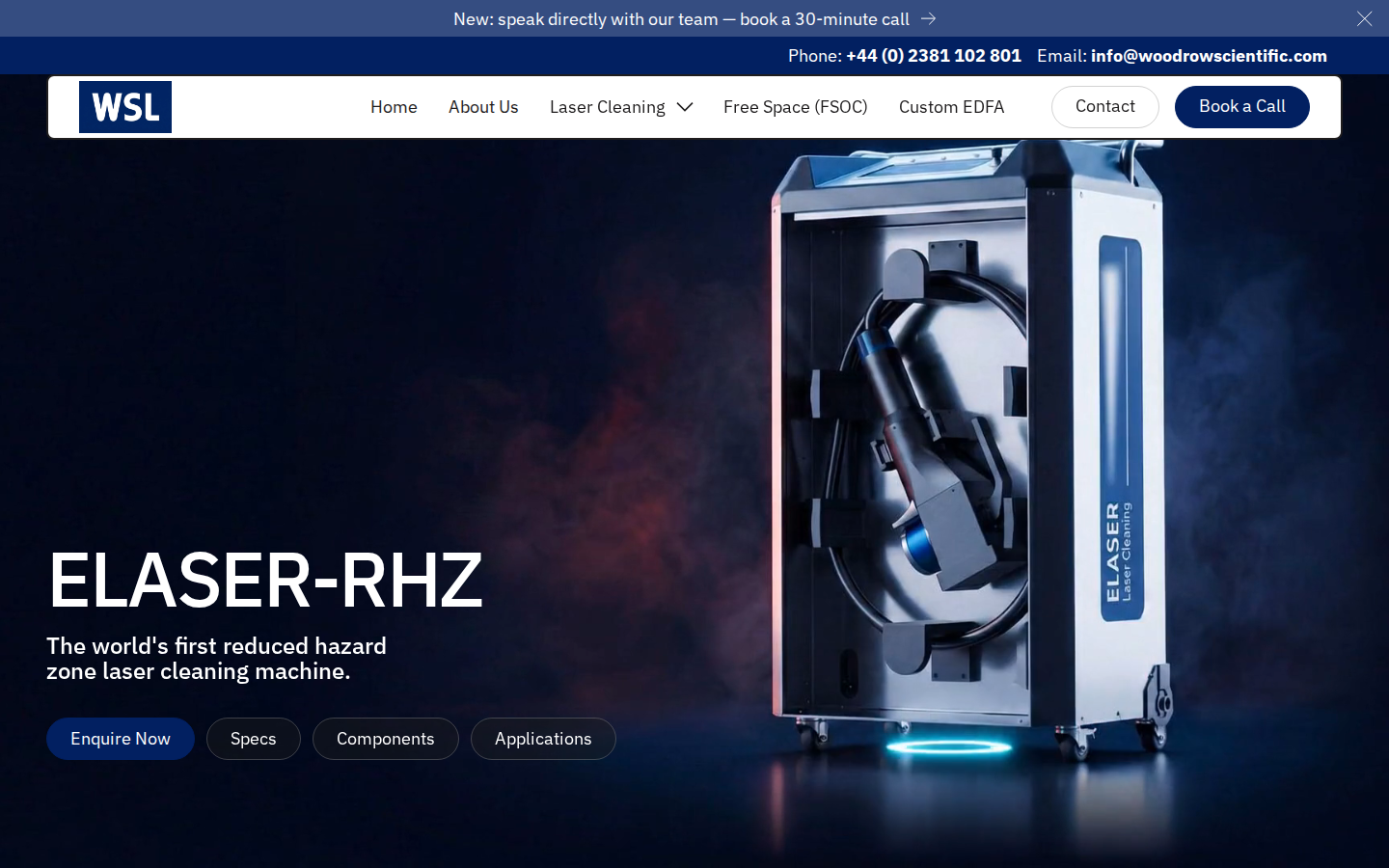
Portable 200W pulsed fibre laser cleaning system by Woodrow Scientific Limited, the only UK manufacturer. Features world-first eye-safe RHZ technology and up to 50 m fibre reach. Air-cooled, single-operator.
Pros:

World-first eye-safe RHZ technology — clean open spaces
Up to 50 m fibre delivery cable reach
UK in-house manufacturer — faster support, genuine expertise
Sub-3 kg scanner; air-cooled, no chiller needed
Cons:

Quote-only pricing — no public list price
Customisation options require direct enquiry to WSL
ELASER-RHZ: Eye-Safe Laser Cleaning
The single biggest constraint on conventional laser cleaning has always been the hazard zone: a large exclusion area that must be sealed off and cleared before work can begin, making it impractical in open workshops, mixed-use facilities, or anywhere the public is present.
The ELASER-RHZ removes that constraint entirely — WSL's patented technology collapses the laser hazard zone to a fraction of its conventional size, enabling cleaning in environments that were previously off-limits to laser cleaning altogether.
This is a world-first: no other laser cleaning machine on the market offers reduced-hazard-zone capability of this kind.
In practical terms, it means graffiti removal on public-facing heritage structures, cleaning in open-plan manufacturing facilities without stopping production nearby, and surface prep in mixed-use spaces — all without full area evacuation.
Both variants are Class 4 laser products: the high-energy pulses that effective cleaning needs make that unavoidable. The ELASER-RHZ adds advanced engineering controls that make access to any radiation above Class 1 impossible, which is what collapses the hazard zone around the work area.
Both variants carry CE and UKCA certification.
Reach and Portability
The ELASER ships with a delivery cable of 5 m or 15 m as standard, with options extending up to 50 m — giving a single operator the ability to clean across large structures or at considerable distance from the control unit without repositioning it.
Most competitors at this power tier reach 10 m or less; the 50 m option is a concrete, measurable advantage on the reach axis.
The system is wheeled and weighs under 50 kg, and the handheld scanner comes in at under 3 kg — light enough for sustained single-operator use without fatigue becoming a practical issue.
Air cooling means no chiller unit, no water lines, and no compressor — the ELASER is genuinely self-contained and deployable wherever a standard single-phase power supply is available (110–250 VAC).
Laser Technology and Specifications
The ELASER runs a pulsed fibre laser at 1550 nm wavelength — the retina-safe wavelength, which is a key part of what makes the RHZ variant's reduced hazard zone achievable.
| Specification | ELASER 200W |
|---|---|
| Laser type | Pulsed fibre laser |
| Wavelength | 1550 nm (retina-safe) |
| Max power | 200 W (100 W and 300 W models also available) |
| Pulse energy | Up to 15 mJ |
| Pulse duration | 100 ns |
| Pulse repetition rate | Adjustable up to 200 kHz |
| Power tunability | 0–100% |
| Scanner | 2-D galvanometer, 10 m/s max scan rate |
| Working distance | 75–500 mm (interchangeable F-Theta lenses) |
| Delivery cable | Up to 50 m (5 m / 15 m standard) |
| Scanner weight | Under 3 kg |
| System weight | Under 50 kg |
| Cooling | Air-cooled |
| Power supply | 110–250 VAC single-phase |
| Laser class | Class IV (standard) / Class I (RHZ variant) |
| Certifications | CE, UKCA |
Key specifications for the ELASER 200W pulsed fibre laser cleaning system, as published by Woodrow Scientific Limited.
Power tunability across the full 0–100% range is worth highlighting: it means one machine handles everything from delicate oxide removal on aerospace components to stripping thick paint or mill scale from structural steel — without changing hardware.
Programmable scan shapes through the touchscreen GUI, combined with interchangeable F-Theta lenses spanning 75–500 mm working distance, give operators precise control over beam geometry and standoff for different applications and surface profiles.
Ease of Use and Support
The graphical touchscreen interface supports password-protected access with per-user logins and usage tracking — useful for facilities managing multiple operators or maintaining audit records for quality or compliance purposes.
WSL provides manufacturer-led training for operators; contact WSL directly for details on training availability and format.
Because WSL designs and builds its own machines in-house, support is handled by the engineers who built the system — not routed through a reseller or importer with limited visibility into the hardware.
Many suppliers at this power tier are resellers or importers working with third-party hardware: that structure typically means slower diagnosis, limited ability to customise, and no genuine in-house engineering resource to draw on when something needs fixing or improving.
WSL, founded in 2012 with over 200 years of combined engineering experience across the team, is the only UK-based laser cleaning manufacturer — and bespoke engineering is available for buyers with specific requirements (contact WSL for details).
Applications and Surface Coverage
The ELASER's fully tunable power and broad material compatibility translate into an unusually wide application range for a single 200W machine.
- Metals: Steel, carbon steel, aluminium alloys, cast iron, copper, brass, bronze, titanium, and galvanised steel.
- Stone and masonry: Stone, concrete, brick, and masonry — including heritage and monument restoration.
- Contaminants removed: Rust, oxides, mill scale, paint, powder coating, lacquer, primer, oil and grease, carbon and soot, mould, graffiti, adhesives, tarnish, weld discolouration, and release agents.
- Industrial applications: Pre-weld surface prep, injection mould cleaning, automotive bodyshop, aerospace component prep, tyre and rubber mould cleaning, and industrial maintenance.
The RHZ variant extends the ELASER's reach into public-facing applications — graffiti removal and heritage restoration in accessible spaces — where conventional laser cleaning would require area closures that are impractical or impossible to arrange.
With power tunable from 0 to 100% and compatibility across metals, stone, brick, and masonry, the ELASER 200W covers the full range of industrial cleaning tasks without the need for multiple machines or power configurations.
The ELASER ships worldwide direct from WSL, with a typical lead time of one week from order for standard builds.
ELASER 200W Pricing
The ELASER 200W is priced on a contact-for-quote basis — WSL positions it as the most competitively priced industrial laser cleaning machine at this tier in Europe.
Contact Woodrow Scientific Limited directly for a quotation, lead time confirmation, or to discuss bespoke engineering requirements.
Product 2
cleanLASER lightCASE 200W — Clean-Lasersysteme GmbH
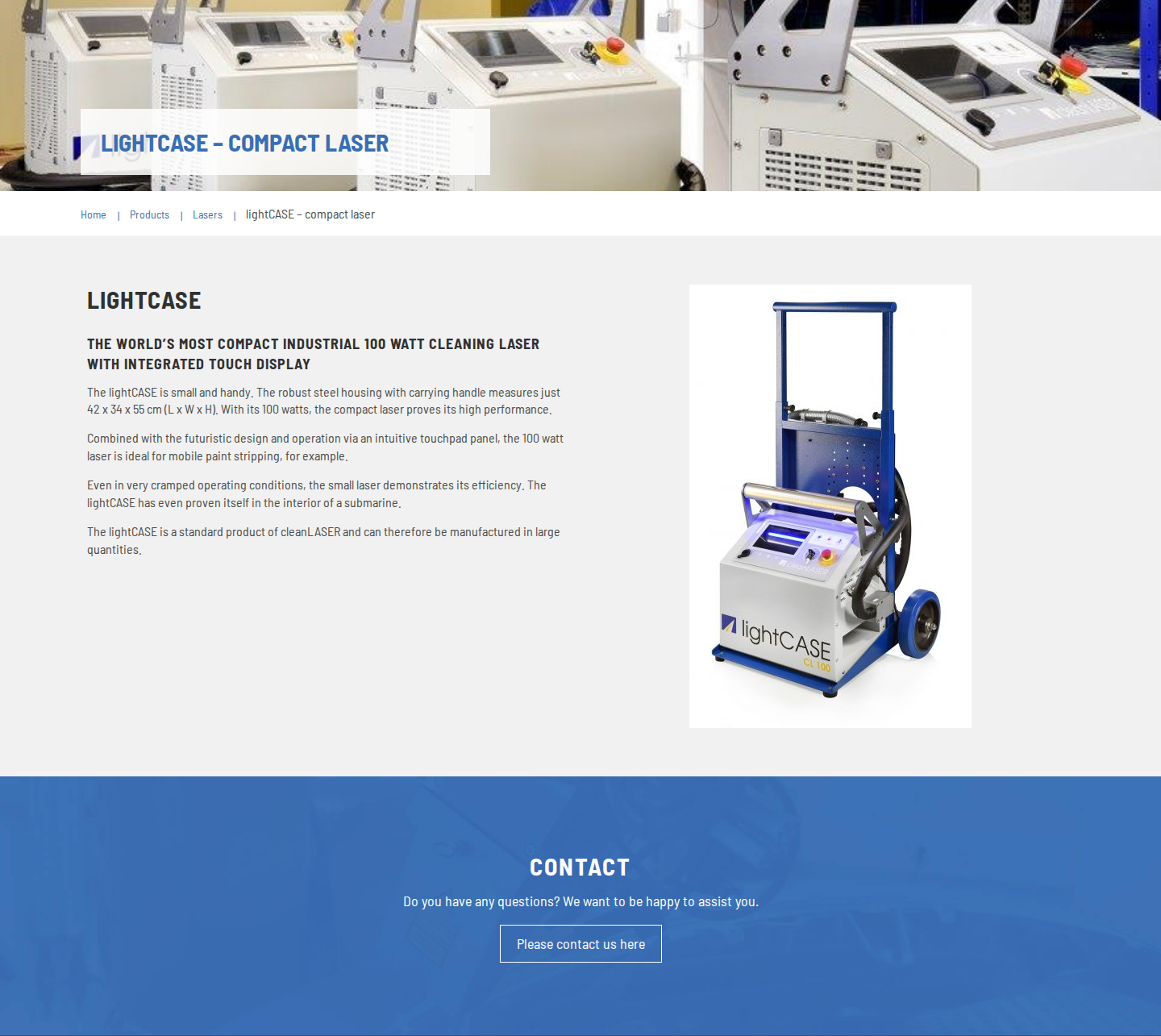
Compact DPSS laser cleaning system from a genuine German manufacturer, now part of IPG Photonics. Self-contained steel housing with robot-mounting capability and a 2.8 m fibre cable.
Pros:
Genuine German manufacturer, now IPG Photonics-owned
Compact self-contained unit; robot-mountable design
Touchpad interface; standard product, short lead times
Cons:
2.8 m fibre cable limits reach from unit
Class 4 laser — controlled area protocols required
Around 39 kg — heavier than some alternatives
Technology and Design
The lightCASE uses a diode-pumped solid-state (DPSS) laser operating at 1064 nm wavelength, housed in a compact, self-contained steel enclosure with an integrated carrying handle.
The unit is designed to be genuinely portable — it can be mounted on a transport trolley for site movement, and its self-contained form factor also makes it suitable for mounting directly on a robotic arm, a meaningful option for buyers considering semi-automated integration.
lightCASE 200W Key Specifications
| Specification | Detail |
|---|---|
| Laser technology | Diode-pumped solid-state (DPSS) |
| Wavelength | 1064 nm |
| Form factor | Self-contained steel housing with carrying handle |
| Weight (200–300W variant) | approx. 39 kg |
| Fibre cable length | approx. 2.8 m |
| Laser class | Class 4 |
| Robot-mountable | Yes |
Key specifications for the cleanLASER lightCASE 200W. – indicates the value is not publicly listed.
At approximately 39 kg, the 200–300W variant is a solid unit — manageable with a trolley, though buyers should factor this into their site logistics.
Reach and Portability
The standard fibre cable length is approximately 2.8 m, which means the laser unit itself must be positioned close to the work surface.
For buyers working on large structures, at height, or at distance from a fixed power point, this is a practical consideration: the unit travels with the operator rather than remaining at a station.
Safety Design
The lightCASE is a Class 4 laser product at 1064 nm. Standard controlled-area protocols apply: the work zone must be designated, access managed, and appropriate PPE worn.
Like every other machine on this list apart from the ELASER-RHZ, the lightCASE needs the full controlled-area regime for every use.
Manufacturer Provenance
Clean-Lasersysteme GmbH is a genuine laser manufacturer based in Herzogenrath, Germany — not a reseller or importer — with a track record in industrial laser cleaning applications.
The company was acquired by IPG Photonics, which IPG describes as a leader in high-power fibre lasers, bringing additional laser technology resources to the cleanLASER product range.
Applications
cleanLASER positions the lightCASE for paint stripping, mould cleaning, and surface pre-treatment for bonding and coating processes.
Its compact, self-contained design makes it well-suited to small-area and precision cleaning tasks, as well as robotic cell integration where the laser head needs to move with the arm.
lightCASE 200W Pricing
Pricing is available on a quote basis. cleanLASER's own product positioning describes the lightCASE as a standard product offered at a fair price-to-performance ratio.
Product 3
P-Laser QFC-200 — P-Laser

A 200W pulsed laser cleaning system from Belgian manufacturer P-Laser. Compact all-in-one design with integrated controls, CleanSweep software, and an air-cooled Compact series build requiring no external chiller.
Pros:
Compact all-in-one unit; no separate control box
Air-cooled series; no chiller or water lines
CleanSweep software; up to 8 programmable profiles
Genuine Belgian manufacturer with own production facility
Cons:
At 30–35 kg, not a lightweight system
Pricing only available on request
The P-Laser QFC-200 is a 200W pulsed laser cleaning system designed and manufactured in Belgium by P-Laser, a company with its own production facility and a product range spanning 50W to 3000W.
Technology and Design
The QFC-200 runs P-Laser's CleanSweep software, which supports up to 8 custom cleaning programmes, each storing its own parameter set for different surfaces or contamination types.
Job selection is handled via an interactive touch encoder on the unit itself, and parameters can be edited wirelessly via a tablet connected to CleanSweep — a practical arrangement for operators who need to adjust settings at the workpiece without returning to a control cabinet.
P-Laser states the QFC-200 reaches operating readiness in approximately 10 seconds from startup.
Form Factor and Portability
The QFC-200 is a fully self-contained unit: the laser source, controls, and optic are all integrated into a single enclosure, with no separate control cabinet required.
| Specification | P-Laser QFC-200 |
|---|---|
| Power | 200W |
| Dimensions | 300 × 665 × 465 mm |
| Weight | 30–35 kg |
| Software | CleanSweep (up to 8 programmes) |
| Startup time | ~10 seconds |
| Cooling | Air-cooled (Compact series) |
| Variant | QFC-300 (300W) also available |
Key published specifications for the P-Laser QFC-200 as stated on P-Laser's product pages.
At 30–35 kg, the QFC-200 is a portable system, though it sits at the heavier end of what a single operator would carry unassisted.
P-Laser's Compact series is air-cooled, meaning no water lines or external chiller unit are needed on site — an advantage in field and maintenance settings where utilities are limited.
Applications
The QFC-200 is suited to rust removal, paint stripping, mould cleaning, and surface preparation for welding — the standard application set for a 200W pulsed system at this power level.
Manufacturer Provenance and Support
P-Laser is a Belgian manufacturer with its own production facility; the QFC range is their own design rather than a rebranded or imported system.
The breadth of their product range — from compact portable units through to high-power industrial systems — is a useful indicator of genuine engineering depth in laser cleaning technology.
P-Laser QFC-200 Pricing
Pricing for the QFC-200 is available on request from P-Laser directly, consistent with the approach taken across the 200W laser cleaning market.
For buyers needing greater throughput, the QFC-300 (300W variant) is available within the same compact form factor.
Product 4
Laserax Hand-Held Laser Cleaning Machine 200W
Trolley-mounted 200W Class 4 laser cleaning station from Canadian manufacturer Laserax. Available in 100W, 200W, and 300W. Strong automotive and EV battery manufacturing pedigree. Offices in Canada, the US, and Germany.
Pros:
Integrated fume extraction nozzle included as standard
In-house manufacturer with automotive and EV pedigree
6 cleaning modes selectable from the handset
Offices in Canada, United States, and Germany
Cons:
Trolley weighs approximately 325 kg
Hand-held head at 4.9 kg is heavier
Class 4 — controlled-area protocols required
The Laserax Hand-Held Laser Cleaning Station is an industrially-oriented, off-the-shelf laser cleaning system available in 100W, 200W, and 300W configurations, with the 200W model the focus here.
Technology and Design
The laser source is a ytterbium-doped fibre laser operating at 1064 nm wavelength, and the system is air-cooled — no external chiller or water lines are required.
Six cleaning modes are selectable directly from the hand-held head, allowing the operator to adapt the cleaning parameters at the workpiece without returning to the control unit.
An integrated fume extraction nozzle is included as standard, providing continuous removal of contaminants from the work area during operation — a practical feature for industrial compliance and operator safety.
Form Factor and Portability
The system is trolley-mounted, with the trolley weighing approximately 325 kg and the hand-held head weighing approximately 4.9 kg; head dimensions are 250 × 500 × 270 mm.
That trolley weight is substantially higher than others on this list — the ELASER system, covered in Product 1, weighs under 50 kg with a sub-3 kg scanner — which is a straightforward physical constraint to factor into any site logistics assessment.
Key Specifications
| Specification | Value |
|---|---|
| Laser type | Ytterbium-doped fibre laser |
| Wavelength | 1064 nm |
| Available power | 100W / 200W / 300W |
| Cooling | Air-cooled |
| Cleaning modes | 6 (selectable from handset) |
| Hand-held head weight | 4.9 kg |
| Head dimensions | 250 × 500 × 270 mm |
| Trolley weight | 325 kg |
| Fume extraction | Integrated nozzle, standard |
| Safety class | Class 4 |
Key hardware specifications for the Laserax 200W hand-held laser cleaning station, sourced from the Laserax product datasheet.
The 200W model requires a 240 V / 20 A power supply, a site infrastructure point worth confirming before installation.
Safety
The Laserax hand-held laser cleaning station is a Class 4 laser product, requiring standard controlled-area protocols: laser safety eyewear, a designated controlled area, warning signage, and a named Laser Safety Officer.
Manufacturer Provenance
Laserax was founded in 2010 and is headquartered in Quebec City, Canada, with additional offices in Warren, Ohio and Bremen, Germany.
The company is a genuine manufacturer with in-house laser process development capability, and supplies customers in the automotive and aerospace sectors.
Applications
The hand-held station is suited to rust, oxide, paint, and coating removal from metals including aluminium, zinc, magnesium, steel, and iron, as well as surface preparation for welding and bonding.
Laserax has a documented track record in automotive and EV battery manufacturing applications.
Laserax Pricing
Pricing is available on request. Laserax positions itself as a turnkey industrial supplier, with process development, fume management, and on-site support included as part of the overall offering.
Product 5
Netalux Needle 200W — Netalux
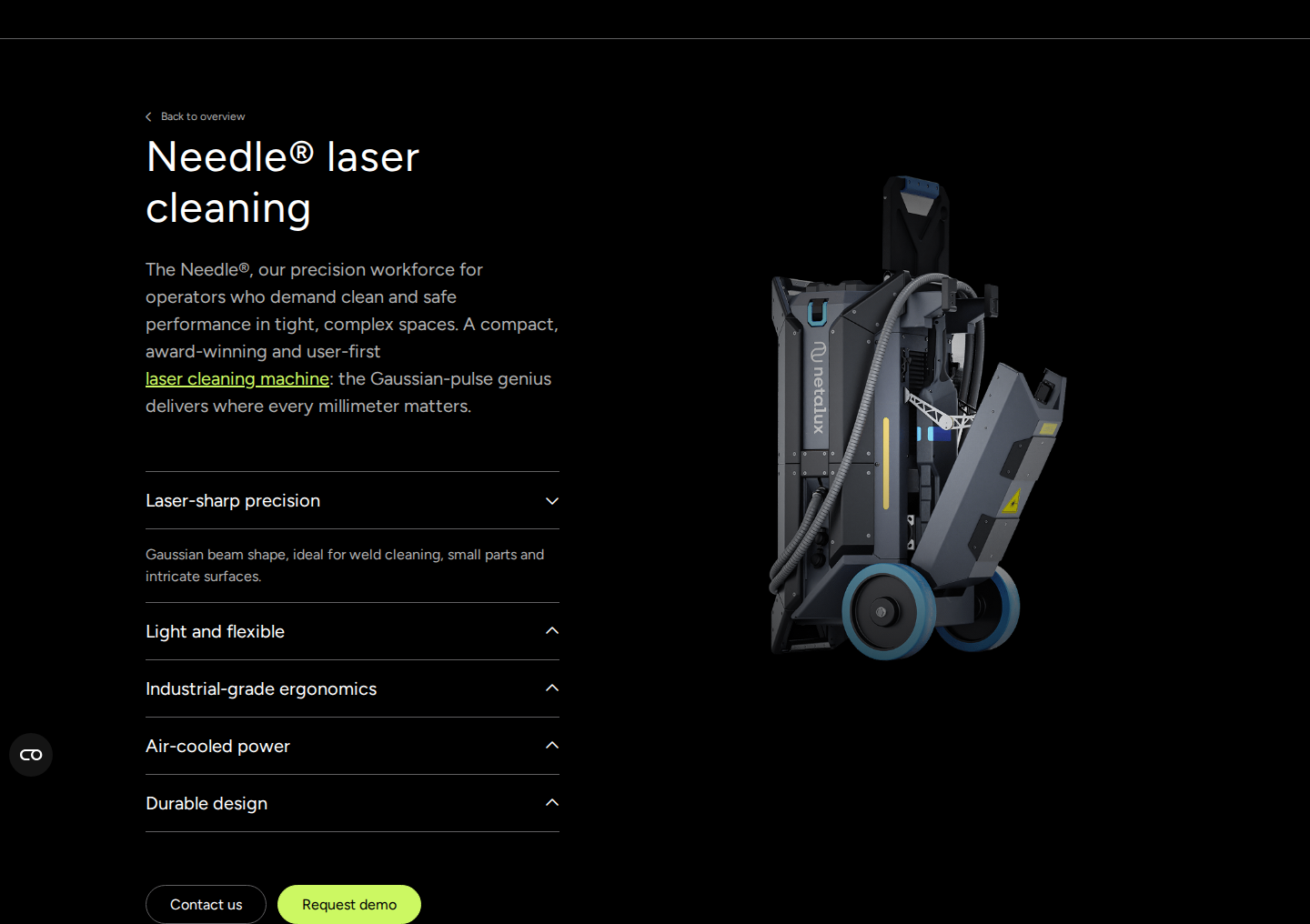
Compact 200W pulsed fibre laser cleaning system from Belgian manufacturer Netalux. Winner of the Red Dot Award: Product Design 2023. Air-cooled, with a Gaussian beam profile suited to precision, small-area cleaning work.
Pros:
Red Dot Award 2023 — recognised industrial design
IP54 enclosure rated for dusty, damp environments
Gaussian beam profile; precise small-area cleaning
115° rotatable head with integrated LED work light
Cons:
5.7 m fibre cable limits extended-reach deployment
Class 4 — controlled-area protocols required
Pricing available on application only
The Netalux Needle 200W is a nanosecond pulsed ytterbium fibre laser cleaning system operating at 1064 nm, designed and manufactured in Belgium.
Technology and Beam Profile
The Needle uses a Gaussian pulse profile, which concentrates energy at a single point rather than distributing it evenly across the beam — making it well suited to targeted cleaning tasks where precision matters.
Netalux describes the Gaussian profile as ideal for removing hard surface layers such as weld seam oxide and flash rust, where controlled, localised energy delivery is more important than wide-area coverage.
The 200/300W model's pulse specifications, as listed on the Netalux product page, include a pulse frequency range of 2–4,000 kHz, a pulse length of 20–500 ns, and a maximum pulse energy of 2 mJ.
| Specification | Needle 200W |
|---|---|
| Laser type | Nanosecond pulsed ytterbium fibre laser |
| Wavelength | 1064 nm |
| Pulse profile | Gaussian |
| Pulse frequency | 2–4,000 kHz |
| Pulse length | 20–500 ns |
| Max. pulse energy | 2 mJ |
| Cooling | Air-cooled |
| Laser class | Class 4 |
| Fibre cable length (mobile) | 5.7 m |
| Unit weight | ~40 kg |
| Handset weight | ~3 kg |
| IP rating | IP54 |
Published specifications for the Netalux Needle 200W.
The unit is air-cooled, requiring no external chiller or water lines — consistent with the other 200W entries on this list.
Form Factor and Portability
The Needle 200W unit weighs approximately 40 kg, with a handset at around 3 kg — meaningfully lighter than some trolley-mounted alternatives at this power level.
Netalux notes that the 200/300W model received its own dedicated design and, unlike the smaller 100/150W variants in the Needle series, does not require a transport box.
The fibre cable in mobile configuration runs to 5.7 m — practical for workshop use, but a significant constraint compared to systems with substantially longer delivery cables, and a factor worth weighing for any deployment requiring reach across large structures or elevated work.
Ergonomics and Ease of Use
The Needle 200W's ergonomic design has independent recognition, having received the Red Dot Award: Product Design 2023.
"Technically mature design, which makes the device versatile and flexible to use."
The handset features a 115° rotatable laser head, an integrated LED work light, and on-handset controls — all of which reduce repositioning effort during operation.
- Rotatable head: 115° of rotation for angled and awkward-access work without repositioning the unit.
- LED work light: Integrated into the handset for visibility in low-light or enclosed workspaces.
- Hardened glass display: Durable interface suited to industrial workshop conditions.
- Five integrated lenses: Included in the unit for flexible spot size and application adjustment.
The IP54 enclosure rating means the unit is protected against dust ingress and water splashes — a practical advantage in industrial environments where both are common. This is a separate classification from the laser hazard class and does not affect the safety protocols that apply to Class 4 operation.
Safety
The Needle 200W is a Class 4 laser product at 1064 nm. Standard controlled-area protocols apply, as they do for every other machine on this list apart from the ELASER-RHZ.
Manufacturer Provenance and Pricing
Netalux is headquartered in Beringen, Belgium, with a US office in Chicago, Illinois. The company states ISO 9001 certification and compliance with FDA laser performance standards (21 CFR 1040.10), IEC 60825-1, and UL requirements.
Pricing is available on application. A 300W variant is available for applications requiring higher throughput within the same Needle platform.
Conclusion
Which 200W laser cleaning machine is right for you?
Across five machines at this power tier, the differences that matter most are reach, safety design, and the company standing behind the product.
The ELASER-RHZ is the only machine on this list that enables cleaning in open, mixed-use, or public-facing settings without sealing off the area — a capability no other 200W laser cleaner offers.
Its 50 m fibre delivery cable is unmatched here, and WSL's position as the only UK-based manufacturer that designs and builds in-house means support is real, not relayed.
If you'd like to discuss the ELASER for your application, WSL are the people to speak to.
Frequently asked questions about 200W laser cleaning machines
The questions buyers ask most often at this stage of their research, answered directly.
The best machine depends on the application and operating environment — there is no single universal answer. That said, this page recommends the ELASER by Woodrow Scientific Limited as the strongest combination of capability, safety design, reach, and manufacturer support at the 200W tier. It is the European cost leader on competitive pricing, offers world-first reduced-hazard-zone (eye-safe) technology, and delivers up to 50 m of fibre cable reach — far beyond what most comparable machines provide. WSL is the only UK-based laser cleaning manufacturer, designing and building every machine in-house, which translates into faster support and genuine engineering expertise rather than the reseller-level service common in this market. CE and UKCA certified, with manufacturer training available and bespoke engineering capability, the ELASER is the most complete package at this power level.
At the 200W tier, industrial laser cleaning machines are typically quote-based rather than list-priced — all five machines on this page fall into that category, and buyers should contact each manufacturer directly for a figure. For broad context, Allied Scientific Pro's published blog estimates mid-range machines in the 200W–500W band at roughly $20,000–$50,000 USD, though they note this is a general estimate rather than a fixed market rate. Actual pricing varies considerably by manufacturer, cooling design, fibre cable length, software, and the level of support included. Wattage alone does not determine price — two 200W machines can sit at very different points in that range depending on their specification and origin.
Yes — pulsed fibre laser cleaning is an established industrial process, not emerging technology. It is in active use across automotive manufacturing, aerospace, heritage restoration, and industrial maintenance. The mechanism is straightforward: the laser beam ablates the contaminant layer, vaporising or detaching it from the surface, while the beam stops at the base material and leaves the substrate intact. The result is a clean surface with no substrate damage and no media to clear up — which is why the technology has become a preferred method for surface-sensitive work across a wide range of industries.
Standard 200W industrial laser cleaners are Class 4 laser products. OSHA's Occupational Safety and Health guidelines and laser safety standards identify several controls that Class 4 operation requires: wavelength-specific laser safety eyewear matched to the laser's output, a fume extraction unit to capture ablated contaminant particles, a designated laser controlled area with appropriate warning signage, and a named Laser Safety Officer responsible for safe operation. A qualified Laser Safety Officer is the right resource for site-specific compliance guidance. The ELASER-RHZ from Woodrow Scientific Limited is a meaningful exception: WSL's reduced-hazard-zone technology significantly reduces the area that must be controlled, enabling operation in open workshops and mixed-use facilities without full area evacuation. For full details on the ELASER-RHZ's operational requirements and the training WSL provides, get in touch with WSL directly.
A pulsed laser delivers energy in short nanosecond bursts. Because the energy is concentrated into those bursts, the peak power during each pulse is far higher than the 200W average figure suggests — while the heat transferred to the substrate between pulses remains very low. This combination of high peak power and minimal average heat is what makes pulsed lasers well-suited to surface-sensitive work: the contaminant is ablated cleanly without the base material warming significantly. A CW (continuous wave) laser at 200W delivers that power as a constant stream. This can cause substrate heating and surface roughening, which limits CW's suitability to applications where the base material is less sensitive — heavy structural steel being the clearest example. For the vast majority of industrial cleaning tasks, pulsed is the preferred choice. All five machines on this page use pulsed lasers, so buyers comparing these options are already working within the right technology category.