

Introduction
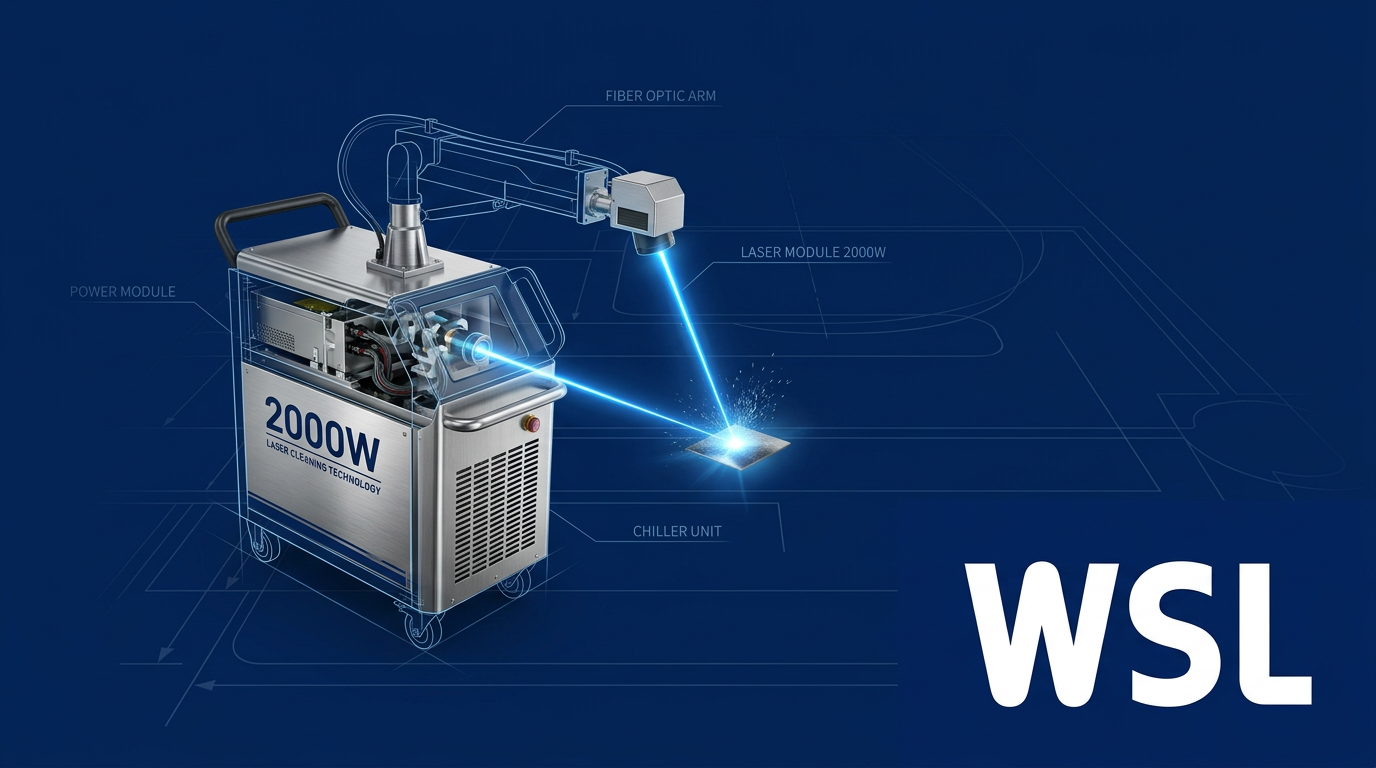
Every machine on this list delivers 2000 W from the laser source itself — not 2000 W of power consumption, but 2000 W of actual laser output.
That matters because this power class exists for heavy rust, thick coatings, mill scale, and large-area surface preparation where lower-wattage machines run out of throughput.
This page is for maintenance engineers, fabrication shop owners, production managers, and procurement leads who have settled on 2000 W and are now comparing options before committing.
Each entry is evaluated on laser source brand, cooling design, scan width, CW versus pulsed mode, form factor, warranty, and after-sales support.
Many machines in this class trade under numerous brand names despite shared origins, making provenance and support quality as important as the spec sheet.
TL;DR
Shared wattage does not mean shared quality. The four machines here differ significantly on laser source provenance, cooling design, CW versus pulsed mode, and the reliability of after-sales support.
A buyer who stops at the headline figure is skipping the decisions that determine real-world value and long-term reliability.
This article covers:

Laser source, cooling, mode and support evaluated
CW vs pulsed at 2000 W compared
Four verified 2000 W machines reviewed
Pricing and cost variation drivers
Warranty and after-sales support quality
Why 2000W: The Power Class in Context
The question serious buyers ask before evaluating specific machines is not whether 2000W is powerful enough — it is whether the machine behind the specification is genuinely built to deliver it, and whether the configuration matches the application.
At 2000W, a CW laser cleaner achieves cleaning rates of 30–65 m²/h on moderate rust and oxide, dropping to roughly 30–60% of that figure on heavy mill scale or thick coatings — the throughput tier that makes shipyard hull prep, structural fabrication, heavy maintenance, and production-line surface preparation economically viable at scale.
The step up from 500–1000W to 2000W follows a direct relationship: doubling average output power approximately doubles area coverage rate at equivalent cleaning quality. That is not a marketing claim — it is the physics of how coverage rate scales with laser power. A 1000W CW system cleaning at 15–25 m²/h on moderate rust becomes a 2000W system cleaning at 30–50 m²/h; the capital cost increase is real, but so is the productive capacity.
This is the threshold where large-area, continuous-duty industrial cleaning becomes economically viable rather than just technically possible — the difference between a machine that can clean a ship hull section and one that can do it at a rate that competes with production sandblasting.
The single most consequential specification decision in the 2000W class is not power — it is operating mode: continuous wave or pulsed.
- Continuous wave (CW): Delivers a steady, uninterrupted beam for maximum area throughput on heavy rust, mill scale, and thick coatings on robust steel substrates.
- Pulsed (MOPA or Q-switched): Fires nanosecond-class bursts at high peak power, minimising heat input per pulse — better for thin metals, heat-sensitive alloys, and precision mould surfaces.
Laser Focus World's trade analysis of CW versus pulsed fiber laser cleaning confirms the distinction: CW mode delivers higher area throughput on large steel structures where heat dissipation is not a concern, while MOPA pulsed mode produces lower substrate roughness and tighter thermal control — critical where substrate preservation matters alongside speed.
This choice drives the rest of machine selection. It is not a minor parameter difference — it determines which substrates the machine can clean safely, what scan head and optics are appropriate, and how the machine integrates into a production workflow.
Cooling is the credibility filter that separates a genuine 2000W industrial machine from a specification on a data sheet. Laser Focus World's coverage of high-power laser cooling methods is direct on this point: above approximately 1 kW average power, water cooling is necessary — fan-based air cooling reaches a heat-transfer ceiling that sustained high-power operation exceeds. A closed-loop water chiller is standard equipment at this power level, not an optional upgrade.
Any 2000W machine claiming air-only cooling warrants serious scepticism about its duty-cycle rating and long-term source reliability. At this power, inadequate cooling does not just reduce performance — it degrades the laser source.
The laser source brand is the most reliable long-term reliability signal in this class. Raycus (Wuhan Raycus Fiber Laser Technologies) is the dominant Chinese fiber laser OEM manufacturer active at 2000W — it publishes both 2000W high-power pulsed and multi-module CW fiber laser products and is a leading domestic supplier in China's highly concentrated fiber laser market.
A machine built around a named, warranted source from one of these manufacturers is a materially different proposition from one with an unspecified or unbranded laser. The source brand determines warranty depth, spare-parts availability, and the manufacturer's ability to diagnose and support the system in the field.
That last point connects to a category-level reality worth stating plainly: many suppliers in this market import and rebadge machines from a small number of Chinese OEMs rather than designing and building them. The practical consequence is that after-sales support depends entirely on the reseller's technical depth — which varies enormously. A buyer evaluating a 2000W machine should establish whether the seller has genuine in-house engineering capability or is a channel intermediary.
At 2000W — the power class built for large-area work — laser cleaning eliminates abrasive media and chemical stripping costs entirely. Sandblasting and chemical stripping costs scale directly with area cleaned; laser cleaning's operating cost does not.
With those fundamentals in place — throughput tier, operating mode, cooling standard, source provenance, and supply-chain transparency — the machines in this class can be evaluated on their actual merits rather than their specifications alone.
Product 1
LaserSan 2000 and CW 2000: Pulsed and CW Cleaners
LaserSan offers two distinct 2000W fiber laser cleaners: a pulsed model for controlled, precision cleaning and a CW model delivering up to 50 m²/h on large steel surfaces, both supplied across Spain and Europe.
Pros:

Pulsed and CW options within one brand
CW 2000 reaches up to 50 m²/h
IP65-rated cabinet on the CW 2000
Lightweight cleaning heads: 1.4 kg and 1.8 kg
Cons:

Both machines are stationary, not portable
CW 2000 requires three-phase power supply
Cleaning rates are application-dependent and variable
LaserSan positions itself as a European supplier of industrial laser cleaning machines, operating across Spain and Europe and covering a range that runs from portable 300W air-cooled units up to a 3000W CW system.
Within that range, two machines sit at the 2000W tier: the LaserSan 2000 (pulsed fiber) and the LaserSan CW 2000 (continuous-wave fiber). They share the same power rating but are built around fundamentally different operating modes, which determines where each one is appropriate.
Specifications at a Glance
The table below sets out the key specifications for both machines side by side. Pricing is not publicly listed on LaserSan's product pages.
| Specification | LaserSan 2000 (Pulsed) | LaserSan CW 2000 (CW) |
|---|---|---|
| Laser type | Pulsed fiber | CW fiber |
| Rated power | 2000W | 2000W |
| Scan / beam width | X: 5–120 mm, Y: 5–120 mm | 10–150 mm |
| Scanning speed | – | 0–7,000 mm/s |
| Reference cleaning rate | ~24 m²/h (rust removal, application-dependent) | ≤50 m²/h (application-dependent) |
| Pulse duration | 30–500 ns | N/A (continuous) |
| Cleaning head weight | 1.4 kg | 1.8 kg |
| Cooling | Water-cooled | Water-cooled |
| Power supply | AC 380V ±10%, 50/60 Hz | Three-phase 380/220V |
| Machine weight | 170 kg | 180 kg |
| Cabinet dimensions | 1025 × 575 × 1030 mm | 120 × 70 × 110 cm |
| IP rating | – | IP65 |
| Price | – | – |
Key specifications for the LaserSan 2000 (pulsed) and LaserSan CW 2000 (continuous-wave) compared directly. Cleaning rates are application-dependent and will vary with material, coating thickness, and operating parameters. – indicates the value is not publicly listed.
Both machines are water-cooled, which is consistent with what sustained 2000W output demands in continuous industrial use.
The pulsed machine ships with a 2D galvanometric scanning system and 12 preset patterns, giving operators control over trajectory on complex or irregular surfaces.
Pulsed vs CW: Choosing the Right Mode
The operating mode is the primary decision axis between these two machines. LaserSan's own comparison page summarises it plainly: pulsed delivers energy in short, controlled pulses, reducing heat input and making it better suited to applications where selectivity and surface protection matter.
The pulsed 2000 is the more appropriate configuration for precision moulds, painted parts, and situations where protecting the base material is the priority alongside cleaning throughput.
The CW 2000 delivers continuous laser output, which translates directly to higher coverage rates. LaserSan's product page notes it is particularly well suited to larger steel surfaces and repetitive industrial workflows where throughput is the key factor.
If the application involves more sensitive surfaces or stricter limits on heat input, LaserSan's own CW 2000 page acknowledges that a pulsed 2000W system may be the better fit — an honest framing that helps buyers self-select.
Range Context and Form Factor
The CW 2000 sits in the middle of LaserSan's CW lineup, which also includes the CW 1500 and CW 3000. The CW 1500 is available in both air-cooled and water-cooled configurations; the CW 2000 and CW 3000 are water-cooled only.
The pulsed 2000 is the top of the pulsed range, sharing its platform with the LaserSan 1000 — both are water-cooled workshop machines, with the 2000W variant intended for larger surfaces and heavier contamination.
At 170 kg and 180 kg respectively, neither machine is designed for frequent repositioning. LaserSan's own comparison page classifies both as stationary, which is a real constraint for operations that require on-site or multi-location deployment.
The CW 2000 includes lifting brackets for crane handling and wheels for movement within industrial environments, which provides some flexibility within a fixed facility — but it is not a portable solution.
The CW 2000 requires a three-phase 380/220V supply. This is a facility infrastructure requirement that must be confirmed before purchase.
The CW 2000's cabinet carries an IP65 rating — a practical consideration for demanding production environments where the machine may be exposed to contamination or wash-down conditions.
Both cleaning heads are designed for manual operation, with the pulsed head weighing 1.4 kg and the CW head 1.8 kg. For extended shift use, that difference in handling weight is worth factoring into operator fatigue considerations.
Product 2
EETO FLC-2000
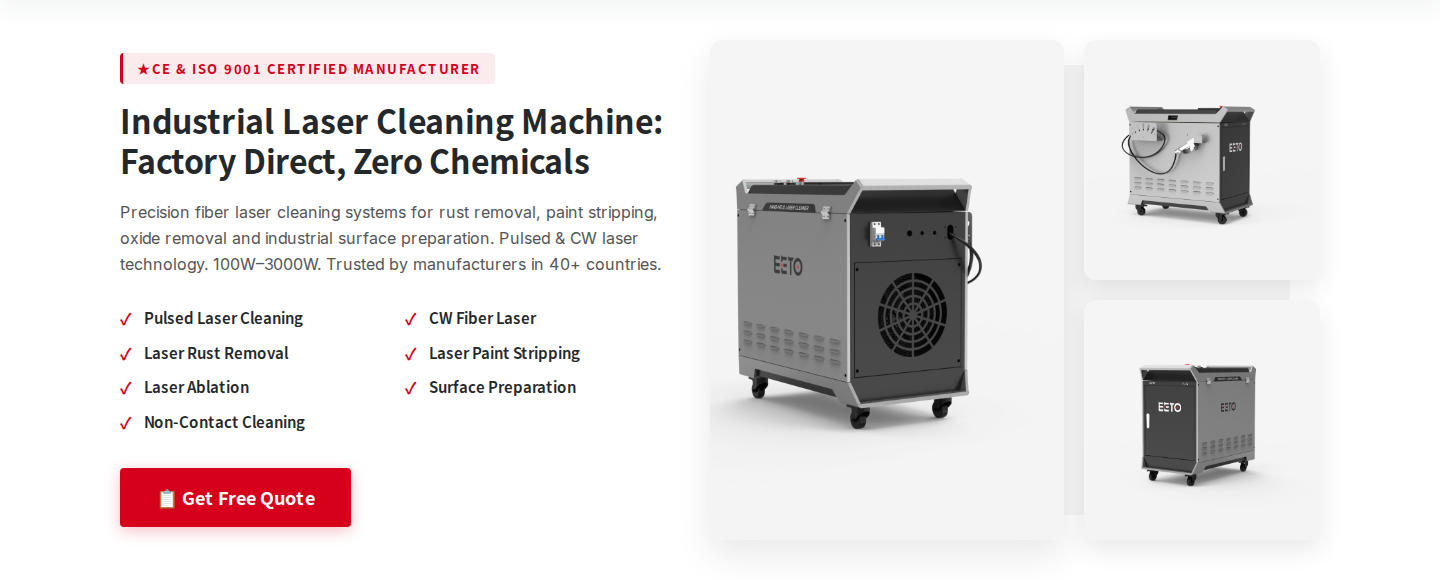
A CW 2000W fiber laser cleaner with the widest scan width on this list at 300 mm, 220V single-phase power supply, and robot-arm compatibility via the IP54-rated SUP22C cleaning head.
Pros:
Widest scan width on this list: 300 mm
220V single-phase power supply
Named OEM laser source: BWT or Raycus
SUP22C head compatible with ABB, KUKA, Fanuc, UR
Cons:
CW mode limits use on heat-sensitive substrates
Stationary machine at up to 220 kg
Requires compressed air supply at 3–5 bar
Published throughput figures are ideal-condition only
The EETO FLC-2000 is a continuous-wave 2000W fiber laser cleaning machine built around a 300 mm maximum scan width — the widest among the four entries on this list.
At full width, the laser energy is distributed across a larger area, which maximises throughput on large flat surfaces with light contamination such as oxide layers and surface rust.
That same geometry cuts both ways: widening the scan reduces power density, so for heavy rust or thick coatings requiring concentrated fluence, the operator narrows the scan width to bring energy levels up. This is an operational variable, not a fixed setting.
Laser Source
The FLC-2000 is specified with either a BWT or Raycus fiber laser source at the buyer's selection.
Raycus, based in Wuhan and listed on the Shenzhen Stock Exchange (stock code 300747), is among China's largest fiber laser manufacturers and exports to more than 20 countries. BWT, founded in 2003 in Beijing and operating with ISO-9001 certified facilities, specialises in high-performance fiber-coupled diode lasers and has distributed products across more than 70 countries and regions.
Specifying a named OEM source — rather than leaving the laser origin unattributed — is a meaningful credibility signal for buyers assessing long-term reliability and spare parts availability.
Cleaning Mode and Performance
Like the LaserSan CW 2000 covered in the previous entry, the FLC-2000 operates in continuous-wave mode: it delivers uninterrupted output at full average power, which suits sustained removal of heavy rust, thick mill scale, and paint coatings from robust steel substrates.
The higher heat input of CW operation is a genuine constraint, not a footnote. This machine is not suited to thin metals, heat-sensitive alloys, or precision applications where substrate preservation is critical.
EETO's own site publishes the following performance figures, described explicitly as ideal-condition test values on flat mild steel with clean compressed air assist at 3 bar and the HANLI chiller at rated setpoint.
| Cleaning Object | Contamination Depth | Scan Speed | Scan Width | Efficiency (Ideal) |
|---|---|---|---|---|
| Oxide layer | ≤ 20 µm | 50 mm/s | 300 mm | 20 m²/h |
| Heavy rust | ≤ 120 µm | 50 mm/s | 300 mm | 5 m²/h |
EETO FLC-2000 published cleaning performance figures. These are factory test values under optimal conditions; real-world throughput on complex geometries, irregular surfaces, or thicker contamination will be lower.
In practice, any surface that departs from flat mild steel — curved sections, weld seams, irregular profiles, or contamination layers beyond 120 µm — will reduce throughput from these figures.
Key Specifications
The table below summarises the FLC-2000's principal specifications as published by EETO.
| Specification | Detail |
|---|---|
| Laser source | BWT or Raycus (buyer's choice) |
| Laser wavelength | 1064 nm |
| Max scan width | 300 mm |
| Power supply | 220V, single-phase, 50/60Hz |
| Power consumption | 8.6 kW |
| Cooling | HANLI water chiller |
| Auxiliary gas | Compressed air, 3–5 bar |
| Machine dimensions | 986 × 635 × 963 mm |
| Weight | ≤ 220 kg |
| Cleaning head | SUP22C, IP54-rated |
EETO FLC-2000 key specifications as published on EETO's product page.
Power Supply and Installation
The FLC-2000 runs on 220V single-phase, 50/60Hz — a practical differentiator for facilities that do not have three-phase infrastructure available.
For comparison, the LaserSan CW 2000 in the previous entry requires three-phase supply. Single-phase availability does not suit every installation context, but it removes a common infrastructure barrier for smaller workshops and maintenance facilities.
Buyers should also account for the compressed air requirement: the machine needs a supply at 3–5 bar as an auxiliary gas for debris removal and plasma suppression. This is an additional facility consideration beyond the machine and chiller footprint.
Cooling System
Thermal management at 2000W continuous output is handled by a HANLI water chiller, a Wuhan, Hubei-based industrial chiller manufacturer with a dedicated fiber laser chiller product line and ISO and CE certification.
EETO specifies that the chiller maintains the laser source temperature within ±0.5°C, supporting consistent beam quality across extended production runs and 24/7 duty cycles.
Cleaning Head and Automation
The SUP22C cleaning head is IP54-rated for dust and splash protection, compact in form, and features a replaceable protective lens for straightforward field maintenance.
EETO's published materials confirm compatibility with ABB, KUKA, Fanuc, and UR robot arms, and the company describes an application case in which two FLC-2000 systems were integrated into a production line with SUP22C heads mounted on ABB IRB 2400 robot arms synchronised with conveyor movement.
For buyers evaluating automated or semi-automated integration, this robot-arm compatibility is a relevant capability to assess against their specific line configuration.
Form Factor
At ≤ 220 kg and 986 × 635 × 963 mm, the FLC-2000 is a stationary machine. It is not designed for portable or mobile deployment; installation planning should account for a fixed floor position alongside the chiller unit.
Pricing and Support
EETO does not publish list pricing for the FLC-2000 on its product page; pricing is available on request directly from EETO.
The FLC-2000's 300 mm scan width and single-phase supply are genuine operational advantages on large flat surfaces in facilities without three-phase infrastructure. The CW mode, stationary weight, compressed air requirement, and ideal-condition test figures are equally genuine constraints that belong in any honest evaluation of this machine.
See How the ELASER Compares
Woodrow Scientific's ELASER is built for industrial laser cleaning at this power level. Review the full specifications and see where it stands against the machines covered here.

Product 3
P-Laser QF 2000 W
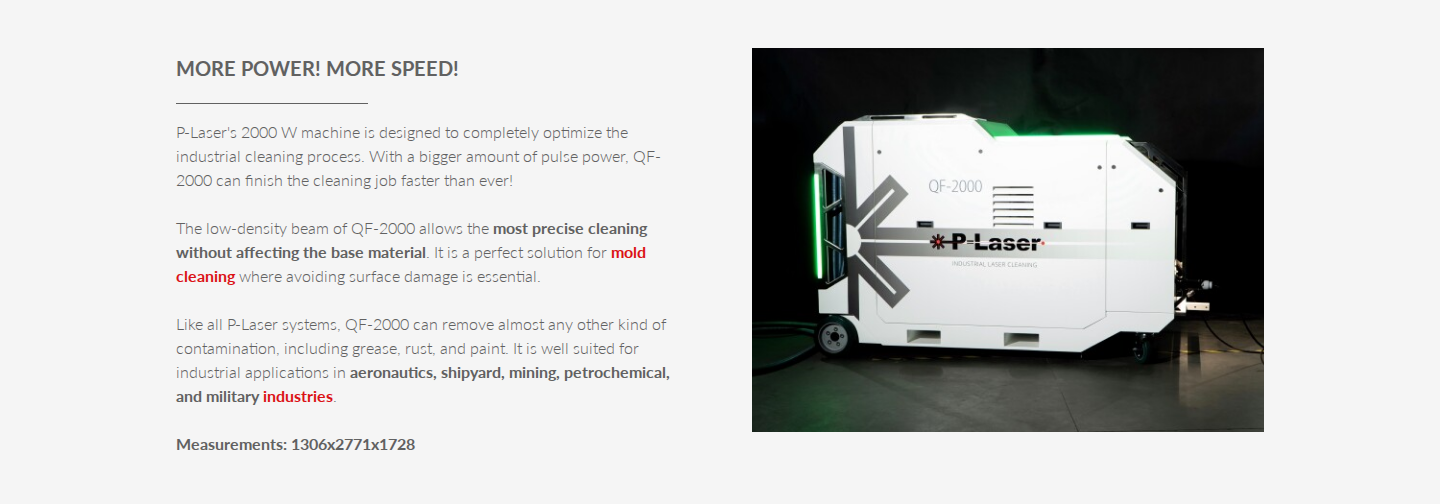
P-Laser develops and produces its own pulsed laser cleaning equipment in Belgium, with a high-power range running from 500 W to 2000 W for manual and automated industrial use.
Pros:
Genuine manufacturer: designs and builds own equipment
Trolley and inline configurations available
Integrated water cooling and optic air treatment
Cloud connectivity for remote monitoring
Cons:
No published pricing; quotation required
Large machine footprint; requires 3-phase power
P-Laser develops and produces its own pulsed laser cleaning equipment, operating from Belgium with more than 35 years of experience in industrial surface treatment.
That provenance matters in practice. When a machine requires technical support or a process needs to be tuned, a manufacturer with its own engineering team can respond with genuine depth rather than routing queries through a third party.
P-Laser QF 2000 W: Pulsed Mode and Power Scaling
The QF 2000 W operates in pulsed mode, delivering high peak power in concentrated bursts rather than as a continuous beam.
P-Laser's documentation describes the scaling logic within the high-power range: the 1000 W model delivers double the pulse frequency of the 500 W, resulting in double the surface speed.
The practical consequence of pulsed operation is that heat input per pulse remains low. P-Laser states that the QF-2000's low-density beam allows precise cleaning without affecting the base material — a characteristic relevant to applications where substrate integrity cannot be compromised.
P-Laser QF 2000 W Applications
P-Laser's high-power range is positioned for applications demanding both speed and precision across large surfaces.
- Mould cleaning: Including large production moulds where surface damage is not acceptable. P-Laser states the QF-2000 is a perfect solution for mould cleaning precisely because the low-density beam avoids marking the substrate.
- Industrial descaling: Rust, oxides, and scale removal from metal surfaces at production scale.
- Paint and oil removal: P-Laser states the QF-2000 can remove grease, rust, and paint, and its high-power range is suited to degreasing large machine parts and paint stripping at speed.
- Heavy industry: P-Laser positions the QF-2000 for aeronautics, shipyard, mining, petrochemical, and military applications.
P-Laser also notes that its pulsed technique can leave the surface beneath untouched or structured as required — giving operators control over whether the substrate is preserved or prepared for a subsequent process such as bonding or coating.
P-Laser QF 2000 W Cooling System
Thermal management in the high-power range goes beyond a standalone chiller. The QF 2000 W integrates water cooling for the optical components, an air treatment unit to cool the optic and prevent dust settling on the lens, and a 19-inch control unit that manages both the chiller and the laser source together.
This integrated approach means the control system has full visibility of both thermal and laser parameters during operation, rather than leaving the chiller to run independently.
P-Laser QF 2000 W Configurations
The high-power range is available in two primary configurations, each suited to a different deployment context.
The trolley configuration is a fully mobile, water-cooled unit built for movement through factory halls. The QF-2000 trolley is equipped with an integrated towing system and forklift pockets, making it practical to reposition across large industrial sites. It can be supplied with a 50-metre fibre, allowing the cleaning head to reach around large steel structures and into confined areas.
The inline configuration arranges the system in 19-inch racks or Rittal cabinets for fixed integration into production or assembly lines. P-Laser states that different laser programmes can be created in its dedicated CleanSweep software for consistent, repeatable process settings.
P-Laser also lists a custom-made configuration line, built to individual requirements, as a distinct product offering.
P-Laser states that the high-power system connects to the cloud for remote monitoring — a feature relevant to production environments where uptime tracking and remote diagnostics are part of normal operations management.
P-Laser QF 2000 W Pricing
P-Laser does not publish pricing on its website. Buyers need to request a quotation directly from the company.
As a European manufacturer that develops and produces its own equipment, P-Laser's cost structure differs from that of suppliers who source machines from third-party OEMs — a factor worth accounting for when comparing quotations across this list.
Product 4
Bogong 2000 W Water-Cooled Pulsed Laser Cleaner
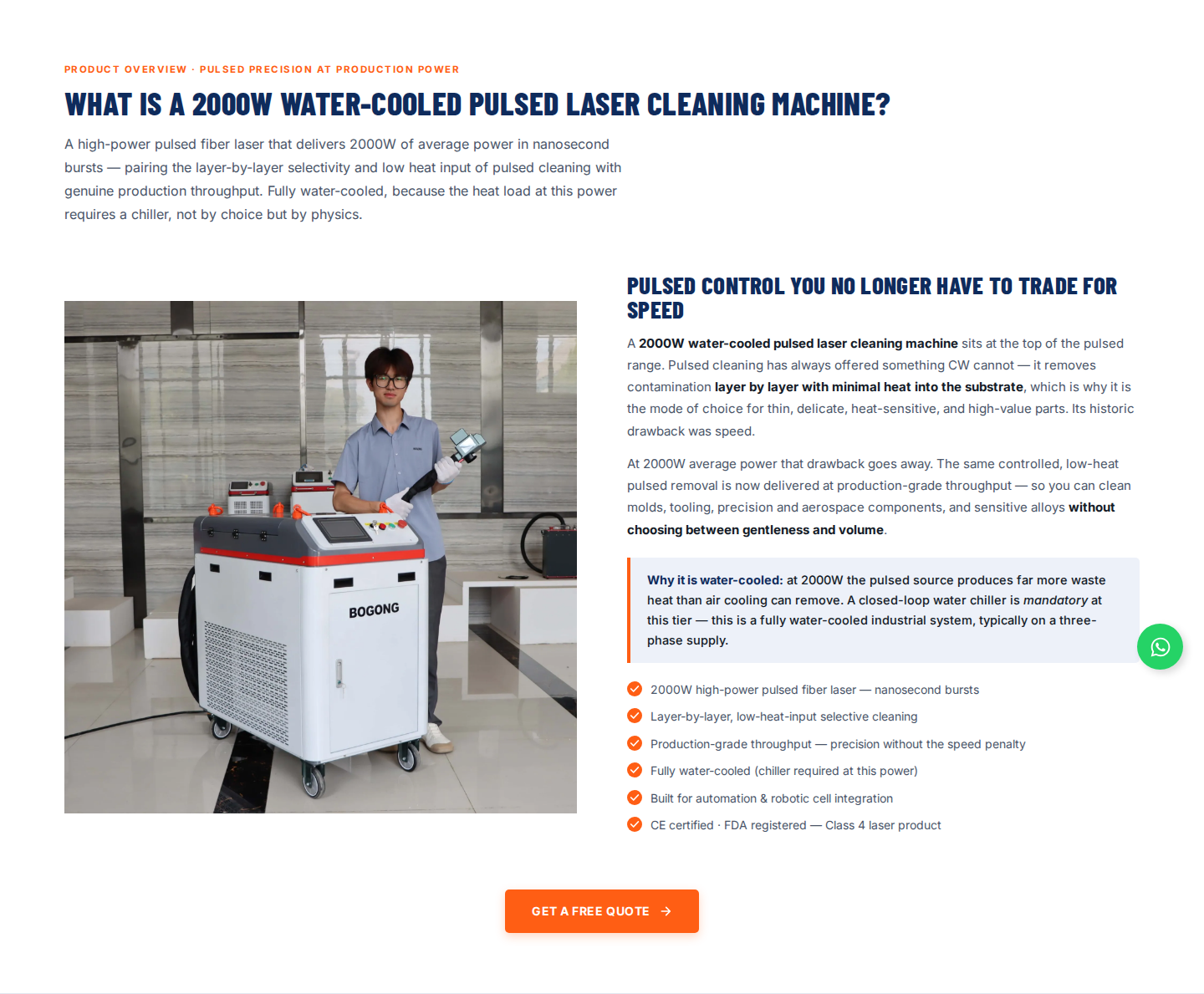
A 2000 W MOPA pulsed fiber laser cleaner with closed-loop water cooling, 10–200 mm adjustable scan width, and continuous-duty operation — pulsed selectivity at full production power.
Pros:
MOPA pulsed precision at 2000 W production power
Wide scan range: 10–200 mm adjustable
Continuous-duty water cooling; rated IP54
Suits heat-sensitive substrates CW cannot handle
Cons:
Lower area rate than CW at same power
Requires 380V three-phase supply and chiller
Regional support should be verified outside China
Bogong Machinery describes itself as a laser equipment manufacturer specialising in laser cleaning machines and industrial surface treatment, supplying both pulsed and continuous-wave systems across a range of industrial applications.
The BG-WCL-2000 sits at the top of Bogong's water-cooled pulsed range, which spans 500 W to 2000 W.
Laser Source and MOPA Architecture
The BG-WCL-2000 uses a MOPA pulsed fiber laser at 2000 W average output, operating at 1064 nm wavelength with a nanosecond-class pulse width.
MOPA architecture separates pulse generation from amplification, which means pulse duration and repetition rate can be adjusted independently — a practical capability that lets operators tune the energy delivered per pulse to suit the substrate, rather than accepting a fixed pulse behaviour.
The repetition frequency is adjustable from 1 to 5,000 kHz, and maximum pulse energy is approximately 60 mJ, as stated in Bogong's water-cooled range comparison table.
| Parameter | Specification |
|---|---|
| Average Laser Power | 2000 W |
| Laser Type | Pulsed Fiber Laser (MOPA) |
| Wavelength | 1064 nm |
| Pulse Width | Nanosecond-class (adjustable) |
| Repetition Frequency | 1–5,000 kHz (adjustable) |
| Max Pulse Energy | ~60 mJ |
| Scan Width | 10–200 mm (adjustable) |
| Scan Speed | Up to 15,000 mm/s |
| Cleaning Rate | – see text |
| Cooling Method | Water-cooled (closed-loop chiller) |
| Coolant | Distilled water / coolant mix |
| Power Supply | 380V / three-phase |
| Power Consumption | – see text |
| Protection Rating | IP54 |
| Duty Cycle | Continuous / sustained |
| Warranty | 2 years (laser source & main components) |
Key technical specifications for the Bogong BG-WCL-2000, drawn from Bogong's own product documentation. – see text: cleaning rate figures differ between Bogong's dedicated product page (10–40 m²/h) and category comparison table (20–40 m²/h); power consumption figures likewise differ between those two sources. See the body text below for the attributed figures.
On cleaning rate, Bogong's dedicated BG-WCL-2000 product page states 10–40 m²/h, while Bogong's water-cooled range comparison table states 20–40 m²/h for the same model; both figures are application- and cleanliness-dependent.
On power consumption, Bogong's water-cooled category comparison table puts the BG-WCL-2000 at ≤ 8.5 kW including the chiller, while the dedicated product page states ≤ 12 kW as a typical figure.
The laser source lifespan is rated at over 100,000 hours, consistent with Bogong's other water-cooled models in the range.
Cleaning Performance and Scan Width
The scan width adjusts from 10 mm to 200 mm — a notably wide range that gives operators practical flexibility: narrow settings for precision work on tight or complex geometry, wider settings for open flat surfaces where throughput matters.
Scan speed reaches up to 15,000 mm/s, which is the mechanism by which the 2000 W average power translates into production-scale throughput despite the pulsed mode's lower heat input per burst.
At lower power levels, pulsed mode means accepting a throughput trade-off. At 2000 W, the BG-WCL-2000 narrows that gap — the high average power combined with scan speeds up to 15,000 mm/s delivers production-scale area coverage while the MOPA pulse structure keeps heat input per pulse low enough for substrates that CW would damage.
The 5 m standard fibre cable length supports handheld and semi-automated operation; 10 m and 15 m options are available for larger working envelopes or robotic cell integration.
Cooling System and Facility Requirements
At 2000 W average output, water cooling is not a configuration option — it is a thermal necessity, and Bogong's own documentation states this directly.
The BG-WCL-2000 runs a closed-loop chiller with distilled water or a coolant mix, holding the laser source at a stable operating temperature across continuous production shifts.
The machine requires a 380V three-phase supply, and the IP54 protection rating covers the cabinet against dust ingress and water splash, appropriate for industrial production environments.
Applications
The combination of 2000 W average power and MOPA pulse control positions the BG-WCL-2000 for applications where CW at equivalent power would risk substrate damage.
- Heavy rust and thick coatings: High average power clears substantial contamination loads at production throughput.
- Mould cleaning: Pulsed mode's low heat input per burst removes residue without thermally stressing mould steel.
- Heat-sensitive substrates: MOPA pulse control keeps inter-pulse cooling gaps intact, limiting thermal accumulation on thin sheet metal and sensitive alloys.
- Precision components: Adjustable pulse width and frequency allow operators to dial removal depth and heat input for high-value parts.
- Automation and robotic cell integration: Bogong's documentation confirms the BG-WCL-2000 supports robotic and cell integration, consistent with its continuous-duty design.
The logic connecting these applications is consistent: where a CW beam at 2000 W deposits heat continuously into the substrate, the pulsed mode fires in nanosecond bursts with cooling gaps between them — which is what makes the machine viable on materials that cannot tolerate sustained thermal load.
Manufacturer and After-Sales Support
Bogong states 14+ years of focused experience in laser cleaning machine technology and industrial surface treatment on its homepage.
Its after-sales support structure, as described on the About page, covers pre-sales application review, remote installation guidance, commissioning support, operator training, remote diagnostics, and spare parts supply.
The BG-WCL-2000 carries a 2-year warranty on the laser source and main components, per Bogong's own product documentation.
Buyers outside China should confirm regional support coverage and spare parts lead times with Bogong before purchase — this is practical due diligence for any Chinese-manufactured industrial system.
Trade-offs
- Lower area coverage rate than CW at equivalent power: Bogong's own CW 2000 W machine reaches 30–65 m²/h on contamination-dependent work. The BG-WCL-2000's pulsed mode delivers a lower cleaning rate — application-dependent, with the range differing between Bogong's own pages. On large-area, heavy-rust jobs where the substrate is robust steel and raw throughput is the only measure, a CW machine at equivalent power is the faster choice. The pulsed mode's value is in what it does on materials where CW cannot safely operate, not in matching CW on open steel.
- Three-phase power and a water chiller are fixed facility requirements: The 380V three-phase supply and closed-loop chiller are not optional at this power level. Buyers must verify their facility can accommodate both before specifying the machine — retrofitting electrical infrastructure or chiller plumbing adds cost and lead time that should be factored into the total acquisition.
- Regional support requires direct verification: Bogong is a Chinese manufacturer based in Jinan, Shandong. Its documented support model centres on remote diagnostics, technical communication, and direct spare parts shipment. Buyers outside China should ask specifically about first-response times, warranty parts freight responsibility, and whether a local agent or distributor is in place for their region.
Conclusion
What separates these 2000 W laser cleaners
The most consequential decision at this power level is not which brand to choose — it is CW or pulsed: continuous-wave for maximum throughput on heavy rust, mill scale, and thick coatings on robust steel; pulsed where substrate preservation matters as much as speed, on heat-sensitive materials, thin metals, and precision surfaces.
Within each mode, laser source provenance, scan width, and after-sales support separate the credible machines from the rest — far more than headline wattage, which every option here shares.
Verify your facility requirements and whether you are buying from a manufacturer or a reseller before any specification becomes relevant.
Frequently asked questions about 2000 W laser cleaning machines
The practical questions industrial buyers at this power level consistently ask before committing to a machine.
Yes — at 2000 W, water cooling is effectively mandatory. The heat load a 2000 W laser source generates exceeds what air cooling can reliably dissipate during sustained operation. A closed-loop water chiller is standard equipment at this power level; treat it as part of the machine, not an optional add-on. Plan for chiller plumbing and coolant maintenance as part of your facility setup. The chiller typically runs on distilled water or a coolant mix and draws its own electrical power, so factor that into your total power budget alongside the laser source and ancillary equipment. Any 2000 W machine marketed as air-cooled only is worth questioning directly with the manufacturer — sustained operation at this power level without water cooling warrants a clear engineering explanation before purchase.
For a 2000 W CW system, basic machine-only listings start around $2,500–$6,000 at the low end of the market. Fully configured industrial CW systems commonly fall in the $6,000–$15,000 range, with the 2000 W tier typically priced toward the upper portion of that band. Pulsed 2000 W systems command a significant premium, with high-power pulsed machines in the market commonly ranging from $25,000 to $80,000 or more depending on configuration and manufacturer. Manufacturers that develop and produce their own equipment tend to be priced higher than those sourcing and rebadging from OEMs, with the premium reflecting engineering depth and after-sales capability. A low-end quoted price may be machine-only: clarify whether it includes the water chiller, cleaning head, safety equipment, and commissioning support, as these can add substantially to the total cost of ownership.
Wattage determines cleaning speed and area coverage rate, not cleaning capability as such — every power level can clean, but higher wattage covers more surface per hour. As a practical guide: 100–500 W suits light rust, weld spatter, precision mold cleaning, and detailed work; 1,000–2,000 W CW is the tier for large-area steel cleaning, heavy rust, mill scale, and production-line surface preparation. At 2000 W, throughput on large, heavily contaminated surfaces is the primary advantage — higher installed power enables meaningfully higher cleaning rates on demanding applications. Where substrate preservation matters as much as speed — thin metals, heat-sensitive alloys, precision components — a pulsed system at the same wattage delivers the same average power with significantly lower heat input per pulse, reducing the risk of surface damage that CW mode can cause if parameters are not correctly managed.
The primary downside is high capital cost relative to sandblasting or chemical stripping. At 2000 W specifically, facility requirements are also significant: three-phase power supply, a water chiller, and a dedicated laser exclusion zone are all part of the installation. Class 4 laser classification applies at this power level. Appropriate laser safety eyewear and operator training are required — buyers should confirm the specific requirements with the relevant authority in their jurisdiction. CW mode at this power level carries a real risk of substrate damage on thin or heat-sensitive materials if scanning speed and power parameters are not correctly set; pulsed mode reduces this risk but does not eliminate it entirely. Finally, the purchase price is only part of the picture: installation, commissioning, operator training, and ongoing maintenance all contribute to the true cost of ownership and should be factored into any capital expenditure decision.