

Why the 1550 nm Erbium-Fibre Window Dominates Photonics
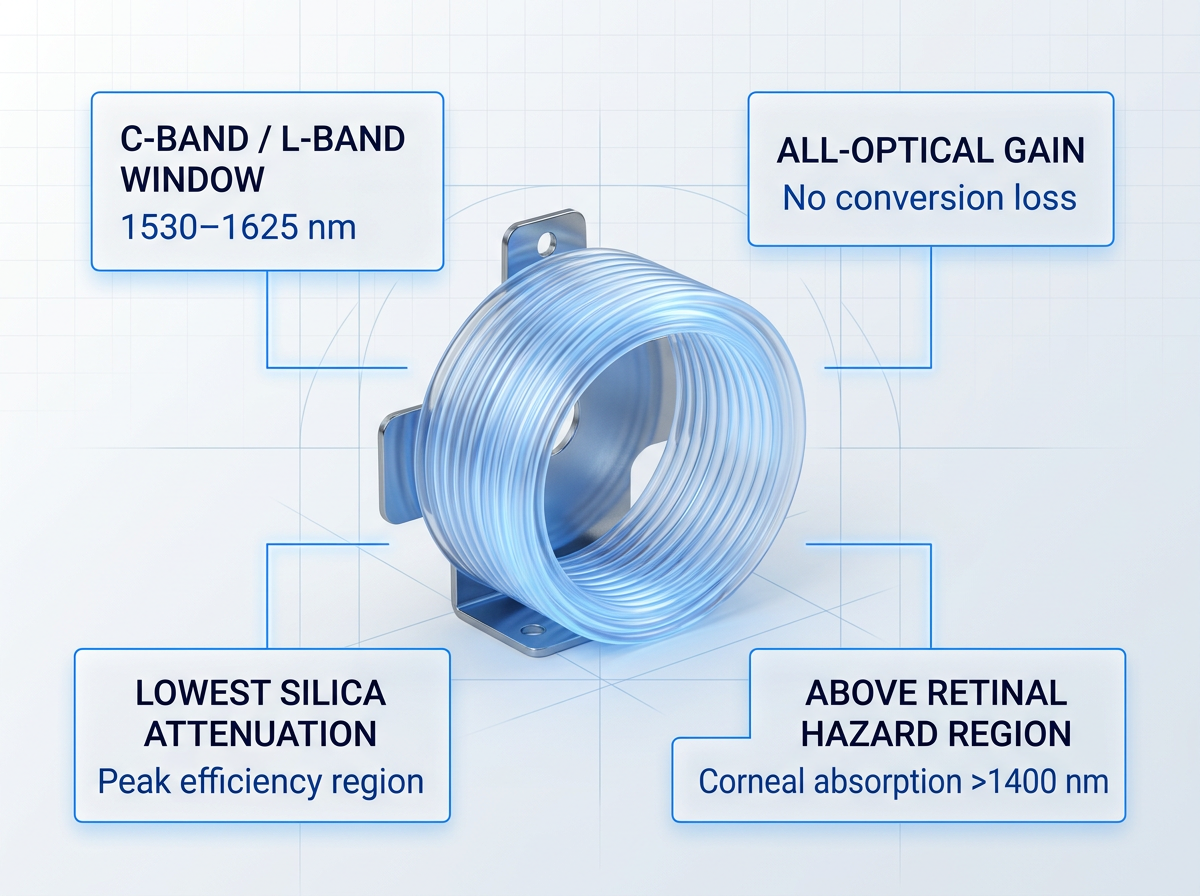
The 1530–1625 nm erbium-fibre window coincides with silica's lowest-attenuation region, underpinning every major fibre transmission architecture. EDFAs amplify entirely in the optical domain — no optoelectronic conversion, no bit-rate dependency — providing simultaneous gain across all WDM channels. Above 1400 nm, wavelengths are absorbed by the cornea rather than focused onto the retina, placing 1550 nm outside the retinal hazard region.
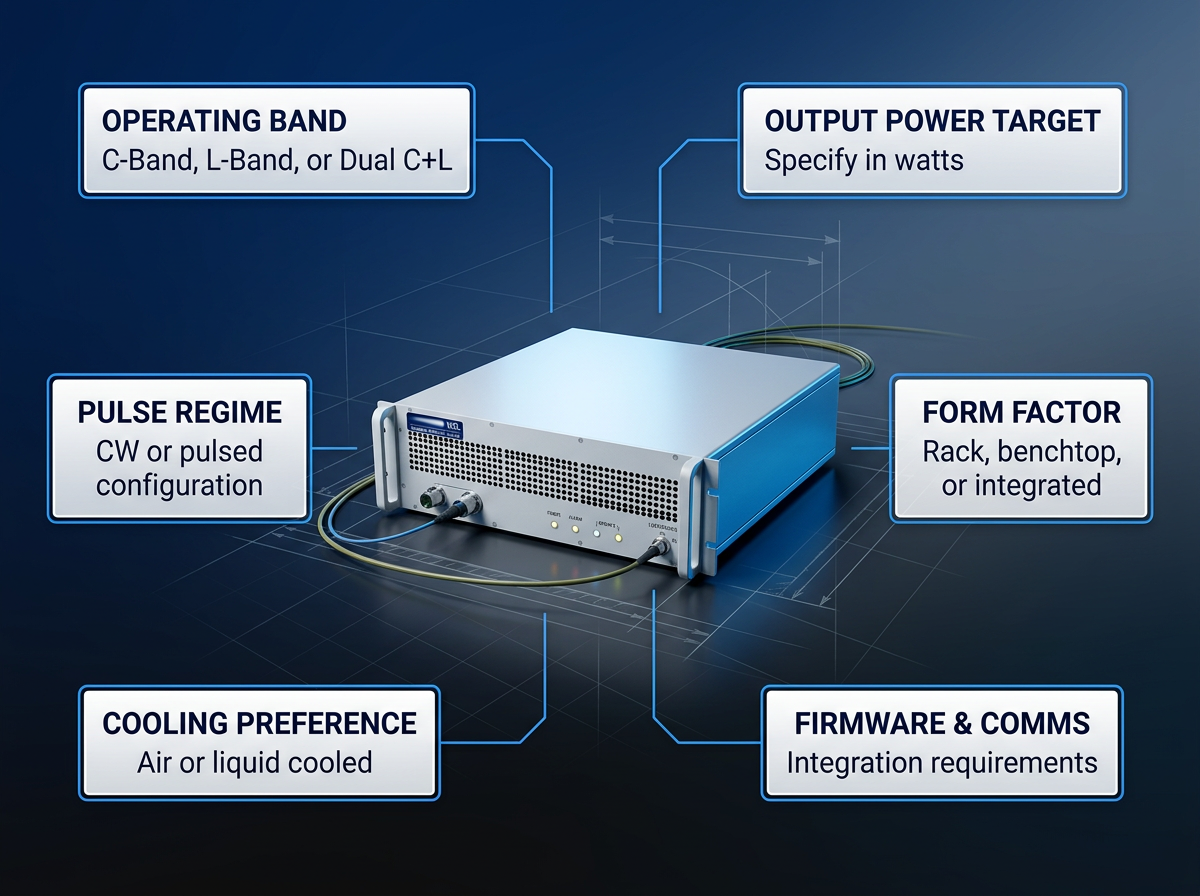
LiDAR, FSOC, quantum communications, fibre sensing, and DWDM have each independently converged on this window. For demanding work, an amplifier engineered to the application — in band, power, pulse regime, and form factor — consistently outperforms a fixed-catalogue part.
C-Band, L-Band, or Both
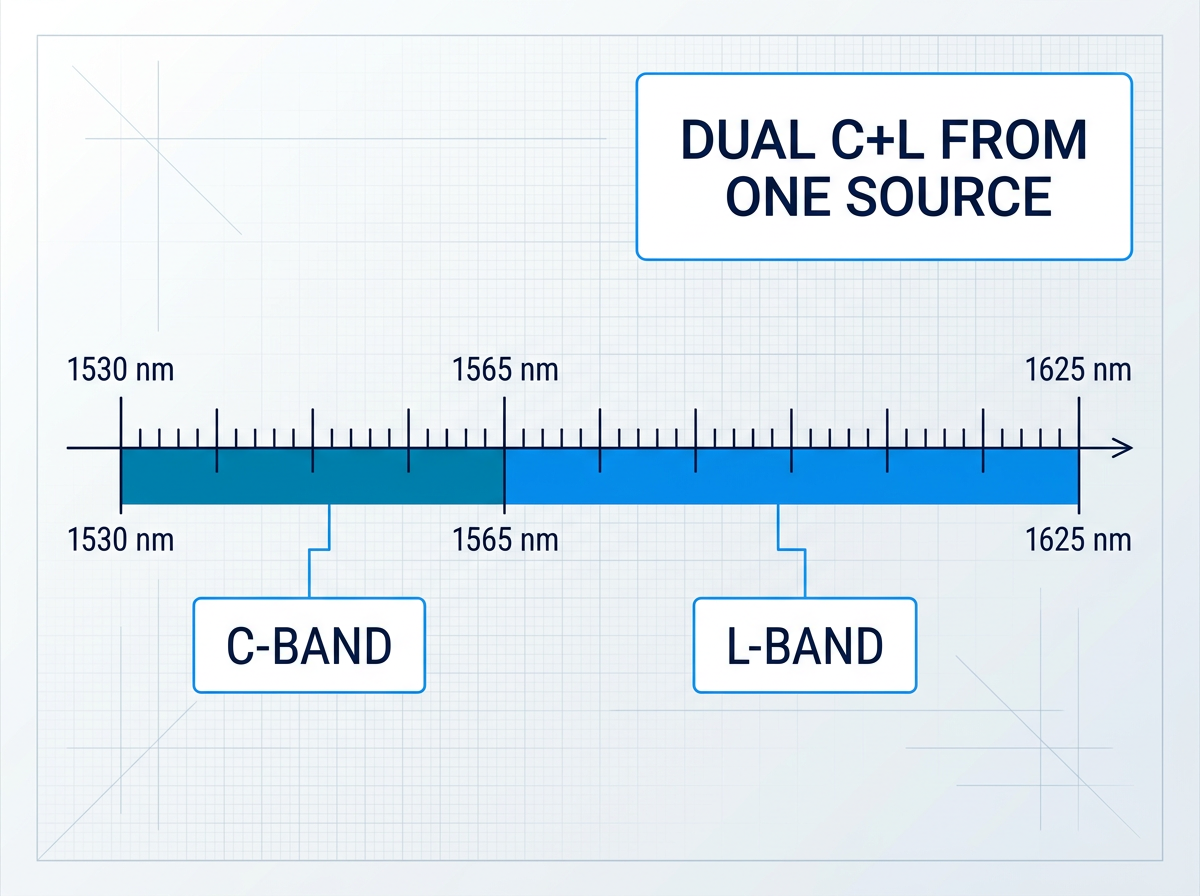
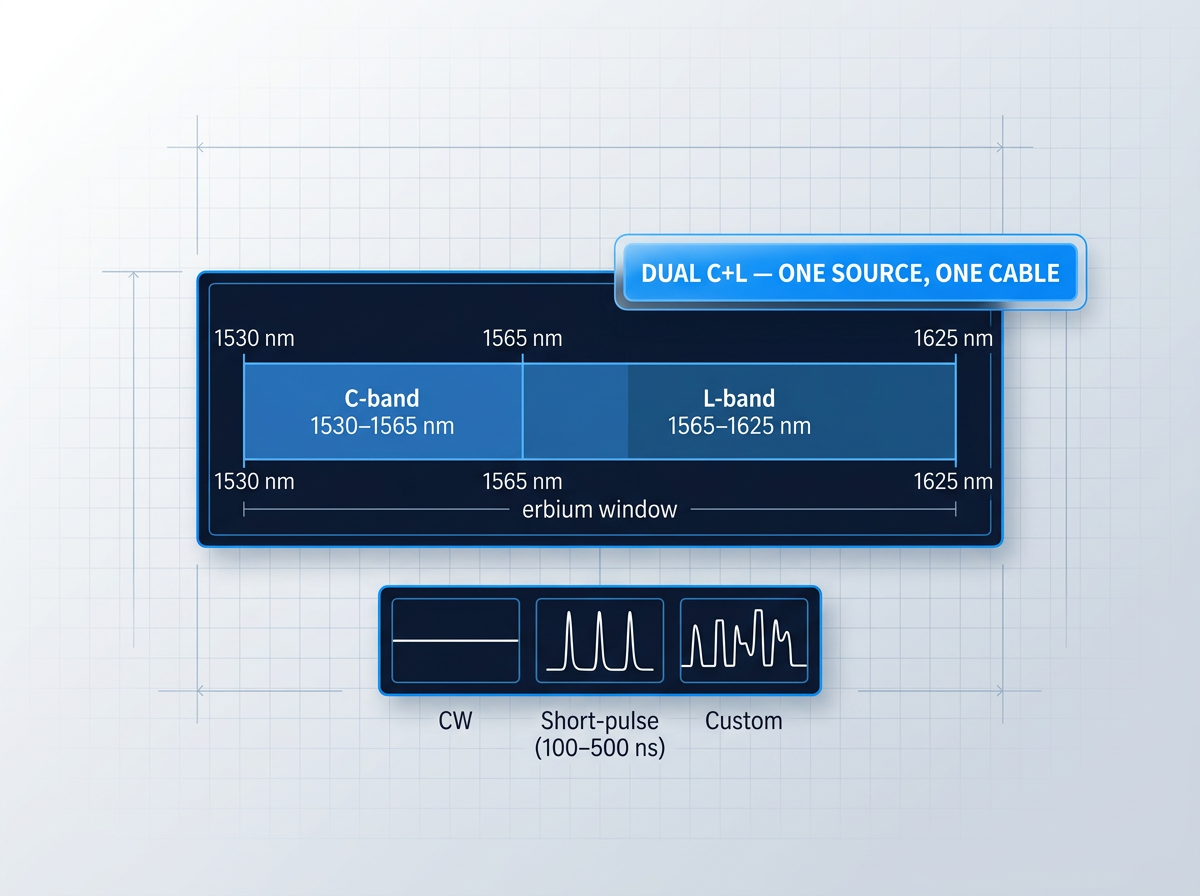
The Custom EDFA operates across the full 1530–1625 nm erbium-fibre window. Specify C-band (1530–1565 nm), L-band (1565–1625 nm), or dual C+L — both bands delivered from one amplifier through a single cable, with no second unit required.
The operating band is set per project. If your application spans both windows, one source handles it.
Up to 200 W and Beyond
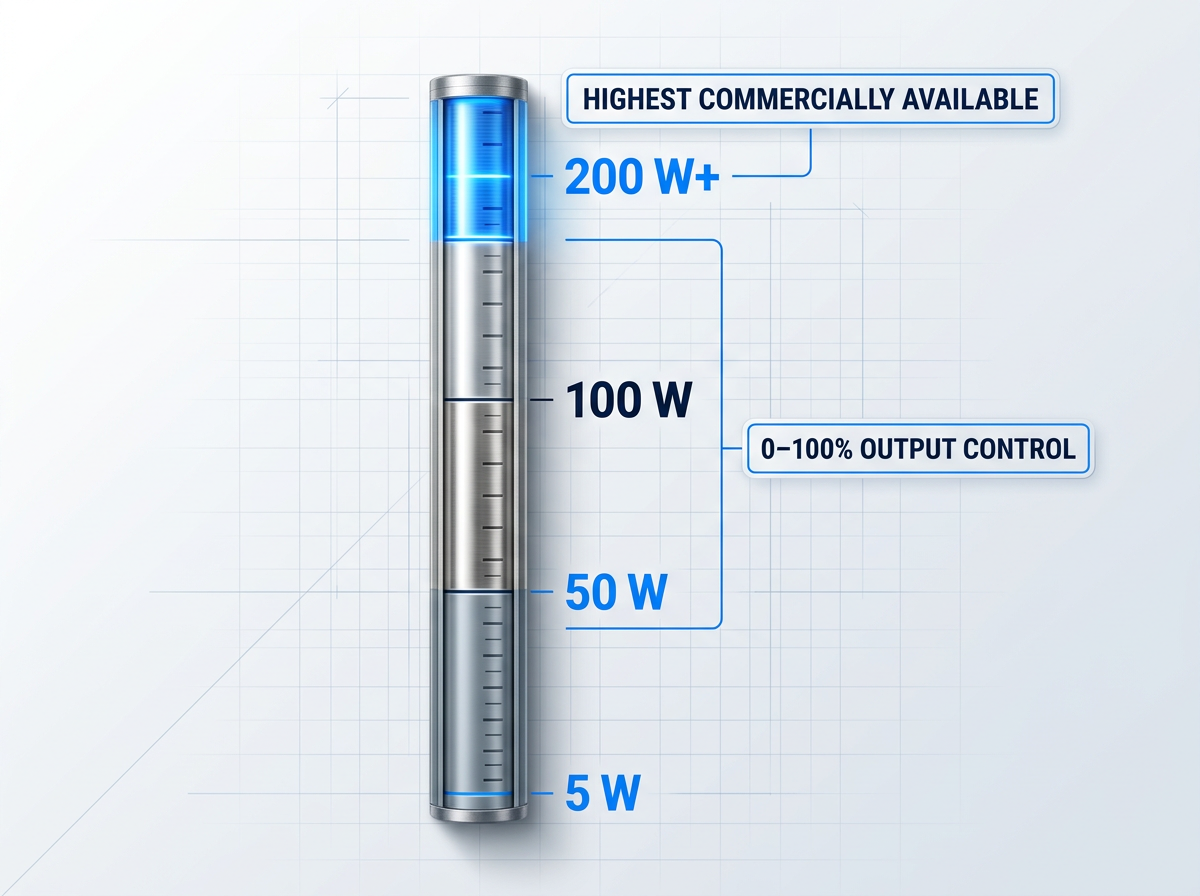
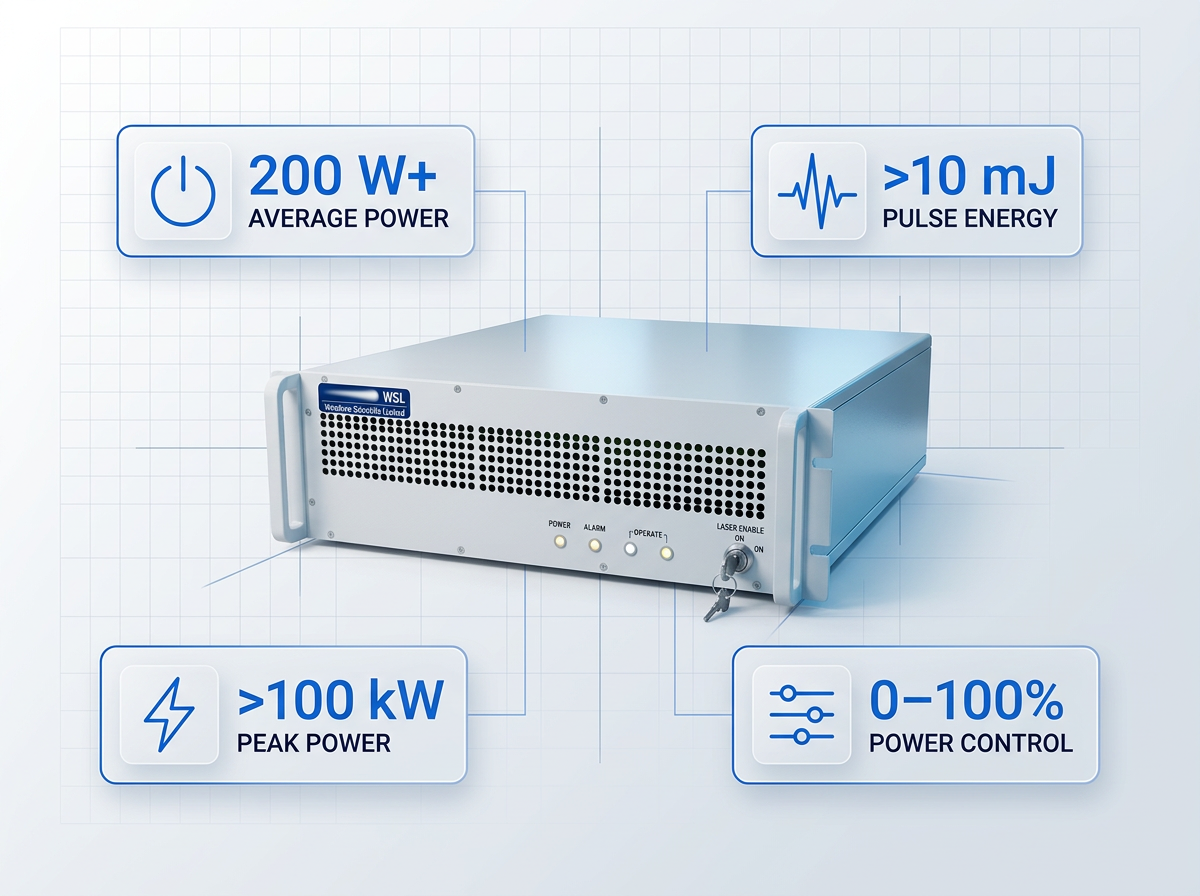
Output power is specified per project, scaling from low-power builds to 200 W or more average power — the highest average power commercially available in a 1550 nm fibre amplifier.
Power control runs from 0 to 100% of rated output, giving integrators full tunability without external attenuation. Submit your power requirement and it is engineered to it.
CW, Short-Pulse, or Custom
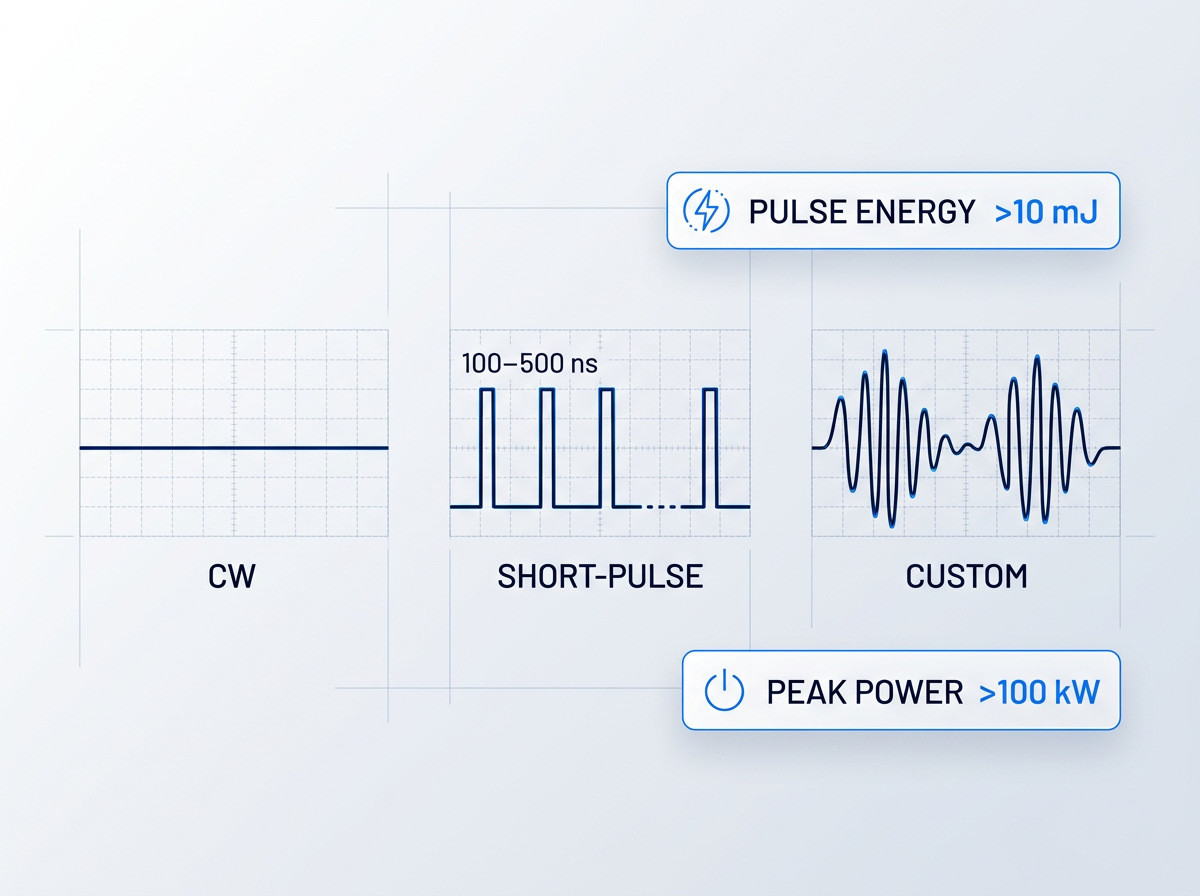
Pulse regime is specified per project: CW, short-pulse (e.g. 100–500 ns), or a custom regime to your timing requirements. Pulse width is a configuration axis defined with WSL's engineering team.
For pulsed applications, the platform delivers pulse energies above 10 mJ and peak powers above 100 kW — at the leading commercially available levels for a 1550 nm fibre amplifier.
Air-Cooled as Standard
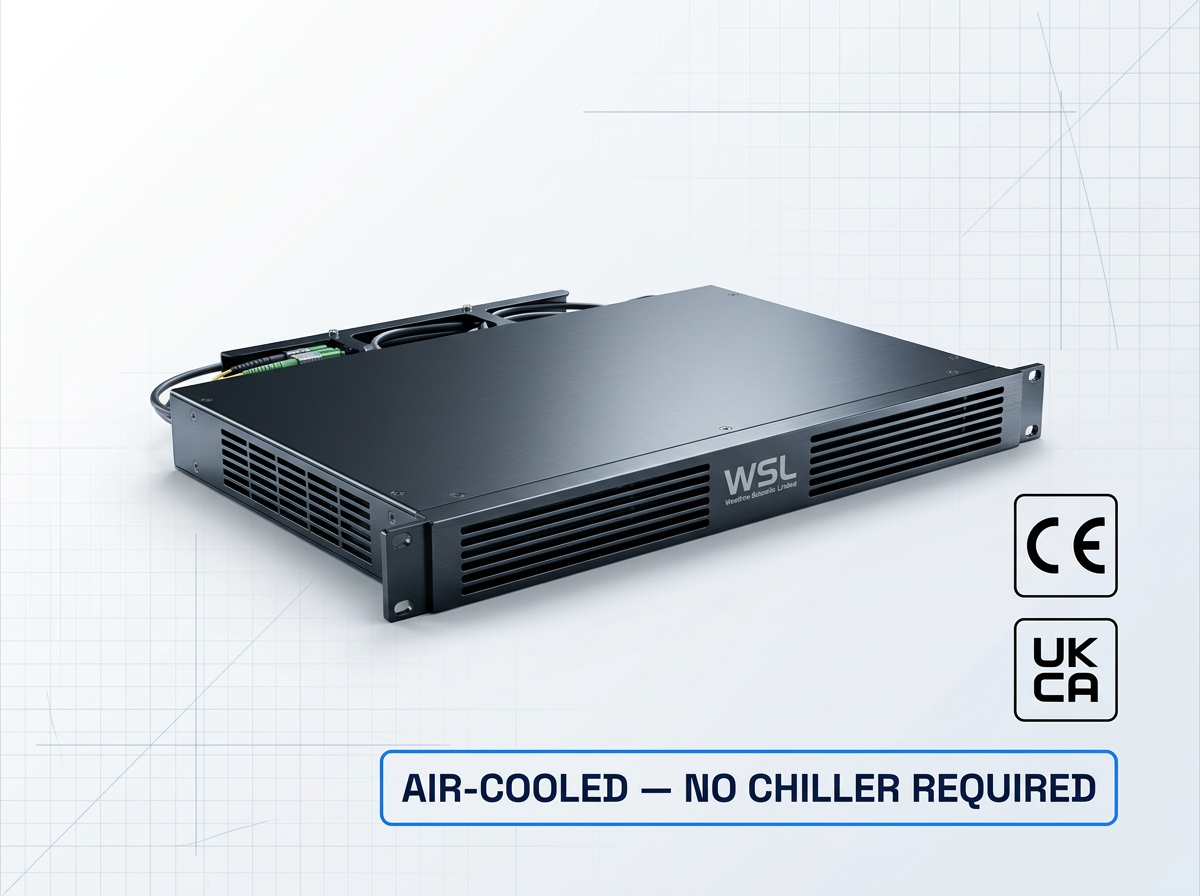
The Custom EDFA is air-cooled as standard — no chiller, no coolant loop, no ancillary infrastructure required. This simplifies integration significantly, particularly in space-constrained or field-deployed systems. Water cooling is available for builds where it is preferred.
Delivery cable length and termination are specified per project, so the fibre output reaches exactly where the system needs it.
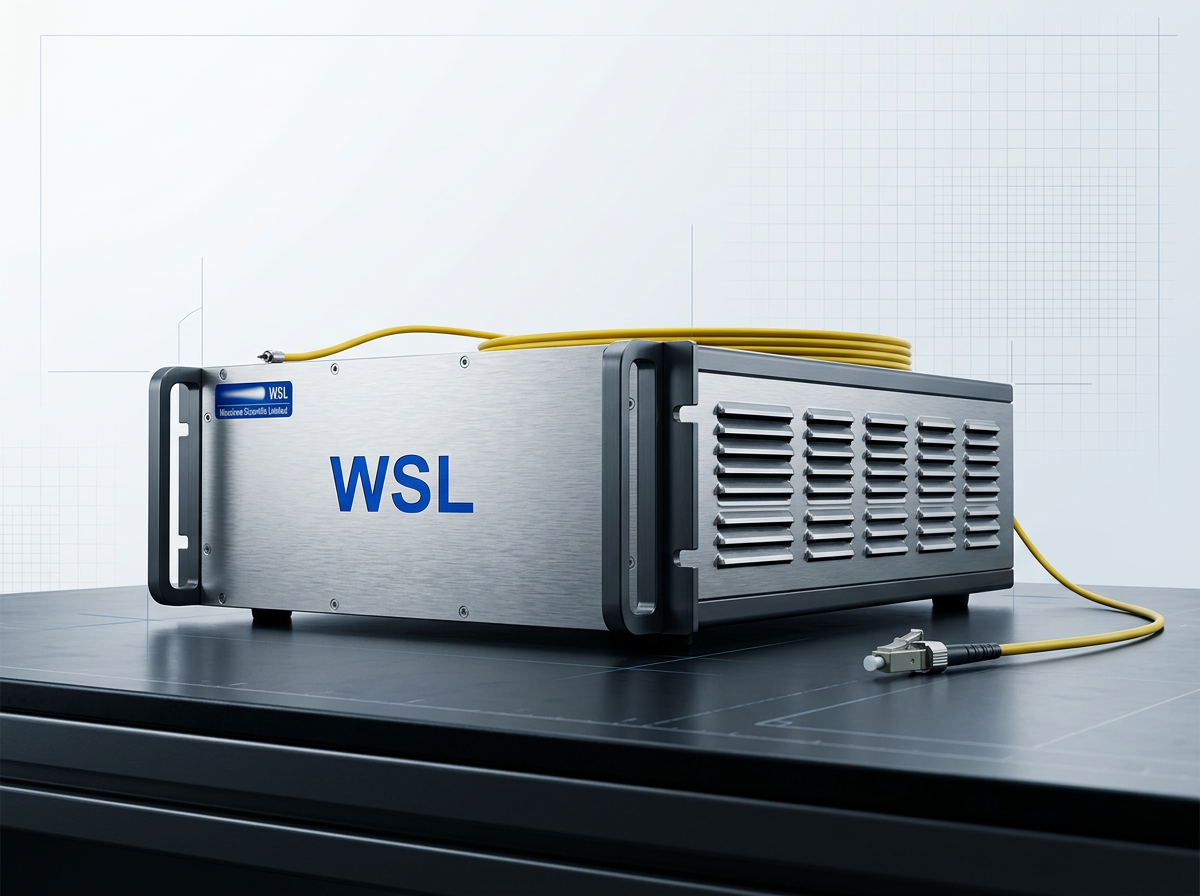
Built to Fit Your System
The amplifier's physical envelope is configured to the application's mechanical constraints — a custom integration envelope built around your system, not the other way around.
Control firmware and communication standards are specified per project. Interface requirements, control protocols, and monitoring outputs are all defined with WSL's engineering team during specification — engineered end-to-end to your application.
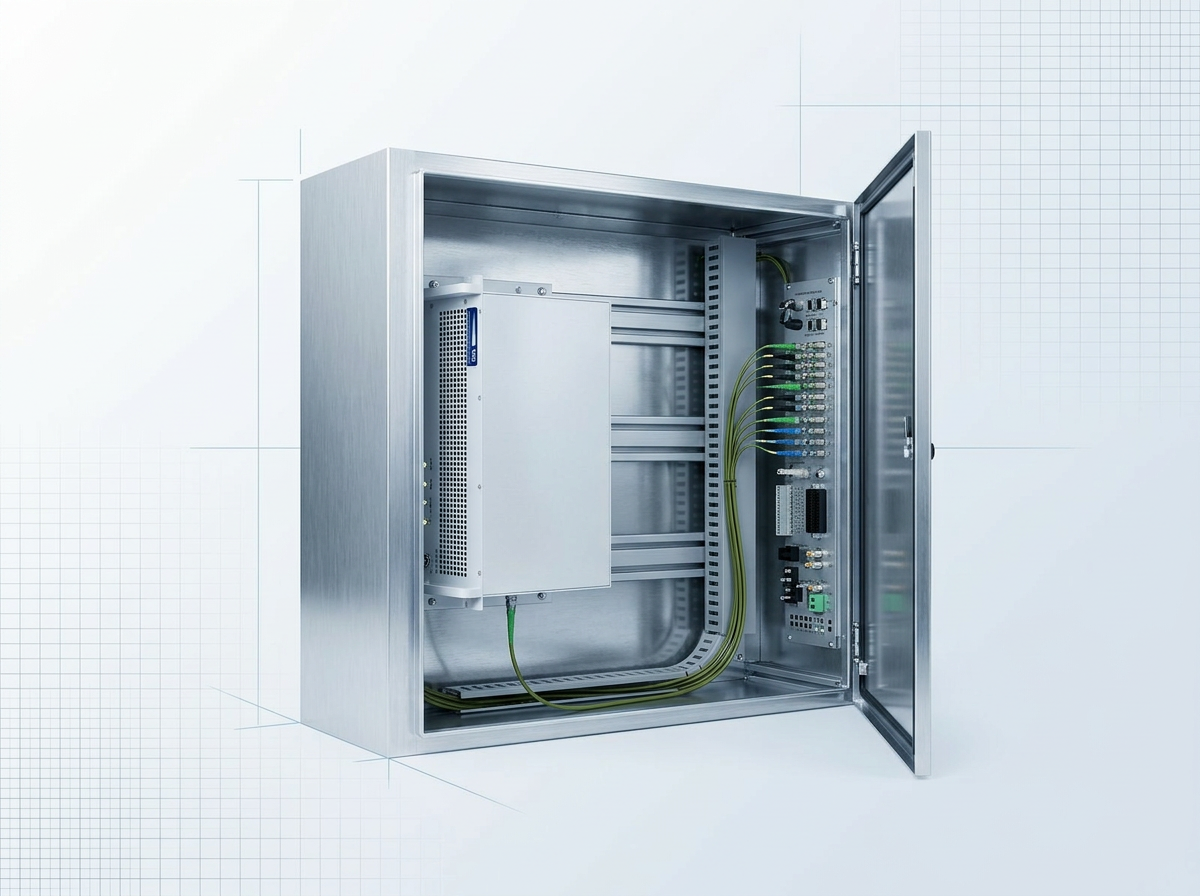
Power Scalability: From Low Power to 200 W
WSL builds the Custom EDFA across the widest commercially available power range for this class of amplifier. Every unit is configured to the buyer's specific power requirement.
Average Power to 200 W or More
Builds range from low-power units to 200 W or more average power — the highest average power commercially available in a 1550 nm fibre amplifier.

Pulse Energy Above 10 mJ
Pulse energies above 10 mJ, configured per project to the application's specific energy requirement.

Peak Power Above 100 kW
Peak powers above 100 kW, configured per project to the application's instantaneous power requirement.

Full Tunability: 0 to 100% of Rated Output
Output is controllable from 0 to 100% of rated power. No fixed operating point: the amplifier adapts to the system.
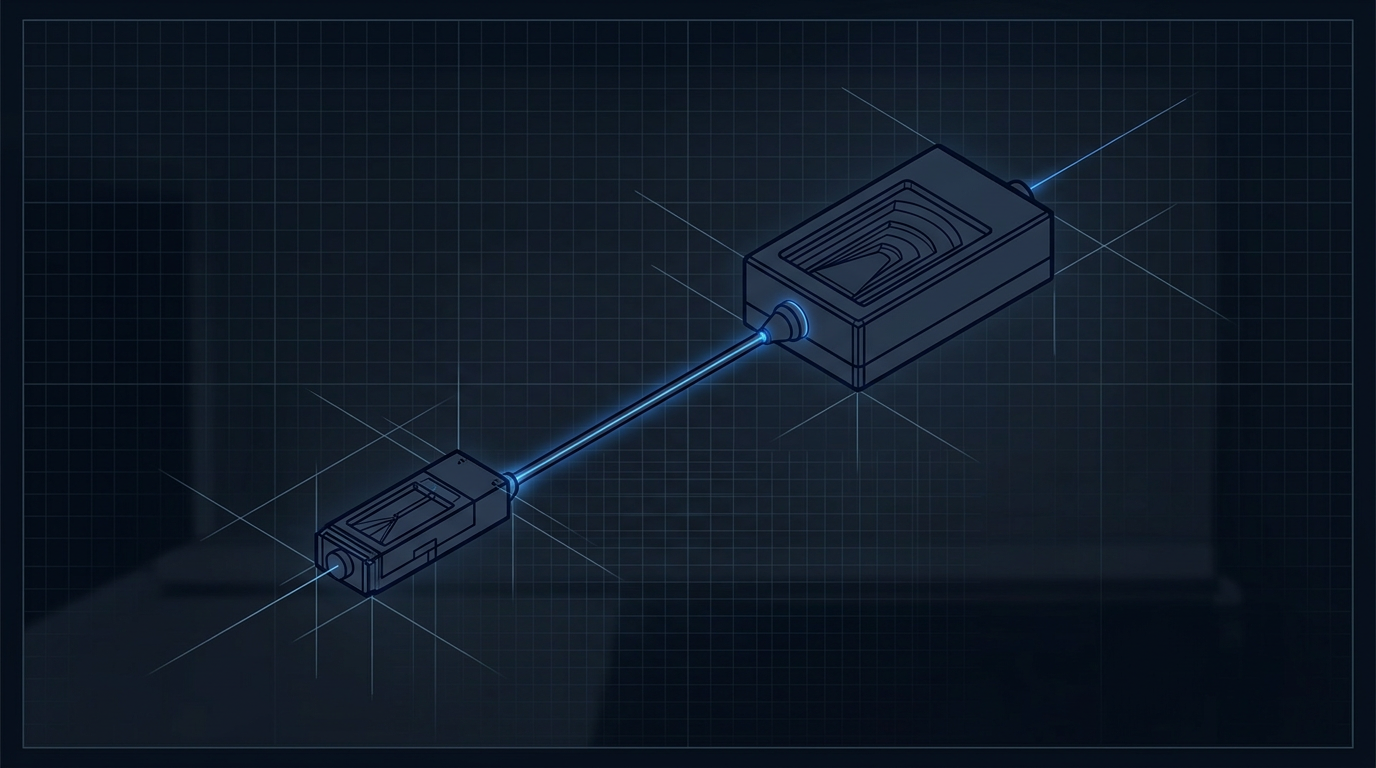
MOPA Architecture Across 1530–1625 nm
Master oscillator power amplifier architecture across the full C-band and L-band window — the platform behind every power figure above.
Applications: Confirm Your Use Case
The Custom EDFA spans network infrastructure and advanced photonics, with every build configured to the specific application. The list below covers the primary deployment contexts — and WSL assesses requirements beyond it.

LiDAR
Eye-safe high-power amplification for automotive, geospatial, and airborne LiDAR systems.
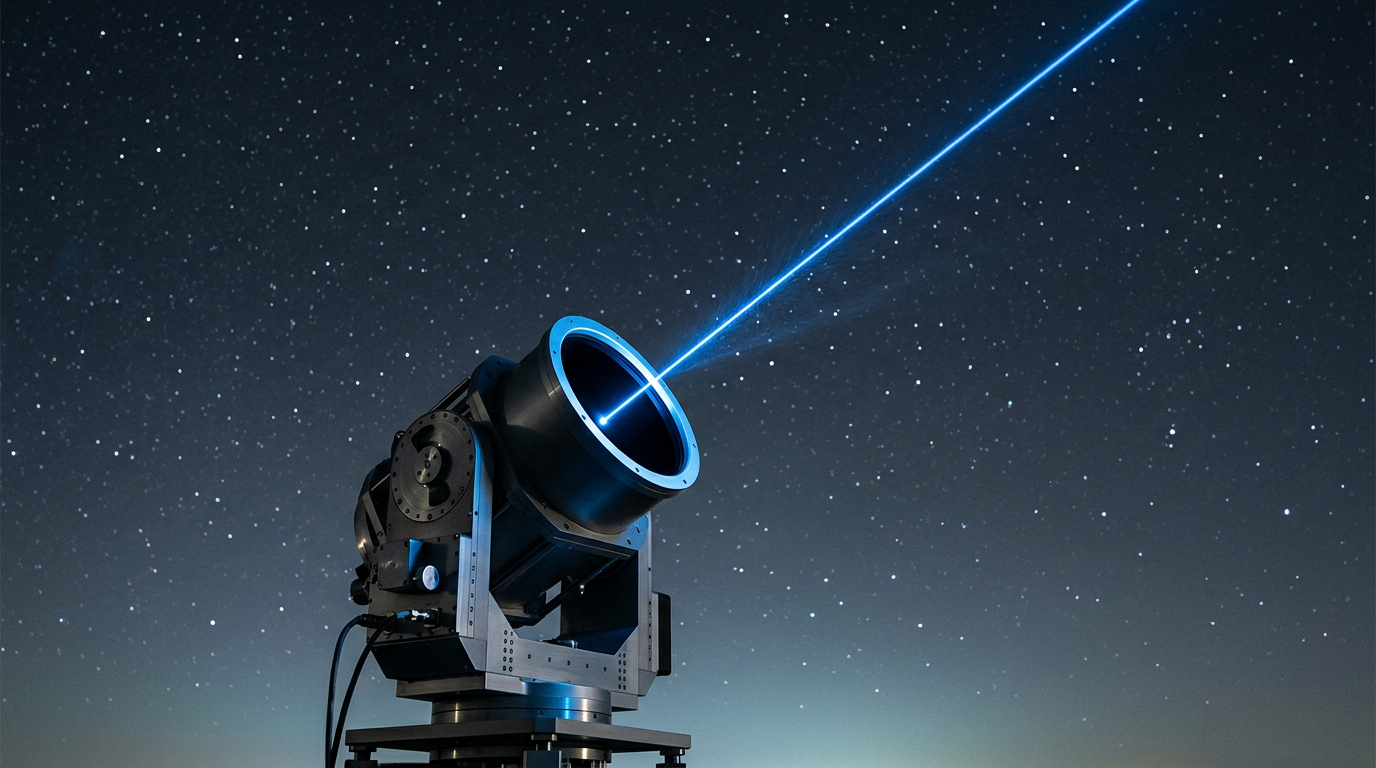
Free-Space Optical Communications (FSOC)
Ground-station uplink and beacon amplification — the EDF-UL-10 is an example configured build.

CATV and FTTH
High output power for RF video overlay at 1550 nm across PON multi-split distributions.

DWDM Networks
Booster and in-line amplification for long-haul and metro, across C-band and L-band.
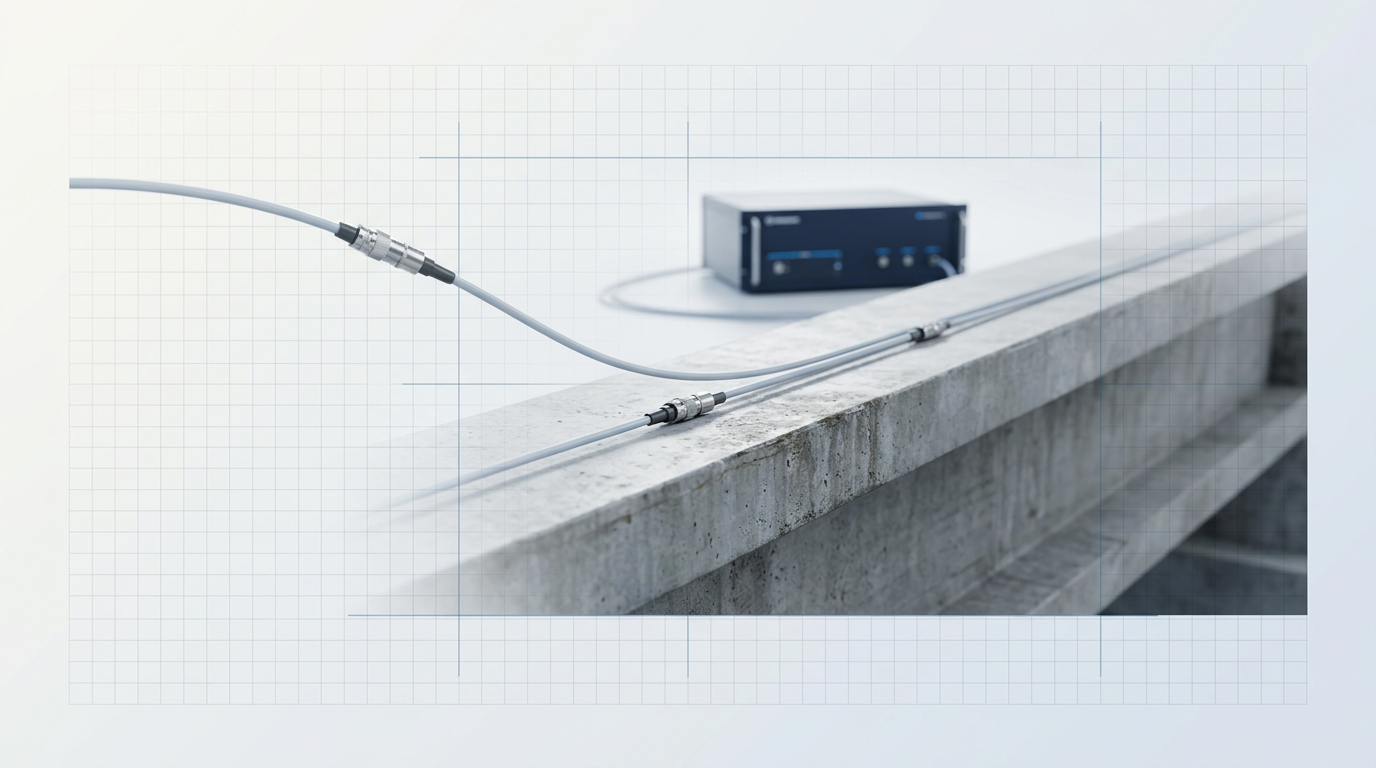
Fibre Sensing: DAS and Structural Monitoring
Amplification for distributed acoustic sensing and structural health monitoring fibre systems.

Quantum and Defence Applications
High-power 1550 nm amplification for quantum communications, QKD, and remote sensing programmes.
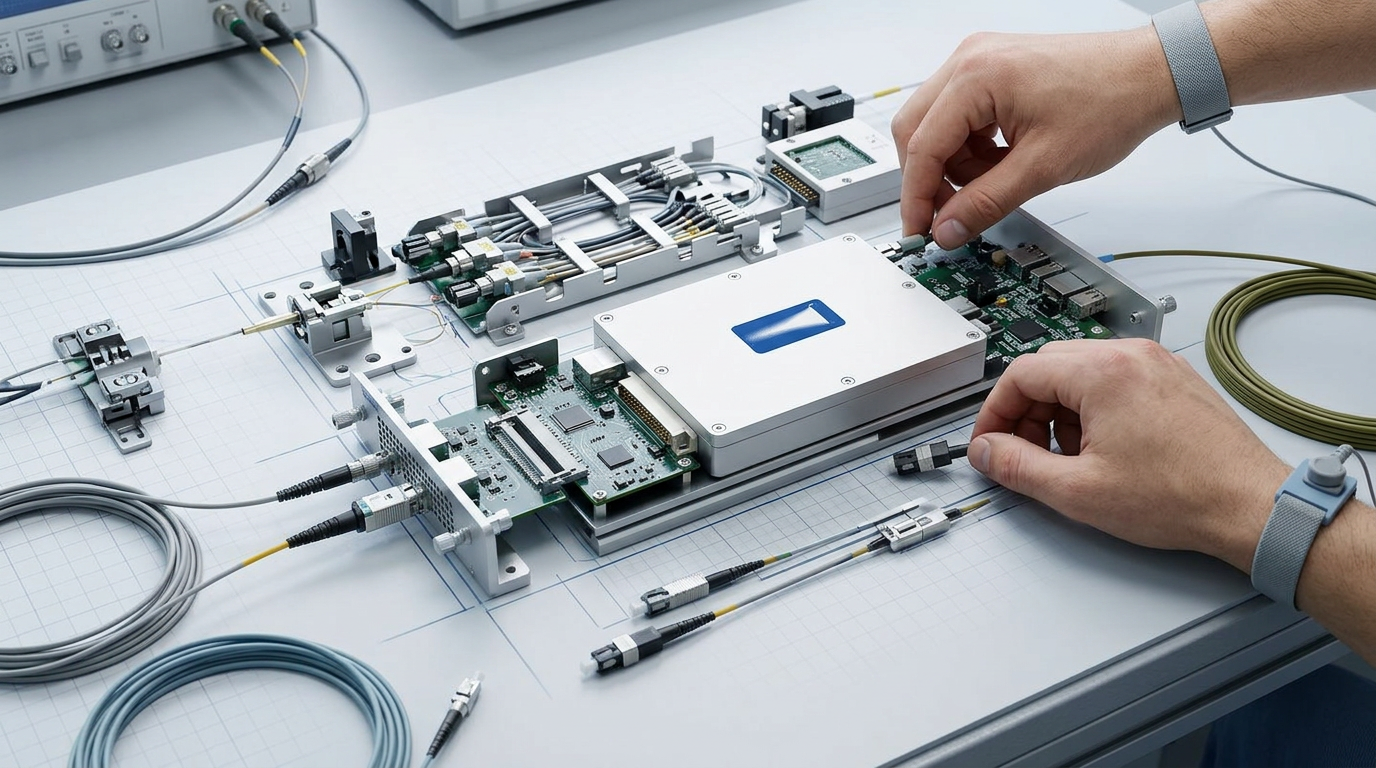
OEM Integration and Custom Requirements
The platform suits any high-power erbium-fibre need. WSL assesses all requirements.
See the Custom EDFA Across Every Application
From FSOC ground-station uplinks to LiDAR and quantum programmes, the Custom EDFA is configured to the application. Explore the full range of tailored builds on the product page.

Architecture and Manufacture
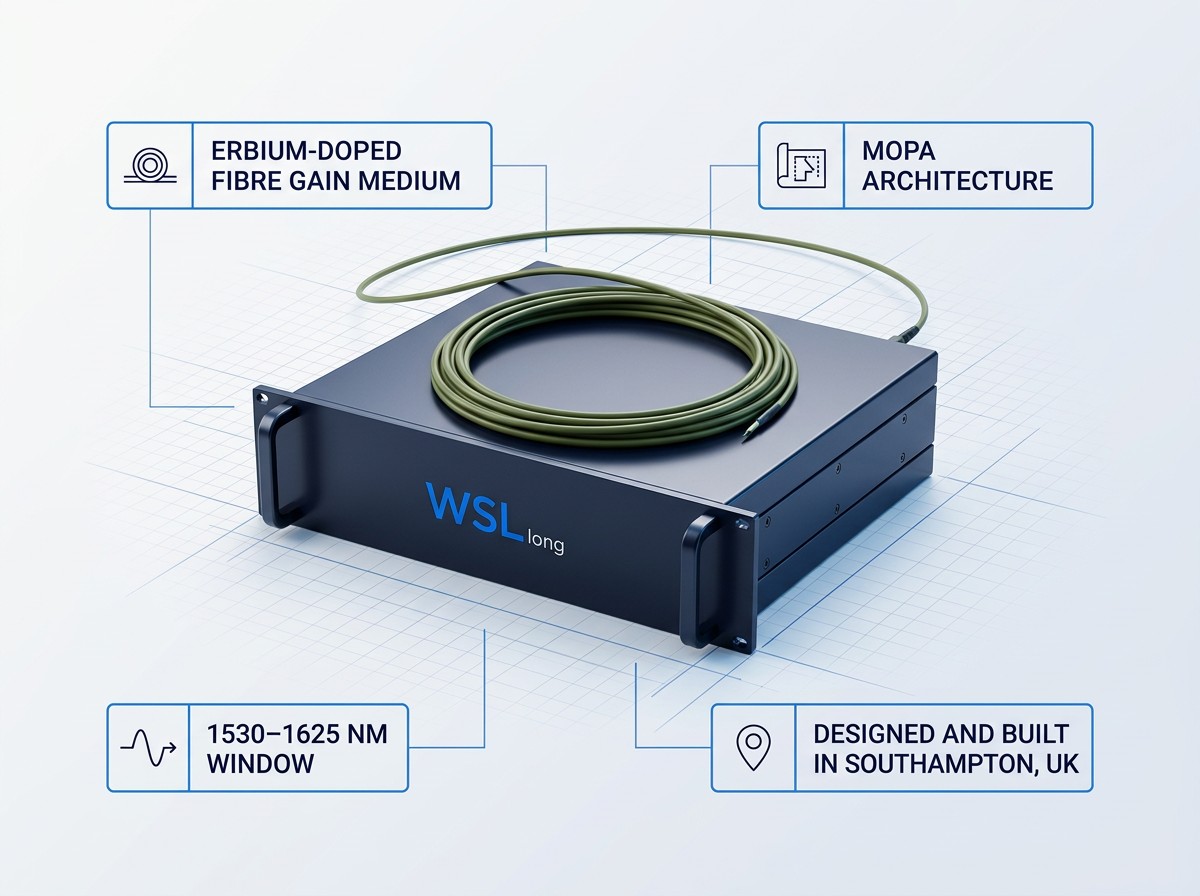
Gain medium: erbium-doped fibre. Wavelength window: 1530–1625 nm — C-band (1530–1565 nm) and L-band (1565–1625 nm). Architecture: MOPA (master oscillator power amplifier).
Designed and built in Southampton, UK. Every unit is engineered per project; only the erbium physics and the MOPA platform are fixed across all builds.
Power, Energy, and Control
All performance parameters are specified per project. Average power scales from low-power builds to 200 W or more. Pulse energy is configurable to above 10 mJ; peak power to above 100 kW.
Output is controllable across the full range: 0–100% of rated power. No fixed operating point — the amplifier is set to the application's requirement.
Operating Band and Pulse Regime
Operating band is specified per project: C-band (1530–1565 nm), L-band (1565–1625 nm), or dual C+L — both bands delivered from one source through a single cable, with no second amplifier required.
Pulse regime is also configured per project: CW, short-pulse (e.g. 100–500 ns), or a custom regime to your timing specification.
Air-Cooled, CE and UKCA Certified
Air-cooled as standard — no chiller or coolant loop required, which simplifies integration. Water cooling is available as an option for builds where it is preferred.
Certifications held: CE certified and UKCA certified.
Retina-Safe, Worldwide Direct
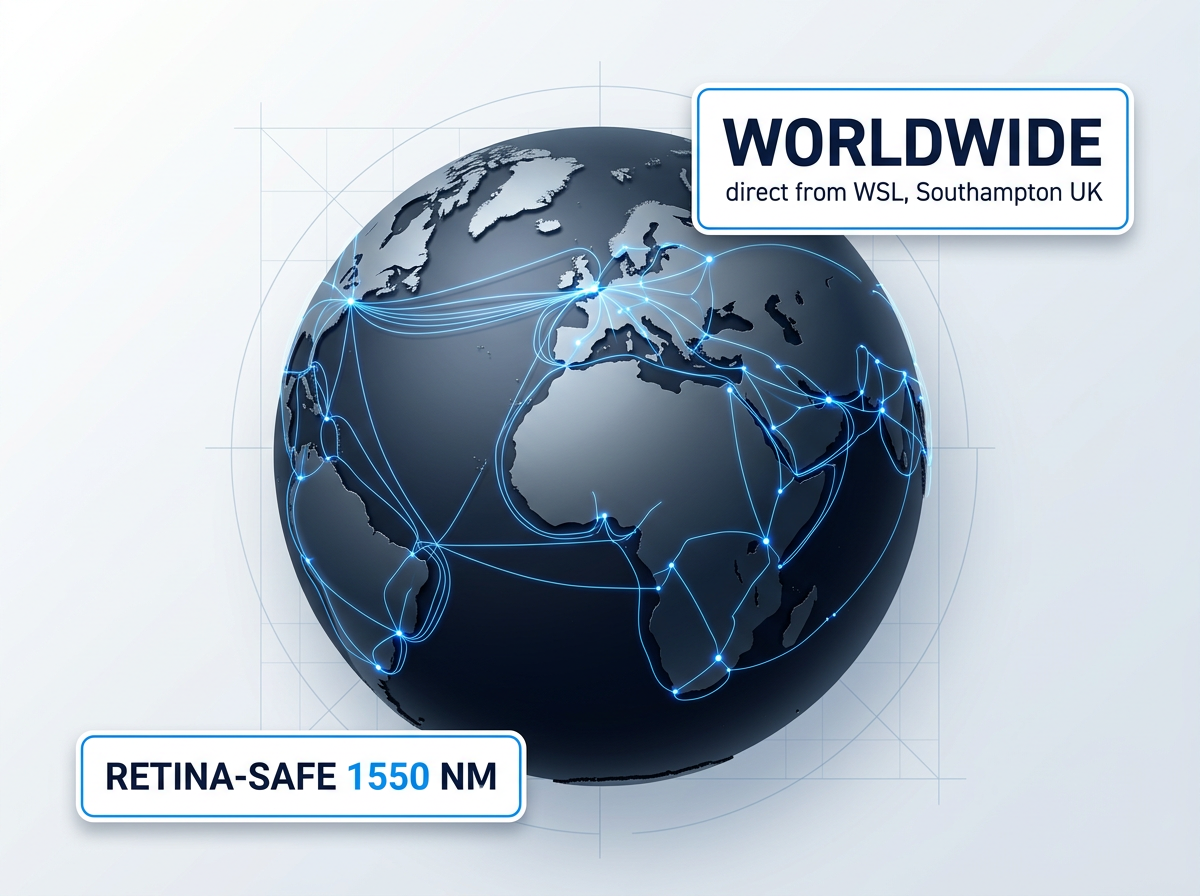
The 1550 nm operating wavelength is retina-safe, with a higher eye-damage threshold than 1064 nm sources. Reduced hazard zone builds are available for deployments where a smaller exclusion zone is required.
Supplied worldwide, direct from WSL — no distributor layer. Orders are placed directly with the engineering team in Southampton.
EEA Market Access Confirmed
The Custom EDFA carries CE marking — the manufacturer's declaration that the product meets EU safety, health, and environmental protection requirements for the EEA market.
As the European Commission's single market guidance states, CE-marked products can be traded throughout the EEA without restriction. For professional deployment into EU and EEA markets, this is the baseline requirement — and it is met.

GB Market Compliance Covered
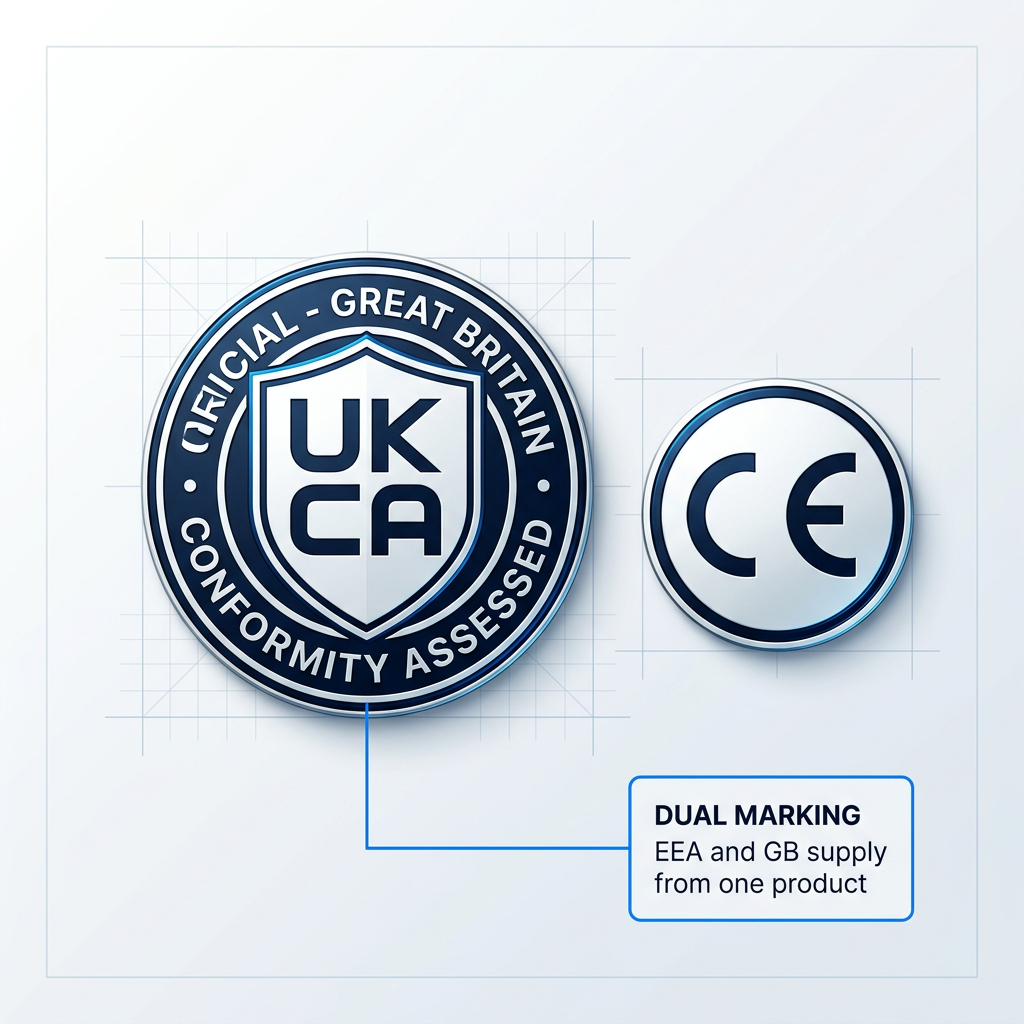
The Custom EDFA also carries UKCA marking — the Great Britain conformity mark demonstrating compliance with GB product regulations under the UK's post-Brexit framework.
UK government guidance confirms that CE and UKCA markings can be applied simultaneously, enabling supply into both the EEA and Great Britain from a single product. For buyers operating across both markets, this removes a supply-chain complication before it arises.
Above the Retinal Hazard Region
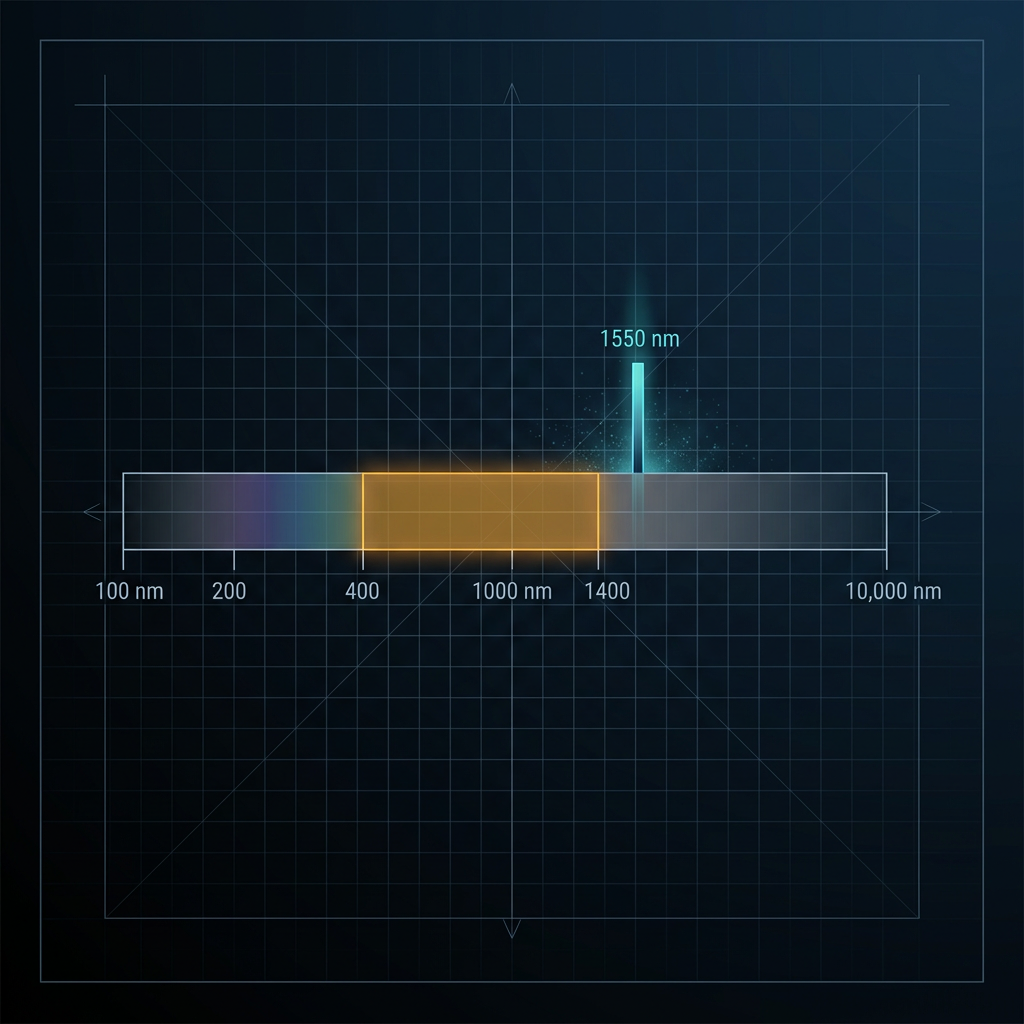
The Caltech Laser Safety Manual defines the retinal hazard region as 400–1400 nm — the wavelength range where ocular optics focus incident radiation onto the retina, amplifying irradiance by a factor of 100,000 when it reaches the retina.
At 1550 nm, the Custom EDFA operates entirely above this region. For engineers specifying amplifiers into environments sensitive to optical hazard classification, this is a meaningful platform property — the 1550 nm operating wavelength sits outside the retinal hazard window as defined under IEC 60825-1.
Reduced Hazard Zone Builds Available
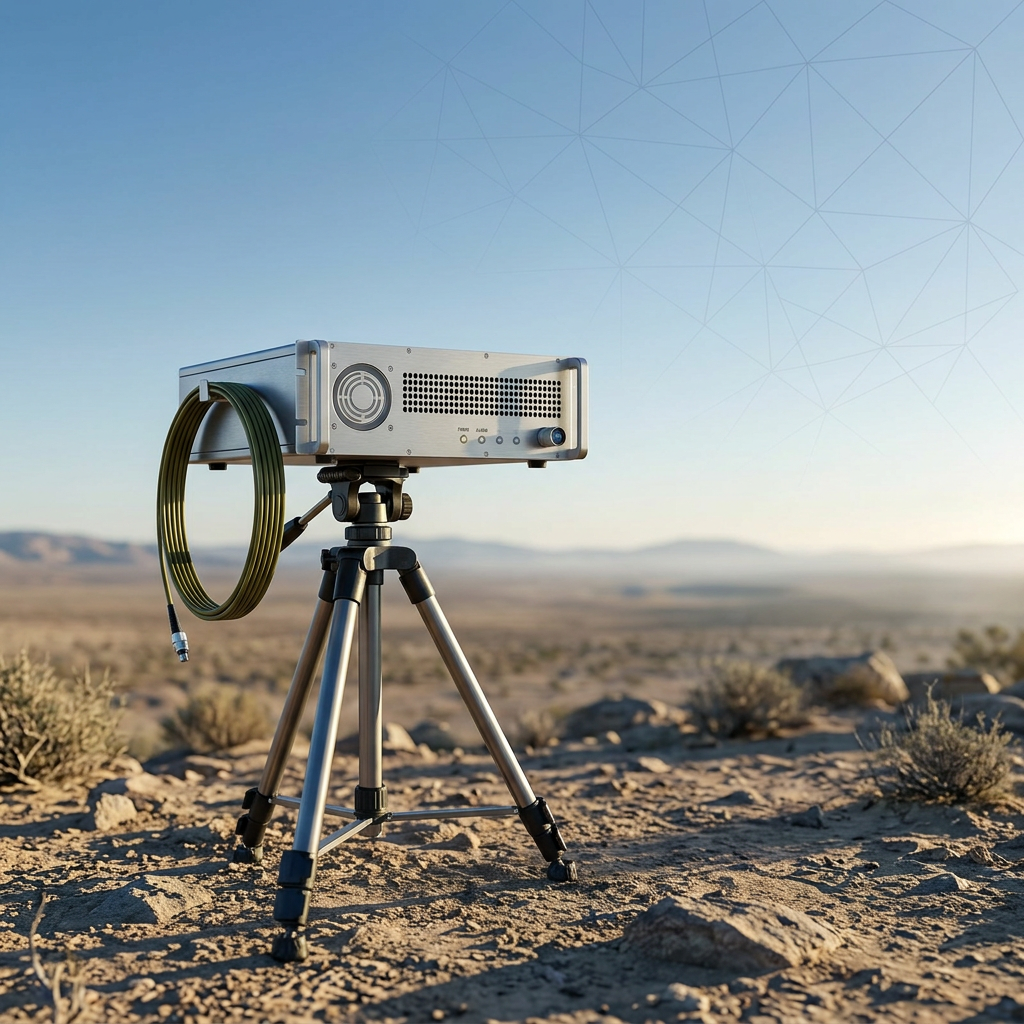
For deployments where minimising restricted areas is operationally critical, reduced hazard zone builds are available.
This option is particularly relevant for outdoor, airborne, and field-deployed applications — contexts where a smaller exclusion zone translates directly into simpler site management and fewer operational constraints. Submit your deployment requirements and WSL's engineering team will assess the appropriate build configuration.
Where the EDFA Was Born
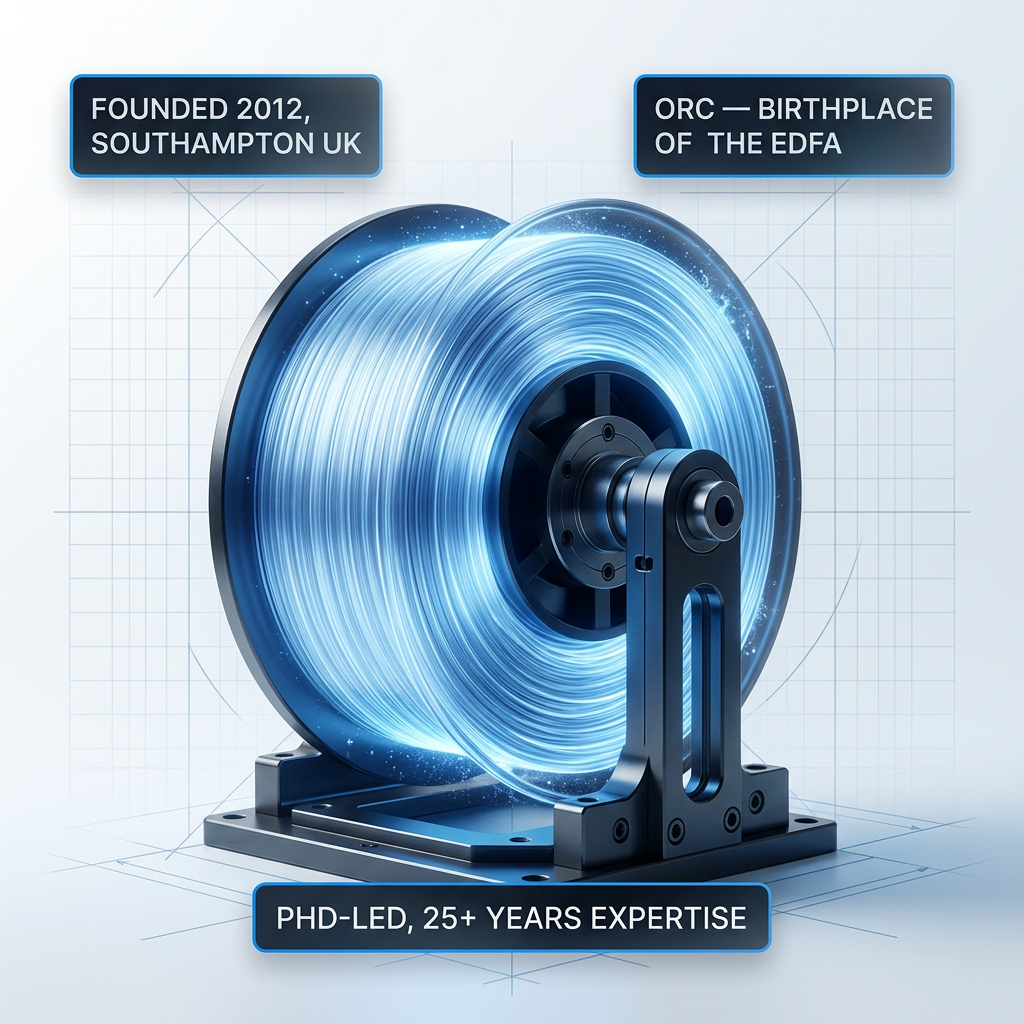
Woodrow Scientific was founded in 2012 in Southampton — the city whose Optoelectronics Research Centre (ORC) is the birthplace of the erbium-doped fibre amplifier. That proximity is not incidental.
WSL's founder holds a PhD from Southampton's ORC and brings 25+ years of fibre-laser expertise to the product. The team and its network work closely with the researchers who pioneered erbium-fibre technology. For a buyer specifying a 1550 nm fibre amplifier, that depth of domain knowledge is a concrete procurement credential.
Designed, Built, Supported In-House
WSL designs, builds, qualifies, and supports every amplifier itself — no outsourced manufacture, no delegated engineering. The team behind the unit is the same team available for integration questions, non-standard requirements, and long-term operational support.
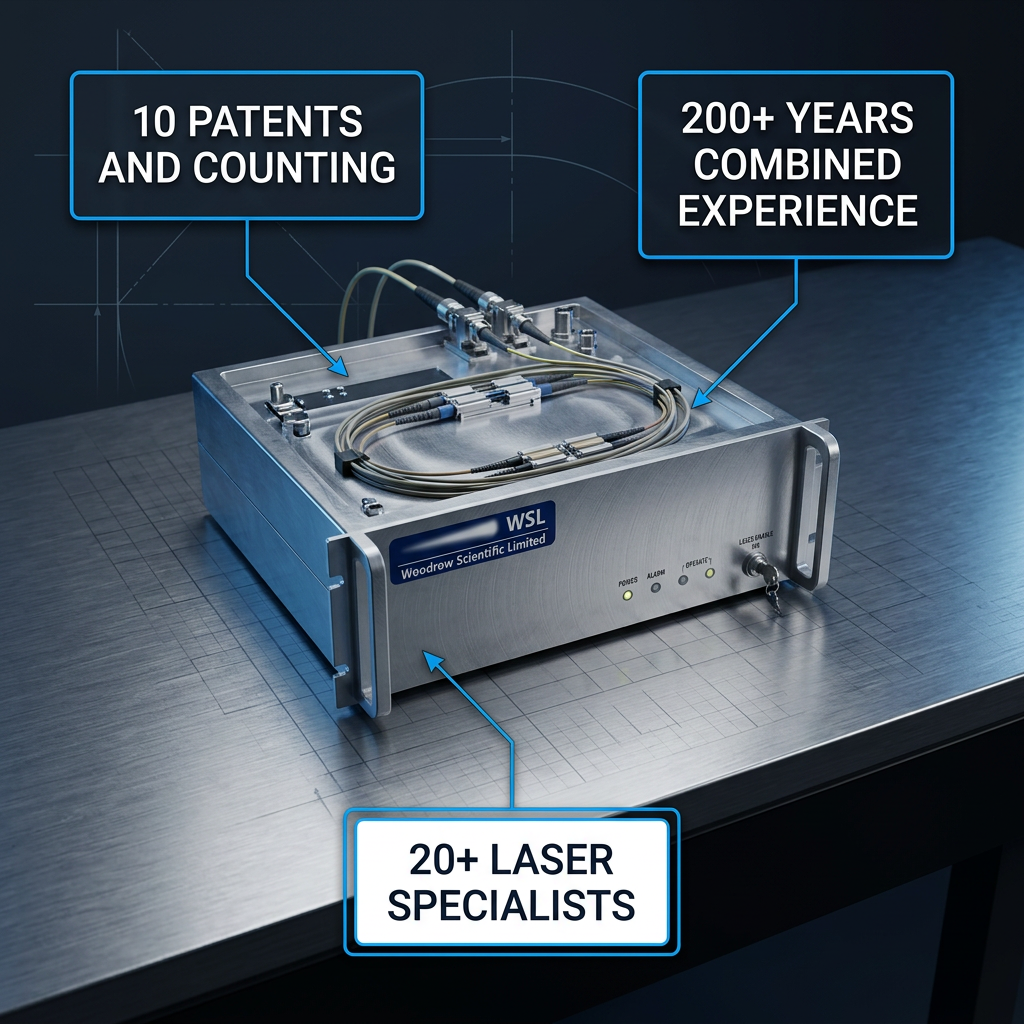
That capability rests on a foundation of 10 patents and counting, 200+ years of combined engineering experience, and a specialist team of more than 20 laser engineers. It is the kind of depth that makes post-supply support substantive rather than nominal.
A Distinction Worth Checking
A significant share of EDFA suppliers are resellers or importers of third-party modules rather than manufacturers. For a standard deployment that distinction may not surface — but for integration into a demanding system, it becomes material quickly.
Resellers carry no in-house engineering. Spares, modifications, and technical queries are routed back through a supply chain the reseller does not control. WSL's manufacturer status means the engineering support behind the product is real and direct — not delegated to a party that did not build it.

WSL Is Part of Global Space Programmes
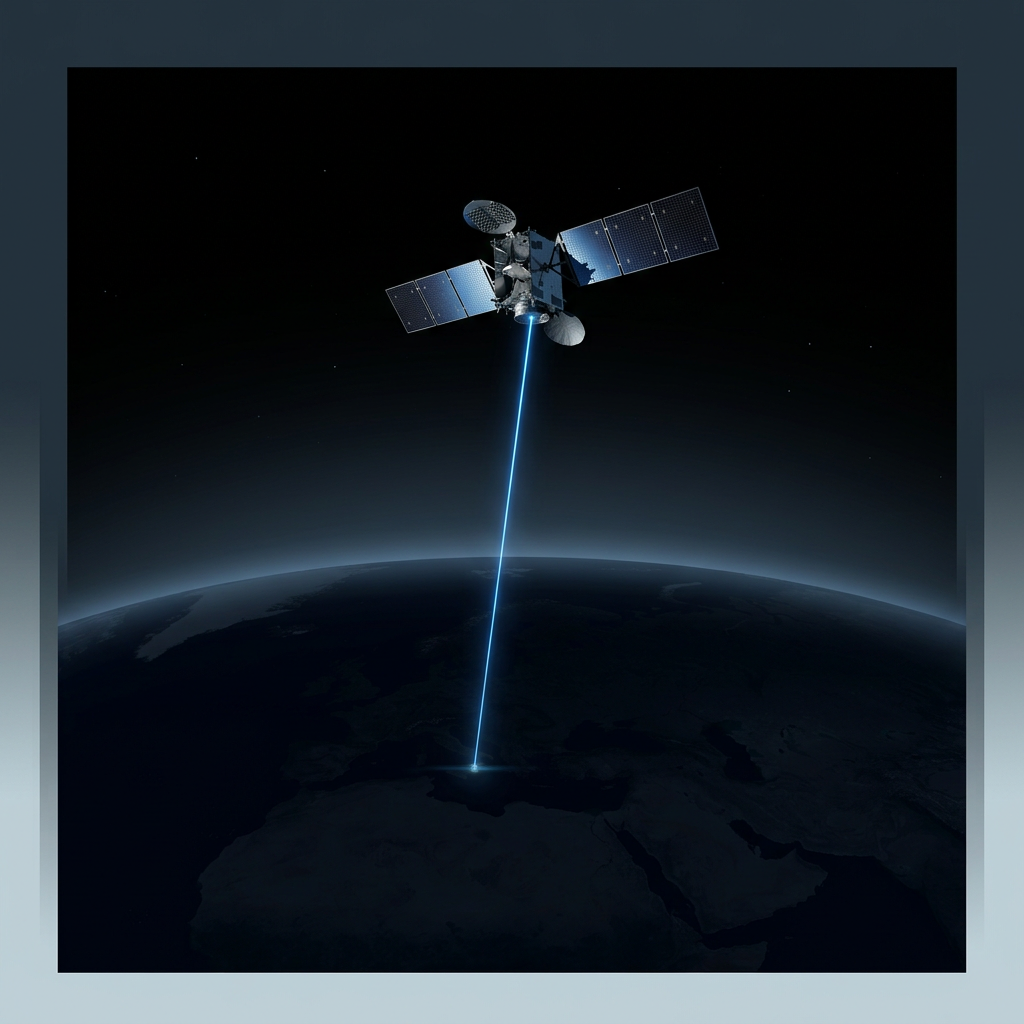
WSL is part of global space programmes today. Customers span worldwide programmes in optical ground stations and laser cleaning, including large-scale deployments supplied direct from WSL's Southampton facility.
Buyers in any country order direct — there is no distributor layer between the customer and the manufacturer. For procurement teams that need a supplier with a verified track record in demanding environments, that operational history is a straightforward credential.
10 Patents and Still Advancing
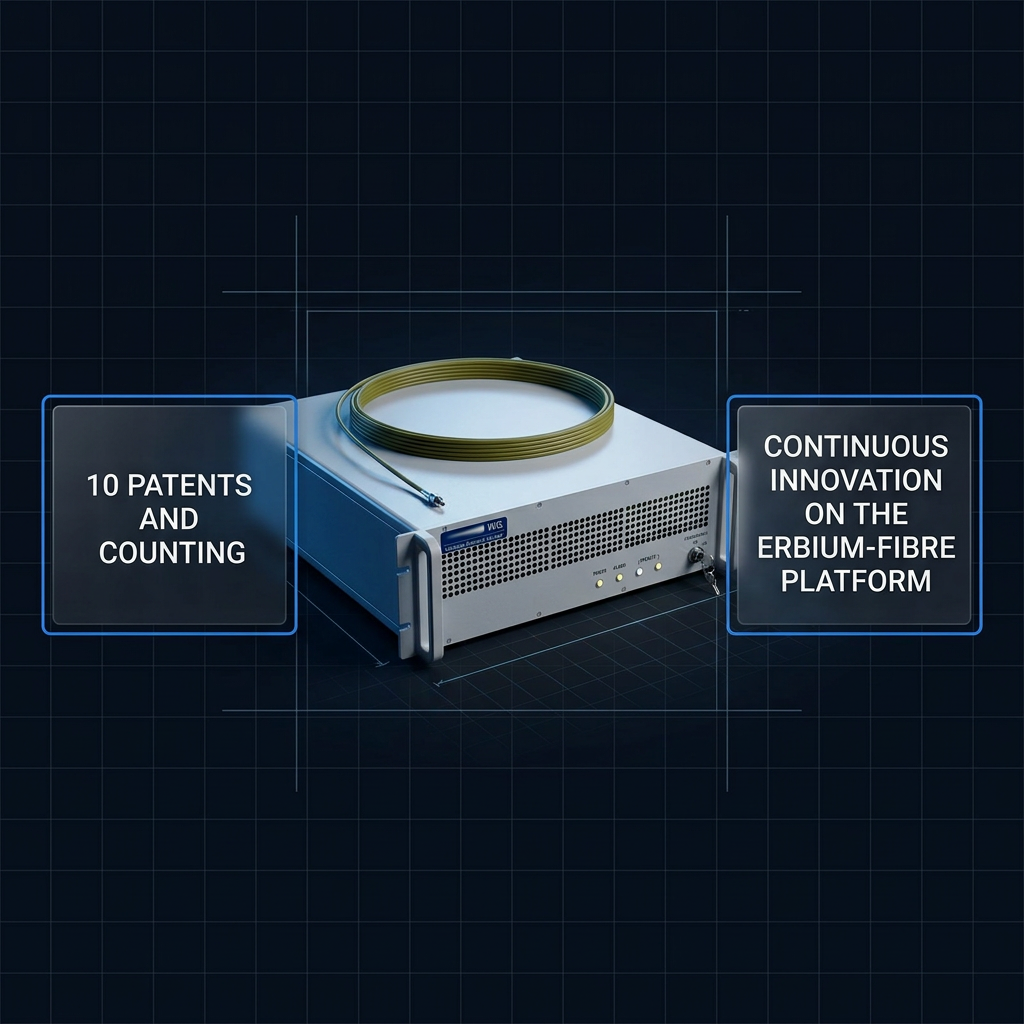
WSL holds 10 patents and counting on the erbium-fibre platform — and continues to develop it. The expertise behind the Custom EDFA is not historical; it is live, applied, and growing with each new programme.
Requirements beyond the published specification are assessed directly by WSL's engineers, who engage with each client on what is achievable. For buyers with non-standard needs, that means a genuine technical conversation with the people who hold the patents — not a catalogue lookup.
Why an Application-Engineered EDFA Outperforms a Catalogue Part
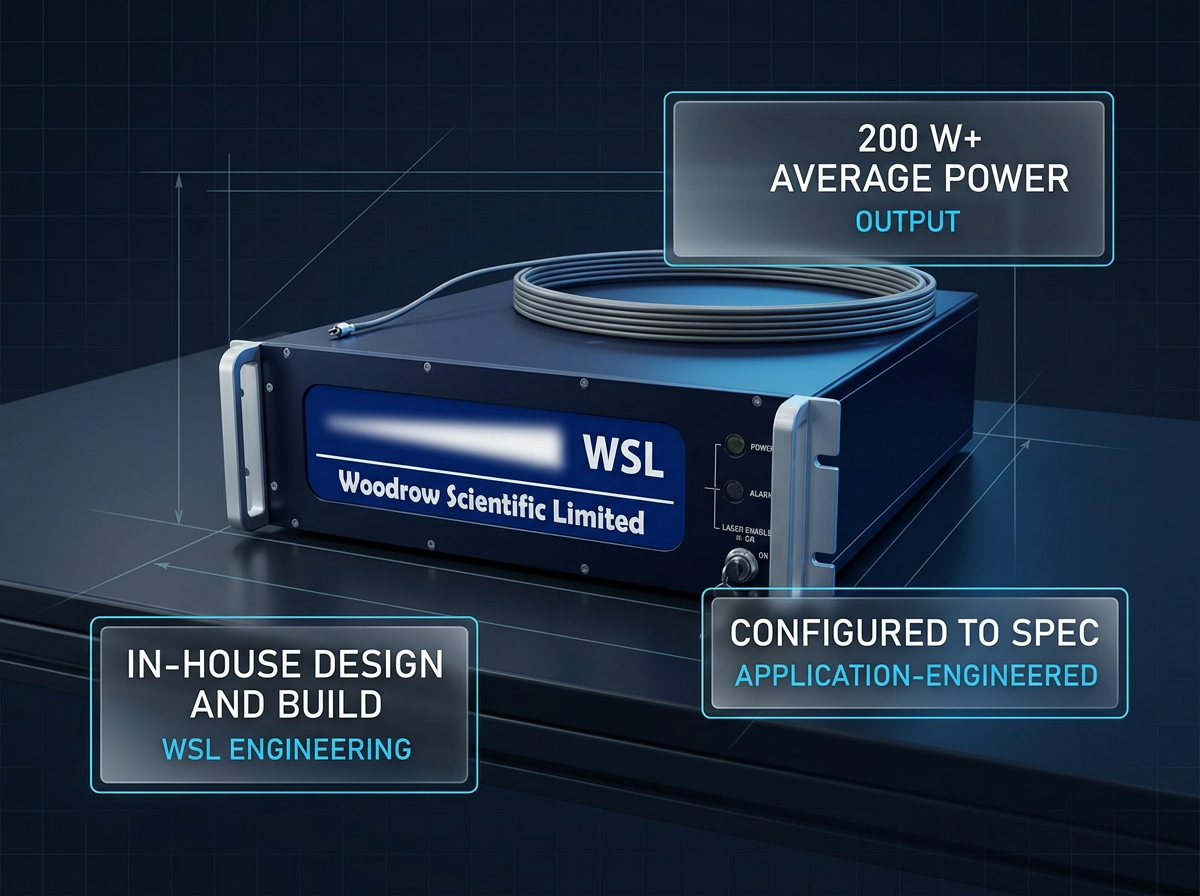
A catalogue EDFA forces your system to fit the amplifier. The application-engineered model inverts this: band, output power, pulse regime, cooling, form factor, and control firmware are all configured to your requirements. Where catalogue suppliers typically top out below 50 W average power, WSL builds to 200 W or more — the ceiling that matters when power is the priority.
Because WSL designs and builds every unit in-house, post-supply support is genuine: the engineers who built it are the ones who support integration. A requirement beyond the published specification is not ruled out — it is assessed.
Submit Your Requirements for a Specialist Evaluation
Every unit is engineered per project, so pricing is quote-based — the appropriate model for a precision component built to your specification. Submit your requirements and WSL's engineers begin the tailored evaluation from there.
Bring what you have: application context, operating band (C-band, L-band, or dual C+L), output power target, pulse regime, form factor, cooling preference, and any integration or firmware constraints. A partial picture is fine — WSL's engineers work through the specification with you.
Engineering support runs from specification through to commissioning, direct from the team who built the unit. Supplied worldwide, direct from WSL.
Frequently Asked Questions: 1550 nm Fibre Amplifiers
Common evaluation questions about erbium-doped fibre amplifiers and the Custom EDFA, answered directly.
The Custom EDFA supports C-band (1530–1565 nm), L-band (1565–1625 nm), and dual C+L-band — both bands delivered from a single source through one cable. The operating band is configured per project to match the application. Dual-band single-source delivery is practically significant: it eliminates the need for a second amplifier unit and removes the complexity of combining two separate sources at the system level.
Builds range from low-power units to 200 W or more average power, with pulse energies above 10 mJ and peak powers above 100 kW configurable per project. Output is fully tunable from 0 to 100% of rated power. This represents the leading commercially available power range for a 1550 nm fibre amplifier — most catalogue EDFAs offer less than 50 W average power, making the Custom EDFA the platform of choice for applications where power headroom is the priority.
Yes. The Custom EDFA is configured per project across every parameter that shapes system fit: operating band, output power, pulse regime, cooling, form factor, delivery cable, and control firmware. Only the erbium physics and the MOPA platform are fixed; everything else is built to your specification. Requirements beyond the published specification are assessed directly by WSL's engineers — nothing is ruled out in advance. Submitting your requirements is the natural entry point for that conversation.
The Custom EDFA is CE certified and UKCA certified. CE marking signifies that the product has been assessed to meet EU safety, health, and environmental protection requirements, as the European Commission's single market guidance states, and allows the product to be traded throughout the EEA. UKCA is the UK conformity marking for Great Britain, demonstrating compliance with GB product regulations; UK government guidance confirms that both markings can be carried simultaneously, supporting supply into both the EEA and Great Britain markets from a single product.
Yes. The Custom EDFA is available as the power engine for OEM integrators building their own laser systems. WSL works directly with integrators throughout the build, providing engineering support from specification through to commissioning. The platform's full customisation depth — band, power, pulse regime, form factor, and control firmware — is available to OEM customers on exactly the same basis as direct buyers. As a manufacturer that designs, builds, and supports every unit in-house, WSL can engage at the engineering level that OEM integration demands.
Submit your requirements for a specialist evaluation. WSL supplies worldwide direct, with no distributor layer, so your enquiry reaches the engineering team immediately. To make the evaluation as precise as possible, bring your application context, required operating band (C-band, L-band, or dual C+L), output power target, pulse regime (CW or pulsed), cooling preference, and any form-factor or integration constraints. Because every unit is engineered per project, the quote process is a technical conversation — not a catalogue transaction.
1550 nm sits above the retinal hazard region, which the Caltech Laser Safety Manual defines as 400–1400 nm — the range where ocular optics focus incident radiation onto the retina, magnifying irradiance by a factor of 100,000. The IEC 60825-1 standard addresses maximum permissible exposure within the retinal hazard region (400–1400 nm); at 1550 nm, which falls outside that region, the exposure threshold is higher than at retinal-hazard wavelengths such as 1064 nm. Reduced hazard zone builds are available for outdoor, airborne, and field-deployed applications where minimising restricted areas is operationally important.
A fibre amplifier boosts optical signals directly in the optical domain — without converting them to electrical signals and back — preserving the signal's wavelength, bit rate, and protocol. As IEEE TechNav describes, this all-optical operation transformed long-haul communications by replacing optoelectronic repeaters with in-line amplification. In the 1550 nm window, erbium-doped fibre amplifiers (EDFAs) simultaneously amplify multiple WDM channels with low noise and high efficiency, making them the amplifier of choice for modern photonics, sensing, and fibre communications systems.
A pump laser — typically at 980 nm or 1480 nm — excites erbium ions in the doped fibre to a metastable energy state. When signal photons in the 1530–1565 nm C-band pass through, they stimulate the excited ions to emit coherent photons at the same wavelength, producing optical gain through stimulated emission. As IEEE TechNav notes, the noise figure of practical EDFAs typically falls in the 4–6 dB range, and gain is transparent to bit rate and modulation format — key reasons the EDFA became the dominant amplifier technology for long-haul and high-power photonics applications.