

Introduction
Every machine on this list is rated at 1500W average output power, for buyers whose cleaning work calls for that level of power.
Until now, buyers searching for a structured, criteria-driven comparison of 1500W laser cleaning machines have not had one. Each entry here is assessed across six axes: cleaning performance, build quality and provenance, portability and form factor, ease of use, after-sales support and warranty, and pricing transparency.
At this power level, after-sales support and manufacturer provenance are decisive — not secondary. CE marking, and UKCA for UK buyers, is the credibility floor: its absence is a red flag the list takes seriously.
TL;DR
At 1500W, the technology gap between credible options is narrower than buyers expect. What separates them is provenance, support infrastructure, and configuration fit for the application.
The entries that hold up under scrutiny earn it through who stands behind them — not just what the spec sheet says.
This article covers:

1500W minimum power threshold for every entry
Six evaluation axes applied across all machines
CW vs pulsed and cooling configuration differences
Provenance and after-sales support as key factors
CE and UKCA certification as credibility indicators
Pricing transparency and how to get quotes
What a 1500W Laser Cleaning Machine Actually Does
At 1500W, a continuous-wave (CW) laser cleaner crosses a threshold that matters on the factory floor: the Bogong 1500W CW product page lists cleaning rates of 20–50 m²/hour on rust, mill scale, and coatings on structural steel — the throughput that makes laser cleaning viable for production environments rather than occasional spot work.
That figure, though, only applies to CW operation. The four machines reviewed below include both CW and pulsed configurations at this power level, and understanding the difference is the most important thing you can do before comparing them.
CW vs Pulsed: Different Tools, Different Jobs
A CW laser delivers constant power output for as long as the trigger is held. At 1500W, that sustained energy is what drives high throughput on heavy rust, thick paint, and oxide removal from durable steel — the dominant industrial cleaning configuration for good reason.
A pulsed laser at 1500W average power works very differently. It delivers energy in nanosecond bursts at high peak power, which ablates contamination with minimal heat transfer to the substrate beneath. The substrate stays essentially at ambient temperature throughout.
- CW at 1500W: Best for heavy rust, mill scale, and thick coatings on structural steel. High throughput, sustained output, straightforward to operate.
- Pulsed at 1500W: Best for heat-sensitive materials, precision components, or selective layer removal where substrate temperature must stay controlled.
Neither configuration is universally better. The right choice depends entirely on your substrate and application — not on which technology sounds more advanced.
The substrate sensitivity rule is the practical decision point: CW at 1500W is appropriate for thick, heat-tolerant materials such as structural steel, carbon steel machinery, and heavy fabrication work. For thin-gauge metals, precision components, or heat-sensitive alloys, the continuous heat accumulation from CW output risks substrate damage — and pulsed is the correct choice for those applications.
Air-Cooled vs Water-Cooled: Deployment Trade-Offs
Cooling configuration shapes how and where a 1500W machine can actually be used. Air-cooled units eliminate the need for an external chiller or coolant circuit, which simplifies deployment, reduces setup time, and makes the machine genuinely portable — a practical advantage for field work or multi-site operations.
Water-cooled configurations sustain output through extended, high-duty-cycle operation: production-line environments where the machine runs continuously without interruption. The trade-off is added complexity — a chiller unit, coolant maintenance, and reduced portability.
On power supply: the LaserSan CW 1500 specification lists single-phase 220V as the supply requirement for its air-cooled variant — a practical advantage for workshop and field deployment where three-phase supply is unavailable.
Every laser cleaning machine at 1500W is a Class 4 laser device under IEC 60825-1, regardless of brand, configuration, or cooling type. This classification is not avoidable by design — it applies universally at this power level.
Class 4 is the highest laser hazard classification under IEC 60825-1. OSHA guidance classifies Class 4 lasers as hazardous under both direct and diffusely scattered beam conditions, and as a potential fire and skin hazard requiring significant controls.
OSHA guidance states that laser protective eyewear is mandatory for Class 4 laser operation, and that an established laser-controlled area with restricted access is required. OSHA also identifies respiratory hazards from laser-induced fumes and vapours as a factor buyers should consider when selecting protective equipment for Class 4 operations.
On certification: CE marking is the minimum credibility threshold for European buyers; UK buyers should look for UKCA marking or valid CE marking under current GB market rules. Absence of either is a red flag at any price point.
With those distinctions clear, the four machines below can be assessed on their own terms.
Product 1
Bogong Laser Cleaner BG-WCL-1500
A 1500W water-cooled pulsed MOPA fiber laser cleaner built for substrate-sensitive work. The only pulsed entry on this list, delivering nanosecond bursts with lower heat input than CW at equivalent power.
Pros:

Pulsed MOPA architecture reduces substrate heat input
Wide frequency range: 1–5,000 kHz adjustable
CE certified and FDA registered, ISO 9001 facility
Factory-direct supply across 160+ countries
Cons:

Chiller and coolant loop required — complex setup
Less portable than air-cooled alternatives
Lower area throughput than CW at same power
BG-WCL-1500 Cleaning Performance
The BG-WCL-1500 uses a pulsed MOPA fiber laser rated at 1500W average output power, operating at a repetition frequency of 1–5,000 kHz with a maximum pulse energy of approximately 45 mJ.
Bogong lists the typical cleaning efficiency for the 1500W water-cooled model at 15–30 m²/hour, depending on material and contamination type — a narrower range than the CW equivalent at the same power rating.
A pulsed MOPA laser delivers energy in nanosecond bursts rather than a continuous beam. At equivalent average power, this means far lower heat accumulation in the substrate between pulses — a meaningful advantage when cleaning heat-sensitive alloys, thin metals, precision tooling, or surfaces where dimensional integrity must be preserved. The trade-off is throughput: pulsed cleaning covers less area per hour than CW at the same wattage.
Bogong's product page lists suitable contaminants as rust, paint, oil, and oxide, with the cleaning width adjustable from 0–200 mm depending on the scanner configuration.
The machine operates at a 1064 nm wavelength and is rated for power adjustment across the full 0–100% range, giving operators precise control over energy delivery per pass.
| Parameter | BG-WCL-1500 Value |
|---|---|
| Laser source | Pulsed fiber (MOPA) |
| Rated average power | 1500 W |
| Repetition frequency | 1–5,000 kHz |
| Max pulse energy | ≈ 45 mJ |
| Typical cleaning efficiency | 15–30 m²/h |
| Power consumption | ≤ 6.5 kW |
| Cooling method | Water-cooled (chiller + coolant loop) |
| Suitable contaminants | Rust, paint, oil, oxide |
| Cleaning width | 0–200 mm (adjustable) |
| Certifications | CE certified, FDA registered (Class 4) |
Key specifications for the BG-WCL-1500 as published on Bogong's water-cooled laser cleaner product page.
With a power consumption ceiling of ≤ 6.5 kW, the BG-WCL-1500 draws notably less from the mains than its rated laser output might suggest, owing to the efficiency of the pulsed source and integrated chiller.
BG-WCL-1500 Build Quality and Provenance
Bogong states that every machine in its range is assembled and calibrated in its own ISO 9001-certified facility, with in-house R&D covering pulsed source integration, cooling, and control firmware.
The company describes itself as having served 9,000+ industrial clients across 160+ countries over 14+ years, with 425+ industrial-level projects delivered — figures it publishes consistently across its product pages.
Bogong lists its laser sources as sourced from named partners including IPG, JPT Laser, Raycus, and Max Laser — a transparency signal that distinguishes it from suppliers who do not disclose their component provenance.
The BG-WCL-1500 carries CE certification and FDA Class 4 laser product registration, and Bogong also states IEC 60825 compliance and RoHS conformance across its range.
BG-WCL-1500 Portability and Form Factor
Water-cooling is a design requirement at 1500W pulsed, not an optional upgrade: the heat load generated by sustained high-power pulsed operation requires a circulating chiller and coolant loop to maintain stable output.
In practice, this makes the BG-WCL-1500 suited to workshop, production-line, and semi-fixed installations where the chiller can be positioned alongside the machine and the coolant loop connected before operation begins.
Compared to air-cooled units, setup involves additional steps: connecting the chiller, filling and checking the coolant level, and allowing the system to reach operating temperature before cleaning begins.
BG-WCL-1500 Ease of Use
Bogong's water-cooled product page describes a control screen with multi-language support and multiple scan modes, indicating that pattern selection and parameter adjustment are operator-accessible from the control interface.
The coolant loop adds a periodic maintenance task to the operating routine: Bogong specifies distilled water or a designated coolant, and advises checking the coolant level periodically.
The machine operates within an ambient temperature range of 5–40 °C and a humidity limit of ≤ 80% non-condensing, which covers most workshop and light-industrial environments without special conditioning.
BG-WCL-1500 After-Sales Support
Bogong structures its support across four stages: pre-sales application review, installation and commissioning guidance, after-sales technical assistance, and ongoing spare parts supply.
- Pre-sales: Application review, material and contamination assessment, preliminary parameter recommendations, and sample testing support before purchase.
- Installation: Remote installation guidance, commissioning support, basic parameter setup, and operator safety training.
- After-sales: Technical assistance for operational issues, remote diagnostics, and process optimisation guidance.
- Spare parts: Supply of original spare parts, maintenance recommendations, and guidance for key functional components.
Bogong states it supplies factory-direct to 160+ countries with a global delivery and support network, and offers free sample testing before purchase — a meaningful provision for buyers evaluating the machine against specific substrates.
BG-WCL-1500 Pricing
Pricing for the BG-WCL-1500 is available on request and will vary with configuration variables including chiller type, fibre cable length, and accessories.
Prospective buyers should request a formal quotation from Bogong, specifying their substrate, contamination type, and required accessories, to obtain an accurate price for the pulsed water-cooled configuration.
Product 5
LaserSan CW 1500
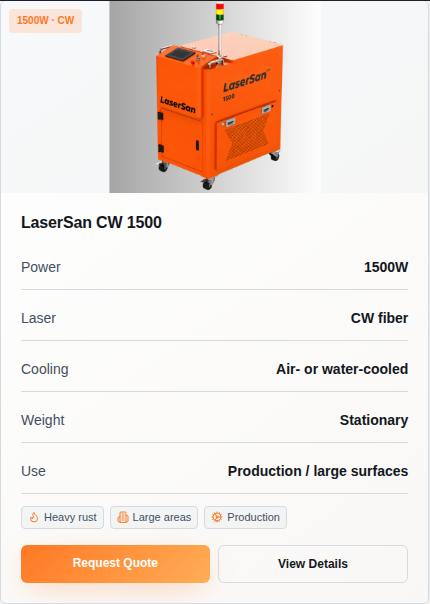
A 1500W continuous-wave fiber laser cleaning machine from a European supplier, available in both air-cooled and water-cooled configurations for production and large-surface industrial cleaning.
Pros:
European supplier with local support in Spain
Unique dual cooling option at 1500W CW
Adjustable beam width: 10–150 mm
CE-marked, adapted to EU standards
Cons:
Pricing not listed; quote required
Stationary form factor — not portable
The LaserSan CW 1500 is a 1500W continuous-wave fiber laser cleaning machine from a Spain-based European supplier, and the only entry on this list available in both air-cooled and water-cooled configurations at this power level.
LaserSan CW 1500 Cleaning Performance
Running at a constant 1500W output, the CW 1500 is rated to a cleaning speed of ≤30 m²/hour, making it suited to large-surface work: heavy rust removal, thick coating stripping, and production-line cleaning on structural steel.
The beam width is adjustable across a 10–150 mm range, giving operators meaningful control over spot size and energy density depending on the surface and coating being treated.
The two cooling variants share the same laser source and cleaning specification — the choice between them is a deployment decision, not a performance one.
| Specification | Air-Cooled | Water-Cooled |
|---|---|---|
| Laser source | CW fiber, 1500W | CW fiber, 1500W |
| Cleaning speed | ≤30 m²/h | ≤30 m²/h |
| Beam width | 10–150 mm | 10–150 mm |
| Power supply | Single-phase 220V/110V | Single-phase 220V/110V |
| Cooling requirement | No chiller needed | Dedicated coolant loop |
| Deployment context | Workshop / flexible deployment | Production line / continuous operation |
| Form factor | Stationary | Stationary |
Key specifications for the air-cooled and water-cooled variants of the LaserSan CW 1500, as published on laser-san.com.
The air-cooled variant removes the chiller dependency entirely, simplifying setup and reducing the infrastructure required at the deployment site.
The water-cooled variant uses a dedicated coolant loop to maintain thermal stability during sustained high-duty-cycle operation, suited to environments where the machine runs continuously over long shifts.
LaserSan describes the CW 1500 as a stationary machine in both configurations — it is positioned for production and large-area industrial cleaning rather than field or handheld use.
LaserSan's machines are manufactured by OEM factories in China, with LaserSan writing the technical specifications, conducting quality control inspection, and adapting each machine to EU electrical standards before dispatch.
Every machine is CE-marked and commissioned by LaserSan engineers, with training, PPE, and safety documentation included as standard.
LaserSan CW 1500 Pricing
Pricing for the CW 1500 is not publicly listed on the LaserSan website; quotes are available directly from LaserSan at laser-san.com.
Both the air-cooled and water-cooled variants operate on a single-phase 220V/110V supply — a practical consideration for workshops and facilities without three-phase infrastructure.
The air-cooled variant requires no coolant loop startup, while the water-cooled variant involves additional setup steps for the cooling system; LaserSan provides guidance on coolant configuration, mixing ratios, and maintenance for water-cooled machines.
The control interface supports multiple operator languages, with up to 12 language options configurable at the time of order.
LaserSan provides on-site service and support from its primary base in Spain (Costa Blanca / Valencia–Alicante region), covering installation, commissioning, operator training, and troubleshooting, with remote support available for European projects.
Local spare parts and service contracts are available, and a workshop facility in Senija, Spain handles inspection and hands-on assistance when needed.
LaserSan states a one-year warranty on the machine and a two-year warranty on the laser source, with access to the local service workshop in Spain included as standard.
Not Sure Which Cooling Configuration Is Right?
Air-cooled or water-cooled, the right choice depends on your application, site setup, and duty cycle. Speak with a laser cleaning expert to work through the options for your specific situation.
Product 3
AccTek AKQ-1500 Continuous Laser Cleaning Machine
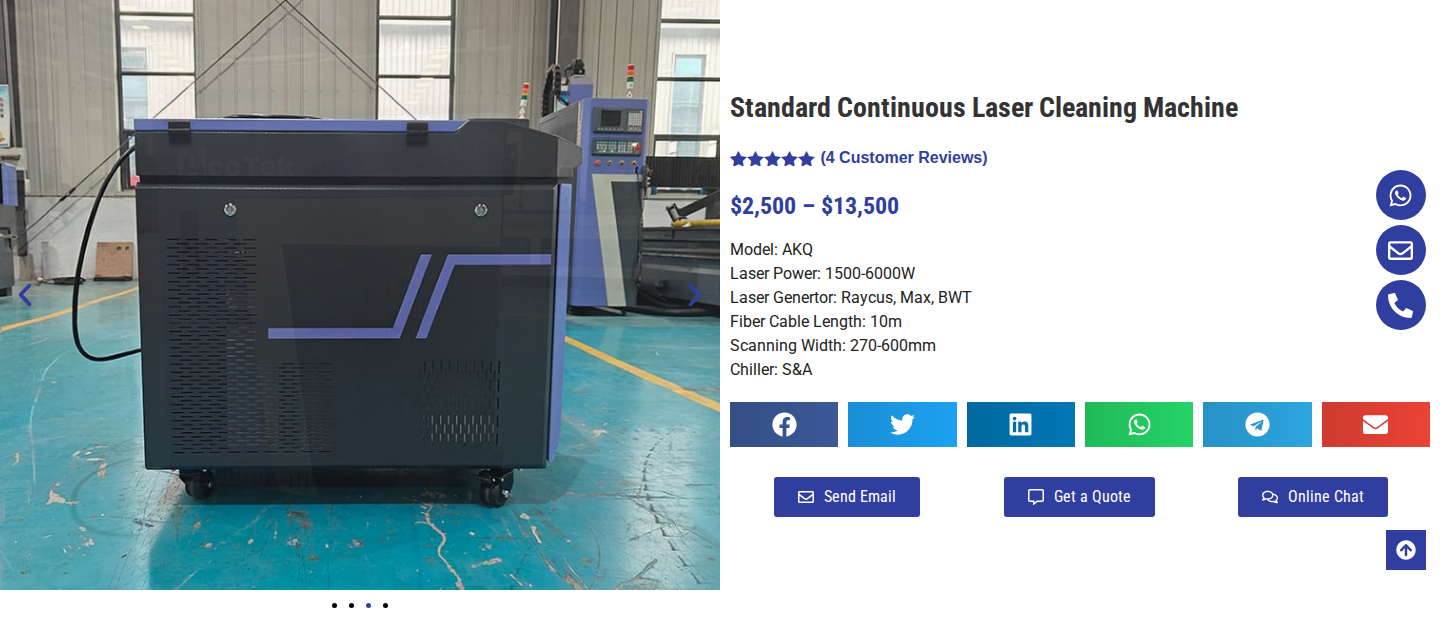
A 1500W CW fiber laser cleaner from AccTek Group, available in three configurations — standard, double-wobble, and portable — with FOB pricing published across all variants.
Pros:
Three configurations available at 1500W
FOB pricing published across all variants
CE and FDA certified
Choice of Raycus, Max, or BWT laser source
Cons:
All configurations are water-cooled only
FOB price excludes shipping and import costs
Local distributor routes vary by geography
AKQ-1500 Cleaning Performance
The AKQ-1500 uses a 1064nm continuous-wave fiber laser rated at 1500W — the entry-level configuration in AccTek's AKQ range, which extends up to 6000W.
AccTek states the machine removes rust, paint, oil, oxidation, and coatings from metal surfaces without damaging the base material, and lists automotive, aerospace, manufacturing, shipbuilding, and restoration as target industries.
Laser source options across all three configurations are Raycus, Max, and BWT — established Chinese fiber laser manufacturers — giving buyers a degree of component-level choice worth factoring into procurement discussions.
Configuration Options and Form Factor
The AKQ-1500 is the only 1500W machine on this list offered in three distinct physical configurations within a single product line: standard handheld, double-wobble head, and portable.
| Configuration | Cooling | Scanning Width (standard) | Scanning Width (optional) | Fiber Cable |
|---|---|---|---|---|
| Standard handheld | Water | 10–270mm | 10–450mm, 10–600mm | 10m |
| Double-wobble head | Water | 10×50mm | Up to 300mm | 10m |
| Portable | Water | 10–270mm | 10–450mm, 10–600mm | 10m |
Key form-factor and scanning specifications across the three AKQ-1500 configurations, as published on AccTek's product pages.
All three configurations are water-cooled, which is standard for CW fiber lasers at this power level, and all ship with a 10m fiber cable as standard.
The double-wobble head configuration uses dual laser beam movement to deliver wider area coverage and more uniform surface cleaning than a standard scanning head — AccTek describes it as suited to high-speed, large-surface industrial applications.
The portable configuration is designed for on-site deployment in a compact, easy-to-transport form factor, while the standard handheld unit targets workshop and fixed-production environments.
Ease of Use
The standard and portable configurations use an Au3tech control system, which AccTek describes as providing intuitive operation with precise adjustment of power, frequency, and cleaning parameters.
The double-wobble configuration lists HANWEI/QILIN/Ralfar cleaning heads and control systems — a different component set from the other two variants, which buyers should clarify with AccTek when specifying.
AccTek's product pages describe the control interface as user-friendly, with advanced software enabling easy adjustment of all cleaning parameters.
Build Quality and Provenance
AccTek Group describes itself as a professional manufacturer of laser cleaning machines, based in China and serving customers in over 100 countries.
The AKQ-1500 carries CE certification for the European Economic Area and FDA certification for the US market — both stated on AccTek's product pages.
Buyers sourcing from any manufacturer should ask about in-house production versus component integration, and request documentation of the quality processes behind the specific machine being quoted.
After-Sales Support
AccTek's published warranty policy across its laser cleaning range states a 3-year warranty for the entire machine, a 2-year warranty for the laser generator, and a 1.5-year warranty for core components, with exclusions for damage from improper use or mishandling.
Online technical support is described as available free of charge via phone, email, or live chat, and AccTek states a growing network of regional service partners across its 100-country footprint.
AKQ-1500 Pricing
AccTek publishes FOB price ranges across all three configurations, giving buyers a concrete factory-gate figure for comparison. Shipping, customs duties, and any local installation or support costs are additional — total landed cost is the relevant figure for procurement decisions.
AccTek's portable product page body text puts the FOB range at $2,500–$14,000, and the double-wobble product page states $3,000–$14,000 FOB — in each case spanning the full wattage band from 1500W upward, with the 1500W configuration at the lower end.
AccTek's homepage lists FOB ranges of $2,800–$14,900 for the portable configuration and $3,400–$15,500 for the double-wobble — buyers should request a specific 1500W quotation to establish the precise entry-level figure for the configuration they are evaluating.
Product 4
Ascent Equipment MASTER X50
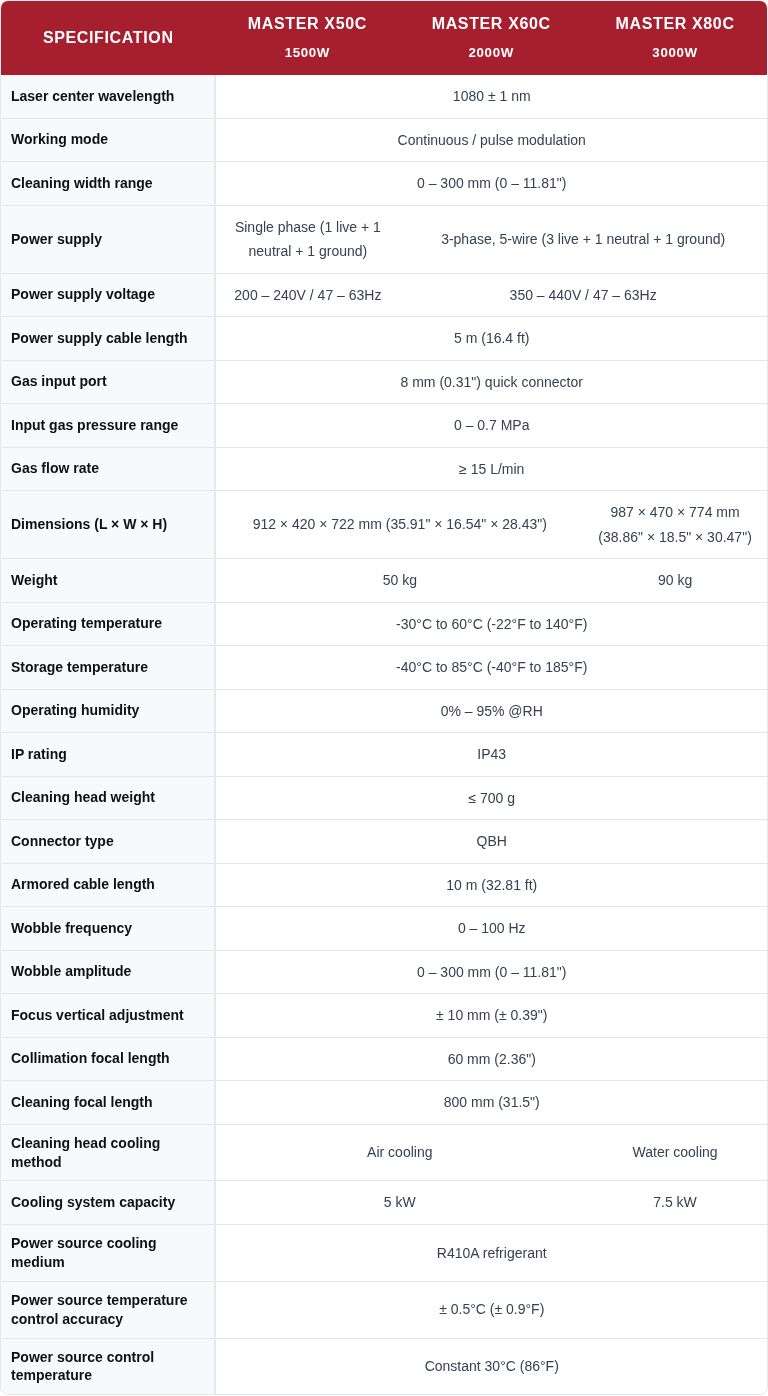
A 1500W continuous-wave fiber laser cleaning machine and the entry-level model in Ascent's MASTER CW range, built for heavy rust removal, large-area paint stripping, and pre-weld surface preparation on steel.
Pros:
Two-year parts-and-labor warranty included
On-site installation and training across USA and Canada
Refrigerant cooling enables -30°C to +60°C operation
FDA/CDRH compliant with accession number received
Cons:
Pricing available on request only
Technician locations limited to three North American cities
Heavier than portable air-cooled alternatives at 50 kg
MASTER X50 Cleaning Performance
The MASTER X50 operates at 1500W continuous wave, with a working mode that Ascent describes as continuous or pulse modulation, a cleaning width range of 0–300 mm, and a 10 m armored fiber cable connecting the control unit to the cleaning head.
Ascent positions this power level as industrial-grade: their published guide describes 1000W–1500W as capable of fast coverage on large surfaces and severe rust and industrial scale.
The application profile Ascent associates with CW cleaning at this power level covers heavy rust and thick scale on structural steel, large-area paint stripping on industrial equipment and vehicles, and pre-weld surface cleaning on thick steel (3 mm and above).
MASTER X50 Build Quality
Ascent's laser cleaning overview page lists the MASTER X50C at an IP43 protection rating and describes the system as combining a high-stability laser source, refrigerant-based cooling, a cleaning head, and a control module in a single integrated unit.
Ascent states that its laser cleaning systems are manufactured to comply with FDA/CDRH laser-product performance requirements under 21 CFR Parts 1000 and 1040, with product reports submitted to the FDA and a unique Accession Number received.
MASTER X50 Portability and Form Factor
The MASTER X50C uses a refrigerant-based cooling system (R410A) for the power source, with an air-cooled cleaning head — a configuration Ascent's own guide describes as standard and necessary for high-power CW systems running production shifts.
| Specification | MASTER X50C |
|---|---|
| Dimensions (L × W × H) | 912 × 420 × 722 mm (35.91" × 16.54" × 28.43") |
| Weight | 50 kg (110 lb) |
| Armored cable length | 10 m (32.81 ft) |
| IP rating | IP43 |
| Cooling — power source | R410A refrigerant |
| Cooling — cleaning head | Air cooling |
| Operating temperature | -30°C to +60°C (-22°F to +140°F) |
| Power supply | Single phase, 200–240V / 47–63Hz |
| Cleaning width range | 0–300 mm |
Physical and electrical specifications for the Ascent MASTER X50C 1500W laser cleaning machine.
At 50 kg and 912 × 420 × 722 mm, the MASTER X50 sits in a similar weight class to the other water-assisted CW units on this list, with the refrigerant cooling system integrated into the main cabinet rather than requiring a separate external chiller.
MASTER X50 Ease of Use
Ascent's laser cleaning page describes a full touchscreen interface that displays operating status and allows cleaning parameters to be set and adjusted for different applications.
Ascent states that every machine includes on-site installation and operator training across their USA and Canada locations — covering both setup and operator familiarisation at the buyer's facility, not a remote session.
MASTER X50 After-Sales Support
Ascent's stated support package includes a full two-year parts-and-labor warranty — not a 90-day parts warranty with labor billed separately — plus lifetime remote support via AnyDesk, pre-installed on every machine.
Ascent publicly states technician locations in Buffalo, New York; Toronto, Ontario; and Kentucky, providing explicitly stated North American service coverage with on-site installation and training included in the quoted price.
Ascent publicly states technician locations in Buffalo NY, Toronto ON, and Kentucky, with on-site installation and training included in the quoted price — a service geography detail Ascent spells out clearly on its own site.
MASTER X50 Pricing
Ascent does not publish pricing for the MASTER X50 on their website. Buyers need to contact Ascent directly for a quote — the same quote-required model as the LaserSan CW 1500, and in contrast to the AccTek AKQ-1500, which publishes FOB pricing across all configurations.
Conclusion
Choosing the Right 1500W Laser Cleaning Machine
The first question to settle is the technology split: whether your application calls for continuous-wave or pulsed operation, and whether air-cooled portability or water-cooled sustained output better fits how the machine will actually run.
Once that is resolved, provenance and support infrastructure become the decisive axis — who built the machine, who services it, and what stands behind it when something goes wrong.
Verify CE certification before purchase and treat its absence as a red flag; landed cost, not factory-gate price, is the honest comparison.
Frequently Asked Questions About 1500W Laser Cleaning Machines
Practical answers to the questions buyers ask most often about 1500W laser cleaning machines — covering how the technology works, what it costs, and how to choose the right configuration for your application.
Yes — and at 1500W continuous wave, the results are industrial rather than laboratory. These machines remove heavy rust, mill scale, paint, and oxide from structural steel at cleaning rates of 20–35 m²/hour under typical conditions, without chemicals and without contact. The base metal is left intact when power, scan speed, and frequency are correctly set for the contamination and substrate in question. That last point is where performance lives or dies. A 1500W CW machine running the wrong parameters on the wrong material will underperform; the same machine correctly configured will outpace wet abrasive blasting on the same surface.
FOB factory prices for 1500W CW configurations vary considerably by supplier and specification. AccTek's CW range — covering 1500W through 6000W — is priced at $2,500–$14,000 FOB depending on variant, with the double-wobble configuration starting from $3,100. Pulsed configurations at 1500W average power carry a significant premium over CW at equivalent average output. All FOB prices exclude shipping, import duties, and local support — landed costs in Europe or North America run meaningfully higher. The range is wide because configuration matters: air-cooled versus water-cooled, CW versus pulsed, laser source brand (Raycus, Max, BWT), and whether local distribution or after-sales support is part of the package all affect the final number. Treat any FOB figure as a starting point, not a landed price.
There is no universal answer — and any source that offers one is selling something. The right machine depends entirely on what you are optimising for: throughput on heavy mill scale, substrate sensitivity, site portability, provenance and build quality, or the availability of local service and support. A machine that leads on one axis will often compromise on another. The machines evaluated on this page were selected because each is credible and verifiable across the dimensions industrial buyers care about most. Assess them against your own requirements — contamination type, substrate, duty cycle, and where you need support — rather than looking for a verdict that applies to everyone.
CW (continuous wave) delivers constant power output — the beam is on and stays on. At 1500W, this translates to sustained thermal ablation that strips heavy rust, thick coatings, and mill scale from durable steel at high area throughput. It is the dominant technology at this power level for industrial surface preparation. Pulsed at 1500W average power works differently: energy is delivered in nanosecond bursts at very high peak power, with intervals between pulses that limit heat transfer into the substrate. This makes it the right technology for heat-sensitive materials — aluminium, stainless steel, thin-gauge metals — where a CW beam would risk discoloration, distortion, or microstructural change. The practical trade-off is cost: a pulsed system at 1500W average output is significantly more expensive than a CW machine at the same average power. Choose CW when throughput on heavy contamination on robust steel is the priority; choose pulsed when substrate heat tolerance is the binding constraint.
Neither is universally better — the right choice depends on how the machine will be used. Air-cooled configurations require no external chiller or coolant loop, making them simpler to deploy and more portable. They suit workshop use, field maintenance, and any situation where site mobility matters. Water-cooled configurations sustain output under continuous, high-duty-cycle operation without thermal throttling — the better fit for production-line environments where the machine runs for extended periods. The two deciding factors are how continuously the machine will run and whether moving it between sites is part of the workflow. At 1500W, both options exist: LaserSan's CW 1500 is available in either air-cooled or water-cooled configuration, which is unusual at this power level. Confirm the cooling arrangement of any specific machine before purchase — it affects installation requirements, duty-cycle capability, and total running cost.