

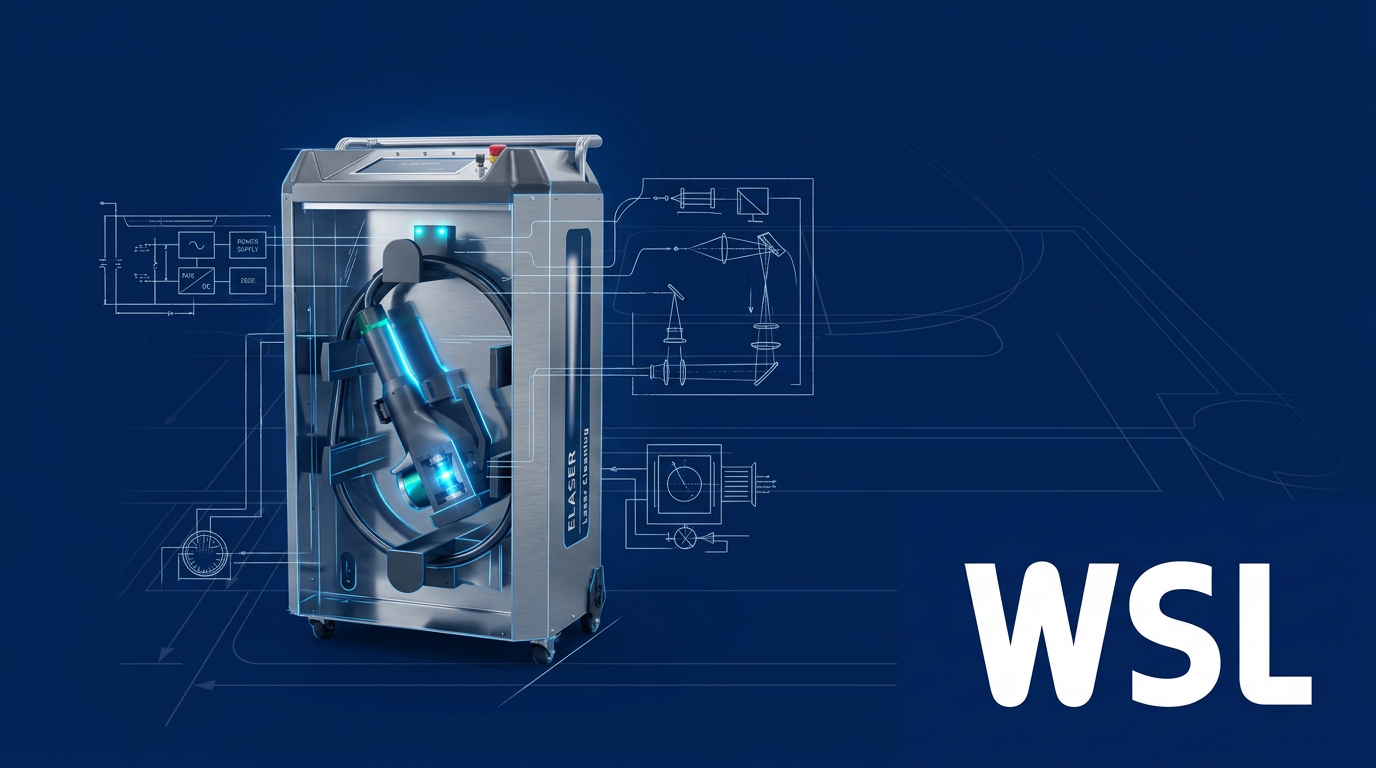
Introduction
This comparison is built for procurement professionals, workshop managers, and engineering leads who are ready to evaluate specific machines, not research the category from scratch.
100W handles rust, oxides, paint, and light-to-medium coatings on metals, stone, and masonry — covering most industrial maintenance and restoration applications. Higher wattage (200W+) is needed for thick coatings at production speed or very large surface areas.
Every entry is assessed against six axes: laser technology type, form factor, cooling system, safety compliance, after-sales support, and pricing approach.
Each machine appears here only where 100W output is confirmed; entries that could not be verified to that specification are excluded.
Published list prices are rare in this category — where pricing is quote-based, the entries explain how to proceed.
TL;DR
The 100W tier is genuinely capable for most industrial cleaning tasks — but the machines within it differ far more than their shared wattage suggests.
Reach, safety deployment, laser architecture, and manufacturer support vary dramatically across this category, and those gaps determine the right fit for a given operation.
This article covers:

Five 100W laser cleaning machines reviewed and compared
Six evaluation axes applied consistently across entries
What 100W handles and where it falls short
Safety compliance and certification across each machine
After-sales support: manufacturer vs. reseller distinction
Pricing transparency and how to obtain quotes
What to Look for in a 100W Laser Cleaning Machine
Not all 100W laser cleaning machines are built to the same standard — and the spec sheet alone won't tell you which one belongs in your operation.
Laser Technology: MOPA vs. Standard Pulsed Fibre
The most important architectural distinction in this category is between MOPA (Master Oscillator Power Amplifier) lasers and standard pulsed fibre (Q-switched) lasers.
A MOPA laser allows pulse width and pulse frequency to be adjusted independently, giving the operator finer control over the energy delivered to the surface — which matters most when substrates are sensitive or applications vary across materials and contaminant types.
Standard pulsed fibre is a capable technology for straightforward tasks such as rust removal on robust steel, but its fixed pulse profile makes it the less versatile choice when your cleaning requirements shift across jobs or substrates.
When comparing machines, ask each supplier which laser architecture their source uses and why that choice suits your specific application — it is one of the most revealing questions you can put to a vendor.
Form Factor, Portability, and Cable Reach
Three main configurations exist in the portable 100W market, each with distinct operational implications for deployment, operator fatigue, and on-site reach.
- Backpack systems: The full unit is worn by the operator. Maximum mobility, but all the weight is carried — fatigue over a full shift is a real consideration.
- Wheeled trolley with handheld scanner: The heavy unit stays on the ground; the operator carries only the lightweight scanner head via a delivery cable. Reach depends on cable length.
- Desktop or inline units: Fixed in position and suited to production-line or robot-mounted applications. Not portable in the field sense.
For trolley-based systems, delivery cable length is the critical purchasing variable that is most often overlooked: a short cable forces frequent repositioning of the unit, while a long cable allows the operator to cover a significant area from a single position.
Before committing to any machine, establish exactly how far the scanner can reach from the unit — and map that against the largest structure or area you will need to clean in a single setup.
Cooling System
At 100W, air cooling is the standard — not a differentiator.
Air-cooled systems at this power level require no external chiller, no plumbing, and no coolant circuit, making them genuinely self-contained: connect to a standard single-phase supply and operate.
Water-cooled systems at 100W are less common and add operational overhead — a chiller unit, water connections, and the associated infrastructure complexity — without a performance justification at this wattage.
Safety Compliance and Certification
Safety compliance has two distinct layers: market certification and laser hazard classification.
On market certification: CE marking is the conformity marking required for machines placed on the EU market; UKCA marking is the equivalent required for machines placed on the Great Britain market following the UK's departure from the EU, as set out in HSE guidance.
For the GB market, look for UKCA marking alongside CE.
On laser hazard classification: Class IV is the standard classification for industrial fibre laser cleaning machines, requiring controlled access areas, appropriate PPE, and formal operator training — in practice, this means sealing off the working area before cleaning can begin.
However, reduced-hazard-zone technology exists in this market that collapses the laser hazard zone to a fraction of conventional size, enabling cleaning in open workshops, mixed-use manufacturing facilities, and publicly accessible spaces without full area evacuation.
Reduced-hazard-zone capability does not just change a machine's compliance status — it changes where and how the machine can be used. Ask every supplier directly whether their system supports reduced-hazard-zone operation.
This capability is not universal across the market, so it warrants a direct question to any supplier you are evaluating.
After-Sales Support: Manufacturer vs. Reseller
This is the axis most buyers underweight at the point of purchase and most regret over the machine's operating life.
The laser cleaning market includes genuine manufacturers — companies that design, engineer, and build their own machines in-house — alongside resellers and importers who rebadge third-party sources and sell them under their own brand.
The practical difference is significant: a genuine manufacturer holds in-house engineering expertise to diagnose and resolve problems, can supply spare parts from its own production, and can genuinely improve the product over time.
A reseller depends entirely on its original source for all of this — which typically means slower support response, longer spare parts lead times, and no capacity to make engineering improvements.
Before purchasing, ask: who designed and built this machine? Is engineering expertise held in-house? What are spare parts lead times? Is operator training delivered by the manufacturer?
Pricing and Total Cost of Ownership
Published list prices are rare in the 100W laser cleaning machine category — quote-based pricing is standard practice, and buyers should expect to engage directly with suppliers.
The more important financial lens, however, is total cost of ownership: laser cleaning machines carry essentially zero consumables (no abrasive media, no chemicals, no water), require minimal downtime when properly maintained, and cause minimal substrate damage — meaning less rework over the machine's life.
A buyer comparing machines on upfront price alone is working from an incomplete picture; the running-cost advantages of laser cleaning compound significantly over a multi-year operating life.
With these six axes in mind, the entries that follow evaluate each machine against the same criteria — starting with the ELASER from Woodrow Scientific Limited.
Product 1
ELASER by Woodrow Scientific Limited
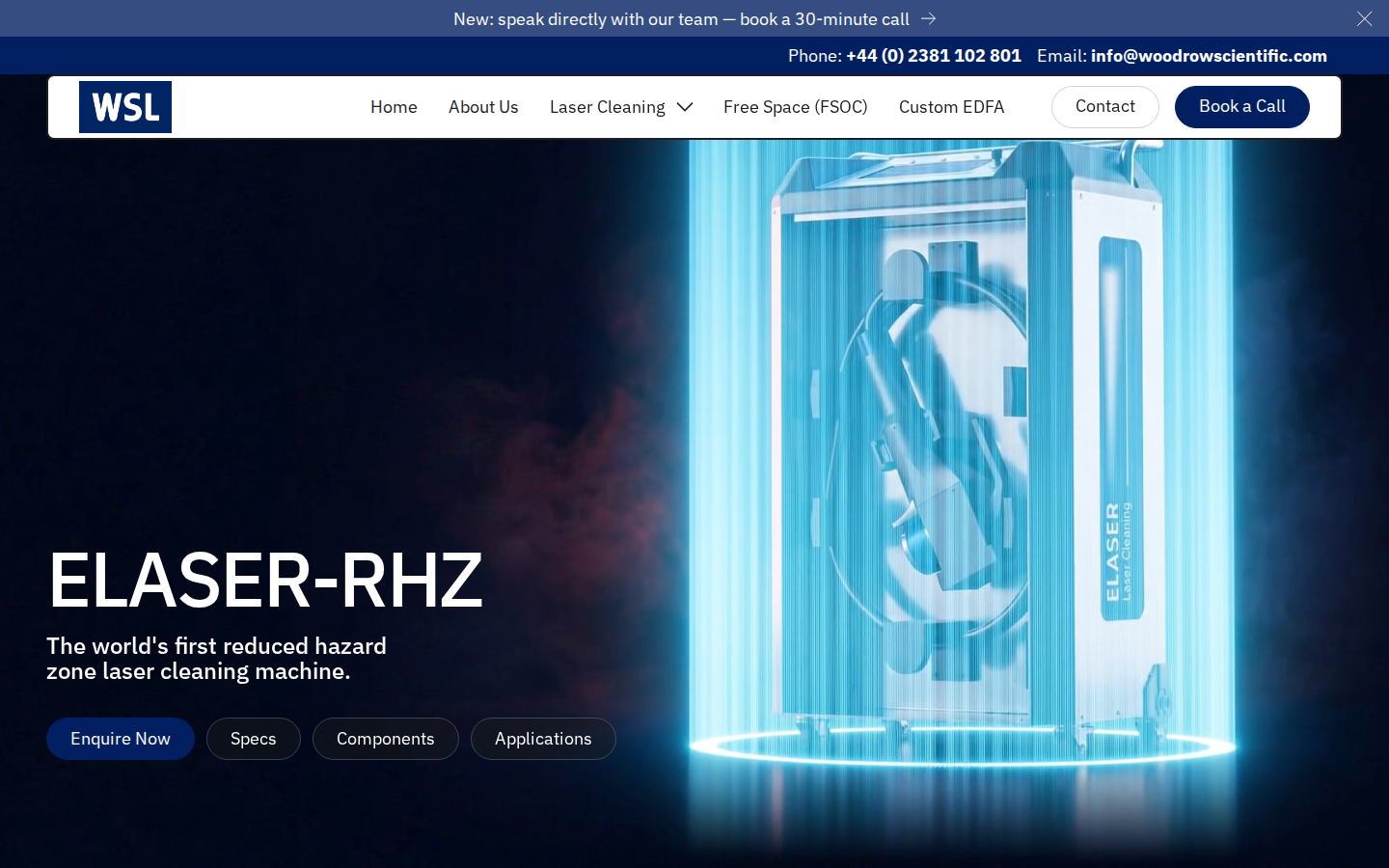
An industrial 100W fibre laser cleaning system from the only UK-based laser cleaning manufacturer, featuring world-first patented eye-safe (RHZ) technology that enables cleaning in open workshops and public spaces.
Pros:

World-first patented eye-safe reduced hazard zone
50 m cable reach — far beyond competitors
Only UK-based laser cleaning manufacturer
CE and UKCA certified for EU and GB
Cons:

Quote-only pricing — no published list price
Custom builds extend the standard one-week lead time
The ELASER is an industrial fibre laser cleaning system designed, built, and supported entirely in-house by Woodrow Scientific Limited — the only UK-based laser cleaning manufacturer, founded in 2012 with over 200 years of combined engineering experience across its team.
This entry focuses on the 100W model, which sits at the entry point of the ELASER range; 200W and 300W models are also available for operations with higher throughput demands.
Laser Technology and Cleaning Performance
The ELASER operates at 1550 nm wavelength — a retina-safe wavelength that underpins the RHZ variant's reduced-hazard-zone capability — with power tunable across the full 0–100% range.
Pulse energy reaches up to 15 mJ at a pulse duration of 100 ns, with pulse repetition rate adjustable up to 200 kHz, giving operators precise control over energy delivery across different contaminant types and substrate sensitivities.
A 2-D galvanometer scanner runs at up to 10 m/s, with fully programmable scan shapes set through the touchscreen GUI. Interchangeable F-Theta lenses cover a working distance of 75–500 mm, adapting the beam to different access geometries and surface areas.
In practice, that tunability means one machine handles everything from light surface oxides and weld discolouration through to thick paint, powder coating, and mill scale — across metals, stone, concrete, brick, and masonry.
Form Factor, Portability, and Reach
The ELASER ships as a wheeled trolley unit with the complete system weighing under 50 kg. The fibre-fed handheld scanner weighs under 3 kg, making single-operator deployment practical across large or awkward workspaces without fatigue.
The delivery cable extends to a maximum of 50 metres — with 5 m and 15 m lengths available as standard. That reach is a significant operational advantage: most competitors on this list top out at 5–10 m, which limits how far the unit can be positioned from the work area.
No compressor, no water supply, and no consumables are required — the system is genuinely self-contained from the moment it arrives on site.
Cooling is air-cooled, meaning no chiller unit, no coolant circuit, and no plumbing infrastructure to arrange before work can begin.
ELASER-RHZ: Cleaning Without Clearing the Area
The ELASER-RHZ is the eye-safe variant of the same machine, enabled by WSL's patented reduced-hazard-zone technology — a world first with no equivalent among any other laser cleaning system currently available.
Conventional laser cleaning requires the surrounding area to be sealed off and personnel evacuated before work starts. In busy manufacturing facilities, shared workshops, or public-facing environments, that safety overhead has historically made laser cleaning impractical or operationally disruptive.
WSL's patented technology collapses the laser hazard zone to a fraction of its conventional size. Cleaning can proceed in open-plan manufacturing facilities, mixed-use workshops, and publicly accessible spaces — graffiti removal on street infrastructure, heritage restoration on monuments — without evacuating the surrounding area or sealing off a zone. It is the single biggest operational barrier to laser cleaning, removed.
The ELASER-RHZ achieves a Class I laser classification through this technology, compared to the standard ELASER's Class IV — a distinction that directly determines what access controls and exclusion zones a site must maintain during operation.
For operators considering graffiti removal contracts, heritage restoration work, or cleaning in shared production facilities, the RHZ variant removes a constraint that no other machine on this list addresses.
After-Sales Support and Manufacturer Depth
WSL designs, builds, services, and continuously improves the ELASER entirely in-house. In a market where a significant proportion of laser cleaning suppliers are resellers or importers rebadging third-party machines, that distinction matters for capital equipment buyers: in-house manufacturing means genuine engineering expertise, faster access to spares, and a supplier that can actually modify or improve the product.
Manufacturer-delivered safety and operation training is available — get in touch with WSL for details on format and scheduling.
Bespoke engineering and customisation is available for specific applications and integration requirements. The ELASER ships worldwide, with a standard lead time of approximately one week from order.
ELASER Specifications at a Glance
| Specification | ELASER (100W) |
|---|---|
| Wavelength | 1550 nm |
| Power tunability | 0–100% |
| Pulse energy | Up to 15 mJ |
| Pulse duration | 100 ns |
| Pulse repetition rate | Up to 200 kHz |
| Scan speed | Up to 10 m/s |
| Working distance (F-Theta lenses) | 75–500 mm |
| Scanner weight | Under 3 kg |
| System weight | Under 50 kg |
| Delivery cable | Up to 50 m (5 m / 15 m standard) |
| Cooling | Air-cooled |
| Power supply | 110–250 VAC single-phase |
| Laser class | Class IV (standard) / Class I (RHZ) |
| Certifications | CE and UKCA |
A spec summary table gives procurement buyers a fast, scannable reference point for the ELASER's key technical parameters — supporting comparison against the competitor entries that follow.
WSL also offers automated laser cleaning systems for production-line environments — contact WSL directly for details if a robotic or integrated solution is relevant to your application.
Pricing and Total Cost of Ownership
The ELASER is priced on a contact-for-quote basis. Among comparable industrial laser cleaning machines from European manufacturers, it is the most competitively priced option — a position WSL achieves through its own technological and operational efficiencies rather than compromises on specification or build quality.
When evaluating total cost of ownership, the ELASER's zero-consumables operation, minimal downtime profile, and low rework rate (a consequence of precise, substrate-safe cleaning) contribute meaningfully to the financial case over the machine's working life.
Applications
The ELASER is deployed across injection moulding and tooling, automotive, industrial maintenance, tyre and rubber, aerospace, and heritage and restoration — as well as by operators running laser cleaning as a service business.
- Injection moulding and tooling: Strip release agents, residue, and build-up from moulds and tooling in place, without disassembly.
- Automotive: Pre-weld surface preparation, rust removal, and paint stripping across bodyshop and production line environments.
- Aerospace: Precise surface preparation and component cleaning to tight tolerances.
- Heritage and restoration: Lift soiling, paint, and corrosion from stone, metal, and masonry with minimal substrate impact — including in publicly accessible locations using the ELASER-RHZ.
- Laser cleaning service businesses: A portable system with full manufacturer training for operators building a cleaning service offering.
Contaminants removed include rust, mill scale, paint, powder coating, oil and grease, carbon and soot, mould, graffiti, weld discolouration, adhesives, tarnish, and release agents, across metal substrates (steel, aluminium alloys, copper, brass, bronze, titanium, cast iron, galvanised) and non-metallic surfaces including stone, concrete, brick, and masonry.
On trade-offs: pricing is available on request only, with no published list price — buyers will need to engage WSL directly for a quote. Customised builds extend beyond the standard one-week lead time, so factor that into project planning if bespoke engineering is required.
See the Full ELASER Specifications
The ELASER is the only UK-built 100W laser cleaning machine with patented eye-safe technology. View the full product page or download the datasheet to compare specifications directly.
Product 2
P-Laser QF-Compact 100W
Belgian-made compact pulsed portable laser cleaner from an established manufacturer. 13 kg, air-cooled, 10-second startup, CleanSweep programmable software, standard Q-switched fibre architecture (not MOPA).
Pros:
Compact and lightweight at just 13 kg
Air-cooled with fast 10-second startup
CleanSweep software: 8 custom cleaning programmes
Established Belgian manufacturer, 100% own technology
Cons:
Q-switched architecture, not MOPA — less pulse flexibility
Fibre cable reach shorter than ELASER's 50 m
No reduced-hazard-zone capability
P-Laser is a Belgian manufacturer based in Heusden-Zolder that develops and produces its own pulsed industrial laser cleaning systems entirely in-house, backed by 8 patents covering its proprietary technology.
The QF-Compact 100W (QFC-100) was one of the first compact air-cooled designs in the P-Laser family, and it opened up a category of portable laser cleaning that was previously constrained by heavy trolleys and bulky cabinets.
P-Laser QF-Compact 100W Laser Technology
The QFC-100 uses a standard Q-switched pulsed fibre laser at 1064 nm — a proven, infrared architecture with high peak power that handles straightforward cleaning applications reliably.
It is not a MOPA architecture. As covered in the buying guide section of this page, MOPA offers finer pulse-width control, which matters for sensitive substrates or applications requiring precise energy management. The Q-switched design is well-suited to rust, oxide, and paint removal on robust surfaces, but buyers with demanding or substrate-sensitive requirements should weigh that distinction.
Cleaning parameter management is handled through CleanSweep, P-Laser's proprietary dedicated software. Up to 8 custom cleaning programmes can be created and uploaded to the machine, selectable via the rotary touch encoder on the unit itself — no laptop required at the point of use.
- 8 custom job slots: Create and store up to 8 cleaning programmes via CleanSweep, each tailored to a specific application or contamination type.
- Wireless connectivity: A tablet with Wi-Fi connectivity is included, allowing programme editing and upload without cables.
- Rotary touch encoder: On-unit job selection via an interactive encoder — operators switch between programmes directly on the machine.
- 40,000+ hour source lifespan: P-Laser states the fibre laser source exceeds 40,000 hours without requiring service, keeping long-term maintenance costs low.
P-Laser also offers the LPC-100 Laserpack within its portable range — a 100W pulsed air-cooled system worn as a backpack, rated IP64 splash-waterproof and designed for maritime and heavy-duty outdoor environments where the operator needs full mobility. It shares the same core functionality as the QFC-100 but in a more ruggedised, wearable casing. It is a separate product, not a configuration of the QFC-100.
Form Factor and Portability
At 13 kg and 485 × 225 × 330 mm with a built-in carrying handle, the QFC-100 is a genuinely portable machine — easy to carry between work areas, position in confined spaces, and deploy without infrastructure setup.
The handheld optic uses a 2D scanner, giving the operator good control over beam coverage during cleaning passes.
| Specification | QFC-100 Value |
|---|---|
| Laser power | 100 W |
| Weight | 13 kg |
| Dimensions (mm) | 485 × 225 × 330 |
| Wavelength | 1064 nm (Q-switched pulsed fibre) |
| Cooling | Internal air-cooled — no water or chiller required |
| Startup time | ~10 seconds |
| Custom programmes | 8 (via CleanSweep software) |
| Source lifespan | 40,000+ hours |
Summarises the QFC-100's verified key specifications in a scannable format, allowing buyers to compare against other entries on this page at a glance.
On reach, the QFC-100's standard fibre cable configuration is shorter than the ELASER's 50 m delivery cable. P-Laser's product page does not publish the exact cable length in its accessible content, so a precise figure cannot be confirmed here — buyers should request this specification directly from P-Laser or their distributor when evaluating for applications where reach is a constraint.
The air-cooled system requires no water supply or external chiller, and the ~10-second startup cycle means the machine is operational almost immediately after power-on — a practical advantage in field or maintenance environments where setup time matters.
Like most 100W portable machines in this category, the QFC-100 does not carry reduced-hazard-zone capability. Cleaning operations require a controlled access area and appropriate PPE in line with standard laser safety protocols. This is not a characteristic unique to the QFC-100; it applies to the majority of machines on this list.
P-Laser QF-Compact 100W Pricing
P-Laser's own FAQ states that low-power machines start from €60,000. This is a category-level anchor, not a configuration-specific quote — actual pricing for the QFC-100 is handled through P-Laser's distributor network and varies by region and specification.
P-Laser notes that CleanSweep carries a yearly software fee, which buyers should factor into total cost of ownership alongside the capital purchase price.
For UK and GB market buyers: P-Laser is a Belgian manufacturer and prices in each country are managed by its distributors. Buyers should contact P-Laser directly to confirm the current UK distributor and local support route before committing to a procurement decision.
Product 3
Netalux Needle 100W
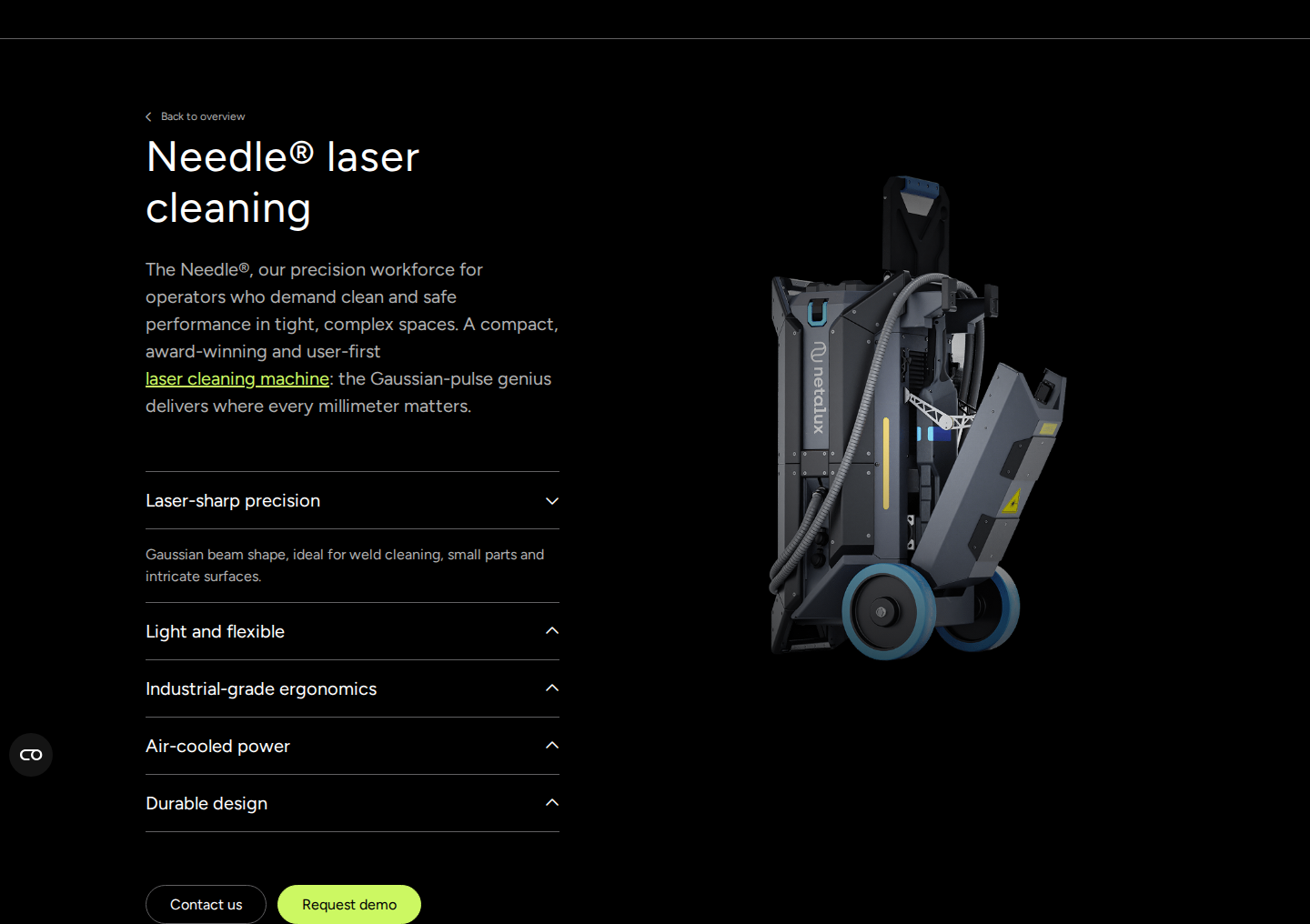
Compact Belgian-made handheld laser cleaner from ISO 9001 certified Netalux. Red Dot Award-recognised design, IP54 rated, and built specifically for precision cleaning in confined spaces and hard-to-reach locations.
Pros:
Extremely compact: ~20 kg total, 2.3 kg handset
115° rotatable head with integrated LED lighting
Red Dot Award winner (2020); same platform design
IP54 rated; CE, CSA, UL, IEC 60825-1 compliant
Cons:
4.5 m fibre cable severely limits on-site reach
Gaussian beam less suited to large-area cleaning
Standard pulsed architecture — not MOPA
Netalux was founded in Belgium in 2017, initially as a laser cleaning contractor before pivoting to manufacture its own machines — a background that directly shaped the Needle's design priorities: low weight, ergonomic control, and usability in demanding site conditions.
The original Needle won the Red Dot Award for Product Design in 2020, and the Needle 200/300W took the same award again in 2023 — the third Red Dot for the Netalux range in as many years, following a 2022 win for the Jango. The 100W model shares the same platform and design philosophy as those award-winning variants.
Laser Technology
The Needle 100W uses a nanosecond pulsed ytterbium fibre laser at 1064 nm — standard pulsed architecture, not MOPA. Pulse frequency spans 10–500 kHz, with a maximum pulse energy of 1 mJ and a 150 ns pulse length.
The beam profile is Gaussian: energy is concentrated at the centre of the beam spot, which makes it well suited to precise cleaning of small surfaces and intricate geometry. That same concentration makes it a less efficient choice for large, flat areas where a flat-top or top-hat beam profile would cover more surface per pass.
Form Factor and Ergonomics
This is where the Needle 100W stands out most clearly in this comparison. The laser unit weighs approximately 17 kg, with the total system coming in at around 20 kg — and the handset itself is just 2.3 kg.
| Specification | Netalux Needle 100W |
|---|---|
| Laser type | Nanosecond pulsed ytterbium fibre (standard pulsed) |
| Wavelength | 1064 nm |
| Beam profile | Gaussian |
| Pulse frequency | 10–500 kHz |
| Max pulse energy | 1 mJ |
| Pulse length | 150 ns |
| Laser class | Class 4 |
| Unit weight | ~17 kg (laser unit); ~20 kg total |
| Handset weight | 2.3 kg |
| Dimensions (unit) | 333 × 244 × 498 mm |
| Fibre cable length | 4.5 m |
| Cooling | Air-cooled |
| IP rating | IP54 |
| Certifications | CE, CSA, UL, IEC 60825-1, ISO 9001 |
Summarises the Needle 100W's key physical and laser specifications in one place, enabling readers to compare against other entries in this listicle without re-reading prose.
The laser head rotates through 115° and integrates both LED lighting and handset controls directly on the gun — a thoughtful detail for operators working in awkward or confined positions where repositioning the unit is not practical.
The unit's dimensions (333 × 244 × 498 mm) and IP54 enclosure make it genuinely suited to environments with dust, light splash, or atmospheric contamination, and Netalux's own positioning is explicit: the Needle 100W was designed for hard-to-reach locations and confined workspaces.
Cooling and Power
The Needle 100W is air-cooled, requiring no chiller unit, coolant circuit, or water supply. It runs from a standard single-phase supply (110–240 V, 50–60 Hz), drawing 450 W at the 100W output level.
Safety Compliance
The Needle 100W is a Class 4 laser product, conforming to IEC 60825-1. Netalux holds ISO 9001 certification and the product carries CE, CSA, and UL compliance — the company also states it participates in ISO committee work on laser standards.
Standard Class 4 laser safety protocols apply during operation, including appropriate PPE, controlled access zones, and trained operators.
After-Sales Support
Netalux operates as the manufacturer with in-house engineering and support, not as a reseller. The unit ships with five integrated lenses included. Netalux also runs a Netalux Academy for customer training, and the company states it provides remote troubleshooting and hands-on guidance globally.
Named regional contacts are listed for Belgium/Luxembourg, France, Italy, and Germany. No dedicated UK or GB distributor is listed on Netalux's published contact information.
Netalux Needle 100W Pricing
Netalux does not publish list pricing for the Needle 100W on its website. Pricing is available on application directly from Netalux or through their regional contacts.
Key Trade-Offs to Consider
The most significant operational constraint is the 4.5 m fibre cable. This limits how far the operator can work from the unit — on larger structures, vehicles, or sites where the machine cannot be positioned close to the cleaning surface, 4.5 m of reach is a meaningful restriction. For context, the ELASER's delivery cable reaches up to 50 m.
The Gaussian beam profile is a genuine strength for precision work on small or intricate surfaces, but buyers with large-area cleaning requirements will find it less efficient than machines using a flat-top beam.
The Needle 100W is the entry-level model in the range; 200W and 300W variants are available for buyers who need more power, though those models carry greater weight and a longer (5.7 m) but still relatively short fibre cable.
Product 4
4JET JETLASER M100
German-made compact handheld entry-level pulsed fibre laser cleaner from 4JET Technologies GmbH. Explicitly positioned as a low-cost solution with operating costs under €1/hour and leasing below €1,500/month.
Pros:
Operating costs under €1/hour; leasing below €1,500/month
CE certified to EU Machinery Directive
Credible German manufacturer with dedicated regional support
Broad application range: rust, paint, mould, facades
Cons:
Entry-level — not suited to continuous production use
5 m fibre cable limits on-site reach significantly
No reduced-hazard-zone capability — standard Class 4 controls
The JETLASER M100 is a compact handheld laser cleaning system from 4JET Technologies GmbH, a German laser technology manufacturer that develops and produces its own laser systems rather than reselling third-party equipment.
The broader JETLASER range spans 100W to 2kW and can be configured for robot or cobot integration, but the M100 is the manual handheld variant at the entry-level of that family.
The system is powered by a fibre-coupled, maintenance-free solid-state pulsed laser and is optimised for manual handheld use. Operation is via a touch PC interface with a variety of cleaning programmes, and the symmetrical handpiece design supports two-handed ergonomic control.
Applying the evaluation framework used across this comparison: the M100 covers laser technology, form factor, safety compliance, support, and pricing — though several hard specifications require specific note on what the source material confirms and what it does not.
| Specification | Detail |
|---|---|
| Laser type | Pulsed fibre-coupled solid-state laser |
| Fibre cable length | 5 m |
| Power supply | 110/220V mains |
| Laser safety class | Class 4 |
| CE certification | Yes — Machinery Directive EC2006/42/EG |
Consolidates the confirmed M100 specifications into a scannable reference, clearly marking where figures are confirmed from 4JET's authoritative sources and where they are unconfirmed, so the reader can compare accurately with other entries.
The M100's 5 m fibre cable is confirmed from 4JET's own milestones page, which records the system's July 2021 launch and specifically notes its mobile, flexible design at the point of use.
Applications confirmed by 4JET include rust removal, degreasing, paint stripping, mould and tool cleaning, facade cleaning, surface preparation for welding, and preparation for non-destructive testing. The process is dry, quiet, dust-free, and requires no consumables or chemicals.
On safety, the JETLASER range carries CE certification to the EU Machinery Directive (EC2006/42/EG) and is designated Class 4 — a standard industrial laser safety classification requiring a laser-secured area for operation. There is no reduced-hazard-zone capability.
For UK and Ireland buyers, TLM Laser (based in Bromsgrove) is confirmed as 4JET's authorised distribution and service partner, providing regional sales and technical support for the JETLASER range.
JETLASER M100 Pricing
The M100's most distinctive characteristic on this list is its explicit low-cost market positioning. 4JET states operating costs of approximately 50 cents per hour, with monthly financing or leasing charges below €1,500.
4JET also notes that the system's price point is broadly comparable to professional blasting or dry-ice systems, while being largely maintenance-free and requiring no consumables. Upfront purchase pricing is not publicly listed; it is available on request from 4JET or TLM Laser.
4JET's own positioning frames the M100 as a low-cost solution for industry and trade — not a continuous-production system. Its operating costs under €1/hour and leasing below €1,500/month represent the lowest-barrier entry point on this list, but buyers with high-duty-cycle or extended-reach requirements should weigh that against its 5 m cable and entry-level specification.
The M100's 5 m fibre cable is a practical constraint worth noting plainly: it limits how far the operator can work from the supply unit on large structures or in complex site layouts.
4JET's materials also cite good energy efficiency and a low CO₂ footprint, noting the system may qualify for government funding projects where energy-intensive conventional cleaning processes are being replaced.
Product 5
Narran ROD 100W
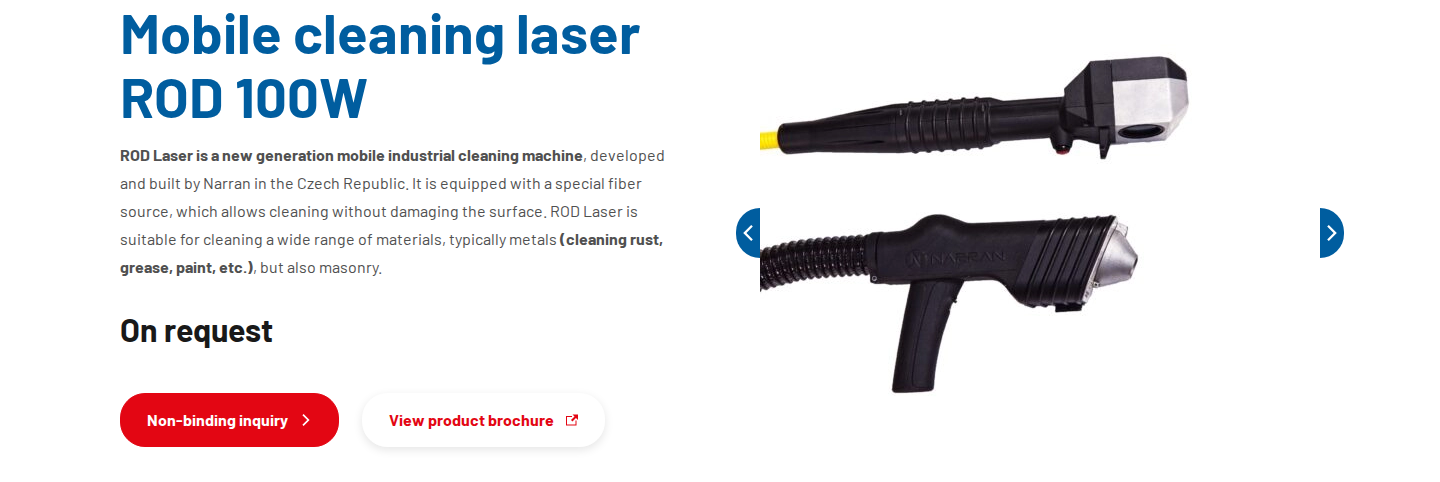
Czech-made wheeled trolley laser cleaner from direct manufacturer Narran (founded 2013). 100W pulsed fibre, air-cooled, suited to metals and masonry. Standard pulsed architecture, not MOPA. Pricing on application.
Pros:
Direct manufacturer with decade-plus track record
Four selectable pulse durations for operational flexibility
Process head compatible with manual and robotic use
Diode lifetime rated over 100,000 hours
Cons:
5 m fibre cable severely limits on-site reach
39 kg — heavier than most compact competitors
Standard pulsed fibre, not MOPA — less flexibility
Central European base; no UK distributor listed
The Narran ROD 100W is a mobile industrial laser cleaning machine developed and built by Narran in the Czech Republic — a direct manufacturer, not a reseller, that has been designing and producing its own laser systems since 2013.
Narran is headquartered in Brno, with an additional branch in Prague. The ROD 100W is designed for cleaning metals (rust, grease, and paint removal) as well as masonry, and the scanning head can be mounted in industrial lines or operated manually in the field.
Laser Technology and Specifications
The ROD 100W uses a pulsed fibre laser at 1064 nm, delivering 100W average output power. It is a standard pulsed fibre architecture — not MOPA — which limits pulse flexibility compared to MOPA systems when working with sensitive substrates.
One genuine strength on the technology axis is the four selectable pulse durations: 30, 60, 100, and 250 ns, with corresponding pulse energies of 0.31, 0.55, 0.91, and 1.54 mJ. This gives the operator meaningful granularity over cleaning intensity without requiring a MOPA source.
Beam scanning is 2D, with a working distance range of 100–400 mm. Diode lifetime is rated at over 100,000 hours — a published figure that speaks to long-term reliability.
| Specification | Narran ROD 100W |
|---|---|
| Wavelength | 1064 nm |
| Average output power | 100 W |
| Pulse durations | 30, 60, 100, 250 ns |
| Pulse energy | 0.31, 0.55, 0.91, 1.54 mJ |
| Beam scanning | 2D |
| Optical fibre length | 5 m |
| System weight | 39 kg |
| Process head weight | 2.35 kg |
| Dimensions | 53 x 66 x 55 cm |
| Power supply | 110/230V, 50/60Hz |
| Cooling | Air (integrated) |
| Laser safety class | 4 |
Consolidates the key published specifications from Narran's product page into a scannable reference, allowing readers to compare the ROD 100W against other entries on the page without re-reading prose.
Form Factor and Portability
The ROD 100W is a wheeled trolley unit — a different form factor from the compact handhelds and backpack-style machines elsewhere on this list. At 39 kg, it is considerably heavier than the Netalux Needle (~20 kg) and in a different category entirely from the handheld 4JET M100.
The most operationally significant constraint is the 5 m optical fibre cable. This limits how far the process head can reach from the machine body, which directly restricts where the trolley can be positioned on site. By comparison, the ELASER's 50 m cable reach means the laser unit can remain stationary while the operator works across a much larger area — a practical gap that matters on large structures or complex sites.
The process head weighs 2.35 kg and is confirmed as suitable for both manual operation and robotic or inline integration, which is a genuine versatility point for buyers considering automated production environments.
Power supply is standard 110/230V single-phase, so no specialist electrical installation is required. Cooling is integrated air cooling — no external chiller or coolant circuit needed.
Safety and Certification
The ROD 100W is rated laser safety class 4. Narran states that the company holds CE, FDA and RoHS certificates.
Narran ROD 100W Pricing
No list pricing is published by Narran for the ROD 100W. Pricing is available on application directly from Narran.
Narran is primarily a Central European manufacturer. UK and international buyers should confirm market availability and the applicable support route with Narran directly before proceeding — this cannot be confirmed from Narran's published sources.
Every other aspect of the ROD 100W — the selectable pulse durations, robotic head compatibility, air cooling, direct manufacturer provenance — is a reasonable match for an industrial 100W machine. The 5 m fibre cable is the single factor that most limits where and how this machine can be deployed on site. Buyers evaluating it for large-structure or multi-location work should weigh this carefully against machines with significantly longer cable reach.
Ready to Discuss Your Laser Cleaning Requirements?
You have compared the field. If you want to talk through which 100W laser cleaning machine fits your operation, our experts are available for a 30-minute call.
Conclusion
Which 100W laser cleaning machine is right for you?
Across these five machines, the gaps that matter most in practice come down to three things: how far the cable reaches, whether the machine can operate in open environments without clearing the area, and who actually built it.
For buyers where all three of those axes are live requirements, the ELASER from Woodrow Scientific Limited is the clear choice — the only machine here with reduced-hazard-zone capability, the longest reach on the list, and a genuine UK manufacturer behind it.
Contact WSL directly to discuss your application or request a quote.
Frequently asked questions about 100W laser cleaning machines
The questions buyers most commonly ask when comparing 100W laser cleaning machines, answered directly.
More powerful than the number suggests. A 100W pulsed fibre laser delivers 100 watts of average power, but the energy is concentrated into extremely short nanosecond pulses — meaning peak power per pulse far exceeds the average, reaching levels that drive effective ablation of rust, paint, oxides, and coatings without transferring excessive heat to the underlying substrate. The 100W figure describes average output; the peak pulse power is what does the cleaning work. This distinction is why a 100W pulsed laser can remove stubborn surface contamination while leaving the base material intact. For the majority of industrial maintenance, restoration, and surface preparation tasks, 100W is genuinely capable — not a compromise. Higher wattage (200W and above) increases cleaning speed across large surface areas or particularly thick coatings, but 100W is not underpowered for most applications buyers in this category are running.
100W laser cleaning machines are capital equipment, and list prices are rarely published in this category — quote-based pricing is the market standard. For indicative context, P-Laser's own FAQ states that their low-power machines (including 100W models) start from €60,000. Most industrial-grade suppliers operate similarly. The ELASER from Woodrow Scientific Limited is competitively priced among comparable industrial laser cleaning machines — contact WSL directly for a quote. The more complete financial picture is total cost of ownership. Laser cleaning machines run with zero consumables, produce no waste media, and cause minimal substrate damage — which reduces rework. Those running-cost advantages compound over the machine's lifetime, making the TCO comparison considerably more favourable than the upfront figure alone implies.
Yes — and this is not an emerging or experimental technology. Laser cleaning is an established industrial process in production use across aerospace, automotive, heritage restoration, and manufacturing worldwide. The mechanism is laser ablation: the beam vaporises the surface contaminant layer — rust, oxides, paint, coatings, grease — while the underlying substrate reflects or absorbs at a different threshold, so the beam effectively stops at the base material. The result is precise, repeatable removal of the contaminant without damaging what is underneath. Compared to alternatives, laser cleaning is more substrate-safe than sandblasting, chemical-free unlike solvent stripping, and produces no waste media to dispose of. The technology has moved well past proof-of-concept; major industries rely on it for production-line surface preparation and precision cleaning tasks where conventional methods introduce too much risk of substrate damage or contamination.
The ELASER from Woodrow Scientific Limited is the standout choice, grounded in several concrete differentiators. First, it is the only laser cleaning machine in the world with patented reduced-hazard-zone (eye-safe) technology — WSL's innovation collapses the laser hazard zone to a fraction of conventional size, enabling cleaning in open workshops, mixed-use facilities, and public-facing settings without sealing off the area. No other machine on this page offers this. Second, the ELASER's delivery cable reaches up to 50 m — most competitors on this list top out at 5–10 m, which is a meaningful practical limitation on larger sites or complex installations. Third, it holds both CE and UKCA certification, covering both EU and GB markets. Fourth, Woodrow Scientific Limited is the only UK-based laser cleaning manufacturer — it designs, builds, and supports every machine in-house, backed by over 200 years of combined engineering experience. That in-house capability translates directly into faster support, genuine product improvement, and no reliance on third-party supply chains. The ELASER is competitively priced among comparable industrial machines. Contact WSL to discuss your application and receive a quote.