
Introduction
If you have reached the 1000W pulsed tier, you are not browsing — you are making a serious capital decision about a machine built for demanding industrial throughput.
It is worth noting upfront that pulsed and continuous-wave (CW) systems can carry identical average wattage figures yet are fundamentally different tools, optimised for different work.
Every machine on this list is a verified 1000W pulsed fibre laser cleaning machine, with both specifications confirmed before inclusion.
Each entry is assessed across six axes: cleaning performance depth, portability and form factor, automation compatibility, safety credentials, manufacturer versus reseller status and after-sales support, and pricing structure — because machines sharing the same headline wattage differ considerably on every one of them.
TL;DR
At the 1000W pulsed tier, the headline wattage is simply the entry ticket. The machines here share that number — but diverge sharply on pulse energy, parameter range, form factor, support infrastructure, and safety architecture. Those differences are what this comparison surfaces, and they matter far more than the figure on the spec sheet.
This article covers:

What defines the 1000W pulsed tier
Pulsed vs. CW laser cleaning at 1000W
Six axes used to evaluate each machine
In-depth evaluation of three verified machines
Guidance on matching machine to application
What to Look for in a 1000W Laser Cleaner
Average power is the specification that gets quoted first and understood least. At the 1000W pulsed tier, every machine on the market shares the same headline figure — yet real-world cleaning performance varies considerably between them, driven by parameters that rarely appear in the top-line spec sheet.
Pulse energy (measured in millijoules), repetition rate (measured in kHz), scan speed, and power tunability are the variables that actually determine ablation performance. A machine with 1000W average power but limited pulse parameter control can underperform a well-matched system on precision or selective cleaning tasks, because peak power — not average power — is what drives material removal.
The relationship is direct: peak power equals pulse energy divided by pulse duration. A 1000W system running at 20 kHz with 50 ns pulses delivers very different peak irradiance than one running at 4000 kHz with 500 ns pulses, even though both report the same average power. Ask any supplier for the full pulse parameter specification, not just the wattage.
Pulse width — how long each individual pulse lasts — is the parameter that determines what that energy does to the surface. Shorter pulses in the 10–50 ns range confine energy tightly, reducing the heat-affected zone; this matters on sensitive alloys, thin coatings, or wherever surface metallurgy must not be altered. Longer pulses in the 100–200 ns range increase ablation depth per shot, which can improve efficiency on thick rust or heavy epoxy where substrate heating is less of a concern.
At 1000W, every machine shares the same headline figure. Pulse energy, repetition rate, pulse width range, and parameter tunability are what separate a precision tool from a blunt one — ask for all four before comparing quotes.
Portability and form factor affect daily usability more than most buyers anticipate. The relevant questions are: how heavy is the scan head, how long is the optical fibre cable, and how is the main cabinet configured?
- Scan head weight: Handheld and robot-mounted heads at this power class typically range from around 1.2 kg to 2.5 kg — meaningful over a full shift.
- Optical cable reach: 10 m is the common standard; longer cables (up to 100 m on some systems) allow the cabinet to stay stationary while the operator moves freely.
- Cabinet configuration: Trolley-mounted units suit site mobility; cabinet-based or rack systems suit fixed installations; robotic-mount heads require compatible end-effector brackets.
These factors directly affect single-operator usability and site mobility. A lighter head on a longer cable can be the deciding factor for confined-space or elevated work, regardless of the laser source specification.
Automation compatibility is a binary decision axis. Buyers deploying in automated production lines need I/O interfaces, fieldbus connectivity (Profinet and OPC UA are common protocols at this tier), and stable beam delivery with repeatable parameter recall. Those using the machine for handheld field maintenance have fundamentally different requirements. Clarify your deployment model before evaluating any machine, because a system optimised for one mode is rarely ideal for the other.
On safety: every industrial laser cleaning system at this power level is a Class 4 laser product under IEC 60825-1 and ANSI Z136.1. OSHA guidance confirms that Class 4 systems require a defined Nominal Hazard Zone, a controlled area with appropriate warning systems, and laser-rated eye protection — with optical density requirements specified for the 1064 nm wavelength these systems operate at. CE marking and relevant compliance documentation are baseline expectations for any industrial purchase.
The practical buyer implication is that safety infrastructure — controlled area setup, PPE, operator training, and fume extraction — represents real operational overhead that should be budgeted and planned before commissioning, not after. A qualified laser safety officer is the right resource for site-specific compliance guidance; the standards themselves set the framework, but implementation is site-dependent.
Finally, manufacturer versus reseller status matters more at this power class than at lower tiers, because the consequences of downtime are greater. Genuine manufacturers design, build, and support their own systems — they can resolve engineering-level faults in-house, supply proprietary spare parts, and back warranty claims with real technical authority. Resellers and importers who rebadge third-party machines cannot. Ask directly: does this supplier manufacture the system, or integrate third-party components?
Warranty scope deserves the same scrutiny. A laser source warranty (covering the fibre laser module) is not the same as a whole-machine warranty. Laser source brands such as IPG, JPT, and Raycus each carry different price points and support structures — and the warranty terms from the machine supplier may differ from those of the underlying source manufacturer. Confirm what is covered, for how long, and what the on-site service response time looks like for your region.
On pricing: a 1000W pulsed laser cleaning machine is a significant capital purchase, and the unit price is rarely the full number. Fume extraction, a water chiller, operator training, and commissioning are frequently quoted as line items rather than included — sometimes omitted entirely to keep the headline figure competitive. Request a quote that covers the full system scope before comparing suppliers.
With that framework in place, the three machines below can be evaluated on terms that actually matter — not just the wattage they share.
Option 1
LaserSan 1000 — 1000W Pulsed Laser Cleaning Machine
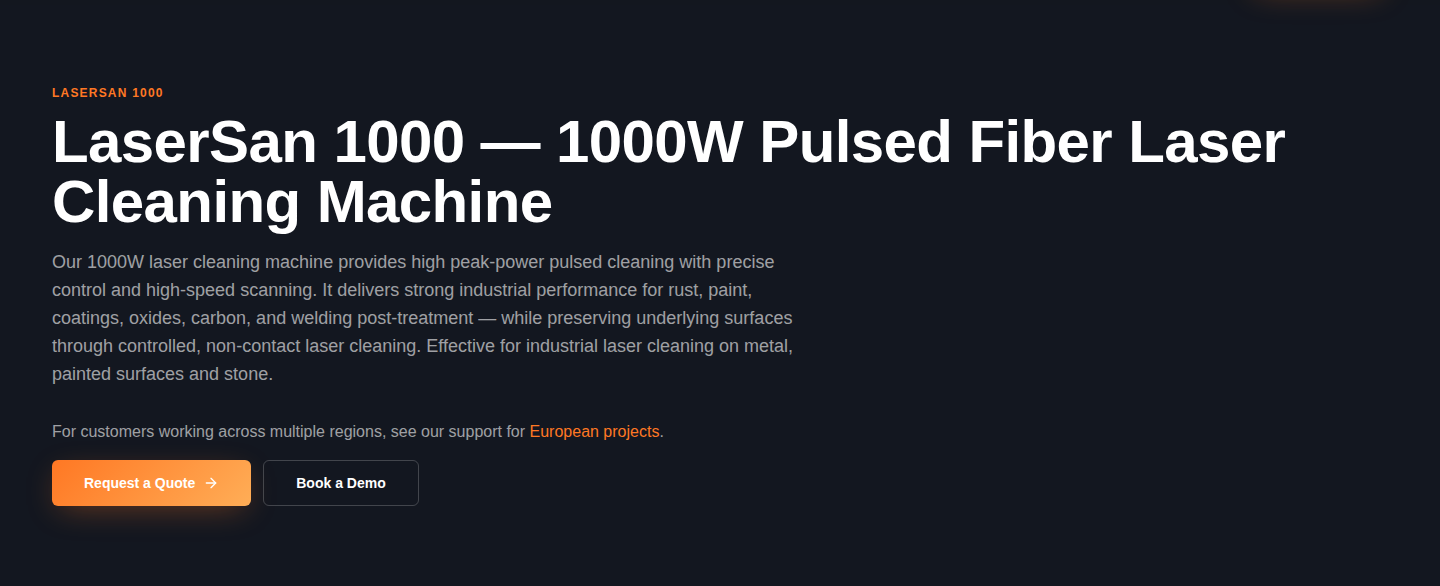
LaserSan 1000 is a 1000W water-cooled pulsed fiber laser cleaning machine from a Spain-based industrial specialist, with a 1.3 kg cleaning head and local on-site support across Spain and European projects.
Pros:

1.3 kg head — light for 1000W class
Wide pulse frequency: 20 kHz to 4,000 kHz
12 cleaning modes, 12 scanning patterns, 9 presets
CE marked, RoHS compliant, local EU support
Cons:

On-site support primarily within Spain
Pricing not publicly listed
150 kg system weight limits site mobility
The LaserSan 1000 is a 1000W water-cooled pulsed fiber laser cleaning machine, positioned by LaserSan as the entry-level machine in their water-cooled industrial range. LaserSan operates from Senija, Alicante, serving industrial customers across Spain and European projects.
Cleaning Performance
Average output power is 1000W (pulsed), delivered through a pulsed fiber laser source with water-cooled thermal management for sustained operation under heavy loads.
The pulse frequency is adjustable across a wide range — from 20 kHz up to 4,000 kHz — which is the parameter that determines how aggressively or selectively the laser interacts with a surface.
That breadth of range means the same machine can be dialled back for oxide removal on a sensitive alloy or pushed harder for heavy rust and thick industrial coatings, without swapping equipment.
| Specification | LaserSan 1000 |
|---|---|
| Average power | 1000W (pulsed) |
| Pulse frequency | 20 kHz – 4,000 kHz (adjustable) |
| Scan area (X/Y) | 5–114 mm / 5–114 mm (adjustable) |
| Cleaning modes | 12 modes, 12 scanning patterns, 9 presets |
| Optical cable length | 10 m |
| Cleaning head weight | 1.3 kg |
| System net weight | 150 kg |
| Cooling | Water-cooled |
| Certifications | CE, RoHS, EU Machinery Directive 2006/42/EC |
Key specifications for the LaserSan 1000.
The scan area runs from 5 mm to 114 mm on both axes, giving operators control over spot size for precision work on tight geometries as well as faster coverage on open surfaces.
Scanning patterns include linear, 2D, triangle, spiral, circular, rectangular, progressive, and rectangular ring — a breadth that matters when working across irregular components or mixed surface conditions.
Portability and Form Factor
The system ships as a trolley-format cabinet with a system net weight of 150 kg, placing it firmly in the workshop or fixed-installation category rather than portable field use.
Where the LaserSan 1000 stands apart at this power level is the cleaning head: at 1.3 kg, it is notably light for a 1000W pulsed system, reducing operator fatigue during extended handheld sessions.
The optical cable runs to 10 m, giving the operator a practical working radius from the cabinet without repositioning the unit between tasks.
Safety and Compliance
The LaserSan 1000 carries CE marking and RoHS compliance, and is built to the EU Machinery Directive 2006/42/EC. LaserSan is also an ECOTIC registered member.
Safety features documented on the product page include an emergency stop on both machine and head, an anti-high-reflection laser source, distance monitoring with automatic shut-off outside the defined working range, and laser goggles included as standard.
As a Class 4 laser system, standard controlled-area protocols and PPE requirements apply — this is consistent across all machines in this power class, not specific to this model.
After-Sales Support
LaserSan's support structure is built around its Spain base. Local teams operate in the Costa Blanca region (Alicante/Valencia), with on-site demos, installation, commissioning, and operator training available within that geography.
For European customers outside Spain, LaserSan offers machine supply with application-based onboarding, remote support, and spare parts coordination through EU supply chains. The service page notes a one-year machine warranty and two-year warranty on the laser source.
Before any machine is dispatched, LaserSan states it performs full testing, configures the system for the application, and completes all safety documentation — a meaningful step for buyers who need EU compliance paperwork in order.
LaserSan provides EU laser safety guidance, risk assessment support, and compliance documentation as part of its onboarding process — a practical advantage for European industrial buyers who need their laser installation to meet regulatory requirements from day one.
LaserSan 1000 Pricing
LaserSan does not publish list prices. Pricing is available on request via their contact and quote form.
When comparing options, it is worth factoring in the full scope of what the purchase includes: local warranty service, compliance documentation, application configuration, and onboarding support alongside the machine itself.
Option 2
P-Laser QF-1000
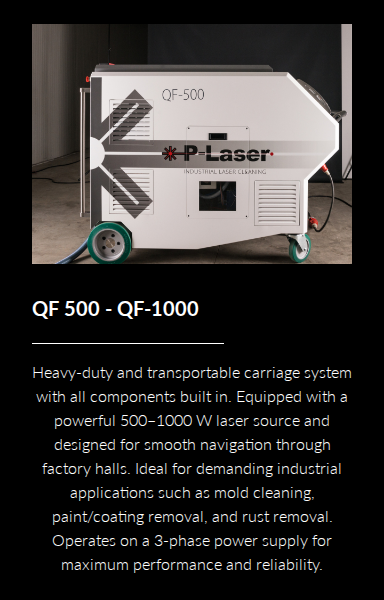
Belgian-manufactured 1000W pulsed water-cooled laser cleaner, built and engineered in-house by P-Laser with 35+ years of surface treatment expertise, proprietary CleanSweep software, and a global network of 42 partners.
Pros:
Genuine manufacturer — 100% proprietary in-house IP
Fiber cable reach: 16–50 m
Proprietary CleanSweep parameter-control software included
42 global partners; rental fleet available
Cons:
Premium European pricing; purchase price on request
Cabinet and trolley formats are large and heavy
The P-Laser QF-1000 is a 1000W pulsed water-cooled laser cleaning system engineered and manufactured at P-Laser's facility in Heusden-Zolder, Belgium, backed by proprietary CleanSweep software and a global partner network.
Cleaning Performance
At 1000W pulsed output with integrated water cooling, the QF-1000 maintains stable optical performance across sustained cleaning runs. P-Laser states that the QF-1000 and QF-500 operate at the same pulse power, but the QF-1000 delivers double the energy of the QF-500, resulting in double the surface cleaning speed.
The application range is broad: mould cleaning, paint and coating removal, rust removal, and other demanding industrial surface treatment tasks are all cited by P-Laser as target use cases.
Portability and Form Factor
The QF-1000 is available in two configurations: a fixed cabinet format and a wheeled trolley format, each suited to different deployment scenarios.
| Configuration | Dimensions (L × W × H) | Mobility |
|---|---|---|
| Cabinet | 103 cm × 80 cm × 121 cm | Fixed; can be integrated into production or assembly lines |
| Trolley | 182 cm × 77 cm × 140 cm | Wheeled with braking system; designed for movement through factory halls |
Key physical specifications for the two QF-1000 configurations, as published by P-Laser.
Both formats are larger than the most compact options at this power tier — an honest trade-off for the machine's industrial build quality and integrated cooling architecture.
Fibre cable options run from 16 m to 50 m, giving operators significantly greater reach than many alternatives at this power level. For context, the LaserSan 1000 covered earlier in this comparison ships with a 10 m cable — the QF-1000's cable range extends that reach by up to five times.
Automation Compatibility
P-Laser offers inline configurations across the QF-500/1000/2000W range, with the laser controlled via a 19-inch control unit suitable for integration into production or assembly lines. The machine optics can be mounted on a robot or external manipulator.
CleanSweep programmes stored on the control unit can be selected directly from the display by a robot or external customer device, with no PC required during automated operation.
Safety
Like all industrial laser cleaning systems at this power level, the QF-1000 is a Class 4 laser — standard PPE and controlled working area requirements apply. P-Laser's FAQ notes that laser radiation is hazardous to eyes and that appropriate laser safety glasses must be worn whenever the machine is active.
An integrated air treatment unit is built into the system to cool the optics and prevent dust accumulation on the lens — a design feature that supports reliable sustained operation in industrial environments.
Manufacturer Credentials
This is the axis where the QF-1000 carries the strongest credentials of the three machines on this list. P-Laser develops and manufactures all of its systems entirely in-house at its Heusden-Zolder, Belgium facility.
P-Laser's technology is backed by 8 patents and fully protected IP — buyers are purchasing from the original manufacturer, not a reseller or integrator. Over 35 years of surface treatment expertise and 450+ systems installed worldwide underpin the engineering.
For buyers who need engineering-level support, in-house fault resolution, and spare parts sourced directly from the manufacturer, P-Laser's status as the original equipment manufacturer is a meaningful differentiator. Warranty and support trace back to the entity that designed and built the machine.
P-Laser QF-1000 Support and Pricing
P-Laser operates through a network of 42 global partners, trained regularly in laser cleaning and supported in sales and marketing — ensuring local expertise is available in most major industrial markets.
- Free training included: P-Laser provides a full day of safety and operational training — covering laser safety, machine operation, and CleanSweep software — with every system purchase.
- Rental fleet available: P-Laser's published rental pricing for the QF-1000 is €2,100/day, €7,200/week, or €26,800/month, making short-term access viable for project-based or trial deployments.
- Pre-production testing: P-Laser offers process testing on a customer's own materials before purchase, with results and cleaning videos provided — reducing risk at the point of decision.
Purchase pricing for the QF-1000 is handled through P-Laser's distributor network and is available on request; P-Laser's FAQ notes that even its low-power machines start from €60,000, placing the QF-1000 firmly in the premium tier relative to Asian-manufactured alternatives at the same watt rating.
CleanSweep Software
CleanSweep is P-Laser's proprietary parameter-control software, used across its product range. It enables operators to create and store multiple cleaning programmes — controlling frequency, intensity, beam shape, and beam size — and to recall those jobs directly from the control unit's display.
In automated deployments, stored CleanSweep programmes can be selected by a robot or external device without a PC present, which simplifies integration into existing production workflows. There is an annual software licence fee, noted in P-Laser's FAQ.
Option 3
Laserax LXQ-UHP-1000
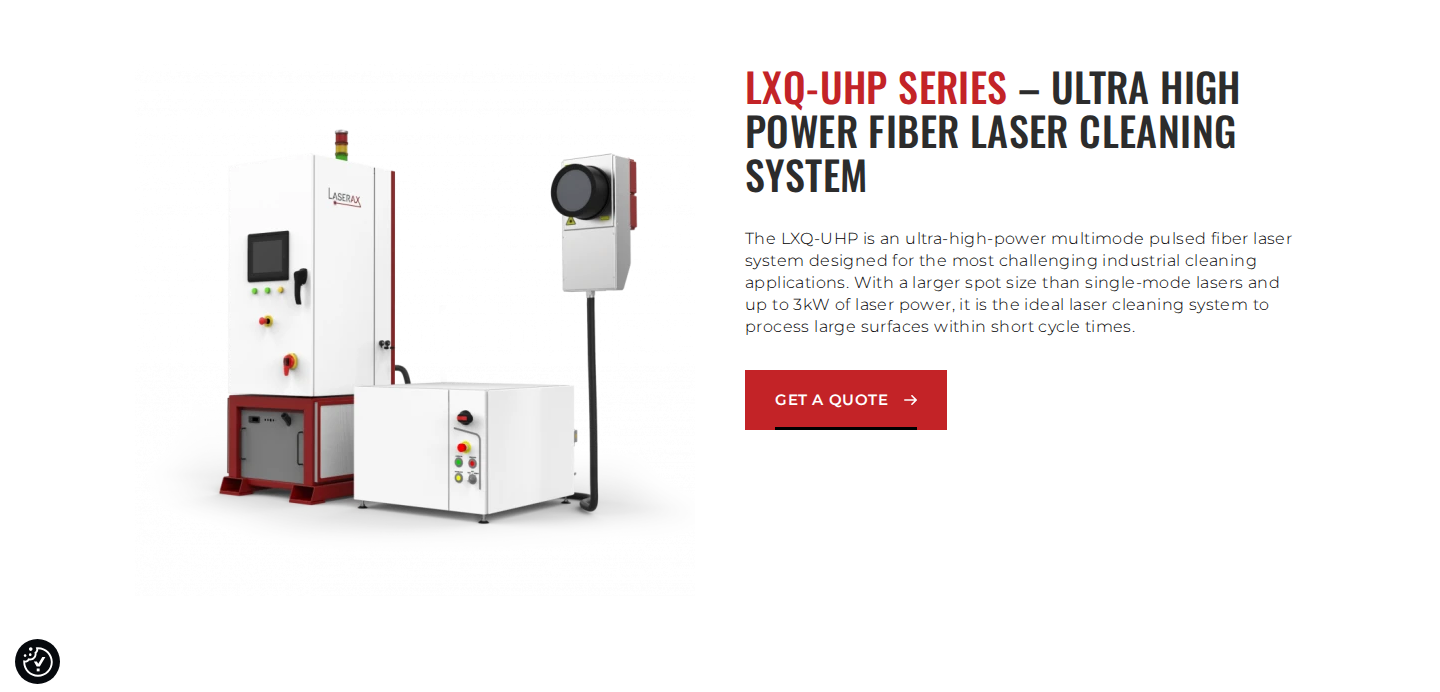
Canadian-manufactured 1000W multimode pulsed fiber laser system, built for high-throughput automated cleaning of large surfaces, with robot-arm integration and up to 100 m of fiber cable reach.
Pros:
Large spot size for faster broad-surface coverage
100 m fiber cable for large-structure reach
Turnkey integration from a single supplier
100,000-hour laser source MTBF
Cons:
Multimode beam cannot simultaneously texture surfaces
Configured for automated, not handheld, deployment
No published pricing; quote required
Cleaning Performance
The LXQ-UHP-1000 is a 1000W multimode pulsed ytterbium-doped fiber laser, operating at a wavelength of 1064 nm with a nominal pulse repetition rate of 10 kHz.
For the 1000W configuration, pulse energy runs from 25 to 100 mJ, with an adjustable pulse width of 25 ns to 100 ns — parameters confirmed in Laserax's published datasheet.
| Specification | LXQ-UHP-1000 |
|---|---|
| Nominal Output Power | 1 kW |
| Wavelength | 1064 nm |
| Pulse Repetition Rate | 10 kHz |
| Pulse Energy | 25–100 mJ |
| Pulse Width (adjustable) | 25–100 ns |
| Spot Size (typical) | 0.8–2 mm |
| Fiber Cable Length | 10 m included; 15–100 m available |
| Communications | Ethernet/IP, PROFINET, EtherCAT |
| Laser Source MTBF | 100,000 hours |
| Safety Class (source) | Class 4 (IEC 60825-1) |
Key published specifications for the Laserax LXQ-UHP-1000, drawn from Laserax's product page and datasheet.
The multimode beam architecture produces a larger spot size than single-mode systems — typically 0.8 to 2 mm — which allows the laser to cover broad surface areas within shorter cycle times.
That coverage advantage comes with one clear trade-off: because the multimode beam cannot achieve the high energy density per unit area that single-mode systems produce, it cannot simultaneously texture the metal surface. Applications requiring combined cleaning and surface texturing in a single pass need a single-mode system instead.
Industry benchmarks from third-party sources put cleaning rates for comparable pulsed laser sources in the range of 1–10 m²/hour on typical industrial contamination, with the rate varying significantly by contaminant type and layer thickness.
Form Factor and Robot Integration
The LXQ-UHP-1000 is not a trolley-format workshop machine. Its design is built around robot-arm or gantry mounting, with up to 100 m of fiber cable available — a reach that makes it practical for cleaning large structures such as fabricated assemblies, shipyard components, and aerospace parts.
The laser head can be positioned in any orientation, and Laserax states a depth of focus of up to 20 mm, which gives the system tolerance for curved or irregular part geometries without requiring constant head repositioning.
Buyers whose application requires handheld field deployment will find this configuration relevant to their evaluation: the LXQ-UHP-1000 is designed for automated cell integration rather than operator-held use.
Automation Integration
This is where the LXQ-UHP-1000 most clearly separates itself from the other machines in this comparison. Laserax offers complete robotic cell configurations built around the laser source, with support for robots from ABB, FANUC, KUKA, and others.
- Part loading options: Front door, inline conveyor, and rotary table configurations are all available, with additional options on request.
- Control architecture: Industrial PLC with Laserax LXQ Controller, and a web-based interface on the operator HMI — compatible with Allen-Bradley and Siemens quick-start programs.
- Fieldbus communications: Ethernet/IP, PROFINET, and EtherCAT are supported as standard, with other options available.
- Fume extraction: An extraction nozzle is mounted directly on the robot arm, capturing fumes and debris at the source rather than relying on ambient extraction.
The rotary table configuration is particularly suited to high-volume lines: parts can be loaded and unloaded on one side of the table while cleaning continues on the other, reducing cell cycle time.
The robotic cell ships pre-configured, pre-calibrated, and pre-tested for the specific application, with plug-and-play functions designed to reduce integration time on the production floor.
Laserax supplies automation, fume management, laser safety, on-site and remote support, performance optimisation, and laser process development as a unified package — removing the need to coordinate multiple vendors for a production-ready installation.
The laser source carries a published MTBF of 100,000 hours, and Laserax describes the system as capable of operating 24/7 in demanding industrial environments with minimal maintenance requirements.
Safety
The LXQ-UHP-1000 laser source is a Class 4 product under IEC 60825-1 (and equivalent CSA and 21 CFR standards), which means appropriate PPE and a controlled working area are required when the source operates outside an enclosed system.
When integrated into Laserax's robotic cell configuration, the system is housed in a Class 1 certified laser safety enclosure with interlocked doors — meaning operators can work at the cell boundary without laser PPE. This Class 1 classification applies to the robotic cell system as a whole, not to the standalone laser source.
Laserax LXQ-UHP-1000 Pricing
Laserax does not publish list prices for the LXQ-UHP-1000. Pricing is available on request, and the investment reflects the system's nature as a production-grade automated installation rather than a portable workshop tool.
For market context: third-party pricing data from riselaser.net puts fully automated robotic laser cleaning systems in the range of approximately $70,000–$200,000 or more, depending on laser power, robot specification, enclosure, and integration scope. Standalone 1000W pulsed systems without robotic integration are estimated at $20,000–$35,000 in the same source.
The footprint and procurement model of the LXQ-UHP-1000 are consistent with a capital production-line investment: buyers evaluating it are typically comparing it against the total cost of a turnkey automated cleaning cell, not against a portable handheld machine.
Conclusion
Making the Right Call at 1000W
Every machine on this list shares the same headline wattage — that number is where the comparison starts, not where it ends.
What actually separates them is form factor, deployment model, and support infrastructure: the axes that determine whether a machine fits your operation or fights it.
Before committing, the questions worth answering are practical ones: Is the work handheld and field-based, or fixed and automated? What does your geography demand from after-sales support?
Get those answers right, and the right machine becomes clear.
1000W Pulsed Laser Cleaning Machine FAQs
Common buyer questions about 1000W pulsed laser cleaning machines, covering pricing, technology comparisons, safety requirements, applications, and cooling.
A 1000W pulsed laser cleaning machine typically costs between $20,000 and $35,000 for a handheld or trolley-mounted system. P-Laser, a Belgian manufacturer, states that even its low-power machines start from €60,000 — a reference point for European-built pricing. Automated and robotic systems at 1000W carry substantially higher costs. Riselaser.net puts automated laser cleaning systems in the $70,000–$200,000+ range, reflecting the additional engineering, safety enclosures, and integration work involved. Laserax does not publish list prices for its automated systems; a direct quote is required. Several factors drive the spread within the handheld tier: the laser source brand (IPG, JPT, and Raycus each sit at different price points and carry different rated-hour guarantees), cooling system specification, scanning head quality, control software, supplier geography, and the support model offered. A full system quote should also account for the water chiller, fume extraction, and any safety infrastructure — these additions typically push the total installed cost 20–40% above the base unit price.
The defining difference is how energy reaches the surface. A pulsed laser delivers energy in nanosecond bursts with very high peak power and low average thermal load — the contaminant is ablated before heat conducts into the substrate. A CW (continuous wave) laser delivers sustained, uninterrupted energy at the same average wattage, creating a heat-affected zone that grows with dwell time. At 1000W average power, pulsed is better suited to selective cleaning, heat-sensitive substrates, thin materials, and applications where thermal damage to the base material must be avoided — such as post-weld oxide removal on stainless steel, mould cleaning, or surface preparation on precision fabrications. CW at 1000W is typically used for high-throughput rust removal and heavy coating stripping on robust structural steel where heat accumulation is not a concern. There is also a meaningful price difference. CW systems at 1000W are generally significantly cheaper to build than pulsed systems at equivalent average power, because pulsed architecture requires additional pulse-shaping electronics and tighter thermal management of the gain fibre. Buyers choosing between the two technologies should weigh substrate sensitivity and required cleaning precision alongside throughput requirements and budget.
All industrial laser cleaning machines at this power level are classified as Class 4 under IEC 60825-1 and ANSI Z136.1. Class 4 is the highest hazard category — the beam is dangerous to the eye and skin under any condition, including diffuse reflections, and poses a fire hazard. OSHA guidance and the ANSI Z136.1 standard set out the controls required for Class 4 operation. These include: appropriate laser protective eyewear (optical density adequate for the energy and wavelength involved, typically OD ≥5 at 1064 nm) for all personnel within the Nominal Hazard Zone (NHZ); a defined and controlled NHZ; audible and visual warning systems; a remote interlock connector; and HEPA-grade filtration on the fume extraction system to capture ablation by-products. A Laser Safety Officer (LSO) must be designated to oversee hazard evaluation and control. Automated systems housed in a certified laser safety enclosure with interlocked doors can achieve Class 1 classification, which eliminates open-beam operator hazards entirely during production. This approach substantially reduces the safety overhead for production environments. Laserax's robot cell configuration is a real-world example — a high-power Class 4 laser source enclosed within a Class 1 certified enclosure with interlocked doors. This overview covers the principal requirements; a qualified LSO should conduct a full hazard assessment for any specific installation. OSHA's laser hazards guidance and ANSI Z136.1 are the authoritative references.
The 1000W pulsed tier handles heavy rust and scale removal on structural steel, thick paint and coating stripping on fabricated assemblies, post-weld oxide and heat tint removal, mould cleaning, and surface preparation before welding or protective coating. It is well-established across automotive, aerospace, heavy manufacturing, and industrial maintenance applications. Cleaning rate depends heavily on contamination type, layer thickness, and scan parameters. On moderate mill scale and medium rust, a 1000W pulsed system can achieve area rates in the range of 10–20 m²/hour under optimised conditions; heavily corroded surfaces or thicker coatings will reduce that rate. Light rust cleans faster than heavy scale, and achieving a higher cleanliness grade (such as Sa 3 white metal) typically requires slower scan speeds or additional passes compared to Sa 2.5. At this power level, the machine is capable of handling both precision-sensitive work — where the pulsed delivery protects the substrate from heat accumulation — and higher-throughput production cleaning. Applications requiring true bulk throughput on very large steel structures (shipyard hull prep, large infrastructure rehabilitation) are typically better served by higher-power CW systems, where sustained energy delivery drives faster area coverage on thick, robust contamination.
Yes. At 1000W average power, water cooling is standard for sustained industrial operation. All three machines covered on this page — the LaserSan 1000, P-Laser QF-1000, and Laserax LXQ-UHP-1000 — are water-cooled systems. The thermal load from continuous operation at this power level requires active liquid cooling to maintain laser source stability and protect the optical components. Air-cooled laser cleaning systems are generally limited to lower average power levels. The thermal load at 1000W exceeds what passive or fan-assisted cooling can manage reliably across a sustained production shift. A correctly sized water chiller should be included in the full system quote from the outset. When reviewing a quotation, it is worth confirming that the chiller's rated cooling capacity matches the laser source's stated heat load — this is a practical question to raise with the supplier before purchase, as an undersized chiller will affect both laser stability and component longevity.